Category: News

Did DOJ Prosecutors Violate Trump’s Executive Order By Selling Forfeited Samourai Wallet Bitcoin?
Did DOJ Prosecutors Violate Trump’s Executive Order By Selling Forfeited Samourai Wallet Bitcoin?
Authored by Frank Corva via BitcoinMagazine.com,
It seems that the U.S. Marshall Service (USMS) has sold the $6.3 million worth of bitcoin that Samourai Wallet developers Keonne Rodriguez and William Lonergan Hill paid the U.S. Department of Justice (DOJ) as a fee that was part of their guilty plea.
In doing so, it has potentially violated Executive Order (EO) 14233, which mandates that bitcoin acquired via criminal or civil asset forfeiture proceedings should be held as part of the United States’ Strategy Bitcoin Reserve (SBR).
If the Southern District of New York (SDNY), the federal judicial district in which the Samourai case was to be tried, did, in fact, violate EO 14233, it would not be the first time employees of the SDNY have acted in defiance of direction from the federal government.
What Happened to the Bitcoin?
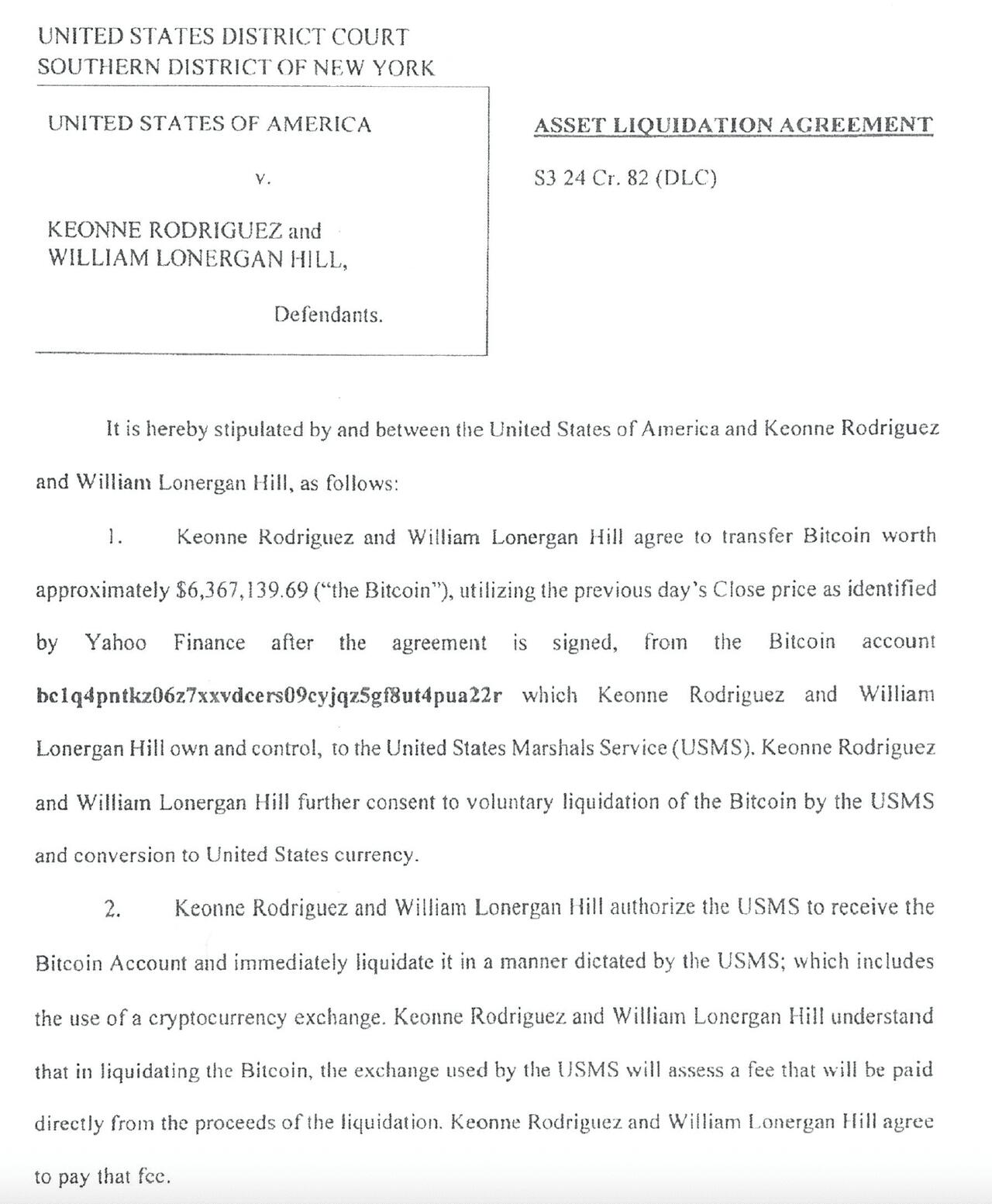
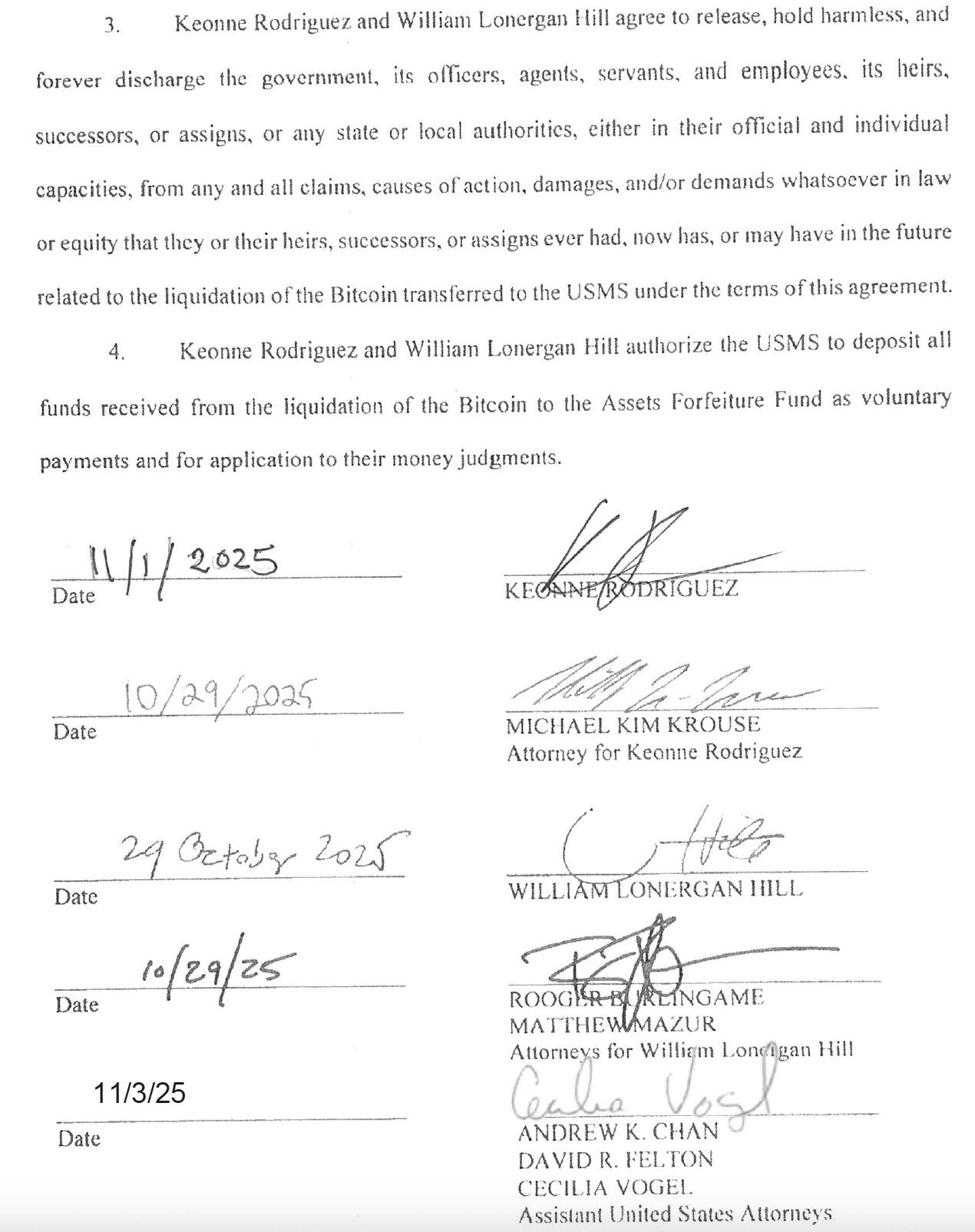
According to a document titled “Asset Liquidation Agreement”, which has been obtained exclusively by Bitcoin Magazine and has not until now been made public, the bitcoin that Rodriguez and Hill forfeited is to be sold — or already has been.
As per the document, the defendants agreed to transfer $6,367,139.69 worth of bitcoin — 57.55353033 bitcoin at the time the final party signed the agreement, which was Assistant United States Attorney Cecilia Vogelon November 3, 2025 — to the USMS.
The bitcoin, which was sent from address bc1q4pntkz06z7xxvdcers09cyjqz5gf8ut4pua22r on November 3, 2025, seems to have bypassed any direct custody by the USMS. Instead, it seems to have been sent directly to Coinbase Prime address 3Lz5ULL7nG7vv6nwc8kNnbjDmSnawKS3n8 (Arkham Intel attributes this address to the brokerage), presumably to be sold.
This Coinbase Prime address currently has a zero balance, indicating that the bitcoin may have already been sold.
Violating Executive Order 14233
If the USMS has sold the forfeited bitcoin, it likely contravened EO 14233, which orders that bitcoin acquired by the U.S. government via criminal forfeiture, termed “Government BTC” in the EO, “shall not be sold” and should be contributed into the U.S. SBR.
If the USMS sold the bitcoin, they did so at their own discretion and not as a legal mandate, which indicates that certain members of the DOJ may still view bitcoin as a taboo asset to be offloaded as opposed to a strategic asset that President Trump has directed government agencies to retain.
Given that the Samourai prosecution originated under the previous administration, which was notoriously hostile toward noncustodial crypto tools and their developers, the decision to ignore EO 14233 and sell the bitcoin despite a mandate from the executive branch fits a pattern of treating bitcoin as something that should be removed from government balance sheets as soon as possible.
Legal Details Regarding the Forfeiture and Liquidation
According to a legal source close to this matter, the Samourai developers’ forfeited their bitcoin under 18 U.S. Code § 982(a)(1), which stipulates that any offense that violates 18 U.S. Code § 1960, the statute that prohibits the operation of unlicensed money transmitting businesses, orders that person to forfeit to the United States any property involved in the offense.
Judging by § 982 and its incorporation of 21 U.S.C. § 853(c), a criminal forfeiture statute that stipulates that “property that is subsequently transferred to a person other than the defendant may be the subject of a special verdict of forfeiture and thereafter shall be ordered forfeited to the United States,” the bitcoin that Rodriguez and Hill forfeited fits the EO’s definition of “Government BTC”.
Neither § 982 nor the incorporated § 853 requires that property that is forfeited as part of a criminal offense be liquidated. Furthermore, the fund forfeiture statutes cited in section three of the EO — 31 U.S.C. § 9705 and 28 U.S.C. § 524(c) — regulate where forfeiture proceeds are deposited and how they may be used; they do not require that forfeited bitcoin be converted to cash rather than held in kind.
The EO also stipulates that “Government BTC” falls under the umbrella of “Government Digital Assets” and states that “the head of each agency shall not sell or otherwise dispose of any Government Digital Assets” except in certain scenarios, none of which apply in the Rodriguez or Hill cases and, in all of which, the U.S. attorney general would play a role in determining what should be done with the forfeited digital assets.
The Sovereign District of New York
When taking EO 14233 and the statutes cited in this article into account, the SDNY seems to have acted in a manner that defies the EO 14233’s mandate to transfer bitcoin obtained via criminal forfeiture to the U.S. SBR.
This would not mark the first time that the SDNY has acted in such a manner.
The judicial jurisdiction, sometimes colloquially referred to as “Sovereign District of New York,” has earned a reputation for operating independently and unilaterally, despite being part of a federal system.
The fact that the SDNY proceeded with the cases against Rodriguez and Hill as well as the case against Tornado Cash developer Roman Storm, is further evidence of this.
On April 7, 2025, Deputy Attorney General Todd Blanche issued a memo entitled “Ending Regulation By Prosecution” in which he stated “the Department [of Justice] will no longer target virtual currency exchanges, mixing and tumbling services, and offline wallets for the acts of their end users…”
The SDNY seemed to disregard the language in this memo, though, as it proceeded with the Samourai Wallet or Tornado Cash cases.
And when the defense team for Hill and Rodrguez learned as per a Brady request that two high-ranking members of the U.S. Department of the Treasury’s Financial Crimes Enforcement Network (FinCEN) “strongly suggested” that Samourai Wallet wasn’t serving as a money transmitter due to the noncustodial nature of the service, the prosecution proceeded anyway.
When it comes to criminal cases tried within the federal court system, over 90% of defendants are convicted and sentenced, with as little as 0.4% being acquitted some years. And the prosecution for SDNY cases has a reputation for having an even higher win rate.
Rodriguez was aware of these statistics, as well as the fact that Judge Denise Cote, the judge who presided over his and Hill’s cases, has a reputation for harsh sentencing.
He told me as much the morning before he pleaded guilty to the conspiracy to operate an unlicensed money transmitter business charge.
Is the War on Crypto Really Over?
Many Bitcoin and crypto proponents who voted for President Trump in 2024 as well as the crypto industry, which supported the president in his reelection, are now beginning to question whether or not President Trump really does want to see an end to the war on crypto.
For this to happen, the DOJ under President Trump must honor what is mandated in EO 14233 and follow Deputy Attorney General Blanche’s guidance to stop prosecuting developers of noncustodial crypto technology.
To the latter point, President Trump recently stated that he is considering a pardon for Rodriguez.
His pardoning Rodriguez as well having the DOJ look into why it sold the bitcoin that the Samourai developers forfeited would send a signal that the president is quite serious about his pro-Bitcoin and pro-crypto stance.
Tyler Durden
Tue, 01/06/2026 – 10:25

Outdoors column: Winter’s cold has many redeeming qualities
On a calm, 22-degree cloudy January day, I pushed my cold feet into warm boots and went outside for a walk, even though it was tempting to stay indoors with a cup of hot tea. A few blades of dormant grass peered through the snow. It was quiet, and I saw no signs of life.
But the “yank, yank” call of the white-breasted nuthatch reminded me that there is life outside in winter. And in fact, cold weather can be good for us, wildlife, gardens and the crops we grow in the Midwest.
“Cold winter air is one reason that we have highly productive soil in Illinois and the Midwest,” according to a University of Illinois Department of Extension Service blog.
“Temperature plays a major role in how much organic matter is present in soils,” the blog stated. Our winters are cold enough for the bacteria in soil to go dormant, which allows organic material to remain at levels, “high enough to make our soils very productive for native plants, gardens, and field crops,” the blog stated.
This cycle is “why Illinois has some of the best soil in the world,” says Illinois Extension Service horticulture educator Christopher Enroth.
What’s worrisome is that a recent study showed that some of the crops grown in the Midwest have lower production levels in spring after warm winters compared with colder ones. So, perhaps we don’t want to be too quick to hope for milder temperatures in January and February.
Native plants also benefit from the cold. They evolved to adapt to low temperatures, and some seeds need to go through freezing temperatures of one to three months if they are to germinate in spring. Some plants that need this process, called cold stratification, include milkweed, purple coneflower, black-eyed Susan and redbud, among many others.
We planted a redbud tree in our front yard many years ago, and now have two smaller ones growing in the yard. We didn’t plant them there, nor did we plant seeds. I’m betting some seeds were beneath snow amid the cold weather, and then germinated in spring.
I also grow black-eyed Susans, and they tend to spread here and there each year. Goldfinches eat the seeds from these plants, but not all of them. The remaining seeds get their “cold” treatment in winter, so I get to see the black and yellow flowers in summer.
The flowers produce seeds that may grow new plants. Within the seeds are embryos — tiny, undeveloped plants. A protective coating on the seed keeps the embryo safe from cold. Then, when more light and warmth hit the soil, the embryo breaks through the coating.
It’s truly amazing that all these latent seeds in winter can endure the cold, even require it, to perpetuate the species.
Humans don’t particularly like the cold, icy weather, especially because it makes getting around in winter difficult and sometimes even impossible. Certainly, extreme weather can cause frostbite or hypothermia. But if you dress properly and take a short walk in the cold, you may temporarily boost your mood and rev up your brain power, according to a few studies. Perhaps that’s why some folks indulge in the annual polar bear plunge into Lake Michigan in Waukegan to start off the new year.
One way I get some cold-weather exposure each winter is to participate in a Christmas Bird Count. Folks worldwide gather data for science to determine which species are most numerous in different regions from mid-December to early January.
Here in northern Illinois, I get some exercise and exposure to cold air during the bird counts, and that keeps me upbeat for several days afterward. The last few bird counts in which I participated were warmer than normal, and to be honest, I wished it had been colder. Let’s hope for more snowy, cold weather before winter is over.
Sheryl DeVore has worked as a full-time and freelance reporter, editor and photographer for the Chicago Tribune and its subsidiaries. She’s the author of several books on nature and the environment. Send story ideas and thoughts to sheryldevorewriter@gmail.com.
https://www.chicagotribune.com/2026/01/06/outdoors-column-winters-cold/

China Slaps Export Controls On Japan For Dual-Use Items, Rare Earths, Could Impact Semiconductors
China Slaps Export Controls On Japan For Dual-Use Items, Rare Earths, Could Impact Semiconductors
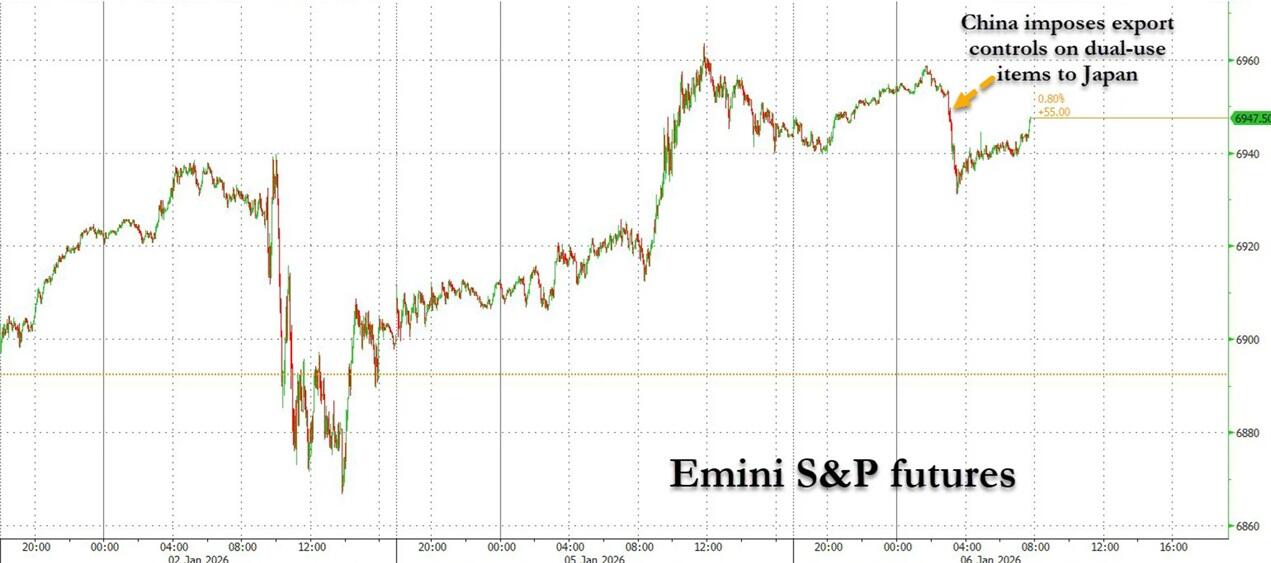
More steady escalation between US-ally Japan and China has emerged, but things just got much more significant – moving from initial Chinese restrictions on things like seafood or cultural exchange events, to now Beijing announcing an immediate ban on all goods deemed dual use for Tokyo. Some rare earth elements are included in this, which impacts a range of technologies, goods, and services with both civilian and military applications.
Japanese Prime Minister Sanae Takaichi – still relatively early and fresh in her tenure – likely regrets her words from last November before her parliament, where she for the first time ever in Japan’s history suggested the Japanese military could intervene to defend Taiwan from a future Chinese invasion of the self-ruled island. However, the Chinese demand for a full public retraction and apology hasn’t come, which means Beijing is now engaged in more screw-tightening to demonstrate how serious it is.
In unveiling the new punitive measures Tuesday, a spokesperson for China’s Commerce Ministry once again hammered on Takaichi’s “erroneous” comments and that China’s national security and interests must be “safeguarded”.
“These comments constitute a crude interference in China’s internal affairs, seriously violate the one-China principle and are extremely harmful in nature and impact,” the statement said, followed by a warning that any entity or individual which violates the export ban will be held legally accountable.
These new controls may affect shipments of semiconductors and rare earth materials to Japan’s Self-Defense Forces and defense industry firms – which is without the intent, and signals that greater punishment and damage could be further implemented at any time.
However, the fresh announcement did not identify specific importers subject to the ban, with details not disclosed, and it remaining unknown just how these controls will be implemented or handled.
Beijing in addition to citing national security, described the move as vital to non-proliferation, especially in light of Tokyo’s anti-China stance in the region.
China had already been steadily retaliating through measures related to curbing trade, cultural exchanges, and tourism – coupled with threats of more punitive action to come. There have lately been some serious military ‘close calls’ as well.
As DA Sails notes, “It’s a reminder that export controls are now a frontline geopolitical tool, not just a trade policy.”
China’s overnight announced ‘dual use’ export controls on Japan…
For example, early December saw an incident play out of Japan where Chinese PLA military aircraft locked radar on Japanese fighter jets, helping relations continue to spiral to their lowest point in many years.
All the while, Beijing has kept up its fiery denunciations, making clear there’s “no space” for ambiguity on what China sees as its territory (Taiwan). Previously the foreign ministry has explained, “China has made its serious position clear several times on Japanese Prime Minister Sanae Takaichi’s wrongful remarks on Taiwan.” And: “The remarks seriously violate the spirit of the four political documents between China and Japan, and cause fundamental damage to the political foundation of China-Japan relations.”
Tyler Durden
Tue, 01/06/2026 – 10:10

Ex-Bears coach Matt Eberflus fired by Cowboys after 1 season as their defensive coordinator
FRISCO, Texas — The Dallas Cowboys have fired first-year defensive coordinator Matt Eberflus after they allowed the most points and intercepted the fewest passes in franchise history, two people with knowledge of the decision said Tuesday.
It’s the second consecutive season in which Eberflus has been fired. He was let go midseason in 2024, his third year as head coach of the Chicago Bears. The people spoke to The Associated Press on condition of anonymity because the decision hasn’t been announced.
Eberflus made it to the end of the season in his return to Dallas, where he had been an assistant from 2011-17 before going to Indianapolis as defensive coordinator. But the 55-year-old’s fate appeared sealed before Sunday’s finale, a 34-17 loss at the New York Giants that set a club record as the ninth game of allowing at least 30 points.
What are the NFL’s rules about timing and interviews for coaching searches during the playoffs?
The departure of Eberflus means the Cowboys will have their fourth defensive coordinator in four seasons, following Dan Quinn in 2023, Mike Zimmer last year and Eberflus. Dallas’ past five defensive coordinators have been former NFL head coaches.
The Cowboys (7-9-1) finished last in the NFL in scoring defense and passing defense and 30th overall, wasting one of quarterback Dak Prescott’s best seasons for the league’s No. 2 offense.
Dallas gave up 500 points for the first time in club history, allowing 511 for an average of 30.1. The only higher average was the 30.8 points per game given up by the franchise’s winless expansion team in 1960.
The defense’s six interceptions fell one short of the previous franchise low, and the 12 takeaways were the second fewest in club history. The Cowboys finished tied for 29th in the NFL with a minus-9 turnover margin.
Owner and general manager Jerry Jones didn’t do Eberflus any favors by trading star pass rusher Micah Parsons a week before the season started.
One of the two first-round picks acquired from Green Bay in that deal led to a trade for standout defensive tackle Quinnen Williams of the New York Jets, a move that sparked a three-game winning streak under first-year coach Brian Schottenheimer.
Jones has said the most surprising moment of the season was the 44-30 loss at Detroit that ended the winning streak and sent the Cowboys tumbling to a 1-4 finish. Trailing most of the game, Dallas couldn’t get a fourth-quarter stop after trimming the deficit to three with 10 minutes remaining.
Dallas has consecutive losing seasons for the first time since the last of three in a row in 2002. The Cowboys had three straight 12-win playoff seasons from 2021-23 but just one postseason victory.
Schottenheimer replaced Mike McCarthy after a 7-10 finish in 2024, and the Cowboys went with a coach they knew to complement Schottenheimer, who calls the plays on offense.
The zone-heavy scheme under Eberflus never seemed to fit with personnel that was more familiar with man-to-man coverage, leading to blown assignments and plenty of open space in the secondary. Plus, the pass rush struggled without Parsons.
Eberflus moved to the coaching booth from the sideline with three games remaining, but the results didn’t change much.
“I don’t really think about it that way,” Eberflus said when asked before the season finale what he might have done differently. “I think about being in the moment and just keep adjusting and learning and growing and getting better. I don’t think I’d do anything differently.”
https://www.chicagotribune.com/2026/01/06/matt-eberflus-fired-dallas-cowboys/
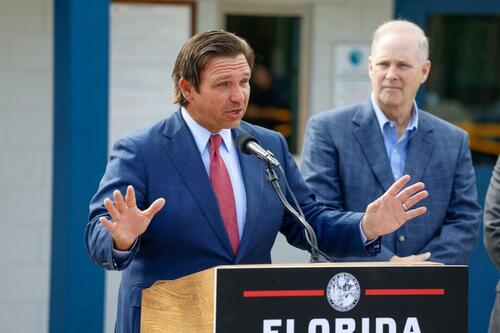
Florida Made Nearly 20,000 Immigration Arrests In 2025
Florida Made Nearly 20,000 Immigration Arrests In 2025
Authored by T.J.Muscaro via The Epoch Times,
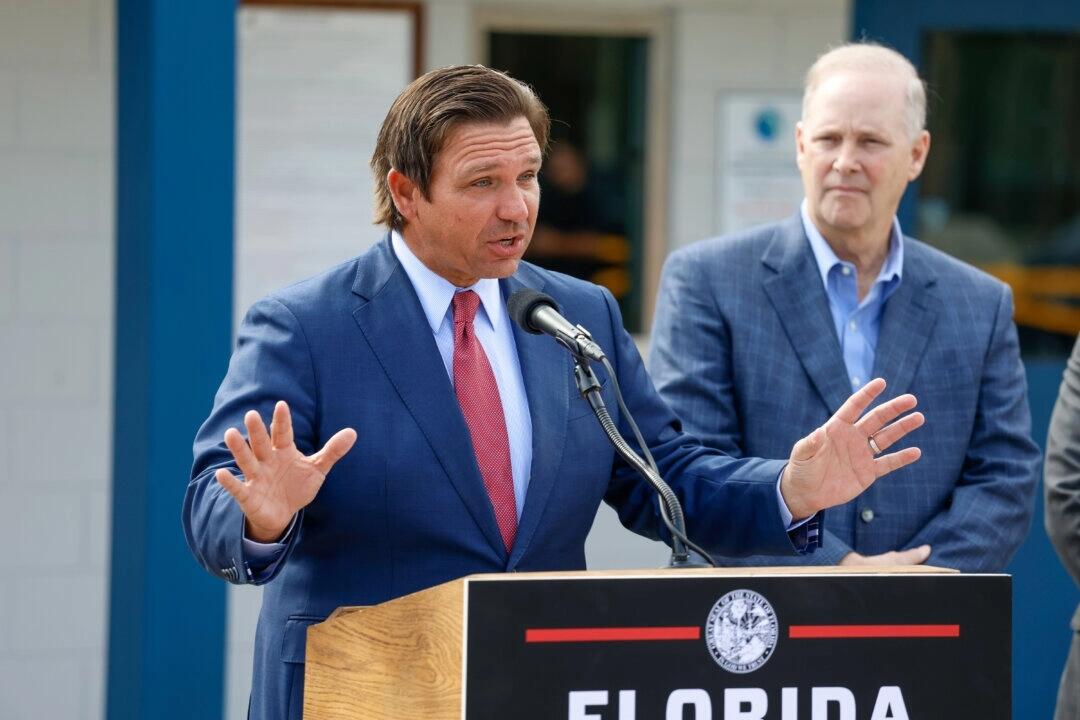
Nearly 20,000 immigration arrests were made in Florida in 2025, Gov. Ron DeSantis announced during a Jan. 5 press conference highlighting his state’s immigration enforcement standards.
Of that total number, 10,000 arrests were made as part of the Department of Homeland Security’s Operation Tidal Wave, and 7,674 were taken into custody by Florida’s highway patrol officers.
Those arrested included more than 6,300 people with criminal records, including violent and sexual offenses, as well as several hundred of the total 1,200 child predators arrested in the state that year.
It did not include any arrests made by federal agents or self-deportations, which authorities said reached about 1,000 people going through the state’s program alone.
DeSantis held the press conference at Deportation Depot outside Jacksonville, from which authorities said 93 deportation flights carried away 2,926 people in the few months the site was in operation last year.
Deportation Depot followed the establishment of the Alligator Alcatraz detention and deportation center deep in the Everglades.
DeSantis said that both facilities now had a federal immigration judge on site to expedite the deportation process.
He also announced that his administration was awaiting DHS approval to open a third detention and deportation center in North Florida that would be called the “Panhandle Pokey.”
The governor also suggested that a fourth site could open this year in South Florida, but he did not go into details.
DeSantis emphasized that the creation of every facility was meant as a temporary solution to support federal agents who have run out of space to keep illegal immigrants off the streets.
Although it is not clear how temporary they are, DeSantis expressed his hope that the federal government could expand its bed space and eliminate the need for any state intervention.
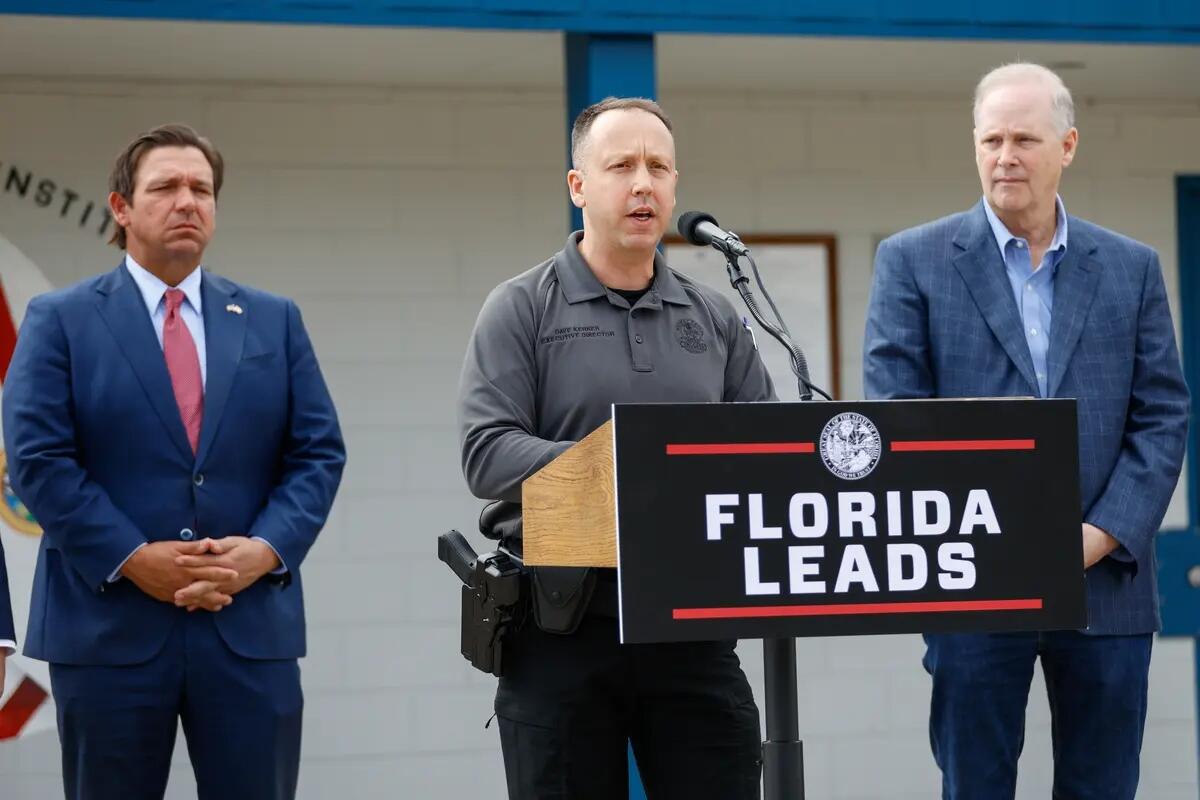
Dave Kerner (C), executive director of the Florida Department of Highway Safety and Motor Vehicles, describes the state’s collaborative efforts with the federal government in immigration enforcement while speaking at a press conference at Deportation Depot in Sanderson, Fla., on Jan. 5, 2026. Natasha Holt for The Epoch Times
Florida Department of Law Enforcement Commissioner Mark Glass said his department and its partners in the Florida Department of Children and Families were continuing to work with the Trump administration to find the estimated hundreds of thousands of children who were brought into the country unaccompanied.
Florida Department of Agriculture and Consumer Services Commissioner Wilton Simpson announced the Department of Transportation was going to build another major highway checkpoint and close up what he called “a major hole” along the state’s northern border.
“We’re breaking up the fuel thefts,” he said. “We’re breaking up the stolen vehicles, the human trafficking, the illegals that we are catching, not only illegals, but the just bad folks … making a big difference.”
Authorities pointed to Florida’s immigration legislation signed in February 2025, which required all state, county, and local agencies inside and outside of law enforcement to enter into 287(g) agreements and support the Department of Homeland Security’s nationwide crackdown on illegal immigration.
“Every state agency in Florida has made a 287 (g) Task Force arrest,” said Anthony Coker, State Board of Immigration Enforcement executive director.
“I think that it’s unprecedented, number one, but it also speaks to the leadership of our Cabinet and our governor really leading the way on immigration, and the state directors that are buying into it [have] been amazing.”
Coker said that state agency directors and county sheriffs have worked to build personal relationships with federal partners, and they continue to act on their own through self-initiated operations.
“The Florida blueprint of immigration enforcement has been widely recognized as being the gold standard of state-level immigration enforcement,” Coker said. “As we begin 2026, we’re excited for the opportunity to partner with other states and have them see as much success as we have.”
Many of these arrests came from engagements such as traffic stops by the Florida Highway Patrol.
“Is it easy? No,” said Dave Kerner, executive director of the Department of Highway Safety and Motor Vehicles.
“It’s not easy. Is it combative? It’s very combative. I can count at least 10 troopers who have been injured as a result of immigration enforcement operations, and seriously injured.
“But the point is, it can be done.”
The governor said that the enthusiasm for working with the federal government is not felt everywhere across the state, and he said that he is prepared to take action against anyone found “breaching duties.”
Tyler Durden
Tue, 01/06/2026 – 10:00
https://www.zerohedge.com/political/florida-made-nearly-20000-immigration-arrests-2025
Resilience Of US Economy Showing “Signs Of Cracking” As US Services PMI Disappoints
Resilience Of US Economy Showing “Signs Of Cracking” As US Services PMI Disappoints
Following yesterday’s US Manufacturing ISM survey disappointment, this morning we get yet more soft survey data – this time a look at the Services sector via S&P Global.
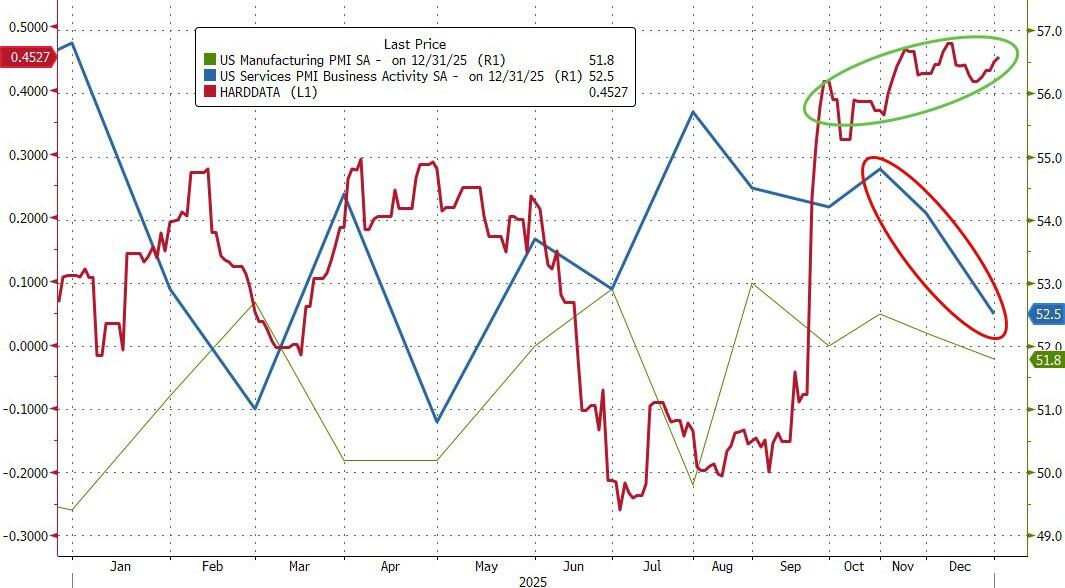
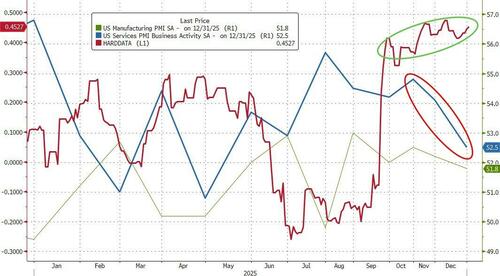
The final (December) US Services PMI data was a disappointment, printing 52.5 vs 52.9 expected…
Source: Bloomberg
While the print was a disappointment, it remains above 50 – expansion – but new business inflows rising to the weakest degree in over a year-and-a-half, growth of activity faltered and was the lowest since last April.
Confidence in the outlook also weakened, whilst employment volumes stagnated, failing to rise for the first time since last February.
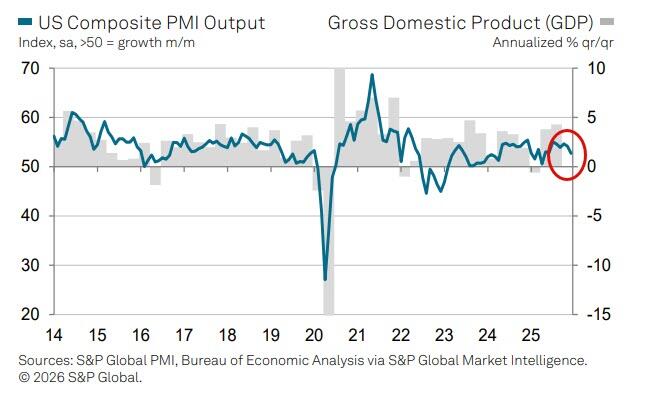
The S&P Global US Composite PMI recorded 52.7 in December, down from 54.2 in the previous month.
Business activity continued to expand in December, rounding off another quarter of robust growth, but as Chris Williamson, Chief Business Economist at S&P Global Market Intelligence, points out, “the resilience of the US economy is showing signs of cracking.”
“New business placed at services providers showed the smallest rise in some 20 months which, accompanied by the first fall in orders placed at manufacturers for a year, points to a broad-based weakening of demand growth.
“Not only has service sector business activity slowed in response to concerns over order books, with the December surveys signaling the weakest economic expansion since last April, but the number of companies cutting headcounts has exceeded those reporting higher employment for the first time since February.
Optimism is fading…
“We also enter 2026 with future output expectations running much lower than seen at the start of 2025, fueling concerns that December’s slowdown and job market malaise could spill over into the new year.
“Confidence has been dampened principally by uncertainty over government policy and the broader economic outlook, with tariffs and affordability featuring as common threads throughout companies’ more cautious views on their prospects.
Affordability worries are underscored by companies reporting an “increased impact of tariffs on both input costs and selling prices in December,” suggesting we could see the unwelcome combination of slower economic growth and stubbornly high inflation at the start of the new year.
However, Williamson notes that “there is an expectation among many companies that lower interest rates and government policy will start to boost demand again as the new year proceeds.”
Tyler Durden
Tue, 01/06/2026 – 09:55
Unrivaled’s 2nd season provides key gathering place for WNBA players during CBA negotiations
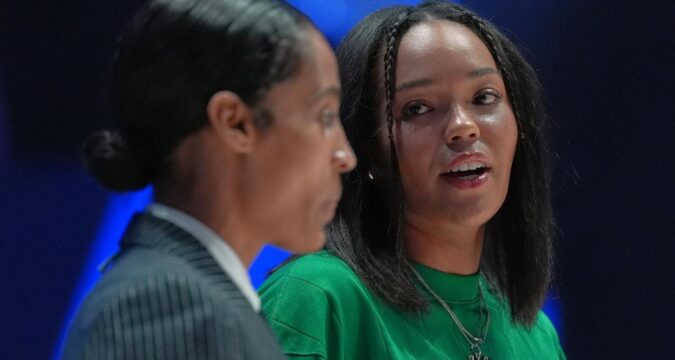
MEDLEY, Fla. — Napheesa Collier sat on the bench at Sephora Arena laughing with Unrivaled teammate Skylar Diggins moments before tipoff between the Lunar Owls and Rose BC.
It was a tiny glimpse of what Unrivaled provided star WNBA players in Year 1: high-level competition and camaraderie while offering an arena for players to sharpen their skills ahead of the WNBA season.
Now, at a pivotal moment in the WNBA when players are negotiating what could be the most consequential collective bargaining agreement in league history, Unrivaled is serving a much bigger purpose. The league, which began its second season on Monday, is providing a central gathering place for players to strategize and build solidarity as CBA talks unfold.
“The offseason is always a harder time to try and connect with people,” Collier said in a Zoom last month, before being ruled out for the season because of ankle surgery, “and so to have our CBA happening in the offseason is usually a disadvantage in that way.
“To have players congregated where you can have those in-person conversations and updates and things like that, I think that does help things move more quickly.”
The league and WNBA Player’s Association have been negotiating a new agreement for the past few months, extending the deadline a couple of times with the latest one set to expire on Friday. Last month, the WNBPA announced players have authorized their union’s executive council to call a strike if necessary, which could delay the WNBA expansion draft and the beginning of free agency that usually starts in late January. The season itself isn’t expected to begin until late April or early May.
“You heard a lot of chatter that what we’re asking for is not sustainable for the business,” Collier said in a television interview during an Unrivaled game Monday night.
“Being on this side with Unrivaled, I know what it takes to run a sustainable business,” added Collier, who co-founded the league with fellow WNBA star Breanna Stewart. “I think if they can’t find a model that makes that happen, they need to put people in place who can … I do think a deal is going to get done, but we’re standing firm in what we believe, and were not going to back down.”
Ahead of its second season, Unrivaled announced that it is now valued at $340 million after closing its oversubscribed Series B investment round led by Bessemer Venture Partners — a massive figure for the young league and a reflection of the increasing momentum and interest in women’s sports.
“What we want to build this into is Champions League women’s basketball,” said Unrivaled president Alex Bazzell. “And that’s not a competition towards the WNBA, it’s just where we feel like we can kind of position ourselves in the market.”
Bazzell has repeated his belief in the league’s potential longevity in part because of its ability to draw some of the game’s biggest names — from Collier to the reigning WNBA Rookie of the Year Paige Bueckers — and their long-term commitment. Around 75% of the league’s players are signed through 2028.
“My strong belief is once people remove the women’s sports blinders and start looking at it relative to what’s going on in the ecosystem in terms of the data,” Bazzell said, “it points to that right now. So we are very bullish on not just where we are today but where we’re going tomorrow.”
https://www.chicagotribune.com/2026/01/06/unrivaled-wnba-cba-negotiations/

Meet the buyer who paid $7.4M for one of Ken Griffin’s Gold Coast condos
Charlie Mills, the chairman and former CEO of Northfield-based Medline Industries, was the buyer who paid $7.4 million last April for billionaire Ken Griffin’s unit on the 35th floor of the Gold Coast building at 9 W. Walton Street. Mills and his wife now plan to spend another estimated $2.75 million to build out the space, according to a building permit filed with the city.
Griffin famously paid $58.75 million in 2017 for the top four floors in the building at 9 W. Walton, but he never built them out and left them as raw space. After declaring in 2022 his intention to move his company and his residence to Florida, Griffin took a major loss on the four floors, selling them for a total of $34.9 million, or a loss of more than 40%.
Griffin paid $12.5 million million in 2017 for the 7,327-square-foot unit Mills purchased. Griffin first listed the 35th-floor unit in 2022 for $14 million. He took the condo off the market the following year, and then sold it for $7.4 million in April 2025 in an off-market deal to an opaque land trust that masks its beneficiary’s name.
But a December 2025 building permit on file with the city of Chicago lists Mills as the current owner of the full-floor unit and shows that he hired architect Michael Waechter and contractor Wujcik Construction to proceed with the initial buildout, which will have an estimated cost of $2.75 million for materials and labor.
In a brief interview with Elite Street, Mills called 9 W. Walton “a very, very nice building, and my wife and I hope to build a very nice home there.”
In buying a condo in the building at 9 W. Walton from Griffin, Mills joins Gov. JB Pritzker, who paid $19 million in 2024 to buy the top two floors of the building from Griffin. The buyer who paid $8.5 million in April for Griffin’s 36th-floor unit at 9 W. Walton remains a mystery.
Pritzker has not yet taken out a permit with the city to build out his top two floors at 9 W. Walton.
Medline underwent an initial public offering in December. Mills’ family previously had sold a majority stake in Medline to private equity firms in 2021.
Goldsborough is a freelance reporter.
https://www.chicagotribune.com/2026/01/06/medline-ken-griffin-gold-coast-condo/

Fairfax Financial Takes 22% Stake In Under Armour As UBS Sees “Turnaround Stock”
Fairfax Financial Takes 22% Stake In Under Armour As UBS Sees “Turnaround Stock”
Fairfax FinancialStruggling apparel brand Under Armour, founded and currently led by Kevin Plank, has seen its market capitalization collapse after years of strategic missteps, brand erosion, and tough global competition. However, a newly disclosed filing shows that a Canadian financial holding company has taken a sizable stake, alongside a recent, more constructive turnaround call from UBS. This suggests the struggle phase may finally be nearing an inflection point.
Fairfax Financial Holdings disclosed a 22.2% ownership stake in UA Class A common stock in a new Schedule 13D filing, stating that the position was acquired for investment purposes and could be adjusted over time.
Fairfax has become the top shareholder.
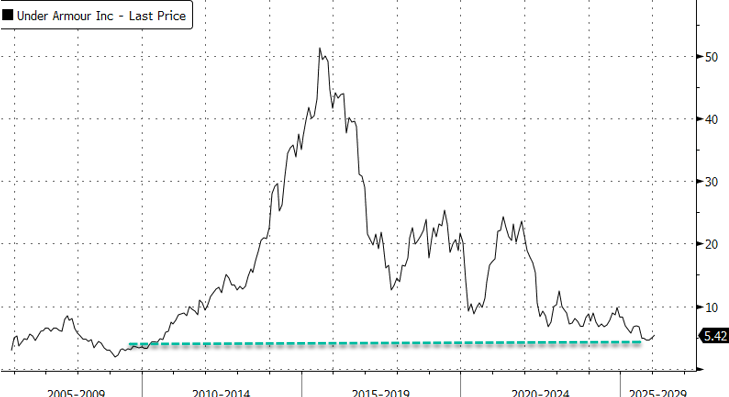
The revelation sent UA shares up 5.5% in pre-market trading in New York. Shares have imploded over the years, falling back to roughly 2010 levels, largely because the brand failed to remain relevant.
In September, UBS analyst Jay Sole wrote to clients, “We think sentiment will turn positive in FY27, driving stock outperformance.”
Just days ago, Sole told clients, “We view UAA as a turnaround stock.”
UAA is back.
The analyst explained why:
We believe improving sales growth will cause the stock’s valuation to increase: We view UAA as a turnaround stock. We believe UAA will achieve a 25% 5-yr. EPS CAGR and this growth will positively surprise the market. Importantly, we expect UAA to deliver considerable innovation and better leverage its brand name, which should help drive 2nd derivative improvement in the company’s North America revenue growth rate. Our view is an improving North America sales growth rate will boost the stock’s valuation. Our $8 price target is 61% above the current stock price.
Investors materially undervalue the Under Armour brand name, in our view: Under Armour remains one of the world’s best known and liked athletic wear brands. UBS Evidence Lab’s 11th annual global athletic wear survey reinforces our conviction in this view. Survey results indicate Under Armour’s brand name belongs in the same class of brands such as Lululemon, Jordan, Adidas, Puma, On, Hoka, Skechers, and New Balance. The average market cap for these brands which are publicly traded as standalone entities is $19B vs. just $2.1B for UAA. We’re not saying UAA is worth $19B, but rather the valuation differential between UAA and its competitors is far too wide in our view.
Two key survey takeaways:
UAA’s unaided brand awareness, purchase intentions, and attributes are strong. These stats are the main reasons we continue to believe the Under Armour brand name is powerful. Under Armour’s unaided awareness is 4th globally for all athletic apparel brands, trailing only Nike, Adidas, and Puma (Fig. 4). With respect to athletic apparel purchase intentions, UAA ranks 4th among the global brands, behind just Nike, Adidas, and Puma (Fig. 12). Also, global consumers continue to associate Under Armour with phrases such as “high quality products” and “good for doing sports” more than they do for most other brands (Figs. 19-20).
Product innovation will catalyze sales growth acceleration, in our view. Roughly 34% of global survey respondents associated the brand with innovation, but this is down ~500 bps y/y to a 8-yr. low (Fig. 29). This probably explains part of UAA’s recent financial trend. However, we believe UAA’s innovation will improve significantly (link) and this will drive better consumer perceptions as well as more loyalty (Fig. 39), conversion (Fig. 39), and full price selling (Fig. 45).
ZeroHedge Pro subscribers can read the full note in the usual place, where Sole lays out the detailed thesis supporting an $8 price target.
Tyler Durden
Tue, 01/06/2026 – 09:40

Anna Chilcutt sets a Carmel record with 100,000 shots in the offseason. Her cookies make an impression too.
Carmel junior guard Anna Chilcutt knows the right mix of ingredients to make her teammates happy.
Not only hitting 3-pointers but also baking desserts, Chilcutt has become a sweet contributor for the Corsairs.
“I make banana bread bars,” she said. “My teammates love them. I bring them every single time to games. I bring 24 of them.”
Chilcutt has even started a cookie company.
“I like creativity,” she said. “I had a bunch of orders in December and make a good amount of money.”
Senior guard Josie Hartman and junior guard Grace Booher are among Chilcutt’s loyal fans.
“Her banana bars are the best I’ve ever had,” Hartman said.
Booher agreed.
“I love trying everything Anna makes,” Booher said. “The banana bread bars are definitely the team’s favorite.”
Chilcutt also likes to shoot the ball.
“I shot 300 to 400 3-pointers a day since last season and occasionally 200 on game days, starting at 5:30 in the morning before I would go to school,” she said.
The 5-foot-6 Chilcutt, who is averaging 4.0 points, 2.0 rebounds, 1.0 assist and 1.0 deflection, is shooting 32% on 3-point attempts this season. But she has carved out a role in the Corsairs’ rotation with more than sharpshooting, according to coach Ben Berg. Even with four returning starters and the addition of freshman phenom Liv Johnson, East Suburban Catholic Conference leader Carmel (12-4, 4-0) has welcomed Chilcutt’s contributions.
“Anna has greatly improved in a lot of different areas,” Berg said. “She put in a lot of hard work in the offseason. She’s playing great defense, rebounding and shooting the ball really well.
“Anna wanted to make herself into a much better player and earned more playing time.”
Carmel’s Anna Chilcutt drives against Marian Catholic during an East Suburban Catholic Conference game in Mundelein on Thursday, Dec. 18, 2025. (Brian O’Mahoney / News-Sun)
Chilcutt said she was particularly motivated after Carmel’s loss to Libertyville in a Class 4A regional final last season.
“My sophomore year wasn’t what I fully expected,” she said. “I wanted more out of it. It was also going to be a transition year for the team. I wanted to play more and get more points — just get more out of the season.
“I remember only playing three or four minutes against Libertyville and thinking to myself, ‘This is not happening next year.’ I wanted to change it and do whatever I could to get on the court more.”
Berg said the previous record for most shots attempted during the offseason was 60,000 by former guard Ashley Schlabowske. Without realizing it, Chilcutt blew past that total, finishing with just over 100,000 shots.
“Shooting and going to the gym became a routine for me,” Chilcutt said. “My mom knew I was there all the time. I would count them and put them on a spreadsheet. I did all kinds of shots, but I would make 75 to 100 threes before I left on most workouts. I became disciplined and would log in my shots.”
Carmel’s Anna Chilcutt (15) huddles with teammates during an East Suburban Catholic Conference game against Marian Catholic in Mundelein on Thursday, Dec. 18, 2025. (Brian O’Mahoney / News-Sun)
Booher witnessed several of Chilcutt’s shooting sessions.
“Anna worked super hard in the offseason to improve her game,” Booher said. “No one on the team has put in more extra work than Anna. Attempting 100,000 shots is an amazing example of her dedication to improving and helping the team.”
Hartman said she has noticed a difference in Chilcutt this season.
“You can really tell how much she’s put in just by her confidence shooting the ball,” Hartman said. “Attempting 100,000 shots is insane, and you can tell how much it’s paid off. Very few people have the drive and dedication she has. … I love seeing her make all these shots after all the work she’s put into it.”
Bobby Narang is a freelance reporter.
https://www.chicagotribune.com/2026/01/06/basketball-carmel-anna-chilcutt/