Category: News
Beloved bell ringer Roger Paulhus remembered as Elmhurst’s ‘symbol of Christmas’
For years, Salvation Army bell ringer Roger Paulhus was a fixture at Jewel-Osco at York Street and Butterfield Road in Elmhurst, and he made quite the impression on shoppers and employees alike.
“He was a symbol of Christmas. He was helping others,” said Kenlyn Geraldi, of Elmhurst. “He would be there on the coldest, nastiest days sitting in his chair. Later on I think he had a knee replacement so he had pain and he would still be sitting there ringing that bell, wrapped up in the blanket.”
She added that everyone thought of him as “kind of like Santa. He had a beard and the droll little mouth and the little red nose cuddled up in his blankets. … It was very sad that he passed away alone.”
The Downers Grove resident died in his apartment just one day after he called off from his usual shift because he wasn’t feeling well. On Dec. 23, he didn’t come to work and wasn’t responding to phone calls or texts, according to Cathleen Himes, resource development director for the Salvation Army Oakbrook Terrace.
“That was unusual both because he’s normally responsive and he rarely called off work,” she said. “We at the Salvation Army felt it important to check on him as he’s become a part of our family.”
Capt. Enrique Coreano, one of the site’s administrators and pastors, set up a wellness check with the local police department, and officers and Paulhus’ landlord discovered he had died in his apartment.
“Roger was a faithful, kind bell ringer who loyally showed up for his shifts day after day, year after year. He loved the community of Elmhurst where he rang and they loved him back,” Coreano shared. “His service meant so much to us at the Salvation Army Oakbrook Terrace – the funds he raised over the course of two decades helped tens of thousands of our neighbors in need. We are so grateful to Roger and his lasting legacy. He is forever a part of our Salvation Army OBT family.”
Geraldi said she heard from the Salvation Army people who took over his shift that “the highlight of his year was ringing the bell at the Jewel. He’d mark it off on his calendar six weeks before.”
She and other donors also helped the bell ringer at times. “Many of us thought he needed the donation and people would give him money or coffee or give him a gift card to McDonald’s or something,” she added. “It looked like he needed help but he was helping others. That was his mission.”
Geraldi said his name was mentioned in the prayers Dec. 28 at the church service at Yorkfield Presbyterian Church near the grocery store, which she attends. “There was kind of a gasp in the congregation. People texted my daughter and said ‘Is that really the guy?’”
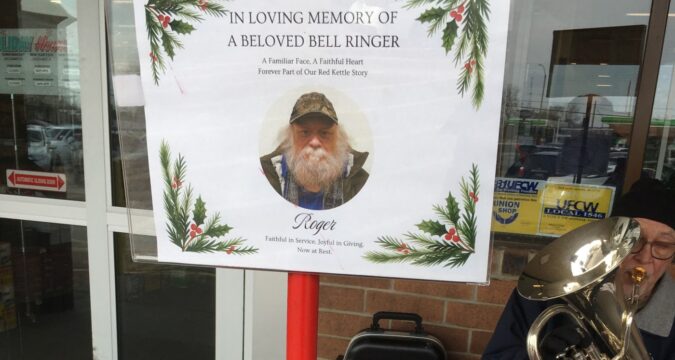
A Salvation Army bell ringer’s stand supports a sign remembering a longtime bell ringer Roger Paulhus, of Downers Grove, who died in late December. He worked as a bell ringer at Jewel-Osco at York Street and Butterfield Road in Elmhurst for 15 years. (Laurel Geraldi)
In addition, on Christmas Eve, “everybody was coming up and putting extra in the kettle for Roger,” she added.
Her daughter, Laurel Geraldi, said he was “always there” when she shopped at Jewel, which is several times each week. “I’ve kind of grown up with him and always saw him in the exact same location every time I’d be there. He was like Santa. You’d see him and talk to him and he’d wave at you and smile and say Merry Christmas and always had a smile on his face.
“You might run into him inside if he was warming up, but he always acknowledged everyone. It wasn’t someone just sitting there doing his job,” she added.
She said she spoke with a woman from the Salvation Army who was there on Christmas Eve.
“I’d been there the day before and noticed the kettle was up by the wall, and then when I was there the next day, there was a woman there and that sign on the post,” Laurel Geraldi shared. “She said even employees from the Jewel were coming out and crying with her and talking about how they always remembered and saw him. … Literally almost every person who walked up from the parking lot or out the door was putting money in the kettle.”
Laurel Geraldi explained that the Salvation Army woman “wanted to make sure she finished the season for him” after learning Paulhus had died. “She had an empty chair by the kettle to represent him. As I was leaving Jewel on the 24th, her husband was there playing Christmas carols. … She said no one could ever take his spot. That was always Roger’s spot.”
She also talked about the bell ringer’s dedication. “It didn’t matter if it was 10 below 0 and snowing six inches. He would be there ringing his bell at the door. He was definitely, as my mom said, a symbol of Christmas and dedicated to that job. He was definitely looking down and watching all those people donating to others.”
Paulhus began working at the Elmhurst Jewel 15 years ago, ringing the Salvation Army’s red kettle bell as a paid worker from 10 a.m. to 7 p.m. six days a week during the six-week campaign that ends on Christmas Eve. He had worked as a bell ringer elsewhere for at least five years.
Himes praised his efforts. “Roger raised the most money of any ringer each year and raised about $15,000 per year,” she said, attributing his success to his personality. “He was kind to customers. He cared about people. He was loyal and faithful, giving so much of his time as a worker of the campaign each year.”
Capt. Enrique Coreano, left, and his wife, Capt. Chrissie Coreano, right, join some of the 24 Salvation Army Oakbrook Terrace’s bell ringers for 2025 during the annual bell ringers’ appreciation luncheon. Roger Paulhus, third from left, worked as a bell ringer at a Jewel-Osco in Elmhurst for 15 years, and at least five more at other locations. (Salvation Army Oakbrook Terrace)
This year, he had been ringing every day since Nov. 11, she said.
Although Paulhus didn’t work during the rest of the year because of a medical condition, he was a hard-working paid ringer for more than 20 years during the six-week campaign.
His efforts helped fund the Salvation Army Oakbrook Terrace, which serves surrounding suburbs in DuPage County, including Elmhurst, Lombard, Downers Grove, Villa Park and Oakbrook Terrace, Himes said. “We serve 25,000 neighbors in need each year, helping with food assistance, rent/mortgage and utility bill assistance, child care, back to school and holiday assistance for children, case management and more.”
Paid bell ringers work six to nine hours per shift, and volunteers work two to four hours per shift. Paid ringers fill out an application, go through hiring channels and complete training with human resources. The process takes about two weeks.
Bell ringers have only a few requirements, Himes explained: “Showing up to shifts on time and being dressed/prepared for the weather, having a smile and kind word/thank you for donors and passers-by, ringing the bell with the purpose of helping others.”
Captain Enrique Coreano, a pastor and site administrator at the Salvation Army Oakbrook Terrace, shakes bell ringer Roger Paulhus’ hand at the annual bell ringers’ appreciation luncheon. Paulhus consistently raised the most money every year for the facility. (Salvation Army Oakbrook Terrace)
Paulhus was honored during the Salvation Army’s Jan. 4 Sunday service, and staff are working with his survivor brother to plan a celebration of life service in the spring, Himes shared.
Those who want to honor his legacy can still do so by donating to the Salvation Army’s virtual kettle fundraising site at https://donate.salarmyncil.org/campaign/the-salvation-army-oakbrook-terrace-virtual-red-kettle-2025/c710979.
Melinda Moore is a freelance reporter for Pioneer Press.
https://www.chicagotribune.com/2026/01/06/bell-ringer-roger-paulhus-remembered/
Naperville News Digest: Volunteers sought for Riverview Farmstead brush control; bands asked to apply to perform at the Last Fling festival
Volunteers sought for Riverview Farmstead brush control
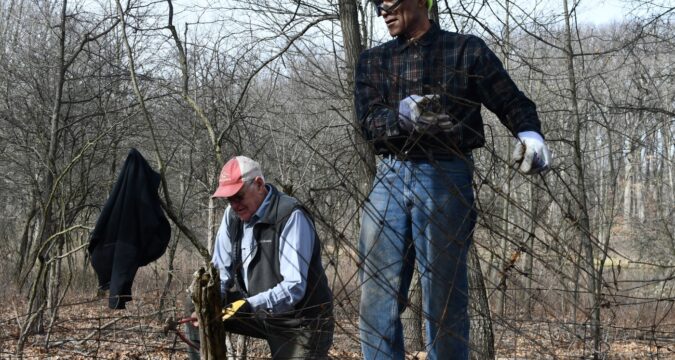
The Forest Preserve District of Will County is seeking volunteers to help with brush control at several area preserves, including the Riverview Farmstead Preserve in Naperville.
Volunteer work sessions are from 9 a.m. to noon and are open to ages 10 and older.
Work at the Riverview Farmstead on Book Road, south of Hassert Boulevard, will be done on Thursday, March 5.
The district is holding similar brush control volunteer programs at other preserves during the first quarter of this year. Other sessions include preserves in Mokena, Frankfort Township, Joliet and Monee Township.
Space is limited, and registration and a completed waiver required.
For more information, contact Emily Kenny at 815-722-7364 or volunteerservices@fpdwc.org or go to www.reconnectwithnature.org.
Theater for Charity announces schedule and beneficiary
Proceeds from Theater for Charity’s 2026 season will benefit Youth Outlook, a nonprofit organization serving the LGBTQ+ community in DuPage County, organizers announced.
Theater for Charity is a nonprofit community theater group that uses performing arts to create meaningful social impact, organizers said.
This year’s schedule kicks off with “Cabaret for Good” at 7 p.m. March 6 and 7 at Nature’s Best Cafe, 1904 Brookdale Road, Naperville. The annual fundraising performance features Broadway favorites and pop hits by local performers. The event helps pay for operational expenses for the company and raise awareness of its supporting charity, organizers said.
Theater for Charity’s main stage production will be the award-winning Broadway musical “The Prom,” which will be held the first two weekends of October at The Matrix Club, 808 S. Route 59, Naperville. Auditions will take place in early August.
“The Prom” celebrates inclusion, matching the Youth Outlook mission, organizers said.
Youth Outlook is Illinois’s first and longest-running social service agency solely dedicated to the support of LGBTQ+ youth, Theater for Charity said.
The theater group is also planning a trivia night in November.
For more information, go to www.theaterforcharity.com.
Bands asked to apply to perform at the Last Fling festival
The application deadline for bands interested in performing at the Naperville Jaycees’ annual Last Fling festival is Saturday, Jan. 31.
The annual event, featuring a carnival, food vendors, live entertainment, a Labor Day parade and more, will take place from Friday, Sept. 4, through Monday, Sept. 7. It is the Jaycees’ largest fundraiser, which raises money to support area nonprofit organizations.
Musical artists can apply online through the event website at lastfling.org/schedule-of-events.
Bands are asked to provide information on how long they’ve been playing and the type of music they play. They should also include their availability during Labor Day weekend, their performance price and a music sample. Bands must have 90 to 120 minutes of material to be considered, organizers said.
Applications are open through the end of the day Jan. 31 and are online only. No other form of application will be accepted, organizers said.
https://www.chicagotribune.com/2026/01/06/naperville-volunteers-riverview-bands-fling/

Washington Post Won’t Say Why Trust In Vaccines Is Gone
Washington Post Won’t Say Why Trust In Vaccines Is Gone
Authored by Roger Bate via the Brownstone Institute,
The Washington Post recently published a detailed investigation showing that childhood vaccination rates across the United States are falling sharply, particularly for measles. Fewer counties now meet the 95 percent coverage level commonly associated with herd immunity, and millions of children attend schools in communities below that threshold.
On the basics, it’s true that routine childhood measles shots are among the most effective measures for keeping that particular infection at bay. But the Post’s analysis fails where it matters most: it cannot explain why trust has collapsed so broadly, so persistently, and so rationally for many ordinary people.
Instead, readers are offered a familiar diagnosis. Distrust of authorities. Political polarization. Misinformation. Backlash against mandates. All of this is curiously detached from responsibility. The article describes the consequences of distrust without confronting its causes.
That omission is not accidental. It reflects a broader unwillingness among elite media and public health institutions to reckon honestly with Covid-era failures. And without that reckoning, efforts to restore vaccine confidence are unlikely to succeed.
This is not an argument against vaccines. It is an argument about credibility.
During the Covid-19 period, public health authorities repeatedly overstated certainty, minimized uncertainty, and treated legitimate scientific disagreement as a threat rather than a feature of good science.
Claims about vaccines preventing infection and transmission were presented as settled fact, not evolving hypotheses. When those claims weakened or collapsed under new evidence, they were revised quietly, without acknowledgment of error.
The same pattern appeared across other policies: masking, school closures, natural immunity, and population-level risk. Positions shifted, sometimes dramatically, but rarely with public explanation. The message conveyed—intentionally or not—was that narrative management mattered more than transparency.
This mattered because trust is cumulative. People do not evaluate each public health recommendation in isolation. They judge institutions based on patterns of behavior over time. When authorities insist they were always right, even when claims visibly change, credibility erodes.
Worse, dissent was often suppressed rather than debated. Scientists and clinicians who questioned prevailing policies—on lockdowns, school closures, or mandates—were frequently labeled as misinformation spreaders rather than engaged on the merits. Government coordination with social media platforms blurred the line between combating falsehoods and policing debate. Once that line is crossed, institutional trust does not merely decline—it inverts.
None of this requires assuming bad faith. Emergencies are hard. Decisions were made under pressure. But good faith does not excuse overstatement, nor does difficulty justify refusing retrospective evaluation.
The result of this approach is now visible in the data the Washington Post reports—but does not explain.
Evidence from Pennsylvania illustrates the point. Montgomery County, a large, affluent, highly educated Philadelphia suburb, has historically had strong vaccination uptake and robust healthcare access. It is not a place easily dismissed as anti-science or anti-medicine.
Yet my physician survey research conducted in the county during and after the pandemic tells a different story. Clinicians reported that while initial Covid vaccine uptake was high in 2021, acceptance declined sharply over time, particularly for boosters. More importantly, many physicians observed a spillover effect: growing hesitancy not only toward Covid vaccines, but toward other vaccines as well.
Patients were not primarily citing technical fears about vaccine safety. They were expressing distrust of public health authorities. They referenced shifting claims, perceived exaggeration, and the absence of acknowledgment of error. Named figures—most notably Dr. Anthony Fauci—were mentioned not as sources of reassurance, but as symbols of lost credibility.
Ongoing follow-up work in Montgomery County suggests this dynamic is not fading. Hesitancy appears to be hardening, increasingly framed not as uncertainty about specific vaccines, but as refusal to rely on institutions that have never conducted a transparent review of their pandemic performance. The absence of any meaningful Covid audit is frequently cited as a reason for continued distrust.
The Washington Post notes “distrust of authorities” but treats it as a sociological condition rather than a consequence of institutional behavior. That framing is convenient, but it is incomplete. Distrust did not emerge from nowhere. It was earned.
This matters for policy because different causes demand different solutions. If vaccine hesitancy were primarily driven by ignorance about vaccine science, then more education and clearer messaging might suffice. But when hesitancy is rooted in governance failure—overconfidence, suppression of debate, refusal to acknowledge mistakes—messaging alone will not work. In fact, it may backfire.
What is missing is accountability—not punishment, not jail, not tribunals—but acknowledgment.
In every other domain of public life, major failures are followed by audits. Financial crises, industrial accidents, intelligence breakdowns, transportation disasters—all prompt formal reviews aimed at understanding what went wrong and how to do better. These processes are not about retribution. They are about restoring confidence that institutions can learn.
Covid has been the exception.
There has been no comprehensive, independent, and transparent review of pandemic decision-making in the United States. Agencies have issued self-assessments, but these emphasize difficulty rather than error. Senior officials rarely concede specific mistakes. Media coverage largely treats criticism as politically motivated rather than analytically serious.
The result is a lingering credibility deficit. Each new public health recommendation—whether about boosters, childhood vaccines, or unrelated interventions—is filtered through the unresolved memory of Covid. People are not asking whether measles vaccines worked in 1965. They are asking whether they can trust institutions that refuse to reflect honestly on 2020–2022.
The Washington Post is right to warn about falling vaccination rates. But by refusing to confront the institutional roots of distrust, it is not part of the solution. It documents the smoke while declining to examine the fire.
Measles immunity matters. But so should elite misinformation, overstatement, and institutional defensiveness.
Until public health authorities—and the media that defend them—are willing to acknowledge Covid-era failures openly, trust will not be restored. And without trust, even the best vaccines will struggle to achieve the coverage they deserve.
The problem is not that science failed. It is that institutions have not yet admitted where they did.
Tyler Durden
Tue, 01/06/2026 – 12:25
https://www.zerohedge.com/medical/washington-post-wont-say-why-trust-vaccines-gone

Naperville Police Arrests for Dec. 29-Jan. 2
The following items were taken from Naperville police reports and press releases. An arrest does not constitute a finding of guilt:
A 19-year-old man from Lisle was arrested on charges of driving on a suspended license and driving without insurance at 5:26 a.m. Dec. 29 at Royce Road and South Washington Street.
A 26-year-old man from Naperville was arrested on two counts of retail theft not exceeding $300 at 3:46 p.m. Dec. 30 at East Jefferson Avenue and South Washington Street.
A 42-year-old woman from Channahon was arrested on a warrant and on a charge of obstructing identification at 5:13 p.m. Dec. 31 in the 1600 block of Naperville Wheaton Road.
A 34-year-old man from Naperville was arrested on a warrant at 7:31 p.m. Dec. 31 in the 1500 block of West Jefferson Avenue.
A 69-year-old man from Naperville was arrested on a charge of making a false police report at 12:42 a.m. Jan. 1 in the 1800 block of Centre Point Circle.
A 21-year-old woman from Somonauk was arrested on a charge of driving under the influence of alcohol at 2:50 a.m. Jan. 1 in the 1200 block of Rickert Drive.
A 20-year-old man from DeKalb was arrested on charges of driving on the wrong side of the road, driving under the influence of alcohol, driving on a suspended license and driving without insurance at 4:20 a.m. Jan. 1 at 111th Street and 248th Avenue.
A 24-year-old man from Chandler, Arizona, was arrested on a charge of retail theft exceeding $300, burglary and attempted fleeing or eluding police at 12:36 a.m. Jan. 2 in the 100 block of West Jefferson Avenue.
A 41-year-old man from Naperville was arrested on a warrant at 12:03 p.m. Jan. 2 in the 1200 block of East Ogden Avenue.
A 19-year-old woman from Hampshire was arrested on charges of obstructing an officer and aggravated assault on an officer at 2:37 p.m. Jan. 2 in the 1500 block of Naperville Wheaton Road.
https://www.chicagotribune.com/2026/01/06/naperville-police-arrests-blotter-january/
Cuba’s Security-State Colonization In Americas, Proven By Delta Force Killing 32 Intel Agents Surrounding Maduro
Cuba’s Security-State Colonization In Americas, Proven By Delta Force Killing 32 Intel Agents Surrounding Maduro
Submitted by The Bureau’s Michael Lima,
For years, the Cuban regime has insisted that its presence in Venezuela was benign—limited to doctors, nurses, and sports trainers offering humanitarian solidarity. The deaths of 32 Cuban military and intelligence personnel while defending Venezuelan dictator Nicolás Maduro have now shattered that fiction.
As early as March 2019, Cuba’s ambassador to Canada, Josefina Vidal, appeared on CBC News to denounce Canadian reporting on Cuba’s security intervention in Venezuela. She dismissed the claims outright: “The assertion that thousands of Cubans would allegedly be inserted into the structures of the armed and security forces of Venezuela, supporting the government of (legitimate) President Nicolás Maduro, is a scandalous slander,” she said, demanding proof.
Today, that proof is unmistakable. These men did not die treating patients or coaching athletes. They were killed as part of Maduro’s inner security ring, exposing Cuba’s central role in exporting its intelligence and repression model to keep authoritarian allies in power.
The Cuban Embassy in the United States honored, in an emotional gathering, the memory of the 32 Cubans who recently died in Venezuela and condemned the blatant violation of all norms of international law by the US government, which is exerting its imperial power over our America. pic.twitter.com/msX6PyMiP6
— Cuban Embassy in US (@EmbaCubaUS) January 6, 2026
This reality did not emerge overnight. Cuban-Venezuelan security cooperation dates back at least to 2008, when both regimes signed agreements granting Havana extraordinary influence over Venezuela’s armed forces and intelligence services. Under these accords, Cuba trained Venezuelan soldiers, restructured key military units, trained intelligence agents in Havana, and—most consequentially—reoriented Venezuela’s intelligence apparatus away from external threats and toward surveilling its own officers and commanders. This transformation proved vital to regime survival, allowing it to neutralize internal dissent and consolidate power for more than two decades.
That architecture of control became fully visible on January 3, 2026, during Operation Absolute Resolve, a U.S. military operation carried out by Delta Force and the 160th Special Operations Aviation Regiment that resulted in the capture of Maduro and his wife, Cilia Flores, and their transfer to the United States. On January 5, Maduro appeared in federal court in New York to face a four-count indictment accusing him of leading a 25-year narco-terrorism conspiracy.
During the operation, 32 Cuban operatives from the Revolutionary Armed Forces and the Ministry of the Interior were killed while defending Maduro. Their deaths were not denied by Havana. On the contrary, the Cuban government confirmed both the casualties and their military ranks in Presidential Decree No. 1147, signed by Miguel Díaz-Canel, which also declared two days of national mourning. The decree amounted to an extraordinary admission: Cuban state forces were embedded at the highest levels of Venezuela’s security apparatus.
Those who talk about respecting sovereignty and international law in #Venezuela should explain why 32 of the 40 casualties of the US operation were Cuban thugs protecting #Maduro.#Cuba is the one that steals Venezuelan oil and violates international law and human rights. pic.twitter.com/UgzTYIlOhj
— Daniel Lacalle (@dlacalle_IA) January 6, 2026
Although the Cuban regime did not officially disclose their names, the independent Cuban outlet 14ymedio identified six of the deceased, along with their ranks and provinces of origin, using social media posts, private messages, and partial confirmations from local authorities. Most were from eastern Cuba, particularly Granma and Santiago de Cuba. Among them were Fernando Báez Hidalgo, 26, linked to the Interior Ministry’s Personal Security Directorate; Landy Osoria López, a State Security operative deployed in Caracas; and Yordenis Marlonis, reportedly part of the Venezuelan president’s direct protection detail.
Others appeared to belong to the Avispas Negras (Black Wasps), an Interior Ministry unit sanctioned by the U.S. Treasury for violently suppressing the July 11, 2021 pro-democracy protests. At least one of those killed was identified as a cryptographer.
The extent of this penetration was underscored days later by U.S. Secretary of State Marco Rubio, who stated that Maduro’s entire security structure was effectively controlled by Cubans—those who guarded him, those who monitored loyalty within the regime, and those who kept him insulated from his own people. The implication was unmistakable: Venezuela had not merely allied with Cuba; it had been colonized by Cuban intelligence.
This model of exported repression is not unique to Venezuela. A similar pattern has taken root in Nicaragua. Since the mass protests of April 2018, credible accounts from retired Nicaraguan military officers—including Major Roberto Samcam—indicate that dictator Daniel Ortega has increasingly surrounded himself with Cuban advisers embedded in his security apparatus, displacing Nicaraguan personnel who once formed his inner circle.
Independent reporting suggests that roughly 60 Cuban advisers operate within Nicaragua’s military and security structures, overseeing surveillance, loyalty screening, and repression. During Operation Clean-Up in April 2018, Cuban special forces reportedly operated alongside paramilitary units during mass arrests and the violent dismantling of civilian resistance—an archetypal case of the “Cubanization” of repression.
The military operation that led to Maduro’s capture signals a decisive shift in U.S. credibility and deterrence. For years, autocrats faced little cost as U.S. responses were limited to statements and sanctions that failed to change behavior. It would now be a strategic mistake for the United States—after executing such a sophisticated operation—not to pair it with a coherent political strategy to promote a democratic transition in Venezuela.
A democratic Venezuela—one that respects electoral results and the popular will, especially that of the more than 70% of Venezuelans who voted for Edmundo González in the July 28, 2024 elections—would halt the export of authoritarianism, dismantle state-sponsored narcotrafficking networks, help reverse the refugee exodus, and reemerge as a reliable energy partner.
Sustained oil production growth is unrealistic under a corrupt criminal regime; by contrast, JP Morgan estimates that a political transition could raise output to 1.3–1.4 million barrels per day within two years, and potentially to 2.5 million over the next decade.
History shows that democratic transitions fail when senior power brokers and regime institutions escape accountability. Figures such as Diosdado Cabello, Delcy Rodríguez, Jorge Rodríguez, and Vladimir Padrino López must face justice—or mafia-like structures will persist.
The eventual fall of the regime would have far-reaching regional consequences: deepening Cuba’s isolation, fracturing the authoritarian axis with Russia, curbing the influence of China and Iran, weakening ELN and FARC groups in Colombia linked to drug trafficking, and helping stem the largest mass exodus in Latin American history.
Despite the deaths of the 32 Cuban operatives, as long as the Venezuelan regime remains in power, many other Cuban intelligence advisers will continue to be embedded across multiple spheres of influence. These deaths reveal how authoritarian regimes sustain one another through intelligence sharing and the export of repression—regardless of the human cost.
Repressive regimes do not stand alone—they sustain one another. The Cubans who died defending Nicolás Maduro did so not in defense of Venezuela, but in defense of a repressive system responsible for crimes against humanity, torture, political imprisonment, enforced disappearances, and extrajudicial killings—a system built on surveillance, fear, and impunity. Their deaths mark not only the collapse of a security ring, but the unmasking of an entire axis of repression in the Americas.
Tyler Durden
Tue, 01/06/2026 – 11:45

Police academy gives teens an understanding of law enforcement: ‘They learn there are … some things you can’t control’
Once a passenger in a car when the driver was stopped by police for a traffic offense, Warren Township High School sophomore Rocco Mireles has a different view of such situations after spending four days at in the Waukegan Police Department’s Youth Citizen Police Academy.
As part of their training, the teens were in a simulated traffic stop where they took the role of an officer, and a member of the police force was the offending driver. There was no actual driving. The student was given a set of facts. The officer sat in a vehicle and interacted with the youngster.
Sgt. Alejos Villalobos, who did much of the teaching over the four days, said the first simulation was rather routine and free of complications. The second mock stop had difficult conditions where quick decision-making was necessary. Mireles now has a deeper understanding of the process.
“Even though it can be for a little thing, the police officer still has to do their job,” Mireles said. “No matter what they do, you cannot show aggression,” he added, referring to necessary police behavior.
Mireles was one of nine area high school students participating in the four-day Waukegan Police Department’s Youth Citizen Police Academy at both the police station and other Waukegan locations, learning elements of law enforcement.
Started nine years ago, Villalobos said traffic stops were only one of the things students learned and experienced. They were exposed to patrol, detective work, the major crimes unit and the drug and gang unit. There was also a mock trial where officers became witnesses.
Waukegan police Sgt. Alejos Villalobos shows Mya Villarreal and George Amorella how handcuffs are fastened during the Waukegan Police Department’s Youth Citizen Police Academy on Friday in Waukegan. (Steve Sadin/For the Lake County News-Sun)
Since police are often the first people on the scene of a situation, the students also learned what to do before paramedics arrive if it is necessary to save a life. They were taught how to give CPR to both adults and a baby, as well as how to apply a tourniquet to stop heavy bleeding.
“It was a very full four days,” Villalobos said. “They learned about leadership because this is a job where you step up and do something. They learn there are situations you can control, and some things you can’t control.”
When it was Mya Villarreal’s turn to conduct a traffic stop, she said she was “a little nervous” at first. She stood next to a police car with lights flashing and approached a vehicle in front of it, not knowing what to expect.
“It was stressful because I didn’t know what was going to happen,” Villarreal, a freshman at Cristo Rey St. Martin College Prep in Waukegan, said. “When I did it again, I was more comfortable.”
A student at the Waukegan Police Department’s Youth Citizen Police Academy practices CPR on a baby on Friday in Waukegan. (Steve Sadin/For the Lake County News-Sun)
Proper use of a gun and firearm safety was also on the agenda. Villalobos said the students used training guns with paintballs substituting for bullets. Both Mireles and Villarreal have a new appreciation of firearms.
“We learned how to hold a gun,” Villarreal said. “It’s heavy, so it was difficult to hold. We learned how to hold it, load the magazine and how to lower it.”
Learning about the work of police detectives, Mireles said he was impressed. He has an appreciation of the detailed work they do to develop a case and determine who may have committed a particular crime.
“There are so many little steps in the process of gathering evidence,” Mireles said.
A student at the Waukegan Police Department’s Youth Citizen Police Academy practices making a traffic stop during a session on Friday in Waukegan. Inside the car is a police officer playing the role of a driver. (Steve Sadin/For the Lake County News-Sun)
George Amorella, a sophomore at Northridge Preparatory School in Niles and a Waukegan resident, said he decided to go to the academy to get a closer look at law enforcement. He hopes to be either a lawyer or a police officer one day.
“It was cool to learn about all these things they do,” Amorella said. “Learning about patrol was cool. You get to see all the things they do.”
Walt Amorella, a Northridge junior and George Amorella’s brother, said he was fascinated by how the police will reconstruct a traffic crash scene to know precisely what happened and to use the model as evidence in court.
“It’s cool to see how they take what happened at a crash and its aftermath and can reconstruct the whole thing,” Walt Amorella said.
Students at the Waukegan Police Department’s Youth Citizen Police Academy practice applying a tourniquet on Friday in Waukegan. (Steve Sadin/For the Lake County News-Sun)
https://www.chicagotribune.com/2026/01/06/waukegan-youth-police-academy/
Memorial planned for Judy Hughes, leader in Northbrook community organizations
Judy Hughes of Northbrook, 81, the longtime president of the Northbrook Historical Society and a fixture in Northbrook community life, died on Dec. 27.
“She had a heart of gold,” said Michael Hughes of his wife of 63 years. He noted that Judy Hughes was active in many Northbrook organizations, but he considers “raising our children” as her number one achievement. The couple has three children and five grandchildren.
“It’s hard to put into words what Judy meant to Northbrook because she was all of Northbrook,” said Cheryl Fayne-Depersio. “She touched so many people in so many ways with
her professionalism, her leadership, and her friendship.”
Fayne-Depersio said that she first met Hughes when she was heading the Northbrook Centennial Committee, and had many interactions with Hughes during Fayne-Depersio’s 30 years as communications manager for the Village of Northbrook.
“I can’t remember not knowing her because she was a big part of my life professionally,” Fayne-Depersio said. “She was a great mentor and a great friend. She created so many magical
moments in Northbrook and magical moments in our friendship, too.”
The pair even traveled together to San Antonio, Texas, to accept a national award for a video they created for the Centennial. “We were a good team—with her leadership,” Fayne-Depersio
said.
They also worked together when Hughes was head of the Northbrook Arts Commission.
“With her guidance, we were able to get the Commission going and establish the Northbrook Friends of the Arts, which was a nonprofit organization,” Fayne-Depersio said.
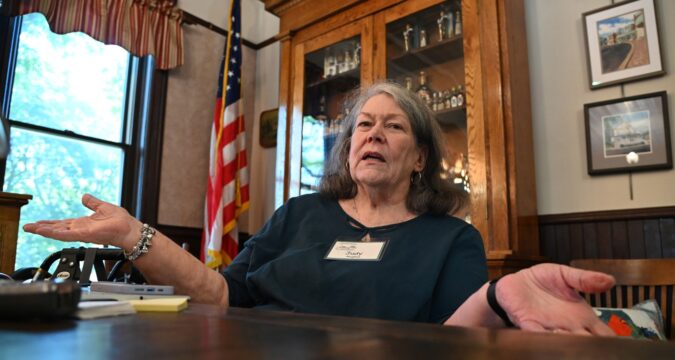
“This little window behind me is our window to the world of Northbrook,” said the late Judy Hughes of Northbrook, Northbrook Historical Society president, seated in the society’s building at Village Green Park in this 2022 photo. “We get to see everything in the park and the people that use it all year long. I just love this place and I love the people in it.” Images from Shermerfest at Village Green Park on Sept. 18, 2022 in Northbrook.
One of Hughes’ longest commitments was to the Northbrook Historical Society.
Dan Kaye, a member of the Northbrook Historical Society Board since 2000, wrote about Hughes’ service to that organization for the Society’s website.
He noted that Hughes joined the board of directors in 1995 and served as president from 1999 until her death.
He was impressed with her fiscal responsibility. “When helping to formulate a Society budget each year, she always aimed to overestimate expenses and underestimate income,” he praised.
Kaye was also impressed with Hughes’ interactions with visitors.
He wrote, “Despite all the challenges involved with leading the all-volunteer organization, one of Judy’s greatest pleasures was simply being at the History Museum on a Sunday afternoon when visitors would drop in and end up giving her a chance to learn about them and their Northbrook connections just by listening.”
From left, Judy Hughes of Northbrook receives a certificate and Key to the Village from Northbrook Village President Kathryn Ciesla during the board meeting on March 14, 2023 at Northbrook Village Hall.
During a phone conversation, Kaye further praised Hughes, saying, “Judy was amazing in many, many ways. She had this amazing recall ability about Northbrook history and families. She was so knowledgeable about the past but she was always looking to the future for the Historical Society, too.” That included encouraging young people to get involved.
Northbrook resident Terry Luc worked with Hughes, scanning hundreds of priceless images from the Northbrook Historical Society for “Northbrook,” an “Images of America” book that was published in 2008 by Arcadia Publishing.
“Her footprint is all over Northbrook,” Luc said of Hughes. “She was so dedicated to everything Northbrook. She will really be missed.”
Hughes was considered such a community champion that at the March 14, 2023 Village Board meeting, she was given a key to the village. Her many contributions to Northbrook were cited during the ceremony, including her 14 years serving on the District 28 School Board, including six as Board president.
Michael Hughes reported that there will be a celebration of life in memory of his wife at 10 a.m. Jan. 17 at the Northbrook Covenant Church, 2737 Techny Rd., Northbrook.
Myrna Petlicki is a freelance reporter for Pioneer Press.
https://www.chicagotribune.com/2026/01/06/memorial-planned-judy-hughes-leader-northbrook/
UBS: “Copper Is The Commodity Everyone Wants To Own”
UBS: “Copper Is The Commodity Everyone Wants To Own”
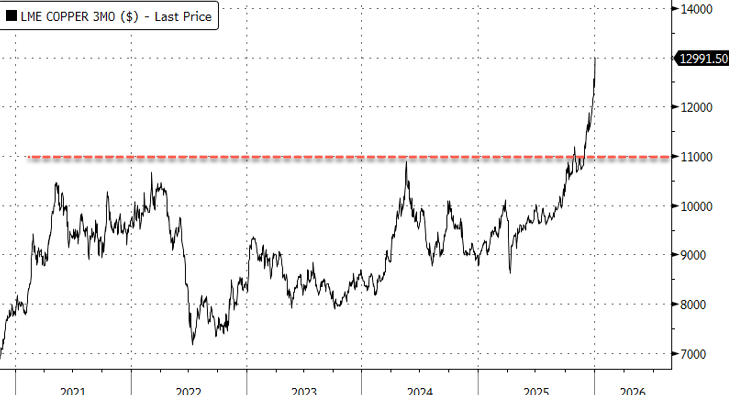
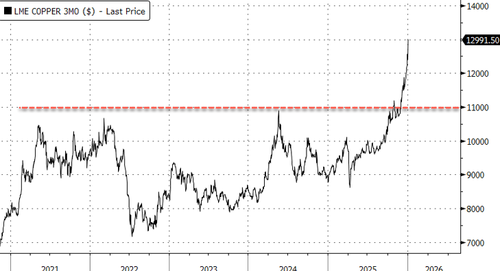
Goldman’s “circular melt-up” call and its recent upgrade to the 2026 London Metal Exchange (LME) copper price forecast have so far proven correct, as the industrial metal surged above $13,000 a ton with traders continuing to price in tighter global supply and a broader risk-on mood across metals.
Three-month LME copper futures rose as much as 3.1% to a record $13,387.50, surpassing the previous record high set just a day earlier. The move is driven by the risk that the Trump administration may impose tariffs on refined copper, prompting a multi-month surge in US inventory and draining supplies from major global markets.
“Copper extended its rally on Tuesday, with prices surging to a record $13,187 per ton, fuelled by a rush to ship the metal to the US amid tariff uncertainty and persistent supply disruptions,” UBS analyst Aditi Samajpati wrote in a brief note to clients earlier.
Samajpati continued, “The US premium has driven global inventory imbalances, with US stockpiles rising while the rest of the world faces tightening supplies. Speculative trading intensified as investors bet on further gains, supported by the metal’s critical role in energy transition and ongoing mine setbacks in Chile, Indonesia, and Congo.”
She added, “The rally is also part of a broader upswing in metals, with gold, silver, and platinum hitting new highs.”
In a separate note, UBS analyst Dan Major noted, “Net speculative positioning is elevated, and it is well known that copper is the commodity everyone wants to own.”
The prospect of US import curbs, combined with strong demand due to copper’s role in high-growth sectors such as data center buildouts and power grid upgrades, fueled a wave of optimistic calls late in 2025.
“Inventories used to act as a buffer, but now they’re locked in the US,” Li Xuezhi, head of research at Chaos Ternary Futures Co., recently told Bloomberg. “So the buffer is gone and everyone will have to scramble.”
Latest reporting:
Goldman: $10,000 Is New Price Floor For Copper
Copper Hits Record High; Goldman Warns A “Circular Melt-Up” Is Now Driving Global Market
Goldman Upgrades Copper Price Forecast Weeks After Warning About “Circular Melt-Up”
“The logic behind this rally remains,” said Li. “We need to track the trend and not get fixated on absolute price levels.”
Tyler Durden
Tue, 01/06/2026 – 11:25
https://www.zerohedge.com/commodities/ubs-copper-commodity-everyone-wants-own
The End Of NATO?
The End Of NATO?
By Molly Schwartz, Cross-Asset Macro Strategist at Rabobank
The Monroe Doctrine, proclaimed by U.S. President James Monroe in 1823, asserted American influence in the Western Hemisphere at a time when newly independent South American nations were emerging from European colonial rule. While the Doctrine, as a tool of policy, warns Europe to keep its hands off, it stopped short of declaring that the United States would act as nanny for these fledgling states.
Don’s interpretation of the Doctrine, however, seems a bit different — though not entirely unique. Indeed, digging a massive trench to split a country in two is a rather explicit form of U.S. intervention, though the recent operation in Venezuela marks the first time we’ve seen something like this from Washington since the Bush Administration (‘H’, not ‘W’). and the current Administration’s rhetoric surrounding the operation certainly sets it apart.
Secretary of State Marco Rubio clarified: “There’s not a war. [There is a] war against drug trafficking organizations—not a war against Venezuela.” Some might argue that a war is still a war regardless of how the opposition is defined, but Rubio would disagree. He has also made the core intentions of the U.S. clear: “This is the Western Hemisphere. This is where we live—and we’re not going to allow the Western Hemisphere to be a base of operation for adversaries, competitors, and rivals of the United States.”
As for Maduro, the situation appears straightforward. He is expected to be convicted by the Southern District of New York on at least one of the charges levied against him and will likely spend the rest of his life in prison. Maduro, however, has asserted that he is “not guilty of narco-terrorism charges,” proclaiming “I am innocent. I am not guilty. I am a decent man.”
On Monday, Vice President Delcy Rodriguez was sworn in as acting president, following Trump’s weekend comments to The Atlantic: “If [Rodriguez] doesn’t do what’s right, she is going to pay a very big price—probably bigger than Maduro.”
Rodriguez’s tone has shifted dramatically since the weekend. Initially condemning Maduro’s arrest as “barbaric,” she now extends an olive branch to Washington, stating: “We invite the U.S. government to work together on a cooperative agenda focused on shared development, within the framework of international law, and to strengthen lasting community coexistence.”
But Venezuela’s future is still uncertain. There has been a whirlwind of headlines questioning how much control the U.S. will take over Venezuela’s energy infrastructure or if they will ultimately end up taking control at all. Trump has thus made his position clear that he wants to be “very strongly involved” in the Venezuelan oil industry.
As noted by Senior Energy Strategist, Joe DeLaura, “a vast amount of capital investment would be needed to get Venezuela back up to its previous production levels…the minimum timeframe for getting output back to where it once was would be five to ten years and billions of dollars.”
Venezuela’s government is in flux as well. Will Maduro’s government, headed by Rodriguez, stay in place, or is she on borrowed time? Rodriguez’ recent mollification may have bought her a few more months (or perhaps that cushy apartment in Qatar that Maduro turned down), but the question remains: will we see true regime change in Venezuela after all?
Historically, the Monroe Doctrine applied to Central and South America, but its geographic boundaries were never explicitly defined. The Trump Administration, however, may be getting creative with borders, suggesting the Doctrine could soon extend to Greenland (which is still technically in the Western Hemisphere).
Greenland first surfaced as a talking point during Trump’s campaign. This has re-emerged over the weekend with Trump announcing that the U.S. “need[s] Greenland from a national security situation,” and that “we will deal with Greenland in about two months. Let’s talk about Greenland in 20 days.” What exactly we’ll be talking about when it comes to Greenland is not yet clear, but Denmark—and the EU—is taking this as a threat.
Danish Prime Minister Mette Frederiksen has said that “if the U.S. chooses to attack another NATO country militarily, then everything stops, including NATO and thus the security that has been established since the end of the Second World War.”
Greenland’s Prime Minister had some strong words for the Trump Administration, but seemed open to negotiations. “No more pressure,” he said, “No more fantasies of annexation. We are open to dialogue. We are open to discussions. But this must happen through the proper channels and with respect for international law.”
While an outright U.S. military takeover seems unlikely, diplomatic maneuvering is another matter. Trump’s approach to Statecraft has often been described as “too much stick, not enough carrot.” In the case of Greenland, we may see a bit more carrot. Still, with a population of only around 50,000, one might imagine a thought experiment where, for the low, low price of $50 billion, the U.S. offers every Greenlander $1 million in exchange for their country. That might prove more attractive.
Tyler Durden
Tue, 01/06/2026 – 11:05

Bobby Narang’s high school girls basketball rankings and player of the week for Lake County
Carmel climbs to No. 1, unbeaten Wauconda leaps five spots, and Mundelein, Vernon Hills, Waukegan and Lake Forest all move up.
TOP 10
With records through Monday and previous rankings in parentheses.
1. Carmel 12-4 (3)
Freshman Liv Johnson is averaging 16.0 points, 9.2 rebounds and 1.6 steals over the East Suburban Catholic Conference leader’s past five games.
2. Libertyville 12-3 (2)
Lily Fisher is averaging 18.9 points and 5.3 rebounds for the North Suburban Conference leader.
3. Lake Zurich 9-7 (1)
Alex Nowak-Tice is averaging 10.5 points and 10.1 rebounds for the Bears, who have had all of their starters for just two games.
4. Wauconda 13-0 (9)
Alessandra Rodriguez is averaging 7.7 points, 3.8 rebounds, 2.0 assists and 1.3 steals for the Northern Lake County Conference co-leader.
5. Mundelein 12-6 (6)
A standout defender, Anahya Castro is averaging 9.0 points, 6.0 rebounds, 2.2 steals, 2.0 bocks and 3.4 deflections for the Mustangs.
6. Vernon Hills 12-4 (7)
Madison Mays is averaging 6.5 points and 7.5 rebounds for the Central Suburban North leader.
7. Grayslake Central 7-7 (5)
Peyton Hoffmann is averaging 16.5 points and 6.2 rebounds over the Rams’ past five games.
8. Waukegan 10-6 (NR)
Freshman Mireya Rodriguez has been a spark off the bench for the Bulldogs with timely baskets and ball handling.
9. Lake Forest 8-7 (NR)
Charlie Axus is leading the Scouts in several statistical categories, including points, assists and steals.
10. Highland Park 6-5 (8)
Emily Calub has been a force on defense, particularly in recent losses to Warren and Stevenson.
PLAYER OF THE WEEK
Mundelein senior guard Casey Vyverman, who is averaging 18.0 points. 5.0 rebounds and 1.6 steals, broke the program record for career points on Dec. 30.
Bobby Narang is a freelance reporter.