Category: News
Today in Chicago History: Rev. Martin Luther King Jr. selects ‘typical ghetto apartment’ on the West Side
Here’s a look back at what happened in the Chicago area on Jan. 7, according to the Tribune’s archives.
Is an important event missing from this date? Email us.
Front page flashback: Jan. 8, 1946
An intruder climbed into the Degnan family’s home in Edgewater on Jan. 7, 1946, and killed their 6-year-old daughter Suzanne. William Heirens, the “Lipstick Killer,” pleaded guilty to her murder and two other killings later that year. (Chicago Tribune)
Six-year-old Suzanne Degnan was strangled by an intruder who used a ladder to climb into a window of her Edgewater home. The killer left a note demanding $20,000, but her body was found dismembered and disposed of in city sewers.
A timeline of the Heirens ‘Lipstick Killer’ case
William Heirens, then a 17-year-old University of Chicago student, was caught and confessed to killing Degnan and two women later that year. He became known as the “Lipstick Killer” after scrawling a message in lipstick at a crime scene: “For heaven’s sake, catch me before I kill more.”
Heirens was in prison for 65 years, becoming one of the longest-serving inmates in Illinois history, before he died in 2012.
Weather records (from the National Weather Service, Chicago)
High temperature: 65 degrees (2008)
Low temperature: Minus 16 degrees (1912)
Precipitation: 0.65 inches (1907)
Snowfall: 3.9 inches (2010)
Abe Saperstein, bottom right, owner-coach of the Harlem Globetrotters, points to a map in New York showing the planned route of the team’s tour with an all-star squad of college players on Jan. 24, 1950, in New York. Listening are Bill Veeck, top left, former Cleveland Indians owner; Chuck Taylor, top right, rubber company representative; and Clair Bee, LIU basketball coach. (Tom Fitzsimmons/AP)
1927: The Harlem Globetrotters played their first road game in Hinckley, Ill. So goes the story, anyway.
“Pretty much the entire official version of how the Globetrotters started is baloney,” said Ben Green, author of “Spinning the Globe: The Rise, Fall, and Return to Greatness of the Harlem Globetrotters.”
Green said the team went through so many hands and changes, there’s really no way to determine when a “first game” occurred.
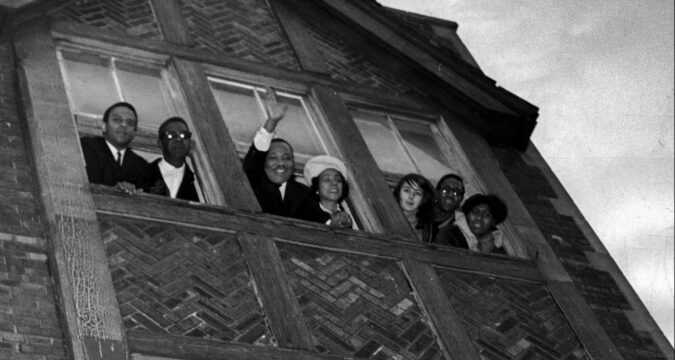
The Rev. Martin Luther King Jr. and his wife Coretta with neighborhood children in their new apartment at 1550 S. Hamlin Ave. in Chicago on Jan. 26, 1966. King and his family moved into the poor neighborhood to shed light on the living conditions of Black people in the city in 1966. (Tom Kinahan/Chicago Tribune)
1966: The Rev. Martin Luther King Jr. told reporters in Chicago that he was working on a three-phase plan to mobilize the city’s roughly 1 million Blacks.
King selected a “typical ghetto apartment on the West Side” at 1550 S. Hamlin Ave. to serve as his base for the following year.
Passengers submit to the first security checkpoint in use at Chicago’s O’Hare International Airport on Jan. 7, 1973. (Chicago Tribune)
1973: Security checkpoints went into operation at Chicago’s O’Hare International Airport. Everyone entering the terminal submitted to electronic scanning devices, which checked for metal objects including guns, knives and bombs, because of new federal anti-skyjacking regulations.
O’Hare International Airport: From farm to global terminal
In operation were 25 electronic screening devices for passengers, 11 X-ray units for carry-on luggage and several hand-held metal-detecting devices.
Want more vintage Chicago?
Subscribe to the free Vintage Chicago Tribune newsletter, join our Chicagoland history Facebook group and follow us on Instagram for more from Chicago’s past.
Have an idea for Vintage Chicago Tribune? Share it with Kori Rumore and Marianne Mather at krumore@chicagotribune.com and mmather@chicagotribune.com
https://www.chicagotribune.com/2026/01/07/january-7-chicago-history/

Today in History: Marian Anderson sings with the Metropolitan Opera
Today is Wednesday, Jan. 7, the seventh day of 2026. There are 358 days left in the year.
Today in history:
On Jan. 7, 1955, Marian Anderson became the first African American to sing with the Metropolitan Opera in New York, in Verdi’s “Un Ballo in Maschera.”
Also on this date:
In 1610, astronomer Galileo Galilei observed three of Jupiter’s moons for the first time and a fourth days later.
In 1979, Vietnamese forces captured the Cambodian capital of Phnom Penh, overthrowing the communist Khmer Rouge government whose brutal policies are blamed for the deaths of 1.7 million people, including the killing of thousands of Vietnamese villagers in cross-border raids.
In 1999, President Bill Clinton’s Senate impeachment trial began on grounds of perjury to a grand jury and obstruction of justice. The Republican-controlled House voted in October 1998 to start proceedings after months of controversy over Clinton’s relationship with White House intern Monica Lewinsky, with whom he denied having a sexual relationship. The Senate acquitted Clinton on Feb. 12, falling far short of the 67 votes needed to convict on each charge.
In 2015, masked gunmen stormed the Paris offices of Charlie Hebdo, a French newspaper that had caricatured the Prophet Muhammad, methodically killing 12 people, including the editor, before escaping. (Two suspects were killed two days later.)
In 2022, three white men convicted of murder after Ahmaud Arbery was chased and killed while jogging in a south Georgia community were sentenced to life in prison. The judge denied any chance of parole for the father and son who armed themselves and initiated the deadly pursuit of the 25-year-old Black man in 2020 after spotting him running in their neighborhood in Brunswick.
Related Articles
Chicago weather: How our 2025-26 seasonal snowfall compares with previous years
Today in Chicago History: Cody Parkey kicks ‘double doink’ that costs Bears chance to advance in playoffs
Today in History: Year-round daylight saving time begins
Holocaust survivor Eva Schloss, stepsister of Anne Frank, dies at 96
Robbins Historical Society director aims to digitize and increase access to town’s Black history
In 2023, Republican Kevin McCarthy was elected speaker of the U.S. House of Representatives in a historic post-midnight 15th ballot, overcoming holdouts from his own ranks after a chaotic week that tested the new GOP majority’s ability to govern.
Today’s Birthdays: Musician Kenny Loggins is 78. Actor David Caruso is 70. TV journalist Katie Couric is 69. Republican Sen. John Thune of South Dakota is 65. Republican Sen. Rand Paul of Kentucky is 63. Actor Nicolas Cage is 62. Actor Jeremy Renner is 55. Country singer-musician John Rich is 52. Formula 1 driver Lewis Hamilton is 41. NFL quarterback Lamar Jackson is 29. Actor Marcus Scribner is 26. Jay-Z and Beyoncé’s daughter Blue Ivy Carter is 14.

Twenty Years Of Watching The Thermometer… And The Narrative
Twenty Years Of Watching The Thermometer… And The Narrative
Authored by Anthony Watts via WattsUpWithThat.com,
In November 2006, when I launched Watts Up With That?, the idea was simple enough: look at the data, check the instruments, and ask whether the conclusions being drawn actually followed from the evidence. It was never intended as a career in heresy. It was, at the time, a fairly normal scientific impulse steeped in curiosity.
Nearly twenty years later, that impulse requires a helmet.
As WUWT approaches its twentieth anniversary in 2026, it’s worth reflecting on how climate change went from being a hypothesis—one among many competing explanations for observed changes—to a full-fledged belief system, complete with sacred texts (IPCC reports), approved language, and the occasional excommunication.
The climate, meanwhile, has been far less dramatic.
2006–2008: When Thermometers Were Still Just Thermometers
Back in the mid-2000s, climate science still resembled…well, science. There were disagreements. There were debates. People argued about cloud feedbacks, solar influences, ocean cycles, and the reliability of historical temperature records without being accused of crimes against humanity.
Al Gore’s An Inconvenient Truth arrived in 2006 like a traveling roadshow of impending doom. Polar bears were stranded, seas were rising, and hurricanes were apparently lining up in formation. It was slick, emotional, and heavy on graphs that only went in one direction.
At the same time, a curious thing was happening on the ground. Actual thermometers—those stubbornly analog devices—were being placed next to heat sources, asphalt, and buildings. So WUWT did something radical: we took pictures.
This turned out to be surprisingly controversial, heretical even.
Apparently, photographing a thermometer next to an air conditioning exhaust was not “constructive engagement.” Who knew?
2009: Climategate—The Sound of Trust Hitting the Floor
Then came Climategate.
The emails were not hacked in the Hollywood sense; they were released, read, and promptly explained away. What they showed was not a grand conspiracy, but something far more human: groupthink, defensiveness, and an alarming willingness to manage perception instead of data.
“Hide the decline” entered the public lexicon, and suddenly climate scientists were explaining that it didn’t mean what it sounded like it meant. Which, coincidentally, is almost never a good sign.
For a brief moment, it looked like climate science might undergo a badly needed course correction. Transparency! Open data! Robust debate!
Instead, we got faux inquiries that investigated themselves and found themselves innocent.
Lesson learned: the problem was not the behavior—it was that outsiders noticed.
2010–2014: The Pause That Wasn’t There (Until It Was)
The next few years delivered an unexpected plot twist: the planet declined to follow the script.
Global temperatures flattened. Models predicted steady warming; observations did not comply. This became known as the “pause,” then the “hiatus,” then—after enough editorials—the “thing that never happened and you’re not allowed to mention.”
This was a golden age for climate creativity. Heat was hiding in the deep oceans, where it could not be measured but could still be blamed. Aerosols became the Swiss Army knife of explanations. Data adjustments proliferated.
When observations disagreed with models, the models were not questioned. The observations were “corrected.”
It was around this time that many of us realized the hierarchy had flipped. Models were now reality. Reality was negotiable.
2015: Paris—Promises, Promises
The Paris Agreement was hailed as a turning point. World leaders gathered to save the planet using pledges that were voluntary, unenforceable, and carefully worded to sound impressive while committing to very little.
It was a triumph of political theater.
No one asked how intermittent energy would power industrial societies. No one discussed grid stability. No one mentioned energy poverty. Those details were, apparently, unhelpful.
From this point on, climate policy became less about outcomes and more about optics. If emissions went up, the solution was more ambition. If costs rose, the solution was more commitment. Failure was proof that we simply hadn’t believed hard enough.
2018–2019: The Emergency Button Gets Stuck
Somewhere around 2018, the word “emergency” became mandatory.
We were told we had twelve years to save the planet. Then ten. Then five. The deadline kept moving, but always closer—like a cosmic treadmill.
Children were encouraged to panic. Adults were scolded for driving cars. Weather was promoted from background noise to moral indictment.
A heatwave? Climate change.
A flood? Climate change.
A cold snap? Climate change “disrupting the jet stream.”
Heads I win, tails you deny science.
2020–2022: When Everything Was an Emergency
The pandemic years revealed just how easily societies could be governed by emergency decree. Climate activism took careful notes.
Lockdowns briefly reduced emissions, proving once and for all that modern civilization could, in fact, be shut down—at great human cost—for minimal climatic benefit.
Energy policies, however, continued unabated. Reliable baseload was dismantled. Wind and solar were celebrated for theoretical capacity rather than actual performance.
When grids faltered and prices soared, we were told this was further proof of the need to double down.
It was around this time that “trust the science” quietly came to mean “do not ask questions.”
2023–2026: The Era of Unquestionable Certainty
Now, at the twenty-year mark, the climate narrative is polished, institutionalized, and remarkably immune to evidence.
Sea level rise continues at rates best appreciated with tide gauges and patience. Extreme weather remains stubbornly inconsistent with apocalyptic claims. Crop yields rise. Human adaptability refuses to cooperate with disaster models.
But none of that matters much anymore.
The climate scare no longer depends on predictions coming true—only on maintaining urgency. Models still overestimate warming, but the solution is always the same: adjust, attribute, and assert.
Dissent is not debated; it is diagnosed.
Twenty Years Later
After two decades of watching this unfold, I’ve learned that the most remarkable thing about the climate scare is not how much the climate has changed—but how much the rules of discussion have.
In 2006, skepticism was part of science.
In 2016, it is treated as a character flaw.
In 2026, it seems like people might be listening to us.
WUWT has endured because it kept doing the unfashionable thing: looking at the data, pointing out inconsistencies, and occasionally raising an eyebrow when the emperor’s new model ran a little warm.
The climate will continue to change. It always has. The real question is whether society can rediscover the value of skepticism before policy built on perpetual emergency does lasting damage.
And if not—well, at least the models will still be very confident. /sarc
By the way, if you’ve not seen it yet, check out our newly updated Failed Climate Predictions Timeline.
Tyler Durden
Wed, 01/07/2026 – 05:00
https://www.zerohedge.com/weather/twenty-years-watching-thermometer-and-narrative

Paris Summit Wants Ukraine ‘Peace’ Through NATO Boots On Ground
Paris Summit Wants Ukraine ‘Peace’ Through NATO Boots On Ground
Tuesday’s major Ukraine summit of the so-called ‘coalition of the willing’ in Paris on Tuesday, where dozens of European leaders were hosted by President Emmanuel Macron, is still desperately trying to salvage strong security guarantees for Kiev as a central part of any future peace deal to end the war with Russia.
Macron vowed that Ukraine’s allies and military backers would “make concrete commitments” at the meeting “to protect Ukraine and ensure a just and lasting peace.” The Kremlin is going to see this as yet another exercise in flirting with Russia’s red lines – especially the idea of NATO ‘Article 5-style’ security guarantees.
Reportedly the United States has already agreed to lead a “ceasefire monitoring and verification mechanism” with European participation assuming a deal can be reached – based on a draft statement seen by the AFP.
Washington is also said to b willing “support” a European-led multinational force, which would necessitate American boots on the ground “in case” of any new future attack by Russia post-truce deal.
But one never really knows when it comes to President Trump – or what he’s ultimately willing to finally sign on to, also at a moment of ongoing friction with the Zelensky government.
It must be recalled that he and his admin officials have been quite vocal time and again about never committing American troops to Ukraine in the context of a fight with nuclear-armed Russia.
Trump himself has been strident on this point, going back even to the early campaign trail. Will he flip? The White House, if it does sign onto this fundamentally European plan or an alteration to the 20-points, is more likely to spin this as “not actually boots on the ground” to satisfy skeptics among the MAGA base.
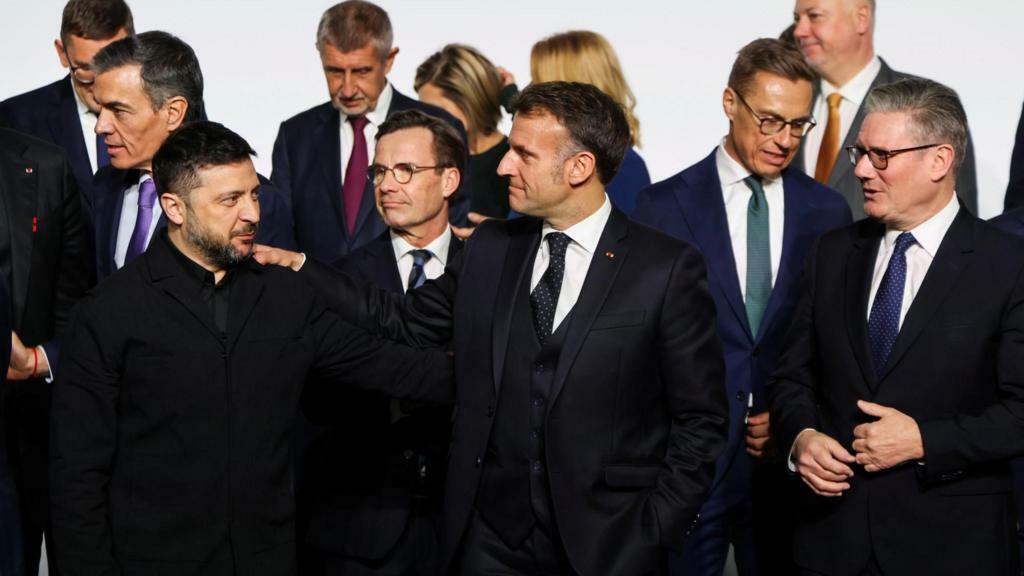
Ukrainian President Volodymyr Zelensky and American envoys are there in Paris, along with what’s said to be an unprecedented amount of other heads of state and defense officials.
🚨 Who is meeting in Paris today: A total of 40 representatives from different countries and international organizations.
28 country leaders, including Ukraine, will attend, along with leaders of 4 international organizations: the European Council, the European Commission,… pic.twitter.com/aLPH0eySBQ
— Kateryna Lisunova (@KaterynaLis) January 6, 2026
Reading the room, this meeting seems much more about Europe taking the reins of the peace deal away from Washington. Just look at the rhetoric… which Moscow will simply receive as dead on arrival:
Downing street has said that Britain will “deploy forces to Ukraine in event of a peace deal.” In a statement released after Starmer signed the “declaration of intent” earlier, his office says:
This is a declaration of intent to deploy forces to Ukraine in event of a peace deal. This is a vital part of our iron cast commitment to stand with Ukraine for the long term.
The ‘Multinational Force for Ukraine’ will act as a reassurance force to bolster security guarantees and Ukraine’s ability to return to peace and stability by supporting the regeneration of Ukraine’s own forces.
The signing of the declaration paves the way for the legal framework to be established for French and UK forces to operate on Ukrainian soil, securing Ukraine’s skies and seas and building an armed forces fit for the future.
In today’s discussions we have also gone into greater detail about the mechanics of the deployment of the force on the ground.
Alongside our plans for a coordination cell, post-ceasefire the UK and France will also establish ‘military hubs’ across Ukraine to enable the deployment and build protected facilities for weapons and military equipment to support Ukraine’s defensive needs.”
Starmer further said, “Putin is not willing to show peace. We will keep the pressure up on Russia, including further measures on oil trades and shadow fleet operators supporting Russia.” And of course this was seconded by all present.
Some interesting long lost faces popped up in Paris…
After all the corruption-related turmoil and reshuffles inside Zelensky’s government, Rada majority leader David Arakhamia surfaces at the meeting of the pro-Ukraine coalition in Paris.
Formerly Ukraine’s top Instanbul negotiator and reputedly a moderate, Arakhamia is known for… pic.twitter.com/9rNm8uj8XQ
— Leonid Ragozin (@leonidragozin) January 6, 2026
Meanwhile President Putin is not going to care about the “mechanics” or technical aspects of what such a deployment would look like. He will see it as but a recipe for what his forces have been fighting against all along: NATO soldiers and infrastructure right along border of the Russian Federation… potentially provoking events which could easily lead to WW3.
Tyler Durden
Wed, 01/07/2026 – 04:15
The Heart Of The Matter: Cardiac Risks Of COVID-19 Vaccines
The Heart Of The Matter: Cardiac Risks Of COVID-19 Vaccines
Authored by Michael Tomlinson via The Brownstone Institute,
Evidence continues to mount indicating that the global response to the Covid-19 pandemic was counterproductive and harmful, yet mainstream opinion continues to proclaim that it was a triumph.
This is based on scientific papers that often manipulate the data or present it selectively.
Exhibit 1: Cohort study of cardiovascular safety of different Covid-19 vaccination doses among 46 million adults in England by Ip et al. The authors conclude that ‘the incidence of common arterial thrombotic events (mainly acute myocardial infarction and ischaemic stroke) was generally lower after each vaccine dose, brand and combination’ and ‘the incidence of common venous thrombotic events (mainly pulmonary embolism and lower limb deep venous thrombosis) was lower after vaccination.’
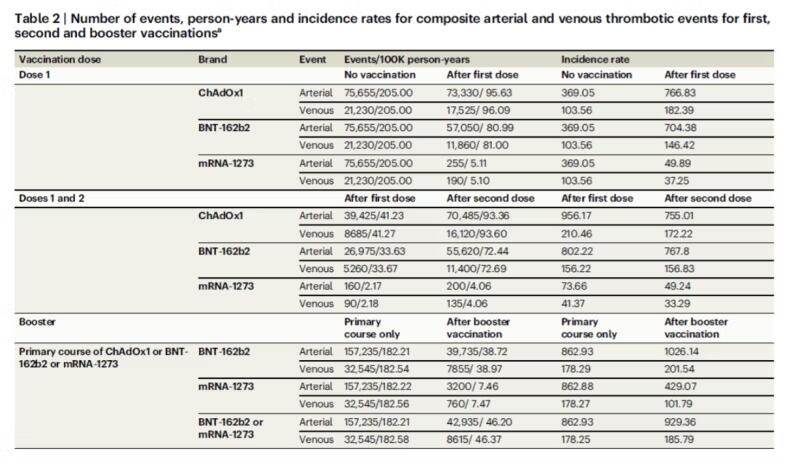
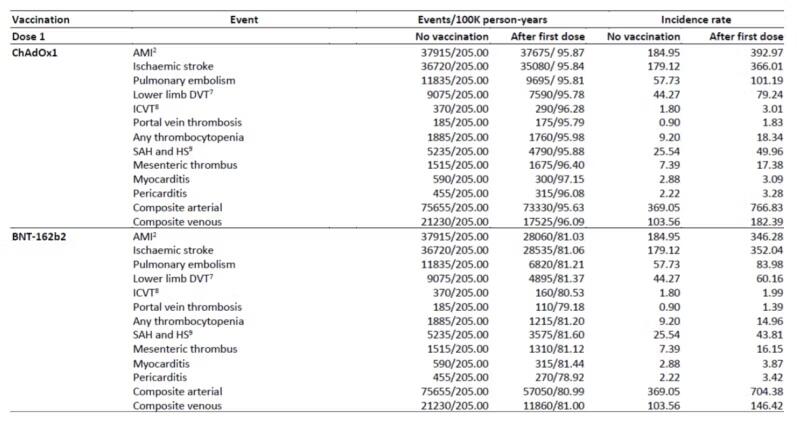
This seems to be a straightforward outcome, based on a most inclusive sample – the whole population of England. However, Table 2 shows incidence rates of cardiovascular events were substantially higher (nearly double for arterial events) after the first dose of the Pfizer and AstraZeneca vaccines, compared to no vaccination:
This contradicts the text: ‘The incidence of thrombotic and cardiovascular complications was generally lower after each dose of each vaccine brand.’ Of course, ‘generally’ is a weasel word. It means that the incidence of complications after each dose was lower except where it was higher. Incidence rates for the Moderna vaccine were indeed much lower at least in the medium term (up to 26 weeks) but rates for AstraZeneca and Pfizer were much higher.
Incidence rates after the second dose were indeed ‘generally’ lower in the tables. But Supplementary Table 3 reveals that the definition of ‘no vaccination’ for Dose 2 in fact means the interval between a first dose and a second dose. The largest increases in incidence rates are for the Pfizer and AstraZeneca Dose 1 vaccination groups, the only cohorts compared with a true vaccination naïve control group.
Supplementary Table 4 shows substantial increases in incidence rates for Dose 1 broken down for all eleven cardiac events measured (and two composites).
Returning to Table 2, the vaccinated group and the unvaccinated groups have comparable numbers of events, but the vaccinated groups are calculated with reference to approximately half the number of person years. If we apply the incidence rates to the numbers of people in each group (at the top of Table 1), we can calculate vaccination with the AstraZeneca and Pfizer vaccines brought about in the region of 91,000 additional serious cardiac events (euphemistically described as ‘complications’) compared to the no vaccination group in a little over one year. On the other hand, the Moderna group experienced over 34,000 fewer events compared with the no vaccination group, leading to an overall balance of around 56,000 additional events. How many of the individuals who had additional heart attacks, strokes, and thromboses subsequently died? The results are shocking, but after further processing we are told they are ‘reassuring.’
To obscure the alarming results, the text relies not on the straight incidence rates but on hazard ratios ‘adjusting for a wide range of potential confounding factors.’
It is not apparent why any adjustment was necessary. On the one hand, ‘There were few differences between subgroups defined by demographic and clinical characteristics,’ and on the other hand, ‘we addressed potential confounding by adjusting for a wide range of demographic factors and prior diagnoses.’ Were there significant differences in demographics or weren’t there?
Further on, we are told that ‘Subgroup analyses by age group, ethnic group, previous history of the event of interest and sex were conducted’ and outcomes ‘were generally similar across subgroups.’ What were the potentially confounding factors that had to be adjusted for if not these? How could an incidence rate of approximately 1.9 for the Pfizer Dose 1 arterial events be adjusted to a hazard ratio of 0.9?
If an adjustment leads to the reversal of findings of this magnitude, then it must be done transparently and with full substantiation. Without further explanation, the adjustment seems extraordinary and unjustifiable if outcomes were similar across subgroups and no differentiating factor is identified. They are statistical artefacts of low credibility and should not be used to guide policy.
This is a well-established academic trope – something that seems on the face of it to be black is not really black, but when ‘adjusted’ in an undisclosed and untransparent way has many white characteristics.
Table 2 compares the ‘primary course’ rates with the ‘after booster vaccination’ rates, where the Pfizer incidence rates are again higher for this last dose in the series, compounding the primary dose increase. I would have thought the authors should have commented on this, given that it contradicts the conclusions of the paper. This rise in the rate for vaccinated individuals with subsequent vaccinations is unlikely to be and is not in fact explained by confounding factors. We are told that both second dose-vaccinated and booster-vaccinated cohorts were older than the first dose cohort, so age does not seem to explain the rise. Other confounding factors are not revealed. Did they exist for any of the cohorts?
The authors also resort to breaking the data down into slices (dose by dose) in a way which prioritises the micro over the macro perspective, and obscures strategic synthesis.
After three doses (including boosters), how did the incidence rates of the vaccinated groups compare with that of the unvaccinated groups in toto, over the whole study period? Were they higher or lower overall? This is not revealed. What about after a year? Two years? Three years? Why are the Moderna rates so much lower, and why do they not discuss this? On the basis of the figures in the table, repeated doses of the Pfizer and AstraZeneca vaccines pose unacceptable risks. Yet these were the main vaccines deployed in England in this period, approximately 90% of the total.
But on the basis of these misleading and selected statistics, unasked and unanswered questions, the authors triumphantly conclude:
These findings, in conjunction with the long-term higher risk of severe cardiovascular and other complications associated with COVID-19, offer compelling evidence supporting the net cardiovascular benefit of COVID vaccination.
This is a whitewash. Their unadjusted data show the reverse – most Covid-19 vaccinations increased cardiac risks. The fact that the authors studiously refrain from referring to or discussing the markedly adverse incidence ratios after vaccination is strongly indicative of bias, although at least they included them in the tables, taking a risk that close readers might notice their significance.
Many other studies perpetuate the whitewash, based on a zero-sum assumption that there are two mutually exclusive groups: unvaccinated people who fall victim to Covid-19 and vaccinated people who don’t.But the Cleveland Clinic preprint by Shrestha et al found that:
Consistent with similar findings in many prior studies…a higher number of prior vaccine doses was associated with a higher risk of COVID-19. The exact reason for this finding is not clear. It is possible that this may be related to the fact that vaccine-induced immunity is weaker and less durable than natural immunity….Thus, the short-term protection provided by a COVID-19 vaccine comes with a risk of increased susceptibility to COVID-19 in the future.
They reached the same conclusion in their peer-reviewed report on the effectiveness of the 2019 bivalent vaccines: ‘The risk of Covid-19 also increased with time since the most recent prior Covid-19 episode and with the number of vaccine doses previously received.’
Studies which show that vaccinated groups have much lower rates of infection than unvaccinated groups are usually founded on the ‘case-counting window bias,’ as explained in the peer-reviewed report on the Italian region of Emilia-Romagna by Alessandria et al. The vaccinated have lower numbers of infections in a defined window of time, but not necessarily beyond it. By contrast, the Cleveland Clinic studies above use a longer and additive timeframe, and Ip et al do not seem to exclude the first 14 days, which is a strength of their base statistics.
There is the risk that both the vaccines and the virus might cause similar harms to the cardiovascular system. Jean Marc Sabatier of Aix-Marseilles University has been warning against this from early in the pandemic. In 2021 he and his colleagues published a peer-reviewed paper: The Renin-Angiotensin System: A Key Role in SARS-CoV-2-Induced COVID-19.
The paper explains:
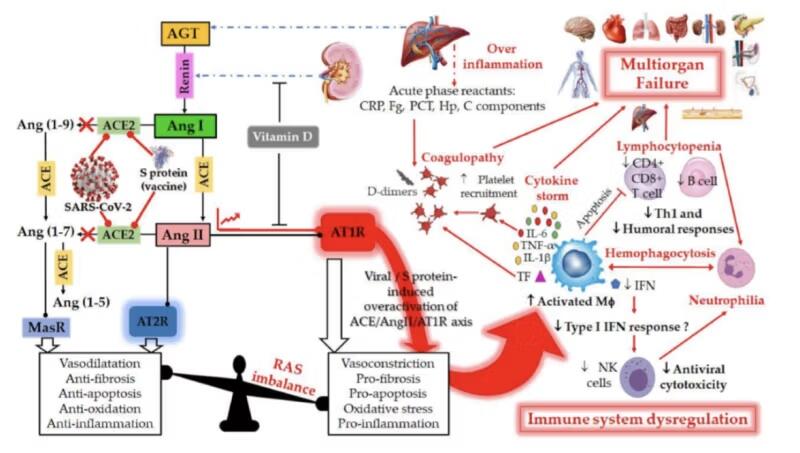
In fact, the viral entrance promotes a downregulation of ACE2 followed by RAS balance dysregulation and an overactivation of the angiotensin II (Ang II)–angiotensin II type I receptor (AT1R) axis, which is characterized by a strong vasoconstriction and the induction of the profibrotic, proapoptotic and proinflammatory signalizations in the lungs and other organs. This mechanism features a massive cytokine storm, hypercoagulation, an acute respiratory distress syndrome (ARDS) and subsequent multiple organ damage.
The model is depicted in Figure 1:
While the paper focuses almost entirely on Covid-19, the disease, the implications of the model go to risks of the vaccine also. This is cautiously slipped into the explication of Figure 1 (my italics): ‘during SARS-CoV-2 infection or upon receiving a spike protein-based vaccine, the viral Spike (S) glycoprotein binding to ACE2 receptor induces overactivation of the ACE/Ang II/AT1R axis.’
So, we must consider the risk that as well as the SARS-CoV-2 virus, some (if not all) vaccines might also induce overactivation of the ACE2 receptor and consequently the renin angiotensin system. There is no proof that they do, but there is equally no proof that they do not, and the model fits well with the Ip data on cardiovascular event incidence levels for the Pfizer and AstraZeneca vaccines (but not with the favourable Moderna figures – what is different about the Moderna vaccine?).
This would be an issue under any scenario, but even more so if incidence of Covid-19 increases with the number of vaccine doses previously received. The vaccinated can be repeatedly challenged by the spike protein both in the form of the virus and in the form of the vaccines as well. The risks from infection are not obviated – the risks of vaccinations are added to them, not substituted for them.
There has been a torrent of papers on the effects of Covid-19 vaccination, focusing on these limited windows of effectiveness. They display strong confirmation bias – data and findings apparently supporting effectiveness are welcomed with open arms despite obvious flaws, findings that overtly cast doubt on effectiveness or safety are vigorously contested and often succumb to a campaign to have them retracted. If the data are unfavourable, better to ‘adjust’ them so you can reverse the conclusions. This constitutes scientific misinformation.
Although pro-vaccine papers sometimes have sophisticated technical values, they show little capability for strategic thinking.
Which is the preferable and lowest-risk strategy over the timeframe of the pandemic crisis:
Undergoing multiple vaccinations of short-term effectiveness
Minimizing exposure to the spike vaccine?
The scientific literature simply does not test this strategic comparison by comparing overall outcomes for the vaccinated from the point of vaccination to the end of the pandemic crisis period, compared with the truly unvaccinated. But what we do know from the Ip population-level study of England is that Dose 1 for the two most commonly used vaccines increased 11 out of 11 cardiac events and a booster increased both arterial and venous events again for the Pfizer vaccine.
Individuals should be free to make the strategic choice, guided by their health professionals, and should not be coerced to follow the first strategy through mandates. Mandates should not risk creating severe adverse outcomes on a mass scale.
Tyler Durden
Wed, 01/07/2026 – 03:30
https://www.zerohedge.com/covid-19/heart-matter-cardiac-risks-covid-19-vaccines
These Are The Middle East’s Most-Populated Cities
These Are The Middle East’s Most-Populated Cities
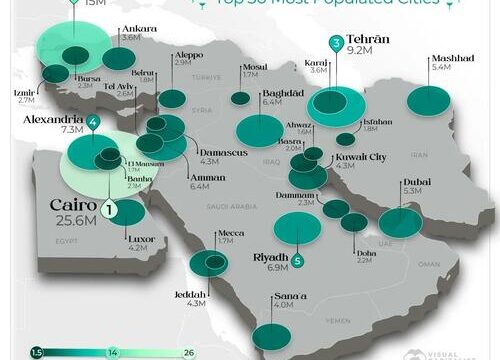
The Middle East is home to some of the world’s fastest-growing and most densely populated cities. Rapid population growth, rural-to-urban migration, and economic concentration have driven major cities to expand well beyond their historic cores.
This map, via Visual Capitalist’s Niccolo Conte, highlights the most populated cities in the region in 2025.
The data for this visualization comes from the United Nations.
Cairo Stands Alone at the Top
Cairo ranks as the Middle East’s most populated city, with more than 25.5 million residents in 2025. The Egyptian capital has expanded steadily for decades, driven by high birth rates and sustained migration from rural areas. Alexandria and several other Egyptian cities also rank highly.
Rank
Location
City
2025 population
1
🇪🇬 Egypt
Al-Qahirah (Cairo)
25,566,000
2
🇹🇷 Türkiye
Istanbul
15,015,000
3
🇮🇷 Iran
Tehrān (Tehran)
9,175,000
4
🇪🇬 Egypt
Alexandria
7,267,000
5
🇸🇦 Saudi Arabia
Ar-Riyāḑ (Riyadh)
6,916,000
6
🇯🇴 Jordan
Ammān (Amman)
6,404,000
7
🇮🇶 Iraq
Baghdād (Baghdad)
6,391,000
8
🇮🇷 Iran
Mashhad
5,398,000
9
🇦🇪 United Arab Emirates
Dubai
5,284,000
10
🇸🇾 Syria
Dimashq (Damascus)
4,288,000
11
🇸🇦 Saudi Arabia
Jeddah
4,284,000
12
🇰🇼 Kuwait
Al Kuwayt (Kuwait City)
4,265,000
13
🇪🇬 Egypt
Luxor
4,188,000
14
🇾🇪 Yemen
Şan’ā’ (Sana’a)
4,019,000
15
🇹🇷 Türkiye
Ankara
3,612,000
16
🇮🇷 Iran
Karaj
3,599,000
17
🇸🇾 Syria
Aleppo
2,922,000
18
🇹🇷 Türkiye
Izmir
2,650,000
19
🇮🇱 Israel
Tel Aviv
2,643,000
20
🇸🇦 Saudi Arabia
Dammam
2,336,000
21
🇹🇷 Türkiye
Bursa
2,282,000
22
🇶🇦 Qatar
Ad-Dawhah (Doha)
2,194,000
23
🇪🇬 Egypt
Banha
2,089,000
24
🇮🇶 Iraq
Basra
2,034,000
25
🇮🇷 Iran
Isfahan
1,844,000
26
🇱🇧 Lebanon
Bayrūt (Beirut)
1,794,000
27
🇪🇬 Egypt
El Mansura
1,713,000
28
🇸🇦 Saudi Arabia
Mecca
1,692,000
29
🇮🇶 Iraq
Mosul
1,665,000
30
🇮🇷 Iran
Ahwaz
1,639,000
Türkiye and Iran Anchor Urban Growth
Türkiye places multiple cities in the top 20, led by Istanbul with over 15 million people, followed by Ankara and Izmir.
Iran also features prominently, with Tehran, Mashhad, Isfahan, and several secondary cities reflecting the country’s large population and relatively balanced urban network.
Gulf Cities Punch Above Their Weight
Several Gulf cities appear high on the list despite much smaller national populations. Riyadh, Dubai, Jeddah, Doha, and Kuwait City have grown rapidly over the past two decades, fueled by economic diversification, infrastructure investment, and foreign labor inflows.
While smaller than Cairo or Istanbul, their growth rates remain among the fastest in the region.
If you enjoyed today’s post, check out The World’s Wealthiest Nations in 2025 on Voronoi, the new app from Visual Capitalist.
Tyler Durden
Wed, 01/07/2026 – 02:45
https://www.zerohedge.com/geopolitical/these-are-middle-easts-most-populated-cities
Trump margina a la oposición de Venezuela y deja al partido de Maduro en el poder
Por REGINA GARCÍA CANO
CARACAS (AP) — Los partidarios de la oposición venezolana llevaban mucho tiempo esperando el día en que Nicolás Maduro no estuviera en el poder, un sueño que se cumplió cuando el ejército de Estados Unidos se llevó al autoritario líder. Pero aunque el presidente de Venezuela está en una cárcel en Nueva York por cargos de tráfico de drogas, los responsables de su represivo gobierno siguen al mando.
La oposición del país, respaldada por gobiernos republicanos y demócratas consecutivos en Estados Unidos, prometió durante años reemplazar inmediatamente a Maduro con uno de los suyos y restaurar la democracia en el país rico en petróleo. Pero el presidente de Estados Unidos, Donald Trump, les asestó un duro golpe al permitir que la vicepresidenta de Maduro, Delcy Rodríguez, asumiera el poder.
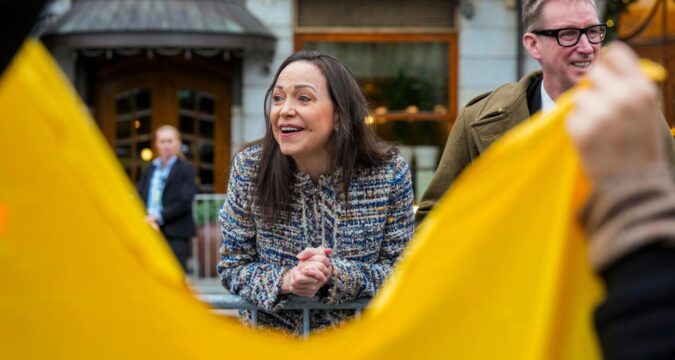
Mientras, la mayoría de los líderes opositores, incluida la ganadora del Premio Nobel de la Paz, María Corina Machado, están en el exilio o en prisión.
“Es evidente que no les impresionó el tipo de realismo mágico etéreo de la oposición, según el cual, con solo dar un empujón a Maduro, se produciría un movimiento instantáneo hacia la democracia”, dijo David Smilde, profesor de la Universidad de Tulane que lleva tres décadas estudiando Venezuela, con respecto al gobierno de Trump .
Estados Unidos capturó a Maduro y a la primera dama, Cilia Flores, en una operación militar el sábado, sacándolos de su hogar en una base militar en la capital de Venezuela, Caracas. Horas después, Trump dijo que Estados Unidos “dirigiría” Venezuela y se mostró escéptico ante la posibilidad de que Machado pudiera ser alguna vez su líder.
“No tiene apoyo interno, ni respeto dentro del país”, dijo el mandatario a reporteros. “Es una mujer muy agradable, pero no la respetan”.
Irónicamente, los incensantes elogios de Machado al presidente estadounidense, como dedicarle su Nobel y apoyar las campañas de Washington para deportar a migrantes venezolanos y atacar a presuntos narcotraficantes en aguas internacionales, le ha hecho perder algo de apoyo en el país.
La legítima ganadora de las presidenciales
Machado se convirtió en la principal figura de la oposición a Maduro en los últimos años, pero su gobierno le prohibió postularse a cargos públicos para evitar que lo desafiara —y probablemente lo derrotara— en las presidenciales de 2024. En su lugar, eligió al embajador retirado Edmundo González Urrutia para representarla en la boleta.
Funcionarios leales al partido gobernante declararon a Maduro como ganador apenas unas horas después del cierre de las urnas, pero la bien organizada campaña de Machado sorprendió a la nación al recopilar hojas de conteo detalladas que mostraban que González Urrutia había derrotado al mandatario por un margen de dos a uno.
Estados Unidos y otros países reconocieron al candidato de la oposición como el legítimo ganador.
Pero los venezolanos identifican a Machado, y no a González Urrutia, como la ganadora, y la carismática líder ha seguido siendo la voz de la campaña, buscando apoyo internacional e insistiendo en que su movimiento reemplazará a Maduro.
En su primera entrevista televisada desde la captura de Maduro, Machado elogió efusivamente a Trump y no reconoció su desprecio a la oposición en la última transición de poder.
“Hablé con el presidente Trump el 10 de octubre, el mismo día en que se anunció el premio, y no desde entonces”, dijo en declaraciones a la televisora Fox News el lunes. “Lo que ha hecho, como dije, es histórico, y es un gran paso hacia una transición democrática”.
Esperanzas de nuevas elecciones
El secretario de Estado de Estados Unidos, Marco Rubio, pareció retractarse el domingo de la afirmación de Trump de que Estados Unidos “dirigiría” Venezuela. En varias entrevistas, Rubio insistió en que Washington utilizará el control de la industria petrolera venezolana para forzar cambios políticos, y calificó a su actual gobierno como ilegítimo. Venezuela alberga las mayores reservas probadas de petróleo crudo del mundo.
Ni Trump ni Rodríguez han dicho cuándo, o incluso si, se celebrarán elecciones en el país.
La constitución venezolana exige que haya elecciones en un plazo de 30 días siempre que un presidente se vea “permanentemente incapacitado” para ejercer el cargo. Los motivos contemplados incluyen la muerte, la renuncia, la destitución o un “abandono” de funciones, según determine la Asamblea Nacional. El calendario electoral se siguió rigurosamente cuando el predecesor de Maduro, Hugo Chávez, murió de cáncer en 2013.
El senador estadounidense Lindsey Graham, un aliado cercano de Trump que viajó con el presidente en el Air Force One el domingo, dijo el martes que cree que habrá comicios, pero no especificó cuándo ni cómo.
“Vamos a reconstruir el país, en términos de infraestructura, culminando con unas elecciones que serán libres”, dijo el republicano de Carolina del Sur a reporteros.
Pero los leales a Maduro en el Tribunal Supremo declararon el sábado, citando otra disposición de la Constitución, la ausencia de Maduro como “temporal”, lo que significa que no hay obligación de convocar elecciones. En su lugar, la vicepresidenta, que no es un cargo electo, asume el control por hasta 90 días, con la posibilidad de una prórroga de hasta seis meses si recibe la autorización de la Asamblea Nacional, que está controlada por el partido gobernante.
Desafíos para la oposición
En su fallo, el alto tribunal venezolano no mencionó el límite de 180 días, lo que llevó a especular con que Rodríguez podría intentar aferrarse al poder mientras busca unir a las facciones del partido gobernante y protegerlo de lo que seguramente sería un complicado desafío electoral.
Machado calificó el lunes a Rodríguez como “una de las principales arquitectas de la tortura, la persecución, la corrupción, el narcotráfico… Ciertamente, no una persona en la que los inversionistas internacionales puedan confiar”.
Incluso si se celebran elecciones, Machado y González Urrutia tendrían que encontrar primero la forma de regresar a Venezuela.
González Urrutia está exiliado en España desde septiembre de 2024 y Machado dejó Venezuela el mes pasado cuando apareció en público por primera vez en 11 meses para recibir el Nobel de la paz en Noruega.
Ronal Rodríguez, investigador del Observatorio de Venezuela en la Universidad del Rosario de Colombia, dijo que la decisión del gobierno de Trump de trabajar con Rodríguez podría dañar el “espíritu democrático” del país.
“Lo que hizo la oposición en las elecciones de 2024 fue unirse con el deseo de transformar la situación en Venezuela por medios democráticos, y eso está encarnado por María Corina Machado y, obviamente, Edmundo González Urrutia”, manifestó. “Ignorar eso es menospreciar, casi humillar, a los venezolanos”.
___
Esta historia fue traducida del inglés por un editor de AP con la ayuda de una herramienta de inteligencia artificial generativa.
“We Don’t Want Your Culture Of Dominance” – Denmark To Ramp Up Deportations Of Criminal Foreigners
“We Don’t Want Your Culture Of Dominance” – Denmark To Ramp Up Deportations Of Criminal Foreigners
Authored by Thomas Brooke via Remix News,
Danish Prime Minister Mette Frederiksen has announced plans for deportation reform aimed at expelling more foreign nationals convicted of serious crimes, using her New Year’s address to argue that Denmark must put public safety and victims first, even if doing so pushes the boundaries of international conventions.
“The government will soon present a comprehensive deportation reform,” Frederiksen said.
“This will mean that even more criminal foreigners will have to be sent out of Denmark.”
She drew a clear distinction between immigrants who, in her words, had embraced Denmark and those who commit crimes.
“You can be Danish even if your favorite dish isn’t meatballs or mackerel sandwiches, for that matter. We Danes, don’t look the same. Nor should we. But we should love each other.”
Frederiksen’s tone hardened when addressing the current issues regarding criminality and integration.
“In Denmark, when democracy and religion collide, it is God who has the right of way,” she said, before adding:
“Therefore, to the people who have come here and are committing crimes: You shouldn’t be here. We don’t want your madness and culture of dominance. You are destroying the most beautiful country in the world, and you should not be allowed to do that.”
🇩🇰🚨 Denmark’s Prime Minister Mette Frederiksen used her New Year’s address to promise ramped-up deportations for foreign criminals.
“We do not want your culture of dominance. You are destroying the most beautiful country in the world.” pic.twitter.com/XKdbTmNXRn
— Remix News & Views (@RMXnews) January 5, 2026
She cited specific cases to underline what she described as systemic failures.
“No one can understand why an Iraqi man convicted of brutally assaulting an innocent person with a golf club cannot be deported,” Frederiksen said.
“Nor why a previously convicted man from Kosovo, convicted of abusing his children and spouse for several years, can be allowed to stay here.”
Under the government’s proposal, foreigners would be deported if they commit serious crimes and receive a prison sentence of at least one year, regardless of their length of stay or personal ties to Denmark.
“This makes it a very clear starting point,” Frederiksen said.
“If you are convicted of, for example, rape, aggravated assault, or other serious crime, then your stay in Denmark is over.”
Frederiksen said Denmark already deports many criminal foreigners due to what she described as a strict immigration policy that goes “to the edge of conventions.” She argued that the government could now go further because Denmark, together with Italy, had succeeded before Christmas in gathering support from 27 countries for a new interpretation of the European Convention on Human Rights. “Now, first and foremost, it must be the populations – and the victims – who are protected. And not the perpetrator,” she said. “Instead of waiting several years for it to take effect in court practice, we are taking the lead and implementing legislation before the summer.”
In October last year, a government report revealed that nearly three-quarters of those convicted under Denmark’s so-called gang clause have immigrant backgrounds from non-Western countries. Data released by the Ministry of Justice showed that between 2018 and 2025, 213 people were convicted under Section 81a of the Criminal Code, which allows courts to double sentences for crimes likely to provoke gang violence. Of those convicted, 54 were of Danish origin, 36 were immigrants from non-Western countries, and 117 were descendants of non-Western immigrants, meaning 72 percent had non-Western roots. Conservative immigration spokesman Frederik Bloch Münster described the figure as “remarkably high.”
Denmark has already moved to tighten deportation rules. In December 2024, the government announced plans to abolish the so-called ladder system, which limits deportation based on the severity of a crime and the offender’s length of stay in the country. The proposed reform would allow the deportation of any foreign national sentenced to an unconditional prison term, unless doing so would breach Denmark’s international obligations.
“Unfortunately, foreigners in Denmark are overrepresented in the crime statistics and too often commit serious crimes — such as those related to gang activity. We don’t have to deal with that. The hammer must fall even harder,” said Immigration and Integration Minister Kaare Dybvad Bek at the time.
“Therefore, we want to tighten the rules so that we can get even more criminal aliens deported. Every criminal alien who is deported by Denmark is a victory for the legal community and a victory for our country.”
The deportation push is part of a broader tightening of Denmark’s approach to immigration and national identity. Since Jan. 1, 2025, it has been illegal to raise foreign flags without special permission, following new legislation passed by the Folketing after a Supreme Court ruling struck down a 1915 ban. The new rule restored restrictions while allowing exceptions for Nordic flags, Germany, Greenland, the Faroe Islands, and specific contexts such as sporting events, demonstrations, or special permits granted by police or the justice minister.
Justice Minister Peter Hummelgaard defended the measure last December, saying, “The Dannebrog is the most important national symbol we have in Denmark. A symbol that binds the Danes together as a people, and which should enjoy a very special status in Denmark.”
Tyler Durden
Wed, 01/07/2026 – 02:00

Kyra Lilly, a college soccer recruit, keeps things going on basketball court for Kaneland. ‘Give it my all.’
First and foremost, Kyra Lilly is a soccer player for Kaneland. But the main thing she does in that sport — constant running, all over the field — serves her well in her second sport.
The Lake Forest College soccer recruit has learned along the way that as long as she does the same thing on the basketball court, she’s doing something right for the Knights.
“If I’m just running, I figure I’m doing something if I’m going as hard as I can,” Lilly said.
Lilly, who does just about everything for the Knights, stayed on course Tuesday night.
The senior guard continues to step up as a key third offensive option and tied teammate Daniela Ridolfi for game-high scoring honors in a 53-22 nonconference win over Plano in Maple Park.
Lilly and Ridolfi each scored 13 points for Kaneland (13-5), while Kalie Brown added seven points and seven rebounds. Chloe Rowe paced Plano (7-8) with eight points and seven rebounds.
Kaneland’s Kyra Lilly (21) reacts to a basket against Plano in the second quarter of a nonconference game in Maple Park on Tuesday, Jan. 6, 2026. (H. Rick Bamman / The Beacon-News)
Although Lilly doesn’t play AAU basketball, she has no qualms accepting what her role is, especially since her only exposure to the sport is during the winter.
“I’m trying to give it my all because I never did AAU or anything,” Lilly said. “I’m more of an effort type of player than skill.”
That’s perfectly fine with Kaneland coach Brian Claesson.
“She literally does everything for us,” Claesson said of Lilly. “She does everything we ask of her. Defensively, she’s a coach on the floor. She’s been playing really great for us.”
Kaneland’s Kyra Lilly (21) looks to pass as Plano’s Jadyn Long (11) defends in the third quarter of a nonconference game in Maple Park on Tuesday, Jan. 6, 2026. (H. Rick Bamman / The Beacon-News)
Grace Brunscheen has become the Knights’ go-to offensive player this season. Amani Meeks has been the second option. Lilly’s emergence on that end has been welcomed by Claesson.
“We’ve been looking for that third option for scoring after Amani and Grace,” Claesson said of Lilly. “And she’s been stepping up.”
Coming out of the holiday break, Kaneland faced a sluggish start Tuesday, leading only 7-6 late in the first quarter. Plano took advantage during those eight minutes.
“We play like that sometimes,” Plano coach Tristan Spivey said of the Reapers. “I told the girls after the first quarter not to let the game get away from us.
“When you play good teams like this, and it’s good to play them, this is what we’ve been doing. There’s a little segment where we start to let it get away and they start hanging their heads.”
Kaneland’s Kyra Lilly (21) sets up on defense against Plano in the second quarter of a nonconference game in Maple Park on Tuesday, Jan. 6, 2026. (H. Rick Bamman / The Beacon-News)
Kaneland got rolling in the second quarter, with a 26-0 run pushing the lead to 33-6. Ridolfi scored seven straight points in that spurt and Lilly ended the burst with three straight layups.
“It took us a little while in the first quarter to kick the rust off a little bit,” Claesson said. “Second quarter, I thought we started playing our brand of basketball and playing defense.”
Plano experienced a scare in the second half as freshman point guard Le’Niya Viser went down with an injury. Spivey hopes it’s not serious but expects her to miss time.
“She’s been really good, handles the ball for us,” Spivey said. “She breaks the press on her own.”
It’s basically a new team this season for Kaneland, and even Claesson has been impressed with how quickly things are clicking.
Kaneland’s Kyra Lilly (21) and teammate Kalie Brown (33) and Plano’s Le’niya Viser (1) fight for a rebound during a nonconference game in Maple Park on Tuesday, Jan. 6, 2026. (H. Rick Bamman / The Beacon-News)
“A lot of different roles, I think it’s coming along faster than I thought,” Claesson said. “Now, we’re just harping on being more consistent.”
Lilly agreed with that assessment, and it even played out early on Tuesday.
“I think we are putting it together,” Lilly said. “The only problem is playing the full four quarters.”
One thing is for certain. No matter how things go, Lilly will be out there running around.
“I never have to sub her out,” Claesson said. “She just plays so hard and never gets tired. It’s awesome to have that.”
Paul Johnson is a freelance reporter for The Beacon-News.
https://www.chicagotribune.com/2026/01/07/kyra-lilly-kaneland-plano-ihsa-girls-basketball/

Asking Eric: I don’t like taking money from friends
Dear Eric: My wife and I own a guest house up the street from our home. When we’re not using it for ourselves, my wife rents it out on Airbnb. The Airbnb guests pay a nightly rate and also pay a cleaning fee, which we use to pay the cleaning staff after they check out.
I like to let friends from out of town stay there for free when they are visiting. My wife is OK with not charging them a nightly rate but thinks we should charge them the cleaning fee because we still have to pay to have the unit cleaned after they leave.
I disagree. I don’t like taking money from friends at all. We’re financially successful, so we don’t need the money. Being generous to my friends and family is part of my personality. It feels wrong to me to ask friends to pay a cleaning fee.
My wife and I rarely argue, but we can’t seem to agree on this. What do you think?
– Generous Husband
Dear Husband: Neither of you is wrong, per se. Your wife doesn’t want to end up paying for the privilege of hosting, which is fair. And you want to extend hospitality to your friends without strings. In this case, the solution may not be coming to an agreement. Instead, the best course of action is to find a compromise that doesn’t cause resentment for either of you.
If you don’t want to ask your friends to pay, then see if there’s another way that the cleaning fee can be covered. Perhaps visiting friends can take you out to dinner that costs the same amount. Or, if you and your wife have discretionary pots of money within your shared accounts, maybe you can volunteer to cover the cost of the cleaning.
If hospitality is paramount for you, be creative about finding a way to do it. And make that the focus of your conversations with your wife. Instead of both of you standing on your separate sides, ask each other what’s in the middle. With disagreements like this, sometimes it’s useful to say “we just see this differently and that’s fine. How can we work together to make sure everyone gets what they want?”
Dear Eric: On December 6, “Leftovers, Anyone” wrote about her daughter’s Friendsgiving overshadowing her own Thanksgiving. The letter read, in part, “I don’t feel it is as special as it was because now everyone has already had the traditional Thanksgiving meal that previously we only had that one time a year.” I think that I can give another way to look at this, or at least share my experience.
My stepdaughter and her daughters were so tired of all the Friendsgiving parties that they attended that they didn’t show up to our traditional Thanksgiving meal. They showed up hours later and literally ate leftovers.
Clearly my party and my side of the family was not a priority. Even the hospitality of sending food home with them was taken away from me, as their refrigerator and freezer was stuffed from their prior parties. I’m not sure that this is what children need to be taught, but I also think that it is the future of Thanksgiving.
– Change is Coming
Dear Change: I’d gently suggest that you’re not helpless against the changing tide. You’ve noticed a pattern that seems to be in conflict with your hopes and expectations for the holiday. So, for next year, you have the opportunity to talk about it with your daughters in advance and find a solution that makes everyone happy.
Every holiday meal is, of course, about the food, but its primary purpose is togetherness as a family. As people change, and family structures change, we have the power to change what that togetherness looks like and how it happens.
It’s important for you to sit at a table with your daughters and share a meal. From your letter, it’s also important to extend hospitality to them in the form of leftovers. Now that the dust of the holidays has settled, talk to them about what’s important to you and what’s important to them. And see if together you can come up with a plan for next year that meets everyone’s needs. It might mean that Thanksgiving changes a little bit on your side – maybe there’s fewer leftovers, for instance – but it also might mean that they’re more aware of the impact of their actions and they plan their time better.
Related Articles
Asking Eric: Judged for hearing loss
Asking Eric: I’m not having him over again unless he apologizes
Asking Eric: Why should I go to my 50th high school reunion?
Asking Eric: Can I take their leftovers?
Asking Eric: Should I send gift cards instead of gifts?
Holidays don’t just happen. I know you know this because you’re putting a lot of work into it. It’s good to talk to your loved ones about what you’re doing and to include them in the work of making the holidays special for everyone, you included.
(Send questions to R. Eric Thomas at eric@askingeric.com or P.O. Box 22474, Philadelphia, PA 19110. Follow him on Instagram and sign up for his weekly newsletter at rericthomas.com.)
https://www.chicagotribune.com/2026/01/07/asking-eric-i-dont-like-taking-money-from-friends/