Category: News
Mamdani’s Clown Show Offers Its Opening Act
Mamdani’s Clown Show Offers Its Opening Act
Submitted by QTR’s Fringe Finance
Zohran Mamdani promised a political revolution. What New York received in his first hours as mayor was a seminar in how slimy, two-faced doubletalk can face-plant when its reality is laid bare.
Mamdani was sworn in on January 1 with soaring rhetoric about affordability, equity, and transformation. It’s been literally one week and the socialist imbecile has already humiliated himself multiple times in front of the entire nation. At this rate, he’s going to make Bill DeBlasio look like Abraham f**king Lincoln.
By the time most New Yorkers had finished their leftover holiday bagels, the transit system he had promised to “liberate” from fares had already become more expensive. Subway and bus fares went up almost immediately. Yes, the increase had been scheduled earlier, but the optics were exquisite: the self-styled champion of free transit officially presiding over higher costs. Nothing captures the Mamdani brand better than promising “free” public transportation and delivering a fare hike before the echo of the oath of office has even faded.
Instead of grappling with that inconvenient collision between slogans and spreadsheets, the new mayor did what any seasoned activist would do: he changed the subject to the expensive cost of World Cup tickets. Yes, a new crusade already! Suddenly, FIFA was the oppressor and average soccer-loving New York City citizens were the proletariat.
Mamdani began lamenting the price of World Cup tickets for matches being held in New Jersey (which isn’t New York) and announced his intention to intervene in global sports pricing. He spoke movingly about affordability. He suggested discounted tickets for New Yorkers. His supporters were very impressed.
What he did not do, however, was explain how a city mayor, with exactly zero authority over FIFA’s international ticketing structure, planned to accomplish any of the aforementioned bullshit. When pressed on what “affordable” actually meant, there was no answer. The proposal was a box labeled ‘solution’ with nothing but hot air and vibes inside of it. And so, at least for one day at the start of his Mayorship, the city keeps drowning in real problems while the mayor was busy trying to wrestle a multibillion-dollar global sports cartel.
It was less policy and more cosplay, but hey — look how genuine and concerned he is!
Housing, the supposed centerpiece of his administration, has started becoming a joke in record time. Mamdani stocked key positions with ideological activists whose past statements attacked private property, denounced homeownership, and treated ownership itself as a moral failing. The most explosive example is Cea Weaver, his newly appointed director of the Mayor’s Office to Protect Tenants, whose old tweets and videos blew up this week after she was shown calling homeownership “a weapon of white supremacy” and arguing that property should be treated as a collective good rather than an individual right. It’s beyond delusion, it’s psychopathy.
The backlash was immediate and predictable. Homeowners, developers, and investors — the very people the city needs if it has any hope of building more housing — reacted with alarm. Mamdani’s response was not to reassure them, but to dig in and defend the appointment, as if antagonizing the people responsible for building the city’s housing supply were some kind of bold reform strategy. Because nothing solves a housing crisis faster than putting someone in charge who has publicly questioned whether property should exist at all. If the plan is to freeze development and watch prices climb even higher, the administration is off to a flawless start.
🔥 80% OFF IF YOU SUBSCRIBE NOW: Get 80% off an annual subscription to Fringe Finance if you subscribe now — a discount you keep for as long as you wish to remain a subscriber. You get my full 26 Stocks I’m Watching for 2026 list and a wide array of toilet humor mixed with rudimentary equity analysis throughout the year: Get 80% off forever
Then came the foreign policy episode, a self-inflicted embarrassment that managed to combine dipshit-level hubris with precisely zero years of experience on how the real world works. When news broke of the U.S. military’s capture of Venezuelan leader Nicolás Maduro, Mamdani announced that he had been “briefed” on the operation, projecting the image of a mayor plugged into high-level national security deliberations. Morons were again, very impressed. Here’s a guy that gets shit done, eh?
But of course, within twenty-four hours, he had to admit he doesn’t even have federal security clearance and that his so-called “briefing” came from his own staff and public reporting. Translation: he read the New York Post and found out about the news like everyone else. Then, because in his mind he’s someone important, he felt the need to say something when no one asked, or cared, about his opinion in the first place.
The mayor of New York City has no role in U.S. military operations, no authority over foreign policy, and no access to classified information, yet Mamdani spoke as though he were taking notes in the Situation Room. The internet responded the only way it could: with laughter.
What emerges from these first hours is not just a series of mistakes, but a governing personality. Big promises. No mechanisms. High drama. No delivery. Ideology over infrastructure. Performance over plumbing. The city’s most powerful office being treated less like an executive command center and more like an activist open mic.
Being Mayor of New York City requires more than ambition, more than buzzwords, and considerably more respect for reality than Mamdani has shown so far. If this is the tone of the opening act, the rest of his term could be a shit show the likes of which New York City hasn’t seen in decades.
QTR’s Disclaimer: Please read my full legal disclaimer on my About page here. This post represents my opinions only. In addition, please understand I am an idiot and often get things wrong and lose money. I may own or transact in any names mentioned in this piece at any time without warning. Contributor posts and aggregated posts have been hand selected by me, have not been fact checked and are the opinions of their authors. They are either submitted to QTR by their author, reprinted under a Creative Commons license with my best effort to uphold what the license asks, or with the permission of the author.
This is not a recommendation to buy or sell any stocks or securities, just my opinions. I often lose money on positions I trade/invest in. I may add any name mentioned in this article and sell any name mentioned in this piece at any time, without further warning. None of this is a solicitation to buy or sell securities. I may or may not own names I write about and are watching. Sometimes I’m bullish without owning things, sometimes I’m bearish and do own things. Just assume my positions could be exactly the opposite of what you think they are just in case. If I’m long I could quickly be short and vice versa. I won’t update my positions. All positions can change immediately as soon as I publish this, with or without notice and at any point I can be long, short or neutral on any position. You are on your own. Do not make decisions based on my blog. I exist on the fringe. If you see numbers and calculations of any sort, assume they are wrong and double check them. I failed Algebra in 8th grade and topped off my high school math accolades by getting a D- in remedial Calculus my senior year, before becoming an English major in college so I could bullshit my way through things easier.
The publisher does not guarantee the accuracy or completeness of the information provided in this page. These are not the opinions of any of my employers, partners, or associates. I did my best to be honest about my disclosures but can’t guarantee I am right; I write these posts after a couple beers sometimes. I edit after my posts are published because I’m impatient and lazy, so if you see a typo, check back in a half hour. Also, I just straight up get shit wrong a lot. I mention it twice because it’s that important.
Tyler Durden
Thu, 01/08/2026 – 11:25
https://www.zerohedge.com/markets/mamdanis-clown-show-offers-its-opening-act

One for the Books: Ready, set, go — new Amazing Book Challenge underway
Let’s make 2026 amazing! If your New Year’s resolutions include reading more, be sure to sign up for the Amazing Book Challenge at Naperville Public Library. This reading program encourages adult and teen readers to branch out and discover new titles, genres and authors they might not pick up otherwise.
Each month, you’ll read a book that fits one of our 12 unique categories. Log your progress along the way to earn fun rewards. Complete all 12 categories, and you’ll score a Naperville Public Library umbrella and an entry into our end-of-year prize drawing.
Check out the category descriptions below, and visit www.naperville-lib.org/ABC for lists of book recommendations for each category.
Novel Newbies
Everyone starts somewhere. Even your favorite author was a debut writer at one time. Celebrate fresh voices and first-time storytellers making their mark by choosing a debut novel.
Go for the Gold
Ready, set, read! Whether you’re into fierce rivalries, photo finishes or underdog victories, this category brings the thrill of competition to the page. Pick your favorite because it’s game time!
Celebrity Book Club
This category features must-read recommendations from your favorite celebrities’ book clubs, including Reese Witherspoon, Jenna Bush Hager and Oprah Winfrey.
Undercover Authors
An author by any other name … would write a very different book! For this category, we’ll uncover the pen names authors use in place of their own.
Out of Order
Who says stories have to start at the beginning? This category is all about books with nonlinear narratives, broken timelines, fractured plots and stories that zig when you expect them to zag.
Unlikely Pairs
Sometimes the best friendships come from the most unexpected places. This category celebrates oddball duos, mismatched mates and surprising bonds that prove connection can bloom in the unlikeliest of places.
Farm to Page
Country reads, take me home! From heartwarming tales set under wide-open skies to rural dramas, this category will make you want to read ‘til the cows come home.
Hit the Road
Create the perfect playlist, fuel up on your favorite snacks and choose a road trip read that is sure to go the literary distance. Whether you’re in it for the miles or the memories, this category will drive you to keep turning the pages.
Thick as Thieves
Get ready for stories that steal the spotlight, and maybe a few priceless artifacts along the way. From daring museum heists to a perfectly planned getaway, stories in this category will keep you guessing … and their characters might just steal your heart.
Between Two Worlds
From journeys of displacement to the search for belonging, this category encourages readers to choose a story about an immigrant or refugee. Follow along as they navigate life between countries, cultures and identities.
On the Menu
Order up! From sizzling plots to savory characters, choose a baking- or cooking-themed story that serves up a feast of food, feelings and a little bit of kitchen chaos.
Snowed In
Baby, it’s cold outside! Grab your favorite mug and cozy blanket as you curl up with a snowy story that brings the chill and the charm of the winter season right to your fingertips.
Ashlee Conour is the marketing specialist at Naperville Public Library
https://www.chicagotribune.com/2026/01/08/naperville-library-books-amazing-challenge/

Kane County mulling regulations on short-term home rentals in unincorporated areas
Regulations on short-term home rentals listed on hosting platforms like Airbnb and Vrbo may soon be coming to Kane County.
The topic has been under discussion in the county for a few months, and now the proposed regulations are set to go to the Kane County Board next Tuesday for a final vote.
In recent months, the county has heard from some residents concerned about short-term home rentals in their neighborhoods.
In October, local resident Susan Blassick said during a meeting of the Kane County Board’s Development Committee that she lives on a quiet, dead-end street, but a short-term rental has become a disruption for her and her neighbors.
“We all bought homes here because of the serene environment, never envisioning that a short-term rental would be on our street,” Blassick said.
Saying that a short-term home rental “has no place here,” she cited loud parties, party buses and overflowing parking on the street as some of her concerns, and expressed gratitude for the county taking up the issue.
Another resident of the same street, Deanna Davisson, said that a large group of people coming to stay in the short-term rental is “literally doubling the population of (their) street,” and pointed to concerns about safety.
“When you clutter our tiny little street, our tiny little cul-de-sac, with 18 additional cars and people who don’t know the area, with animals that don’t know the area, if something happens in our community, getting out is going to be very difficult, if not impossible,” Davisson said. “We feel that there’s a major safety issue that needs to be addressed.”
At that same meeting, Mark VanKerkhoff, the director of the county’s Development and Community Services Department, presented the county’s first pass at additions to the county code meant to regulate such rentals.
Kane County is not alone in considering this sort of measure — Skokie has discussed regulations on them and Chicago aldermen have mulled giving themselves the power to ban short-term home rentals from opening in their wards. And Lake County, for example, has outright prohibited short-term rentals in unincorporated areas.
VanKerkhoff noted that Kane County looked at regulations passed by area municipalities, and said the proposed additions to the county code do two things, broadly: require a rental to get a license from the county’s Development and Community Services Department, and allow for fines to be assessed if there are violations of the regulations on short-term rentals. He noted that all other aspects of the county code still apply to such properties.
At that meeting in October, members of the Kane County Board discussed the proposed ordinance, but ultimately held off on moving it forward to allow for further discussion and revisions.
Board member Mohammad Iqbal at the time said the ordinance was not in its final form, echoing the concerns about short-term rentals being allowed on cul-de-sacs, among other issues. And board member Michael Linder said limits in the proposed regulations on how many people can sleep in a short-term rental home doesn’t address the issue of frequent large parties.
“People on vacation just behave differently than neighbors,” board member Deborah Allan said about the issue. “The neighbors know that, tomorrow, they have to face their neighbors, whereas vacationers are just there for a good time, and then they leave. And I don’t know how we protect a neighborhood, but we need to try and do that.”
At subsequent Development Committee meetings, a few residents suggested that the proposed ordinance did not go far enough, and the committee continued to discuss revisions to the proposed amendments to the county code.
At its Dec. 16 meeting, the committee ultimately opted to recommend approval of the revised ordinance, which included modifications to things like parking restrictions and what information had to be provided for an individual to register to operate a short-term home rental, VanKerkhoff noted. The committee also recommended two related ordinances related to noise levels and trespassing in the county’s unincorporated areas.
Then, the proposed additions to the county code came to the County Board’s Executive Committee on Wednesday.
At that meeting, Davisson — one of the residents who had initially come to the county with concerns about a short-term rental in her neighborhood — asked the committee not to move the ordinance, which she called “well-intended,” forward to the full board, essentially saying that the ordinance as it stands endorses the operation of short-term rental properties.
“The introduction of (a short-term rental) introduces a revolving door of risk into our daily lives, it reduces our property values simply by virtue of the fact that it is there, it erodes the character of our community, and, by signing this ordinance, you are codifying all of that,” Davisson said, noting that the ordinance doesn’t limit short-term rentals from opening in the future. “This is a one-size-fits-all, blanket permission slip for transient lodging businesses to operate in residential communities.”
The proposed additions to the code under consideration note, for example, that a $200 licensing fee would be levied on short-term rentals, and outline what information is required for someone to register a short-term rental property with the county: things like a 24-hour contact for the rental, proof of liability insurance, documentation of a completed safety inspection and an affidavit confirming that the rental’s owner will comply with all the provisions of the county code regarding short-term rentals.
Should the additions to the code be approved, such rentals will be limited to housing a maximum of two guests per bedroom, with a cap of 16 guests. Commercial vehicles would be prohibited, as would parking things like campers, food trucks and portable hot tubs and saunas.
The code would also require, among a number of other provisions, that the property’s smoke and carbon monoxide detectors be tested regularly, that an emergency plan be made available to guests and that the property’s short-term rental license be in a location visible to guests. Under the proposed language, a rental cannot have more than 12 rental contracts in a year, or 180 days’ worth of rentals, whichever is greater.
As for the rental’s neighbors, the regulations, if approved, also stipulate that a short-term rental’s owner send a letter by mail to adjoining property owners informing them that the residence has been approved as a short-term rental at least one week before the first rental in a calendar year.
Violating any of the code’s provisions could result in suspension or revocation of the rental license, and operating a short-term rental without a license could lead to a fee of up to $1,000.
At Wednesday’s meeting, Development Committee Chair Rick Williams explained that issues with a short-term home rental that has been discussed by several residents at county meetings “sort of precipitated” the county getting involved. VanKerkhoff said at the meeting that there have been issues with rental properties occasionally within the county.
Williams said the county believes it has the authority to regulate such rentals — which is what this ordinance aims to do — but not to ban them outright.
Under the ordinance, Williams said, anyone who wants to rent out a property for less than 30 days at a time must apply and pay for a license, have the property inspected and follow the regulations outlined in the ordinance. The ordinance also enables fines or license revocation for those who violate it.
An outright ban, on the other hand, wouldn’t apply to rentals that already exist, nor would it impose any regulations on them, he said.
“This ordinance has a lot of teeth in it,” Williams said, noting that he thinks this ordinance — combined with the noise and trespassing ordinances the county board is also considering — “will alleviate a large majority of the problem” with the property in question.
Board member Clifford Surges said he was in favor of a measure that allowed the county to quantify the number of short-term rentals in the county, but said he hopes the discussion of the issue doesn’t stop with this measure.
And board member Leslie Juby asked about enforcement, and it was clarified that the Kane County Sheriff’s Office would handle calls about violations.
Board member Mavis Bates called the proposed language a “good step,” and suggested the county should consider things like what percentage of homes can be devoted to short-term rentals and where they can be located. Board member Michelle Gumz also said that, while she wouldn’t support a complete ban, the county should look at regulations in other places on the percentage of properties that operate as rentals.
Kane County Board Chair Corinne Pierog said she had “real concerns about continuing to allow these kinds of residences, these short-term rentals, within the unincorporated areas” in the future. But, she suggested that, because the county as it stands has “no authority” to regulate the rentals, the committee should move the measure forward to the board, and then consider additional regulations in the future.
The committee ultimately voted on Wednesday to move the ordinance forward to the full Kane County Board for a vote.
Also discussed were two other ordinances related to the county code — aimed at addressing noise issues and trespassing.
Williams explained that the county’s existing provisions regulating noise are “very vague,” and that this ordinance provides decibel limits for daytime and nighttime noise that can be enforced by the Sheriff’s Office.
Gumz said she took issue with the decibel limits, which she called “pretty low.”
“If you don’t like your neighbor, and they’re having a backyard barbecue, you know, we might have a problem here,” she said.
Following some discussion, however, that measure was also recommended for approval by the committee, and will go on to the full board for a vote. Likewise, the committee also recommended approval of an ordinance declaring trespassing on privately-owned land in unincorporated areas of the county a public nuisance, another item set to go to the full board next week for final approval.
mmorrow@chicagotribune.com
https://www.chicagotribune.com/2026/01/08/kane-county-airbnb-short-term-rental-regulations/
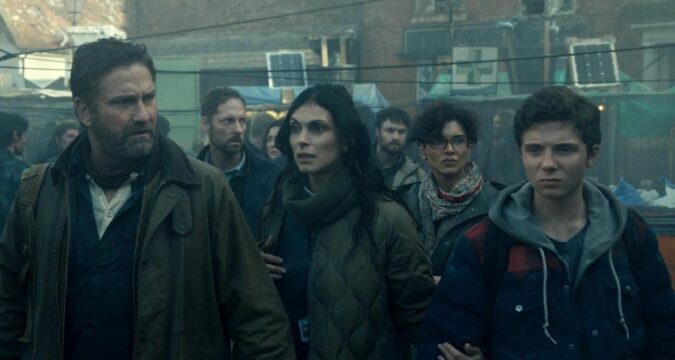
Review: ‘Greenland 2: Migration’ is Gerard Butler’s predictable January return
Gerard Butler is the Prince of January. You could print calendars now with the knowledge that the Scottish actor will invariably open the year with some kind of action bombast, ranging from the goofy (last year’s “Den of Thieves 2: Pantera”) to the earnest — this year’s disaster movie sequel “Greenland 2: Migration.” Butler reunites with his “Kandahar,” “Angel Has Fallen” and “Greenland” director Ric Roman Waugh for the film, and much like “Den of Thieves 2,” the film sees our star setting out for the south of France, under, of course, very different circumstances.
In the surprisingly effective 2020 film “Greenland,” Butler’s John Garrity and family just barely survive a comet named Clarke, which destroys 75% of the planet on impact. Five years later, when “Greenland 2: Migration” takes place, they’re living in a nuclear fallout bunker in Greenland, sheltering from radioactive storms with a group of survivors. This little society has to make a choice: stay put in a relatively safe but increasingly untenable place, or make a move for (possibly) greener pastures. Those potential pastures are in Clarke’s impact crater, where a scientist, Dr. Casey Amina (Amber Rose Revah), believes that new life may have sprung, shielded from the toxic air.
That decision is made for them when the bunker is destroyed by earthquakes, and the Garrity family escapes across the Atlantic with a small group of survivors. They alight in a waterlogged Liverpool, and discover the broken social factions that have cropped up in the wake of environmental collapse. From there, John and his wife Allison (Morena Baccarin) and teenage son Nathan (Roman Griffin Davis) make their way to London, then Dover, and then France, in search of Clarke’s landing spot.
Their journey takes them from destinations that are comfortingly homey (a barricaded memory care home in London), outlandish (traversing a dry English Channel via ladder), and even weirdly historical (trench warfare has returned in France). Waugh’s location shooting in the U.K. and Iceland makes for some stunning landscape imagery, and keeps the world grounded in reality — for the most part — as he did with “Greenland,” previously. The only difference is that Butler fades to the background, oddly, with Baccarin, Davis and the rotating cast of people they meet on the way drawing focus.
There is an interesting comparison to make with “Greenland 2: Migration,” to Danny Boyle’s 2025 zombie sequel “28 Years Later.” Both feature stories about fathers and young teen sons venturing to the U.K. from an island enclave years after disaster, but Boyle (and writer Alex Garland) are willing to get freaky with it, while Waugh and writers Mitchell LaFortune and Chris Sparling walk a very predictable and straightforward path.
While we get a glimpse of the Liverpool lunatics roaming the streets, as well as faceless marauders and insurgents that make outside even more dangerous than the radioactive air, for the most part, the people the Garrity family encounter prove to be trustworthy. I kept expecting a twist, a rug pull, some spin on the material, or even a strange new life-form birthed by Clarke. I’m not sure why I thought that was an option, considering the first film. Everything proceeds exactly as one might expect.
That is in line with the film’s overall ethos. Butler’s John hopes for his son that he is able to rebuild a world based on kindness and compassion, and his vision of what the world could be is indeed reflected back at him. Conflict rages over resources, but people are, for the most part, decent.
But who gets to enjoy the spoils of the new world? The message that Waugh, LaFortune and Sparling impart is that those who dare to dream that it exists, who endure the journey to get there, rather than clinging to tenuous safety, are the ones who have earned the prize of new life and the abundance that comes with it. “Greenland 2: Migration” offers up a proudly, even defiantly, optimistic view of what comes after disaster, which can serve for the viewer as either cathartic fictional balm, or Pollyanna-ish fantasy — pick your poison.
Katie Walsh is a critic for Tribune News Service.
“Greenland 2: Migration” — 2 stars (out of 4)
MPA rating: PG-13 (for some strong violence, bloody images, and action)
Running time: 1:38
How to watch: In theaters Jan. 9
https://www.chicagotribune.com/2026/01/08/review-greenland-2-migration/

Bruno Mars concert tour will bring him to Soldier Field in May
Bruno Mars announced a stadium tour on Thursday that will bring him to Chicago in May. “The Romantic” tour, in support of his fourth solo album of the same title, will be his first headlining tour in nearly a decade.
His one-night Chicago concert will be on May 16 at Soldier Field. Tickets go on sale Jan. 14 in an artist pre-sale. The general public on-sale begins at noon Jan. 15; more information and access to both at www.brunomars.com.
Mars last performed in Chicago in 2018 as part of Lollapalooza in Grant Park.
His “The Romantic” album is released Feb. 27.
The headlining tour, produced by Live Nation, will be his first since the “24K Magic World Tour,” which began in 2017. Launching on April 10 in Las Vegas, this new tour will include some 40 shows across North America, Europe and the UK. He’ll be joined by Anderson .Paak as DJ Pee. Wee. on all dates, with guest artist Leon Thomas added in Chicago and Victoria Monét and RAYE on other select dates.
April 10 — Las Vegas — Allegiant Stadium
April 14 — Glendale, Arizona — State Farm Stadium
April 18 — Arlington, Texas — Globe Life Field
April 22 — Houston — NRG Stadium
April 25 — Atlanta — Bobby Dodd Stadium at Hyundai Field
April 29 — Charlotte, North Carolina — Bank of America Stadium
May 2 — Landover, Maryland — Northwest Stadium
May 6 — Nashville — Nissan Stadium
May 9 — Detroit — Ford Field
May 13 — Minneapolis — U.S. Bank Stadium
May 16 — Chicago — Soldier Field
Who’s coming for concerts this summer: 50 shows for 2026, from Rosalía to Guns N’ Roses
May 20 — Columbus — Ohio Stadium
May 23 — Toronto — Rogers Stadium
May 24 — Toronto — Rogers Stadium
June 20 — Paris
June 21 — Paris
June 26 — Berlin
July 4 — Amsterdam
July 5 — Amsterdam
July 10 — Madrid
July 14 — Milan
July 18 — London
July 19 — London
Aug. 21 — East Rutherford, New Jersey — MetLife Stadium
Aug. 22 — East Rutherford, New Jersey — MetLife Stadium
Aug. 29 — Pittsburgh — Acrisure Stadium
Sept. 1 — Philadelphia — Lincoln Financial Field
Sept. 5 — Foxborough, Massachusetts — Gillette Stadium
Sept. 9 — Indianapolis — Lucas Oil Stadium
Sept. 12 — Tampa, Florida — Raymond James Stadium
Sept. 16 — New Orleans — Caesars Superdome
Sept. 19 — Miami — Hard Rock Stadium
Sept. 23 — San Antonio, Texas — Alamodome
Sept. 26 — Air Force Academy in Colorado — Falcon Stadium
Oct. 2 — Inglewood, California — SoFi Stadium
Oct. 3 — Inglewood, California — SoFi Stadium
Oct. 10 — Santa Clara, California — Levi’s Stadium
Oct. 14 — Vancouver — BC Place
https://www.chicagotribune.com/2026/01/08/bruno-mars-tour-chicago/

DOJ Sues Arizona, Connecticut For Failing To Hand Over Voter Rolls
DOJ Sues Arizona, Connecticut For Failing To Hand Over Voter Rolls
Authored by Matthew Vadum via The Epoch Times (emphasis ours),
The U.S. Department of Justice (DOJ) said on Jan. 6 that it is suing Arizona and Connecticut for allegedly failing to turn over their full voter registration rolls for federal inspection.
The two new federal lawsuits, which say the two states are hindering federal oversight that is intended to stop election fraud and ensure voter lists accuracy, bring the department’s nationwide total to 23 states plus the District of Columbia.
Before the most recent lawsuits were filed, the DOJ on Dec. 18, 2025, filed lawsuits against Georgia, Illinois, Wisconsin, and the District of Columbia, alleging they failed to produce voter registration lists upon request. Earlier the same month, the DOJ filed similar lawsuits against Delaware, Maryland, New Mexico, Rhode Island, Vermont, and Washington state, also for allegedly not producing the lists upon request.
U.S. Attorney General Pamela Bondi said on Jan. 6 that the DOJ will continue to file lawsuits “to protect American elections.”
“Accurate voter rolls are the foundation of election integrity, and any state that fails to meet this basic obligation of transparency can expect to see us in court,” Bondi said in a statement.
Assistant U.S. Attorney General Harmeet Dhillon of the DOJ’s Civil Rights Division added the department “is committed to safeguarding fair and free elections, and will hold states accountable when they refuse to respect our federal elections laws.”
The lawsuits state that the U.S. attorney general is responsible for enforcing the National Voter Registration Act and the Help America Vote Act, which Congress passed to make sure states have effective voter registration and voter list maintenance programs. The U.S. attorney general also enforces the Civil Rights Act of 1960, which allows her to demand that states produce statewide voter registration lists.
The Arizona lawsuit states that Bondi asked Arizona Secretary of State Adrian Fontes in July 2025 to produce a copy of his state’s voter registration list within 14 days.
Fontes responded, saying he could not comply with the 14-day deadline, and Bondi gave him an extension to September 2025. Two weeks before the new deadline, Fontes informed Bondi that he could not comply because doing so would violate state and federal privacy laws, according to the lawsuit.
The lawsuit alleges Fontes’s refusal to produce the requested records violates the information-production provisions of the Civil Rights Act. The lawsuit asks the court to order Fontes to produce the records.
Arizona Attorney General Kris Mayes told The Epoch Times that “Arizonans’ private voter registration information is not up for grabs.”
“Both state and federal law prohibit the unrestricted release of Arizona’s complete voter registration database to the DOJ,” she said. “My office will continue to work with the Secretary of State to defend the private data of Arizona voters and safeguard our independent election systems.”
Fontes said in a statement on Dec. 19, 2025, that he declined to hand over the voter rolls to the DOJ out of voter privacy concerns.
“Arizona voters also have important privacy rights that cannot be infringed because they choose to exercise their constitutionally protected voting rights,” he said.
The Connecticut lawsuit states that in August 2025 Bondi asked Secretary of State Stephanie Thomas to produce the state’s voter registration list. Thomas handed over some of the requested data and said more data would follow, but she did not send more information.
Bondi sent a letter in December 2025 demanding the list. Later that month, Thomas responded, saying that she could not comply because Connecticut law forbids her from releasing the information sought.
The lawsuit says that Thomas’s failure to hand over the list violates the information-production provisions of the Civil Rights Act, and asks the court to compel Thomas to do so.
Thomas said she was not surprised that Connecticut has been “added to the long list of states being sued on these grounds.”
She told The Epoch Times that as secretary of state, her “foremost responsibility” is to Connecticut voters “who entrust the state and their local election officials with sensitive data so they can participate in our representative democracy without fear that their information will be misused or exposed.”
Connecticut Attorney General William Tong said that Connecticut obeys federal laws and that he was disappointed that his state is being sued.
“We tried to work cooperatively with DOJ to understand the basis for their request for our voters’ sensitive personal information. Rather than communicating productively with us, they rushed to sue,” Tong told The Epoch Times.
Tyler Durden
Thu, 01/08/2026 – 10:45
https://www.zerohedge.com/political/doj-sues-arizona-connecticut-failing-hand-over-voter-rolls

Skokie’s Winter Farmers Market on Main Street starts Sunday with vendors, music
The winter-coats version of the Skokie Farmers Market is set to open Sunday, Jan. 11, with more than 40 vendors indoors and outdoors, as well as live music and fire pits, the Village of Skokie announced.
Don’t head to the location of the summer farmer’s market, though. The winter indoor/outdoor market, which is returning for its second season, will center around two Main Street locations— 4022 Main St., Skokie (Soul Good Coffee) and 4051 Main St., Skokie (The Storefront).
A list of more than 40 vendors, specifying their location indoors or outdoors, can be found at skokie.org/506/Vendors. Market-goers can also check the Winter Market’s Facebook page for updates. Coffee and food to eat onsite will be available, per the village.
Winter Market on Main will be open on select Sundays from 8:30 a.m. to 12:30 p.m., and live music will run from 9 to 11 a.m. Dates include:
January 11 and 25
February 1 and 22
March 15 and 29
April 12 and 26
Each market will feature free children’s activities and fire pits, and s’mores for the first market of each month, the village announced.
The Skokie Winter Farmers Market on Main will open Jan 11 with more than 40 indoor and outdoor vendors, and run through April. (Joerg Metzner Photography)
Free street parking is available around the market, and accessible parking will be located behind 4051 Main St., Skokie, with direct access into the market.

China Blocks Japan From ‘Heavy’ Rare-Earths Supply, Will Filter Down Across Global Supply Chains
China Blocks Japan From ‘Heavy’ Rare-Earths Supply, Will Filter Down Across Global Supply Chains
Going all the back to November 7, when Japanese Prime Minister Sanae Takaichi first provoked outrage in China by suggesting that Japanese Defense Forces could militarily defend Taiwan in the event of a Chinese invasion, there’s been a steady spiraling in relations between Tokyo and Beijing. First, China’s punitive measures took place merely on the tourism, culture, and diplomatic fronts – also with some limited economic measures such as halting its exports of seafood from Japan.
New action was also unveiled at not more than a weekly pace, or even monthly – but now after it’s been several months with no retraction and formal apology by Takaichi (demanded by Beijing), the screws are tightening on a daily basis. After this week barring Japan from dual use items (anything with military-civilian application), China has begun depriving Japan of rare earth minerals and rare earth magnets – which could have immediate impact on Japanese companies involved in components for global chip makers, and also hitting the defense and auto sectors. It will be felt by Japanese companies involved in advanced electronics, aviation components, drones and nuclear-related tech.
This sends a resoundingly clear signal to the US as well, after Beijing already moved to cut off rare-earth exports to American companies last year – and Trump blinked first by backing off his trade war with China, and now Beijing is ready and willing to apply the same leverage to close US regional ally Japan.
Referencing Tuesday’s move to ban exports to Japan of dual-use goods, The Wall Street Journal is confirming Thursday:
Then, in the days since, China began restricting exports to Japanese companies of scarce and expensive “heavy” rare earths, as well as the powerful magnets containing them, according to two exporters in China.
Another person familiar with Chinese government decisions said the review of applications for export licenses to Japan has been halted. The licensing restrictions extend across Japanese industry, the people said, and don’t only target Japanese defense companies.
Japan is the world’s second-largest producer of rare-earth magnets after China, but is hugely dependent on Chinese raw materials for their manufacture. According to 2024 data, Japan relied on China for 63% of its rare earth imports.
For well over a decade Japan has struggled reduce its dependence on China, following significant supply disruptions related to clashing with China over contested islands – maritime and fishing disputes which are still ongoing. While at the time Beijing denied it was singling out Japan, this latest spiral in ties and punitive measures have been made much clearer. Beijing is now overt about these muscular trade measures as being due to Takaichi’s “erroneous” comments which constitutes a “crude interference in China’s internal affairs”.
What’s bad for Tokyo has been perhaps an immediate or short-term benefit for American companies, ironically enough, as WSJ observes:
Since then, some American companies say they have had an easier time getting licenses. Rare-earth magnet exports to Japan had also returned to normal levels even before the October deal between the U.S. and China, according to Chinese trade data.
If maintained, Chinese restrictions on rare earths could cause the equivalent of about $17 billion in economic losses over the course of the year, according to Nomura Research Institute.
The publication further cites rare-earths analyst David S. Abraham, who described that industrial disruptions in Japan would be felt across global supply chains. “That will filter down,” he assured.
China has announced new export restrictions targeting Japan—
including a ban on rare earth exports.
In response, Minister Onoda stated:
“We are developing rare-earth technologies,
magnets that do not rely on rare earths,
and heat-resistant superalloys that use fewer rare… pic.twitter.com/jUXp2xg6Jy
— Rutaso.Japan🇯🇵🐶 (@rutasosabu) January 7, 2026
Masaaki Kanai, secretary general of the Japanese Foreign Ministry’s Asian and Oceanian Affairs Bureau, has “strongly protested and demanded the withdrawal of these measures.” And Japan’s Chief Cabinet Secretary Minoru Kihara said, “A measure such as this, targeting only our country, differs significantly from international practice, is absolutely unacceptable and deeply regrettable” – among other condemnations out of Tokyo.
Tyler Durden
Thu, 01/08/2026 – 10:25

Naperville’s Nicki Hernandez will make her NWSL debut for the expansion Boston Legacy. Is the World Cup next?
Former Metea Valley soccer star Nicki Hernandez has never been afraid of adventure.
The Naperville native took a big leap four years ago when she moved to Mexico City to begin her professional soccer career with Club América of Liga MX Femenil even though she spoke little Spanish.
Now Hernandez is joining NWSL expansion team Boston Legacy, which signed her to a two-year contract on Monday.
“I had offers from other teams in the NWSL that were kind of already established who are doing really well,” she said. “But I knew that it would just really help by having everyone kind of on the same page as teammates.”
Hernandez didn’t get any NWSL offers after a four-year college career at Michigan, where she scored 29 goals in 93 games. But her stellar performance in Mexico, where she switched positions from forward to defender and became a regular on the Mexican national team, finally opened eyes.
Hernandez, 26, said she was comfortable in Mexico, which was a big reason why she felt it was time for another challenge. Then Legacy coach Filipa Patão convinced her.
“It’s not like I chose an easy route because I know it’s going to be just as hard to start on this team,” Hernandez said. “But the top reason I came here was because of the coach, Filipa. When I called her on Zoom, she just had an amazing positive energy.
“She cut into me with amazing positive criticism. She showed me things that I needed to improve and things that I’m amazing at. She was showing me videos of my mistakes. That’s exactly what I needed, and that’s something that’s going to help me improve because my goal is to be in the World Cup.”
Qualifying for the 2027 Women’s World Cup in Brazil has already begun. Hernandez has made 27 appearances for Mexico, helping the team win the gold medal at the 2023 Pan American Games and starting in Mexico’s historic 2-0 upset of the United States at the 2024 CONCACAF W Gold Cup.
“I need to go to a team that’s going to prepare me for that,” she said. “I don’t want it to be last minute and not feel prepared.”
The NWSL is still regarded as the best league in the world.
“That’s why I moved because I needed somewhere to push me to become better, and it’s my third year of being a defender,” Hernandez said. “It’s kind of a new thing for me, and with the tactics, over the years you have muscle memory, but I don’t.
“So it’s something where I’m trying to learn, and that’s what I’m going to do here. I’m going to play against amazing teams and amazing girls, like Trinity Rodman, who are on other national teams. That will prepare me for the World Cup.”
Hernandez, in turn, will help the Legacy compete in its inaugural season, which begins in March.
“We’re really excited to welcome a player of Nicki’s quality to Boston,” Legacy general manager Domènec Guasch said in a statement. “She’s had a strong college career, has been a consistent presence in a very competitive Club América side, and is a regular with the Mexican national team, including at major tournaments.
“Nicki is a dynamic, hardworking defender who plays with real intensity and brings qualities our fans will enjoy watching. She’s already performing at a high level, but she also has the ambition and drive to keep improving, which aligns well with what we’re building at Boston Legacy.”
Hernandez leaves Thursday for Boston. The Legacy will have three weeks of preseason training in Florida, followed by another week in Spain. World Cup qualifying matches will be interspersed throughout the year.
Hernandez recently spent some time at home in Naperville with her parents and younger sister Olivia, who helped Metea Valley win the 2022 Class 3A state title and recently completed her freshman season at Marquette. They’ll have chances to see Hernandez play over the next two years.
“They’re so excited,” Hernandez said. “My mom was like, ‘You need a two-bedroom apartment because me and your grandma are going to come visit all the time.’”
Metea Valley girls soccer coach Chris Whaley plans to buy tickets when the Legacy play the Chicago Stars in Evanston. Hernandez will be the first Metea Valley graduate to play in the NWSL.
“That’s pretty wild, when you really think about it,” Whaley said. “I’m super excited for her. Just watching her journey over the last few years, you can see she’s just really enjoying herself and getting better and better as a player, which is awesome.
“I’m just so happy that she’s able to keep playing and have a career like this. It couldn’t happen to a better kid.”
Hernandez appreciates the support.
“Especially when I go to Chicago, I already have so many people saying, ‘Yeah, we’re going to come,’” Hernandez said. “It’s really nice.”
Matt Le Cren is a freelance reporter.
https://www.chicagotribune.com/2026/01/08/nwsl-naperville-nicki-hernandez-signs-boston-legacy/
2026 Forecast: ‘Tis The Season For Wild Guesses
2026 Forecast: ‘Tis The Season For Wild Guesses
Authored by Michael Lebowitz via RealInvestmentAdevice.com,
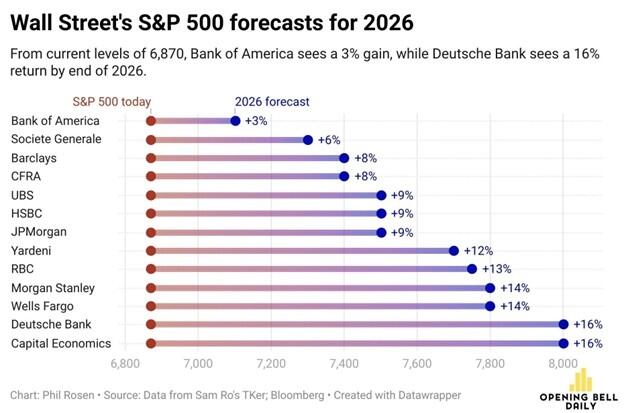
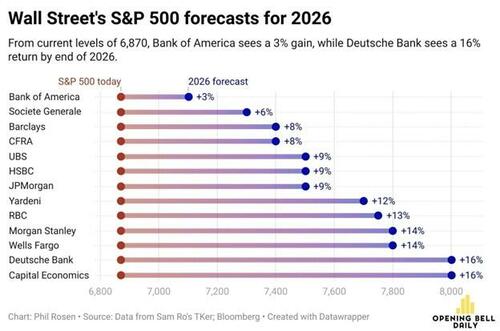
It’s that time of year when every Wall Street analyst posts their forecast for where the S&P 500 will close at the end of 2026. This year, as in every other, Wall Street expects the S&P 500 to post positive returns. As shown below, Bank of America is the most cautious, with a 3% gain, while Deutsche Bank and Capital Economics are the most bullish. On average, the analysts shown below forecast a 10.5% return in 2026, below last year’s 16% but slightly above the longer-term average.
Like Wall Street, we could spitball a 2026 price forecast for the S&P 500, but why? It’s a fruitless endeavor. No one has enough insight into the countless events that will unfold in 2026 and their potential economic, fiscal, and monetary consequences to make a meaningful forecast. Furthermore, even if we had a crystal ball that predicted how the year’s events would unfold, gauging their impact on investor sentiment and, ultimately, on markets would be nearly impossible.
Instead of offering a forecast for 2026, let us consider the potential events and factors that could influence investor sentiment and move markets this year. Inevitably, no matter how many events we and others are considering today, there will be market-moving ones that are not on anyone’s radar currently.
Perspective Matters
Before we focus on potential events in 2026, let’s review historical returns since 1970 to gain perspective.
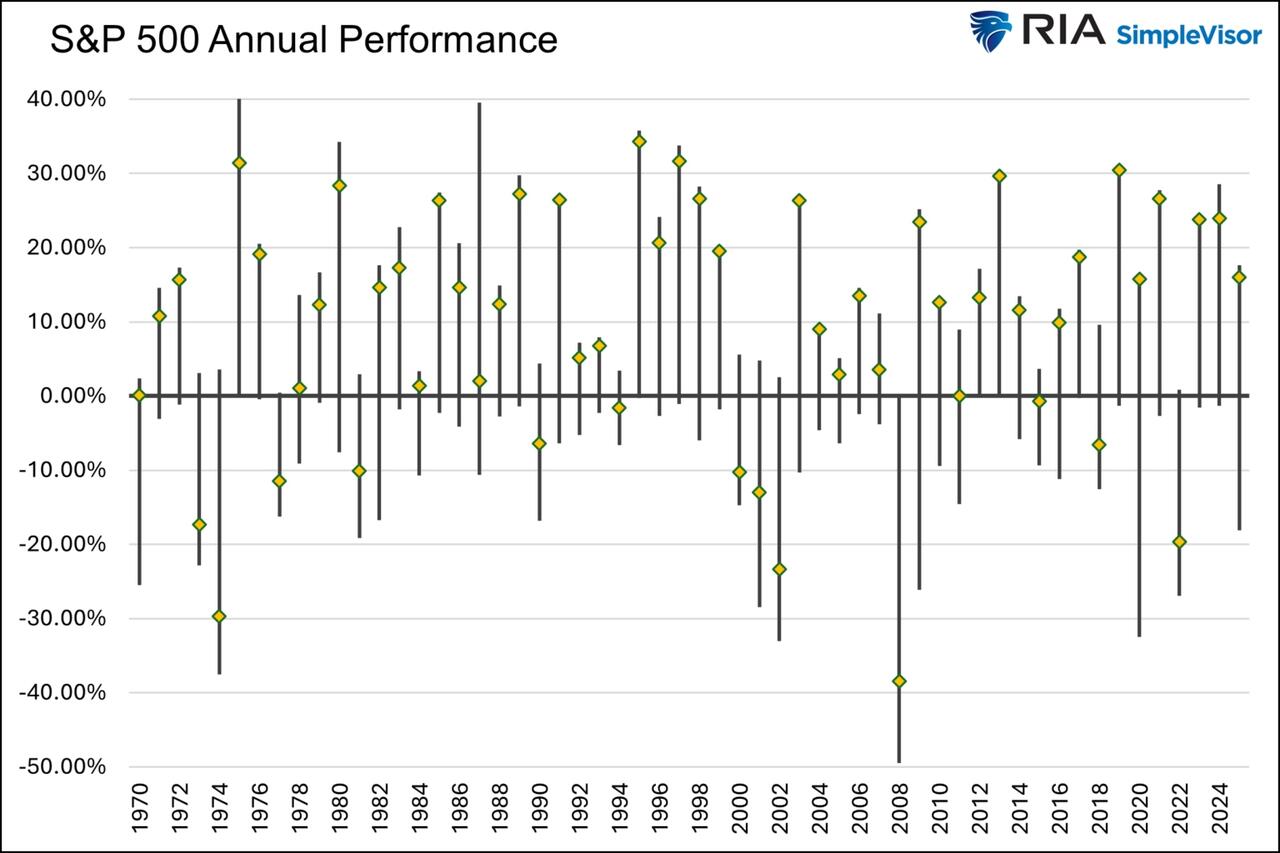
The graph below shows annual returns (gold diamonds) and the range between the minimum and maximum returns for each respective year. The average annual return since 1970 has been 9.43%, with an average yearly drawdown of 11.12%. Moreover, the average annual maximum gain was 16.35%, approximately 7% higher than the average closing price. Thus, the market, on average, closes at the 65th percentile of its range.
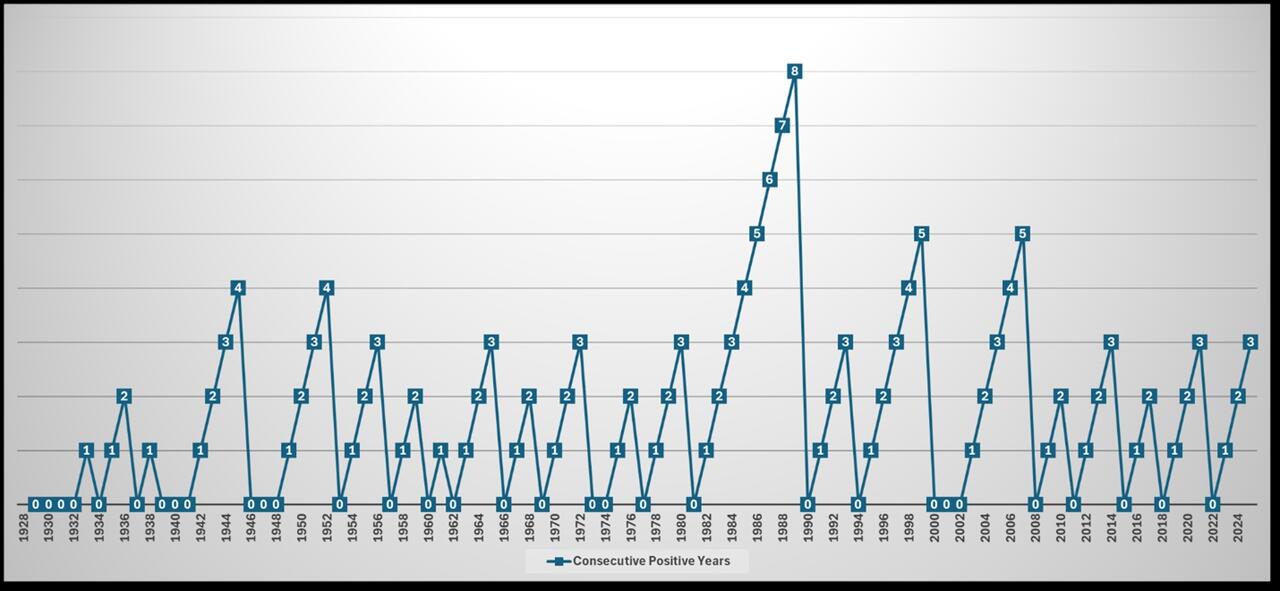
The second graph below is courtesy of one of our clients. His graph helps us assess whether we can expect a fourth consecutive year of positive returns. As shown, eight straight years is the record, with two four- and five-year winning streaks.
The odds are stacked against positive. Since 1928, there have only been five times that a four-year gains streak occurred.
Beware Of Valuations
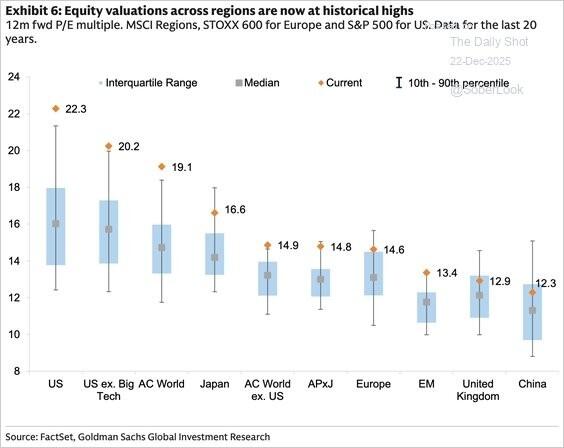
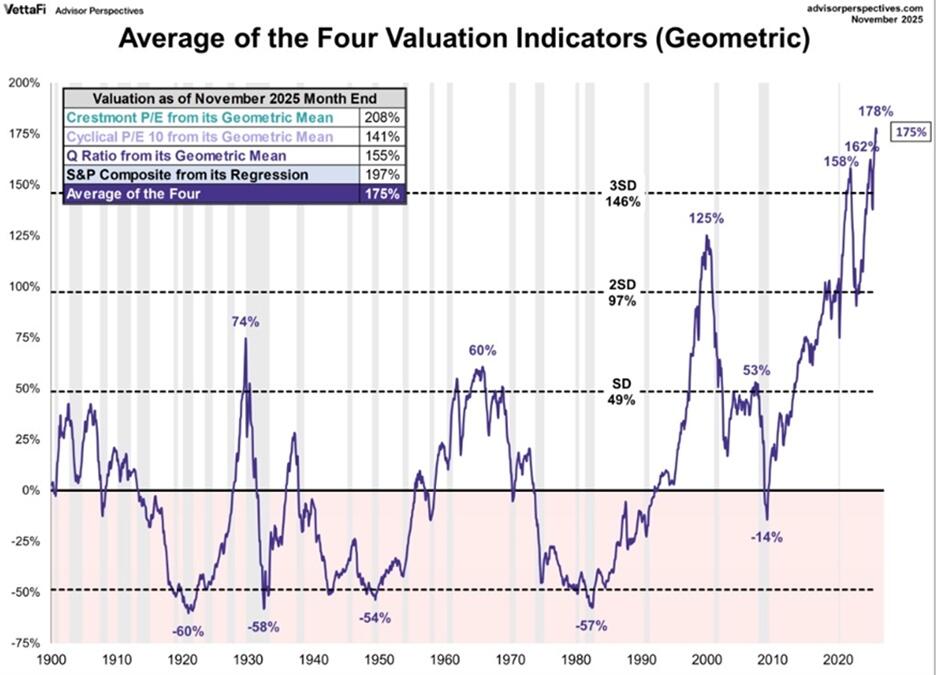
Valuations are stretched! The first graphic below, courtesy of Goldman Sachs, shows that 12-month forward P/E ratios are significantly elevated globally. The second from Crestmont indicates that the average of four widely used valuation techniques is at a record high.
Current valuations should serve as a constant reminder throughout 2026 to avoid complacency. While caution may be rewarded this year, we must also bear in mind that valuations make poor short-term timing tools.
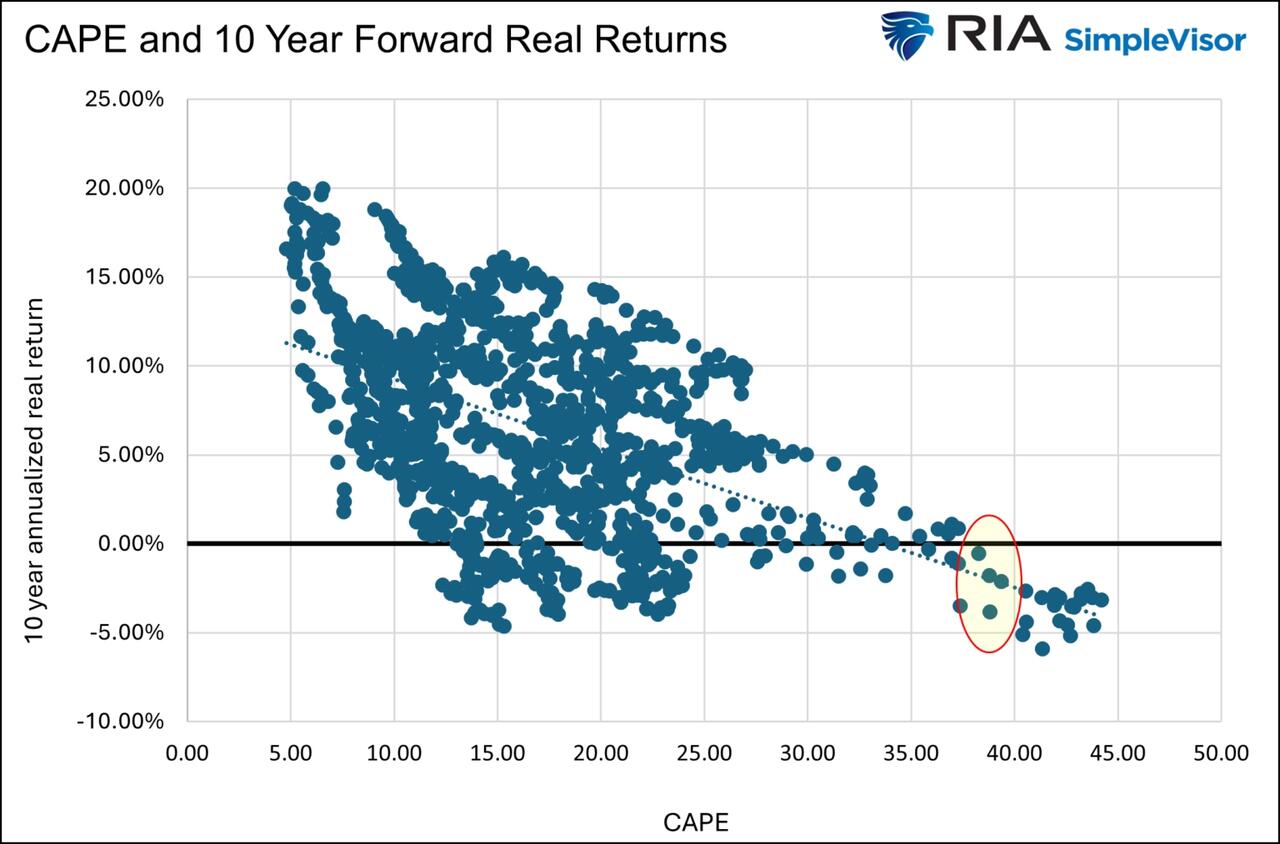
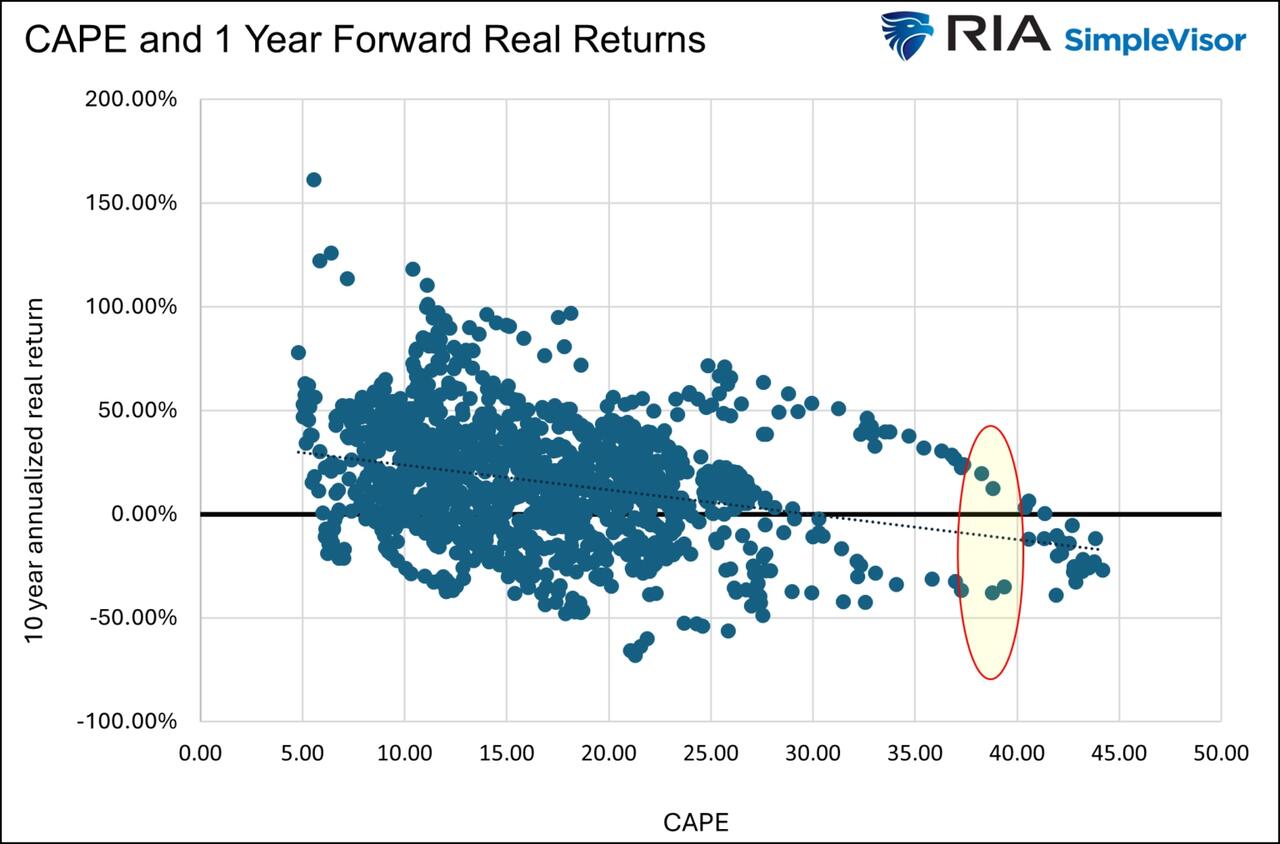
The first graph below shows the extent to which the CAPE10 valuation at 39 is stretched. Based on historical correlations between valuations and returns, we should expect negative real returns over the next 10 years. However, the second graph indicates that returns of +/- 25% are possible in 2026.
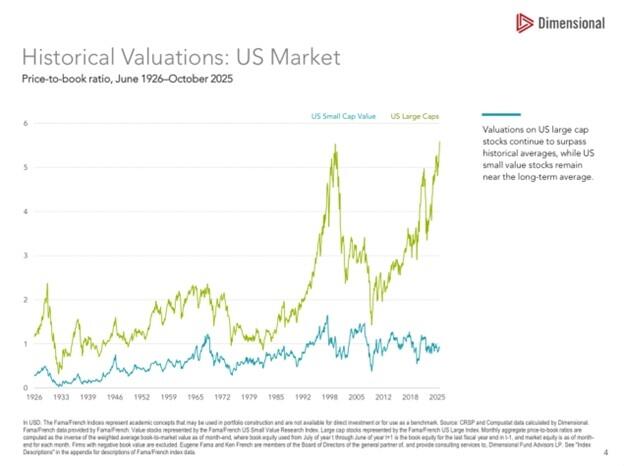
2026 may be the year that valuations normalize, thus resulting in a down year. Even if that is the case, we must recognize that market valuations and those of individual stocks and sectors can differ significantly. Some sectors are less expensive than others and may perform better in a down market. For example, the graph below, courtesy of Dimensional, shows that large-cap price-to-book ratios are at record highs, whereas those for small-cap value companies are at the midpoint of their range over the last 25 years.
Might 2026 be the year where value comes back into vogue, or will valuations, especially for the largest of stocks, get even more extreme?
QE And Liquidity
Last December, the Fed reintroduced QE under the guise of Reserve Management Purchases (RMP). The action is intended to supply the market with liquidity. Per the Fed’s Statement Regarding RMP:
The Desk plans to release the first schedule on December 11, 2025, with a total amount of RMPs of approximately $40 billion in Treasury bills; purchases will start on December 12, 2025. The Desk anticipates that the pace of RMPs will remain elevated for a few months to offset expected large increases in non-reserve liabilities in April. After that, the pace of total purchases will likely be significantly reduced in line with expected seasonal patterns in Federal Reserve liabilities.
Simply put, liquidity in the banking system was becoming scarce as reserves declined. To avoid worsening liquidity conditions, the Federal Reserve is injecting reserves into the banking system.
The question for investors is whether the $40 billion in monthly reserves, intended to last “a few months,” is sufficient to offset the expected decline in liquidity over that period.
If it’s not, then the markets may come under pressure as liquidity wanes.
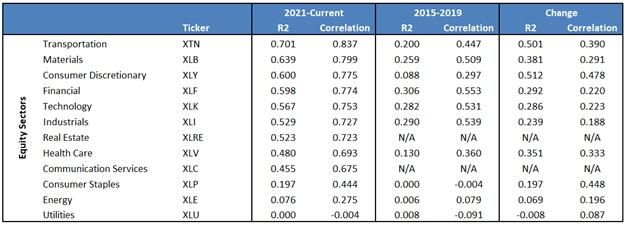
Conversely, if you think the Federal Reserve’s actions will boost reserves meaningfully, our article “QE Is Back” may offer a practical trading blueprint for the first few months of 2026. The article identifies which stock market indexes, sectors, and factors are strongly correlated with bank reserves. The table below, from the article, indicates that transportation, materials, consumer-discretionary, financial, and technology stocks could benefit most from a reserve increase. Conversely, the utilities, energy, and staple sectors offer little correlation.
Will QE once again prove to be a driving force for the stock market?
Powell Exits
Jerome Powell’s term as Fed Chair ends in May 2026, and Trump’s appointment of a new Chair is being closely watched. The new Chair’s stance on the trade-offs between inflation and labor-market weakness could significantly alter investor sentiment.
The two front-runners for Powell’s chair are Kevin Warsh and Kevin Hassett. We compared the two potential nominees in our Daily Commentary on December 17th–
Warsh is viewed as more hawkish than Hassett. He has frequently mentioned the inflation risk associated with dovish monetary policy. Moreover, as we noted above, he has expressed skepticism about aggressive QE. Conversely, Hassett, viewed as dovish, actively advocates deeper rate cuts to stimulate growth.
Kevin Warsh adheres to a Milton Friedman-style logic: inflation is a function of excessive money-supply growth. Based on recent speeches, Hassett is focused on growth-oriented easing and is not overly concerned with inflation.
Hassett likely appeals more to President Trump because of his dovish views. However, Kevin Warsh lends greater credibility to the Federal Reserve’s promise to reduce inflation. Additionally, Warsh is more likely to improve sentiment in the bond market, thereby lowering long-term yields.
Initially, the bond market is likely to be more affected than the stock market by President Trump’s decision regarding the next Federal Reserve chair. However, said changes in interest rates could readily impact the stock market.
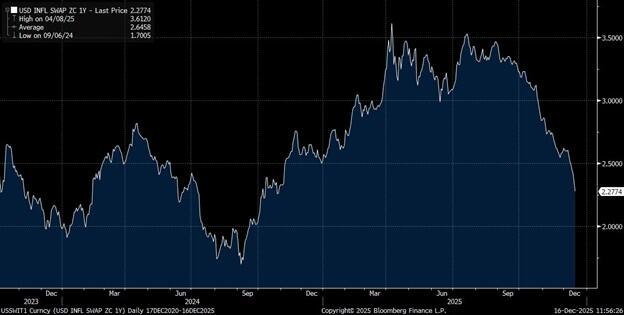
To assess potential market reaction, we should monitor changes in inflation expectations. As noted below, 1-year inflation expectations are falling rapidly, despite the more dovish Kevin Hassett expected to replace Powell. Thus, at the moment, the market is not expressing concerns about a dovish Fed Chair.
Will it be the dovish Kevin Hassett or the hawkish Kevin Warsh running the Federal Reserve in 2026?
Midterm Elections and Fiscal Policy
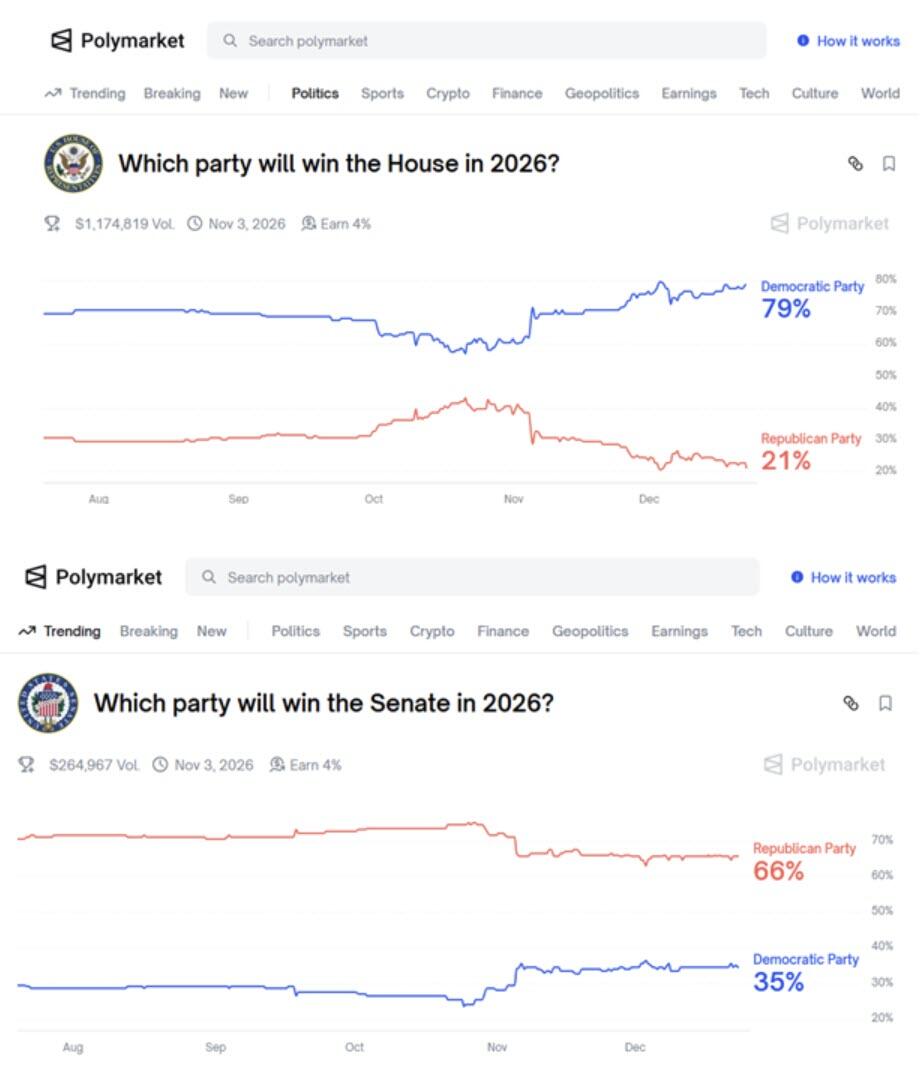
The November midterm elections will determine the balance of power in the U.S. Congress. As shown below, the Polymarket betting site assigns a 79% probability to the Democrats taking control of the House and a 66% chance that the Republicans will maintain Senate leadership.
If one or both houses of Congress change hands, the administration will find it much more challenging to pursue its domestic and foreign policy objectives. From a market perspective, this may limit the President’s ability to manage fiscal spending and further change the tax code. Accordingly, changes in Congressional power and budgetary implications could significantly affect growth and inflation, as well as individual stocks and sectors.
As the year progresses, investors will likely pay closer attention to the betting markets and traditional polls for insight into the midterm elections.
While investors wait for the elections, it is worth noting that Americans will get a “gigantic” tax refund next year. The tax provisions in the Big Beautiful Bill should, in practice, result in larger-than-normal refunds this year. Per Treasury Secretary Scott Bessent via FoxBusiness:
I can see that we’re gonna have a gigantic refund year in the first quarter because working Americans did not change their withholdings,” Bessent told the “All-In Podcast” hosts. “I think households could see, depending on the number of workers, $1,000- $2,000 refunds.”
The AI Infrastructure Boom and Productivity Gains
The massive capital expenditure (CapEx) cycle for AI infrastructure, including data centers, the power grid, and supercomputing, is expected to continue into 2026 and beyond. As we saw in 2025, the spending will boost GDP growth and profits for many companies involved. However, toward the end of 2025, investors began to question whether some companies were spending and borrowing more than they would ever recoup.
We pose a few questions to help you consider what 2026 may bring.
Will the AI-led bull market continue to charge ahead like last year on the belief and hope that massive CapEx spending will translate into enormous profits?
Will the rapidly growing debt requirements needed to fund CapEx be a drag on the market?
Given that technological change is occurring rapidly, might there be a new development to shake up the AI industry? Think about Deep Seek roiling the market last January.
Might investors start to question whether the productivity benefits of AI are worth the cost?
Is AI in a bubble like the dotcom bubble? If so, will 2026 be the year it surges, as in 1999, or the year it peaks, as in 2000?
Tariffs and Trade
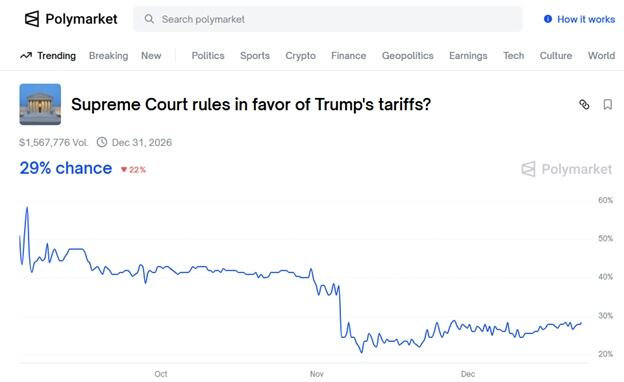
The Supreme Court has heard oral arguments in the tariff legality case and will announce its findings on January 9, 2026. According to Polymarket, the odds of a favorable ruling for Donald Trump are low at 29%.
If the Supreme Court strikes down the tariffs, the economic impact could be substantial. To begin with, the prices of some goods that are no longer subject to tariffs may fall, and trade flows will adjust accordingly.
However, it’s not wise to go down that road too far. The President reportedly has a Plan B ready. Tariffs or some other similar measure will most certainly be implemented if the Supreme Court rules against tariffs. But these measures may also be subject to judicial review.
Whatever the final trade policy is, there will be supply chain realignments that could significantly affect import costs, profit margins, and global trade patterns.
The question is not the Supreme Court ruling itself, but the mechanism the administration will ultimately use to implement tariffs, taxes, or trade restrictions. Moreover, we should consider how investors will handle a period of uncertainty.
Miscellaneous
Geopolitical Hotspots: Ongoing conflicts and tensions in Ukraine, Venezuela, and the Middle East, along with increased provocations between the US, China, Iran, and Russia, pose persistent headline risks. Many of these tensions can cause sudden changes in energy prices and economic activity, and disrupt supply chains and consumer sentiment.
Debt Levels and Sovereign Risk: 2025 began with higher bond yields, driven by the “bond vigilantes” and their grave concerns about the U.S. fiscal situation. With the U.S. government continuing to run massive fiscal deficits, the ability to finance these debts and manage interest costs will remain a concern. Renewed signs of bond market stress or investor concerns about a government’s ability to meet its debt obligations could trigger significant volatility, particularly in the U.S. Treasury market. Such volatility would quickly filter through to the stock markets. Will the bond vigilantes regain their voice?
Bear in mind, there is a risk of another government shutdown by the end of the month.
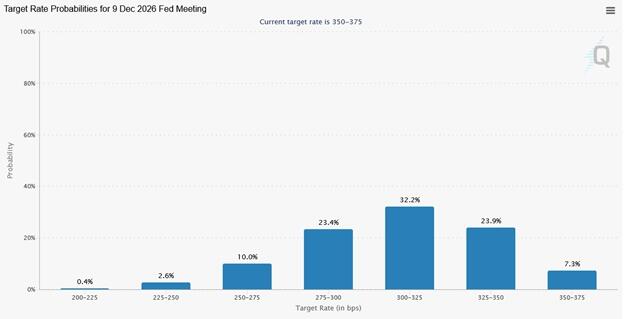
Monetary Policy: The ECB is considering raising interest rates. Might we find that the Fed reaches a similar conclusion later in 2026? Or might rates and inflation be heading much lower? As shown below, the Fed Funds futures market forecasts only one rate cut in 2026. The Fed has enough trouble predicting the next three to six months; what makes anyone think Wall Street is any better?
Yen Carry Trade: A depreciating yen strengthens the carry trade, supporting many US financial assets. At the same time, a depreciating yen heightens affordability issues and the popularity of its political leaders. This is primarily because Japan is heavily dependent on imports of energy and raw materials, whose prices rise when the yen depreciates.
Given domestic economic and political pressures, along with US persuasion, we expect the Japanese government to take steps to strengthen the yen. If any upward adjustment is done gradually, the impact on financial markets should be minimal. However, if it occurs suddenly, such as in August 2024, financial market volatility could spike.
Summary
There are 14 questions in this article, and we could easily have doubled or tripled that number. There are far more questions than answers about what the new year may hold. More importantly, there will be additional events that are not known today.
Thus, instead of forecasting where the S&P will close in 2026 with zero confidence, we would rather take the market and news as they come. We suspect that QE will provide initial support to the market through the winter. Valuations should keep us on guard throughout the year. Many of the other items we discuss pose a constant risk and or the potential for better returns throughout the year.
As you consider your forecast for 2026, we leave you with a thought to ponder from Arthur Zeikel:
Most investors tend to cling to the course to which they are currently committed, especially at turning points.
Tyler Durden
Thu, 01/08/2026 – 10:05
https://www.zerohedge.com/markets/2026-forecast-tis-season-wild-guesses