Category: News

Harvey Mayor Christopher Clark absent from first meeting in two months; City Council approves budget, tax levy
There was a bark of laughter from the crowd when it was announced Harvey Mayor Christopher Clark would not be attending the City Council meeting Monday night, the first of the new year.
“I wish the mayor was here tonight,” 4th Ward Ald. Tracy Key said. “I don’t know the situation, but he’s got a lot of explaining to do.”
Fifth Ward Ald. Dominique Randle-El, who chaired the meeting, defended Clark from criticism regarding his absence, saying for all the audience knew the mayor could be dealing with sickness or a loss in his family.
“He’s not running, he’s not hiding, he’s not afraid,” Randle-El said. “He’s human.”
Monday’s meeting was only the second City Council meeting in Harvey since the city declared a state of financial distress and a partial government shutdown last October. In that time, the city has instituted mass layoffs, including at the Police and Fire Departments, to address the emergency.
It was the first council meeting in more than two months. A spokesperson for the city previously said the decision not to hold meetings while the city was in a state of financial emergency was the fiscally responsible move, but critics of Clark saw it as a way of avoiding public scrutiny.
Key drew attention to the several holidays that had come and gone since the last meeting.
“Since we haven’t had a meeting in almost two months, which is unprecedented, I hope everybody had a nice Thanksgiving, a nice Christmas and a prosperous New Year coming ahead,” Key said.
The council meeting was preceded by a committee of the whole meeting. Both were largely spent on the topic of Harvey’s fraught finances.
The City Council voted to approve a budget and a tax levy ordinance. Both were listed on the agenda as being for the fiscal year beginning May 1, 2025 and ending April 30, 2026, a time period which has mostly elapsed.
Resident Glynis James-Watson questioned the timing during public comment, noting Illinois law requires municipalities to adopt budgets before or in the first quarter of a fiscal year.
“The fiscal year that they just voted for was last year,” James-Watson said. “They’re a year behind, almost. And so, where was all of this talk a year ago? Where was all this discussion a year ago? How have you been operating without a budget for this whole time? Or what budget have you been operating on?”
Glynis James-Watson speaks during public comment at Monday’s Harvey City Council meeting. (Evy Lewis/Daily Southtown)
Residents listen at the Harvey City Council meeting Monday night. (Evy Lewis/Daily Southtown)
Randle-El, 1st Ward Ald. Shirley Drewenski, 3rd Ward Ald. Telanee Smith and 6th Ward Ald. Tyrone Rogers all voted in favor of both ordinances. Key and 2nd Ward Ald. Colby Chapman, both frequent critics of Clark, voted against approving the appropriations ordinance. Neither voted on the levy ordinance due to a procedural dispute with Randle-El.
Copies of the ordinances were not available from the city clerk’s office Monday night.
Kyle Kasperek, of the accounting firm John Kasperek Co., presented his firm’s audit of the city’s 2021-2022 fiscal year at the committee meeting. Harvey is multiple years behind on its annual audits.
In the audit, the firm issued “disclaimer” opinions on Harvey’s general fund, water fund, business activities and governmental activities for the time period, meaning it did not have sufficient information to give opinions on those sections of the city’s finances.
A disclaimer opinion is one step above an adverse opinion, which would mean the firm found active problems or contradictions with sections of the city’s finances. The audit did not contain any adverse opinions.
Accountant Kyle Kasperek speaks to Harvey resident Mauzkie Ervin during a committee meeting ahead of Monday’s City Council meeting. (Evy Lewis/Daily Southtown)
Kasperek highlighted that the city did have its revenues exceed expenses by $2 million in the year in question, an improvement from the year before.
“I know the financial picture, you look at the debt scheme, it may not look as ideal,” Kasperek said. “There’s a lot of upsides still to look at.”
Kasperek said the plan is for John Kasperek Co. to continue conducting audits until Harvey’s annual financial reports are caught up. The firm previously conducted an audit for the city’s 2020-2021 fiscal year.
“We’re just doing our best to get this city caught up and looking ahead to the future,” Kasperek said.
elewis@chicagotribune.com
https://www.chicagotribune.com/2026/01/13/harvey-mayor-christopher-clark-absent-city-council/
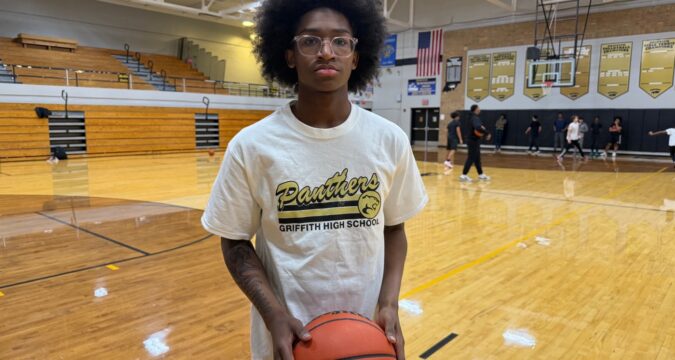
Antonio Hatch’s varsity debut has been worth wait for Griffith. ‘I really pride myself on how far I’ve come.’
Griffith junior Antonio Hatch has been making up for lost time.
The 5-foot-9 point guard missed last season due to academic issues but has shined in his varsity debut for the Panthers.
“Not playing last year, it was really hard,” Hatch said. “But I just got in the gym to get better. I never want to end up in that situation again.
“I wasn’t focused last year. This year, I’m more focused, doing good in school. I matured.”
Last season, Hatch missed his chance to play with his older brother Antoine, who was a senior guard. But Hatch and his younger brother Amarion, a sophomore guard, are teammates this season.
“I got to play with my older brother last year, but not him, so it means a lot to play with him this year,” Amarion Hatch said. “It’s great. I love it. He definitely makes us better. We’re winning with him.”
Indeed, Antonio Hatch is averaging 16.1 points, 4.3 rebounds, 4.0 assists and 2.8 steals, all team highs for the Panthers (7-5, 4-1), whose only Greater South Shore Conference loss is a one-point defeat against Bishop Noll on Dec. 10.
Hatch played on the junior varsity team as a freshman.
“I gained a lot,” he said. “I focused on getting a better left hand and shooting and finishing through contact and defense.”
Hatch’s skills have impressed first-year Griffith coach Cameron Ashley.
“He has a high motor,” Ashley said. “He can get to the basket any time he wants at will. Even though he can get to the basket at will, he’s always looking to get his teammates involved. Every coach in America wants that in a point guard, absolutely.”
Griffith senior forward Kingston Gant also praised Hatch’s game.
“I have to guard him every day, so I’d have to say he’s the hardest player I’ve ever had to guard,” Gant said. “He’s unpredictable. He can go left, he can go right, he can finish middle. He really does whatever he wants on the court. He’s a great passer as well.
“He’s a great defender too. If he wants the ball from you, he’s probably going to take it.”
Hatch has taken on a position of prominence for the Panthers as a leader too.
“Antonio’s a great kid,” Ashley said. “He’s an evolving, emerging leader. He’s a leader that’s really been showing up for us for the last four or five months in practice and in the games as well.
“I always tell him, ‘When you’re up, the team’s up; when you’re down, you can bring the team down. So your leadership ability tends to affect the entire team. Your leadership role is very important. Whether we’re up 20 or down 10, you have to stay up.’”
Hatch has taken such words to heart.
“A quiet gym is a losing gym, so I try to keep the gym loud, just clapping and yelling and bringing the energy,” he said.
Hatch’s voice was absent last season. It didn’t take long for him to demonstrate to Ashley just how much of a difference he could make.
“I heard quite a bit about him coming in,” Ashley said. “A lot of the kids were telling me about him, about his skill set, ability, what he can do. When I was able to see him in open gym, I was like, ‘Wow, OK, this kid can definitely be our starting point guard.’
“The fact that he didn’t play last year, I was kind of skeptical, like, how’s he going to be? But seeing him in open gym, I was like, ‘Oh, he hasn’t lost the touch.’ A lot of times, when kids don’t play, they also stay out of the gym. But with him, whatever he did, he either didn’t lose anything or he enhanced everything that he had.”
Hatch has delivered on that potential, overcoming self-doubt earlier in his career.
“I really pride myself on how far I’ve come,” he said. “At first, I didn’t think I was good at basketball. But I took the time to practice, stayed focused and got better.
“My brothers and my coaches really helped me. My older brother really got me better. They all believed in me, and I started believing in myself.”
https://www.chicagotribune.com/2026/01/13/basketball-griffith-antonio-hatch/
EEUU designa a la Hermandad Musulmana en Líbano, Jordania y Egipto como organizaciones terroristas
EEUU designa a la Hermandad Musulmana en Líbano, Jordania y Egipto como organizaciones terroristas.
JPM Kicks Off Q4 Earnings Season With Rare Miss Driven By Weakness In Debt Underwriting
JPM Kicks Off Q4 Earnings Season With Rare Miss Driven By Weakness In Debt Underwriting
Ahead of the official start of earnings season this morning when JPM reported Q4 results, Goldman’s head of Delta One Rich Privorotsky wrote that “attention now turns to JPM to set tone for earnings seasons. Prices/multiples are elevated across the sector so hard to argue expectations are low. Focus on NII/NIM durability as deposit costs and loan pricing adjust… trading and IB momentum… expense discipline against the now well-telegraphed ~$105bn 2026 expense guide (~10% increase) … and any change in credit quality (likely still benign near-term).”
With that in mind, moments ago JPM reported Q1 earnings that while beating on sales and trading, unexpectedly missed on revenue and earnings, with traders pointing to a rare miss in investment-banking fees which fell in Q4, missing the firm’s own guidance from just last month. The biggest US bank generated $2.35 billion from the business in the last three months of 2025, down 5% from a year earlier, according to a statement Tuesday. The firm said in December that it expected a percentage gain in the “low single digits.”
The investment-banking results were largely driven by a surprise 2% decline in debt-underwriting fees while analysts expected a 19% gain.
This was partially offset by stronger than expected Q4 trading revenue, which came in at $8.24 billion, ahead of even the highest estimate of analysts in the survey, with both equity and fixed-income traders beating expectations.
As we previewed yesterday, JPMorgan kicks off the banking industry’s Q2 results Tuesday, with megabank rivals Bank of America, Wells Fargo, Citigroup, Goldman Sachs Group Inc. and Morgan Stanley slated for Wednesday and Thursday. The group’s is expected to post its second-highest annual profit ever, boosted by President Donald Trump’s policy changes.
Here is a snapshot of what JPM reported:
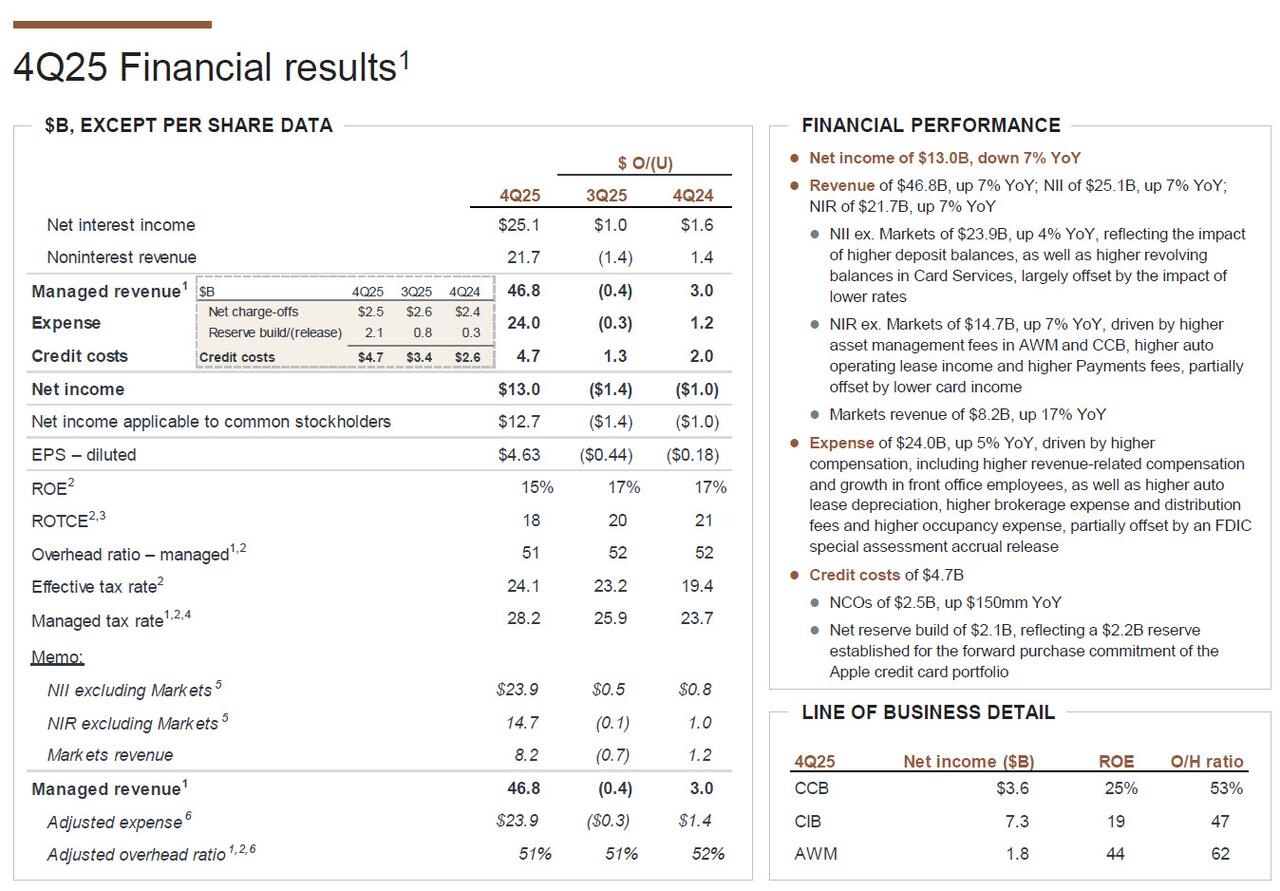
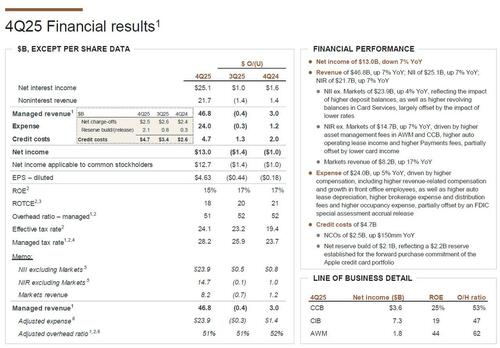
Net Income $13.0BN, down 7% YoY
Full year 2025 Net Income was $57 billion, which short of beating its 2024 record, which was the highest annual profit in the history of American banking.
EPS $4.63, Missing estimates of $4.97
Adjusted revenue $46.77 billion, beating estimates $46.35 billion; This was driven by NII of $25.11B, up 7% YoY; and NIR of $21.7B, up 7% YoY
Markets revenue of $8.2B, up 17% YoY
FICC sales & trading revenue $5.38 billion, +7.5% y/y, estimate $5.27 billion
Equities sales & trading revenue $2.86 billion, +40% y/y, estimate $2.7 billion
Investment banking revenue $2.55 billion, -1.9% y/y, estimate $2.65 billion
Advisory revenue $1.03 billion, -2.5% y/y, estimate $953.9 million
Equity underwriting rev. $416 million, -16% y/y, estimate $499.5 million
Debt underwriting rev. $898 million, -2.5% y/y, estimate $1.1 billion
Some more highlights here:
NII ex. Markets of $23.9B, up 4% YoY, reflecting the impact of higher deposit balances, as well as higher revolving balances in Card Services, largely offset by the impact of lower rates
NIR ex. Markets of $14.7B, up 7% YoY, driven by higher asset management fees in AWM and CCB, higher auto operating lease income and higher Payments fees, partially offset by lower card income
Expense of $24.0B, up 5% YoY, driven by higher compensation, including higher revenue-related compensation and growth in front office employees, as well as higher auto lease depreciation, higher brokerage expense and distribution fees and higher occupancy expense, partially offset by an FDIC special assessment accrual release
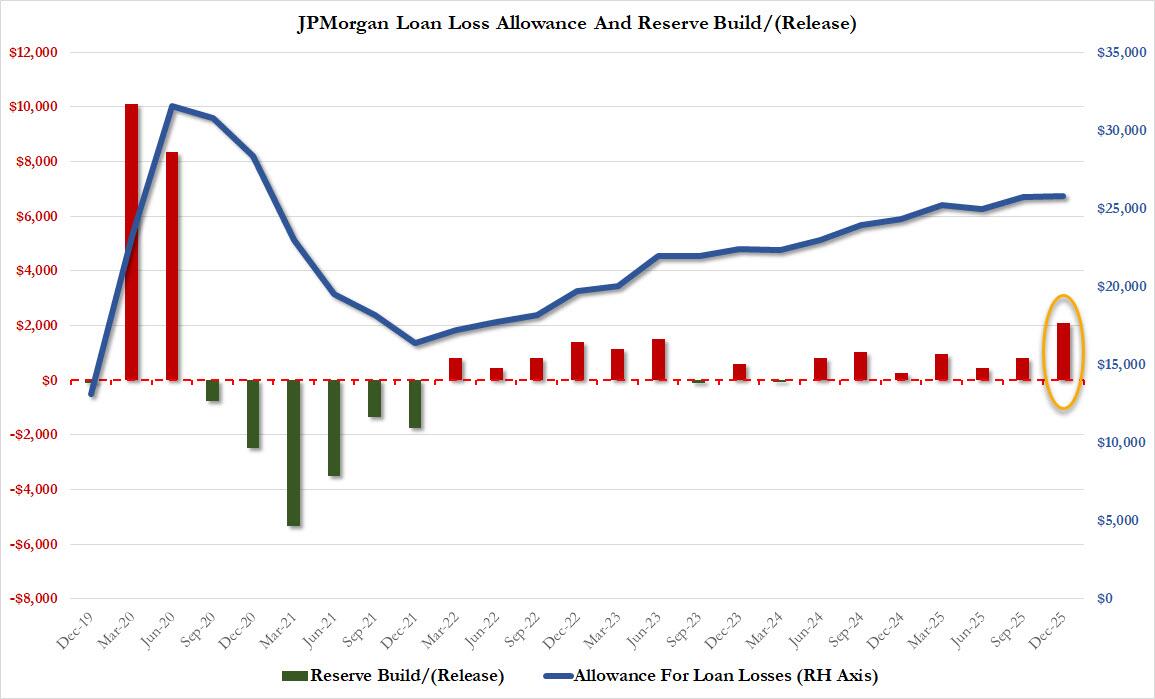
Especially notable is that in Q4, JPM’s reserve build soared to $2.1BN, highest since Covid, reflecting $2.2BN reserve established for forward purchase commitment of Apple credit card business, which must have been an epic disaster under Goldman. Combined with $2.51BN in charge offs (which was below estimates of $2.56BN), this meant that total credit costs were a whopping $4.7 billion, also highest since covid.
Some more details from the quarter:
Loans $1.49 trillion, +11% y/y, beating estimate $1.45 trillion
Total deposits $2.56 trillion, missing estimate $2.58 trillion
Compensation expenses $13.12 billion, +5.2% y/y, beating estimate $13.74 billion
Non-interest expenses $23.98 billion, +5.4% y/y, higher than estimate $24.65 billion
Net yield on interest-earning assets 2.54% vs. 2.61% y/y, beating estimate 2.53%
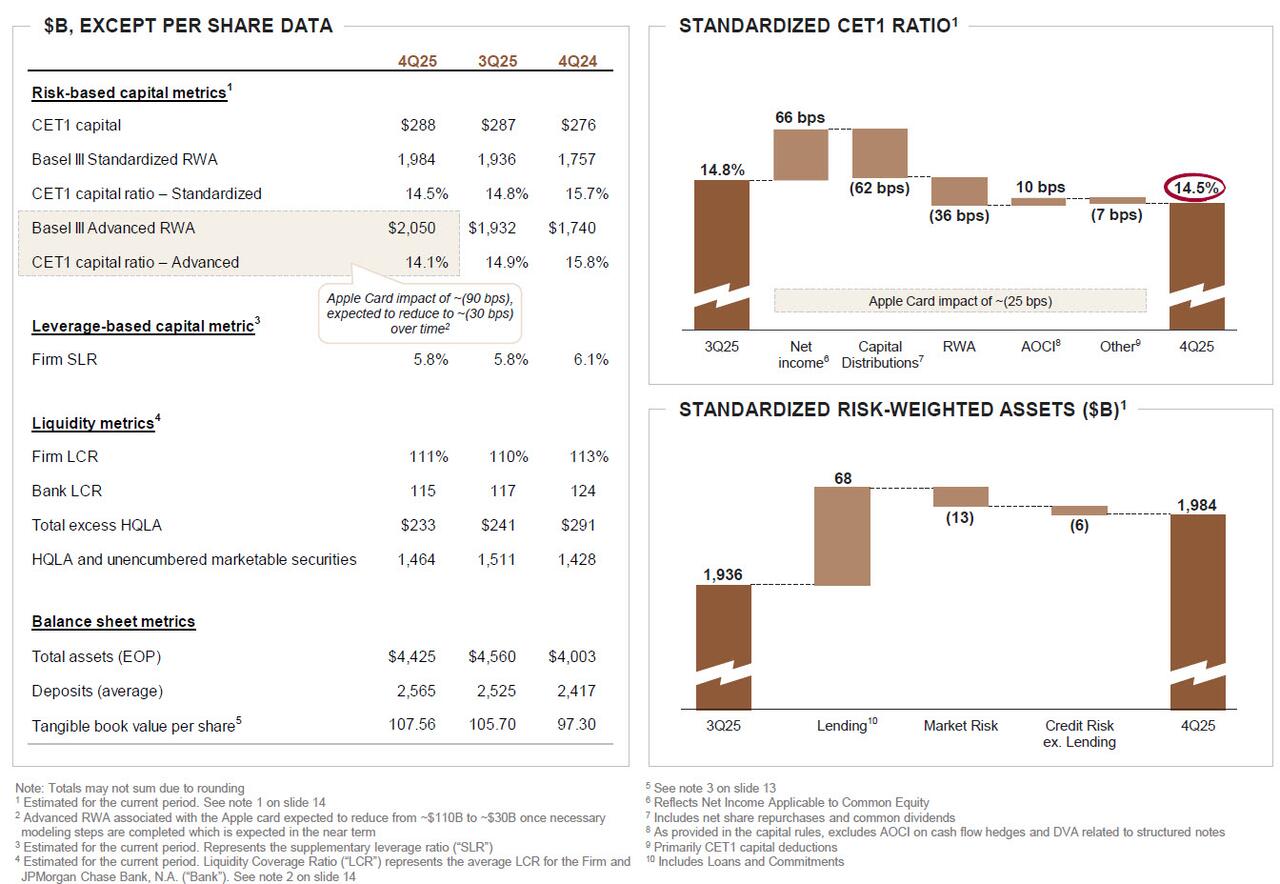
Standardized CET1 ratio 14.5% vs. 15.7% y/y, estimate 14.8%
Managed overhead ratio 51%, missing estimate 53.1%
Return on equity 15%, missing estimate 15.7%
Return on tangible common equity 18%, missing estimate 18.9%
Tangible book value per share $107.56, beating estimate $106.66
Book value per share $126.99, estimate $126.47
Cash and due from banks $21.74 billion, estimate $22.24 billion
Some more:
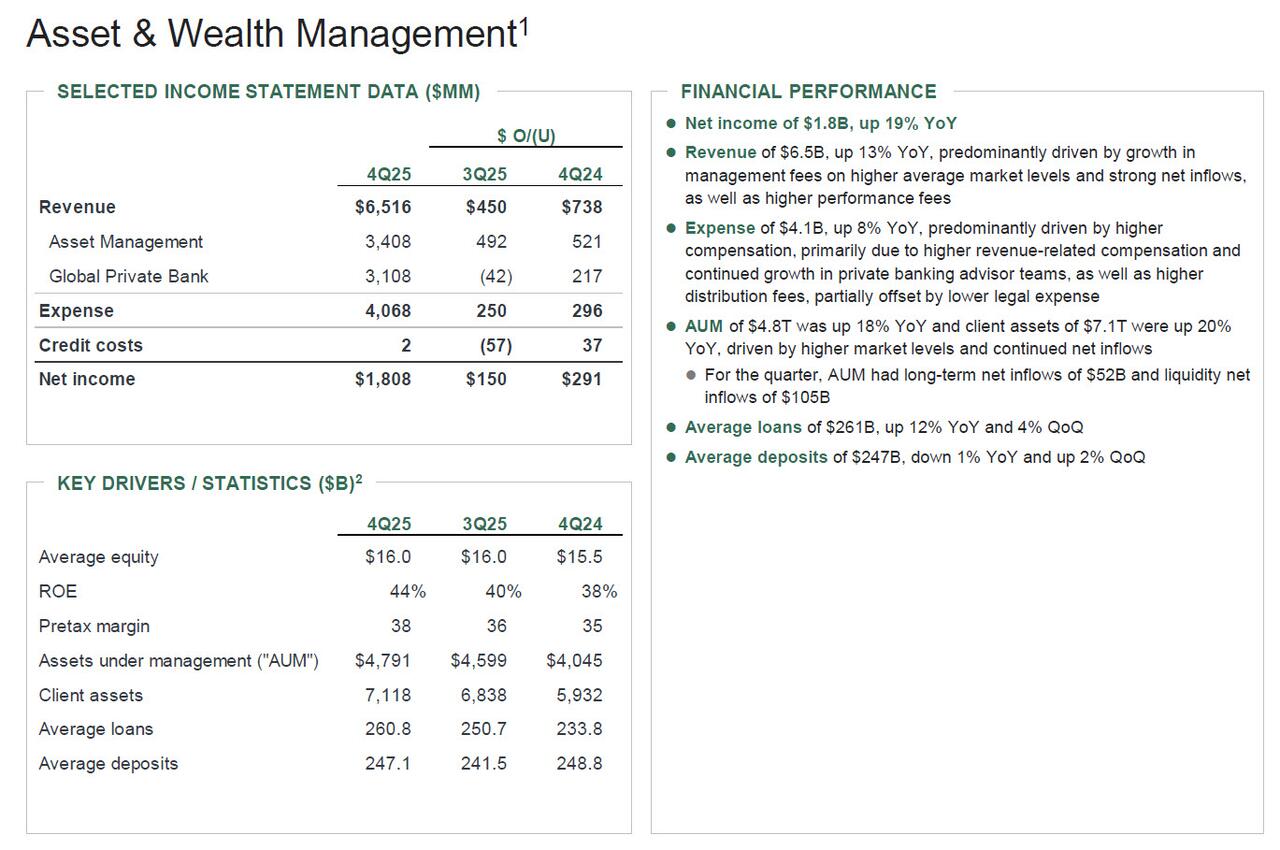
Assets under management $4.79 trillion, beating estimate $4.73 trillion
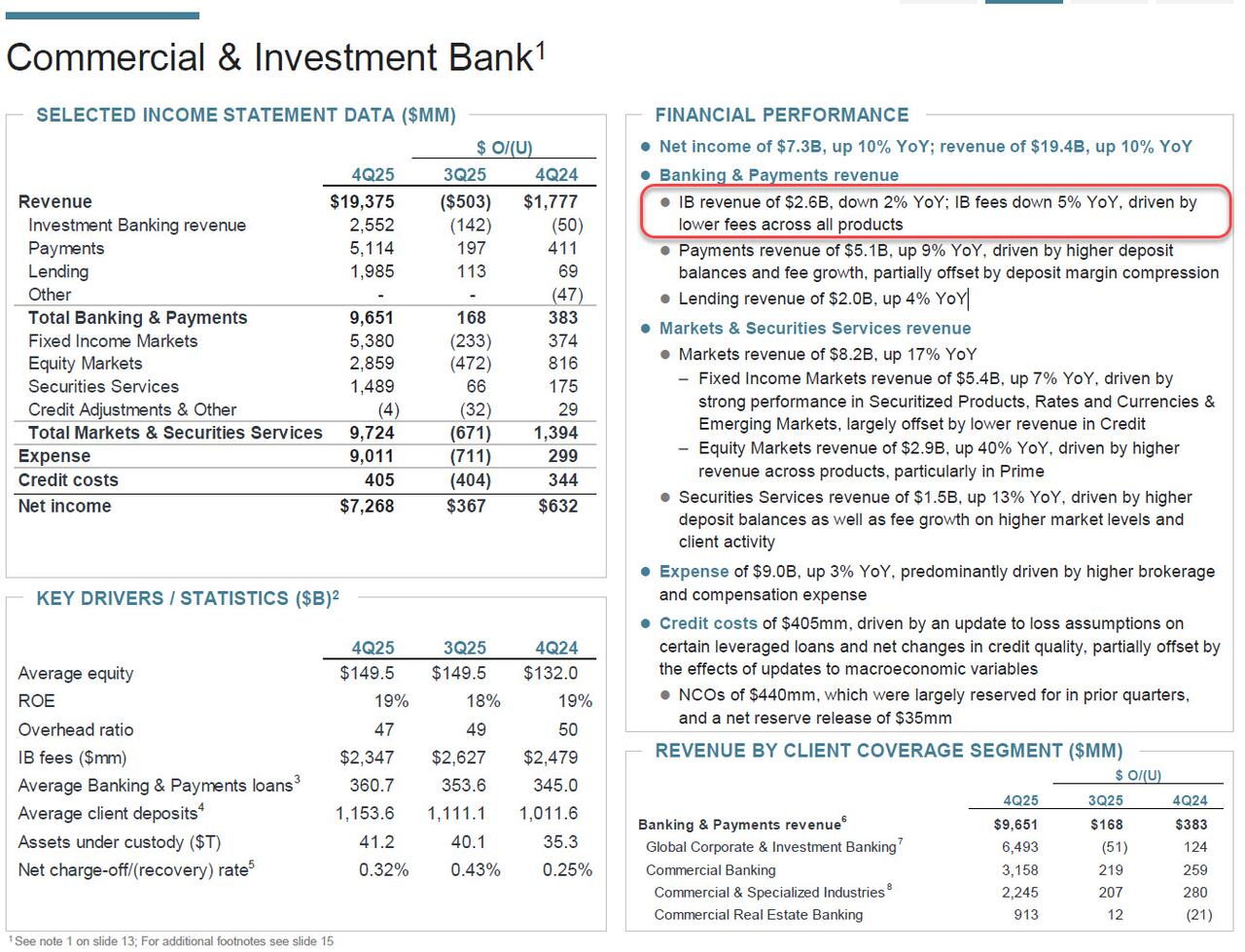
Turning to the all important Commercial and Investment Bank division, it was a story of two opposing halves: solid Markets revenue and disappointing Banking performance. Starting with the former:
Markets revenue of $8.2B, up 17% YoY
Fixed Income Markets revenue of $5.38B, beating est of $5.27B, up 7% YoY, driven by strong performance in Securitized Products, Rates and Currencies & Emerging Markets, largely offset by lower revenue in Credit
Equity Markets revenue of $2.86B, beating est of $2.7B, up 40% YoY, driven by higher revenue across products, particularly in Prime
Securities Services revenue of $1.5B, up 13% YoY, driven by higher deposit balances as well as fee growth on higher market levels and client activity
That’s the good news. The not so good news was the surprising weakness in Investment Banking and especially Debt Underwriting:
IB revenue of $2.6B, down 2% YoY; IB fees down 5% YoY, driven by lower fees across all products
Equity underwriting rev. $416 million, -16% y/y, missing estimate $499.5 million
Debt underwriting rev. $898 million, -2.5% y/y, missing estimate $1.1 billion
The only silver lining: advisory revenue $1.03 billion, which also declined 2.5% y/y, but beat estimates of $953.9 million
“The U.S. economy has remained resilient,” said CEO Jamie Dimon adding that “while labor markets have softened, conditions do not appear to be worsening. Meanwhile, consumers continue to spend, and businesses generally remain healthy.” Dimon said those conditions “could persist for some time, particularly with ongoing fiscal stimulus, the benefits of deregulation and the Fed’s recent monetary policy. However, as usual, we remain vigilant, and markets seem to underappreciate the potential hazards—including from complex geopolitical conditions, the risk of sticky inflation and elevated asset prices.”
In the first three quarters of last year, the biggest banks increased their loan books at the fastest pace since the financial crisis — boosting net interest income.
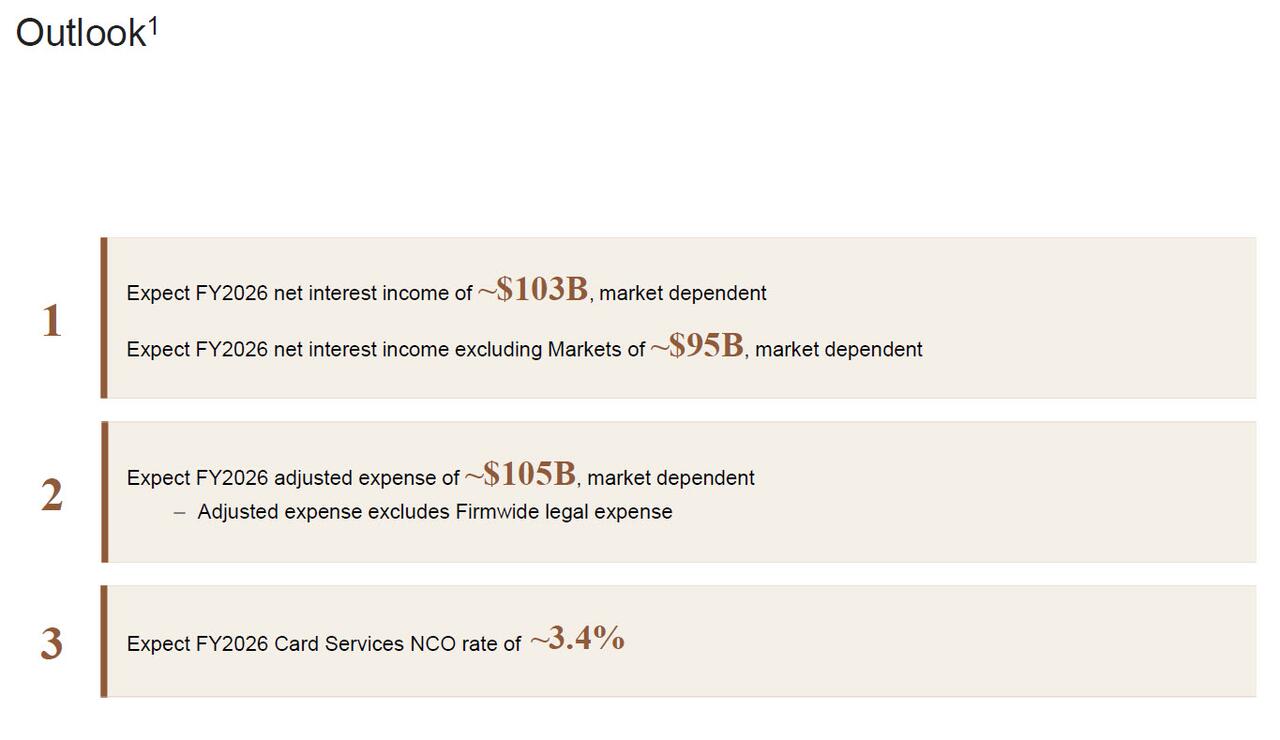
JPMorgan’s loans climbed 4% in the last three months of the year from the previous quarter. NII climbed 7% from a year earlier. The bank said in a presentation Tuesday that it expects to earn about $103 billion in NII in 2026.
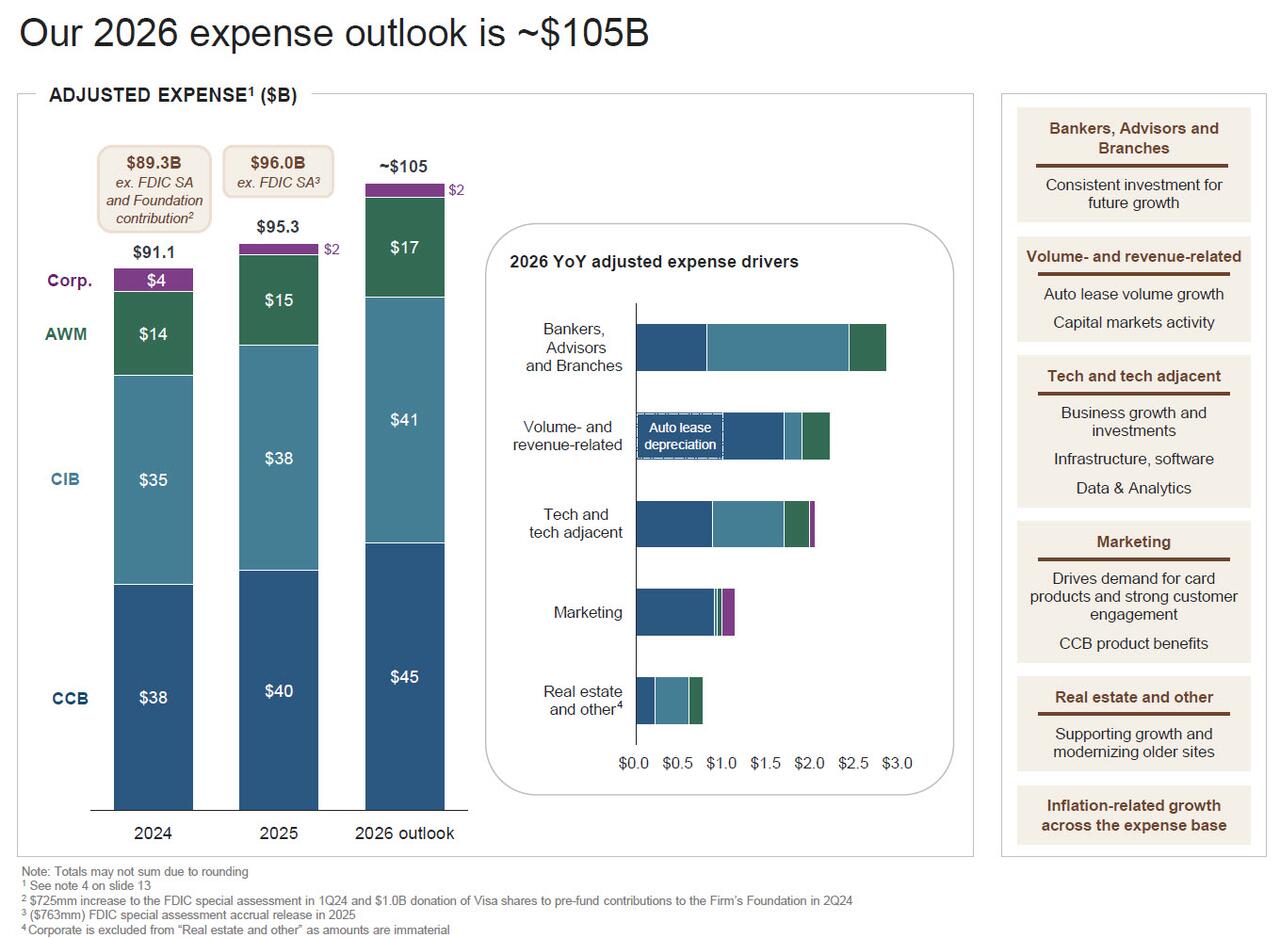
The bank also reiterated that it expects to spend about $105 billion this year. Marianne Lake, who runs the bank’s consumer and community bank, previewed that outlook — which was higher than analysts had been expecting — at an industry conference last month, saying the biggest driver is “volume- and growth-related expenses.”
+1% pre mkt… PPNR beat driven by better NII, fees and lower expenses (lower comp). In his commentary, Dimon noted a resilient economy with consumers continuing to spend though acknowledged that labor markets have softened and the market seems to underappreciate potential hazards… the key focus here will be
Finally, while the historical numbers were mixed, all eyes were on the bank’s guidance. Here, JPM reiterated what we already knew – expenses would be $105bn for FY26…
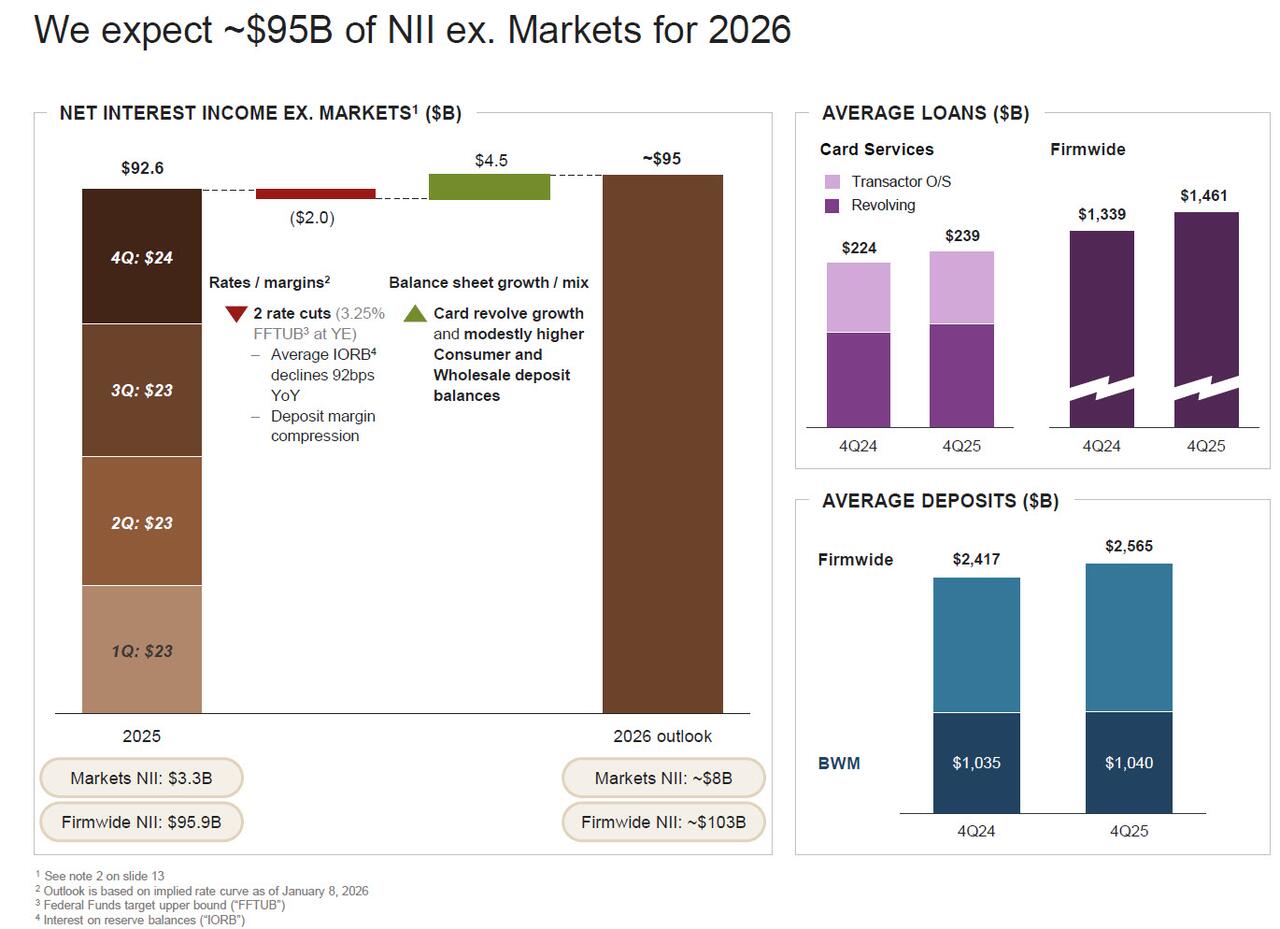
… and NII ex markets was $95bn…
… but the bank gave a markets NII of ~$8bn, putting total NII modestly above consensus, and helping stabilize the stock.
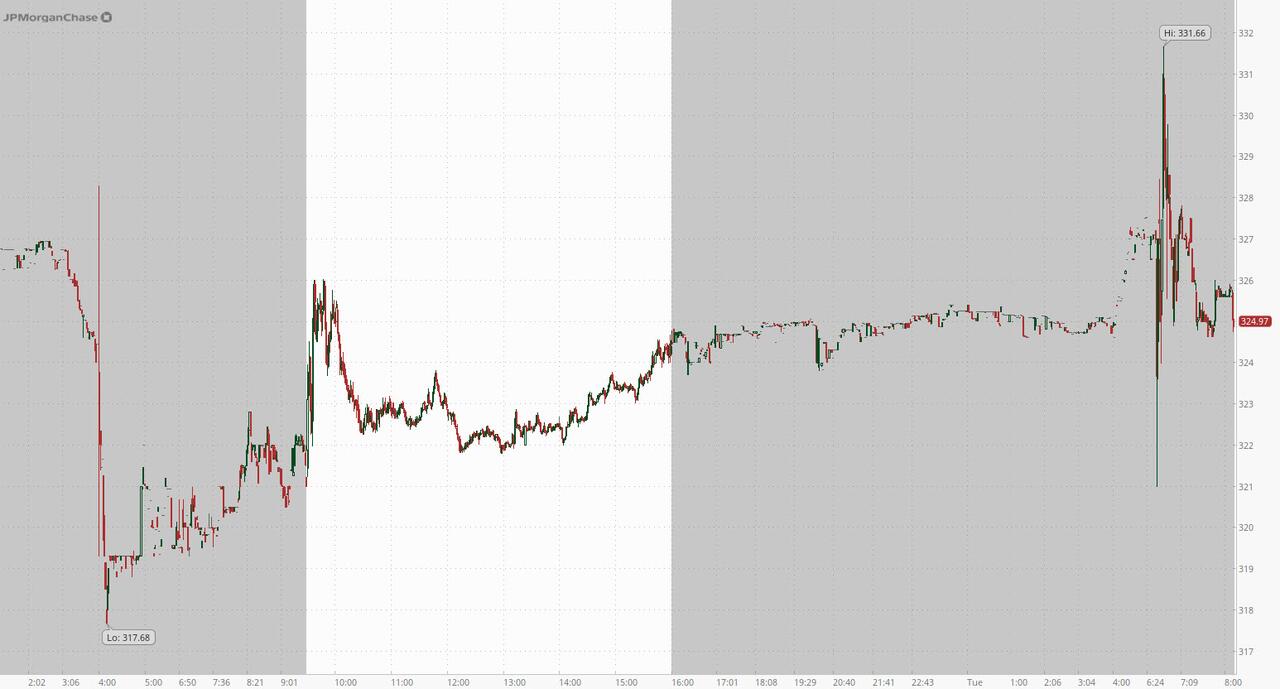
Putting it all together, the market reaction was mixed, with the price first sliding in premarket trading on the IB miss, before rebounding on the strong markets revenue and the NII forecast which was modestly above consensus, before eventually stabilizing to unchanged as much of what was reported was already known.
Full Q4 investor presentation below (pdf link).
Tyler Durden
Tue, 01/13/2026 – 08:18

Patrons at Skokie’s winter farmers market rewarded with apples, meats, cheeses, s’mores
The Winter Market on Main in downtown Skokie launched for the 2026 season on Sunday, Jan. 11 with more than 40 vendors and a lot of excitement over the Chicago Bears’ win the night before.
Shoppers had plenty of choices, including eggs, farm fresh meats, fresh herbs, apples, potatoes, microgreens, fresh pasta, baked goods, gluten-free items, honey, fresh peanut butter, mushrooms, oils and spices, soup varieties, macaroni and cheese, tamales, dog treats, kettle corn and cheese choices plus more.
“Skokie’s excited about it and we have a lot of new vendors this season and we expanded,” said Jennifer Engel, Skokie Farmers Market manager for the Village of Skokie, indicating 18 winter vendors were added this year.
Over the eight winter market Sundays, between 8,000 to 9,000 people are expected to attend, with possibly more, judging from opening day turnout, organizers noted.
Shoppers can visit with vendors inside and outside of The Storefront (4051 Main St.), as well as inside and outside of Soul Good Coffee (4022 Main St.).
At this Sunday’s market, people were able to get their knives sharpened by vendor Get Sharp, and will be able to do so at market dates only through February.
The Winter Market on Main is a “Producers Only Market,” which means everything purchased is grown or produced directly by the vendor one is purchasing from.
Many people showed up wearing warm Chicago Bears attire after Saturday night’s stunning win over the Green Bay Packers.
This included David Hayes of Skokie, who performed on acoustic guitar outside with Bears hat and scarf, except, as a strumming musician, he could not wear Chicago Bears mittens or gloves.
In the 33-degree weather, “My fingertips are frozen right now,” Hayes said with a laugh.
Chicago Bears fans were abundant at the market including Ralph Petrella of Evanston at the Winter Market on Main on Jan. 11, 2026. (Karie Angell Luc/Pioneer Press)
What brought patrons out to shop in the cold?
“It’s fun,” to eat outside with college and high school friends, said Katie Wiemeler of Park Ridge, who noshed seated outdoors with pals Shea O’Sullivan of Park Ridge and Ellen Phillips of Mexico, Missouri. O’Sullivan and Wiemeler are of the Maine South High School Class of 2000.
“It’s fun,” to eat outside with college and high school friends, said Katie Wiemeler. From left to right, pals noshing on freshly made food are Shea O’Sullivan of Park Ridge, Katie Wiemeler of Park Ridge and Ellen Phillips of Mexico, Missouri. O’Sullivan and Wiemeler are of the Maine South High School Class of 2000. Seen at the Winter Market on Main in Skokie on Jan. 11, 2026. (Karie Angell Luc/Pioneer Press)
Chad and Vera Flores of Skokie made s’mores, which were offered for free, with their children, and came to get food such as custom ice cream which, of course, stays cold on the way home during winter.
“We’re really excited to support the local vendors and our neighborhood,” Vera Flores said, adding they’re big fans of the Ice Cream Girl, who is vendor Sarah Cochran of Chicago’s Avondale meighborhood.
From left, Chad and Vera Flores of Skokie make s’mores, which were free, with their children at the Winter Market on Main in Skokie on Jan. 11, 2026. (Karie Angell Luc/Pioneer Press)
“You can’t get her in a grocery store and she makes the most phenomenal flavors of ice cream,” Flores said about Cochran.
Cochran said, “I only sell by the pint size so I do pretty well because everyone is going to take it home and eat there.”
Buying those coveted fresh eggs from a Michigan vendor was Janice Linkowski of Wilmette.
The Ice Cream Girl, selling out of custom flavors, is Sarah Cochran of Chicago’s Avondale at the Winter Market on Main in Skokie on Jan. 11, 2026. (Karie Angell Luc/Pioneer Press)
“I’m a farmers market junkie,” Linkowski said with a smile.
The Winter Market on Main runs from 8:30 a.m. until 12:30 p.m. on Jan. 25, Feb. 1, Feb. 22, March 15, March 29, April 12 and April 26.

‘Stuck behind’ after illnesses, Alessandra Rodriguez almost quit. Instead, she pushes unbeaten Wauconda ahead.
Wauconda junior Alessandra Rodriguez faced her toughest opponent before the season even started.
Rodriguez had high expectations after coming off the Bulldogs’ bench for two seasons, but back-to-back illnesses over the summer set her back.
“In June, I suffered from a stomach flu and then got the regular flu and lost 10 to 12 pounds,” she said. “I was already skinny.”
The illnesses sapped not only Rodriguez’s strength but also her desire to play basketball. She believed she was losing ground.
“I was really close over the summer to quitting,” she said. “I was sick a second time and wasn’t playing the way I used to be playing, and seeing everyone improve while I was stuck behind, it made me realize I didn’t want to do it anymore.”
Rodriguez said junior varsity coach Emily Ellison convinced her to get on the court for a shootaround in late September. The impromptu session turned out to be an emotional experience.
“I started to get the itch back to play during my volleyball season,” Rodriguez said. “When I shot around with coach Ellison, she told me I was a good player and should at least try. It made me feel emotional. I started crying during the practice. I had not touched a basketball in months.
“It was an hour and a half of me shooting. I realized I didn’t want to waste all the time I had put into basketball.”
Wauconda coach Jaime Dennis is happy Rodriguez decided to return to the sport. The 5-foot-9 forward is averaging 7.3 points, 3.3 rebounds, 1.8 assists and 1.2 steals for the undefeated Bulldogs (16-0, 6-0), who are the front-runners in the Northern Lake County Conference.
On Friday, Rodriguez scored 11 points as Wauconda defeated three-time defending conference champion Grayslake Central for the first time “in over 20 years,” according to Dennis.
“Alessandra battled some injuries and illnesses that kept her out in her first two years, but this year she has been healthy and playing really good,” Dennis said. “She’s starting to blossom.”
Rodriguez’s defensive effort against Grayslake Central junior guard/forward Peyton Hoffmann fueled the big win.
“This year has been amazing,” Rodriguez said. “The coaches trust me guarding some really good players. Peyton is very good, and it was tough guarding her. I just did my job.”
Wauconda junior point guard Alexia Manalo said Rodriguez can guard anyone.
“Because of her height and speed, she dominates in the post,” Manalo said. “But she can even lock down shorter and quicker guards.”
Wauconda’s Alessandra Rodriguez (5) drives against Grayslake Central’s Lucy Otoo (24) during a Northern Lake County Conference game in Wauconda on Friday, Jan. 9, 2026. (Rob Dicker / News-Sun)
Wauconda shooting guard Sarah Palmer said Rodriguez can make an impact on a game in multiple ways.
“Alessandra is basically the Swiss knife version of a basketball player, from rebounding to lockdown defense to finishing in the paint,” Palmer said. “Whenever we are playing a well-known team, she is always the one we look to for defense. Her length and athleticism give us such an advantage on the court. When she is on point, there is pretty much no stopping her.
“You also will never catch her looking down on the team. She is one of the most encouraging teammates I have ever had.”
Rodriguez is encouraged by the Bulldogs’ play this season.
“Being undefeated means a lot,” she said. “We have put so much hard work in practices, but this team knows how to have fun and to get it done.”
Bobby Narang is a freelance reporter.
https://www.chicagotribune.com/2026/01/13/basketball-wauconda-alessandra-rodriguez/
L3Harris Rockets Higher On “First-Of-It’s Kind” Pentagon Investment Into Missile Unit
L3Harris Rockets Higher On “First-Of-It’s Kind” Pentagon Investment Into Missile Unit
L3Harris Technologies (our top stock for the Hemispheric Defense Theme) announced on Tuesday a “first-of-its-kind” proposed partnership with the Department of War (DoW) to significantly boost solid rocket motor production.
The DoW will inject $1 billion into L3Harris’ Missile Solutions unit through a convertible preferred investment, creating a direct link between the federal government and a major weapons manufacturer as the US races to increase missile production. The investment would automatically convert into common equity upon an initial public offering.
Under the plan, L3Harris’ Missile Solutions unit will go public in the second half of 2026, creating a pure-play missile propulsion company built around the former Aerojet Rocketdyne business. L3Harris will retain control.
“Since its acquisition of Aerojet Rocketdyne, L3Harris has significantly invested to transform and grow its production operations, and recently created the Missile Solutions business, combining all aspects of its capabilities in support of offensive and defensive missile systems,” L3Harris wrote in a press release, adding the investment will help expand capacity for the DoW’s missile systems, such as PAC-3, THAAD, Tomahawk and Standard Missile.
L3Harris CEO Christopher Kubasik stated, “We’re taking action to build today’s ‘Arsenal of Freedom’ by launching a pure-play missile solutions provider. Recent Trump Administration actions have placed renewed emphasis on strengthening the defense industrial base and reinvigorating competition following a 30-year wave of consolidation. Building on several years of sustained investment and operational improvements by L3Harris, this new company will serve as a key partner to the DoW in supporting efforts to deter and defeat America’s adversaries.”
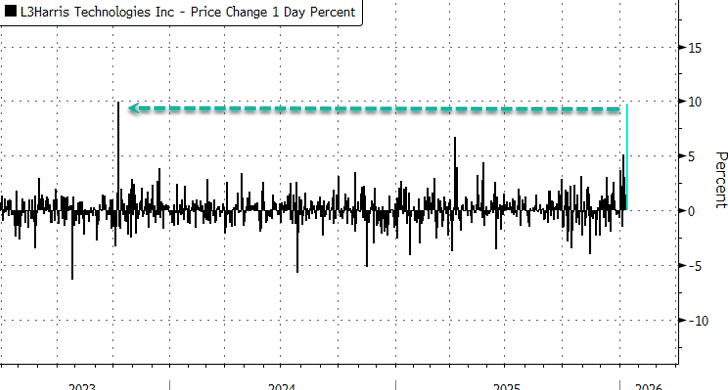
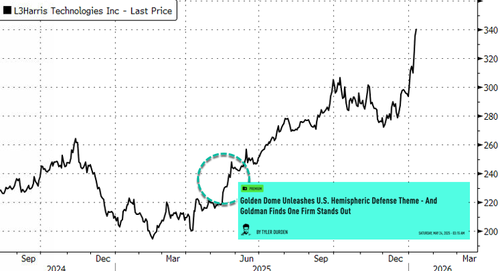
In premarket trading, L3Harris shares are up nearly 10%.
If those gains are held into the cash session, this would mark the largest intraday up move since October 2023.
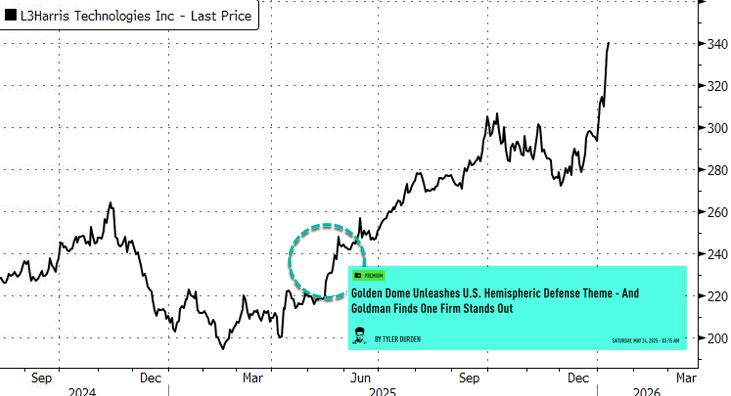
L3Harris has been a top pick in our Western Hemisphere Defense theme since late May, mostly based on the fact that DoW’s reposturing and fortifying the hemisphere would take new investments where L3Harris would stand to greatly benefit. L3Harris is up more than 50% since our report.
Read the report (May 2025):
Golden Dome Unleashes U.S. Hemispheric Defense Theme – And Goldman Finds One Firm Stands Out
Last week, Trump called for a 50% increase in U.S. military spending by 2027. The race to fortify the Western Hemisphere is well underway, and L3Harris stands out as a defense contractor poised to benefit from those trends.
Tyler Durden
Tue, 01/13/2026 – 07:45

Daywatch: The cost of late tax bills
Good morning, Chicago.
Late property tax bills weren’t just an inconvenience for homeowners and businesses, they were a drag on taxing districts around Cook County, to the collective tune of almost $122 million for school districts alone, according to a group of suburban school leaders.
Bills that typically land in the summer weren’t paid until mid-December thanks to a halting technology upgrade. Additional problems with the system prevented the county from distributing those revenues to hundreds of taxing bodies.
To bridge the gap in the meantime, school districts — particularly wealthier ones whose budgets rely more heavily on property taxes than on state aid — had to take out loans, cash out investments or forgo other investment income that would have built up on property tax revenues parked in the bank, the Tribune previously reported.
According to a group of school leaders who have been surveying colleagues countywide, the interest and issuance cost of borrowing, plus cashed out and lost interest on investments, totaled $59.5 million for suburban school districts and $62.2 million for Chicago Public Schools.
Read the full story from the Tribune’s A.D. Quig.
Here are the top stories you need to know to start your day, including an Illinois Supreme Court Justice retiring, the NFL commissioner touring potential new Bears stadium sites and a discussion on the art of “difficult” women with Evanston’s Sara Levine.
Today’s eNewspaper edition | Subscribe to more newsletters | Asking Eric | Horoscopes | Puzzles & Games | Today in History
Federal agents use tear gas and smoke on community members and activists while they protest near the 3900 block of South Kedzie Avenue on Oct. 4, 2025, in Chicago. (Armando L. Sanchez/Chicago Tribune)
Illinois and Chicago sue DHS over ‘militarized’ immigration-enforcement tactics
Saying immigration agents have acted more like an occupying military force than law enforcement, lawyers for the state of Illinois and city of Chicago sued the Trump administration in federal court seeking to bar agents from using tear gas without sufficient warning, making warrantless arrests, and randomly stopping people to question them about their citizenship.
Minnesota and the Twin Cities sue the federal government to stop the immigration crackdown
FBI says it has found no video of Border Patrol agent shooting 2 people in Oregon
Dr. Michael McKee’s residence at 2100 N. Lincoln Park West in Chicago, on Jan. 12, 2026. A criminal complaint lists McKee’s home address as the building at left. Mckee is charged with killing his ex-wife, Monique Tepe, and her husband, Spencer Tepe, in Ohio. (Antonio Perez/Chicago Tribune)
Lincoln Park man charged in murders of ex-wife and her dentist husband to be extradited to Ohio
A Lincoln Park man accused of killing his ex-wife and her husband in their Columbus home will be sent back to Ohio to face charges in the couple’s deaths, according to the Winnebago County sheriff’s office.
Linda Brown, right, pictured with her husband, Antwon Brown. (Jen Rivera)
Body of missing CPS teacher recovered from Lake Michigan: ‘She was an amazing person’
Linda Brown, a special education teacher at Robert Healy Elementary School in Bridgeport, was reported missing on Jan. 3. But after days spent searching for her, Brown’s family in a written statement last night said her body had been found in the 31st Street Harbor.
Illinois Supreme Court Justice Mary Jane Theis attends as Charles Beach is installed as the new chief judge of the Circuit Court of Cook County in a ceremony Dec. 1, 2025, at Chicago-Kent College of Law. (Brian Cassella/Chicago Tribune)
Illinois Supreme Court Justice Mary Jane Theis retiring after four decades on the bench
Mary Jane Theis became a judge in 1983, a few weeks before the biggest, most sweeping judicial corruption scandal in Cook County history came to a head.
Operation Greylord resulted in about 100 indictments and the conviction of more than a dozen judges. And throughout a career that eventually saw Theis elected to the Illinois Supreme Court and serve as chief justice, she said the scandal was a constant reminder that the judiciary in Illinois had once been a national disgrace and that judges must approach their roles with integrity, humility, and honesty.
Former Mayor Lori Lightfoot departs after announcing an independent commission to document and collect evidence of abuses by federal immigration agents on Jan. 8, 2026, at the Union League Club of Chicago. (Brian Cassella/Chicago Tribune)
Former Mayor Lori Lightfoot sued over credit card debt
Former Mayor Lori Lightfoot was served with a lawsuit from JPMorgan Chase Bank for allegedly failing to pay about $11,078 in bills, according to a copy of the complaint filed in Cook County Circuit Court.
A woman walks out of Indian Trails Apartments, an affordable housing development that a developer plans to rehabilitate, in West Pullman, Jan. 12, 2026. (Eileen T. Meslar/Chicago Tribune)
Troubled West Pullman housing complex has new owners, and will get a complete rehab
A Far South Side affordable housing complex plagued by neglect and deteriorating conditions has been sold, and city officials say the new owner will launch much-needed renovations.
Bears kicker Cairo Santos speaks to NFL Commissioner Roger Goodell before the NFC wild-card playoff against the Packers at Soldier Field on Jan. 10, 2026. (Patrick McDermott/Getty)
NFL commissioner tours potential new Bears stadium sites, including Arlington Heights and northwest Indiana
NFL Commissioner Roger Goodell joined top Chicago Bears officials to tour potential new stadium sites before the team’s stunning playoff win over the Green Bay Packers, a source familiar with the visit said.
What to know about the Bears’ possible move from Soldier Field
Packers wide receiver Matthew Golden (0) pushes Bears cornerback Jaylon Johnson (1) after the play during the fourth quarter of an NFC wild-card game Jan. 10, 2026, at Soldier Field. (Armando L. Sanchez/Chicago Tribune)
Column: Chicago Bears are moving on — but 3-game drama vs. Green Bay Packers shows the rivalry is reborn
During the teams’ three meetings this season, the postgame handshakes between Bears coach Ben Johnson and Packers Coach Matt LaFleur may have set a record for brevity, writes Phil Thompson.
Johnson might have reignited this feud out of obligation, playing to a long-suffering Chicago crowd, but did this somehow become personal?
5 things we learned from the Bears: ‘No weak links’ at this stage of the playoffs
Bears likely to lean on Theo Benedet at left tackle after Ozzy Trapilo’s season-ending knee injury
Chevy Chase, left, with Marina Zenovich, the director of a new documentary about him, “I’m Chevy Chase and You’re Not,” in New York, Dec. 4, 2025. The famously prickly comedian found a sympathetic adversary in the director. (Blaise Cepis/The New York Times)
Column: Chevy Chase and Seymour Hersh get the documentaries they deserve
Be thankful that you are not Cornelius Crane “Chevy” Chase, writes Rick Kogan.
The subject of a new CNN documentary titled “I’m Chevy Chase and You’re Not” is not a particularly pleasant person, even though some of his churlishness may have been caused by a brutal and physically abusive childhood.
The mansion at 609 Sheridan Road in Winnetka, which sold for $34.5 million in November, sits along the lakeshore on Jan. 7, 2026. (E. Jason Wambsgans/Chicago Tribune)
Here are the Chicago area’s top 10 home sales of 2025
For residential real estate, 2025 was the year of the Chicago-area megasale.
Two mansions on the North Shore sold for more than $30 million each, setting new Chicago-area sales records.
Sara Levine sits in home writing space on Jan. 9, 2026, in Evanston. Levine is the chair of the writing department at School of the Art Institute of Chicago and a novelist whose new book, “The Hitch,” follows her 2011 novel Treasure Island. (Stacey Wescott/Chicago Tribune)
What’s like got to do with it? Evanston’s Sara Levine on the art of ‘difficult’ women.
Sara Levine’s novels feel right for early January, for this gray period when we’re all expected to reassess our lives, make changes and emerge in the spring with clearer heads.
The way certain works of fiction can do, her books could double as perverse self-help, starring heroines who go out of their ways to show how not to conduct your life. Her writing voice, sardonic, breezy, chimes with Joy Williams and Donald Barthelme, but it’s hard not to hear “Curb Your Enthusiasm” and even “The Office” — that nexus where unraveling people lacking self-awareness stumble across empathy.
https://www.chicagotribune.com/2026/01/13/daywatch-the-cost-of-late-tax-bills/

2026 Earnings Outlook: Another Year Of Optimism
2026 Earnings Outlook: Another Year Of Optimism
Authored by Lance Roberts via RealInvestmentAdvice.com,
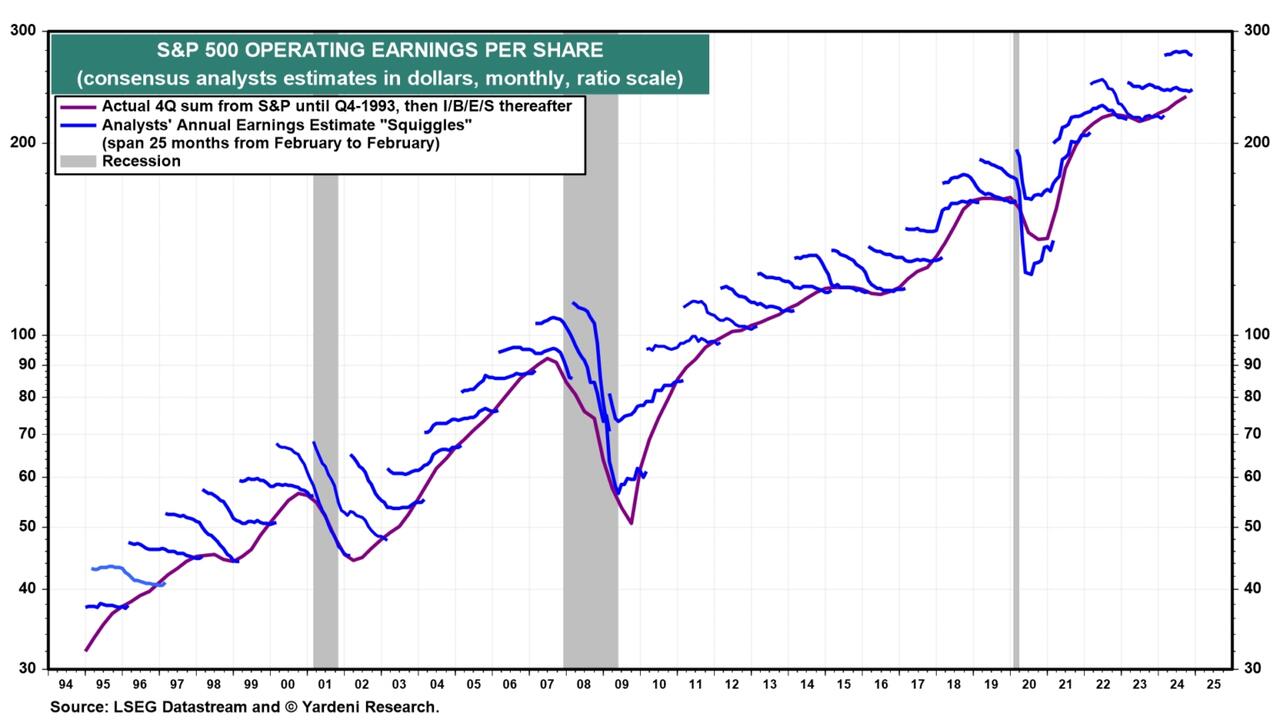
The Wall Street consensus forecast for 2026 earnings growth is strong by historical standards. Analysts are giddy and projecting another year of double-digit growth in S&P 500 earnings per share (EPS). FactSet’s most recent data showed an expected 2026 earnings growth rate for the S&P 500 of about 15 percent. That is well above the long‑term average of roughly 8–9 percent. If FactSet is correct, such would mark a third consecutive year of double‑digit earnings gains.
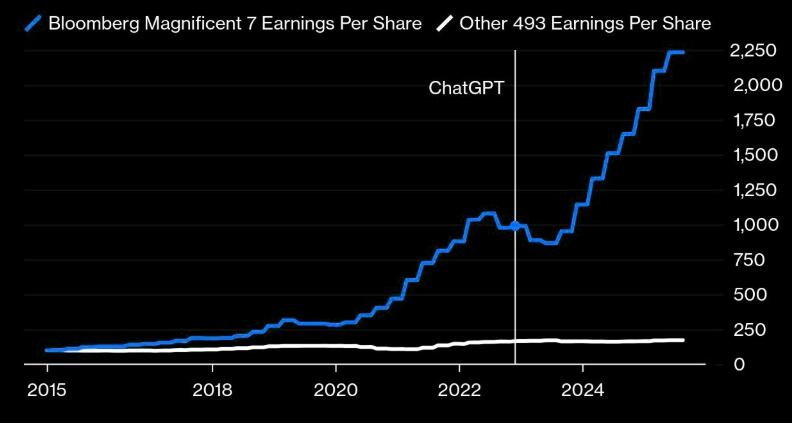
Notably, the 2026 earnings assumptions are driven by the continued strength in the large technology and communications sectors. With those sectors dominated by the “Magnificent Seven,” it is hoped that they continue to contribute disproportionately to earnings growth. Those seven companies alone are forecast to grow earnings strongly once again. As shown, since 2018, there has been very little earnings growth from the bottom 493 companies.
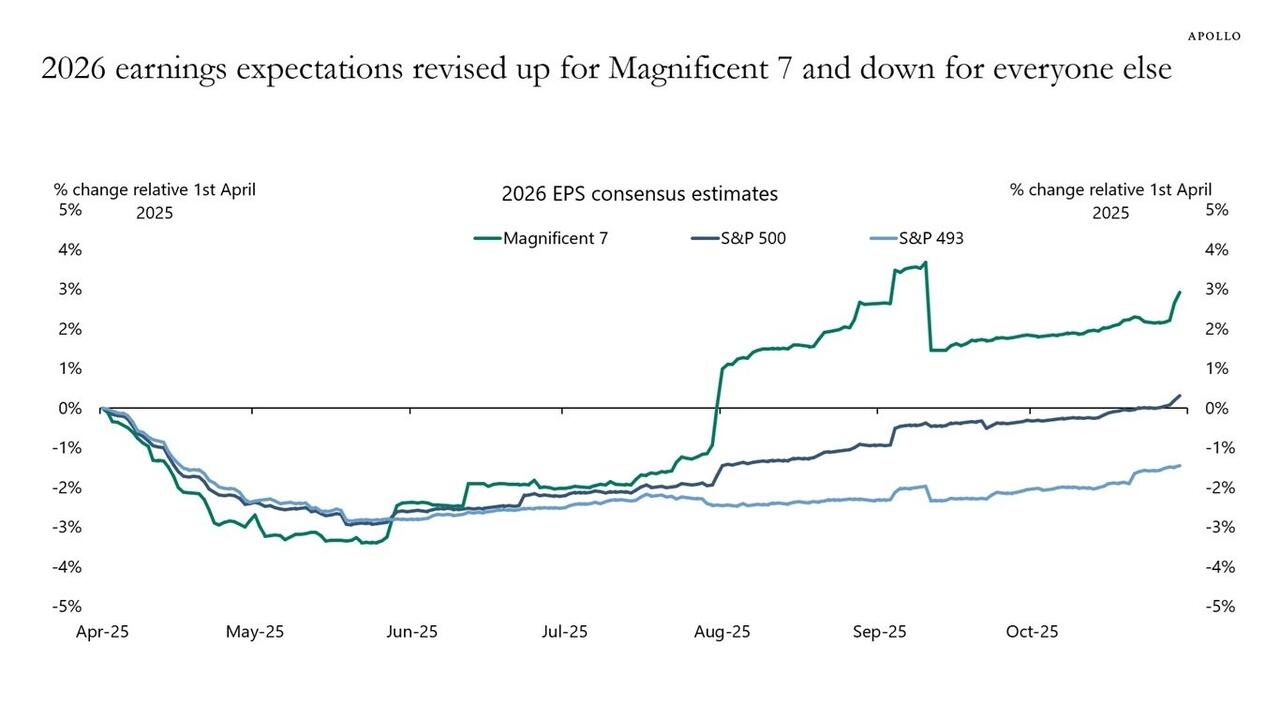
Furthermore, despite the exuberance from Wall Street analysts regarding the overall index, expectations for 2026 earnings improved only for the top seven companies, while estimates for the bottom 493 have seen virtually no change since April.
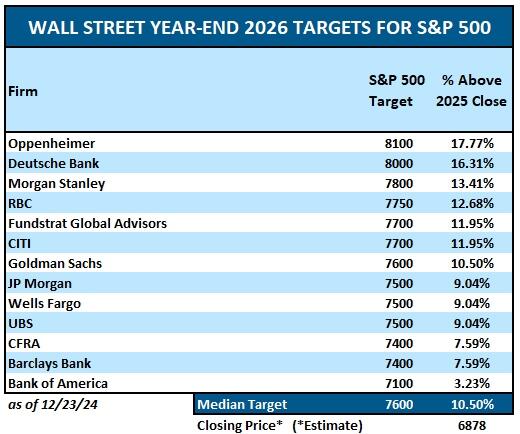
Notably, these 2026 earnings forecasts are influenced by broader market return expectations. For example, many sell‑side strategists are assigning S&P 500 price targets that embed this earnings growth outlook. For example, as shown, current analysts’ forecasts imply that the index could rise between 8% and 17% in 2026. However, to justify that price increase (P), they assume an earnings (E) rate that keeps valuations (P/E) stable.
In other words, Wall Street hopes that earnings expansion rather than valuation multiples will drive market gains. However, over the last 5 years, multiple expansions led the charge as earnings growth failed to keep pace.
This optimism currently comes against a backdrop of a resilient U.S. economy. GDP growth forecasts center on continued expansion, albeit modest, with some estimates indicating annual growth of around 2 percent. That stability reinforces the case for continued corporate profitability. One support is fiscal policy from the recently passed OBBB, which provides tax relief and deregulation. Still, this type of projected growth is not guaranteed. As such, investors should recognize that earnings forecasts reflect analysts’ estimates at a given moment, which is always “bullish” to ensure that Wall Street can sell you products.
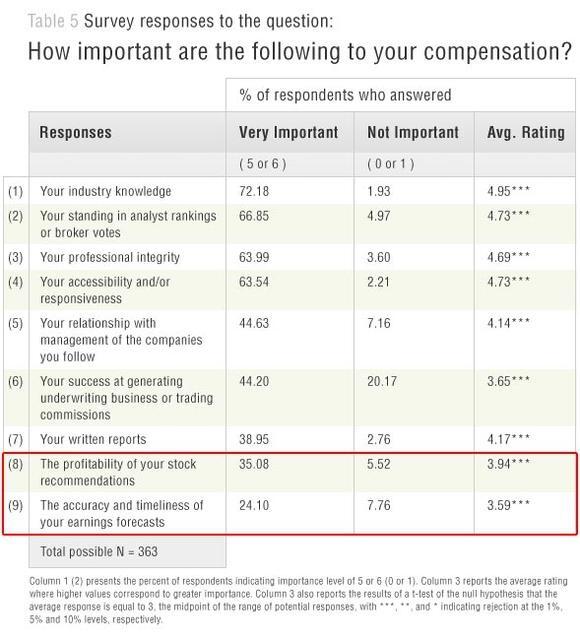
As we previously reported, the accuracy of analysts’ estimates is far down their list of concerns.
However, instead of focusing on Wall Street estimates, which will likely be revised lower in the future, investors should pay closer attention to what will drive 2026 earnings growth.
The Link Between Economic Growth, Profit Margins, and Earnings
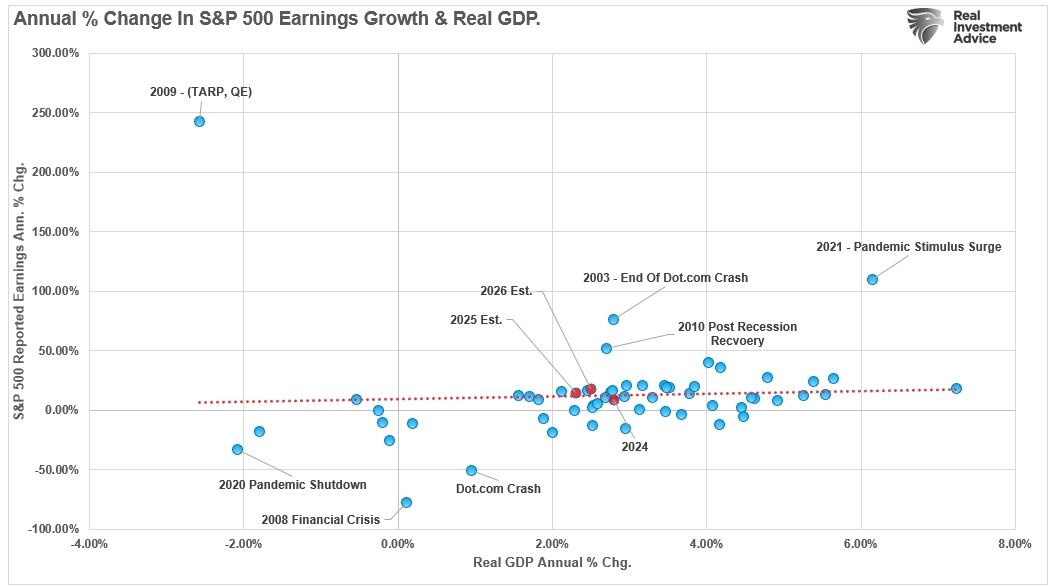
Earnings growth does not occur in a vacuum. Corporate profits are inherently a function of economic growth, pricing power, input costs, and labor dynamics. If the economy grows at a moderate pace, as most anticipate, corporate revenues are expected to expand in line with broader demand. Many forecasts for GDP growth in 2026 hover around the 1.8% to 3% range. Those estimates are driven partly by fiscal support and ongoing investment in sectors such as technology and infrastructure. This modest expansion provides a supportive backdrop for 2026 earnings, as historical correlations suggest. (Outliers are historically a function of recovery or impact from a crisis or recession)
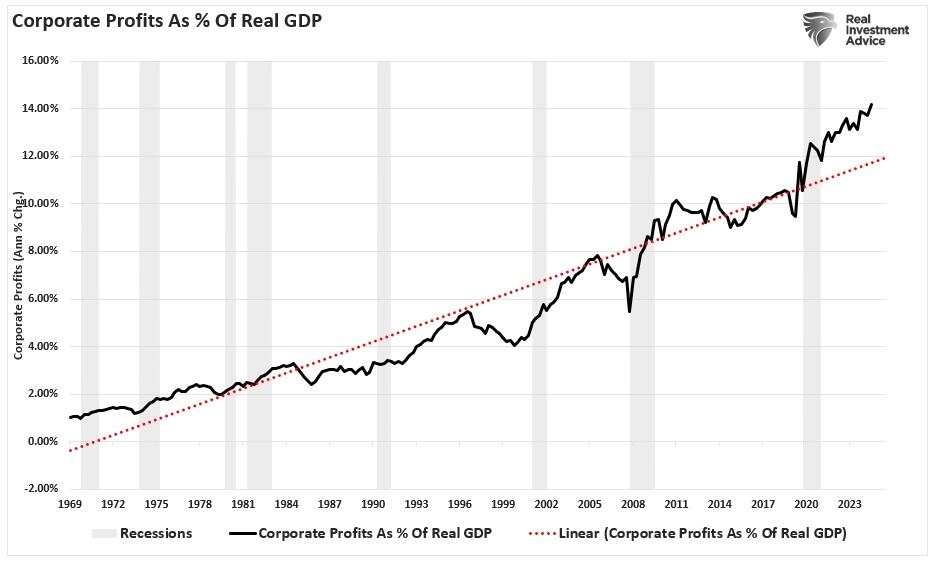
At the same time, corporate profit margins in the S&P 500 are currently very high relative to historical norms. According to FactSet, the estimated net profit margin for the index is near its highest level since tracking began in 2008, at around 13.9%, compared to a ten-year average of 11%. We also see this in corporate profits as a percentage of real economic growth, which is at its highest deviation from the long-term profit growth trend in history.
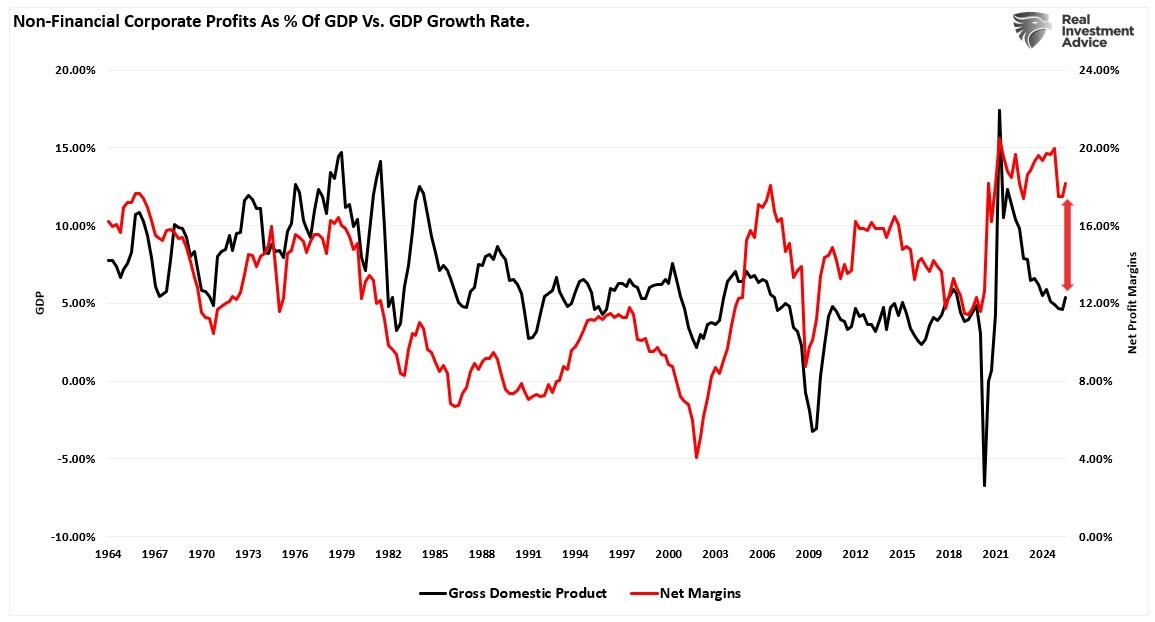
Elevated margins suggest companies have maintained pricing power and cost control, even amid inflationary pressures. But these high margins raise questions about sustainability. Given the supply-demand imbalances (more demand than supply), which allow for elevated margins, it is worth noting that as the economy returns to more normalized growth rates, profit margins tend to follow. Such is particularly the case as inflation pressures subside, employment weakens, and competitive forces erode pricing power. Margin compression has historically dampened earnings growth. Even if revenues are rising, if rising costs cannot be passed on to consumers, they eat into profits.
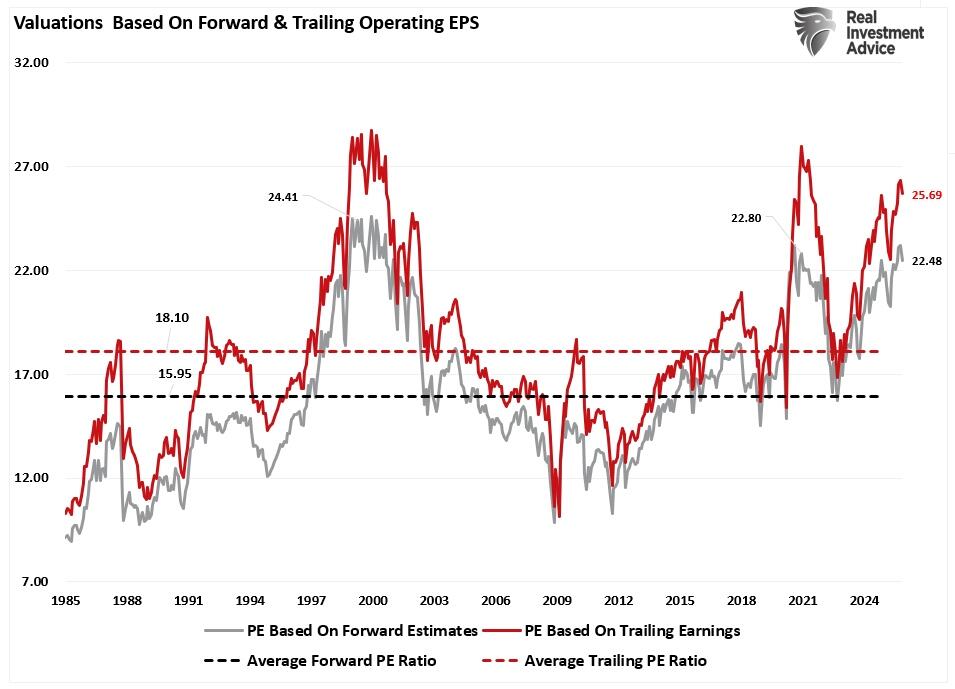
Valuations also matter. As noted above, the current price-to-earnings ratio for the S&P 500 remains above historical averages, at approximately 22x forward earnings. Those valuation levels are also well above the five- and ten-year averages. In other words, the market is pricing in continued earnings momentum. Therefore, if growth slows toward historical norms or margins compress, elevated valuations will mean even modest earnings disappointments could result in share price declines rather than gains.
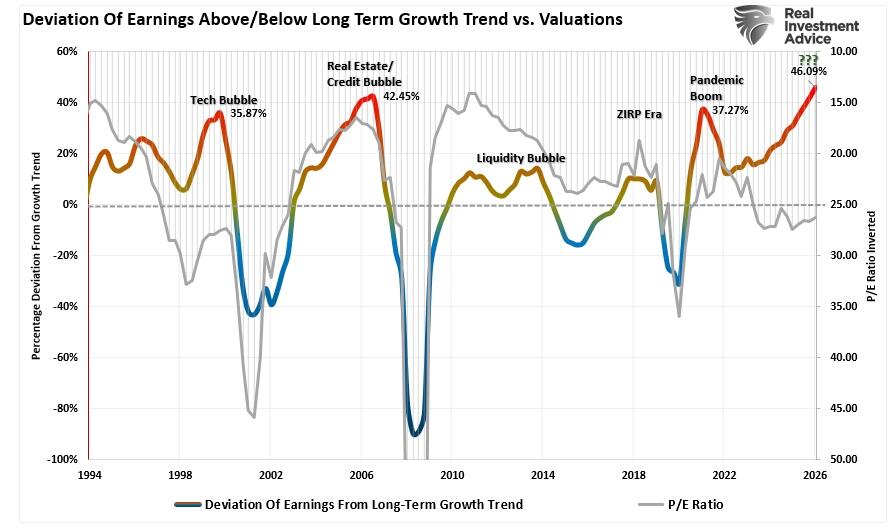
The most considerable risk to investors is that the 2026 earnings estimates, which are the most deviated above its 125-year growth trend, disappoint, and the markets reprice lower. As shown, historically, when earnings become deviated from actual economic activity, the mean reversion process is not kind to investors.
In this context, understanding the mechanics behind earnings expectations becomes critical. Analysts’ expectations for robust earnings growth assume that these economic and profit margin conditions remain supportive; however, any divergence from this script increases the risk of downward earnings revisions, valuation compression, and market volatility.
Analyst Optimism, Valuation Risk, and Structural Challenges
One of the enduring themes in earnings forecasting is the bias toward optimism early in the forecast cycle. Analysts typically issue forward earnings estimates at the start of a year and revise them lower later as actual economic and corporate results become available.
As noted above, such optimism is partly behavioral and partly structural; analysts often have incentives tied to institutional clients who favor growth narratives. When growth assumptions falter due to weaker demand, rising costs, or unforeseen macroeconomic shocks, analysts will typically revise their estimates downward. This creates the familiar pattern of “estimates drifting lower” over the course of the reporting year.
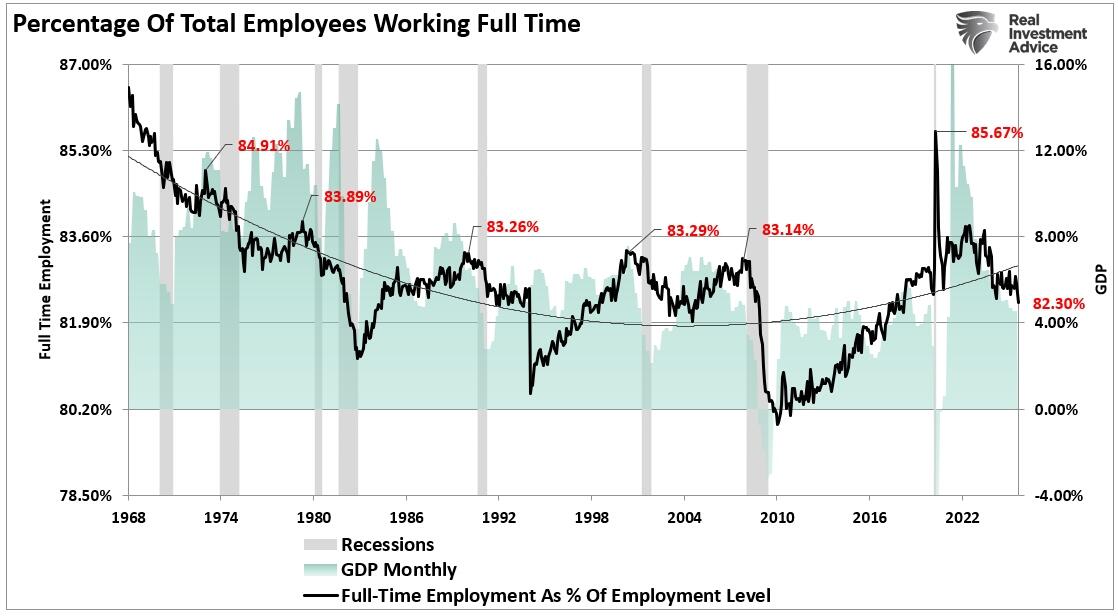
The current earnings growth consensus for 2026 is no exception. While forecasts indicate roughly 12.5–15% EPS growth, several structural vulnerabilities underpin these expectations. As discussed, profit margins are at elevated levels, which makes sustaining margin levels challenging in an environment where employment is declining.
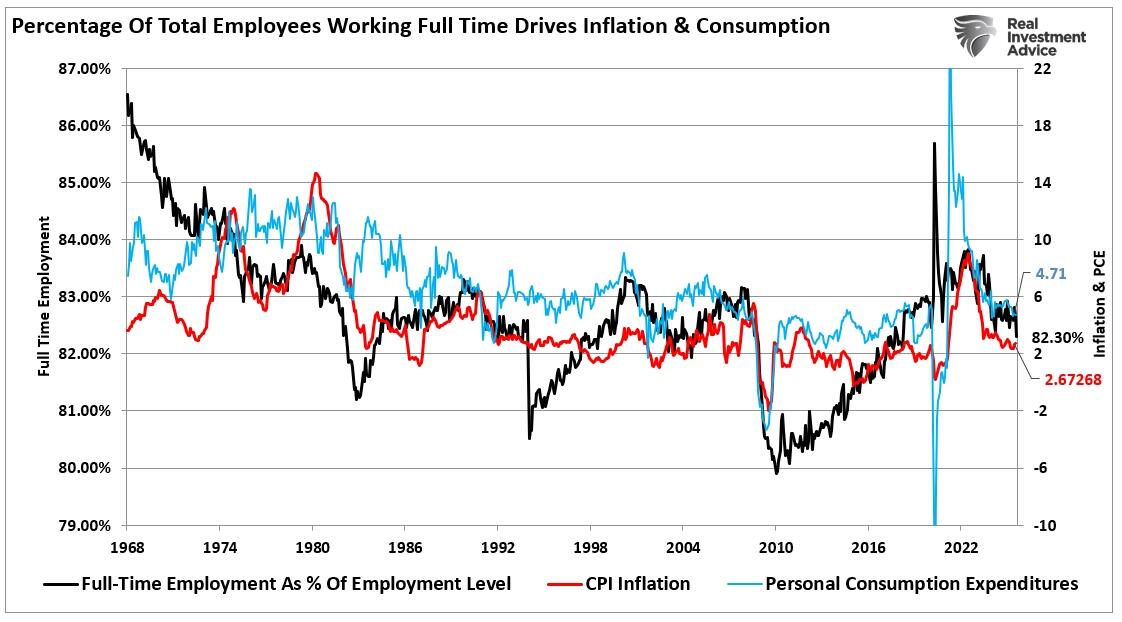
Given that full-time employment is declining, which correlates with the reversal of economic growth rates, it is unsurprising that inflation and personal consumption are also trending lower. This is because employment, particularly full-time employment, supports economic supply and demand.
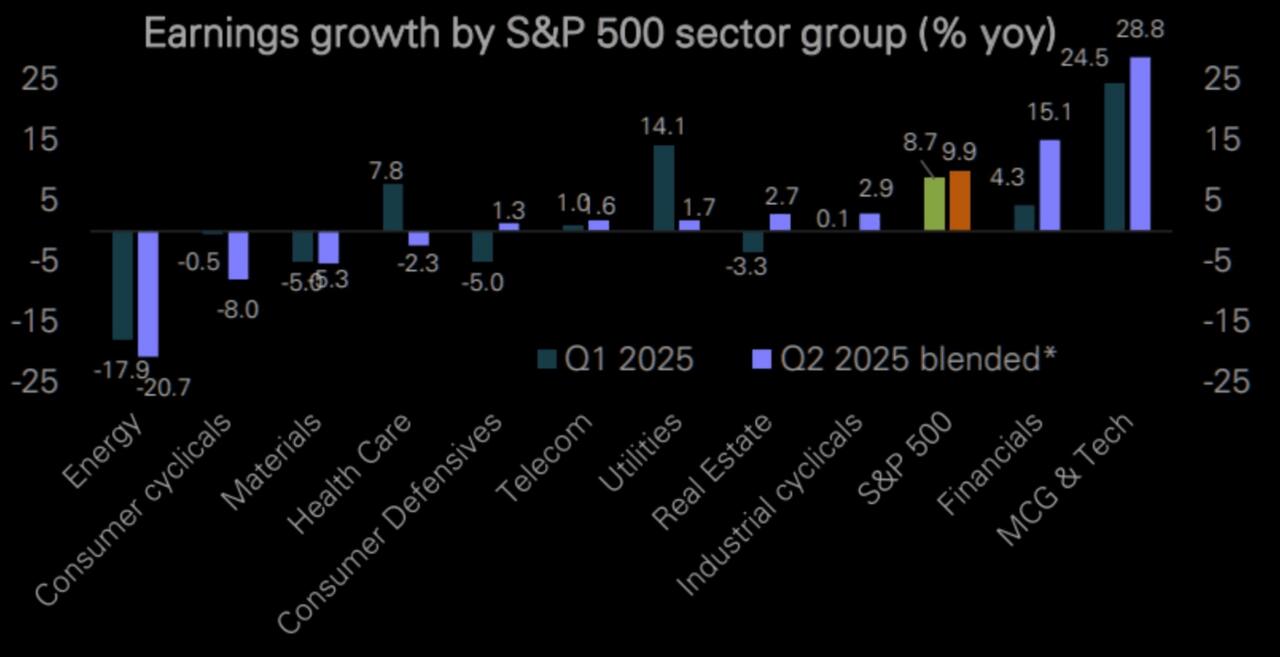
Second, sector concentration risk is significant. A significant portion of projected 2026 earnings growth stems from a small group of mega-cap technology companies. If these firms underperform or face regulatory, competitive, or macroeconomic headwinds, the impact on aggregate earnings could be disproportionately large. A concentrated earnings base magnifies downside risk because fewer companies are carrying the growth load. As we noted previously:
“While technology and AI-driven firms have recently become bright spots, their strength cannot offset broader corporate margin pressures. In Q2, S&P 500 earnings grew 6.4%, with 80 percent of companies beating estimates. But this masks a weakening breadth of growth, where earnings beats are concentrated in essentially just two sectors. There would have been no earnings growth without Megacap Technology and major Wall Street banks.”
Lastly, valuations remain historically high. Elevated price‑to‑earnings ratios reflect market confidence in future earnings growth. But high valuations also reduce the margin for error. If growth falls short of expectations, a multiple contraction is a likely outcome, resulting in stock price declines even if earnings do grow. Several market strategists caution that nearly all favorable assumptions must materialize for current valuations to be justified.
While analysts note that policy factors, such as deregulation and potential tax incentives, are a tailwind for earnings, their actual impact remains uncertain. Policy implementation timing, regulatory uncertainties, and shifting political landscapes can blunt or delay these effects. Investors should note that fiscal tailwinds often operate with lags and can be offset by rising costs elsewhere in the economy.
As such, investors should consider several key factors in 2026.
Expect Earnings Revisions: Analysts are historically optimistic in their early forecasts, and downward revisions are standard. Investors should monitor quarterly earnings guidance and track earnings revisions as one of the earliest indicators that actual performance may diverge from consensus. Early downward revisions often precede broader market corrections, so maintaining a disciplined watch on guidance can help you adjust risk exposure sooner.
Focus on Quality Over Momentum: Higher‑quality companies—those with strong balance sheets, consistent free cash flow, stable profit margins, and resilient business models—tend to outperform during periods of earnings disappointment. When consensus growth slows, lower‑quality or speculative names typically experience sharper drawdowns. Allocating capital toward quality can reduce downside risk.
Manage Valuation Risk: With forward price-to-earnings ratios above long-term averages, it is crucial to stay mindful of valuations. Avoid chasing valuations that imply perfect outcomes. If earnings growth disappoints, valuation compression is likely to occur. Use valuation metrics, such as the PEG ratio, to assess whether growth prospects justify current prices.
Monitor Economic Indicators: Keep a close eye on key macroeconomic data, including GDP growth, inflation trends, and labor market indicators. These indicators directly influence corporate revenues and margins. Early signs of a slowing economy or rising inflation pressures should prompt reevaluation of equity risk exposure.
Diversify Beyond the U.S. Market: The U.S. market valuations are high and heavily concentrated in a handful of mega‑cap tech names. Diversifying into international equities or sectors less dependent on narrow profit drivers can reduce concentration risk. Other markets may offer stronger valuations and more attractive earnings prospects if the U.S. slows.
Use Defensive Instruments Appropriately: In periods of earnings uncertainty, adding defensive instruments—such as high-quality bonds, low-volatility equities, or hedging strategies—can help mitigate downside risk. These positions typically underperform during strong rallies but provide ballast when earnings or economic data disappoint.
Prepare for Volatility: Volatility increases when analysts reduce earnings forecasts, and uncertainties mount. Investors should adopt a tactical approach that accounts for higher volatility, utilizing position sizing and stop-loss discipline to protect their capital. Volatility indicators such as the VIX can serve as early warning signals.
Revisit Fiscal and Policy Tailwinds: Assess how fiscal policy changes—such as tax incentives or deregulation—are actually impacting corporate profitability. If intended policy benefits fail to meet expectations, earnings momentum may weaken. Staying attuned to policy developments helps recalibrate expectations and positions.
Just remember, while all analysts are very bullish about 2026, there is no guarantee.
Tyler Durden
Tue, 01/13/2026 – 07:20
https://www.zerohedge.com/markets/2026-earnings-outlook-another-year-optimism

Lake Forest/Lake Bluff native is artistic director of a theater, directs a play, will act in another play later this year
Serving as Artistic Director of A Red Orchid Theatre is a full-time job for Lake Bluff and Lake Forest native Kirsten Fitzgerald, but she still finds time to take on acting and directing projects.
Her latest is directing the Chicago premiere of “Birds of North America” by Anna Ouyang Moench, which runs from Jan. 15 to Feb. 22. After that, she will flex her acting muscles in A Red Orchid Theatre’s world premiere of “The Targeted” by Hanna Kime, May 7-June 14 on the Chopin Theatre mainstage.
“Birds of North America” tracks a decade in the life and relationship between a father and daughter who are both avid birders.
A Red Orchid Theatre’s Artistic Director Kirsten Fitzgerald will direct the Chicago premiere of “Birds of North America” by Anna Ouyang Moench, featuring ensemble member John Judd (pictured) and Cassidy Slaughter-Mason as father-and-daughter birders, Jan. 15-Feb.22. (Jeff Kurysz)
“The thing that attracted me to that show had to do with the relationship between this father and daughter, and the very personal, very intense both joy and damage that they either carry or do to each other over the course of these 10 years that the play takes place,” Fitzgerald said. “I’m also really attracted to plays that are intensely personal and simultaneously either addressing directly or raising awareness about ethic and global issues, like the environment, which is a big part of this play.”
The play also deals with the difficulty of a relationship between family members whose political beliefs are very different, the Artistic Director noted.
“Where family is concerned, the relationships are rarely a straight line,” Fitzgerald concluded.
Fitzgerald’s family moved from Chicago to Lake Bluff when she was in first grade. They relocated to Lake Forest when she was in junior high school. Fitzgerald graduated from Lake Forest High School.
She was always involved in different aspects of theater.
“I was involved in a program called Group 4 at Gorton Community Center in Lake Forest,” Fitzgerald said. Her family was living in Lake Bluff at the time.
“I remember being very excited to be in a grown-up production once I was in high school,” she recalled. The show was “Sweet Charity.”
The summer program was run by Phyllis Mount, who was also the drama teacher at Lake Forest Country Day School when Fitzgerald attended that school for a couple of years.
“When I was finishing up high school, I knew that I wanted to do some sort of performance in school,” Fitzgerald said. “I did a lot of auditioning for different conservatory programs — more geared toward musical theater.”
Her goal was to attend NYU (New York University), but that was financially impossible for her.
“I ended up going to the University of Kansas in Lawrence, Kansas, with all intentions of transferring after a year,” she said. “You couldn’t have paid me to leave once I was there. It was a spectacular small theater department in the middle of this giant university. We were working all the time.”
She is still working all the time and has performed or directed at the most acclaimed Chicago theaters, including Goodman, Steppenwolf, and Victory Gardens. She also has numerous television credits, including “Chicago Med,” “Chicago Fire,” and “Chicago Justice.”
Fitzgerald has directed a number of productions for A Red Orchid Theatre, where she has been an ensemble member since 2000. She won a Best Director of a Play–Midsize Jeff Award for “The Moors” at her home company.
She has been the Artistic Director of A Red Orchid Theatre since 2008.
“I had no intentions of being an artistic director. That was not on my radar at all,” Fitzgerald admitted. “When our Founding Artistic Director (Guy Van Swearingen) was feeling it was time for him to take a break, I said I’d give it a try.”
What swayed her toward accepting the position was the “wonderfully intense and close artistic ensemble,” she said.
The Artistic Director is proud of the framework she has developed for the theater company. “When I stepped in, our staff was a volunteer artistic director and a part-time hourly general manager,” Fitzgerald reported. They now have four full-time staff and a couple of part-time employees.
When Fitzgerald is acting in or directing a show at A Red Orchid Theatre, a part-time associate artistic director takes over some of her artistic director chores.
One of the things Fitzgerald said she is proudest of is “how much new work we do and how committed we are in treating each play and playwright individually. There is no one formula that works for every play,” Fitzgerald said.
Performances of “Birds of North America” are 7 p.m. Thursdays and Fridays, 3 p.m. and 7 p.m. Saturdays, and 3 p.m. Sundays, Jan. 29-Feb. 22, at 1531 N. Wells St. in Chicago. Previews are 7 p.m. Jan. 15-17, 3 p.m. Jan. 18, 7 p.m. Jan. 22 and 23, and 3 p.m. and 7 p.m. Jan. 24. Opening is 6 p.m. Jan. 25. Tickets are $33-$44 for previews; $55 for regular run.
For reservations, call 312-943-8722 or visit aredorchidtheatre.org.
Myrna Petlicki is a freelance reporter for Pioneer Press.