Category: News

Portage man convicted in child sexual misconduct trial
A Portage man accused of molesting three boys was convicted Wednesday after a three-day trial.
Michael Langford, 47, faced three counts of sexual misconduct with a minor and two counts of child seduction. Jurors deliberated for about three hours.
His sentencing hearing is March 19.
Deputy Prosecutor Arturo Balcazar argued in closing arguments that Langford “knew what he was doing to these boys.”
The victims didn’t decide “to make up a story” for almost eight years, he said.
Defense lawyer Herb Shaps told jurors he believed the victims made it up. There was no “medical” or “forensic” evidence corroborating the accounts, he said.
Court documents allege the youngest victim — who experienced the most sexual abuse — told relatives what happened on an August 2019 camping trip. Investigators wrote Langford molested the victims between March 2018 and July 2019.
He told police that he was sexually abused starting at age 5 or 6. He was molested at least “five hundred times,” including 50 times in Crown Point, court records allege.
Post-Tribune archives contributed.
https://www.chicagotribune.com/2026/01/14/portage-man-convicted-in-child-sexual-misconduct-trial/

Obamacare Enrollment Trails 2025 By Less Than Expected
Obamacare Enrollment Trails 2025 By Less Than Expected
Authored by Lawrence Wilson via The Epoch Times (emphasis ours),
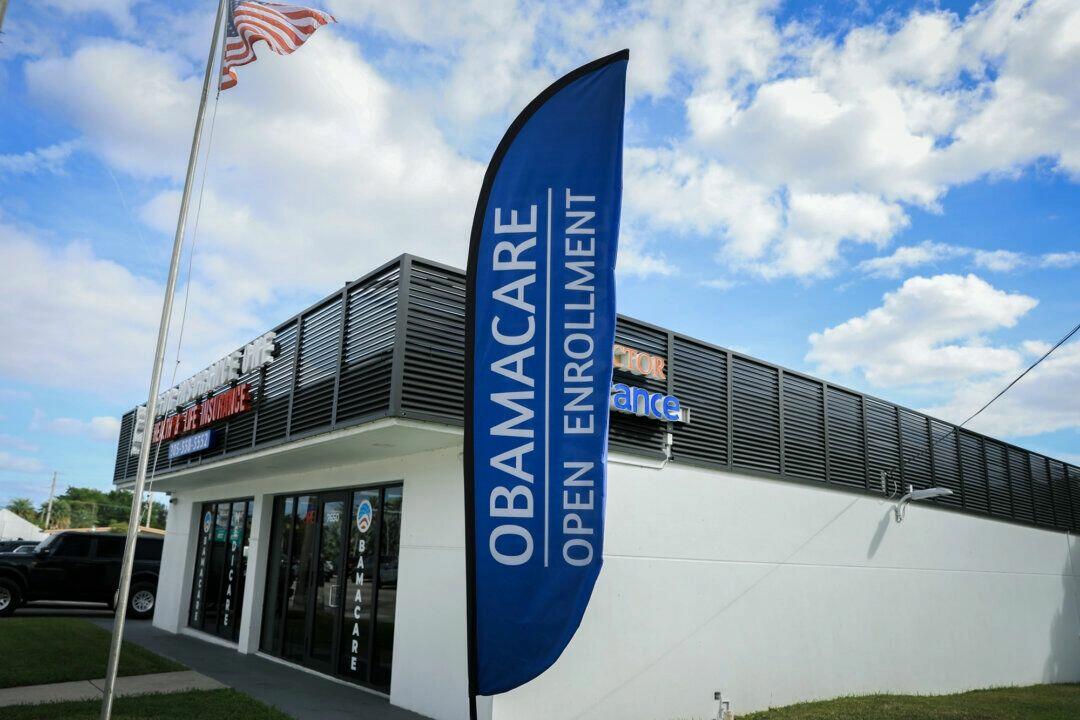
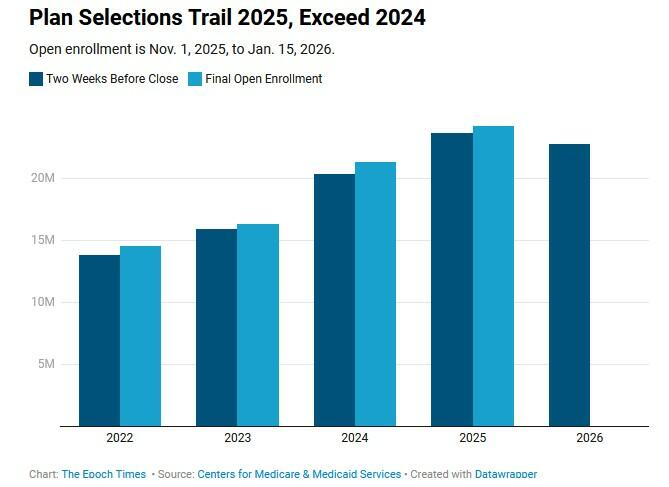
Plan selections in the Affordable Care Act Marketplace were 3.5 percent behind 2025’s number with two weeks left in open enrollment, but the drop-off has not been as severe as some analysts predicted.
Some 22.8 million people had selected a plan by Jan. 3, about 830,000 fewer than at the same point in 2025. The program, popularly known as Obamacare, appears on track for its second-highest enrollment ever.
The open enrollment period began on Nov. 1, 2025, and ends on Jan. 15 in most states. During open enrollment, anyone can sign up for Obamacare. Outside that period, only those who report a qualifying life event such as a birth, divorce, or job change can enroll.
The decline for 2026, if it continues through the final weeks of open enrollment, will mark the first drop in participation since 2020.
Subsidies Boosted Enrollment
Since its inception, Obamacare enrollments started slower than predicted, taking three years to reach 12.7 million in 2016. From there, enrollment decreased by about 10 percent over four years.
Enrollment was bolstered by enhanced subsidies starting in 2021, more than doubling to 23.4 million by 2025.
The scheduled expiration of the enhanced subsidies in December 2025 sparked heated debate in Congress on the affordability of the program without them.
Congressional Democrats sought to make the enhanced subsidies permanent. That effort failed to advance in the Senate despite Democrats’ willingness to withhold federal government funding throughout the fall in an attempt to force negotiations.
The enhanced subsidies were implemented in 2021 as a two-year measure to ensure the affordability of health coverage during the COVID-19 pandemic era. They were later extended through 2025.
Health insurers judged that middle-class Americans who had opted into Obamacare in recent years would opt out again when the subsidies expired, dramatically changing the risk profile of remaining enrollees and shifting it toward those with chronic conditions or higher medical needs.
In response, insurers raised premiums by an average of 27 percent, according to data from health policy research group KFF.
Drop Less Than Predicted
Many observers predicted a huge drop in enrollment in 2026 based on both the decrease in subsidies and the increase in premium costs.
Jason Levitis, senior fellow at Urban Institute, told senators in November that 4.8 million people would lose health coverage in 2026 if the enhanced subsidies expired, based on a report from his organization.
The expiration of the subsidies would “leave millions uninsured or forced to make impossible choices,” according to the Center on Budget and Policy Priorities.
Although the initial 3.5 percent drop of 830,000 enrollees is significant, it does not approach those predictions.
At 22.8 million enrollees, the 2026 figure is 12 percent ahead of 2024 and 43 percent ahead of 2023.
Over the past four years, the number of plan selections increased by an average of 3.7 percent during the final two weeks of open enrollment. In 2025, the increase was 2.4 percent.
On the current track, the number of 2026 plan selections would be the second-highest ever.
Further Decline Likely
Yet some analysts say there will be a further drop after open enrollment closes.
“While we do eventually expect to see declines in Marketplace enrollment, following the expiration of the enhanced premium tax credits at the end of 2025, it is too soon to tell how much it will change,” said Jared Ortaliza, a policy analyst at KFF studying the Affordable Care Act.
The data available now indicate marketplace plan selections, which become “effectuated” enrollments when consumers begin paying premiums.
The vast majority of 2026 plan selections so far—20 million—are 2025 customers who were automatically reenrolled in the plan, according to the Centers for Medicare and Medicaid Services.
Those automatic plan selections do not always become premium-paying enrollees, according to Ortaliza.
“The extent of [Affordable Care Act] enrollment changes likely won’t be known until this summer, when effectuated enrollment data are typically released,” he said.
In 2025, the number of effectuated enrollments was about 4 percent less than the number of plan selections.
Brian Blase, president of Paragon Health Institute, theorized that much of the decline in plan selection, and a likely further decline in effectuated enrollments, is attributable to improper or fraudulent enrollments.
“The decline in enrollment from ’25 to ’26 means that some of the fraudulent enrollment exited the market,” Blase wrote on social media.
Blase estimated that about 5 million enrollments in 2024 and 6.4 million in 2025 were improper, with many being fraudulently enrolled in plans with $0 premiums. He said many will disappear as people do not effectuate coverage, which involves paying a premium.
“This means that people who are unaware of their enrollment, in other coverage, or ‘fake’ people will not pay their share of the premium and should (assuming insurers follow the rules) be removed,” Blase wrote.
An effort to reinstate the enhanced subsidies is ongoing in Congress.
Open enrollment in Kentucky and Maine closes on Jan. 16 and in Massachusetts on Jan. 23. Open enrollment closes in California, New Jersey, New York, Rhode Island, Washington state, and Washington on Jan. 31.
Tyler Durden
Wed, 01/14/2026 – 17:30
https://www.zerohedge.com/political/obamacare-enrollment-trails-2025-less-expected

Naperville News Digest: Naper Settlement summer camp registration starts Monday; COD offering summer credit program for high school seniors
Naper Settlement summer camp registration starts Monday
Registration for Naper Settlement’s summer camps opens to the public on Monday, Jan. 19.
Summer camps are spread across the museum’s campus and feature an array of topics including science, history, art and more, officials said in a news release. They run from 9 a.m. to 3 p.m. June 1 to Aug. 14, with free drop-off starting at 8 a.m., and offer activities for younger and older children.
Among the options are an animal kingdom camp, robotics camp, architecture camp and forensics camp. Children will learn from guest speakers and participate in themed hands-on learning experiences, the release said.
Naper Settlement members can register before Monday.
For more information, go to www.napersettlement.org/campnaper.
COD offering summer credit program for high school seniors
Students who will be entering their senior year of high school in fall 2026 can earn up to four transferable general education courses at half-off tuition this summer through College of DuPage’s College Jumpstart program.
This program offers college courses at $78 per credit hour, a news release said.
Students can enroll in a program that pairs two courses from academic areas such as humanities, art, anthropology and history, the release said. Courses run from June 15 to Aug. 8 at the main campus, 425 Fawell Blvd., Glen Ellyn.
Registration opens March 11.
Virtual informational sessions will be held at 7 p.m. Monday, Feb. 12, and 6 p.m. Tuesday, March 10. To register for a Zoom information session, go to www.cod.edu.
Will County making plans for its 190th anniversary year
Will County is celebrating the 190th anniversary of its founding this and will be highlighting its history throughout 2026.
The county’s incorporation on Jan. 12, 1836, was recognized by County Executive Jennifer Bertino-Tarrant with an executive proclamation noting how its growth from simple trading posts to a hub of agricultural, manufacturing, energy and transportation industries, a news release said.
Throughout the year, Bertino-Tarrant’s office will partner with the Will County Historic Preservation Commission to showcase local historic sites and milestones under the theme of “Celebrating 190 Years of Community,” the release said. There are 60 sites designated by the commission as local landmarks.
They also will mark other milestones, including the 250th anniversary of the signing of the Declaration of Independence and the Route 66 centennial.
These are the first-, second- and third-place winners of the 2025 Student Silent Film Festival held at the Tivoli Theatre in Downers Grove. The year the fest is set for Jan. 28, and will include an entry from students at Neuqua Valley High School in Naperville. (James C. Svehla)
Neuqua Valley student movie to compete at Silent Film Fest
Neuqua Valley High School students will compete against students from a dozen Chicago-area high schools at the 9th annual Student Silent Film Festival.
Scheduled for 6:45 p.m. Wednesday, Jan. 28, at the Tivoli Theatre in Downers Grove, the event will showcase student films told without voices or sound effects, a news release said.
Neuqua Valley’s film is titled “King of Hearts.” The Naperville school’s entry will compete against other suburban high schools, including Lyons Township, Lake Forest, Oak Forest and Tinley Park.
Derek Berg, a professional pianist and CEO of the Clarendon Hills Music Academy, will provide the musical accompaniment, the release said. Scores will be performed on the SilentFilmtronic 2000, which employs virtual instruments sampled from classic synthesizers from between 1950 to 1980.
Entertainment and arts education professionals will evaluate the films, and three winners will be selected based on narrative development, cinematography, lighting and technical editing.
Festival tickets are $20 in advance at www.studentsilentfilmfestival.org and $25 at the door.
https://www.chicagotribune.com/2026/01/14/naperville-settlement-camp-dupage-silent-neuqua/

A part that broke on a UPS plane that crashed in Kentucky failed 4 times on other planes years ago
Boeing warned plane owners in 2011 about a broken part that contributed to a UPS plane crash that killed 15 last year but at that point the plane manufacturer didn’t believe it threatened safety, the National Transportation Safety Board said Wednesday.
The UPS plane crashed in November 2025 shortly after taking off in Louisville, Kentucky, when the left engine flew off the wing as the plane rolled down the runway.
The NTSB said Wednesday that Boeing had documented in 2011 there were four previous failures of a part that helps secure the MD-11’s engines to the wings on three different planes, but at that point the plane manufacturer “determined it would not result in a safety of flight condition.” These planes were actually built by McDonnell Douglas, which was later bought by Boeing.
The NTSB previously said investigators found cracks in some of the parts that held the engine to the wing. Those cracks hadn’t been caught in regular maintenance done on the plane, which raised questions about the adequacy of the maintenance schedule. The last time those key engine mount parts were examined closely was in October 2021, and the plane wasn’t due for another detailed inspection for roughly 7,000 more takeoffs and landings.
It’s not clear when the cracks started to develop in the parts that helped hold the engine on the wing, but this crash is reminiscent of a 1979 crash in Chicago when the left engine flew off an American Airlines DC-10 during takeoff, killing 273 people. The DC-10 was the predecessor of the MD-11.
That previous crash led to the worldwide grounding of 274 DC-10s. The airline workhorse was allowed to return to the skies because the NTSB determined that maintenance workers damaged the plane that crashed while improperly using a forklift to reattach the engine. That meant the crash wasn’t caused by a fatal design flaw even though there had already been a number of accidents involving DC-10s.
But former FAA and NTSB crash investigator Jeff Guzzetti said that a service bulletin McDonnell Douglas issued in 1980 did identify failures of the spherical bearing race as a “safety of flight condition” so it’s surprising that Boeing didn’t call it that in 2011. He said that American had removed the engine of that plane so it could inspect that bearing.
“I just think it raises questions regarding the adequacy of the severity of the 2011 service letter, and it also raises questions about how UPS incorporated that information and acted upon it,” Guzzetti said.
NTSB didn’t say whether there had been additional documented failures of the spherical bearing race since 2011. Investigators found that part broken into two pieces after the UPS crash, and the lugs that held that part were cracked.
Photos released by the NTSB of the Nov. 4 crash show flames erupting as the rear of the engine starting to detach before it flew up and over the wing. Then the wing was engulfed by fire as the burning engine flew above it.
Three pilots on the plane that was headed for Hawaii were killed along with 12 more people on the ground near Louisville’s Muhammad Ali International Airport.
The factual report released Wednesday doesn’t state what caused the engine to fly off, but it’s clear that investigators are focused on the failure of this bearing. The ultimate conclusion won’t come though until the NTSB’s final report, which usually doesn’t come until more than a year after a crash.
The report does make clear that neither of the plane’s two other engines were on fire before the crash. Some experts had previously speculated that debris flying off of the left engine might have damaged the engine on the tail.
Boeing, UPS and the Federal Aviation Administration are limited on what they can say while the NTSB investigation is ongoing, so they all declined to comment on Wednesday’s report. Boeing and UPS both expressed condolences to the families that lost loved ones in the crash.
“We remain profoundly saddened by the Flight 2976 accident,” UPS spokesperson Jim Mayer said. “Our thoughts continue to be with the families and Louisville community who are grieving, and we remain focused on the recovery effort,” Mayer said.
The 34-year-old MD-11 plane only got 30 feet (9.1 meters) off the ground before crashing into several industrial buildings just past the runway and generating a massive fireball that could be seen for miles. Dramatic videos of the crash showed the plane on fire as it plowed into buildings and released a massive plume of smoke.
Airlines quit flying this type of plane commercially years ago because it isn’t as efficient as newer models, but they had continued to fly for cargo carriers like UPS and FedEx and a few of these planes were also modified for use in firefighting. All the MD-11s that had been in use and 10 related DC-10s have been grounded since the crash.

President Trump signs a law returning whole milk to school lunches
Whole milk is heading back to school cafeterias across the country after President Donald Trump signed a bill Wednesday overturning Obama-era limits on higher-fat milk options.
Nondairy drinks such as fortified soy milk may also be on the menu in the coming months following adoption of the Whole Milk for Healthy Kids Act, which cleared Congress in the fall.
The action allows schools participating in the National School Lunch Program to serve whole and 2% fat milk along with the skim and low-fat products required since 2012.
“Whether you’re a Democrat or a Republican, whole milk is a great thing,” Trump said at a White House signing ceremony that featured lawmakers, dairy farmers and their children.
The law also permits schools to serve nondairy milk that meets the nutritional standards of milk and requires schools to offer a nondairy milk alternative if kids provide a note from their parents, not just from doctors, saying they have a dietary restriction.
The signing comes days after the release of the 2025-2030 Dietary Guidelines for Americans, which emphasize consumption of full-fat dairy products as part of a healthy diet. Previous editions advised that consumers older than 2 should consume low-fat or fat-free dairy.
Earlier this week, the Agriculture Department sent a social media post showing Trump with a glass of milk and a “milk mustache” that declared: “Drink Whole Milk.”
The change could take effect as soon as this fall, though school nutrition and dairy industry officials said it may take longer for some schools to gauge demand for full-fat dairy and adjust supply chains.
Long sought by the dairy industry, the return of whole and 2% milk to school meals reverses provisions of the Healthy Hunger-Free Kids Act championed by former first lady Michelle Obama. Enacted more than a dozen years ago, the law aimed to slow obesity and boost health by cutting kids’ consumption of saturated fat and calories in higher-fat milk.
Nutrition experts, lawmakers and the dairy industry have argued that whole milk is a delicious, nutritious food that has been unfairly vilified, and that some studies suggest that kids who drink it are less likely to develop obesity than those who drink lower-fat options. Critics have also said that many children don’t like the taste of lower-fat milk and don’t drink it, leading to missed nutrition and food waste.
Change affects nearly 30 million schoolkids
The new rules will change meals served to about 30 million students enrolled in the National School Lunch Program.
Health Secretary Robert F. Kennedy Jr. described the new law as “a long-overdue correction to school nutrition policy.” Agriculture Secretary Brooke Rollins said it fixed Michelle Obama’s “short-sighted campaign to ditch whole milk.”
Schools will be required to provide students with a range of fluid milk options, which can now include flavored and unflavored organic or conventional whole milk, 2%, 1% and lactose-free milk, as well as non-dairy options that meet nutrition standards.
The new dietary guidelines call for “full-fat dairy with no added sugars,” which would preclude chocolate- and strawberry-flavored milks allowed under a recent update of school meal standards. Agriculture officials will have to translate that recommendation into specific requirements for schools to eliminate flavored milks.
The new law exempts milk fat from being considered as part of federal requirements that average saturated fats make up less than 10% of calories in school meals.
One top nutrition expert, Dr. Dariush Mozaffarian of Tufts University, has said there is “no meaningful benefit” in choosing low-fat over high-fat dairy. Saturated fatty acids in dairy have a different composition than other fat, such as beef fat, plus different beneficial compounds that could offset theoretical harms, he added.
“Saturated fat in dairy has not been linked to any adverse health outcomes,” Mozaffarian said in an interview.
Research has shown that changes in the federal nutrition program after the Obama-era law was enacted slowed the rise in obesity among U.S. kids, including teenagers.
But some nutrition experts point to newer research that suggests that kids who drink whole milk could be less likely to be overweight or to develop obesity than children who drink lower-fat milk. One 2020 review of 28 studies suggests that the risk was 40% less for kids who drank whole milk, although the authors noted they couldn’t say whether milk consumption was the reason.
https://www.chicagotribune.com/2026/01/14/whole-milk-school-lunches/

AED requirement for schools restored in Indiana House bill
A massive education deregulation bill met mostly with support from 15 speakers during a House education committee hearing on Wednesday.
The biggest issue for many speakers was the removal of a mandate requiring defibrillators and cardiac emergency plans in schools, a law just passed last year.
An amendment, however, restored the requirement.
State Rep. Robert Behning, R-Indianapolis, authored the bill and chairs the education committee. He said a vote will be taken Jan. 21.
Behning said the 68-page bill aims to reduce redundancies and ease the burden on educators. He said it removes 21,600 words from the state code.
After the language eliminating the AED requirement in schools was removed, several people spoke to support the amendment.
Julie West, a LaPorte city councilwoman, said her 17-year-old son Jake died from cardiac arrest during football practice in 2013. She became a staunch advocate for the law requiring defibrillators at schools and at school events.
“All schools should plan and prepare and protect everyone on school grounds,” she said.
“I never thought my 17-year-old son would suffer cardiac arrest and not come home from school,” she said.
West said about 23,000 young people have cardiac arrest each year. “We have the opportunity to teach our kids lifesaving skills. We are teaching our children they are capable of stepping up and becoming part of the chain of survival.”
She said schools are eligible to use state school safety grants, increased by $5 million statewide last year, to purchase AEDs.
Former Munster School Board member and athletic trainer John Doherty said he doesn’t want the AED requirement watered down.
“Time is crucial,” he said, citing the urgency of a 1-to-3-minute response.
He said the AEDs can be purchased for $100 or less. “I see no need to change the legislation at this point.”
State Rep. Randy Novak, a former Michigan City fire chief, supported the amendment restoring the AED language.
“At a time when data shows AEDs support life, we should be expanding it, not limiting it,” said Novak, D-Michigan City.
Speakers representing the state’s teacher unions voiced concern about the possible removal of contractual teacher rights if they work in a joint program such as an interlocal.
“It appears to treat them differently because of where they teach,” said Gail Zeheralis, a lobbyist for the Indiana State Teachers Association.
Joel Hand, who represents the Indiana Federation of Teachers, pointed to a possible restriction in bargaining rights for teachers in the Gary Community School Corp. because of its distressed status.
Carole Carlson is a freelance reporter for the Post-Tribune.

Northern Illinois’ Jordan Lynch, ex-Chicago Bears Olin Kreutz and Jerry Azumah in College Football HOF class
Mark Ingram, the first Alabama player to win the Heisman Trophy, and Ndamukong Suh and Aaron Donald, two of the most fearsome defensive linemen of their era, highlight the 2026 College Football Hall of Fame class announced Wednesday.
Gary Patterson of TCU and Chris Petersen of Boise State and Washington are among four coaches who will be inducted at the National Football Foundation’s awards dinner in December in Las Vegas.
The class includes six consensus first-team All-Americans, four multiyear first-team All-Americans and eight major award winners.
Also in the class are Northern Illinois quarterback Jordan Lynch, former Chicago Bears center Olin Kreutz (Washington) and former Bears cornerback and kick returner Jerry Azumah (New Hampshire).
Lynch finished third in Heisman Trophy voting in 2013 and led the Huskies to an Orange Bowl berth in 2012. NIU went 24-4 in his two seasons as the starter. He’s now the head coach at his high school alma mater, Mount Carmel, and has led the Caravan to four straight state titles and five in all.
Mount Carmel coach Jordan Lynch celebrates after his team won the Class 8A state championship game against Oswego on Dec. 3, 2025, in DeKalb, Ill. (Vincent D. Johnson/for the Daily Southtown)
Kreutz, a six-time Pro Bowl selection and two-time All-Pro with the Bears, was a consensus All-American at Washington in 1997.
Azumah starred at running back at New Hampshire, winning the 1998 Walter Payton Award as the top offensive player in Division I-AA (now FCS), before switching to defense in the NFL. He made the Pro Bowl in 2003 as a kick returner.
Ingram won the Heisman in 2009 while leading Alabama to a 14-0 record and national championship. He led the SEC in rushing with a school-record 1,658 yards and scored 20 touchdowns. He finished his Alabama career as the school’s all-time leader in rushing touchdowns. He played 12 seasons in the NFL.
Nebraska’s Suh turned in one of the most dominant seasons by a defensive lineman in 2009, sweeping the Bednarik, Lombardi, Nagurski and Outland trophies and being voted Associated Press national player of the year. He was the first defensive lineman in 15 years to be a Heisman finalist. Last August he was named to the All-Time AP All-America first team. Suh recorded 12 sacks and 21 tackles for a loss in 2009 and went on to play 13 NFL seasons.
Pittsburgh’s Donald, like Suh, swept the major defensive awards in his last college season. He led the nation with 28½ tackles for a loss in 2013 and remains Pitt’s leader in career and single-season tackles for a loss. He played all 10 of his NFL seasons with the Los Angeles Rams and teamed with Suh on their defensive line in 2018.
Among the offensive players joining Ingram in the hall are wide receivers Peter Warrick of Florida State and Marvin Harrison of Syracuse.
Warrick starred in the late 1990s for an FSU team that never finished ranked lower than No. 3 during his career. He was a two-time first-team All-American as the Seminoles compiled a 45–4 record, won a national championship and played for another title. He finished his career as the ACC’s all-time leader in receiving yards and second in touchdown receptions. He played six NFL seasons.
Harrison excelled as a kick returner and wide receiver, setting multiple school records. He set the Big East record with a 94-yard punt-return touchdown against Minnesota in 1995 and ranked among the league’s all-time leaders in 100-yard receiving games (13) and receiving touchdowns (20). He played 13 NFL seasons with the Indianapolis Colts and was inducted into the Pro Football Hall of Fame in 2016.
Other players entering the hall are Ki-Jana Carter of Penn State, Bruce Collie of Texas-Arlington, George Cumby of Oklahoma, Garrison Hearst of Georgia, Chris Hudson of Colorado, James Laurinaitis of Ohio State, Herman Moore of Virginia, Terence Newman of Kansas State, Bob Novogratz of Army and Eric Weddle of Utah.
In addition to Patterson and Petersen, coaches who will be inducted are Jim Margraff of Johns Hopkins and Ken Sparks of Carson-Newman.
https://www.chicagotribune.com/2026/01/14/college-football-hall-of-fame-class/
Is It Time To Realign State Borders?
Is It Time To Realign State Borders?
Authored by John Kudla via American Thinker,
Let’s pretend you are a liberal living in a red state. If you feel aggrieved about the condition of the world and believe that conservatives are to blame, you can find a few like-minded souls, print up some signs covered in half-clever phrases, and go protest. In most cases, unless you chain yourself to a railing on the courthouse steps or attack the police, you will usually be ignored.
Image: Don Hankins via Flickr, CC BY 2.0
On the flip side, let’s pretend you are a conservative living in a deep blue state. If you don’t like the school policy, E.V. mandates, high electricity prices, or restrictive gun laws, and you dare to complain, not only will you not be ignored, but you might be harassed, shunned, or canceled. Your solution to the hard blue insanity is a four-letter word: move.
Now let’s pretend you live in a state with a blue megalopolis somewhere over the horizon, but you don’t want to move. Let’s also pretend you have lived in your community all of your life and have roots there — a job or a farm or a business that would be difficult to replicate somewhere else. Why should you suffer because once upon a midnight dreary, councilors to a long dead king or a few drunk senators drew a line on a map that ignored rational boundaries?
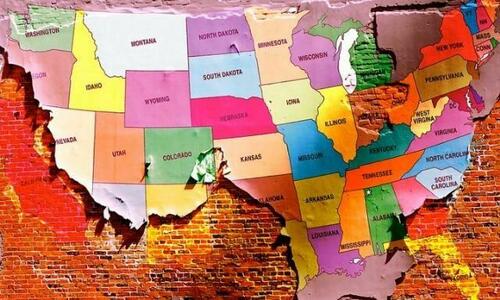
Generally speaking, I don’t have a problem with people living the way they want to. That is called freedom. However, I object to some of our more right-leaning or left-leaning citizens forcing their ideas on everyone else, then treating those who disagree with them as second-class citizens. In some cases, this has prompted states to heavily gerrymander congressional districts, which disenfranchises both liberal and conservative voters. One solution is to adjust state boundaries to more adequately reflect local political values.
Ever since the founding of the republic, various groups and political movements have sought to redraw state boundaries. Some have been successful. Maine was originally part of Massachusetts, and the states of Kentucky and West Virginia were created from land originally part of Virginia. Other partitions to existing boundaries have been suggested, but none has been adopted. The reason is that the Constitution requires both the blessings of the partitioned state and the U.S. Congress.
Ask yourself a simple question. Why would any state governor or legislature willingly give up territory if it is not forced to? The serfs — excuse me, taxpayers — there help balance the state budget. How they feel about their lives or the number of potholes in their roads is secondary to ensuring that state budgets are met and the state programs, even those for non-citizens, continue.
Despite the obstacles, secession movements continue. Let’s look at three of the more recent secession ideas.
In 2014, residents of western Maryland, reportedly unhappy with taxes and gun control policy, started signing petitions to secede from Maryland and form a new state. Later in 2021, Republican lawmakers in Allegany, Garrett, and Washington counties in Maryland sent a letter to the West Virginia legislature asking if the Mountain State would be willing to annex them.
The Maryland panhandle, an artifact of English colonial land grants, is a mountainous area more similar to West Virginia than the rest of Maryland. The three counties have a combined population of just over a quarter of a quarter million. That is probably not enough to take a congressional seat from Maryland or give one to West Virginia. Will it change the U.S. political structure if these counties are allowed to switch states? Not really.
The state of Oregon is divided almost in half by the Cascade Mountain Range. The majority of the population lives on the western or Pacific Coast side of the mountains, either in the city of Portland or towns in the Willamette Valley. In 2021, five counties in eastern Oregon, unhappy with the liberal state government, voted to take steps to secede from Oregon and join Idaho.
By 2024, a total of thirteen Oregon counties had voted to join Idaho. The population in these counties is roughly 240,000, or about 5.5% of Oregon’s population — again, probably not enough to change the number of congressional seats between the states.
A third secession movement is active in Illinois. Since 2011, more than one attempt has been made to separate the city of Chicago from the rest of Illinois or individual counties from the state. The issue here is the dominance of Chicago and Chicago politics over the rest of Illinois. As of 2024, 33 counties had voted to secede, about a third of the state’s counties.
In 2025, lawmakers in Indiana discussed annexing those counties, although only twenty-seven of them are contiguous with the Indiana border. The others are on the western side of Illinois and would be a better fit with Missouri. The twenty-seven counties represent nearly half a million residents. This would almost certainly take a congressional seat from Illinois and add one to Indiana.
Besides liberal political values, another reason people are moving from blue states or seeking to join red states is that blue states typically have higher tax burdens than red states. Call it an issue of affordability.
There is an easy way to check this. Let’s take the median income in the U.S., which was roughly $84,000 in 2024, multiply it by the average tax burden in the blue state of origin, do the same for the red state destination, and then subtract the two numbers.
The following results are based on a combination of income taxes, property taxes, and sales taxes. If the Oregon counties join Idaho, residents earning $84,000 would save about $250 per year, or about 0.3 percent of their income. If the Illinois counties join Indiana, their residents would save over $750 per year or about 0.9 percent of their income. And if the three Maryland counties joined West Virginia, residents there would save about $924 per year or about 1.1 percent of their income. Remember, these are ballpark numbers and will change depending on income and other individual circumstances.
As the country approaches the 250th anniversary of its founding, perhaps it is time to consider a constitutional amendment to facilitate changes to state boundaries. After all, most of our state boundaries were arbitrary to begin with.
Counties wishing to become a separate state would have to follow the rules for statehood. Imagine Chicago as the 51st state, along with New York City plus Long Island as the 52nd. Upstate New York and downstate Illinois could then breathe a sigh of relief.
Until then, you can still move.
On a similar note, I hear the Canadian province of Alberta is thinking about leaving Canada. Maybe Trump can talk the Canadians into a straight-up swap of Alberta for Minnesota. It couldn’t hurt to try.
Tyler Durden
Wed, 01/14/2026 – 16:30
https://www.zerohedge.com/political/it-time-realign-state-borders

Chicago man convicted of molesting girl in East Chicago
Jurors convicted a Chicago man Wednesday afternoon of molesting an underage teen girl in East Chicago.
Hakeem Pittman, 30, was found guilty of three counts of Level 1 child molesting and one count of Level 5 felony sexual misconduct with a minor. He faces from 21 years to essentially life in prison.
The sentencing hearing is Feb. 12.
During closing arguments Wednesday, Deputy Prosecutor Jessica (Arnold) Woodward told jurors that Pittman and the victim bonded over XBox, anime and her trust in him.
“(He) used that relationship to commit the worst crime you can commit,” she said.
Defense lawyer Roseann Ivanovich argued there was no DNA, medical documents, or “geo-tracking” of Pittman’s cell phone.
Court documents alleged Pittman groomed the girl, starting with a “Truth or Dare” game that grew sexual, asking her to perform sex acts. Later, he texted her to start having sex.
Over time, he told her to delete scores of texts over a dozen times, the prosecutor said. The victim later testified she kept a lot of them, later texting her mom screenshots to tell her what had been happening.
According to the probable cause affidavit, the mother was crying, “hyperventilating” and yelling for cops on April 26, 2024, at the East Chicago police station.
Her daughter’s behavior had been off in recent months, she said. When the girl said she needed to tell her something, the woman suggested she could write it in texts. Pittman had been touching her “inappropriately,” the girl told her.
The texts Pittman sent the child appeared to imply he had sexual contact with her. The girl told police Pittman had molested her eight times over two years, starting as a preteen. He raped her two months earlier.
Post-Tribune archives contributed.
https://www.chicagotribune.com/2026/01/14/chicago-man-convicted-of-molesting-girl-in-east-chicago/

Helen Keller Elementary in Tinley Park undergoing $3.6 million renovation
Several bulldozers took to Helen Keller Elementary School in Tinley Park in September as a part of a $3.6 million renovation project to add eight classrooms and a dedicated blacktop by August 2026.
Construction crews installed beams under heavy snow, built the classroom walls, poured the foundation for the blacktop and completed portions of the classroom ceilings, according to the school website.
The school board has begun phase two of the project by submitting a proposal with the village’s Plan Commission, asking to acquire and rezone a village-owned property located at16227 Everdon Drive.
Kirby District 140 Superintendent Daniel Callaghan said Wednesday that while overall enrollment has remained relatively stagnant, the addition of eight classrooms was prompted by a need for space to meet students’ needs.
He said the improvements are focused on student safety, appropriate learning spaces, and long-term planning.
“The project allows the district to better serve students while enhancing traffic flow and outdoor facilities,” he said.
Callaghan said the additions are fully funded through district reserve funds. No state grants or external funding sources are being used, he said.
Specifically, Callaghan said acquiring the village property along Everdon Drive would allow the district to implement Phase 2 of the project, which includes relocating Keller’s existing playground and adding a dedicated blacktop space for recess and bus rider arrival and dismissal.
“This redesign improves safety by separating car and bus traffic and restores outdoor play and recess space that was displaced during Phase 1,” he said.
Construction at Helen Keller Elementary School this month, after the exterior walls and portions of the ceiling were completed. (Kirby School District 140)
The proposal also requests that the 163rd Street roadway, which is part of the village property, be dedicated to the village for right of way.
The village lot, measured at a little under an acre, would bring the school’s total property to 6.9 acres, not including the property dedicated to the right of way.
The village-owned property was annexed in 1987 and included as an outlet in Gallagher & Henry’s Tinley Park Meadows Unit 6 subdivision, called Tinley Meadows, according to Plan Commission records.
Helen Keller Principal Julie Simpson promised in September that students and staff would continue to learn and work safely in the existing building, without disruption to the school day, during the construction.
She said the expansion will create a more functional and comfortable environment for Keller students and staff.
A new blacktop will be put in at this site outside Helen Keller Elementary School in Tinley Park. (Kirby School District 140)
The Kirby Elementary District 140 board voted in August to pay Talsma Buildings of Alsip, the lowest responsible bidder, about $3.6 million for the renovations, according to meeting minutes.
The board also plans to request an intergovernmental agreement that would include a land transfer with a deed conveying property ownership of the village lot to the school district.
The agreement would also include plans for public utility drainage easements rights by the village, as the property on Everdon Drive has public utilities running underground, according to the Plan Commission.
“The district and the village have worked collaboratively throughout this process to ensure a smooth and thoughtful transition of the property,” Callaghan said.
Callaghan said the renovation project remains on schedule and on budget.
awright@chicagotribune.com
https://www.chicagotribune.com/2026/01/14/helen-keller-tinley-park-eight-classrooms/