Category: News

Glenview indoor water park closes for months during $8.4 million in upgrades
Users of the Glenview Park District’s indoor aquatic center will have to find alternatives for swimming and water recreation for much of this year as the 25-year-old facility undergoes major renovations.
Splash Landings, housed within Park Center at 2400 Chestnut Ave., closed Jan. 5 and will remain shuttered until at least September while $8.4 million in improvements to the facility are made, the park district announced.
According to park district officials, the planned improvements include new interactive play structures with multiple levels, spray features and a new, larger flume slide; a warmer zero-depth pool and separate temperature controls for the activity and lap pools; upgraded pool surfaces; new water filtration systems for cleaner water and cost savings; new color schemes; and updated and accessible family changing rooms, among other upgrades.
The Splash Landings Indoor Aquatic Center, and the Park Center that houses it, opened to the public in 2001, said Anna Ables, spokeswoman for the Glenview Park District.
“No major updates or changes have been made to the facility since its opening,” she said.
The improvements will modernize the facility and also provide amenities that users are seeking, said Steve Neill, division director of recreation and museum services at the Glenview Park District.
“The Glenview Park District is replacing and modernizing Splash Landings to meet today’s operational standards and community expectations,” he said. “Over the past 25 years, pool technology has advanced significantly, and this project will incorporate more environmentally-friendly, resource-conscious mechanical equipment. Guest expectations for indoor swimming and aquatic play have also evolved.”
When it reopens, the center will continue to offer a six-lane, 25-yard lap pool for swimming and dedicated areas for swim and aqua fitness classes, a whirlpool, and a warm water therapy pool.
The project’s $8.4 million price tag will be covered in part by a $2.8 million Park and Recreational Facility Construction Act (PARC) grant from the state of Illinois, which was announced in January 2024. The remaining $5.6 million will be covered by the park district through savings, officials said.
Bids for the project were approved by the Glenview Park District Board on Nov. 16, with Northbrook-based W.B Olson, Inc. managing construction.
The most recent data for the aquatic center shows that there were 88,919 users in 2024, an increase of nearly 3,000 users compared to the previous year. Ables said the park district projects that revenues will increase by 8%—to about $555,000—during the first year that the renovated Splash Landings is open.
The park district anticipates a grand re-opening of Splash Landings in September. While the facility is closed, users of daily passes and punch passes may purchase passes for lap swim and aqua fitness classes at the Park District of Highland Park and the Wheeling Park District and pay the Glenview resident rate, the Glenview Park District said.
The Glenview Park District’s Park Center houses Splash Landings indoor aquatic center, which is closed until at least September for $8.4 million in upgrades (Pioneer Press file photo)
During summer months, the Glenview Park District operates the Flick Outdoor Aquatic Center at 3600 Glenview Road and the Roosevelt Outdoor Aquatic Center at 2239 Fir St. Members of Park Center Health and Fitness may use Flick and Roosevelt pools for swimming this summer at no additional cost, the park district said.
More information about alternative swimming locations during the closure can be found at glenviewparks.org/splash-landings-renovation.
https://www.chicagotribune.com/2026/01/15/glenview-indoor-water-park-closes-8-4-million-upgrades/

15 former NCAA players among those charged in alleged scheme to rig basketball games
PHILADELPHIA — Federal prosecutors charged 20 people on Thursday, including 15 former college basketball players, in what they called a betting scheme to rig NCAA and Chinese Basketball Association games.
Of the defendants, 15 played basketball for Division 1 NCAA schools as recently as the 2024-25 season.
The other five defendants were described by authorities as fixers.
They include two men who prosecutors say worked in the training and development of basketball players. Another was a trainer and former coach, one was a former NCAA player and two were described as gamblers, influencers and sports handicappers.
The charges, filed in federal court in Philadelphia, include wire fraud.
In the 70-page indictment, authorities say the fixers recruited the college basketball players with “bribe payments” usually ranging from $10,000 to $30,000 per game.
The indictment follows a series of NCAA investigations that led to at least 10 players receiving lifetime bans this year for bets that sometimes involved their own teams and their own performances. And the NCAA has said that at least 30 players have been investigated over gambling allegations.
More than 30 people were also charged in last year’s sprawling federal takedown of illegal gambling operations linked to professional basketball.
https://www.chicagotribune.com/2026/01/15/college-basketball-rig-games-scheme/
Multifamily Delinquencies Rise Again, Hit New Post-Great Recession High
Multifamily Delinquencies Rise Again, Hit New Post-Great Recession High
Authored by Ryan McMaken via Mises Institute,
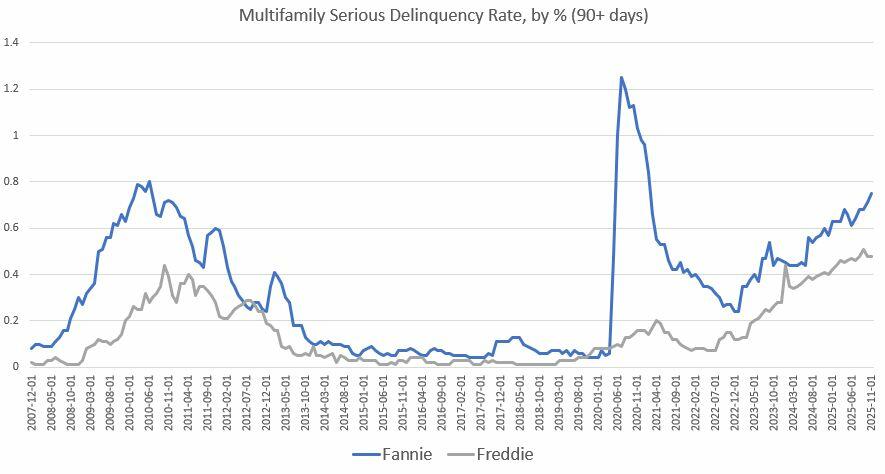
Fannie Mae and Freddie Mac (also known as “GSEs”) have released their November reports on their mortgage portfolios and mortgage delinquencies. Both Fannie and Freddie report that serious delinquencies in multifamily are rising to multiyear highs.
For November, seriously delinquent multifamily mortgages (90+ days delinquent) at Fannie Mae rose to 0.75 percent. That’s up from October’s total of 0.71 percent, and it was up from November 2024’s total of 0.60 percent. Fannie’s delinquency rate has risen quickly since December 2022 when the rate was 0.24 percent. Excluding the covid panic, Fannie’s delinquency rate is now the highest since 2010, but remains below the Great-Recession high of 0.80 percent.
Freddie Mac’s delinquency report, on the other hand, shows delinquencies above the Great-Recession peak. During November, Freddie reported multifamily serious delinquency rate was 0.48 percent. That’s unchanged from October 2025, but up from November 2024’s level of 0.41 percent.
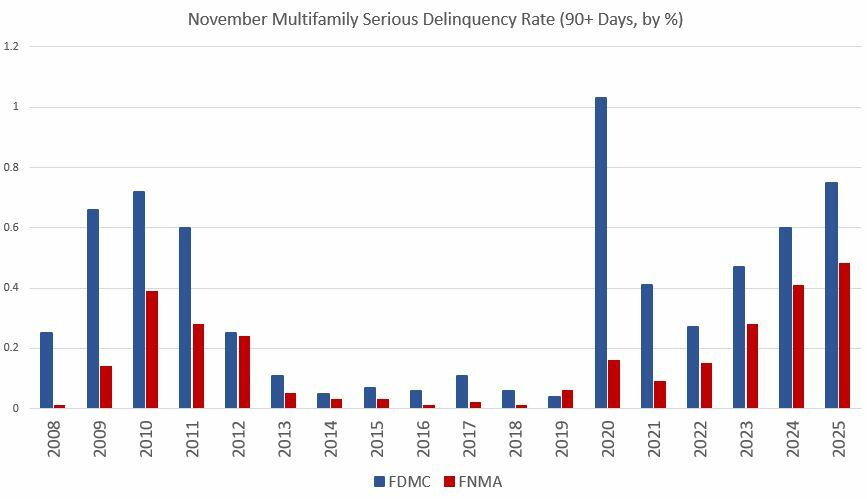
Comparing for November of each year, November 2025’s delinquency rate at Fannie exceeds that of November 2011, the previous peak year for delinquencies (ex covid), when November delinquencies reached 0.72 percent. At Freddie, November 2025’s delinquency rate of .48 percent is the highest in decades, and above the previous peak of 0.39 percent.
This trend likely reflects slowing rent growth and waning demand for rentals as employment stagnates and wage growth slows. CNBC reported on Dec 26:
After years of steep increases, renters are finally seeing sustained price relief, a trend that appears to be carrying into early 2026.
In November, the median asking rent across the 50 largest U.S. metro areas was $1,693, down about 1% from a year earlier and marking the 28th consecutive month of year-over-year declines, according to Realtor.com listings data. Nationally, the median rent fell to $1,367, down 1.1% from a year earlier, according to Apartment List’s data.
November is typically the slowest month for rentals, but rents fell more from October to November this year than they did over the same period last year, according to Apartment List.
With new apartment supply still hitting the market, rents are expected to remain lower into 2026.
“Barring a major economic shock, 2026 is shaping up to be one of the more renter-friendly periods we’ve seen in a decade,” says Michelle Griffith, a luxury real estate broker at Douglas Elliman.
The phrase “renter friendly” is anything but friendly for owners of multifamily rentals. Moreover, landlords must continue to contend with rising prices in services and materials necessary for regular maintenance of multifamily units. In other words, we must consider inflation, so real, inflation-adjusted rent growth is even worse than the nominal declines now reported in a number of metro areas. In Denver metro, for example, the median asking rent in November was down 4.8 percent, year over year.
Tyler Durden
Thu, 01/15/2026 – 10:40

Jackson Stavros elevates Carmel when he’s on the court. Healthy again, junior guard ‘really gives us a spark.’
Carmel’s Jackson Stavros didn’t expect a roller-coaster ride in his first varsity season.
But two injuries, including one over the summer, have sidelined the 6-foot-1 junior guard for extended periods of time.
“I had put in a lot of really good work with my travel team the spring and summer before, and I was really looking forward to proving myself,” Stavros said. “It hurt a lot mentally after putting in all that work. But the only thing I can do now is keep getting better.”
Stavros, who is averaging 9.0 points this season, appears to be on the upswing again after his more recent injury, which forced him to miss nearly a month.
Stavros contributed 14 points, hitting four 3-pointers, during an East Suburban Catholic Conference loss to Joliet Catholic last week and scored a team-high 15 points during a nonconference win against Zion-Benton on Tuesday as the Corsairs (7-11, 2-2) snapped a five-game losing streak.
“Our offense has struggled at times, and I have a feeling that if he was available, our record would be better than it is,” Carmel coach Mike Wasielewski said.
Carmel’s Jackson Stavros high-fives a teammate during a nonconference game against Zion-Benton in Zion on Tuesday, Jan. 13, 2026. (Mark Ukena / News-Sun)
Stavros’ first injury occurred during the Corsairs’ initial summer league game in early June, when he suffered a broken left collarbone. That wiped out his entire summer slate of high school and AAU games. Stavros trusted the medical advice he received and endured a summer of inactivity.
“I knew they were telling me the truth, so I waited, and as soon as they told me I could shoot, I was in the gym every single day,” he said. “I got to play some fall AAU tournaments, and I felt better than ever by tryouts.”
Stavros convinced Carmel’s coaches that he was worthy of extensive varsity minutes at the beginning of the season, and he impressed early. He helped the Corsairs finish second in Mundelein’s Thanksgiving Tournament and beat St. Viator in a conference game Dec. 5.
Within a matter of days, however, Stavros suffered a severely sprained ankle during a scrimmage. The Corsairs had to play without him.
“Jackson’s injury really set us back,” Wasielewski said. “Through the St. Viator game, he was our second-leading scorer, averaging 11 points a game.”
Carmel’s Jackson Stavros shoots a free throw during a nonconference game against Zion-Benton in Zion on Tuesday, Jan. 13, 2026. (Mark Ukena / News-Sun)
Stavros clearly makes a difference when he’s on the court. His best attribute — outside shooting — is otherwise in fairly short supply in Carmel’s rotation and complements the strengths of senior guard Ethan Matz, who leads the team in scoring with his midrange shooting and drives to the basket. Stavros has made 37% of his 3-point attempts this season.
“He definitely helps me, too, because once he starts hitting shots, teams have to honor him and lay off of me,” Matz said. “Sometimes when I pass it to him and he shoots, I can tell before it leaves his hands that it’s going in, and I can start heading down the court. He’s a big threat for us and really gives us a spark.”
Stavros and Matz put that connection on display during the Corsairs’ double-overtime loss to Lake Park on Dec. 6, when Stavros was 3-for-4 from long distance in the first half.
“Ethan took one step toward the basket, and it was like the whole defense crumbled toward him,” Stavros said. “The whole perimeter opened wide open, and he kicked it to me on two possessions in a row. It’s huge for us to be on the court at the same time.”
Stavros has always had an affinity for shooting, and he displayed it as the leading scorer on Carmel’s sophomore team last season. But instructors in his travel program helped him make some adjustments to his shot during the offseason.
“They saw little things that I could fix, and it’s increased my 3-point shooting percentage by about 5 percent,” Stavros said. “One of the first things they told me was to flex my abs when I shot. The goal was to keep my shoulders forward. It makes for a more fluid shot.”
Carmel’s Jackson Stavros (1) guards Zion-Benton’s Dionel Hernandez (20) during a nonconference game in Zion on Tuesday, Jan. 13, 2026. (Mark Ukena / News-Sun)
Stavros moved into the starting lineup for the game against Zion-Benton, and he expects that to be beneficial for all parties.
“It gives a great opportunity to start off the game strong,” he said. “I loved the energy of starting, and I’ll keep working to solidify myself as a starter.
“While I was out, all I could do was watch, and I developed so much trust in my teammates. I think we have the pieces to compete with anyone we go up against.”
Steve Reaven is a freelance reporter.
https://www.chicagotribune.com/2026/01/15/basketball-carmel-jackson-stavros/

Airlines Still Avoid Iran, Iraq Airspace Despite Reopening – Trump Assures Tehran No Strikes Imminent
Airlines Still Avoid Iran, Iraq Airspace Despite Reopening – Trump Assures Tehran No Strikes Imminent
Overnight, the world was on edge watching for potential signs of a new US military strike on Iran. This sense of anticipation was only heightened when Iran issued a nationwide “NOTAM” – or “notice to all airmen” – for its airspace which lasted nearly five hours.
All flights were banned except ones to and from Tehran which had been issued special permission. This was coupled with online rumors of fighter jets being heard over neighboring Iraqi airspace, but no new attack materialized. Late in the evening, President Trump also made known his reasons for holding off on any new strikes. Iranian officials say Trump informed Iran he does not intend to attack.
Iran’s airspace is again open after yesterday’s closure. pic.twitter.com/6UJtEmJ21H
— Flightradar24 (@flightradar24) January 15, 2026
As we reported, Trump told his national security team that “he would want any U.S. military action in Iran to deliver a swift and decisive blow to the regime and not spark a sustained war that dragged on for weeks or months.”
“If he does something, he wants it to be definitive,” one of the people familiar with the discussions said.
He had also earlier cited that he’s been told that Iran is not killing anymore people in the streets – which Tehran leaders said were rioting and killing police in some cases. Further Trump said there are no further plans to execute protesters:
US President Donald Trump has welcomed “good news” in Iran after posting a message on social media suggesting an Iranian protester would no longer face the death penalty as earlier reported by various human rights organizations.
Trump wrote that an “Iranian protester will no longer be sentenced to death after President Trump’s warnings”. In response to the report, he added: “This is good news. Hopefully, it will continue.”
Whether the protester in question was really set to be executed is unclear, given the Western MSM sourcing for this and other claims:
The huge death tolls in Iran being splashed all over the media are sourced to an outfit in Fairfax, VA called “Human Rights Activists in Iran” that is overwhelmingly funded by the US government. What is their methodology? Is it credible? Who cares? Just pump the big numbers out pic.twitter.com/9No2e7n1Dw
— Michael Tracey (@mtracey) January 12, 2026
Despite Trump indicating there will be no imminent strike on Iran, and with Iranian authorities now saying the streets are calm and police and security services are in complete control again, there’s still concern that this is a ploy by the administration.
Security has been heavy on Iran’s streets in the last 48 hours:
“There is big military presence on the streets of the capital and elsewhere,” the resident said, describing widespread checkpoints, police stops and the presence of the Islamic Revolutionary Guard Corps (IRGC).
After all, just prior to the start of the June war, the Iranians were lulled into thinking that they were entering new good-faith negotiations with Washington, and then suddenly a surprise Israeli-US attack ensued and their nuclear facilities were taken out.
As for regional airspace, commercial aviation (out of Europe) is still not taking any chances, even though airspace over the Islamic Republic has reopened:
European airlines are continuing to avoid flying over Iran, despite Tehran having reopened its airspace following an earlier closure of nearly five hours, according to reports.
Airlines were also avoiding flying over neighboring Iraq, Reuters news agency reported, citing information on flight tracking websites.
British Airways, Wizz Air, Lufthansa and TUI were among the airlines flying alternative routes in a bid to mitigate risks in the region, amid fears of potential US military action against Iran.
“We avoid Iraqi and Iranian airspaces, therefore some westbound flights from Dubai and Abu Dhabi airports will have to make [refuelling and crew change] stops in Larnaca, Cyprus or Thessaloniki, Greece,” a Wizz Air spokesperson was quoted as saying.
Trump has long proven his ability to catch the world, and Washington’s rivals and enemies, by shock and surprise – so it’s still anyone’s guess what might happen in the coming days and weeks.
Tyler Durden
Thu, 01/15/2026 – 10:20

Boric y Kast vuelven a reunirse para coordinar la transición en Chile pese al aumento de fricciones
Por NAYARA BATSCHKE
SANTIAGO (AP) — El mandatario chileno, Gabriel Boric, recibió el jueves al presidente electo del país, el ultraderechista José Antonio Kast, para una nueva ronda de conversaciones en el marco de la transición de poder que culminará el próximo 11 de marzo tras las elecciones celebradas a fines del año pasado.
Kast, fundador del Partido Republicano, fue elegido presidente al conseguir un 58,16% de los votos en el balotaje celebrado en diciembre, frente al 41,84% del respaldo logrado por la candidata oficialista, la comunista Jeannette Jara.
El dirigente de extrema derecha llegó al Palacio de La Moneda de Santiago a primera hora de la mañana para una cita marcada por la creciente tensión entre los dos liderazgos políticos, producto de las críticas públicas vertidas por Kast a la actual administración y las fricciones en torno a proyectos políticos y la situación en Venezuela.
Se trata de la segunda visita del presidente electo al palacio de gobierno, tras el primer encuentro que tuvo lugar el 15 de diciembre, un día después de su triunfo en la elección presidencial.
En la cita, ambos trataron de diversos detalles para afinar la transición y mostraron “disposición” para mantener un diálogo abierto y transparente, detalló Kast en declaraciones a la prensa luego del encuentro.
Pero el futuro gobernante dejó en suspenso la aprobación de algunos proyectos considerados prioritarios por la gestión de Boric, como el Sala Cuna, que prevé ampliar los derechos de los trabajadores y las trabajadoras a la sala cuna o guardería en el ambiente laboral a través de la creación de un fondo solidario financiado por empleadores y aportes fiscales.
“Para nosotros el tema de las normas fiscales, el estado de las arcas fiscales, es muy relevante, porque para poder avanzar en los distintos proyectos que hoy día para el gobierno son relevantes… tenemos que estar seguros de que tenemos los recursos suficientes”, dijo Kast.
“Para ser muy responsables uno tiene que ver que estas políticas sean permanentes en el tiempo, para que no se creen falsas expectativas”, agregó.
Kast confirmó además que presentará su equipo de ministros el próximo 20 de enero, por lo que confía en fortalecer el diálogo a partir de ese momento “entre los distintos ministerios para que la transición sea lo mejor posible”.
Hace cuatro años, Boric y Kast, situados en polos antagónicos de la política chilena, compitieron por la presidencia en unas elecciones que terminaron con la victoria del izquierdista.
En las últimas semanas, han aumentado las fricciones entre ambos debido al endurecimiento del discurso de Kast contra el Ejecutivo saliente respecto a algunos proyectos claves bajo debate en el Congreso y, en el contexto internacional, por la situación en Venezuela.
Mientras que Boric ha criticado ferozmente la incursión militar de Estados Unidos que resultó en la captura del expresidente venezolano Nicolás Maduro, Kast — ideológicamente alineado con el presidente estadounidense Donald Trump — ha expresado su apoyo a la operación y celebrado la caída del dirigente socialista.
Así, el presidente electo destacó que a veces es “necesario hacer una pausa” para “analizar y dialogar” ante los distintos escenarios antes de tomar decisiones. “Habrá cambios importantes en el Parlamento y, por supuesto, un cambio significativo en la administración del gobierno”, matizó.
Tribunal de apelaciones revoca decisión que liberó a activista propalestino Mahmoud Khalil
Por JAKE OFFENHARTZ
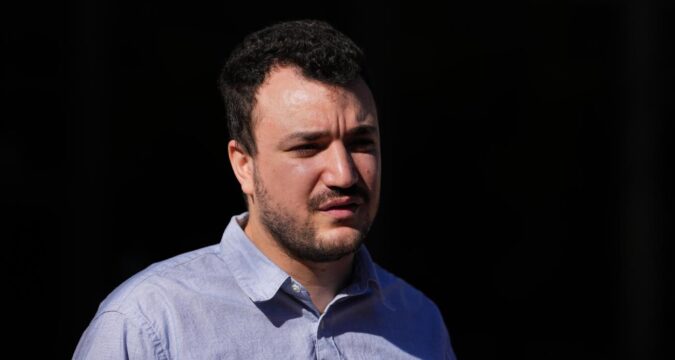
Un panel de apelaciones federal revirtió el jueves una decisión de un tribunal inferior que liberó al activista estudiantil propalestino Mahmoud Khalil de una cárcel de inmigración, acercando al gobierno un paso más para detener y finalmente deportar al activista.
Un panel de tres jueces del Tribunal de Apelaciones del 3er Circuito en Filadelfia instruyó al tribunal inferior a desestimar la petición de hábeas corpus de Khalil, un documento judicial que aseguró su liberación. El panel dictaminó que el tribunal de distrito federal en Nueva Jersey no tenía jurisdicción sobre el asunto porque los desafíos de inmigración se manejan de manera diferente bajo la ley.
En una decisión de 2-1, el panel determinó que las leyes federales de inmigración requieren que los casos de deportación se realicen presentando una petición de revisión de una orden final de expulsión ante un tribunal de apelaciones federal, no ante un tribunal de distrito de nivel inferior.
“Ese esquema asegura que los peticionarios tengan solo una oportunidad, no cero o dos”, escribió el panel. “Pero también significa que algunos peticionarios, como Khalil, tendrán que esperar para buscar alivio por una conducta gubernamental supuestamente ilegal”.
La ley prohíbe a Khalil “atacar su detención y expulsión en una petición de hábeas corpus”, agregó el panel.
Los mensajes enviados a Khalil y su equipo legal no fueron respondidos de inmediato.
La decisión marcó una gran victoria para la amplia campaña de la administración de Trump para detener y deportar a no ciudadanos que se unieron a protestas contra Israel.
Es probable que no sea la última palabra en la batalla legal de Khalil, estudiante de posgrado de la Universidad de Columbia. Los abogados del activista palestino de 30 años han dicho que agotarán todas las opciones de apelación.
Un vocal líder del movimiento propalestino en Columbia, Khalil fue arrestado en su apartamento el 8 de marzo de 2025. Pasó tres meses detenido en una cárcel de inmigración en Luisiana, perdiéndose el nacimiento de su primer hijo.
Funcionarios federales han acusado a Khalil de liderar actividades “alineadas con Hamás”, aunque no han presentado pruebas para respaldar la afirmación y no lo han acusado de conducta criminal.
El gobierno ha justificado el arresto bajo un estatuto poco utilizado que permite la expulsión de no ciudadanos cuyas creencias se consideran una amenaza para los intereses de política exterior de Estados Unidos.
En junio, un juez federal en Nueva Jersey dictaminó que esa justificación probablemente sería declarada inconstitucional y ordenó la liberación de Khalil.
La administración del presidente Donald Trump apeló esa decisión, argumentando que la decisión de deportación debería recaer finalmente en un juez de inmigración, en lugar de un tribunal federal. También han acusado a Khalil de no revelar información en su solicitud de tarjeta verde.
Khalil ha desestimado esas acusaciones como “infundadas y ridículas”, enmarcando su arresto y detención como una “consecuencia directa de ejercer mi derecho a la libertad de expresión mientras abogaba por una Palestina libre y el fin del genocidio en Gaza”.
La decisión del tribunal de apelaciones llega mientras una junta de apelaciones en el sistema de tribunales de inmigración está evaluando una orden previa de un juez de inmigración que determinó que Khalil podría ser deportado. Sus abogados han argumentado que la orden federal debería tener prioridad.
Ese juez ha sugerido que Khalil podría ser deportado a Argelia, donde mantiene la ciudadanía a través de un pariente lejano, o Siria, donde nació en un campo de refugiados de una familia palestina.
Sus abogados han dicho que enfrentaría un peligro mortal si se viera obligado a regresar a cualquiera de esos países.
___________________________________
Esta historia fue traducida del inglés por un editor de AP con ayuda de una herramienta de inteligencia artificial generativa.

US seizes in Caribbean Sea another sanctioned oil tanker it says has ties to Venezuela
WASHINGTON — U.S. forces in the Caribbean Sea have seized another sanctioned oil tanker the Trump administration says has ties to Venezuela, part of a broader U.S. effort to take control of the South American country’s oil.
Homeland Security Secretary Kristi Noem wrote Thursday on social media, “Motor Tanker Veronica had previously passed through Venezuelan waters, and was operating in defiance of President Trump’s established quarantine of sanctioned vessels in the Caribbean.”
A social media post from U.S. Southern Command on the capture said that Marines and sailors launched from the aircraft carrier USS Gerald R. Ford to make the capture while Noem’s post noted that, like in previous raids, a U.S. Coast Guard tactical team conducted the boarding and seizure.
Noem posted a brief video that appeared to show part of the ship’s capture. The black-and-white footage showed helicopters hovering over the deck of a merchant vessel while armed troops dropped down on the deck by rope.
The Veronica is the sixth tanker that has been seized by U.S. forces as part of the effort by President Donald Trump’s administration to control the production, refining and global distribution of Venezuela’s oil products, and the fourth since the U.S. ouster of Venezuela President Nicolás Maduro in a surprise nighttime raid almost two weeks ago.
Noem, in her social media post, said that the raid was carried out with “close coordination with our colleagues” in the military as well as the State and Justice departments.
“Our heroic Coast Guard men and women once again ensured a flawlessly executed operation, in accordance with international law,” Noem added.
As with prior posts, Noem and the military framed the seizure as part of an effort to enforce the law. Noem argued that the multiple captures show that “there is no outrunning or escaping American justice.”
However, other officials in Trump’s Republican administration have made clear they see it as a way to generate cash as they seek to rebuild Venezuela’s battered oil industry and restore its economy.
Last week, Trump met with executives from oil companies to discuss his goal of investing $100 billion in Venezuela to repair and upgrade its oil production and distribution. His administration has said it expects to sell at least 30 million to 50 million barrels of sanctioned Venezuelan oil.
https://www.chicagotribune.com/2026/01/15/oil-tanker-venezuela-2/

Aurora officials discover leak in major water pipe under railway
Aurora city officials discovered a leak in one of the city’s major water pipes over the holidays, an issue complicated by its location under railroad tracks.
The city’s 36-inch southeast transmission main carries about 55% of the drinking water that leaves Aurora’s treatment plant, according to Director of Public Works Jason Bauer. He told the Aurora City Council on Tuesday that leaks typically aren’t a huge problem, as the pipe can be taken out of service for a short time for repairs, but the location of the leak makes it “not an easy fix” and likely to cost over half a million dollars.
“We can’t just dig up the railroad and, you know, put them out of service,” Bauer said. “So, it’s a little bit difficult.”
Luckily, there is lower demand for water at this time of year, so the pipe can be taken out of service temporarily to get the work done, he said. The transmission main connects to the city’s water network at many different points, he said, so it can be bypassed for a time.
According to a map Bauer showed during his presentation, the leak is located under the southern-most track near Solfisburg Park, just west of where North Ohio Street passes over the railroad. The city keeps a close eye on this pipe because of how much water it distributes and because it goes under a variety of different areas like railroad tracks and forest preserves, meaning it has a lot of opportunities to leak, he said.
While the leak hasn’t gotten any worse since city officials noticed it, they aren’t sure if it is a crack or a hole, or how bad it is, since they aren’t able to see it yet, Bauer said.
So, city staff don’t want to spend two months going through the typical bidding process for a construction contract, according to Bauer. Instead, the city will use an existing emergency repair contract to do digging and related work, he said, plus staff reached out to several companies capable of fixing the leak to find one capable of doing it for the lowest price.
“We want to get this moving as quickly as possible and really not wait any longer, because again it’s taken us a couple of weeks just to get to this point,” Bauer said.
The repair is likely to cost at least $600,000 but could be up to $800,000, depending on what additional work the city wants done, he said.
While this may sound like bad news, Aurora Mayor John Laesch said cost estimates originally were around $1 million to $2 million. So the good news, he said, is that staff was able to come up with the current plan.
The plan is to line the pipe, according to Bauer. He said it will take three to four weeks for the company to manufacture the liner, but that in the meantime the construction company already under contract with the city for emergencies will be doing work to prepare the site for the installation of the liner.
Bauer is expecting to bring a roughly $500,000 contract to line the pipe directly to City Council in two weeks. The rest of the project’s cost, he said, will be paying the construction company with the emergency repair contract.
Leaks happen all the time for a variety of reasons, including nearby soil or a defect in the pipe, but it is possible that traffic on the railroad tracks could have caused the leak, Bauer said.
However, the pipe does have a casing that takes the brunt of the force when a train goes over the tracks, he said.
Even if railroad traffic did have something to do with the leak, the company wouldn’t be responsible for the cost of repairs, according to Bauer. He said that the pipe crosses the railroad’s property, so the city takes all the responsibility.
rsmith@chicagotribune.com

Trump Invokes Section 232 To Seek Foreign Supplies Of Processed Critical Minerals, Avoids Tariffs For Now
Trump Invokes Section 232 To Seek Foreign Supplies Of Processed Critical Minerals, Avoids Tariffs For Now
President Trump said on Wednesday he had opted against imposing tariffs on rare earths, lithium and other critical minerals – for now – and instead ordered his administration to seek supplies from international trading partners.
By invoking Section 232 not to slap immediate tariffs, but to renegotiate how the US imports processed critical minerals, the White House defers a decision on duties that could further roil the US economy, especially while the Supreme Court is still deliberating the legality of Trump’s tariffs (and just punted on the ruling for a second time).
Trump ordered US Trade Representative Jamieson Greer and Commerce Secretary Howard Lutnick to “enter into negotiations with trading partners to adjust the imports of (critical minerals) so that such imports will not threaten to impair the national security of the United States.”
In acknowledging the country is far from being self-reliant for its critical minerals needs, though, it may rankle the domestic mining sector according to Reuters.
As DA Sails noted on X, the decision “matters because the real bottleneck isn’t mining…it’s refining and downstream processing. That’s where the U.S. is most exposed.” As such, the goal of the decision is to “work with allies to set more stable trade terms (including price floors), reduce reliance on non-market suppliers, and rebuild domestic capacity.”
The negotiations, Trump said, should promote the use of price floors for critical minerals, a step long sought by Western miners and policymakers. G7 finance ministers and those from other major economies like Australia met in Washington earlier this week to discuss such a step, for example.
And if Greer and Lutnick’s negotiations are not successful, Trump said he would consider setting minimum import prices for critical minerals or “may take other measures,” without elaborating.
As Reuters notes, Trump is essentially agreeing to a recommendation by Lutnick, who last April launched a national security review under Section 232 of the Trade Expansion Act of 1962 and in October submitted his findings to the president.
Lutnick’s report found that the U.S. is “too reliant on foreign sources” of critical minerals, lacks access to a secure supply chain, and is experiencing “unsustainable price volatility” for the materials, with all those factors fueling a “significant national security vulnerability that could be exploited by foreign actors.”
It was not immediately clear why Trump waited until this month to act on Lutnick’s report.
It is well known that China is a top global producer of more than half of the 54 minerals considered critical by the U.S. Geological Survey, for example, and has been curtailing exports in the past year amid its trade dispute with Washington. The country is also a major refiner of critical minerals.
“Mining a mineral domestically does not safeguard the national security of the United States if the United States remains dependent on a foreign country for the processing of that mineral,” Trump said in the order.
Following news that US held off from imposing import tariffs on critical minerals, silver and other metals retreated from record highs as investors took profits following a blistering rally in the space.
Tyler Durden
Thu, 01/15/2026 – 09:40