Category: News

Simons anota 39 puntos desde la banca, Brown suma 27 y Celtics remontan para vencer al Heat 119-114
MIAMI (AP) — Anfernee Simons anotó 39 puntos, su cifra más alta en la campaña, incluidos 18 en el último cuarto, y los Celtics de Boston remontaron y vencieron el jueves 119-114 al Heat de Miami.
Jaylen Brown sumó 27 unidades por los Celtics, que estuvieron en desveentaja durante buena parte del partido.
Sam Hauser añadió 17 puntos a la causa de Boston, que superó a Miami por 36-21 en el último cuarto y se embolsó el triunfo después de enfrentar una desventaja de hasta 19 tantos. Fue su segunda mayor remontada de la campaña, después de recuperarse de una desventaja de 20 puntos para vencer a Indiana el 22 de diciembre.
Simons logró el segundo partido con más puntos para un suplente esta temporada — Brice Sensabaugh de Utah anotó 43 el miércoles en una derrota ante Chicago — y se convirtió en el cuarto jugador de los Celtics en los últimos 50 años en anotar al menos 39 puntos desde el banquillo.
Los otros: Larry Bird, Todd Day y Payton Pritchard.
Norman Powell anotó 26 puntos por Miami, que obtuvo aportes respectivos de 22 unidades de Bam Adebayo y Tyler Herro. Andrew Wiggins añadió 16 por el Heat.
_____
Deportes AP: https://apnews.com/hub/deportes

36,000 Refugees Could Not Provide IDs When Entering US After Afghanistan Withdrawal: Deputy IG
36,000 Refugees Could Not Provide IDs When Entering US After Afghanistan Withdrawal: Deputy IG
Authored by Troy Myers via The Epoch Times,
A deputy inspector general revealed in a Jan. 14 Senate hearing that tens of thousands of Afghan refugees could not provide key identification when entering the United States through a Biden-era parole program.
Additionally, lawmakers revealed that more than 50 individuals in the United States with confirmed or suspected terrorist ties were allowed into the country under the same program. The joint hearing was held with the Senate Border Security and Immigration and Crime and Counterterrorism subcommittees, which spiraled into arguments between Republican and Democratic lawmakers over whether vetting or counterterrorism is to blame.
Under Operation Allies Welcome, a 2021 initiative under President Joe Biden to resettle Afghans in the wake of what was widely called a botched U.S. military withdrawal from the Middle Eastern country, roughly 76,000 evacuees were let into the United States. The operation was meant to help Afghan allies who helped American forces and faced a serious threat from the Taliban because of that employment.
“There was missing information from the [Operation Allies Welcome] population, including first, last names, and date of birth,” Deputy Inspector General Craig Adelman for the office of audits in Homeland Security said.
“There was about 11,000 to 12,000 that did not know their date of birth.”
Although Afghan refugees were asked to provide identification, Adelman testified that about 36,000 could not provide any form of it.
When asked if the Department of Homeland Security systematically interviewed or conducted mental health screenings of evacuees before they were allowed into the United States, Adelman simply replied “no” and “not that I’m aware of.”
The hearing was called “Biden’s Afghan Parolee Program – A Trojan Horse with Flawed Vetting and Deadly Consequences.”
Democrats said this title was misleading and demonized thousands of Afghan individuals.
Republicans said the hearing was appropriately named, and above all else, the safety of Americans should be prioritized over refugee programs. This wasn’t taken into consideration during Operation Allies Welcome, the GOP senators said.
“We have no idea of their potential terrorist connections, and in many cases, we now have no idea where they are or what they’re doing, who they’re connected with, or what they’re capable of,” Sen. Josh Hawley (R-Mo.) said.
One report shows the total number of refugees reached a much higher amount at more than 200,000 Afghan nationals through the Biden administration’s policies, according to the Center for Immigration Studies.
“Contrary to popular narratives, most Afghans admitted during and after the evacuation had nothing to do with the U.S. government or any of its contractors,” senior researcher Nayla Rush said in her report. “They were not U.S. ‘allies,’ nor were they ‘persecuted’ individuals in need of refugee resettlement.”
Another senior researcher with the Center for Immigration Studies, Simon Hankinson, testified Wednesday that he has no doubt there are hundreds of Afghan nationals who should be deported.
In December 2025, Director of National Intelligence Tulsi Gabbard said at least 2,000 Afghan refugees in the United States have terrorism ties.
One of the Afghan men who entered the United States through Operation Allies Welcome is the suspect accused of the November 2025 shooting of two National Guard members in Washington, killing one and seriously injuring the other. The FBI called the attack an act of terrorism.
“How did this murderer come to be let in the United States in the first place?” Sen. John Cornyn (R-Texas) said. “How do we know that there are no other such Afghan nationals in the United States who might carry out another similar attack?”
Democratic lawmakers on Wednesday argued the Afghan refugees were in fact vetted multiple times, and the shooting of the National Guard members was due to a failure of counterterrorism, not because of a failure of vetting.
Sen. Alejandor Padilla (D-Calif.) pleaded in the hearing that “we not condemn the many for the inexcusable act of one person.”
Multiple witnesses at the hearing, including another deputy inspector general with the Defense Department and one with the State Department, testified that vetting did occur, but their offices found flaws and inadequate practices.
Republican lawmakers said Americans’ safety should still take precedent over letting thousands of Afghan refugees into the United States with insufficient vetting.
Cornyn put this question to the witnesses at the hearing, asking three of them if they disagree that an absolute non-negotiable requirement of any visa or parole program should be the safety and security of the American people. None of the witnesses spoke up.
Tyler Durden
Thu, 01/15/2026 – 22:35

Kyle Tucker agrees to a 4-year, $240M contract with the World Series champion Los Angeles Dodgers
Kyle Tucker has agreed to a four-year, $240 million contract with the Los Angeles Dodgers, according to a person familiar with the deal, bolstering the franchise’s chance for a third consecutive World Series championship.
The person spoke to The Associated Press on Thursday night on condition of anonymity because the agreement was pending a physical.
Tucker’s $60 million average-annual value would be the second-highest in baseball history, not factoring discounting, behind Shohei Ohtani’s $70 million in his 10-year deal with the Dodgers that runs through 2033.
When healthy, Tucker is among the best all-around players in the majors. But the 28-year-old outfielder has played in just 214 regular-season games over the last two years.
He batted .266 with 22 home runs and 73 RBIs with the Chicago Cubs last season. He was acquired in a blockbuster trade with Houston in December 2024 that moved slugging prospect Cam Smith to the Astros.
Tucker was slowed by a pair of injuries in his lone season with the Cubs. He suffered a small fracture in his right hand on an awkward slide against Cincinnati on June 1. He also strained his left calf on Sept. 2.
After getting off to a fast start with his new team, Tucker hit just .231 with five home runs in 41 games after the All-Star break. He served as the designated hitter in the playoffs as the Cubs eliminated the San Diego Padres in the wild-card round before losing to the Milwaukee Brewers in a five-game NL Division Series.
Tucker, who turns 29 on Saturday, rejected a $22,025,000 qualifying offer in November, so his new deal means the Cubs will get a compensatory draft pick.
The Astros selected Tucker with the No. 5 pick in the 2015 amateur draft. He played in three World Series with the Astros, winning a ring in 2022.
He hit at least 29 home runs and drove in at least 92 runs for three straight seasons from 2021-23. He won a Gold Glove in 2022 and led the AL with 112 RBIs in 2023.
He was limited to 78 games in his final season in Houston because of a fractured right shin, but he hit .289 with 23 home runs and 49 RBIs.
The Tampa, Fla., native is a .273 hitter with 147 home runs, 490 RBIs and an .865 OPS in 769 career games. He also has 119 steals in 135 attempts.
AP reporter Ronald Blum contributed.
https://www.chicagotribune.com/2026/01/15/kyle-tucker-los-angeles-dodgers-signing/

Pistons, líderes del Este, remontan y superan 108-105 a Suns con bajas
DETROIT (AP) — Duncan Robinson anotó 19 puntos, Jalen Duren totalizó 16 unidades y 18 rebotes, y los Pistons de Detroit se recuperaron para superar el jueves 108-105 a los Suns de Phoenix.
Los Pistons, líderes de la Conferencia Este, estuvieron 16 puntos abajo en la primera mitad. Enfrentaron desventajas en cada uno de los tres primeros cuartos.
Tobias Harris hizo un tiro que les dio la ventaja, frente a Dillon Brooks a mitad del cuarto periodo, y Detroit se sostuvo para lograr su cuarta victoria en cinco duelos.
Detroit ganó a pesar de que Cade Cunningham tuvo un mal desempeño en los tiros y el equipo encaró dificultades en la línea, incluyendo a Robinson, que dividió un par de tiros libres que le dieron a Grayson Allen la oportunidad de lanzar un triple justo antes del final.
Cunningham falló 13 de 16 tiros, no acertó ninguno de sus siete intentos de triple y se fue de cuatro nueve en la línea, terminando con diez puntos y 11 asistencias.
Allen anotó 21 de sus 33 puntos en la primera mitad, para liderar a los Suns, cuya estrella Devin Booker está fuera por una lesión de tobillo.
_____
Deportes AP: https://apnews.com/hub/deportes
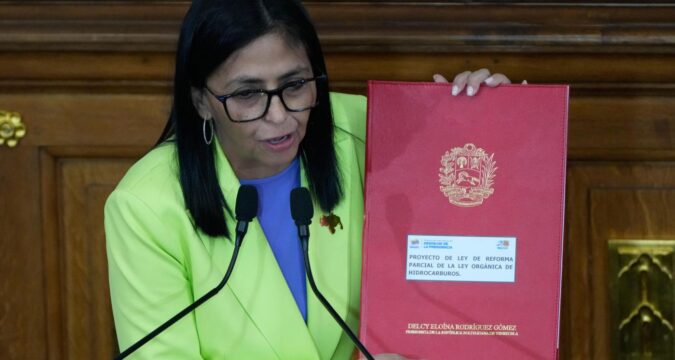
Venezuela’s new leader calls for opening oil industry to foreign investment and warmer US relations
CARACAS, Venezuela — Venezuela’s acting President Delcy Rodríguez used her first state of the union message Thursday to advocate for opening the crucial state-run oil industry to more foreign investment following the Trump administration’s pledge to seize control of Venezuelan crude sales.
For the first time, Rodríguez laid out a vision for Venezuela’s new political reality — one that challenges her government’s most deeply rooted beliefs less than two weeks after the United States captured and toppled former President Nicolás Maduro.
Under pressure from the U.S. to cooperate with its plans for reshaping Venezuela’s sanctioned oil industry, Maduro’s former vice president declared that a “new policy is being formed in Venezuela.”
She urged the foreign diplomats in attendance to tell investors abroad about the changes and called on lawmakers to approve oil sector reforms that would secure foreign firms’ access to Venezuela’s vast reserves.
“Venezuela, in free trade relations with the world, can sell the products of its energy industry,” she said.
The Trump administration has said it plans to control future oil export revenues to ensure it benefits the Venezuelan people.
In that vein, Rodríguez described cash from the oil sales flowing into two sovereign wealth funds, one to support crisis-stricken health services and another to bolster public infrastructure, much of which was built under Maduro’s predecessor, Hugo Chávez, and has since deteriorated.
These days the country’s hospitals are so poorly equipped that patients are asked to provide supplies needed for their care, from syringes to surgical screws.
While Rodríguez criticized the U.S. capture of Maduro and referred to a “stain on our relations,” she also promoted the resumption of diplomacy between the historic adversaries. Her succinct, 44-minute speech and mollifying tone marked a dramatic contrast to her predecessors’ fiery rants against U.S. imperialism that often went on for hours.
“Let us not be afraid of diplomacy,” Rodriguez. “I ask that politics not be transformed, that it not begin with hatred and intolerance.”
The day before, she gave a 4-minute briefing to the media to say her government would continue releasing prisoners detained under Maduro’s harsh rule. But human rights groups have verified just a fraction of the releases that she claimed took place.
Rodríguez appears to be threading a needle.
A portrait of Maduro and his wife, Cilia Flores, was displayed next to her as she spoke. She called for the U.S. government to “respect the dignity” of Maduro, who is being held in a Brooklyn jail after pleading not guilty to drug-trafficking charges. She portrayed herself as defending Venezuela’s sovereignty even as the country warmed up to the U.S. with dizzying speed.
“If one day, as acting president, I have to go to Washington, I will do so standing up, walking, not being dragged,” she said. “I’ll go standing tall … never crawling.”
Rodríguez delivered her speech as Venezuela’s Nobel Prize-winning opposition leader María Corina Machado was the one in Washington to meet President Donald Trump.
Since Maduro’s ouster, Trump has frozen Machado out of discussions about the nation’s political fate while embracing Rodríguez, praising Maduro’s long-time loyalist as a “terrific person” after holding his first known phone call with her on Wednesday.
Machado, whose party is considered to have won the tumultuous 2024 presidential elections despite Maduro’s claims of victory, said she presented her Nobel Peace Prize medal to Trump during their closed-door conversation.
Emerging from the White House afterward, she greeted dozens of cheering supporters. “We can count on President Trump,” she told them, without elaborating.
Her role in Venezuelan politics remains uncertain as Rodríguez’s government has been effectively relieved of having to hold elections for the foreseeable future.
Machado’s meeting with Trump received no coverage in Venezuela.
The country’s state-run TV still pumps out a steady stream of pro-government images, including various statements from Iranian and Russian officials decrying “U.S. aggression” and wall-to-wall coverage of state-orchestrated rallies demanding Maduro’s return.
Crowds of teachers on Thursday marched through the streets of Venezuela’s capital, Caracas, carrying posters condemning the U.S. for “kidnapping” Maduro and chanting slogans in support of the government. National police wearing riot gear were everywhere. Pro-government graffiti scrawled across city walls read: “To doubt is to betray.”
“They’ve kept the same anti-imperialist rhetoric going, but more moderated,” said David Smilde, a Venezuela expert at Tulane University who has studied Venezuela for 30 years. “Their idea is to give Trump everything he wants economically, but stay the course politically.”
On the streets of central Caracas, most Venezuelans going about their days declined to be interviewed about their opinions, fearful of government reprisals as Maduro’s security apparatus remains intact. Others were simply at a loss of what to say about their country’s strange new reality in which the U.S. claims to call the shots.
“It’s a complete sea of uncertainty, and the only one who now has the power to make decisions is the United States government,” said Pablo Rojas, 28, a music producer.
He said he was following Trump’s meeting with Machado closely “to see if she takes a leadership position, if they consider her ready to lead the country or be a candidate.” He shook his head in puzzlement. “It’s impossible to know what will happen.”
Associated Press writers Isabel DeBre in Buenos Aires, Argentina, and Megan Janetsky in Mexico City contributed to this report.
https://www.chicagotribune.com/2026/01/15/venezuela-state-of-the-union-address/

Day One Of UBS China Conference Reveals Emphasis On Humanoid Robotics
Day One Of UBS China Conference Reveals Emphasis On Humanoid Robotics
The first day of the UBS Greater China Conference in Shanghai wrapped up earlier today. It is one of the largest investment conferences hosted by the global wealth manager and investment bank, with a particular focus on Asia.
“Robotics has climbed the agenda from previous years, but humanoids in every home remain many years off,” analysts from the bank said while covering highlights from day one.
The analysts noted another developing theme:
AI will divide nations into “AI‑developed” and “AI‑developing” economies, with China firmly in the former. The US is pursuing a capital‑intensive drive towards AGI, whereas China has a more capital efficient focus on more immediate applications; like governance gaps elsewhere, regulation is lagging the technology.
At the company level, Zhang Shipu, CEO of Noetix Robotics, told the audience that China’s humanoid robotics development has superior motion control and is considered ahead of the US.
UBS analyst Jolie Ho provided more color on Shipu’s comments:
China’s humanoid robots are built around rotary‑joint architectures, enabling highly flexible, multi‑degree‑of‑freedom movement, Zhang Shipu, CEO of Noetix Robotics, said at the UBS Greater China Conference. He highlighted the robots’ impressive progress in hardware stability, control precision, and whole‑body coordination. Importantly, these advancements do not require very high costs, positioning China at a leading transitional stage relative to the US. Yuan Bingbing, Vice President of Robot Era, echoed Zhang’s view in the same panel discussion, emphasizing Chinese robotics’ notable strengths in motion‑control technology. She also stressed the importance of software and hardware advancing together, drawing parallels to Tesla’s integrated development approach.
This development is particularly concerning, given that the humanoid AI robot race appears to be Tesla’s Optimus versus Chinese Unitree robots.
Separate from the humanoid robot race, Ho cited comments from another industry insider that said mass production of these robots hinges on just three things:
Yuan Bingbing, Vice President of Robot Era, said at the UBS Greater China Conference that three factors are required for humanoid robots to reach mass production. First, their performance must be close enough to that of a human; only then will customers be willing to buy them. Second, the economics must work: customers need to be able to “do the math” and justify the purchase.. Third, companies need strong engineering and mass‑production capabilities, meaning the ability to supply reliably at scale. Once these three conditions are met, the industry enters the mass‑production stage, Yuan said. She added that today, the largest market opportunity is in logistics, where robots are being deployed in factories to supplement human labor.
Related:
Trump’s Next National Strategy Will Center On Humanoid Robots
2026 Will Be Breakout Year For Autonomous Driving And Humanoid Robots; Deutsche Bank
Comments from the UBS conference suggest the U.S. may be falling behind China in the global robotics race, highlighting the importance of Tesla’s robotics unit. It also serves as a reminder that the Democratic Party was rooting for Tesla’s bankruptcy.
Tim Walz last year: “Tesla $225 and DROPPING. Gives me a boost.”
Tim Walz today: “I’m DROPPING out of the governor’s race.”
Tesla is up, Walz is down.
pic.twitter.com/gJqiBYTRc2
— Benny Johnson (@bennyjohnson) January 5, 2026
At times, the Democratic posture appears anti-American and, more curiously, sympathetic to China and to adversarial foreign nations. Why is that?
Tyler Durden
Thu, 01/15/2026 – 22:10
https://www.zerohedge.com/technology/day-one-ubs-china-conference-reveals-emphasis-humanoid-robotics

El campeón defensor Nick Taylor comparte la cima del Sony Open
HONOLULÚ (AP) — El campeón defensor Nick Taylor estuvo preciso con sus hierros y manejó bien los hoyos par tres en el Waialae Country Club para firmar el jueves una tarjeta de 62 golpes, ocho bajo par, lo que le permitió compartir la cima del Sony Open, junto con Kevin Roy, al comenzar la temporada de la Gira de la PGA.
La campaña no había iniciado tan tarde. El certamen The Sentry en Kapalua, en Maui, fue cancelado debido a problemas con el agua. El Sony atrajo a un grupo fuerte de golfistas, incluidos cuatro de los diez mejores del mundo.
Taylor, quien ganó el año pasado en un desempate, hizo birdie en tres de los hoyos par tres. Su mejor tiro llegó en el complicado cuarto hoyo, dejando la pelota para un putt de 25 pies que casi emboca.
El canadiense estaba satisfecho, aunque no sorprendido con su juego a pesar de que éste es el primer torneo del año. Jugó lo suficiente en el receso entre temporadas para mantenerse en forma y aún así descansar, jugando solo en México y luego en el Nedbank Challenge de Sudáfrica.
Roy acumuló siete birdies en 11 hoyos al inicio, y terminó con un birdie en el 18, par-cinco.
Ben Griffin, que viene de una temporada con tres victorias y un debut en la Copa Ryder se apuntó un 63, al igual que Chris Gotterup, campeón del Abierto de Escocia.
_____
Deportes AP: https://apnews.com/hub/deportes

Inflation And Revolution
Inflation And Revolution
Authored by Jeffrey Tucker via The Epoch Times,
The revolutionary fervor in Iran today has deep political roots and invites every theory concerning outside influences that have a deep stake in the kind of regime that rules this country. But amidst all the speculation about what’s really happening here, there is an overwhelming factor rarely mentioned.
Iran has experienced the sort of inflation that brings down whole governments. This is why so many among the merchant class have joined the revolutionary movements.
For many years, the regime had pursued an inflationary monetary policy that devastated the value of the currency, the rial. Over a 10-year period, worsening in the last two years, the currency has experienced 3,500 percent inflation. Crucial in this country’s financial structures is the value of the currency on international exchanges. It is now one of the worst, making business nearly impossible and banking highly volatile.
The tipping point has been identified by the Wall Street Journal:
“Late last year, Ayandeh Bank, run by regime cronies and saddled with nearly $5 billion in losses on a pile of bad loans, went bust. The government folded the carcass into a state bank and printed a massive amount of money to try to paper over all the red ink. That buried the problem but didn’t solve it.”
“After decades of engineering workarounds and using shadowy flows of cash to keep the country’s battered economy functioning,” the analysis continues, “Tehran had reached a dead end, with no tools to address a deepening economic crisis or meet the needs of an increasingly desperate population. Hundreds of merchants, who don’t typically join the country’s mass protests, took to the streets of Tehran to demand relief.”
This is a familiar story. Money printing can create the appearance of temporary prosperity. Once it begins to fall apart, there are only two choices: retrenchment and recession or making more loans to continue the illusion.
Iran’s banking system backing vast projects of fake opulence had become wildly overextended. At some point, the house of cards collapsed and the currency along with it.
This is the essential pre-history to grasp in order to understand why people hit the streets and have been unwilling to be intimidated by shows of force. In these cases, even executions do not work to restore order. Indeed, this only creates martyrs that fuel more boldness and revolutionary fervor.
There is nothing unusual historically about this. In an inflation that wrecks peoples’ livelihoods, people find every problem with the regime that rules them even if they put up with its features in the past. In Iran, the blame falls squarely on the heads of the Islamic fundamentalists but it could have been otherwise even under a wholly secular regime. It’s the inflation and financial collapse that is the trigger.
The recent inflationary bout in the United States was mild by historical standards but you could feel the anger in the population rise. A major reason for the defeat of the party in power traced to the loss of purchasing power. Inflation works like a tax but a deeply surreptitious one. It steals your money’s value by increasing the quantity of money in circulation beyond which is supported by existing rates of economic growth.
The previous bout in U.S. history was in 1979–1980 and it too led to the equivalent of a revolution. Jimmy Carter was a decent man and a hard-working president who governed in a moderate way. But none of this mattered once inflation hit double digits and started wiping out the value of savings and saved capital. It felt like a pillaging. Carter was blamed even though it was the supposed independent central bank that was really at fault.
Inflation is the force behind many political revolutions. The story of the Russian Revolution of 1917 is not usually about the money but inflation played a big role. The ruling monarchy had used money printing as the means by which it paid for its involvement in the Great War. This hit the population hard even as regular people were being drafted into the army and killed in a foreign war.
It was this wicked combination of inflation and conscription in an unpopular war that destabilized the Czar’s rule and led to the Bolshevik Revolution. It was not the case that the population had suddenly and strangely converted to the teachings of Karl Marx. Russian culture is centered on three points: religion, family, and ownership. Marxism attacked all three, that which the people loved more than anything else. Inflation is such a powerful force that it even leads people into their own worst political hell.
Going back in time, inflation was the key to the destabilization that led to the French Revolution and the murder of the king and the overthrow of the monarchy. People today tell stories of royal opulence but the reason those stories resonated had to do with high inflation that people experienced in their own lives. They wondered why they were getting poor while the monarchy was getting richer. They sensed that the regime had become rapacious and they were correct.
The French Revolution began in high ideals but collapsed into a bloody mess of political execution and chaos. Even to this day, the country has not quite recovered.
Then there is the most famous case of all: the devastation of the Weimar inflation (1921–23) that destroyed the German currency and certainly ushered in the rise of Hitler and Nazi party rule. When the money fails, totalitarianism often rises. This is a lesson of history.
Everywhere you look today you see the hidden hand of inflation behind political revolutions. In Venezuela, inflation hit 800 percent in 2016, 4,000 percent in 2017, and 130,000 to 2,000,000 percent in 2018. This is one of the one of the worst hyperinflation episodes ever recorded. The cycle was a familiar one: public fury, regime crackdown, and eventual upheaval, this one assisted by the United States who flat-out arrested the leader of the country without a great deal of resentment by the public.
Any political leadership that presides over inflation is playing with fire that can end up burning down the entire house. Commentators most often look at the failure of governance and the rationale behind the regime to explain revolutions, the French Revolution being the most obvious case. But once you understand the underlying economic dynamic, all becomes clear. The key to maintaining the rule of law, longevity in leadership, and regime stability is sound money, zero inflation, a money on which people can depend, and a banking system that serves the public rather than collaborates with industrial elites.
This is why the Founders put a line in the U.S. Constitution about the kinds of money states could issue: only gold and silver. How did they know? Because of the experience of hyperinflation during the War of Independence. The phrase “not worth a Continental” comes from a time when the currency was utterly wrecked. The new country was born with a fear of what inflation could do.
“It is worthy of observation,” wrote Thomas Paine, “that every case of failure in finances, since the system of paper began, has produced a revolution in governments, either total or partial.”
Paine was correct. The slogans of a regime are largely beside the point.
If they cannot manage the money well and allow the logic of high leverage to take its course, it risks being overthrown, always and everywhere.
Tyler Durden
Thu, 01/15/2026 – 21:45
https://www.zerohedge.com/geopolitical/inflation-and-revolution
El campocorto venezolano Luis Hernández firma por 5 millones con Gigantes
NUEVA YORK (AP) — El campocorto venezolano Luis Hernández, el prospecto mejor calificado en el draft internacional amateur de este año, llegó el jueves a un acuerdo con los Gigantes de San Francisco, en el primer día del período de firmas internacionales de 2026.
Hernández logró suscribir el convenio después de dejar el caos en su país natal para llegar a República Dominicana. El pelotero, quien cumplió 17 años el mes pasado, recibirá un bono de 5 millones de dólares por la firma.
“Nuestros jugadores a los que estábamos siguiendo o íbamos a firmar estaban todos a salvo. A Luis lo sacamos de Venezuela a través de Curazao y lo trajimos a la República Dominicana”, explicó Joe Salermo, director senior de exploración internacional de los Gigantes, durante una conferencia de prensa.
Salermo comentó que la agitación política en Venezuela tuvo un impacto mínimo en las operaciones de los Gigantes.
“Nuestros cazatalentos se quedaron en casa un par de días con la familia hasta que fue seguro para ellos salir a la carretera. Nuestros jugadores a los que estábamos siguiendo o íbamos a firmar están todos a salvo”, expresó Salermo.
Confió en que Hernández pueda evolucionar rápidamente y quizás saltarse la Liga de Verano Dominicana y comenzar con un equipo de ligas menores en Estados Unidos.
“Está por encima de su edad en cuanto a madurez”, manifestó Salermo. “Tiene un carácter muy fuerte. Ha trabajado duro. Es un profesional de principio a fin. Juega al golf. Piénsalo. Un joven de 16, 17 años en América Latina jugando al golf, se puede ver el avance que ha tenido con su madurez”.
A Hernández le siguen el campocorto dominicano Johenssy Colomé que firmó con los Atléticos y el jardinero venezolano Francisco Rentería que pactó con los Filis de Filadelfia, ambos por 4 millones.
Más de 170 jugadores oficializaron acuerdos al inicio de un período de firmas que se extiende hasta el 15 de diciembre.
Colomé fue clasificado como el quinto mejor prospecto de la generación por MLB.com y Rentería fue tercero detrás de Hernández y el campocorto puertorriqueño Wandy Asigen, quien acordó un bono de 3,9 millones con los Mets de Nueva York.
Otros acuerdos incluyeron al jardinero dominicano Ángel Nuñez y Cincinnati (3 millones), el jardinero venezolano Angeibel Gómez y Kansas City (2.797.500), el jardinero dominicano Emanuel Luna con San Luis (2,3 millones) y el receptor venezolano Manuel Bolívar y Detroit (2.297.500).
Los peloteros nacidos del primero de septiembre de 2008 al 31 de agosto de 2009 son elegibles para firmar durante el período de este año, que finaliza el 15 de diciembre.
Los equipos comenzaron con asignaciones de entre 5,44 millones y 8,03 millones y pueden aumentar su total hasta en un 60% con canjes. Los Mets comenzaron con la cifra menor y adquirieron 1,5 millones de asignación de Cleveland el jueves a cambio del zurdo Franklin Gómez.
El receptor ruso Ricardo Pulles acordó un bono de 60.000 dólares con los Dodgers de Los Ángeles, quienes firmaron al zurdo alemán Tom Apfelbaum por 197.500.
Filadelfia acordó por 20.000 con el lanzador japonés Alexandre Moretti y un bono de 10.000 con el infielder italiano Patrick Silva, y Pittsburgh acordó un bono de 30.000 con el lanzador derecho brasileño Pietro Albanez.
___
Deportes AP: https://apnews.com/hub/deportes

No. 25 Illinois women fall to No. 8 Michigan 85-69 for their 3rd loss in 4 games
ANN ARBOR, Mich. — Olivia Olson scored 21 points, including 15 in the first half, and Te’Yala Delfosse added 15 to lead No. 8 Michigan to a 85-69 victory over No. 25 Illinois on Thursday night.
Mila Holloway added 13 points and Syla Swords had 11 for the Wolverines (15-2, 6-1 Big Ten). Michigan, which has won all 10 of its home games, is off to its best start since is started 20-2 during the 2021-22 season.
Berry Wallace scored 26 points and Jasmine Brown-Hagger added 16 for the Illini (14-4, 4-3), who have dropped three of their last four.
Michigan started by hitting its first five shots and led by as many as 18 points in the first half. Wallace and Brown-Hagger kept it from getting completely out of hand early by combining for the Illini’s first 19 points.
After trailing 47-32 at halftime, Illinois used an 11-0 run to get within 52-47. Michigan responded with a 15-4 spurt to push the lead back to 18. The Illini, who missed their last seven field goal attempts, could get no closer than 11.
The Wolverines kept the Illini’s offense out of sync throughout, forcing 15 turnovers and holding Illinois to 39.7% shooting. The Illini came in averaging only 12.8 turnovers and hitting 47% of their shots.
Starting guard Gretchen Dolan, Illinois’ second-leading scorer with 13.6 points per game, didn’t play because of a knee injury. She was replaced by Maddie Webber, who was held to 3 points.
Up next
Illinois: plays Northwestern on Sunday.
Michigan: plays Vanderbilt in the Coretta Scott King Classic in Newark, N.J, on Monday.
https://www.chicagotribune.com/2026/01/15/illinois-michigan-women-big-ten/