Category: News

Thompson anota 26 puntos y Mavericks sin Flagg vencen a Jazz por 144-122
DALLAS (AP) — Klay Thompson igualó su mejor marca de la temporada con seis triples y se colocó en el cuarto lugar de la lista histórica de más encestes de tres puntos, para que los Mavericks de Dallas doblegaran el jueves 144-122 al Jazz de Utah.
Thompson estableció su mayor cifra de la campaña con 26 puntos por los Mavericks (16-26), quienes jugaron sin su astro novato Cooper Flagg después de que se torció el tobillo izquierdo el miércoles por la noche en la primera mitad de una derrota en casa ante Denver.
Thompson acumula 2.809 triples, superando a Damian Lillard (2.804) en la lista histórica. Stephen Curry es el líder, seguido por James Harden y Ray Allen, quien totalizó 2.973.
En general, Thompson acertó 10 de 18 disparos. Logró su mayor cifra de la temporada, con seis asistencias.
Los equipos —ambos venían de derrotas el miércoles por la noche— se enfrentarán nuevamente el sábado en Dallas.
Naji Marshall agregó 22 puntos para ayudar a que Dallas mejorara a una foja de 16-26. Los Mavs tuvieron sus máximos números de la temporada en puntos y triples (19) contra el equipo que permite más unidades (127.0) y triples (15.6) en la NBA.
_____
Deportes AP: https://apnews.com/hub/deportes
Cómo se ha usado la Ley de Insurrección en EEUU y qué quiere hacer Trump con ella
Por BILL BARROW
ATLANTA (AP) — Donald Trump no sería el primer presidente de Estados Unidos en invocar la Ley de Insurrección, según ha amenazado, para enviar fuerzas militares federales a Minnesota.
Pero sí sería el único comandante en jefe de las fuerzas armadas en usar esta ley del siglo XIX para mandar soldados y sofocar las protestas, las cuales comenzaron debido a acciones de los agentes federales que el mandatario ya había enviado a la zona, uno de los cuales baleó y mató a una ciudadana estadounidense.
La ley, que le permite al presidente en funciones utilizar a las fuerzas armadas en el interior del país, se ha invocado en más de una veintena de ocasiones, pero rara vez desde el movimiento por los derechos civiles del siglo XX.
Las fuerzas federales suelen ser convocadas para sofocar la violencia generalizada que estalla a nivel local, antes de que Washington intervenga y cuando las autoridades locales solicitan ayuda. Cuando los presidentes actuaron sin una solicitud local, generalmente fue para hacer cumplir los derechos de personas amenazadas o que no eran protegidas por los gobiernos estatales y locales. Un tercer escenario es una insurrección abierta, como la de la Confederación durante la guerra de Secesión.
Expertos en derecho constitucional y militar dicen que nada de esto tiene que ver con lo que está pasando en Minneapolis.
“Esto constituiría un abuso flagrante de la Ley de Insurrección como nunca hemos visto antes”, apuntó Joseph Nunn, abogado del Programa de Libertad y Seguridad Nacional del Brennan Center for Justice, una organización sin fines de lucro de la facultad de derecho de la Universidad de Nueva York. “No se ha cumplido ninguno de los criterios”.
A continuación se presenta un análisis de la ley, cómo se ha utilizado y comparaciones con la situación en Minneapolis.
La ley se concibió originalmente como una forma para proteger a la joven república
George Washington promulgó la primera versión en 1792, la cual lo autorizó a movilizar milicias estatales —precursoras de la Guardia Nacional— cuando “las leyes de Estados Unidos sufran oposición o se obstruya su ejecución”.
Él y John Adams la utilizaron para sofocar las revueltas ciudadanas contra los impuestos, incluidos los gravámenes sobre las bebidas alcohólicas y los impuestos a la propiedad, que se consideraron esenciales para la supervivencia de la joven república.
El Congreso amplió la ley en 1807 y reafirmó la autoridad presidencial para contrarrestar la “insurrección u obstrucción” de las leyes. Nunn explicó que los primeros estatutos reconocían una fundamental “tradición angloamericana contra la intervención militar en asuntos civiles”, excepto “como una herramienta de último recurso”.
Trump insiste en que las circunstancias exigen el último recurso
El presidente argumenta que funcionarios y ciudadanos de Minnesota obstaculizan la aplicación de la ley federal al protestar contra sus planes y la presencia de agentes del Servicio de Inmigración y Control de Aduanas (ICE, por sus siglas en inglés) y de la Oficina de Aduanas y Protección Fronteriza (CBP, por sus siglas en inglés). No obstante, los primeros estatutos también definieron que disturbios “demasiado fuertes para ser reprimidos por el curso ordinario” de las fuerzas del orden eran circunstancias que justificaban el uso de la ley.
Hay entre 2.000 y 3.000 miembros de las autoridades federales en el área metropolitana de Minneapolis y Saint Paul, en comparación con Minneapolis, que tiene menos de 600 agentes de policía. Por otra parte, los videos de manifestantes y transeúntes han mostrado violencia iniciada por agentes federales, y las interacciones se han vuelto más frecuentes desde que Renee Good recibió tres disparos y murió.
“El ICE tiene la autoridad legal para hacer cumplir las leyes federales de inmigración”, explicó Nunn. “Pero lo que están haciendo es una especie de comportamiento violento e ilegal” que va más allá de su función legal y “fomenta la situación” que Trump quiere reprimir.
“No pueden crear una crisis intencionalmente, y luego dar un giro para reprimir”, refirió, y agregó que el requisito constitucional de que un presidente “cumpla fielmente las leyes” significa que Trump debe ejercer su poder, en materia de inmigración y de la Ley de Insurrección, “de buena fe”.
Los cambios de la época de la guerra de Secesión fueron para favorecer los intereses de la Unión y la protección de los derechos civiles
Los tribunales han bloqueado algunos de los empeños de Trump para desplegar a la Guardia Nacional, pero él alegaría con la Ley de Insurrección que no necesita el permiso de un estado para enviar efectivos.
Esto se remonta al presidente Abraham Lincoln, quien sostuvo en 1861 que los estados del sur no podían separarse legítimamente. Por lo tanto, convenció al Congreso para que le otorgara la facultad expresa de desplegar soldados federales, sin preguntar, en los estados confederados que, según él, aún formaban parte de la Unión. Literalmente, Lincoln utilizó la ley como base legal de lucha en la guerra de Secesión.
Nunn indicó que situaciones más allá de una insurrección tan clara como la de la Confederación aún requieren una solicitud local o de otro detonante que el Congreso añadió después de la guerra civil: la protección de los derechos individuales. Ulysses S. Grant utilizó esa disposición con el fin de enviar soldados para contrarrestar al Ku Klux Klan y a otros supremacistas blancos que ignoraron las enmiendas 14 y 15 de la Constitución, así como las leyes de derechos civiles.
Los trabajadores e inmigrantes estuvieron en el centro de algunos despliegues
Durante la industrialización de la posguerra, la violencia estalló en torno a las huelgas y la expansión de la inmigración, y los gobernadores intentaron obtener ayuda.
El presidente Rutherford B. Hayes accedió a las solicitudes estatales durante la gran huelga ferroviaria de 1877, tras enfrentamientos entre trabajadores en huelga, fuerzas estatales y policías locales, los cuales dejaron decenas de muertos. Grover Cleveland accedió a la solicitud de un gobernador del estado de Washington para ayudar a proteger a los ciudadanos chinos que eran atacados por alborotadores blancos. El presidente Woodrow Wilson envió soldados a Colorado en 1914 en medio de una huelga en minas de carbón tras la muerte de varios trabajadores.
Los efectivos federales ayudaron a apaciguar ambas situaciones.
Para abordar los derechos civiles en el siglo XX se recurrió a la estrategia de la Reconstrucción
Al igual que Grant, los presidentes de mediados del siglo XX utilizaron la ley para contrarrestar a los supremacistas blancos.
Franklin Roosevelt envió 6.000 soldados a Detroit —más del doble de las fuerzas federales que están en Minneapolis— tras los disturbios raciales que comenzaron con ataques de blancos contra residentes negros. Las autoridades estatales solicitaron la ayuda de Roosevelt tras la agudización de los disturbios, en parte, explicó Nunn, porque las fuerzas policiales locales blancas se sumaron a la violencia contra los residentes negros. Los soldados federales calmaron la ciudad tras decenas de muertes, incluidos 17 residentes negros asesinados por la policía local.
Una vez que comenzó el movimiento por los derechos civiles, los presidentes enviaron autoridades a los estados del sur sin solicitud ni permiso, porque las autoridades locales desafiaban la ley estadounidense de derechos civiles y ellas mismas fomentaban la violencia.
Dwight Eisenhower impuso la integración en la escuela secundaria Central de Little Rock, Arkansas. John F. Kennedy envió soldados a la Universidad de Mississippi tras los disturbios por la admisión de James Meredith y, posteriormente, de manera preventiva para asegurar la ausencia de violencia ante el incidente conocido como el “Bloqueo a las puertas de la escuela” por parte de George Wallace, en su protesta contra la integración de la Universidad de Alabama.
“Podría haber habido una pérdida significativa de vidas a causa de los alborotadores” en Mississippi, señaló Nunn.
Lyndon Johnson protegió la marcha por el derecho al voto de 1965, desde Selma hasta Montgomery, después de que efectivos de Wallace atacaran a los manifestantes en su primer intento pacífico.
Disturbios en ciudades y el último caso en 1992
Johnson también envió soldados a varias ciudades de Estados Unidos en 1967 y 1968 tras la agudización de los enfrentamientos entre residentes y la policía. Lo mismo ocurrió en Los Ángeles en 1992, la última vez que se invocó la Ley de Insurrección.
Los disturbios estallaron después de que un jurado no lograra declarar culpables a cuatro policías blancos por uso excesivo de la fuerza, a pesar de un video en el que se les veía golpear a Rodney King, un hombre negro. Pete Wilson, gobernador de California, solicitó apoyo al presidente George H.W. Bush.
Bush autorizó el envío de unos 4.000 soldados, pero después de haber expresado públicamente su descontento con el veredicto del juicio. Prometió “restablecer el orden”, pero le ordenó al Departamento de Justicia que abriera una investigación por posible violación de derechos civiles, y posteriormente dos de los agentes de Los Ángeles fueron declarados culpables en un tribunal federal.

Kyle Tucker llega a un acuerdo de 240 millones y 4 años con Dodgers, campeones de la Serie Mundial
Por JAY COHEN
Kyle Tucker ha llegado a un acuerdo por 240 millones de dólares y cuatro años con los Dodgers de Los Ángeles, según una persona enterada de las negociaciones.
El convenio refuerza las posibilidades de la franquicia para obtener un tercer campeonato consecutivo de la Serie Mundial.
La persona que dio la información habló con The Associated Press el jueves por la noche bajo condición de anonimato porque el acuerdo estaba pendiente de un examen físico.
El valor promedio anual de 60 millones de dólares de Tucker sería el segundo más alto en la historia del béisbol, sin considerar descuentos, detrás de los 70 millones de Shohei Ohtani en su contrato de diez años con los Dodgers que se extiende hasta 2033.
Cuando está saludable, Tucker es uno de los peloteros más completos en las mayores. Sin embargo, el jardinero ha jugado apenas en 214 duelos de temporada regular en los últimos dos años.
Bateó para .266 con 22 jonrones y 73 carreras impulsadas con los Cachorros de Chicago la temporada pasada. Fue adquirido en un intercambio de gran magnitud con Houston en diciembre de 2024, que mudó al promisorio toletero Cam Smith a los Astros.
Tucker fue frenado por un par de lesiones en su única temporada con los Cachorros. Sufrió una pequeña fractura en su mano derecha en un deslizamiento incómodo contra Cincinnati el 1 de junio. También se lesionó la pantorrilla izquierda contra Atlanta el dos de septiembre.
Después de un comienzo rápido con su nuevo equipo, Tucker bateó apenas para .231 con cinco jonrones en 41 encuentros después del receso del Juego de Estrellas. Se desempeñó como bateador designado de Chicago en los playoffs para eliminar a San Diego en la primera ronda antes de perder ante Milwaukee en una serie divisional de la Liga Nacional dirimida en cinco juegos.
Tucker, quien cumplirá 29 años el sábado, rechazó una oferta calificada de 22.025.000 dólares en noviembre, por lo que su nuevo acuerdo significa que los Cachorros obtendrán una selección compensatoria en el draft.
En el draft amateur de 2015, Tucker fue seleccionado por Houston en el quinto turno. Jugó en tres Series Mundiales con los Astros, ganando un anillo en 2022.
Conectó al menos 29 jonrones e impulsó un mínimo de 92 carreras durante tres temporadas consecutivas de 2021 a 2023. Ganó un Guante de Oro en 2022 y lideró la Liga Americana con 112 carreras impulsadas en 2023.
Se limitó a 78 juegos en su última temporada con Houston debido a una fractura en la espinilla derecha, pero bateó para .289 con 23 jonrones y 49 carreras impulsadas.
El pelotero originario de Tampa, Florida, tiene un promedio de bateo de .273 con 147 jonrones, 490 carreras impulsadas y un OPS de .865 en 769 juegos de por vida. También totaliza 119 robos en 135 intentos.
___
El escritor de béisbol de AP Ronald Blum contribuyó a este informe.
_____
Deportes AP: https://apnews.com/hub/deportes
Morales y Velázquez vuelven a responder y Santurce queda a un triunfo del título en Puerto Rico
Por The Associated Press
Yohandy Morales y Nelson Velázquez se volaron la barda y guiaron el jueves a los Cangrejeros de Santurce a una victoria por 6-3 sobre los Leones de Ponce, para ampliar a 3-0 su ventaja en la serie final de la Liga de Béisbol Profesional Roberto Clemente (LBPRC).
Morales impulsó dos carreras con un jonrón y un doble, mientras que Velázquez aportó un cuadrangular y un elevado de sacrificio, liderando una ofensiva que tomó ventaja desde temprano.
Desde la lomita, Colin Wiles trabajó cuatro entradas sin permitir carreras, y Andrew Baker (1-0) se llevó la victoria en labor de relevo tras colgar dos ceros.
La derrota fue para Jackson Goddard (0-1), quien permitió cuatro carreras en seis episodios. Santurce quedó a un solo triunfo de conquistar el campeonato.
Toros encadenan su 3ra victoria y se acercan a final dominicana
Los Toros del Este explotaron con un ataque de cinco anotaciones en la séptima entrada para remontar y vencer 8-5 a los Leones del Escogido en la Liga Domincana de Béisbol.
Con la victoria, los Toros mantuvieron su ventaja de un juego sobre las Águilas Cibaeñas en la lucha por el último boleto disponible a la serie final, cuando restan dos jornadas por disputarse en el Round Robin.
Yairo Muñoz se vistió de héroe al conectar un triple con las bases llenas que remolcó tres carreras y coronó el ataque definitivo de los Toros. Además, Muñoz sacudió un cuadrangular de dos anotaciones en la segunda entrada para cerrar la noche con cinco carreras impulsadas y convertirse en la figura del encuentro.
En Santiago de los Caballeros, Steward Berroa y Geraldo Perdomo conectaron imparables remolcadores para encabezar un ataque de cuatro carreras en la segunda entrada, con el que las Águilas doblegaron 5-4 a unos Gigantes del Cibao ya eliminados.
Las Águilas se mantuvieron con vida en la pelea por el último pase a la final.
Con dos fechas por disputarse en el Round Robin, los Leones (11-5) ya aseguraron su lugar en la serie final, seguidos por los Toros(10-6), Águilas (9-7) y Gigantes (2-14).
Acuña brilla de nuevo y Cardenales ratifican liderato en Venezuela
Luisangel Acuña volvió a tener una noche explosiva con el madero para guiar a los Cardenales de Lara a una victoria por 9-6 sobre los Bravos de Margarita, con la que ampliaron su ventaja en la cima de la ronda de todos contra todos que define a los finalistas de la Liga Venezolana de Béisbol.
Acuña, quien el sábado se convirtió en el primer jugador en la historia de la Liga Venezolana de Béisbol Profesional en conectar cuatro vuelacercas en un mismo juego de postemporada, bateó de 3-2 con un doble, otro cuadrangular y cinco carreras remolcadas.
En la postemporada, el infielder batea para .343, con cinco jonrones y 17 carreras producidas en apenas ocho encuentros.
En Maracaibo, Ángel Reyes se fue de 3-2 con un triple, un jonrón y tres carreras impulsadas, mientras que Leandro Cedeño bateó de 3-2 con un cuadrangular y también tres remolcadas, en la victoria de los Navegantes del Magallanes por 10-4 sobre las Águilas del Zulia.
A la mitad del round robin, Cardenales lideran con marca de 6-2, seguidos por Caribes de Anzoátegui (5-3), Águilas (4-4), Navegantes (3-5) y Bravos (2-6).
_____
Deportes AP: https://apnews.com/hub/deportes
“Emergency Intervention”: Trump To Cap Residential Electric Bills By Forcing Tech Giants To Pay For Soaring Power Costs
“Emergency Intervention”: Trump To Cap Residential Electric Bills By Forcing Tech Giants To Pay For Soaring Power Costs
Back in August, when the American population was just waking up to the dire consequences the exponentially growing army of data centers spawned across the country was having on residential electricity bills, we said that the chart of US CPI would soon become the most popular (not in a good way) chart in the financial realm.
In one year, this will be the most popular chart on this site pic.twitter.com/h93gWXMoNL
— zerohedge (@zerohedge) August 11, 2025
One month later we added that it was only a matter of time before Trump, realizing that soaring electricity costs would almost certainly cost Republicans the midterms, would enforce price caps.
100% wrong. Trump is about to put a cap on power price and will crush utilities. https://t.co/WjiZe8MEnM
— zerohedge (@zerohedge) September 29, 2025
Turns out we were right.
And while Trump obviously can not pull a communist rabbit out of his hat, and centrally plan the entire US power grid, what he can do is precisely what he is about to announce.
According to Bloomberg, Trump and the governors of several US Northeastern states agreed to push for an emergency wholesale electricity auction that would compel technology companies to effectively fund new power plants, effectively putting a cap for residential power prices at the expense of hyperscalers and data centers. Which, come to think of it, we also proposed back in October.
The data centers and AI giants are making billions as they drain the power grid dry and get indirect consumer subsidies in the form of 100% bill increases. It’s time they allocate some of trillions in circle jerk funds to lowering electricity costs for everyone else
— zerohedge (@zerohedge) October 15, 2025
The unprecedented plan, set to be announced Friday morning, seeks to address growing tensions over how the nation can supply electricity to power-hungry data centers, critical to help win the global AI race against China, without simultaneously hiking utility bills for homes and businesses.
The Trump administration and some US governors plan to direct grid operator PJM Interconnection LLC, the largest regional power grid in the US serving 67 million customers primarily in the Northeast, to hold an auction for tech companies to bid on 15-year contracts for new electricity generation capacity.
If the auction proceeds as envisaged, tech giants would pay for power over the duration of the contracts, whether they use the electricity or not, providing secure revenues for years in a market notorious for price volatility and generator bankruptcies.
The auction would deliver contracts supporting the construction of some $15 billion worth of new power plants, said a White House official granted anonymity to detail the approach.
Naturally, since this plan is being introduced under duress, representatives of PJM won’t be in attendance when the plan is laid out Friday according to Bloomberg.
“We don’t have a lot to say on this,” PJM spokesman Jeffrey Shields said by email. “We were not invited to the event they are apparently having tomorrow and we will not be there.”
The push by the administration and the governors — which will come in the form of a non-binding “statement of principles” signed by Trump’s National Energy Dominance Council and the governors of Pennsylvania, Ohio, Virginia and other states — responds to growing concern about power demand far outpacing supply in the region managed by PJM.
PJM is already home to the world’s biggest concentration of data centers, in northern Virginia. It expects peak demand across its system to jump 17% by 2030 from this year’s high. Furthermore, as we noted two months ago, PJM is one of the 8 (out of 13) regional power markets that are already below critical spare capacity levels.
“eight out of the 13 US regional power markets are already at or below critical spare capacity levels.” – Goldman https://t.co/YYAGUukfwR pic.twitter.com/eU4XPFAMrp
— zerohedge (@zerohedge) November 23, 2025
Trump has repeatedly described power plants being built alongside data centers, and on Monday, he doubled down on the idea, insisting in a social media post that the big technology companies that construct data centers must “pay their own way.”
“I never want Americans to pay higher Electricity bills because of Data Centers,” Trump wrote in his post, and now he will try to make that a reality.
As we have warned repeatedly in the past year, cost-of-living concerns – especially when it comes to staples like electricity – are already weighing heavily on Republicans’ bid to maintain control of the House and Senate in this November’s congressional elections. While Trump has stressed the plummeting cost of oil and gasoline since he took office last January, electricity prices have climbed due to rising demand, and there’s a building backlash against data centers that are fueling the surge… which – you guessed it – we warned about too.
between exploding electricity bills and lack of jobs for grads, a new luddite revolution is coming – they will be burning down data centers within a year
— zerohedge (@zerohedge) August 25, 2025
The average US retail price for electricity gained 7.4% in September to a record 18.07 cents per kilowatt-hour, the biggest gain since December 2023. Residential prices have jumped even higher, rising by 10.5% between January and August 2025, marking one of the largest increases in more than a decade, according to the National Energy Assistance Directors Association.
Friday’s action is being cast as a one-time emergency intervention into the PJM market, necessary because of the rapid rise in electricity prices in the Mid-Atlantic region. The Trump administration and governors will urge the grid operator to return to market fundamentals after the acute problem is addressed, the White House official said.
The administration’s prescription for PJM is what’s known as a reliability backstop auction — something the grid operator already envisioned in the wake of repeated failed sales. But the administration and governors’ plan would mean holding the emergency auction right away after one clear failure – with unusual terms meant to foster a wave of rapid, new construction and the only bidders being data center owners and operators.
While PJM already holds auctions procuring electricity supplies, those are 12-month periods. In the auction encouraged by Trump and the governors for 15-year contracts, start-up times for the new power plants are likely to be staggered. The White House and governors are urging PJM to hold the special one-time auction by the end of September.
“It sounds like a significant improvement and a logical extension of bring-your-own new generation,” Joe Bowring, president of PJM’ s independent watchdog Monitoring Analytics LLC, said in a telephone interview. Almost as if the Trump admin read something else we wrote…
To prevent skyrocketing electric bills, every state has to follow the Texas example: each data center must have its own “behind the meter” onsite power generation.
“We believe data centers should pay for the full cost of their power,” Dominion Energy spokesperson Aaron Ruby… https://t.co/0u1owTeAs8 pic.twitter.com/8W421s3rzV
— zerohedge (@zerohedge) November 23, 2025
“While a ‘statement of principles’ doesn’t appear to include a legal mandate for PJM to act, pressure from the Trump administration and a bipartisan coalition of PJM states is very likely to motivate a considerable response” from the grid operator, said Timothy Fox, an analyst with the research firm ClearView Energy Partners.
This plan also could fast track the development of natural gas generation and potentially nuclear plants by guaranteeing revenues – and profits – specifically to support data campuses needed to deploy artificial intelligence. The approach could benefit larger tech companies at the expense of smaller firms, as well as companies involved in advanced energy development such as Small and Modular Nuclear Reactors.
Amazon.com Inc., Alphabet Inc.’s Google and Microsoft Corp. are less exposed to electricity price fluctuations since they can pass those costs on to customers, said Gil Luria, analyst at DA Davidson & Co. However, dozens of smaller companies, including Nebius and CoreWeave that offer artificial intelligence infrastructure to cloud-computing companies on multi-year contracts, could be more exposed to big price swings since they are on the hook to absorb higher electricity costs, he said.
“If they have to pay more for electricity, their margins will get squeezed,” Luria said.
Trump’s initiative will deliver another benefit: the effort has the potential to help PJM tackle a significant roadblock: improving the accuracy of its forecasts for demand growth. With tech giants paying for the power plants they need, the approach could weed out speculative projects that have skewed demand growth projections, something we discussed earlier.
As Bloomberg notes, the involvement of Democratic governors – including Pennsylvania’s Josh Shapiro and Maryland’s Wes Moore – is seen by the Trump administration as helping to anchor the effort, since state policies have driven recent changes in the power mix, including the retirement of coal and gas plants. The initiative is also seen aiding hyperscalers by ensuring reliable power supply, and it could be a model for other parts of the country, the White House official said.
Governors are committing to implement and assign these costs to the data centers, ensuring the price of these new power plants doesn’t land on the average household, the White House official said.
PJM’s auctions have emerged as a political flashpoint in the national debate about affordability after prices reached record levels in 2024. Although Pennsylvania’s Shapiro struck a deal with PJM to cap prices in future auctions, costs hit new highs in two subsequent sales. In fact, had it not been for an implicit cap in the latest auction, residential prices would have been 60% higher (see “Inside The PJM Auction Report, Something Crazy: Without Price Controls, Electricity Bills Would Explode“.)
The most recent auction, in December, also fell 6.6 gigawatts short of supplies, which PJM blamed on the frenzy to build massive data centers. PJM is now being asked to extend the price cap for auctions held through this year, the White House official said.
While the statement of principles being signed Friday isn’t a binding legal document, administration officials have discussed the plan with a host of stakeholders, from PJM executives and state officials, to utilities, power-plant developers, Wall Street and the hyperscalers building these data centers, the official said.
Tyler Durden
Thu, 01/15/2026 – 23:27

Wembanyama regresa tras susto por lesión y conduce a Spurs a triunfo 119-101 sobre Bucks
SAN ANTONIO (AP) — Victor Wembanyama regresó tras un susto por lesión en el primer cuarto para anotar 22 puntos y capturar diez rebotes, con lo cual guio el jueves a los Spurs de San Antonio a una victoria de 119-101 sobre los Bucks de Milwaukee.
Stephon Castle añadió 19 puntos y diez asistencias, y Julian Champagnie sumó 13 puntos y 11 rebotes por San Antonio. Los Spurs llegaron a ostentar una ventaja de 39 puntos al inicio del cuarto periodo.
Giannis Antetokounmpo anotó 21 puntos por Milwaukee, que sufrió su tercera derrota consecutiva.
Fue la segunda derrota abultada consecutiva de los Bucks después de ser abucheados en casa el martes, durante una paliza de 139-106 ante los Timberwolves de Minnesota.
Wembanyama sorprendió a la multitud en el Frost Bank Center, y ello no tuvo nada que ver con su recién afeitada cabeza.
Regresó a la cancha después de hacer contacto rodilla con rodilla con Antetokounmpo bajo la canasta de los Bucks con 9:18 minutos restantes en el primer cuarto. Wembanyama cayó con dolor antes de levantarse y marcharse hacia el vestuario, cojeando pero sin ayuda.
El pívot francés de 2,23 metros sufrió una hiperextensión de rodilla el 31 de diciembre en el último cuarto del encuentro contra los Knicks de Nueva York tras una jugada similar. Regresó para mirar desde el banco en la víspera de Año Nuevo, pero se perdió los siguientes dos duelos.
Wembanyama regresó al banco al final del primer cuarto el jueves, pero esta vez volvió a la cancha para comenzar el segundo periodo.
_____
Deportes AP: https://apnews.com/hub/deportes

PJM Trims Near-Term Load Forecast On Stricter Data Center Vetting, Economic Outlook
PJM Trims Near-Term Load Forecast On Stricter Data Center Vetting, Economic Outlook
By Ethan Howland of UtilityDive
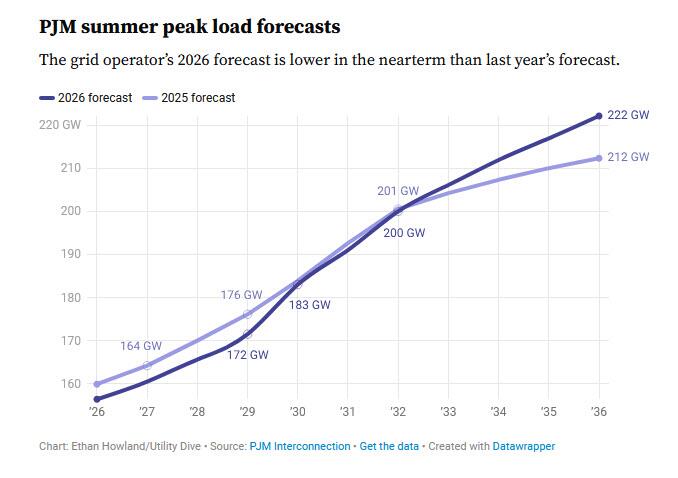
The PJM Interconnection scaled back its load growth forecast through 2032 compared to last year’s estimates, but the largest U.S. grid operator expects electric demand to surge past those expectations through the next decade, according to an annual report released Wednesday. PJM expects its summer peak load will grow by 3.6% a year to about 222 GW by 2036, up from its previous 3.1% forecast. The increase totals about 65.7 GW over the next 10 years.
In a change that affects PJM’s upcoming capacity auction, the grid cut its peak demand forecast for the summer of 2028 by 4.4 GW, or 2.6%. It also lowered its forecast for the summer of 2027 by about 4 GW, reducing a reserve margin shortfall for that capacity year to about 2.6 GW.
PJM’s reduced near-term load forecast was driven by updates to electric vehicle and economic forecasts and stricter vetting of planned data centers and large loads, according to the grid operator.
Those changes reduced PJM’s peak load forecast for this summer by 0.7% from large loads, 0.5% from economic activity and 0.1% from EVs compared to the last long-term load forecast report, PJM said in a press release.
PJM uses its annual load forecast for transmission planning and to help determine how much capacity it should buy in its capacity auctions. PJM’s next base capacity auction, for the 2028/29 delivery year, is set to start June 30.
PJM’s downward revisions to its load forecast don’t indicate weakening demand for electricity, according to Jefferies equity analysts.
“We read the load revisions as reflective of pushouts/delays, NOT weakness in demand,” they said in a note Wednesday. “While we expect a 3-4 GW improvement in shortfall for [the] next two auctions, [the] market will still fall short — an accelerated backstop procurement is the way to go.”
Even if PJM secures an additional 10 GW in a procurement process, capacity prices will “comfortably clear” at the maximum price of about $530/MW-day in PJM’s next two capacity auctions, the analysts said.
Compared to last year’s forecast, PJM increased its 2031 summer peak load forecast for the Dayton Power and Light zone by 27%, or 1 GW, the Commonwealth Edison zone by 16.5%, or 3.7 GW, and the PECO Energy zone by 5.1%, or 0.5 GW.
In the same year, it cut its forecast for the American Electric Power zone by 10.4%, or 3.7 GW, the American Transmission Systems Inc. zone by 8.1%, or 1.2 GW, and the Pennsylvania Electric zone by 6.1%, or 0.2 GW.
The PJM zones with the strongest 10-year average annual summer peak growth forecasts are: PPL Electric at 6.4% (up from 5.9% last year); Dominion at 5.4% (down from 6.3%); AEP at 5.3% (down from 5.5%); DPL at 5.2% (up from 1.2%); and ComEd at 3.9% (up from 1.6%), according to PJM’s report.
After PJM stakeholders failed to agree last year on reforming the grid operator’s processes for adding large loads to its system, PJM’s board is expected to “outline its determination of a path forward on the [Critical Issue Fast Path] issues in the next few weeks,” PJM said in the news release.
Reforms may include changes to PJM’s process for considering large load forecasts.
Tyler Durden
Thu, 01/15/2026 – 23:24

Remontada de Thunder en el último cuarto le permite vencer a Rockets 111-91
HOUSTON (AP) — Shai Gilgeous-Alexander anotó 20 puntos, Chet Holmgren agregó 18 y el Thunder de Oklahoma City se despegó en el último cuarto para vencer el jueves 111-91 a los Rockets de Houston.
Cason Wallace sumó 17 unidades desde el banco y el Thunder, líder de la NBA, superó a Houston 34-16 en el último cuarto para conseguir su quinta victoria consecutiva.
Kevin Durant lideró a Houston con 19 puntos, pero falló sus cinco intentos de triple y acertó siete de 23 tiros en general en una noche en la que los Rockets encestaron apenas siete de 24 disparos desde detrás del arco.
El Thunder ganaba por dos puntos al inicio del último cuarto antes de emprender una racha de 11-2, con un triple de Ajay Mitchell y dos de Wallace, para poner el marcador 90-79 con menos de nueve minutos por jugar.
Oklahoma City se mantuvo arriba por nueve tantos más tarde en el cuarto cuando Mitchell encestó otro triple para iniciar una racha de 7-0 que puso el marcador 99-83 con unos cuatro minutos restantes. Jaylin Williams culminó esa ráfaga de puntos con una clavada a dos manos y el entrenador de Houston, Ime Udoka, pidió un tiempo muerto mientras muchos fanáticos comenzaban a dirigirse hacia las salidas.
Udoka recibió una falta técnica por protestar a los oficiales durante el tiempo muerto y el Thunder continuó su racha después de eso, extendiéndola a 14-0. Gilgeous-Alexander encestó el tiro libre antes de agregar tres más en los siguientes minutos y un triple de Kenrich Williams puso el marcador 106-83 con dos minutos restantes.
Para cuando Reed Sheppard encestó un triple unos segundos después, los Rockets llevaban más de cinco minutos sin anotar.
_____
Deportes AP: https://apnews.com/hub/deportes

First European Troops Arrive In Greenland In Dark Of Night
First European Troops Arrive In Greenland In Dark Of Night
In a move that will further inflame already rising tensions over Greenland, the first European troops have quietly begun arriving on the island following President Trump’s repeated provocative declarations on the need for Washington to take control of the territory, according to Germany’s Bild.
The newspaper reports that a Danish military transport aircraft landed overnight in Nuuk, Greenland’s capital, carrying Danish soldiers alongside members of the French armed forces.
Soon on the first plane’s heels, another Danish Hercules aircraft touched down at Kangerlussuaq in western Greenland. Both planes reportedly flew with their transponders switched off – a detail unlikely to go unnoticed in an already tense Arctic standoff.
The initial German contingent of 13 soldiers arrived in Nuuk on Thursday morning. Additionally the United Kingdom, Canada, the Netherlands, Norway, and Sweden are also set to participate in the deployment.
While all of these countries are NATO members, the operation is being coordinated directly from Copenhagen rather than through NATO channels, underscoring the political sensitivity of the move.
Here’s how Bild describes it, according to machine translation:
Officially, it is NATO countries from Europe that are expanding their presence in Greenland. However, according to information obtained by BILD, the operation is being coordinated from Copenhagen – and NOT through NATO structures.
The reason: The Nordic states in NATO – including Greenland – are under the command of NATO headquarters in Norfolk, USA. The operation is intended to proceed without US involvement. In Germany, the Ministry of Defense and, in a leading role, the Federal Chancellery are involved.
The newspaper notes that the first troops were dispatched only after talks between Danish and Greenlandic officials and the United States collapsed Wednesday at the White House, despite agreements to establish a joint ‘working group’.
Greenland remains an autonomous territory of Denmark, but the resource-rich island has long sat at the center of US strategic planning, and there are US Air Force and Space Forces bases and monitoring sites located there – some in very extreme climates.
Troops from Denmark and other European countries are arriving in Greenland to help boost the territory’s security after a meeting between American, Danish, and Greenlandic officials ended without resolving “fundamental disagreements” over the strategically critical Arctic island. pic.twitter.com/briR9g0JYe
— DW News (@dwnews) January 15, 2026
One revealing line outside the White House Wednesday came from Danish Foreign Minister Lars Løkke Rasmussen who said it remains “clear that the president has this wish of conquering over Greenland” – but that dialogue has not been totally abandoned.
* * *
The unraveling of NATO? French President Macron vows further “land, air & sea assets” in the coming days.
Denmark calls. Europe answers.
European troops have arrived in Greenland.
Not to escalate tensions — but to defend sovereignty, deter intimidation, and send a clear political message.
👉 Greenland is not for sale.
👉 Denmark is not alone.
👉 Europe stands together. pic.twitter.com/XFvEHYOCrF
— European Federalists (@federalists) January 15, 2026
Tyler Durden
Thu, 01/15/2026 – 23:00
https://www.zerohedge.com/markets/first-european-troops-arrive-greenland-dark-night

Proposals on immigration enforcement flood into state legislatures, heightened by Minnesota action
NASHVILLE, Tenn. — As Democrats across the country propose state law changes to restrict federal immigration officers after the shooting death of a protester in Minneapolis, Tennessee Republicans introduced a package of bills Thursday backed by the White House that would enlist the full force of the state to support President Donald Trump’s immigration crackdown.
Momentum in Democratic-led states for the measures, some of them proposed for years, is growing as legislatures return to work following the killing of Renee Good by an Immigration and Customs Enforcement officer. But Republicans are pushing back, blaming protesters for impeding the enforcement of immigration laws.
Democratic bills seek to limit ICE
Democratic Gov. Kathy Hochul wants New York to allow people to sue federal officers alleging violations of their constitutional rights. Another measure aims to keep immigration officers lacking judicial warrants out of schools, hospitals and houses of worship.
Oregon Democrats plan to introduce a bill to allow residents to sue federal officers for violating their Fourth Amendment rights against unlawful search and seizure.
New Jersey’s Democrat-led Legislature passed three bills Monday that immigrant rights groups have long pushed for, including a measure prohibiting state law enforcement officers from cooperating with federal immigration enforcement. Democratic Gov. Phil Murphy has until his last day in office Tuesday to sign or veto them.
California lawmakers are proposing to ban local and state law enforcement from taking second jobs with the Department of Homeland Security and make it a violation of state law when ICE officers make “indiscriminate” arrests around court appearances. Other measures are pending.
“Where you have government actions with no accountability, that is not true democracy,” Democratic state Sen. Scott Wiener of San Francisco said at a news conference.
Democrats also push bills in red states
Democrats in Georgia introduced four Senate bills designed to limit immigration enforcement — a package unlikely to become law because Georgia’s conservative upper chamber is led by Lt. Gov. Burt Jones, a close Trump ally. Democrats said it is still important to take a stand.
“Donald Trump has unleashed brutal aggression on our families and our communities across our country,” said state Sen. Sheikh Rahman, an immigrant from Bangladesh whose district in suburban Atlanta’s Gwinnett County is home to many immigrants.
Democrats in New Hampshire have proposed numerous measures seeking to limit federal immigration enforcement, but the state’s Republican majorities passed a new law taking effect this month that bans “sanctuary cities.”
Tennessee GOP works with White House on a response
The bills Tennessee Republicans are introducing appear to require government agencies to check the legal status of all residents before they can obtain public benefits; secure licenses for teaching, nursing and other professions; and get driver’s licenses or register their cars.
They also would include verifying K-12 students’ legal status, which appears to conflict with a U.S. Supreme Court precedent. And they propose criminalizing illegal entry as a misdemeanor, a measure similar to several other states’ requirements, some of which are blocked in court.
“We’re going to do what we can to make sure that if you’re here illegally, we will have the data, we’ll have the transparency, and we’re not spending taxpayer dollars on you unless you’re in jail,” House Speaker Cameron Sexton said at a news conference Thursday.
Trump administration sues to stop laws
The Trump administration has opposed any effort to blunt ICE, including suing local governments whose “sanctuary” policies limit police interactions with federal officers.
States have broad power to regulate within their borders unless the U.S. Constitution bars it, but many of these laws raise novel issues that courts will have to sort out, said Harrison Stark, senior counsel with the State Democracy Research Initiative at the University of Wisconsin Law School.
“There’s not a super clear, concrete legal answer to a lot of these questions,” he said. “It’s almost guaranteed there will be federal litigation over a lot of these policies.”
That is already happening.
California in September was the first to ban most law enforcement officers, including federal immigration officers, from covering their faces on duty. The Justice Department said its officers won’t comply and sued California, arguing that the laws threaten the safety of officers who are facing “unprecedented” harassment, doxing and violence.
The Justice Department also sued Illinois last month, challenging a law that bars federal civil arrests near courthouses, protects medical records and regulates how universities and day care centers manage information about immigration status. The Justice Department claims the law is unconstitutional and threatens federal officers’ safety.
Targeted states push back
Minnesota and Illinois, joined by their largest cities, sued the Trump administration this week. Minneapolis and Minnesota accuse the Republican administration of violating free speech rights by punishing a progressive state that favors Democrats and welcomes immigrants. Illinois and Chicago claim “Operation Midway Blitz” made residents afraid to leave their homes.
Homeland Security spokesperson Tricia McLaughlin accused Minnesota officials of ignoring public safety and called the Illinois lawsuit “baseless.”
Bauer reported from Madison, Wisconsin. Associated Press writers John O’Connor in Springfield, Illinois; Sophie Austin in Sacramento, California; Mike Catalini in Trenton, New Jersey; Anthony Izaguirre in Albany, New York; Claire Rush in Portland, Oregon; and Jeff Amy in Atlanta contributed.
https://www.chicagotribune.com/2026/01/15/state-immigration-enforcement-proposals/