Category: News
Inside a year of firings that have shaken the Trump Justice Department: ‘A great deal of fear’
WASHINGTON — Michael Ben’Ary was driving one evening last October when he paused at a red light to check his work phone. He was in the middle of a counterterrorism prosecution so important that President Donald Trump highlighted it in his State of the Union address.
Ben’Ary said he was shocked to see his phone was disabled. He found the explanation later in his personal email account, a letter informing him he was fired.
A veteran prosecutor, Ben’Ary handled high-profile cases over two decades at the Justice Department. Yet the same credentials that enhanced Ben’Ary’s resume spelled the undoing of his government career.
His termination came hours after right-wing commentator Julie Kelly told her online followers that he had previously served as a senior counsel to Lisa Monaco, the No. 2 Justice Department official in the Biden administration. Kelly also suggested Ben’Ary was part of the “internal resistance” to prosecuting former FBI Director James Comey. Ben’Ary was never involved in the case.
As Attorney General Pam Bondi approaches her first year on the job, the firings of attorneys like Ben’Ary have defined her turbulent tenure. The terminations and a larger voluntary exodus of lawyers have erased centuries of combined experience and left the department with fewer career employees to act as a bulwark for the rule of law as Trump tests the limits of executive power by demanding prosecutions of his political enemies.
Interviews by The Associated Press of more than a half-dozen fired employees offer a snapshot of the toll. The departures include lawyers who prosecuted attacks on police at the U.S. Capitol on Jan. 6, 2021, civil rights and ethics enforcers, immigration judges and attorneys who defend administration policies. They continued this week, when several prosecutors in Minnesota moved to resign amid turmoil over an investigation into the shooting of a woman by an Immigration and Customs Enforcement officer.
“To lose people at that career level, people who otherwise intended to stay and now are either being discharged or themselves are walking away, is immensely damaging to the public interest,” said Stuart Gerson, a senior official in the George H.W. Bush administration and acting attorney general early in the Clinton administration.
Justice Connection, a network of department alumni, estimates that more than 230 lawyers, agents and other employees from across the department were fired last year. More than 6,400 employees are estimated to have left a department that at the end of 2025 had roughly 108,000.
The Justice Department says it has hired thousands of career attorneys over the last year. The Trump administration has publicly characterized some of the fired and departed workers as out-of-step with its agenda.
After he was fired, Ben’Ary who led the national security unit at the U.S. attorney’s office for the Eastern District of Virginia, posted a note near his door reminding colleagues they had vowed to follow the facts “unhindered by political interference.”
But, he warned, “In recent months, the political leadership of the Department have violated these principles, jeopardizing our national security and making Americans less safe.”
An unprecedented purge
The firings began before Bondi arrived last February. Prosecutors on special counsel Jack Smith’s team that investigated Trump were terminated days after the inauguration, followed by prosecutors hired on temporary assignments for cases resulting from the 2021 Capitol insurrection.
“The people working on these cases were not political agents of any kind,” said fired Jan. 6 prosecutor Aliya Khalidi.
The Justice Department has disputed the accounts of some of those who have fired or quit and has defended the termination of those who investigated Trump as “consistent with the mission of ending the weaponization of government.”
“This is the most efficient Department of Justice in American history, and our attorneys will continue to deliver measurable results for the American people,” the department said in a statement. It says more than 3,400 career attorneys have been hired since Trump took office.
The departures have affected the department’s daily business as well as efforts to fulfill Trump’s desires to prosecute political opponents.
Desperate for lawyers willing to file criminal cases against Comey and New York Attorney General Letitia James, the administration in September forced out the veteran U.S. attorney for the Eastern District of Virginia, replacing him with Lindsey Halligan, a White House aide with no experience as a federal prosecutor.
Halligan secured the indictments but the win was short-lived. A judge dismissed both prosecutions, calling Halligan’s appointment unlawful.
Firings via email
Upon Trump’s return to the White House, Khalidi watched Jan. 6 cases she handled get dismantled by Trump’s sweeping clemency for all 1,500 defendants charged in the riot.
Less than two weeks later, a Justice Department demand for the names of FBI agents involved in Jan. 6 investigations triggered rumors of potential mass firings. As she prepared dinner one Friday evening, she received an email suggesting she had lost her own job.
The news came in September for Anam Petit, an immigration judge, who learned via email during a break between hearings that she’d been fired. She left to text her husband, then returned to work.
“I just put my phone back in my pocket and I went into the courtroom to deliver my decision, with a very shaky voice and shaky hands, trying to center myself back to that decision to so that I could relay it,” Petit said.
‘Our country depends on you’
Trump used his State of the Union address last March to announce the capture of an ISIS-K militant charged in a Kabul airport bombing that killed 13 American servicemembers during the 2021 withdrawal from Afghanistan.
Ben’Ary spent the next several months working on the case against Mohammad Sharifullah, but on Oct. 1, he was fired without explanation.
In his farewell note, he observed that in “just a few short months” career employees like himself had been removed.
“While I am no longer your colleague, I ask that each of you continue to do the right thing, in the right way, for the right reasons,” Ben’Ary wrote. “Follow the facts and the law. Stand up for what we all believe in — our Constitution and the rule of law. Our country depends on you.”
https://www.chicagotribune.com/2026/01/16/firings-trump-justice-department/

Al-Attiyah y Brabec dominan penúltima etapa y se acercan a victorias en el Rally Dakar
YANBU, Arabia Saudí (AP) — El piloto Nasser Al-Attiyah y el motociclista Ricky Brabec quedaron a tiro de coronarse campeones del Rally Dakar después de dominar el viernes a sus perseguidores más cercanos en el desierto saudí.
Ambos ganaron la 12ª y penúltima etapa de 311 kilómetros entre Al Henakiyah y Yanbu, el punto de partida del rally en la costa del Mar Rojo hace dos semanas.
La segunda victoria de etapa para ambos en este Dakar les dejó en la cima de la clasificación general —ampliados en el caso de Al-Attiyah— que son lo suficientemente cómodo como para asegurar un sexto título de autos para Al-Attiyah y una tercera corona de motos para Brabec, salvo contratiempos importantes.
El Dacia de Al-Attiyah tenía una ventaja de 15 minutos sobre el Ford de Nani Roma y la Honda de Brabec tenía más de tres minutos de ventaja sobre la KTM del argentina Luciano Benavides con miras a la 13ª y última etapa el sábado, una carrera de 108 kilómetros fuera de Yanbu.
Al-Attiyah no tuvo que arriesgar nada el viernes. Comenzó con una ventaja general de más de ocho minutos y la mejoró en los primeros 100 kilómetros a más de diez minutos. La magistral victoria de etapa fue la 50ª de su carrera, igualando el récord de autos con Ari Vatanen y Stéphane Peterhansel.
Roma comenzó 11º en la etapa y por delante de Al-Attiyah, y Romain Dumas esperó 30 minutos al español para apoyarlo, pero Roma no pudo capitalizar. Quedó octavo detrás de Al-Attiyah, pero después de la etapa Dumas le dio a Roma su unidad de eje delantero para que pudiera llegar al vivac sin penalización.
El Ford de Mitch Guthrie fue segundo, a un minuto de distancia. El Ford de Mattias Ekström fue tercero, abriendo el camino de principio a fin y superando al Dacia de Sébastien Loeb en la clasificación general para obtener el tercer lugar por 29 segundos.
Apuesta de Brabec da sus frutos
Brabec transformó un déficit de 23 segundos respecto al líder nocturno Benavides en una ventaja general decisiva de 3 minutos y 20 segundos.
Brabec gestó la estrategia el jueves. Buscó comenzar la especial desde el sexto lugar el viernes, dos posiciones detrás de Benavides, con el beneficio de medir su progreso relativo y seguir las huellas sin tener que navegar.
Eliminó la ventaja nocturna de Benavides en los primeros 80 kilómetros. Benavides eligió alcanzar a los líderes de la etapa y tomó el relevo marcando el paso después de unos 120 kilómetros y acumuló bonificaciones de tiempo. Pero el esfuerzo por despejar el camino y reducir la velocidad para mantenerse en la pista jugó a favor de Brabec.
Brabec debería añadir este Dakar a sus victorias anteriores en 2020 y 2024 y convertirse en el séptimo hombre en ganar al menos tres coronas de motos. El récord es de seis por Peterhansel de 1991-98 cuando la carrera estaba en África.
Benavides todavía creía que podía ganar. Su hermano Kevin Benavides lo hizo en 2023, pero estaba detrás de Toby Price por solo 12 segundos.
“Mantenemos la esperanza viva hasta el último kilómetro”, dijo Luciano. “Va a ser difícil, seguro.”
Brabec saborea la victoria.
“Mañana se supone que será ‘fácil’, dicen, y si abro y hago un buen trabajo debería obtener un minuto y medio en bonificación de tiempo”, dijo. “Veremos”.
___
Deportes AP: https://apnews.com/hub/deportes
US Industrial Production Surged To End 2025
US Industrial Production Surged To End 2025
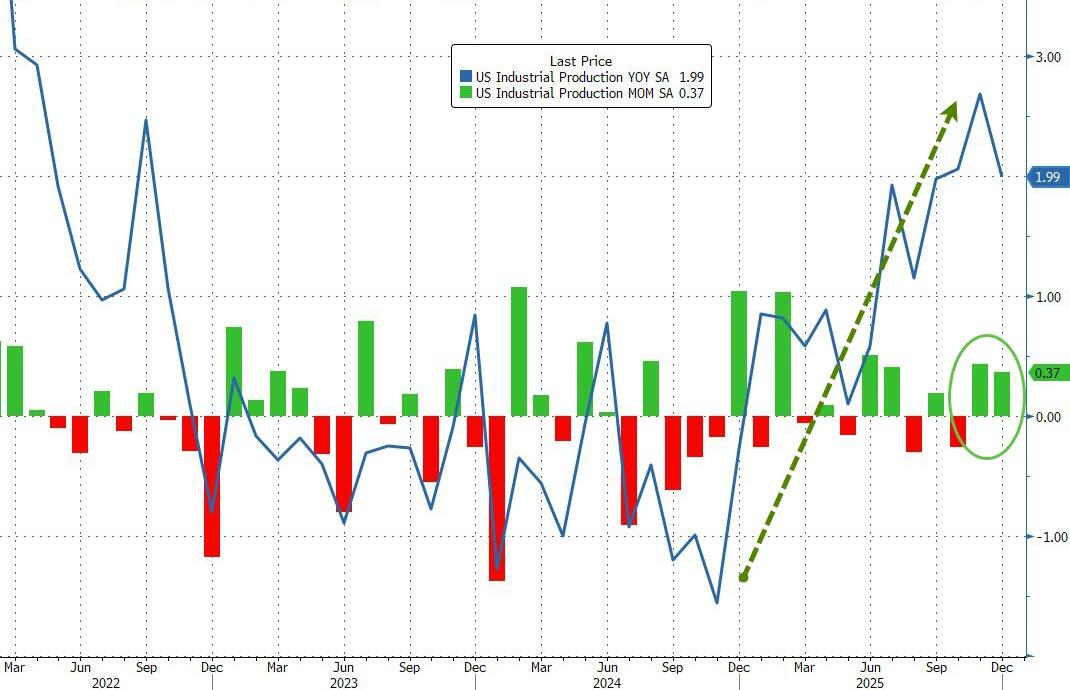
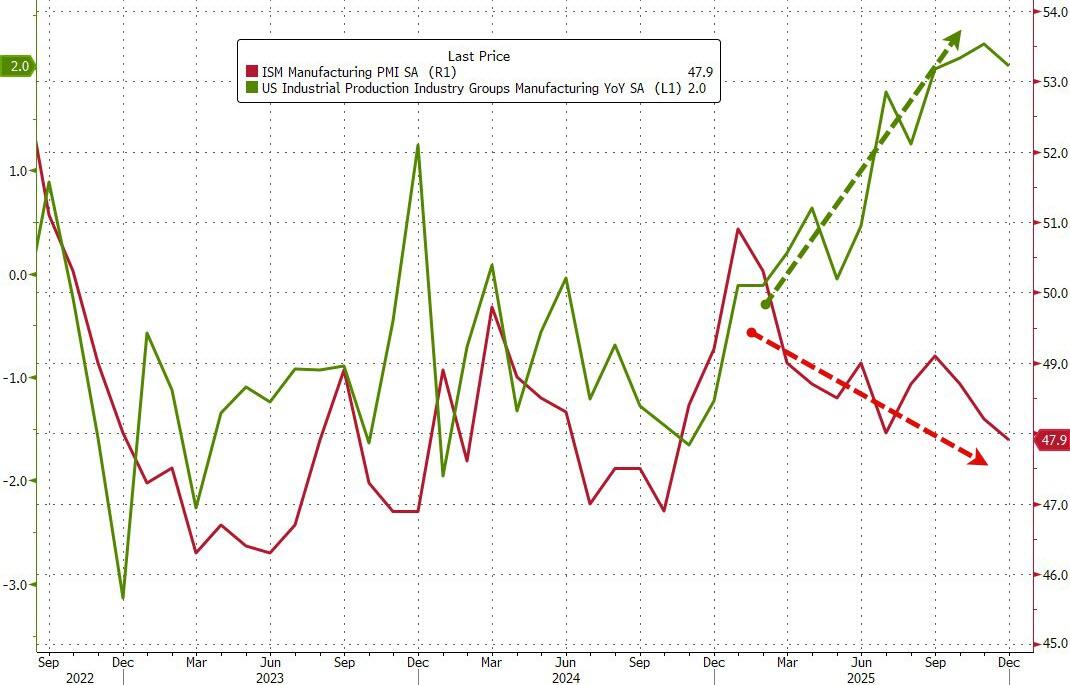
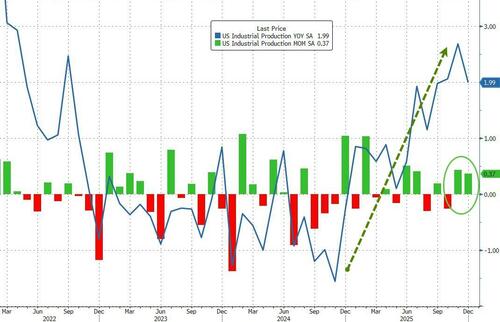
While ‘soft’ survey data has been disappointing, hard macro data has been resilient and Industrial Production ended 2025 on a bright note with a 0.4% MoM surge in December (considerably better than the +0.1% MoM expected) complementing November’s 0.4% MoM rise. This left industrial production up 2% YoY…
Source: Bloomberg
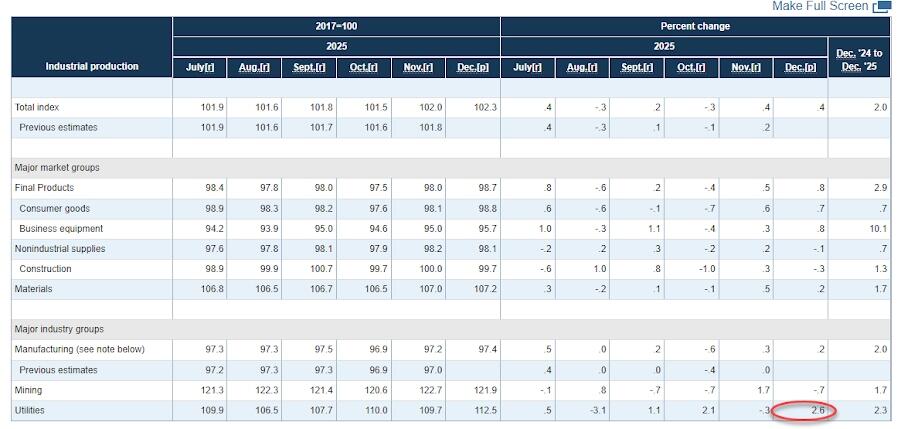
The index for utilities increased 2.6 percent in December, supported by a rise of 12.0 percent in the index for natural gas…
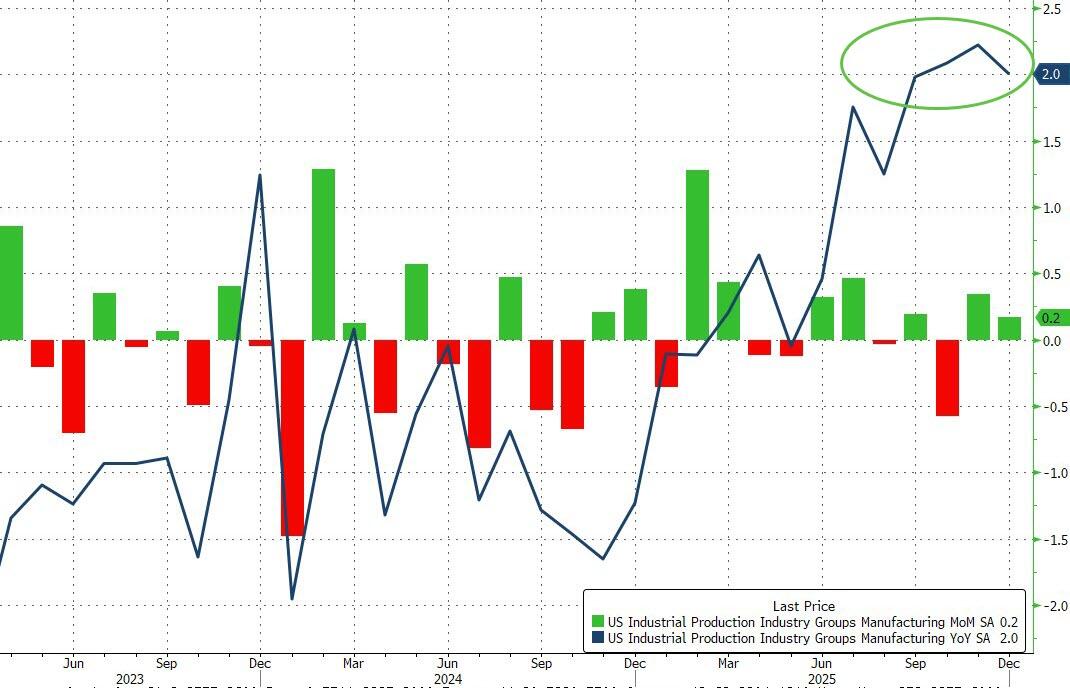
US Manufacturing output also rose more than expected, +0.2% MoM vs -0.1% MoM exp.
Source: Bloomberg
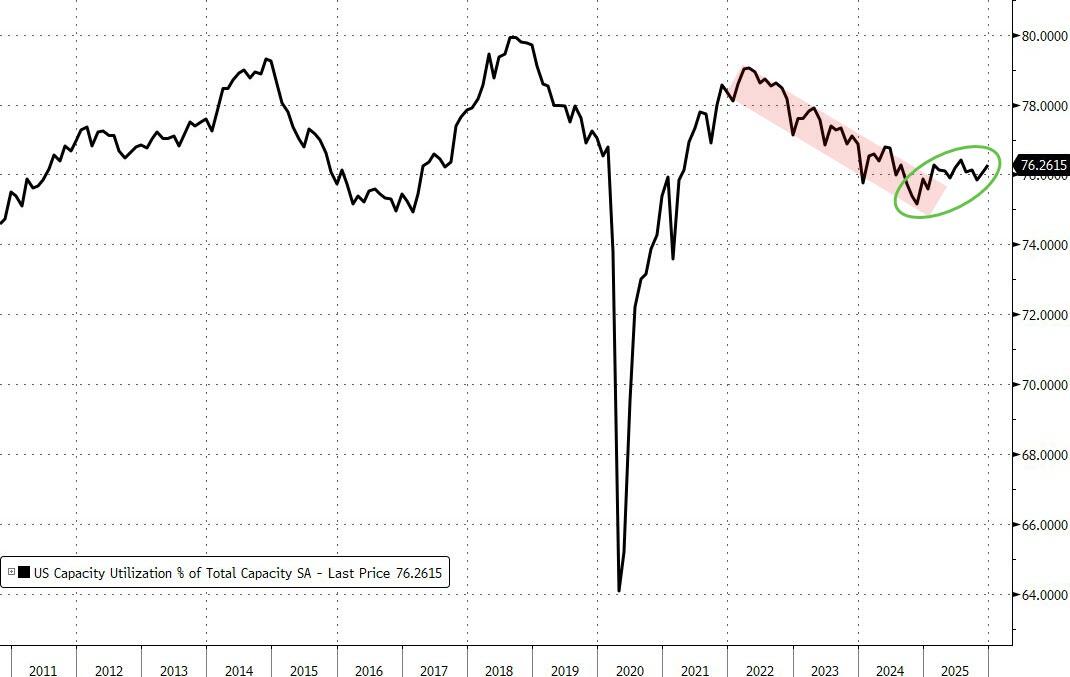
Capacity Utilization also rebounded in December, seemingly breaking the downtrend…
Source: Bloomberg
This ‘positive’ macro news seems at odds to the soft survey data that suggests the end of the world.
Finally, rate-cut expectations are lower still following this ‘good’ news.
Tyler Durden
Fri, 01/16/2026 – 09:23
https://www.zerohedge.com/markets/us-industrial-production-surged-end-2025

Beijing First? Canada’s PM Carney Opens The Doors To Chinese EVs
Beijing First? Canada’s PM Carney Opens The Doors To Chinese EVs
The invasion of Chinese electric vehicles into North America is set to accelerate after Canadian Prime Minister Mark Carney agreed to roll back the triple-digit tariffs previously imposed on Chinese EVs. The move sharply diverges from President Trump’s America First policy, which aims to revitalize the North American auto industry. While Chinese EVs remain effectively blocked from US import, there has been a noticeable increase in BYD Motor vehicles on highways in Mexico.
Canadian Prime Minister Mark Carney, who appears to have deep ties with Beijing, was the first prime minister to visit China since 2017 and is seeking a major thaw in relations after years of tense diplomatic and trade ties.
Carney’s move abandons the 100% tariffs on Chinese EVs imposed by former Prime Minister Justin Trudeau in 2024, replacing them with a 6.1% rate capped at 49,000 Chinese EVs. In 2023, China exported 41,678 EVs to Canada. The shift in trade policy will certainly capture the Trump administration’s attention.
“In order for Canada to build our own competitive EV sector, we need to learn from innovative partners, access their supply chains and increase local demand,” Carney told reporters after talks with President Xi Jinping.
Carney may have given the wrong answer. Logically, if Canada wanted to build out an EV sector, it would turn to American expertise, such as Tesla, Rivian, Lucid, or even legacy Detroit automakers. Instead, that does not appear to be the case, raising questions about where Carney’s allegiance truly lies, whether with the East or the West.
A recent report via The Bureau’s Sam Cooper only suggests Carney’s allegiance points towards Beijing…
Brookfield’s Deep Ties To Chinese Land, Loans & Green Deals
And there it is.
His face really says it all!
Watch as Scott Moe reacts to Mark Carney’s New World Order remark. pic.twitter.com/DyKZB62Rnh
— Rebel News (@RebelNewsOnline) January 15, 2026
He added that recent trade friction forced Beijing to slap 100% duties on Canadian canola oil – also known as rapeseed oil – as well as other ag products, with 25% on pork and seafood.
“China used to be the largest market for Canadian canola seed,” Carney said. “We want to not just return to those levels, but to surpass them.”
It appears Carney has not learned the lesson from Europe, where flooding the market with Chinese EVs helped decimate automakers across the continent.
Tyler Durden
Fri, 01/16/2026 – 09:05
https://www.zerohedge.com/markets/beijing-first-canadian-pm-carney-opens-canada-chinese-evs

Más de 100 muertos por lluvias torrenciales e inundaciones en el sur de África
Por MICHELLE GUMEDE y GERALD IMIRAY
JOHANNESBURGO (AP) — Las lluvias torrenciales y las inundaciones han causado la muerte de más de 100 personas en Sudáfrica, Mozambique y Zimbabue, y las autoridades advirtieron el viernes que se esperaba un clima más severo en varios países del sur de África.
Sudáfrica ha reportado al menos 19 muertes en dos de sus provincias del norte tras las intensas lluvias que comenzaron el mes pasado y provocaron graves inundaciones.
Turistas y miembros del personal fueron evacuados esta semana en helicóptero desde campamentos inundados hacia otras áreas en el renombrado Parque Nacional Kruger, que está cerrado a los visitantes al tiempo que partes de él son inaccesibles debido a carreteras y puentes destruidos, informó la agencia de parques nacionales de Sudáfrica.
En la vecina Mozambique, el Instituto de Gestión de Desastres y Reducción de Riesgos señaló que 103 personas habían muerto en una temporada de lluvias inusualmente severa desde finales del año pasado. Esas muertes fueron por diversas causas, incluyendo electrocución por rayos, ahogamiento en inundaciones, colapso de infraestructuras causado por el clima severo y cólera, detalló el instituto.
Las peores inundaciones en Mozambique han sido en las regiones central y sur, donde más de 200.000 personas se han visto afectadas, miles de hogares han sido dañados, y decenas de miles de habitantes enfrentan evacuaciones, indicó el Programa Mundial de Alimentos (PMA).
La agencia de gestión de desastres de Zimbabue informó que 70 personas han muerto y más de 1.000 hogares han sido destruidos en las fuertes lluvias desde el comienzo del año, e infraestructuras, incluidas escuelas, carreteras y puentes, colapsaron.
Las inundaciones también han afectado a la nación insular de Madagascar frente a la costa de África, así como a Malawi y Zambia. Las autoridades en Madagascar aseveraron que 11 personas han muerto en inundaciones desde finales de noviembre.
El Sistema de Alerta Temprana de Hambruna de Estados Unidos resaltó que se reportaron o se esperaban inundaciones en al menos siete naciones del sur de África, posiblemente debido a la presencia del fenómeno meteorológico La Niña que puede generar fuertes lluvias en partes del sureste de África.
El presidente sudafricano Cyril Ramaphosa visitó el jueves las áreas afectadas por las inundaciones en la provincia norteña de Limpopo y dijo que esa región había recibido alrededor de 400 milímetros (más de 15 pulgadas) de lluvia en menos de una semana. Añadió que en un distrito que visitó “hay 36 casas que simplemente han sido borradas de la faz de la Tierra. Todo se ha ido… los techos, los muros, las cercas, todo”.
Las inundaciones ocurrieron en las provincias de Limpopo y Mpumalanga en el norte, y el Servicio Meteorológico de Sudáfrica emitió una alerta de nivel rojo 10 para partes del país para el viernes, advirtiendo de más lluvias intensas e inundaciones que representan una amenaza para las vidas y podrían causar daños generalizados a la infraestructura.
El enorme parque de vida silvestre Kruger, que cubre unos 22.000 kilómetros cuadrados (7.722 millas cuadradas) a través de las provincias de Limpopo y Mpumalanga, ha sido impactado por graves inundaciones y alrededor de 600 turistas y miembros del personal han sido evacuados de los campamentos a áreas elevadas en el parque, dijo el portavoz del Parque Nacional Kruger, Reynold Thakhuli.
De momento no se pudo indicar cuántas personas había en el parque, que ha sido cerrado a los visitantes luego que varios ríos desbordaran sus cauces e inundaran campamentos, restaurantes y otras áreas. La agencia de parques señaló que se estaban tomando precauciones y no se habían reportado muertes ni lesiones en Kruger.
El ejército sudafricano envió helicópteros para rescatar a otras personas atrapadas en los techos de sus casas o en árboles en las partes del norte del país, agregó. Un helicóptero del ejército también rescató a agentes de aduanas y policías varados en un puesto de control inundado en la frontera entre Sudáfrica y Zimbabue.
El sur de África ha vivido una serie de eventos climáticos extremos en los últimos años, incluidos ciclones devastadores y una sequía abrasadora que causó una crisis alimentaria en partes de una región que a menudo sufre escasez de alimentos.
El Programa Mundial de Alimentos informó que más de 70.000 hectáreas (alrededor de 173.000 acres) de cultivos en Mozambique, incluidos alimentos básicos como arroz y maíz, han quedado anegadas en las inundaciones actuales, empeorando la inseguridad alimentaria para miles de pequeños agricultores que dependen de sus cosechas para alimentarse.
___
Imray reportó desde Ciudad del Cabo, Sudáfrica. Los periodistas de The Associated Press Charles Mangwiro en Maputo, Mozambique, y Farai Mutsaka en Harare, Zimbabue, contribuyeron a este despacho.
___
Esta historia fue traducida del inglés por un editor de AP con la ayuda de una herramienta de inteligencia artificial generativa.

Desempeño de Trump en la economía decepciona a muchos republicanos: encuesta AP-NORC
Por STEVE PEOPLES, MIKE CATALINI, JESSE BEDAYN y AMELIA THOMSON-DEVEAUX
NUEVA YORK (AP) — Casi un año después de iniciar su segundo mandato, el trabajo del presidente Donald Trump con respecto a la economía no ha cumplido con las expectativas de muchos simpatizantes de su propio partido, según una nueva encuesta de AP-NORC.
En la encuesta de The Associated Press-NORC Center for Public Affairs Research se encontró una diferencia significativa entre el liderazgo económico que los estadounidenses recordaban del primer mandato de Trump y lo que han obtenido hasta ahora, mientras el mandatario crea un nivel sorprendente de agitación en el país y en el extranjero.
Apenas el 16% de los republicanos dice que Trump ha ayudado “mucho” a abordar el costo de vida, una disminución con respecto al 49% en abril de 2024, cuando en una encuesta de AP-NORC se hizo la misma pregunta a los estadounidenses sobre su primer mandato.
Al mismo tiempo, los republicanos apoyan abrumadoramente el liderazgo del presidente en el tema de la inmigración, aun si a algunos no les gustan sus tácticas.
John Candela, de 64 años, que vive en New Rochelle, Nueva York, dijo que el costo de vida no ha mejorado para su familia: su salario y sus facturas siguen siendo los mismos que antes.
“Las Oreos siguen costando 5 dólares”, dijo. Pero está dispuesto a ser paciente: “Esperaría que fuera diferente para cuando terminen sus cuatro años”.
La encuesta revela signos de debilidad entre los consumidores con respecto a la economía, especialmente en la promesa central de campaña de Trump de reducir costos. La inflación se ha enfriado un poco, pero los precios de muchos productos son más altos de lo que eran cuando el republicano asumió el cargo en enero pasado.
Sin embargo, hay pocas señales en general de que la base republicana esté abandonando a Trump. La gran mayoría de los republicanos, alrededor de 8 de cada 10, aprueban su desempeño laboral, en comparación con 4 de cada 10 entre los adultos en general.
“No me gusta el hombre como ser humano. No me gusta su arrogancia. No me gusta su rudeza. No me gusta cómo escribe sus mensajes de texto en mayúsculas como si estuviera gritando a todos. Pero lo que apruebo es lo que está haciendo para tratar de encaminar al país”, dijo Candela.
Trump no mejora los costos, según la mayoría de los republicanos
En varios factores económicos, Trump aún no ha convencido a muchos de sus seguidores de que está cambiando las cosas para mejor.
Solo alrededor de 4 de cada 10 republicanos en general dicen que Trump ha ayudado a abordar el costo de vida al menos “un poco” en su segundo mandato, mientras que el 79% dijo que ayudó a abordar el problema en la misma medida en su primer mandato, según la encuesta de 2024. Poco más de la mitad de los republicanos dijeron en la nueva encuesta que Trump ha ayudado a crear empleos en su segundo mandato; el 85% dijo lo mismo sobre su primer mandato, incluyendo el 62% que dijo que ayudó “mucho”.
Solo el 26% de los republicanos en la encuesta de enero dice que ha ayudado “mucho” en la creación de empleos en su segundo mandato.
Y en cuanto a la atención médica, alrededor de un tercio de los republicanos dicen que Trump ha ayudado a abordar los costos al menos “un poco”, mientras que, en la encuesta de abril de 2024, el 53% dijo que ayudó a reducir los costos de atención médica en esa medida durante su primer mandato. Los subsidios federales de atención médica para más de 20 millones de estadounidenses expiraron el 1 de enero, lo que hizo que los costos de atención médica se duplicaran o incluso se triplicaran para muchas familias.
En la ciudad de Waxahachie, Texas, al sur de Dallas, Ryan James Hughes, un pastor infantil de 28 años que ha votado tres veces por Trump, no ve una mejora en la situación financiera de su familia. Dijo que las facturas médicas no han disminuido.
Sin embargo, afirmó, “no recurro al gobierno para asegurar mi futuro financiero”.
La inmigración es una fortaleza entre la base de Trump, a pesar de la controversia
La nueva encuesta subraya que los republicanos están satisfechos en gran medida en cuanto a la inmigración, aun cuando algunos mencionan preocupaciones sobre los agentes federales de inmigración que han inundado las ciudades de Estados Unidos bajo la dirección de Trump.
Alrededor de 8 de cada 10 republicanos dicen que Trump ha ayudado al menos “un poco” en inmigración y seguridad fronteriza en su segundo mandato. Esa proporción es similar a la de la encuesta de abril de 2024, en la que se vio un efecto positivo del liderazgo de Trump en inmigración y seguridad fronteriza durante su primer mandato.
La mayoría de los republicanos dicen que el republicano ha encontrado el equilibrio adecuado cuando se trata de deportar a inmigrantes que están en Estados Unidos ilegalmente, y alrededor de un tercio piensa que no ha ido lo suficientemente lejos.
Pero la aprobación de Trump en inmigración también disminuyó entre los republicanos en el último año, cayendo del 88% en marzo al 76% en la nueva encuesta.
Kevin Kellenbarger, de 69 años, un votante de Trump en tres ocasiones que se retiró de una empresa de impresión, dijo que su fe cristiana lo llevó al Partido Republicano. El residente de Lancaster, Ohio, piensa que la ofensiva del presidente contra la inmigración es necesaria, aunque expresó su insatisfacción por el reciente asesinato de Renee Good por un agente federal de inmigración en Minneapolis.
“No me gusta que maten a nadie, pero no fue culpa de Trump”, dijo Kellenbarger, agregando que el expresidente demócrata Joe Biden “dejó entrar a millones de personas. Tienen que ser expulsadas”.
Varios republicanos dijeron en entrevistas que, en su opinión, las agresivas tácticas vistas recientemente en Minneapolis fueron demasiado lejos, indicando que Trump debería centrarse más en los inmigrantes con antecedentes penales como prometió durante la campaña.
En general, solo el 38% de los adultos en Estados Unidos aprueban el liderazgo de Trump en inmigración, mientras que el 61% lo desaprueba.
“Estas familias están siendo separadas y solo están aquí para tratar de vivir el sueño americano”, dijo la republicana Liz Gonzalez, de 40 años, hija de inmigrantes mexicanos y ranchera y agricultora autónoma de Palestine, Texas.
Al mismo tiempo, Gonzalez dijo que no cree que las personas que se oponen a la ofensiva deban interferir en absoluto. “Creo que si solo dejaran que (el Servicio de Inmigración y Control de Aduanas), ya sabes, como los patrulleros, hicieran su trabajo, entonces verían que no tiene que ser un caos”, dijo.
Más republicanos ven que el país mejora más que sus vidas personales
Alrededor de dos tercios de los republicanos dicen que el país en su conjunto está “mucho” o “algo” mejor que antes de que Trump asumiera el cargo, pero solo alrededor de la mitad dice esto sobre ellos mismos y sus familias.
La amplia sensación de que el país avanza en la dirección correcta podría contrarrestar la insatisfacción republicana con el estado de la economía.
Phyllis Gilpin, una republicana de 62 años de Booneville, Missouri, elogió la capacidad de Trump para “realmente escuchar a la gente”. Pero no le encanta su personalidad.
“Es muy arrogante”, dijo, expresando frustración por sus insultos. Pero afirmó que la política divisiva va en ambos sentidos: “En realidad, honestamente, solo desearía que todos pudiéramos no ser demócratas o republicanos, simplemente unirnos”.
___
La encuesta de AP-NORC entre 1.203 adultos se realizó del 8 al 11 de enero utilizando una muestra extraída del Panel AmeriSpeak basado en probabilidad de NORC, diseñado para ser representativo de la población de Estados Unidos. El margen de error de muestreo para los adultos en general es de más o menos 3,9 puntos porcentuales. La encuesta incluyó entrevistas con 404 republicanos, y el margen de error de muestreo para los republicanos en general es de más o menos 6 puntos porcentuales.
___
Esta historia fue traducida del inglés por un editor de AP con la ayuda de una herramienta de inteligencia artificial generativa.

Trump Says ‘Venezuela Leaker’ Jailed As Polymarket Accounts Go Quiet
Trump Says ‘Venezuela Leaker’ Jailed As Polymarket Accounts Go Quiet
Authored by Helen Partz via CoinTelegraph.com,
US President Donald Trump said the “leaker on Venezuela” has been jailed, a remark that has renewed scrutiny of prediction markets following a series of well-timed bets earlier this month.
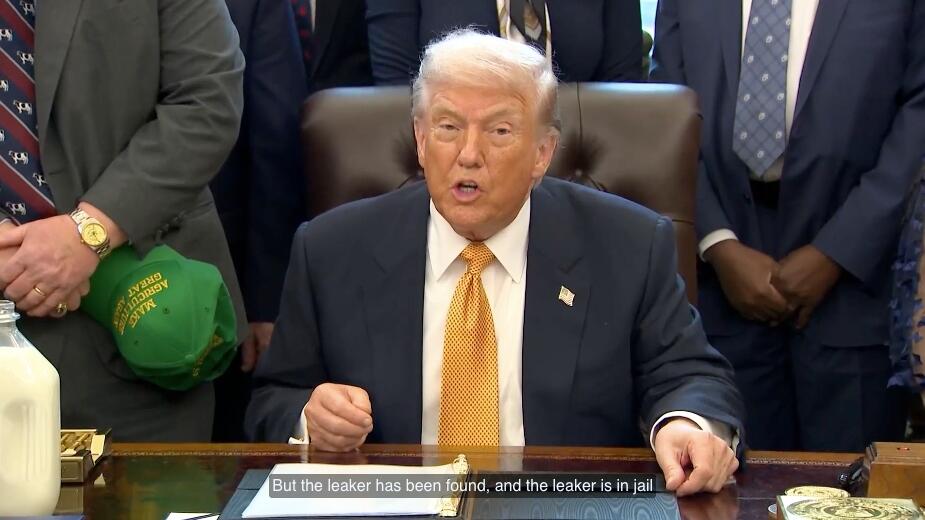
“The leaker on Venezuela has been found and is in jail right now,” Trump said in the Oval Office on Wednesday, according to a video posted by The Wall Street Journal.
Although Trump did not mention prediction markets, blockchain analysts such as Lookonchain have speculated that the leaker may be linked to a cluster of Polymarket accounts that placed concentrated bets on Venezuela outcomes just hours before the news became public.
“We noticed that two of the three wallets that previously profited from betting on Venezuelan President Maduro being out of office have been inactive for 11 days,” Lookonchain wrote in an X post on Thursday.
Some accounts are still active with bets on Iran
Addressing the inactive wallets, Lookonchain highlighted the 0xa72DB1 Polymarket account, which turned a $5,800 stake into $75,000 by betting on Maduro being out of office by Jan. 31, 2026.
Lookonchain also noted the 0x31a56e account, which placed a series of bets on Venezuelan events before disappearing from Polymarket around Jan. 8.
Source: WSJ
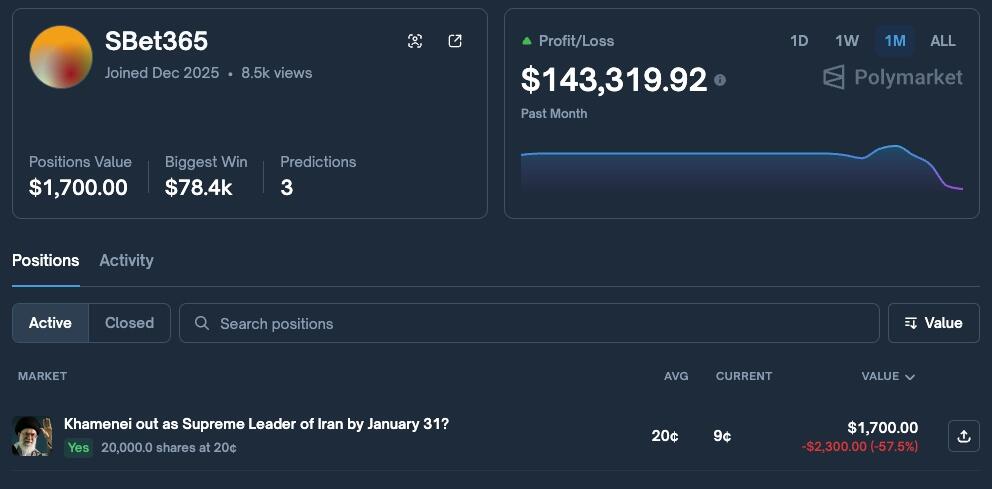
The remaining wallet, SBet365, placed another bet two days ago, predicting that Iran’s Supreme Leader Ayatollah Ali Khamenei would be ousted by Jan. 31, Lookonchain noted.
SBet365 was also among accounts that gained significant profits from betting on Venezuela on Polymarket, making abour $140,000 from wagers tied to Maduro’s ouster.
“There could be some others [leakers], and we will let you know about that,” Trump said, referring to the jailed Venezuelan leaker.
Source: Polymarket
The events come amid ongoing scrutiny of prediction markets, with US lawmakers pushing a bill to combat insider trading on political wagers.
Sean Patrick Maloney, president and CEO at Coalition for Prediction Markets, a national industry alliance formed in late 2025, said coalition members already ban insider trading by enforcing strict Know Your Customer policies.
“It’s critical to draw a bright line between offshore, unregulated prediction platforms and federally regulated US ones,” Maloney told Cointelegraph, adding:
“Consistent with current law, offshore, unregistered platforms should not be able to operate in the US or serve US customers without the same safeguards and registrations, keeping this activity governed responsibly under US oversight.”
Tyler Durden
Fri, 01/16/2026 – 08:45
https://www.zerohedge.com/political/trump-says-venezuela-leaker-jailed-polymarket-accounts-go-quiet

Taiwán celebra su “mejor” acuerdo comercial con EEUU; China protesta
Por TAIJING WU y SIMINA MISTREANU
TAIPÉI, Taiwán (AP) — El primer ministro de Taiwán elogió el viernes un nuevo pacto comercial con Estados Unidos como el “mejor acuerdo arancelario” logrado por países con superávit comercial con Washington, al tiempo que un funcionario chino en Beijing condenó el acuerdo.
El pacto reduce los aranceles estadounidenses sobre los productos taiwaneses al 15% a cambio de 250.000 millones de dólares en nuevas inversiones en la industria tecnológica de Estados Unidos. Es comparable a los acuerdos con la Unión Europea y Japón que se negociaron después que el presidente Donald Trump propusiera aranceles generales para muchos socios comerciales de Estados Unidos.
“Por el momento, obtuvimos el mejor acuerdo arancelario logrado por los países con superávit comercial con Estados Unidos”, afirmó el primer ministro de Taiwán, Cho Jung-tai. “Esto también muestra que Estados Unidos ve a Taiwán como un socio estratégico importante”.
“Nuestro objetivo es reducir los aranceles mutuos”, expresó Cho. “Por lo tanto, según los resultados de las negociaciones, Taiwán ha logrado obtener un 15% en aranceles sin tarifas adicionales. Este es el mismo arancel impuesto a Japón, Corea y la Unión Europea”.
Inicialmente, Trump había fijado el arancel en un 32% para los productos taiwaneses, pero luego lo cambió al 20%.
China reclama a Taiwán, que se gobierna de manera independiente, como su territorio, y en Beijing, un portavoz del Ministerio de Relaciones Exteriores criticó el acuerdo cuando se le preguntó en una rueda de prensa rutinaria.
“China siempre se opone firmemente a que los países que tienen relaciones diplomáticas con China y la región de Taiwán de China firmen cualquier acuerdo que tenga connotaciones soberanas y un carácter oficial con la región de Taiwán de China”, manifestó Guo Jiakun.
El Departamento de Comercio de Estados Unidos resaltó que el acuerdo con Taiwán establecerá una asociación económica para crear varios parques industriales de clase mundial con sede en Estados Unidos para ayudar a aumentar la manufactura doméstica.
Es “un acuerdo comercial histórico que impulsará una gran relocalización del sector de semiconductores de Estados Unidos”, afirmó el Departamento en un comunicado.
Cho agregó que Taiwán había asegurado aranceles del 15% sin tarifas adicionales para las industrias automotriz y de muebles de madera, y sin aranceles para algunos componentes utilizados en la industria aeroespacial.
El acuerdo debe ser ratificado por el Parlamento de Taiwán, donde los legisladores de la oposición han expresado preocupación por el posible impacto en la industria interna de semiconductores de la isla.
Coincidió con un anuncio de TSMC, con sede en Taiwán, el mayor fabricante de chips de computadora del mundo, de que planea aumentar su gasto de capital en casi un 40% este año. Informó un aumento del 35% en su beneficio neto para el último trimestre gracias al auge de la inteligencia artificial.
TSMC ha prometido alrededor de 165.000 millones de dólares en inversiones en Estados Unidos y señaló que está acelerando la construcción de nuevas plantas en Arizona, buscando crear un grupo de fábricas y satisfacer la fuerte demanda de los clientes.
El Departamento de Comercio sostuvo que los productores de semiconductores taiwaneses que inviertan en Estados Unidos también recibirán un trato arancelario favorable, incluidas exenciones.
Ryan Majerus, un funcionario comercial en el primer gobierno de Trump y en el gobierno del expresidente Joe Biden, comentó que el “momento del acuerdo es interesante”.
La Corte Suprema aún no ha dictaminado sobre la legalidad de los aranceles más amplios de Trump, que ha utilizado para presionar concesiones de otros socios comerciales de Estados Unidos. Los jueces podrían anular los aranceles tan pronto como este mes.
Pero Taiwán, enfrentando amenazas continuas de China, estaba ansioso por llegar a un acuerdo y fortalecer las relaciones con Estados Unidos de todos modos.
“Querer solidificar las cosas con Estados Unidos probablemente jugó un papel importante aquí”, añadió Majerus, ahora socio en el bufete de abogados King & Spalding.
___
El productor de The Associated Press Liu Zheng contribuyó a este despacho desde Beijing, y el periodista de la AP Paul Wiseman desde Washington. ___
Esta historia fue traducida del inglés por un editor de AP con la ayuda de una herramienta de inteligencia artificial generativa.
Stocks Rise As Tech Meltup Accelerates
Stocks Rise As Tech Meltup Accelerates
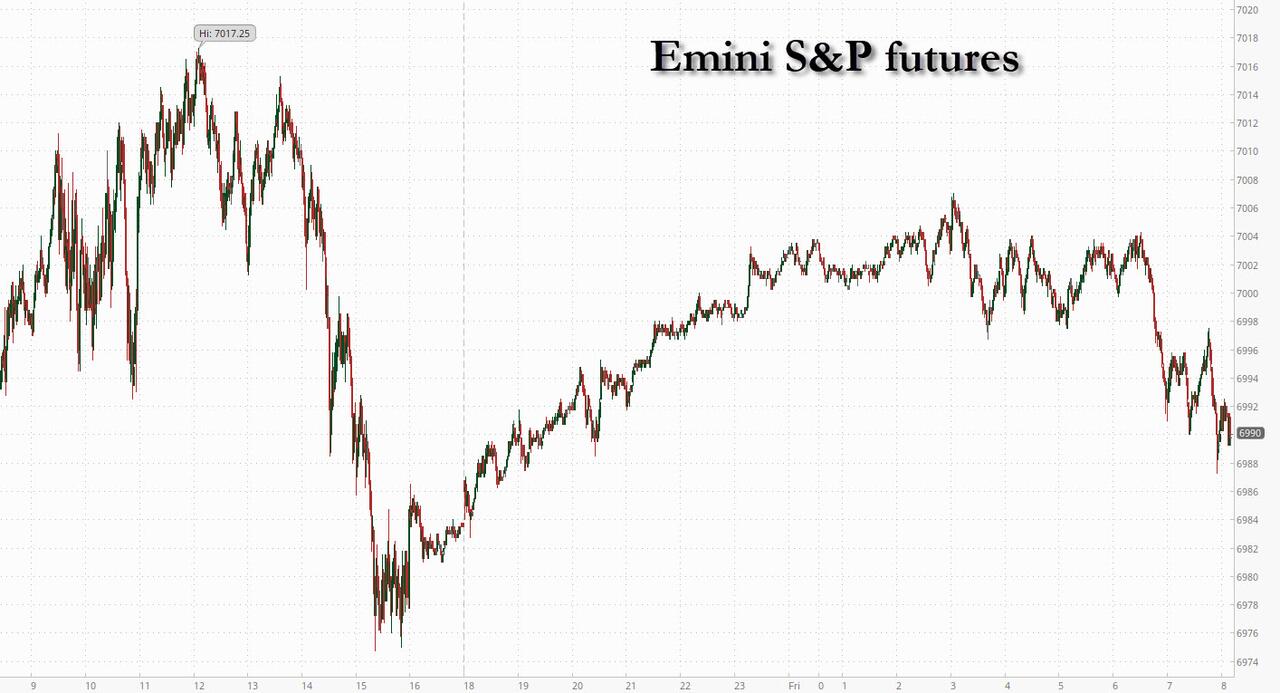
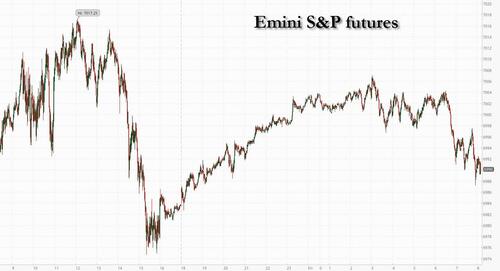
Futures are higher, and trading near record territory, led by tech as this year’s great rotation shows no sign of slowing, broadening the base of names driving Wall Street’s push back towards all time highs. As of 8:00am, S&P 500 futures were 0.3% higher with Nasdaq 100 contracts up 0.4% as the latest wave of enthusiasm for technology stocks carried into Friday. Overnight headlines were mostly muted. Pre-market, Mag 7 are mostly higher led by NVDA +1.1%; AI names (AMD +3.2%, AVGO +1.3%, MU +2%) continued their rally yesterday. Bond yields are unchanged. Commodities are mixed: oil added 1.2%, while silver fell -2.0%; ags are mostly higher. US session features industrial production data and three scheduled Fed speakers.
In premarket trading, Mag 7 stocks are mostly higher (Nvidia +0.8%, Tesla +0.6%, Meta +0.09%, Alphabet +0.5%, Microsoft +0.06%, Amazon +0.3%, Apple -0.2%
JB Hunt Transport Services Inc. (JBHT) falls 4% after the trucking firm reported quarterly revenue that missed estimates, underscoring continued weakness in freight demand.
Kraft Heinz (KHC) is down 1.1% after Morgan Stanley downgraded the maker of Jell-O and Oscar Mayer hot dogs to underweight.
Mosaic (MOS) falls 6% after the producer of phosphate and potash crop nutrients said North American fertilizer demand declined well beyond normal seasonal softness in the fourth quarter.
PNC Financial Services Group Inc. (PNC) rises 3% after reporting a 9% increase in fourth-quarter revenue, beating analysts’ estimates as financing and dealmaking by middle-market customers accelerated.
Regions Financial (RF) falls 4% after the regional bank reported EPS and total loans for the fourth quarter that came in below the average analyst estimate. The bank also said it sees net interest income declining in the first quarter of 2026.
In corporate news, Trump continues to try to ease the squeeze on Main Street that’s hurting his popularity among voters. A plan is set to be announced on Friday to compel tech firms to effectively fund new plants to power the data centers essential to win the global AI race, without hiking utility bills for homes and businesses. A potential deal that would see China’s BYD supply Ford’s overseas factories with batteries for hybrid vehicles drew immediate political blowback from White House trade adviser Peter Navarro, who questioned its wisdom. OpenAI and Microsoft face a trial over Elon Musk’s claims that Sam Altman’s startup betrayed its founding mission as a public charity when it took billions in funding from the software giant and made plans to operate as a for-profit business.
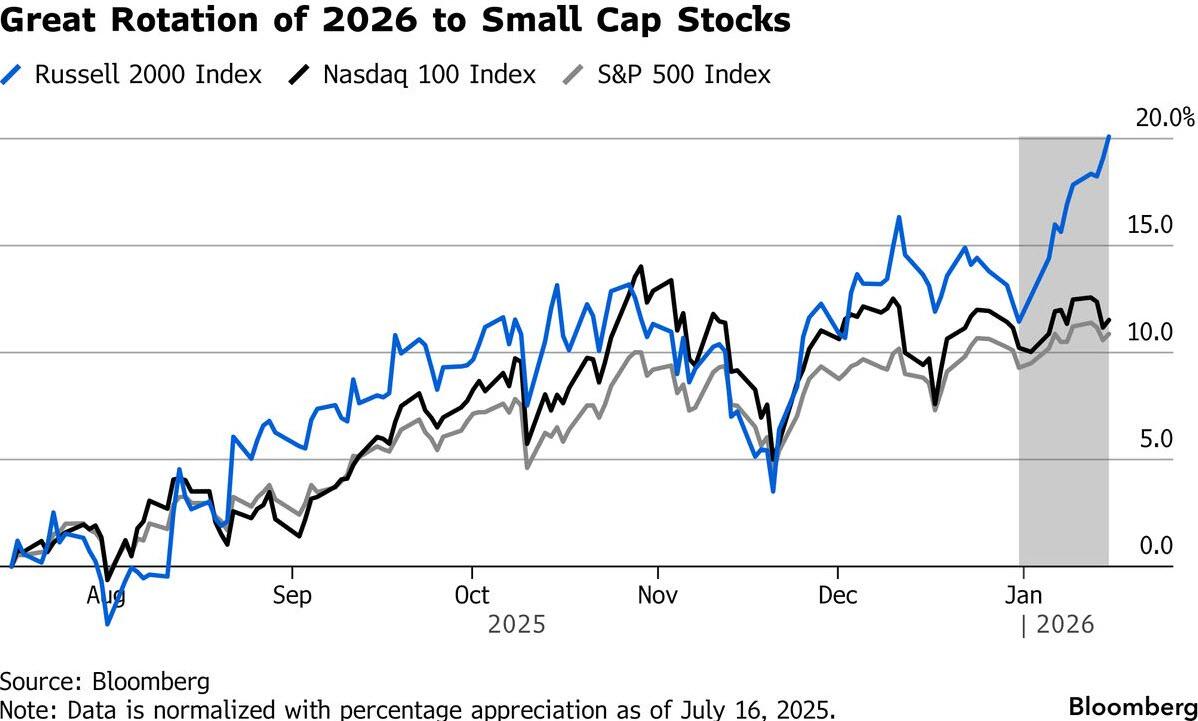
Yet even after TSMC’s huge beat and capex forecast fueled optimism on Thursday that the AI boom has plenty of room to run, the Russell 2000 continued to outperform the S&P 500. It outpaced its bigger counterpart for a 10th straight session, leaving small caps’ relative performance more than 600 basis points better so far this year.
Despite the bounce, the Nasdaq 100 closed Thursday still in the red for the week, as investors turned toward firms that are benefiting from improving economic growth prospects. The balance between tech leadership and broader market participation is likely to persist in the coming weeks.
“There is scope for some diversification away from concentrated positioning,” said Geoff Yu, senior macro strategist at BNY. “A rising tide can lift all boats as the US economy is still expanding and expectations for market returns remain favorable.”
The first full week of the latest earnings season is boding well for what’s to come, with 89% of the 28 companies that have reported so far beating expectations. With big banks dominating the early days, stock investors will get a clearer view of the broader economy next week when results from names such as Netflix Inc., Johnson & Johnson and 3M Co. are due.
“The results so far show, at least for the banks, that the consumer is okay, deal activity and capital markets are healthy, earnings revisions are still very positive,” said Andrea Gabellone, head of global equities at KBC Global Services. “In the meantime, you have some big tailwinds, like the weak dollar.”
Investors continue to deploy funds into equities and trim cash holdings. According to Bank of America, citing EPFR Global data, US stock funds saw $36.5 billion of inflows in the week ended Jan. 14.
Meanwhile, yield premiums on corporate debt have narrowed to the least since 2007, a Bloomberg index of bonds across currencies and ratings shows, prompting some of the world’s biggest money managers to warn against complacency. The extra yield investors demand to hold junk notes has also dropped to the lowest in nearly two decades. Companies issued roughly $435 billion of bonds in the first half of January, a record for the period, and more than a third above last year’s tally at this point, according to data compiled by Bloomberg.
Five presidents of regional Fed banks, who in recent months found themselves on opposite sides of the policy debate, indicated on Thursday that the central bank is now well-positioned to sit tight and wait for further data before cutting rates again. No change is expected at the Fed’s Jan. 27-28 meeting, after cuts at each of its last three.
European stocks dip but remain on track for their fifth straight weekly advance, the longest streak of gains since May, as investors remain confident about earnings and artificial intelligence demand. The Stoxx 600 falls 0.1% as health care stocks outperform while miners lag, as news of a Chinese clampdown on high-frequency trading sinks metals. Here are some of the biggest movers on Friday:
Kloeckner & Co shares surge as much as 30%, to the highest level since June 2022, after Worthington Steel agreed to buy the metals processor for €11 per share in cash.
Polar Capital shares rise as much as 8% to their highest level since April 2022, following the asset manager’s quarterly update and announcement of a share buyback program.
Novo Nordisk shares advance as much as 6.7%, snapping two days of declines, as analysts at Berenberg and Bank of America lift their price targets on the stock, while Deutsche Bank calls the Danish drugmaker one of its top picks.
Elekta shares gain as much as 9.1% after its Evo Linear Accelerator imaging system gained clearance from the US FDA.
HBX shares rise as much as 8.6%, the most since May, after the Spanish travel technology firm announced a share buy-back program and plans to pay regular dividends.
Genus shares surge as much as 15%, the most in more than four months, after the animal genetics firm said it now expects FY26 adjusted pretax profit to come in “moderately” above the top end of current views.
Sunrise Communications shares slide as much as 4.7% after an offering of 4 million shares by holder Baupost Group priced at a 3.38% discount to Thursday’s close.
Richemont shares fall as much as 3.8% as BofA downgrades to neutral from buy, in a second day of declines for the stock following the luxury goods group’s sales report.
Boliden shares slip as much as 3.7%, leading miners lower as news of a Chinese clampdown on high-frequency trading cooled sentiment.
Earlier in the session, Asian stocks rose, with Taiwan’s key index jumping to a record, as results from TSMC helped confirm an upbeat outlook for artificial intelligence demand. The MSCI Asia Pacific Index advanced 0.4%, with TSMC the biggest contributor along with other tech firms including Samsung Electronics and Delta Electronics. Taiwan’s Taiex climbed nearly 2% and Korea’s Kospi gained 0.9% to a new high, while Japanese stocks slipped following a recent rally. The regional benchmark has gained about 2.8% this week, which would be its best since September 2025. While TSMC helped reinforce the AI rally, an agreement for the US to lower tariffs on Taiwan provided additional relief amid ongoing geopolitical concerns on multiple fronts. Chinese stocks fell amid fresh signs that authorities are attempting to cool the market rally, with record outflows seen in some of the exchange‑traded funds heavily owned by the so‑called national team. Next week’s highlights include monetary policy decisions in Japan, Malaysia and Indonesia. The World Economic Forum in Davos is among the key events that will be watched by global investors.
In FX,the yen strengthened, trimming its third weekly decline, as Japan’s Finance Minister Satsuki Katayama reiterated her warning that all options including direct currency intervention are available for dealing with the recent weakness. The US dollar slipped against most major currencies with Treasury yields trading in a tight range. The kiwi is leading gains against the greenback, rising 0.4% while the Japanese yen and Norwegian krone are not far behind.
While equities are moving, yields are snoozing. The 10-year Treasury yield is headed for a fifth straight week of minimal change, rivaling its longest stretch of inertia in the past two decades. The bond market is waiting for a clearer steer on the economy and the outcome of the Trump administration’s pressure on Fed chair Jerome Powell to cut interest rates further. On Friday, treasuries edged lower in early US session after plying small ranges since Asia open with European bonds underperforming. Yields are less than 2bp cheaper on the day with curve spreads little changed; 10-year around 4.19% is 2bps higher, outperforming bunds and gilts slightly.The weekly IG volume stands in line with $60b projection after Thursday’s six-name $35b slate headed by Goldman Sachs’ $16b landmark transaction; issuers paid about 1bp in new issue concessions on deals that were 3.5 times covered.
In commodities, oil rebounded after its biggest drop since June, while gold and silver declined. WTI crude futures rise 1.3% to near $60 a barrel. Spot silver falls 4%.
US economic calendar includes January NY Fed services business activity (8:30am), December industrial production (9:15am) and January NAHB housing market index (10am). Scheduled Fed speakers include Collins (10:50am), Bowman (11am) and Jefferson (3:30pm)
Market Snapshot
S&P 500 mini +0.3%
Nasdaq 100 mini +0.5%
Russell 2000 mini +0.4%
Stoxx Europe 600 little changed
DAX -0.1%
CAC 40 -0.4%
10-year Treasury yield little changed at 4.17%
VIX -0.3 points at 15.54
Bloomberg Dollar Index little changed at 1210.82
euro little changed at $1.1613
WTI crude +1.1% at $59.82/barrel
Top Overnight News
A plan to address power costs from data centers is set to be announced today. Donald Trump will direct the top US grid operator to hold an emergency power auction, forcing tech giants to fund new power plants, according to a White House official. BBG
President Trump was advised that a large-scale strike against Iran was unlikely to make the government fall and could spark a wider conflict, U.S. officials said, and for now will monitor how Tehran handles protesters before deciding on the scope of a potential attack. Still, Trump is expected to order the Pentagon to send an aircraft carrier, the USS Abraham Lincoln, from the South China Sea to the Middle East. WSJ
Bipartisan talks in the Senate about a healthcare deal to extend ACA subsidies are stalling, making an agreement less likely. Politico
US senators are set to meet members of the Danish parliament in Copenhagen today as Denmark and Greenland step up lobbying in an effort to head off Trump’s push to take control of Greenland. BBG
Canada and China reached a wide-ranging agreement to lower trade barriers including a reduction in tariffs for Canadian canola and Chinese EVs. Mark Carney hailed his strategic partnership with Xi Jinping, referencing a “new world order.” BBG
Chinese companies have started discussions about renting computing power at data centers in Southeast Asia and the Middle East to get access to Rubin chips, according to people involved in the talks. That follows companies’ efforts last year to access chips in Nvidia’s Blackwell series. WSJ
Some Bank of Japan policymakers see scope to raise interest rates sooner than markets expect with April a distinct possibility, as a sliding yen risks adding to already broadening inflationary pressure. RTRS
The criminal investigation into Federal Reserve Chair Jerome Powell threatens to upend the contest over whom President Trump will choose to succeed him as it enters its final stretch. Trump has made clear he prizes loyalty in his pick, but the Justice Department probe—which Powell said was part of a pressure campaign to get the Fed to lower interest rates—threatens to make that quality a liability. WSJ
Japanese Finance Minister Katayama said FX intervention is a potential option under the US-Japan agreement and expresses readiness to take decisive action while keeping all options on the table: BBG
Trade/ Tariffs
Canadian PM Carney said the relationship with China is more predictable than the one Canada has with the US.
Canadian PM Carney announces that they will allow as many as 49k Chinese EVs into the Canadian market, with a most-favoured-nation tariff of 6.1%. In return, Canada anticipates that by March 1st China will reduce tariffs on Canola seed to a c. 15% combined rate. In addition to a resolution to other trade obstacles.
A White House Official said the chip announcement on Wednesday was ‘phase one’ action and there could be other announcements, pending ongoing negotiations with other countries and companies.
Central Banks
BoJ: abolish the “Amount of Cash Collateral for Lending of ETFs” today, given that the new lending of ETFs has been ceased and the outstanding balance of ETF lending has reached zero.
BoJ is seen as likely to raise its FY26 economic and inflation forecasts, Reuters reported citing sources; the report adds that some BoJ policymakers see scope to raise interest rates as soon as April due to the inflationary effect of a weaker JPY.
ECB’s Lane said that there is no immediate debate on interest rates if current conditions persist and that that current rates set to establish baseline for years ahead.
NBP Governor Kotecki, in a Bloomberg interview, said it is becoming increasingly clear that there is room for further rapid interest rate cuts. Assumes that in February, the MPC will resume its activities from last year. The inflation outlook is increasingly optimistic.
A more detailed look at global markets courtesy of Newqsuawk
Top Asian News
European equities (STOXX 600 -0.1%) are trading mostly softer, contrary to APAC which traded mostly in the green. Not much on a macro newsflow to explain broader weakened sentiment seen in European. European sectors are trading mostly in the red. At the bottom of the pile are Basic Resources (1.5%), Automobiles & Parts (-1.4%) and Consumer Product & Services (-1.3%). Sentiment around the Basic Resources sector has been pinned down by lower metal prices with copper especially pressured by China’s crack down on high-frequency trading. On the upside, Utilities (+0.3%), Health Care (+0.3%) and Energy (+0.2%) are the slight outperformers.
Top European News
The ONS has drawn up contingency plans to delay the launch of its new labour market survey by 6 months, Bloomberg reported citing people familiar with the matter. Another scenario under consideration is to launch the survey in May 2027. ONS plans to decide in the summer whether to stick to the November roll-out date.
FX
DXY is flat/incrementally lower this morning and currently within a narrow 99.26-99.40 range, which is towards the upper end of Thursday’s bands. Overnight, a White House Official suggested that the latest chip announcement was “phase one” and more could be put out following negotiations. That aside, not really much US specific newsflow, but focus will turn to a few Fed speakers and Industrial Production later.
G10s are mixed, with the Kiwi and JPY topping the pile whilst the Loonie is mildly pressured. The JPY was boosted overnight after a Reuters report suggested that the BoJ could hike as soon as April, with some members fearing a weak currency could lead to a resurgence in inflation. In the midst of all this, Finance Minister Katayama has continued to provide some jawboning, which also helped the JPY. USD/JPY currently trades at the lower end of a 157.97-158.70 range vs Monday’s open of 158.07.
Politics remains the main theme for Japan, as attention now turns to the 22nd of January, when PM Takaichi is expected to dissolve the Diet. UBS believes that the LDP will be able to secure a half majority, improving the party’s position. Interestingly, Nippon TV ran the numbers following the CDP-Komeito tie-up and calculated that LDP “would retain only 60 of the 132 single‑member districts it won in 2024”. Though this is only a mathematical calculation, and does not account for Takaichi’s high approval rating of more than 70%.
Japanese Finance Minister said the statement between Japan and the US can be viewed as saying intervention to counter FX moves out of line with fundamentals is permitted. Not sure when JPY-carry trades peak out as Japan-US interest rate differentials are set to narrow further.
Fixed Income
A contained start for fixed income benchmarks, though the bias is increasingly bearish.
Newsflow has been light. USTs in a very thin sub-five tick range just above the 112-00 mark into an afternoon once again dictated by, on paper at least, data and Fed speak.
Bunds under increasing pressure into the morning, pressure that has emerged without a clear or overt fundamental driver. Down to a 128.26 base with downside of 17 ticks at most. No reaction to unrevised inflation from Germany and Italy, while the European docket ahead is light today before picking up next week with several key ECB speakers at the Davos WEF, including President Lagarde.
OATs lag in Europe, down by 20 ticks at worst to a 121.01 base. Action that has lifted the OAT-Bund 10yr yield spread above 68bps, though the above Bund pressure is stemming the downside. Slight underperformance that is likely a function of the French Government electing to suspend the National Assembly budget debate last night, meaning that the deliberations of the budget and likely conclusion of it will not occur today. As such, the pencilled-in date of a Monday vote on the revenue draft is off the table.
Gilts opened on the backfoot, with losses of six ticks and have since extended to a 92.27 low, -21 ticks at most. Pressure that is a function of catch-up to the bearish action that was seen in the latter part of Thursday’s US session, the morning’s bearish bias, and reports that the ONS might be delaying the new labour data by six months.
Commodities
Crude benchmarks are firmer this morning, and while they are set to end the week in the green with upside of c. USD 0.80/bbl for WTI and USD 1.0/bbl for Brent, they are towards the lower-end of the week’s c. USD 4.00/bbl parameters. Continuing with energy but away from crude, gas benchmarks remain alight and at highs. Drivers remain the same as discussed in recent sessions, including: Iran supply, European cold spell, Asian demand, and expectations for a cold spell in APAC next week. Dutch TTF briefly surmounted the EUR 35/MWh mark this morning
Spot gold is under modest pressure. Hovering around the USD 4.6k/oz handle despite a contained USD, but hit as the risk tone stateside is constructive and geopolitics, as discussed, hasn’t escalated. Further pressure is also potentially stemming from the firmer global yield environment.
Base peers were softer overnight, hit by China cracking down on high-frequency trading via the removal of servers from some data centres. Action that pushed 3M LME Copper below the USD 13k/t handle early doors and since to a USD 12.77k/t trough, lower by over USD 300/t on the session.
Heavy rainfall in northeast Australia has triggered floods that are hampering mine operations, with some coal miners declaring force majeure on portions of their shipments or potential delays to customers.
US Event Calendar
9:15 am: United States Dec Industrial Production MoM, est. 0.1%, prior 0.2%
9:15 am: United States Dec Capacity Utilization, est. 76%, prior 76%
10:50 am: United States Fed’s Collins Delivers Welcoming Remarks
11:00 am: United States Fed’s Bowman Speaks on Economy and Monetary Policy
3:30 pm: United States Fed’s Jefferson Soppeaks on Economy, Monetary Policy
DB’s Jim Reid concludes the overnight wrap
Welcome to the end of another big market week. I had a knee scan yesterday and I made the mistake of uploading the images (which I don’t understand) into AI last night. The scan was supposed to see how far the arthritis on the lateral side (outside) had spread and how far I might be towards partial knee replacement. Its swollen and I’m limping a fair bit at the moment. However AI said the scans showed the complete opposite. It says I have a medial (inside) meniscus tear and “massive” bone bruising. AI said my knee was at high risk of a stress fracture and I should see a consultant immediately and stop all activity! This was a bit of a fright. I’m seeing my consultant on Tuesday. Will AI be correct? There are few good outcomes here but I will be impressed if AI has accurately picked up a completely different issue to what my consultant and I thought before the scan. Update to follow next week!
Markets put in a stronger performance than my knee yesterday, as ebbing fears about a US military intervention in Iran saw the geopolitical risk premium taken out of various assets. For instance, Brent crude oil (-2.18%) saw its biggest decline since June, closing at $63.76/bbl. Meanwhile, gold (-0.23%) and silver (-0.80%) also retreated slightly from their record highs on Wednesday and continue to dip a little in Asia. Moreover, just as fears eased about the geopolitical situation, a strong batch of US data meant investors grew increasingly confident in the 2026 outlook, offering further support to risk assets. So the S&P 500 (+0.26%) and Europe’s STOXX 600 (+0.49%) moved higher, with the latter hitting a fresh record high. And as investors priced in fewer rate cuts, the 10yr Treasury yield (+3.8bps) also picked back up to 4.17%.
The latest headlines on Iran were the main drivers of market sentiment yesterday, as expectations rose that the US would not intervene for the time being. For instance, Trump posted a reference to a Fox News article that an Iranian protester wouldn’t be sentenced to death, saying “This is good news. Hopefully, it will continue!” So that helped oil prices to come down yesterday, with Brent crude and WTI both posting their first daily decline after a run of 5 consecutive increases. Some lingering uncertainty remains, with Fox News reporting that the US military was preparing a range of options towards Iran.
On top of the Iran developments, risk assets got a further boost from the latest US data, which added to the sense the expansion has further to run. Notably, the weekly initial jobless claims fell to just 198k in the week ending January 10 (vs. 215k expected), which meant that the 4-week moving average (205k) fell to its lowest in nearly 2 years. Even though there is likely to be a holiday season distortion partly impacting these numbers, it still added to optimism on the US economy. This was cemented by a couple of Fed surveys too, which painted an optimistic picture on both growth and inflation. First, there was the New York Fed’s Empire State manufacturing survey, which rose to 7.7 in January (vs. +1.0 expected), with the prices paid component at a 10-month low. And second, the Philadelphia Fed’s manufacturing business outlook survey rose to 12.6 (vs. -1.4 expected), with the prices paid component at a 7-month low.
This strong backdrop for growth meant that investors dialled back the prospect of Fed rate cuts in the months ahead. Indeed, the amount of cuts priced by the December meeting fell -6.3bps on the day to just 48bps, which is the fewest cuts priced so far this year. So that pushed Treasury yields up across the curve, particularly at the front end, with the 2yr yield (+5.4bps) rising to 3.57%, whilst the 10yr yield (+3.8bps) moved up to 4.17%. That also followed some hawkish-leaning comments from Fed officials, with Chicago Fed President Goolsbee saying that “The most important thing facing us is we’ve got to get inflation back to 2%”. Atlanta Fed President Bostic said “We need to make sure that we stay in a restrictive stance, because inflation is still too high”. Kansas City Fed President Schmid suggested that monetary policy should remain “modestly restrictive” and San Francisco Fed President Daly posted that “policy is in a good place”. Remember that today is the last chance we’ll get to hear from Fed officials before the next meeting, as their blackout periods start tomorrow.
With geopolitical risk subsiding and US data surprising on the upside, that meant it was another solid day for equities, though the S&P 500 (+0.26%) did decline late in the session, closing half a percent below its intra-day highs. Semiconductor stocks led the gains after TSMC’s strong earnings release, with the Philadelphia Semiconductor index up +1.76% and Nvidia rising +2.13%, though the broader Mag-7 (+0.18%) had a more neutral day. It was also a good day for bank stocks, with the KBW Bank index (+1.67%) recovering after four consecutive declines, aided by strong earnings from Morgan Stanley (+5.78%) and Goldman Sachs (+4.63%). And it was another strong day for small-cap stocks, with the Russell 2000 (+0.86%) up to a fresh record, meaning the index is already up +7.76% in 2026 so far. This marked the tenth consecutive session that the Russell 2000 outperformed the S&P 500, the longest such run since 1990.
Over in Europe, markets also put in a decent performance, with the STOXX 600 (+0.49%) and the FTSE 100 (+0.54%) reaching fresh record highs. Meanwhile, strong data also helped to push up sovereign bond yields, particularly for UK gilts after the November GDP print surprised on the upside. It showed that GDP grew by +0.3% in November (vs. +0.1% expected), which is the strongest monthly print since June. Separately in Germany, we also found out that the economy grew by +0.2% for the full year in 2025, in line with expectations, recovering after two consecutive contractions in 2023-24. So yields on 10yr UK gilts moved up +4.8bps, whilst those on 10yr bunds (+0.5bps) and OATs (+0.1bps) saw marginal increases.
Asian equity markets are a little mixed this morning. Tech is performing, still benefitting from robust earnings from chipmaking leader TSMC the day before. However, this positive sentiment is being tempered by dips in other sectors. The KOSPI (+0.59%) and the S&P/ASX 200 (+0.48%) are increasing but with the Hang Seng (-0.27%) lower. The Nikkei (-0.11%) is pausing for breath after a great week and mainland China is flat. S&P 500 (+0.28%) and NASDAQ 100 (+0.38%) futures are regaining some of the late losses last night.
In FX markets, the Japanese Yen (+0.25%) is appreciating, currently trading at 158.23 against the US Dollar. This strengthening follows remarks from Japanese Finance Minister Satsuki Katayama, who indicated a willingness to consider all available options, including coordinated intervention with the US, to address excessive foreign exchange volatility. Yields on 10-year Japanese Government Bonds have risen by +2.0bps, reaching 2.18% as we go to print.
The next main data point in Asia is China’s fourth-quarter GDP data on Monday. This will tell us whether the Chinese economy met the government’s annual growth target of 5%.
Looking at the day ahead, data releases include US industrial production and capacity utilization for December, along with the NAHB’s housing market index for January. Otherwise from central banks, we’ll hear from the Fed’s Jefferson, Bowman and Collins, along with the ECB’s Escriva.
Tyler Durden
Fri, 01/16/2026 – 08:33
https://www.zerohedge.com/markets/stocks-rise-tech-meltup-accelerates

Langdon Oldenburg’s wait for varsity minutes is over. As Hanover Central learns, he’s an ‘incredible leader.’
The time is now for Hanover Central senior Langdon Oldenburg.
The 6-foot-3 guard/forward waited his turn to be a central figure for the Wildcats, so he was eager for whatever came his way.
“I’ve had to take a different role from what I’ve been used to as a shooting guard,” Oldenburg said. “I’ve had to play post more just because we’ve lacked a little bit of size, especially compared to some other teams.
“I’ve had to embrace a role of getting to the basket more, drawing more fouls, hit my free throws, contribute more on defense with steals. I have to be more active than I was last year, obviously. Hit threes when I’m able to pop open and definitely just keep our team together and keep us levelheaded and make sure we’re always communicating.”
Oldenburg is flourishing on those fronts. He was averaging team highs of 12.0 points and 7.0 rebounds for the Wildcats (5-7, 0-1) before a Northwest Crossroads Conference game at Hobart on Friday night, and he also serves as a captain with senior forward/center Owen Sosnowski and senior guard Jack Geldmyer.
“He’s technically first lead in terms of our captains,” first-year Hanover Central coach Chandler Spring said. “He’s the lead. He really represents everything we want our program to be about.
“He’s an incredible leader. When you think of the mold of someone you want to lead by example, it’s him. He may not be the most vocal guy, but everything he says is with intent. Part of that lead by example, he lets the game come to him. He has this patience and maturity to him that applies not only on the court but off the court too. It’s fantastic.”
Oldenburg has exhibited that patience over the years. As a freshman at Illinois Lutheran, he missed most of the season with a stress fracture in his back. He was limited to the junior varsity team as a sophomore after transferring to Hanover Central, and he spent most of last season on the JV team, too, as a senior-dominated group won its first sectional title since 2020.
This team is virtually entirely new under Spring, who was the JV coach and varsity assistant for two seasons.
“I’ve had to step into a much larger role this year, obviously,” Oldenburg said. “I really consider this my first varsity year. It’s been a lot. But I’ve been mentally preparing the last two years. I’ve been waiting to get on the court and embrace varsity minutes.”
Oldenburg has been making the most of that opportunity.
“What Langdon brings to the team is his determined mindset to get better every day and that hardworking guy that everyone looks up to,” Sosnowski said. “Everyone always sees Langdon at the early shootarounds and how he’s the first person in the gym every day. Langdon isn’t the guy to show up every once in a while. He’s in practice leading and providing that leadership role that you don’t even have to ask for.
“Langdon is even arguably a better role model off of the court as well. Langdon is one of the smartest guys I know and kills it in the classroom with his pure intelligence. If I have a question about any subject and need someone to turn to, I know who to go to, and that’s Langdon. Langdon is the perfect mixture of seriousness and the relaxed funny guy he is. People know if you have a question, Langdon is the guy to go to.”
Oldenburg “really has it here,” Spring said as he pointed to his head.
“He’s extremely intelligent,” Spring said. “He’s very, very bright.”
Oldenburg emphasized he’s a student before he’s an athlete.
“All of my friends will say I’m a nerd,” Oldenburg said with a grin. “I like reading. I actually enjoy school. Some kids might not. But I enjoy my academics. I like learning every day. I like to be able to better myself off the court because I know it’s not going to last forever with basketball.”
Still, Oldenburg aims to play in college. He said he’ll likely major in secondary education with a minor in economics, and he’s interested in teaching and coaching.
Oldenburg called Spring “a role model” and praised the seniors from last season for helping get him ready for this moment.
“I give them a shoutout,” he said. “They had a big role in our sectional win, and being able to play against guys like Brad (Rohde) and Henry (Maurer) every single day in practice, even on scout team, I may not have gotten varsity minutes on the court, but going against 6-6 in Brad and a lights-out shooter in Henry, it really did help me further my game.”
https://www.chicagotribune.com/2026/01/16/basketball-hanover-central-langdon-oldenburg/