Category: News
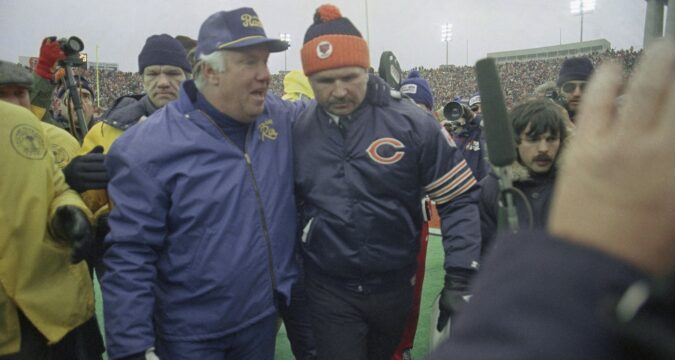
Flashback: When the Chicago Bears played the Los Angeles Rams in the NFC championship game 40 years ago
The Chicago Bears and Los Angeles Rams have faced each other only twice previously in the playoffs.
They will meet for the third time Sunday night.
The Los Angeles Rams beat the Chicago Bears 24-14 on Dec. 17, 1950 in a divisional playoff game to determine the National Conference (Western Division) champion. (Chicago Tribune)
A Dec. 17, 1950, game was needed to break a conference tie. The Rams won 24-14 in front of more than 83,000 people at the Coliseum in Los Angeles.
The Jan. 12, 1986, meeting was part of the memorable Bears season. Here’s a look back at how the teams got to the NFC championship game and how their second postseason matchup played out.
Want the latest Bears news? Subscribe to the Chicago Tribune to read it all — and sign up for our free Bears Insider newsletter.
How they got to the NFC championship game
Cowboys coach Tom Landrylooks dejected as the clock ticks down on Jan. 4, 1986, in an NFC divisional playoff game against the Los Angeles Rams. The Rams won 20-0. (Lennox McLendon/AP)
The Rams (11-5) were NFC West champs for the first time since 1979 — when they lost 31-19 to the Pittsburgh Steelers in Super Bowl XIV. They beat the Dallas Cowboys 20-0 on Jan. 4, 1986, thanks to an impressive performance by running back Eric Dickerson.
Los Angeles Rams running back Eric Dickerson, left, with a hotel key in his mouth, signs an autograph for a fan upon arrival on Jan. 10, 1986 at a Chicago hotel. (Mark Elias/AP)
The third-year pro had 34 carries for 248 yards — five more than the entire Cowboys offense and good enough for an NFL playoff rushing record. Dickerson had touchdown runs of 55 and 40 yards.
“Going into the playoffs this year, I think we’re equal with anybody, maybe with the exception of the Chicago Bears,” Rams coach John Robinson said in early January 1986.
The Bears (15-1) shut out the New York Giants 21-0. Tribune reporter Don Pierson described the Bears defense “as cold-hearted as the weather.” William “Refrigerator” Perry jumped on top of Giants running back Joe Morris to send Morris temporarily out of the game.
Bears linebacker Mike Singletary closes in on Giants quarterback Phil Simms, who was sacked six times in the NFC semifinal game on Jan. 5, 1986, at Soldier Field. The Bears won 21-0. (Bob Langer/Chicago Tribune)
The Bears sacked Giants quarterback Phil Simms six times — 3.5 by future Hall of Famer Richard Dent, who led the Bears with 6.5 tackles in the game and also had threatened to boycott the Super Bowl if not given a contract extension. Kicker Kevin Butler was among the short list of Bears who had a tough day. He missed field-goal attempts from 26, 49 and 38 yards after making 22 straight from inside the 40. Blame the wind.
“The Giants came into the game with the No. 2 defense in the National Football League and left knowing that Avis is a lot closer to Hertz than the Giants are to the Bears,” Pierson wrote.
Pregame hype
The Refrigerettes cheer on Chicago Mayor Harold Washington as he bets on the Bears-Rams game with Mayor Don Roth of Anaheim, Calif. on Jan. 10, 1986. (Frank Hanes/Chicago Tribune)
Many planned to watch the Bears-Rams game in person or on TV — except for the Chicago Sting. Their opponent, the Baltimore Blast, refused to move their conflicting match to another day.
Parking, too, would be at a premium since the Chicago Boat, Sports and RV Show expected nearly 70,000 people at nearby McCormick Place on game day.
Chicago Bears running back Walter Payton, seated left, jokingly interviews teammate Steve McMichael, right, on Jan. 8, 1986, in Suwanee, Georgia, at the Atlanta Falcons training camp facility during preparations for the NFL playoff game against the Los Angeles Rams in Chicago. (Charles Knoblock/AP)
Then as now, the Bears — who practiced at the Atlanta Falcons training facility in Suwanee, Ga., during the playoffs — hoped playing at Soldier Field would give them an advantage.
“There’s no way the weather’s not going to be a factor,” Bears safety Dave Duerson said. “I imagine they are going to wake up Sunday and hope the snow has melted and the temperature is 55 degrees. Sorry, it’s not going to be that way.”
At the time, the Rams hadn’t won a cold-weather playoff game in 40 years.
Aerial photo of Chicago’s Soldier Field in 1986. (Luigi Mendicino/Chicago Tribune)
The game preparation for the Bears, the Tribune wrote, was over. “Time to file away the X’s and O’s, stow the coaching clichés and play the long-awaited game that will determine, finally, whether the Bears go to the Super Bowl.”
Jan. 12, 1986: Rams-Bears at Soldier Field
Bears quarterback Jim McMahon sporting his famous “Rozelle” headband during the NFC Championship game against the Rams on Jan. 12, 1986, at Soldier Field. (Frank Hanes/Chicago Tribune)
It was a balmy 36 degrees at kickoff. A sold-out crowd of more than 65,000 fans packed Soldier Field.
Bears quarterback Jim McMahon — in a headband that read “ROZELLE” (for NFL Commissioner Pete Rozelle) instead of his outlawed Adidas one — completed 16 of 25 passes for 164 yards.
“He threw against the wind and through the wind in a performance marked by utter defiance,” Pierson wrote.
Los Angeles Rams running back Eric Dickerson (29) comes up short of running room against Chicago Bears defenders Mike Richardson (27) and Mike Singletary (50) on a second quarter carry during the Jan. 12, 1986 NFC championship at Chicago’s Soldier Field. (Fred Jewell/AP)
McMahon ran 16 yards for the first touchdown that was supposed to be a pass. A 34-yard Butler field goal made the score 10-0 by the end of the first quarter.
Also wearing a “ROZELLE” headband was McMahon’s favorite target of the day — running back Walter Payton. Payton ran for only 32 yards on 18 carries but added 48 yards on seven receptions.
The Bears defense had no trouble handling Dickerson, who had 17 carries for 46 yards. Defensive coordinator Buddy Ryan had predicted three fumbles by Dickerson. He had two.
Chicago Bears defensive end Dan Hampton (99) in action during the NFC Championship game against the Los Angeles Rams at Soldier Field on Jan. 12, 1986. The Bears won 24-0. (Ed Wagner Jr./Chicago Tribune)
Dan Hampton was later asked when the Bears gained control of the line of scrimmage.
“Kickoff,” he said.
McMahon connected with receiver Willie Gault on a 22-yard touchdown pass that was supposed to be a run, making it 17-0 in the third quarter.
Bears’ Wilber Marshall glides into the end zone after scooping up a fumble and running 52 yards during the fourth quarter of the NFC Championship game against the Rams on Jan. 12, 1986, at Soldier Field. The Bears won 24-0. (Bob Langer/Chicago Tribune)
The snowflakes started to fall at Soldier Field in the final minutes of the game after Dent sacked Rams quarterback Dieter Brock and forced a fumble that Wilber Marshall returned 52 yards to the end zone.
Snow looked like confetti sent from heaven by Bears founder George Halas as the Bears earned their first Super Bowl trip, Pierson wrote.
“He sent the sunshine, the snow, the touchdowns, everything,” Ditka said.
The Bears won 24-0.
Chicago Bears running back Walter Payton, left, carries the ball during first-quarter action against the Los Angeles Rams on Jan. 12, 1986 during the NFC championship game in Chicago. (John Swart/AP)
“Eleven years of climbing mountains and all the sweat finally paid off,” Payton said. “I wish this was the Super Bowl.”
“In a season full of one-upmanship, the shutout was one point better than the San Francisco 49ers’ 23-0 victory over the Bears for the NFC title a year ago,” Pierson wrote. “The Bears … will enter Super Bowl XX as the only team ever to record two straight playoff shutouts.”
The subdued Bears locker room was free of celebration — except for a few cigars. Ditka, Pierson reported, turned to Robert Frost for explanation.
“There’s a poem that says something about we’ve come many miles but we’ve got many miles to go,” Ditka said. “I don’t want to sound like I’m not happy about what happened today, but we’re on a mission and it won’t be finished until we’re finished in New Orleans.”
Firefighters in snorkel buckets attach a giant sweatband to the Picasso statue in Daley Plaza in Chicago on Jan. 22, 1986. The Chicago Bears were set to meet the New England Patriots in New Orleans for Super Bowl XX. (Phil Greer/Chicago Tribune)
That’s where the New England Patriots would be waiting on Jan. 26, 1986, to face the Bears.
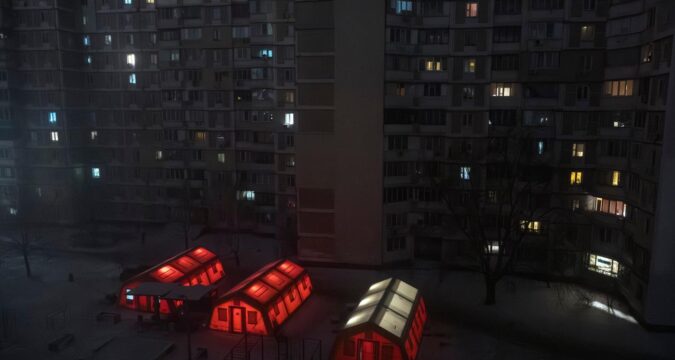
Red eléctrica dañada de Ucrania enfrenta un desafío sin precedentes, advierte ministro de Energía
Por ILLIA NOVIKOV
KIEV, Ucrania (AP) — Rusia no ha dejado intacta ni una sola planta de energía ucraniana desde su invasión total, dijo el viernes el nuevo ministro de Energía de Ucrania, luego que una reciente escalada de bombardeos aéreos rusos dejó a cientos de miles de personas sin calefacción ni luz durante días en el invierno más frío en años.
Denys Shmyhal afirmó que Rusia llevó a cabo 612 ataques contra objetivos de infraestructura energética de Ucrania el año pasado. El bombardeo se ha intensificado en los últimos meses a medida que las temperaturas nocturnas caen a -18 grados Celsius (-0,4 grados Fahrenheit).
“Nadie en el mundo ha enfrentado jamás un desafío como éste”, subrayó Shmyhal ante los legisladores en un discurso en el Parlamento de Ucrania, la Verkhovna Rada.
Rusia ha azotado la red eléctrica de Ucrania, especialmente en invierno, a lo largo de casi cuatro años de guerra. Su objetivo es debilitar la voluntad ucraniana de resistir en una estrategia que las autoridades de Kiev llaman “convertir el invierno en un arma”.
Asegurar desde el extranjero nuevos suministros de misiles para defensas aéreas de Ucrania que puedan contrarrestar los ataques de Rusia a la red eléctrica es un proceso difícil y agotador, dijo el presidente ucraniano Volodymyr Zelenskyy, quien reveló que algunos de los sistemas de defensa aérea del país no contaban con misiles y estaban a merced de Rusia –hasta que un nuevo envío llegó el viernes por la mañana.
Obtener suministros requiere una intensa presión diplomática debido a los niveles mínimos de existencias y las leyes nacionales en los países aliados, de acuerdo con el presidente ucraniano.
“Pero, honestamente, ¿qué significan esas reglas y leyes cuando estamos en guerra y necesitamos desesperadamente estos misiles?”, preguntó Zelenskyy.
El sombrío panorama a mitad de la temporada de invierno coincide con la incertidumbre sobre la dirección y el progreso de los esfuerzos de paz liderados por Estados Unidos.
Zelenskyy informó el viernes que una delegación ucraniana se dirige a Estados Unidos para intentar finalizar con Washington documentos para un acuerdo de paz propuesto que se relaciona con garantías de seguridad posguerra y recuperación económica.
Si las autoridades estadounidenses aprueban las propuestas, Estados Unidos y Ucrania podrían firmar los documentos la próxima semana en el Foro Económico Mundial en Davos, Suiza, dijo Zelenskyy en una conferencia de prensa en Kiev, acompañado por el presidente checo Petr Pavel.
El presidente de Estados Unidos, Donald Trump, planea estar en Davos, dicen los organizadores.
Rusia aún necesitará ser consultada sobre las propuestas.
En Ucrania, la dificultad era aguda en medio de apagones prolongados.
“Este es un momento crítico”, resaltó el viernes Jaime Wah, el subdirector de la delegación de la Federación Internacional de Sociedades de la Cruz Roja y de la Media Luna Roja en Kiev.
“Este es el invierno más duro desde la escalada del conflicto: las temperaturas frías castigadoras y la falta de calefacción y electricidad están afectando a millones que ya están al borde por años de violencia y tensión económica”, dijo en una sesión informativa en Ginebra.
La escasez de energía en Ucrania es tan desesperada que Shmyhal instó a las empresas a apagar sus letreros iluminados y decoraciones exteriores a fin de ahorrar electricidad.
“Si tienen energía de sobra, mejor dénsela a la gente”, exhortó el ministro de Energía. “Esto es lo más importante hoy. La gente estará agradecida”.
Ucrania ha implementado medidas de emergencia, incluyendo la flexibilización temporal de las restricciones de toque de queda para permitir que las personas acudan cuando lo necesiten a los centros de calefacción pública establecidos por las autoridades, dijo Shmyhal. Agregó que los hospitales, escuelas y otras infraestructuras críticas siguen siendo la máxima prioridad para el suministro de electricidad y calefacción.
Las autoridades han instruido a las empresas estatales de energía Ukrzaliznytsia, Naftogaz y Ukroboronprom a comprar urgentemente electricidad importada que cubra al menos el 50% de su propio consumo, según Shmyhal.
El viceprimer ministro del Reino Unido, David Lammy, estuvo en Kiev el viernes para conmemorar el primer aniversario de la “asociación de 100 años” entre el Reino Unido y Ucrania. Para coincidir con el aniversario, el gobierno británico anunció 20 millones de libras adicionales (27 millones de dólares) para reparaciones de la infraestructura energética de Ucrania.
Una guerra de desgaste continúa a lo largo de la línea del frente de aproximadamente 1.000 kilómetros (600 millas). A pesar de todo su poderío militar, Rusia ha logrado ocupar menos del 20% de Ucrania desde 2014.
___
Esta historia fue traducida del inglés por un editor de AP con la ayuda de una herramienta de inteligencia artificial generativa.
Isotopes 101
Isotopes 101
Submitted by TightSpreads
Many smart investors are catching up to the nuclear story already, but there is another angle to it that is grossly uncovered: isotopes.
This educational primer provides a useful starting point for understanding isotope market opportunities and the nuclear equities or advanced materials companies to be featured soon.
Why is this timely?
Because Oklo management has told the street that radioisotope revenues could begin as early as Q1-2026.
Isotopes are about to drastically change the semiconductor, industrial, and medical industries.
What is an isotope?
Isotopes are atoms of the same element with identical chemical properties (same protons/electrons) but differing neutron counts, leading to variations in atomic mass and nuclear behavior. So if elements are families, isotopes are siblings. Being that sibings are similar, but not identical. They arise naturally as the result of ancient stellar explosions, cosmic ray interactions, and radioactive decay; or artificially via nuclear reactors/particle accelerators.
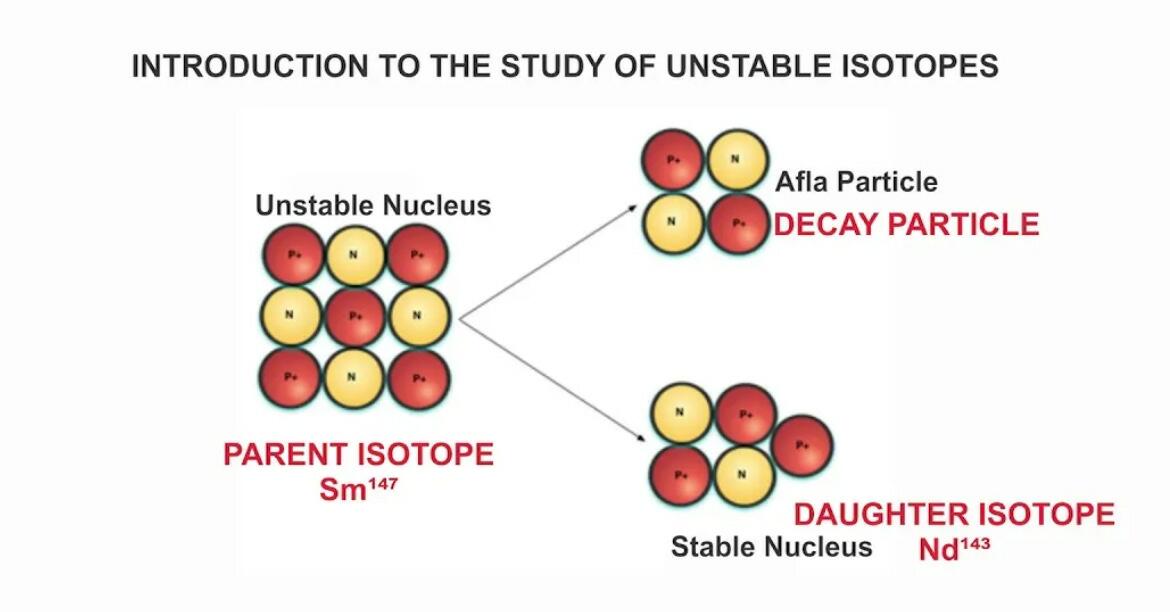
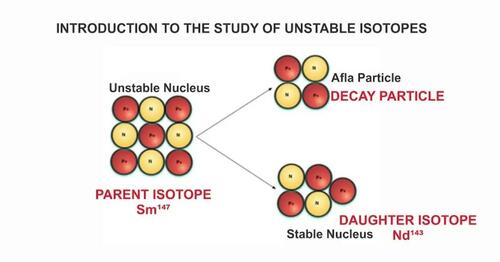
There are two types of isotopes: stable and unstable/radioactive. Stable isotopes have energetically balanced nucleus (protons/neutrons) and don’t decay. They are ideal for long-term uses like environmental tracking and are more ‘commoditized’ compared to radioactive isotopes. In contrast, radioactive isotopes have an imbalanced nucleus. This imbalance of energy, typically caused by an excess or deficiency of neutrons, forces the isotope to undergo spontaneous radioactive decay
Radioactive decay is a process exclusive to radioisotopes. It’s the transformation of an unstable atomic nucleus rebalancing into a more stable configuration. This process involves the release of energy through various decay modes, primarily alpha, beta, and gamma radiation. It is important to note that decay often occurs in sequences known as decay chains, where a parent isotope transforms into one or more daughter isotopes before reaching a final, stable state. The opportunity set of daughter isotopes have been increasingly researched and pursued in private markets, and more recently, public equity markets.
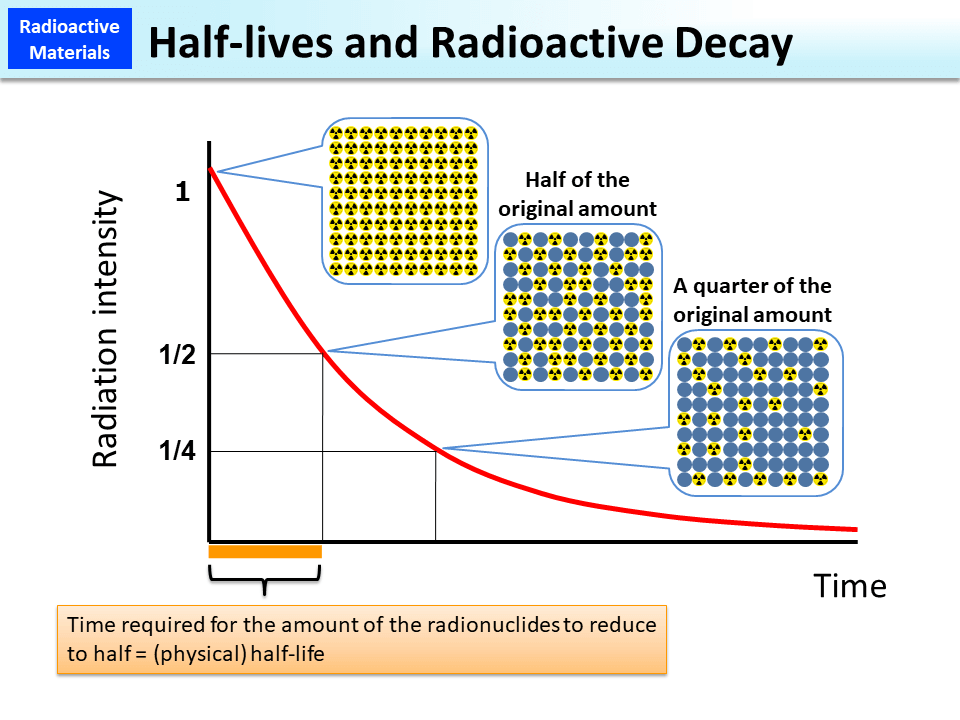
The rate of this transformation is measured by an isotope’s half-life—the time required for half of a given sample to undergo decay. Half-lives vary significantly across the isotopic spectrum. This especially important for logistical considerations of isotope production and end-market delivery. Radioactive half-lives can be as short as septillionths of a second, but most commonly-used radioactive isotopes will have half-life spans of a few hours or days.
Major Applications
Nuclear Energy & Fuel Cycle:
Enrichment Services: Focus on Enriched U-235 for the existing fleet and HALEU (High-Assay Low-Enriched Uranium) for next-generation SMRs (Small Modular Reactors). Exacerbated by the “Russia Exit” play to shift the U.S. from Russian enrichment reliance and assert our own nuclear and material dominance.
Specialty Lithium: Lithium-7 is critical for pH control in pressurized water reactors (PWRs) to prevent corrosion, while Lithium-6 is the primary precursor for Tritium in the burgeoning fusion energy sector.
Market Tailwinds: The Nuclear Energy Institute estimates the nuclear fuel enrichment opportunity will grow from ~18.0 MT/ year in 2024 to ~613.8 MT/ year in 2035, reflecting a ~37.8% CAGR.
Medical (Primary Growth Engine):
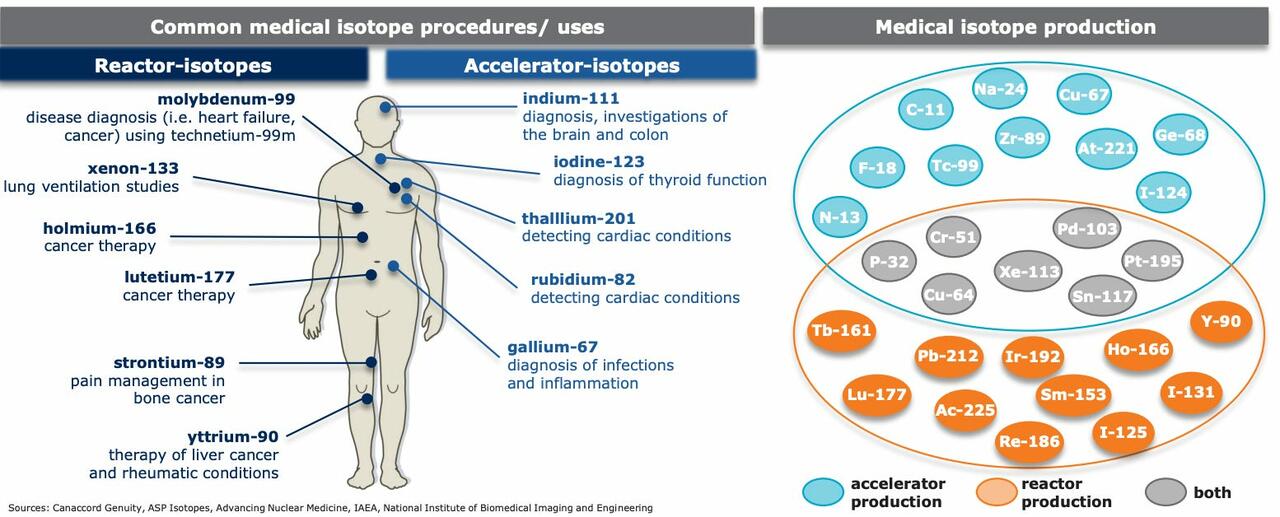
Diagnostics: Technetium-99m (Tc-99m) remains the industry workhorse, utilized in approximately 80–85% of all nuclear diagnostic scans worldwide.
Theranostics (Targeted Therapies): The “Oncology Boom” is driven by Actinium-225 and Lutetium-177, which allow for “search and destroy” cancer treatments.
Market Tailwinds: According to Allied Market Research, the nuclear medical isotope market was estimated at ~$6.6B in 2025 and is projected to reach ~$14B by 2034 (8.8% CAGR). Growth is catalyzed by: the targeted oncology boom, a massive influx of biotech capital into radiopharmaceutical pipelines, aging global demographics, and the urgent need to diversify supply away from aging legacy reactors.
Supply Chain Fragility: The medical isotope market is notoriously fragile because it relies on a linear, “just-in-time” supply chain with almost no buffer for error. Much of the world’s supply currently relies on a handful of aging legacy reactors
High-Value Industrial & Tech Niches:
Semiconductors and Quantum Computing: Isolating and enriching materials like Silicon-28 or Phosphorus-31, can unlock significant technological performance enhancements. McKinsey estimates the global semiconductor market will reach ~$1T by 2030, up from ~$527B in 2023 (~7.7% CAGR).
Industrial and Tech: Germanium isotope end use cases span electronics, infrared optics, solar cells, and fiber optics, among other applications.
Industrial/Research: Helium-3 for cryogenics and neutron detection; Carbon-13 for metabolic research and gas tracing.
Resource Management: Isotopes are essential for oil/gas reservoir tracing and high-precision environmental monitoring (e.g., tracking carbon sources or water table movement).
Isotope Production and Enrichment
As we recently mentionef, elements come as a mix of “heavy” and “light” versions of their atomic masses. Thus, elements may have a variety of isotopes found and to be made. Production methods work by bombarding target materials with high-energy particles—such as neutrons in nuclear reactors to create neutron-rich isotopes or protons in cyclotrons to create proton-rich isotopes. Enrichment takes a natural mixture (like raw Uranium) and use precision methods such as lasers to “sort” or separate the isotopes that are already there.
In a high-tech supply chain, you often need both enrichment and production to get to a final product.
Production Methods:
The Future, Nuclear Reactors
The Process: Reactors act as “controlled furnaces” that generate a dense flux of neutrons. Target materials are inserted into the reactor core where they are “baked” or irradiated by these neutrons to create a radioactive isotope.
The Reaction (Neutron Capture): Because neutrons have no electrical charge, they easily enter the nucleus of a target atom. The nucleus absorbs the neutron, becoming a heavier and often unstable isotope that then decays into the desired material.
Why it’s better:
Massive Scale: Reactors are the only cost-competitive machines capable of “bulk” production, irradiating dozens of targets simultaneously. Making nuclear reactor isotope producers such as Oklo’s Versatile Isotope Production Reactors (VIPR) a strong contender for scaling U.S. domestic supply amid global shortages with uniform distribution.
Unique Capabilities: Only reactors can produce the neutron-rich therapeutic isotopes and industrial dopants that represent the current largest growth drivers in healthcare and AI.
The Specialized Alternative, Cyclotrons
The Process: Magnets and electricity fire a high-speed “proton beam” in an ever-widening spiral at a target.
The Result: This “proton bombardment” creates proton-rich isotopes.
Status: Commercially scaled and widely distributed, often found directly in or near hospitals due to the short half-lives of the isotopes they produce.
The Precision Straight-Line, Linear Accelerators (Linacs)
The Process: Propels charged particles in a straight line through a long vacuum tube using electric fields.
The Result: Produces a wide range of isotopes with high precision and reduced beam loss compared to cyclotrons.
Status: Commercially scaled for both isotope production and medical radiotherapy, though they often require significantly more physical space than cyclotrons.
The High-Energy Ring, Synchrotrons
The Process: Guides particles in a circular path using variable magnetic fields to keep them in a fixed ring as they gain extreme energy.
The Result: Capable of reaching GeV energy levels, far beyond what standard cyclotrons can achieve.
Status: Not typically used for commercial isotope production; they are primarily “frontier” machines for high-energy physics research and specialized cancer treatments like carbon-ion therapy.
Enrichment Methods:
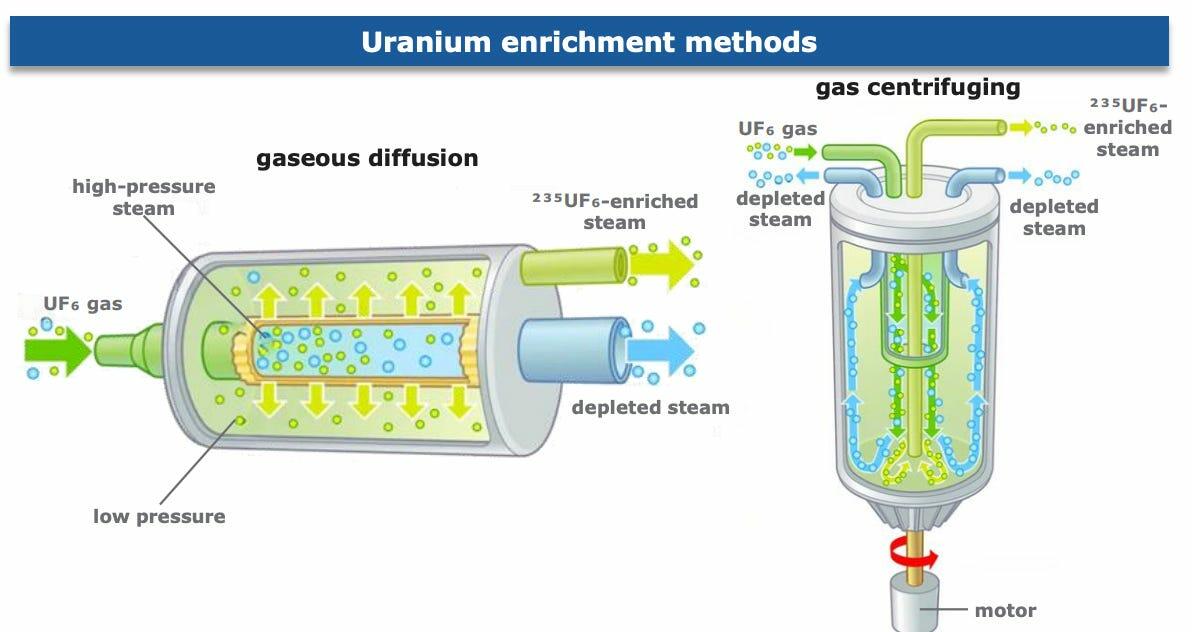
The Current Standard, Gas Centrifuge
The Process: The material is turned into a gas and spun at incredibly high speeds in a cylinder.
The Result: The “heavy” pieces are thrown to the outside walls, while the “lighter” ones stay in the center. By repeating this hundreds of times through a cascade of centrifuges, the desired isotope is concentrated.
The Retired Method, Gaseous Diffusion
The Process: Pumping gas through miles of filters with tiny holes.
Status: This was the original Cold War method. It is now obsolete because it uses massive amounts of electricity and is far too expensive compared to modern spinning.
The Future, Laser Enrichment
After 50 years of development, laser technology is the “next frontier.” Unlike the methods above, lasers are surgical and precise. The only downfall has been their ability to scale lasers for mass commercialization.
How it works: Scientists “tune” a laser to a specific frequency that only hits the target isotope. It’s like using a specialized magnet to pull only the copper pennies out of a jar of mixed coins.
Why it’s better: It is much more efficient and can handle materials that centrifuges can’t.
Key laser types:
Atomic Vapor Laser Isotope Separation (AVLIS): Heat the element to gas atoms → lasers selectively charge (ionize) the target isotope → charged atoms stick to a collector plate (opposites attract). Was not scaled due to technical challenges.
Molecular Laser Isotope Separation (MLIS): Convert to a gas molecule → lasers excite/break bonds in molecules with the target isotope → enriched part is collected via collector plate.
SILEX (most advanced version, from Australia’s Silex Systems): A smarter MLIS approach. Lasers excite target molecules → in a fast-moving gas jet, excited (lighter) ones resist clumping/condensing and separate differently.
Avlis technique:
* * *
Tyler Durden
Fri, 01/16/2026 – 10:05

Migrantes venezolanos en España, entre la esperanza y el temor por el futuro de su país
Por SUMAN NAISHADHAM
MADRID (AP) — Los venezolanos que viven en España observan con una mezcla de asombro, alegría y miedo los acontecimientos que se desarrollan en su país de origen.
Unos 600.000 venezolanos viven en España, hogar de la mayor población fuera de las Américas. Muchos huyeron de la persecución política y la violencia, pero también del colapso económico del país.
La mayoría vive en Madrid, la capital, trabajando en hospitales, restaurantes, cafeterías, residencias de ancianos y otros lugares. Algunos migrantes venezolanos han establecido raíces profundas y vidas en la nación ibérica, mientras que otros son recién llegados.
Esto es lo que tres de ellos dijeron sobre el futuro de Venezuela desde que las fuerzas de Estados Unidos derrocaron a Nicolás Maduro.
___
Un padre busca justicia para su hijo
David Vallenilla se despertó el 3 de enero con los mensajes de texto de un primo que le informaba “que invadieron a Venezuela”. El hombre de 65 años, originario de Caracas, vive solo en un ordenado apartamento en el sur de Madrid, con dos perros dachshund y varios pájaros. No lo creía.
” En ese momento, yo quería tener certeza”, dijo Vallenilla, ” certeza de lo que me estaban diciendo”.
En junio de 2017, David José, de 22 años e hijo de Vallenilla, estudiaba enfermería en Caracas y fue tiroteado a quemarropa por un soldado venezolano tras participar en una protesta cerca de una base aérea militar en la capital. Posteriormente, murió a causa de sus heridas. Las imágenes del incidente se difundieron ampliamente, convirtiendo ese año la muerte de su hijo en un caso emblemático de la represión del gobierno de Maduro contra los manifestantes.
Tras exigir respuestas por la muerte de su hijo, Vallenilla también comenzó a recibir amenazas y, dos años después, decidió mudarse a España con la ayuda de una organización no gubernamental.
El día de la captura de Maduro, Vallenilla dijo que su teléfono se inundó de mensajes sobre su hijo.
“Y muchos decían, ‘ahora David si va a estar descansando en paz. David debe estar alegre en el cielo’”, señaló. “Pero no te creas que fue fácil. Pasé casi todo el día llorando porque me llegaba demasiada información”.
Vallenilla observa los acontecimientos en Venezuela con desconfianza, pero también con optimismo. Teme más violencia, pero dice tener la esperanza de que el gobierno del presidente Donald Trump pueda lograr el cambio que los venezolanos como su hijo intentaron obtener a través de elecciones, protestas populares e instituciones internacionales.
“Nada me va a devolver a mi hijo. Pero el hecho de que se empezó a hacer algo de justicia por los responsables de alguna manera me ayuda a ver una luz al final del túnel. Aparte de que también espero que sea Venezuela libre”.
Una madre espera que sus hijas puedan visitar una Venezuela democrática
La periodista Carleth Morales llegó por primera vez a Madrid hace un cuarto de siglo, cuando Hugo Chávez fue reelegido como presidente de Venezuela en 2000 bajo una nueva constitución.
La mujer de 54 años quería estudiar y regresar a casa, tomándose una especie de descanso en Madrid al percibir un entorno político y económico que se volvía cada vez más desafiante.
“Yo salí con la intención de prepararme, de estudiar y de volver más preparada, porque yo entendía que el país estaba pasando como por un proceso de adaptación entre lo que habíamos conocido antes y bueno, Chávez y su y su nueva política. Pero tampoco tenía idea de que íbamos a llegar al punto que llegamos”.
En 2015, Morales fundó una organización de periodistas venezolanos en España, que hoy cuenta con cientos de miembros.
La mañana en que las fuerzas de Estados Unidos capturaron a Maduro, Morales se despertó con una avalancha de llamadas perdidas de amigos y familiares en Venezuela, afirmó.
“Por supuesto, esperamos recuperar un país democrático, un país libre, un país donde se respeten los derechos humanos”, señaló Morales. “Pero es difícil pensar eso como venezolana cuando hemos vivido tantas cosas y sufrido tanto”.
“Y esperanza tenemos, por supuesto, de recuperar un país democrático, un país en libertad, un país donde se respeten los derechos humanos”, afirmó. “Eso siempre está. Y realmente es muy difícil pensar como venezolano cuando, no sé, y hemos vivido tantas cosas y hemos sufrido tanto”.
Morales considera poco probable volver a su patria tras haber pasado más de dos décadas en España, pero espera que sus hijas puedan algún día ver a Venezuela como una opción viable.
“Una vez escuché a un compañero que dijo, ‘Trabajo por Venezuela para que mis hijos la consideren como una oportunidad de vida’. Y la adopté como mía esa frase. O sea que quizás, en algunos años, no sea yo la que disfrute de una Venezuela democrática, sino mis hijas”.
Una mujer preocupada por su esposo y su hermano en prisiones venezolanas
Durante dos semanas, Verónica Noya ha esperado que suene su teléfono con la noticia de que su esposo y su hermano han sido liberados.
El esposo de Noya, el capitán del ejército venezolano Antonio Sequea, fue encarcelado en 2020 tras participar en una incursión militar para derrocar a Maduro. Dijo que su marido permanece en confinamiento solitario en la prisión de El Rodeo en Caracas. Durante 20 meses, Noya no ha podido comunicarse con él ni con su hermano, quien también fue arrestado por participar en el mismo complot.
“Allí comenzó mi pesadilla”, afirmó.
Las autoridades venezolanas señalan que cientos de presos políticos han sido liberados desde la captura de Maduro, mientras que los grupos de derechos humanos afirman que el número real es una fracción de eso. Noya ha esperado con angustia escuchar algo sobre sus cuatro familiares que permanecen encarcelados, incluida la madre de su esposo.
Mientras tanto, no ha sabido qué decirles a sus hijos cuando preguntan por el paradero de su padre. Salieron de Venezuela apresuradamente y decidieron venir a España porque las raíces familiares en el país significaban que Noya ya tenía un pasaporte español.
Aun así, espera regresar a su país.
“Soy venezolana por sobre todas las cosas”, afirmó. “Y sueño con ver un país nuevamente con democracia”.
___
Esta historia fue traducida del inglés por un editor de AP con la ayuda de una herramienta de inteligencia artificial generativa.
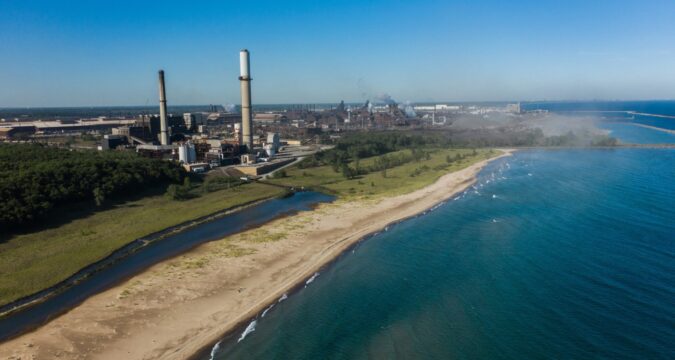
Indiana Senate committee passes nuclear facility permit bill
Nuclear power is closer to coming to Indiana as the state Senate’s utility committee passed legislation that would shape how permits are issued to nuclear-powered generating facilities and fuel reprocessing plants.
State Sen. Eric Koch, R-Bedford, authored Senate Bill 258, which would make changes to the Indiana Code about how the Indiana Department of Environmental Management issues permits to nuclear facilities. Changes include repealing a prohibition from constructing or operating a nuclear facility without an IDEM permit and repealing the authorization for the commissioner to conduct a public hearing on the environmental effects.
The bill, if passed, would also require the facility operator to file an environmental feasibility report to IDEM, according to the Indiana General Assembly.
Multiple Indiana residents, who are opposed to the bill, testified that it reduces state-level oversight on Thursday.
“Indiana has no experience whatsoever operating nuclear facilities,” said Kerwin Olson, executive director of the Citizens Action Coalition. “We have great concerns about eviscerating the abilities of (IDEM).”
Alex Goodnight, deputy legislative director for IDEM, said the bill makes common sense changes to Indiana Code, and it would eliminate “outdated and unnecessary provisions.”
“These proposed changes reflect existing laws and establish appropriate division of responsibilities between the state and Nuclear Regulatory Commission,” Goodnight said. “The federal government maintains exclusive authority over radiological safety and the construction and operation of nuclear facilities under the Atomic Energy Act of 1954.”
According to its website, the U.S. Nuclear Regulatory Commission was created in 1974 and ensures the safe use of radioactive materials for “beneficial civilian purposes” and protects people and the environment. The commission regulates commercial nuclear power plants and other uses of nuclear materials.
The U.S. Supreme Court ruled in 1983 that state laws conflict with and are preempted by the Atomic Energy Act, Goodnight said.
“Nuclear energy facilities remain subject to the same environmental permitting requirements as any other industrial project in Indiana,” Goodnight said. “SB 258 would eliminate these preempted provisions while maintaining coordination between IDEM and the NRC, regarding a required environmental feasibility report, which would help inform any necessary IDEM land, air or water permits.”
State Sen. Andrea Hunley, D-Indianapolis, was outspoken about concerns that Hoosiers are protected from hazards related to nuclear power, including radiation.
The state can’t regulate radiological safety, Goodnight told Hunley, adding that it’s up to the federal government.
“When I hear it’s up to the federal government, that doesn’t make me feel safer,” Hunley said. “I just want to have a little more assurance.”
Hunley eventually voted against Senate Bill 258, saying that her vote isn’t against nuclear power in Indiana, but she wants to ensure that the state has regulations.
Gov. Mike Braun has been dedicated to bringing nuclear power to Indiana, and in November 2025 he announced that First American Nuclear would bring its headquarters, manufacturing facilities and an energy park to the state, according to Post-Tribune archives. First American Nuclear is dedicated to building small modular reactors, or SMRs, which are advanced nuclear reactors that have about one-third the generating capacity of traditional nuclear reactors, according to the International Atomic Energy Agency.
Olson has expressed concerns with nuclear power, including that it might not be able to meet the state’s energy demands and questions whether it’s as clean as nuclear power companies say.
In November, a First American Nuclear spokesperson told the Post-Tribune that the company is looking for sites for its corporate headquarters, manufacturing facility and energy park, but none have been decided yet. Construction for the manufacturing and energy park sites is expected to start in 2028.
The Senate will vote on Senate Bill 258 at a later date.

Madison Keys se imagina como campeona nuevamente en el Abierto de Australia
Por JOHN PYE
MELBOURNE, Australia (AP) — Madison Keys planeaba entrar al túnel de jugadores de la Arena Rod Laver en un momento tranquilo cuando nadie estuviera mirando, y tomar una foto de su nombre junto a los otros campeones del Abierto de Australia.
Después de vencer a la número uno mundial Aryna Sabalenka en la final del año pasado en Melbourne Park para ganar su primer título de Grand Slam, Keys imaginó el momento en que regresaría al estadio por primera vez como campeona defensora.
“Siempre he recordado caminar por ese túnel y ver todos los nombres”, afirmó el viernes, dos días antes de que comience el primer gran torneo del año. “Fue un momento de pellizcarme un poco, donde pensé, ‘wow, voy a estar ahí arriba’”.
“Aún no he visto mi nombre en el túnel. Espero poder entrar cuando no haya nadie más para poder tomar una foto y enviársela a mi mamá”, agregó.
Antes de enfrentar a los medios en Melbourne, no pudo evitar notar otras evidencias en el lugar de su triunfo decisivo.
“Hay una foto realmente genial de mí sosteniendo el trofeo”, comentó Keys. “Ver eso es algo con lo que sueñas en tu carrera”.
La estadounidense de 30 años dijo que es fácil mirar hacia atrás casi 12 meses y pensar que todo funcionó a la perfección, pero “también piensas, ‘wow, casi perdí.’”
“Estuve a punto de perder el partido. Tantos partidos a tres sets. Hubo algunos partidos feos. Creo que eso hace que todo sea un poco mejor solo porque no fue sin problemas”, indicó.
Keys ganó un torneo de preparación en Adelaida en 2025 antes de terminar con la racha de 20 victorias consecutivas de Sabalenka en el Abierto de Australia. A los 29 años, fue la campeona debutante más veterana del torneo en la categoría femenina. También estableció un récord como la jugadora con el mayor intervalo entre sus dos primeras finales de Grand Slam: la primera fue el Abierto de Estados Unidos de 2017.
La victoria en el Abierto de Australia la catapultó al Top 5 del ranking el mes siguiente. Sin embargo, después del gran avance, fue eliminada en los cuartos de final del Abierto de Francia, en la tercera ronda de Wimbledon y sucumbió a las primeras de cambio en el Abierto de Estados Unidos. En las Finales de la WTA al final de la temporada, perdió dos partidos de la fase de grupos.
Sabalenka, por su parte, admitió el viernes que la derrota aquí ante Keys el año pasado fue difícil.
“Jugó increíble y me superó. Me tomó un poco de tiempo recuperarme”, expresó. “Tuvimos partidos después de eso. Trabajé en mis errores en esos partidos”, comentó. “Al ir a este Abierto de Australia, realmente no me estoy enfocando en el resultado del año pasado, pero por supuesto me gustaría hacerlo un poco mejor que el año pasado”.
Sabalenka, quien venció a Keys en los cuartos de final la semana pasada en camino al título del Brisbane International, juega su partido de primera ronda el domingo por la noche contra Tiantsoa Rakotomanga Rajaonah, una francesa que recibió un wildcard.
Keys también perdió en los cuartos de final en su defensa del título en Adelaida a principios de esta semana. Pero lo está tomando con calma mientras se prepara para otro primer hito en su carrera: defender el título de un Slam.
“Aunque he estado en el tour durante mucho tiempo, esta también es mi primera experiencia como tal”, comentó. “Realmente estoy tratando de absorber todas las partes realmente geniales y divertidas.”
Novena cabeza de serie y en el lado opuesto del cuadro de Sabalenka, Keys debutará contra la ucraniana Oleksandra Oliynykova.
“Sí, estoy segura de que al entrar a la cancha estaré muy nerviosa”, dijo. “ero no creo que haya entrado a la cancha en la primera ronda de un Grand Slam sin estar nerviosa”.
___
Deportes AP: https://apnews.com/hub/deportes

US Outraged Iranian Warships Are Docked At Cape Town: South Africa ‘Cozying Up’ To Tehran
US Outraged Iranian Warships Are Docked At Cape Town: South Africa ‘Cozying Up’ To Tehran
The United States is making its anger known to longtime but strained ally South Africa, charging the country’s defense ministry of ignoring directives from its own government to send Iranian warships home after they took part in naval exercises in South African waters.
Washington’s statement held nothing back: “South Africa can’t lecture the world on ‘justice’ while cozying up to Iran,” the US embassy in South Africa posted on Facebook. Islamic Republic warships have been docked in Cape Town for some days now. “Iran is a destabilizing actor and state sponsor of terror, and its inclusion in joint exercises – in any capacity – undermines maritime security and regional stability,” the US statement said.
“It is particularly unconscionable that South Africa welcomed Iranian security forces as they were shooting, jailing, and torturing Iranian citizens engaging in peaceful political activity South Africans fought so hard to gain for themselves,” it continued.
While the protests and riots have largely died down, and it should be noted that much of the activity in the streets especially in the latter days of the unrest was not entirely ‘peaceful’ – the potential for some kind of looming military action is still there. US military assets are en route to the Middle East region, after much of the naval strike group has been built up for months in the southern Caribbean.
South Africa’s defense ministry in turn rejected the accusation and said it had opened an investigation to determine the facts behind what it called “serious allegations”.
Ironically the weeklong naval exercise South Africa has been hosting is dubbed the “Will for Peace 2026”. It has widely been described as a BRICS and “BRICS+” naval drill and chiefly involves Russian, Chinese, and Iranian warships.
The drill had long been in planning and the date set, significantly before the flare-up of two weeks of economic-driven protests in the Islamic Republic.
But in light of the controversy, the South African government did apparently succumb to pressure from Western allies to send Iranian military assets home.
On Friday, the office of Defense Minister Angie Motshekga underscored she “would like to place it on record” that President Cyril Ramaphosa’s instructions for the Iranians do depart immediately had been “clearly communicated to all parties concerned, agreed upon and to be implemented and adhered to as such.”
But this wasn’t fast enough, and the US Embassy is outraged, with its diplomats getting to literally view Iranian warships parked and prominently displayed off South Africa’s main capital city.
However, some reports have said that the Iranian warships had already docked in Cape Town by the time the order instructing them to turn back was issued – but again, it also seems they are in no hurry to leave, perhaps trolling the US.
🇿🇦⚓️ Multinational naval exercises “Will for Peace 2026” have begun in SA’s territorial waters.
Based in Simon’s Town, the drills involve navies of China and South Africa, with ships from Russia and Iran participating.
The exercises focus on maritime security & safe navigation. pic.twitter.com/LvRUNy5MQV
— Russian Embassy in South Africa 🇷🇺 (@EmbassyofRussia) January 9, 2026
Meanwhile, Russian President Vladimir Putin held phone calls Friday with the leaders of Iran and Israel, marking his first public response to the Iran crisis, and amid US threats for intervention.
The Kremlin said Putin spoke by phone with Iranian President Masoud Pezeshkian as part of what it described as his “continued efforts” to de-escalate tensions.
“This is assistance not only to Iran, but to the entire region, as well as to the cause of regional stability and peace,” Kremlin spokesman Dmitry Peskov told a press briefing.
Tyler Durden
Fri, 01/16/2026 – 09:45

Event at Rosary in Aurora to showcase performing and visual arts
An event showcasing performing and visual arts featuring current students and alumni from Rosary College Prep and Marmion Academy will take place from 7 to 9 p.m. Saturday, Jan. 24, at Rosary, 901 N. Edgelawn Drive in Aurora.
The evening’s theme is “Movie Musicals,” with the event sponsored by Rosary Fine Arts Boosters, according to a press release about the event.
Doors will open at 6:30 p.m. Those attending can browse the artwork on display in the foyer gallery before the show and during intermission, organizers said.
There will be a dessert buffet during intermission of the show, and there will also be raffle baskets and a 50/50 raffle during the event, according to the release.
Tickets cost $25 for adults and $10 for students, and can be purchased at https://rosaryfab.square.site.
All proceeds from the event will benefit Rosary Fine Arts programs and auditorium improvements at the school, the release said.
Rosary College Prep is a Catholic, Dominican school for young women, sponsored by the Dominican Sisters of Springfield, Illinois. For more information about Rosary College Prep, go to www.rosaryprep.org.
Entries sought for St. Patrick’s Parade
The St. Charles Business Alliance is accepting entries for the 2026 St. Patrick’s Parade in St. Charles.
The parade will begin at 2 p.m. Saturday, March 14, and will travel down Main Street, starting at Sixth Street and concluding at Fourth Avenue.
The deadline for entry forms to be submitted is Friday, Feb. 13, and the maximum number of entries accepted will be 80, event organizers said.
Local businesses, community groups and non-profits are invited to participate in this year’s parade, according to a press release from the St. Charles Business Alliance.
To view the entry form, go to www.stcstpatricksparade.com. Entries that are planning on having more than 20 walkers will need to reach out to the St. Charles Business Alliance at 630-443-3967 or info@stcalliance.org for special permission and guidelines, according to the release.
Deadline nears to apply to scholarship program
The deadline to apply to the Community Foundation of the Fox River Valley’s Scholarship Program for the 2026-27 school year is 4 p.m. Tuesday, Jan. 20, foundation officials said in a press release.
The Community Foundation’s Scholarship Program consists of more than 500 community-sourced scholarship funds created by Fox Valley-area donors, including individuals, families, local businesses, clubs and associations, officials said.
The awards are available to high school seniors, college undergrad and graduate students, as well as trade school students, who live in Kendall County, southern Kane County and the city of Aurora. The awards total over $3 million to be given out over the next four years, according to the release.
Students only need to complete one application to be considered for one of the hundreds of available awards. To apply, students can go to cffrv.org to access the scholarship application, general policies, types of scholarships available, location-based opportunities, eligibility requirements and a list of materials needed to apply.
“Last spring, a record $3.4 million was awarded to 569 students, ranging in age from 16 to 47 years old, for use over the next four years, all thanks to the generosity of Fox Valley residents,” said Beth Christoffel, scholarship program manager, in the release.
Will County making plans for its 190th anniversary
Will County is celebrating the 190th anniversary of its founding this year and will be highlighting its history throughout 2026.
The county’s incorporation on Jan. 12, 1836, was recognized by Will County Executive Jennifer Bertino-Tarrant with an executive proclamation noting its growth from simple trading posts to a hub of agricultural, manufacturing, energy and transportation industries, a news release said.
Throughout the year, Bertino-Tarrant’s office will partner with the Will County Historic Preservation Commission to showcase local historic sites and milestones under the theme of “Celebrating 190 Years of Community,” the release said. There are 60 sites designated by the commission as local landmarks.

Cientos huyen a zonas controladas por el gobierno en el norte de Siria ante posible ofensiva
Por HOGIR AL ABDO y GHAITH ALSAYED
DEIR HAFER, Siria (AP) — Decenas de personas llegaron a áreas controladas por el gobierno en el norte de Siria el viernes, antes de un posible ataque de las tropas sirias en territorio controlado por combatientes liderados por kurdos al este de la ciudad de Alepo.
Muchos de los civiles que huyeron, cargando con sus pertenencias, utilizaron caminos secundarios para llegar a las áreas controladas por el gobierno porque la carretera principal estaba bloqueada con barreras en un puesto de control que anteriormente estaba en manos de las Fuerzas Democráticas Sirias (FDS), lideradas por kurdos y respaldadas por Estados Unidos, observaron periodistas de The Associated Press.
El anuncio del ejército sirio del miércoles por la noche —que decía que los civiles podrían evacuar a través del “corredor humanitario” de 9:00 de la mañana a 5:00 de la tarde el jueves— parecía señalar planes para una ofensiva contra las FDS en el área al este de Alepo. Ya ha habido intercambios limitados de fuego entre ambas partes.
Hombres, mujeres y niños llegaron en autos y camionetas tipo pickup cargados de bolsas de ropa, colchones y otras pertenencias. Fueron recibidos por funcionarios locales, que los dirigieron a refugios.
En otras áreas, la gente cruzó canales en pequeños botes y atravesó un puente peatonal seriamente dañado para llegar al lado controlado por las fuerzas del gobierno.
Las FDS cerraron la carretera principal, pero unas 4.000 personas aún pudieron llegar a las áreas controladas por el gobierno por otras vías, reportó la televisión estatal siria.
Un convoy militar de Estados Unidos llegó a Deir Hafer a primera hora de la tarde, pero por el momento no queda claro si ese personal permanecerá. Estados Unidos tiene buenas relaciones con ambas partes y ha instado a la calma.
Dentro de Deir Hafer, muchas tiendas estaban cerradas y la población se quedó en casa.
“Cuando vi a la gente irse, vine aquí”, dijo Umm Talal, quien llegó al área controlada por el gobierno con su esposo e hijos. Agregó que la carretera parecía segura y su esposo planea regresar a su hogar.
Abu Mohammed indicó que se dirigió a la ciudad de Maskana tras escuchar que el gobierno había abierto un corredor seguro, “pero para nuestra sorpresa, al llegar a Deir Hafer lo encontramos cerrado”.
Los combatientes de las FDS estaban impidiendo que la gente cruzara por la principal carretera de este a oeste de Siria y los obligaban a tomar un camino secundario, dijo.
Las tensiones en el área de Deir Hafer se producen luego de varios días de intensos enfrentamientos la semana pasada en Alepo, anteriormente la ciudad más grande y centro comercial de Siria, que terminaron con la evacuación de combatientes kurdos de tres barrios al norte de la ciudad que luego fueron tomados por las fuerzas del gobierno.
Los combates estallaron cuando las negociaciones se estancaron entre Damasco y las FDS sobre un acuerdo alcanzado en marzo para integrar sus fuerzas y que el gobierno central tomara el control de instituciones, incluidos los cruces fronterizos y los campos petroleros en el noreste.
El enviado especial de Estados Unidos para Siria, Tom Barrack, publicó el viernes en X que Washington sigue en estrecho contacto con todas las partes en Siria, “trabajando día y noche para bajar la temperatura, prevenir la escalada y volver a las conversaciones de integración entre el gobierno sirio y las FDS”.
Durante años, las FDS han sido el principal socio de Estados Unidos en Siria en la lucha contra el grupo Estado Islámico, pero Turquía considera a las FDS una organización terrorista debido a su asociación con insurgentes separatistas kurdos en Turquía.
___
Esta historia fue traducida del inglés por un editor de AP con la ayuda de una herramienta de inteligencia artificial generativa.
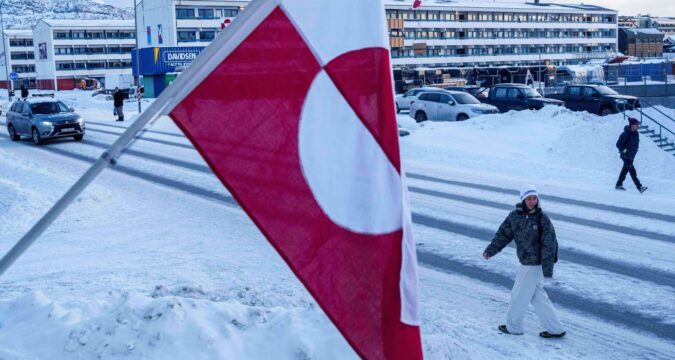
In their words: Greenlanders talk about Trump’s desire to own their Arctic island
NUUK, Greenland — U.S. President Donald Trump has turned the Arctic island of Greenland into a geopolitical hotspot with his demands to own it and suggestions that the U.S. could take it by force.
The island is a semiautonomous region of Denmark, and Denmark’s foreign minister said Wednesday after a meeting at the White House that a “ fundamental disagreement ” remains with Trump over the island.
The crisis is dominating the lives of Greenlanders and “people are not sleeping, children are afraid, and it just fills everything these days. And we can’t really understand it,” Naaja Nathanielsen, a Greenlandic minister said at a meeting with lawmakers in Britain’s Parliament this week.
Here’s a look at what Greenlanders have been saying:
Trump “undermining” Greenlandic culture
Trump has dismissed Denmark’s defenses in Greenland, suggesting it’s “two dog sleds.”
By saying that, Trump is “undermining us as a people,” Mari Laursen told AP.
Laursen said she used to work on a fishing trawler but is now studying law. She approached AP to say she thought previous examples of cooperation between Greenlanders and Americans are “often overlooked when Trump talks about dog sleds.”
She said during World War II, Greenlandic hunters on their dog sleds worked in conjunction with the U.S. military to detect Nazi German forces on the island.
“The Arctic climate and environment is so different from maybe what they (Americans) are used to with the warships and helicopters and tanks. A dog sled is more efficient. It can go where no warship and helicopter can go,” Laursen said.
Greenlanders don’t believe Trump’s claims
Trump has repeatedly claimed Russian and Chinese ships are swarming the seas around Greenland. Plenty of Greenlanders who spoke to AP dismissed that claim.
“I think he (Trump) should mind his own business,” said Lars Vintner, a heating engineer.
“What’s he going to do with Greenland? He speaks of Russians and Chinese and everything in Greenlandic waters or in our country. We are only 57,000 people. The only Chinese I see is when I go to the fast food market. And every summer we go sailing and we go hunting and I never saw Russian or Chinese ships here in Greenland,” he said.
Down at Nuuk’s small harbor, Gerth Josefsen spoke to AP as he attached small fish as bait to his lines. He said, “I don’t see them (the ships)” and said he had only seen “a Russian fishing boat ten years ago.”
Trump is interested in Greenland’s critical minerals
Maya Martinsen, 21, a shop worker, told AP she doesn’t believe Trump wants Greenland to enhance America’s security.
“I know it’s not national security. I think it’s for the oils and minerals that we have that are untouched,” she said, suggesting the Americans are treating her home like a “business trade.”
She said she thought it was good that American, Greenlandic and Danish officials met in the White House Wednesday and said she believes that “the Danish and Greenlandic people are mostly on the same side,” despite some Greenlanders wanting independence.
“It is nerve-wrecking, that the Americans aren’t changing their mind,” she said, adding that she welcomed the news that Denmark and its allies would be sending troops to Greenland because “it’s important that the people we work closest with, that they send support.”
Greenlanders get support from Denmark
Tuuta Mikaelsen, a 22-year-old student, told AP that she hopes the U.S. got the message from Danish and Greenlandic officials to “back off.”
She said she didn’t want to join the United States because in Greenland “there are laws and stuff, and health insurance .. .we can go to the doctors and nurses … we don’t have to pay anything,” she said adding “I don’t want the U.S. to take that away from us.”
Greenland is at the center of a media storm
In Greenland’s parliament, Juno Berthelsen, MP for the Naleraq opposition party that campaigns for independence in the Greenlandic parliament told AP that he has done multiple media interviews every day for the last two weeks.
When asked by AP what he would say to Trump and Vice President JD Vance if he had the chance, Berthelsen said:
“I would tell them, of course, that — as we’ve seen — a lot of Republicans as well as Democrats are not in favor of having such an aggressive rhetoric and talk about military intervention, invasion. So we would tell them to move beyond that and continue this diplomatic dialogue and making sure that the Greenlandic people are the ones who are at the very center of this conversation.”
“It is our country,” he said. “Greenland belongs to the Greenlandic people.”
https://www.chicagotribune.com/2026/01/16/greenlanders-trump/