Category: News

Para Guardiola ‘todo está saliendo mal’ con el City tras sorpresiva derrota en la Champions
BODO, Noruega (AP) — Pep Guardiola reconoció que “todo está saliendo mal” en su Manchester City después de sufrir una sorprendente derrota el martes en la Liga de Campeones ante el Bodø/Glimt de Noruega.
El City sucumbió 3-1 en un partido en el que jugó la última media hora con 10 hombres. Rodri Hernández, el centrocampista español que ganó el Balón de Oro en 2024, fue expulsado tras recibir dos tarjetas amarillas en rápida sucesión.
La inesperada caída contra un debutante en el torneo se produjo tres días después de que el City fuera superado por 2-0 en la Liga Premier ante su clásico rival Manchester United.
El City apenas ha ganado dos de sus últimos siete partidos en todas las competiciones, y uno de esos triunfos fue contra el Exeter de la tercera división en la Copa FA.
“Hoy fue una oportunidad increíble para nosotros”, expresó Guardiola. “Pero todo está saliendo mal, las cosas en contra en muchos detalles. Eso es un hecho y tenemos que intentar cambiarlo. Los jugadores están ahí y lo intentamos”.
“No tengo ninguna duda de que en esta competición, nada está garantizado, eso es seguro. El United fue mejor que nosotros el sábado”, remarcó.
El City también ha sido afectado por las lesiones, especialmente en la defensa. Sus centrales Ruben Dias, John Stones y Josko Gvardiol están descartados de momento. Además, el lateral derecho Matheus Nunes estuvo ausente debido a una enfermedad.
“Llegamos en algunos sectores sin jugadores importantes… estamos un poco frágiles”, admitió Guardiola.
___
Deportes AP: https://apnews.com/deportes
Gobierno colombiano reduce sueldos de congresistas tras años de debates por altos ingresos
Associated Press
BOGOTÁ (AP) — El gobierno colombiano informó el martes que se reducirá el sueldo de los congresistas en un 30% a partir de julio por medio de un decreto, tras años de debates en el país por los altos ingresos de los legisladores que negaron leyes que pretendían bajarlos.
El decreto elimina una prima especial por cerca de 4.600 dólares que reciben los congresistas con su salario desde 2013. Con la reducción los congresistas continuarán con ingresos por aproximadamente 9.449 dólares.
“Después de 18 proyectos (de ley), muchos años de lucha y 11,6 millones de votos en la Consulta Anticorrupción, por fin se logró bajar el salario de los congresistas”, celebró en la red social X la senadora Angélica Lozano, independiente al gobierno.
La reducción aplicará a los congresistas que sean elegidos en las legislativas que tendrán lugar en marzo de este año, por lo que no afectará a los legisladores actuales.
“Se la pasan aprobando reformas tributarias contra los pobres y hunden las que le ponen impuestos a los ricos. Por eso creo que es muy justo reducir el salario a los congresistas”, aseguró el presidente Gustavo Petro en X.
Petro, primer presidente de izquierda en el país, ha tenido una relación tensa con el Congreso, al que ha señalado de torpedear sus reformas sociales, especialmente a la salud, así como dos reformas tributarias que le han sido negadas.
El presidente del Senado, Lidio García, criticó la reducción del sueldo al considerarlo un “castigo” desde el gobierno hacia el Congreso por no “someterse” y no una medida de austeridad del gobierno. “Que quede claro: la independencia del Congreso no se negocia ni se castiga. Seguiremos legislando y ejerciendo control”, indicó en X.
En el decreto el gobierno justifica la eliminación de la prima especial como una medida justa ante la remuneración que reciben los congresistas y que “resulta desproporcionada en relación con el ingreso promedio de la población y con la realidad económica del país”.
El salario mínimo en Colombia aumentó para este año un 23%, por lo que el gobierno también ha dicho que la reducción del sueldo de los congresistas es un “un acto de justicia social” que va de la mano con el aumento de los trabajadores.

Lululemon Yanks Leggings Over “See-Through” Concerns When Bending Over
Lululemon Yanks Leggings Over “See-Through” Concerns When Bending Over
Lululemon Athletica yanked its new Get Low training apparel line from its North America e-commerce website just days after launch, following customer complaints that the leggings were see-through.
“The Get Low line has officially been pulled. The leggings are absolutely see-through when you squat or bend over (in every colorway). You can bring them into any store and trade them for a different legging even if they have been worn, FYI. They didn’t pull them from stores, so I don’t know what Lululemon is thinking. The tops are great, in my opinion,” a viral post on the r/lululemon subreddit stated two days ago.
A spokesperson for Lululemon Athletica told Bloomberg that the entire “collection remains available in our stores in North America, but we have temporarily paused sales online in the market to better understand some initial guest feedback and support with product education.”
“We expect to bring the collection back to our North America e-commerce channels soon, and the collection continues to be available in other markets,” Lululemon said.
JPMorgan analyst Matthew Boss told clients that the Get Low training apparel was removed from the company’s website just three days after its debut. He said complaints on social media were mostly centered on the tights, with customers describing them as “not squat proof.”
Shares of LULU were down more than 5% in late afternoon trading on Tuesday. This is not Lululemon’s first product debut fumble. In 2013, the company was forced to recall large amounts of its black yoga pants after customers complained that the leggings were see-through.
Tyler Durden
Tue, 01/20/2026 – 17:25

Vice President JD Vance and his wife Usha Vance say they are expecting their fourth child
WASHINGTON — Vice President JD Vance and his wife, second lady Usha Vance, are expecting a son in late July, they announced in a social media post on Tuesday.
The couple said they were excited to share the news of their fourth child, who will join their other three young kids: Ewan, Vivek and Mirabel.
Vance, 41, and his wife, 40, said in the post that both mother and baby were doing well.
“During this exciting and hectic time, we are particularly grateful for the military doctors who take excellent care of our family and for the staff members who do so much to ensure that we can serve the country while enjoying a wonderful life with our children,” the post read.
The news of the Republican vice president’s growing family comes as he has spent years passionately advocating for Americans to have more children.
Vance repeatedly expressed alarm about declining birth rates as he launched his political career in 2021 with a bid for the U.S. Senate in Ohio. As vice president, he has continued on that mission, saying in a 2025 March for Life speech, “I want more babies in the United States of America.”
The vice president has been accompanied on overseas travels by Usha Vance and their children, the kids usually in pajamas as they board Air Force Two for overnight trips.
Throughout history, it’s been exceptionally rare for the occupants of the highest leadership roles in the U.S. to have children while in office. One well-documented exception was President Grover Cleveland, whose wife, Frances Cleveland, gave birth to their second child in 1893 during his second term in office.
https://www.chicagotribune.com/2026/01/20/usha-vance-pregnant/
The US is on the verge of losing its measles elimination status. Here’s why that matters.
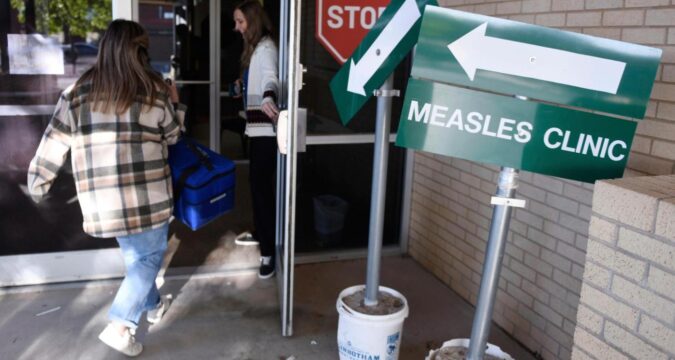
It’s been a year since a measles outbreak began in West Texas, and international health authorities say they plan to meet in April to determine if the U.S. has lost its measles-free designation.
Experts fear the vaccine-preventable virus has regained a foothold and that the U.S. may soon follow Canada in losing the achievement of having eliminated it.
The reevaluation is largely symbolic and hinges on whether a single measles chain has spread uninterrupted within the U.S. for at least 12 months.
Public health scientists around the country are investigating whether the now-ended Texas outbreak is linked to active ones in Utah, Arizona and South Carolina. But doctors and scientists say the U.S. — and North America overall — has a measles problem, regardless of the decision.
“It is really a question of semantics,” said Dr. Jonathan Temte, a Wisconsin family physician who helped certify the U.S. was measles-free in 2000. “The bottom line is the conditions are sufficient to allow this many cases to occur. And that gets back to de-emphasizing a safe and effective vaccine.”
Last year, the Centers for Disease Control and Prevention confirmed 2,144 measles cases across 44 states — the most since 1991 — and nearly 50 separate outbreaks.
The problem has been years in the making, as fewer kids get routine vaccines due to parental waivers, health care access issues and rampant disinformation. More recently, Trump administration health officials have questioned and sown doubt about the established safety of vaccines at an unprecedented level while also defunding local efforts to improve vaccination rates.
“The most important thing that we can do is to make sure the people who aren’t vaccinated get vaccinated,” said Jennifer Nuzzo, director of Brown University’s Pandemic Center. “We have not issued a clear enough message about that.”
A Department of Health and Human Services spokesperson said Thursday that Health Secretary Robert F. Kennedy Jr. has consistently emphasized vaccines as the best way to prevent measles, adding that the CDC is responding to outbreaks and working to increase vaccination rates.
In a briefing Tuesday, department officials said they don’t yet have evidence that a single chain of measles has spread for a year.
But CDC’s principal deputy director said he would consider the loss of elimination status to be the “cost of doing business” globally.
“We have these communities that choose to be unvaccinated,” said Dr. Ralph Abraham. “That’s their personal freedom.”
Measles finds the unvaccinated
There is little room for error in trying to stop measles. The virus is one of the most contagious, infecting 9 out of every 10 unvaccinated people exposed. Community-level protection takes a 95% vaccination rate. The current rate nationally is 92.5%, according to CDC data, but many communities fall far below that.
The patient in Texas’ first known case developed the telltale rash on Jan. 20, 2025, according to state health department data.
From there, the outbreak exploded. Officially, 762 people fell ill, most of them in rural Gaines County, and two children died. Many more got sick and were never diagnosed: 182 potential measles cases among children in Gaines County went unconfirmed in March 2025 alone, state health officials said, a possible undercount of 44% in that county.
Such data gaps are common, though, making it especially hard to track outbreaks. Many people living in communities where the virus is spreading face health care barriers and distrust the government.
Contact tracing so many cases is also expensive, said behavioral scientist Noel Brewer, who chairs the U.S. committee that will finalize the data for international health officials. Research shows a single measles case can cost public health departments tens of thousands of dollars.
CDC data on measles is still among the best worldwide, Brewer said, but “the U.S. has changed its investment in public health, so we’re less able to do the case tracking that we used to do.”
Genetic sequencing can fill some gaps.
But that’s not always enough to say the outbreaks are connected. Genetically, the measles virus doesn’t change as often as, say, flu.
“Within an outbreak, everybody is going to look the same,” said Justin Lessler, a University of North Carolina disease researcher.
The key question may then be how PAHO experts will navigate final data gaps, said Dr. Andrew Pavia, a Utah physician and longtime CDC consultant.
“My best guess is we will lose elimination status,” Pavia said. “The case for this not being continuous transmission is tenuous, and I think they are likely to err on the side of declaring it a loss of elimination status.”
Scientists have confirmed the same measles strain in Texas, New Mexico, Utah, Arizona, South Carolina, Canada, Mexico and several other North American countries, said Sebastian Oliel, a spokesperson for the Pan American Health Organization, which will make the final decision on U.S. measles elimination at an April 13 meeting.
Oliel said when there is a case of unknown origin in a country with ongoing local spread, “the most conservative approach is to consider the case part of the existing national transmission.”
Mexico also up for review
PAHO will review Mexico’s measles-free status alongside the U.S., Oliel said. That country’s largest outbreak has roots in Texas. It started when an 8-year-old boy from Chihuahua state got sick after visiting family in Seminole, Texas. Since last February, 6,000 people have gotten sick in Mexico, and 21 have died in Chihuahua state.
But under PAHO’s definition of elimination, borders matter. If, for example, the chain of measles that started in the U.S. spread to Mexico and then returned to the U.S. anew, it would be considered a new chain, experts said. Still, many experts call that standard outdated.
What’s clear is that measles found ample fertile ground in the U.S. in 2025, infiltrating schools and day cares, churches, hospital waiting rooms and a detention center. New Mexico logged 100 cases and one adult died. Kansas officials spent seven months trying to control an outbreak that sickened nearly 90 people across 10 counties. Ohio confirmed 40 cases. Montana, North Dakota and Wisconsin each had 36.
Now, more than 800 people have gotten sick across Utah, Arizona and South Carolina since late summer, with no end in sight.
“2025 was the year of measles,” Brewer said. “Will 2026 be the year of rising or falling measles cases? Does it get worse or does it get better? No one knows the answer.”
https://www.chicagotribune.com/2026/01/20/measles-elimination-status/

Despite frigid temps, crowd turns out in Federal Plaza to protest the Trump administration
Kaitlin Cordes and a group of moms gathered in a Lincoln Park living room last spring to figure out ways to stand up for democracy under what she called “un-American” attacks from President Donald Trump.
Although Trump has scoffed at allegations that he’s a dictator, Cordes worried about his “authoritarian playbook,” including using government powers to seek revenge against perceived political opponents. So, on a kids’ easel, Cordes brainstormed ideas to push back and co-founded Moms for Democracy.
On Tuesday, on the one-year anniversary of President Donald Trump’s inauguration, Cordes and about 150 others gathered downtown in freezing temperatures to continue to “support democracy and resist moves toward authoritarianism.”
“We all want our children to grow up in a thriving democracy. We want our kids to grow up in a place where masked men do not roam the streets with guns,” Cordes told the crowd, who bundled up in big coats and gloves. “Where we have a government that is truly of the people, by the people and for the people.”
At the Federal Plaza rally, protesters carried signs that read “Hands off Chicago” and “Defend Democracy.” They chanted “no hate, no fear, immigrants are welcome here” as wind chills dipped below zero throughout the afternoon. Moms for Democracy organized the protest alongside Indivisible Chicago, a progressive activist group.
Hundreds have taken to Chicago’s streets in recent days to protest the Trump administration and its aggressive immigration enforcement in Chicago and Minneapolis, including downtown Monday and at the west suburban Broadview ICE processing center Saturday. Federal agents arrested thousands of immigrants, most of whom didn’t have a criminal record, and repeatedly deployed tear gas and pepper spray during Operation Midway Blitz in Chicago.
Protesters march Jan. 20, 2026, around Chicago’s Federal Plaza during a rally to support democracy on the anniversary of President Donald Trump’s inauguration. (Brian Cassella/Chicago Tribune)
The Tribune interviewed several Trump voters who have expressed dissatisfaction with aspects of his leadership. A Reuters/Ipsos poll earlier this month showed 42% of Americans approved of Trump’s job overall.
Alexi Giannoulias, Illinois secretary of state and a likely candidate for Chicago mayor, said never in his “wildest dreams” did he anticipate the “damage (Trump) would do to our democracy.”
“Both my parents came to this country as immigrants, and when they came here, they had nothing, but they believed in the promise of America — that if you’re willing to work hard, if you’re willing to sacrifice and struggle, regardless of what your last name is or what you look like, that you have a shot in this country,” Giannoulias said.
“That is what has always made us the greatest country in the world, and to see the destruction of ICE and the Trump administration is absolutely unacceptable, so we will fight back,” he continued.
He cited a recent lawsuit from the state of Illinois and city of Chicago against the Trump administration as an example of local politicians willing to fight back. The suit seeks to bar agents from using tear gas without sufficient warning and making warrantless arrests.
Colleen Connell, executive director of the ACLU of Illinois, also encouraged members of Congress to reject a government funding bill if it doesn’t include policies to curtail federal immigration agents.
Congress will consider a routine annual funding package for the Department of Homeland Security unveiled Tuesday, or risk a partial shutdown Jan. 30. A growing group of Democratic senators and the Congressional Progressive Caucus say they won’t support additional funds without significant changes.
“Ultimately, we cannot rely on the courts alone to save us,” Connell said. “It is up to we the people to resist, to speak the truth, and we need to start by speaking the truth to our members of Congress.”
For Regan Lachapelle, the other co-founder of Moms for Democracy, the U.S. is a “beacon for democracy” internationally, and that if democracy slips in this country it will weaken everywhere. She also wants to show her two children that democracy is a value they should protect.
“Authoritarians use chaos to confuse, to make us feel scared, to keep us silent. They want you to feel like there’s nothing you can do,” said Lachapelle, of Lincoln Park. “They do this because they know that they are the ones that don’t have the power.”
The Associated Press contributed.
https://www.chicagotribune.com/2026/01/20/chicago-protest-trump-federal-plaza/
Ministro del Interior ruso llega a Cuba y rendirá honores a 32 soldados isleños muertos en Venezuela
Associated Press
LA HABANA (AP) — El ministro del Interior ruso, Vladimir Kolokoltsev, inició el martes una visita oficial a Cuba durante la cual rendirá homenaje a 32 militares isleños muertos en Venezuela a comienzo de mes durante un operativo estadounidense que capturó al entonces presidente Nicolás Maduro, informaron las autoridades.
La detención y posterior traslado a Nueva York de Maduro –un aliado político y económico vital para la nación caribeña— generó inquietud en la isla, sin que haya información oficial pública sobre si Caracas continuará o no vendiendo petróleo a precios preferenciales a la isla.
Rusia, con la cual la isla tiene un amplio programa de cooperación, y México siguen siendo los otros países que envían crudo a Cuba, mientras el mandatario estadounidense Donald Trump ajustó las sanciones contra la isla y amenazó con asfixiarla económicamente presionando un cambio de modelo.
En los últimos años junto con las carencias y desabastecimiento se comenzaron a producir apagones de largas horas que llegaron incluso a cortes nacionales en el suministro de energía, ocasionado tanto por roturas en las viejas centrales para las cuales la isla no cuenta con presupuesto para solucionar o la falta de energía para echarlas a andar.
Las páginas en las redes sociales de la embajada de Rusia en La Habana dieron cuenta de la llegada de Kolokoltsev y mostraron un video en el cual se ve al funcionario en momentos en que es recibido por su colega, el ministro del Interior de Cuba, Lázaro Alberto Álvarez Casas.
Posteriormente, la Agencia Cubana de Noticias (ACN) y medios de prensa oficiales indicaron que la visita comenzó el martes con la colocación por parte de Kolokoltsev de una ofrenda floral ante un monumento que rinde homenaje a los soldados de la era soviética, en las afueras de la capital.
Según la ACN, el funcionario ruso también rendirá en esta jornada honores a los 32 soldados muertos en Caracas y que el gobierno reconoció formaron parte de la seguridad personal de Maduro mediante un convenio de seguridad entre los dos países. Se desconocen los otros puntos de la agenda del funcionario ruso en Cuba.
La semana pasada, en momentos que el presidente Trump incrementó la narrativa hostil contra Cuba y le exigió negociar con Washington antes de que sea “tarde”, el mandatario ruso Vladimir Putin hizo expresa su solidaridad con la isla.

The Reckoning On Immigration Is Here
The Reckoning On Immigration Is Here
Authored by Alex Berenson via Unreported Truths,
The easy part is over.
Americans wanted the borders closed.
For decades, the legacy media and politicians in both parties ignored that wish, claiming the United States had to accept and support an endless flood of illegal migrants. The disconnect between average people and elite opinion was so obvious that academics wrote papers about it.
President Trump broke with the elite consensus from the first day of his 2016 presidential campaign, when he announced “I will build a great, great wall on our southern border.” No issue proved more politically potent for him.
In his second term, Trump has kept his promise. The wall may not be literally complete, but it might as well be. Customs and Border Patrol reports monthly “encounters” with illegal migrants on the southern border have fallen about 95 percent from the Biden Administration average, and 97 percent from their 2023 peak.
But closing the border to new arrivals does not undo the fact that tens of millions of people are living in the United States illegally, or with quasi-legal “asylum” or “temporary protected” status the Trump Administration is now seeking to revoke.
Just how many people are inside the United States illegally? We do not really know. In 2024, the Department of Homeland Security put the figure at roughly 11 million in 2022 — and said the number had not changed for almost 20 years.
That estimate is nonsensical, given that close to 10 million people arrived in the first three years of the Biden Administration alone.
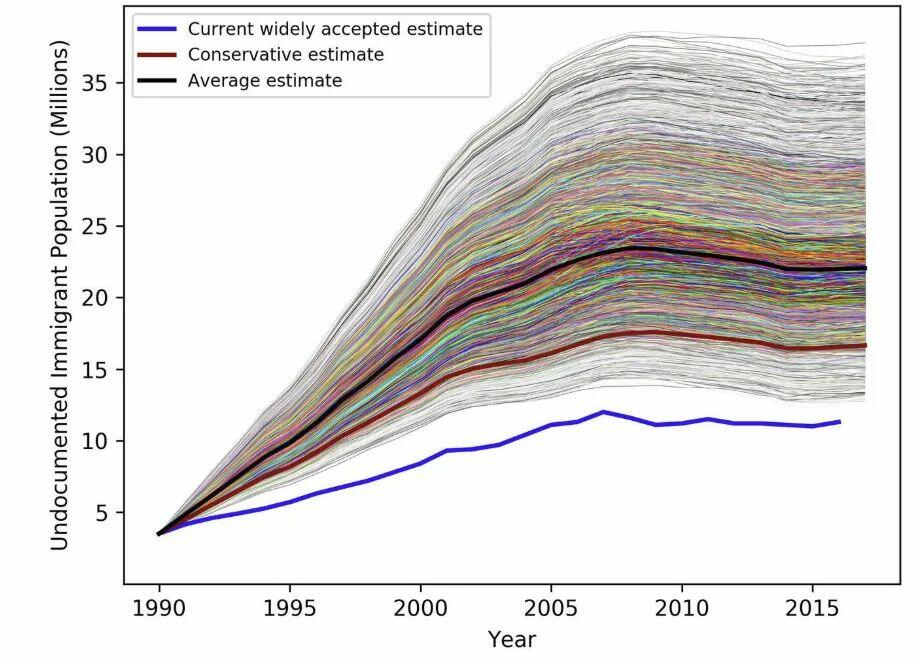
In 2018, in a paper that should have received more attention than it did, three researchers from Yale and MIT estimated about 22 million people — double the official figure — were living illegally in the United States.
As the paper explained, the consensus 11 million figure comes from a census question that “requires accurate responses from survey respondents when asked where they were born, and whether they are American citizens.” In other words, the survey required illegal immigrants to tell on themselves — to government officials. (It’s a surprise the figure was not zero.)
The researchers used a different method, netting out changes in immigration over time by estimating the number of migrants entering, leaving, and dying. To be clear, this was an exercise in modeling, with all the uncertainty that implies. But even a modeled figure is better than a clearly nonsensical one.
Their best estimate was that the number of illegal migrants rose from under 5 million in 1990 to about 22 million before the 2008 financial crisis, then stayed roughly flat for the next decade. This growth makes intuitive sense. The American economy was very strong in the 1990s, and making money is the primary reason people uproot their lives and cross borders.
—
(The 2018 Yale estimate of illegal immigrants in the United States. Note the black line hovering just over 20 million.)
The prolonged recession and slow recovery from the 2008 financial crisis kept a lid on illegal migration for the next several years.
Then three factors combined to drive up migration.
Economic growth accelerated in President Trump’s first term.
Leaders in the Democratic Party began to speak out aggressively against any enforcement of border laws.
And migrants realized they could use asylum claims to gain entry into the United States and become quickly eligible for Medicaid and other public benefits programs, which previously had not been available to them. The number of people claiming asylum rose from 44,000 in 2011 to 209,000 in 2017, according to a State Department report to Congress.
When the Biden Administration took over in 2021, these trends exploded.
Covid lockdowns and plunging tourism devastated Latin American economies, making the United States more attractive. The official 2020 Democratic Party platform essentially called for an end to border enforcement. And requests for asylum surged even further, with almost 480,000 people asking for asylum in 2023 — even as the Biden Administration created other new pathways to admission, like the “Humanitarian Parole Program.”
—
Millions more people simply came across the border without even the fig leaf of an asylum request or humanitarian parole. In 2024, the Congressional Budget Office estimated that about 65 percent of all the migrants in the post-2020 surge — roughly five to six million people — fell in that category.
At an minimum, the United States now probably has close to 20 million people inside its borders who have no legal right to be here under any circumstance. The number may well be closer to 30 million, especially as the Trump Administration strips away the Biden Administration’s expansion of asylum and “humanitarian parole.”
Many of those people are hardworking migrants whose only crime is their immigration status. Others have depended on public assistance since the day they arrived on American soil and have no plans to or realistic hope of getting off it. And some — a small but still real percentage — are criminals.
But they are all present illegally and thus face the risk of deportation. Until now, that risk had been largely theoretical. The United States had operated under a fragile don’t-ask-don’t-tell-style consensus on deportation, which was more or less as follows:
If you can get across the border and you work and do not commit crimes, you will not face a serious risk of immigration enforcement or deportation. And if you have children here, they will be American citizens, under birthright citizenship.
To be clear, the left — not the right — destabilized this bargain.
Opening taxpayer-financed programs to millions of asylees, refugees, and other immigrants with quasi-legal status infuriated many native-born Americans. In combination with the sheer number of new arrivals, the welfare expansion understandably led to an angry backlash.
Now the Trump Administration has made clear that in its view closing the border was the first step, not the last, in immigration enforcement, and that the United States should view the presence of tens of millions of illegal migrants as a mass violation of its laws and sovereignty, even if they are committing no other crimes.
We are about to find out whether most Americans agree.
The easy part — closing the borders — is over.
The hard part — deciding what to do about the people who are already here — comes now.
Tyler Durden
Tue, 01/20/2026 – 17:05
https://www.zerohedge.com/political/reckoning-immigration-here

Although attendance down because of bad weather, Aurora’s Christkindlmarket still had ‘fantastic year,’ organizers say
Although attendance numbers fell short because of the weather, Aurora’s Christkindlmarket still had “another fantastic year,” according to organizers.
Before the final stretch of this season’s outdoor holiday market in Aurora, which takes place at RiverEdge Park near downtown, attendance had been up during good weather but down overall, according to Maren Priebe. She’s the CEO and general manager of German American Events, which puts on the Chicago-area Christkindlmarkets.
Now that the market has closed for the season, the final attendance numbers are in, and they show a similar trend to what Priebe had described before. Attendance was up 20% over last year on good weather days, but the event saw fewer attendees overall because of serious winter weather during some of the market’s busiest times, she said.
The region has seen unusually heavy and record-breaking snowfall this season, with one Saturday in November even breaking a Chicago daily snowfall record set in 1951. Weather officials have said this year had the “quickest start to winter” since 1978, according to the Chicago Tribune.
The snow forced the market to close early on Nov. 29 because of the major snowfall, according to Priebe. She said that weekend is typically “super successful” with attendance.
Another very popular day, Dec. 13, saw extremely cold temperatures that forced the market to again close early, Priebe said. Still, she was “pleasantly surprised” by the turnout the next day, even with the very cold temperatures.
Overall, Aurora’s Christkindlmarket saw 220,000 visitors this season, which was about 55,000 less than the year before. Before opening day, officials told Beacon-News columnist Denise Crosby that the market could easily see 325,000–350,000 attendees this year, barring any kind of weather occurrence.
The market ran from Nov. 21 to Christmas Eve and was generally open Thursdays to Sundays, but also ran the Monday, Tuesday and Wednesday before Christmas.
Priebe had attributed to repeat business much of the increase in attendance seen this season during days with more standard weather. The Aurora market has a good following now and is becoming a family tradition, one that people are bringing others along for, she previously said.
RiverEdge Park’s General Manager Jim Jarvis recently said he was hearing the same thing from greeters: that Aurora’s Christkindlmarket is becoming a tradition.
Plus, Aurora’s event is larger than other markets and also convenient, with a Metra station and free parking within walking distance, Priebe previously said.
Although attendance numbers were down this season, vendors at the holiday market still saw higher sales than in years past, she said recently. They are “elated” at how things went, she said, and on some days even saw higher sales in Aurora than at the Chicago locations.
Christkindlmarket’s economic impact extends beyond just the vendors who participate in it. The city of Aurora’s director of economic development, David Dibo, said that local businesses and restaurants are feeling a significant positive impact from the market, both this year and in years past.
The same days that the market’s attendance dropped because of weather, he said, businesses also felt it.
Still, Aurora is working on further moving people from the market to local businesses, especially those in the nearby downtown, according to Dibo. Jarvis said that, when construction at both the park and nearby buildings is complete, it’s going to be a “beautiful walk” from the park to the downtown core of the city.
Christkindlmarket is honored to be the first group to be hosted at the newly-renovated RiverEdge Park, Priebe said, although that work is still ongoing. According to Jarvis, some construction was actually happening while the market was open, although people wouldn’t have known.
The market this season was up to 70 vendors, and because of the renovations that number is set to further increase next season, Priebe said. New vendors are already looking to participate, she said, and typically finding good vendors is the hardest part, so that’s one problem the Aurora location doesn’t have.
Plus, Christkindlmarket is planning to bring some new events and attractions to RiverEdge Park, she said.
Planning for next season’s market is actually set to begin within the month, according to Jarvis. He said that people often don’t realize the amount of work that goes into planning this event.
rsmith@chicagotribune.com
https://www.chicagotribune.com/2026/01/20/aurora-christkindlmarket-2025-weather/
Amendments to welfare fraud bill fail in Indiana Senate
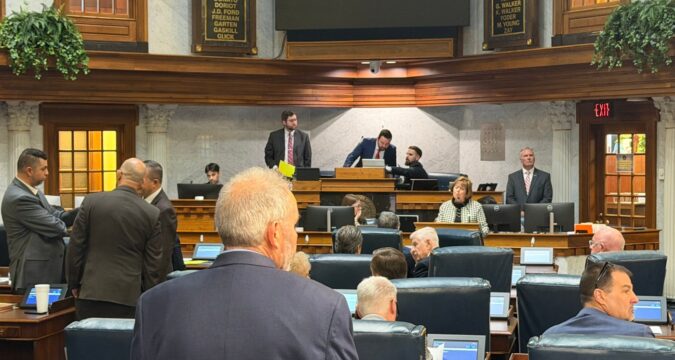
Indiana Senate Democrats filed six amendments Tuesday bill aimed at tackling welfare fraud, which is a Senate Republican priority, but all of their amendments failed.
Senate Bill 1, authored by State Sen. Chris Garten, R-Charlestown, was filed to prevent fraud and contain state spending on welfare programs because “Americans are outraged by the billions of dollars of welfare fraud in our nation — and the Minnesota scandal is Exhibit A,” according to a press release.
Minnesota has been under the spotlight for years for Medicaid fraud, including a massive $300 million pandemic fraud case involving the nonprofit Feeding Our Future. Prosecutors said it was the country’s largest COVID-19-related fraud scam and that defendants exploited a state-run, federally funded program intended to provide food for children.
In 2022, during President Joe Biden’s administration, 47 people were charged. The number of defendants has grown to 78 throughout the ongoing investigation. So far, 57 people have been convicted, either because they pleaded guilty or lost at trial.
In news interviews and press releases over the summer, then-federal prosecutor Joe Thompson estimated the total loss from all fraud cases could exceed $1 billion. Thompson left the U.S. Attorney’s Office in Minnesota last week over the way the investigation of the Jan. 7 shooting of Renee Good by ICE agent Jonathan Ross is being handled, according to the New York Times and Minnesota Star-Tribune.
The 24-page bill will end the state’s participation in the use of expanded categorical eligibility within the federal Supplemental Nutrition Assistance Program, set gross income standards and countable resources for SNAP eligibility, and establish immigration eligibility requirements for SNAP.
Undocumented immigrants are already ineligible for SNAP. The only non-citizens who may qualify are lawful permanent residents, or Green card holders; asylees; and other legal residents under temporary protected status, according to the Center for Budget and Policy Priorities.
State Sen. Fady Qaddoura, D-Indianapolis, filed two amendments: one for the state to fully fund the state’s portion of SNAP administrative costs and for the state to establish a program to feed school-aged children over the summer.
The fiscal note of Senate Bill 1 estimates that potentially up to 3,000 families would have to be redetermined to see if they can remain on SNAP, Qaddoura said. Currently, the state has to pay up to 50% of the administrative costs, and that will increase to 75%, he said.
“This measure is extremely necessary for Indiana to continue to fund the SNAP program in the state of Indiana so that those who are eligible could continue to receive those benefits,” Qaddoura said.
Qaddoura also filed an amendment for the state to establish its own SUN Bucks program, a federal program that ensures school-aged children receive food over the summer, for the summer of 2026 because the state didn’t apply to the program for this year. Then, the amendment would require the state to apply to the federal SUN Bucks program for 2027.
“We used to be a donor state to the federal government. Meaning, our tax dollars that we pay to the federal government they go, if we don’t use it, they will take it and spend it in different states. It’s helpful for us to leverage those dollars and bring them back to Indiana,” Qaddoura said.
State Sen. Shelli Yoder, D-Bloomington, filed four amendments on the Medicaid portion of the bill: two amendments addressing criteria for being medically frail, requiring FSSA to provide Medicaid information on its website, and defining rehabilitation programs as eligible for Medicaid.
Garten, the bill author, spoke against each amendment. All of the amendments failed.
Under the bill, a SNAP applicant’s immigration status can’t be verified, the applicant’s information will be “immediately referred to the U.S. Department of Homeland Security for investigation and potential deportation proceedings,” Garten said in a release.
Senate Bill 1 also establishes the time frame for Medicaid eligibility redeterminations, and requires the secretary of family and social services to transmit certain information to the federal government to prevent multiple state Medicaid enrollment.
The bill further sets income requirements for Medicaid, and modifies immigration status requirements for Medicaid, including presumptive eligibility, including an increase to 80 hours of work or volunteering per month, and the Healthy Indiana Plan, and requires the office to verify compliance of the requirements and report information to the federal government.
Under HIP, the bill modifies work and exemption requirements and requires the conditions to be met in the three preceding months before an individual applies. The bill directs the Secretary of Family and Social Services to verify compliance with the work requirements on an ongoing basis and at least quarterly.
Senate Bill 1 removes the 12-month eligibility period for HIP and requires semiannual renewal, and it sets an additional copayment for the use of an emergency room for nonemergency services and other services under HIP.
The Senate Appropriations Committee amended the bill last week to include that candy and soft drinks can’t be purchased with SNAP benefits. The amendment further establishes the Indiana Rural Health Transformation Fund.
The bill moves forward for final consideration by the Senate.
https://www.chicagotribune.com/2026/01/20/amendments-to-welfare-fraud-bill-fail-in-indiana-senate/