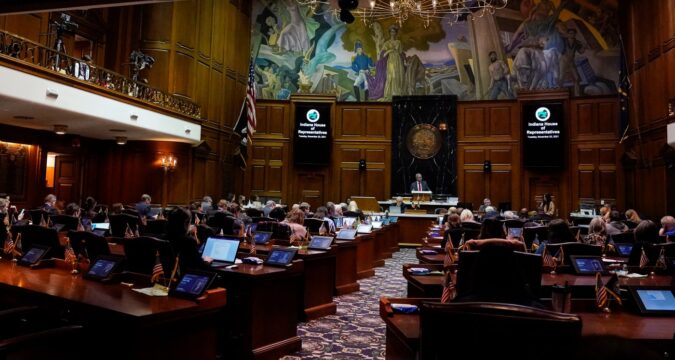
The Indiana House voted against more than a dozen Democratic amendments to the redistricting bill Thursday, which allowed the bill to advance, as is, for final approval by the House Friday.
House Bill 1032, authored by State Rep. Ben Smaltz, would allow the legislature to amend congressional districts “at a time other than the first regular session of the general assembly convening immediately following the United States decennial census.”
The bill also establishes new Indiana Congressional districts, and states that any challenges to the new maps will be heard by the state’s Supreme Court. The bill states that the current Congressional Districts won’t expire before Nov. 3, 2026.
In committee Tuesday, Smaltz, R-Auburn, said Indiana is taking up mid-census redistricting because of that action across the country, including Texas, California, Virginia and Missouri. The constitution allows for Congressional Districts to be drawn with political consideration in mind, he said.
“We have drawn these maps to create a Republican political advantage,” said Smaltz, R-Auburn.
House Democrats offered 15 amendments, all of which failed, during second reading Thursday. The amendments offered protection for minority voters, different approaches to redistricting, and addressed fiscal implications of the bill.
State Rep. Robin Shackleford, D-Indianapolis, offered two amendments that would provide protections for minority voters: for the Legislative Services Agency to analyze the impact of the proposed maps on Black and Latino voters; and to analyze the proposed districts to ensure they comply with nondiscrimination statutes in the Voting Rights Act of 1965 and the U.S. Constitution.
“I do not support this redistricting process by any means, but if the majority insists on forcing new maps, the least we can do is require a district-by-district analysis to prevent discrimination,” Shackleford said. “The majority should at least verify that the maps do not violate the federal law or harm any minority communities.”
The bill “has been carefully crafted for political performance” and is consistent with state and federal laws, Smaltz said.
State Rep. Mitch Gore, D-Indianapolis, offered an amendment to request Congress pass a law that bans gerrymandering, which is when the party in charge draws Congressional maps in its favor.
Gore said he offered the amendment since House Republicans have stated the reason for mid-census redistricting is due to gerrymandering in other states.
“You don’t put out a fire by pouring gasoline on it,” Gore said.
Smaltz encouraged House members and the public to contact Congress to address gerrymandering.
State Rep. Sue Errington, D-Muncie, offered an amendment that stated the bill won’t go into effect until improved metrics for utility costs, health care, and childcare are reached.
State Rep. Matt Pierce, D-Bloomington, proposed an amendment that would’ve established a nonpartisan redistricting system where the Legislative Services Agency offers maps, which get edited by and voted on by the legislature.
This process is similar to the one used by Iowa, he said.
“It would be based on things other than political outcomes,” Pierce said.
State Rep. Carey Hamilton, D-Indianapolis, said she supported Pierce’s amendment because it’s a fair way to address redistricting.
“We can send a signal to Congress that this is what’s best for our country. Let’s lead the way,” Hamilton said. “Let’s flip the script.”
While Iowa uses the process successfully, Smaltz said Virginia proves the process has flaws. Congress should make a uniform law to address redistricting, Smaltz said.
Two bills requesting either fiscal analysis or support to local municipalities after the congressional districts change were ruled out of order.
State Rep. Earl Harris, D-East Chicago, offered an amendment to create a study to determine the cost of mid-decade redistricting, which failed.
“This week, Indiana Republicans have shown us that they don’t care what Hoosiers want, they don’t care about the process, and they don’t care about the cost if it means they get to retain power,” Harris said in a statement after the House session.
When the legislature last convened a two-week special session to pass a near-total abortion ban in 2022, it cost $240,151.
A few hours before gaveling in Monday, the House released its proposed map that splits the current First District, held by U.S. Rep. Frank Mrvan, D-Highland, into two, and the Seventh District, currently held by U.S. Rep. André Carson, D-Indianapolis, into four sections.
The new map was drawn by a group that works with the National Republican Committee, Smaltz said.
President Donald Trump and his administration has asked Republican-led states to undertake mid-census redistricting to maintain the Republican majority in the U.S. House of Representatives.
Redistricting typically occurs every 10 years after the release of census data. The Indiana constitution dictates that the legislature should take up redistricting every 10 years after census data is released.
In response to Trump’s request, Texas conducted mid-census redistricting to give Republicans five more seats, to which California responded with voter-approved mid-census redistricting to create five more seats.
In August, Vice President JD Vance met with state Republicans to discuss redistricting in Indiana. Ultimately, after more meetings and discussions with federal officials, Gov. Mike Braun called for a special session to address redistricting.
Both chambers of the Indiana legislature agreed to meet Dec. 1 to discuss redistricting. Ahead of Organization Day, Nov. 18, Senate President Pro Tempore Rodric Bray, R-Martinsville, announced the Senate does not have the votes to pass new maps and canceled the Senate’s December session.
Officials with the Indiana House have maintained that they have the votes to pass new maps, and at the end of Organization Day House Speaker Todd Huston, R-Fishers, told his chamber to be prepared to come in December to address redistricting.
If the bill passes the House Friday, it will move forward for consideration by the Senate. After multiple swatting calls against Republican Senators, Bray said the Senate would meet Dec. 8 to consider any maps passed by the House.


