Aurora Christian School may be known for its athletic programs, but in November much of the excitement in the hallways centered around a nerdier display of strategy and competition.
For the past 11 years, ever since Jerry Baker arrived at Aurora Christian, this veteran government teacher has been conducting a mock Congress where, for two days, all seniors take on the role of our country’s leaders as they try to pass laws that, in the end, will help them better understand how our government works.
It is a “very big deal,” says Aurora Christian Principal Collette House, who has a front row seat at how much work – and passion – goes into the event recently held over two days at the school.
House, like many educators across the nation, is well aware how civics has been watered down in schools, with courses in government often shortened or folded into broader social studies classes that tend to focus on memorizing facts rather than critical thinking.
As a teacher for 38 years, and a self-professed patriot, Baker is among those who are concerned. Kids “have become like puppets,” who can read from a textbook and answer questions on a test, he told me, “but don’t know how to apply” this knowledge to the real world.
That’s why his stint at Aurora Christian has always included an annual mock Congress for seniors, an event enthusiastically embraced by students along with their families who filled the 165-seat “gallery” in the school’s auditorium on Nov. 20 – and the following day – to watch this year’s “senators and U.S. representatives” determine what bills become laws and which ones get waylaid.
It’s a lot of tough work from the sounds of it. That’s especially true for the handful of students Baker chose as juniors last semester to assume Congress’ five leadership roles.
He began working with this group almost immediately. These students even met over the summer to get ready to “take on the reins of power,” as their teacher put it, so he could “back away and become just the scorekeeper.”
For Tessa Sepulveda, the role of Speaker of the House involved countless hours of preparation – in school and out of class. The project involves “a lot of moving parts,” she explained. And it called upon all her organizational abilities, as well as team-building skills she acquired over four years of playing volleyball.
Aurora Christian senior Tessa Sepulveda spent months of preparation to take on the role of Speaker of the House at the school’s mock Congress held recently. (Stacy McReynolds)
“It’s hard to work together when there are so many different beliefs,” Sepulveda told me. “But it can’t run unless the two sides are working together. Once we figured out how to do that, things moved more smoothly and it was more enjoyable.”
This year, after the 56 seniors were assigned roles, they were given three packets: one involved extensive research on their elected officials and the district he or she represented, the second focused on what bills they could sponsor and the final section was the creation of an election commercial or advertisement.
Aurora Christian senior Alexa Waweru plays U.S. Rep. Maxine Waters from California at the school’s mock Congress held recently. (Stacy McReynolds)
With at least a dozen pop quizzes under their belts, by the time the students put on this mock Congress, they had mastered the art of parliamentary procedure, said Baker. Just as critical, they knew how to reach across the aisle and convince their opponents their bill was worthy of their vote.
As Baker noted, “it didn’t take them long to realize how complicated getting a bill passed can be when compromise is essential.”
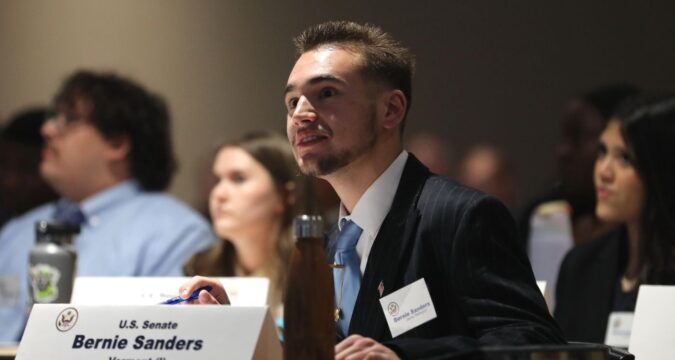
Making it even more challenging, he deliberately paired students with Republican backgrounds to Democratic figures, and vice versa. For example, James Wellington, who describes himself as “very conservative,” took on the role of Bernie Sanders, even using the iconic Vermont senator’s mannerisms and quotes as he argued for his bills, including one that got passed assuring funding for the Department of Education.
“I knew Bernie cared a lot about education,” Wellington said, adding that, because this issue “is not as radical, I knew I could make it something that could get passed.”
Like his conservative classmate, James Gibson knew he’d have to “be fair and not biased” when taking on the role of U.S. Rep. Bill Foster. While researching the Illinois Democratic congressman, Gibson soon realized that, despite their political differences, they were “also similar in many ways.”
And for the first time he learned “interesting” things about the man behind the political name: that Foster was a “scientist, successful businessman” and “family man of integrity” with “a good heart.”
“We all want a better America for our future,” Gibson said. “We just think differently.”
While Gibson’s bills, which included funding for clean energy, STEM education and SNAP benefits for children, did not pass because of procedural errors, the combination of “hard work” and a “passionate” teacher made this learning experience one he will never forget.
Having already made contact with Foster’s office, Gibson even hopes to meet the congressman one day in person.
Aurora Christian government teacher Jerry Baker, second from left, talks to some of his students during the recent mock Congress held at the school. (Stacy McReynolds)
Like his classmates, Jake Eissens, who played New Jersey’s Democratic U.S Rep. Frank Pallone but took on the role as the House minority leader, had been looking forward to this mock Congress since he was in grade school. And it did not disappoint, he told me, adding that the leadership skills he picked up as captain of the football team really “came through” in those two days of intense mental competition.
“As Mr. Baker explained it to us,” said Eissens, “it is like a chess match between the minority and majority parties, with plenty of playmaking going on.”
For Baker, who also requires his students over age 18 to register to vote, there are few things more important than preparing these “future voters and leaders of our country” to understand our system of government.
“I love doing this,” he insisted. “And when it is all over, I want them to be exposed to what Abraham Lincoln said: That our government is the last best hope of Earth.”
dcrosby@tribpub.com


