Category: News

Goretzka: Trump nos hace sentir “no solo alemanes, sino también europeos”
MÚNICH (AP) — El centrocampista alemán Leon Goretzka afirmó que el presidente estadounidense Donald Trump “ha logrado que nos sintamos no solo alemanes, sino también europeos”.
Goretzka, quien juega para el Bayern Múnich, habló sobre la Copa del Mundo que será organizada por Estados Unidos, Canadá y México, y sugirió que Alemania y otros equipos europeos serán los favoritos.
“Otros nos han alcanzado, pero en el deporte más importante del mundo todavía estamos por delante de todos los continentes”, expresó Goretzka en una entrevista con el periódico Die Zeit publicada el miércoles. “Lejos de quedarnos atrás, Europa mostrará a todos lo que es en la cancha”.
En Europa, la cuenta regresiva para el torneo del 11 de junio al 19 de julio ha generado llamados de un boicot. Oke Göttlich, el presidente del club de la Bundesliga St. Pauli y uno de los 10 vicepresidentes de la federación alemana, dijo la semana pasada que había llegado el momento de “considerar y discutir seriamente esto”.
El ex presidente de la FIFA, Joseph Blatter, también se pronunció a favor de un boicot el lunes.
“Soy consciente de los debates políticos”, manifestó Goretzka. “Aun así, espero que sea un gran torneo. El fútbol crecerá allí y convencerá a muchas personas de que es un deporte fantástico”.
Alemania enfrentará a Costa de Marfil, Curazao y Ecuador en el Grupo E del Mundial.
___
Deportes AP: https://apnews.com/hub/deportes
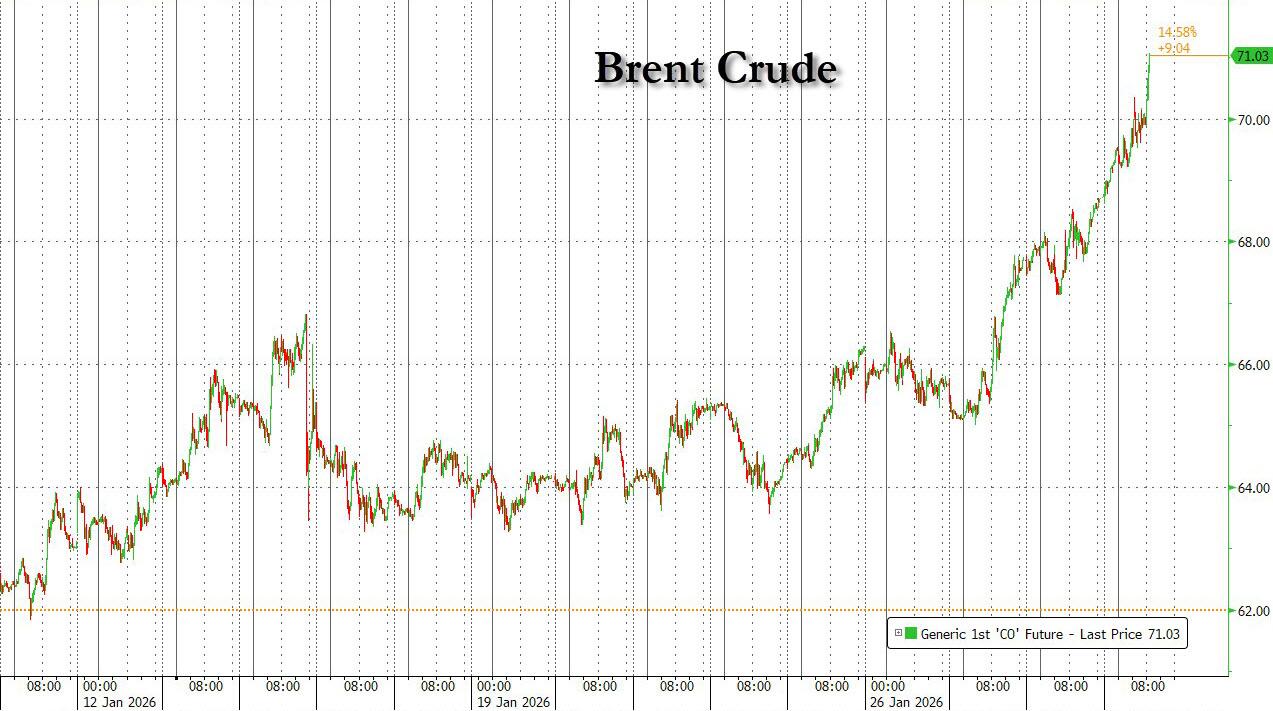
Brent Surges To 4 Month High Above $70 After Trump Threatens Iran With Military Force
Brent Surges To 4 Month High Above $70 After Trump Threatens Iran With Military Force
By Charles Kennedy of OilPrice.com
Brent Crude prices topped $70 per barrel – and $71 shortly after – early on Thursday for the first time since September, as U.S. President Donald Trump warned Iran that a “massive armada” of U.S. Navy ships is headed to the Persian Gulf.
At the time of writing, Brent Crude prices had jumped by 3.38% at $70.71. This was the highest in more than five months and the first time the international benchmark has topped $70 per barrel since early August. The U.S. benchmark, WTI Crude, was also trading higher, up by 3.51% to $65.43. WTI topped $65 per barrel for the first time since September.
After a week or so of relative calmness in the U.S. rhetoric toward Iran, which continued to brutally suppress mass protests, President Trump warned the Islamic Republic of a Venezuela-style “mission,” at least this is what the President suggested in a post on his Truth Social platform.
“A massive Armada is heading to Iran. It is moving quickly, with great power, enthusiasm, and purpose,” President Trump posted.
“It is a larger fleet, headed by the great Aircraft Carrier Abraham Lincoln, than that sent to Venezuela. Like with Venezuela, it is, ready, willing, and able to rapidly fulfill its mission, with speed and violence, if necessary,” the President continued.
He urged Iran “to make a deal” pledging “NO NUCLEAR WEAPONS,” otherwise, President Trump said, “The next attack will be far worse! Don’t make that happen again.”
Markets reacted to the renewed tension in the world’s most important oil-producing and exporting region, and oil and gold soared.
Iran, for its part, said that its army is ready to “immediately and powerfully” respond to any possible attack by the United States.
“Our brave Armed Forces are prepared—with their fingers on the trigger—to immediately and powerfully respond to ANY aggression against our beloved land, air, and sea,” Iran’s Foreign Minister Abbas Araghchi posted on X.
If Trump tries to enforce a blockade, Iran will retaliate using asymmetrical means.
The Houthis caused havoc for global trade by hitting just 30 vessels over two years. Iranian attacks on merchant vessels in the Persian Gulf will have far greater impact.https://t.co/oLKvUzFrVd
— Esfandyar Batmanghelidj (@yarbatman) January 28, 2026
Commenting on the latest flare-up in the Middle East, ING commodities strategists Warren Patterson and Ewa Manthey said on Thursday, “Clearly, this more aggressive rhetoric has left the oil market nervous about the potential for supply disruptions.”
Tyler Durden
Thu, 01/29/2026 – 09:35

US life expectancy hit an all-time high in 2024, CDC says
NEW YORK — U.S. life expectancy rose to 79 years in 2024 — the highest mark in American history.
It’s the result of not only the dissipation of the COVID-19 pandemic, but also waning death rates from all the nation’s top killers, including heart disease, cancer and drug overdoses.
What’s more, preliminary statistics suggest a continued improvement in 2025.
“It’s pretty much good news all the way around,” said Robert Anderson, of the National Center for Health Statistics at the Centers for Disease Control and Prevention, which released the 2024 data on Thursday.
Life expectancy, a fundamental measure of a population’s health, is an estimate of the average number of years a baby born in a given year might expect to live, given death rates at that time.
For decades, U.S. life expectancy rose at least a little bit almost every year, thanks to medical advances and public health measures. It peaked in 2014, just shy of 79 years.
It was relatively flat for several years before plunging as the COVID-19 pandemic killed more than 1.2 million Americans. In 2021, life expectancy fell to just under 76 1/2 years. It has been rebounding since.
The data reflect not only a complete turnaround from the pandemic but also a lasting improvement in the drug overdose epidemic, said Andrew Stokes, a researcher at Boston University.
The bad news is that the U.S. still ranks below dozens of other countries, Stokes noted.
“There’s a lot more to be done,” he said.
In 2024, about 3.07 million U.S. residents died, about 18,000 fewer than the year before. Death rates declined across all racial and ethnic groups, and in both men and women.
Heart disease remained the nation’s leading cause of death, but the death rate due to it dropped by about 3% for the second year in a row. A combination of factors are likely at play, including advances in medical treatments and weight management, said Dr. Sadiya Khan, who treats and studies heart disease at Northwestern University.
Deaths from unintentional injuries — a category that includes drug overdoses — fell the most, dropping more than 14% in 2024. COVID-19, which only a few years ago was the nation’s No. 3 killer, in 2024 dropped out of the top 10.
COVID-19’s fall meant suicide moved into the top 10, even though suicides in 2024 declined. Homicides fell that year, too, this week’s report said.
Deaths statistics for 2025 are not finalized, but preliminary data suggest around 3.05 million deaths have been recorded. That number may grow as more death certificates are rounded up and analyzed, but Anderson said he expects last year will end up at least a slight improvement over the 2024.
https://www.chicagotribune.com/2026/01/29/us-life-expectancy/

IDEM releases updates on efforts to reduce lead, copper exposure in water
The Indiana Department of Environmental Management announced that the state is among national leaders in efforts to reduce exposure to lead and copper in drinking water.
IDEM, in a Jan. 16 news release, said that Indiana’s water systems have submitted more than 98% of the required lead service line inventories.
“Indiana’s proactive approach and high submission rate show we’re not just meeting federal expectations, we’re setting the pace nationally,” IDEM Commissioner Clint Woods said in a news release. “This milestone reflects the dedication of our water systems and IDEM’s commitment to supporting them.”
According to IDEM, 1,355 of Indiana’s water systems have submitted inventories, which the agency calls “a significant achievement given the state’s size and complexity.” Indiana has 1,376 water systems.
In 2024, the agency’s Drinking Water Branch worked with water systems statewide to complete and submit inventories, and the team worked with the Indiana Finance Authority to create an online Public Water System Portal to streamline submissions.
The branch also created a public-facing site that allows Hoosiers to view submitted inventories, and it displays service line locations, material types and relevant contact information for public water systems, according to the news release.
“We want to thank all the water system operators for their hard work and dedication in completing their service line inventories,” Drinking Water Branch Chief Matt Prater said in a news release. “These inventories are a critical first step in protecting Hoosier families and ensuring safe drinking water for generations to come.”
Throughout the state, 21 water systems not yet provided a service line inventory. Two water systems are in Porter County and one is in LaPorte County. All Lake County systems have provided a service line inventory.
In October 2024, President Joe Biden’s administration issued a final rule requiring drinking systems nationwide to identify and replace lead pipes within 10 years, according to the U.S. Environmental Protection Agency. The EPA also announced at the time that it planned to provide $2.6 billion in drinking water infrastructure, according to Post-Tribune archives.
“These timelines have not shifted with the new federal administration,” an IDEM spokesperson said in an email. “Should dates or specific requirements change, IDEM will work with utilities to help ensure compliance.”
In April 2025, the city of Hammond received $5 million through the Indiana Finance Authority’s State Revolving Fund program to help replace its lead service lines, according to Post-Tribune archives. Through the program, Hammond would save about $5.5 million in principal and interest costs, according to archives, which should help replace lead service lines for about 400 Hammond homes.
The Biden administration issued the lead pipes final rule a decade after the Flint, Michigan, water crisis, which exposed the city’s residents to dangerous levels of lead and outbreaks of Legionnaires’ disease — a severe form of pneumonia that’s caught through inhaling bacteria from water or soil.
The EPA first announced the proposed Lead and Copper Rule Improvements on Nov. 23, 2023, which included achieving 100% lead pipe replacement within 10 years, locating legacy lead pipes and strengthening protections to reduce exposure.
According to IDEM, Indiana’s water systems are required to submit a replacement plan to the state by Nov. 1, 2027, and line replacement must be completed by 2037.

‘Thrown into the fire,’ Lake Central’s Alex and Emma Myszak stick together. The sisters always do.
Lake Central’s Alex Myszak has been interested in dentistry for years.
Myszak’s younger sister Emma had a hand — or teeth — in making that a career choice.
“I always just liked going to the dentist growing up,” Alex Myszak said. “I really enjoyed getting the dentist appointments. That made me want to be a dentist because I liked going there.
“When I was younger, I used to pretend to clean Emma’s teeth. I pretended I was a dentist on her. So it just stuck with me as I got older.”
Alex and Emma Myszak have stuck together for the Indians (11-12, 4-3), who finished fourth in the Duneland Athletic Conference and will play Munster in a Class 4A sectional semifinal on Feb. 6.
Alex Myszak, a 5-foot-9 senior guard, was averaging 5.1 points, 2.4 rebounds, 1.4 assists and 1.0 steals off the bench before the regular-season finale against Washington Township on Thursday.
Emma Myszak, a 5-10 sophomore guard, is Lake Central’s second-leading scorer behind sophomore forward/center Jill Beaderstadt as a starter and was averaging 7.2 points, 4.0 rebounds and team highs of 2.4 assists and 1.5 steals.
The Myszak sisters don’t take playing together for granted.
“It’s fun,” Emma Myszak said. “I’ve played with her for a while. This is the last of it, so we’re trying to make it last as long as possible. After we lose, we’re done. It’s my last time playing with her.”
Alex Myszak believes it’s going well.
“We’re sisters, so I feel like we have good chemistry, a different type of chemistry that you just don’t have even with your friends,” she said. “That helps us. We do get along well.”
Lake Central coach Joe Huppenthal does recall a few instances when Alex and Emma Myszak butted heads.
“There’s been a couple times at practice where they’ve been barking at each other,” he said. “But they’re inseparable. That’s good to see. Families have squabbles. One shooting drill, one of them gave the other one a bad pass, and one was barking at the other. But that happens. It doesn’t matter if you’re sisters or not. But their relationship is really good.
“The way Alex has handled her situation, she could be like, ‘My sister is starting in front of me.’ But she is more than supportive of Emma in that role, and Emma is supportive of Alex in her role. That’s important. That’s what makes it go.”
Lake Central’s Alex Myszak (22) shoots a free throw as Valparaiso’s Allison Sedevic (11) watches during a Duneland Athletic Conference game in St. John on Thursday, Jan. 22, 2026. (John Smierciak / Post-Tribune)
Alex Myszak took her bench role in stride, according to Huppenthal.
“Alex has had a problem with confidence,” Huppenthal said. “So all summer, all year, we’ve been telling her, ‘Next play, be confident.’ It’s a lot better than where it was. She can still grow there, but I like where she is right now. The one thing about Alex, her little sister is starting before her, and this kid has taken that and understands what’s best for our team and has just accepted her role in a great way. I haven’t even talked to her about it. That tells you the kid, the person, she is.
“That’s not easy. Your little sister’s starting, you’re not, you could be asking why. Alex could start. But what’s best for our team and what’s best for Alex, she gets to ease into the game and comes in with some confidence. We started her a couple of games, and it didn’t go so well. I said, ‘Let’s keep it this way.’ She’s grown as a person and as an individual, which for me and our program is so important. The girl’s going to be a dentist. That speaks volumes.”
Lake Central’s Emma Myszak, right, drives against Valparaiso’s Bri Fincannon during a Duneland Athletic Conference game in St. John on Thursday, Jan. 22, 2026. (John Smierciak / Post-Tribune)
Alex and Emma Myszak are part of an athletic family. Their brother Ethan, who graduated from Lake Central in 2020, played baseball growing up, and their sister Amayah, who graduated from Lake Central in 2023, competed in wrestling and soccer.
The Myszaks’ father, Jeff, is a 1997 Lake Central graduate who played baseball at St. Joseph’s in Rensselaer and is entering his first season as Calumet’s baseball coach. He was an assistant for the Indians’ 4A state championship team in 2012 and worked as the hitting coach at Calumet College under his father, Tony, who died Dec. 12.
“Jeff’s a competitor, and that’s instilled at home,” Huppenthal said. “These kids are gym rats. They’re always up here shooting, trying to get better. They have that work ethic.
“Both of these kids were thrown into the fire, thrown into varsity basketball in big roles in a program that’s been highly successful, and they’ve adjusted to the process and bought into the process. It’s not easy, and it’s not supposed to be, and I’m super proud of them.”
https://www.chicagotribune.com/2026/01/29/basketball-lake-central-alex-myszak-emma-myszak/
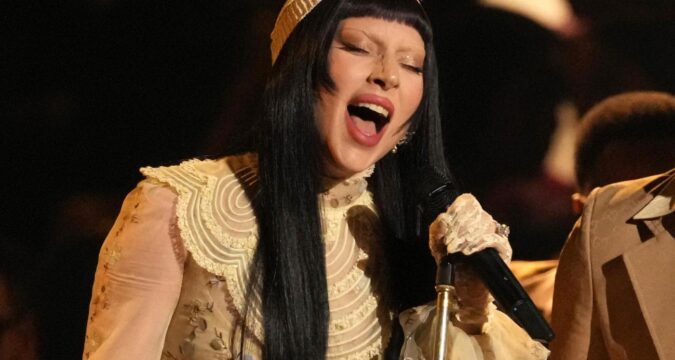
Kendrick Lamar, Lady Gaga, K-pop and more: AP predicts who will win at the 2026 Grammys
The competition is fierce. Kendrick Lamar’s dominance continues at the 2026 Grammy Awards, where he leads the nominations with nine. He’s followed closely by Lady Gaga, Jack Antonoff and Canadian record producer/songwriter Cirkut, who boast seven each. Then it’s Sabrina Carpenter, Bad Bunny, Leon Thomas and Serban Ghenea with six.
But who will win? Who will make history at the 68th Grammy Awards on Feb. 1?
The Associated Press’ Maria Sherman and Jonathan Landrum Jr. break down the close races for Grammy glory.
Album of the year
“Debí Tirar Más Fotos,” Bad Bunny; “Swag,” Justin Bieber; “Man’s Best Friend,” Sabrina Carpenter; “Let God Sort Em Out,” Clipse, Pusha T and Malice; “Mayhem,” Lady Gaga; “GNX,” Kendrick Lamar; “Mutt,” Leon Thomas; “Chromakopia,” Tyler, the Creator.
SHERMAN: Starting off with the big guns. Last year’s “Cowboy Carter” victory was long overdue for Beyoncé. That, and an evolving Recording Academy electorate, is enough to inspire hope that winners may soon be in sync with the current cultural zeitgeist. But change is slow, and it is most likely Lady Gaga will be awarded. “Mayhem” is a great album, but her victory will be more about narrative — recognizing a game-changing artist with her return-to-form record — instead of who should really win this year. That’s Bad Bunny’s “Debí Tirar Más Fotos.” (Let’s not forget all Latin Recording Academy members were invited to join the Recording Academy in 2025, but it is not clear how many can actually vote.) The world would love to see a Spanish-language album win for the very first time — Bad Bunny was once again the most streamed artist, globally, on Spotify last year.
There’s also “GNX,” which deserves the victory, as well. But the 2025 ceremony felt like Kendrick Lamar’s victory lap, and even with three rap albums nominated in the top spot, it’s not clear whether voters will give him the recognition he deserves.
LANDRUM: I understand the appeal of a breakthrough narrative here, especially with such a globally representative field. But this category tends to land with the project that moved most cleanly across multiple spaces without explanation. “GNX” stayed active across music, sports and everyday culture throughout the year. Let’s not forget that songs “luther” and “Squabble Up” sustained long-term engagement; “TV Off” entered everyday language with the “Mustard” catchphrase; and “Dodger Blue” extended the project into sports culture during the Los Angeles Dodgers’ championship run. Much respect to the other nominees here, but Lamar delivered a tightly structured album that circulated naturally. That kind of sustained presence usually carries more weight than momentum built around a single lane.
Record of the year
“DtMF,” Bad Bunny; “Manchild,” Sabrina Carpenter; “Anxiety,” Doechii; “Wildflower,” Billie Eilish; “Abracadabra,” Lady Gaga; “luther,” Kendrick Lamar with SZA; “The Subway,” Chappell Roan; “APT.,” Rosé and Bruno Mars.
LANDRUM: If one song feels both inescapable and effortless, it’s “APT.” I look at what songs listeners — especially younger ones including my soon-to-be 6-year-old — still keep in rotation. The song easily translates across age groups, platforms and borders. Bruno Mars brought a proven sense of structure that voters respond to, while Rosé’s presence reflects the academy’s growing comfort with global pop influence. If this wins, which I believe will happen, Rosé would become the first K-pop artist to take the record of the year milestone. I think it’s time to make history.
SHERMAN: For all of the reasons you’ve listed above — as well as its total ubiquity and cultural meshing — “APT.” is the most likely candidate. But because record of the year is meant to highlight performance and production (as opposed to song of the year, which focuses on songwriting and composition), “luther” should win.
Song of the year (songwriter’s award)
“Abracadabra,” Henry Walter, Lady Gaga and Andrew Watt; “Anxiety,” Jaylah Hickmon; “APT.,” Amy Allen, Christopher Brody Brown, Rogét Chahayed, Henry Walter, Omer Fedi, Philip Lawrence, Bruno Mars, Chae Young Park and Theron Thomas; “DtMF,” Benito Antonio Martínez Ocasio, Scott Dittrich, Benjamin Falik, Hugo René Sención and Tyler Thomas Spry; “Golden,” EJAI and Mark Sonnenblick; “luther,” Jack Antonoff, Roshwita Larisha Bacha, Matthew Bernard, Ink, Scott Bridgeway, Sam Dew, Kendrick Lamar, Mark Anthony Spears, Solána Rowe and Kamasi Washington; “Manchild,” Amy Allen, Jack Antonoff and Sabrina Carpenter; “Wildflower,” Billie Eilish O’Connell and Finneas O’Connell.
SHERMAN: There’s no “Not Like Us” this year, but there is a lot of competition. Billie Eilish and Bruno Mars are back — two established favorites of Grammy voters — it would be a third win for both in this category, the most of any artist. And it wouldn’t be wise to count out the gargantuan “Golden,” though it may be awarded elsewhere. Signs point to Lady Gaga for this one. She has been nominated in this category four times with no victories. “Abracadabra” could take it home — and it will feel more justified than an album of the year win for many.
LANDRUM: I agree. The competition is strong here. But this category often comes down to precision. And “Abracadabra” is tightly constructed and intentional, shaped by Lady Gaga’s renewed focus on lyric construction and melodic intent. That was something we spoke about ahead of her album. You hear that discipline in the writing itself with every line pulling its weight.
Best new artist
Olivia Dean; Katseye; The Marias; Addison Rae; sombr; Leon Thomas; Alex Warren; Lola Young.
LANDRUM: This category increasingly rewards artists who arrive with a fully formed identity. Leon Thomas separated himself by presenting a cohesive body of work rather than a moment driven by visibility alone. “Mutt” reflects songwriting discipline, genre fluency and a clear point of view shaped by years of experience. That foundation tends to resonate when voters are thinking long term.
SHERMAN: Points have been made! Thomas is an exemplar candidate. But there are other factors. If streaming was the ultimate metric, this would go to “Ordinary” singer Alex Warren. But it rarely is. In this category, Olivia Dean’s name has been uttered the most.
Best pop duo/group performance
“Defying Gravity,” Cynthia Erivo and Ariana Grande; “Golden,” HUNTR/X: EJAE, Audrey Nuna, REI AMI; “Gabriela,” Katseye; “APT.,” Rosé and Bruno Mars, “30 for 30,” SZA with Kendrick Lamar.
SHERMAN: Three of these nominees could be considered K-pop, or at the very least, K-pop-adjacent: “Golden,” “APT.,” and “Gabriela.” If any of them win, it will mark the first time any K-pop act has won any Grammy — and who wouldn’t want to see that? “Golden” feels most likely. If the Lamar and SZA song here was “Luther” instead of “30 for 30,” this would be a different conversation.
LANDRUM: For me, this is a toss-up between “Golden” and “APT.” But I’m going to give a slight nod to “APT.” What sets the song apart is balance. It also features a voter favorite: Bruno Mars. The collaboration with him and Rosé feels settled, with neither artist competing for space. Mars understands how to shape performances that voters consistently recognize, and Rosé fits seamlessly into that structure. In this category, cohesion often matters more than ambition.
Best rap album
“Let God Sort Em Out,” Clipse, Pusha T and Malice; “Glorious,” GloRilla; “God Does Like Ugly,” JID, “GNX,” Kendrick Lamar, “Chromakopia,” Tyler, the Creator.
LANDRUM: If I believe “GNX” deserves album of the year, then this category shouldn’t even be a debate. Same logic would apply to Tyler, the Creator: You shouldn’t crown the album at the top and ignore it in its home genre. “GNX” is cohesive, quotable and culturally dominant without chasing the algorithm. That’s rap at its highest level.
SHERMAN: It’s a no contest pick. “GNX” is more than an album, but a paragon — and should be awarded as such.
Best contemporary country album
“Patterns,” Kelsea Ballerini; “Snipe Hunter,” Tyler Childers; “Evangeline vs the Machine,” Eric Church; “Beautifully Broken,” Jelly Roll; “Postcards from Texas,” Miranda Lambert.
SHERMAN: This year, the Grammys renamed country album to contemporary country album and added a traditional country album category, a distinction that exists in other genres. But the news arrived right after “Cowboy Carter” won best country album, inspiring backlash online. In this inaugural edition, “contemporary” seems to mean “country that includes elements of other genres and/or left-of-center narratives.” In the case of the former, Eric Church’s inventive country-rock may sway voters over Kelsea Ballerini’s pop affectations, Jelly Roll’s hip-hop-informed phrasing or Tyler Childers’ eclecticism.
LANDRUM: Like Jelly Roll said in an interview with Maria, it’s his time. And I sure do believe him. This album fits the newly defined category almost too perfectly: emotional, honest, genre-fluid production and storytelling that connects beyond traditional country audiences. He expanded this genre, and I believe voters love a moment that feels both timely and redemptive. This checks both boxes.
Best R&B Album
“Beloved,” Giveon; “Why Not More?,” Coco Jones; “The Crown,” Ledisi; “Escape Room,” Teyana Taylor; “Mutt,” Leon Thomas.
LANDRUM: There’s only one album in this category that’s also up for album of the year, and that matters. “Mutt” distinguished itself through restraint, allowing songwriting and performance to lead rather than production excess. This should be a lock … which is exactly why I’m bracing for voters to surprise me.
SHERMAN: “Mutt” is a clear standout here. As Ty Dolla $ign told AP in October, “There’s definitely going to be a comeback in R&B very soon.” And who did he name as its leader? “We’re talking Leon specifically.”
Best dance/electronic album
“EUSEXUA,” FKA twigs; “Ten Days,” Fred again …; “Fancy That,” PinkPantheress; “Inhale/Exhale,” Rüfüs du Sol; “F— U Skrillex You Think Ur Andy Warhol but UR Not! 3,” Skrillex
SHERMAN: There are a lot of heavyweights in this category: Fred again …, Rüfüs du Sol, PinkPantheress and more. FKA twigs’ “EUSEXUA” made a big splash in 2025. But all signs point to Skrillex, one of the most Grammy-awarded dance/electronic artists, with nine career wins.
LANDRUM: This field is rich with compelling artistic statements. What gives Skrillex’s “F— U Skrillex You Think Ur Andy Warhol but UR Not! 3″ an edge is direction. It pushes sound forward while maintaining structure. That balance between experimentation and clarity has historically resonated with voters in this category.
Best Latin pop album
“Cosa Nuestra,” Rauw Alejandro; “Bogotá (Deluxe),” Andrés Cepeda; “Tropicoqueta,” Karol G; “Cancionera,” Natalia Lafourcade; “¿Y ahora qué?,” Alejandro Sanz.
SHERMAN: This trophy is likely headed to Natalia Lafourcade or Alejandro Sanz, who took home record of the year at the 2025 Latin Grammys a few months ago. Even though this is a pop category, I sense voters will go traditional. The Latin categories at the Grammys often reflect the top winners at the Latin Grammys, too.
LANDRUM: There’s a strong case for tradition in this field, but “Tropicoqueta” reflects forward movement. Karol G operates with clear creative authority here, balancing accessibility with cultural specificity. When voters meet the moment rather than default to familiarity, this type of project tends to stand out.
https://www.chicagotribune.com/2026/01/29/kendrick-lamar-lady-gaga-k-pop-grammys/

Editorial: Make no mistake, a Democratic National Convention bid is good for Chicago
We got the happy word some time ago that Chicago was pushing for a return of the Democratic National Convention to the United Center in 2028 and had been led to believe that it was within the realm of possibility.
In essence, Chicago’s pitch was, look guys, with Trump causing chaos all around and the Democratic Party trying to get its own act together, why not suspend the usual practice of traipsing across the country and collecting bids, pitting one stressed-out city against another? Who has the time for that in the current situation? What is the party going to do, ask Minneapolis to put together a bid? That city has other problems.
Here stands Chicago, fresh from the highly successful 2024 convention (at least in convention terms) ready to go with the arena, the hotels, the warm welcome, not only in friendly territory but with lots of media-friendly stories about past Immigration and Customs Enforcement and Border Patrol excesses lurking just beyond the security fence. All the site details can simply be reprised from the last time around, saving everyone’s money. Indeed, doing things twice (or even thrice) is actually common in the world of major conventions for precisely those reasons: Once you’ve gone to all that trouble, you might as well reap the benefits the following year, especially since you can improve on the first time.
There’s a complication in that the United Center presumably will be in the middle of a construction project by 2028, building a new theater and retail amenities where a lot of media trucks sat the last time, but we assume that could be worked out; there’s plenty of space in the United Center’s environs. And with United and American airlines fighting tooth and nail over dominance at Chicago O’Hare and adding new flights virtually by the hour to everywhere from Kalamazoo to Maui, the city has never been more convenient to reach by air. Nowhere else has a similar level of competitively fueled connectivity. Even the Kennedy Expressway is no longer under construction as it was in 2024, although we might be counting our chickens if we are talking 2028.
We won’t bore you with the economic, marketing, media-driven, image-related and other advantages of having a major political convention take place in your city. We went on about all of that the last time. Plus, it’s obvious. Sure, some people miss out or are inconvenienced, but the benefits are legion to restaurants, hotels, Uber drivers, museums, caterers and on and on. Perhaps most importantly, conventions bring in tax revenue to a city that needs plenty.
So if you are the mayor of Chicago, you have one job when it comes to bidding for the Democratic National Convention in 2028: Act enthusiastic. We’d even go so far to say this applies just as well to the Republican National Convention, not that they are likely to head our way. Milwaukee saw a $320 million economic impact from Trump’s gathering, according to the local host committee.
Is that the sort of message we saw this week from Brandon Johnson? Nope. This is what he said.
“The Democratic National Convention would take place at a time when the Trump administration would still be in charge,” the mayor said. “What we’ve seen in cities across America and more recently in Minneapolis, that to turn over the security of our city to the Trump administration … it’s not just me, but a number of us have profound concerns about that.”
First, the convention would not involve turning over the security of the entire city to the Trump administration. Second, we’ve seen no evidence that the Secret Service is not capably doing its job protecting those whom it is mandated to protect. To suggest those officers would do less than their best because they are protecting Democrats rather than administration officials is an insult to that storied institution.
You can be appalled by what has transpired with ICE and the Border Patrol in the name of immigration enforcement and refrain from using it as a cudgel with which to bash all of federal law enforcement. The Trump administration will still be in charge because that is its electoral term: Chicago simply cannot refuse to have any dealings whatsoever with the federal government, and to imply that it can is, to say the least, unhelpful. It’s also ironic that Johnson is pouring cold water on a DNC bid presumably designed to end the Trump administration’s tenure, which many here would see as a cathartic payback for Trump’s myriad insults.
Gov. JB Pritzker offered a sop to Johnson’s remarks, calling this “a real question,” which is also unhelpful, although given that the audience for the bid (which also includes 2032) is made up of fellow Democrats, it surely will be seen as political rhetoric.
Pritzker is, of course, far more of a pragmatist than Johnson, and he went on to point out how the 2024 convention made Chicago “shine” and he rightly noted that 2028 is a long way away.
Trump will likely still be in place; the mayor may not be. And, of course, there will have been midterm elections. Of impact yet unknown.
But that’s not our main point here. If, in 2028, we live in a city where local and state officials are openly refusing to cede control to the Secret Service or any other aspect of the federal government’s lawful operations, as Johnson implied, we will have much bigger problems to worry about than staging a political convention.
We remain more optimistic about America’s recovery from the current horrors than that.
Submit a letter, of no more than 400 words, to the editor here or email letters@chicagotribune.com.
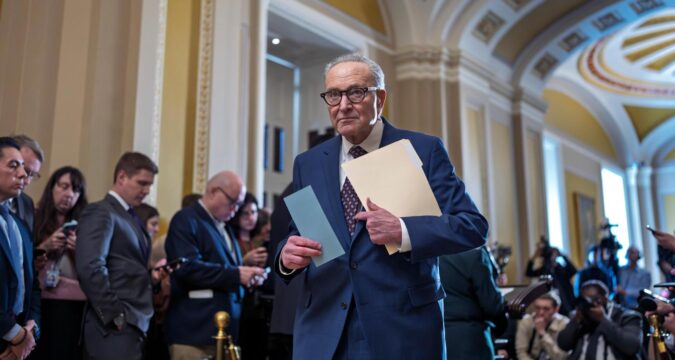
Democrats are poised to trigger government shutdown if White House won’t meet demands for ICE reform
WASHINGTON — Senate Democrats are threatening to block legislation that would fund the Department of Homeland Security and several other agencies Thursday, potentially bringing the government a step closer to a partial shutdown if Republicans and the White House do not agree to new restrictions on President Donald Trump’s surge of immigration enforcement.
There were some signs of possible progress late Wednesday as the White House has appeared open to trying to strike a deal with Democrats to avert a shutdown, and the two sides were discussing a possible agreement to separate Homeland Security funding from the rest of the legislation and fund it for a short time, according to a person familiar with the negotiations who insisted on anonymity to speak about the private talks.
As the country reels from the deaths of two protesters at the hands of federal agents in Minneapolis, irate Senate Democrats laid out a list of demands ahead of a Thursday morning test vote, including that officers take off their masks and identify themselves and obtain warrants for arrest. If those are not met, Democrats say they are prepared to block the wide-ranging spending bill, denying Republicans the votes they need to pass it and triggering a shutdown at midnight on Friday.
Senate Democratic leader Chuck Schumer of New York said Wednesday that Democrats won’t provide needed votes until U.S. Immigration and Customs Enforcement is “reined in and overhauled.”
“The American people support law enforcement. They support border security. They do not support ICE terrorizing our streets and killing American citizens,” Schumer said.
Schumer has pushed Republicans and the White House to strip the Homeland Security funding from the rest of the bill, which includes money for the Defense Department and other agencies. In the deal under discussion, Homeland Security would still be funded but for a short time to allow for negotiations on the Democrats’ demands. Other agencies included in the bill would be funded through the end of September.
Still, with no agreement and an uncertain path ahead, the standoff threatened to plunge the country into another shutdown just two months after Democrats blocked a spending bill over expiring federal health care subsidies, a dispute that closed the government for 43 days as Republicans refused to negotiate.
That shutdown ended when a small group of moderate Democrats broke away to strike a deal with Republicans, but Democrats are more unified this time after the fatal shootings of Alex Pretti and Renee Good by federal agents.
Democrats lay out their demands
There’s a lot of “unanimity and shared purpose” within the Democratic caucus, Minnesota Sen. Tina Smith said after a lunch meeting Wednesday.
“Boil it all down, what we are talking about is that these lawless ICE agents should be following the same rules that your local police department does,” Smith said. “There has to be accountability.”
Earlier Thursday, Tom Homan, the president’s border czar, said during a press conference in Minneapolis that federal immigration officials are working on a plan to begin drawing down the number of agents in Minnesota but that it would depend on cooperation from state authorities.
It’s unclear how far those assurances will go in satisfying Democrats. During the Trump administration’s immigration crackdown, Schumer said Democrats are asking the White House to “end roving patrols” in cities and coordinate with local law enforcement on immigration arrests, including requiring tighter rules for warrants.
Democrats also want an enforceable code of conduct so agents are held accountable when they violate rules. Schumer said agents should be required to have “masks off, body cameras on” and carry proper identification, as is common practice in most law enforcement agencies.
The Democratic caucus is united in those “common sense reforms” and the burden is on Republicans to accept them, Schumer said, as he has pushed for the Homeland Security spending to be separated out to avoid a broader shutdown.
Senate Majority Leader John Thune, R-S.D., has indicated that he might be open to considering some of the Democrats’ demands, but he encouraged Democrats and the White House to talk and find agreement.
Many obstacles to a deal
As the two sides negotiated, it was unclear whether they could agree on anything that would satisfy Democrats who want Trump’s aggressive crackdown to end.
The White House had invited some Democrats for a discussion to better understand their positions and avoid a partial government shutdown, a senior White House official said, but the meeting did not happen. The official insisted on anonymity to discuss the private invitation.
The House passed the six remaining funding bills last week and sent them to the Senate as a package, making it more difficult to strip out the Homeland Security portion as Democrats have demanded. Republicans could break the package apart with the consent of all 100 senators or through a series of votes that would extend past the Friday deadline.
Even if the Senate can resolve the issue, House Republicans have said they do not want any changes to the bill they have passed. In a letter to Trump on Tuesday, the conservative House Freedom Caucus wrote that its members stand with the Republican president and ICE.
“The package will not come back through the House without funding for the Department of Homeland Security,” according to the letter.
Republican opposition
Several Republican senators have said they would be fine with Democrats’ request to separate the Homeland Security funds for further debate and pass the other bills in the package. But it might be more difficult for Democrats to find broad GOP support for their demands on ICE.
Republican North Carolina Sen. Thom Tillis said he’s OK with separating the bills but is opposed to the Democrats’ proposal to require the immigration enforcement officers to show their faces, even as he blamed Homeland Security Secretary Kristi Noem for decisions that he said are “tarnishing” the agency’s reputation.
“You know, there’s a lot of vicious people out there, and they’ll take a picture of your face, and the next thing you know, your children or your wife or your husband are being threatened at home,” Tillis said. “And that’s just the reality of the world that we’re in.”
Republican Sen. John Cornyn of Texas said Democrats shouldn’t punish Americans with a shutdown and a “political stunt.”
Democrats say they won’t back down.
“It is truly a moral moment,” said Sen. Richard Blumenthal, D-Conn. “I think we need to take a stand.”
https://www.chicagotribune.com/2026/01/29/government-shutdown-ice-reform/

Australian Open: Women’s title match is set as American Jessica Pegula falls in semifinals
MELBOURNE, Australia — Not even a point penalty for hindrance slowed Aryna Sabalenka’s run to a fourth consecutive Australian Open final.
The top-ranked Sabalenka overpowered Elina Svitolina 6-2, 6-3 on Thursday to move within one victory of a third Australian Open title in four years.
A rematch of the 2023 final against Elena Rybakina was set up when the No. 5 seed ousted No. 6 Jessica Pegula 6-3, 7-6 (7) in the second semifinal.
Her semifinal was mostly one way until Rybakina had match point. The 2022 Wimbledon champion missed three match points on Pegula’s serve and was broken twice while serving for the match.
Pegula rallied and had two set points in the tiebreaker but wasn’t able to convert, and Rybakina finally clinched it 29 minutes after her first match point.
“Really, really stressful,” Rybakina said. She admitted to flashbacks from the 2024 Australian Open when she lost the longest women’s tiebreaker ever at a Grand Slam to Anna Blinkova 22-20 in a three-set defeat.
“I’m proud no matter the situation. It got very tight. I stayed there,” she said of the win over Pegula. “I was fighting for each point.”
For Pegula, it became a matter of swing or miss out.
“Sometimes when you’re on the brink of losing everything, you get a little clarity because you’re kind of just like, ‘Screw it, I’m just going to try and stay in this,’” she said. “I played a couple of really good points to save the match points, and, you know, she missed a couple short balls … a couple free points to take some pressure off.”
All four players reached the semifinals without dropping a set — for the first time in 56 years in Australia — and Sabalenka and Svitolina were each on 10-match winning streaks to start the season after titles in warmup events.
Sabalenka kept both of her streaks alive. As has become customary for Ukrainians against players from Russia and Belarus, there was no handshake at the net or group photo before the match.
Sabalenka is the third woman in the Open era to reach four consecutive singles finals at the Australian Open after Evonne Goolagong Cawley and Martina Hingis.
“It’s an incredible achievement, but the job’s not done yet,” an emotional Sabalenka said in her on-court TV interview. “I’ve been watching her game, (Svitolina) was playing incredible. I felt like I had to step in and put as much pressure as I could back on her. I’m glad the level was there. I think I played great tennis.”
The hindrance call
The only hiccup was the hindrance to start the fourth game. Hindrance is called for a distraction that prevents a player from making a shot and can include an opponent’s loud noise.
Umpire Louise Azemar Engzell deemed Sabalenka made a prolonged grunt after she shanked a forehand. The shot seemed to be going long but landed inside the baseline, giving Svitolina the chance to play on. That’s when the umpire intervened.
Sabalenka asked for a video review, but after going to the tape, Azemar Engzell confirmed her decision that the grunt was more elongated than usual.
“That’s actually never happened to me … especially with my grunting,” Sabalenka said. “Then she called it, and I was like, ‘What? What is wrong with you?’”
Sabalenka said it worked as motivation — she broke serve in that game.
“It actually helped me — I was more aggressive. I was not happy with the call, and it really helped me to get that game,” Sabalenka said, then added with a laugh: “So if she (Azemar Engzell) ever wants to do it again — like, I want to make sure that she’s not afraid of it — go ahead, call it. It’s going to help me.”
Rematch
Rybakina is back into a major final for the first time since 2023 and said she learned a lot from that match. She’s also coming off a win over Sabalenka in the deciding match of the WTA Finals last November, when she picked up a record $5.2 million in prize money.
“I could take only positive from that week,” she said. “This is what I’m trying to do … remembering some good stuff from this WTA Final.”
Svitolina’s exit
After reaching her first semifinal in Australia and winning a title in a warmup tournament in New Zealand, Svitolina will return to the top 10 for the first time since she took a maternity break in 2022.
The Auckland title was her first foray back on tour after an early end to the 2025 season for a mental health break. She said the rest and time out prolonged her career.
“Definitely very, very happy with the two weeks here and in New Zealand, as well, winning,” she said. “Gutted to not make it through tonight, but it’s very difficult when you’re playing the world No. 1, who is really on fire.
“It was really complicated for me today, but, yeah, I just want to take positives from the past weeks and just carry them through for the season.”
https://www.chicagotribune.com/2026/01/29/australian-open-womens-semifinals/

Senegal y Marruecos reciben fuertes multas tras caótica final de la Copa Africana
Por GERALD IMRAY
CIUDAD DEL CABO, Sudáfrica (AP) — La caótica final de la Copa Africana de Naciones dejó más de un millón de dólares en multas y sanciones para Senegal y Marruecos.
Las sanciones se aplicarán exclusivamente a los partidos de África y no a la Copa Mundial que comenzará en junio, para la cual Senegal y Marruecos se clasificaron.
En la final del 18 de enero en Rabat, ganada por Senegal 1-0 en tiempo extra, los jugadores senegalases abandonaron la cancha durante 15 minutos en protesta al pitarse un penal en los descuentos. Hinchas de Senegal intentaron invadir el campo y se produjeron peleas entre periodistas después.
La FIFA condenó lo ocurrido, mientras que el ente rector del fútbol de África lo calificó de inaceptable.
La federación de Senegal fue multada con un total de 615.000 dólares, la de Marruecos fue multada con un total de 315.000, y el técnico de Senegal, Pape Thiaw, fue multado con 100.000 y suspendido por cinco partidos por desacreditar el juego, dijo la Confederación Africana de Fútbol (CAF).
Los jugadores senegaleses Iliman Ndiaye e Ismaila Sarr fueron suspendidos por dos partidos, el marroquí Achraf Hakimi fue suspendido por dos partidos con uno en suspenso, y el también marroquí Ismael Saibari fue suspendido por tres partidos y multado con 100.000 dólares por comportamiento antideportivo.
Senegal se enfureció en el tiempo de descuento, con el marcador igualado 0-0, cuando a Marruecos se le otorgó un penal. Thiaw lideró una retirada de sus jugadores y retrasó el juego por 15 minutos. Marruecos falló el penal y Senegal anotó el único gol en la prórroga.
Además de los seguidores saltando las barricadas y los jugadores de ambos lados peleando en las líneas laterales, los recogepelotas marroquíes intentaron apoderarse de una toalla perteneciente al arquero senegalés Edouard Mendy en un aparente intento de distraerlo. Ese comportamiento de los recogepelotas por sí solo llevó a una multa de 200.000 dólares para Marruecos.
El técnico de Marruecos, Walid Regragui, dijo que la final de la Copa Africana dio al fútbol africano una imagen “vergonzosa”. Los incidentes también reflejaron mal en Marruecos, que co-organizará la Copa del Mundo 2030 junto con España y Portugal. El presidente de la FIFA, Gianni Infantino, calificó los incidentes de la Copa Africana como feos y esperaba sanciones de la CAF.
Marruecos deseaba albergar la final del Mundial 2030 en el Estadio Hassan II en construcción, y que se convertirá en el estadio de fútbol más grande del mundo con una capacidad de 115.000 después de su finalización prevista en 2028. España aseguró esta semana que albergará la final de 2030.
La CAF desestimó una apelación de Marruecos para que se anulara el resultado y se declarara a Marruecos como ganador debido a la retirada de Senegal.
El partidos incluso tensó los lazos diplomáticos entre Senegal y Marruecos y llevó a funcionarios políticos de las naciones a comprometerse a seguir siendo amigos y a pedir calma. En Marruecos, grupos de derechos denunciaron lo que llamaron discursos de odio dirigidos a residentes africanos subsaharianos en el país.
El primer ministro de Senegal, Ousmane Sonko, dijo en un viaje relacionado con inversiones a Marruecos días después de la final que la reacción a la misma debería verse como “arrebatos emocionales producidos por el fervor y no como divisiones políticas o culturales”.
___
Deportes AP: https://apnews.com/hub/deportes