Category: News

Daily Horoscope for February 03, 2026
General Daily Insight for February 03, 2026
Two steps forward and one step back is still progress! At 9:33 pm EST, the cosmic rebel Uranus ends its retrograde and moves ahead through steady Taurus. Stalled changes around resources and stability should finally regain momentum. We may begin the day cautiously, yet by evening the urge to upgrade our tools, budgets, or habits grows. We must pay attention to find updates that are both useful and realistic. Outsized expectations risk causing a lot of stress! Picking a single main project would be wise.
Aries
March 21 – April 19
Money, money, money! Your finances are the focus as unpredictable Uranus stations direct in your 2nd House of Resources, stalled money moves unstick, so a raise chat or subscription cleanup suddenly looks worth action. Your bold streak helps you negotiate fairly, while steady pacing keeps nerves calm if an invoice or shared bill surprises you. Your 2nd House of Resources rewards clean tracking, so check banking alerts and receipts to stop small leaks before they spread. Clear numbers calm nerves and protect your energy well today.
Taurus
April 20 – May 20
Comfort isn’t frivolous at this time. Radical Uranus is shifting ahead while stationed in your sign, powering up your 1st house — the sector that rules your character and style. You might be craving a wardrobe update or an appearance modification (anything from painting your nails to getting a tattoo is on the table here). You deserve to live a life you enjoy! On top of that, even if others don’t understand your total depth, their first impression of you should be very positive.
Gemini
May 21 – June 20
Quiet time brings behind-the-scenes breakthroughs. As the innovation planet Uranus stations direct in your 12th House of Secrets, solutions are more likely to appear when you step back and rest. If you’ve lost something, take a break and then double-check with fresh eyes. Maybe you’re struggling to remember some information that could fly into your mind almost as soon as you stop trying so hard to think of it. Jot down any more vivid dreams ASAP, because their symbolism may point to your next step.
Cancer
June 21 – July 22
Friends could currently respond best to kind, steady leadership. With unconventional Uranus stationing direct in your 11th House of Socialization, a group “plan” might seem more like a collection of unrelated ideas with conflicting schedules. You can step up and suggest less polarizing activities, massage the timeline, or redistribute roles — whatever’s necessary to reduce friction and increase joy. To be the best possible leader, make sure to get everyone’s input and check in with them along the way. Take charge with empathy.
Leo
July 23 – August 22
Trust your instincts! Your generosity and creativity are in charge as surprising Uranus shifts direct in your 10th House of Authority. You’ve got real leadership potential right now, and even if you’d rather not be in charge, managers or mentors are more inclined to view you positively. This is a great time to polish your professional portfolio or apply for jobs — you might even feel inspired to look up auditions for local theater performances! Your presence can turn curveballs into home runs.
Virgo
August 23 – September 22
Fixing tiny missteps has massive benefits at present. Your 9th House of Growth welcomes Uranus as it begins moving ahead — now’s your chance to follow up on applications, book trips, or contemplate education opportunities. These things might have seemed intimidatingly complex, but asking a few thoughtful questions could make a huge difference. Someone might respond with a workaround that saves money without lowering quality. Once today’s tasks are checked off, consider setting up some structures to assist your future self in similar endeavors.
Libra
September 23 – October 22
This afternoon invites fair judgment — even if that isn’t the outcome you’d prefer. As freedom-seeking Uranus stations direct in your 8th House of Shared Resources, tangled arrangements loosen, and a more just split or cleaner agreement becomes easier to reach. If money, knowledge, or labor feel uneven, propose simple rules and choose transparency, because trust strengthens when everyone sees the same numbers. If there’s too much to handle at once, try to arrange a friendly follow-up to revise details without blame if anything changes.
Scorpio
October 23 – November 21
Your needs are valid, and don’t let anyone tell you otherwise. Relationship dynamics (platonic or otherwise) may shift abruptly as shocking Uranus spins direct in your 7th House of Alignments. Your friends have a deep impact on your character, and this is a great time to think about that impact. If it’s positive, all is well, but it might not be positive. Address any negative shifts directly, but not confrontationally. Being open with one another is the best way to meet everyone’s needs.
Sagittarius
November 22 – December 21
A flexible routine will be much easier to keep up today than a strict one. Uranus wakes up in your 6th House of Practice, invigorating your efforts to streamline your day-to-day activities. You might switch up your commute, try a new snack, or reorganize your everyday bag. As each small update stacks up, you could regain a lot of time and energy. Don’t jump into things too quickly, though. Tweak your set-up gradually and celebrate each win along the way. Consistency is crucial!
Capricorn
December 22 – January 19
The stars are calling for some silliness! Nothing too dramatic, just a little dose of laughter to lighten up your day. With reactive Uranus stationing direct in your 5th House of Creativity, a passion project or date idea gets a jolt, inviting you to try something new on a whim. Tell a lame joke, paint a blob, or sing along with a song even when you can’t hit the high notes. Indulging in happiness renews your energy, allowing you to commit to bigger goals.
Aquarius
January 20 – February 18
Your home may start feeling different in a good way. As unruly Uranus stations direct in your tender 4th house, domestic changes are afoot. Seize this opening to design a home set-up that actually fits your daily life. Your living room isn’t in an interior design magazine — it’s in your life! Moving furniture to let in more light or designing a chore chart (yes, even if you live alone) could greatly improve your home’s energy. When you’re comfortable there, your guests will be, too.
Pisces
February 19 – March 20
A simple message could send you down a helpful path. Honest inquiries, in particular, can travel far. With erratic Uranus stationing direct in your 3rd House of Communication, a favor, errand, or repair should happen much faster when you’re willing to start the conversation. Speak and be concrete about needs, because clear words bridge gaps with siblings, neighbors, classmates, or co-workers. Be wary of misbehaving devices — in-person chats are more reliable than texts or emails. When you need something to happen, say so!
https://www.chicagotribune.com/2026/02/02/daily-horoscope-for-february-03-2026/

Hundreds of students walk out from class across Chicago’s North Side to protest against ICE
Hundreds of students across Chicago’s North Side walked out of their classrooms Monday in protest of the Trump administration’s continued mass deportation campaign.
The rally came after a string of actions staged across the Chicago area and country last week amid widespread outrage over the killing of Alex Pretti, an intensive care nurse who was shot several times after he used his cellphone to record Border Patrol officers conducting an immigration enforcement operation in Minneapolis.
Held just after noon, the walkout saw students from Amundsen High School in Lincoln Square, Mather High School in West Ridge, Northside College Prep in North Park and Roosevelt High School in Albany Park turn out to rally in solidarity with Minnesota and stand against the immigration crackdown.
“I’ve never felt more proud in my life,” said 16-year-old Amari Bell, who helped organize the walkout.
Bell, a junior at Mather High, was sitting in her Uptown bedroom last week when she read a news story about Liam Conejo Ramos, a 5-year-old boy who, while arriving home from preschool in Minnesota, was taken by federal agents along with his father to a detention facility in Texas late last month.
Images of the boy — wearing a bunny hat and Spider-Man backpack — being surrounded by Immigration and Customs Enforcement officers has sparked even more outcry about the Trump administration’s enforcement in Minnesota. The boy and his father were back in Minneapolis on Sunday after a federal judge recently ordered their release.
Mather High School students Amari Bell, from left, Angelique Guzmán and Emina Alikadic organize students from various North Side schools at River Park to rally during an anti-ICE walkout, on Feb. 2, 2026. (E. Jason Wambsgans/Chicago Tribune)
When Bell saw what had happened, she was taken aback by how indiscriminate the arrest was, she said.
“My youngest sibling is older than this child,” she recalled thinking to herself. “That’s absurd. To me, that’s absolutely absurd. And I think it’s unjust.”
Spurred by her shock, Bell took to social media to ask if any of her classmates would be interested in a walkout in protest of ICE. Yes, her peers replied, and Bell soon connected with fellow student leaders to bring the action to fruition.
“A problem cannot be solved or addressed,” Bell said, “if it’s not acknowledged.”
North Side Ald. Andre Vásquez commended the students’ action.
“We’re watching a government suppress people’s voice,” he said. “It is inspiring to see the youth make sure that they are being heard and articulating theirs.”
Vásquez said students planned the event, but he helped as an “adult marshal” after a high school intern who works with his office informed him of the protest. He coordinated with police, helped find crossing guards and held up a loudspeaker, he said.
A Chicago Public Schools spokesperson, in a statement to the Tribune, said the district “remains committed to fostering learning environments that allow students to respectfully deliberate issues with evidence and an open mind — and safely participate in civic action.”
High school students from Chicago’s North Side, with assistance from Ald. Andre Vásquez, center holding speaker, gather at River Park to rally during an anti-ICE walkout, on Feb. 2, 2026. (E. Jason Wambsgans/Chicago Tribune)
The spokesperson said the district allows for students to participate in planned civic actions — including walkouts or protests — for a period of time during the school day, per CPS guidance.
Whether or not they could participate, students were encouraged to wear red to school Monday to show solidarity, according to Angelique Guzmán, a senior at Mather High who also helped organize the walkout. She even heard about students making posters during class before they left to rally, Guzmán said.
“It truly … (was) empowering to see the youth really step up,” the 18-year-old said.
Guzmán said the “rage we have” has long been building.
“It frightens me how minorities are constantly overlooked in this country,” she said. “The systems of injustices, I think, are so deeply rooted in America (and) I have been victim to (them), and I know a lot of my classmates have been (victim to them, too).”
Chicago Tribune’s Jake Sheridan, Jason Wambsgans and The Associated Press contributed.
https://www.chicagotribune.com/2026/02/02/student-walkout-chicago/

The Arrest Of Don Lemon: Journalists Cannot Also Be Activists
The Arrest Of Don Lemon: Journalists Cannot Also Be Activists
The line between journalism and activism has become excessively thin in the past ten years, and the problems associated with this trend are numerous. Media figures have long leaned toward the liberal side of the political spectrum; liberal bias among journalists is nothing new. However, direct participation in an activist insurgency to help it or lead or propagandize in favor of it crosses into the realm of criminality.
Just because someone declares they are a “journalist” does not mean they’re protected from consequences if they commit a crime. Furthermore, the political left seems to believe that the 1st Amendment gives them the right to disrupt the free speech of others as long as they are protesting: This is a dangerous fallacy.
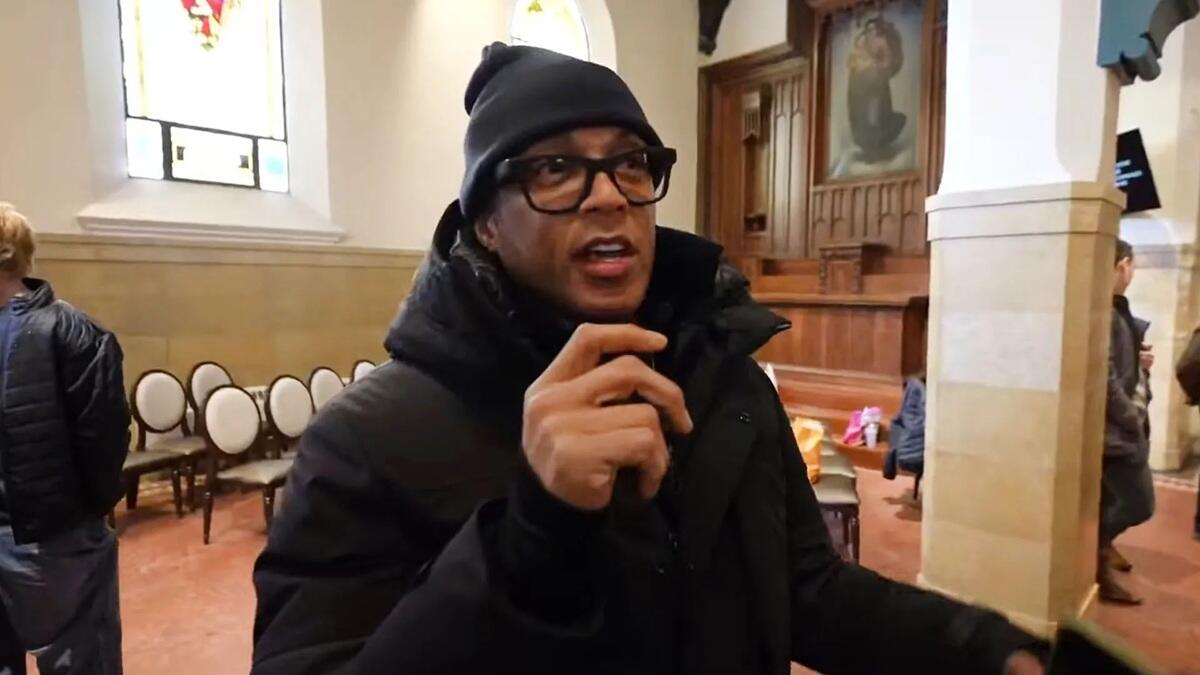
It’s not clear yet if disgraced media pundit Don Lemon broke the law. Criminal guilt is for the courts to decide. He does appear to join with a horde of Anti-ICE protesters that invaded a Minneapolis church service with the plan to intimidate and antagonize Christian worshipers into declaring their opposition to deportation (A communist struggle session in the form of an ambush). There is more than enough evidence to warrant Lemon’s arrest and prosecution for civil rights violations, and a lot of it he filmed himself.
REMINDER: Don Lemon fully admitted that he planned to storm and disrupt a church service with the anti-ICE lunatics.
The only person in this case who attacked the first amendment was him.pic.twitter.com/sYcPEEnPLz
— CJ Pearson (@Cjpearson) January 30, 2026
🚨 HOLY CRAP! Don Lemon admitted he “turned the camera off” while St. Paul church attack planners gave “CRITICAL INFORMATION” to their rioters
Even MORE proof Lemon was NOT documenting — he was ACTIVELY ASSISTING THEM
LOCK HIM UP! pic.twitter.com/fmdoRjB84o
— Nick Sortor (@nicksortor) January 30, 2026
Lemon is not acting like an impartial journalist covering the event, he is acting like a participant in the operation while using journalism as a cover.
🚨 SICKENING: Anti-ICE mob just STORMED a church in Minneapolis during worship, desecrating sacred ground, harassing Christians mid-service!
This has ZERO place in America.
DOJ is now investigating for FACE Act violations!
Arrests need to happen!
pic.twitter.com/KAmMlFrsfM
— Gunther Eagleman™ (@GuntherEagleman) January 19, 2026
Deputy Attorney General Todd Blanche alleged Sunday that journalist Don Lemon was included in the planning of a protest at a Minnesota church, days after the former CNN anchor was arrested and charged with conspiracy and interfering with a place of worship.
Citing an unsealed grand jury indictment, Blanche told host Dana Bash on CNN’s “State of the Union” that Lemon is accused of being “part of the planning” of the protest and was “part of the decisions to make sure the police didn’t know this was happening and federal law enforcement didn’t know this was happening.”
Lemon, along with several activists, has been charged with violating the FACE Act, a federal law prohibiting the use of force, threat of force, or physical obstruction to intimidate or interfere with persons accessing reproductive health clinics (including abortion clinics) or places of religious worship. Obviously, the law was not originally intended to protect Christians, which makes Lemon’s arrest all the more ironic.
Lemon would go on to compare the church goers in Minneapolis to “White Supremacists” and accuse them of “entitlement”. In other words, he believes that the incident is justified because the church was largely white.
Don Lemon on church members upset that he stormed their church: “They’re entitled, white supremacists” pic.twitter.com/aMlXYBugwB
— End Wokeness (@EndWokeness) January 19, 2026
The “journalist”, basking in the glow of his newfound limelight, says he will never stop fighting and asserts that he only became the “face of the protest” because he is a “gay black man in America.” Liberals and some conservatives argue that the arrest is a political mistake and that it makes the Trump Administration look authoritarian, however, they’re looking at the situation with narrow vision.
The real question is, when does a journalist stop being a journalist? Don Lemon was not arrested for journalism and exercising free speech. He was arrested for allegedly violating the free speech of others. The “optics” of the situation are irrelevant and Don Lemon being a media personality is irrelevant. He should not be allowed to escape prosecution simply because the political left will inevitably spin the narrative.
Tyler Durden
Mon, 02/02/2026 – 18:50
https://www.zerohedge.com/political/arrest-don-lemon-jounalists-cannot-also-be-activists

NFL must re-evaluate minority hiring, Roger Goodell says, after none of 10 jobs went to a Black candidate
SAN JOSE, Calif. — NFL Commissioner Roger Goodell said the league needs to re-evaluate its approach to minority hiring after an offseason coaching cycle that saw only one of 10 head coaching jobs go to a minority and none to Black candidates.
“We need to continue to make progress,” Goodell said Monday. “I believe that and I believe diversity is good for us. … I think we have become a more diverse league across every platform, including coaching. But we still have more work to do.”
The NFL will have only three Black head coaches next season. There were 10 head coaching openings this year and none was filled by a Black coach. Robert Saleh, who is of Lebanese descent, was the only minority to get a head coaching job when the Tennessee Titans hired him.
This was just the fifth time since the start of the Rooney Rule in 2003 that no Black head coaches were hired during an offseason coaching cycle. The only other time it happened in a year with more than five changes came in 2013, when there were eight openings.
No formal talks with union about adding 18th game
Goodell said there have been no discussions with the union about adding an 18th game to the regular season and said lengthening the season again is not inevitable.
The NFL added a 17th game in 2021, and Goodell has expressed interest in the past about adding an 18th game in place of one of the three exhibition games each team plays.
Goodell said a number of issues would have to be discussed with the union before an 18th game would be added, including whether a second bye week would be needed and the size of rosters to make sure it wouldn’t have a negative impact on player safety and competitiveness.
“We have not had any formal discussions about it and frankly very little of any informal conversations,” Goodell said. “It is not a given that we will do that. It’s not something we assume will happen. It’s something we want to talk about with the union leadership.”
NFL will look into Giants co-owner’s association with Jeffrey Epstein
The NFL will look into New York Giants co-owner Steve Tisch and his association with Jeffrey Epstein after his name showed up more than 400 times in files released by the U.S. Justice Department regarding Epstein.
“Absolutely we will look at all the facts,” Goodell said. “We’ll look at the context of those and try to understand that. We’ll look at how that falls under the (league’s personal conduct) policy. We’ll take one step at a time. Let’s get the facts first.”
Tisch said last week he knew Epstein and they “exchanged emails about adult women” and “discussed movies, philanthropy and investments.” But Tisch, 76, denied going to Epstein’s island and never was charged in the investigation.
Epstein killed himself in a New York jail cell in August 2019, a month after being indicted on federal sex trafficking charges.
The documents were disclosed under the Epstein Files Transparency Act, the law enacted after months of public and political pressure that requires the government to open its files on the late financier and his confidant and onetime girlfriend, Ghislaine Maxwell.
Saints will play in NFL’s 1st regular-season game in France
The NFL will play its first regular-season game in France next season, with the New Orleans Saints set to travel to Paris, and the league also will head back to Mexico City for the first time since 2022.
The league on Monday announced plans to play a game at the Stade de France next season in addition to a multiyear deal to keep playing regular-season games at Real Madrid’s Santiago Bernabeu Stadium and a game to be played in Mexico City in December.
“It’s the ambition we have to be a global sport,” Goodell said at his Super Bowl news conference. “But it’s also the demand we’re having. We’re hearing from cities that want to host these games and really want to get more American football.”
The NFL already announced its first game in Australia next season with the Los Angeles Rams set to host that game, as well as games in Rio de Janeiro, Munich and three in London. The league will have nine international games next season, and Goodell said it eventually will have 16 international games a year so each team plays one.
“That’s an important mark to shoot for and I think we’re on our way.” Goodell said.
The additions of Australia and France mean NFL games will have been played in nine countries outside of the United States after next season.
The NFL says it has played 62 regular-season games outside the U.S. so far, with London, Berlin, Munich, Frankfurt, Madrid, Dublin, Sao Paulo, Mexico City and Toronto as hosts.
The Saints will play an opponent to be determined after the schedule is finalized later this year. The Saints have international marketing rights in France as part of the NFL’s Global Markets Program.
Saints owner Gayle Benson said she is excited to play in France, citing the “strong cultural connection between Louisiana and France.”
The Stade de France was built in 1998 when the country hosted the World Cup. It also was used for the 2024 Olympics and has hosted several major international sporting events.
The NFL says it has more than 14 million fans in France and launched a flag football program there in 2023 that already reaches more than 8,000 boys and girls.
The NFL did not announce either team for the game in Spain. The Miami Dolphins, Kansas City Chiefs and Chicago Bears currently have marketing rights in Spain as part of the league’s Global Markets Program.
The first regular-season game in Spain was played at the Bernabeu in November as the Dolphins defeated the Washington Commanders 16-13 in overtime before a crowd of 78,610.
NFL Spain country manager Rafa De Los Santos said the multiyear agreement to play games in Madrid “underlines our commitment to the market and enables us to continue to engage fans year-round and invest long-term in initiatives like NFL Flag and youth participation.”
The NFL said Spain is “an important market globally” with 11 million fans. It said it also will focus on developing the league’s flag football initiatives across the country.
After the first game in Madrid last year, there had been talk of the league also trying to organize a game in Barcelona at some point.
The NFL has played five games in Mexico City but hasn’t been back since 2022 while the stadium has undergone renovations for this summer’s World Cup.
“We’re heading back to Mexico City in December, which I think is wonderful for our fans in Mexico,” Goodell said. “They’re redoing the stadium for the World Cup. This will be a chance for us to get back there this December. We can’t wait for that either.”
https://www.chicagotribune.com/2026/02/02/nfl-roger-goodell-minority-hiring/

Have Fiat Money, Will Tyrannize
Have Fiat Money, Will Tyrannize
Authored by George Ford Smith via The Mises Institute,
“My fellow Americans, ask not what your country can do for you. Ask instead what your country has been doing to you and is likely to keep doing to you for as long as it can buy with fiat money the votes of a majority.”
– Gary North, “History Revisionism – High Priests of Woodrow Wilson’s Covenant”
Gary North’s article focuses mostly on Woodrow Wilson’s influence on the inaugural addresses of Eisenhower and Kennedy and their meaning in the world of 2008. As he observed, we have had “one long war since 1917,” with Fed fiat money playing an indispensable supporting role.
Everything the government does costs money, and it produces nothing with which to acquire it. For 2025, it coerced a total of $5.4 trillion from taxpayers and dollar-holders but ended up spending $7 trillion, producing a “rolling” deficit of $1.7 trillion. The biggest fights have always been over whose ox gets gored to fund it. Almost no one wonders whether government as it stands should exist at all.
When Wilson decided to impose democracy on the world, he had the backing of two newly-created theft mechanisms that he signed into law in 1913: The income tax and the central bank. The first extracts wealth directly from those who own it; the second takes it surreptitiously, which, as Copernicus wrote in 1526,
…is noticed by only a few very thoughtful people, since it does not operate all at once and at a single blow, but gradually overthrows governments, and in a hidden, insidious way.
Knowingly or not, Keynes, in 1919, expressed a similar thought with his famous “one man in a million” declaration:
There is no subtler, no surer means of overturning the existing basis of society than to debauch the currency. The process engages all the hidden forces of economic law on the side of destruction, and does it in a manner which not one man in a million is able to diagnose.
Americans like to think of themselves as sharp, incapable of being hoodwinked.
If they get scammed a second time they blame themselves for not seeing it—“Fool me twice, shame on me.”
But most of them have missed the biggest scam of all: The Federal Reserve System.
Of the various reasons for missing it, the biggest one is the conviction that market economies are vulnerable to harmful forces that only the state and its central bank can avoid. Experts on the Great Depression such as former Fed Chair Ben Bernanke build their arguments on the grounds that markets sometimes violate the fundamental law of trade—production buys production (sometimes known as Say’s Law)—and need supervision and intervention to avoid this problem.
When the roof began to fall in August 1929, they were at a loss as to which intervention to pursue. They could’ve referred to the Depression of 1921 for guidance when the government watched as the Fed tightened then eased. As one economist explained, “During this period, there was nothing remotely like a fiscal stimulus package, a TARP program, or even a QE policy designed to prevent economic collapse.” Deflation—seen as the villain in the 1930s Depression—cured the earlier slump because prices had been inflated.
Most people who study economics at state-funded universities treat the Fed as a necessary institution, not a scam. Their acquired expertise will include the view that the Fed’s Federal Open Market Committee (FOMC) has undertaken the formidable task of determining interest rates that best promotes full employment and low inflation. The Fed has a superhuman challenge and if it sometimes fails to please everyone, who could do better?
But it goes deeper. According to a FAQ section posted by the Kansas City Fed, “The Fed has long viewed transparency as a fundamental principle of central banking that supports accountability.” If Fed operations are transparent, most people are blind. The Fed’s operations are largely a mystery to most people. And this is to its advantage.
How the Fed Conducts Its Mission
It is commonly said the Fed prints money when it targets a lower Federal Funds Rate. While this is true, it shrouds all the plumbing that makes it happen.
The Federal Funds Rate is “the interest commercial banks charge when they lend money to one another for extremely short-term periods—literally, overnight.” It influences other rates such as rates for mortgages, loans, credit cards, and savings.
The FOMC meets at least eight times a year to decide what to do about the current Federal Funds Rate. Their discussions are augmented by the Beige Book report of conditions in the 12 Reserve districts. Lowering the rate means the Fed will print more money (in its convoluted manner) to get the consumer price increases it wants. If it decides that prices are running too high, it will pull money out of the economy by selling some of its securities. This is how it attempts to lower or raise the Federal Funds Rate.
Influencing the Federal Funds Rate is “the interest the Fed pays on the funds that banks hold as reserve balances at their Federal Reserve Bank, which is the Interest on Reserves Balances (IORB) rate.” If banks make more keeping their reserves than lending them to other banks, the reason is likely a high IORB. Both the Federal Funds Rate and the IORB rate are considered important tools for manipulating market prices.
Actual market prices sometimes defy Fed intentions to raise them, as seen by the Moore’s Law effects on computer technology. Fortunately for consumers, innovation can outpace monetary debasement in specific sectors.
The Arsonist is Seen as a Firefighter
The Fed sets as a target a 2 percent inflation rate. It defines inflation as “the rate at which the price of goods and services increases over time.” In other words, its job is to increase prices. Price increases, not the Fed actions that increase them, are the measure of inflation. And while many judge the results by the Consumer Price Index (CPI), the Fed relies on the Personal Consumption Index (PCI), presumably because it covers more consumer spending than the CPI.
Please note, the Fed is not perceiving inflation and reacting to it. It is instead pursuing inflation as a goal, as stated in its mandate. Quoting Chairman Powell:
In conducting monetary policy, we will remain highly focused on fostering as strong a labor market as possible for the benefit of all Americans. And we will steadfastly seek to achieve a 2 percent inflation rate over time.
It is pursuing, in other words, a steady 2 percent depreciation in the purchasing power of the dollar. The Fed has been exceptional in this regard: Since my daughters were born in 1982, consumer prices have risen roughly 235 percent. Its policy bias pushes people to spend rather than save, even if it means they go into debt. Savers get punished, as do people living on fixed incomes. Since savings are the pool from which investment draws, entrepreneurs are punished too. Yet investment is the springboard of rising productivity and higher living standards. It sounds like a predatory computer game but it’s Fed policy.
Inflation provides the wealth transfer. The interest-rate juggling is how it’s accomplished.
Changing Definition
As discussed in On the Origin and Evolution of the Word “Inflation” by Michael F. Bryan, published by the Cleveland Fed, inflation once had an entirely different meaning:
What was once a word that described a monetary cause now describes a price outcome. This shift in meaning has complicated the position of anti-inflation advocates. As a condition of the money stock, an inflating currency has but one origin—the central bank—and one solution—a less expansive money growth rate. But as a condition of the price level, which may have originated from a variety of things (including a depreciating dollar, rising labor costs, bad weather, or a number of factors other than “too much money”), the solution to—and the prudence of— eliminating inflation is much less clear.
Confusion accelerated after the publication of Keynes’s General Theory in 1936:
In addition to separating the price level from the money stock, the Keynesian revolution in economics appears to have separated the word inflation from a condition of money and redefined it as a description of prices. In this way, inflation became synonymous with any price increase.
The Fed thus escapes the public’s scrutiny when prices rise.
Conclusion
If the modern global fiat regime began in 1971 with the Nixon Shock and the stagflation of the 1970s, it deserves applause: it was not an instant disaster.
Fiat money is a politician’s best friend because it creates an invisible tax through the institutionalized depreciation of currency. We shouldn’t expect them to part with it—especially as their perpetual interest in war demands ever greater funding.
Tyler Durden
Mon, 02/02/2026 – 18:25
https://www.zerohedge.com/political/have-fiat-money-will-tyrannize

Lake Forest Caucus looking ahead after two votes fell short of approval to change the organization’s bylaws
Lake Forest Caucus officials are now looking ahead following another setback by the organization’s general membership.
On Jan. 24, nearly 63 % of Caucus members voted to approve a bylaw amendment that would have allowed electronic and mail-in voting for Caucus elections, in addition to the longstanding in-person option. The amendment had been endorsed by the 43-member Caucus Committee. However, Caucus rules require a two-thirds majority to amend the bylaws, and the proposal fell short of that threshold.
The outcome mirrored the result of a vote at the Oct. 14, 2025, Caucus annual meeting, when more than 64 % supported the change, but the measure fell 21 votes short of passage. Caucus leadership at the time attributed the shortfall in part to Metra delays that prevented some residents from reaching the Gorton Center as they were commuting from downtown Chicago.
In response, leadership called a second vote, making some changes to the amendment language and scheduling the election on a Saturday to address concerns about weekday accessibility. While turnout in the special election roughly doubled despite the frigid conditions, the percentage of votes in favor of the amendment declined slightly.
Caucus President Regina Etherton said she was disappointed with the results, noting that leadership’s goal was to broaden participation by offering alternative voting options. Opponents of the change, however, cited concerns about vote security and verification and argued that the Caucus should focus its efforts elsewhere.
The defeats mark the latest challenge during a turbulent period for the longtime Lake Forest institution.
In November 2022, the Caucus Committee endorsed Stanford “Randy” Tack for mayor over former alderwoman Prue Beidler. In what is traditionally a “pro forma” vote the general membership did not approve the endorsement. With the bylaws unclear on how to proceed, the committee continued its support of Tack, who went on to defeat Beidler in a rare contested municipal election.
Following that episode, Caucus leadership proposed eliminating the general membership vote from the endorsement process, but that measure was rejected in November 2023.
In 2024, the general membership initially voted down the Caucus leadership slate for the following year before approving it in a second vote.
Amid those events, the Caucus formed an ad hoc committee, facilitated by former City Manager Bob Kiely, to examine how the organization should respond when the general membership votes down a proposal or candidate endorsement. The committee recommended that, in certain circumstances, the matter revert to the Caucus Committee, which would then present multiple options to provide members with greater choice.
Etherton said the electronic voting proposal aligned with the ad hoc committee’s work and was intended to address concerns about voter participation, adding that leadership planned to revisit broader bylaw changes in the future.
Opposition to the electronic voting amendment included former Caucus external communications chairman Tyler Lisenby, who resigned following a dispute with leadership. Lisenby said he remains a supporter of the Caucus but objected to its recent focus on electronic voting.
“I disagreed with the approach the Caucus was taking in focusing on internet voting while sidelining more substantive issues regarding binding bylaws and how to handle a no vote from the general membership,” Lisenby said.
He also said he was not permitted to inform members that a Caucus vice president had resigned last year.
“If I am not allowed to do my job,” Lisenby said, “Why am I here?”
Etherton declined to comment directly on Lisenby’s claims. She acknowledged there have been other resignations from Caucus leadership and ward representatives, saying some departures stemmed from dissatisfaction with leadership selections. She added that many others were due to unrelated factors, including members moving out of Lake Forest, health issues, or changes in professional commitments.
Another prominent opponent of the proposed bylaw change was former state Sen. Susan Garrett, who said she continues to believe in the mission of the Caucus.
“I think the Caucus has been a stabilizing force in the community for decades, and they do a great job recruiting qualified candidates,” Garrett said. “Somehow, they lost their way with these voting and bylaw issues, and I think once they get back to their mission, they will regain the trust and support they’ve always had.”
Etherton said there will not be a third vote on electronic voting and said she is frustrated.
“It does get disheartening for Caucus members who are working their butts off to try and do something positive for the community,” she said.
Looking ahead, the Caucus will hold its spring meeting in March, during which it will set its executive slate for the 2026–27 year. Current vice president Scott Nehls is expected to succeed Etherton as president.
Municipal elections are scheduled for March 17, with incumbent alderwomen Nancy Novit and Alice LeVert seeking new terms, and Rosemary Kehr and Lloyd Culbertson looking to join the City Council. None of the candidates, all of whom are endorsed by the Caucus formal opposition, according to Lake County Clerk Anthony Vega.
The Caucus will also begin the process of endorsing a mayoral candidate to succeed Tack, whose tenure concludes in 2027, as Lake Forest mayors serve two two-year terms.
Founded in 1935, the Caucus vets and recommends candidates for local boards, commissions, and elected offices. Candidates who receive Caucus endorsements for positions such as City Council or school board are often unopposed in municipal elections.
Daniel I. Dorfman is a freelance reporter for Pioneer Press.
https://www.chicagotribune.com/2026/02/02/lake-forest-caucus-looking-ahead/
Indiana state senator has two Gary-inspired bills make it to House
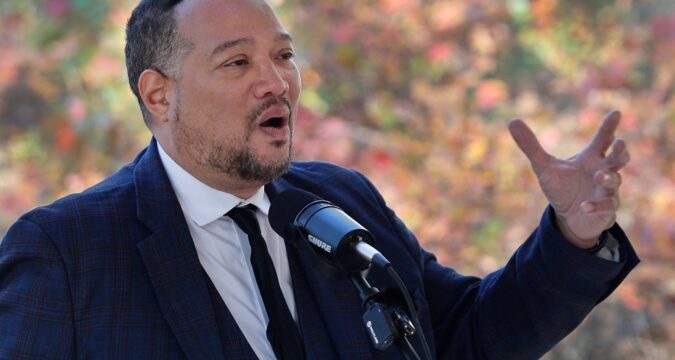
After two of his authored bills received unanimous support, state Sen. Mark Spencer is feeling hopeful about the second half of Indiana’s legislative session.
“The bills in general are important because they reflect the desire of leadership and constituents in District 3,” Spencer, D-Gary, said. “I’m grateful for the bipartisan support and their patience with me as I’m trying to find my way and figure out how I can make a small contribution for Northwest Indiana.”
In his second legislative session as a state senator, two bills Spencer has authored passed the Indiana Senate and have moved to the House. Spencer authored Senate Bill 164 and Senate Bill 232, both of which have received unanimous support.
Senate Bill 164 would require the Indiana Department of Agriculture to conduct a feasibility study to establish urban microfarm zones statewide, according to the Indiana General Assembly website. The department must submit a report with findings and recommendations to the general assembly by Dec. 1, 2027.
Spencer got the inspiration for Senate Bill 164 after his work creating a documentary with Faith CDC, “Nourishing Lives: The Power of Food is Medicine.”
“My eyes were opened, and I was absolutely inspired,” Spencer said. “The idea of taking seed to soil and soul to product, and also dealing with issues of food disparities and food deserts, was very intriguing to me.”
Spencer was the film’s director, and the documentary shows a deeper look into programs offered by Faith CDC and how providing access to medically tailored meals can help transform lives.
Spencer was “pleasantly surprised” that the Senate Agriculture Committee gave the bill a hearing, he said, and he believes it will teach many of his fellow legislators about the benefits of urban agriculture.
“I’m hoping to see a statewide efficient plan for partnership with the likes of Purdue University and other groups like Faith CDC that are leading the way with these practices,” Spencer said. “I also want it to help teach our young people because I truly fear that they don’t conceptualize where our food comes from and how it makes it to our table.”
The state senator also hopes that if passed, the bill will also start more conversations about the importance of nourishment and balanced meals, Spencer said.
This session, Spencer also authored Senate Bill 232, which has moved to the House. The bill would allow the city of Gary to hire a professional to appraise residential and commercial properties, and it prohibits employees or elected officials of the city from buying the appraised properties.
City officials can’t buy the property to ensure it’s given to the community, Spencer said, with the hope that neighborhoods will grow in the future.
“(The city of Gary) has 7,000 properties that are stuck in red tape, impossible to move, not on tax rolls and not generating revenue for the city,” Spencer said. “They’re just in a position where they’re bottlenecked with the red tape language.”
With the 7,000 properties, it would cost about $1,000 each to appraise the properties, which Spencer said “was cost-prohibitive.” If the bill passes, an appraiser could look at 10 residential and 10 commercial properties throughout the city, according to the bill.
“The city would then be able to use the average values from those appraisals as a minimum offering price for sale for those residential and commercial properties,” Spencer said. “I thought it would be a very productive and very resourceful tool for the city and its endeavors to continue to grow.”
Gary Mayor Eddie Melton, pictured during the Lake County Advancement Committee luncheon Thursday, Jan. 22, 2026. (Doug Ross/for Post-Tribune)
Spencer said he worked with Mayor Eddie Melton’s administration to create Senate Bill 232. In a statement, Melton said the legislation is “a bold step” toward the city’s future, streamlining the path to growth and unlocking the potential of thousands of properties.
“We are entering a new era of revitalization for Gary, where every vacant lot represents a fresh opportunity for growth,” Melton said. “By updating the appraisal process through SB 232, we are removing financial barriers and unlocking the true value of our land. This legislation provides the modern tools we need to transform thousands of properties into vibrant community assets.”
As the bills move to the House, Spencer is hopeful they will receive the same unanimous support they had in the Senate.
“I’m very hopeful and focused on educating and making sure the members of the House are aware of the importance and value of these bills, and how they can affect various regions of our state,” Spencer said. “But I also understand that it is a measured process that takes time, and I appreciate that as well.”
On Monday, Senate Bill 164 was sent to the House Agriculture and Rural Development committee, and Senate Bill 232 was sent to the Local Government Committee on Jan. 28. Both bills will be heard at a later date.
mwilkins@chicagotribune.com

Elgin, Indiana students had loaded gun, bags of pot in college dorm room, police say
Two college students, one from Elgin and the other from Merrillville, Indiana, have been arrested by Naperville police for allegedly having a loaded handgun and 39 bags of cannabis in their dorm room, officials said.
Police were notified by North Central College campus safety officers about 1:10 a.m. Saturday that they smelled marijuana and observed a loaded handgun and loaded firearm magazine in a dorm room shared by Kurtis Cruz, 18, of Merrillville, Indiana, and Diyonnes King, 18, of Elgin, according to a news release from the Naperville Police Department and DuPage County state’s attorney’s office.
Police officers located the firearm, a Glock 29 Gen5 10mm and a loaded 26-round capacity extended magazine with one round in the chamber, in a backpack next to a safe under Cruz’s bed, the release said. The 39 bags of cannabis, weighing about 136 grams with packaging, were reportedly found in King’s backpack on the other side of the room.
Cruz was charged with unlawful possession of a weapon in a school and King with one count each of delivery of cannabis on school grounds and delivery of 30 to 500 grams of cannabis. All of the charges are felonies.
Cruz will be held in the DuPage County jail pending trial on the order of Judge Christine Cody. King was released from custody because he cannot be detained on the charges, but was prohibited by a judge from going into North Central dormitory buildings, the release said.
Cruz’s next court appearance is scheduled for March 3. King is next scheduled to be in court on March 2.
https://www.chicagotribune.com/2026/02/02/elgin-merrillville-college-students-gun-pot/

Cook County Board President Toni Preckwinkle’s security team fleet to get upgrade
Cook County Board President Toni Preckwinkle’s security costs continue to rise, as she’s set to add a new vehicle this year for her seven-member team.
Preckwinkle’s executive protection detail is budgeted to cost up to $1.5 million in 2026 for the “salaries, benefits, duty-related personnel expenses and other necessary non-personnel expenses of seven members,” according to Forest Preserves of Cook County documents. The district has handled her detail since 2019.
That’s up from $1.3 million in 2025. The 2026 budget included up to $130,000 to buy a new Ford Expedition to replace a 2019 model SUV in her seven-vehicle security fleet.
“Security protection for elected officials has always been critical, never more so than today,” forest preserve district spokesman Carl Vogel told the Tribune in an email.
Preckwinkle’s security team was increased from four to seven people in 2022 to allow for shifts of two three-person teams “after a review found inadequate full-time staffing dedicated to the real-world needs, as well as a reassessment of security demands,” Vogel said.
That boost came a year after a member of her detail was the target of an attempted carjacking outside her Hyde Park home.
“Compared to other counties of this size, the number of vehicles used is very standard and accounts for maintenance, breakdowns, and personnel logistics,” Preckwinkle spokeswoman Cara Yi told the Tribune in an email. “This allows security detail to work efficiently across multiple shifts and across the 940 square miles of the county. The president’s schedule often runs seven days a week, from sunrise into the night.”
There are currently five people in Preckwinkle’s detail and two open positions. Until those are filled, other officers are assigned as necessary, Vogel said.
The four security specialist operators and one deputy chief for executive protection earn between $135,715 and $141,848. Their combined salaries are $685,343. That’s more than other forest preserve police, who earn between about $71,000 and $98,000, according to FPCC records.
The detail was moved from the sheriff’s office over to the Department of Homeland Security and Emergency Management in 2014, then to the forest preserve district in 2018.
That last move followed an inspector general probe launched after one of the security fleet vehicles was found abandoned on election night in 2016. The investigation faulted Preckwinkle’s security chief for not checking on her safety after the car was discovered in the mud with its tires, driver’s seat and dashboard slashed and campaign materials inside.
The county reimburses the Forest Preserves district for the costs — and new vehicles for the president’s security fleet — as part of an annual intergovernmental agreement between the two bodies.
Per internal fleet policy, the vehicles in Preckwinkle’s detail are newer than the average FPCC law enforcement car. Vogel said the security detail cars are newer “because of the critical importance of public safety,” but noted roughly half of the patrol cars for sworn officers have been replaced in the last four years.
The executive protection fleet includes two black Ford Expeditions and five black Ford Explorers, according to district records. The oldest — a 2019 Expedition — is slated to be replaced by a 2025 or 2026 Expedition Max Platinum. The current price for the Max Platinum starts at about $77,000. The other security cars were purchased between 2020 and 2024, the same year the models were issued.
Protocols require two or three cars to assess locations “and provide sufficient detail protection,” Vogel wrote. “To ensure that proper security measures are consistently met, vehicles must be available, including in case of breakdowns or maintenance requirements. The geographic and personnel logistics are also considered as the detail team works in shifts and vehicles must be available for all shifts.”
The average model year for the other cars in the district’s law enforcement fleet is 2018. Districtwide, the average model year is 2016. The oldest, according to FPCC records, is a 1994 Hummer. Several landscape maintenance vehicles are from the early 2000s.
The forest preserve district board, which is composed of the same members as the county board, approved the new Expedition purchase at its December meeting.
It’s a heftier fleet than the president had a decade ago, when her detail was part of the sheriff’s office. Back then, according to the county’s inspector general, the fleet included two SUVs and three Ford Fusions.
The detail accompanies Preckwinkle wherever she travels, including political events. While the county’s ethics ordinance prohibits “the use of county resources for political and non-county business” and bars employees from engaging in political activity on county time, security doesn’t count, since officers aren’t engaging in the political activity itself, the county’s ethics board has found. Ethics officials for the city of Chicago and New York have similar rules.
The president does directly cover the cost of travel expenses when it is strictly for non-county business, Vogel said.
“All In” On AI: Deutsche Bank Says Tesla No Longer Just A Car Company
“All In” On AI: Deutsche Bank Says Tesla No Longer Just A Car Company
Deutsche Bank’s latest note argues that Tesla Inc. is no longer mainly a car company, but a long-term bet on artificial intelligence, robotics, and autonomy. In the report, Edison Yu and his team of analysts at Deutsche say that after Tesla’s latest earnings, any doubt about its direction is gone, describing the company as now “all in on Physical AI.”
The clearest sign of that shift is spending. Tesla plans to more than double capital expenditures, potentially topping $20 billion, with most of the money going toward AI training systems, data centers, custom chips, robotics factories, and new platforms. The analysts estimate that billions will be poured into computing alone, as Tesla builds the infrastructure needed to train self-driving and robot systems at scale. Management, they note, is aiming to “structurally disrupt labor intensive services” through vertical integration.
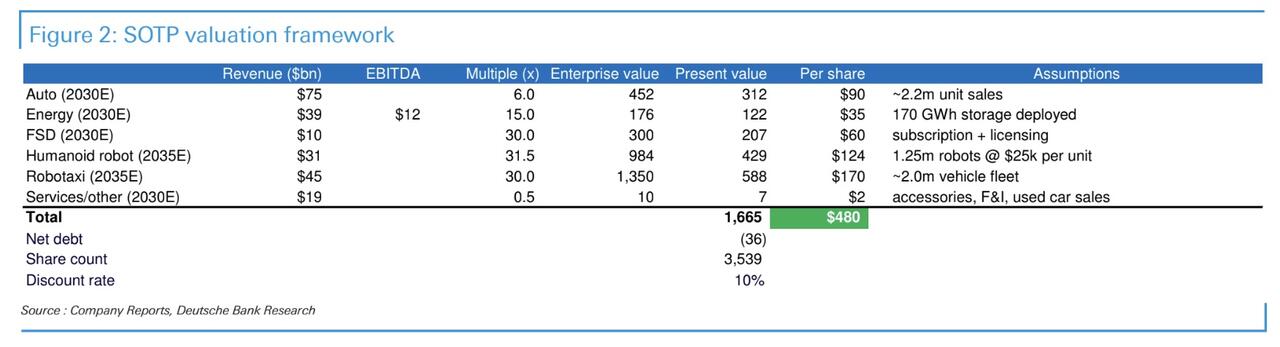
Autonomy and robotics now sit at the center of Deutsche’s long-term outlook. The firm highlights Tesla’s 1.1 million Full Self-Driving subscribers and sees FSD eventually generating up to $10 billion in annual revenue. It also expects the robotaxi network to grow to hundreds of thousands of vehicles by the end of the decade, producing more than $15 billion a year.
On Optimus, Tesla’s humanoid robot, the analysts are optimistic but realistic, warning that complex engineering, new supply chains, and slow early production will limit volumes in the near term.
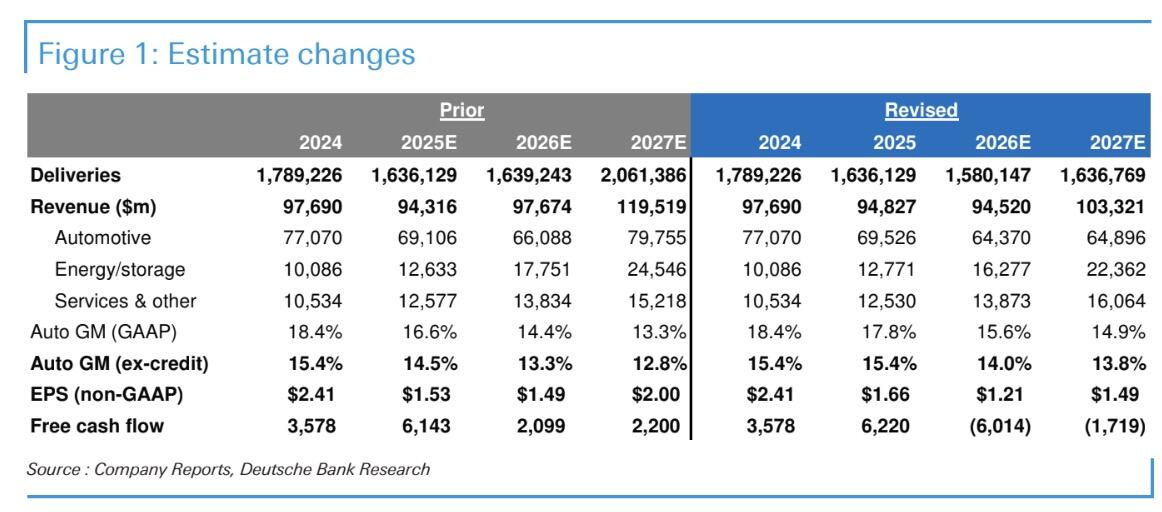
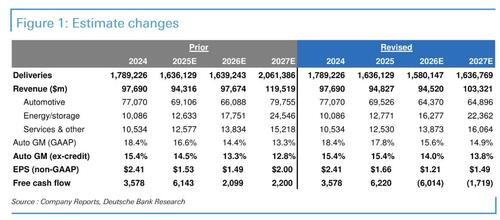
Despite its bullish view on AI, Deutsche slightly trimmed its numbers. It cut earnings and revenue forecasts and lowered its price target from $500 to $480, while keeping a Buy rating. The reduction reflects more conservative assumptions on vehicle sales and slower model rollouts, along with a revised valuation that separates FSD, robotaxis, and robotics into distinct businesses.
Most of Tesla’s long-term value, in their model, now comes from software, autonomy, and robots rather than car sales.
The note also flags risks, including weaker EV demand, intense competition, high execution hurdles in AI and robotics, regulatory scrutiny, and Tesla’s dependence on Elon Musk. Still, Deutsche argues that Tesla’s scale, data advantage, and vertical integration give it a strong chance to win if its strategy works.
Overall, the report frames Tesla as a company in the middle of a major transformation. Short-term forecasts have been trimmed, but Deutsche believes the real story is Tesla’s push to become a leader in AI-powered mobility and automation, with the potential to reshape multiple industries over the next decade.
Tyler Durden
Mon, 02/02/2026 – 18:00
https://www.zerohedge.com/markets/all-ai-deutsche-bank-says-tesla-no-longer-just-car-company