Category: News

La OMS reanudará programas de vacunación contra el cólera tras pausa de casi cuatro años
CIUDAD DEL CABO, Sudáfrica (AP) — Los programas de vacunación preventiva contra el cólera se reiniciarán a nivel mundial después de haber sido suspendidos durante casi cuatro años debido a una escasez de vacunas, informó la Organización Mundial de la Salud el miércoles.
En un comunicado conjunto, la OMS, la alianza de vacunas GAVI y el Fondo de las Naciones Unidas para la Infancia dijeron que las existencias de vacunas orales contra el cólera que gestionan habían mejorado a casi 70 millones de dosis el año pasado.
Las vacunas se distribuyen gratuitamente a los países que las necesitan, pero tuvieron que ser utilizadas solo en reacción a brotes en lugar de campañas preventivas después de que se anunciara una escasez en 2022 debido a un aumento en la demanda. La reserva se redujo a 35 millones de dosis y los países que enfrentaban brotes solicitaron muchas más de las que estaban disponibles.
La OMS, GAVI y UNICEF indicaron que una primera asignación de 20 millones de dosis estaba siendo desplegada, con 3,6 millones de dosis destinadas a Mozambique, 6,1 millones al Congo y 10,3 millones planificadas para su entrega a Bangladesh.
“La escasez global de vacunas nos obligó a entrar en un ciclo de reacción a los brotes de cólera en lugar de prevenirlos. Ahora estamos en una posición más fuerte para romper ese ciclo”, declaró el director general de la OMS, Tedros Adhanom Ghebreyesus, en un comunicado.
El cólera es una enfermedad diarreica causada por bacterias transmitidas por el agua. Los brotes a menudo ocurren como resultado de la pobreza, el conflicto o las crisis climáticas en lugares donde las instalaciones de salud son destruidas, el acceso al agua potable se interrumpe o las inundaciones propagan las bacterias.
Mozambique es uno de los países prioritarios después de que inundaciones afectaran a alrededor de 700.000 personas y aumentaran la amenaza de brotes de cólera el mes pasado.
La OMS ha dicho anteriormente que, si bien la pobreza y el conflicto siguen siendo factores persistentes para el cólera en todo el mundo, el cambio climático agravó un repunte de la enfermedad que comenzó en 2021 porque contribuyó a más tormentas y más húmedas.
La escasez de vacunas también llevó a la OMS a recomendar una estrategia de vacunación de una dosis en lugar de dos dosis. El miércoles la agencia señaló que una estrategia de una dosis seguiría siendo estándar, con campañas de dos dosis consideradas caso por caso.
Más de 600.000 casos de cólera y casi 7.600 muertes fueron reportados a la OMS el año pasado, según la organización de salud.
Los casos globales de cólera habían aumentado año tras año desde 2021 antes de un descenso en 2025. Sin embargo, las muertes relacionadas con el cólera continuaron aumentando.
___________________________________
The Associated Press recibe apoyo financiero para su cobertura sobre temas de salud y desarrollo en África de la Fundación Gates. La AP es la única responsable de todo el contenido. Encuentra los estándares de la AP para trabajar con organizaciones filantrópicas, una lista de las fundaciones y las áreas de cobertura que financian en AP.org.
___________________________________
Esta historia fue traducida del inglés por un editor de AP con ayuda de una herramienta de inteligencia artificial generativa.
Nuclear Nuggets From Goldman Offers Snapshot Of Reactor Space, Uranium Prices, Cameco
Nuclear Nuggets From Goldman Offers Snapshot Of Reactor Space, Uranium Prices, Cameco
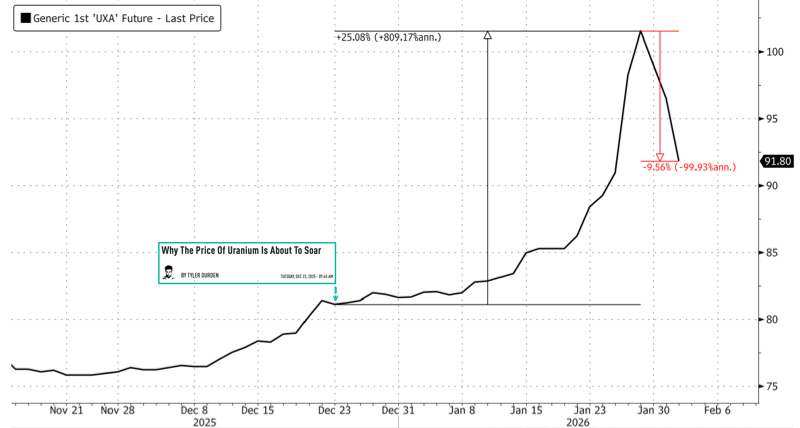
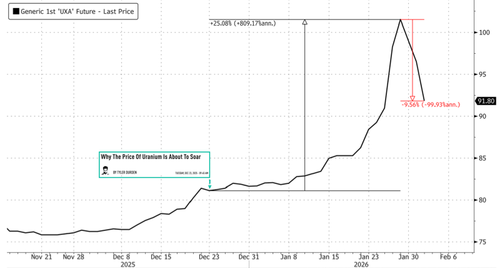
Our Dec. 23 note, “Why the Price of Uranium Is About to Soar,” was published just days before uranium futures surged 25% to above $100 per pound. Prices have since corrected about 10% to around $91 per pound, but the broader thesis remains intact: up and to the right.
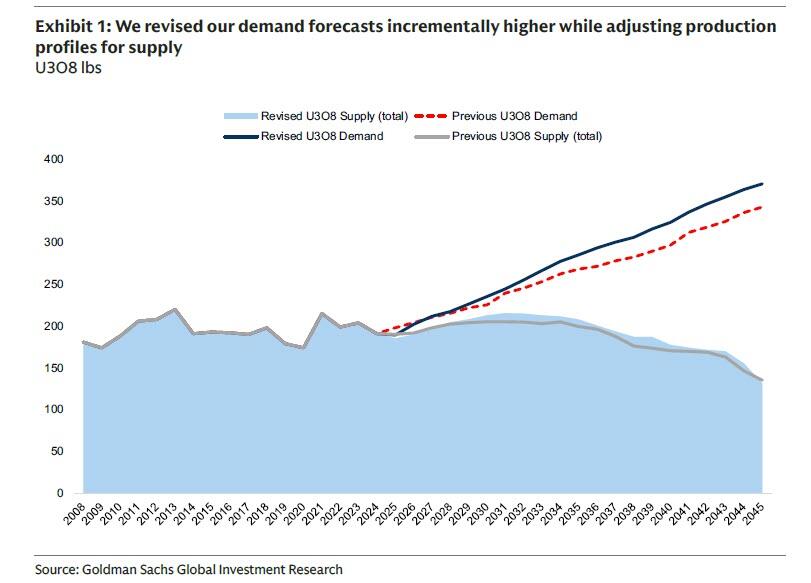
As we first outlined to readers since December 2020 (read here), uranium has emerged as the next gold. In an era of data centers and a rush to power up America with new nuclear reactors and to build next-generation grids capable of supporting explosive data-center growth and broader electrification trends, the world faces a massive uranium supply deficit that is only set to worsen by the end of the decade.
Drawing on Goldman’s Global Reactor Tracker, we provide readers with the latest developments, data points, and progress across North America, Europe, and Asia that only reinforce our bullish thesis on Cameco Corp and peers. We expect this to remain a solid bet on the industry this decade. Just remember, the CCJ call was made in December 2020 at around $11 per share.
Analysts led by Brian Lee have done all the hard work in capturing a snapshot of the uranium industry.
Here are the most critical developments happening across the space:
North America
1/16/26 – United States – NASA and the DOE have renewed their commitment through an MoU to develop a fission power source for the Moon and future Mars missions. This initiative, driven by an Executive Order, prioritizes deploying a lunar surface reactor by 2030 to provide safe, efficient, and continuous electrical power for sustained lunar missions, independent of sunlight or temperature. This aligns with NASA’s 2025 Integrated Lunar Power Strategy, which considers nuclear fission as a primary power generation technology.
1/29/2026 – Canada – Saskatchewan’s government and SaskPower are evaluating large nuclear reactor technologies alongside existing SMR plans. This dual strategy aims for energy security and future electricity demand, utilizing Saskatchewan’s uranium. GE Hitachi’s BWRX-300 SMR is planned for mid-2030s deployment near Estevan, while Westinghouse’s AP1000 and AP300 SMRs are also being explored. Large reactors could take 15-20 years to become operational.
1/29/2026 – Canada – Westinghouse and Tetra Tech Canada are collaborating to deploy Westinghouse’s AP1000 and AP300 reactors in Ontario. This partnership supports Ontario’s exploration of new nuclear generation at the Wesleyville site, where Ontario Power Generation (OPG) is evaluating various reactor technologies. The AP300 SMR aims for design certification by 2027 and operation by 2033.
Europe
1/19/26 – Slovakia- Slovakia and the USA have signed an Intergovernmental Agreement to advance Slovakia’s nuclear power program. This includes a new 1,200 MWe unit, possibly a Westinghouse reactor, at the Bohunice Nuclear Power Plant, targeting 2040-2041 operation. This follows a feasibility study supporting SMRs in Slovakia by 2035.
1/23/2026 – Denmark – Denmark is studying new nuclear technologies, including SMRs, to assess their potential and risks. This aims to inform a possible lifting of its 1985 nuclear power ban, driven by energy security and growing SMR interest. The analysis, covering economic viability and regulatory needs, is due Q2 2026 and is supported by a Nuclear Power Alliance.
Asia and other
1/2/2026 – South Korea – South Korea’s Nuclear Safety and Security Commission has issued an operating license for Saeul Nuclear Power Plant unit 3, an APR1400 reactor, with commercial operation targeted for January after fuel loading and testing. This unit, featuring enhanced safety measures and contributing 1.7% of Korea’s total power, marks a significant step following the reversal of the country’s nuclear phase-out policy.
1/2/2026 – Russia – The first VVER-TOI power unit at Russia’s Kursk II nuclear power plant was connected to the grid on Dec 31, reaching an initial capacity of 240MW, with a full capacity of 1,250MW. This new unit, is part of a project to replace the older RBMK-1000 reactors at the existing Kursk plant, with all four new units targeted for operation by 2034 (here).
1/5/2026 – China – Unit 2 of China’s Zhangzhou nuclear power plant, a Hualong One reactor, has entered commercial operation, completing the first phase of the project and bringing China Nuclear Power Corporation’s total operating units to 27. This plant, once fully completed with six units, is expected to provide over 60 billion kilowatt-hours of clean energy annually, significantly contributing to China’s energy structure and “dual carbon” goal (here).
1/6/2026 – Russia – Russia’s Bilibino Nuclear Power Plant permanently shut down its last unit on December 30 after 51 years, replaced by the 70 MW Akademik Lomonosov floating nuclear power plant. This marks Rosenergoatom’s first complete plant shutdown, with unique decommissioning challenges in the Arctic, aiming for full rehabilitation by 2055 (here).
1/15/2026 – Russia – Russia has approved a five-year life extension for Leningrad-4, an RBMK-1000 reactor, allowing it to operate for a total of 50 years until 2031 after comprehensive modernization and safety checks. This extension ensures continued electricity supply for northwest Russia and the production of medical isotopes, complementing the ongoing replacement of older RBMK units with new VVER-1200 reactors at the site.
1/16/2026 – China – China has commenced construction on Unit 1 of the Xuwei nuclear power project, a “world’s first dual-coupling demonstration” combining Hualong One PWRs with a high-temperature gas-cooled reactor to provide both electricity and industrial heating. This innovative project is projected to annually supply 32.5 million tonnes of industrial steam and over 11.5 billion kWh of electricity, significantly reducing coal consumption and carbon emissions.
1/19/2026 – Japan – Tepco postponed the scheduled January 20 restart of unit 6 at its Kashiwazaki-Kariwa nuclear power plant. The delay occurred after a safety alarm failed to sound during a control rod withdrawal test on January 17. Tepco identified and corrected an error in the alarm’s settings by January 18, confirming its proper function. This Advanced Boiling Water Reactor had been offline since the Fukushima Daiichi accident (here).
1/19/2026 – Russia – Rosatom Director expects four foreign nuclear units to start in 2026: Bangladesh (Rooppur), Turkey (Akkuyu), and two in China. Rosatom exceeded 2025 goals despite sanctions, advancing Hungary’s Paks II and Turkey’s Akkuyu projects. He discussed yuan financing, 100-year unit operation, advanced nuclear tech, and the Northern Sea Route. Zaporizhzhia NPP Unit 1 was licensed in 2025, with generation conditional.
1/26/2026 – South Korea – South Korea confirmed plans for two new large nuclear reactors and 700 MW of SMR capacity by 2038, as part of its 11th Basic Plan. The strategy prioritizes nuclear and renewables to reduce carbon emissions, projecting increased electricity demand and a rise in carbon-free energy to 70% by 2038. KHNP will launch a bidding process for host cities by 2027, targeting reactor completion by 2037-2038.
1/26/2026 – Argentina – Argentina’s CNEA plans to reactivate its Neuquén Heavy Water Industrial Plant (PIAP), mothballed since 2017. Once the world’s largest facility, it will undergo maintenance and refurbishment to restart production, aiming for revenue generation and exports. A May 2025 MoU with Candu Energy supports the restart and long-term heavy water acquisition, with Argentina’s plants needing 485 tonnes and surplus available for export.
1/19/2026 – Russia – Russia’s Roscosmos has contracted NPO Lavochkin to develop a lunar nuclear power station by 2036, requiring three missions (2033-2035). This station will power Russia’s lunar program and the International Lunar Research Station (ILRS), a joint Russia-China initiative also involving Rosatom and the Kurchatov Institute.
SMR announcement tracker
1/6/2026 – Bulgaria – Blue Bird Energy and Synthos Green Energy formed a joint venture to deploy up to six GE Vernova Hitachi Nuclear Energy BWRX-300 small modular reactors (SMRs) in Bulgaria, aiming to provide affordable, reliable energy. This expands Synthos Green Energy’s European SMR strategy, which includes plans for 24 BWRX-300 units in Poland.
1/8/2026 – United States – Terrestrial Energy and Oklo have signed agreements with the US Department of Energy for pilot projects under the Advanced Reactor Pilot Program. Terrestrial Energy will develop a pilot Integral Molten Salt Reactor (IMSR) to expedite commercialization of its 4th generation technology, while Oklo will build a radioisotope pilot plant for medical and research isotopes. These agreements, leveraging Other Transaction Authority, aim to fast-track advanced reactor innovation and achieve criticality by July 2026.
1/8/2026 – China – China’s ACP100 (Linglong One) SMR at the Changjiang site successfully completed its non-nuclear turbine test run on December 23. This 125 MWe SMR, developed by CNNC, is the world’s first commercial land-based SMR to reach this milestone, verifying its conventional island systems. Commercial operation is targeted for the first half of 2026.
1/12/2026 – United States – Ameresco and NANO Nuclear signed an MoU to deploy NANO’s KRONOS, ZEUS, and LOKI microreactors on US federal and commercial sites, with Ameresco leading EPC. DS Danseok also signed an MoU for NANO microreactors in South Korea. This builds on Ameresco’s prior IMSR collaboration.
1/16/2026 – Slovakia – A Project Phoenix study confirmed Slovakia’s suitability for SMR deployment, with four sites (Bohunice, Mochovce, Vojany, US Steel Košice) meeting baseline criteria. The next steps involve developing a regulatory framework, detailed site investigations, and public consultation. SMRs could be operational by 2035, enhancing energy security and decarbonization.
1/16/2026 – Uzbekistan – Uzbekistan and Rosatom are progressing on a nuclear power plant project, with first concrete for the SMR anticipated “well before December” 2026, targeting spring pouring. The project initially involved six RITM-200N SMRs (330 MW total), with the first unit critical by late 2029. The plan later expanded to include two large VVER-1000 units and two 55 MW RITM-200N SMRs. Excavation for the first SMR is underway in the Jizzakh region.
1/29/2026 – United States – NextEra Energy plans up to 6 GWe of SMR capacity, primarily for data centers. They are evaluating SMR manufacturers and have identified 6 GW of co-location opportunities at existing or new sites. The Duane Arnold plant will restart by 2029, supported by a Google power purchase agreement. This is part of NextEra’s “15 by 35” strategy, aiming for 15-30 GW for data centers by 2035.
Global reactor critical updates
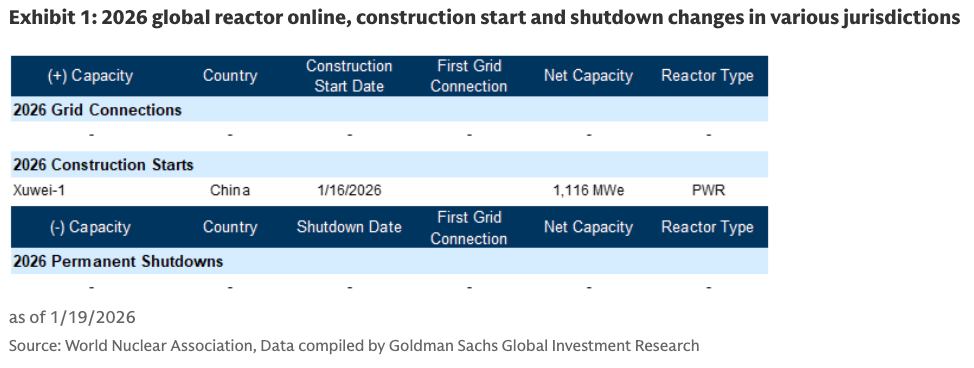
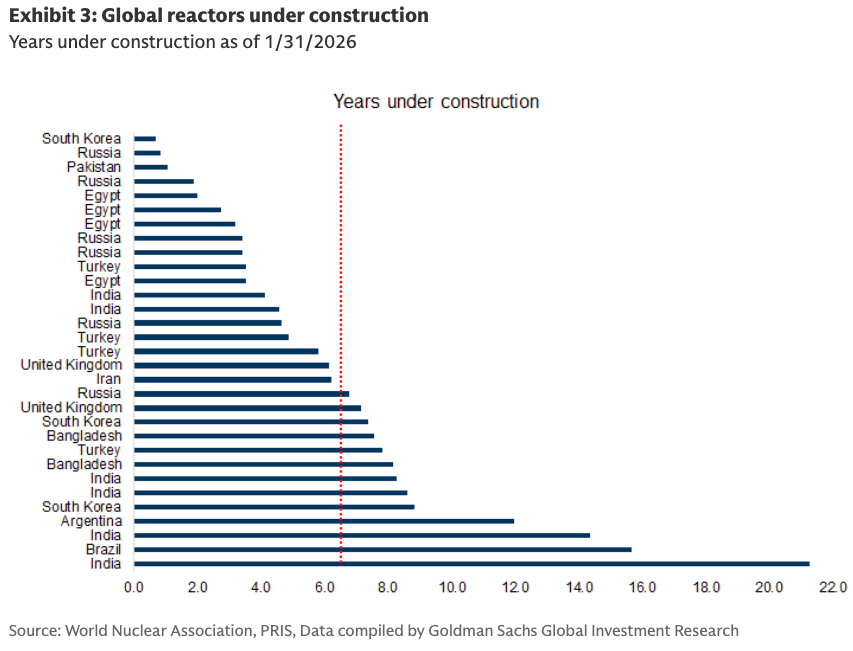
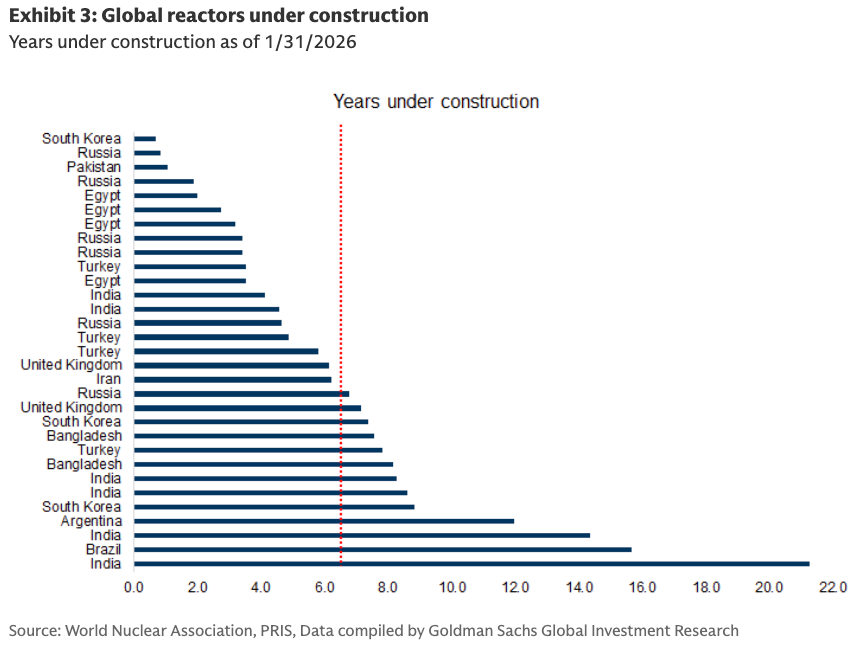
In the month of January, there have been few changes to new reactor construction starts, grid connections, shutdowns, or restarts.
Global reactor construction tracker
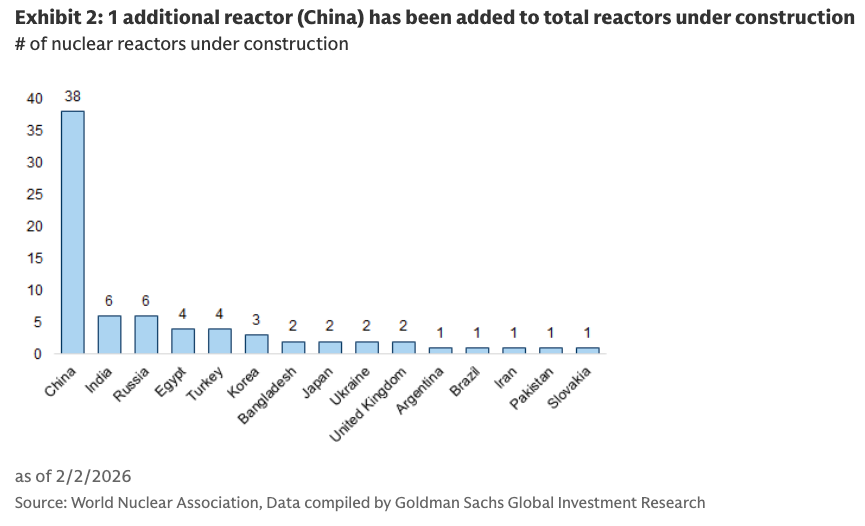
The epicenter of the world’s nuclear reactor buildouts is China.
Global reactors under construction.
China.
Latest on spot uranium prices:
Spot momentum continues into the new year. Uranium pricing has shown continued strength in the new year, up +21% over the month of January, with spot climbing over $100/lb for the first time in almost two years. Spot market activity was robust with a total of 90 transactions involving 9mn/lbs of uranium. Pricing momentum intensified in the last week of January as Sprott raised funds and accumulated ~2.5mn lbs of uranium. The spot price currently sits at ~$91/lb compared to $82/lb in December.
Term pricing moderate. Term pricing increased in January by $2 to $88/lb, marking its highest level since May 2008. However, term market activity was moderate throughout the month, with one utility finalizing an off-market selection for uranium deliveries starting in 2029. A new utility also entered the market seeking approximately 1.2 million pounds of uranium for delivery in the same year. Additionally, non-U.S. utilities were actively evaluating offers for longer-term uranium and EUP requests.
KAP guidance update. On 2/2/26, KAP provided its 4Q25 operations and trading update, which included 2026 production guidance. The company’s 2025 production of 25,839 tonnes uranium (tU) (67.2mn lbs) was in line with guidance of 25,000-26,500 tU. Additionally, KAP provided 2026 guidance of 27,500-29,000 tU (71.5-75.4mn lbs), signaling growth of 9% yoy that is driven by the planned ramp of its JV Budenovskoye, which is fully reserved under offtakes from 2024-2026. Importantly, the midpoint of 2026 guidance is ~5% below its subsoil use contract annual production of 29,697 tU, which was lowered by ~10% from 32,777 tU in August 2025. Additionally, the guidance is dependent on the availability of sulfuric acid, which was a key factor that weighed on production in 2025. We note that KAP could potentially lower its production another ~15% and be within the confines of the +/- 20% threshold provided in its Competent Person’s Report.
Color on nuclear stocks:
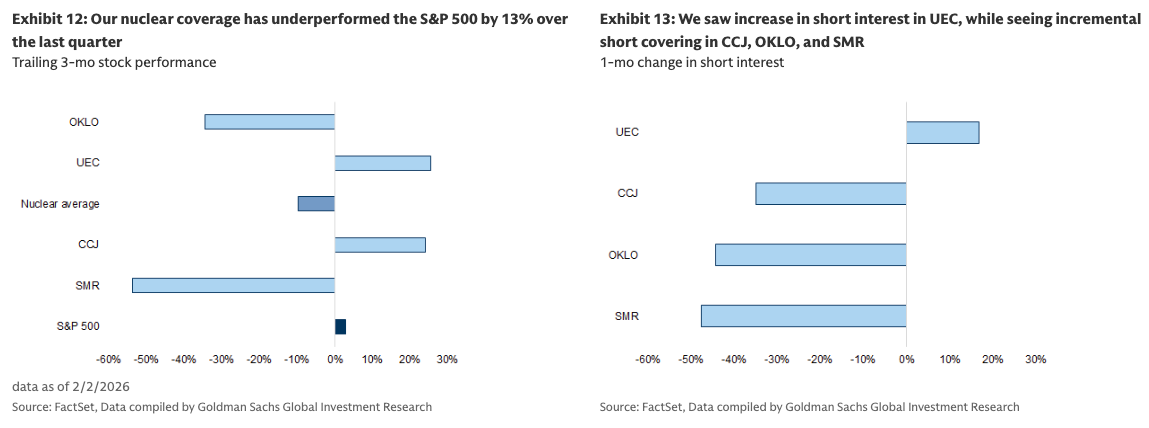
Nuclear stocks have seen mixed performance over the past three months, with our nuclear coverage averaging a -13% return over the period compared to the S&P which returned 3%. Performance was collectively positive across uranium-levered names (CCJ/UEC), likely in large part owing to the recent rally in spot uranium pricing, while SMR technology players have traded significantly off. With respect to investor positioning, UEC was the only stock in our coverage which saw an increase in short interest, as the stock continues to rally, up 26%/35% over the past 3mo/12mo. Across the remainder of our coverage, short interest decreased across both CCJ and OKLO while SMR saw the largest decrease in short interest.
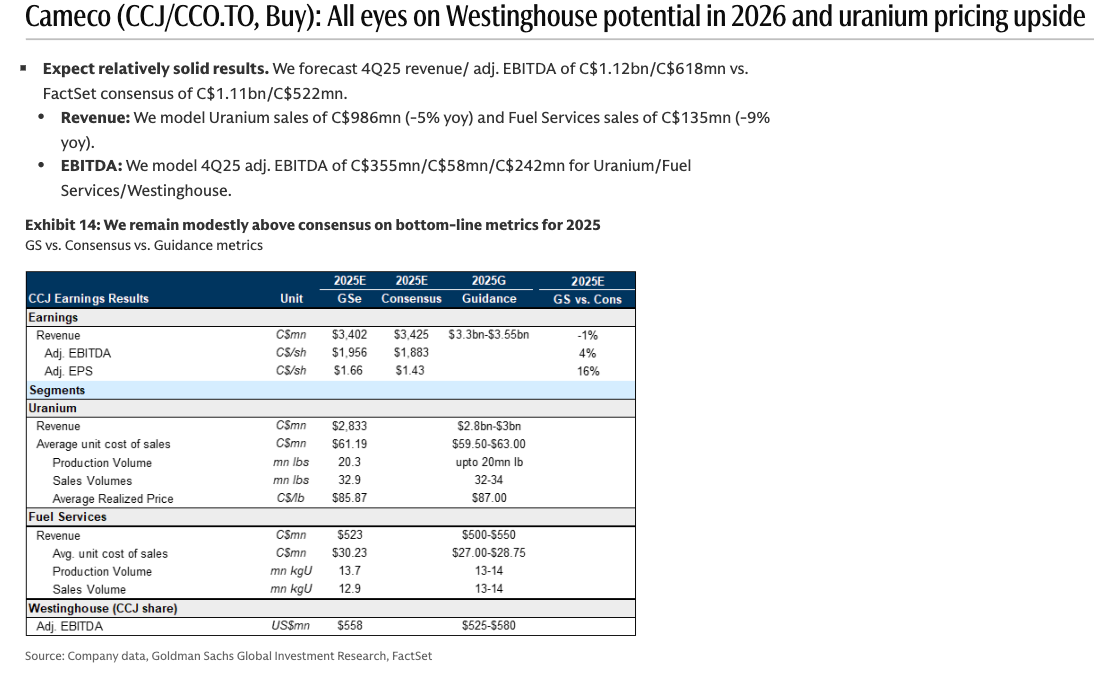
Cameco
Professional subscribers can read much more from Goldman here at our new Marketdesk.ai portal
Tyler Durden
Wed, 02/04/2026 – 13:40

Japan Is Normalizing: Risks To The Yen Carry Trade
Japan Is Normalizing: Risks To The Yen Carry Trade
Authored by Michael Lebowitz via RealInvestmentAdvice.com,
“Japan Bond Meltdown Sends Yields to Record High on Fiscal Fears,” read a January 2026 Bloomberg article. Headlines like this, and many others, warn that Japan’s abrupt interest rate increase is an omen of dire trouble. While that may be the case, given decades of economic woes, declining demographics, and extreme levels of outstanding debt, we have an alternative view.
Might the recent sharp rise in Japanese yields simply reflect the normalization of its economy, inflation, and interest rates following decades of stagnation and very aggressive monetary and fiscal policies?
Whether you follow Japan or not, its situation is incredibly important for investors because it is a major provider of global liquidity. Instead of being overly dramatic about the slim chance of a near-term Japanese crisis, we prefer to focus on how Japan normalizes policy after years of artificially suppressed interest rates and how it will impact the yen carry trade.
Japan’s Lost Decades
To help appreciate Japan’s current situation and why some pundits claim that Japan is near the end of its fiscal line, we share the links to prior articles: Japan’s Lost Decades & Are We on Japan’s Path Of Stagnation? The following quotes from the articles summarize Japan’s plight.
Japan’s prolonged stagnation traces back to the collapse of one of the largest asset bubbles in history in the late 1980s. As we explain, enormous real estate and stock market valuations imploded, leaving banks burdened with bad loans and unable to lend effectively. For example: “from 1956 to 1986 land prices in Japan increased by 5000% even though consumer prices only doubled in that time,” and its Nikkei stock index P/E was close to 70 at its peak.
The government chose to support failing banks and extend the economic pain over decades through massive government spending and near-zero interest rate policies rather than take a short-term, deeper contraction.
They elected the latter, saving their banks and relying on massive government spending to insulate the economy.
This response contributed to a fragile financial system with “zombie” banks, suppressed lending, and a private sector unable to drive robust growth, leading to deflationary pressures and very low economic growth for decades.
Demographics and structural factors have compounded the issue. Japan’s population has been aging and declining, with low birth rates and minimal immigration dampening labor force growth and consumption, making growth harder to achieve. Additionally, long-standing fiscal dominance — where policy focuses on funding government debt and supporting markets — along with weak incentives for productive private investment, have kept economic activity subdued.
Japan Removes Its Financial Support
Prior to the last few years, Japan experienced decades of economic malaise. The post-WWII economic boom was spectacular, and the echo payback was equally stunning.
A recent uptick in inflation, GDP, and interest rates has allowed Japan to gradually remove the monetary policy crutch that has supported its banks, economy, and financial markets for decades. This primarily entails the Bank of Japan (BOJ) reducing its balance sheet and letting interest rates gravitate toward normal market levels.
Some investors watching the sharp increase in interest rates warn that rates are rising because investors are pricing in rising default risks. Others, including us, think this is the normalization process.
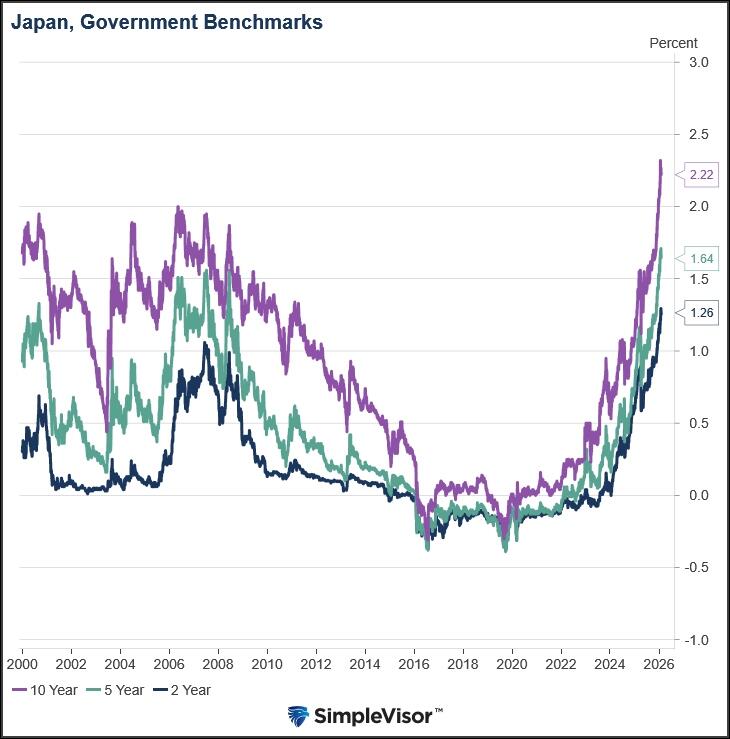
The first graph below shows the current benchmark interest rates for Japanese 2-year, 5-year, and 10-year bonds.
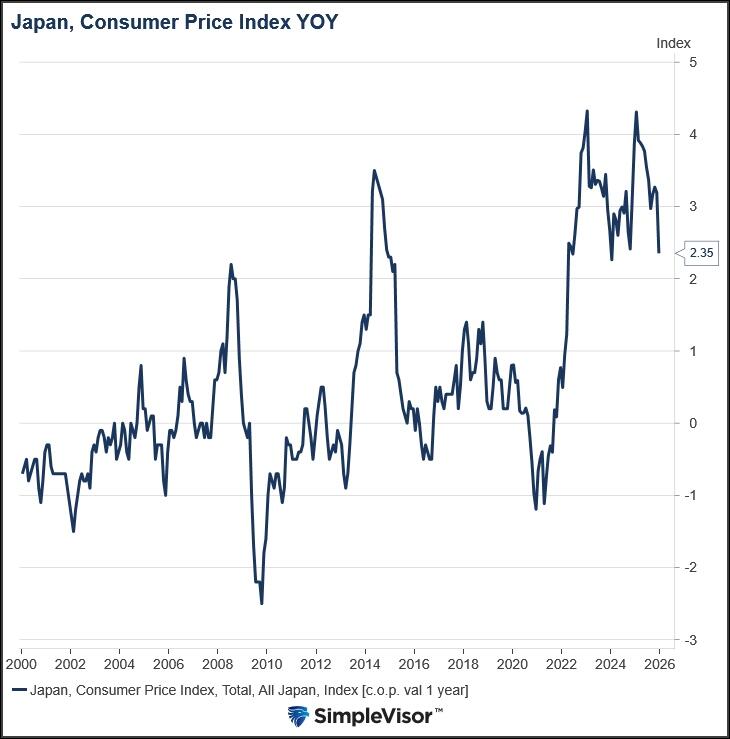
The recent increase in interest rates from negative levels is significant. The next graph shows that the inflation rate has recently been much higher than in the pre-pandemic era.
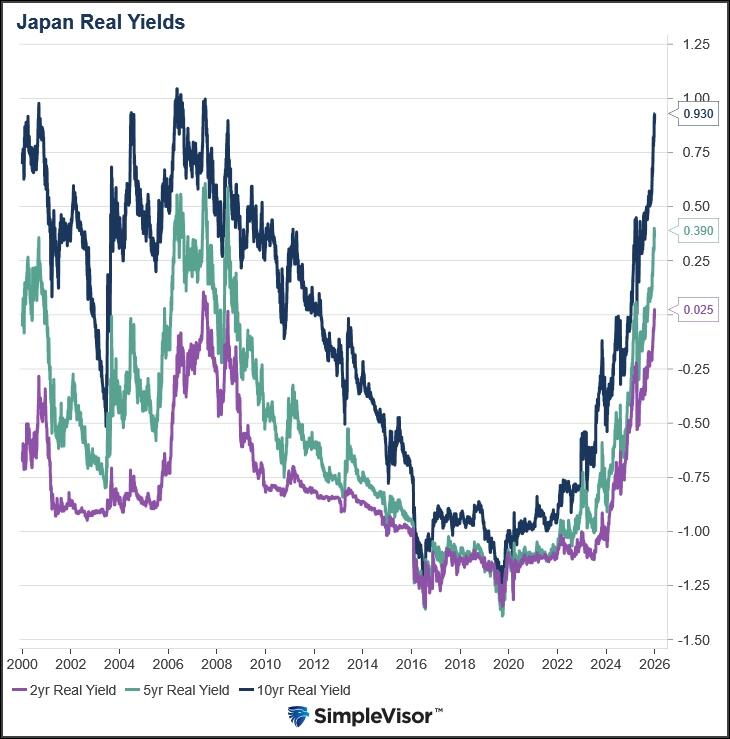
Next, we combine the two graphs to arrive at real (inflation-adjusted) yields. As shown, the 2-year, 5-year, and 10-year real yields are below 1%, albeit well above the -1% real yields that persisted from 2016 to 2022. They are now in line with the pre-financial crisis period.
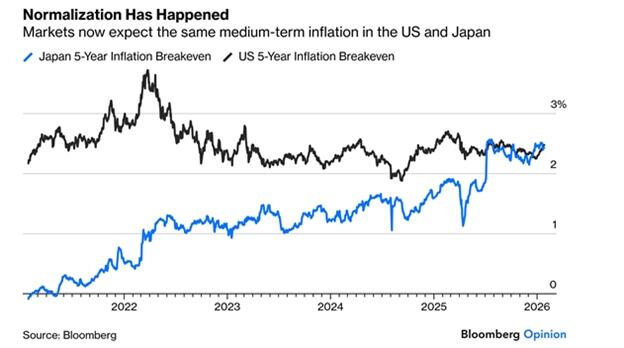
The takeaway from the three graphs is that Japan has allowed yields to gravitate toward a normal spread relative to the inflation rate. The next graph, courtesy of Bloomberg, provides global context. Inflation expectations are very similar for Japan and the US. However, Japanese yields, despite the recent increase, are about 2% below US Treasury yields.
The charts signal that Japanese interest rates and inflation are moving toward levels more in line with those of other large economies.
Economic Signs Of Normalization
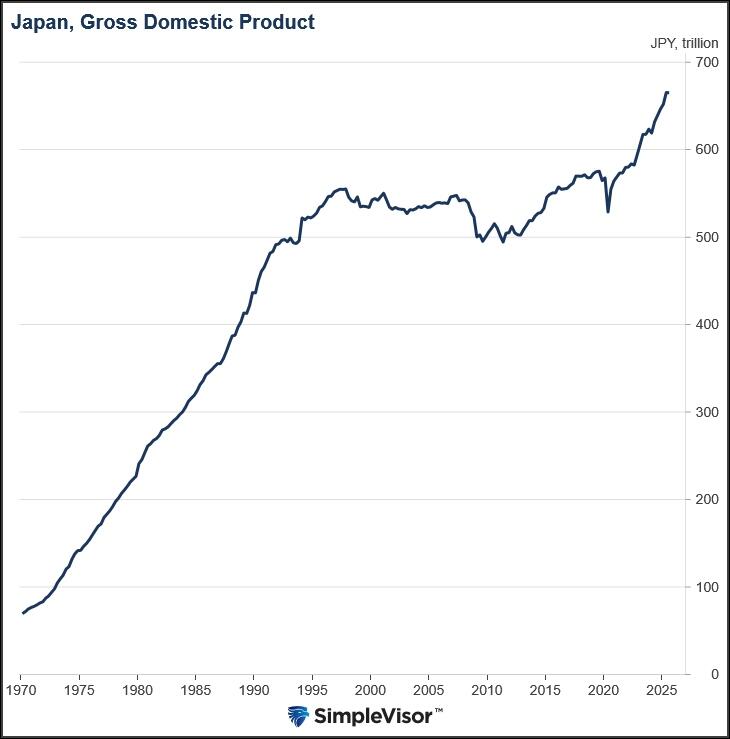
The normalization argument is further supported by a recent spurt in economic activity. The graph below shows Japan’s economy was stagnant for 23 years, ranging from 1997 to 2020. However, economic activity has accelerated in earnest since the second half of 2022.
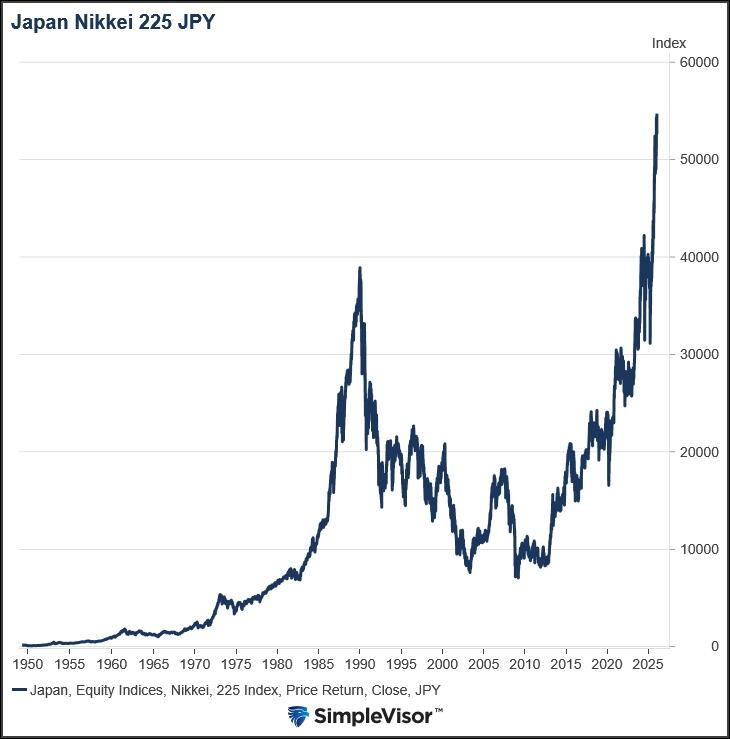
Furthermore, the Nikkei 225, Japan’s primary stock index, broke to new record highs, finally eclipsing the prior peak seen at the end of 1989.
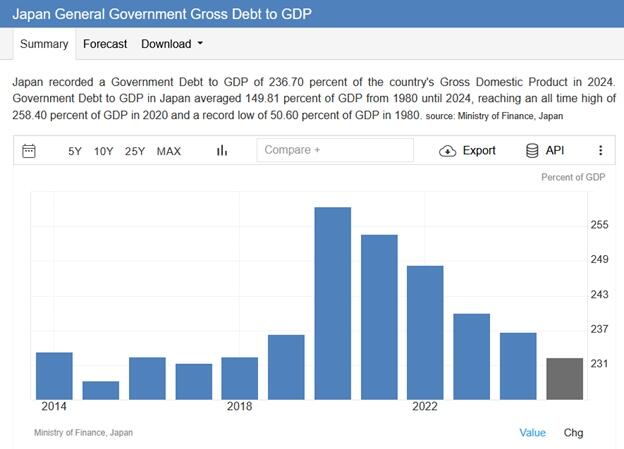
Lastly, Japan’s debt, while rising nominally, is falling as a percentage of economic activity. As we share below, its Debt-to-GDP ratio peaked at 2.58x and has since moderated to 2.32x. It is still exceptionally high but trending in the right direction. For context, the US debt-to-GDP ratio stands at 1.21x, which is considered problematic by some economists.
Japan Is In A Pickle
Normalization after years of significant fiscal and monetary stimulus will not be easy. For example, the public, used to near-zero inflation, is growing uneasy about inflation and unhappy with calls for fiscal austerity. Its policymakers, fiscal and monetary, are being forced to decide between economic growth and inflation.
Policymakers could contain inflation by raising interest rates and implementing fiscal austerity, thereby resulting in yen appreciation. The risk is that they reduce economic growth in the process. Conversely, they could keep rates at current levels and increase fiscal spending, as some politicians want, but risk that inflation keeps increasing.
As if that decision isn’t hard enough, they must also manage interest rates to accommodate the funding of Japan’s excessive outstanding debt. As we noted earlier, Japan has a debt-to-GDP ratio almost twice that of the US. Higher interest rates increase the government’s interest expense. In turn, they must issue more debt to fund existing debt. This is the trap noted by Japan’s bond vigilantes.
However, Japan’s debt situation is not comparable to the US’s. To wit, John Authers of Bloomberg recently reminded us why Japan can maintain higher levels of debt than most other countries. Per his missive, Japan Needn’t Drive An International Crisis:
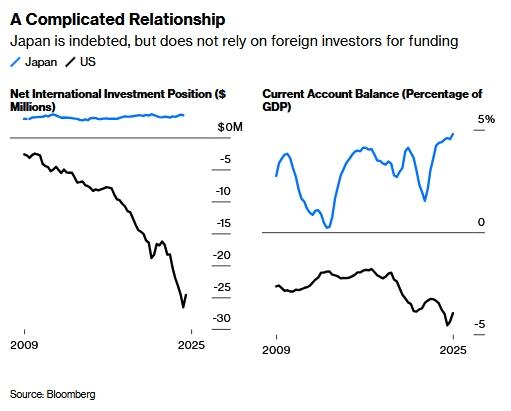
Another key argument against a crisis is that, despite its huge pile of debt, Japan is stable. It maintains a current account surplus (unlike the US). Also, unlike the US, it has a positive net international investment position, meaning that it holds more foreign assets than foreigners hold assets in Japan:
Further, he argues:
Moreover, fears of an imminent fiscal accident appear overstated. Political constraints may limit aggressive fiscal expansion, the primary deficit has been shrinking, and authorities retain extensive tools to manage yield volatility. Unlike sudden crises driven by foreign capital flight, Japan’s challenge is one of gradual adjustment, not sudden loss of confidence.
Global Liquidity- Yen Carry Trade
As we led the article, we think the most important aspect of Japan’s normalization path is its impact on global liquidity through the yen carry trade. Thus, before discussing tough decisions facing Japan and their potential impacts on the yen carry trade, we share a basic example of how the yen carry trade works.
A US-based hedge fund borrows ¥15.3 billion yen ($100 million) at 0.75% for one month.
They convert the yen to $100 million and purchase shares of IBM.
The return on the trade depends on three components. First, the borrowing cost (0.75%). Second is the change in the yen-dollar exchange rate. Lastly, there is IBM’s price change.
Recently, borrowing costs in Japan have risen but remain well below US rates. Despite higher rates, the yen has depreciated against the dollar, which benefits the carry trade returns and more than offsets the higher interest costs. However, bear in mind that an appreciating yen can easily offset the interest rate differential, making the yen carry trade less favorable.
If Japan can gradually normalize its interest rate and support its currency with minimal volatility, the yen carry trade can unwind in a market-healthy fashion. But, as we saw in 2024, sudden shocks to the yen can trigger a swift reversal of the carry trade, harming global stock and bond markets.
Summary
In our opinion, Japan’s rising yields and currency volatility reflect an economic normalization. We do not think Japan is on the verge of fiscal collapse. However, the transition from a monetary- and fiscal-policy-dependent economy to a free-market economy could significantly affect a major source of global market liquidity. Policy decisions that cause sharp, sudden changes in rates and or the yen can have a notable effect on stock and bond markets worldwide.
We witnessed this in August 2024, when the BOJ unexpectedly raised interest rates. As a result, the Nikkei 225 fell by over 12% in one day, and the S&P 500 corrected by 6% over a few days. The BOJ and government seem more aware that their decisions have a significant impact on global markets. We trust they will aim for a smooth normalization process, free of market shocks. But understand that their endeavor to return to a free-market economy entails significant risks for Japanese and global markets
Tyler Durden
Wed, 02/04/2026 – 13:20
https://www.zerohedge.com/markets/japan-normalizing-risks-yen-carry-trade

Falleció Mickey Lolich, héroe de la Serie Mundial de 1968 con los Tigres. Tenía 85 años
Por ED WHITE
DETROIT (AP) — Mickey Lolich, quien se apuntó tres victorias de juego completo para los Tigres de Detroit en la Serie Mundial de 1968, el último lanzador de las Grandes Ligas en lograr esta increíble hazaña, murió el miércoles. Tenía 85 años.
Los Tigres dijeron que la esposa de Lolich les informó que falleció tras una breve estancia en cuidados paliativos. No se proporcionó una causa exacta de la muerte.
Denny McLain fue la estrella del cuerpo de lanzadores de Detroit en 1968, ganando 31 juegos de la temporada regular. Pero Lolich fue el Jugador Más Valioso de la Serie Mundial, con una efectividad de 1.67 y una victoria en el séptimo juego como visitante sobre Bob Gibson y los Cardenales de San Luis.
Bill Freehan se quitó la máscara de receptor y atrapó un elevado de foul de Tim McCarver para el último out. Lolich saltó a los brazos de Freehan, una imagen icónica de la temporada de campeonato de Detroit.
“Siempre era alguien más, pero finalmente llegó mi día”, dijo Lolich afirmó al diario Detroit Free Press en 2018.
Es el número 23 en la lista histórica de ponches con 2.832, por delante de muchos otros que, a diferencia de Lolich, están en el Salón de la Fama, y quinto entre todos los zurdos, según baseball-reference.com.
Lolich fue un héroe inesperado en 1968. Durante una reunión del equipo de la Serie Mundial, recordó cómo el manager Mayo Smith lo envió al bullpen durante gran parte de agosto. Regresó a la rotación de abridores de los Tigres y tuvo un récord de 6-1 en las semanas finales.
“Estaba teniendo algunos problemas, pero había sido un lanzador abridor desde 1964”, dijo Lolich, quien estaba molesto por el movimiento al bullpen. “Recuerdo haberle dicho: ‘Si ganamos esto este año, será por mí’. Pero solo estaba hablando de la temporada. No estaba hablando de la Serie Mundial”.
“Me vengué en la Serie Mundial”, expresó.
Lolich lanzó el séptimo partido después de solo dos días de descanso. Pensó que recibiría un Corvette de General Motors por ser el MVP de la Serie, pero tuvo que conformarse con un Dodge Charger GT porque Chrysler era el patrocinador en 1968.
“Nada en contra de los Chargers, nada en absoluto”, dijo Lolich en su libro, “Joy in Tigertown”. “Es solo que ya tenía dos de ellos”.
Desde Lolich, solo Randy Johnson de Arizona en 2001 ha ganado tres juegos en una Serie Mundial, aunque Johnson lanzó alrededor de 10 innings menos y fue relevista, no abridor, en el séptimo duelo.
Lolich tuvo un récord de 220-192, incluyendo la postemporada, a lo largo de una carrera de 16 años, todos menos tres con Detroit. Dejó el béisbol después de lanzar para los Mets de Nueva York en 1976, pero regresó con San Diego en 1978-79.
El zurdo tuvo un récord de 25-14 en 1971, ponchando a 308 bateadores en 376 entradas y terminando segundo en la votación del premio Cy Young de la Liga Americana. Siguió con un récord de 22-14 y 250 ponches en 1972.
Después de su carrera en el béisbol, Lolich, oriundo de Portland, Oregón, estuvo en el negocio de las donas o rosquillas en los suburbios de Detroit, haciéndolas y vendiéndolas durante 18 años.
“Dudo que algún otro jugador de béisbol haya hecho esa transición, del diamante a las donas. Pero yo lo hice”, escribió en su libro.
___
El escritor de deportes de AP Larry Lage contribuyó a este despacho.
Deportes AP: https://apnews.com/hub/deportes

Entrenador de Lindsey Vonn dice “no hay duda” que la esquiadora competirá en los Juegos Olímpicos
Por ANDREW DAMPF
CORTINA D’AMPEZZO, Italia (AP) — Lindsey Vonn necesitó usar una muleta para moverse durante el fin de semana. Ahora está realizando saltos sobre un cajón, entrenándose en una piscina llevando chaleco con peso y esquiando a alta velocidad.
No es de extrañar que la estadounidense de 41 años sea tan optimista sobre su capacidad para competir en el descenso de los Juegos Olímpicos de Invierno de Milán-Cortina el domingo, a pesar de tener un ligamento cruzado anterior roto en su rodilla izquierda.
“Estoy bastante seguro de que todavía puede lograr este sueño. No tengo dudas en mi mente de que esto va a estar bien”, señaló Chris Knight, el entrenador principal de Vonn, en una entrevista el miércoles con The Associated Press.
El equipo de Vonn, compuesto por dos fisioterapeutas —Lindsay Winninger y Andi Mitterfellner— y el preparador físico Peter Meliessnig, ha estado trabajando horas extras con ella.
“Ha estado haciendo saltos sobre un cajón, está probando todo, cargas y tensiones y cosas así para ver dónde está y cómo se siente, y ha respondido muy bien a todo. Sin hinchazón, sin dolor”, dijo Knight.
Vonn declaró el martes que “no se ha hablado” de someterse a una cirugía.
“No está realmente en mi radar en este momento. Los Juegos Olímpicos son lo único en lo que estoy pensando”, expresó. “Cada día mi rodilla ha mejorado. Y cada día estamos discutiendo con un equipo médico completo, doctores, fisioterapeutas, todos, para asegurarnos de que estamos haciendo todo para tomar decisiones inteligentes y seguras”.
‘Decisión fácil de seguir adelante’
A Vonn se le insertó un reemplazo parcial de titanio en su rodilla derecha en 2024 y regresó a las competencias de esquí la temporada pasada después de casi seis años de retiro.
Ahora también tiene contusiones óseas y daño meniscal en su rodilla izquierda, aunque sus médicos no están seguros si el problema meniscal es resultado de su última lesión o de su larga serie de percances anteriores en su carrera.
“No tiene 20 años, tiene 40 años. Y de todos modos no estamos mirando más allá de este año”, declaró Knight. “Obviamente hay algunos riesgos solo para poder esquiar al nivel que ella quiere. Y nadie sabe al 100% qué va a pasar. Pero todos los indicadores y factores correctos están ahí para nosotros. … Es una decisión bastante fácil seguir adelante”.
Vonn se lesionó cuando perdió el control al aterrizar un salto en Crans-Montana, Suiza, el viernes, y terminó chocando contra las redes de seguridad.
“Tuvo una muleta hasta ayer. Solo para ayudar con un poco de la carga, pero ahora eso también ha desaparecido”, indicó.
Después de usar una muleta el lunes, Vonn intentó esquiar libremente el martes.
“Hizo esquí a alta velocidad y no tuvo problemas”, señaló Knight.
Aún así, Vonn y su equipo podrían necesitar más tiempo para recuperarse. Knight dijo que no le importaría si hay una cancelación relacionada con el clima, y obtuvieron su deseo el miércoles cuando los organizadores anunciaron que la sesión de entrenamiento de descenso del jueves no se llevaría a cabo debido a la intensa nevada en el recorrido.
“Pero también necesitamos salir de la puerta de salida en una carrera de entrenamiento en caso de que algo suceda más adelante y tengan que cancelar otra cosa”, dijo Knight.
Hay dos sesiones de entrenamiento más programadas para el viernes y el sábado, y Vonn necesita comenzar al menos una sesión para participar en la carrera del domingo. Podría hacer solo una.
“Tenemos que ver cómo están las condiciones. Hay muchas opciones”, dijo Knight.
Vonn tiene el récord de 12 victorias en la Copa del Mundo en Cortina y ha estado compitiendo aquí durante casi un cuarto de siglo, desde antes de que algunos de sus competidores actuales nacieran. También ha regresado con éxito de lesiones de esta magnitud antes.
También quiere competir en honor a su difunta madre, Lindy, quien murió en 2022 de ELA, también conocida como la enfermedad de Lou Gehrig, y su entrenador de infancia, Erich Sailer, quien murió en agosto a los 99 años.
Se detuvo para visitar la tumba de Sailer en Austria en su camino a Cortina.
“Hay tantas razones para que ella no se rinda, que la están impulsando y manteniendo la adrenalina alta. No quieres desacelerar en estas situaciones”, afirmó Knight.
___
Deportes AP: https://apnews.com/hub/deportes
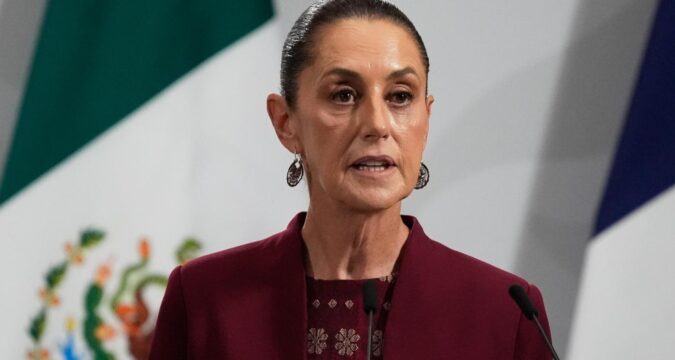
México busca vías para enviar crudo a Cuba; dice que la isla está al día con los pagos
Associated Press
CIUDAD DE MÉXICO (AP) — La presidenta mexicana Claudia Sheinbaum afirmó el miércoles que su gobierno sigue en la búsqueda de vías diplomáticas para reanudar las ventas de petróleo a Cuba, que alcanzaron el año pasado casi 500 millones de dólares, y aseguró que la isla está al día con sus pagos.
Sheinbaum defendió una vez más la decisión de su gobierno de seguir apoyando de manera humanitaria a Cuba y dijo que “estamos buscando todas las vías diplomáticas para poder resolver ese problema” y evitar que México resulte afectada por la amenaza que lanzó la semana pasada el presidente Donald Trump de imponer gravámenes a los países que vendan o suministren crudo a la isla.
Antes del anuncio de Trump, la petrolera estatal Petróleo Mexicanos (Pemex) ya había suspendido en enero los envíos de crudo a Cuba, aunque no ha aclarado las causas de esa decisión.
La paralización de los suministros de México vino en el peor momento para Cuba debido a que desde inicios de año Venezuela —su mayor proveedor energético — también suspendió los envíos a la isla tras la operación que realizaron militares estadounidenses en Caracas para capturar al entonces presidente Nicolás Maduro y su esposa.
Según expertos internacionales, el gobierno de Maduro —estrecho aliado del gobierno cubano— enviaba a la isla unos 35.000 barriles diarios, mientras que Rusia mandaba 7.500 barriles al día. De enero a septiembre pasado México mandó a Cuba 19.200 barriles diarios, consistentes en 17.200 de petróleo crudo y 2.000 de productos derivados, de acuerdo con registros de la Comisión de Bolsa y Valores de Estados Unidos, (SEC por sus siglas en inglés).
Al hablar sobre las ventas de crudo a Cuba, el director general de Pemex, Víctor Rodríguez, se mostró parco y dijo en la conferencia presidencial matutina que la petrolera estatal tenía desde 2023 un solo contrato con la isla y que ese año las ventas alcanzaron 367 millones de dólares.
Rodríguez informó que las ventas de petróleo y derivados a Cuba representaron el año pasado 496 millones de dólares y que la isla no tiene “ninguna factura vencida conforme el contrato”.
Al respecto, Sheinbaum agregó que las autoridades cubanas “van pagando como cualquier otro proveedor” y reconoció que lo que se manda por ayuda humanitaria es “mucho más” de lo que se vende por contrato, pero no ofreció detalles.
El directivo petrolero desestimó las afirmaciones de analistas y adversarios del gobierno que sostienen que las operaciones con Cuba estarían afectando a Pemex y señaló que las ventas a la isla representaron el año pasado “menos del 1% de la producción de crudo en términos de la venta” y sostuvo que los suministros “los hacemos por razones humanitarias… también por razones comerciales”.
El gobierno mexicano planea enviar esta semana ayuda humanitaria a la isla que enfrenta una compleja situación por la falta de energéticos y severos problemas económicos.
Putin Touts Energy Ties With China, While India Still Dodges Issue Of Russian Oil Ban
Putin Touts Energy Ties With China, While India Still Dodges Issue Of Russian Oil Ban
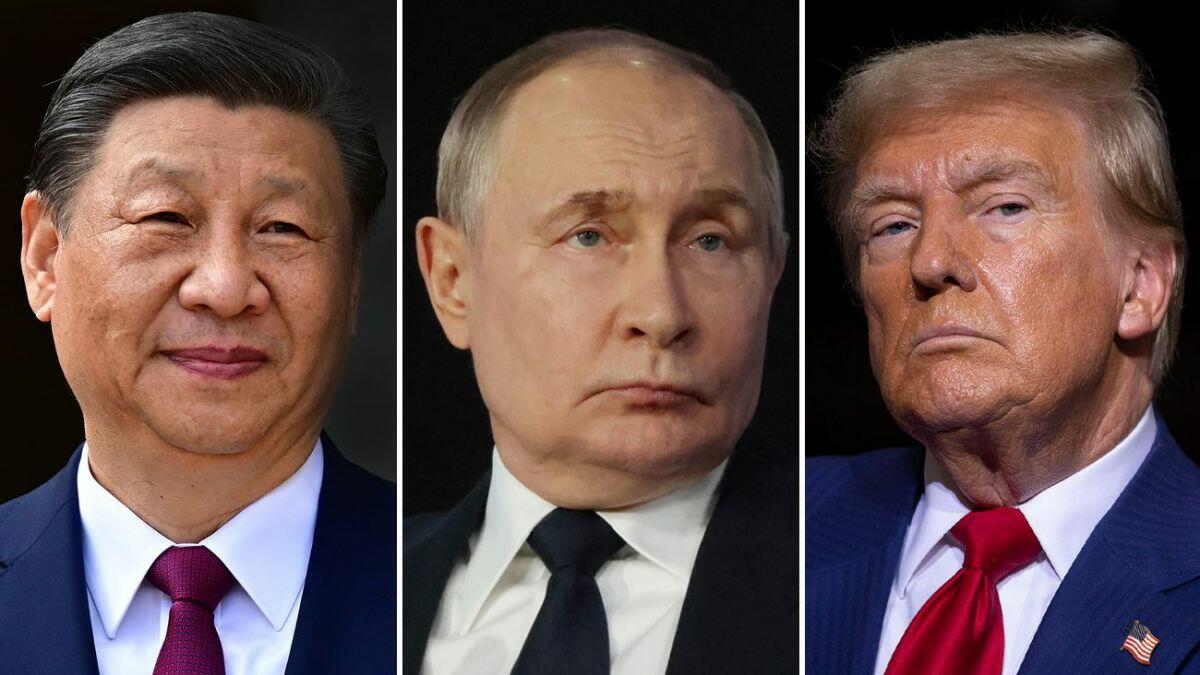
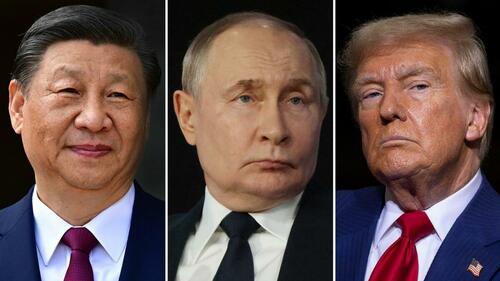
Russian President Vladimir Putin and Chinese President Xi Jinping held a video link call on Wednesday, wherein Putin hailed Russia’s energy relationship with China as “strategic” while emphasizing that Beijing has become Moscow’s top buyer of oil and gas since the Ukraine ‘special military operation’ began.
The timing is the most notable aspect, given the call came just two days after Trump announced he would cut tariffs on Indian goods in exchange for New Delhi halting purchases of Russian crude. Trump also said Washington could lift an additional 25% penalty tariff imposed over India’s energy cooperation with Moscow.
The curious thing is the lack of confirmation of the oil purchase cutoff from the Indian side. As yet, there’s no clear indicator that this key element in the Modi-Trump deal has been ratified. On Wednesday FT reports India hails Donald Trump ‘deal’ but ducks discussing Russian oil ban. The reality remains that there are also technical problems with US crude imports replacing Russian…
“WTI is simply too light to be considered as Urals replacement” for refiners in India following this week’s announcement of a US-India deal on tariffs, June Goh, an analyst at Sparta Commodities said in a note.
And this is likely why Putin seized the opportunity to tout his energy ties with China. Kremlin aide Yury Ushakov has also reminded the world in a statement to TASS that Russia tops the list in terms of oil and pipe gas supplies to China.
“China continues to hold the first place among our foreign trade partners. Russia is fifth among the countries – trade counterparties of China. The task was set during the talk to take efforts for further development of trade and economic ties, in particular, for example, in the energy sphere. Russia is the top supplier of oil and pipe gas to China,” Ushakov said.
Kremlin estimates say China has purchased more than $230 billion worth of Russian energy since the invasion.
Putin himself in the call acknowledged that bilateral trade saw a “slight decline” last year, including a “correction in indicators,” but insisted Russia remains “among the leaders in energy supplies to China.” He vowed the two will continue to closely coordinate together on a range of issues.
As for the India trade, Reuters reported earlier that Indian refiners have yet to receive instructions to fully stop buying Russian oil and are awaiting a formal government decision. Any official halt would be followed with a transition period, no doubt. Trump’s earlier statements may have been too far out front compared to what Modi actually agreed or said yes to.
Hours after Xi and Putin spoke, President Trump also held a call with the Russian leader Wednesday. They last spoke by phone in late November, at which time a conciliatory Trump praised America’s “extremely strong” relations with China. Xinhua News Agency first revealed the Trump-Xi call, but no further details have been immediately forthcoming.
Tyler Durden
Wed, 02/04/2026 – 13:00

Nominations for Non-Equity Jeff Awards: Theo and Kokandy lead the list for 2026
Nominations are in for the 52nd anniversary Non-Equity Jeff Awards with Theo Ubique Cabaret Theatre leading the way with 20 nominations in total, including 10 for “Diana the Musical.”
Theo is closely followed by Kokandy Productions with 17 nominations, also with 10 for its own musical “Jekyll & Hyde,” which ran late last year in the Chopin Theatre in Wicker Park. “Diana” and “Jekyll & Hyde” tied for the most-recognized productions in the nominations announced Wednesday. Both companies are known for their off-Loop musicals and are longtime favorites of the all-volunteer Joseph Jefferson Awards committee.
Invictus Theatre, recently in the news for postponing its next production amid internal conflicts, was the next most recognized company with 14 nominations, including nine for “Angels in America” at the Windy City Playhouse, making it the leading play.
This year’s list includes shows by 26 Chicago-area non-union theater companies from the last year, running between Jan. 1 and Dec. 31, 2025. Nominations were spread among 147 theater artists across 26 categories. An awards ceremony will be held at 7 p.m. March 23 at the Harris Theater (205 E. Randolph St.) in Millennium Park; tickets ($62.30) go on sale Feb. 17 at www.jeffawards.org.
Non-Equity Jeff Award nominees for 2026
PRODUCTION OF A PLAY
“Angels in America” – Invictus Theatre
“At the Wake of a Dead Drag Queen” – The Story Theatre
“Girls & Boys” – Griffin Theatre Company
“One Party Consent” – First Floor Theater
“The Pilon” – Red Theater
“The School for Scandal” – Idle Muse Theatre Company
PRODUCTION OF A MUSICAL
“Amélie” – Kokandy Productions
“Diana the Musical” – Theo Ubique Cabaret Theatre
“Jekyll & Hyde” – Kokandy Productions
“Urinetown” – Theo Ubique Cabaret Theatre
Nicki Rossi as The Angel in “Part Two: Perestroika” from “Angels in America” by Invictus Theatre Company at the Windy City Playhouse. (Aaron Reese Boseman)
ENSEMBLE OF A PLAY
“Angels in America” – Invictus Theatre
“The Pilon” – Red Theater
“The School for Scandal” – Idle Muse Theatre Company
“Shakin’ the Mess Outta Misery” – Pegasus Theatre Chicago
“Strange Cargo: The Doom of the Demeter” – City Lit Theater Company
ENSEMBLE OF A MUSICAL
“Amélie” – Kokandy Productions
“Diana the Musical” – Theo Ubique Cabaret Theatre
“Jekyll & Hyde” – Kokandy Productions
“Urinetown” – Theo Ubique Cabaret Theatre
NEW WORK
Zach Barr – “The Pilon” – Red Theater
Susan H. Pak – “The F*** House” – Strawdog Theatre Company
Omer Abbas Salem – “One Party Consent” – First Floor Theater
Lisa Sanaye Dring – “Kairos” – Red Theater
Chase Wheaton-Werle – “The Curious Circumstances of Louis Le Prince” – Factory Theater
DIRECTOR OF A PLAY
Charles Askenaizer – “Angels in America” – Invictus Theatre
Mikael Burke – “At the Wake of a Dead Drag Queen” – The Story Theatre
Jessica Love – “The Pilon” – Red Theater
Nadya Naumaan – “One Party Consent” – First Floor Theater
Robin Witt – “Girls & Boys” – Griffin Theatre Company
Quinn Simmons, David Moreland and cast in “Jekyll & Hyde” by Kokandy Productions at the Chopin Theatre. (Evan Hanover)
DIRECTOR OF A MUSICAL
Fred Anzevino and Brenda Didier – “Diana the Musical” – Theo Ubique Cabaret Theatre
Danny Kapinos – “Urinetown” – Theo Ubique Cabaret Theatre
Derek Van Barham – “Amélie” – Kokandy Productions
Derek Van Barham – “Jekyll & Hyde” – Kokandy Productions
PERFORMER IN A PRINCIPAL ROLE – PLAY
Kirk Anderson (Hamm) – “Endgame” – Facility Theatre
William Delforge (Gary) – “Gary: A Sequel to Titus Andronicus” – Redtwist Theatre
Terry Guest (Courtney / Anthony) – “At the Wake of a Dead Drag Queen” – The Story Theatre
Ryan Hake (Prior Walter) – “Angels in America” – Invictus Theatre
Brookelyn Hébert (Hedda Gabler) – “Hedda Gabler” – Artistic Home
Lenin Izquierdo (Angel Cruz) – “Jesus Hopped the ‘A’ Train” – City Lit Theater Company
Olivia Lindsay (Steff) – “The F*** House” – Strawdog Theatre Company
David Lovejoy (Galileo) – “Galileo” – Trap Door Theatre
Seoyoung Park (Eliza) – “Tom & Eliza” – TUTA Theatre
Bradford Stevens (Lucius Jenkins) – “Jesus Hopped the ‘A’ Train” – City Lit Theater Company
Scott Westerman (Arthur Pryszbyszewski) – “Superior Donuts” – Artistic Home
PERFORMER IN A PRINCIPAL ROLE – MUSICAL
Jesús Barajas (Pablo) – “Kid Prince and Pablo” – Lifeline Theatre
Evan Bradford (Giorgio Bachetti) – “Passion” – Blank Theatre Company
Brittney Brown (Fosca) – “Passion” – Blank Theatre Company
Teah Kiang Mirabelli (Charity Hope Valentine) – “Sweet Charity” – Blank Theatre Company
David Moreland (Dr. Henry Jekyll and Mr. Edward Hyde) – “Jekyll & Hyde” – Kokandy Productions
Kate McQuillan (Diana) – “Diana the Musical” – Theo Ubique Cabaret Theatre
Luke Nowakowski (Bobby Strong) – “Urinetown” – Theo Ubique Cabaret Theatre
Aurora Penepacker (Amélie Poulain) – “Amélie” – Kokandy Productions
Joshua Zambrano (Kid Prince) – “Kid Prince and Pablo” – Lifeline Theatre
Evan Bradford and Brittney Brown in “Passion” by Blank Theatre Co. at Greenhouse Theater Center. (Steve Townshend)
SOLO PERFORMER
Cynthia Marker (Woman) – “Girls & Boys” – Griffin Theatre Company
Dani Pike (Emma) – “Tell Me on a Sunday” – Theo Ubique Cabaret Theatre
PERFORMER IN A SUPPORTING ROLE – PLAY
Patrick Blashill (Clarence Seward / Thomas Edison) – “The Curious Circumstances of Louis Le Prince” – Factory Theater
Amber Dow (Paulina) – “The Winter’s Tale” – Invictus Theatre
Caty Gordon (Lady Teazle) – “The School for Scandal” – Idle Muse Theatre Company
Michael D. Graham (Roy M. Cohn) – “Angels in America” – Invictus Theatre
Dakota Hughes (Liza Minnelli) – “Queen for a Day” – Hell in a Handbag Productions
Delia Kropp (Rhonda) – “The Pilon” – Red Theater
Cynthia Marker (Wendy Lee Evans) – “One Party Consent” – First Floor Theater
Hanna Rhode (Janice) – “Gary: A Sequel to Titus Andronicus” – Redtwist Theatre
Paul Michael Thomson (Vickie / Hunter) – “At the Wake of a Dead Drag Queen” – The Story Theatre
Anne Trodden (Harper Amaty Pitt) – “Angels in America” – Invictus Theatre
Todd Wojcik (Jorge Tessman) – “Hedda Gabler” – Artistic Home
PERFORMER IN A SUPPORTING ROLE – MUSICAL
Joe Giovannetti (Nino Quincampoix) – “Amélie” – Kokandy Productions
Jacqueline Grandt (Queen / Barbara) – “Diana the Musical” – Theo Ubique Cabaret Theatre
Rachel Guth (Clara) – “Passion” – Blank Theatre Company
Ava Lane Stovall (Lucy Harris) – “Jekyll & Hyde” – Kokandy Productions
Emily McCormick (Emma Carew) – “Jekyll & Hyde” – Kokandy Productions
Amanda Rodriguez (Hope Cladwell) – “Urinetown” – Theo Ubique Cabaret Theatre
Jack Saunders (Charles) – “Diana the Musical” – Theo Ubique Cabaret Theatre
Ryan Stajmiger (Officer Lockstock) – “Urinetown” – Theo Ubique Cabaret Theatre
Maya Tanaka Allwardt (Little Sally) – “Urinetown” – Theo Ubique Cabaret Theatre
Colette Todd (Camilla) – “Diana the Musical” – Theo Ubique Cabaret Theatre
Shaina Toledo (Langhorne) – “Kid Prince and Pablo” – Lifeline Theatre Company
Paul Michael Thomson and Terry Guest in “At the Wake of a Dead Drag Queen” by Story Theatre at Raven Theatre. (David Hagen)
MUSIC DIRECTION
T.J. Anderson and Anna Wegener – “Amélie” – Kokandy Productions
Carolyn Brady – “Diana the Musical” – Theo Ubique Cabaret Theatre
Aaron Kaplan – “Passion” – Blank Theatre Company
Aaron Kaplan – “Urinetown” – Theo Ubique Cabaret Theatre
Nick Sula – “Jekyll & Hyde” – Kokandy Productions
SCENIC DESIGN
Kevin Hagan – “Hedda Gabler” – Artistic Home
Tatiana Kahvegian – “Tom & Eliza” – TUTA Theatre
Sotirios Livaditis – “Girls & Boys” – Griffin Theatre Company
Ruby Lowe – “Strange Cargo: The Doom of the Demeter” – City Lit Theater Company
Manuel Ortiz – “The Pilon” – Red Theater
Kevin Rolfs – “The House That Will Not Stand” – Invictus Theatre
COSTUME DESIGN
Terrie Devine – “The House That Will Not Stand” – Invictus Theatre
Patty Halajian – “Diana the Musical” – Theo Ubique Cabaret Theatre
Victoria Jablonski – “The School for Scandal” – Idle Muse Theatre Company
Rachel Lambert – “Hedda Gabler” – Artistic Home
Jennifer Mohr – “The Blood Countess” – Idle Muse Theatre Company
Racquel Postigilione – “At the Wake of a Dead Drag Queen” – The Story Theatre
CHOREOGRAPHY
Kasey Alfonso – “Kid Prince and Pablo” – Lifeline Theatre
Brenda Didier and Cameron Turner – “Diana the Musical” – Theo Ubique Cabaret Theatre
Brenda Didier – “Jekyll & Hyde” – Kokandy Productions
Brenda Didier – “Urinetown” – Theo Ubique Cabaret Theatre
Lauryn Schmelzer – “Sweet Charity” – Blank Theatre Company
Cynthia Marker in “Girls & Boys” by Griffin Theatre Company at Bramble Arts Loft. (Michael Brosilow)
SOUND DESIGN
Joe Griffin – “Strange Cargo: The Doom of the Demeter” – City Lit Theater Company
Joe Griffin – “War of the Worlds” – Lifeline Theatre
L.J. Luthringer – “The Blood Countess” – Idle Muse Theatre Company
Matt Reich – “Jekyll & Hyde” – Kokandy Productions
Petter Wahlbäck – “Angels in America” – Invictus Theatre
LIGHTING DESIGN
Brenden Marble – “At the Wake of a Dead Drag Queen” – The Story Theatre
G. Max Maxin IV – “Amélie” – Kokandy Productions
G. Max Maxin IV – “Jekyll & Hyde” – Kokandy Productions
Keith Parham – “Tom & Eliza” – TUTA Theatre
Brandon Wardell – “Angels in America” – Invictus Theatre
Levi J. Wilkins – “The House That Will Not Stand” – Invictus Theatre
PROJECTION DESIGN
DJ Douglass – “Strange Cargo: The Doom of the Demeter” – City Lit Theater Company
G. Max Maxin IV – “Angels in America” – Invictus Theatre
David Sajewich – “The Curious Circumstances of Louis Le Prince” – Factory Theater
ARTISTIC SPECIALIZATION
Jeremiah Barr (puppet design) – “Strange Cargo: The Doom of the Demeter” – City Lit Theater Company
David Blixt (fight choreography) – “Superior Donuts” – Artistic Home
Ayanna Bria Bakari (wig design) – “At the Wake of a Dead Drag Queen” – The Story Theatre
Victoria Jablonski (wig design) – “The School for Scandal” – Idle Muse Theatre Company
Rachel Livingston (properties design) – “The Curious Circumstances of Louis Le Prince” – Factory Theater
Robin Manganaro (properties design) – “Gary: A Sequel to Titus Andronicus” – Redtwist Theatre
Chas Mathieu (properties design) – “The Pilon” – Red Theater
Keith Ryan (wig design) – “The Real Housewives of the North Pole” – Hell in a Handbag Productions
Petter Wahlbäck (original music) – “The Winter’s Tale” – Invictus Theatre
Brian Parry and the cast of “Strange Cargo: The Doom of the Demeter” by City Lit Theater and Black Button Eyes Productions. (Steve Graue)
PRODUCTION OF A SHORT RUN
“Bernhardt/Hamlet” – Edge of the Wood Theatre
“The Drowning Girls” – Three Crows Theatre
“Helena & Hermia in the Enamored Odyssey” – The Impostors Theatre Co.
“Mr. Parker” – Open Space Arts
DIRECTOR OF A SHORT RUN
Daniel King – “The Drowning Girls” – Three Crows Theatre
Tony Lawry – “Matt & Ben” – Theatre Above the Law
Stefan Roseen – “Helena & Hermia in the Enamored Odyssey” – The Impostors Theatre Co.
David G. Zak – “Mr. Parker” – Open Space Arts
NEW WORK – SHORT RUN
Dominick Alesia – “Helena & Hermia in the Enamored Odyssey” – The Impostors Theatre Co.
Greta Geiser – “The Pyg Hypothesis” – Theatre Above the Law
PERFORMER IN A PRINCIPAL ROLE – SHORT RUN
Courtney Abbott (Sarah Bernhardt) – “Bernhardt/Hamlet” – Edge of the Wood Theatre
Connar Brown Sprenger (Matt & Ben) – “Matt & Ben” – Theatre Above the Law
Andrew Kain Miller (Terrence) – “Mr. Parker” – Open Space Arts
Shannon McEldowney (Hermia) – “Helena & Hermia in the Enamored Odyssey” – The Impostors Theatre Co.
Cameron Raasdal-Munro (Junior) – “Gangsta Baby” – Open Space Arts
Kendal Romero (Matt & Ben) – “Matt & Ben” – Theatre Above the Law
PERFORMER IN A SUPPORTING ROLE – SHORT RUN
Riley Capp (Justin) – “Mr. Parker” – Open Space Arts
Abby Denault (Maureen) – “Rent” – Suring Films & Theatrics
Stephen Loch (Constant Coquelin) – “Bernhardt/Hamlet” – Edge of the Wood Theatre
Josh Odor (Senior) – “Gangsta Baby” – Open Space Arts
Ian Rigg (Nick Bottom) – “Helena & Hermia in the Enamored Odyssey” – The Impostors Theatre Co.
Sarah Wisterman (Professor Pickering) – “The Pyg Hypothesis” – Theatre Above the Law
DESIGN OF A SHORT RUN
Elizabeth Niemczyk (costume design) – “Bernhardt/Hamlet” – Edge of the Wood Theatre
Toria Olivier (costume design) – “Helena & Hermia in the Enamored Odyssey” – The Impostors Theatre Co.
Jae Robinson (sound design) – “Pussy Sludge” – Facility Theatre
dgeorge@chicagotribune.com
https://www.chicagotribune.com/2026/02/04/non-equity-jeff-nominations-2026/

Federal judge dismisses whistleblower lawsuit from former COPA investigator
A federal judge has dismissed a whistleblower lawsuit brought by a veteran police misconduct investigator against the city and the former chief administrator of the Civilian Office of Police Accountability who resigned last year.
The lawsuit brought by Matthew Haynam claimed that his First Amendment rights were violated when he was fired by former COPA chief administrator Andrea Kersten in August 2024 after he reported her alleged malfeasance to the Community Commission for Public Safety and Accountability and the city’s Office of Inspector General.
Federal court records show the two-count suit was dismissed on Jan. 29 by U.S. District Judge Joan Lefkow for Haynam’s failure to state a claim. A lawyer for Haynam did not immediately comment.
“Based on Haynam’s well-pleaded allegations, the court finds that Haynam’s speech was made as a public employee, and not as a private citizen,” Lefkow wrote in a Jan. 29 order. “It was thus unprotected by the First Amendment.”
Records show the lawsuit dismissed last week was the second that Haynam filed in relation to his firing. He also filed a similar lawsuit in Cook County court in September 2024 that was voluntarily dismissed last year.
Lefkow’s order came six months after attorneys for the city and Kersten filed a motion to dismiss the lawsuit. Haynam’s attorney did not respond to a request for comment. Kersten declined to comment.
Kristen Cabanban, a spokesperson for the city’s Law Department, said in a statement to the Tribune: “The Department of Law is pleased that the court correctly dismissed plaintiff’s First Amendment claim. We remain prepared to vigorously defend against any remaining state law claims.”
Ephraim Eaddy, COPA’s former deputy chief administrator under Kersten, said he was unsurprised by the dismissal order and stressed that COPA delivered on expectations throughout her tenure as chief.
“If we’re really looking at the job of the chief administrator, it takes courage and it takes having a strong spine, and I thought Kersten represented that,” Eaddy said. “When anyone … is in that kind of role, you have to withstand the winds of opposition, and I saw a person do that even when faced with it internally and externally.”
Chicago police Supt. Larry Snelling responds to statements from Andrea Kersten, chief administrator of the Civilian Office of Police Accountability (COPA), at the monthly Chicago Police Board meeting at police headquarters Thursday, April 18, 2024, in Chicago. (John J. Kim/Chicago Tribune)
Haynam’s lawsuit came as scrutiny of Kersten’s leadership swelled in the wake of the Dexter Reed shooting in March 2024. Weeks before that shooting, CPD Superintendent Larry Snelling issued a stern public rebuke of COPA during a meeting of the Chicago Police Board.
Kersten resigned about a year later as the CCPSA was preparing to hold a vote of no-confidence.
Persistent complaints and concerns about oversight within COPA, the agency’s workplace culture, the quality of investigations, as well as Kersten’s own public statements and appearances were chief among the reasons highlighted by CCPSA — claims all echoed in Haynam’s lawsuit.
“Kersten’s malfeasance included, but was not limited to, Kersten’s knowing and intentional suppression of information from the public regarding how quality assurance audits revealed COPA’s systemic failures related to the mischaracterization of evidence, failure to interview key witnesses, and failure to properly train COPA investigators regarding the applicable standards for use of force by Chicago Police Officers,” Haynam’s complaint alleged.
Last week, the CCPSA announced LaKenya White, a longtime Chicago police misconduct investigator who has overseen COPA on an interim basis since Kersten resigned last year, would be nominated to lead the agency permanently.
https://www.chicagotribune.com/2026/02/04/judge-dismisses-whistleblower-lawsuit-copa/

NFL: ICE Will Not Be Present At Super Bowl
NFL: ICE Will Not Be Present At Super Bowl
Authored by Jill McLaughlin via The Epoch Times,
Federal immigration officers will not make an appearance at the Super Bowl this year, NFL Chief Security Officer Cathy Lanier announced at a news conference on Feb. 2.
“There are no planned ICE [Immigration and Customs Enforcement] or immigration enforcement operations that are scheduled around the Super Bowl or any Super Bowl-related events,” Lanier said during the briefing.
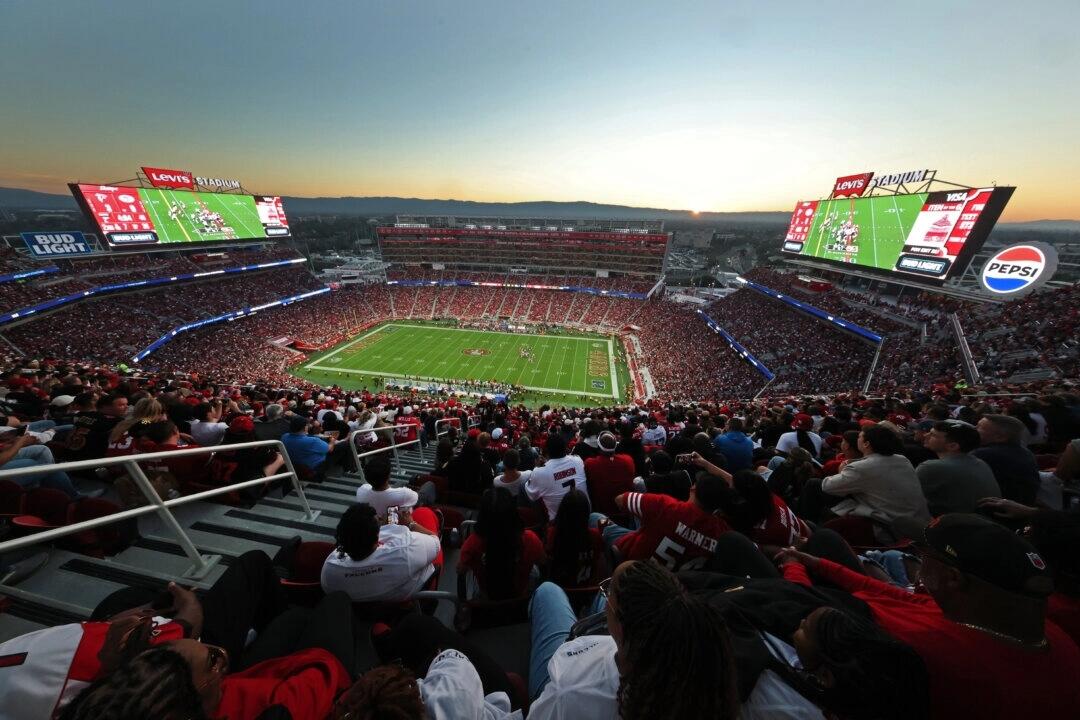
The Seattle Seahawks will face the New England Patriots in Super Bowl LX on Feb. 8 at Levi’s Stadium in Santa Clara, California, about 45 miles south of San Francisco.
The NFL’s announcement differed from an earlier statement made by Homeland Security Secretary Kristi Noem in October 2025, after Super Bowl officials announced that outspoken anti-ICE performer Bad Bunny had been selected as this year’s halftime headliner.
Noem told conservative commentator Benny Johnson on his podcast that ICE officers would be present at the event and “all over that place.”
President Donald Trump has previously criticized the artists selected to headline the Super Bowl halftime show, noting that both Bad Bunny and Green Day have been outspoken critics of him.
“I’m anti-them. I think it’s a terrible choice. All it does is sow hatred. Terrible,” Trump told the New York Post.
NFL commissioner Roger Goodell has voiced support for Bad Bunny, who won the Latin Grammy award for Album of the Year on Feb. 1.
“We’re confident it’s going to be a great show,” Goodell said. “He understands the platform that he’s on, and I think it’s going to be exciting and a united moment.”
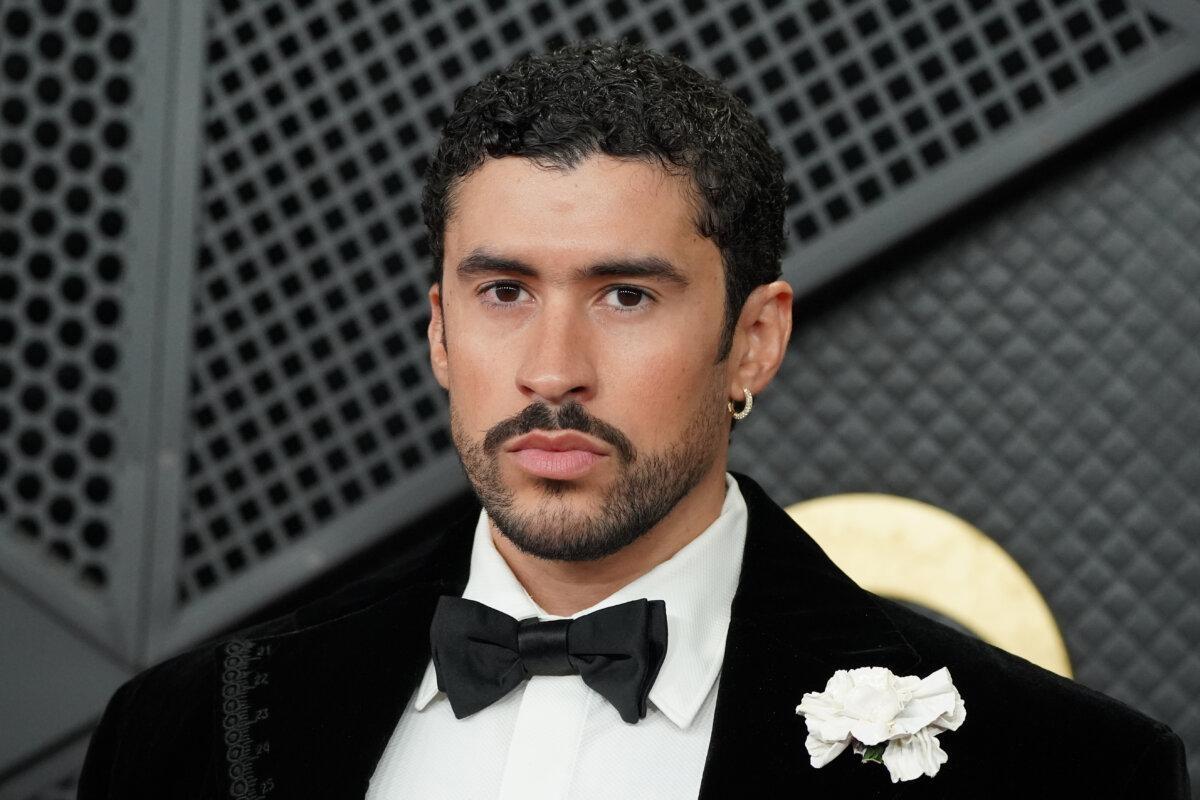
Bad Bunny arrives at the 68th annual Grammy Awards in Los Angeles on Feb. 1, 2026. Jordan Strauss/Invision/AP
San Francisco Mayor Daniel Lurie said his priority would be public safety as the city welcomes people from around the world during the Super Bowl.
“Our city teams have been preparing for months,” Lurie posted on Feb. 2 on X.
About 1.3 million visitors are expected to attend the game or related events in the San Francisco Bay Area this weekend, the San Francisco International Airport estimated.
San Francisco police and local law enforcement are focused on protecting the public, including the right to “peaceful expression,” the mayor added.
“We will continue to uphold San Francisco’s longstanding policies that keep local law enforcement focused on keeping our city safe—not on federal immigration enforcement,” Lurie stated.
Even so, the city expects the Super Bowl to attract criminal activity, including human trafficking, according to Lurie.
The San Francisco Police Department and other authorities were conducting targeted operations to prevent exploitation of vulnerable people, he said.
Tyler Durden
Wed, 02/04/2026 – 12:40
https://www.zerohedge.com/political/nfl-ice-will-not-be-present-super-bowl