Category: News

Review: There’s an ‘Enormous Crocodile’ on the Studebaker stage, and kids can throw peanuts at him
As you enter the Studebaker Theater for “The Enormous Crocodile,” a visiting family show from the U.K.-based Roald Dahl Story Company, a foam monkey nut (aka a peanut) is helpfully provided. And, at the appropriate point in the show, you are encouraged to throw said goober at the performers. Well, more specifically, you can lob it at the titular croc to try and dissuade the overgrown reptile from following his usual habit of eating children.
To say this was a moment of catharsis at Friday night’s Chicago opening is to understate. Like a giant beast, the kids in the crowd flung their missiles toward the stage and their predator, who clearly was knocked off his game by the intensity of the reaction. Your friendly critic, of course, demurred, although it took some self-control.
The Roald Dahl Story Company (now Netflix-owned) is the business of creating new projects from the famously creepy children’s writer, most famously responsible for “Matilda” and “Willie Wonka and the Chocolate Factory,” but also “James and the Giant Peach” and “The BFG.” Even though most of those stories were penned for a generation who are now parents (and most likely of adult children), kids of all ages tend to respond to Dahl’s uncanny ability to write from a child’s point of view, not to mention his aversion to the typical moral sentimentalism found in most children’s literature. He was never in the business of telling children they were safe; rather, he created the creatures of their nightmares, but his wacky, language-rich yarns usually ended with the triumph of a plucky kid over some scary beast, often in human-authoritarian form but sometimes lurking in “the biggest, brownest, muddiest river,” as in this case.
“The Enormous Crocodile” is presented by the Roald Dahl Story Company of England at the Studebaker Theater as part of the Chicago International Puppet Theater Festival. (Danny Kaan)
Developed and directed by Emily Lim, the hour-long show is filled with puppets (it began at the tail end of the Chicago International Puppet Festival) and it is billed as a musical (with music by Ahmed Abdullahi Gallab, book and lyrics by Suhayla El-Bushra, and additional music and lyrics by Tom Brady), although the singing is limited in scope and quality and the musical score pretty much emanates from one on-stage dude with a lot of keyboards and such. If you are expecting a Broadway-level tour, or something on the level of “Matilda,” you will be disappointed and I think it could have gone a lot further when it came to really communicating with the audience. The sound reinforcement also was not great at the opening performance.
But as a good time for young fans of the book replete with the chance to throw things? Knock yourself out, folks.
Chris Jones is a Tribune critic.
cjones5@chicagotribune.com
Review: “The Enormous Crocodile” (2.5 stars)
When: Through Feb. 21
Where: Studebaker Theater in the Fine Arts Building, 410 S. Michigan Ave.
Running time: 1 hour
Tickets: $26-$71.50 at 312-753-3210 and www.fineartsbuilding.com
https://www.chicagotribune.com/2026/02/06/review-enormous-crocodile-studebaker/

Canadá y Francia abrirán consulados en Groenlandia tras las tensiones con EEUU
Associated Press
NUUK, Groenlandia (AP) — Canadá y Francia tenían previsto abrir el viernes consulados diplomáticos en la capital de Groenlandia, en una muestra de apoyo a Dinamarca, aliado en la OTAN, y a la isla ártica tras los esfuerzos de Estados Unidos por conseguir el control del territorio semiautónomo danés.
La ministra de Exteriores de Canadá, Anita Anand, viajaba a Nuuk para inaugurar el consulado que, según las autoridades, podría ayudar a impulsar la cooperación en temas como el cambio climático y los derechos de los inuit. Anand estaba acompañada por la gobernadora general indígena del país, Mary Simon.
Por su parte, el Ministerio de Exteriores francés señaló que Jean-Noël Poirier asumiría como cónsul general, convirtiéndose en el primer país de la Unión Europea en establecer una oficima diplomática en Groenlandia.
Poirier tendrá “la tarea de trabajar para fortalecer los proyectos de cooperación existentes con Groenlandia en los campos cultural, científico y económico, al tiempo que refuerza los lazos políticos con las autoridades locales”, explicó el ministerio.
Canadá se comprometió a abrir un consulado en Groenlandia en 2024, antes de que Trump hablara recientemente de lograr el control de la isla, y la inauguración formal se retrasó desde noviembre debido al mal tiempo.
Anand se reunió con su homólogo danés, Lars Løkke Rasmussen, en Dinamarca el jueves y dijo en un mensaje en redes sociales que “como naciones árticas, Canadá y el Reino de Dinamarca están trabajando juntos para fortalecer la estabilidad, la seguridad y la cooperación en toda la región”.
Francia sostiene que la decisión de abrir el consulado se tomó cuando el presidente, Emmanuel Macron, visitó el territorio en junio.
Trump anunció en enero que impondría nuevos aranceles a Dinamarca y a otros siete países europeos que se opusieron a sus llamados para asumir el control de la isla, pero retiró sus amenazas de forma abrupta luego de anunciar un “marco” para un acuerdo sobre el acceso Groenlandia, rica en minerales, con la ayuda del secretario general de la OTAN, Mark Rutte. Por el momento se conocen pocos detalles de ese acuerdo.
La semana pasada se iniciaron las conversaciones técnicas entre Estados Unidos, Dinamarca y Groenlandia para elaborar un acuerdo de seguridad ártica. Los ministros de Exteriores de Dinamarca y Groenlandia habían acordado crear un grupo de trabajo durante una reunión con el vicepresidente de Estados Unidos, JD Vance, y el secretario de Estado, Marco Rubio, antes de la amenaza arancelaria de Trump.
___
Esta historia fue traducida del inglés por un editor de AP con la ayuda de una herramienta de inteligencia artificial generativa.

Students remain uncertain about next steps 3 months before Trinity Christian College closure
For sophomore education student Julia Leidecker, there was never a sad moment on Trinity Christian College’s campus until the Palos Heights school announced it would permanently close in May.
The atmosphere completely changed that day in November, Leidecker said.
“It went from an upbeat, happy environment to everybody’s like, what’s next? What do we do?” she said.
Three months ahead of closure, some Trinity students and parents say they remain uncertain about their next steps. While more and more institutions have agreed to partner with the private college, accepting their credits and offering comparable costs, the transfer process has been far from straightforward.
The current list of partner institutions includes Kuyper College and Calvin University in Grand Rapids, Michigan; Carroll University in Waukesha, Wisconsin; Dominican University in River Forest; Judson University in Elgin; Lewis University in Romeoville; North Park University and Saint Xavier University in Chicago; Olivet Nazarene University in Bourbonnais; and Wheaton College in Wheaton.
Leidecker is waiting on acceptance from Saint Xavier, which she heard is backlogged due to high demand among Trinity students.
She also said she was on track to complete a double major at Trinity but is unsure what that will look like at Saint Xavier or any other institution.
“There’s so much backup that we don’t have answers yet,” Leidecker said. “It’s really frustrating, but at the same time, everybody has to deal with it at some point, so it’s kind of just like wait your turn.”
Julia Leidecker stands in front of a mural at Trinity Christian College. The Palos Heights school will permanently close in May 2026. (Julia Leidecker)
Brian Hotzfield, vice president of enrollment at Saint Xavier, said about 150 Trinity students have demonstrated interest in transferring, and said 10 of them made the switch at the start of the school’s spring semester Jan. 12.
“We were really not expecting any to enroll in the spring,” Hotzfield said. “It was a pleasant surprise.”
Hotzfield said he is unsure how many students will enroll in the fall semester, which begins Aug. 24, but said the school is preparing to find homes for as many who are interested. He said he was surprised to hear students waiting for transfer assistance, though adjusting schedules for students from programs that differ from those offered at Saint Xavier may take longer.
“We’re encouraging students to try and work through the process sooner rather than later so that we can get them squared away and make sure that they feel comfortable,” though there are no set deadlines for Trinity students to enroll, he said.
Patricia Serio is waffling between Saint Xavier and Judson University to finish her degree.
Her mother, Marcia Serio, said the sophomore graphic design student loved the independence of living on Trinity’s campus while staying close to her family’s Mount Greenwood home, and many of Trinity’s partner institutions are too far away to consider.
“She’s very much an introvert,” Serio said. “So for her, moving 15 minutes away may as well been another state for how she did with it, but she’s been fantastic since being (at Trinity).”
John Karlic, a 35-year-old student who lives in Burbank, said Saint Xavier was his first choice for transferring his Trinity credits. Unlike many younger students, he said the college’s closing was only the latest interruption to him receiving his bachelor’s degree.
The business major said he first enrolled at the Palos Heights college in 2021, but took a two-year break due to a medical issue. He returned in 2023 and was on track to graduate from Trinity next year.
“I just started going back, and that’s why it was such a shock,” Karlic said. “Of course it’s closing as soon as I decided to come back and finish my degree.”
Karlic said location and class format are important factors as he considers moving schools.
He said while he finishes his degree, he can’t give up his job as a maintenance worker for DuPage County. Karlic also struggles with strictly online classes, further limiting his options.
Trinity Christian College on Nov. 4, 2025, after the liberal arts college announced it would close at the end of the 2025-2026 school year. (Olivia Stevens/Daily Southtown)
Karlic said Trinity’s closure makes a part of him wish he had gone back to school sooner, but he is sadder for younger students who aren’t used to academic uncertainty and staff who will be forced to find new jobs.
“I see kids in my class that are younger than me and they’re trying to figure out what to do,” Karlic said. “They haven’t been through the having to jump around and go from school to school. I’ve kind of had some semblance of that, switching schools and switching majors.”
The college will host a transfer fair from 10 a.m. to 3 p.m. on Wednesday at DeVos Gymnasium on campus, billed as an opportunity for students to receive information on teach-out partners, transfer-out partners and traditional transfer institutions.
Alumni hope remains
While current Trinity students plan their next steps, a small group of alumni maintains hope the campus that contains a trove of happy memories can be saved.
Trinity’s closure announcement came as a shock to many, with the liberal arts college’s president and board citing financial struggles caused by declining enrollment and other factors.
“It’s a really dynamic place for me, and it’s hard to be content to leave Trinity’s legacy to merely linger in the halls of history,” said Ryan Wynia, who graduated in 2004.
A sign welcomes freshman students to Trinity Christian College on move in day in 2025. (Olivia Stevens/Daily Southtown)
Wynia said he understands the complexity of issues surrounding the board of trustee’s decision to close but wishes leaders had been more transparent about the college’s financial situation beforehand.
He said the group met in December with two board members but was made to feel like a nuisance when requesting information and proposing ideas to help the school stay open.
“They said, ‘Well, if you can just get us $40 million, we can save the school,’” Wynia said. “We know there’s some issues here, both in the market and in pressures on higher education, but also, a college doesn’t close if there’s not some internal issues, right?”
A spokesperson for Trinity declined to provide updates on what’s next for the college.
Wynia said he understands board members’ fatigue around discussing Trinity’s future with members of the college community but isn’t ready to give up trying to make them listen.
“With each passing day, hope slips away a little bit more, but who knows? Big things can happen,” he said.
ostevens@chicagotribune.com
West Chicago teacher resigns after being placed on leave for social media post supporting ICE
A West Chicago elementary school teacher has resigned after he was placed on leave last month for an alleged social media post that appeared to support U.S. Immigration and Customs Enforcement.
The West Chicago Elementary School District 33 board announced during a meeting on Thursday night that it had accepted the voluntary resignation of the Gary Elementary School teacher and would be entering into a separation agreement with him. The teacher, whom the Tribune is not naming, could not be immediately reached for comment Thursday night.
Around a half hour of public comment followed the announcement, as speakers voiced both disappointment in the teacher’s departure and ire over the post to his personal social media.
“Schools must be places where every student feels safe, respected and supported,” Nestor Ruiz, interim chief of staff for state Sen. Karina Villa of West Chicago, said to the board, speaking on her behalf. “That sense of safety depends on trust.”
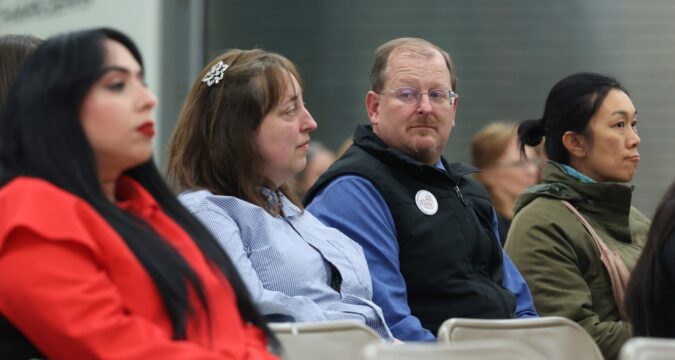
Last week, parents, students and community members filled West Chicago City Hall to express outrage over the post, where several attendees — including a third grader — spoke to the importance of safety.
Per a written statement from Superintendent Kristina Davis, the school district on Jan. 22 “learned of concerns regarding a disruptive social media comment made by a district employee on his personal account.” The teacher initially submitted his resignation but later that day withdrew it before the school board had an opportunity to take action, according to the statement. He then met with district administration and was placed on administrative leave pending a district investigation.
An online petition encouraging community members to “show the district that you do not stand for this teacher continuing to educate” had more than 530 signatures as of Thursday night.
“(A) D33 teacher commented, ‘Go ICE!’ in response to a community article,” the petition read. “The casual way in which he publicly promoted the actions of ICE in our area is inappropriate and unsuitable for an educator.”
The board started Thursday’s meeting in closed session to discuss the “appointment, employment, compensation, discipline, performance, or dismissal” of an employee, independent contractor, volunteer, or district legal counsel, according to the board agenda for the night.
At the outset of the public portion of the meeting, which about 50 people attended, school board President Rita Balgeman said that during closed session, the board voted “to accept (the teacher’s) voluntary resignation effective immediately.”
Balgeman said the board believes “this action is the most appropriate next step for our school community at this time.” She said the district’s actions through this process were guided by legal counsel and focused on balancing the employee’s rights and due process, board policy and the “need to minimize disruption to our schools.”
Balgeman said that the school board is made up of those with a range of personal and political views and that throughout their discussion, the situation was never about politics but rather about ensuring schools operate normally.
“We now look forward to restoring focus, stability and safe conditions for teaching and learning across the district,” she said.
The remainder of the meeting was primarily spent on public comment.
“Is it a prerequisite of employment to agree with the majority or the popular opinion of the day?” speaker Timothy Lorman asked the board.
Samanta Reuter, whose kids attend Gary Elementary School, spoke positively about the teacher and said that she thought it was sad that he “felt like he had no choice but to resign.”
“My 8-year-old here said to me the other day that … people can make bad choices but not be bad people,” she said.
Corinne Ingrum urged the community to “pick your battles more wisely.”
“I get that the state of our country is in turmoil,” she said. “I’m not discrediting your fear. We all have fear. But the problem is bigger than any one person. … If you want change, please speak to your elected politicians, not ruin one man’s life.”
Still, others reiterated the need for retaining students’ sense of security and acceptance.
“You cannot expect students to feel safe at the care of someone who celebrates an agency that terrorizes their loved ones,” said Keely Walker, a former art teacher at Gary Elementary. Walker, who said she left teaching at the end of the 2024-25 school year, recalled her students telling her they were scared back in January of last year.
“(They) told me that they had heard that bad men were coming to take people like their families,” she said. In response, Walker said she told them that “their job was to play, laugh and learn, and that it was the adults’ job to protect them.”
Audrey Luhmann, whose homeschooled teenage sons for months have been on the front lines of the Trump administration’s mass deportation campaign, urged the board, “A healthy community protects its members.”
“A healthy community,” she continued, “welcomes and celebrates a diversity of culture and experience. … We keep all of us safe.”
Thursday’s meeting comes as President Donald Trump’s immigration crackdown reaches a flashpoint following the fatal shootings of U.S. citizens Renee Good and Alex Pretti in Minneapolis last month. In early January, after spending last fall sweeping the Chicago area in a 64-day blitz, the Department of Homeland Security launched what the agency has called its “largest immigration enforcement operation ever.” The Trump administration this week reduced the number of immigration officers in Minnesota by roughly a quarter.
Meanwhile, a shutdown looms for DHS as Democratic leaders threaten to vote down a spending bill for the agency unless there are dramatic changes to ICE and other federal law enforcement agencies.
Controversial social media posts have sparked backlash at grade school and college campuses alike in recent months.
The Illini Republicans club at the University of Illinois at Urbana-Champaign is facing a complaint by the school’s Title VI Office after posting an illustration on social media of a masked gunman holding a weapon to a kneeling man’s head alongside the caption, “Only traitors help invaders.”
Last fall, in the wake of the September assassination of conservative activist and Prospect Heights native Charlie Kirk, scores of educators — several in Illinois and Indiana — faced criticism over social posts they made in response to the fatal shooting.
After Thursday’s meeting, West Chicago Mayor Daniel Bovey said the suburb was a community that “has come together in the most difficult of times.” He said he thought the district had gone through the due process that they needed to go through.
“We are looking forward to moving on,” he told the Tribune, “and are going to continue to try to make everyone in our community feel as safe as we are able to make them feel.”
Chicago Tribune’s Angie Leventis Lourgos, John Kim and The Associated Press contributed.

Public policy experts: The hidden inequity in school funding? Illinois’ teacher pension funding structure
We’ll start with an apology. While pension funding is deeply important both to the public servants who earn pensions and to the fiscal stability of Illinois, it’s not always the most thrilling topic to read about. So to cut to the chase: Illinois will never truly achieve equitable school funding unless it fixes teacher pension funding.
Chicago faces the most obvious and perhaps the most egregious inequity. For every $1 the state pays for non-Chicago public teacher pension current costs, it pays about $4 for legacy costs; that is, debt from years of inadequate payments. For every $1 the state pays for current Chicago Public Schools teacher pension costs, it pays almost nothing for legacy costs. Chicago taxpayers are on the hook for those legacy payments. That’s about $660 million this year.
And the pension-related school funding disparities do not stop with Chicago. Low-income school districts across Illinois face another serious, though more complicated, hurdle. The state pays employer pension costs for all of them, but for districts with more resources and higher salaries, those costs are a lot more than for lower-income schools. This has been a hidden inequity for as long as the pension system existed.
Across the state, that state subsidy for covering employer costs of teacher pensions averages $890 per student. But for the highest-funded school districts in the state, the cost to the state might be twice as much. In fact, the state spends more than $2,300 per pupil to subsidize teacher pension costs in the best-funded district in the state. As for the less fortunate school districts, some benefit less than $600 per student from the state picking up their employer pension costs.
It is exactly the opposite of how policymakers wanted our school funding system to work. Illinois still faces deep inequities in school funding, largely due to our continued overreliance on property taxes to fund education. Our state’s evidence-based funding formula strives to raise the floor for the schools hit hardest by those inequities. We have come a long way. When the formula first passed, 431 school districts had fewer than 70% of the resources they needed. Now, all but 48 school districts are funded above 70% of adequacy. It is an incredible feat.
But while the school funding system fights inequities, the pension funding structure exacerbates them. There is a groundswell of support for enhancing benefit levels for newer teachers, whose benefits cost far less than teachers who were hired before 2011. Without a corresponding change in who pays for those enhancements, a boost in pension benefits will drive deeper funding inequities, while leaving fewer available resources for evidence-based funding to close those gaps.
These inequities come with straightforward solutions. First, let the state treat Chicago Public Schools the same as every other school district and consolidate the Chicago Teachers’ Pension Fund with the statewide Teachers’ Retirement System. This would be good for reducing administrative costs and improving fund liquidity and investment returns, but more importantly it would level the playing field across school districts in Illinois. The state would take on unfunded liability costs for CPS, as it does for all other districts.
Second, start incorporating a district’s teacher pension costs — and the state’s pension contributions on behalf of that district — into evidence-based funding calculations. You cannot adequately fund a school district without paying the retirement costs of its educators, nor should you subsidize wealthier districts’ pension obligations at the expense of inadequately meeting the needs of poorer districts. With a more accurate assessment of the resources the state’s school districts have and need, new formula funds will flow in an even more focused and gap-closing way to reduce inequities in school funding across the state.
Illinois has built a good framework for fair school funding. But that structure remains undermined by a pension funding system that totally ignores it, benefits wealthier school districts more than poor ones and treats Chicago differently than everyone else. Fix the pension funding structure, and evidence-based funding will be better able to deliver on its promise.
John Cullerton was president of the Illinois Senate from 2009 to 2020. Conor Durkin provides public policy analysis about Chicago on Substack at A City That Works. Jessica Handy is executive director of Stand for Children Illinois, an education advocacy organization.
Submit a letter, of no more than 400 words, to the editor here or email letters@chicagotribune.com.
https://www.chicagotribune.com/2026/02/06/opinion-illinois-teacher-pensions-school-funding/

Editorial: Illinois should consider pragmatic tweaks to its sanctuary law
For much of the past nine months, there’s been next to no talk of compromise between a Trump administration determined to deport as many undocumented residents as possible and Democrats in so-called sanctuary states such as Gov. JB Pritzker.
But suddenly, in the wake of the shocking killings of two American citizens in Minneapolis by federal immigration-enforcement agents, we’re seeing some tentative steps towards, dare we say it, compromise. In Minnesota, that is.
On Wednesday, we hosted Illinois Lt. Gov. Juliana Stratton to discuss her run to succeed retiring U.S. Sen. Dick Durbin, the first of the three major candidates for that office to meet with the editorial board. During the discussion, Stratton said something that frankly surprised us.
We asked her about Illinois’ sanctuary law, the Trust Act signed by Gov. Bruce Rauner in 2017, and how it bars state officials from cooperating with U.S. Immigration and Customs Enforcement officials to begin the process of deportation of undocumented individuals incarcerated in our prisons for violent crimes, as they’re being released back out onto the streets. (The existing exception in the law to that prohibition is if ICE has a judicial warrant for the prisoner’s arrest. But that’s a rarity, we’re told.)
“I’ve always taken the position that if there’s somebody who’s a threat to public safety and convicted of a violent crime, that’s something that we would cooperate with,” she told us. “So if there needs to be some sort of amendment, I would not be opposed to that.”
She’s not the only Illinois Democrat to say something like that, but she’s the most prominent. And, of course, even as she’s running for Senate, she remains Pritzker’s lieutenant governor. We’ve not heard the governor express an opinion on this question. We wonder if he would agree.
If he does, we wonder too if Democratic legislators in Springfield would take it upon themselves in this session to debate and pass changes to the Trust Act that, for example, would allow the Illinois Department of Corrections to notify ICE when an undocumented violent criminal is to be released in order to potentially get that person deported, following due process on their immigration case.
For our part, it seems obvious — and something that the overwhelming of residents of this blue state would support — that a law barring state and local law enforcement from cooperating to deport convicted violent criminals in this country illegally should be amended to allow for that. And do so without going through the bureaucratic hoops of obtaining a judicial warrant.
For those on the Democratic side who might be squeamish at the prospect, here’s the other side of the equation, the one that puts the Trump administration on the spot.
We’ve heard administration officials justify the invasion-like tactics of ICE and the Border Patrol in Democratic cities such as Chicago and Minneapolis by saying the lack of cooperation from these cities and states forces them to hunt down violent criminals after they’re released from prison.
“If you want less officers in the street, then let us in the jail,” Trump’s border czar Tom Homan said recently.
Homan has been in Minneapolis of late, dispatched by Trump to try to calm the situation after the shooting death of Alex Pretti by agents caused a justified uproar in the Twin Cities and across the country. Homan announced Wednesday that he was drawing down the surged force of agents by 700, leaving 2,000 remaining in Minneapolis. Homan credited cooperation by sheriffs in giving ICE access to county jails to remove undocumented prisoners deemed public-safety threats upon their release from the jails.
It’s not clear precisely what Gov. Tim Walz, Minneapolis Mayor Jacob Frey and other Minnesota officeholders have agreed to with Homan and other Trump officials. But, judging from the positive comments from both sides, the conversations have been and continue to be productive.
Reasonable and narrow changes to state laws that currently make it extremely difficult to do what the overwhelming majority of Americans say they want and what Democratic officeholders say they support would put the ball squarely in the Trump administration’s court. If it gets reasonable concessions on handing over violent criminals once they’ve served their sentences, the Department of Homeland Security should halt its provocative and dangerous surges into Chicago and its suburbs. That’s essentially what Homan has pledged.
So Minnesota’s experience is instructive in our view, and the Democrats who run Springfield and who dominate the halls of power in the Chicago area should take notice. Throughout this immigration-enforcement ordeal, in which this page consistently has condemned the heavy-handed tactics of ICE and the Border Patrol, we’ve also wished for the opening of channels of communication between sides that, while their leaders don’t like each other (Trump and Pritzker), nonetheless is the obligation of elected officials in such high-pressure situations.
Minnesota, even in its grief and trauma over the needless deaths of two of its citizens at the hands of the state, is managing to show that communication and negotiation are possible.
This is not to say that deciding on what narrow amendments to make to the state’s sanctuary law (and those of Chicago and Cook County as well) is a simple matter. If that debate is opened, there will be tough decisions to make in terms of what sorts of crimes qualify for cooperation with the feds from those running our state and local prisons and jails. Should the handover of violent criminals who happen to be in the country without permission happen strictly in the state prisons? Should it include Cook County Jail, where many inmates are detained while they await their day in court on violent crime charges but who also have criminal records from the past, even if there are more charges to come?
Let’s just say, though, that if a political leader as progressive as Juliana Stratton says she’s open to amending a state law that as it stands leads to the release back into our communities of violent criminals who happen also to be undocumented, that strikes us as a notable opening to a discussion that should take place. As it is now in Minnesota.
Submit a letter, of no more than 400 words, to the editor here or email letters@chicagotribune.com.
Shlomo Soroka: Gov. JB Pritzker shouldn’t let politics block free help for Illinois students
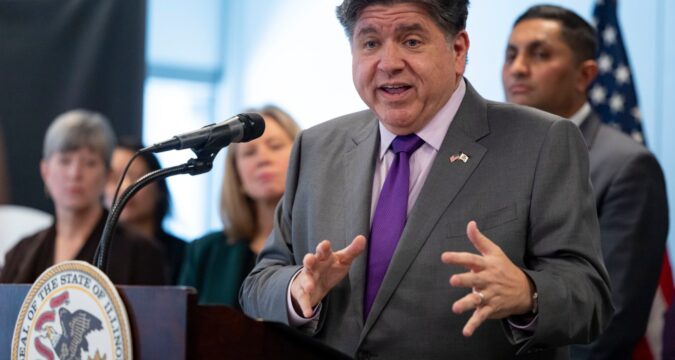
When Gov. JB Pritzker was asked last week whether Illinois will opt into a new federal tax-credit scholarship opportunity, he didn’t rush to judgment.
“Those rules when they’re issued, we’ll be able to evaluate whether that’s good for the state of Illinois and the people of Illinois, or not,” he said.
That restraint matters, because the pressure campaign is already underway. Teachers unions are demanding an immediate rejection, and given Pritzker’s role as one of President Donald Trump’s most vocal critics, the easy political move would be to treat anything connected to Trump as automatically toxic.
But governing isn’t about reflexes. It’s about results.
The governor’s “wait for the rules” approach is consistent with his position during the fight over Illinois’ Invest in Kids tax credit scholarship program. He was not opposed to extending it; he only wanted to shift some of the cost to the federal government.
Now that option exists. This program is funded entirely through a federal tax credit. The cost is carried by Washington, not Springfield, an important distinction for a state that consistently sends far more to Washington than it gets back.
Even more significant, this opportunity can benefit public school students as well as nonpublic school students. Unlike most tax-credit scholarship programs, the federal framework allows donations to support tutoring, after-school programs and other educational expenses for public school families.
Teachers union members themselves could participate and direct donations to public school students. The potential infusion for public school children could reach hundreds of millions of dollars.
If the goal is helping kids learn, opting in should be an easy yes.
Opponents argue, as they did with Invest in Kids, that any policy assisting nonpublic school students is an attack on public education. But that claim has never matched reality. When Invest in Kids ended, public schools did not receive new funding. Thousands of low-income students, however, lost access to scholarships. With unions still celebrating the program’s demise despite the absence of a public school windfall, it’s fair to ask what their real agenda is.
There’s also a critical fact being ignored: Even if Illinois refuses to opt in, Illinois taxpayers can still claim the federal credit. The only question is where the money goes.
Opt in, and those dollars support Illinois students through Illinois-based organizations. Decline, and the money flows to other states, taking tens of millions in tutoring and academic support with it.
The standard talking point is that this is a “voucher program.” It isn’t. Vouchers involve government funds sent directly to families. Tax credit scholarships are funded by voluntary private contributions. Illinois public schools lose no local, state or even federal funding when someone donates and claims a credit.
Another refrain is that this is part of Trump’s agenda to destroy public education. That’s not an argument; it’s an attempt to avoid one.
Strip away the slogans, and a pattern emerges: Some interest groups seem determined to block any benefit for nonpublic school students, even when public school students benefit too. That view is out of step with public opinion. Even Democratic voters see this as help for children, not a culture war prop. That’s why Arne Duncan, former Chicago Public Schools CEO and U.S. secretary of education, has called opting in a “no-brainer”.
Pritzker is right to be deliberate. This isn’t a referendum on Trump. It’s a decision about whether Illinois will accept a tool that helps students, especially public school students, without reducing state revenue, or whether it will send those dollars elsewhere.
The governor should keep doing what he started: Wait for the rules, ignore the noise and choose the option that maximizes help for Illinois kids.
That’s not just good policy. It’s the leadership our state needs.
Rabbi Shlomo Soroka, director of government affairs for Agudath Israel of America, was involved in the advocacy for Illinois’ Invest in Kids program.
Submit a letter, of no more than 400 words, to the editor here or email letters@chicagotribune.com.
https://www.chicagotribune.com/2026/02/06/opinion-federal-tax-credit-scholarships-jb-pritzker/
Elizabeth Shackelford: What history tells us about fighting the repression we are seeing here
The U.S. government is using unaccountable federal forces to violently suppress dissent and reinforce its power through force and fear. This behavior is designed to make the people feel powerless and the governing authority impenetrable. It may feel shocking in America today, but it’s a common approach used by repressive regimes around the world.
Pushing back on this is difficult and scary, but history has shown us how and under what circumstances citizens have built effective resistance. The good news is that the people across targeted U.S. cities have been doing just that.
When and how do social movements succeed against abusive governments? We have many historic examples to draw on.
Poland’s communist government brutally suppressed the Solidarity Movement during the 1980s as the country’s workers used protests, labor organizing and labor strikes to fight for rights and freedoms.
The 1980s saw a similar popular movement in Chile against Augusto Pinochet who had seized power in a military coup in 1973. Organized civil resistance grew, with regular protests involving widespread evening noise, honking horns and banging pots and pans in solidarity, and “lightning” protests that organized and dispersed quickly.
Students founded the Otpor movement in Serbia in 1998 to resist the regime’s repression of universities. Its focus soon shifted to ousting dictator Slobodan Milosevic, using mass demonstrations and a general strike across the provinces to make its point.
Each of these movements were met with violence and repression, with activists arrested in the thousands, beaten and harassed, but they continued resisting with nonviolence. Gradually, concessions were secured, culminating in elections that the violent regimes lost and ultimately conceded.
America’s own Civil Rights Movement tells the story and success of generations of resistance in the face of violent repression, but its leaders’ deep commitment to nonviolence and persistence won the support of the American public and political leadership and ultimately dismantled legal segregation and disenfranchisement.
None were quick successes, but all achieved remarkable outcomes. In recent years, experts have built databases to study hundreds of examples of civil resistance movements, and the outcomes reveal some lessons and trends.
Social mobilization against governments tend to be most effective when they are nonviolent, align with public opinion, have media coverage and are ultimately supported by elite actors (business or political figures with influence on public opinion or government actors). These elements all help grow public support and pressure. Nonviolent movements are about twice as likely to succeed as violent ones.
Social media have enhanced the power of another useful tool: real-time video. Exposing government violence before the government sells a different story undermines support for and trust in the government, which in turn reinforces support for the social movement against it.
All of this plays into what Erica Chenoweth, an expert on political violence, calls the “3.5% rule,” which asserts that “no government has withstood a challenge of 3.5% of the population mobilized against it” at one time. This conclusion was based on analysis of over 300 movements since 1900. The study focuses on efforts to oust incumbent leaders and has exceptions, but the conclusion is broadly applicable: a movement that can generate this much active public support has a high chance of success.
For context, the most recent nationwide mobilization was the No Kings protest in October, with about 7 million participants, or about 2% of the U.S. population, and this happened well before federal forces killed two U.S. citizens in the streets. The response so far in targeted cities seems beyond the 3.5% threshold already.
Residents of Los Angeles, Chicago and Minneapolis, which have each faced heavy-handed federal crackdowns, are showing us how this is done. They have deployed rapid-response networks of community groups and volunteers to witness, document and track aggressive federal officer activity in their cities. Their videos have turned American public opinion squarely against these operations and undercut the administration’s justifications for use of force. They have secured the support of big and small businesses.
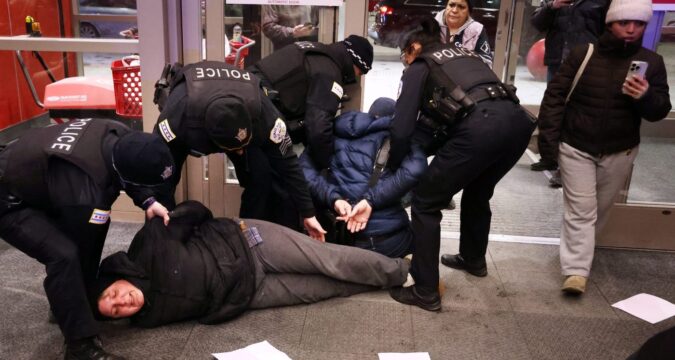
The effort to do so continues. Just last week, protesters were arrested demonstrating at a Target in Chicago’s West Loop as they pressed Target stores to deny entry to immigration agents and call for Immigration and Customs Enforcement to leave Illinois and Minnesota.
Activist groups such as Indivisible have trained tens of thousands of people in nonviolent tactics. As federal agents try to scare and provoke, in a way that could easily undermine the cause, such training is essential to ensure peaceful protesters do not take the bait.
And it’s working. Los Angeles succeeded in ousting thousands of National Guard forces the administration had deployed to aggressively back up its immigration operation. Last week, U.S. Border Patrol Cmdr. Gregory Bovino was stripped of leadership of the Minneapolis operation, and the Department of Homeland Security has announced that it is drawing down numbers of immigration officers there and would be issuing the remaining ones body cameras, a policy that gradually will be expanded nationwide. These are small but important concessions.
Ending this government repression will take a sustained and organized effort well beyond these cities. But if more Americans are ready to stand up with similar conviction, I have faith that the people will succeed.
Elizabeth Shackelford is a senior adviser with the Institute for Global Affairs at Eurasia Group and a foreign affairs columnist for the Chicago Tribune. She is also a distinguished lecturer with the Dickey Center at Dartmouth College. She was previously a U.S. diplomat and is the author of “The Dissent Channel: American Diplomacy in a Dishonest Age.”
Submit a letter, of no more than 400 words, to the editor here or email letters@chicagotribune.com.

Theodore J. Karamanski: Lake Michigan is under threat. The dangers are out of sight.
Back in 2014, singer-songwriter Lee Murdock released a song that asked the question: “What about the water?” The song is about the pollution in Lake Erie in the 1960s and ’70s. At that time, headlines that Erie was dying helped energize across the Great Lakes region an environmental movement that forced a national commitment to clean up the lakes.
The Clean Water Act of 1972 ushered in an era of federal activism that did much to restore all of the Great Lakes. More than half a century later, the Great Lakes have again reached an inflection point. People in cities such as Chicago and Milwaukee, which draw their very life from Lake Michigan, need to again ask themselves: What about the water?
The environmental threats to Lake Michigan are less obvious than the images that spurred public action in the past. In the summer of 1967, Chicago’s lakefront was fouled by millions of dead fish. The Chicago Park District dispatched crews to clear the beaches and ran out of places to put the foul flotsam. Billions of the alewives, a small silvery invasive fish, died that summer and awoke citizens to the fact that something was wrong with the region’s greatest natural resource. Out of that awakening came important measures to counteract giant algae blooms by stopping the use of phosphates in dishwashing liquid and other household items. Chicago’s Deep Tunnel and Reservoir Plan to reduce the discharge of street and municipal sewage into the lake received billions of federal dollars.
Today, Lake Michigan is not sending up a warning flag as obvious as miles of dead fish. The threats to our waters are insidiously obscured from sight. Most days, a trip to the beach yields beautifully clear water. The water is actually unnaturally clear because more than 400 trillion invasive Black Sea quagga mussels have taken over the bottom of the lake. Their constant filtering of water for food, about a liter a day, has made the water clearer but also has removed much of the phytoplankton, single-celled organisms, and zooplankton, tiny aquatic organisms, in the lake. In doing so the mussels eliminate the base of the lake food chain, the sustenance for young and small fish.
The result is that whitefish, once the most abundant fish in the lake, are near expiration. At the same time, the remarkably clear water results in localized blooms of Cladophora, a weed-like algae, and Microcystis, a poisonous blue-green bacteria. Phosphate fertilizer that runs off farm fields is a wonder food for algae. Together, they are a long-term threat to the health of beaches and urban water supplies.
Another invisible threat to the lake and public health is microplastics. This petrochemical product is ubiquitous in modern life, from cosmetics to food packaging. As it has become part of daily life for the millions of residents in the region, it has also become an increasing part of the Great Lakes. Plastic in streams, rivers and household water makes its way into the lake and from there into our bodies. It has been estimated that each week we ingest about a credit card-sized amount of plastic.
Another unregulated biology experiment that is underway is the unknown impact of per- and polyfluoroalkyl substances, or PFAS. We have used these compounds for more than a generation to make fabrics, furniture and firefighting foam, among other products. PFAS have been dubbed “forever chemicals” because they degrade very slowly and are carried widely via air and water. Maybe the only way to combat this toxic pollutant is by consumer boycott, the way we eliminated phosphates in household cleaners in the 1970s.
As residents of the Great Lakes region, we are caretakers of 21% of the world’s most precious resource: freshwater. At a time when Americans may feel beset with crises at home and abroad, we nevertheless must once again ask ourselves: What about the water?
Theodore J. Karamanski is an emeritus professor at Loyola University Chicago and author of the new book “Great Lake: An Unnatural History of Lake Michigan.”
Submit a letter, of no more than 400 words, to the editor here or email letters@chicagotribune.com.
https://www.chicagotribune.com/2026/02/06/opinion-lake-michigan-environmental-threats/
Letters: Mayor Brandon Johnson is struggling to do what real leaders must do
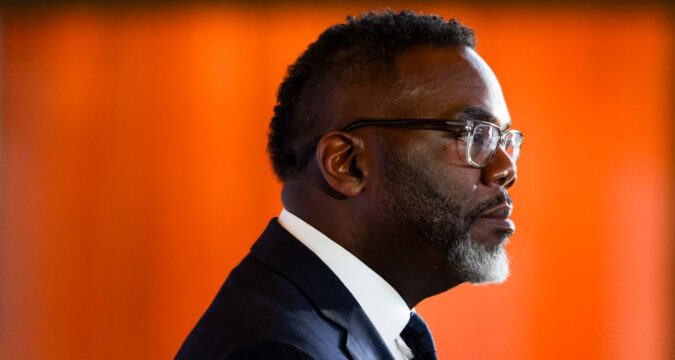
After spending 26 years in the military and serving under countless leaders across multiple platforms, I have come to the realization that Mayor Brandon Johnson is struggling with being a good leader. Does he wish he was? Probably. But talking loudly and throwing out numbers that give the impression of action without many of these actions taking place are not what a respectable leader does. Obfuscating when asked questions, getting perturbed when your messaging is being questioned by reporters whose job is to get to the facts and having council members continue to push back and question your agenda absolutely do not show a leader in charge of their environment.
And while nice suits can give the appearance of looking like a man in charge, having substance inside the cotton and wool are what voters demand and what can sustain a person who knows that leadership is the long game. Leaders make it a practice to think before they act because actions are what matter most. Many would not have put out an important executive order over the media-anemic weekend while simultaneously stating that a needed law enforcement agency was onboard with it, only to have the same agency declare the statement as false. Furthermore, a more seasoned leader would have apologized for making such a preemptive mistake and chalked it up to failed communication, not double down on it until it becomes a he-said-she-said argument that further undermines their office’s credibility.
True leadership can sometimes be lonely and hard. Many are asked to have a vision when one does not readily exist and to do more with less, and they are given the hard task of carrying multiple personalities forward toward a common goal. They learn to listen more and talk less, spot great talent for future tasks, take and use important advice, and most of all, stand by their decisions.
If Johnson expects to get a second bite at the apple of leading this city, he might wish to study harder at developing these traits.
— Ephraim Lee, Chicago
Criticizing Biss’ ambition
The Tribune Editorial Board says that Daniel Biss “all too frequently (is) seeking to move up the political ladder,” as if ambition is a flaw and as if none of the other candidates share Biss’ ambition (“Laura Fine for Democratic nomination in 9th Congressional District,” Feb. 3). If elected to the 9th District, Biss would have served six years as mayor of Evanston. If he were to serve eight years or 10 years, would he no longer be overly ambitious?
When Barack Obama declared a bid for president, he had served just two years in the U.S. Senate and fewer than three when elected president. Did the Tribune Editorial Board criticize Obama as wrongly trying to move up the political ladder? The board actually endorsed Obama.
There is nothing wrong with Biss seeking higher office as he is and working to better his constituents, including by confronting Immigration and Customs Enforcement, as he did to protect vulnerable residents of Evanston. Good for Biss!
— Daniel A Engel, Evanston
Too focused on Preckwinkle
If the Tribune Editorial Board is going to endorse Brendan Reilly (“Brendan Reilly for Cook County Board president,” Feb. 1), it should really be talking about him and not Toni Preckwinkle. The board gave us her best and worst but didn’t say much about Reilly. I have no idea who he is.
— Alexandria Moran, Hoffman Estates
A new party for Americans
I am writing in response to Jim Nowlan’s op-ed in the Feb. 2 Tribune (“A party for unrepresented suburbia: the Democratic-Republicans”). For years, I have thought that we need more than two political parties because if we did, our politicians would be forced to cooperate with each other and make compromises instead of holding fast to their own party’s doctrine. Sadly, loyalty to a party, instead of our country, seems to be the new norm.
The question is how to go about establishing another party. I am neither politically astute nor well connected enough to know how to go about this, but perhaps we could borrow a page from Barack Obama’s playbook and start at the grassroots level — from the bottom up.
And it wouldn’t hurt to find a billionaire who is both politically astute and well connected enough to help get the ball rolling with funding.
— Jo Ann Potenziani, Joliet
Concerned about gas bills
Regarding Peoples Gas seeking a $202 million rate hike: I am concerned about the potential of continued increases in gas prices each year if this current rate hike is approved. The current proposal calls for increased spending to replace pipes, but Peoples Gas will need $600 million to complete this project, $202 million of which it does not have.
If the proposal passes with support from the Illinois Commerce Commission, I worry that we may see huge increases each year.
I am concerned about how Chicago residents will afford these increases, combined with the increased cost of living. Residents should never have to choose between heating their homes in the winter and paying for other essential services.
— Alethea Oakley, Chicago
Goodbye to Damen Silos
Let’s not talk about Donald Trump for a moment. Instead, let us enjoy a newly beautiful location on Chicago’s South Side, where the Damen Silos have been demolished.
Just not seeing these huge concrete towers is a big improvement. And looking at this area that was covered in ugly graffiti is such a welcome change. The area north of the Stevenson Expressway and east of Damen Avenue has a fresh, new look for everyone. It provides an amazing view of downtown from a few miles away.
An old eyesore is gone, and no one will miss it. The wrecking contractor did a superb job of clearing the area. Perhaps the public will get some access to the Chicago River here just as there is on the North Side.
This is a Chicago story with a happy ending for everyone.
— Steven J. Bahnsen, Chicago
E-bikes vs. motorized bikes
Government officials seem to be confused between e-bikes and electric motorized bicycles. An e-bike is pedaled like any other bicycle and generally goes no faster and is no more dangerous than many people riding other bikes. An e-bike simply provides an assist with each stroke of the pedals and is a godsend to many older people who still want to ride a bicycle.
Perhaps they need a different name for electric motorized bicycles.
— David Rosenak, Highland Park
Submit a letter, of no more than 400 words, to the editor here or email letters@chicagotribune.com.
https://www.chicagotribune.com/2026/02/06/letters-020626-mayor-brandon-johnson/


