Category: News

Nueva ronda de conversaciones Rusia-Ucrania mediadas por EEUU será en Ginebra la próxima semana
Por THE ASSOCIATED PRESS
Otra ronda de conversaciones mediadas por Estados Unidos entre enviados de Rusia y Ucrania se realizará la próxima semana en Ginebra, a pocos días del cuarto aniversario de la invasión rusa a gran escala de su vecino, informaron autoridades de Moscú y Kiev el viernes.
El portavoz del Kremlin, Dmitry Peskov, señaló en un comunicado difundido por agencias de noticias rusas que la reunión se realizará el martes y el miércoles.
El asesor de comunicaciones del presidente ucraniano Volodymyr Zelenskyy, Dmytro Lytvyn, confirmó la nueva ronda de negociaciones.
Las conversaciones se producen en un contexto de combates continuos a lo largo de la línea del frente, de unos 1.250 kilómetros (750 millas), de incesantes bombardeos rusos sobre zonas civiles de Ucrania y la red eléctrica del país, y de ataques ucranianos con drones de largo alcance casi a diario contra activos vinculados a la guerra en territorio ruso.
Los intentos previos encabezados por Estados Unidos para lograr consenso sobre el fin de la guerra —más recientemente, dos rondas de conversaciones en Abu Dabi, la capital de Emiratos Árabes Unidos— no han logrado resolver asuntos difíciles, como el futuro del corazón industrial del Donbás ucraniano, que en gran medida está ocupado por fuerzas rusas.
Zelenskyy afirmó la semana pasada que Estados Unidos ha dado a Ucrania y Rusia un plazo hasta junio para alcanzar un acuerdo. Plazos anteriores fijados por el presidente estadounidense Donald Trump han vencido en gran medida sin consecuencias.
Zelenskyy estuvo en Múnich, Alemania, el viernes y visitó la primera empresa conjunta ucraniano-alemana para la producción de drones. Alemania ha sido un importante respaldo de Ucrania en la guerra.
También tenía previsto celebrar reuniones bilaterales y multilaterales en la Conferencia de Seguridad de Múnich, un encuentro anual de las principales figuras internacionales de la seguridad.
Los negociadores que se dirigen a Ginebra tienen la difícil tarea de encontrar compromisos aceptables tanto para Moscú como para Kiev.
El asesor del presidente ruso Vladímir Putin, Vladímir Medinsky, quien encabezó el equipo negociador de Moscú en las primeras conversaciones directas de paz con Ucrania en Estambul en marzo de 2022, regresa para liderar la delegación de Moscú.
Según se informó, las dos rondas anteriores de conversaciones trilaterales en Abu Dabi se centraron en asuntos militares, como una posible zona de amortiguamiento y la supervisión de un alto el fuego. El regreso de Medinsky, quien ha impulsado las condiciones maximalistas de paz de Putin, podría marcar un giro hacia cuestiones políticas en la próxima ronda de conversaciones.
La delegación de Ucrania volverá a estar encabezada por Rustem Umerov, jefe del Consejo de Seguridad Nacional y Defensa de Ucrania.
La sombría guerra de desgaste continúa al tiempo que ambas partes negocian.
Un ataque ruso registrado durante la noche del jueves al viernes mató a tres hermanos de entre 8 y 19 años en el este de Ucrania, informaron las autoridades. La fiscalía regional de Donetsk indicó que su madre y su abuela sobrevivieron, pero sufrieron múltiples heridas.
En Odesa, una persona murió y otras seis resultaron heridas en un ataque ruso contra el puerto de la ciudad y su infraestructura energética, señalaron funcionarios.
El Ministerio de Defensa de Rusia informó el viernes que sus defensas antiaéreas derribaron 58 drones ucranianos sobre varias regiones rusas y la Crimea anexionada durante la noche.
De ellos, 43 fueron abatidos en la región de Volgogrado, en el suroeste de Rusia, donde tres personas, incluido un niño de 12 años, resultaron heridas por restos de drones, según el gobernador local. Ucrania ha atacado recientemente la refinería de petróleo de Volgogrado.
___
Esta historia fue traducida del inglés por un editor de AP con la ayuda de una herramienta de inteligencia artificial generativa.
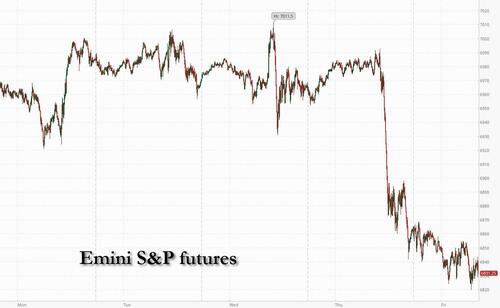
Futures Fall On Friday The 13th As CPI Looms
Futures Fall On Friday The 13th As CPI Looms
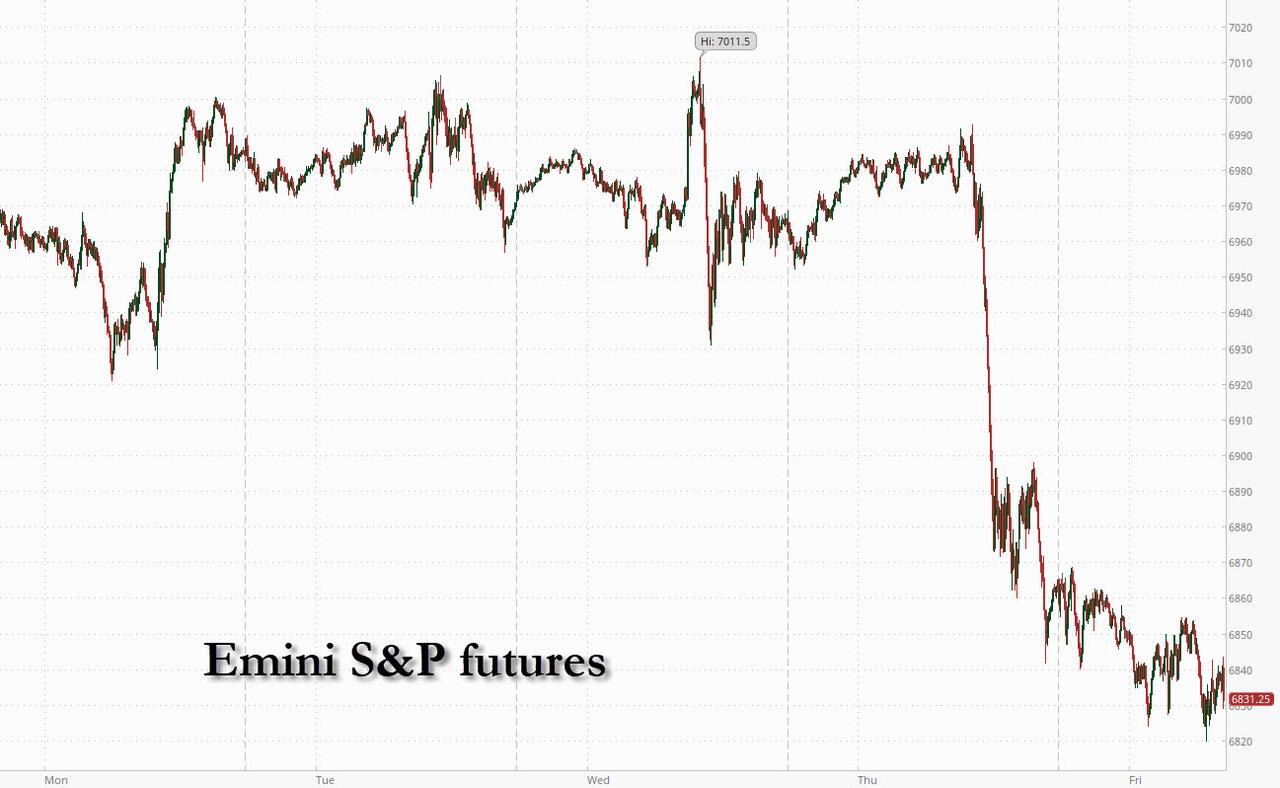
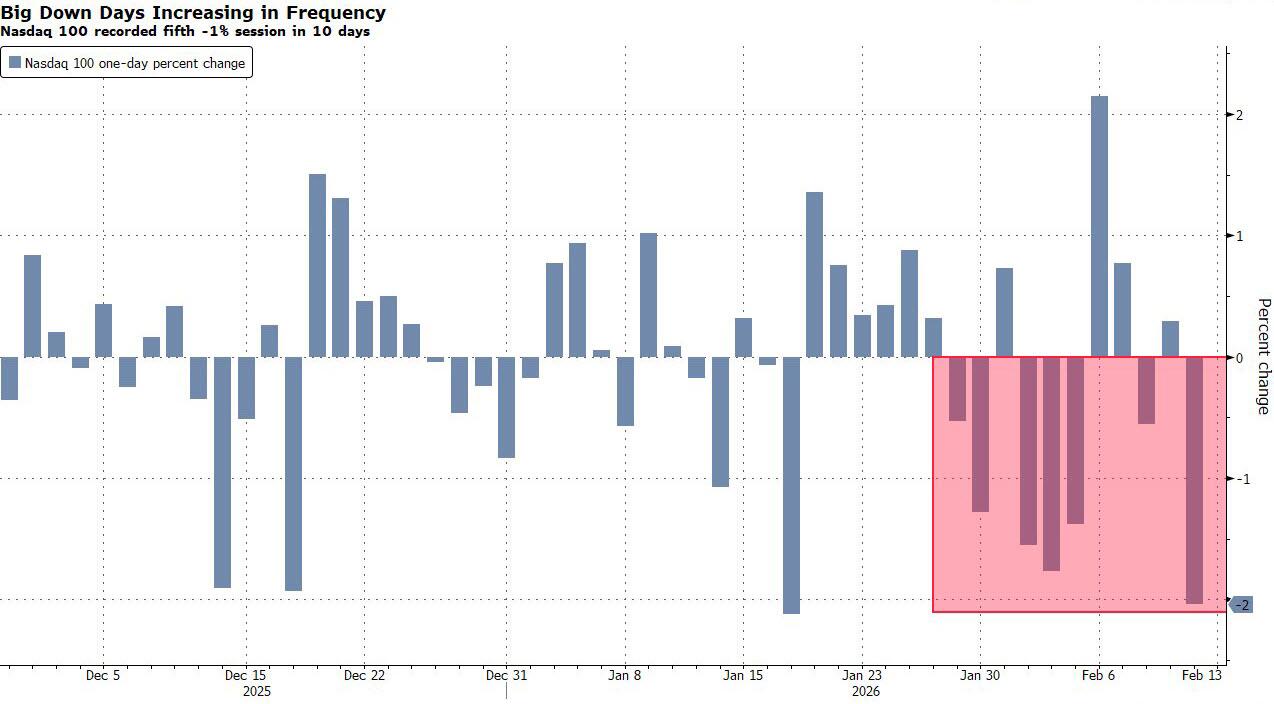
US equity futures are lower in a scary start this Friday the 13th, having given up modest overnight gains, as Investors – already on high alert for any further signs of the “AI scare trade” – braced for Friday’s inflation reading and any clues it holds on what happens next for interest rates. As of 8:00am ET, S&P and Nasdaq futures are down by 0.2%, having flipped between gains and losses after a three-day S&P 500 losing streak and especially Thursday’s brutal 1.6% cash-market slump, which DB’s Jim Reid described as “Friday 13th coming a day early for risk assets yesterday.” In pre-market trading, Mag-7 all names are weaker ahead of the long weekend, but there are some bright spots within Energy / Mats / Fins but, so far, pre-mkt trading does not point to another significant de-risking. Bond yields climb 1-2bps across the curve with the belly underperforming and USD rallying. Commodities are retracing some of yesterday’s losses led by precious metals. Crude oil futures fell on a report that some OPEC+ nations see scope for output hikes. Today’s macro focus is on CPI and if any new AI “Obsolescence” trades emerge.
In premarket trading, Mag 7 stocks are all lower (Alphabet -0.7%, Amazon -1.0%, Apple -0.4%, Nvidia -0.3%, Meta -0.8%, Microsoft -0.6%, Tesla -0.8%).
Airbnb (ABNB) is up around 4.8% after the travel-booking platform’s first-quarter revenue forecast exceeded the average analyst estimate.
Applied Materials (AMAT) is up 11% after the semiconductor capital equipment company reported first-quarter results that beat expectations and gave an outlook for adjusted earnings that is above the analyst consensus.
DraftKings (DKNG) slides 15% after the sports betting company’s revenue forecast for 2026 missed the average analyst estimate.
Dutch Bros (BROS) jumps 13% after the coffee chain reported adjusted earnings per share for the fourth quarter that surpassed Wall Street estimates.
Pinterest (PINS) is down around 20% after the social media company’s first-quarter forecast was weaker than expected.
Tri Pointe Homes (TPH) rose 27% after Sumitomo Forestry says it will acquire the company for around $4.28 billion.
In corporate news, Goldman Sachs’ top lawyer, Kathy Ruemmler, is leaving the firm following a cache of Department of Justice documents showing her links with sex offender Jeffrey Epstein.
The sharp swings this week have highlighted how quickly shifts in sentiment around AI can reverberate far beyond the technology sector. The so-called AI scare trade has seen knee-jerk selloffs in sectors from logistics to software providers amid fear the technology will hurt their businesses. Meanwhile, investors are watching Friday’s January inflation print to see if it reinforces strong jobs numbers earlier in the week, which prompted traders to curb bets on interest-rate cuts by the Federal Reserve. The median forecast predicts a year-over-year increase of 2.5% for the core consumer price index.
“What could help the market is if inflation comes in softer than expected,” said Joachim Klement, head of strategy at Panmure Liberum. “The strong labor market data earlier this week has reduced hopes for rate cuts by the Fed, yet if inflation continues to cool off, we think the Fed might be willing to add more rate cuts in the mix.”
Punishment has turned “brutal” for any stocks perceived to be at risk from AI disruption, according to Joel Kulina, managing director for TMT trading at Wedbush Securities.The worries over AI-fueled disruption underscore a sea change in market sentiment. Enthusiasm for the technology drove the lion’s share of stock market gains over the last few years. That’s been replaced by concerns that the newest tools released by Google, closely held AI developer Anthropic and a slew of lesser-known startups are already good enough to threaten a wide array of companies, many far outside the umbrella of technology.
“The number one issue for the market: AI has now become a net negative, pressuring equities,” Kulina says. “‘Sell first, ask questions later’ has been the mentality on a day-to-day basis this month. Megacaps remain capital intense, likely leading to less free cash flow and buybacks on one hand, while decimating legacy industries due to fears of severe disruption on the other.” In the latest such episode, Algorhythm Holdings, a former karaoke company turned AI developer with a stock-market value of only $6 million, announced a logistics platform that triggered a 6.6% slide in the Russell 3000 Trucking Index on Thursday.
Volatility, already stirring, may flare up further as traders square off positions to cut risk before the Presidents’ Day holiday on Monday and Lunar New Year holidays in China and several other Asian markets next week. After Wednesday’s surprisingly strong jobs report prompted traders to pare bets on rate cuts by the Fed, inflation data numbers due at 8:30 a.m. ET have added significance. “The CPI tends to run hot in January as businesses often hike prices in the beginning of the year, a phenomenon that statistical adjustments can’t completely strip out,” according to Bloomberg Economics chief economist Anna Wong. She expects headline consumer prices to rise 0.20% month-on-month, slower than the 0.31% increase in December. Remove volatile food and energy prices, and core consumer prices are predicted to rise 0.31% in January, up from 0.24% the previous month.
European stocks extend declines from the prior session. Stoxx 600 down 0.5% technology stocks outperform as a selloff in sectors deemed at risk from artificial intelligence eases, while basic resources lag on reports the Trump administration is planning to scale back some tariffs on steel and aluminum goods. FTSE 100 and the DAX slightly outperforming.Here are some of the biggest movers on Friday:
Safran shares rise as much as 8% to a record high, after the French engine manufacturer improved its guidance for 2026 and lifted its outlook for 2028, expecting a strong civil engines aftermarket and momentum on defense.
RELX shares rise as much as 5.9%, the most since April, after BofA Securities said the information and analytics provider is one of its top stocks for this year and that this week’s results shows the recent de-rating is overdone.
DataWalk shares surge as much as 7.2%, bucking a broader selloff on the Warsaw Stock Exchange, after the Polish data processing company’s accelerated book-building saw shares priced above Thursday’s closing level.
Kalmar shares gain as much as 8.2%, hitting a record high, after releasing its fourth-quarter results and announcing a “major order” from Maher Terminals for 30 hybrid straddle carriers.
NatWest shares swing between gains and losses on Friday after the UK lender posted a strong profit beat, currently trading 1.5% down as Shore Capital analysts flag its outlook is yet to take the recently announced deal to buy Evelyn into account.
L’Oréal shares drop as much as 7%, the most since October, after the beauty company reported like-for-like sales for the fourth quarter that missed the average analyst estimate.
Tomra shares drop as much as 9.3%, the most since October, after the recycler reported fourth quarter revenues below consensus and DNB Carnegie said it sees “muted” collections.
SSAB shares slide as much as 8.9%, leading a drop in European miners after the Financial Times reported the Trump administration is planning to scale back some tariffs on steel and aluminum goods, which would ease market disruptions.
Norsk Hydro shares fall as much 6.6%, the most since 2023, as analysts called the company’s guidance weak, due to soft pricing and pressure in the aluminum extrusions business.
Elkem shares fall as much as 13% in Oslo, the most since July, after the company agreed to sell the majority of its silicones division to Bluestar — a deal in which “many investors might have thought there would be a sale for cash,” Morgan Stanley analysts write.
Huhtamaki shares decline as much as 5.5% following the Finnish consumer packaging firm’s fourth-quarter results, which DNB Carnegie noted showed organic sales continuing to decline.
Earlier in the session, Asian stocks fell, as the region’s AI-driven rally took a breather after US tech shares tumbled overnight. Shares in Hong Kong led losses ahead of the Lunar New Year holiday. The MSCI Asia Pacific Index fell as much as 1.5%, snapping five days of gains. Still, the gauge is on track for its best week since September 2024, after hitting fresh records every day this week through Thursday. Equity benchmarks in Japan, South Korea and mainland China also fell. Despite the near-term pullback, Asian stocks have demonstrated resilience against the broad selloff driven by Wall Street’s fears of business disruption caused by artificial intelligence. The region is seeing more foreign demand as investors rotate away from crowded US trades and seek exposure in Asia’s AI supply chain. Equity markets in mainland China and Taiwan will remain shut all of next week, while Hong Kong is closed for three of the days.
Citigroup is raising the pay of CEO Jane Fraser to $42 million for 2025, making her among the best compensated US banking heads. Clear Street, a Wall Street broker built on cloud computing technology, postponed its IPO after cutting the target by nearly two thirds. And Coinbase Global showed how quickly a cooling crypto market can pressure even one of the industry’s most diversified exchanges. Revenue in the fourth quarter tumbled a more-than-estimated 20% to $1.8 billion as falling token prices drained trading activity across digital assets.
“Today’s pullback looks like a healthy pause within a broader upward trend,” said Tareck Horchani, head of sales trading, prime brokerage at Maybank Securities in Singapore. “Near term, I expect choppier price action driven by global tech sentiment and positioning flows, but the underlying earnings trajectory, especially in semiconductors, and sustained foreign inflows should continue to provide support once liquidity normalizes.”
In FX, the Bloomberg Dollar Spot Index up 0.2%, with yen and the Aussie dollar underperforming. Russia’s central bank cut rates by 50bps versus expectation for a hold.
In rates, treasuries are little changed in early US session, holding most of Thursday’s curve-flattening gains as focus shifts to January US CPI report at 8:30am New York time. Yields remain within 1bp of Thursday’s closing levels, the 10-year near 4.11%, lagging bunds and gilts in the sector by 2bp-3bp. 2s10s spread is near 65bp, about 6bp flatter on the week.
In commodities, WTI crude oil futures fell on a report that some OPEC+ nations see scope for output hikes. Gold is steadying short of $5,000/oz.
Friday’s US economic calendar slate includes January CPI at 8:30am. No Fed speakers are scheduled
Market Snapshot
S&P 500 mini -0.2%
Nasdaq 100 mini -0.2%
Russell 2000 mini -0.2%
Stoxx Europe 600 little changed
DAX +0.1%
CAC 40 -0.2%
10-year Treasury yield +2 basis points at 4.12%
VIX -0.4 points at 20.47
Bloomberg Dollar Index +0.1% at 1183.57
euro -0.1% at $1.1857
WTI crude +0.2% at $62.99/barrel
Top Overnight News
The US and Taiwan signed a trade deal to cut tariffs and boost access for American products in Asia, including a pledge by Taipei to buy more than $44 billion worth of LNG and crude. BBG
Ukraine and Russia peace talks process remain stuck, primarily over territorial concessions and security guarantees. Politico
OpenAI told US lawmakers that DeepSeek used unfair methods to extract results from leading rival models to train its next-gen chatbot. BBG
The Central Intelligence Agency released a new video on Thursday seeking to capitalize on upheaval at the top of China’s armed forces to recruit potential spies. WSJ
Trump is planning to scale back some tariffs on steel and aluminum goods as he battles an affordability crisis that has sapped his approval ratings ahead of November’s midterm elections. FT
Bank of Japan policy board member Naoki Tamura floated the possibility that the bank could soon declare that its price target has been achieved, as the nation’s inflation is becoming stickier. WSJ
The Pentagon is sending the Navy’s largest and most advanced aircraft carrier to the Middle East, as the U.S. steps up plans for a potential attack on Iran, two U.S. officials said. WSJ
Tech and banking trade groups are among others that are urging the Trump administration to not change the federal framework they have been using to safely deploy AI: Axios
Trade/Tariffs
China and the US held an anti-drug intelligence exchange meeting on February 10th-12th, Xinhua reported; both sides agreed to promote healthy and practical anti-drug cooperation.
China’s Ministry of Commerce holds a roundtable with German firms; hopes that German companies can increase investment in China.
US President Trump plans to roll back tariffs on metal and aluminium goods, according to FT.
Japan’s Trade Minister Akazawa engaged with US Commerce Secretary Lutnick on US-bound investment initiatives and confirmed progress on talks to launch the USD 550bln investment.
Taiwan President Lai said trade deal with US marks a pivotal moment for Taiwan’s economy and industries, adds we secured significant benefits for Taiwan’s industries and overall economy, and we solidified the Taiwan-US high-tech strategic partnership.
US Department of Commerce increases duties on Chinese battery-grade graphite to 160% related to Novonix (NVX).
US and Taiwan sign a reciprocal trade agreement with Taiwan to eliminate or reduce 99% of tariff barriers on US goods, while US confirms 15% tariff rate on Taiwanese goods.
US and North Macedonia agreed to a trade framework with the US to impose 15% tariff on North Macedonian goods, while North Macedonia is to eliminate all tariffs on US goods.
A more detailed look at global markets courtesy of Newsquawk
APAC stocks were mostly lower as the region took its cue from the losses stateside, where tech underperformed as AI-disruption concerns re-emerged, and logistics/industrials stocks were also pressured after Algorhythm Holdings (RIME) released its AI freight scaling tool. ASX 200 was dragged lower by losses in tech stocks, and as participants also digested earnings releases. Nikkei 225 retreated at the open after recent currency strength and with focus also on earnings reports, including from SoftBank, which returned to profit in Q3 but missed expectations, while its shares were also not helped by its AI exposure. Hang Seng and Shanghai Comp suffered alongside the broad downbeat mood in the region, and despite reports that President Trump paused some China tech bans ahead of his summit with Xi in April, while it is also the last trading day in the mainland before the Lunar New Year and Spring Festival holiday closures.
Top Asian News
Chinese New Yuan Loans (Jan) 4710B vs. Exp. 5000B (Prev. 910B).
Chinese M2 Money Supply YoY (Jan) Y/Y 9% vs. Exp. 8.4% (Prev. 8.5%).
Chinese Total Social Financing (Jan) 7220B vs. Exp. 7050B (Prev. 2210B).
Chinese Outstanding Loan Growth YoY (Jan) Y/Y 6.1% vs. Exp. 6.2% (Prev. 6.4%).
Chinese House Price Index MM (Jan) Y/Y -0.4% (Prev. -0.4%).
Chinese House Price Index YoY (Jan) Y/Y -3.1% (Prev. -2.7%).
European bourses (STOXX 600 -0.1%) are trading mixed as the end of the week nears. SMI (+0.6%) leads its European peers, closely followed by the AEX (+0.5%). On the other hand, the CAC 40 (-0.2%) is the slight laggard following a mixed bag of earnings coming out of France. European sectors are mixed. Technology (+1.3%) sits comfortably at the top of the pile, followed by Insurance (+0.6%) and Industrial Goods and Services (+0.5%). Upside in Tech follows on from the earnings by Applied Materials, which posted positive earnings and Q2 forecasts. Sitting at the bottom lies Basic Resources (-1.3%), as miners react to the selloff in metals prices. Consumer Products and Services (-0.7%) is weighed on by L’Oreal (-3.5%) post-earnings.
Top European News
UK PM Starmer is set to call for multinational defence initiative to cut costs of rearmament, according to FT
FX
DXY is currently trading with very mild gains and trades at the midpoint of a 96.89-97.15 range. Really not much driving things for the index this morning, with traders awaiting the US CPI report later. On that, the headline is expected to rise +0.3% M/M (prev. 0.3%), and core rising at a rate of 0.3% M/M (prev. 0.2%). UBS said easing inflation should keep the Fed on track for rate cuts despite strong jobs data, forecasting two 25bps reductions in June and September, while FOMC projections indicate one additional cut this year. In terms of recent price action, ING notes that there has been a strong inclination to sell USD rallies this week, as such, analysts “struggle to see the dollar recover substantially from here”.
G10s are mixed against the USD, with the NZD and CAD holding around the unchanged mark, whilst the CHF, AUD and JPY hold towards the foot of the pile, with the latter the clear underperformer. EUR was little moved by the EZ GDP 2nd estimates and Employment change, which printed more-or-less in-line with expectations.
Really not much driving things for the JPY this morning, with the weakness potentially a slight paring of a four-day winning streak seen following PM Takaichi’s landslide victory. Focus has been on Takaichi’s remarks that she will adhere to fiscal responsibility, with attention also on comments via FinMin Katayama, who noted that the foodstuff tax cut could be funded by foreign reserves. On the monetary policy side of things, markets now see the chance of faster BoJ normalisation; on that, BoJ’s Tamura (Hawk) suggested inflation is becoming “sticky”, and flagged the chance of a rate hike “this spring”. On the neutral rate, he suggested that the policy rate is “very distant” from the neutral rate. USD/JPY was little moved by his comments, and currently trades at the upper end of a 152.63-153.66 range.
CHF is slightly lower this morning, in the aftermath of the region’s inflation data; the Y/Y metric printed in-line with the consensus, whilst the M/M metric was a touch below the prior and surprisingly fell into negative territory. The CHF initially weakened on the report, before scaling back much of the pressure thereafter. It is worth reminding that SNB’s Schlegel suggested that the Bank is willing “look through negative months of inflation”, adding that the bar to negative rates is high.
Central Banks
Fed’s Miran (voter) said some of the concern he has on labour markets is a little less than he had before, adds a range of policies are pushing out the supply of the economy and will increase economic growth in a non-inflationary way. said:. Fed is one of the biggest risks to growth. Monetary policy has passively tightened. We may be underestimating how restrictive monetary policy actually is.
BoJ’s Tamura said he feels Japan’s recent inflation is becoming sticky and reiterates will keep raising rates if outlook is met, adds we may be able to judge that BoJ’s price goal has been achieved as early as this spring. Added that even if the BoJ raises the policy rate further, monetary conditions will remain accommodative.
Japan’s PM Takaichi is to meet with BoJ Governor Ueda on February 16th at 17:00JST / 08:00GMT.
Japanese PM Takaichi’s advisor Honda suggests the BoJ may consider raising interest rates later this year, but noted the unlikelihood of a hike in March.
ECB’s Kazaks said the ECB has yet to see full impact of EUR appreciation; he worries strong EUR reflects dollar weakness; said now is not the time for ECB to move interest rates; said ECB officials are on monitoring mode on EUR strength.
PBoC’s new emphasis on overnight money market rate has reportedly sparked speculation it could become the main policy target.
Riksbank’s Jansson said January inflation confirmed the picture of downside risks to inflation. Figures for GDP and consumption have been a little weaker recently.
Russian Federation Interest Rate Decision 15.50% vs. Exp. 16% (Prev. 16.00%).
Fixed Income
Another contained start for fixed income into US CPI and before Monday’s US holiday, which coincides with the Chinese New Year holiday period.
USTs on the backfoot, but only marginally, going into US CPI to round off a packed week of data. Currently, at the low-end of a 112-21 to 112-28 band, and while in the red as it stands, the upper-end of that band is a new marginal WTD peak.
Bunds are also contained, though the benchmark finds itself firmer by a handful of ticks, but off best in 128.93 to 129.12 confines. The firmer APAC bias came from gains towards the end of the European day after German Chancellor Merz said he is not in favour of joint eurobonds, in addition to the read-across from a strong US 30yr auction.
Gilts opened higher by nine ticks, catching up to the strength seen on that US auction. Since, the benchmark has retreated into the red with losses of c. five ticks in 91.34 to 91.51 parameters. Ahead of US CPI today but, more pertinently for the UK, next week’s packed data docket that will likely determine if the BoE cuts in April as markets currently forecast, or if March comes into consideration.
JGBs came under pressure to a 131.52 low after BoJ’s Tamura said even if they tighten, monetary conditions will remain accommodative.
Japan sold JPY 649.5bln in 10yr, 20yr and 30yr JGBs in enhanced liquidity auction; b/c 2.95 vs. Prev. 2.58. Highest accepted spread -0.014% vs. Prev. +0.018%. Allotment of bids at highest spread 2.5490% vs. Prev. 86.2119%.
PBoC is to issue CNY 30bln in 3-month and 1-year bills in Hong Kong.
Australia sold AUD 1bln 2.50% May 2034 bonds, b/c 3.44, avg. yield 4.2898%.
Commodities
Crude benchmarks are trading relatively flat following yesterday’s slump after dollar strength and weak risk sentiment, sparked by AI disruption woes. Adding to further downside pressure were comments from US President Trump yesterday evening that the US must make a deal with Iran and that they could reach a deal over the next month. Not much in terms of fresh catalysts thus far in the European session, as traders await US CPI. WTI and Brent are trading at the lower end range of USD 62.54-63.17/bbl and USD 67.22-67.89/bbl, respectively.
Precious metals are rebounding after yesterday’s decline, which was driven by a stronger US dollar following strong jobs data surpassing market expectation. There is no fresh catalyst behind today’s recovery, though some analysts attribute the move to dip-buying after the recent sell-off. Spot gold is currently trading near the upper end of USD 4,885.89–4,997.53/oz range, while silver is holding at the upper range of USD 73.745–79.085/oz.
Copper trades slightly lower triggered by downbeat sentiment in Wall Street and APAC, although Europe fares somewhat better. The red metal trades at the lower end range of 12,800-13,021/t. Other relevant news in the metal space includes the Shanghai Weekly updating their Warehouse changes before the Chinese holiday: Copper +9.47%, Nickel +2.29%, Aluminium +21.3%.
Indonesia’s Mining Minister said we are studying a plan to ban exports on a number of raw materials next year, which includes tin.
India’s Reliance has reportedly been awarded general authorisation from the US to buy Venezuelan Oil.
Three people reportedly burnt at Exxon’s (XOM) Beaumont facility.
Shanghai Weekly Warehouse Changes: Copper +9.47%, Nickel +2.29%, Aluminium +21.3%.
ANZ revises gold price forecast, now sees gold hitting USD 5,800/oz in Q2 vs. previous forecast of USD 5,400/oz.
Qatar hikes April term price for Al Shaheen oil to USD 0.87/bbl over Dubai quotes, according sources.
Shenzhen financial regulator issues public notice to further standardise gold market operations.
Trade/Tariffs
China and the US held an anti-drug intelligence exchange meeting on February 10th-12th, Xinhua reported; both sides agreed to promote healthy and practical anti-drug cooperation.
China’s Ministry of Commerce holds a roundtable with German firms; hopes that German companies can increase investment in China.
US President Trump plans to roll back tariffs on metal and aluminium goods, according to FT.
Japan’s Trade Minister Akazawa engaged with US Commerce Secretary Lutnick on US-bound investment initiatives and confirmed progress on talks to launch the USD 550bln investment.
Taiwan President Lai said trade deal with US marks a pivotal moment for Taiwan’s economy and industries, adds we secured significant benefits for Taiwan’s industries and overall economy, and we solidified the Taiwan-US high-tech strategic partnership.
US Department of Commerce increases duties on Chinese battery-grade graphite to 160% related to Novonix (NVX).
US and Taiwan sign a reciprocal trade agreement with Taiwan to eliminate or reduce 99% of tariff barriers on US goods, while US confirms 15% tariff rate on Taiwanese goods.
US and North Macedonia agreed to a trade framework with the US to impose 15% tariff on North Macedonian goods, while North Macedonia is to eliminate all tariffs on US goods.
Geopolitics: Ukraine
Russia’s Kremlin said that new round of peace talks with Ukraine will take place next week; adds that its unlikely that discussions will move beyond talks before the conflict in Ukraine is settled.
US, Russia and Ukraine are planning to meet again next week, possibly in Miami or Abu Dhabi, POLITICO reported.
Geopolitics: Middle East
US aircraft carrier U.S.S Gerald R. Ford will be sent to the Middle East from Venezuela, according to officials cited by NYT.
Geopolitics: Other
Russia’s Deputy Foreign Minister Ryabkov said Russia will provide Cuba with material assistance, TASS reported.
Russia’s Kremlin said they did not decide to stop using the dollar but that the US imposed restrictions, dollar will have to compete with other currencies if the US lifts restrictions.
Japan seizes a Chinese fishing boat off the Nagasaki coast, according to Japanese press.
US Event Calendar
8:30 am: United States Jan CPI MoM, est. 0.3%, prior 0.3%
8:30 am: United States Jan Core CPI MoM, est. 0.3%, prior 0.2%
8:30 am: United States Jan CPI YoY, est. 2.5%, prior 2.7%
8:30 am: United States Jan Core CPI YoY, est. 2.5%, prior 2.6%
DB’s Jim Reid concludes the overnight wrap
Friday 13th came a day early for risk assets yesterday and although the sell-off is continuing this morning in Asia, US futures are more stable as I type. It’s perhaps indicative of the state of markets at the moment that a $6 million market cap company that until recently specialised in Karaoke helped wipe tens of billions off logistics stocks to add to the weakness. I’ve seen some shocking Karaoke performances in my time but this perhaps tops them all. Overall the S&P 500 (-1.57%) slid to a third consecutive decline. Once again, software stocks in the index were one of the worst hit, falling -1.49%, but it was a rough day for tech in general, with the Magnificent 7 (-2.24%) and the NASDAQ (-2.03%) both losing significant ground. Matters weren’t helped by some weaker US data, which added to the risk-off tone, leading to clear signs of financial stress across several asset classes. Indeed, Bitcoin (-2.92%) fell for a 4th consecutive session, credit spreads widened on both sides of the Atlantic, and silver (-10.67%) posted another sharp decline.
Tech stocks were in the driving seat of yesterday’s selloff, although unlike some sessions recently, the move was a broad-based one as investors reckoned with the AI-led disruption of various industries. In terms of the movers, Cisco Systems (-12.32%) was one of the worst performers, posting its worst daily performance since 2022 as investors reacted to its latest earnings. On some days, that would make the worst performer in the entire S&P, but there were 7 companies that saw a double-digit decline yesterday, which just shows the adjustment taking place. One of those double-digit declines was CH Robinson Worldwide (-14.54%), as global logistic companies were the latest industry to see artificial intelligence concerns as a very small AI logistics company called Algorhythm Holdings (formerly a Karaoke company) said its SemiCab platform helped customers scale freight volumes by 300% to 400% without a corresponding increase in headcount. The Russell 3000 trucking index fell -6.64% as companies of all size reacted to the news.
Old fears were rekindled within commercial real estate as well as CBRE (-8.84%), a commercial real estate company, saw large losses for a second day following comments from their CEO saying “If there are less office workers in the long run as a result of AI, there will be less demand for office space. That would be a long-term trend to unfold.” So, the market continues to price in further AI disruption across industries, sometimes in the most abstract way.
S&P Financials (-1.99%) also saw a sharp decline, as the KBW Bank Index (-3.21%) posted its worst performance since October. And there were signs of the selloff broadening out, with the equal-weighted S&P 500 (-1.31%) falling back from its record high the previous day, whilst Europe’s STOXX 600 (-0.49%) also fell back from Wednesday’s record. European credit markets were relatively steady as EUR IG was unchanged at 75bps, while EUR HY spreads were just 1bp wider to 264bps. USD IG spreads were 2bps wider to 77bps and USD HY spreads moved 12bps wider to 275bps.
Looking forward, attention will today turn to the US CPI print for January, which is a couple of days later than expected because of the partial government shutdown. This is an important one, because markets are still expecting further rate cuts under a new Fed Chair, but stronger data like the jobs report on Wednesday has led to a bit more doubt as to whether that’s still possible. So another hawkish print today would further push in that direction, particularly given this quarter is already seeing a decent fiscal impulse from the Trump tax cuts.
In terms of what to expect, our US economists forecast that monthly headline CPI would be at +0.26% in January, down from +0.31% in December. And if realised, that would take the year-on-year CPI rate down to +2.5%. However, they think that headline inflation would be weighed down by a -2.4% decline in motor fuel prices, meaning that core CPI should be relatively strong at +0.35% on the month.
Otherwise, they’re keeping an eye on tariff-related strength in core goods, as they expect a continued impact in categories like household furnishings and supplies, as well as apparel. For more details, click here for their preview and to register for their subsequent webinar.
Ahead of that release, Treasury yields fell across the curve, driven by the wider risk-off move as well as some weaker US data. For instance, the weekly initial jobless claims were a bit higher than expected, coming in at 227k in the week ending February 7 (vs. 223k expected). Meanwhile, existing home sales were down to an annualised rate of 3.91m in January (vs. 4.15m expected). So that further dampened sentiment, and expectations for Fed rate cuts this year moved back up again. For instance, the amount of cuts priced in by the December meeting was up +5.3bps on the day to 53bps. And in turn, yields on 2yr Treasuries (-5.4bps) fell back to 3.456%, whilst the 10yr Treasury yield (-7.4bps) fell to 4.098%. Yields have moved back up +1 to +1.5bps across the curve this morning.
Oil prices had already been moving lower along with other risk assets, but the selloff gained momentum amid a bevy of headlines that pointed to greater supply. Brent crude futures closed -2.71% lower on the day, finishing at $67.52/bbl. First, there were comments from US Energy Secretary Wright that China had bought crude from the US that was previously purchased from Venezuela. This was followed by comments later in the day from Interior Secretary Burgum, who said during an event in Washington that the US would be selling Venezuelan oil to China at global market price levels. Bloomberg reported that Venezuelan officials are set to grant more oil permits to Chevron and Repsol, adding credence to the potential for further supply in the medium term. Staying with the US, President Trump reiterated his preference to “reach a deal” with Iran and said that it could come together “over the next month, something like that.” Additionally, there was reporting from Bloomberg that showed Russia had included returning to the dollar settlement system as part of a greater re-framing of the US-Russia economic relationship.
Staying in commodities, gold saw a sharp sell-off of their own despite its traditional haven status. The story of Russia returning to the dollar payment system probably contributed. Gold prices fell -3.19% to $4922/oz, while silver (-10.67%) and copper (-3.02%) also saw outsized moves. As noted above there was more crypto weakness as bitcoin fell -2.92% and is under 5% away from last week’s lows, which was the lowest level since October 2024.
Earlier in Europe, the main highlight yesterday was the EU leaders summit in Belgium. At the summit, EU leaders sought to move forward with reforms to bolster Europe’s economy and improve regional coordination. There were many proposals with various champions. French President Macron pushed a “Buy European” agenda, which remains on the table as European Council president Costa said, “ I feel that there is a broad agreement on the need to use (European preference) in the selected strategic sectors, in the proportional and targeted way.” German Chancellor Merz and Italian PM Meloni called for greater deregulation, with PM Meloni saying that the EU “ cannot continue to hyperregulate…there’s no time to lose.” On the matter of greater joint debt, most leaders were calling for greater stimulus, however Merz seemed unmoved saying, “We have taken on European debt in exceptional situations — but those were exceptional situations…We have to make do with the money we have.”
Across the Channel, UK gilts outperformed after the latest UK GDP print came in softer than expected. It showed Q4 GDP up by +0.1% (vs. +0.2% expected), which left annual GDP growth for 2025 at +1.3%. So with the downside surprise in the Q4 number, investors priced in more rate cuts from the Bank of England this year, and the 2yr gilt yield (-2.1bps) fell to just 3.60%, its lowest level since August 2024, whilst the 10yr gilt yield (-2.4bps) fell to 4.45%. And elsewhere in Europe, there was a smaller decline that left yields on 10yr bunds (-1.3bps), OATs (-1.5bps) and BTPs (-1.3bps) lower as well.
In Asia, the AI related sell-off continues, albeit after a strong week in the region. The Hang Seng (-2.10%) stands out as the largest underperformer, with the CSI (-0.92%) and the Shanghai Composite (-0.85%) also lower. The Nikkei (-1.22%) is also weak but its gains so far this week are close to +5.5% post the election results. Elsewhere the S&P/ASX 200 (-1.37%) is also lower after a firmer week with the KOSPI (-0.23%) outperforming. S&P 500 and Nasdaq futures are down jus over a tenth of a percent with European ones back up a similar amount. As we go to print the FT is reporting that the US is planning to roll back some steel and aluminium tariffs that nods to our view that the tariffs headlines this year, whilst very noisy, will likely lean in a dovish direction ahead of mid-terms where the cost of living issue is likely to be decisive.
Early morning data revealed that China’s new home prices continued their decline in January, reflecting weak demand that is likely to further burden the country’s financially constrained developers. Prices decreased by -0.4% month-on-month, matching the decline observed in the previous month.
Looking at the day ahead, data releases include the US CPI print for January, and the second estimate of Euro Area GDP for Q4. Otherwise, central bank speakers include ECB Vice President de Guindos, and the BoE’s Pill.
Tyler Durden
Fri, 02/13/2026 – 08:29
https://www.zerohedge.com/markets/futures-fall-friday-13th-cpi-looms

El Mundial supone recortes salariales y desplazamiento para algunos pobres en la Ciudad de México
Por MEGAN JANETSKY y EDUARDO VERDUGO
CIUDAD DE MÉXICO (AP) — Montserrat Fuentes se para en la misma esquina donde trabaja desde hace 20 años. Pero el habitual aluvión de clientes de la trabajadora sexual todos los viernes por la noche ha desaparecido.
En su lugar, la transitada arteria de Ciudad de México donde unas 2.500 trabajadoras sexuales se ganan la vida está flanqueada por las obras, como parte de los preparativos de la capital mexicana para la Copa Mundial de fútbol que se disputará en el verano boreal.
Fuentes, de 42 años, y otros afirman que han visto como sus ingresos se han reducido debido a los proyectos gubernamentales destinados a limpiar grandes zonas de la ciudad antes de abrir sus puertas a aficionados al deporte de todo el mundo. Los vendedores ambulantes también aseguran que se les está desplazando y que no saben qué les quedará cuando termine el Mundial.
“Esto que estamos viviendo aquí en México lo han vivido en prácticamente casi todo el mundo. Porque cuando hay un evento de esta índole, siempre quieren hacer arreglos en cualquier ciudad, quieren hacer que se vea la ciudad bonita”, apuntó Fuentes. “Pero los afectados son las personas de abajo”.
Se espera que la Copa del Mundo —organizada conjuntamente por México, Estados Unidos y Canadá— genere un impulso económico de 3.000 millones de dólares en México con la llegada de visitantes a sus aeropuertos, hoteles, restaurantes y recintos deportivos, de acuerdo con la Federación Mexicana de Fútbol.
Pero en un país donde más de la mitad de la población activa trabaja en la economía informal, muchos mexicanos tienen condiciones precarias temen quedarse atrás.
El gobierno de Ciudad de México dijo que estaba tomando medidas para compensar el impacto en trabajadoras sexuales y vendedores, y que ha mantenido conversaciones continuas con los trabajadores.
Ingresos de trabajadoras sexuales, afectados por los preparativos
En la Ciudad de México, donde se celebrará la ceremonia inaugural del torneo, las tensiones comenzaron a incrementarse en los últimos meses, a medida que el gobierno local renovaba rápidamente el emblemático Estadio Azteca, mejoraba el transporte público y llevaba a cabo obras públicas en barrios históricamente obreros.
Fuentes y muchas de las trabajadoras sexuales de la avenida Calzada de Tlalpan, que pasa por el estadio, señalaron que la construcción de una ciclovía que comenzó a finales de 2025 ha reducido sus ingresos a más de la mitad. Grandes separadores impiden que los autos se orillen para negociar. Además, la ciudad anunció más tarde el cierre nocturno de las estaciones de metro ubicadas en la carretera debido a las obras del Mundial, lo que ha dejado a muchas mujeres abandonadas a su suerte.
“El unico que ve el gobierno son los ingresos que (el Mundial) les va a generar”, afirmó Elvira Madrid Romero, presidenta de la organización de defensa de las trabajadoras sexuales Brigada Callejera. “Los turistas vienen para festejar en las espaldas de los pobres”.
El trabajo sexual no está penalizado en México y, en la capital, sigue siendo un salvavidas económico para alrededor de 15.000 personas, incluyendo mujeres transgénero que tienen dificultades para encontrar un salario justo en otros sectores.
A muchas madres solteras en la coalición de Madrid les preocupa cómo van a poner comida en la mesa o pagar la renta. Su organización ha negociado con las autoridades locales, que prometieron pequeños pagos mensuales y reparto de alimentos que son una pequeña parte de lo que las mujeres necesitan para subsistir, explicó.
En septiembre, la alcaldesa de la Ciudad de México, Clara Brugada, anunció que se habilitarían 58 puntos a lo largo de la calzada donde las trabajadoras podrían encontrarse con clientes.
“Queremos un Mundial con juego limpio y sociedad justa”, dijo Brugada entonces.
Pero las mujeres no han visto ninguno de esos puntos ni han recibido ayuda de las autoridades locales, y se niegan a ser trasladadas de las zonas donde trabajan, indicó Madrid.
Los eventos deportivos globales tienen un costo
Fuentes tuvo que buscar un segundo empleo vendiendo comida por las mañanas, después de trabajar toda la noche, para pagar la renta, lo que la deja exhausta. Comenzó a ejercer la prostitución hace 20 años, cuando se vio obligada a dejar la venta de comida en el centro durante otra campaña de limpieza gubernamental.
A pesar de la insistencia de la coalición en que no se moverán, Fuentes teme que pueda volver a ocurrirle lo mismo, sobre todo al ver que las autoridades locales trasladan a los vendedores ambulantes de la arteria principal a calles laterales menos transitadas.
“Aunque alcemos la voz, no podemos hacer nada”, manifestó. “La única esperanza que tengo es que, terminando el Mundial, esto volverá a la normalidad (…) No queremos que nos quiten”.
Este tipo de presiones por parte de los gobiernos locales son habituales antes de eventos deportivos globales, que a menudo se sitúan en la confluencia de tensiones sociales y políticas más amplias y que los grupos activistas critican ampliamente por considerarlos una “limpieza social”.
Durante los Juegos Olímpicos de París 2024, las autoridades municipales reunieron a migrantes africanos y a personas sin hogar y los llevaron fuera de la capital francesa en buses. Cuando Brasil organizó la Copa del Mundo en 2014, organizaciones activistas reportaron que decenas de miles de personas fueron desalojadas de sus hogares.
La Ciudad de México está experimentando ya una tensión latente debido a que la llegada de extranjeros, especialmente de Estados Unidos, ha incrementando los precios en algunas colonias hasta hacerlas inaccesibles para la población local. Los críticos sostienen que las autoridades han hecho poco para contrarrestar la escasez de vivienda y el alza de los precios que acompaña al auge del turismo promovido en su momento por el gobierno.
Vendedores desplazados de sus lugares de trabajo
Para otros que trabajan a lo largo de la avenida, como la vendedora de licuados Esperanza Toribio Rojas, de 68 años, la posibilidad de verse desplazados ya no es hipotética. Asegura que es una inevitabilidad inminente que se cierne sobre ella.
Toribio es una de los cientos de vendedores que ofrecen comida, ropa, herramientas y otras mercancías en los túneles que cruzan por debajo de la avenida y que dan acceso a las estaciones del metro que dan servicio al estadio del Mundial.
Durante décadas, los comerciantes trabajaron en puestos ofrecidos por el gobierno local cuando los pasajes estaban plagados de delincuencia y llenos de basura. Ahora, los compradores pasean junto a familias que comparten comidas y preguntan los precios de la ropa expuesta.
“Realmente nosotros fuimos los que le dimos vida a esto”, dijo Toribio. “Antes había mucha delincuencia, y en ese entonces nadie se se preocupó”.
Los vendedores dijeron que se sorprendieron cuando, a principios del año pasado, los funcionarios municipales se presentaron en la zona y les dijeron que debían dejar espacio para un proyecto anunciado por la alcaldesa en noviembre.
La iniciativa “Pasos de la utopía”, según la oficina de Brugada, “preparará la zona” para el torneo, convirtiendo los pasos subterráneos en “espacios seguros con más de 300 actividades culturales, deportivas, educativas, de salud y bienestar”.
El líder de los comerciantes locales, Jaír Torruco, señaló que entre 100 y 200 vendedores fueron expulsados, mientras que unos 250 más, como Toribio, rechazaron la oferta del gobierno por considerar que no era suficiente para subsistir.
Siguen negociando con las autoridades en un intento por quedarse en sus puestos, dijo Torruco.
El gobierno de Ciudad de México dijo que ha brindado apoyo a quienes ha desplazado y que los vendedores podrán regresar a sus puestos más adelante. Toribio y otros dicen que no creen a los funcionarios y afirman que les ofrecieron tres meses en un espacio temporal, que debían rentar, y que quienes se mudaron a una plaza del centro han tenido dificultades para llegar a fin de mes.
Rodeada de sus hijos y nietos, Toribio apuntó que no sabe cómo podría costear el traslado del negocio que se ha convertido en el trabajo de su vida.
“Hoy (el gobierno) lo ve, ven que ya tiene una vida y ya quieren tomar el lugar”, afirmó. “Esto es nuestro patrimonio”.
___
Martín Silva Rey en la Ciudad de México contribuyó a este despacho.
___
Esta historia fue traducida del inglés por un editor de AP con la ayuda de una herramienta de inteligencia artificial generativa.

Aluminum Futs Slide As Trump Weighs Metal Tariff Rollback In Affordability Push
Aluminum Futs Slide As Trump Weighs Metal Tariff Rollback In Affordability Push
Aluminum futures in London slipped on Friday after a Financial Times report stated that the Trump administration is considering a partial rollback of steel and aluminum tariffs as it battles an affordability crisis (left over from the Biden-Harris regime years) ahead of November’s midterm elections.
The FT cited three people familiar with internal discussions who said White House officials are reviewing steel and aluminum import tariffs of up to 50%, which affect a wide range of downstream consumer products such as appliances to soda cans. The plan would exempt some products, pause further expansions, and shift toward narrower, product-specific national security investigations.
Trade officials at the U.S. Department of Commerce and the Office of the U.S. Trade Representative believe these tariffs are already denting consumer sentiment by pushing up prices for goods such as drink cans and pie tins.
The administration is mulling carve-outs for popular food products to tame grocery-store inflation amid affordability concerns this year. Last year, Trump called for a trade war with Beijing ahead of the U.S. midterm elections.
News of the planned tariff rollback on aluminum and steel goods sent metal futures in London falling on Friday morning.
Aluminum slid 1.3% to $3,059 a ton on the LME. Zinc dropped 1.4%, while copper fell by about half a percent after available LME inventories posted their largest increase since July.
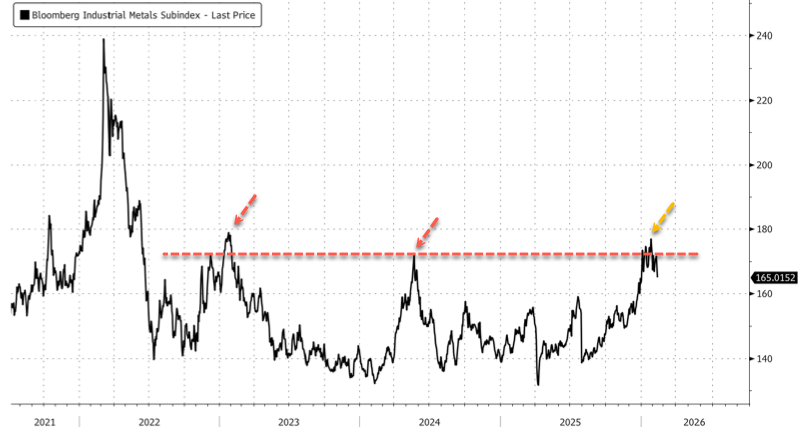
The Bloomberg Industrial Metals Subindex (core contracts: aluminum, copper, nickel, lead, and zinc futures) appears to have formed yet another peak since 2022 and is still trading well below its Covid-era high.
What is clear for companies operating in this space is that navigating the U.S. tariff regime has become arduous, with tariffs appearing to change monthly.
Tyler Durden
Fri, 02/13/2026 – 08:20

En China, los robots también celebran el Año Nuevo Lunar
Por E. EDUARDO CASTILLO
BEIJING (AP) — No solo las personas: en China, los robots también se están preparando para celebrar el Año Nuevo Lunar.
El viernes fue el día del ensayo general para cuatro simpáticos robots humanoides, cada uno de unos 95 centímetros (3 pies) de altura, en un centro comercial del oeste de Beijing. Los curiosos se detuvieron a mirar.
Cada robot recibió un colorido disfraz de león y, en cuestión de minutos, comenzaron los movimientos: doblar las rodillas, arriba, a la izquierda, a la derecha, sacudir la máscara y volver a hacerlo todo otra vez.
De cara al Año Nuevo Lunar, que se celebra la próxima semana, y como parte de distintas “ferias” y actividades en torno a Beijing, algunos recintos han estado ocupados montando sus escenarios y utilería.
Por segundo año consecutivo, una de las ferias estará dedicada a la tecnología y —así es— los robots ocuparán el centro del escenario.
La gente los verá bailar y también apilar bloques sobre otros para hacer una pequeña torre, ensartar bayas de espino en un palito —cubiertas con un jarabe, un popular dulce— o jugar al fútbol.
“Este año, el número de nuestros robots ha aumentado mucho”, comentó Qiu Feng, integrante del comité organizador. “Interpretarán danza, artes marciales, ópera de Beijing, poesía y fútbol”.
Añadió Qiu: “Algunos eventos también estuvieron disponibles el año pasado, pero esta vez la fineza de las acciones y el ambiente de alta tecnología son más fuertes”.
China ha estado intensificando sus esfuerzos para desarrollar mejores robots que puedan realizar distintas actividades, impulsados por inteligencia artificial y con menor intervención humana.
Pero, aunque ahora pueden hacer cosas que era difícil imaginar hace unos años, todavía se necesita a los humanos para ayudarlos —por ejemplo, para vestirlos o moverlos cuando se detienen en medio de un mini campo de fútbol.
“La tecnología se desarrolla más rápido y se vuelve más avanzada cada día”, señaló Qiu. “Mientras sigamos el ritmo de esta tendencia, nuestra… feria seguirá evolucionando y creciendo con los tiempos”.
Los robots que actuaban en el centro comercial fueron desarrollados por algunas startups chinas, como Booster Robotics. La empresa exhibirá alrededor de 20 robots humanoides, que también bailarán y jugarán al fútbol.
“Es un entorno de IA, lo que significa que, una vez que suene el silbato, se dejarán a un lado todos los controles remotos y toda la toma de decisiones y el control del movimiento los harán los propios robots”, indicó Ren Zixin, director de marketing de Booster Robotics.
___________________________________
Esta historia fue traducida del inglés por un editor de AP con ayuda de una herramienta de inteligencia artificial generativa.
https://www.chicagotribune.com/2026/02/13/en-china-los-robots-tambin-celebran-el-ao-nuevo-lunar/

Bitcoin Advances Toward Quantum Resistance With Proposed Update
Bitcoin Advances Toward Quantum Resistance With Proposed Update
Authored by Micah Zimmerman via Bitcoin Magazine,
BIP 360, a proposal aimed at preparing Bitcoin for future computing threats, has been updated and merged into the official Bitcoin Improvement Proposal (BIP) GitHub repository, marking a new step in efforts to strengthen the network against emerging cryptographic and quantum computing risks.
The proposal introduces a new Bitcoin output type called Pay-to-Merkle-Root (P2MR), designed to support quantum-resistant script tree functionality while maintaining compatibility with existing Tapscript infrastructure, according to a note seen by Bitcoin Magazine.
Supporters of BIP 360 describe the proposal as an early move toward quantum-hardening Bitcoin at the protocol level.
A merge into the BIP repository does not signal endorsement or future activation. BIPs are merged as part of the open process for documenting or discussing potential upgrades.
BIP 360: Pay to Merkle Root
was published pic.twitter.com/GXkmTHnDoL
— Murch (@murchandamus) February 11, 2026
Bitcoin at risk from Quantum computing in theory
Quantum computing has raised concerns across the cryptography and cybersecurity fields because sufficiently advanced machines may be able to break widely used cryptographic systems.
In Bitcoin’s case, the threat centers on the possibility that computers could derive private keys from exposed public keys, which could lead to stolen funds.
While all Bitcoin addresses become vulnerable when spending reveals a public key, some output types carry greater exposure.
Taproot addresses, along with Pay-to-Public-Key (P2PK) outputs and reused addresses, are considered more at risk because public keys are visible on-chain.
P2MR is conceptually similar to Taproot but removes a key weakness. Taproot includes a key-path spending method that can expose public keys. The proposed P2MR output type disables that key-path spend and commits only to the script path, reducing the surface area for potential attacks.
The BIP’s authors say the proposal is meant to serve as a foundation for later upgrades that could introduce post-quantum signature schemes into Bitcoin through follow-on soft forks. The note points to algorithms such as ML-DSA (Dilithium) and SLH-DSA (SPHINCS+) as possible candidates.
“Ultimately, the introduction of BIP 360 and P2MR is a first step in a larger set of quantum-resistance proposals that will be necessary to quantum-harden Bitcoin,” said co-author Hunter Beast, a Bitcoin developer and senior protocol engineer at MARA.
Beast added that the team is also exploring proposals to address vulnerable coins that are unlikely to move, including long-dormant holdings.
The latest update adds Isabel Foxen Duke as a co-author alongside Beast and cryptographic researcher Ethan Heilman.
Duke, a technical communications specialist, said the goal was to make the proposal understandable beyond the developer community.
“Given the sensitivity of the subject matter, we aimed to ensure the BIP was written in a manner that was clear and understandable to the general public,” Duke said.
The proposal arrives as governments and major technology firms increase investment in post-quantum cryptography.
The U.S. National Security Agency’s CNSA 2.0 framework calls for quantum-safe systems by 2030, while the National Institute of Standards and Technology plans to phase out elliptic curve cryptography in federal systems in the mid-2030s.
Supporters argue that BIP 360 aligns Bitcoin with a broader shift toward quantum-safe security standards, positioning the network to adapt as computing capabilities advance.
Tyler Durden
Fri, 02/13/2026 – 08:05
https://www.zerohedge.com/crypto/bitcoin-advances-toward-quantum-resistance-proposed-update

Cristo Rey transfer LeBron Massey Jr. makes Warren even better: ‘I’m just grateful that I did find my role’
LeBron Massey Jr. had an inkling that his senior season at Warren would be a good one after transferring from Cristo Rey St. Martin.
But the 6-foot guard didn’t know where he would fit on the team that was the 2025 Class 4A state runner-up and features junior guard Jaxson Davis, the 2025 Mr. Basketball of Illinois, and senior guard Braylon Walker.
“Even before the season, I knew I would be able to make an impact here,” Massey said. “I just wasn’t sure how. I knew I was playing with one of the best players (Davis) in the state, besides someone like Braylon, who’s very underrated. I knew my role would be different.”
Although Massey was new to the program, he knew the vast majority of his new teammates and had played with some of them in AAU.
“I’ve been around most of these guys for a while, but it was a little difficult and definitely something new for me,” he said. “I knew when I came here that I’d have to work really hard to get a spot and to be where I’m at now. I just continued to come to practice every day and work hard, and thankfully I’m in this position where I can help my team win.”
Indeed, the wins have been plentiful for Massey and the Blue Devils (25-2, 12-0), who have already clinched the North Suburban Conference with two games to play, have a No. 1 seed in the Rockton Hononegah Sectional and are ranked No. 4 in 4A in the poll by The Associated Press.
After a slow start to the season, Massey has secured a place in Warren’s rotation and is routinely on the floor late in games.
“Coming from a smaller school as a guy who’s new to the program, I couldn’t be afraid to persevere,” he said. “That’s something I did earlier in the year. I wasn’t playing much and was on the B team in practice.
“Once I got a role and understood what I needed to do, my role shifted from practicing with those guys to getting reps with the starters and being out there in games.”
Massey’s attitude has impressed Warren coach Zack Ryan.
“Coming from a different school into a team that’s been together and had success, he’s done a really good job of accepting his role,” Ryan said. “Especially as a senior, that’s not an easy thing to do. He’s continued to play well as the season has progressed.
“He started out having to learn our system and learning what his role should be. But he’s given us some really good minutes the last couple of weeks.”
It’s a different role than Massey had at Cristo Rey, which lost by 19 points in a Class 2A regional opener last year.
“At my old school, I was one of the top scorers, so it was definitely a transition,” Massey said. “I had to learn to play a role on this team and learn to find that role, which is to be a good defender, hit the open shots when needed.
“Once I started to do that, I started playing a lot more, and I’m just grateful that I did find my role not too late into the season.”
Warren’s LeBron Massey Jr., right, guards Benet’s Jayden Wright during a game in the When Sides Collide shootout in Lisle on Saturday, Jan. 24, 2026. (James C. Svehla / News-Sun)
Before Massey’s playing time increased, he was already a solid foil for Davis during practices. Making the state’s top player work hard day in and day out not only kept Davis on his toes and helped him prepare but also made Massey a better defender.
“He’s a huge defensive stopper for us,” Davis said. “Sometimes, I’m the best he’s going to get, so when he’s guarding other guys on the court, he can really stop them and make an impact on the game.
“I can definitely count on him, seeing how high-intensity he is. This is my brother for life now, and we’re going to make a run at state.”
Defense isn’t all that Massey provides. He has a good all-around game on offense and has enough athleticism and wingspan to get into the paint for rebounds. He also hit some clutch free throws late in Warren’s 83-75 win over Racine Lutheran of Wisconsin on Jan. 31.
“I’ve always been a pretty good free-throw shooter and been comfortable down the stretch of games,” Massey said. “It’s fun being in the game in those important times.”
Massey, whose younger brother Haze is a sophomore in the program, also isn’t afraid to speak up on the court.
“I’ve always been a talker, but as far as being that glue guy and bringing energy off the bench, it’s been a good process getting there,” he said.
Massey, whose father, LeBron Sr., played professionally in Argentina and Lithuania, is happy to contribute to the Blue Devils’ success.
“It feels good taking some pressure off my teammates’ shoulders because I know there’s a lot,” he said. “The focus now is to be able to help take my team as far as it can go and continue to take steps for us to hopefully be great.”
Steve Reaven is a freelance reporter.
https://www.chicagotribune.com/2026/02/13/warren-high-school-basketball-lebron-massey-jr/

Daywatch: Trump administration dismantles US ability to fight climate change
Good morning, Chicago.
The Trump administration yesterday repealed the scientific determination that underpins federal greenhouse gas regulations, delivering one of the most dramatic reversals of U.S. climate policy.
The reversal drew an immediate outcry from environmentalists and other critics, who said it comes as climate change intensifies. In the Midwest, this is fueling extreme heat, toxic algal blooms in the Great Lakes and tornadoes across Illinois. The move is widely expected to upend numerous U.S. policies aimed at curbing pollution.
“ This is a really profound and utter rejection of decades of scientific consensus. It shows a willingness to sacrifice the lives of Americans to boost the profits of the oil industry,” said the Sierra Club’s Illinois Chapter Director Jack Darin. “Just like we regulate ozone or particulate matter or lead, we need to be protected from carbon and other greenhouse gases as well.”
Here are the top stories you need to know to start your day, including a look at the push to legalize human composting in Illinois, why Matas Buzelis is the new face of the Chicago Bulls and a review of “Trial in the Delta: The Murder of Emmett Till.”
Today’s eNewspaper edition | Subscribe to more newsletters | Asking Eric | Horoscopes | Puzzles & Games | Today in History
The Springfield headquarters of the Illinois Department of Public Health, along the 500 block of West Jefferson Street, Feb. 8, 2024. (Stacey Wescott/Chicago Tribune)
Judge temporarily blocks Trump administration cuts to health care grants in Illinois, other states
A federal judge has temporarily blocked the Trump administration from cutting more than $600 million in health care grants meant for Illinois and three other states.
In their lawsuit, the states argue that the Trump administration has targeted them for “devastating funding cuts to basic public health infrastructure based on political animus and disagreements about unrelated topics such as federal immigration enforcement, political protest, and clean energy.”
U.S. Rep. Darin LaHood, 16th, questions Mayor Brandon Johnson before the House Oversight Committee on March 5, 2025, during a hearing on Capitol Hill about sanctuary cities and immigration policy. (Brian Cassella/Chicago Tribune)
Illinois Republicans weigh fealty to Trump as president’s agenda faces backlash and shutdown threat
House Republicans have used a slim majority to push through some of President Donald Trump’s biggest priorities — and shield him from political and legal trouble — since Trump returned to the White House last year.
But as Trump’s approval ratings slide and the federal government faces a partial shutdown this weekend, their united front is showing hairline cracks.
Cook County Treasurer Maria Pappas leads a Greek Vasilopita New Year celebration in her office on Jan. 10, 2024. (Brian Cassella/Chicago Tribune)
Cook County Treasurer Maria Pappas held stock in company that has county technology deal
Cook County Treasurer Maria Pappas held stock for years in a company with a major contract working in her office, a potential violation of the county’s conflict-of-interest rules.
Pappas has been one of the most vociferous critics of Tyler Technologies, the company that has been in charge of the rocky upgrade of the county’s property tax system, for more than a decade. Tyler has been embedded in the treasurer’s office, which calculates and mails out property tax bills, for years.
Paul Modrowski, 18, of Mokena, is removed from the Barrington police station on April 30, 1995, to be arraigned in the dismemberment murder of Dean Fawcett. (Val Mazzenga/Chicago Tribune)
After man freed in Barrington murder-dismemberment case, online dating efforts spark anger
A convicted murderer’s recent foray into online dating is causing a stir on social media, where outraged commenters who learned of his connection to a grisly 1993 suburban slaying are warning women in search of love to swipe left.
Reynaldo Guevara leaves the Dirksen U.S. Courthouse in Chicago on June 8, 2018. (Terrence Antonio James/Chicago Tribune)
Ex-CPD detective invokes 5th Amendment dozens of times in wrongful conviction trial
Disgraced former Chicago police detective Reynaldo Guevara invoked his Fifth Amendment rights against self-incrimination more than 80 times yesterday in an ongoing federal wrongful conviction trial where he is accused of beating witnesses and coercing a confession in a 1989 gang-related slaying in Humboldt Park.
Roxann Specht’s 2024 note about choosing to compost her body after her death shows her husband Jerry Specht’s agreement to do the same. He wrote: “The same for me as well!” In 2025, Jerry died and Roxann carried out his wishes. (Stacey Wescott/Chicago Tribune)
Human composting offers an environmentally friendly end. Some are pushing to legalize it in Illinois.
Not only is human composting affordable, but it also avoids the release of plumes of smoke from cremation and the leaking of fluids from burying embalmed bodies. In the United States, each year, cremation releases hundreds of thousands of tons of carbon dioxide into the atmosphere, and funerals put hundreds of thousands of gallons of toxic chemicals into the ground.
And for nature lovers, it is a way to return to whence they came.
U.S. forward Brock Nelson, left, scores a goal past Latvia goaltender Elvis Merzļikins in the second period during a Group C match at the Winter Olympic on Feb. 12, 2026, in Milan. (David W Cerny/Getty)
US men’s hockey team opens Olympics with 5-1 rout of Latvia behind pair of Brock Nelson goals
Brock Nelson scored twice, four teammates had two assists apiece and the U.S. opened the Olympics by rolling past Latvia 5-1 yesterday in a dominant showcase of some of the country’s best NHL players.
A 54-year-old personal injury lawyer from Minnesota becomes the oldest US Winter Olympian
Chloe Kim falls short of an Olympic 3-peat, as the US snowboarder takes silver in the halfpipe
Bulls forward Matas Buzelis rises to dunk over the defense of Magic guard Jalen Suggs in the second quarter at the United Center on Jan. 2, 2026, in Chicago. (John J. Kim/Chicago Tribune)
Column: Matas Buzelis is the new face of the Chicago Bulls — but stardom remains slightly out of reach
After a tumultuous trade deadline, Matas Buzelis is the primary option for the Bulls, the face of a team taking the first step toward redefining its identity. He’s also one of only three players available who was also on the roster a week ago. Young stars are supposed to get the spotlight treatment. But what Buzelis is receiving is something closer to a floodlight, writes Julia Poe.
Darren Jones (from left) plays Mose Wright, NK Gutiérrez is Mamie Bradley, Donald Fitzdarryl plays Chester Miller and Mysun Aja Wade is Willie Reed in Collaboraction Theatre’s “Trial in the Delta: The Murder of Emmett Till.” (Joel Maisonet)
Review: ‘Trial in the Delta: The Murder of Emmett Till’ makes plain the injustice of that moment
Collaboraction has opened a new, 99-seat black-box theater in the Kimball Arts Center in Chicago’s Humboldt Park neighborhood, a flexible venue with a spiffy attached cafe and lounge, ideal for stimulating pre- and post-show gatherings around the work of a progressive theater company with an explicit mission of confronting “Chicago’s most critical social issues” and seeking political change. Collaboraction refers to its theater as a House of Belonging — so you get the vibe.
The first show in the new space, which Chris Jones caught last weekend, is called “Trial in the Delta: The Murder of Emmett Till,” and it is a re-creation of the 1955 trial of J.W. Milam and Roy Bryant for the murder of 14-year-old Emmett Till in Mississippi.
George Ellzey, Jr. on the set in Lincoln Park of his new short film, “Closed Mouths,” on Dec. 26, 2024. (M. Lamourt)
Short film series features local Black filmmakers at Facets, Music Box for Black History Month
When Tyler Balentine was hired at the Music Box Theatre in 2023 as a concessionaire to serve popcorn and check tickets, he was informed that he could have a hand in programming too. From that seed sprouted a short film series that Balentine created, dedicated to local filmmakers of color called “Life Within the Lens.”
Warsh Likes It Hot, And Will Move The Fed’s Inflation Target To 2.5-3.5%
Warsh Likes It Hot, And Will Move The Fed’s Inflation Target To 2.5-3.5%
By Dhaval Joshi of BCA Research
Executive Summary:
The Fed will run the US economy hot – because, with labour demand and supply now in balance, both demand and supply must expand to keep output expanding.
Short-term US real rates will come down further because the Fed will continue to cut even with inflation in the 2.5-3.5 percent range.
The US dollar will continue to weaken, given the currency’s dependence on real interest rate differentials.
The US yield curve will undergo a ‘bear steepening’ as US inflation expectations ratchet higher. Meaning, T-bonds will underperform cash, as well as other major sovereign bonds.
Stocks will continue to outperform bonds.
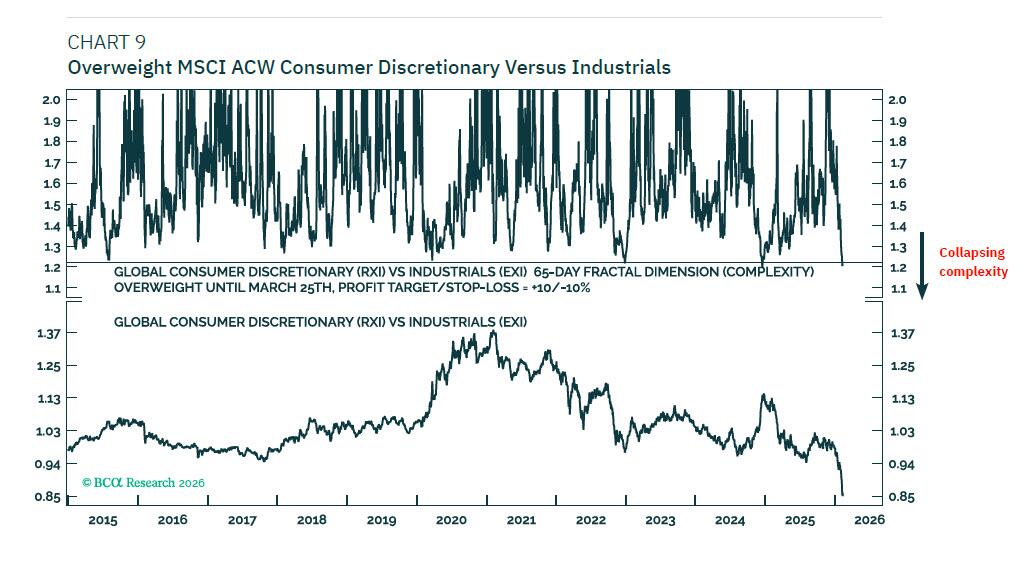
New tactical trade: Overweight MSCI ACW Consumer Discretionary versus Industrials.
Some Like It Hot
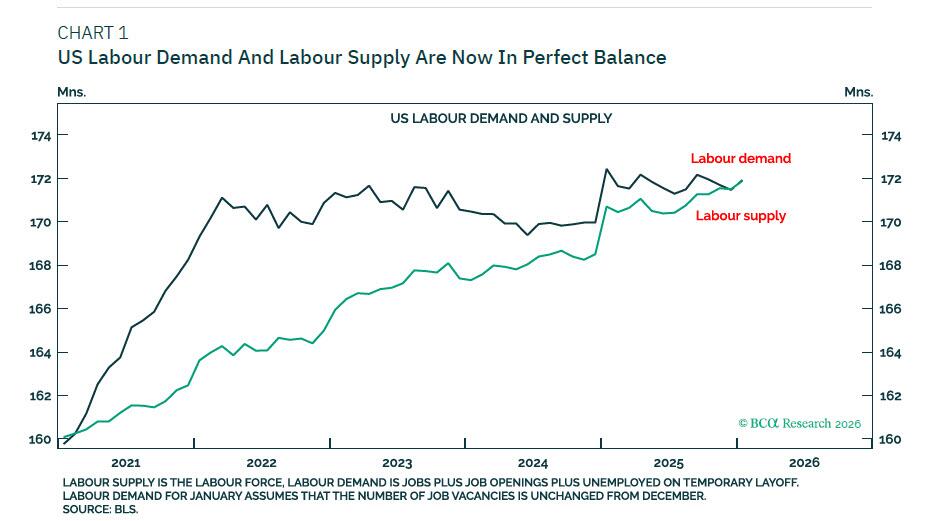
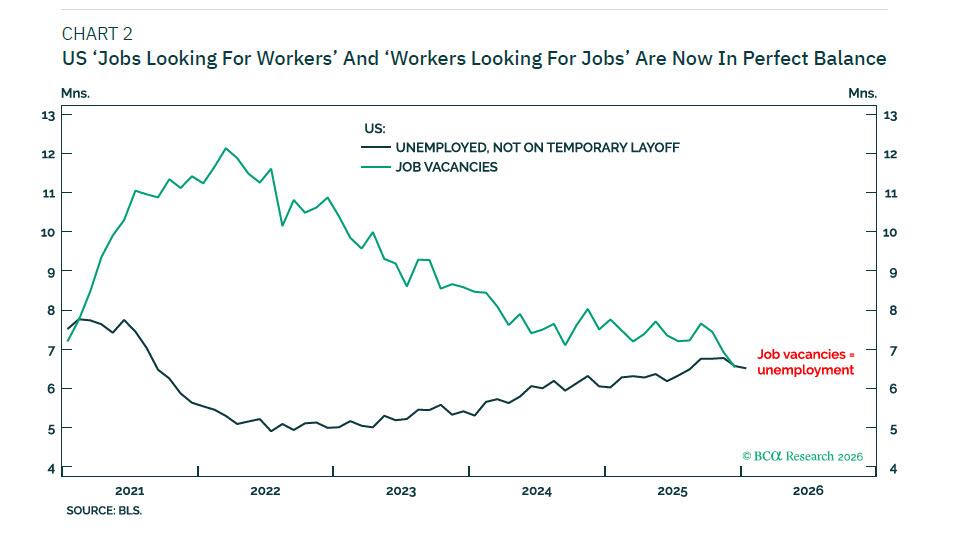
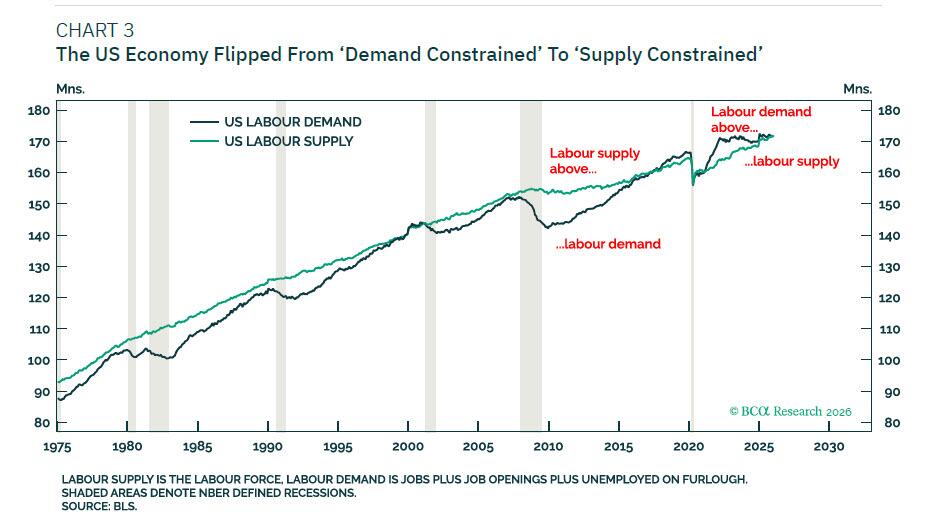
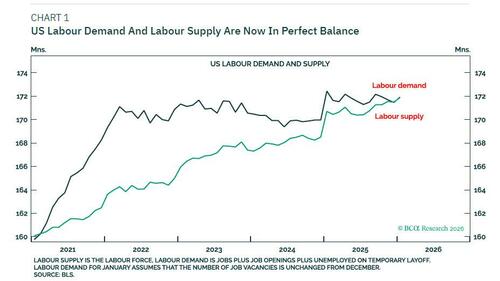
The US economy has reached a watershed. For the first time since the pandemic, labor demand and labor supply are in perfect balance, with both now standing at 172 million workers.
Labor supply equals the number of available workers: those with jobs plus those without jobs. Labor demand equals the number of people in work plus job vacancies plus workers on temporary layoff. Many people miss this last component of labor demand. Labor demand must include workers on temporary layoff because there is demand for these workers, albeit they are on temporary layoff for idiosyncratic reasons (such as a government shutdown).
Put a different but equivalent way, the labor market is balanced when the number of ‘jobs looking for workers’ (job vacancies) equals the number of ‘workers looking for jobs.’ The latter means the unemployed. But given that those on temporary layoff are not looking for jobs, it more correctly means the unemployed that are not on temporary layoff.
The number of job vacancies and the number of unemployed not on temporary layoff both now stand at 6.6 million workers
So, correctly measured either way, the US labor market is now in balance.
A Labor Market In Balance Means Double Jeopardy
The US labor market is in balance, but such a balance is extremely rare. In the normal state, that prevailed for decades prior to the pandemic, labor demand runs short of labor supply. Meaning the economy is demand-constrained.
Since the pandemic though, in a highly unusual state, the relationship flipped. Labor supply has been running short of labor demand. Meaning the economy has been supply-constrained.
The distinction between demand-constrained and supply-constrained is crucial because it is the constraint on the economy – the lower of demand and supply – that drives economic output.
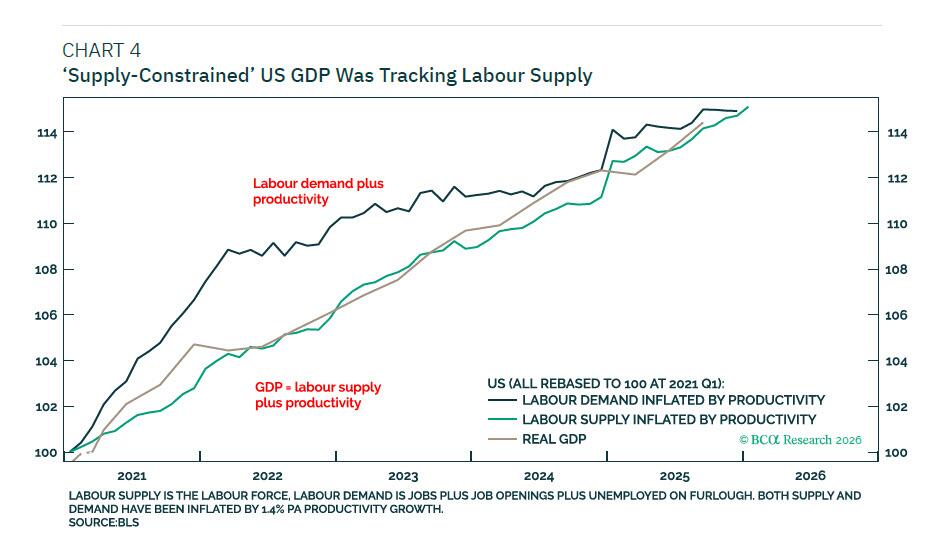
In a normal demand-constrained economy therefore, a demand recession causes a GDP recession. In a supply-constrained economy however, it takes a supply recession to cause a GDP recession. This explains why the abnormally supply-constrained US economy cheated a GDP recession when demand went into recession through 2023-24. The growth in the constraint – labor supply – kept output growing.
Now though, the US economy is at a watershed that puts it in ‘double jeopardy’. Given that labor demand and labor supply are in perfect balance, a drop in either would cause output to contract.
Put another way, both demand and supply must expand. To counter this double jeopardy, the Fed must run the economy hot.
Stimulate demand. But also stimulate supply by creating conditions for labor participation to rise – to offset the Immigration and Customs Enforcement (ICE) expulsions of (illegal) migrant workers.
Don’t Bet On An AI-Driven Productivity Surge
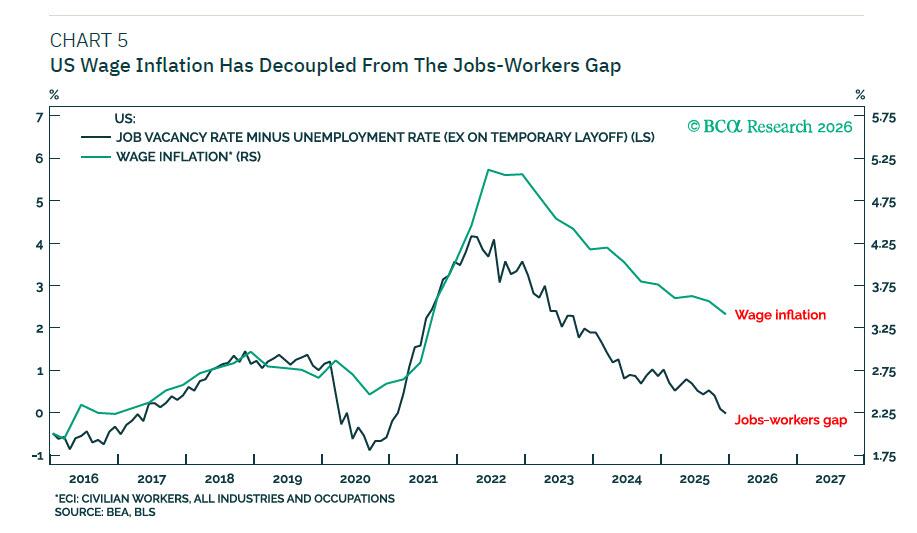
If the US labor market is back in the balance it was pre-pandemic, then why is US wage inflation still running hotter than pre-pandemic?
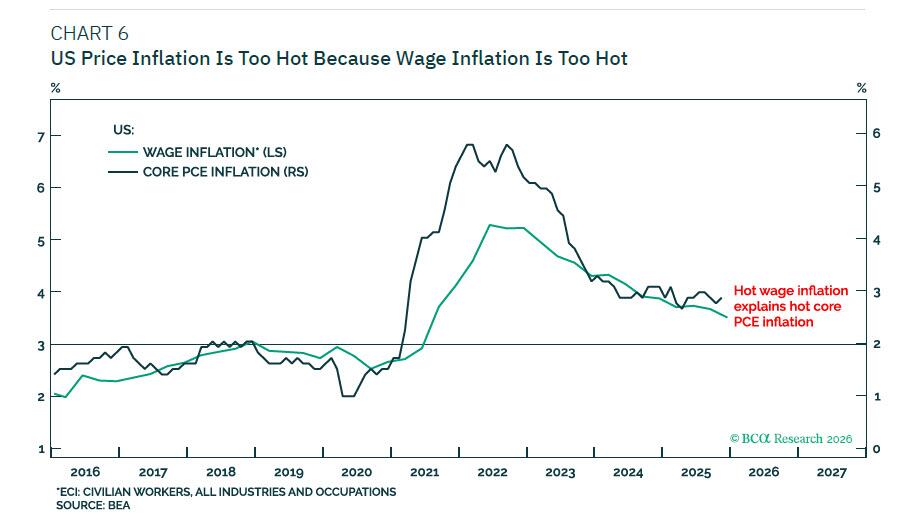
You might counter that the just-released Employment Cost Index (ECI) showed quarter-on-quarter wage inflation slowing to just 3 percent (annualized rate). Yet quarter-on-quarter wage inflation is highly volatile. More meaningful is the smoother 4-quarter wage inflation rate, running at 3.4 percent.
You might further counter that even 3.4 percent achieves the target of 3.5 percent wage inflation that several Fed governors have claimed is consistent with 2 percent price inflation.
Yet 3.5 percent ECI inflation is not consistent with 2 percent price inflation.
The very well-established relationship between ECI inflation and core PCE inflation tells us that, to be consistent with core PCE inflation at 2 percent, ECI inflation must be at 3 percent
Again, you might counter that such a 1 percent gap between ECI inflation and core PCE inflation implies that productivity growth is 1 percent, which is implausibly low. Yet while other more comprehensive measures of productivity growth may show a higher number, 1 percent is the well-established gap between these two specific datasets.
Finally, you might counter that even this specific 1 percent gap should widen if AI boosts productivity growth, allowing wage inflation to run hotter. Yet, despite much wishful thinking, the fact that the gap has not widened warns us that we should not bet on an AI-driven productivity surge as our base case.
The Warsh Fed Will Let The US Economy Run Hot
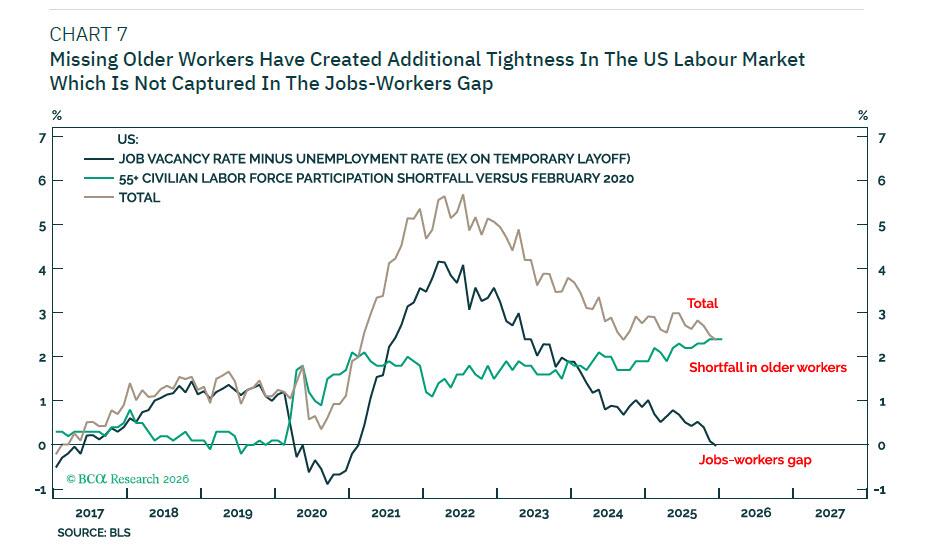
The reason that wage inflation has gapped structurally higher versus the jobs-workers gap is that the composition of the US labor market has structurally changed. As I highlighted in Why The World’s Fate Hangs On 2.5 Million Older American, there are almost 3 million fewer older workers in the US labor supply now than before the pandemic.
The loss of millions of older workers is significant because many jobs are non-fungible by age. Just as older workers cannot do younger-aged jobs that require physical strength or athleticism, younger workers cannot do older-aged jobs that require decades of acquired skills or experience.
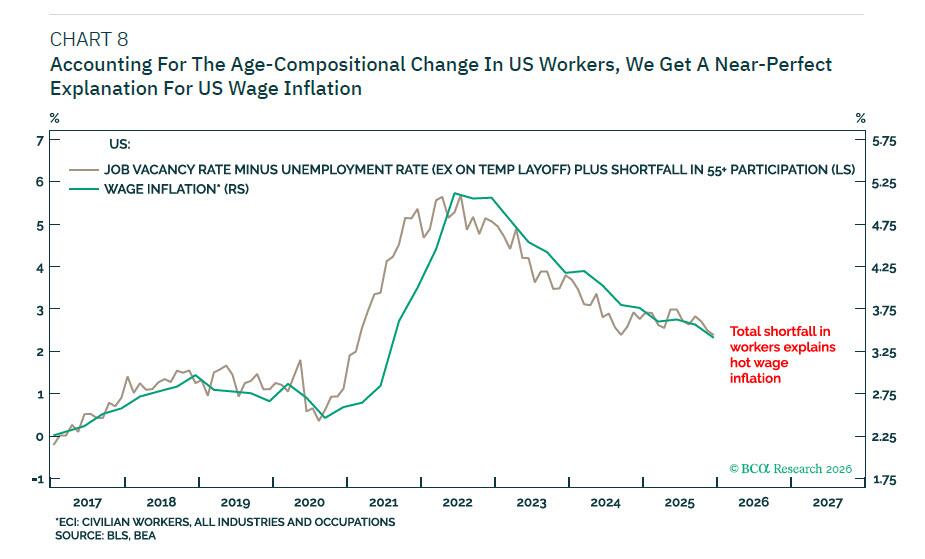
Therefore, the shortfall of older workers has created an additional tightness in the US labor market which is not captured in the aggregate jobs-workers gap. Once we account for this additional tightness, we get a near-perfect explanation for the evolution of US wage inflation.
To repeat, faced with the double jeopardy of declining labor demand or declining labor supply, the Fed will turn a blind eye to this structural uplift in wage inflation. It will do this by de facto moving its inflation target to 2.5-3.5 percent. In effect, a Warsh-led Fed will let the US economy run hot.
There are several investment conclusions:
Short-term US real rates will come down further because the Fed will continue to cut even with inflation in the 2.5-3.5 percent range.
The US dollar will continue to weaken, given the currency’s dependence on real interest rate differentials.
The US yield curve will undergo a ‘bear steepening’ as US inflation expectations ratchet higher. Meaning, T-bonds will underperform cash, as well as other major sovereign bonds.
Stocks will continue to outperform bonds, as the Fed runs the US economy hot.
New Tactical Trade: Overweight Consumer Discretionary Versus Industrials
Consumer Discretionary has underperformed Industrials by almost 20 percent through the last 65 trading days. But the collapsed complexity of this near-vertical underperformance suggests that the magnitude and pace is overdone.
The potential pivot could be the market warming to the US consumer, given the combined effect of ultra-low US real interest rates, fiscal stimulus, and a still-robust labour market.
Hence, in line with our thesis that the Fed will run the US economy hot, and given the stark underperformance of Consumer Discretionary, a new tactical trade is to go overweight MSCI ACW Consumer Discretionary versus Industrials.
Set the profit target/stop-loss at +/-10 percent, and trade expiry on March 25th.
Tyler Durden
Fri, 02/13/2026 – 07:20
https://www.zerohedge.com/economics/warsh-likes-it-hot-and-will-move-feds-inflation-target-25-35
Gigante logístico DP World reemplaza a su presidente, nombrado en los archivos de Epstein
Associated Press
EL CAIRO (AP) — Dubái designó a un nuevo presidente de DP World, una de las mayores empresas de logística del mundo, en sustitución del anterior responsable, cuyo nombre aparece en los archivos de Jeffrey Epstein.
El anuncio de la Oficina de Prensa del gobierno de Dubái no mencionaba específicamente al sultán Ahmed bin Sulayem. Pero en el comunicado indicó que Essa Kazim fue nombrado presidente de DP World y Yuvraj Narayan fue designado nuevo director ejecutivo del grupo. Esos eran cargos que ocupaba Sulayem.
DP World ha sido durante mucho tiempo un pilar de la economía de la ciudad de Oriente Medio. Es un gigante de la logística que gestiona el puerto de Jebel Ali en Dubái y opera terminales en otros puertos de todo el mundo.
El anuncio se produce un día después de que grupos financieros en Canadá y el Reino Unido anunciaron una pausa en iniciativas con DP World después de que correos electrónicos recién publicados mostraran una amistad de años entre bin Sulayem y Epstein.
Los correos electrónicos —algunos con referencias a pornografía, masajes sexuales y escorts— surgieron en el conjunto de documentos relacionados con Epstein publicado recientemente por el Departamento de Justicia de Estados Unidos.
Epstein se suicidó en la cárcel en 2019 después de que fue acusado de tráfico sexual. Los correos electrónicos no parecen implicar a bin Sulayem en los presuntos delitos de Epstein. DP World no respondió a una solicitud de comentarios.
Bin Sulayem anteriormente tuvo un papel más amplio como presidente del conglomerado Dubai World, que en ese momento incluía al promotor inmobiliario Nakheel. Esa empresa estuvo detrás de la creación de islas artificiales con forma de palmeras y de un mapa del mundo que ayudaron a consolidar el estatus de Dubái como una ciudad global emergente.
La agencia estatal de noticias WAM también informó que el gobernante de Dubái, el jeque Mohammed bin Rashid Al Maktoum, nombró a un nuevo responsable de la Corporación de Puertos, Aduanas y Zona Franca de la ciudad-estado. Ese también era un cargo que ocupaba bin Sulayem.
Los temas en los correos electrónicos entre Epstein y bin Sulayem abarcan ampliamente, incluidos el presidente Donald Trump, el sexo y la teología.
En un correo electrónico de 2013, Epstein escribió a bin Sulayem que “eres uno de mis amigos más confiables en todo sentido de la palabra, nunca me has fallado”.
En respuesta, bin Sulayem dijo: “Gracias, amigo mío, me voy a probar una chica 100% rusa en mi yate”.
Ese mismo año, bin Sulayem envió a Epstein un correo electrónico que mostraba un menú de un negocio de masajes que incluía ofertas sexuales. Dos años después, bin Sulayem envió a Epstein un mensaje de texto con un enlace a un sitio porno y, en 2017, Epstein envió a bin Sulayem un enlace a un sitio web de escorts.
Epstein intercambió correos electrónicos con bin Sulayem sobre Steve Bannon, el acólito de Trump, en 2018, diciendo “te va a gustar”. En otro intercambio, bin Sulayem preguntó a Epstein sobre un evento en el que parecía que Trump estaría presente.
___
Esta historia fue traducida del inglés por un editor de AP con la ayuda de una herramienta de inteligencia artificial generativa.