Category: News
GLP-1 Anti-Obesity U.S. Drug Market In Four Charts
GLP-1 Anti-Obesity U.S. Drug Market In Four Charts
Beyond the most recent GLP-1 feud between Hims & Hers and Novo Nordisk, UBS analysts shift attention to anti-obesity drug trends in the U.S. market for the first week of February.
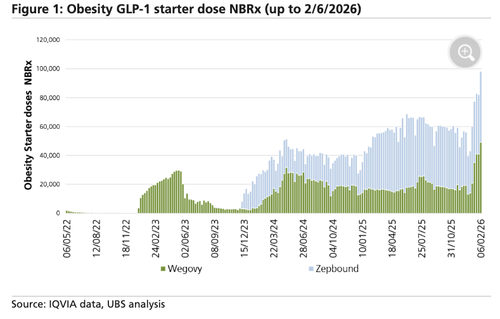
Analysts led by Matthew Weston focused on new data that show new-to-brand prescriptions (NBRx) for starter doses and all doses across the major obesity GLP-1s in a series of charts:
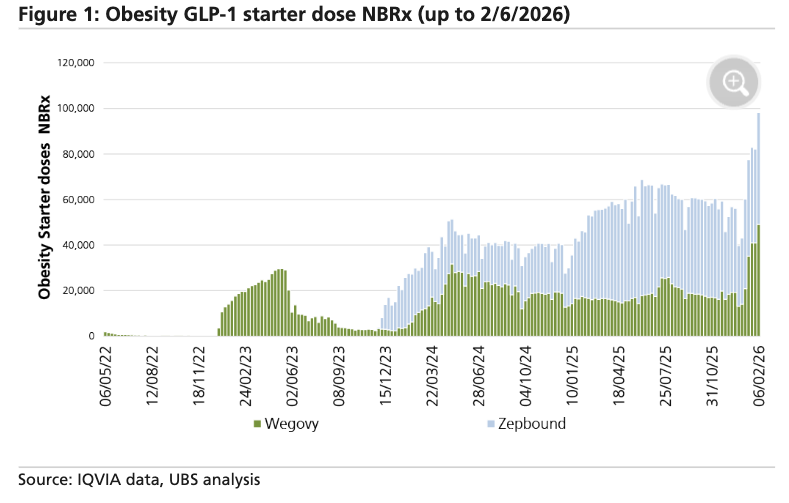
Obesity GLP-1 starter dose NBRx (up to 2/6/2026)
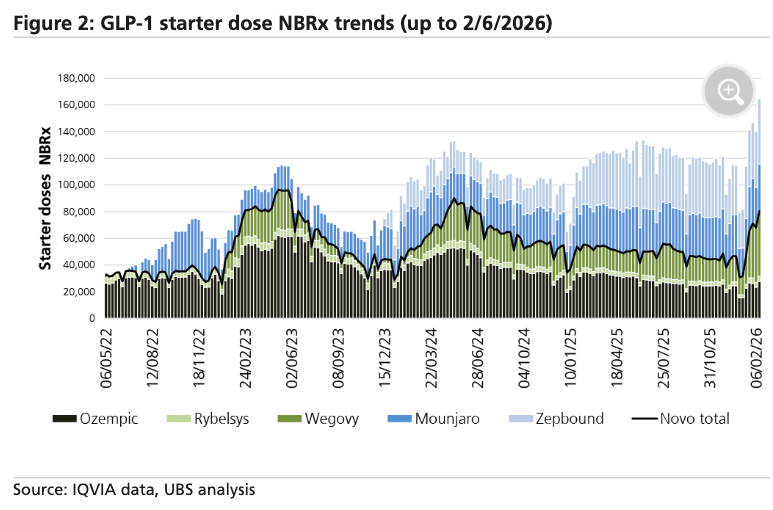
GLP-1 starter dose NBRx trends (up to 2/6/2026)
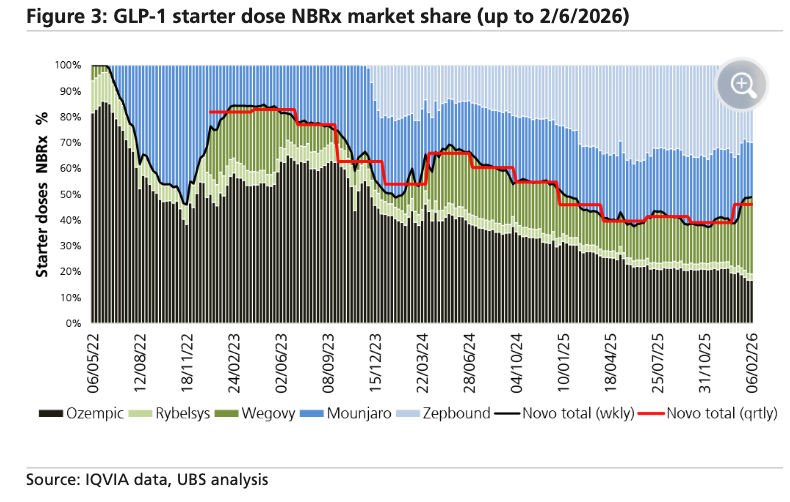
GLP-1 starter dose NBRx market share (up to 2/6/2026)
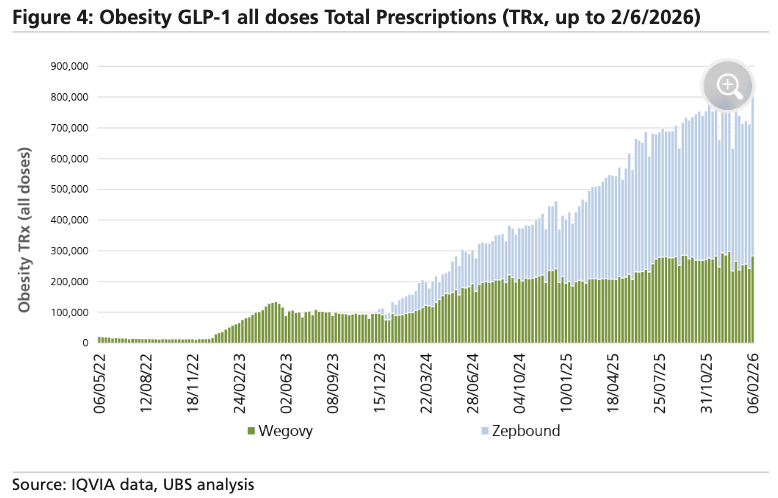
Obesity GLP-1 all doses Total Prescriptions (TRx, up to 2/6/2026)
Weston concluded:
NBRx trends for Wegovy continue to look strong with an encouraging start to the Wegovy pill launch. The uptick in NBRx at the start of the year for Wegovy pen is also going in the right direction. Importantly, the high proportion of Wegovy NBRx pill to TRx and high proportion of Wegovy pill starter dose NBRx to total NBRx suggest that there is very little cannibalisation of Wegovy pen volumes through the pill launch. Further focus points later in the year will be Medicare coverage from July, high dose Wegovy (7.2mg) launch and competitive dynamics from LLY’s orforglipron launch (UBSe April).
The latest GLP-1 headline came from Europe earlier on Tuesday, when the European Commission cleared Novo to use a higher 7.2 mg maintenance dose of Wegovy. This approval reinforces that even greater demand for semaglutide is inbound.
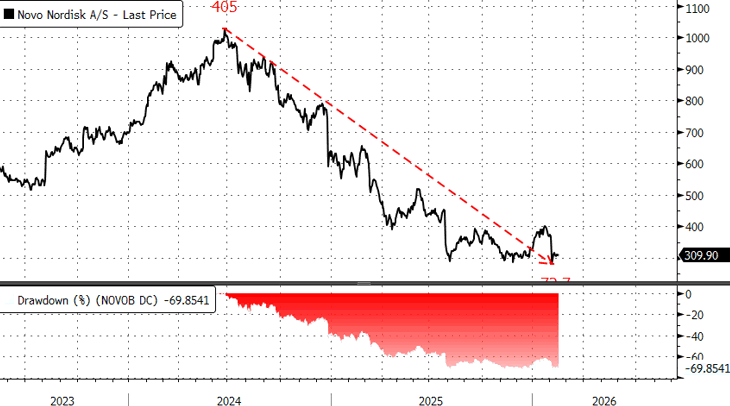
In markets, Novo shares in Copenhagen have been pummeled by market share losses to rival GLP-1 drugs, a public feud with Hims & Hers over copycat GLP-1 offerings, and a recently downbeat outlook for the year. Still, the stock’s downside momentum has eased in recent quarters, although it remains about 70% below its 2024 peak.
Meanwhile, Goldman analyst Faris Mourad previously told clients that “obesity drug narrative sentiment is on the rise” and “it’s an opportunity to buy the dip.” James Quigley (Novo superbull) has remained bullish during Novo’s bear market.
Professional subscribers can read the full UBS GLP-1 note on our new Marketdesk.ai portal.
Tyler Durden
Wed, 02/18/2026 – 17:20
https://www.zerohedge.com/markets/glp-1-anti-obesity-drug-market-four-charts
Días con clima propenso para incendios van en aumento en todo el mundo, según un nuevo estudio
Por SETH BORENSTEIN
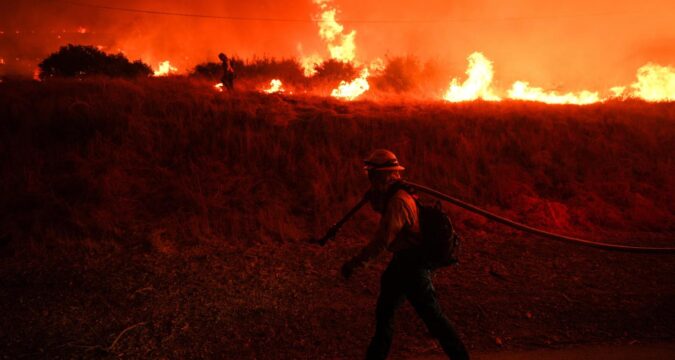
WASHINGTON (AP) — La cantidad de días en que el clima se vuelve más caluroso, árido y ventoso –condiciones ideales para desencadenar incendios forestales extremos— prácticamente se ha triplicado en los últimos 45 años en todo el mundo, y la tendencia es aún mayor en el continente americano, según un nuevo estudio.
Y más de la mitad de ese aumento se debe al cambio climático provocado por el ser humano, de acuerdo con las estimaciones de los investigadores.
Esto significa que, a medida que el planeta se calienta, hay más lugares propensos a arder en llamas al mismo tiempo debido a que el clima propicio para incendios está cada vez más sincronizado, es decir, cuando varios puntos reúnen las condiciones adecuadas al mismo tiempo.
Debido a lo anterior, los países podrían no tener recursos suficientes para apagar todos los incendios que surjan y sería menos probable que la ayuda llegue de naciones vecinas que lidian con sus propias conflagraciones, destacaron los autores del estudio publicado el miércoles en Science Advances.
Según el estudio, el planeta promedió 22 días al año de clima sincronizado propicio para incendios en 1979 y durante los 15 años siguientes, para conflagraciones que se mantuvieron dentro de grandes regiones globales. En contraste, hubo más de 60 días al año en 2023 y 2024.
“Este tipo de cambios que hemos observado incrementa la probabilidad en muchas zonas de que haya incendios que serán muy difíciles de sofocar”, destacó el coautor del estudio John Abatzoglou, científico especializado en incendios de la Universidad de California, campus Merced.
Los investigadores no analizaron incendios reales, sino las condiciones meteorológicas: calor, vientos fuertes y aire y suelo secos.
“Esto aumenta la probabilidad de brotes de incendios generalizados, pero el clima es una dimensión”, declaró el autor principal del estudio, Cong Yin, científico especializado en incendios de la Universidad de California, campus Merced. Los otros ingredientes principales de los incendios son el oxígeno, el combustible como árboles y matorrales, y una fuente de ignición como rayos, incendios provocados o accidentes.
Este estudio es relevante debido a que el clima extremo propicio para incendios es el factor principal —aunque no el único— en el aumento de los impactos de los incendios en todo el mundo, señaló el científico de incendios Mike Flannigan, de la Universidad Thompson Rivers en Canadá, quien no fue parte de la investigación. También es importante ya que regiones que solían tener temporadas de incendios en momentos distintos y podían compartir sus recursos ahora se superponen, destacó.
“Y ahí es donde las cosas empiezan a salir mal”, dijo Abatzoglou.
Más del 60% del aumento global de días de clima sincronizado propicio para incendios puede atribuirse al cambio climático derivado de la quema de carbón, petróleo y gas natural, subrayó Yin. Él y sus colegas lo saben porque usaron simulaciones por computadora para comparar lo ocurrido en los últimos 45 años con un mundo ficticio sin el incremento de gases de efecto invernadero por la quema de combustibles fósiles.
En el territorio continental de Estados Unidos, entre 1979 y 1988, el promedio fue de 7,7 días al año de clima sincronizado propicio para incendios. El promedio se elevó a 38 días al año en los últimos 10 años, indicó Yin.
Pero eso no es nada en comparación con la mitad sur de Sudamérica. La región promedió 5,5 días al año de clima propicio para incendios entre 1979 y 1988, frente a los 70,6 días al año en la última década, incluidos 118 en 2023.
De 14 regiones globales, sólo el Sudeste Asiático registró una disminución de días de clima propicio, probablemente porque la zona se está volviendo más húmeda, señaló Yin.
___
La cobertura climática y ambiental de The Associated Press recibe apoyo financiero de múltiples fundaciones privadas. AP es la única responsable de todo el contenido. Consulte las normas de AP para trabajar con filantropías, una lista de patrocinadores y las áreas de cobertura financiadas en AP.org.
___
Esta historia fue traducida del inglés por un editor de AP con la ayuda de una herramienta de inteligencia artificial generativa.
Días con clima propenso para incendios van en aumento en todo el mundo, según un nuevo estudio
Por SETH BORENSTEIN
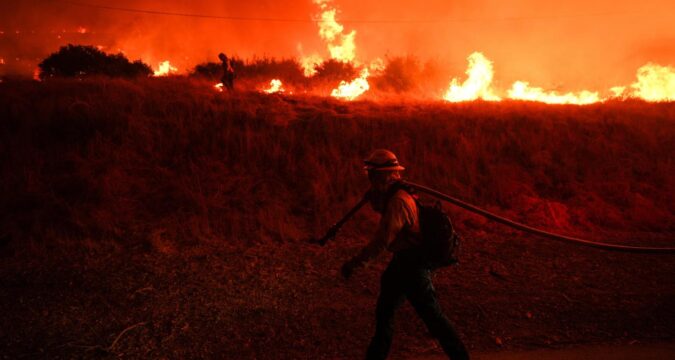
WASHINGTON (AP) — La cantidad de días en que el clima se vuelve más caluroso, árido y ventoso –condiciones ideales para desencadenar incendios forestales extremos— prácticamente se ha triplicado en los últimos 45 años en todo el mundo, y la tendencia es aún mayor en el continente americano, según un nuevo estudio.
Y más de la mitad de ese aumento se debe al cambio climático provocado por el ser humano, de acuerdo con las estimaciones de los investigadores.
Esto significa que, a medida que el planeta se calienta, hay más lugares propensos a arder en llamas al mismo tiempo debido a que el clima propicio para incendios está cada vez más sincronizado, es decir, cuando varios puntos reúnen las condiciones adecuadas al mismo tiempo.
Debido a lo anterior, los países podrían no tener recursos suficientes para apagar todos los incendios que surjan y sería menos probable que la ayuda llegue de naciones vecinas que lidian con sus propias conflagraciones, destacaron los autores del estudio publicado el miércoles en Science Advances.
Según el estudio, el planeta promedió 22 días al año de clima sincronizado propicio para incendios en 1979 y durante los 15 años siguientes, para conflagraciones que se mantuvieron dentro de grandes regiones globales. En contraste, hubo más de 60 días al año en 2023 y 2024.
“Este tipo de cambios que hemos observado incrementa la probabilidad en muchas zonas de que haya incendios que serán muy difíciles de sofocar”, destacó el coautor del estudio John Abatzoglou, científico especializado en incendios de la Universidad de California, campus Merced.
Los investigadores no analizaron incendios reales, sino las condiciones meteorológicas: calor, vientos fuertes y aire y suelo secos.
“Esto aumenta la probabilidad de brotes de incendios generalizados, pero el clima es una dimensión”, declaró el autor principal del estudio, Cong Yin, científico especializado en incendios de la Universidad de California, campus Merced. Los otros ingredientes principales de los incendios son el oxígeno, el combustible como árboles y matorrales, y una fuente de ignición como rayos, incendios provocados o accidentes.
Este estudio es relevante debido a que el clima extremo propicio para incendios es el factor principal —aunque no el único— en el aumento de los impactos de los incendios en todo el mundo, señaló el científico de incendios Mike Flannigan, de la Universidad Thompson Rivers en Canadá, quien no fue parte de la investigación. También es importante ya que regiones que solían tener temporadas de incendios en momentos distintos y podían compartir sus recursos ahora se superponen, destacó.
“Y ahí es donde las cosas empiezan a salir mal”, dijo Abatzoglou.
Más del 60% del aumento global de días de clima sincronizado propicio para incendios puede atribuirse al cambio climático derivado de la quema de carbón, petróleo y gas natural, subrayó Yin. Él y sus colegas lo saben porque usaron simulaciones por computadora para comparar lo ocurrido en los últimos 45 años con un mundo ficticio sin el incremento de gases de efecto invernadero por la quema de combustibles fósiles.
En el territorio continental de Estados Unidos, entre 1979 y 1988, el promedio fue de 7,7 días al año de clima sincronizado propicio para incendios. El promedio se elevó a 38 días al año en los últimos 10 años, indicó Yin.
Pero eso no es nada en comparación con la mitad sur de Sudamérica. La región promedió 5,5 días al año de clima propicio para incendios entre 1979 y 1988, frente a los 70,6 días al año en la última década, incluidos 118 en 2023.
De 14 regiones globales, sólo el Sudeste Asiático registró una disminución de días de clima propicio, probablemente porque la zona se está volviendo más húmeda, señaló Yin.
___
La cobertura climática y ambiental de The Associated Press recibe apoyo financiero de múltiples fundaciones privadas. AP es la única responsable de todo el contenido. Consulte las normas de AP para trabajar con filantropías, una lista de patrocinadores y las áreas de cobertura financiadas en AP.org.
___
Esta historia fue traducida del inglés por un editor de AP con la ayuda de una herramienta de inteligencia artificial generativa.
Días con clima propenso para incendios van en aumento en todo el mundo, según un nuevo estudio
Por SETH BORENSTEIN
WASHINGTON (AP) — La cantidad de días en que el clima se vuelve más caluroso, árido y ventoso –condiciones ideales para desencadenar incendios forestales extremos— prácticamente se ha triplicado en los últimos 45 años en todo el mundo, y la tendencia es aún mayor en el continente americano, según un nuevo estudio.
Y más de la mitad de ese aumento se debe al cambio climático provocado por el ser humano, de acuerdo con las estimaciones de los investigadores.
Esto significa que, a medida que el planeta se calienta, hay más lugares propensos a arder en llamas al mismo tiempo debido a que el clima propicio para incendios está cada vez más sincronizado, es decir, cuando varios puntos reúnen las condiciones adecuadas al mismo tiempo.
Debido a lo anterior, los países podrían no tener recursos suficientes para apagar todos los incendios que surjan y sería menos probable que la ayuda llegue de naciones vecinas que lidian con sus propias conflagraciones, destacaron los autores del estudio publicado el miércoles en Science Advances.
Según el estudio, el planeta promedió 22 días al año de clima sincronizado propicio para incendios en 1979 y durante los 15 años siguientes, para conflagraciones que se mantuvieron dentro de grandes regiones globales. En contraste, hubo más de 60 días al año en 2023 y 2024.
“Este tipo de cambios que hemos observado incrementa la probabilidad en muchas zonas de que haya incendios que serán muy difíciles de sofocar”, destacó el coautor del estudio John Abatzoglou, científico especializado en incendios de la Universidad de California, campus Merced.
Los investigadores no analizaron incendios reales, sino las condiciones meteorológicas: calor, vientos fuertes y aire y suelo secos.
“Esto aumenta la probabilidad de brotes de incendios generalizados, pero el clima es una dimensión”, declaró el autor principal del estudio, Cong Yin, científico especializado en incendios de la Universidad de California, campus Merced. Los otros ingredientes principales de los incendios son el oxígeno, el combustible como árboles y matorrales, y una fuente de ignición como rayos, incendios provocados o accidentes.
Este estudio es relevante debido a que el clima extremo propicio para incendios es el factor principal —aunque no el único— en el aumento de los impactos de los incendios en todo el mundo, señaló el científico de incendios Mike Flannigan, de la Universidad Thompson Rivers en Canadá, quien no fue parte de la investigación. También es importante ya que regiones que solían tener temporadas de incendios en momentos distintos y podían compartir sus recursos ahora se superponen, destacó.
“Y ahí es donde las cosas empiezan a salir mal”, dijo Abatzoglou.
Más del 60% del aumento global de días de clima sincronizado propicio para incendios puede atribuirse al cambio climático derivado de la quema de carbón, petróleo y gas natural, subrayó Yin. Él y sus colegas lo saben porque usaron simulaciones por computadora para comparar lo ocurrido en los últimos 45 años con un mundo ficticio sin el incremento de gases de efecto invernadero por la quema de combustibles fósiles.
En el territorio continental de Estados Unidos, entre 1979 y 1988, el promedio fue de 7,7 días al año de clima sincronizado propicio para incendios. El promedio se elevó a 38 días al año en los últimos 10 años, indicó Yin.
Pero eso no es nada en comparación con la mitad sur de Sudamérica. La región promedió 5,5 días al año de clima propicio para incendios entre 1979 y 1988, frente a los 70,6 días al año en la última década, incluidos 118 en 2023.
De 14 regiones globales, sólo el Sudeste Asiático registró una disminución de días de clima propicio, probablemente porque la zona se está volviendo más húmeda, señaló Yin.
___
La cobertura climática y ambiental de The Associated Press recibe apoyo financiero de múltiples fundaciones privadas. AP es la única responsable de todo el contenido. Consulte las normas de AP para trabajar con filantropías, una lista de patrocinadores y las áreas de cobertura financiadas en AP.org.
___
Esta historia fue traducida del inglés por un editor de AP con la ayuda de una herramienta de inteligencia artificial generativa.
Zoning Committee stalemate continues under Mayor Brandon Johnson, along with other vacancies
Divided by competing personal ambitions and ethnic caucuses once again, the Chicago City Council failed Wednesday to find its next Zoning Committee chair.
The latest instance of a key leadership vacancy dragging on under Mayor Brandon Johnson came as Ald. Bennett Lawson, the powerful committee’s vice chair and longtime interim leader, waited in the wings.
Lawson appeared hopeful early Wednesday that he would win the position, which has been vacant since Johnson ally Walter Burnett retired from the council in July. But as the North Side alderman tried to coax votes in the room behind the City Council’s chambers and met with Johnson’s top advisers, it became clear aldermen would remain stuck in an unproductive stalemate.
After a lengthy afternoon recess, Lawson announced he would hold the resolution to name him chair rather than let it face an up or down vote.
Meanwhile, the suspense over other Johnson appointments seems unlikely to abate as he nears his three-year mark, particularly with the city’s three sister agencies that have been rudderless for over a year.
The mayor sought Wednesday to move on one of those vacancies — the Chicago Housing Authority CEO — by introducing new board members who would support Burnett, his preferred candidate, for the post. But Johnson opponent Ald. Anthony Beale stalled the legislation.
Aldermen also became embroiled in a heated but symbolic debate about hemp after Johnson vetoed an ordinance approved by the council last month that would have broadly banned many intoxicating hemp substances. The effort to overrule the mayor’s red stamp fell short of the needed two-thirds supermajority as aldermen voted 26 to 20.
The council approved a plan to spend $29.2 million to settle four lawsuits that alleged misconduct by disgraced Chicago police Det. Reynaldo Guevara led to wrongful imprisonment. And the Foundry Park development slotted for the North Side land once set to become the northern half of the Lincoln Yards development also won aldermanic approval. The decision clears the way for construction of the mixed-use community with over 3,000 residences and new riverfront parks.
On Zoning chair, Johnson had said last month Lawson “has done an exceptional job over the course of my time as mayor to help continue to move business along in the city of Chicago” but indicated a final decision would be premature. He gave tacit approval for Lawson to multiple aldermen this week, sources said, but the Lake View alderman apparently did not have the 34 votes required to put him in the seat.
Lawson has served as interim Zoning chair twice, first for ten months after ex-Ald. Carlos Ramirez Rosa left the position, then in his ongoing six-month stint. In an effort to put pressure on Johnson and aldermen to find a permanent replacement, he publicly promised to stop holding Zoning meetings until a selection was made. He did not host a meeting in January, causing a minor delay to construction projects that would have been otherwise approved, but hosted the meeting this month.
During Wednesday’s meeting, Black Caucus Chair Ald. Stephanie Coleman sparked a recess just ahead of the planned vote to make Lawson chair. As he waited for aldermen to return from last-second negotiations, Lawson vented to a group of colleauges.
“No Zoning meetings until there’s a permanent chair,” he told them. “And I shouldn’t have done that last one.”
Ald. Gil Villegas, who has also expressed interest in the role, said it “depends on what my colleagues want” when asked whether he was still gunning for it. He suggested other council members had reservations about the two proposed vice chairs under Lawson’s measure, Alds. Walt Burnett and Ruth Cruz, because they are freshmen.
“I think it was a lot of resistance to that,” Villegas said. “It’s just the precedence around whole freshmen on one of the most powerful committees. … At the end of the day, if my colleagues want me there, I’ll go there.”
For her part, Coleman said the lack of a decision stems from aldermen wanting to make sure “we are not patch-working” with one-by-one appointments.
“We want to make sure it’s cohesive so we can move forward in 2026 with a very good, functioning governing body,” she said.
She argued competing caucus interests had not sparked the delay. “We believe that it should be a Latino Caucus member,” she said.
Johnson ally Ald. Jason Ervin demurred when asked whether he leaned toward Villegas or Lawson for the role, quipping “Anybody could be a possibility at this point.”
The Zoning Committee controls critical legislation related to development and other land use issues in Chicago, making the selection of its chair traditionally one of the most consequential. And like any City Council committee chairmanship, the position comes with a budget to hire staff.
The city’s tradition of strong mayors and weak councils has meant that choice has effectively rested with the chief executive capable of quickly filling vacancies, until now.
On the larger issue of vacancies facing the city, Villegas noted that the heads of CHA, Chicago Public Schools, the Chicago Transit Authority, Department of Transportation remained unfilled.
“At the end of the day, this administration has failed to lead and put forward candidates for different positions,” he said. “I mean, it’s just on and on, and so that’s where we need to make sure that at some point these positions get filled.”
On CHA, Johnson has tried to install his ally Walter Burnett to helm the public housing agency for months now but CHA leadership has resisted his efforts, saying there are more qualified candidates.
The mayor can replace up to four board members whose terms have expired, which could get Burnett over the finish line, but the board could also call a meeting and approve a different CEO candidate by the time Johnson’s CHA appointments reach the full council floor.
Beale sending the mayor’s newest appointments to Rules on Wednesday will likely delay the final vote for about a month.
Johnson ally Ald. Byron Sigcho-Lopez derided Beale for his “obstructionist agenda” after the meeting adjourned, though he declined to opine on whether Burnett is the right person for the job.
“It just delays the process,” Sigcho-Lopez, Johnson’s handpicked Housing Committee chair, said. “I do think that the obstructionist agenda is really harming CHA residents in the city, and I hope that the council would rather focus on focusing on the solutions to these issues of housing.”
Beale, for his part, told the Tribune despite his respect for the elder Burnett, “if the board is doing their due diligence, who are we to just start stacking the board to go against” it.
“The mayor is trying to force people out in order to get more people in his favor to support Walter Burnett,” Beale said. “And that’s a power play by the administration.”
https://www.chicagotribune.com/2026/02/18/zoning-committee-stalemate-mayor-brandon-johnson/
Zoning Committee stalemate continues under Mayor Brandon Johnson, along with other vacancies
Divided by competing personal ambitions and ethnic caucuses once again, the Chicago City Council failed Wednesday to find its next Zoning Committee chair.
The latest instance of a key leadership vacancy dragging on under Mayor Brandon Johnson came as Ald. Bennett Lawson, the powerful committee’s vice chair and longtime interim leader, waited in the wings.
Lawson appeared hopeful early Wednesday that he would win the position, which has been vacant since Johnson ally Walter Burnett retired from the council in July. But as the North Side alderman tried to coax votes in the room behind the City Council’s chambers and met with Johnson’s top advisers, it became clear aldermen would remain stuck in an unproductive stalemate.
After a lengthy afternoon recess, Lawson announced he would hold the resolution to name him chair rather than let it face an up or down vote.
Meanwhile, the suspense over other Johnson appointments seems unlikely to abate as he nears his three-year mark, particularly with the city’s three sister agencies that have been rudderless for over a year.
The mayor sought Wednesday to move on one of those vacancies — the Chicago Housing Authority CEO — by introducing new board members who would support Burnett, his preferred candidate, for the post. But Johnson opponent Ald. Anthony Beale stalled the legislation.
Aldermen also became embroiled in a heated but symbolic debate about hemp after Johnson vetoed an ordinance approved by the council last month that would have broadly banned many intoxicating hemp substances. The effort to overrule the mayor’s red stamp fell short of the needed two-thirds supermajority as aldermen voted 26 to 20.
The council approved a plan to spend $29.2 million to settle four lawsuits that alleged misconduct by disgraced Chicago police Det. Reynaldo Guevara led to wrongful imprisonment. And the Foundry Park development slotted for the North Side land once set to become the northern half of the Lincoln Yards development also won aldermanic approval. The decision clears the way for construction of the mixed-use community with over 3,000 residences and new riverfront parks.
On Zoning chair, Johnson had said last month Lawson “has done an exceptional job over the course of my time as mayor to help continue to move business along in the city of Chicago” but indicated a final decision would be premature. He gave tacit approval for Lawson to multiple aldermen this week, sources said, but the Lake View alderman apparently did not have the 34 votes required to put him in the seat.
Lawson has served as interim Zoning chair twice, first for ten months after ex-Ald. Carlos Ramirez Rosa left the position, then in his ongoing six-month stint. In an effort to put pressure on Johnson and aldermen to find a permanent replacement, he publicly promised to stop holding Zoning meetings until a selection was made. He did not host a meeting in January, causing a minor delay to construction projects that would have been otherwise approved, but hosted the meeting this month.
During Wednesday’s meeting, Black Caucus Chair Ald. Stephanie Coleman sparked a recess just ahead of the planned vote to make Lawson chair. As he waited for aldermen to return from last-second negotiations, Lawson vented to a group of colleauges.
“No Zoning meetings until there’s a permanent chair,” he told them. “And I shouldn’t have done that last one.”
Ald. Gil Villegas, who has also expressed interest in the role, said it “depends on what my colleagues want” when asked whether he was still gunning for it. He suggested other council members had reservations about the two proposed vice chairs under Lawson’s measure, Alds. Walt Burnett and Ruth Cruz, because they are freshmen.
“I think it was a lot of resistance to that,” Villegas said. “It’s just the precedence around whole freshmen on one of the most powerful committees. … At the end of the day, if my colleagues want me there, I’ll go there.”
For her part, Coleman said the lack of a decision stems from aldermen wanting to make sure “we are not patch-working” with one-by-one appointments.
“We want to make sure it’s cohesive so we can move forward in 2026 with a very good, functioning governing body,” she said.
She argued competing caucus interests had not sparked the delay. “We believe that it should be a Latino Caucus member,” she said.
Johnson ally Ald. Jason Ervin demurred when asked whether he leaned toward Villegas or Lawson for the role, quipping “Anybody could be a possibility at this point.”
The Zoning Committee controls critical legislation related to development and other land use issues in Chicago, making the selection of its chair traditionally one of the most consequential. And like any City Council committee chairmanship, the position comes with a budget to hire staff.
The city’s tradition of strong mayors and weak councils has meant that choice has effectively rested with the chief executive capable of quickly filling vacancies, until now.
On the larger issue of vacancies facing the city, Villegas noted that the heads of CHA, Chicago Public Schools, the Chicago Transit Authority, Department of Transportation remained unfilled.
“At the end of the day, this administration has failed to lead and put forward candidates for different positions,” he said. “I mean, it’s just on and on, and so that’s where we need to make sure that at some point these positions get filled.”
On CHA, Johnson has tried to install his ally Walter Burnett to helm the public housing agency for months now but CHA leadership has resisted his efforts, saying there are more qualified candidates.
The mayor can replace up to four board members whose terms have expired, which could get Burnett over the finish line, but the board could also call a meeting and approve a different CEO candidate by the time Johnson’s CHA appointments reach the full council floor.
Beale sending the mayor’s newest appointments to Rules on Wednesday will likely delay the final vote for about a month.
Johnson ally Ald. Byron Sigcho-Lopez derided Beale for his “obstructionist agenda” after the meeting adjourned, though he declined to opine on whether Burnett is the right person for the job.
“It just delays the process,” Sigcho-Lopez, Johnson’s handpicked Housing Committee chair, said. “I do think that the obstructionist agenda is really harming CHA residents in the city, and I hope that the council would rather focus on focusing on the solutions to these issues of housing.”
Beale, for his part, told the Tribune despite his respect for the elder Burnett, “if the board is doing their due diligence, who are we to just start stacking the board to go against” it.
“The mayor is trying to force people out in order to get more people in his favor to support Walter Burnett,” Beale said. “And that’s a power play by the administration.”
https://www.chicagotribune.com/2026/02/18/zoning-committee-stalemate-mayor-brandon-johnson/
Zoning Committee stalemate continues under Mayor Brandon Johnson, along with other vacancies
Divided by competing personal ambitions and ethnic caucuses once again, the Chicago City Council failed Wednesday to find its next Zoning Committee chair.
The latest instance of a key leadership vacancy dragging on under Mayor Brandon Johnson came as Ald. Bennett Lawson, the powerful committee’s vice chair and longtime interim leader, waited in the wings.
Lawson appeared hopeful early Wednesday that he would win the position, which has been vacant since Johnson ally Walter Burnett retired from the council in July. But as the North Side alderman tried to coax votes in the room behind the City Council’s chambers and met with Johnson’s top advisers, it became clear aldermen would remain stuck in an unproductive stalemate.
After a lengthy afternoon recess, Lawson announced he would hold the resolution to name him chair rather than let it face an up or down vote.
Meanwhile, the suspense over other Johnson appointments seems unlikely to abate as he nears his three-year mark, particularly with the city’s three sister agencies that have been rudderless for over a year.
The mayor sought Wednesday to move on one of those vacancies — the Chicago Housing Authority CEO — by introducing new board members who would support Burnett, his preferred candidate, for the post. But Johnson opponent Ald. Anthony Beale stalled the legislation.
Aldermen also became embroiled in a heated but symbolic debate about hemp after Johnson vetoed an ordinance approved by the council last month that would have broadly banned many intoxicating hemp substances. The effort to overrule the mayor’s red stamp fell short of the needed two-thirds supermajority as aldermen voted 26 to 20.
The council approved a plan to spend $29.2 million to settle four lawsuits that alleged misconduct by disgraced Chicago police Det. Reynaldo Guevara led to wrongful imprisonment. And the Foundry Park development slotted for the North Side land once set to become the northern half of the Lincoln Yards development also won aldermanic approval. The decision clears the way for construction of the mixed-use community with over 3,000 residences and new riverfront parks.
On Zoning chair, Johnson had said last month Lawson “has done an exceptional job over the course of my time as mayor to help continue to move business along in the city of Chicago” but indicated a final decision would be premature. He gave tacit approval for Lawson to multiple aldermen this week, sources said, but the Lake View alderman apparently did not have the 34 votes required to put him in the seat.
Lawson has served as interim Zoning chair twice, first for ten months after ex-Ald. Carlos Ramirez Rosa left the position, then in his ongoing six-month stint. In an effort to put pressure on Johnson and aldermen to find a permanent replacement, he publicly promised to stop holding Zoning meetings until a selection was made. He did not host a meeting in January, causing a minor delay to construction projects that would have been otherwise approved, but hosted the meeting this month.
During Wednesday’s meeting, Black Caucus Chair Ald. Stephanie Coleman sparked a recess just ahead of the planned vote to make Lawson chair. As he waited for aldermen to return from last-second negotiations, Lawson vented to a group of colleauges.
“No Zoning meetings until there’s a permanent chair,” he told them. “And I shouldn’t have done that last one.”
Ald. Gil Villegas, who has also expressed interest in the role, said it “depends on what my colleagues want” when asked whether he was still gunning for it. He suggested other council members had reservations about the two proposed vice chairs under Lawson’s measure, Alds. Walt Burnett and Ruth Cruz, because they are freshmen.
“I think it was a lot of resistance to that,” Villegas said. “It’s just the precedence around whole freshmen on one of the most powerful committees. … At the end of the day, if my colleagues want me there, I’ll go there.”
For her part, Coleman said the lack of a decision stems from aldermen wanting to make sure “we are not patch-working” with one-by-one appointments.
“We want to make sure it’s cohesive so we can move forward in 2026 with a very good, functioning governing body,” she said.
She argued competing caucus interests had not sparked the delay. “We believe that it should be a Latino Caucus member,” she said.
Johnson ally Ald. Jason Ervin demurred when asked whether he leaned toward Villegas or Lawson for the role, quipping “Anybody could be a possibility at this point.”
The Zoning Committee controls critical legislation related to development and other land use issues in Chicago, making the selection of its chair traditionally one of the most consequential. And like any City Council committee chairmanship, the position comes with a budget to hire staff.
The city’s tradition of strong mayors and weak councils has meant that choice has effectively rested with the chief executive capable of quickly filling vacancies, until now.
On the larger issue of vacancies facing the city, Villegas noted that the heads of CHA, Chicago Public Schools, the Chicago Transit Authority, Department of Transportation remained unfilled.
“At the end of the day, this administration has failed to lead and put forward candidates for different positions,” he said. “I mean, it’s just on and on, and so that’s where we need to make sure that at some point these positions get filled.”
On CHA, Johnson has tried to install his ally Walter Burnett to helm the public housing agency for months now but CHA leadership has resisted his efforts, saying there are more qualified candidates.
The mayor can replace up to four board members whose terms have expired, which could get Burnett over the finish line, but the board could also call a meeting and approve a different CEO candidate by the time Johnson’s CHA appointments reach the full council floor.
Beale sending the mayor’s newest appointments to Rules on Wednesday will likely delay the final vote for about a month.
Johnson ally Ald. Byron Sigcho-Lopez derided Beale for his “obstructionist agenda” after the meeting adjourned, though he declined to opine on whether Burnett is the right person for the job.
“It just delays the process,” Sigcho-Lopez, Johnson’s handpicked Housing Committee chair, said. “I do think that the obstructionist agenda is really harming CHA residents in the city, and I hope that the council would rather focus on focusing on the solutions to these issues of housing.”
Beale, for his part, told the Tribune despite his respect for the elder Burnett, “if the board is doing their due diligence, who are we to just start stacking the board to go against” it.
“The mayor is trying to force people out in order to get more people in his favor to support Walter Burnett,” Beale said. “And that’s a power play by the administration.”
https://www.chicagotribune.com/2026/02/18/zoning-committee-stalemate-mayor-brandon-johnson/
Voter ID Is Common Sense, But It Won’t Fix Anything
Voter ID Is Common Sense, But It Won’t Fix Anything
Authored by Connor O’Keefe via The Mises Institute,
As panic builds within the GOP over the approaching midterm elections, Republicans have renewed a push for one of their most popular policy proposals: voter ID.
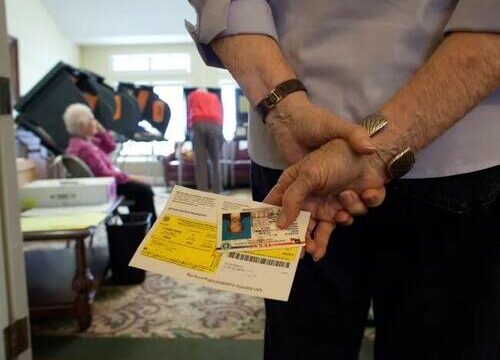
In the latest version of the so-called SAVE America Act—formerly just the SAVE Act—Congressional Republicans added a requirement for every voter in federal elections to provide poll workers with a valid government-issued photo ID if they’re voting in person or a copy of a valid photo ID if they’re voting by mail.
On Friday—a day after the House passed the law and sent it to the Senate—President Trump put out a post in support of voter ID requirements, which led Senate Democrats to issue familiar denunciations of the policy while promising to block this version of the bill.
The arguments in favor of voter ID are pretty straightforward. If every eligible American citizen is entitled to one vote, poll workers and election officials should confirm that the person voting is who they say they are, so that people cannot submit extra or fraudulent votes by pretending to be someone else. And the best way to do that is the same way identities are confirmed in most other clerical settings—with an officially-recognized photo ID.
The vast majority of Americans, including over 70 percent of Democrats, are in favor of this measure. But that hasn’t stopped top Democratic leaders and many of the Left’s most vocal activists from blocking legislation and loudly opposing any step towards a federal voter ID law.
However, the arguments most often made against voter ID do not stand up well to even the slightest scrutiny.
First, opponents will often point out—correctly—that there is no undisputable evidence of “widespread” voter fraud. They’ll then use that fact to argue that voter ID is a burdensome solution to a fake problem.
But if there was an actual conspiracy to either foment or permit voter fraud in a way that successfully flipped an election, it would not be “widespread,” it would be targeted. Even in large national elections like the presidential race, the outcome is almost always decided by a small handful of precincts. So a conspiracy to commit or allow “widespread” voter fraud would not only be pointless, it would all but guarantee its discovery.
Next, critics often assert that an ID requirement would prevent millions of legitimate voters from casting their ballots because they do not currently have a valid photo ID. But if that’s really true, the emphasis has been in the wrong place. The difficulties faced by people without any form of photo ID go far beyond voting, since ID requirements have become an increasingly frequent aspect of American public life. The obvious way for politicians to fix that problem would be to make it easier for people to get photo IDs, not to leave all those clerical barriers in place while preserving a gap that could allow people to commit voter fraud.
Finally, with the SAVE America Act specifically, its opponents in Congress are trying to frame this as an illegal “nationalization” of elections. There may be something to this argument if Trump tries to do this through executive action. But the Constitution gives Congress a fair amount of control over federal elections, which it has used with recent legislation like the National Voter Registration Act, the Voting Rights Act, and the Help America Vote Act.
Overall, it’s quite clear that the arguments against voter ID are not genuine arguments but excuses to preserve a status quo that has been advantageous to the party making them.
The lopsided polling on this issue indicates that most people, in both parties, aren’t falling for these talking points anymore.
So even if the SAVE America Act stalls in the Senate, it is certainly possible that some version of voter ID will become federal law in the near future.
But while that would probably be great for Republican politicians, candidates, and RNC officials focused on beating Democrats in elections, there is no reason to think it alone will genuinely put this country on a better path.
Because, while there are indeed some meaningful differences between the parties which keep elections from becoming an entirely meaningless ritual, the lesson of the last twenty years—at least—is that people tend to significantly overestimate how much elections matter, and, in doing so, get distracted from the most malicious and damaging government programs, which tend to have quiet, bipartisan support.
In the past two decades, almost every single presidential election has been won by a so-called “change” candidate who presented themselves as a sharper departure from the status quo than their opponent.
Obama won in 2008 by presenting himself as a repudiation of the financial cronyism and foreign interventionism of the W. Bush years. Trump won in 2016 by campaigning against the foreign wars, lax immigration restrictions, and crony neoliberalism of both the establishment Democrats and Republicans. Even in 2020, Biden rode to victory on a wave of utter exhaustion with the chaos of Trump’s media war with the establishment and the pandemonium set off by the government’s response to the covid pandemic—presenting himself as an abrupt deviation back to the “normalcy” of the Obama years. Finally, in his second victory, Trump and his team presented themselves as being ready and able to really deliver all the change he had promised the first time around, having totally learned from their mistakes in the first term.
But each and every time, the “change” candidate ended up delivering the exact kind of crony, inflationist, interventionist status quo with, at most, a few minor and easily-reversible executive actions to keep their base happy for a bit.
As Ryan McMaken laid out in an article earlier this month, this shouldn’t surprise anybody who understands where power truly resides in this country. It does not lie mostly with the handful of bombastic politicians and political appointees who fill the heavily-televised halls and briefing rooms on Capitol Hill, at the White House, and in the various executive agencies, as we learn in elementary school.
The bulk of federal power lies with a large group of governing elites, most of whom are faceless, seemingly unimportant bureaucrats, “nonpartisan” federal officials, and well-connected heads of industry. And that class of people—call them the establishment, the political class, the elites, whatever—are not willing or interested in surrendering their power.
Primarily by using their institutional control to determine which candidates voters get the option of voting for, the established governing elites have brought about a comfortable political status quo for them where both major parties spend all their time fighting ferociously over issues that—while certainly not unimportant—pose no actual risk to the establishment’s interventionist, inflationist, crony rackets that are quietly expanding their power and transferring a tremendous amount of the American public’s wealth to the elites and their friends.
This has been great for the establishment. But the whole scheme requires keeping the population blind to how badly it’s being ripped off. And, as I hinted at above, one of the main ways the current governing elites in America do that is by aggressively playing up the differences between establishment Republicans and establishment Democrats, to keep us all in a state of perpetual certainty that nearly all of our current societal problems will be, if not solved, greatly diminished if “our party” just wins the next election.
Look back at the unbridled joy and overwhelming sense of accomplishment and hope that voters on both sides felt after their party won each of the elections I talked about before. With Obama in 2008, Trump in 2016, Biden in 2020, and Trump again in 2024, there was a palpable sense among their supporters after the election that the battle was won, and things would now, finally, be alright. The same goes for a lot of midterm elections—most famously the “Republican Revolution” in 1994 and the Democrats’ “Blue Wave” in 2018.
All that optimism looks almost delusional in hindsight, knowing where we’ve ended up. But that isn’t really the fault of the voters in question. They were deliberately tricked. Because there is no better way for the current elites to fortify their power than to convince roughly half of the population at any given time that they are in control now, that they are in power, that they are winning.
If we’re ever going to truly escape this awful status quo—as a sizable portion of the American public clearly desires—it won’t come from a policy like voter ID. It will happen once “both sides” understand that they are losing.
Tyler Durden
Wed, 02/18/2026 – 17:00
https://www.zerohedge.com/political/voter-id-common-sense-it-wont-fix-anything
Voter ID Is Common Sense, But It Won’t Fix Anything
Voter ID Is Common Sense, But It Won’t Fix Anything
Authored by Connor O’Keefe via The Mises Institute,
As panic builds within the GOP over the approaching midterm elections, Republicans have renewed a push for one of their most popular policy proposals: voter ID.
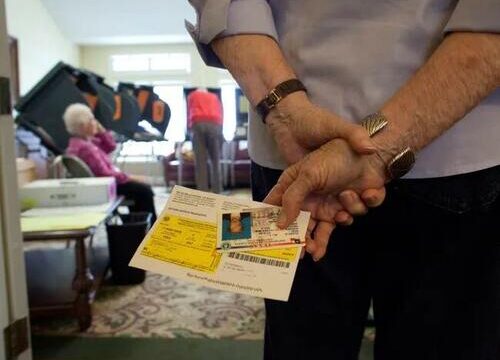
In the latest version of the so-called SAVE America Act—formerly just the SAVE Act—Congressional Republicans added a requirement for every voter in federal elections to provide poll workers with a valid government-issued photo ID if they’re voting in person or a copy of a valid photo ID if they’re voting by mail.
On Friday—a day after the House passed the law and sent it to the Senate—President Trump put out a post in support of voter ID requirements, which led Senate Democrats to issue familiar denunciations of the policy while promising to block this version of the bill.
The arguments in favor of voter ID are pretty straightforward. If every eligible American citizen is entitled to one vote, poll workers and election officials should confirm that the person voting is who they say they are, so that people cannot submit extra or fraudulent votes by pretending to be someone else. And the best way to do that is the same way identities are confirmed in most other clerical settings—with an officially-recognized photo ID.
The vast majority of Americans, including over 70 percent of Democrats, are in favor of this measure. But that hasn’t stopped top Democratic leaders and many of the Left’s most vocal activists from blocking legislation and loudly opposing any step towards a federal voter ID law.
However, the arguments most often made against voter ID do not stand up well to even the slightest scrutiny.
First, opponents will often point out—correctly—that there is no undisputable evidence of “widespread” voter fraud. They’ll then use that fact to argue that voter ID is a burdensome solution to a fake problem.
But if there was an actual conspiracy to either foment or permit voter fraud in a way that successfully flipped an election, it would not be “widespread,” it would be targeted. Even in large national elections like the presidential race, the outcome is almost always decided by a small handful of precincts. So a conspiracy to commit or allow “widespread” voter fraud would not only be pointless, it would all but guarantee its discovery.
Next, critics often assert that an ID requirement would prevent millions of legitimate voters from casting their ballots because they do not currently have a valid photo ID. But if that’s really true, the emphasis has been in the wrong place. The difficulties faced by people without any form of photo ID go far beyond voting, since ID requirements have become an increasingly frequent aspect of American public life. The obvious way for politicians to fix that problem would be to make it easier for people to get photo IDs, not to leave all those clerical barriers in place while preserving a gap that could allow people to commit voter fraud.
Finally, with the SAVE America Act specifically, its opponents in Congress are trying to frame this as an illegal “nationalization” of elections. There may be something to this argument if Trump tries to do this through executive action. But the Constitution gives Congress a fair amount of control over federal elections, which it has used with recent legislation like the National Voter Registration Act, the Voting Rights Act, and the Help America Vote Act.
Overall, it’s quite clear that the arguments against voter ID are not genuine arguments but excuses to preserve a status quo that has been advantageous to the party making them.
The lopsided polling on this issue indicates that most people, in both parties, aren’t falling for these talking points anymore.
So even if the SAVE America Act stalls in the Senate, it is certainly possible that some version of voter ID will become federal law in the near future.
But while that would probably be great for Republican politicians, candidates, and RNC officials focused on beating Democrats in elections, there is no reason to think it alone will genuinely put this country on a better path.
Because, while there are indeed some meaningful differences between the parties which keep elections from becoming an entirely meaningless ritual, the lesson of the last twenty years—at least—is that people tend to significantly overestimate how much elections matter, and, in doing so, get distracted from the most malicious and damaging government programs, which tend to have quiet, bipartisan support.
In the past two decades, almost every single presidential election has been won by a so-called “change” candidate who presented themselves as a sharper departure from the status quo than their opponent.
Obama won in 2008 by presenting himself as a repudiation of the financial cronyism and foreign interventionism of the W. Bush years. Trump won in 2016 by campaigning against the foreign wars, lax immigration restrictions, and crony neoliberalism of both the establishment Democrats and Republicans. Even in 2020, Biden rode to victory on a wave of utter exhaustion with the chaos of Trump’s media war with the establishment and the pandemonium set off by the government’s response to the covid pandemic—presenting himself as an abrupt deviation back to the “normalcy” of the Obama years. Finally, in his second victory, Trump and his team presented themselves as being ready and able to really deliver all the change he had promised the first time around, having totally learned from their mistakes in the first term.
But each and every time, the “change” candidate ended up delivering the exact kind of crony, inflationist, interventionist status quo with, at most, a few minor and easily-reversible executive actions to keep their base happy for a bit.
As Ryan McMaken laid out in an article earlier this month, this shouldn’t surprise anybody who understands where power truly resides in this country. It does not lie mostly with the handful of bombastic politicians and political appointees who fill the heavily-televised halls and briefing rooms on Capitol Hill, at the White House, and in the various executive agencies, as we learn in elementary school.
The bulk of federal power lies with a large group of governing elites, most of whom are faceless, seemingly unimportant bureaucrats, “nonpartisan” federal officials, and well-connected heads of industry. And that class of people—call them the establishment, the political class, the elites, whatever—are not willing or interested in surrendering their power.
Primarily by using their institutional control to determine which candidates voters get the option of voting for, the established governing elites have brought about a comfortable political status quo for them where both major parties spend all their time fighting ferociously over issues that—while certainly not unimportant—pose no actual risk to the establishment’s interventionist, inflationist, crony rackets that are quietly expanding their power and transferring a tremendous amount of the American public’s wealth to the elites and their friends.
This has been great for the establishment. But the whole scheme requires keeping the population blind to how badly it’s being ripped off. And, as I hinted at above, one of the main ways the current governing elites in America do that is by aggressively playing up the differences between establishment Republicans and establishment Democrats, to keep us all in a state of perpetual certainty that nearly all of our current societal problems will be, if not solved, greatly diminished if “our party” just wins the next election.
Look back at the unbridled joy and overwhelming sense of accomplishment and hope that voters on both sides felt after their party won each of the elections I talked about before. With Obama in 2008, Trump in 2016, Biden in 2020, and Trump again in 2024, there was a palpable sense among their supporters after the election that the battle was won, and things would now, finally, be alright. The same goes for a lot of midterm elections—most famously the “Republican Revolution” in 1994 and the Democrats’ “Blue Wave” in 2018.
All that optimism looks almost delusional in hindsight, knowing where we’ve ended up. But that isn’t really the fault of the voters in question. They were deliberately tricked. Because there is no better way for the current elites to fortify their power than to convince roughly half of the population at any given time that they are in control now, that they are in power, that they are winning.
If we’re ever going to truly escape this awful status quo—as a sizable portion of the American public clearly desires—it won’t come from a policy like voter ID. It will happen once “both sides” understand that they are losing.
Tyler Durden
Wed, 02/18/2026 – 17:00
https://www.zerohedge.com/political/voter-id-common-sense-it-wont-fix-anything
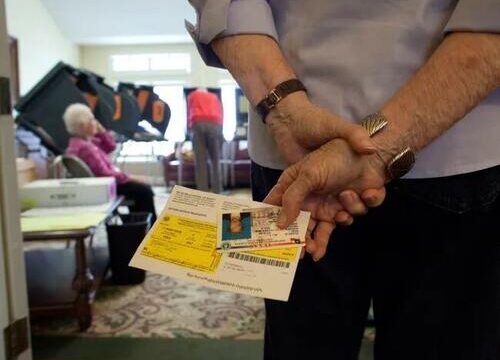
Voter ID Is Common Sense, But It Won’t Fix Anything
Voter ID Is Common Sense, But It Won’t Fix Anything
Authored by Connor O’Keefe via The Mises Institute,
As panic builds within the GOP over the approaching midterm elections, Republicans have renewed a push for one of their most popular policy proposals: voter ID.
In the latest version of the so-called SAVE America Act—formerly just the SAVE Act—Congressional Republicans added a requirement for every voter in federal elections to provide poll workers with a valid government-issued photo ID if they’re voting in person or a copy of a valid photo ID if they’re voting by mail.
On Friday—a day after the House passed the law and sent it to the Senate—President Trump put out a post in support of voter ID requirements, which led Senate Democrats to issue familiar denunciations of the policy while promising to block this version of the bill.
The arguments in favor of voter ID are pretty straightforward. If every eligible American citizen is entitled to one vote, poll workers and election officials should confirm that the person voting is who they say they are, so that people cannot submit extra or fraudulent votes by pretending to be someone else. And the best way to do that is the same way identities are confirmed in most other clerical settings—with an officially-recognized photo ID.
The vast majority of Americans, including over 70 percent of Democrats, are in favor of this measure. But that hasn’t stopped top Democratic leaders and many of the Left’s most vocal activists from blocking legislation and loudly opposing any step towards a federal voter ID law.
However, the arguments most often made against voter ID do not stand up well to even the slightest scrutiny.
First, opponents will often point out—correctly—that there is no undisputable evidence of “widespread” voter fraud. They’ll then use that fact to argue that voter ID is a burdensome solution to a fake problem.
But if there was an actual conspiracy to either foment or permit voter fraud in a way that successfully flipped an election, it would not be “widespread,” it would be targeted. Even in large national elections like the presidential race, the outcome is almost always decided by a small handful of precincts. So a conspiracy to commit or allow “widespread” voter fraud would not only be pointless, it would all but guarantee its discovery.
Next, critics often assert that an ID requirement would prevent millions of legitimate voters from casting their ballots because they do not currently have a valid photo ID. But if that’s really true, the emphasis has been in the wrong place. The difficulties faced by people without any form of photo ID go far beyond voting, since ID requirements have become an increasingly frequent aspect of American public life. The obvious way for politicians to fix that problem would be to make it easier for people to get photo IDs, not to leave all those clerical barriers in place while preserving a gap that could allow people to commit voter fraud.
Finally, with the SAVE America Act specifically, its opponents in Congress are trying to frame this as an illegal “nationalization” of elections. There may be something to this argument if Trump tries to do this through executive action. But the Constitution gives Congress a fair amount of control over federal elections, which it has used with recent legislation like the National Voter Registration Act, the Voting Rights Act, and the Help America Vote Act.
Overall, it’s quite clear that the arguments against voter ID are not genuine arguments but excuses to preserve a status quo that has been advantageous to the party making them.
The lopsided polling on this issue indicates that most people, in both parties, aren’t falling for these talking points anymore.
So even if the SAVE America Act stalls in the Senate, it is certainly possible that some version of voter ID will become federal law in the near future.
But while that would probably be great for Republican politicians, candidates, and RNC officials focused on beating Democrats in elections, there is no reason to think it alone will genuinely put this country on a better path.
Because, while there are indeed some meaningful differences between the parties which keep elections from becoming an entirely meaningless ritual, the lesson of the last twenty years—at least—is that people tend to significantly overestimate how much elections matter, and, in doing so, get distracted from the most malicious and damaging government programs, which tend to have quiet, bipartisan support.
In the past two decades, almost every single presidential election has been won by a so-called “change” candidate who presented themselves as a sharper departure from the status quo than their opponent.
Obama won in 2008 by presenting himself as a repudiation of the financial cronyism and foreign interventionism of the W. Bush years. Trump won in 2016 by campaigning against the foreign wars, lax immigration restrictions, and crony neoliberalism of both the establishment Democrats and Republicans. Even in 2020, Biden rode to victory on a wave of utter exhaustion with the chaos of Trump’s media war with the establishment and the pandemonium set off by the government’s response to the covid pandemic—presenting himself as an abrupt deviation back to the “normalcy” of the Obama years. Finally, in his second victory, Trump and his team presented themselves as being ready and able to really deliver all the change he had promised the first time around, having totally learned from their mistakes in the first term.
But each and every time, the “change” candidate ended up delivering the exact kind of crony, inflationist, interventionist status quo with, at most, a few minor and easily-reversible executive actions to keep their base happy for a bit.
As Ryan McMaken laid out in an article earlier this month, this shouldn’t surprise anybody who understands where power truly resides in this country. It does not lie mostly with the handful of bombastic politicians and political appointees who fill the heavily-televised halls and briefing rooms on Capitol Hill, at the White House, and in the various executive agencies, as we learn in elementary school.
The bulk of federal power lies with a large group of governing elites, most of whom are faceless, seemingly unimportant bureaucrats, “nonpartisan” federal officials, and well-connected heads of industry. And that class of people—call them the establishment, the political class, the elites, whatever—are not willing or interested in surrendering their power.
Primarily by using their institutional control to determine which candidates voters get the option of voting for, the established governing elites have brought about a comfortable political status quo for them where both major parties spend all their time fighting ferociously over issues that—while certainly not unimportant—pose no actual risk to the establishment’s interventionist, inflationist, crony rackets that are quietly expanding their power and transferring a tremendous amount of the American public’s wealth to the elites and their friends.
This has been great for the establishment. But the whole scheme requires keeping the population blind to how badly it’s being ripped off. And, as I hinted at above, one of the main ways the current governing elites in America do that is by aggressively playing up the differences between establishment Republicans and establishment Democrats, to keep us all in a state of perpetual certainty that nearly all of our current societal problems will be, if not solved, greatly diminished if “our party” just wins the next election.
Look back at the unbridled joy and overwhelming sense of accomplishment and hope that voters on both sides felt after their party won each of the elections I talked about before. With Obama in 2008, Trump in 2016, Biden in 2020, and Trump again in 2024, there was a palpable sense among their supporters after the election that the battle was won, and things would now, finally, be alright. The same goes for a lot of midterm elections—most famously the “Republican Revolution” in 1994 and the Democrats’ “Blue Wave” in 2018.
All that optimism looks almost delusional in hindsight, knowing where we’ve ended up. But that isn’t really the fault of the voters in question. They were deliberately tricked. Because there is no better way for the current elites to fortify their power than to convince roughly half of the population at any given time that they are in control now, that they are in power, that they are winning.
If we’re ever going to truly escape this awful status quo—as a sizable portion of the American public clearly desires—it won’t come from a policy like voter ID. It will happen once “both sides” understand that they are losing.
Tyler Durden
Wed, 02/18/2026 – 17:00
https://www.zerohedge.com/political/voter-id-common-sense-it-wont-fix-anything