Category: News
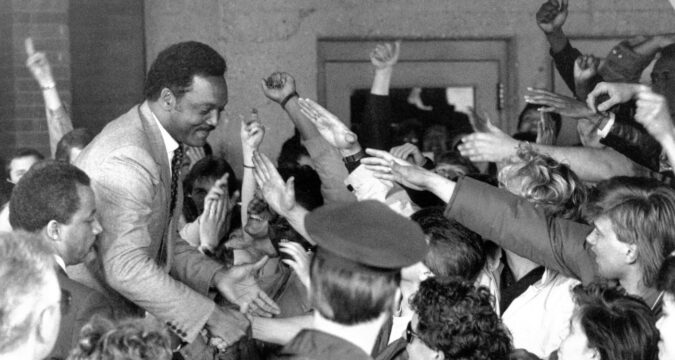
Glenn Eden: Why we must allow space for the Rev. Jesse Jackson’s extraordinary and imperfect legacy
The Rev. Jesse Jackson was never just a man at a pulpit on the South Side; he was the skyline itself — imposing, essential and occasionally casting long, complicated shadows over the city that raised him. From the nerve center of the Rainbow PUSH Coalition headquarters on 50th Street and Drexel, Jackson didn’t just preach; he orchestrated a movement that redefined the American power structure.
To study the anatomy of his iconism is to look into a mirror of the American project: a blend of soaring transcendence and gritty, human fallibility. An icon, after all, isn’t a statue carved from perfect, sterile marble; it is a vessel of lived history, chipped and weathered by the very storms it weathered. In this country, we must hold space for the full spectrum of such a legacy, honoring the imperfect architect even as we walk through the doors he forced open with his own two hands.
We must be honest: An icon isn’t a saint. A saint is removed from the world, hovering in a space of moral purity. But an icon such as Jackson is deeply, and sometimes messily, entangled in the world. In 1984, Jackson used the offensive term “Hymietown” to refer to New York City during his groundbreaking first presidential campaign — a remark that fractured his relationship with the Jewish community and remains a painful footnote in his biography. Decades later, during then-Sen. Barack Obama’s 2008 run, Jackson was caught on a hot mic making crude remarks about the future president, frustrated that Obama wasn’t addressing the specific anxieties of the Black community. Jackson eventually acknowledged the harm of both incidents, yet they remain essential to the “anatomy” of the man.
Related Articles
David Greising: The Rev. Jesse Jackson shaped Chicago in innumerable ways
Lori Lightfoot: The Rev. Jesse Jackson challenged me to think bigger
Rev. Jesse Jackson was a ‘giant figure in the world,’ but he stayed rooted in Illinois
Jackson’s journey, beginning as a young, firebrand disciple of the Rev. Martin Luther King Jr., was never a sterile march toward progress. It was a noisy, human scramble. Most icons stay in a single lane — we have fashion icons, sports icons and musical icons. Jackson was different; he was a transcendental icon. He was a bridge-builder who traversed wildly different eras and subcultures, evolving from a local Chicago organizer to a formidable two-time Democratic presidential candidate who proved a Black man could win primary states. He was a high-profile minister who championed gay rights as early as the 1980s and a global diplomat who successfully negotiated hostage releases in Syria and Iraq when the State Department could not.
There is a lesson here for our modern, polarized era. While icons can emerge from either side of history, we must allow space for their followers and the public at large to honor the legacy in its entirety — the good, the bad and the complicated. This is America. We are a nation built by brilliant, broken and boisterous visionaries who often stepped on toes while trying to leap toward justice. To demand a sanitized version of Jackson is to demand a fiction.
Ultimately, Jesse Jackson’s story is the quintessentially American one — a narrative of magnificent contradictions that refuse to be flattened into a simple, polished eulogy. To allow space for his brilliance while acknowledging his stumbles is not an act of disrespect; it is an act of intellectual honesty. As we lay this civil rights giant to rest, we need not ask for a saint. We should instead honor the man who, in all his flawed humanity, taught a generation that they were “somebody.”
In the end, the true anatomy of an icon isn’t found in their perfection, but in the enduring strength of the doors they left open for the rest of us to walk through.
Glenn Eden is a corporate affairs consultant and immediate past chair of Choose Chicago.
Submit a letter, of no more than 400 words, to the editor here or email letters@chicagotribune.com.
https://www.chicagotribune.com/2026/02/27/opinion-jesse-jackson-imperfect-legacy/
Catella, Deniz face off in Republican primary for Kane County Board seat in District 13
Editor’s note: This is one in a series of stories about contested races in the March 17 primary election.
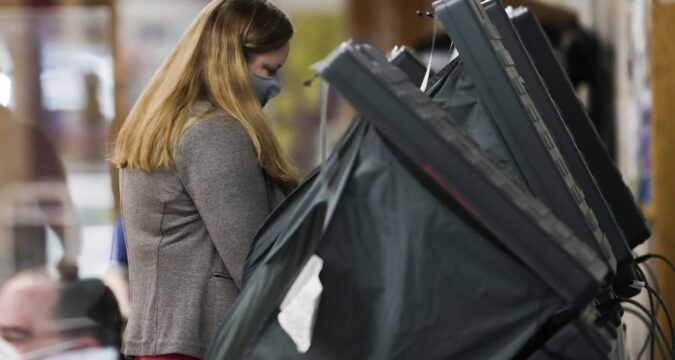
The Republican primary race for a Kane County Board seat in District 13 in the March 17 election includes candidates Ryan Deniz and Anthony Catella.
The winner in the contest will move on to the general election on Nov. 3 to face the victor in the Democratic primary race between Nicolas “Nico” Jimenez and incumbent Michael Linder.
Ryan Deniz
Deniz, 43, of Geneva, says he grew up in the area and that voters are concerned about taxes, public safety and the current economic environment within the county.
“In regards to taxes, they’re too high and people are concerned about spending. The county is operating at a deficit and most people know they tried to increase property levies and they had the countywide sales tax referendum that was shot down,” Deniz said. “They’ve got major concerns about that.”
Public safety concerns a “lot of the unfunded mandates that are sometimes being pushed from downstate.”
“Some of those have no funding and that’s a problem for our constituents,” Deniz explained. “Those unfunded mandates affect public safety here as it puts pressure on our local sheriff to deal with – obviously, there’s a mental health crisis and there’s inadequate funding for that and it puts more of a burden on public safety. If we can’t fund our mental health crisis it’s going to compound and lead to other issues.”
Ryan Deniz is running in the Republican primary for a seat on the Kane County Board in District 13. (Ryan Deniz)
Economic development is another topic voters are concerned about, Deniz said.
If elected, Deniz wants to work on a number of issues including serving “on the new Kane County Economic Committee” which he wants to be a part of “because that’s going to help coordinate deals for the county and hopefully open up more business opportunities here.”
“I’d also like to work with public safety as I’m in the medical field and work as a chiropractor,” he said. “It would be great to try to work with the mental health crisis you’re hearing about from people, especially with all the turmoil from ICE and everything.”
Deniz said he would also be interested in looking into “the budgetary shortfalls and if hiring freezes need to be continued or enacted.”
“I’d also be open to RTA diversion of tax funds to help with public safety,” he said.
Anthony Catella
Catella, 55, of St. Charles, said this is his second time running for county board and that voters are telling him their concerns include taxation, safety and the ability to buy adequate housing.
“Taxes – property taxes are high and people would, of course, like to have them lowered,” he said. “The current county board seems to find ways to increase any kind of tax rather than lower it. There seems to be more raises than cuts.”
Regarding safety, Catella acknowledges that “crime is always an issue” but adds that “St. Charles is basically a peaceful town.”
Anthony Catella is running in the Republican primary for a Kane County Board seat in District 13. (Anthony Catella)
Regarding housing, Catella said citizens “want homes to remain affordable” despite the growth in the area.
“People don’t want to see prices skyrocket and still have affordable housing – when prices go up, it’s because somebody has to get paid that we either know or don’t know about,” he said.
If elected, Catella said his goals include focusing “on cooperation with my fellow board members, whether they are Republican or Democrat.”
“I want to get on that board and listen to what they have to say and hopefully they listen to what I have to say and we can come up with some compromise agreement we can all agree to and vote on and be beneficial to the people of District 13,” he said.
Catella said he is supportive of local protest groups that “are united against hate” adding that “nobody wants to be the object of somebody’s hatred or scorn.”
Catella said he wants to also see “less regulation of county businesses, more control of county spending and a stable monetary supply which can be brought about by reducing interest rates and bringing down inflation.”
David Sharos is a freelance reporter for The Beacon-News.
Andy Shaw: Mexico, like Chicago, is more than just its worst headlines
I spent decades covering Chicago’s “wars” — political ones at City Hall and the aftermath of gang violence on the city’s streets.
So when the news broke on Sunday morning that a joint Mexican-U.S. operation killed a major cartel boss, Nemesio Rubén Oseguera Cervantes, nicknamed “El Mencho,” not too far from our retirement enclave in Mexico, I didn’t reach for the smelling salts. I reached for perspective.
Mexico is a vibrant, colorful, complicated, wounded and resilient nation of 130 million people. It’s not a Netflix crime series. It’s not a State Department warning label. And it’s certainly not defined solely by the depravity of drug cartel men with rifles and armored SUVs.
Yes — the cartels are real. Their brutality is real. The recent killing that reverberated through parts of Jalisco, the state we winter in, is real. Violence tied to the notorious Jalisco New Generation Cartel is not something to shrug off.
When gunfire erupts and a public figure, police officer or journalist is targeted, the shock waves are felt not just locally but also internationally. Markets turn tremble. Travel plans are reconsidered. Cable news panels light up.
But here’s what I’ve learned after decades in journalism: Reacting is easy. Understanding is hard.
We’ve spent the last three winters in a safe, tranquil expat retirement community on Lake Chapala, 30 minutes south of Guadalajara, a reputed cartel stronghold that feels light-years away.
I wrote about the allure of our retirement community in a Tribune op-ed last year, blissfully unaware of the possible fallout after the killing of a major cartel boss.
So last Sunday, when the news broke, businesses started shutting their doors, and warnings went out to shelter in place, which was smart because the anticipated cartel reaction included bus, car and business torchings only a few miles away.
We hunkered down on Sunday and Monday, and early Tuesday, local government officials announced that after meetings with business leaders, the lockdown would be ending with a return to business as usual.
It almost felt scripted, but that’s another story for another day.
Our experience, coincidentally, was eerily similar to our youngest daughter’s two years ago when the arrest of drug kingpin Joaquín “El Chapo” Guzmán’s son, Ovidio Guzman Lopez, a few miles from their Mazatlan hotel sparked several days of retaliatory backlash that shut down the airport, businesses, bus service and local activities until an all-clear was declared five days later.
In both cases, we all hunkered down, stayed in touch with worried family and friends back home, and waited for the volatility to subside.
Chicagoans like us know something about living alongside violence without surrendering our civic identity. For years, national media caricatured our city as a war zone. They tallied homicides like baseball scores and ignored the neighborhoods, businesses, schools and cultural institutions that functioned every day despite the periodic nearby violence.
They never mentioned our lakefront at sunrise or the bustle of Pilsen and Bronzeville. They reduced a world-class city to a crime blotter.
Mexico gets the same treatment.
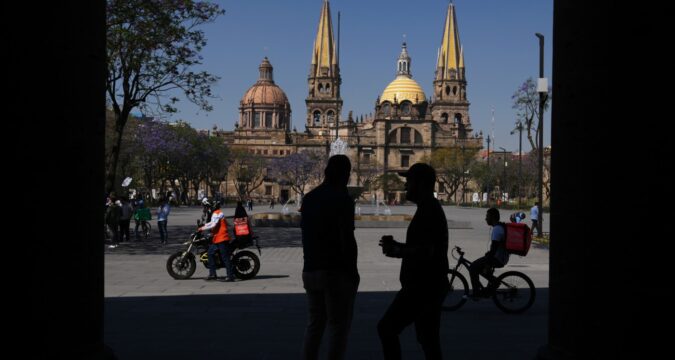
Turn on certain cable channels in the U.S., and you’d think all of Mexico is a lawless wasteland. But walk the streets of Chapala or Ajijic or our town, San Antonio Tlayacapan, on a Sunday afternoon, and you see something very different: families, entrepreneurs, retirees, artists and students, people eating, drinking, shopping and living their lives.
The bilateral relationship between the United States and Mexico is not incidental — it’s foundational. Our economies are braided together through the United States-Mexico-Canada Agreement. Supply chains run north and south every hour of every day. Chicago’s own commercial vitality depends in part on what moves through Mexican ports, factories and farms.
President Donald Trump’s tariffs and threats rattle the foundation, but the walls are strong.
And when violence flares, it’s not just Mexico’s problem. It’s ours. That doesn’t mean minimizing the danger. It means refusing to flatten a nation into a stereotype. Cartel power flourishes where corruption, poverty and demand intersect.
And let’s be honest: America’s appetite for drugs and American guns flowing south are part of that toxic equation. We are not innocent bystanders watching chaos from a safe distance. We are participants in a shared struggle.
What strikes me most, though, is the resilience of ordinary Mexicans. After an assassination or a burst of violence, there is fear, yes. But there is also a stubborn insistence on normalcy.
Shops reopen. Schools resume. Neighbors gather. It reminds me of Chicagoans after a horrific shooting or a brazen act of public corruption. We grumble, we mourn, we demand accountability — and then we carry on.
That’s not denial. It’s survival.
As a reporter and good government watchdog, I’ve always believed that sunlight is the best disinfectant. Mexico’s press corps operates under risks that would chill most American journalists, yet they continue to report, to expose, to question. That courage deserves acknowledgment.
So how do I feel about Mexico in the wake of nearby cartel violence?
Concerned, certainly. No one should be blasé about targeted killings or criminal organizations flexing their muscle. But I also feel admiration for a culture that predates our own republic, for communities that refuse to be defined by criminals and for a bilateral partnership that endures despite political theatrics on both sides of the border.
The easy narrative is fear. The responsible one is complexity.
If Chicago has taught me anything, it’s this: A place is never just its worst headlines. Mexico, like my hometown, is more than the violence that periodically scars it.
And it deserves to be seen and covered that way.
So the towns along Lake Chapala, where most winter days are sunny, dry and warm, have regained their mojo, and we’re back to living “la vida buena” — the good life — after a brief interruption that affects people and life everywhere without, in our case at least, precipitating a second thought about where and how to live out the winters of our retirement years.
Andy Shaw is a semi-retired Chicago journalist and good government watchdog who winters in Mexico.
Submit a letter, of no more than 400 words, to the editor here or email letters@chicagotribune.com.
https://www.chicagotribune.com/2026/02/27/opinion-mexico-el-mencho-violence-chicago/
Editorial: Mayor Brandon Johnson is leaving his successors with a financial ash heap. It’s worse than we thought.
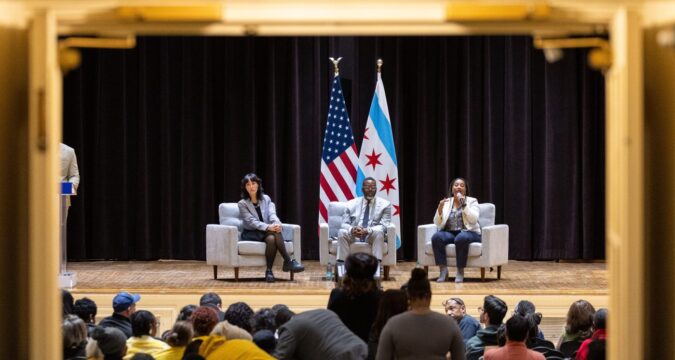
Mayor Brandon Johnson already has presided over the downgrading of Chicago’s credit by three separate ratings agencies. The latest to ding the city’s credit are Fitch Ratings and Kroll Bond Rating Agency, both of which docked their ratings on the city’s general obligation bonds by one notch on Wednesday.
Standard & Poor’s downgraded Chicago a little over a year ago and continues to give Chicago a negative outlook. This most recent Kroll downgrade is its second in two years.
Wednesday’s downgrades come as the city prepares to solicit bond investors next month for more than $500 million to cover back pay owed to firefighters due to a lengthy contract negotiation and hundreds of millions in anticipated costs to settle lawsuits, most of which pertain to alleged police misconduct. The downgrades will make the debt more expensive for the city, as investors will be expected to demand higher yields in response to the higher risk tied to Chicago’s precarious financial condition.
But here’s the real shocker: The city is structuring this debt so it doesn’t have to make payments for the next three-plus years, extending the time frame for paying off the bonds and making the entire enterprise considerably more expensive than was envisioned during the fraught budget discussions late last year.
Before the downgrades, these bonds already were problematic.
Cities in decent financial health customarily don’t float bonds to cover operational expenses such as legal settlements and compensation for workers. Bonds are supposed to be for capital investments — improvements that will last for years, justifying the long-term cost of financing them.
The cost of the firefighter pay and the settlements together totals about $449 million. But the city is seeking to issue $503 million in bonds.
Hmm, we wondered. Why such a difference?
As it turns out, the Johnson administration wants to keep the cash-strapped city from having to make payments on these bonds for another three years, Fitch tells us. The extra amount the city is borrowing would go largely toward making interest payments on the debt through 2029.
In describing the arrangement to us, Fitch actually used the dreaded municipal-bond financing term, “scoop and toss.” As in the frowned-upon practice of refinancing existing debt and extending it into the future, thereby raising the total cost of whatever costs that initial debt was covering in the first place — a method Chicago mayors largely have eschewed since Richard M. Daley retired.
“While not an actual scoop and toss, the city’s choices do throw the city’s current and past liabilities into the future,” Fitch Senior Director Ashlee Gabrysch told us in a statement.
During last year’s budget debates, Chicago’s then-chief financial officer, Jill Jaworski, provided aldermen with a chart projecting that these bonds would be retired in 2031 and total interest on them would amount to $58 million.
Obviously, that plan fell by the wayside in the intervening months.
Fitch now tells us it’s the agency’s understanding the city will retire the bonds within a decade, not the five years originally envisioned. Adding insult to injury, the city will need to float taxable bonds rather than the tax-free bonds municipalities ordinarily issue because of how it’s using the money. That also will hike the city’s interest rate substantially because investors require far higher yields if they’re paying taxes on their interest income.
We don’t know as of now how much more the total interest costs will be, but no doubt they’ll be considerably higher than $58 million. All to pay for $449 million in operational costs that should have been managed within the city’s budget. We asked the mayor’s office about all of this, but they were unable to comment by press time.
Suffice to say, though, the city right now is akin to a household living paycheck to paycheck that must take out payday loans to pay for a car repair.
No wonder, then, that downgrades are the order of the day for the Johnson administration.
So is the mayor taking any responsibility for this dismal state of affairs? No, the buck is stopping anywhere but his fifth floor desk. When he’s not blaming his predecessors for the mess they left him, he’s pointing the finger at the City Council majority that refused to endorse his job-killing corporate head tax. That council group reluctantly included the plan to debt-finance the firefighter back pay and the settlements in the budget that eventually passed, but those proposals originated with the mayor.
Now, the mayor’s team is continuing to criticize some of the other budget actions the council approved, which was part of Fitch’s rationale for the downgrade. Johnson’s refusal to accept the limited defeats he suffered in the budget process is raising costs for all Chicago taxpayers.
Fitch in its release cited “ongoing disagreements between the administration and the city council … (which) have impeded decision timeliness and the development of a credible and comprehensive plan to restore structural balance.”
The reality is that, as much as Johnson likes to heap blame on prior mayors for his troubles, he’s poised to leave whoever sits in his chair after next year’s election a worse situation than he inherited.
Chicago saw nothing but credit upgrades for the seven years that preceded Johnson’s mayoralty.
And no one should be surprised if the pile of downgrades on Johnson’s watch grows larger than it is today before Chicago voters go to the polls a year from now.
Submit a letter, of no more than 400 words, to the editor here or email letters@chicagotribune.com.
Editorial: Why Chicago’s parking and red light ticketing is such a mess
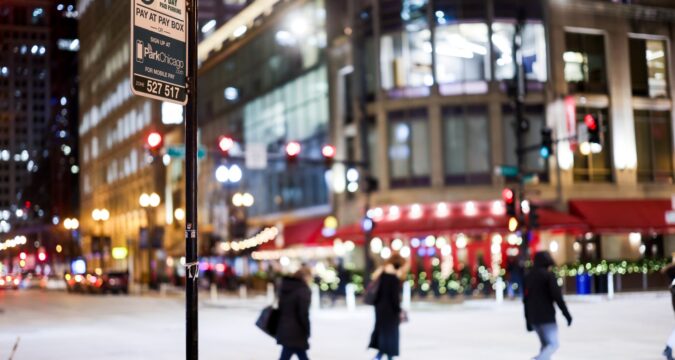
For Chicago’s last two progressive mayors, automobile-related tickets have proved quite the conundrum.
On the one hand, the revenue from parking overstays, speed violations in school zones, the lack of a city permit and other infractions provide revenue badly needed for righteous programs in a cash-strapped city. On the other, these fines clearly discriminate against less affluent Chicagoans because fines are standardized.
Fifty bucks is a lot more of a problem for someone living paycheck to paycheck than a person with a high salary. Worse, the former is less likely to pay that ticket, which in turn means their becoming subject to multiplying hefty penalties. In time, that can mean someone gets trapped in a swamp of debt.
So if you look at the history of tickets in Chicago, you see mayors zigzagging between making revenue plays (such as adding more speed cameras) and then lamenting the impact of fines and fees on citizens and trying to assuage their social cost.
In truth, the problem flows from a combination of far too much costly metered parking in Chicago with far longer hours of operation than most cities (a curse of the notorious parking meter privatization sale), thus bringing more violations and then penalties, and the city’s infamous reluctance to cut spending so it was not so reliant on fines and fees.
Most wise heads when it comes to municipal budgets argue that tickets should be seen as deterrents; not city ATMs.
Now comes more salt in the city’s wound.
Cook County Circuit Judge William Sullivan ruled Feb. 19 that the city had overcharged thousands of Chicago drivers between 2012 and 2022 because the city had ignored a state law limiting penalties for a violation to no more than $250, as a condition of allowing Chicago to run its own appeals process. The city ticketed multiple times for the same violation, such as the absence of a city sticker, and thus the cumulative penalties exceeded the cap. Chicago has said it may appeal the ruling.
This is no small potatoes. According to Tribune reporting, the ruling means Chicago likely is liable for $69.6 million in cash-out-the-door refunds, not to mention having to forgive nearly $100 million that’s currently listed as debt held by ticketed drivers. Not good.
In 2022, the city came into compliance, tacitly suggesting it knew the prior practice was not in compliance with state law. No doubt legal wrangling will follow, but it looks to us like this expensive taxpayer horse has bolted. The question now is what reforms are needed.
In our view, the city should be issuing more tickets, not increasing penalties so fast and so heftily, which only propel tickets to a place they should not go, but make it less likely people will pay at all.
That will mean hiring more inspectors to issue the tickets. We hear City Hall has been reluctant, and, granted, we generally advocate for smaller government payrolls. But these revenue-generating employees would more than pay for themselves.
And if Mayor Brandon Johnson wants to decrease the discriminatory aspects of ticketing, which we acknowledge, then by all means quietly unleash more of these new ticket givers into the more affluent neighborhoods of the city, where, for example, permits are routinely ignored. Reasonableness should prevail: No one wants to live in a place where you get ticketed for jumping out of your car in the wrong spot for a matter of seconds. But the law is the law.
We’ve long thought that penalties for Chicago tickets are out of whack with the actual cost of the tickets, less severe in real terms after years of inflation.
The city’s tickets collections would also improve with better incentives.
Lots of U.S. municipalities offer a 50% “discount” for tickets paid in 24 or 48 hours, a powerful incentive for the guilty to cough up immediately. That’s far more enticing than threatening a future “penalty,” even if the dollar figures don’t change. Once a massive penalty is on the ticket, many people do a risk analysis and figure it’s not worth paying at all. And this court ruling only has vindicated that strategy, to the city’s cost.
Submit a letter, of no more than 400 words, to the editor here or email letters@chicagotribune.com.
Just in time for Casimir Pulaski Day: The Red Apple Buffet, filling stretchy pants since 1989
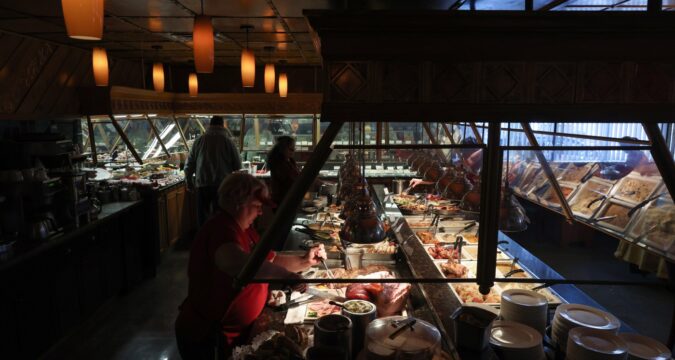
The Red Apple Buffet weekend buffet, which claims to be the nation’s largest Polish buffet, which sees an annual migration of Chicago Polish to the Northwest Side around Casimir Pulaski Day (March 2), is so vast, homey and engorging you must, must wear your stretchy pants.
Go buy some if you don’t own some — you’ll thank me, somewhere after you’ve passed on a “mini meat croissant” for another Angus beef roll (stuffed with additional beef), but not before you’ve set aside the green pea salad (with apple, red onion and cheese) for creamy beet salad, not to be confused with the spinach and beet salad, red bean and celery salad, beets in horseradish or the sweet carrot slaw.
“Daddy,” my daughter said at one point, dragging back another plate of food as if she were towing a brontosaurus, “I couldn’t tell if this was a desert so I just took it anyway.”
My instructions to her about the buffet at Red Apple Buffet were thus: Just sample, do not get bogged down on any one dish (that’s madness), and save room for dessert at the end. The problem is cheese blintzes (lemony, covered in powdered sugar), the dish she wasn’t certain about, is one of those Eastern European staples that blurs decorum.
But then so does everything about the weekend buffet at Red Apple Buffet, which generally offers about 84 different options for $33, and which changes seasonally, a meal so large and endlessly tempting that I heard not one but two strangers discreetly fart.
I like to think Anna Hebal, owner of this Norwood Park institution, would have been pleased. In 2019, after 30 years, she and husband Ferdynand closed the original Red Apple in Avondale to focus on their unassuming Northwest Side location. Three years ago, Ferdynand died.
He was “really the author of the whole buffet, the crazy guy with a crazy idea to make it this so gigantic,” said Anna, who considered herself “the PR” of the business. Now she’s in charge. But other than two life-altering events, little else about the Red Apple Buffet has changed since it first began overstuffing Chicagoans in 1989.
There are still large metal apples atop wooden booths.
There are still paintings of country landscapes.
Diners get food at one of the buffet tables at the Red Apple Buffet in Chicago on Feb. 7, 2026. (John J. Kim/Chicago Tribune)
The crowd still speaks with an Eastern European accent, and every other table appears occupied by a quiet dinner between an elderly couple and their elderly children. Alongside the dining room, on the restaurant’s outdoor wall, there is still a striking portrait of Gen. Casimir Pulaski, Polish-born hero of the American Revolution, recruited to the cause by Ben Franklin himself, looking rakish and more than a little like Prince. He is often thought to be buried in coastal Georgia, though some say he was buried at sea. Fittingly, a burial at sea is also what you pray for after a Red Apple buffet.
That’s a compliment.
The meal begins before you can even step up to long, crowded food stations warming beneath peaked roofs. A waitress offers a cup of Ukrainian borscht, served warm here and full of cabbage and root veggies. It may be the lightest thing in the room, or at least the soupiest, other than the beef tripe soup, which itself is hard to notice being so close to mountains of plum-filled roast pork, and meat pierogi, and cheese and potato pierogi, and stacks of breaded pork cutlets, which are across from perfectly fried gold footballs of chicken Kiev and an ocean of pork stew and apple-stuffed chunks of roasted duck.
A few logistical points: You eat by filling a plate, then pushing it aside like aristocracy, then waddling back to the food stations to fill a new plate. As far as I can tell from my experience, other than the smoked salmon — which I found cold and dry — nothing sits in this buffet long before being replaced and freshened with more and More and MORE.
Also, to be frank, I hate buffets — they gross me out, they’re gloppy, watery.
But this one, oh boy, is way closer to grazing in a relative’s dining room. Homey, it is. Anna told me that “other than the mustard and ketchup,” everything is made in-house.
It’s so charming, I experienced at least four or five madeleine moments. The crinkly golden fry on the schnitzel leapt nations and returned me to my grandmother’s eggplant. A buttery scoop of carrots and peas was a doppelganger for those tiny side dishes from 1970s frozen dinners, the kind I would beg for, but my Italian family usually refused to buy. (Again, a compliment.) But also: The char on those cookies has the just-blackened smokiness of a home batch! The shock of old-school ambrosia, pink marshmallows soaking in a mash of citrus and pineapple blocks! Dear god, a quarry of Jell-O cubes!
Steadily, you feel your blood pressure rising, which is also just like home.
A diner reaches for smoked ribs with his plate of sausage, chicken and mashed potatoes and gravy at the Red Apple Buffet in Chicago on Feb. 7, 2026. (John J. Kim/Chicago Tribune)
Buffets, in general, as snobby as it sounds, long associated with low-quality strip-mall troughs and overpriced cruises, are held in low esteem for good reasons. But a thoughtful buffet, at its heart, resurrects the family gatherings we miss. My own family is getting older and dying off; there are fewer aging Italians left to fill St. Joseph Day tables; the last few Christmas Eves were less Night of Seven Fishes and more Night of Three or Four Fishes.
But here at Red Apple, a guy sits across from me on a subzero day wearing a tank top and a fanny pack, bulking up after the gym. The Beatles’ “Please Mister Postman” plays faintly, as if wafting in from a kitchen radio never turned off. A waitress calls my daughter “Honey” and brings her a scoop of vanilla ice cream.
History is alive and unremarked upon here, not the self-conscious nostalgia of yearning but just another Saturday night. Those little gnocchi-like kopytka dumplings, beside yellow pyzy potato dumplings elongated into dense spheroids, beside fire-red stuffed cabbages. And kielbasa. And a downed forest of the shiny green beans.
But the present is here, too. The way everyone in the room looks like they could be a distant aunt or an uncle. The moistness of rum balls. The way meatballs in dill sauce remind a kid of Ikea.
Diners walk past a portrait of Casimir Pulaski on their way into the Red Apple Buffet at 6474 N. Milwaukee Ave., Chicago, on Feb. 7, 2026. (John J. Kim/Chicago Tribune)
An argument against such unchecked, encouraged gluttony can be found just down the street, three blocks away, stretching along Milwaukee Avenue, in the rows of snowy tombstones at St. Adalbert Cemetery. The upside, though, is that if you do grasp the glory of such memories, you will slide into a food coma. You will be in bed by 7:30 p.m.
Either way, a pretty full day.
Red Apple Buffet, 6474 N. Milwaukee Ave., 773-763-3407
A changing Illinois 8th District sets stage for wide-open Democratic primary to replace Rep. Krishnamoorthi
In a crowded election, the front-runner typically is whoever the other candidates are targeting. In the Democratic primary for the 8th Congressional District, where incumbent Rep. Raja Krishnamoorthi is leaving to run for U.S. Senate, the focus is on former U.S. Rep. Melissa Bean.
Opponents have attacked Bean in commercials, at forums and in private. Having previously held the seat from 2005 to 2011, she has name recognition and legislative experience.
But the political landscape has changed dramatically since Bean held the seat and then lost it to Republican Joe Walsh in a Tea Party upset, a defeat she blames on her vote for the Affordable Care Act, the health care plan known as Obamacare. Since then, Donald Trump has been elected president twice, and immigration and inflation have become critical battlegrounds.
The 8th District itself has changed substantially. When Bean defeated longtime incumbent Republican Phil Crane to take office, the district was farther north, mostly in parts of Lake and McHenry counties that were more conservative at the time. Since redistricting, the district now lies in parts of Cook, DuPage and Kane counties, stretching mainly along I-90 from Des Plaines to rural Gilberts, and along the Fox River from St. Charles to Carpentersville.
The 8th District has grown solidly Democratic and has become much more diverse, with the U.S. Census Bureau reporting that 55% of the population was white, 15% two or more races, 13% Asian, 11% some other race, and 5% Black. In addition, 27% identify as Hispanic, and 28% were born in another country.
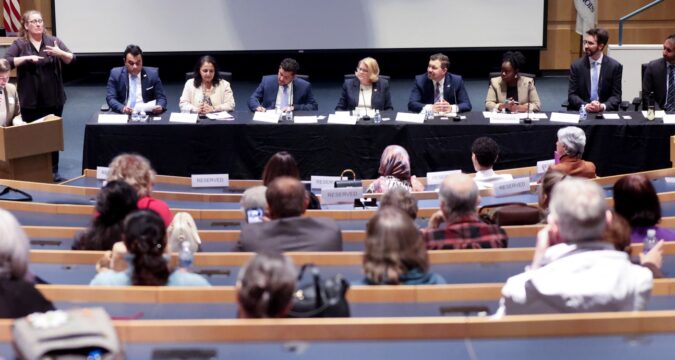
That demographic shift is reflected in the eight-candidate field running in the Democratic primary on March 17, which includes white, Asian and Black candidates trying to differentiate themselves. Some have no political experience, like Neil Khot, while others ran for the seat before, like Junaid Ahmed, or are members of the Cook County Board, like Kevin Morrison, or a local municipal office, like Yasmeen Bankole. Others have worked with the federal government, like Dan Tully, Sanjyot Dunung and Ryan Vetticad.
Despite differences in experience and tone, most emphasize similar themes: lowering costs for families, expanding access to health care and abolishing Trump’s U.S. Immigration and Customs Enforcement agency, which they say repeatedly breaks the law while arresting undocumented immigrants. They differ on the details of how stop Trump.
Bean’s own polling, released in January, showed her in the lead with 10% of the vote, but with other candidates close behind and two-thirds of voters undecided, leaving the race wide open.
The amount of campaign funds raised by the leaders was also similar at the start of 2026. Bean led with $1.3 million, followed closely by Ahmed and Khot, each with about $1.2 million.
Bean — who has been endorsed by U.S. Sen. Tammy Duckworth and U.S. Reps. Bill Foster, Brad Schneider and Nancy Pelosi, — sounded a common theme in the race: “The American Dream is under assault, as are our American values,” she said. Speaking of Trump’s attacks on immigration, she said, “It’s dangerous and unconstitutional. I’m ready to deliver again and hold him to account.”
Former Rep. Melissa Bean, a Democratic candidate for Illinois’ 8th Congressional District, speaks during a candidate forum at Harper College in Palatine on Feb. 7, 2026. (Talia Sprague/for the Chicago Tribune)
After Bean left office, she worked for JPMorgan Chase and Mesirow Financial. Ahmed, a progressive, has attacked Bean as “Wall Street’s favorite Democrat,” a reference to campaign contributions from the finance industry and to her opposition, while in office, to letting states override federal banking regulations. Bean argued that a national standard was necessary to let banks operate without conflicting laws.
But in responding to the criticism that she’s too tight with the nation’s monied interests, Bean argues that while she was in Congress following the 2008 financial crisis, she helped pass the Dodd-Frank Act, which was signed into law in 2010 and limited risky bank speculation and created the Consumer Financial Protection Bureau to regulate mortgages and credit cards.
Ahmed, who ran unsuccessfully against Krishnamoorthi in 2022, has countered that Bean is “out of touch.” A tech entrepreneur, Ahmed helped launch the nonprofit Chi-Care to deliver meals to the homeless. He boasts that he doesn’t take any corporate or PAC campaign contributions, and criticizes Bean for doing so.
With endorsements from U.S. Sens. Bernie Sanders and Elizabeth Warren, Ahmed has called for abolishing and replacing ICE as part of a broader immigration reform, supporting Medicare for all, and ending military aid to Israel due to its bombing and blockade of Gaza after the Hamas attack on Israel.
“Americans are realizing, we cannot be on the side of genocide,” he said. “I’ve yet to find someone who says, ‘I want my tax dollars to go to starve children.’”
Khot, who was endorsed by U.S. Rep. Danny Davis, said he’s running to fight for women’s rights, protect seniors and implement insurance reform, noting that his mother was denied coverage.
Born in India, Khot came to the United States 30 years ago with his parents, who emphasized education and respect for elders. Now, because immigration officers are asking people for citizenship identification, he carries a passport to show his identification, saying, “This is what we have come to in this country.”
“I’m looking to give back to the country that has given me everything,” he said.
Morrison, the first openly LGBTQ+ member of the Cook County Board, defeated the then-head of the Illinois Republican Party, Tim Schneider, in 2018. In office, Morrison helped create the county’s first Office of Behavioral Health, and he has called for lowering costs and protecting voting access and reproductive freedom.
He has endorsements from U.S. Reps. Jan Schakowsky and Mike Quigley.
“My generation feels like the American Dream is out of reach,” the 36-year-old said. “I’ll tackle the affordability crisis. I’ll always stand up for Main Street, not Wall Street … so we all have the ability to actually earn the American dream.”
Bankole was the youngest trustee ever elected to the Hanover Park Village Board, and helped create a water bill discount program there.
She cites her experience as an aide in Congress, having previously worked for Krishnamoorthi and U.S. Sen. Dick Durbin, who has endorsed her candidacy. She’s calling for universal health care and child care, and abolishing ICE.
“We’re seeing the law broken time and again by ICE,” she said. “I believe in law and order, not violence and chaos.”
Dunung also came to the United States from India at a young age. She has a small education business, and served on the Truman Center for National Policy board. By taking care of her mother, who had muscular dystrophy, Dunung said she came to understand that disability care is a right, not a privilege.
She blamed both parties for failing to pass immigration reform, saying legal immigration must be streamlined and expedited.
“I’m tired of politics as usual, and I know that all of you are too,” she said at a League of Women Voters forum.
Tully was a judge advocate in the U.S. Army Reserve, and worked in the U.S. Department of Commerce, before resigning in protest of Trump, saying the president “betrayed the oath of office and is a danger to our country.”
Tully remains in the Army Reserve and argues that his legal experience makes him well-qualified to fight Trump’s challenge of the separation of powers and to reassert congressional authority. He has a 10-point plan to stop Trump, including reasserting Congress’ constitutional powers, and called for an elected U.S. attorney general to act as an independent check on the president.
“I have the experience to hold this administration accountable,” he said. “The president is acting outside the law.”
Vetticad, the youngest candidate in the race, is too young to serve in Congress, but he will turn 25, the minimum required age, just before the March 17 primary election.
He grew up in an immigrant, Catholic, Indian American family. He taught Sunday school and worked on counterterrorism in the Presidential Management Fellows Program for the U.S. Department of Justice, but resigned in protest of Trump’s policies.
He called for lowering property taxes, making groceries and health care affordable, banning Congress from trading stocks, and enacting gun safety laws.
“We need not just younger, but better voices in Congress,” he said.
Republican candidates for Illinois’ 8th Congressional District Jennifer Davis, from left, Kevin Ake and Mark Rice listen to questions during a candidate forum at Harper College in Palatine on Feb. 7, 2026. (Talia Sprague/for the Chicago Tribune)
The Republican primary features Mark Rice, who challenged Krishnamoorthi in 2024 but lost with 43% of the vote, tech entrepreneur Jennifer Davis, retired Chicago police Officer Herbert Hebein and accountant Kevin Ake, who was convicted of a hate crime in 2002 and previously ran unsuccessfully against Morrison.
Chocolate Market Enters New Phase As “Double-Digit Raw Material Deflation” Eases Costs
Chocolate Market Enters New Phase As “Double-Digit Raw Material Deflation” Eases Costs
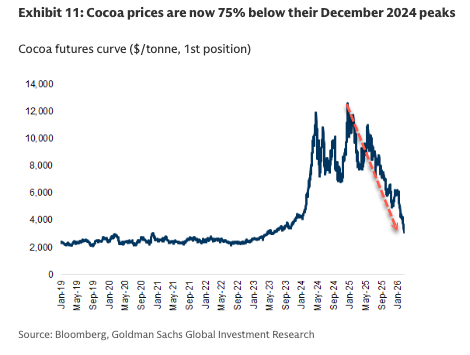
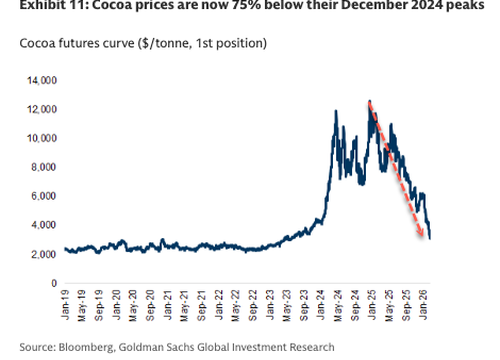
Cocoa prices have collapsed 75% from their 2024 peaks, and Goldman’s latest note points out that the worst of the cocoa shock for chocolate makers may finally be passing after being squeezed by soaring bean costs through 2023, 2024, and into the first half of 2025. This only suggests that lower chocolate bar prices at the supermarket could materialize later this year. Against that backdrop, Goldman reiterated Buy ratings on two confectionery stocks.
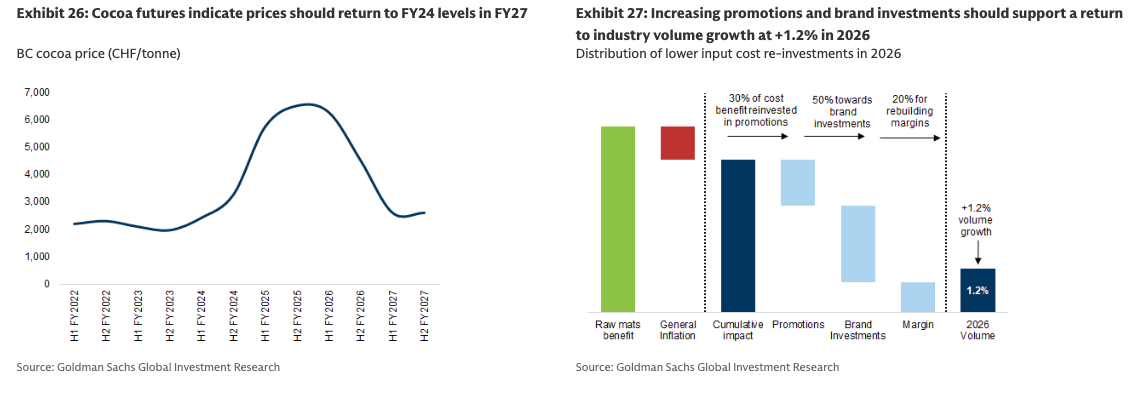
Analysts led by Sam Darbyshire said the global chocolate production costs should drop by as much as 10% in 2026 and 2027. She pointed out that weather patterns in West Africa – the mecca of global cocoa farming – have supported increased production for the upcoming harvest, leading to stabilization in global supplies.
Darbyshire pointed out that the cocoa futures curve is no longer backward-dated, with December 2027 delivery now 17% more expensive than March 2026 delivery. She said this would help top confectionery firms to commit to increased volumes.
“Double-digit raw material deflation in chocolate over the next two years is likely to drive an increasingly competitive operating environment as manufacturers strive to return to volume growth,” she wrote in the report.
Darbyshire noted that, with elevated chocolate prices, current Nielsen data show that consumer demand for chocolate remained soft in January, with elasticities worsening in Europe (consistent with Mondelez commentary). She said that private players are being more competitive on pricing, with Mars and Ferrero pricing below market.
“With weak underlying volumes and easing raw material inflation, we expect promotional activity to intensify throughout the year,” the analyst said.
Darbyshire said this new cocoa pricing regime has generated a “Buy” in Barry Callebaut and Nestle, but “Sell” in Lindt.
Why this matters is that the chocolate industry is about to transition from a period of price hikes to one of greater discounting and tougher competition.
In a separate note, Bonnie Herzog, managing director and senior consumer analyst at Goldman, highlighted in December that sliding cocoa prices could produce “tailwinds” for candy and junk food companies. Read that note here.
Professional subscribers can read the full note on the inflection point the chocolate industry is entering this year, along with many more charts via Goldman, on our new MarketDesk.ai portal. As noted above, attractive setups are emerging in several beaten-down candy stocks.
Tyler Durden
Fri, 02/27/2026 – 05:45
Today in Chicago History: Jane Byrne beats Mayor Michael Bilandic in the Democratic primary
Here’s a look back at what happened in the Chicago area on Feb. 27, according to the Tribune’s archives.
Is an important event missing from this date? Email us.
Sports front flashback: Feb. 28, 1998
The funeral for popular Chicago Cubs announcer Harry Caray took place on Feb. 27, 1998, at Holy Name Cathedral. (Chicago Tribune)
1998: Chicago Cubs broadcaster Harry Caray — who died Feb. 18, 1998, in Rancho Mirage, California — received a final standing ovation during his funeral Mass at Holy Name Cathedral. “Take Me Out to the Ball Game” played as his casket left the sanctuary.
Weather records (from the National Weather Service, Chicago)
High temperature: 75 degrees (1976)
Low temperature: Minus 6 degrees (1897)
Precipitation: 1.08 inches (1876)
Snowfall: 2.9 inches (1954)
Mary E. Hoy and her daughter Elizabeth were two of the 12 people who died after the Cunard line ship Laconia was struck by a German torpedo on Feb. 27, 1917, off the coast of Ireland. At least 20 passengers on the ship were American. (Chicago Tribune)
1917: Tribune correspondent Floyd P. Gibbons was on the British ocean liner Laconia bound for reporting duty in England when the ship was torpedoed off the coast of Ireland by a German submarine in the North Atlantic. The Tribune reported Gibbons, who previously traveled with Mexican revolutionary Pancho Villa, was the only reporter aboard the vessel when it was struck and began sinking. Gibbons messaged the Tribune: “Two Chicago women victims,” before the first draft of his story about the attack was published in the Feb. 28, 1917, edition of the newspaper.
“I have serious doubts whether this is a real story,” Gibbons wrote. “I am not entirely certain that it is not all a dream. … It is now a little over thirty hours since I stood on the slanting decks of the big liner, listened to the lowering of the lifeboats, heard the hiss of escaping steam and the roar of ascending rockets as they tore lurid rents in the black sky and cast their red glare over the roaring sea.”
Mary E. Hoy and her daughter Elizabeth were two of the 12 people who died after the Cunard line ship Laconia was struck by a German torpedo on Feb. 27, 1917, off the coast of Ireland. At least 20 passengers on the ship were American. (Chicago Tribune)
Widely reprinted, Gibbons’ story stiffened American support for war with Germany by depicting the emotional roller coaster of Americans on a sinking ship in which 12 people died. Gibbons became a well-known and decorated World War I correspondent who lost his eye during a battle.
1974: During an argument outside City Council chambers, Ald. Edward Burke threatened to punch 5th Ward Ald. Leon Despres in the mouth.
Despres told Burke, “Thank you for not doing it,” before returning to chambers. The two later shook hands and made up.
Paralyzing blizzards set up Chicago Mayor Michael Bilandic for defeat, but it was bright sunshine on Feb. 27, 1979, that did him in. The fair weather on the day of the mayoral primary election brought out the voters the second-biggest turnout for a primary election in 40 years and the memory of the city’s inept handling of record January storms drove them to overturn the Democratic machine. Maverick candidate Jane Byrne won the Democratic nomination. (Chicago Tribune)
1979: In the wake of the city’s inept handling of record January snowstorms, Jane Byrne upset Mayor Michael Bilandic in the Democratic primary. Byrne’s campaign, launched after she was fired from a City Hall job by Bilandic, was dismissed at first as a bid for retribution. But Bilandic’s handling of the snow buried him.
Byrne easily defeated Republican opponent Wallace Johnson in the general election and was elected Chicago’s first female mayor on April 3, 1979.
Want more vintage Chicago?
Subscribe to the free Vintage Chicago Tribune newsletter, join our Chicagoland history Facebook group, stay current with Today in Chicago History and follow us on Instagram for more from Chicago’s past.
Have an idea for Vintage Chicago Tribune? Share it with Kori Rumore and Marianne Mather at krumore@chicagotribune.com and mmather@chicagotribune.com
https://www.chicagotribune.com/2026/02/27/february-27-chicago-history/

Anarcho-Tyranny & The UK Grooming Gangs Scandal
Anarcho-Tyranny & The UK Grooming Gangs Scandal
Authored by Lipton Matthews via The Mises Institute,
I recently attended an event at the Prosperity Institute in the United Kingdom, and, as a foreigner listening to the discussion unfold, I found it both unsettling and clarifying.
The panel addressed the grooming gang scandal, a subject that remains profoundly uncomfortable for Britain’s political and cultural establishment. What distinguished this event was its refusal to soften the reality of what occurred or to retreat into evasive language. The discussion did not merely revisit past failures; it exposed a deeper pattern in how British institutions exercise power.
At the center of the panel was Fiona Goddard—a victim of grooming who spoke with calm precision.
She described how the police betrayed her trust after she came forward with her story, only to discover that information she had shared in confidence had been passed back to members of the grooming gang. That institutional betrayal placed her at renewed risk and compounded the original abuse. She also recounted something even more disturbing. The men who groomed her told her explicitly that they targeted her because she was white and that their aim was to destroy white girls. The starkness of her testimony stripped away any remaining illusions about the ideological framing that has often surrounded these crimes.
Listening to Fiona, what struck me was not only the brutality of what she endured, but the nature of the state’s response. Fiona explained that her claims were subjected to extraordinary scrutiny. She was examined by ten attorneys, her credibility tested repeatedly before her story was taken seriously. This stood in sharp contrast to the cultural climate of the #MeToo era, when allegations of harassment were often treated as self-validating. Men whose names appeared on the “Shitty Media Men” list were publicly ruined without due process or serious examination of the accusers. The disparity raises uncomfortable questions about which victims are believed, which are doubted, and how ideology governs the distribution of moral concern.
The wider panel discussion was notable for its candor. Panelists criticized diversity and multiculturalism not as benign aspirations, but as governing ideologies that discourage honesty and enforce selective silence. It was repeatedly noted that in many cases connected to the grooming gang scandal, the individuals who faced punishment were not the professionals who ignored, enabled, or concealed abuse, but whistleblowers who attempted to raise concerns. Those who spoke out were disciplined, sidelined, or removed, while senior officials who presided over failure often escaped consequences altogether.
Several speakers sharply criticized politicians and senior security officials for ignoring, minimizing, or suppressing the scandal over many years. This pattern reflected not incompetence but fear, fear of reputational damage and fear of challenging ideological orthodoxy. Enforcement did not fail because institutions were incapable, but because they were unwilling.
One panelist in particular, Leila Cunningham—a prosecutor and Reform politician—was especially forthright.
Cunningham identified herself as Muslim and criticized what she described as police cowardice, arguing that law enforcement repeatedly failed to act decisively out of fear of being accused of racism. In her assessment, the grooming gang scandal amounted to a systemic cover-up by legal and political authorities.
Cunningham stated that local councils were aware of what was happening for years and yet chose inaction. This was not ignorance or bureaucratic delay, but deliberate suppression. The failure of councils, police forces, and senior officials to intervene represented a national shame, one that discredited Britain’s claims to moral seriousness and institutional competence.
She also argued that British institutions apply justice unevenly. When perpetrators are white, she claimed, the system acts swiftly and punitively. When offenders fall outside that category, it becomes hesitant and evasive. This asymmetry is not justice but ideology masquerading as principle. She further emphasized the class dimension of the scandal, pointing out that the victims were overwhelmingly working-class girls whose lack of social power made them easy to ignore.
In one of the evening’s most controversial moments, Cunningham argued that elements within Pakistani immigrant communities had encouraged what she described as “rape tourism” and that Britain’s immigration and visa regime had failed to respond. She called for strict visa bans and enforcement measures against countries that refuse to take back convicted offenders, naming Pakistan explicitly. Whether one agreed with her conclusions or not, the bluntness of her language stood in stark contrast to decades of official euphemism.
These criticisms of multicultural orthodoxy were reinforced by Labour peer Lord Maurice Glassman, who criticized multiculturalism as an ideology that deters solidarity. By fragmenting society into competing identity groups, he argued, multiculturalism had weakened shared moral obligations and eroded the foundations of working-class politics.
Despite the severity of the subject, the atmosphere in the room was introspective rather than confrontational. The audience was largely composed of elite professionals, yet there was a palpable sense of unease. During the question-and-answer session, a man of Pakistani descent criticized the media for its longstanding refusal to speak honestly about the ethnicity of the groomers. He accused journalists of deliberately suppressing factual description and of turning truth-telling itself into a punishable offence. The reflex, he argued, was not to investigate wrongdoing, but to manage narratives.
It was only after hearing these accounts and observing the broader patterns of selective enforcement that the evening’s discussion began to coalesce into a sharper insight, one that echoes the warnings of the late political theorist Sam Francis. What unfolded before us was a clear case of anarcho-tyranny—a system in which the state withdraws from enforcing basic law and order where it is most needed, while simultaneously expanding its authority over thought, speech, and symbolic behavior. Police and councils proved incapable or unwilling to protect vulnerable girls, yet the same institutions have shown remarkable zeal in punishing those who defy approved narratives.
Across Europe, governments increasingly appear more interested in prosecuting thought crimes than confronting serious harm. In Britain, Sam Melia sits in prison for posting stickers reading, “It’s OK to be white,” while blogger Pete North was reportedly arrested for sharing an anti-Hamas meme. In Germany, a woman was given a harsher sentence for insulting her attacker, calling him a “disgraceful rapist pig,” than the rapist himself received for the crime.
Words are treated as dangerous, while actions are often tolerated or excused.
By the end of the evening, it was difficult to ignore the sense that something was shifting. The event suggested a broader ideological change, even within elite environments long aligned with liberal orthodoxies. There was a growing willingness to question the dogmas of diversity and multiculturalism, and an emerging resistance to what several speakers openly described as liberal, anti-white politics. More fundamentally, there was a dawning recognition that a state which punishes speech while tolerating predation is not compassionate or progressive, but decadent. Whether this shift will endure remains uncertain, but the discussion itself felt like a decisive break from years of silence, deflection, and managed anarchy.
Tyler Durden
Fri, 02/27/2026 – 05:00
https://www.zerohedge.com/political/anarcho-tyranny-uk-grooming-gangs-scandal