Category: News

Dense fog advisory issued until 10 a.m. Friday in Chicago area
A dense fog advisory was issued for northern and central Cook County set to expire at 10 a.m. Friday, weather officials said.
The advisory covers cities including Gurnee, Des Plaines, Oak Park, Chicago, LaGrange, Mundelein, Waukegan, Buffalo Grove, Cicero, Palatine, Evanston, Northbrook, Schaumberg and Oak Lawn, according to the National Weather Service.
Officials warn fog may cut visibility to less than a quarter mile and caution drivers to slow down, use headlights and allow plenty of distance ahead of you as driving conditions will be hazardous in some areas.
Current morning conditions at O’Hare International Airport are fog/mist at 45 degrees. Farther south at Midway Airport, conditions are similar at 46 degrees, officials said.
There is an 80 to 60 percent chance of thunderstorms Friday, and by the nighttime hours, the chance of thunderstorms storms drops to diminishes to 40 percent with a 90 percent chance of showers, officials said.
Temperatures are expected to reach the high 60s Friday, and are expected to be in the low 60s Saturday with showers in the morning hours when conditions are expected to be breezy but partly sunny. Sunday conditions are expected to shift to sunny and breezy with temperatures in the high 50s.
https://www.chicagotribune.com/2026/03/06/weather-forecast-fog-advisory/

Naperville Police Arrests for Feb. 28-March 3
The following items were taken from Naperville police reports and press releases. An arrest does not constitute a finding of guilt:
A 43-year-old man from Cicero was arrested on a charge of felony possession or use of a weapon/firearm/ammunition/body armor at 12:37 p.m. Feb. 28 in the 1600 block of Naperville Wheaton Road.
A 40-year-old woman from Geneva was arrested on charges of retail theft exceeding $300 and retail theft not exceeding $300 at 1:39 p.m. Feb. 28 at the police station, 1350 Aurora Ave.
A 51-year-old man from Naperville was arrested on a warrant at 8 p.m. Feb. 28 in the 1800 block of South Washington Street.
A 27-year-old man from Naperville was arrested on a charge of retail theft exceeding $300 at 1:05 a.m. March 1 at Jackson Avenue and South Webster Street.
A 21-year-old man from Lisle was arrested on a charge of aggravated speeding in a construction zone/35 mph or more over the limit at 2:22 a.m. March 2 at West 75th Street and Plainfield Naperville Road.
A 38-year-old man from Naperville was arrested on a warrant at 11:41 a.m. March 2 at the police station, 1350 Aurora Ave.
An 18-year-old man from Winfield was arrested on a charge of battery at 3:10 p.m. March 2 at the police station, 1350 Aurora Ave.
A 38-year-old woman from Stevenson, Ohio, was arrested on a charge of possession of a controlled substance/less than 100 grams of heroin at 5:58 p.m. March 2 in the 37W700 block of Route 38 in St. Charles.
A 53-year-old woman from Naperville was arrested on a warrant at 3:52 a.m. March 3 in the 100 block of 4th Avenue.
https://www.chicagotribune.com/2026/03/06/naperville-police-arrests-blotter-32/
Suspende UE viajes sin visa a diplomáticos y funcionarios de Georgia por retroceso democrático
Associated Press
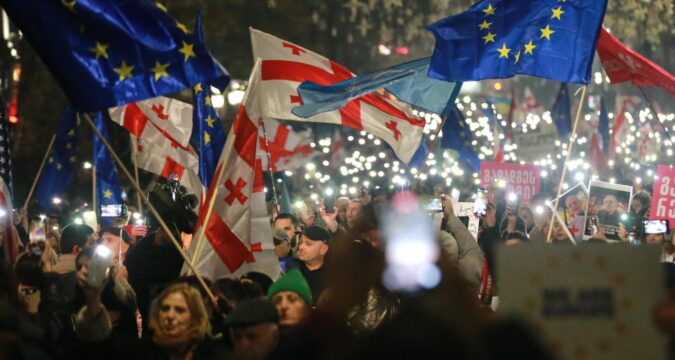
BRUSELAS (AP) — La Unión Europea suspendió el viernes, por al menos un año, los viajes sin visado a Europa para diplomáticos y funcionarios de Georgia debido al retroceso democrático y a la represión contra manifestantes antigubernamentales.
“Si un gobierno ataca a su propio pueblo, silencia a los periodistas y recorta la libertad, hay consecuencias”, indicó en un comunicado la jefa de la diplomacia de la UE, Kaja Kallas.
Las protestas y la agitación política han sacudido a Georgia desde que el partido gobernante Sueño Georgiano detuvo en noviembre de 2024 las conversaciones para unirse a la UE, pese a que se trata de un objetivo para muchos georgianos consagrado en la Constitución del país.
La medida desencadenó oleadas de protestas que han sido respondidas con detenciones masivas y violencia policial. Ocurrió luego que el partido, en el poder desde hace mucho tiempo, declarara su victoria en unas elecciones parlamentarias que la oposición afirmó que fueron amañadas.
La Comisión Europea indicó que había suspendido los viajes oficiales “en respuesta a la violación deliberada y persistente por parte de Georgia de los compromisos asumidos en el marco de su régimen de exención de visado en ámbitos clave de la democracia y los derechos fundamentales”.
Esas violaciones incluyen una “represión contra manifestantes, políticos de la oposición y medios independientes”, que ha “derivado en vulneraciones de varios derechos fundamentales y de normas jurídicas internacionales”.
El brazo ejecutivo de la UE señaló que los viajes sin visado quedarán suspendidos hasta el 6 de marzo de 2027, pero que esto podría ampliarse por dos años más si las autoridades georgianas no abordan los problemas de gobernanza y de Estado de derecho.
La comisión también recomendó a los gobiernos europeos que examinen de cerca a todos los ciudadanos georgianos que entren en Europa. Advirtió que los funcionarios y diplomáticos que intenten cruzar con pasaportes personales en lugar de documentos oficiales podrían enfrentarse a una prohibición de entrada.
“El pueblo de Georgia cuenta con todo nuestro apoyo, pero no hay lugar en nuestra unión para quienes representan la represión”, añadió Kallas.
___
Esta historia fue traducida del inglés por un editor de AP con la ayuda de una herramienta de inteligencia artificial generativa.
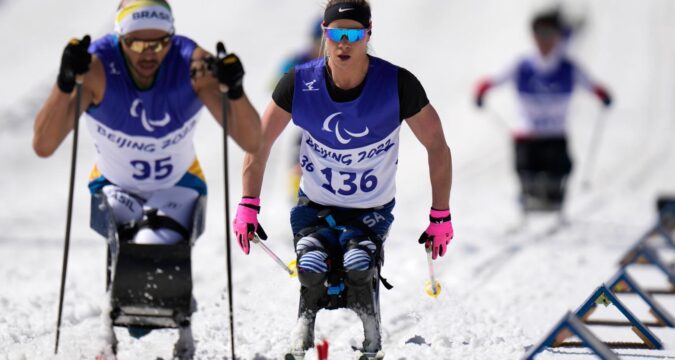
Guide to the 6 sports at the Milan Cortina Winter Paralympics
MILAN — The Winter Paralympics officially start on Friday, with the opening ceremony in Verona, Italy.
With 665 Para athletes and 79 sets of medals to be awarded, Milan Cortina will feature a record number of athletes and medals.
They will compete across six sports: Para alpine skiing, Para biathlon, Para cross-country skiing, Para ice hockey, Para snowboard and wheelchair curling.
In the skiing sports — Para alpine skiing, Para biathlon, Para cross-country skiing — athletes compete in one of three categories: standing, sitting (on a sit-ski or monoski) or vision impaired (who race following a guide connected via radio).
Guides also receive medals.
Within each of these three categories skiers compete in different divisions depending on their functional ability. A results calculation system determines the factored time of each athlete, which allows athletes from different divisions to race against each other.
Here’s a look at the sports.
Para alpine skiing
Introduced at the first Winter Paralympics in 1976, it includes five events: slalom, giant slalom, super-G, downhill and super combined.
There are 30 medal events — 15 for men and 15 for women.
In the sitting category, athletes use a specialized monoski, a seat mounted on a single ski with a shock absorber that helps with riding on uneven terrain and making turns.
In Para biathlon and Para cross-country, the sit-ski is a sitting device mounted on a pair of cross country skis.
Para alpine skiing will take place on the Olympia delle Tofane course in Cortina d’Ampezzo, the same iconic course that held the women’s alpine skiing at the recently concluded Winter Olympics.
Para biathlon
Combines the strength and endurance of cross-country skiing with the precision and composure of target shooting.
There are three events in each class — 7.5-kilometer sprint, 12.5-kilometer individual and sprint pursuit — and men and women compete in separate races, for a total of 18 medal events.
The ski course is tackled several times and between each lap athletes shoot at five metal targets placed 10 meters away. For each missed shot they get a time penalty or have to ski a penalty loop, depending on the event.
Athletes with disabilities in the upper limbs can be assisted by their coaches in positioning the rifle and pulling the trigger at their direction. In the vision impairment category, athletes are aided by acoustic targets which indicate how close they are to the target before shooting.
The sport was introduced for athletes with physical disabilities at the 1988 Innsbruck Paralympic Games and for athletes with visual disabilities in 1992 at Albertville.
At Milan Cortina, Para biathlon will take place at the Tesero Cross-Country Skiing Stadium.
Para cross-country skiing
This will also take place in Tesero and has a total of 20 medal events.
There are three events for men and women (across the three categories): sprint, 10-kilometer interval start classic, 20-kilometer interval start free. There is also the mixed 4×2.5-kilometer relay, and open 4×2.5-kilometer relay.
For each competition, there are separate courses for athletes in the sitting category and for athletes in the standing and vision impaired categories. The courses for the athletes in the sitting category have lower gradients as the athletes rely on the upper body for pushing/pulling themselves forward while on a sit-ski.
A relay team can be made up of two, three or four athletes (plus guides as appropriate) with athletes able to ski more than one leg.
Para ice hockey
Para ice hockey was invented at a rehabilitation center in Stockholm, Sweden, during the early 1960s by a group of Swedes who, despite their physical impairment, wanted to continue playing hockey.
It debuted in the Winter Paralympics at Lillehammer in 1994 and involves athletes with a physical disability in their lower limbs. Matches consist of three 15-minute periods.
Rather than skates, players use double blade sledges that allow the puck to slide underneath and have two sticks, which have a spike-end for propulsion and a blade-end for handling the puck.
Suburban natives hope to lead US sled hockey team to another Paralympic gold medal
Para ice hockey is a mixed gender sport, although only two teams at Milan Cortina have a female in their squads — Japan and Slovakia.
Moreover, only three female ice hockey players have ever participated at the Paralympic Games: Norwegians Brit Mjaasund Oeyen in 1994 and Lena Schroeder at Pyeongchang in 2018, and Yu Jing of China at Beijing in 2022.
The United States will be looking to complete a three-peat, having won both the men’s and women’s tournaments at the recent Winter Olympics. The U.S. has also won the Para ice hockey at five of the past six editions of the Winter Paralympics, with only Canada interrupting that streak in 2006.
Competition will take place at the new Santagiulia arena in Milan. There are eight teams, split into two groups. The teams play each other team in their group once in a round-robin format, with the top two from each group advancing to the semifinals.
Para snowboard
Debuted in Sochi in 2014 as part of the alpine skiing program, although there have been a varied number of events at subsequent Olympics.
At Milan Cortina there are two events across three categories for men depending on the disability and one category for women.
There are two categories for men with lower-limb impairments and one for those with upper-limb impairments, while there is one category for women with lower-limb impairments.
Para snowboarders with a disability affecting one or both legs can use prosthetics or modified equipment to compete.
The two events are banked slalom and snowboard cross and will take place in Cortina. In banked slalom, athletes get two individual runs down the course with their best time counting toward the final ranking.
The heats and the finals of the snowboard cross will see four athletes racing at the same time. The top two advance from the heats and then the first across the finish line in the final wins.
Wheelchair curling
The mixed-team event for athletes with physical disabilities in their legs is celebrating its 20th anniversary after being introduced the last time the Paralympics were held in Italy, in 2006.
Players can choose whether to throw the stone alone or with a teammate who holds the wheelchair steady. Athletes can use an extender to add speed and direction.
There are eight ends per game, two less than games at the Olympics, and there is no sweeping.
Competition will take place at the Cortina Curling Olympic Stadium and the program will feature a mixed doubles competition for the first time as well as the regular mixed team event.
https://www.chicagotribune.com/2026/03/06/winter-paralympics-six-sports/
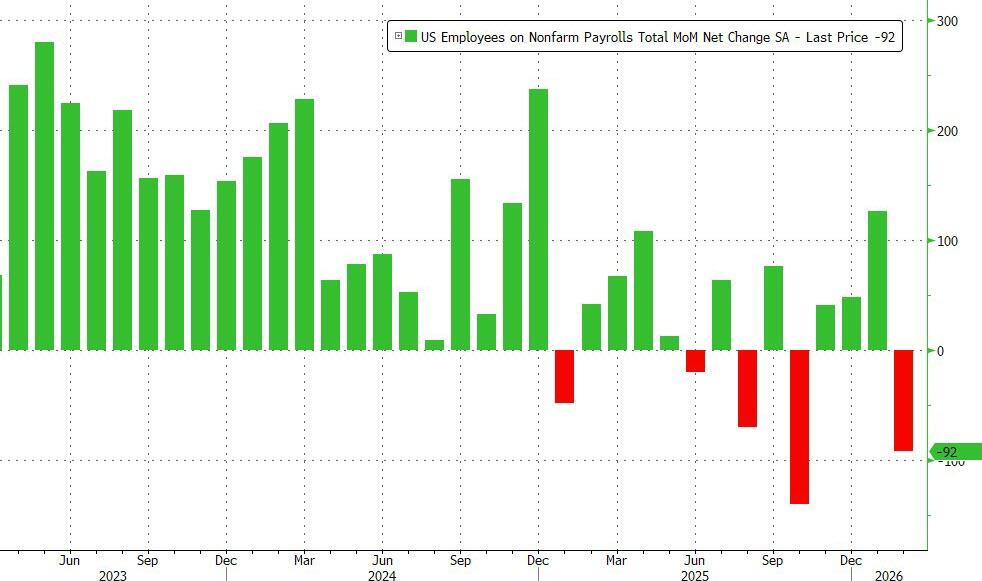
Jobs Shock: US Lost 92K Payrolls In February, Far Below Lowest Estimate, As Unemployment Rate Rises
Jobs Shock: US Lost 92K Payrolls In February, Far Below Lowest Estimate, As Unemployment Rate Rises
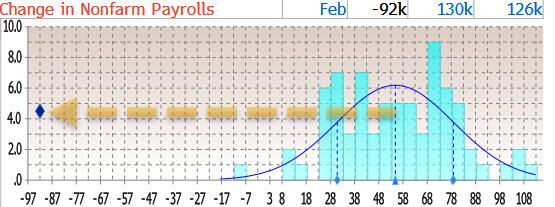
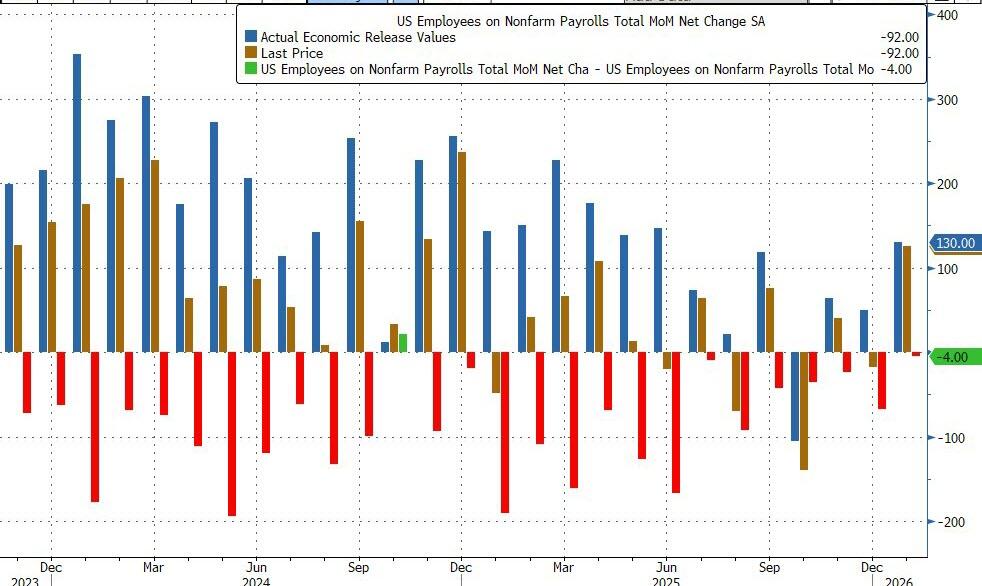
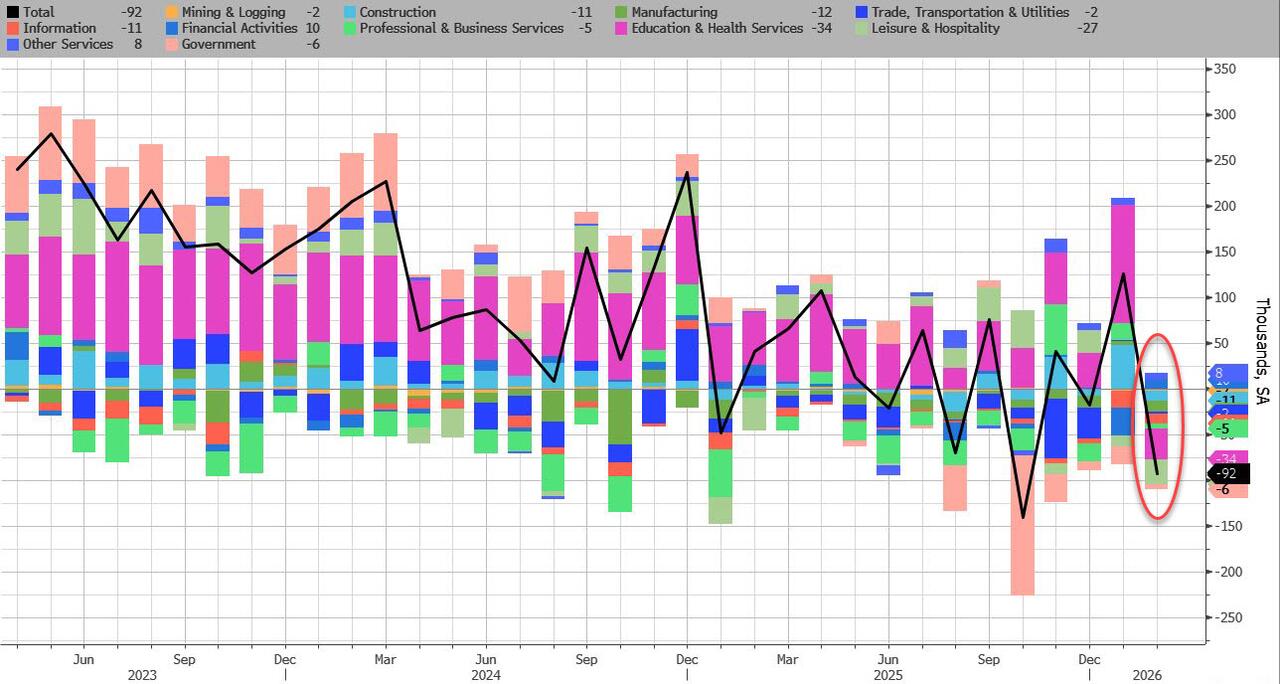
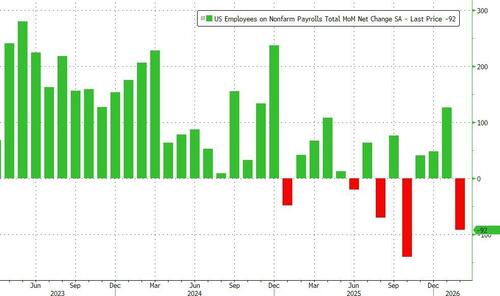
In our nonfarm payrolls preview, we quoted JPMorgan’s Market Intel desk which said that “for this print, the stronger the better”, which by implication means that a poor number would be bad. By that logic, the actual number couldn’t be any worse, because moments ago the BLS reported that in February, the US lost 92,000 jobs, a huge drop from the downward revised (of course) 126K in January, and the second worst print since 2020 (only October’s shock -140K was worse). The number of private payrolls dropped by 86K, also a huge miss to estimates of a 60K increase.
The February payrolls print was a six-sigma miss to the 55K median estimate, and came in 83K below the lowest estimate!
The change in total nonfarm payroll employment for December was revised down by 65,000, from +48,000 to -17,000, and the change for January was revised down by 4,000, from +130,000 to +126,000. With these revisions, employment in December and January combined is 69,000 lower than previously reported.
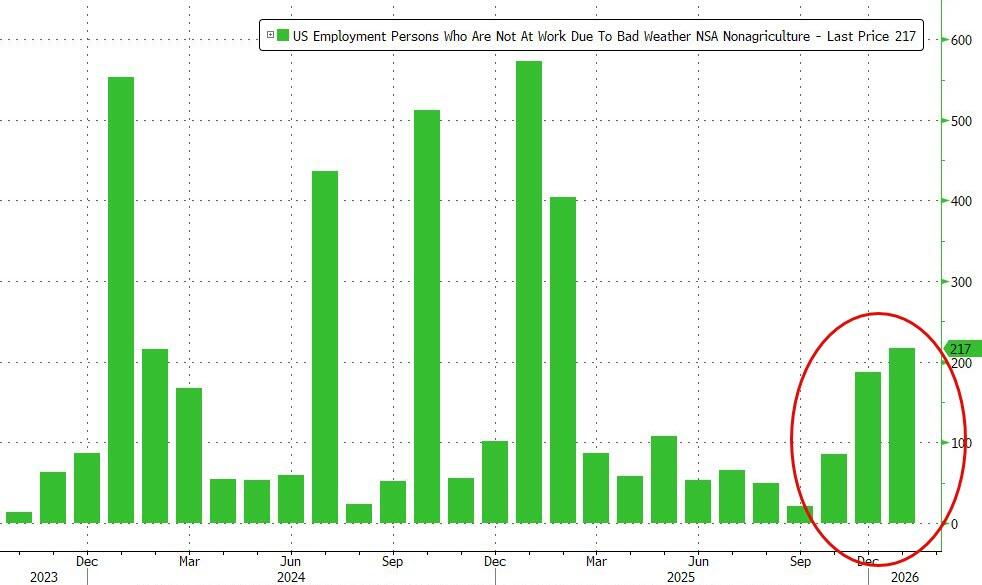
One potential mitigating factor: the number of people who were unable to work due to weather surged to 228K in February, well above last year’s level 167K, due to the powerful winter storms hitting the US.
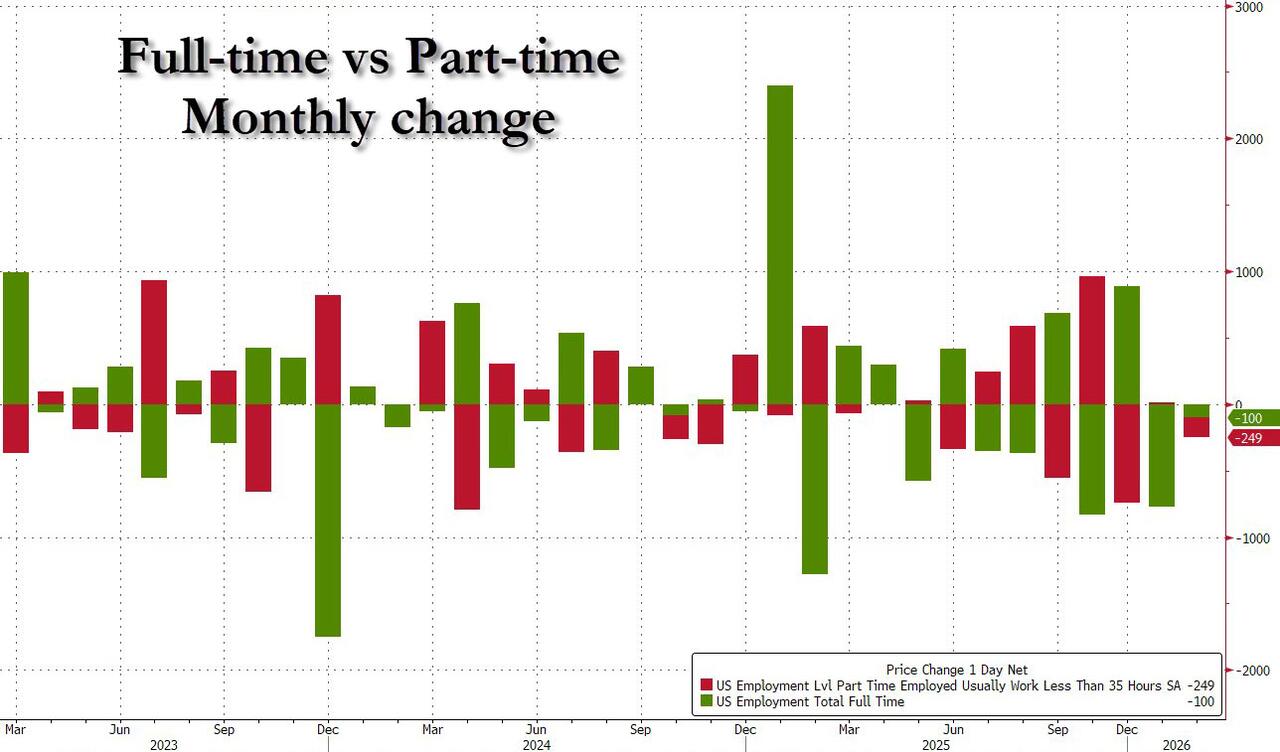
Looking under the surface does not reveal as silver lining: part-time workers dropped by 249K while full-time workers slid by 100K.
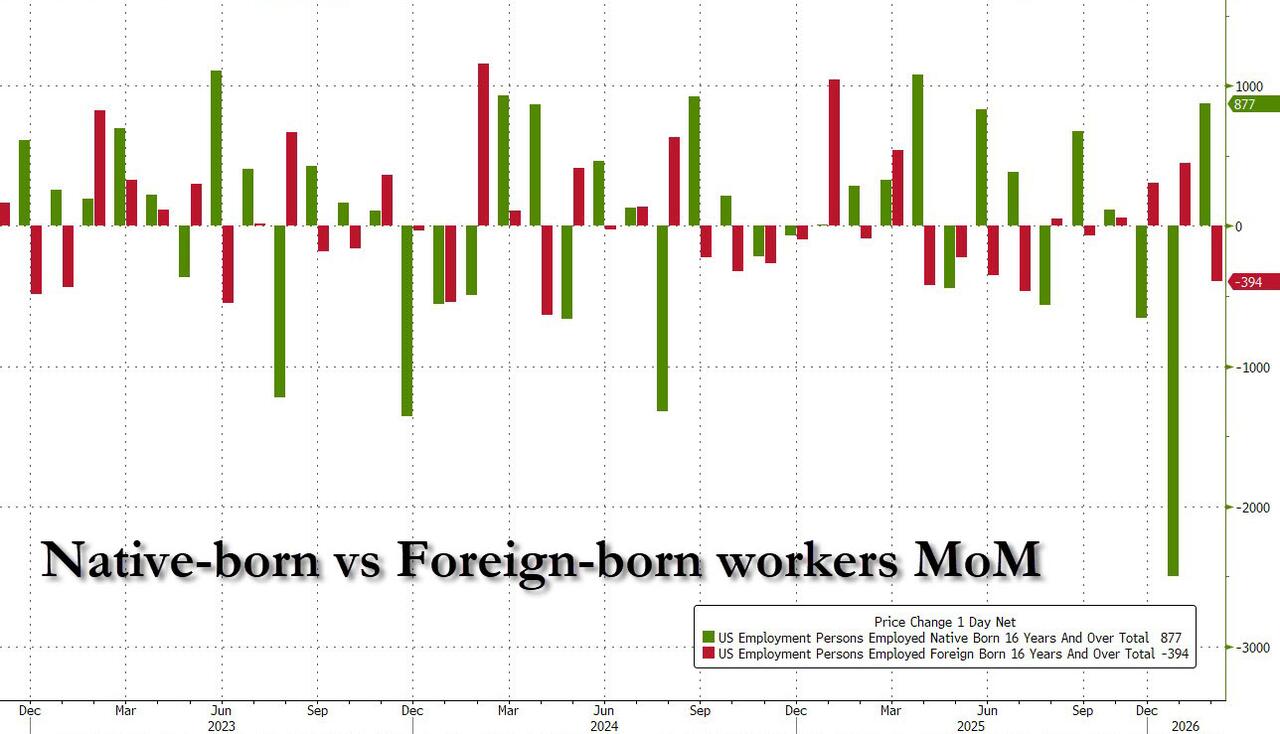
Perhaps the only silver lining was that native-born workers jumped by 877K (which was only a modest reversal of the 2.5 million drop last month), while foreign born workers dropped by 394K.
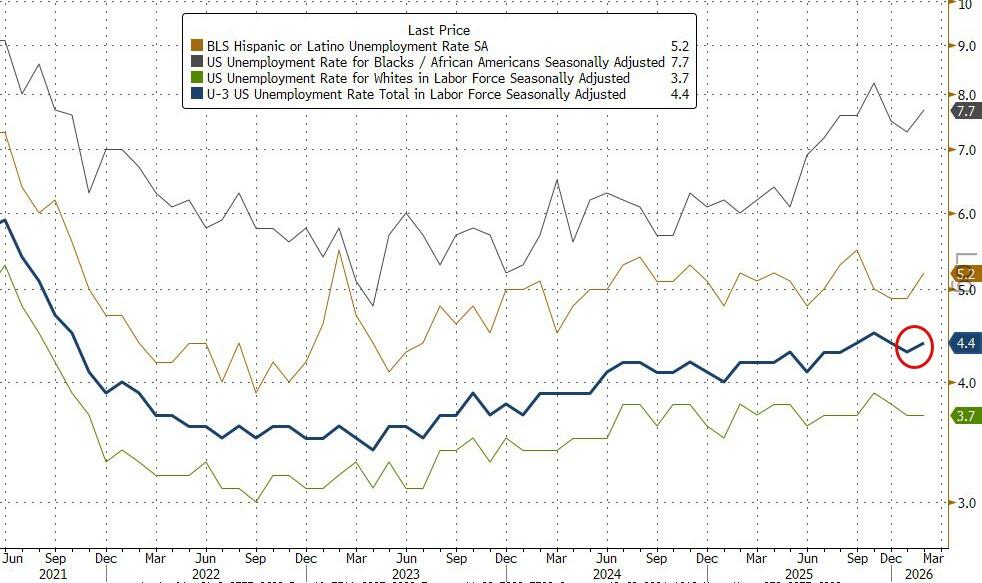
The unemployment rate rose from 4.3% to 4.4% vs estimates of an unchanged print, as the number of unemployed workers rose by 203K from 7.368MM to 7.571MM, while the civilian labor force was virtually unchanged (from 170.564K to 170.483K). Among the major worker groups, the unemployment rates for adult men (4.0 percent), adult women (4.1 percent), teenagers (14.9 percent), and people who are White (3.7 percent), Black (7.7 percent), Asian (4.8 percent), or Hispanic (5.2 percent) all rose modestly in February.
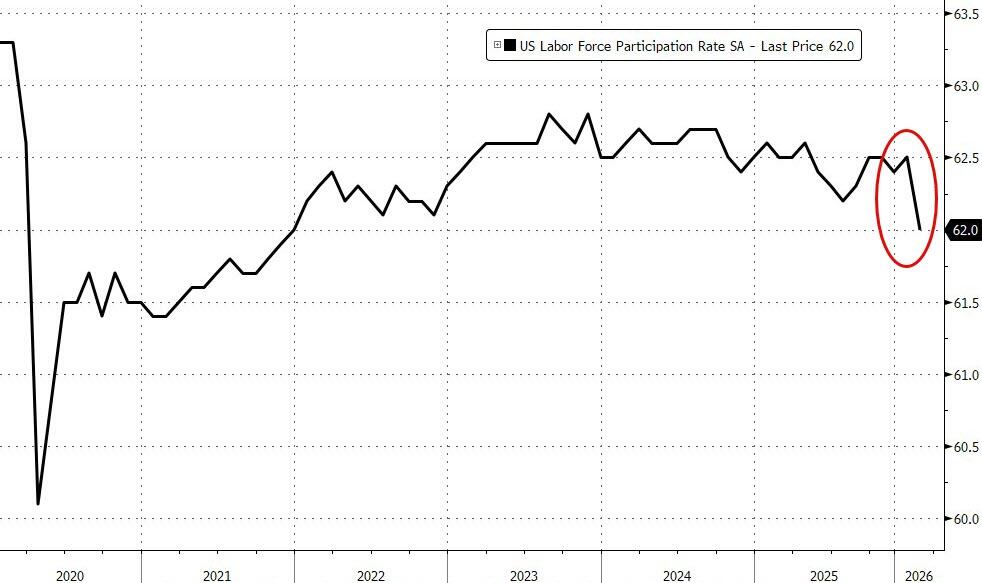
Both the labor force participation rate, at 62.0% (below the estimate of 62.5%), and the employment-population ratio, at 59.3%, changed little in February. These measures showed little change over the year, after accounting for the annual adjustments to the population controls.
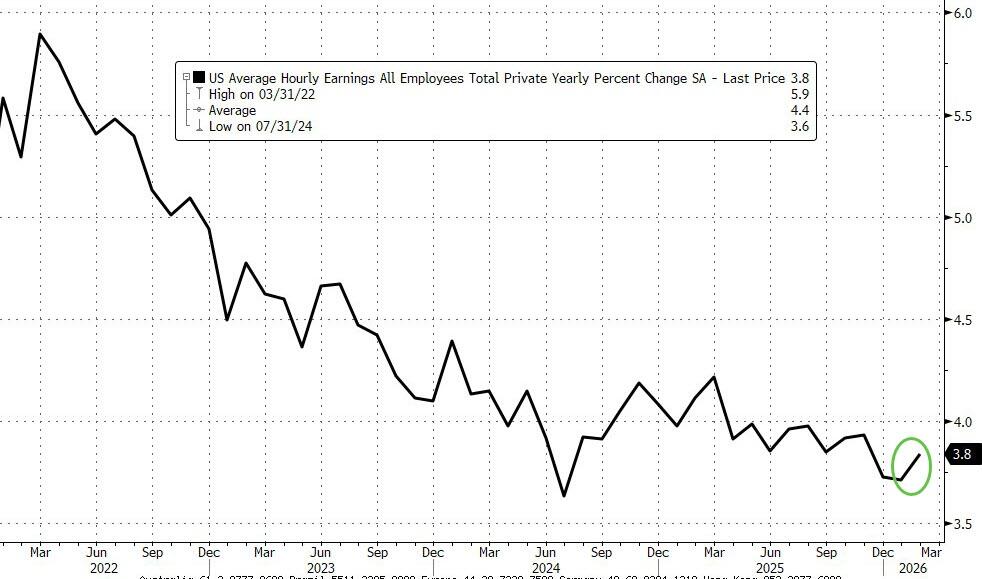
Turning to wages, average hourly earnings rose 0.4% MoM, same as January and above estimates of a 0.3% imcrease. This translated into a 3.8% YoY increase, up from 3.7% and the consensus of an unchanged print.
Some more details from the report
The number of long-term unemployed (those jobless for 27 weeks or more) changed little at 1.9 million in February but is up from 1.5 million a year earlier. The long-term unemployed accounted for 25.3 percent of all unemployed people in February.
The number of people employed part time for economic reasons decreased by 477,000 to 4.4 million in February. These individuals would have preferred full-time employment but were working part time because their hours had been reduced or they were unable to find full-time jobs.
The number of people not in the labor force who currently want a job changed little in February at 6.0 million. These individuals were not counted as unemployed because they were not actively looking for work during the 4 weeks preceding the survey or were unavailable to take a job.
Among those not in the labor force who wanted a job, the number of people marginally attached to the labor force changed little at 1.6 million in February. These individuals wanted and were available for work and had looked for a job sometime in the prior 12 months but had not looked for work in the 4 weeks preceding the survey. The number of discouraged workers, a subset of the marginally attached who believed that no jobs were available for them, decreased by 109,000 in February to 366,000.
Turning to the establishment survey, which unveiled the shocking
Employment in health care decreased in February, reflecting strike activity. Employment in information and federal government continued to trend down. Payroll employment changed little on net in 2025.
Health care employment declined by 28,000 in February, following a large increase in January (+77,000). Offices of physicians lost 37,000 jobs in February, primarily due to strike activity. Hospitals added 12,000 jobs. Over the prior 12 months, health care had added an average of 36,000 jobs per month.
Employment in information continued to trend down in February (-11,000). The industry had lost an average of 5,000 jobs per month over the prior 12 months.
In February, federal government employment continued to decline (-10,000). Since reaching a peak in October 2024, federal government employment is down by 330,000, or 11.0 percent.
Employment in social assistance continued its upward trend in February (+9,000), driven by individual and family services (+12,000).
Transportation and warehousing employment changed little in February (-11,000). A job loss in couriers and messengers (-17,000) was partially offset by a gain in air transportation (+5,000). Employment in transportation and warehousing has declined by 157,000, or 2.4 percent, since reaching a peak in February 2025.
Employment showed little change over the month in other major industries, including mining, quarrying, and oil and gas extraction; construction; manufacturing; wholesale trade; retail trade; financial activities; professional and business services; leisure and hospitality; and other services.
While we will have more to say about this report, the kneejerk reaction is, well, bad: this was about as ugly as it could be, and coming in a time when input costs are soaring due to the Iran war, it screams AI-driven stagflation.
Tyler Durden
Fri, 03/06/2026 – 08:57
https://www.zerohedge.com/markets/jobs-shock-us-lost-92k-payrolls-february-unemployment-rate-rises

Shohei Ohtani hits grand slam as Japan routs Taiwan 13-0 in WBC game stopped after 7 innings by mercy rule
Japanese fans don’t get to see Shohei Ohtani in person very often. They got an eyeful on Friday in a sellout at the Tokyo Dome.
Related Articles
Can a loaded US roster dethrone Japan at the World Baseball Classic?
At 76, Dusty Baker is managing again. He’s leading Nicaragua in the World Baseball Classic.
17 Cubs and White Sox players and prospects are competing in the World Baseball Classic: Here’s what to know
Column: Is it un-American to root against Team USA in WBC? Plus other pressing sports issues.
Ohtani hit a grand slam in the second inning — in the first he doubled on the first pitch of the game but didn’t score — as Japan hammered Taiwan 13-0 in Pool C at the World Baseball Classic. It was Japan’s first game of four in pool play.
The game was called after seven innings under the mercy rule, which is being used in the WBC. The game is called after five innings if a team leads by 15 runs or more, or after seven if the lead is 10 or more.
After threatening in the first, Japan exploded for 10 runs in the second inning.
Japan, batting first as the designated visiting team, put the first three runners on base — a walk, a single and a hit-by-pitch. Kenya Wakatsuki fouled out to the catcher, bringing up Ohtani for the dramatic slam to right field off starter Hao-Chun Cheng.
Japan added six more runs in the inning, which lasted 28 minutes. Reliever Chih-Wei Hu finished the inning, but not before Japan batted around and Ohtani got his third hit of the game — a single — and his fifth RBI in the inning.
And only two innings had been played.
Japan scored three more in the third, this time off the third pitcher, Tzu-Chen Sha, to push the lead to 13-0.
Left in the shadows was Japan’s starting pitcher Yoshinobu Yamamoto, last season’s World Series MVP with the Dodgers.
After long rests between innings, Yamamoto got into trouble in the third, walking two and loading the bases with the help of an error. He was replaced by Shoma Fujihira who struck out An-Ko Lin to end the threat.
Yamamoto struck out three, walked two and allowed no hits and was the winner. Cheng got the loss.
Ohtani led off the fourth and lined out on a leaping catch by first baseman Nien-Ting Wu as he tried for the cycle — a single, double, triple and a home run. He needed a triple to complete the cycle, and the leaping catch might have prevented it.
Japan is the defending WBC champion and the favorite from Pool C to reach the quarterfinals. Japan is also a favorite to reach the final in Miami on March 17, perhaps against the United States.
On Saturday in Pool C, Taiwan faces the Czech Republic and Japan plays South Korea.
Australia beats the Czech Republic 5-1 on a three-run homer by Curtis Mead
Australia defeated the Czech Republic 5-1 on Friday behind a three-run homer from Chicago White Sox infielder Curtis Mead to remain unbeaten in Pool C.
Australia is lining up among the favorites from Tokyo to reach the quarterfinals along with home team Japan.
Mead’s homer in the third put Australia up 3-1 after the Czechs failed to convert a double play early in the inning that eventually gave Mead a chance to bat. Australia added two runs in the ninth, including a solo home run by Alex Hall.
The Czechs took a 1-0 lead in the bottom of the second on a sacrifice fly by Vojtech Mensik.
Josh Hendrickson was the winning pitcher and Tomas Ondra got the loss.
Australia improved to 2-0 in Pool C and the Czechs fell to 0-2. Australia reached the quarterfinals three years ago in the last WBC but lost to Cuba 4-3.
The Australians have several players with MLB organizations including Mead. There’s also Travis Bazzana, the first pick in the 2024 MLB amateur draft taken by the Cleveland Guardians.
https://www.chicagotribune.com/2026/03/06/shohei-ohtani-japan-wbc-opener/

‘Worse than a prison’: 911 calls, interviews reveal problems at ICE’s largest detention camp
EL PASO, Texas — Serious medical and mental health emergencies have been routine at the nation’s largest U.S. Immigration and Customs Enforcement detention facility since its opening, according to records obtained by The Associated Press.
Data and recordings from more than a hundred 911 calls at Camp East Montana in El Paso, Texas, along with interviews and court filings, offer a disturbing portrait of overcrowding, medical neglect, malnutrition and emotional distress.
Current and former detainees describe a camp where about 3,000 people have lived per day in loud and unsanitary quarters. They say detainees struggle to obtain health care as disease spreads, lose weight because of a lack of food, and fear security guards known to use force to put down disturbances.
Chicago appeals court vacates judge’s use-of-force injunction on immigration agents
“Every day felt like a week. Every week felt like a month. Every month felt like a year,” said Owen Ramsingh, a former property manager in Columbia, Missouri, who spent several weeks in the camp before his deportation in February to the Netherlands. “Camp East Montana was 1,000% worse than a prison.”
EDITOR’S NOTE — This story includes discussion of suicide. If you or someone you know needs help, the national suicide and crisis lifeline in the U.S. is available by calling or texting 988. There is also an online chat at 988lifeline.org
A Department of Homeland Security spokesperson who did not provide their name rejected claims of subprime conditions, saying Camp East Montana detainees receive food, water and medical treatment in a facility that is regularly cleaned.
Here are some takeaways from AP’s reporting:
Camp averaged nearly one 911 call per day for months
After its opening in mid-August, staff at the camp made nearly one 911 call per day in its first five months of operation, according to data covering 130 calls from the City of El Paso obtained by the AP.
In one call, a man is heard sobbing after being assaulted by another detainee. In another, a doctor says a man is banging his head against the wall while expressing suicidal thoughts. In a third, a nurse says a pregnant woman is in severe pain and has coronavirus.
The injured detainees ranged from a 19-year-old man who fell out of a bunk bed to a 79-year-old man struggling to breathe. At least 20 emergencies were reported as seizures, including some that resulted in serious head trauma.
Calls reveal repeated attempted suicides
The calls show detainees have repeatedly tried to harm themselves and expressed suicidal thoughts.
Two incidents have resulted in death. On Jan. 3, ICE said security guards responded after a 55-year-old Cuban man tried to harm himself and then used handcuffs and force to restrain him. A medical examiner ruled that Geraldo Lunas Campos’s death was a homicide caused by asphyxia.
On Jan. 14, staff reported that a 36-year-old Nicaraguan man died by suicide days after he was detained while working in Minnesota.
In addition to those cases, at least six other suicide attempts were reported, according to records from the City of El Paso.
The DHS spokesperson said the facility’s staff “closely monitors at-risk detainees” and provides mental health treatment.
ICE has not released inspection results
The Washington Post reported in September that a required ICE inspection found conditions at the facility violated at least 60 federal standards for immigration detention. But that report has never been released, unlike dozens of other inspections at facilities posted on ICE’s website.
DHS has called claims of violations described in the Post story false without explaining why the inspection report was wrong. ICE’s current database on detention facilities indicates Camp East Montana has never been inspected but is scheduled for one this fiscal year.
A DHS spokesperson said ICE’s Office of Detention Oversight recently completed an inspection at Camp East Montana but provided no other information and the results have not been made public.
Congresswoman calls for camp’s closure and contract investigation
U.S. Rep. Veronica Escobar, an El Paso Democrat who has toured the camp several times, is calling for its closure.
“This facility should not be operational. It feels like this contractor is reinventing the wheel, and people are losing their lives in their experiment,” she said.
She said the facility had temporarily cut its population below 1,900 when she visited last month and will be closed to visitors temporarily because of a measles outbreak.
On one visit, a female detainee showed Escobar a meager serving of scrambled eggs that was served still frozen in the middle. She learned detainees protested after they had stopped receiving juice, fruit and milk with their meals.
Escobar met with a detainee from Ecuador who said his arm had been broken during a violent arrest by immigration agents in Minnesota. Weeks later, the congresswoman could still the fractured bones in his forearm poking up under the skin.
Escobar called for an investigation into contractor Acquisition Logistics LLC, which was awarded a contract worth up to $1.3 billion to build and operate the camp. She said the company, which didn’t return messages, and its subcontractors were not delivering services paid for by taxpayers.
“People should be moved by the abject cruelty, but if they’re not, I hope they’re moved by the fraud and corruption,” Escobar said.
https://www.chicagotribune.com/2026/03/06/911-ice-detention-camp/

Shohei Ohtani conecta un grand slam en su estreno en el Clásico Mundial
Por STEPHEN WADE
TOKIO (AP) — Este es el efecto Shohei Ohtani.
Ohtani sacudió un grand slam en la segunda entrada el viernes en el Clásico Mundial de béisbol, lo que impulsó a Japón a tomar rápidamente la ventaja sobre Taiwán. También pegó un doble en su primer turno al bate en la primera entrada.
Esa fue la acción temprana del juego que acabó con una victoria 13-0 por abultamiento de carreras.
También ofreció un espectáculo enorme en la práctica de bateo, horas antes de que siquiera comenzara el partido, y entusiasmó a muchos que habían viajado desde lejos para verlo.
Lia Chan y su esposo How, junto con otros familiares, viajaron desde Singapur —un vuelo de unas siete horas a Tokio— solo para ver a Ohtani jugar en el Clásico.
“Y el béisbol ni siquiera es popular en Singapur”, comentó Lia, sentada a unas cuantas filas detrás del plato. “Sabemos de béisbol, lo vemos, pero cuando apareció Ohtani, esto se salió de proporción”.
Lia, su esposo y otros singapurenses de su grupo estuvieron entre los cerca de 40.000 presentes en el estadio que el viernes exclamaban de asombro, y eso que era solo la práctica de bateo, horas antes del segundo juego del Grupo C.
Ohtani sabe de drama.
Hizo esperar al público quizá unos 30 minutos mientras otros jugadores japoneses practicaban y cientos de reporteros con cámaras, teléfonos y trípodes deambulaban en una zona cercada en el terreno.
Finalmente, Ohtani salió de la cueva y esperó su turno alrededor de la jaula de bateo, abrazó a algunos jugadores, intercambió unas palabras y saludó a algunos aficionados en un área para patrocinadores.
Los aficionados en las gradas se pusieron de pie para verlo mejor. Pero los acomodadores les pidieron que se sentaran, sosteniendo carteles en japonés e inglés que decían: “Please watch from your seats” (“Por favor, miren desde sus asientos”).
Ohtani hizo unos 25 swings, sacó del parque alrededor de 10 pelotas y envió otras cuantas contra la barda del jardín.
Cuando terminó la práctica de bateo, trotó para agradecer al lanzador de la práctica, hizo una leve reverencia y recogió algunas pelotas sueltas para arrojarlas al contenedor. Luego, con un bate en cada mano, se fue trotando del campo para prepararse para el juego contra Taiwán.
“¿Quién hace cosas así?”, expresó Lia. “Está en otra liga”.
___
Deportes AP: https://apnews.com/hub/deportes
US Retail Sales Dropped In January As Weather, Weak Gas Prices Weigh
US Retail Sales Dropped In January As Weather, Weak Gas Prices Weigh
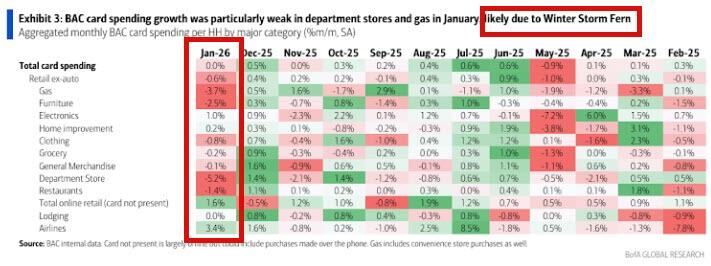
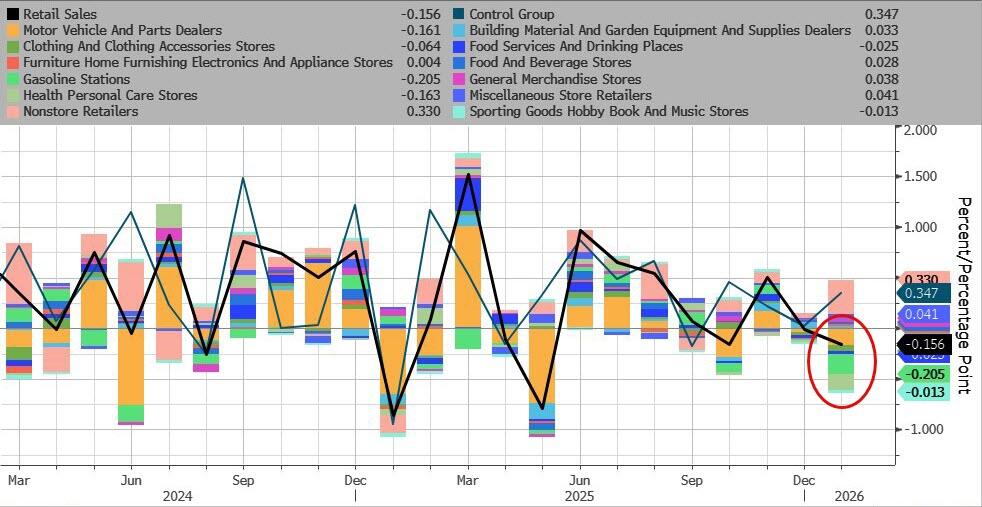
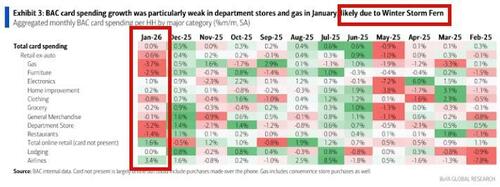
This morning’s retail sales data is for January (still lagging due to the govt shutdown) and is expected to be a decline (BofA’s omniscient analysts see a worse than consensus drop MoM, due in large part to weather disruptions).
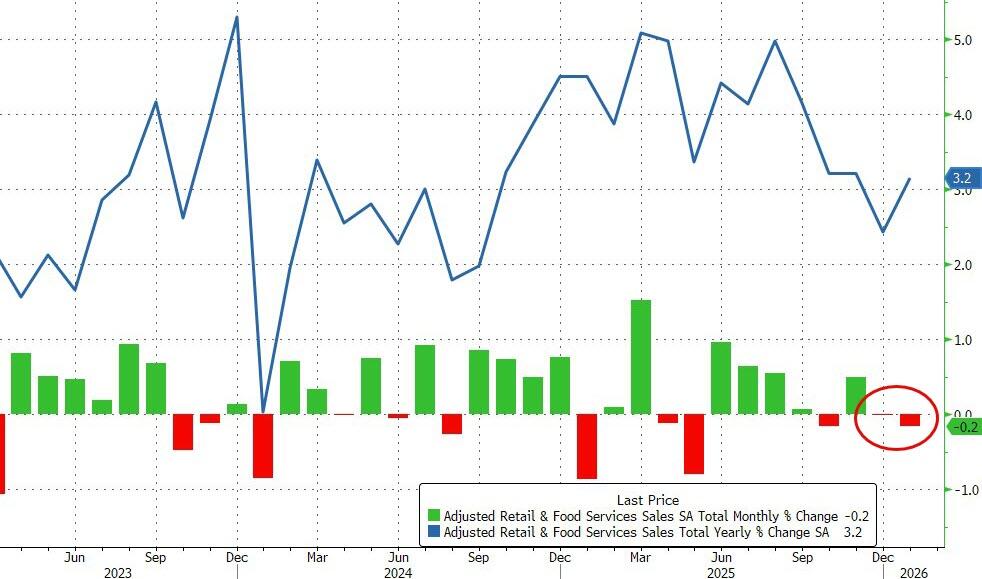
The actual print was a decline but slightly better than expected at -0.2% MoM. Despite two months of no increase, sales rose 3.2% YoY in January (increased from December)
Source: Bloomberg
The decline was driven by a decline in sales at gas stations (lower gas prices) and Health Personal Care Stores. Motor Vehicles sales also dropped MoM. Non-store (online) retailers saw sales surge MoM…
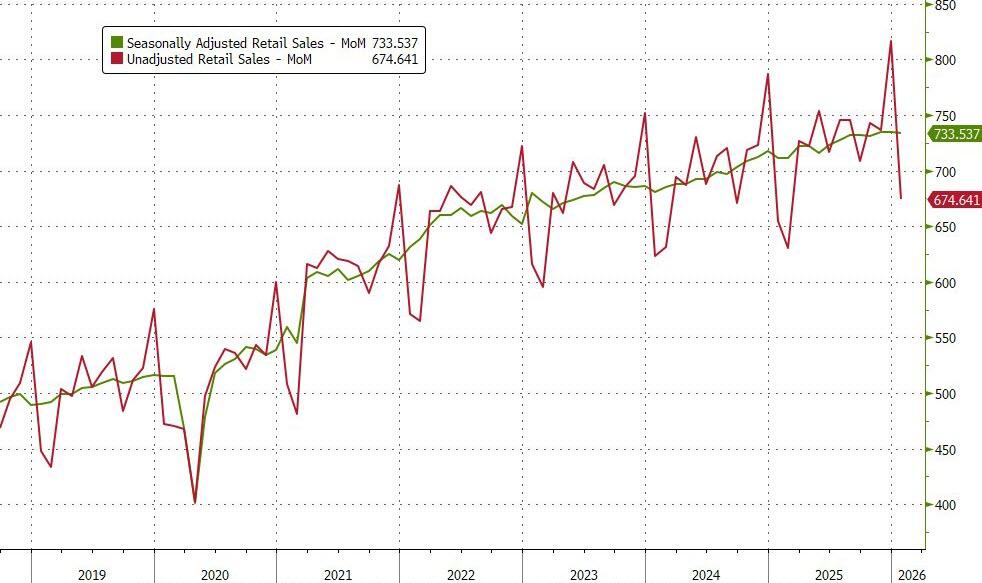
Even though December’s seasonally-adjusted move was disappointing, it was a record high on a non-seasonally adjusted basis and January saw the usual big post-Xmas hangover plunge…
Source: Bloomberg
A lengthy winter storm that included significant snowfall and ice across the central and eastern US likely impeded shoppers during the weather event. The Arctic blast triggered the most flight cancellations since the pandemic and left more than 1 million homes and businesses without power.
Receipts at restaurants and bars, the only service-sector category in the retail report, declined 0.2% in January. Restaurants including Sweetgreen and Chipotle said that sub-freezing temperatures and winter storms hindered sales.
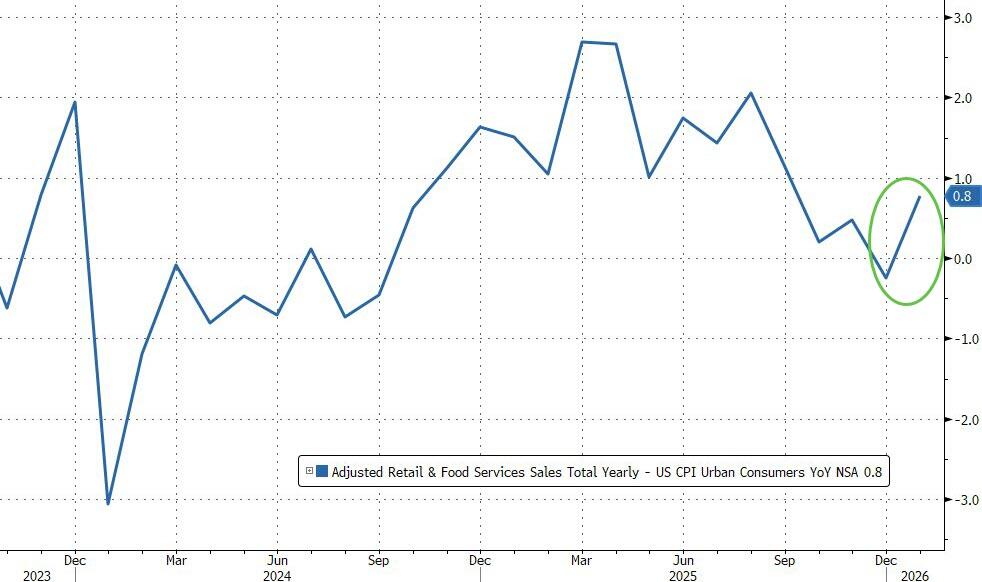
‘Real’ retail sales (very roughly adjusted by CPI) showed an acceleration in January…
The report showed a 0.3% increase in so-called control-group sales – which feed into the government’s calculation of goods spending for gross domestic product. The measure excludes food services, auto dealers, building materials stores and gasoline stations.
Tyler Durden
Fri, 03/06/2026 – 08:46
https://www.zerohedge.com/markets/us-retail-sales-dropped-january-weather-weak-gas-prices-weigh

Comentarios de Hegseth recuerdan que el gobierno no siempre muestra el costo humano de la guerra
Por DAVID BAUDER
Las declaraciones del secretario de Defensa de Estados Unidos, Pete Hegseth, de que la prensa estadounidense enfatiza las bajas de Estados Unidos en la guerra con Irán porque “quiere hacer quedar mal al presidente” recuerdan algo que ha perdurado a lo largo de muchas décadas y conflictos: la tensión y el temor ante las noticias que recuerdan a los estadounidenses el costo humano de la guerra.
Hegseth arremetió contra las “noticias falsas” durante su sesión informativa en el Pentágono sobre la guerra, al referirse a los seis reservistas del Ejército de Estados Unidos que murieron en un ataque iraní contra un centro de operaciones en Kuwait.
“Cuando unos cuantos drones logran pasar u ocurren cosas trágicas, es noticia de primera plana”, afirmó el secretario. “Lo entiendo. La prensa solo quiere hacer quedar mal al presidente. Pero intenten, por una vez, informar sobre la realidad. Los términos de esta guerra los fijaremos nosotros en cada paso”.
La secretaria de prensa de la Casa Blanca, Karoline Leavitt, redobló la apuesta cuando Kaitlan Collins, de CNN, le preguntó más tarde sobre el comentario en su propia conferencia de prensa. “Ustedes toman cada cosa que dice esta administración e intentan usarla para hacer quedar mal al presidente. Eso es un hecho objetivo”, sostuvo Leavitt.
A quienes vivieron la guerra de Vietnam en la década de 1960 les costaba sacudirse los recuerdos de imágenes explícitas transmitidas noche tras noche a los hogares a través de un invento entonces reciente: la televisión. Muchos creían que el impacto acumulado de ver ese sufrimiento todas las noches convirtió a los estadounidenses de partidarios en escépticos.
Desde entonces no se han visto en esa medida escenas tan vívidas e íntimas de la acción militar de estadounidenses, un legado que sigue vigente con la guerra que el presidente Donald Trump y Hegseth libran ahora en nombre de Estados Unidos.
“Para muchos presidentes, la lección parecía ser: no permitan que las realidades de la guerra entren en las salas de estar de la gente si pueden evitarlo”, señaló Timothy Naftali, investigador principal de la Escuela de Asuntos Internacionales y Públicos de la Universidad de Columbia.
La cobertura de la guerra —y el acceso a ella— han cambiado
Hoy, las imágenes de la guerra que ve el público pueden parecerse a un videojuego —explosiones que iluminan el cielo vistas desde lejos—, con el dolor mucho más en privado.
Generaciones atrás, durante la Segunda Guerra Mundial, los periodistas estaban integrados en las fuerzas armadas, y muchos se convirtieron en nombres conocidos: los reporteros Ernie Pyle y Walter Cronkite, los fotógrafos Robert Capa y Margaret Bourke-White. Sin embargo, esos fueron los días anteriores a la televisión.
Vietnam fue, posiblemente, la guerra estadounidense más accesible para los reporteros. Los periodistas desplegados en el país enviaban de regreso un flujo constante de muerte y destrucción.
Cronkite, para entonces presentador en CBS-TV del noticiero nocturno más popular en Estados Unidos, informó desde Vietnam en 1968 y concluyó que la única salida racional era una paz negociada. “Si he perdido a Cronkite”, dijo el presidente Lyndon Johnson, “he perdido a la clase media estadounidense”.
Durante la Guerra del Golfo en 1991, el presidente George H.W. Bush se enfureció por las imágenes televisivas presentadas en pantalla dividida que mostraban los ataúdes de miembros de las fuerzas armadas de Estados Unidos enviados de regreso al país mientras él, aparentemente sin saber el momento en que ocurría, bromeaba con reporteros sobre otro tema en la Casa Blanca. El Pentágono prohibió la cobertura de esas ceremonias, afirmando que era para proteger la privacidad de los familiares de los fallecidos, aunque los críticos decían que el verdadero objetivo era evitar mostrar imágenes de ataúdes.
Esa prohibición, con algunas excepciones, se mantuvo hasta que el presidente Barack Obama la levantó en 2009.
Los reporteros que se acercaban al campo de batalla en las guerras libradas por las fuerzas armadas de Estados Unidos en la década de 2000 probablemente enfrentaban restricciones a sus movimientos, si es que se les permitía estar allí. Jessica Donati, reportera de The Wall Street Journal y Reuters que cubrió la guerra en Afganistán, escribió para el Modern War Institute en 2021 que “hoy en día es más fácil para los periodistas en Afganistán integrarse con los talibanes que con las fuerzas armadas de Estados Unidos”.
La cobertura de las bajas es anterior a la presidencia de Trump
La naturaleza de esta guerra —que se libra a miles de kilómetros del territorio continental estadounidense y en la que aún no hay soldados en el territorio iraní— ha limitado el número de bajas estadounidenses y, por lo tanto, las ha hecho más perceptibles. Varios periodistas han señalado que la cobertura de las bajas militares es anterior a la presidencia de Trump. La declaración de Hegseth “es una manera distorsionada de ver el mundo”, dijo Jake Tapper, de CNN. “Ahistórica”.
“Los medios de comunicación cubren a los miembros de las fuerzas armadas caídos porque han hecho el máximo sacrificio por su país”, explicó. “Es un tributo. Es un honor”.
Ha habido relativamente poca cobertura desde el terreno en Irán. Un equipo de CNN encabezado por Frederik Pleitgen se convirtió el jueves en el primer grupo de periodistas de una cadena de televisión con sede en Estados Unidos en entrar al país, y él pasó el día recorriéndolo a toda prisa hasta llegar a Teherán.
Dan Lamothe, reportero de asuntos militares de The Washington Post, publicó en redes sociales que los comentarios de Hegseth no lo detendrán y que seguirá cubriendo las bajas de la guerra, como se ha hecho bajo presidentes de los dos principales partidos políticos.
“Estos esfuerzos no siempre han sido perfectos”, escribió Lamothe. “Pero han puesto de relieve los sacrificios de los miembros de las fuerzas armadas estadounidenses y de sus familias, y las deficiencias que a veces permitieron que ocurrieran estas muertes. Seguiremos haciéndolo. Es demasiado importante como para detenerse”.
Cuando Robert H. Reid fue editor principal de Stars and Stripes entre 2014 y 2025, descubrió que la audiencia del periódico, principalmente miembros de las fuerzas armadas, quería algo más que cifras en bruto cuando morían estadounidenses en acciones militares. Querían conocer detalles sobre la vida de quienes servían: dónde crecieron, a quiénes dejaron atrás, cuáles eran sus pasiones, contó.
Dentro de 10 o 20 años, muchas de estas personas serán olvidadas por todos salvo por quienes las amaron. Pero por lo que dieron por su país, merecen reconocimiento por sus vidas, dijo Reid, que ha sido corresponsal internacional de The Associated Press durante la mayor parte de su carrera.
“El público necesita saber que la guerra no es un videojuego”, afirmó Naftali. “Afecta a las personas”.
___
Esta historia fue traducida del inglés por un editor de AP con la ayuda de una herramienta de inteligencia artificial generativa.