Category: News
Kristi Noem’s firing is little comfort to Minneapolis residents struggling to recover from crackdown
MINNEAPOLIS — Daniel Hernandez’s grocery store in south Minneapolis has served Latino families for over 5 years, but he says it’s on the verge of closing due to lasting economic damage from the nation’s largest immigration enforcement crackdown.
Many of Hernandez’s customers have continued to stay home or drastically reduce their spending, and 10 of the 12 Latino small businesses that rent space from him remain shuttered, he said in an interview Friday. Even though President Donald Trump’s administration scaled back the crackdown earlier, and the president fired Kristi Noem as homeland security secretary on Thursday, many are still feeling the ripple effects.
Hernandez, an immigrant from Mexico, said only one business, an Ecuadorian ice cream shop, has been able to reopen since December, when the immigration crackdown began.
“I don’t know if my business will survive, being honest,” Hernandez said. “The amount of damage is so big that I am afraid.”
The fall of Noem
Noem was pushed out amid mounting criticism over her leadership, including her handling of the crackdown and the aftermath of the shooting deaths of two Minneapolis residents by federal officers, Renee Good and Alex Pretti.
It’s not clear how many Immigration and Customs Enforcement and other federal officers are left in Minnesota after peaking around 3,000 at the height of the surge. Noem put the number at 650 in her congressional testimony this week.
But U.S. Sen. Amy Klobuchar told Minnesota Public Radio that White House border czar Tom Homan called her to say that total was incorrect, and they’ve cut back to their original number of a little over 100 ICE officers, plus some additional agents working on fraud investigations.
ICE and Homeland Security officials did not immediately respond to emails seeking details Friday.
Many businesses are still struggling
Like Hernandez’s Colonial Market, many businesses owned by immigrants or that cater to them are still struggling from sharp drops in sales.
“Instead of spending $150, now they spend $30, $40,” Hernandez said.
Other customers stopped coming in altogether — either because they were afraid of being detained, regardless of their legal status, or because money is tight from being unable to work.
Minneapolis Mayor Jacob Frey said last month that small businesses have collectively lost tens of millions of dollars in revenue. He estimated the federal immigration operation cost the city’s economy $203 million in January alone and led 76,000 people to experience food insecurity.
Activists credit community organizing
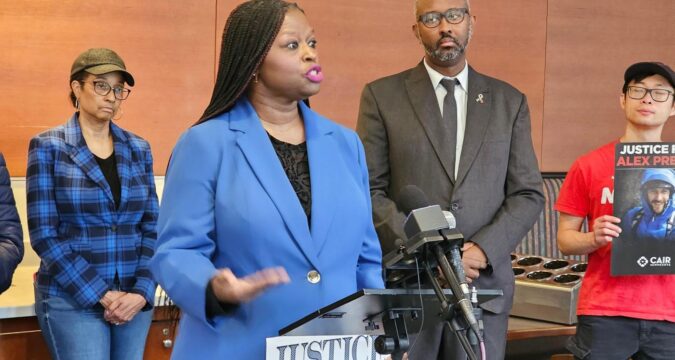
“We warn our community that the fight is not over,” said Jaylani Hussein, a Somali American who is executive director of the Minnesota chapter of the Council on American-Islamic Relations, at a news conference Friday. “It is a good day to say good riddance to Kristi Noem. But it’s not a good day to walk away from the fight.”
The sense among many activists is that the intense community organizing against the surge played a decisive role in the administration backing down. And they say it sparked the formation of strong neighborhood networks that will live on and continue to push for social justice.
Minneapolis resident Patty O’Keefe, who was detained in January for following a federal officer’s vehicle, said she’s happy to see Noem go but it will take more to bring about real change.
“It’s a sign that we’re winning, that the Trump administration feels like they have to make a change to save face because they’re losing public support and losing the narrative,” she said. “And I think it’s a testament to the hard work of Minnesotans who fought back against this war of political retribution and xenophobia that has been and continues to be waged against us.”
Brandon Sigüenza, who was detained with O’Keefe, said the mood isn’t celebratory because the crackdown is ongoing.
“I don’t think Minneapolitans are necessarily dancing in the streets. Because there’s still no justice for Renee Good, there’s still no justice for Alex Pretti,” Sigüenza said.
Minneapolis psychologist Lucy Olson helped organize a covert grassroots network that swelled to 2,000 volunteers assisting around 500 immigrant families with legal matters, shelter, food and rent assistance. She said that after the crackdown, the mutual aid systems that formed will continue to respond to community needs.
“For those of us who had the honor of participating as volunteers, I think we will never be the same,” Olson said. “I think there’s been cross-cultural friendships, the opportunity to build out neighborhood networks that have changed the face of our city.”
Charges still against 39 indicted in church protest
Nekima Levy Armstrong, a local civil rights activist and lawyer, said at the news conference with Hussein that Noem should have been fired after the deaths of Good and Pretti.
Levy Armstrong, an ordained nondenominational Christian reverend, is also one of 39 people indicted for their alleged roles in a protest in January at a St. Paul church where a pastor, David Easterwood, is a top local ICE official. She said that she’d been praying for a day like Thursday when Noem was fired.
“So while we celebrate the fact that this woman has been removed from her high perch — where she thought she was untouchable, she thought she could literally allow these agents to get away with murder — we recognize that this system is very broken,” Levy Armstrong said.
Safety for school children
Brenda Lewis, superintendent of Fridley Public Schools in suburban Minneapolis, said Noem’s firing “doesn’t really matter” because the safety of children in her school district is still impacted.
Fridley, which has students from many Somali and Ecuadorian families, has been the site of heightened ICE activity over the past two months. Federal vehicles were found in neighborhoods near the schools and at the homes of school board members.
Of the around 2,700 students in the district, more than 112 have unenrolled, Lewis said. Another 400 are in virtual learning. The district has also lost $130,000 in revenue because of lower participation in meal programs.
“It’s not a Democrat or a Republican issue,” Lewis said. “It’s about children’s safety, and we need to really come together and ensure that this absolute removal of safety for school children by a federal agency can never ever happen again in the state or the country.”
GOP lawmakers in Minnesota have muted reaction
While the state’s top Republican leaders had generally supported Noem’s leadership of the surge, they’ve been mostly silent on her downfall. A message seeking comment from U.S. House Majority Whip Tom Emmer — the state’s most powerful Republican — was not immediately returned Friday.
But GOP state Sen. Jim Abeler, a moderate from suburban Anoka, noted that he wrote Noem in January expressing “grave concerns” about actions by some of her officers in Minnesota.
“With her departure, I hope that what happened in Minnesota won’t happen anywhere else,” Abeler said in a statement.
Brook reported from New Orleans, while Raza reported from Sioux Falls, S.D.

3 Reasons Why Obamacare Is So Hard To Fix
3 Reasons Why Obamacare Is So Hard To Fix
Authored by Lawrence Wilson via The Epoch Times,
Obamacare had problems even before it launched in 2014. Marketplace websites were glitchy during the open enrollment period, frustrating many would-be customers.
Sweeping changes ushered in by the Affordable Care Act, the law creating Obamacare, all but guaranteed that premiums would increase—which they did by 23 percent in the program’s first year.
Even so, public opinion swung in favor of Obamacare starting in 2017 and remains positive, according to KFF Health Tracking polls.
More than 24 million people were insured through the program by 2025.
And insurers learned to thrive under the new rules, more than doubling annual revenue to $1.1 trillion and consistently generating a profit between 2014 and 2024.
Problems do persist, however.
Premiums have more than doubled over 12 years. Some consumers have only a few plans to choose from. And flaws in the program’s design continue to waste taxpayer dollars.
Lawmakers on both sides of the aisle have proposed solutions, many with bipartisan support. Yet permanent reform remains elusive.
The reason may have less to do with the ideas themselves and more to do with the most persistent disagreement between Republicans and Democrats: the role of the federal government.
Here are three commonly proposed remedies for problems within Obamacare, and why those problems remain.
1. Increase Plan Options
Of the more than 1,100 health insurers doing business in the United States, about 10, on average, offer plans through Obamacare in each state.
About 5 percent of Obamacare users have only one or two insurers to choose from.
“Obamacare created a system that left American families with fewer choices,” said Sen. Rick Scott (R-Fla.), who proposed legislation to improve Obamacare in 2025.
Scott’s proposal would have allowed consumers to buy health insurance across state lines, which is now prohibited by most states with limited exceptions.
Five years ago, Sens. Tim Kaine (D-Va.) and Michael Bennet (D-Colo.) proposed allowing more choice by allowing consumers to opt into Medicare in counties where fewer than three insurers offered Obamacare plans. That plan, called Medicare X, later expanded to other counties with high-cost plans and few options.
Bennet and Kaine said the plan would both reduce costs and offer health coverage to people with few options. The plan was introduced in 2021 and again last year.
Others have suggested broadening the availability of catastrophic plans, which have low premiums but high deductibles.
That proposal and Scott’s proposal had been suggested by Democrats in 2017.
Still others have proposed allowing insurers to offer short-term health insurance plans through Obamacare. These three-month to six-month plans are popular with people between jobs or in a waiting period for employer-sponsored insurance.
“Short-term plans typically offer far lower premiums, substantially broader provider networks, and greater overall value for many middle-class families,” Brian Blase, president of Paragon Health Institute, said.
None of these ideas received a vote in Congress.
Conservatives were skeptical of the Medicare X proposal, seeing it as a step toward socialized medicine.
“Democrats claim that they just want to offer another health insurance choice. But Medicare X would simply nudge us along toward the Democrats’ endgame: a complete government takeover of the health insurance system,” Sally C. Pipes, president and CEO of Pacific Research Institute, wrote on the think tank’s website in 2024.
Left-leaning politicians and analysts have been skeptical of any plan that would offer what they see as inferior health coverage through Obamacare, including short-term insurance and catastrophic plans.
“Short-term coverage is not community-rated (that is, people can be charged more based on their health status, gender, or other factors) and it typically does not cover preexisting conditions,” Mark A. Hall and Michael J. McCue wrote in a 2022 article for The Commonwealth Fund.
2. Empower Consumers
Obamacare subsidizes health insurance for people earning between 100 percent and 400 percent of the federal poverty level. The subsidy comes in the form of an advanced tax credit. But the money is paid directly to insurance companies, not to the insured individuals.
President Donald Trump and several others have proposed making those funds available to consumers, which they say would increase choice and lower prices.
Trump’s plan, and some others, would provide funded Health Savings Accounts, which enrollees could use only for health expenses. That would include buying insurance, paying out-of-pocket expenses, or buying health care directly from providers.
Scott made a similar proposal, as did Sens. Mike Crapo (R-Idaho) and Bill Cassidy (R-La.), and Sen. Roger Marshall (R-Kan.).
“Giving billions of taxpayer dollars to insurers is not working to reduce health insurance premiums for patients,” Crapo said in a statement announcing his plan in December 2025. “We need to give Americans more control over their own health care decisions.”
The Crapo–Cassidy plan failed to advance in the Senate last year. None of the other plans have even been put to a vote. Democrats have opposed the idea as a halfway measure that would undermine the value of Obamacare.
Health Savings Accounts are available only with insurance plans that have a high deductible, leading some analysts to conclude that they wouldn’t benefit people who have the most trouble affording health care.
“While healthier people could benefit … sicker people could be stuck with higher premiums or higher out-of-pocket health costs,” wrote Larry Levitt and Cynthia Cox of KFF.
Democrats objected also to other provisions of the Crapo–Cassidy plan, like verifying citizenship and immigration status before enrolling in coverage, and excluding abortion as an essential health benefit in Obamacare plans.
Senate Minority Leader Chuck Schumer (D-N.Y.) called the plan “junk insurance.”
3. Fix Structural Problems
One feature of Obamacare was intended to lower premium prices but produced the opposite result.
Insurers must offer cost-sharing reductions to customers making less than 250 percent of the federal poverty level who choose a silver-level plan.
The cost-sharing reductions mean lower copays and deductibles, which helps low-income enrollees.
It also increases costs for insurers, so the federal government reimbursed them for the added expense.
But a federal judge ruled that those reimbursements were improper because Congress had never authorized funds for them through an appropriations bill. Cost-sharing reduction payments to insurers were discontinued in 2017. However, insurers are still required to offer the cost-sharing reductions.
To compensate, insurers raised premiums on the silver-level plans, a practice known as silver loading.
Because all premium subsidies are based on the cost of a silver-level plan, any increase to silver-plan premiums has the knock-on effect of increasing federal subsidies on every plan sold through Obamacare.
The overall effect added billions per year in costs to taxpayers.
Politicians from both major parties have called for Congress to fix the problem by appropriating money to pay for the cost-sharing reductions. That would save taxpayers nearly $37 billion and reduce premiums for the most common Obamacare plans by 11 percent, according to the Congressional Budget Office.
Then-Sen. Lamar Alexander (R-Tenn.) and Sen. Patty Murray (D-Wash.) proposed this and other program changes in 2017.
The bipartisan House Problem Solvers Caucus also pitched the idea that year.
Rep. Mariannette Miller-Meeks (R-Iowa) introduced a health care bill in 2025 that included funding for cost-sharing reductions.
The idea is included in Trump’s Great Healthcare Plan, released in January.
Despite having bipartisan support, this proposal appears to have been overshadowed by larger questions about Obamacare.
The 2017 Murray–Alexander plan was proposed at a time when many Republicans were intent on repealing and replacing Obamacare.
Trump opposed the proposal, according to then-White House press secretary Sarah Huckabee Sanders, because it did not go far enough to expand options and drive competition.
“This president certainly supports Republicans and Democrats coming to work together, but it’s not a full approach, and we need something to go a little bit further to get on board,” Sanders told reporters in 2017.
Democrats opposed the Miller–Meeks proposal because it did not extend the expiring enhanced tax credits for Obamacare, which was their primary legislative aim in late 2025.
Rep. Bobby Scott (D-Va.) urged colleagues to vote against the Miller-Meeks proposal, saying, “This plan does nothing to extend the [Obamacare] enhanced tax credits which are set to expire.
Jeremy Nighohossian of the Competitive Enterprise Institute suggested that some policy makers oppose funding the cost-sharing reductions precisely because the higher federal subsidies that result from silver loading serve a political end.
“Some may prefer the indirect subsidy increase because it raises the proportion of the population with insurance,” Nighohossian wrote in January on the think tank’s website.
The Impasse
The legislative impasse over improving Obamacare appears to arise from the basic difference in approach by Republicans and Democrats to health care financing.
Republicans generally favor deregulation and other marketplace reforms that they believe will increase competition and lower prices.
“As President Trump has said, he will make our health care system better by increasing transparency, promoting choice and competition, and expanding access to new affordable health care and insurance options,” White House press secretary Karoline Leavitt told The Poynter Institute in 2024.
Republican proposals for Obamacare generally follow that blueprint: add choices, improve competition, and allow the market to lower prices.
Democrats generally favor increased government intervention in the form of regulation and subsidization with the goal of ensuring access to health care services for everyone.
“Access to high-quality health care should be a right available to every single American,” House Democratic Leader Hakeem Jeffries (D-N.Y.) said in December 2025. “One of the ways we can make sure that we strive to achieve that principle is to extend the Affordable Care Act tax credits.”
Democrat-led bills to extend those credits failed to advance in both the House and Senate. Republican proposals to increase choice and competition also failed to advance.
Obamacare’s benchmark silver plan premiums for 2026 increased by about 26 percent.
Tyler Durden
Fri, 03/06/2026 – 20:05
https://www.zerohedge.com/medical/3-reasons-why-obamacare-so-hard-fix

Olas de calor que producen sequías dañinas ocurren con más frecuencia, revela estudio
Por SETH BORENSTEIN
WASHINGTON (AP) — Las olas de calor que provocan sequías repentinas y dañinas se extienden por todo el mundo a un ritmo acelerado, lo que resalta cómo los fenómenos extremos impulsados por el cambio climático pueden potenciarse peligrosamente entre sí, halló un nuevo estudio.
Investigadores de Corea del Sur y Australia analizaron fenómenos meteorológicos extremos compuestos —un doble golpe de calor y sequía— y descubrieron que son más frecuentes a medida que el mundo se calienta. Pero el que aumenta con especial rapidez es el tipo más dañino: cuando el calor llega primero y eso desencadena la sequía. En la década de 1980, ese tipo de fenómeno extremo cubría sólo aproximadamente el 2,5% de la superficie terrestre cada año. Para 2023 —el último año que los investigadores estudiaron— alcanzó el 16,7%, con un promedio del 7,9% en 10 años.
Es probable que el promedio haya aumentado aún más con el calor global récord de 2024 y un 2025 casi igual de cálido, indicaron los autores del estudio.
En su investigación, publicada el viernes en la revista especializada Science Advances, los científicos indicaron que la aceleración del ritmo de cambio es aún más preocupante que las cifras brutas. Durante aproximadamente las dos primeras décadas desde 1980 que examinaron, la extensión de los fenómenos extremos que se originan primero con calor aumentó, pero la tasa en los últimos 22 años es ocho veces mayor que la tasa anterior, encontró el estudio.
Los eventos donde la sequía ocurre primero, seguida de calor intenso, son aún más comunes y también van en aumento. Pero los científicos se centraron en los casos, cada vez más frecuentes, en los que el calor golpeó primero. Eso se debe a que cuando el calor pega primero, las sequías son más intensas que cuando éstas llegan primero, o no vienen acompañadas de un calor intenso, explicó Sang-Wook Yeh, coautor y climatólogo de la Universidad de Hanyang, en Corea del Sur.
Además conduce a “sequías repentinas”, las cuales son más dañinas que las sequías comunes porque se producen súbitamente, lo que impide que las personas en general, y los agricultores en particular, se preparen, dijo Yong-Jun Kim, el autor principal, quien también es climatólogo de la Universidad de Hanyang.
Las sequías repentinas —cuando el aire más cálido se vuelve más sediento y absorbe más agua del suelo— han ido en aumento en un mundo en calentamiento, según han mostrado investigaciones anteriores.
“El estudio ilustra un punto clave sobre el cambio climático: los impactos más dañinos suelen provenir de (fenómenos) extremos compuestos. Cuando las olas de calor, la sequía y el riesgo de incendios forestales ocurren simultáneamente —tal como vimos en eventos como la ola de calor rusa de 2010 o los incendios forestales australianos de 2019-2020—, los impactos pueden intensificarse rápidamente”, expresó Andrew Weaver, climatólogo de la Universidad de Victoria, en Columbia Británica, Canadá. “Lo que este estudio demuestra es que el calentamiento no sólo aumenta la probabilidad de (que ocurran) olas de calor, sino que también altera la interacción entre el calor y la sequía, lo que amplifica los riesgos que enfrentamos”.
Weaver no participó en el estudio, pero reside en la región Noroeste del Pacífico —el noroeste del continente americano—, donde la cúpula de calor y la sequía de 2021 fueron, según Kim, un excelente ejemplo de lo que ellos notan que aumenta rápidamente. Otros ejemplos incluyen la temperatura y sequía de 2022 en torno al río Yangtsé, en China, y la temperatura récord de 2023-2024 en la Amazonía, agregó Kim.
“La cúpula de calor de 2021, en el Noroeste del Pacífico, ilustra la rapidez con la que estos extremos compuestos pueden intensificarse: temperaturas cercanas a los 50 grados Celsius (122 grados Farenheit) en Lytton (Columbia Británica) fueron seguidas por una sequía rápida e incendios forestales extremos que destruyeron la comunidad”, dijo Weaver, exlegislador canadiense, en un correo electrónico.
El estudio detectó un mayor aumento de eventos en los que las sequías ocurrieron primero en Sudamérica, Alaska, el oeste de Canadá y de Estados Unidos, así como en partes de África central y oriental.
Kim y Yeh reportaron haber notado un “punto de inflexión” aproximadamente en el año 2000, cuando todo se aceleró para que se produjeran situaciones en las que primero hacía calor y luego sobrevenía sequía.
Jennifer Francis, climatóloga del Centro de Investigación Climática Woodwell, quien no participó en el estudio, señaló que ese punto de inflexión coincidió “inquietantemente con el inicio del rápido calentamiento del Ártico, la pérdida de hielo marino y la disminución de la capa de nieve primaveral en los continentes del hemisferio norte”.
Además de que el calentamiento a largo plazo cause más fenómenos extremos compuestos, Kim manifestó que observaron una aceleración en la forma en que el calor pasaba de la tierra a la atmósfera y de regreso justo antes del punto de inflexión del año 2000. Él y Yeh especularon que la Tierra podría haber cruzado un “punto de inflexión” donde el cambio es irreversible.
Varios aspectos del clima y los sistemas ecológicos de la Tierra cambiaron a finales de la década de 1990, posiblemente desencadenados por un importante fenómeno de El Niño en 1997-1998, dijo Gerald Meehl, climatólogo del Centro Nacional de Investigación Atmosférica, quien no participó en el estudio. Sin embargo, añadió que es difícil determinar si se trata de cambios permanentes.
Algunos modelos informáticos pronostican que otro importante fenómeno de El Niño —un calentamiento natural de partes del Pacífico que distorsiona el clima a nivel mundial— se gestará a finales de este año.
——-
La cobertura climática y ambiental de The Associated Press recibe el apoyo económico de varias fundaciones privadas. La AP es la única responsable de todo el contenido. Encuentre los estándares de la AP para trabajar con organizaciones filantrópicas, una lista de patrocinadores y las áreas de cobertura financiadas en AP.org.
——-
Esta historia fue traducida del inglés por un editor de AP con la ayuda de una herramienta de inteligencia artificial generativa.

‘Sinners’ takes top prize at the Actor Awards, setting up an Oscar showdown
After a near awards-season sweep by “One Battle After Another,” “Sinners” won best ensemble at the Screen Actors Guild’s 32nd Actor Awards on Sunday, shaking up the Oscar race and setting up a potential nail-biter finale in two weeks at the Academy Awards.
The guild’s awards, formerly known as the SAG Awards, are one of the most closely watched Oscar precursors. Actors make up the largest slice of the Academy of Motion Picture Arts and Sciences and their choices at the Actor Awards often align.
The victory for Ryan Coogler’s blues-soaked vampire saga showed that it has a strong chance to win at the Oscars, too, despite an almost unblemished run of awards for Paul Thomas Anderson’s “One Battle After Another.” It’s won at the Golden Globes, the Producers Guild Awards, the BAFTAs and the Directors Guild Awards.
But the win Sunday, in a Netflix-streamed ceremony at the Shine Auditorium in Los Angeles, flipped that awards-season script. Writer-director Ryan Coogler, whose “Black Panther” triumphed at the guild’s awards in 2019, became the first filmmaker to steer two ensembles to the guild’s top prize.
“From the bottom of our hearts, to the bottom of your hearts, thank you so much for everything,” said Delroy Lindo, who spoke on behalf of the film’s cast.
Moments earlier, Michael B. Jordan also won best male actor, upsetting the category favorite, Timothée Chalamet, and handing the 39-year-old Jordan the most significant prize of his acclaimed career. Even Jordan looked shocked as the audience rose to its feet and Viola Davis, the award’s presenter, celebrated.
“I wasn’t expecting this at all,” said Jordan, who reflected on starting out as actor before he paused to appreciate the moment. “Yeah, man, this is pretty cool.”
As expected, Jessie Buckley won best female actor for her performance in “Hamnet.” But the other actor races have been harder to call. On Sunday, Sean Penn (who didn’t attend) won best supporting male actor for “One Battle After Another” and Amy Madigan won best supporting female actor for “Weapons.”
The 75-year-old Madigan, who had never before been nominated by the guild, was visibly surprised. Partway through her winding and charming acceptance speech, she looked down at the statuette.
“It’s like when you were little and you had the Barbie and then you got Ken and whipped down his drawers and went, ‘Hey, that’s nothing,’” joked Madigan before apologizing for getting distracted.
A posthumous prize for Catherine O’Hara
Catherine O’Hara posthumously won best female actor in a comedy series for her performance as a movie executive in the showbiz satire “The Studio.” O’Hara died at the age of 71 on Jan. 30 from a blood clot in the lungs. At the Shine Auditorium in Los Angeles, the crowd stood in a standing ovation for O’Hara after she was announced as the winner.
Seth Rogen, co-creator of “The Studio,” accepted the award on her behalf. He recalled a passionate collaborator who would, the night before a scene, invariably send a polite email with suggested rewrites. Rogen said O’Hara “showed that you could be a genius and you could be kind.”
“If you have people in your lives who don’t know her work,” Rogen said, “show them O’Hara dancing to Harry Belafonte in ‘Beetlejuice,’ show them O’Hara hurting her knee in ‘Best in Show’ and doing that amazing thing where she hobbles around, and tell the people as they are laughing that that’s Catherine O’Hara and we were lucky that we got to live in a world where she so generously shared her talents with us.”
A ceremony that skirted politics
The ceremony, presented by the actors guild SAG-AFTRA, were hosted by returning emcee Kristen Bell, who kicked off the show on a light, song-and-dance note despite the war in Iran and entertainment industry upheaval. Sean Astin, SAG-AFTRA president,offered a “a prayer for peace” in his remarks.
The Actor Awards were the biggest Hollywood bash since Paramount reached an agreement to acquire Warner Bros. Discovery for $111 billion. The merger, which awaits regulatory approval, sent shock waves through Hollywood. Netflix chief executive Ted Sarandos, whose company lost out to Paramount competing bid, walked the red carpet in jeans.
The win for “Sinners” insures that Warner Bros. will head into the Academy Awards with the two clear best pictures favorites in it and “One Battle After Another” — an awards-season coup for a studio set to be sold.
Before the ceremony began, the award for best stunt ensemble went to a Paramount release: “Mission: Impossible — The Final Reckoning.” Among the TV awards, “The Studio” won for comedy series and “The Pitt” won for drama series. Individual winners included Keri Russell (“The Diplomat”), Rogen (“The Studio”), Michelle Williams (“Dying for Sex”), Owen Cooper (“Adolescence”) and Noah Wyle (“The Pitt”).
A Harrison Ford tribute
Harrison Ford was honored with the SAG-AFTRA Life Achievement Award, a prize presented with warm sarcasm by Woody Harrelson. The 83-year-old actor said he was humbled.
“I’m in a room with actors, many of whom are here because they’ve been nominated to receive a prize for their amazing work, while I’m here to receive a prize for being alive,” said Ford, who called it “the half point” of his career.
Ford teared up for much of his speech, reflecting on a career that he noted was “not an overnight success.” He called the award “very encouraging.”
“I’m indeed a lucky guy,” said Ford. “Lucky to have found my people. Lucky to have work that challenges me. Lucky to still be doing it.”
https://www.chicagotribune.com/2026/03/06/sinners-actor-awards-winners/
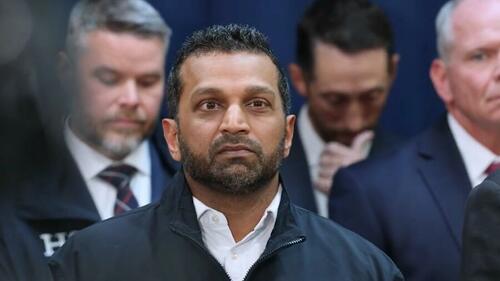
FBI Investigating Suspected Cyber Attack On Sensitive Surveillance Network
FBI Investigating Suspected Cyber Attack On Sensitive Surveillance Network
The FBI is scrambling to investigate a suspected cybersecurity incident involving a sensitive internal network used to manage court-ordered wiretaps and foreign-intelligence surveillance warrants, according to CNN.
The bureau confirmed the activity in a brief statement, saying that it had “identified and addressed suspicious activities on FBI networks” and deployed its full technical resources in response.
And of course, the timing couldn’t be more interesting, as the incident comes amid heightened vigilance for retaliatory cyberattacks following the joint U.S.-Israeli military operation, dubbed Operation Epic Fury, which targeted Iranian nuclear, missile and command infrastructure and resulted in the killing of Supreme Leader Ayatollah Ali Khamenei. The strikes have triggered regional escalation, including Iranian counterstrikes and proxy activity in Saudi Arabia and the United Arab Emirates.
U.S. intelligence assessments, including a Department of Homeland Security bulletin, indicate that while large-scale physical attacks on U.S. soil remain improbable, Iran-aligned hacktivists and potentially state-linked actors are likely to pursue lower-level disruptive actions. Such attacks could include distributed denial-of-service instructions, website defacements and other intrusions aimed at causing nuisance or temporary disruption.
“Although a large-scale physical attack is unlikely, Iran and its proxies probably pose a persistent threat of targeted attacks in the Homeland, and will almost certainly escalate retaliatory actions – or calls to action – if reports of the Ayatollah’s death are confirmed,” according to the bulletin obtained by ABC News.
“In the short-term, we are most concerned that Iran-aligned hacktivists will conduct low-level cyber attacks against US networks, such as website defacements and distributed denial-of-service attacks,” officials said in the bulletin.
Major banks and other institutions have intensified monitoring and fortified defenses in recent days. However, no significant breaches directly attributed to the current phase of hostilities have been publicly confirmed.
Speaking to investors this week, JPMorganChase CEO Jamie Dimon said that while he endorsed the U.S.-Israeli strikes as a necessary response to longstanding threats from Tehran but cautioned about the asymmetric risks ahead, including cyber attacks on major financial institutions.
“They can’t match us militarily, so they’ll hit where it hurts – our networks, our operations, our customers,” Dimon added.
“We always try to prepare for that,” the top Wall Street banker said, underscoring that he considers cyber attacks “one of the highest risks banks bear.”
Or that’s all just propaganda and it’s this guy…
Tyler Durden
Fri, 03/06/2026 – 19:40

Leeds condena abucheos a la pausa por Ramadán y pide a los hinchas respeto
LEEDS, Inglaterra (AP) — El club de la Liga Premier inglesa Leeds afirmó que los abucheos en Elland Road el fin de semana pasado, cuando su partido contra Manchester City se detuvo para permitir que los jugadores que observan el Ramadán rompieran el ayuno, fueron “decepcionantes e inesperados”.
En un mensaje dirigido el viernes a los aficionados, el club indicó que espera una mejor reacción el domingo durante el partido de quinta ronda de la Copa de la FA contra Norwich.
No obstante, el equipo enumeró también algunas “circunstancias atenuantes” del hecho.
“Para que quede claro, el Leeds United Football Club condena explícitamente a cualquier aficionado, ya sea en las gradas locales o visitantes, que abuchee activamente a los jugadores que observan el Ramadán y utilicen el protocolo establecido para romper su ayuno”, señaló el club en un comunicado.
El ayuno diario en el mes sagrado islámico del Ramadán incluye abstenerse de toda comida y bebida —ni siquiera se permite un sorbo de agua— desde el amanecer hasta la puesta del sol, antes de romper el ayuno en una comida conocida en árabe como “iftar”.
Los abucheos resonaron en el estadio el sábado pasado cuando el partido contra el City se detuvo brevemente para que los jugadores que observan el Ramadán pudieran beber líquidos y tomar suplementos energéticos.
“Tras tomarnos un tiempo para reflexionar, también hubo varias circunstancias atenuantes que llevaron a esto”, manifestó el Leeds.
El club explicó que era la primera vez que organizaba una pausa de ese tipo en Elland Road.
“En retrospectiva, deberíamos haber sido más proactivos con nuestras comunicaciones”, reconoció.
Luego, indicó que el mensaje en la pantalla gigante no era visible para el 25% del estadio. Además, el Leeds señaló que su partido en el campo del City el pasado noviembre “se detuvo de manera controvertida en la segunda mitad por un ‘tiempo muerto táctico’ durante una pausa por lesión”.
“Dado que los planteles estaban reunidos junto a la línea de banda, los aficionados pudieron haber pensado que esto estaba ocurriendo de nuevo”.
Por último, añadió que “varios jugadores estaban confundidos sobre por qué se había detenido el partido, lo cual se ve claramente en las imágenes de la transmisión y también pudo haber generado confusión entre los aficionados”.
Está prevista una pausa similar el domingo alrededor de los 75 minutos —justo después de la puesta del sol. El Leeds señaló que entre los jugadores que romperán el ayuno estará el propio delantero del club, Joël Piroe.
“El domingo contra Norwich City, hay una oportunidad de mostrar lo mejor del Leeds United y que todo el mundo es bienvenido en Elland Road”, expresó el club.
_____
Deportes AP: https://apnews.com/hub/deportes

Fractura en el dedo pone en duda al dominicano Jeremy Peña para el día inaugural con los Astros
WEST PALM BEACH, Florida, EE.UU. (AP) — El estelar campocorto dominicano de los Astros de Houston, Jeremy Peña, podría perderse el día inaugural de la temporada debido a la fractura en un dedo que lo obligó a quedar fuera del Clásico Mundial de Béisbol.
Peña, quien se fracturó el dedo anular derecho tras fildear un roletazo fuerte con la República Dominicana durante un juego de exhibición previo al Clásico el miércoles, será evaluado dentro de dos semanas. Los Astros inauguran el 26 de marzo en casa contra los Angelinos de Los Ángeles.
“Siento que las últimas 48 horas han sido muy inciertas, pero es lo que es. Las lesiones son parte del juego. Ojalá estuviera ahí afuera jugando con los muchachos”, comentó Peña a los reporteros el viernes.
Se espera que Peña continúe con ejercicios de béisbol durante la próxima semana. El jugador de 28 años fue llamado al Juego de Estrellas por primera vez el año pasado, cuando bateó para .304 con 17 jonrones, 62 carreras impulsadas, 20 bases robadas y un OPS de .840.
“El objetivo es tratar de estar listo para el día inaugural. No sé cómo va a sanar. No sé cómo va a ser el proceso, pero el objetivo siempre es tratar de unirme al equipo para el día inaugural”, comentó Peña.
___
Deportes en español AP: https://apnews.com/hub/deportes
Ecuador y EEUU bombardean campamento de organización armada colombiana Comandos de la Frontera
Associated Press
QUITO (AP) — En una operación conjunta fuerzas de seguridad de Ecuador y Estados Unidos atacaron el viernes un refugio de la organización armada ilegal colombiana Comandos de la Frontera en la Amazonía ecuatoriana, informaron las autoridades.
El campamento servía como área de descanso del cabecilla de esa organización, alias “Mono Tole”, así como para “entrenamiento de narcoterroristas”, indicó un video publicado por el presidente de Ecuador, Daniel Noboa, en redes sociales.
“Los encontraremos donde sea que se escondan, ahí estaremos. Nuestras fronteras no serán las bases del narcotráfico”, dijo el mandatario en su mensaje. Agregó que esta “lucha en conjunto es solo el principio”.
Las imágenes muestran el bombardeo desde un helicóptero a una zona en medio de la selva, en la provincia de Sucumbíos, al norte de Ecuador.
Los Comandos de la Frontera están integrados por disidentes de diversos frentes de las desaparecidas Fuerzas Armadas Revolucionarias de Colombia (FARC) que no se acogieron al acuerdo de paz firmado entre el Estado colombiano y la guerrilla en 2016.
Se convirtieron en una poderosa organización dedicada al narcotráfico y la minería ilegal, la cual opera en los departamentos colombianos de Putumayo y Nariño, fronterizos con Ecuador, según las autoridades que les señalan de la muerte de 11 soldados ecuatorianos en 2025.
La operación conjunta ocurre dos días después de que ambos países anunciaron el inicio de acciones para garantizar la seguridad en la región y un día después de que Estados Unidos instó a sus aliados a pasar a la ofensiva contra carteles de droga.
Desde Washington, el portavoz del Pentágono, Sean Parnell, destacó el viernes en su cuenta de X la participación de las fuerzas militares estadounidenses “uniendo a sus socios” para “detectar, desmantelar y destruir organizaciones terroristas designadas” que alimentan la violencia y la corrupción.
Parnell calificó como exitosa la operación que, a solicitud de Ecuador, se ejecutó según dijo contra un “complejo de suministro narcoterrorista”.
“Las redes narcoterroristas no encontrarán refugio en nuestro hemisferio”, señaló. “Exigiremos responsabilidades a estas organizaciones y restauraremos la paz con fuerza”.

Indian Prairie School District 204 unveils new STEM lab at Birkett Center
Indian Prairie School District 204 recently unveiled its new STEM lab, called “Studio 204,” at the district’s Birkett Center in Naperville. The new space is set to focus on immersive experiences for students and professional development for teachers, according to the district.
Touting Studio 204 as the new “primary hub for instructional innovation” at Indian Prairie, the district said in a news release that its idea is for the center to facilitate the advancement of “innovative teaching methodologies, state-of-the-art educational technologies and community engagement initiatives.”
“Studio 204 represents our district’s continued commitment to preparing students for an ever-changing world,” District 204 Superintendent Adrian Talley said in the district news release.
Studio 204 is located at the district’s Birkett Center, which is where freshman students at Neuqua Valley High School currently attend classes. The district’s major facilities overhaul is set to bring freshman students back into Neuqua’s main building starting in 2027, which will free up Birkett to house a number of district programs.
Offerings at the new STEM lab for students are intended to encourage students to design projects and activities that “foster critical thinking, creativity and problem-solving skills,” per the news release. The center is also set to host field trips.
The space is also set to hold professional development, workshops and training sessions for teachers meant to explore new instruction strategies and help them further integrate technology into their teaching, according to the district. It is also meant to allow for collaboration among teachers from different departments and grade levels.
“Studio 204 is more than a space — it’s a mindset,” Laura Nylen, the district’s Director of Digital Learning and STEM Integration, said in a news release from the district. “Through hands-on learning, collaboration and experimentation, we’re equipping our teachers and students with the skills and confidence to innovate for the future.”
Studio 204, a new STEM lab at Indian Prairie School District 204’s Birkett Center in Naperville, was unveiled on March 3, 2026. (School District 204)
The launch of the new STEM lab in the district was supported by a partnership with SAM Labs, which provided hardware and equipment to get the center started, the district said.
In the future, the district intends to host things like STEM Saturdays, summer events and partnerships with local experts and volunteers, according to the news release. Educators will also be able to engage in research to analyze the impact of these approaches on student learning.
mmorrow@chicagotribune.com
US Gasoline Demand Fell Further Amid Long-Term Structural Shift: Plunging Per-Capita Consumption
US Gasoline Demand Fell Further Amid Long-Term Structural Shift: Plunging Per-Capita Consumption
Authored by Wolf Richter via Wolf Street,
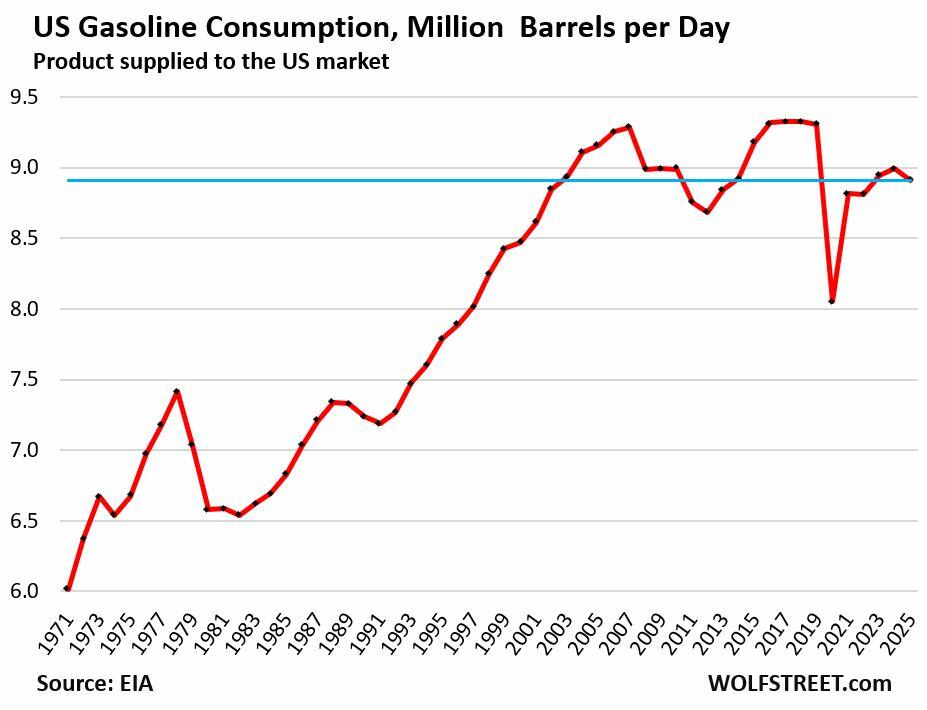
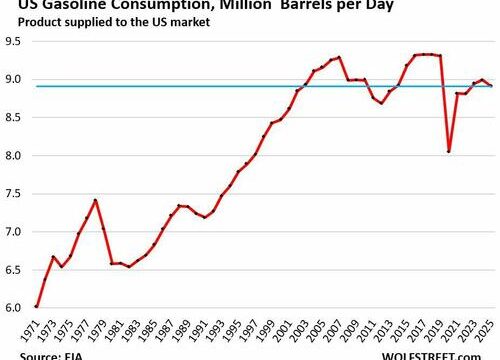
Gasoline consumption in the US, in terms of product supplied to gas stations, declined by about 1% in 2025, to 8.91 million barrels per day, according to EIA data, below where consumption had first been in 2003, even though the US population increased by 52 million people, or by 18%, over the same period.
Compared to the peak in 2018, gasoline consumption in 2025 fell by 4.5%. Compared to the prior peak in 2007, gasoline consumption is down 4.1%.
Gasoline consumption is increased by miles driven – which inched up to a record – and is slowed by the improving efficiency of gasoline-powered vehicles and the growing share of EVs.
The effects of the two Oil Shocks in the 1970s on gasoline consumption was dramatic. High gasoline prices and a recession led to fewer miles driven, but it also unleashed efforts by US automakers to make and sell smaller, more fuel-efficient vehicles. And the small fuel-efficient Japanese models became immensely popular. This wave of smaller and more fuel-efficient vehicles held down gasoline consumption, and it didn’t surpass its 1978 high until 1993, though the population grew by 18% over those 16 years.
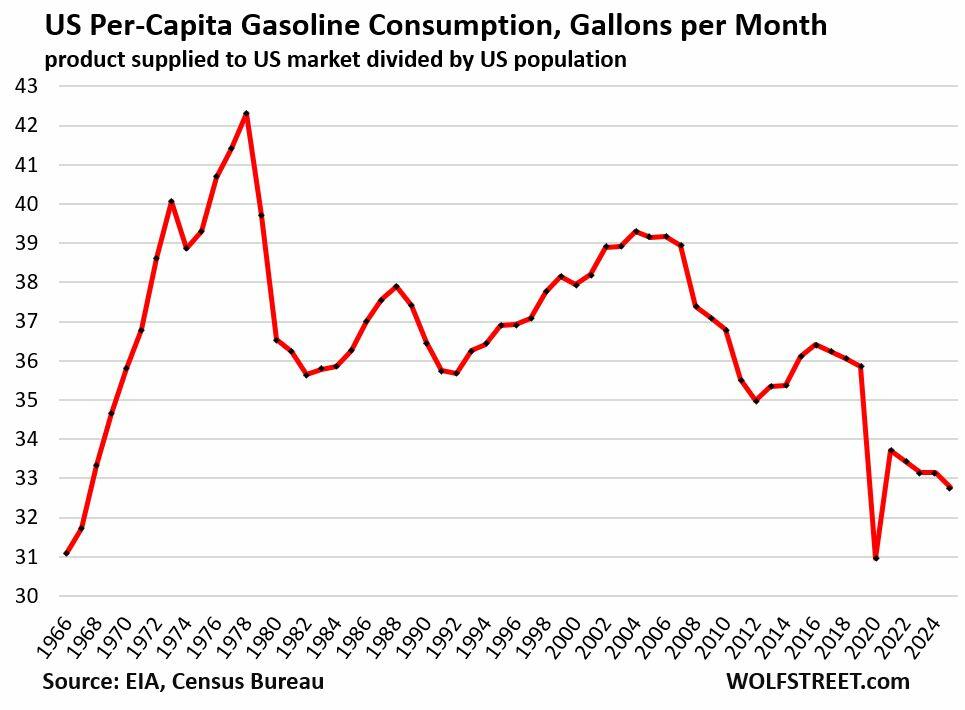
Per-capita gasoline consumption fell to 32.8 gallons per month in 2025, the lowest since 1967, except for the Covid year 2020, as a result of declining overall gasoline consumption amid a growing population.
This dynamic illustrates the structural decline in demand for gasoline.
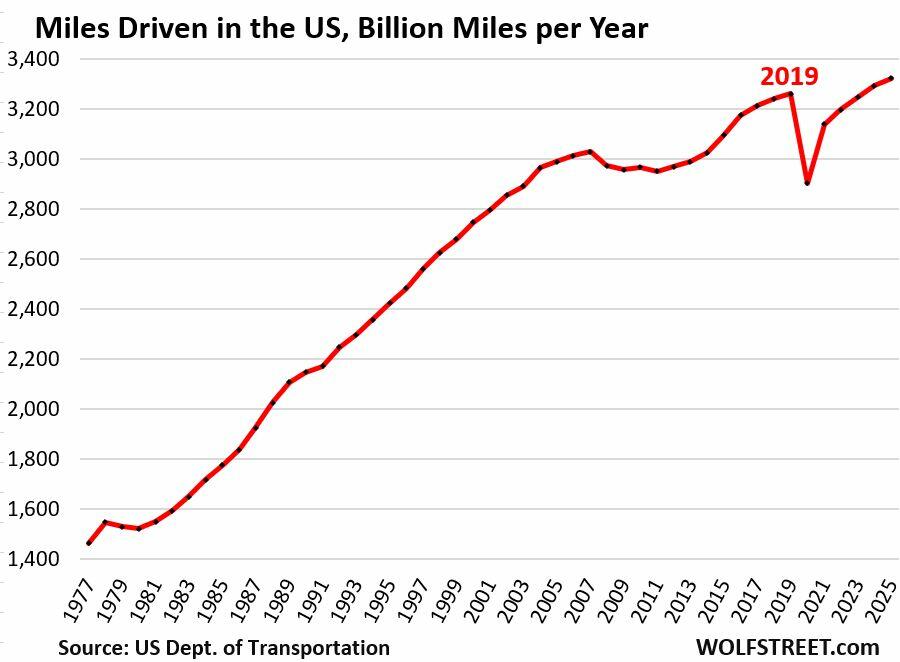
Miles driven edged up 0.9% in 2025, to a record of 3,324 billion miles, according to data from the Department of Transportation (includes miles driven by cars, light trucks, buses, motorcycles, delivery vans, and commercial trucks). But that’s only 9.7% higher than at the prior peak in 2007.
That gasoline consumption declines even as miles driven increases attests to the impact of more fuel-efficient ICE vehicles and more EVs in the vehicle mix.
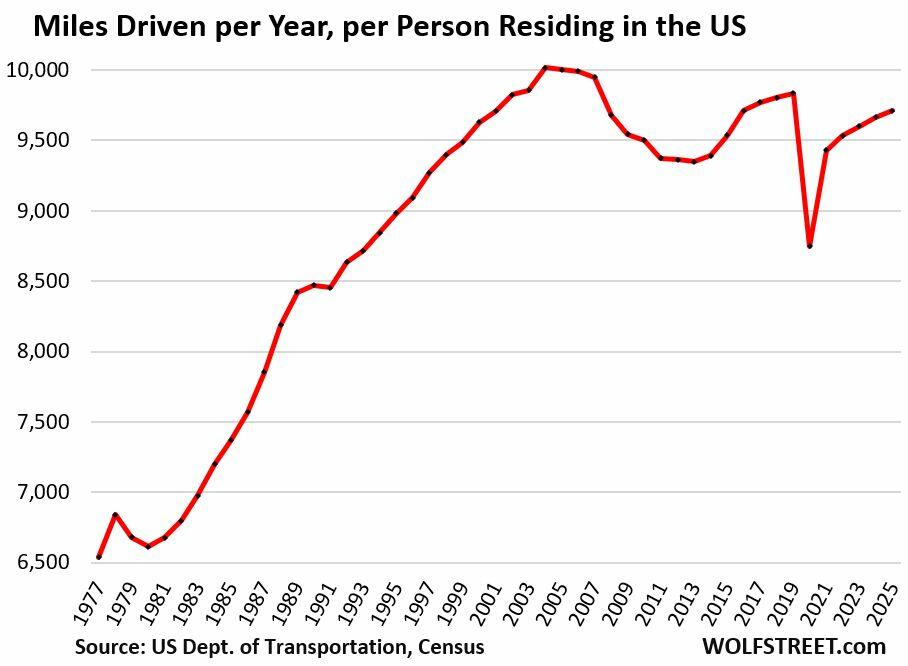
But people drive a little less: Miles driven per person residing in the US, at 9,710 miles in 2025, was 3.1% below the peak in 2004.
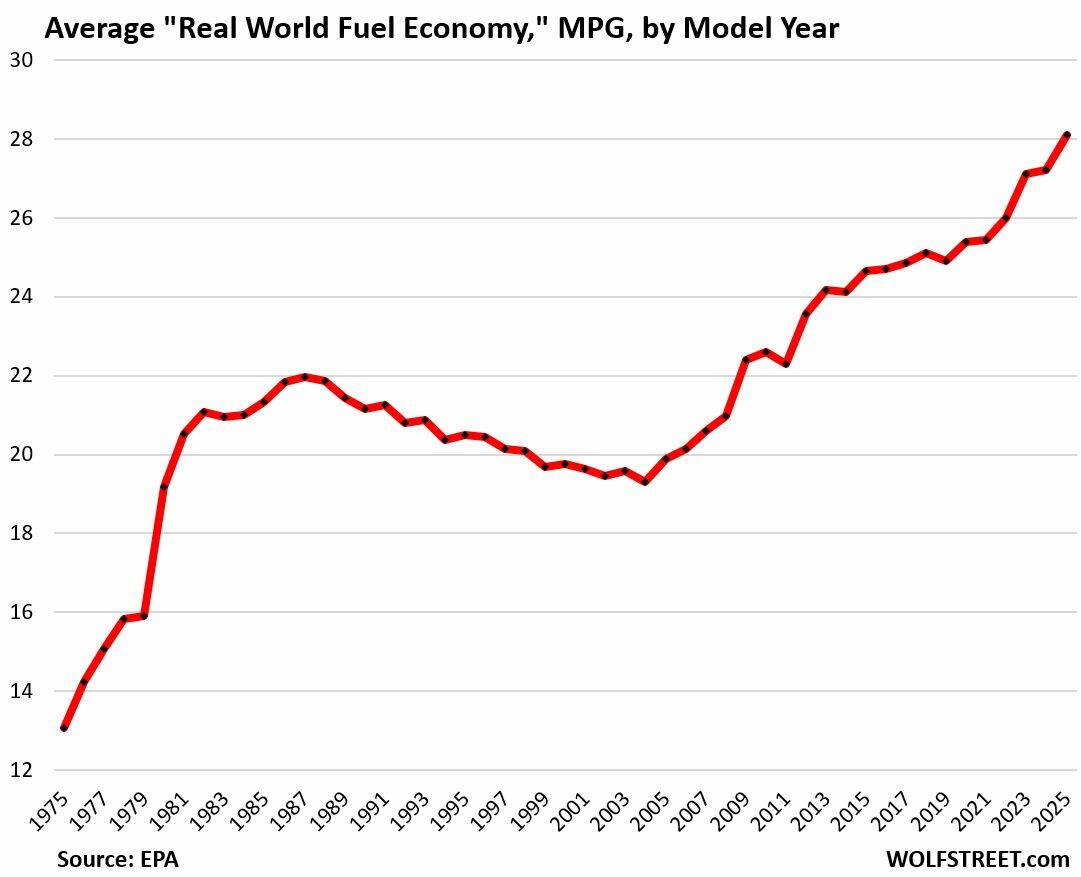
And average fuel economy keeps improving: that has been a big part of the long-term structural demand issue for gasoline.
Over the past 25 years, the average fuel economy of all passenger vehicles sold in the US rose by 43%, to a record of 28.1 “real world” MPG for the 2025 model year, according to preliminary data from the EPA last month.
Note the spike in average fuel economy coming out of the Oil Shocks, as compact Japanese vehicles made huge inroads, and as US automakers began offering smaller vehicles with better mileage.
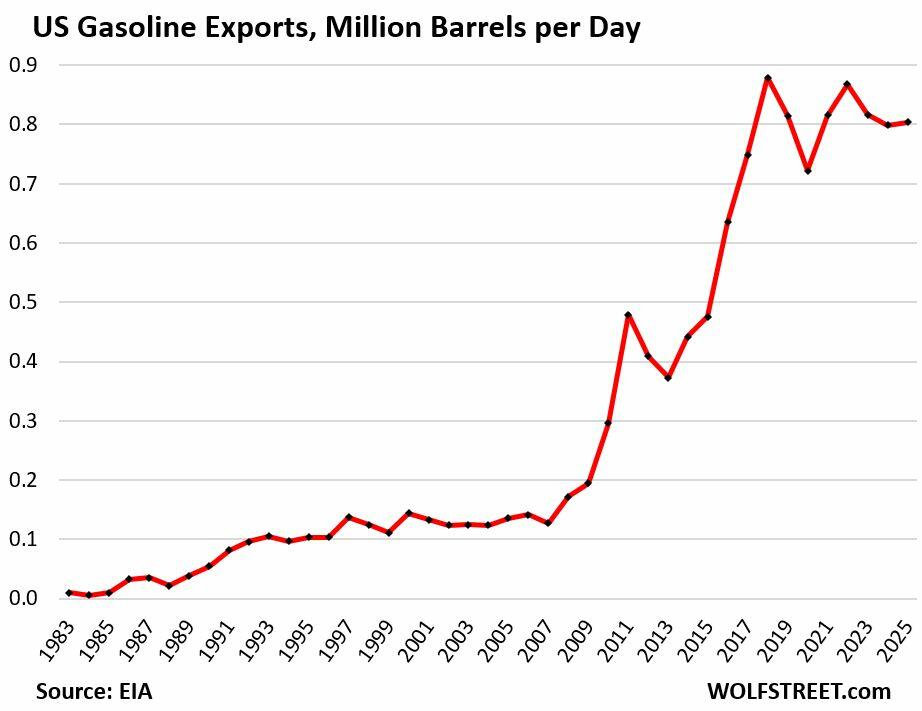
Exports of gasoline have become an outlet for refiners.
Crude oil production in the US has surged by 172% since 2008, to a record 13.6 million barrels per day (MMb/d) in 2025, according to EIA data. Over the years, exports of crude oil and petroleum products (diesel, gasoline, jet fuel, petroleum coke, and many others) have soared, and imports have fallen. In 2020, the US became a net exporter of crude oil and petroleum products, exporting more than importing. In 2025, net exports of crude oil and petroleum products rose to a record 2.8 MMb/d (detailed analysis and charts here).
Gasoline exports have become a big profitable trade for US refiners, and an outlet to replace falling demand at home. Many refiners import crude oil and export value-added products, such as gasoline, including refineries in California which face steeply dropping gasoline demand amid the rapidly growing prevalence of EVs and hybrids in the state.
For example, the US had a trade surplus of 590,000 barrels per day in crude oil and petroleum products with Mexico in 2025, importing 500,000 barrels a day of crude oil and exporting 1.1 MMb/d in value-added petroleum products, largely diesel and gasoline.
Gasoline exports started soaring in 2008, surpassed 700,000 barrels per day for the first time in 2017, hit 879,000 barrels per day in 2018, and have stayed in that range since then. In 2025, gasoline exports edged up to 804,000 barrels per day.
Tyler Durden
Fri, 03/06/2026 – 19:15