Category: News

Like a sleeping giant awakened, Benet’s Edvardas Stasys can’t be stopped by Bolingbrook. ‘A huge difference.’
At halftime of the Class 4A Bolingbrook Sectional championship game on Friday night, Edvardas Stasys hadn’t attempted a shot, and Benet trailed the host Raiders.
That changed midway through the third quarter, when the 6-foot-8 junior forward’s first shot resulted in a three-point play that put the defending state champion Redwings ahead for good.
“In the first half, I wasn’t getting too many open looks,” Stasys said. “I don’t have to force it. I’ve got a bunch of great players around me, so I let them handle it, and then in the second half I knew I had to step up a bit more.”
Stasys ended up scoring 13 points in the final 12 minutes as Benet defeated Bolingbrook 51-44.
“We talked at halftime,” Benet coach Gene Heidkamp said. “It was a point of emphasis. We’ve got to get Ed going. He’s a big part of our team. He made a huge difference down the stretch. He made winning plays all the way through.”
Stasys also had eight rebounds for the Redwings (34-1), who are ranked No. 1 in 4A in the poll by The Associated Press, have won 31 games in a row and will play Rockford Guilford or Rockford Auburn in the NIU Supersectional at 7:30 p.m. Monday.
Junior guard Perry Tchiegne added 13 points, seven rebounds and four steals against the Raiders (24-8), and senior guard Jayden Wright, an Eastern Illinois recruit, had nine points and four assists.
Freelance reporter Matt Le Cren contributed. This story will be updated.
Explosions rock Iran’s capital, more attacks target Israel and US warns bombing will intensify
DUBAI, United Arab Emirates — Explosions sent up clouds of dark smoke in the Iranian capital city early Saturday, and Tehran retaliated by firing missiles at Israel as the United States warned of a forthcoming bombing campaign that officials said would be the most intense yet in the weeklong conflict.
There was no foreseeable end to the fighting. U.S. President Donald Trump’s administration approved a new $151 million arms sale to Israel after Trump said he would not negotiate with Iran without its “unconditional surrender.” Iran’s U.N. ambassador said the country would “take all necessary measures” to defend itself.
Associated Press video showed explosions flashing and smoke rising over western Tehran as Israel said it had begun a broad wave of strikes. Also early Saturday, the Israeli military said it was moving to intercept a new salvo of missiles launched from Iran.
In a sign of the widening nature of the conflict, sirens sounded early Saturday in Bahrain as an Iranian attack targeted the island kingdom. And Saudi Arabia said it destroyed drones headed toward its vast Shaybah oil field and shot down a ballistic missile launched toward Prince Sultan Air Base, which hosts U.S. forces.
The U.S. and Israel have battered Iran with strikes, targeting its military capabilities, leadership and nuclear program. The stated goals and timelines for the war have repeatedly shifted, as the U.S. has at times suggested it seeks to topple Iran’s government or elevate new leadership from within.
Meanwhile, Russia has provided Iran with information that could help Tehran strike the U.S. military, according to two officials familiar with U.S. intelligence on the matter. Russian President Vladimir Putin had a call Friday with Iranian President Masoud Pezeshkian, expressing his condolences over the killing of Iranian Supreme Leader Ayatollah Ali Khamenei, the Kremlin said.
In other developments, evidence emerged suggesting that an explosion that killed scores of Iranian students at a school was likely caused by U.S. airstrikes that also hit an adjacent compound associated with the regime’s Revolutionary Guard.
Qatar’s energy minister, Saad al-Kaabi, warned in an interview with the Financial Times that the war could “bring down the economies of the world,” predicting a widespread shutdown of Gulf energy exports that could send oil to $150 a barrel.
The price for a barrel of benchmark U.S. crude rose above $90 on Friday for the first time in more than two years.
Russia is providing information to Iran, officials say
Russia has provided Iran with information that could help Tehran strike American warships, aircraft and other assets in the region, according to two officials familiar with U.S. intelligence on the matter.
The people, who were not authorized to comment publicly and spoke on the condition of anonymity, cautioned that the U.S. intelligence has not uncovered that Russia is directing Iran on what to do with the information.
Still, it’s the first indication that Moscow has sought to get involved in the war.
Russia has provided Iran with information that can help Tehran strike US military, AP sources say
Trump says US will help rebuild Iran once it has ‘ACCEPTABLE’ leaders
In a social media post Friday, Trump said “There will be no deal with Iran except UNCONDITIONAL SURRENDER!” After a surrender, “and the selection of a GREAT & ACCEPTABLE Leader(s),” he wrote, the U.S. and its allies will help rebuild Iran, making it “economically bigger, better, and stronger than ever before.”
Those comments were likely to raise further questions about the endgame of the war. The fighting has killed at least 1,230 people in Iran, more than 200 in Lebanon and around a dozen in Israel, according to officials in those countries. Six U.S. troops have been killed.
Iranian President Masoud Pezeshkian wrote on social media that “some countries” had begun mediation efforts, without elaborating.
Trump has also told media outlets that he should be involved in choosing a replacement for Khamenei, who was killed in the opening strikes of the war. Trump spoke dismissively of Khamenei’s son, Mojtaba Khamenei — a front-runner to replace his father — calling him “a lightweight.”
Iran’s U.N. ambassador, Amir Saeid Iravani, condemned Trump’s statement and said Iran “does not accept and will never allow any foreign power to interfere in its internal affairs.”
Iranian state television reported Friday that a leadership council had started discussing how to convene the country’s Assembly of Experts, which will select the new supreme leader.
Trump rules out talks absent Iran’s ‘unconditional surrender’ as Israel strikes Lebanon
U.S. official warns that ‘biggest bombing’ is coming
U.S. Treasury Secretary Scott Bessent said in a television interview that the “biggest bombing campaign” of the war was still to come.
Israel has said that over the past week it has heavily bombed an extensive underground bunker that Iranian leaders had planned to use during the hostilities.
New information surfaced suggesting that a deadly Feb. 28 explosion at a school in the Iranian city of Minab, some 680 miles southeast of Tehran, was likely caused by U.S. airstrikes. The information included satellite images, expert analysis, a U.S. official and public information released by U.S. and Israeli military forces.
Iranian state media has said more than 165 people were killed in the blast, most of them of children.
Iran has blamed Israel and the U.S. for the explosion. Neither country has accepted responsibility, though Defense Secretary Pete Hegseth has said the U.S. is investigating.
Fighting with Israeli troops reported in eastern Lebanon
Lebanon’s state-run news agency reported that local fighters clashed early Saturday with an Israeli force that landed near the town of Nabi Chit, a Hezbollah stronghold in eastern Lebanon. There was no word on casualties. The Israeli military did not immediately respond to the AP’s request for comment.
Israel has carried out waves of airstrikes on the southern suburbs of Beirut, where Hezbollah has a large presence but which is also home to hundreds of thousands of civilians.
Lebanon’s Health Ministry said 217 people had been killed by Israeli strikes since Monday and 798 wounded.
Roads in the Lebanese capital were choked with evacuating traffic as smoke rose over the city’s southern districts. Two hospitals evacuated patients and staff.
“What can we do? We prayed here under the tree. During the night, we slept in the car because there is no place to stay,” Jihan Shehadeh, one of the tens of thousands of displaced, said.
Metz reported from Ramallah, West Bank, Rising from Bangkok and Abou AlJoud from Beirut. Associated Press journalists around the world contributed.
https://www.chicagotribune.com/2026/03/06/us-israel-iran-bombing-intensifies/
California May Flip 50-Year Nuclear Moratorium
California May Flip 50-Year Nuclear Moratorium
California, long a leader in aggressive renewable energy mandates, is showing early signs of softening its decades-old ban on new nuclear power. Bloomberg reported cracks are appearing in the state’s 1976 moratorium, driven by surging electricity demand from AI data centers and the challenge of hitting absurd climate targets like 90% clean electricity by 2035 and 100% by 2045.
At the center of the development is Assembly Bill 2647, introduced last month by Democratic Assembly Member Lisa Calderon with Republican co-sponsors. The legislation would exempt “advanced nuclear reactors”, defined as systems licensed by the Nuclear Regulatory Commission since 2005, from the state’s long-standing prohibition. Calderon stated the bill keeps nuclear “on the table” as an essential tool for reliable, low-carbon power.
The move aligns with a broader U.S. resurgence in nuclear interest, but in California it comes against a backdrop of chronic grid strain.
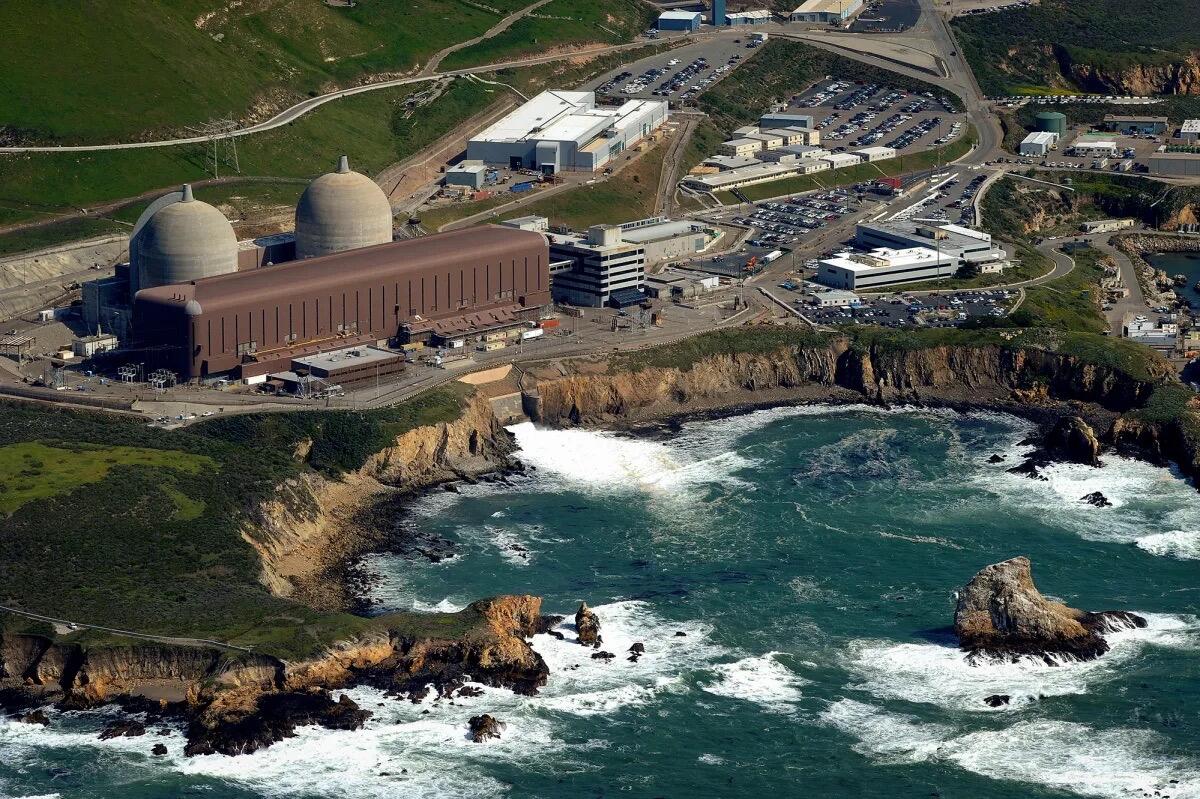
The state has already leaned on its sole remaining nuclear facility, Diablo Canyon, to avoid worse outcomes. In 2022/23, Governor Gavin Newsom pushed through lawsuits for an extension of the plant’s operations past its original 2025 closure date after warnings of rolling blackouts. It was a glaring admission that electric grids are far from being sustainable with just wind and sunlight.
PG&E Launches $73B California Grid Plan To Feed Starving AI https://t.co/tsmtfalX1K
— zerohedge (@zerohedge) September 30, 2025
Just last week, Diablo Canyon cleared its final state permitting hurdles, paving the way for continued operation through at least 2030 and potentially longer pending federal relicensing.
We’ve chronicled these pressures for years. As far back as 2023 we detailed the legal battles surrounding Diablo Canyon’s then-planned shutdown. Last year, we also noted Newsom’s clean-energy claims and how extensions of both Diablo Canyon and natural-gas plants were critical to preventing blackouts during peak summer demand.
Even with massive investments in solar, wind, and batteries, California’s grid has repeatedly flirted with instability, especially when intermittent renewables fall short during heat waves or evening ramps. The AI boom has only accelerated the problem; data centers are projected to drive unprecedented load growth nationwide, and California utilities are scrambling to keep pace.
The bill does not mandate new reactors or repeal the moratorium outright. It simply removes a regulatory barrier rooted in 1950s-era technology concerns and unresolved federal waste-storage issues. Whether it passes and whether utilities or tech firms actually pursue advanced nuclear projects remains to be seen.
Tyler Durden
Fri, 03/06/2026 – 22:10
https://www.zerohedge.com/energy/california-may-flip-50-year-nuclear-moratorium

Los Celtics vencen 120-100 a los Mavericks en el primer juego de Tatum en casi 10 meses
BOSTON (AP) — Jaylen Brown anotó 24 puntos, capturó siete rebotes y repartió siete asistencias, y los Celtics de Boston vencieron 120-100 a los Mavericks de Dallas la noche del viernes, en el primer partido de Jayson Tatum en casi 10 meses tras romperse el tendón de Aquiles derecho.
Tatum sumó 15 unidades al encestar 6 de 16 tiros de campo, bajar 12 rebotes y conseguir siete asistencias en 27 minutos marcados por la falta de ritmo. Disputó tramos de cinco y seis minutos en su primer encuentro desde que sufrió la lesión durante el cuarto partido de la derrota de Boston ante Nueva York en las semifinales de la Conferencia Este en mayo.
Derrick White agregó 20 tantos para ayudar a Boston a ganar por cuarta vez en cinco partidos. Dallas ha perdido seis seguidos.
El número 1 del draft, Cooper Flagg, oriundo de Maine y que jugó su primer partido en el TD Garden, registró 16 puntos, ocho rebotes y seis asistencias por Dallas. Klay Thompson terminó con 19 unidades y Naji Marshall aportó 13.
Tatum falló sus primeros seis disparos, incluidos tres triples. Pero siguió buscando a sus compañeros y colocando bloqueos de manera activa para iniciar la ofensiva.
A los Celtics les quedan 19 partidos en la temporada regular, incluidos 11 en el TD Garden, para intentar poner a punto a Tatum de cara a los playoffs.
___
Deportes en español AP: https://apnews.com/hub/deportes

Maxx Crosby heading to Baltimore Ravens, who send 2 first-round draft picks to Las Vegas Raiders
Five-time Pro Bowl edge rusher Maxx Crosby is heading to the Baltimore Ravens, two people with knowledge of the trade told The Associated Press on Friday night.
Both people spoke on condition of anonymity because the deal can’t be announced until the NFL’s new year starts next week.
The Las Vegas Raiders will receive two first-round picks from the Ravens, including the No. 14 pick in next month’s NFL draft, one of the people said.
Crosby, 28, had 10 sacks last season and has reached double digits four times in his seven seasons.
https://www.chicagotribune.com/2026/03/06/maxx-crosby-trade-baltimore-ravens/

Why’d The US Temporarily Waive Sanctions On India’s Purchase Of Russian Oil?
Why’d The US Temporarily Waive Sanctions On India’s Purchase Of Russian Oil?
The “politically inconvenient” truth is that the US is unilaterally reshaping the world order in a bid to restore unipolarity, and regardless of one’s opinion about this, it’s objectively achieved some tangible progress as of late.
Treasury Secretary Scott Bennett announced that Indian refiners had just been provided with a 30-day waiver to purchase Russian oil, but only if it’s that which is already stranded at sea, thus ensuring “no significant financial benefit to the Russian government”. The stated purpose is “To enable oil to keep flowing into the global market” due to disruptions around the Strait of Hormuz caused by the Third Gulf War, which the US initiated as part of its grand strategy against China as explained here.
Depriving China of the 13.4% of its oil imports that it received from Iran last year is designed to give the US enormous leverage ahead of Trump’s upcoming trip at month’s end with the hope of then coercing the People’s Republic into agreeing to a lopsided trade deal for derailing its superpower rise. It’s beyond the scope of this analysis to critique that strategy, but the point in referencing it is to draw attention to how India could have suffered collateral damage had the US not temporarily waived its sanctions.
After all, Trump threatened last month to reimpose his punitive 25% tariffs on India for these purchases if they’re resumed after claiming that Modi agreed to zero them out as part of the Indo-US trade deal, which India denied. Nevertheless, India did indeed reduce its imports under what top Russian expert Fyodor Lukyanov described as “US pressure”, though he also clarified that this doesn’t mean that India isn’t a sovereign state despite the US unofficially exerting influence over its energy security.
In his words, “India’s understanding (of sovereignty), like that of many other states, is different (than Russia’s). Sovereignty does not necessarily mean refusing to bend under pressure; it means finding ways to realize one’s interests under less-than-ideal conditions…This is the practical reality of what is often called a multipolar world…look after your own first.”
This insight frames the rest of Bennett’s announcement about how “we fully anticipate that New Delhi will ramp up purchases of U.S. oil”.
Trump 2.0 weaponized tariffs to re-engineer India’s energy ties in order to place more long-term financial pressure on Russia while reaping more profits for US companies. Even though the Supreme Court ruled that some of its tariffs were unconstitutional, it was explained here how that only slightly complicates Trump 2.0’s foreign policy, while this analysis here argued that India is unlikely to defy Trump on Russian oil. Simply put, it doesn’t want to face Trump’s wrath no matter what form it takes, which is reasonable.
Be that as it may, it would be inaccurate to describe India as a US vassal in spite of the newfound influence that the US now wields over its energy security since “India’s New Multi-Alignment Trend Prioritizes Middle Powers For Tri-Multipolarity Purposes”. In simple English, India’s partnerships with similarly positioned countries in the emerging world order are aimed at collectively balancing the influence of the American and Chinese superpowers therein, thus preserving some of their sovereignty.
The “politically inconvenient” truth is that the US is unilaterally reshaping the world order in a bid to restore unipolarity, and regardless of one’s opinion about this, it’s objectively achieved some tangible progress as of late. The new world order that it envisages has India playing a prominent geo-economic and geopolitical role, especially vis-à-vis China, ergo why it temporarily waived the sanctions on Russian oil purchases in order to avoid India sliding into turmoil and possibly offsetting this scenario if it didn’t.
Tyler Durden
Fri, 03/06/2026 – 21:45
Jefe de tecnología del Pentágono dice que se enfrentó con Anthropic por armas autónomas
Por MATT O’BRIEN
Un alto funcionario del Pentágono dijo que la disputa de Anthropic con el gobierno de Estados Unidos por el uso de su tecnología de inteligencia artificial en armas totalmente autónomas surgió después de un debate sobre cómo podría utilizarse la IA en el futuro programa de defensa antimisiles Golden Dome, que pretende colocar armas estadounidenses en el espacio.
El subsecretario de Defensa Emil Michael, director de tecnología del Pentágono, señaló que llegó a considerar las restricciones éticas de la empresa de IA sobre el uso de su chatbot Claude como un obstáculo irracional, en un momento en que las fuerzas armadas de Estados Unidos procuran otorgar mayor autonomía a enjambres de drones armados, vehículos submarinos y otras máquinas para competir con rivales como China, que podría hacer lo mismo.
“Necesito un socio confiable y constante que me dé algo, que trabaje conmigo en lo autónomo, porque algún día será real y estamos empezando a ver versiones tempranas de eso”, manifestó Michael en un podcast el viernes. “Necesito a alguien que no sienta desasosiego a mitad del camino”.
Efectuó sus comentarios después de que el Pentágono designara formalmente a Anthropic —ubicada en San Francisco— como un riesgo para la cadena de suministro, prescindiendo de su trabajo de defensa mediante una norma diseñada para impedir que adversarios extranjeros dañen sistemas de seguridad nacional.
Anthropic se comprometió a interponer una demanda por la designación, que afecta sus alianzas comerciales con otros contratistas militares.
El presidente Donald Trump también ordenó a las agencias federales que dejen de usar Claude de inmediato, aunque le dio seis meses al Pentágono para retirar gradualmente un producto que está profundamente integrado en sistemas militares secretos, incluidos los utilizados en la guerra de Irán.
Anthropic indicó que sólo intentó restringir que su tecnología se utilizara para dos usos de alto nivel: la vigilancia masiva de estadounidenses y armas totalmente autónomas.
Michael, exejecutivo de Uber, expuso su versión de meses de conversaciones con el director general de Anthropic, Dario Amodei, en una extensa charla con Jason Calacanis, David Friedberg y Chamath Palihapitiya, capitalistas de riesgo de Silicon Valley y copresentadores del podcast “All-In”.
Un cuarto copresentador, el exejecutivo de PayPal David Sacks, es ahora el zar de IA de Trump y no estuvo presente en el episodio, pero ha criticado abiertamente a Anthropic, incluido por el hecho de que haya contratado a exfuncionarios del gobierno del presidente Joe Biden poco después de que Trump regresara a la Casa Blanca el año pasado.
Cuando las conversaciones se estancaron la semana pasada, Michael arremetió contra Amodei en redes sociales, al afirmar que “tiene un complejo de Dios” y que “no quiere nada más que intentar controlar personalmente” a las fuerzas armadas. Sin embargo, en el podcast enmarcó la disputa como parte de un giro militar más amplio hacia el uso de la IA.
Michael sostuvo que las fuerzas armadas están desarrollando procedimientos para habilitar distintos niveles de autonomía en la guerra, según el riesgo que se plantee.
“Esto es parte del debate que tuve con Anthropic, y es que necesitamos IA para cosas como Golden Dome”, comentó Michael, al compartir un escenario hipotético en el que Estados Unidos tendría sólo 90 segundos para responder a un misil hipersónico chino. Trump ha promovido el desarrollo del Golden Dome.
Un operador humano de defensa antimisiles “quizá no pueda distinguir con sus propios ojos a qué está apuntando”, pero un contraataque autónomo sería de bajo riesgo “porque está en el espacio, y sólo intentas golpear algo que intenta golpearte”.
En otro escenario, afirmó: “¿Quién podría oponerse si tienes una base militar, tienes a un montón de soldados durmiendo, y tienes un láser que puede derribar drones de forma autónoma?”.
En respuesta a los comentarios del podcast, Anthropic remitió a una declaración anterior de Amodei en la que decía: “Anthropic entiende que el Departamento de Guerra, no las empresas privadas, toma las decisiones militares. Nunca hemos planteado objeciones a operaciones militares concretas ni intentado limitar el uso de nuestra tecnología de manera ad hoc”.
Michael, subsecretario de Defensa para investigación e ingeniería, fue juramentado para el cargo en mayo pasado, y dijo que asumió la “cartera de IA” de las fuerzas armadas en agosto. Fue entonces cuando, según explicó, empezó a examinar los contratos de Anthropic, algunos de los cuales se remontaban al gobierno demócrata de Biden. Michael indicó que cuestionó a Anthropic por condiciones de uso que consideró demasiado restrictivas.
“Necesito que las condiciones del servicio sean racionales en relación con nuestro conjunto de misiones”, manifestó. “Así que iniciamos estas negociaciones. Requirió tres meses, y tuve que plantearles escenarios, como este ejemplo del misil hipersónico chino. Ellos dicen: ‘Está bien, te daremos una excepción para eso’. Bueno, ¿y qué hay de este enjambre de drones? ‘Te daremos una excepción para eso’. Y yo pensaba: las excepciones no funcionan. No puedo predecir para los próximos 20 años cuáles son todas las cosas para las que podríamos usar la IA”.
Fue entonces cuando el Pentágono empezó a insistir en que Anthropic y otras empresas de IA permitieran “todo uso lícito” de su tecnología, según Michael.
Anthropic se resistió a ese cambio, alegando que los principales sistemas de IA actuales “simplemente no son lo bastante confiables como para impulsar armas totalmente autónomas”.
Sus competidores —Google, OpenAI y xAI de Elon Musk— aceptaron las condiciones del Pentágono, aunque algunos aún tienen que preparar su infraestructura para trabajo militar secreto, señaló Michael. El otro punto de fricción para Anthropic fue el no permitir ninguna vigilancia masiva de estadounidenses.
“No querían que recopiláramos en bloque información pública sobre personas que usan su sistema de IA”, explicó Michael, y dijo que las negociaciones eran “interminables”.
Anthropic ha rebatido partes de la versión de Michael sobre las conversaciones, y subrayó que las protecciones que buscaba eran limitadas y no se basaban en usos existentes de Claude. Es probable que la siguiente etapa de la disputa se desarrolle en los tribunales.
———
Esta historia fue traducida del inglés por un editor de AP con la ayuda de una herramienta de inteligencia artificial generativa.
President Trump says ‘whole educational system’ could go out of business without fixes to college sports
President Donald Trump predicted the destruction not just of college sports but the entire U.S. collegiate system unless the industry is fixed quickly — something some sports leaders who joined him Friday at a White House summit agreed could only happen by raising more money to pay players.
Trump suggested he would write an “all-encompassing” executive order within a week in hopes it would spark action from Congress. He said he expected the order to trigger a lawsuit that could put the issue back in front of the court system that approved industry-changing payments to players for their name, image and likeness.
That new system has left many schools drowning in red ink, while rules governing their payments to players are only slowly taking hold.
“The whole educational system is going to go out of business because of this,” Trump explained, when asked why he was devoting time to college sports with the war in Iran and other issues dominating the headlines.
In a big-money era, University of Illinois shrugs off rules on athletes’ NIL deals
During the meeting in the East Room — which included lawmakers, conference commissioners, the president of the NCAA and CEO of the U.S. Olympic team but none of the NCAA’s 550,000 college athletes — Trump said, “I thought the system of scholarships was great.” He was harkening to the recently ended era in which players received little to nothing beyond financial aid.
He said the “horrible” court settlement that led to the current system — a settlement that virtually everyone in the room agreed to — “threw the sports world and the college athletic world into ‘tithers.’”
Everyone at the meeting agreed that the industry needs to be saved from the spiraling costs associated with the onset of NIL payments.
They also mostly agreed that a bill called the SCORE Act that would provide the NCAA with a limited antitrust exemption (opposed by many Democrats) and would preempt state laws regarding NIL could be the base of any change. House Speaker Mike Johnson suggested the bill, which has struggled to get through the lower chamber, could now have enough support to pass.
Shortly after meeting, bipartisan Senate bill on TV rights emerges
An essay published earlier this week by the University of Louisville’s president and athletic director went through an unflinching list of the way payments to players have recalibrated college sports and sent much of the industry spiraling into the red. It said Louisville’s athletic department is running a $12.5 million deficit and is hardly alone.
How to generate more revenue — and the wide differences that exist over how to fund the growth — received less attention at the White House meeting full of big-picture speeches about the perils facing college sports.
Shortly after the meeting, Sens. Eric Schmitt, R-Mo., and Maria Cantwell, D-Wash, reupped an idea that has been popular over the past several months. They plan to introduce a bill next week that would give conferences the option of pooling their media rights — a practice forbidden by the 1961 Sports Broadcasting Act.
“The revenue side is inextricably linked to the success of this,” Schmitt said. “I do think we can come together.”
Another key backer of that idea, Texas Tech regent Cody Campbell, was at the meeting and told Trump he would like to be part of a smaller working group that helps him draft his executive order.
Campbell has suggested pooling TV rights could raise another $6 billion, which could keep football, basketball and Olympic-sports programs solvent for decades. The SEC and the Big Ten disagree with that conclusion.
Speaking to Trump, SEC Commissioner Greg Sankey urged the Senate to act, but he wasn’t focused on the broadcasting piece.
“This is not about revenue, this is about structures and national standards,” he said before listing a number of issues the SCORE Act, as currently written, would address.
Sen. Ted Cruz, R-Texas, whose committee is key to getting a bill passed in the upper chamber, said lawmakers need to look at both the cost and revenues side in formulating a law.
“If we wait another year, wait another two years, the programs in your state are going away and the students in your state are losing their scholarships,” Cruz said. “It would be an absolute travesty if we let that happen.”
Trump tears into judge who approved a deal that most everyone agreed to
Trump repeatedly dogged U.S. District Judge Claudia Wilken — whom he called a “radical-left judge” — for approving the so-called House settlement that put this system into play.
He seemed surprised that Wilken’s decision — which was signed off on by the NCAA, the major conferences and the athletes themselves after a yearslong legal process — had not been appealed.
He was also taken aback when told the Supreme Court in 2021, by a 9-0 ruling in a case called NCAA vs. Alston, had set things in motion to create the system now seen by many as in peril.
“So, the Supreme Court was responsible for this? Gee, that’s surprising,” Trump said.
Olympic sports are in the most danger if college costs aren’t controlled
But the president was crystal clear about the stakes involved in saving college sports.
He acknowledged that potentially the biggest losers in all this could be Olympic and women’s sports, whose budgets in college athletic departments are funded via revenue generated by football and basketball programs across the country.
U.S. Olympic and Paralympic Committee CEO Sarah Hirshland told Trump the U.S. team has topped the medals table at eight of the last 10 Summer Olympics, largely on the strength of athletes developed in the college system.
“The economic pressures are unsustainable,” she said. “We’ve heard this several times and we know that Olympic-sport budgets inevitably rise to the top as the first to be cut. In some cases, it’s women’s sports, but also men’s sports that could be eliminated. We must keep our eye on both.”
https://www.chicagotribune.com/2026/03/06/president-trump-college-sports/
These Are The Retailers That Change Prices Most Often…And When They Offer The Largest Discounts
These Are The Retailers That Change Prices Most Often…And When They Offer The Largest Discounts
Dynamic pricing is becoming a defining feature of modern retail, with more of America’s best-known brands adjusting prices in real time based on demand, timing, and market conditions, according to Decodo.
A new report from Decodo, which analyzed more than 1.5 million data points across 120 global eCommerce retailers, reveals which companies are changing prices most often — and when shoppers are most likely to find a deal.
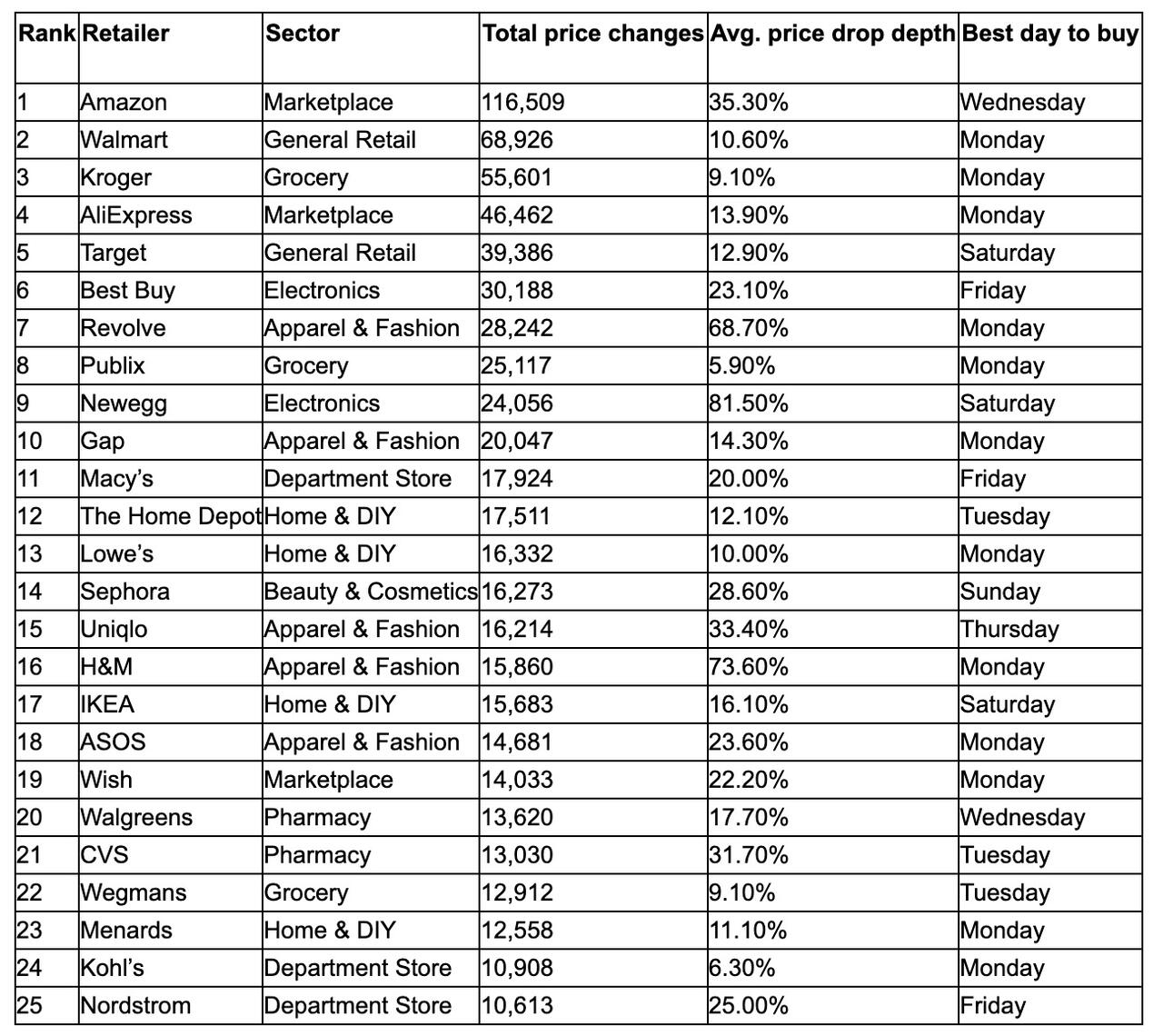
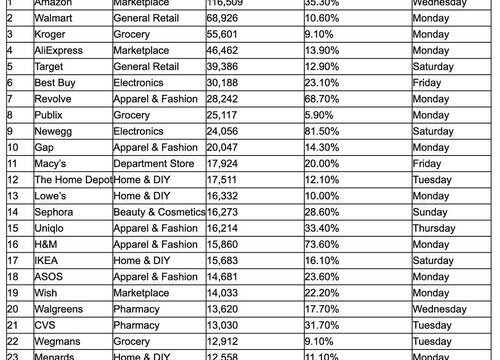
At the top of the list is Amazon, which recorded 116,509 price changes over the past year — far more than any other retailer analyzed. The online marketplace also offered the deepest average discounts, with prices dropping by 35.3% on average. According to the data, Wednesday is the best day for shoppers to find bargains on Amazon. Walmart ranked second with 68,926 price adjustments and an average discount of 10.6%, while Kroger came third, making 55,601 changes with an average 9.1% reduction. For both Walmart and Kroger, Monday emerged as the most favorable day for deals.
Other major retailers also showed significant pricing activity. Target recorded 39,386 changes, with Saturday offering the best savings. In electronics, Best Buy posted over 30,000 price shifts, with Friday standing out for discounts. Fashion brands were particularly active, with companies such as H&M, Uniqlo, and ASOS frequently adjusting prices to keep pace with trends and demand.
The United States leads the world in dynamic pricing activity, accounting for 542,946 price changes — far ahead of Germany, India, the United Kingdom, and Korea. Notably, U.S. price shifts were almost evenly split between increases and decreases, reflecting a highly competitive retail environment. This challenges the perception that dynamic pricing primarily pushes costs upward, as roughly half of all recorded adjustments were price reductions.
Decodo found that that by sector, fashion experienced the greatest volatility, with 427,340 pricing changes over the past year. Electronics followed with more than 351,000 adjustments, and groceries saw nearly 319,000 changes. Health and beauty, DIY and home, and online marketplaces also recorded substantial fluctuations, underscoring how widespread automated pricing strategies have become across industries.
The report comes amid growing political scrutiny of dynamic pricing practices in several U.S. states, where lawmakers are questioning whether constantly shifting prices disadvantage consumers. Decodo’s leadership argues that the approach allows businesses to respond quickly to demand, manage inventory more efficiently, and remain competitive in fast-moving markets. Company representatives also note that about half of all price changes tracked in the study resulted in lower prices, meaning shoppers regularly benefit from real-time discounts.
The findings are based on a year-long analysis conducted between January and December 2026, during which researchers monitored 12 products on each of more than 120 eCommerce websites across 40 countries. Prices were recorded every four hours, generating more than 1.5 million data points. As dynamic pricing becomes increasingly common, the data suggests that shoppers who pay attention to timing — particularly specific days of the week — may improve their chances of securing better deals.
Tyler Durden
Fri, 03/06/2026 – 21:20

Celta de Vigo busca desesperadamente a Madonna y su camiseta de 36 años
MADRID (AP) — El Celta de Vigo busca desesperadamente a Madonna mientras intenta encontrar una camiseta de fútbol de 36 años que la estrella del pop usó durante un concierto en 1990, en el estadio de Balaídos del club español de fútbol.
Madonna apareció en el escenario con el emblemático azul celeste del equipo en julio de 1990, durante su gira Blonde Ambition.
Encantó a los lugareños, que reclamaron a la “chica material” como una de los suyos. Madonna atrajo además una atención inesperada sobre el defensor José Manuel Espinosa, cuya camiseta con el número 5 fue la que portó la estrella.
Sin embargo, se desconoce el paradero de la preciada prenda y, tras buscarla sin éxito durante décadas, el Celta le pide a Madonna, actualmente de 67 años, que ayude a encontrarla para el archivo del club.
La presidenta del Celta, Marián Mouriño Terrazo, escribió en una carta abierta a la cantante estadounidense: “Aunque la nuestra no fue la única camisola de fútbol que alguna vez usaste en el escenario, esta imagen icónica ha ido brillando de manera distinta con el paso de los años”.
“Con el tiempo llegamos a comprender mejor lo que representabas entonces: cuestionar las normas establecidas y plantarte ante quienes intentan decirte lo que puedes o no puedes hacer. En nuestro club nos reconocemos en esa forma de pensar. Por eso mantenemos la esperanza de encontrar la prenda que una vez llevaste.
“¿La tienes? Si sabes dónde puede estar, o si te gustaría unirte a nosotros en la búsqueda para recuperarla, por favor contáctanos por mensaje privado”.
El exhorto causó revuelo en redes sociales a partir del miércoles, cuando se publicó, y el club redobló la apuesta antes de la derrota liguera en casa por 2-1 sufrida el viernes ante el Real Madrid; puso canciones de Madonna antes del cotejo y colocó la imagen de la artista estadunidense en el campo y en redes sociales.
Mouriño Terrazo comentó a medios locales que tenía la esperanza de que las repercusiones llegaran a la estrella del pop.
“Me imagino que la carta le llegó a Madonna y que responderá”, manifestó.
Madonna irrumpió en la escena en 1983 con el éxito “Holiday” y después encadenó una serie de temas que entraron en el top 10, entre ellos “Like a Virgin”, “papa Don’t Preach” y “Ray of Light”.
Sigue siendo una de las artistas más exitosas de la historia de la discografía.
_____
Deportes AP: https://apnews.com/hub/deportes