Category: News
El crudo supera los 100 dólares por barril mientras la guerra con Irán frena producción y envíos
Por ALEX VEIGA
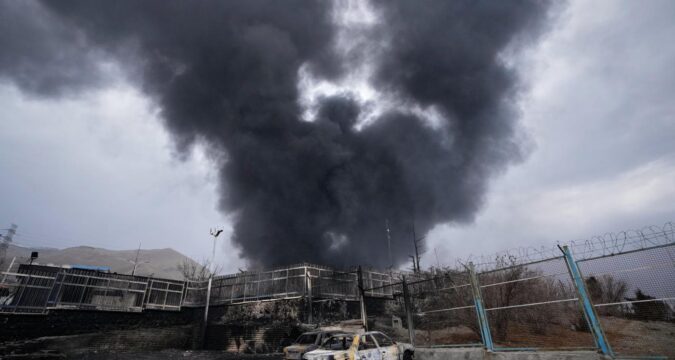
CHICAGO (AP) — Los precios del petróleo superaron los 100 dólares por barril por primera vez en más de tres años y medio, ya que la guerra con Irán obstaculiza la producción y el transporte en Oriente Medio.
El precio del barril de crudo Brent, el referente internacional, se situaba en 101,19 dólares poco después de que se reanudaran las operaciones en la Bolsa Mercantil de Chicago, un 9,2% por encima de su precio de cierre del viernes, de 92,69 dólares.
El West Texas Intermediate, el crudo ligero y dulce producido en Estados Unidos, se vendía a unos 107,06 dólares por barril. Eso es un 16,2% más que su precio de cierre del viernes, de 90,90 dólares.
Ambos podrían subir o bajar a medida que continúan las negociaciones en el mercado.
Los aumentos se produjeron después de que los precios del crudo en Estados Unidos se dispararan un 36% y los del Brent subieran un 28% la semana pasada. Los precios del petróleo se han incrementado fuertemente a medida que la guerra, ya en su segunda semana, ha involucrado a países y lugares que son cruciales para la producción y el movimiento de crudo y gas desde el golfo Pérsico.
Aproximadamente 15 millones de barriles de crudo —alrededor del 20% del petróleo mundial— suelen transportarse cada día a través del estrecho de Ormuz, según la firma independiente de investigación Rystad Energy. La amenaza de ataques iraníes con misiles y drones prácticamente ha detenido a los petroleros que atraviesan el estrecho, que limita al norte con Irán, y que transportan petróleo y gas desde Arabia Saudí, Kuwait, Irak, Qatar, Bahrein, los Emiratos Árabes Unidos e Irán.
Irak, Kuwait y los Emiratos Árabes Unidos han recortado su producción de petróleo a medida que los tanques de almacenamiento se llenan, pues tienen menor capacidad para exportar crudo. Irán, Israel y Estados Unidos también han atacado instalaciones de petróleo y gas desde que comenzó la guerra, lo que ha agravado las preocupaciones sobre el suministro.

Doncic anota 35 y los Lakers resisten 110-97 ante los Knicks sin LeBron
Associated Press
LOS ÁNGELES (AP) — Luka Doncic anotó 35 puntos y capturó ocho rebotes, Austin Reaves sumó 25 puntos y los Lakers de Los Ángeles superaron el domingo la ausencia por lesión de LeBron James para imponerse con esfuerzo 110-97 a los Knicks de Nueva York.
Rui Hachimura aportó 13 puntos para los Lakers, que nunca estuvieron abajo ante los Knicks, en racha, en su cuarta victoria consecutiva, incluso mientras James se perdió su segundo partido seguido por una contusión en el codo izquierdo y una lesión en el pie izquierdo.
Los Lakers se vinieron abajo en el último cuarto, con apenas una canasta en un tramo de 6 minutos y medio en la recta final, mientras Nueva York recortó su desventaja de 23 puntos a 10. Pero los Knicks no encestaron lo suficiente como para aprovecharlo y cometieron ocho pérdidas de balón en el cuarto periodo.
Karl-Anthony Towns terminó con 25 puntos y 16 rebotes por los Knicks, que perdieron apenas por segunda vez en seis partidos.
Jalen Brunson anotó 10 de sus 24 puntos en el último cuarto, pero Nueva York no pudo sobreponerse a su 8 de 34 en intentos de triple en la segunda parada de su gira de cinco partidos, que comenzó con una victoria impresionante en Denver. Mikal Bridges se fue en blanco en 27 minutos.
___
Deportes en español AP: https://apnews.com/hub/deportes
Crude oil prices surpass $100 a barrel as the Iran war impedes production and shipping
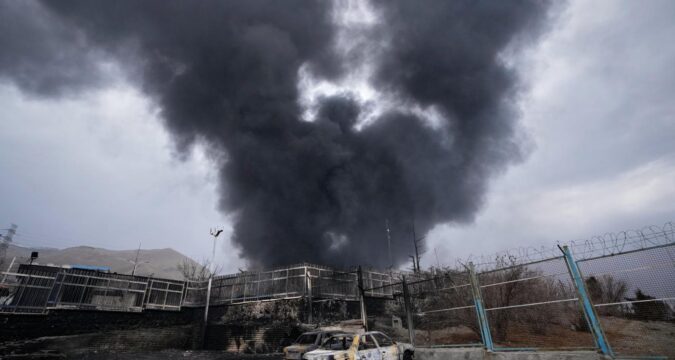
CHICAGO — Oil prices have eclipsed $100 per barrel for the first time in more than three and a half years as the Iran war hinders production and shipping in the Middle East.
The price for a barrel of Brent crude, the international standard, was at $101.19 shortly after trading resumed on the Chicago Mercantile Exchange, up 9.2% from its settlement price of $92.69 Friday.
West Texas Intermediate, the light, sweet crude oil produced in the United States, was selling for about $107.06 a barrel. That’s 16.2% higher than its Friday settlement price of $90.90.
Both could rise or fall as market trading continues.
The increases followed U.S. crude prices jumping by 36% and Brent crude prices rising 28% last week. Oil prices have surged as the war, now in its second week, ensnared countries and places that are critical to the production and movement of oil and gas from the Persian Gulf.
Roughly 15 million barrels of crude oil — about 20% of the world’s oil — typically are shipped every day through the Strait of Hormuz, according to independent research firm Rystad Energy. The threat of Iranian missile and drone attacks has all but stopped tankers from traveling through the strait, which is bordered in the north by Iran, carry oil and gas from Saudi Arabia, Kuwait, Iraq, Qatar, Bahrain, the United Arab Emirates and Iran.
Iraq, Kuwait and the UAE have cut their oil production as storage tanks fill due to the reduced ability to export crude. Iran, Israel and the United States also have attacked oil and gas facilities since the war started, exacerbating supply concerns.
The last time U.S. crude futures traded above $100 per barrel was June 30, 2022, when the price reached $105.76. For Brent, it was July 29, 2022, when the price hit $104 per barrel.
The global surge in oil prices since Israel and the U.S. attacked Iran on March 1 has rattled financial markets, sparking worries that higher energy costs will fuel inflation and lead to less spending by U.S. consumers, the main engine of the economy.
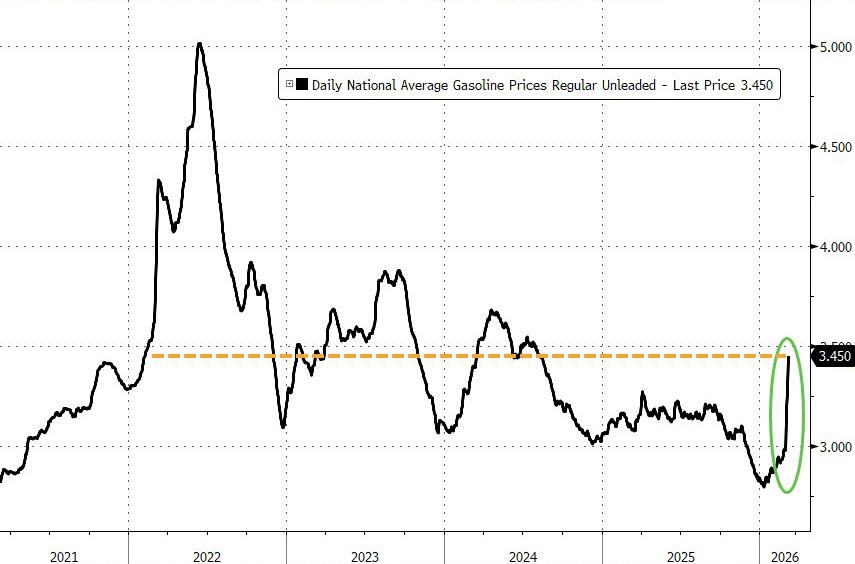
In the U.S., a gallon of regular gasoline rose to $3.45 on Sunday, about 47 cents more than a week earlier, according to AAA motor club. Diesel was selling for about $4.60 a gallon, a weekly increase of about 83 cents.
The price of natural gas has also climbed, though not as much as oil. It rose about 11% last week and ended Friday at $3.19 per 1,000 cubic feet.
If oil prices stay above $100 per barrel, some analysts and investors say it could be too much for the global economy to withstand.
Over the weekend, Israel’s military struck oil depots in Tehran and four oil storage tankers and a petroleum transfer terminal.
Mohammad Bagher Qalibaf, the speaker of Iran’s parliament, said the war’s impact on the oil industry would spiral, warning it soon could become harder to produce and sell oil.
Iran exports roughly 1.6 million barrels of oil a day, mostly to China, which may need to look elsewhere for supply if Iran’s exports are disrupted, another factor that could increase energy prices.
https://www.chicagotribune.com/2026/03/08/crude-oil-prices-iran-war/

Credit – A Little Bit Louder Now
Credit – A Little Bit Louder Now
Submitted by Peter Tchir of Academy Securities
Credit
‘Hey, hey, A, yeah, yahhh… you make me wanna shout!!’
After a tumultuous week, if there was one thing we could do for you, it is put a song in your head that hopefully makes you smile. Seriously, a song featured in Animal House and Wedding Crashers should make you smile, at least for a moment.
This week’s T-Report follows up last weekend’s Is Credit Whispering? Or Shouting?
We examined the risks to credit markets, from several angles, and explored potential vulnerabilities. The main focus was on the risk of potential “contagion” (though we didn’t use the word) of “selling what you can” instead of what you might want to.
On a “housekeeping” note, we often use ETFs in T-Reports. Whether we are just pointing something out, or taking a view, one way or another, it is meant to be a “badge of honor” to the ETFs selected (except single stock leveraged ETFs, but that is another story). We use ETFs when we feel they “represent” a market or a sector well. Especially when there is no “index” that people follow that tracks that sector. ETFs have multiple advantages over obscure indices. Everyone can see them trade in real-time during market hours. You can see their holdings, their volume, their NAV, etc. You can even trade them. Like any other stock, “price charts” don’t do a good job with dividends/total return, but we try to highlight that, when total return is the focus.
Iran
We will continue to keep you as informed as possible of our views on the conflict in the Middle East and the market ramifications.
Webinar from last Sunday night.
Three Themes Driving Markets from Tuesday.
Tuesday’s Iran War Update SITREP.
The Spider Web podcast from Thursday. We don’t actually call it that, but I think it is “catchy.”
Finally, with reference to Mrs. Robinson, we published NFP and Plastics on Friday. Jet fuel was also featured.
I had the pleasure of going on Bloomberg TV on Monday morning (the 52:25 mark). Why Markets Will Move Past Iran, on the Schwab Network, from the NYSE, also on Monday. Finally, on CNBC, Attacks on LNG Facilities Worry Me, from Thursday, via laptop from a weirdly set up hotel room in D.C.
Our Academy in the News webpage has links to General Deptula on CNN, General Spider Marks on CNN (multiple times), General Robeson on Bloomberg TV, and Joe Zacks (former CIA Deputy Assistant Director) on CBS Face The Nation.
As of Sunday morning, with an immense amount of input from the Geopolitical Intelligence Group, we are still looking for the parties to find some sort of “off-ramp” soon. Soon being measured in days, and maybe weeks, but definitely not months. We could be wrong, and will know more by Monday morning and will update you if our timing or view changes.
We seem to be at the lower-end of the “fear spectrum” on this issue. Worried, concerned, and cannot rule out a lot more pressure on markets and the global economy, but that is not our base case.
A Little Bit Quieter Now
Yes, the song says “softer” but that could be interpreted as negative, and there were some positive developments this week, at least with respect to my concerns.
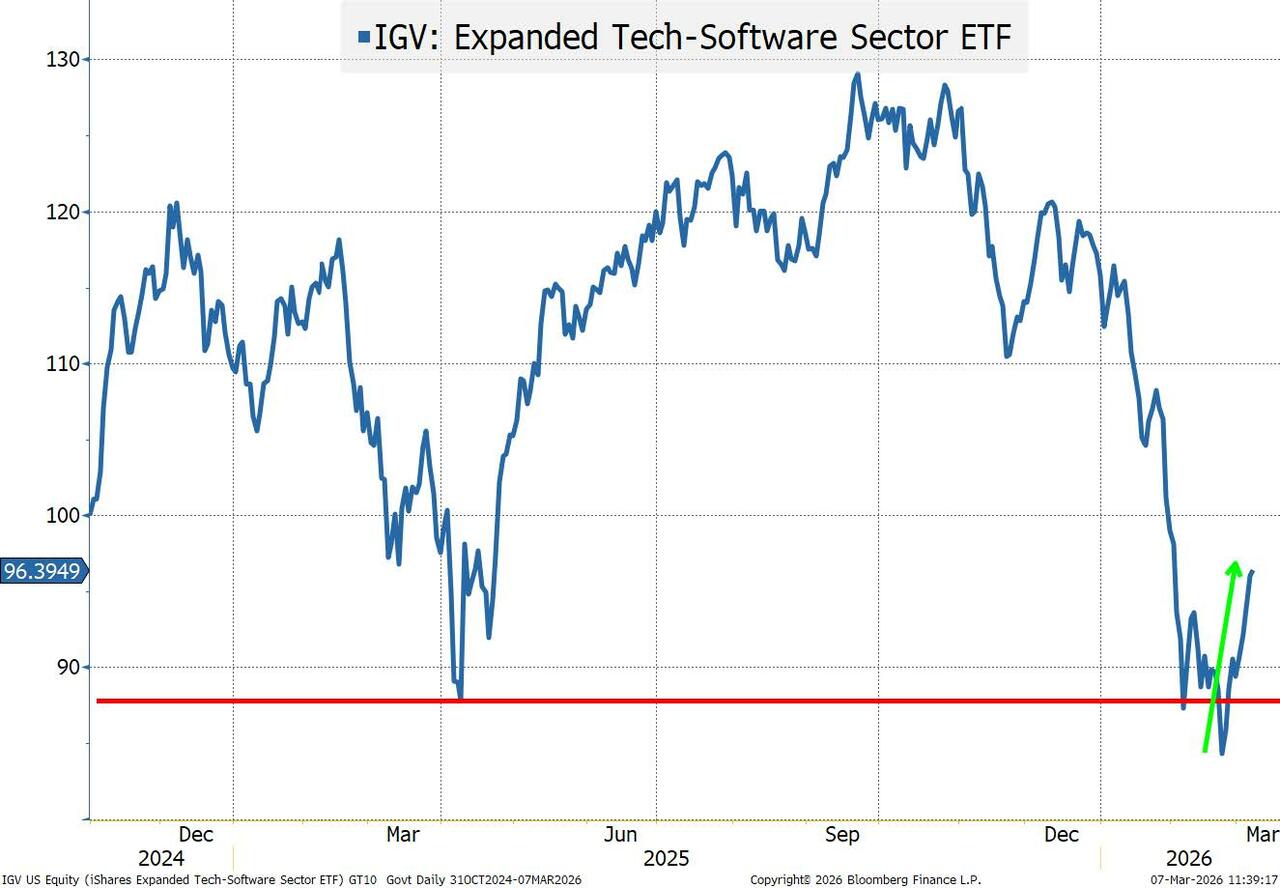
The software sector, as represented by this ETF, reclaimed levels above its post-Liberation Day lows. It was up every day this week, including Friday. A technical bounce, or re-thinking the software is “doomed” narrative? A bit of both?
Given the relative importance of the software sector in private credit, this could provide welcome relief!
We saw BDCs bounce this week as well. I track BIZD, a $1.5 billion ETF, as a proxy for this market. While higher on the week, it closed below Monday’s close and is well off the week’s highs that occurred on Monday.
Unfortunately, several of the stocks that are categorized as “private credit” related companies finished the week poorly, in some cases at 52-week lows.
Everybody Shout Now
If it weren’t for you meddling headlines.
There is always the risk that headlines massively overstate the problem(s). Headlines and titles are designed to do that. You can’t create “click bait” without some aggressive headlines.
So, part of me wants to downplay the headlines. But the headlines seemed to write themselves this week.
Limiting redemptions. Limiting withdrawals. Even the dreaded 4-letter word – GATE – crept into conversations and stories.
These products were not designed to be liquid. Some of the limits were always in place, but they just weren’t a limiting factor until recently. Some still aren’t a limiting factor. So, these headlines versus reality are skewed towards too much fear! But they seemed to cause markets to move, which is not comforting. In a “healthy” market, we’d absorb inflated headline risk, but we are clearly still in the “where there is smoke, there is fire” part of the narrative.
Defaults, fraud, and jump to default. If you didn’t see any headlines around defaults and frauds this week, you did well. I heard more “cockroach” stories this week than I needed to, or wanted to (please don’t bring up cockroaches during dinner – it doesn’t make the meal more enjoyable in any way, shape, or form).
Jump to default has a “special place” in my heart. Jump to default refers to the potential for a bond (or loan) to go from “money good” or “near-par” or “unstressed” overnight. I’ve been in credit a LONG time, and jump to default takes up more time than has ever really been warranted.
Was there a day when “jump to default” occurred? Sure. When loans sat on bank balance sheets in accrual accounting books, with no capital relief for treating them as mark-to-market. Extend and Pretend ruled the world. Problems would be put off as long as possible and in some cases the problems fixed themselves over time (markets changed, etc.). With enough “extend and pretend” when the banks could not “extend and pretend” (the recovery values would be low and on the accounting side of things), it looked like a “jump to default.” But it was really more about accounting than anything like “last month this loan looked good, and today it looks bad.”
With fraud this can happen (and it seems to have happened in a few recent cases).
Has “jump to default” really existed in the past few decades? A few months ago, I would have argued vehemently that it didn’t. The leveraged loan market has become robust. It trades regularly in the secondary market. There is price discovery. You can see loans trade down and then sometimes back up. The high yield bond market has changed to include big, large, well-known, and often public companies, where there are “lots of eyes” on the bonds and price discovery works. It doesn’t mean you don’t have defaults, it just means that you rarely have “large gaps” and certainly not from 100 to 0 “overnight.” For the life of me, I think there was only one case that I can remember where a bond quite literally went from near-par to bankrupt (and a low price) almost overnight. If my memory is correct, it was a company that had one product (glass for cell phones) and only one customer, and that customer dropped them. So, until recently, I would have fought the concept of “jump to default” kicking and screaming the whole way.
NCAA bonds are more common. I had no idea what the desk meant when they made fun of a bond that went NCAA. It meant No Coupon At All. In the high yield market, with semi-annual coupons, it meant that from time of issue to the first coupon, in 6 month’s time, the company wasn’t able to pay. I rarely see it, but I’ve seen it happen in the wild.
If you include bonds that elect to PIK (Pay In Kind) in that category, it is less rare. Still not common. Also, since the company has the right to PIK, it doesn’t even seem that unnatural to me that some would choose to PIK. Having said that, the usage of the term PIK has “picked” up in recent conversations about the market.
The loan that went from par to 0 in a few months. That was a headline that hit. Is that the norm? Heck no, if it was, it wouldn’t have generated so much interest. But am I rethinking defending the “impossibility” of jump to default?
A little. Just a little. Smaller loans with only a handful of investors who have read the documents, and understand the company, are less likely to face “price discovery” every day. It is price discovery that prevents “jump to default” from happening. Without price discovery, then yes, we can see jump to default (though no recovery seems pretty extreme).
Mark-to-market is always tricky in credit. It can be tricky in every asset class, but I find credit to be susceptible to “liquidity” events, where prices go below “reasonable” levels. The most extreme example (and there was forced selling involved) was the “super senior” tranches of synthetic CDOs. If you look at the 10-year CDX IG tranches, I think it is still accurate to say that NEVER has there been a loss in the mezz tranche (losses start at 3% of portfolio losses and get absorbed until 7% of portfolio losses). That is for well over 20 years now. Yet super senior (call it 15% loss absorption) traded at incredible discounts. This is both meant to be:
Soothing – prices in credit can be far lower than any economic reality indicates, purely because of the nature of credit market liquidity.
Scary – prices in credit can be far lower than any economic reality indicates, purely because of the nature of credit market liquidity.
If the credit risk is already mispriced too aggressively, then we have nothing to fear. If we haven’t reached that stage, then we have a lot to fear, which is what my concerns about “Sell what you Can” are rooted in.
A Little Bit Louder Now
The first “true line of defense” in whatever is going on in private credit is likely going to be the leveraged loan market.
While not a “true” proxy for private credit, it is probably the “best proxy” for those looking to shed “similar” risk-reward instruments in their private credit holdings.
BKLN ($6 billion) finished higher on the week, though off its highs. SRLN ($5 billion) finished a touch lower on the week, and off its highs of the week. While I consider HYG and JNK largely interchangeable on the high yield bond side of things, BKLN and SRLN are quite different in terms of portfolio construction.
According to Bloomberg both ETFs were trading about 0.6% below NAV. Is that accurate? I’m not sure. (It is harder to get a good NAV calculation for loans compared to bonds, and in turn, far more difficult to get for bonds than for equity-based ETFs). Keeping a close eye on this as I’m an adherent to the ETF Spiral™ theory, that the “arbitrage” tends to push markets in the direction of the arb (in this case lower) at least during the early stages of a real NAV discount developing (again, I’m not sure we have that here, but want to highlight).
Both leveraged loan ETFs had outflows on the week, though BKLN still has more shares outstanding than in late April (post-Liberation Day) and in early October (presumably peak rate cut fears).
Which brings us to one odd point:
Is floating rate good or bad?
It is good for those who are borrowing the money as they pay less.
It is bad for lenders as they receive less.
Do the two things just cancel each other out?
In theory, somewhat. If people are already looking to sell an asset class because of credit concerns, then 50 bps of rate cuts might cause them to want to sell due to lower returns if the 50 bps of hypothetical cuts isn’t viewed as helping credit quality that much.
Investors are likely to reduce exposure ahead of cuts, while the companies don’t benefit until the cuts actually occur.
I am keeping a close eye on this market and it isn’t “shouting” (or screaming) but it is “a little bit louder now.”
Remember When LCDX Traded Worse than HY CDX?
If I lost you with that title, it is completely understandable. LCDX was a leveraged loan CDS index. I think it died a well deserved death a long time ago. HY CDX still exists and is traded to this day.
So, we had an index that was referencing senior secured loans (LCDX).
There were a large number of companies that were in both indices (their unsecured bonds were referenced in HY CDX and their Senior Secured Loans in LCDX). On this overlapping set of names, you would certainly expect the loans to recover more in the event of a Credit Event (default in CDS language).
I guess in theory, the non-overlapping loans in LCDX could have a higher likelihood of default than the non-overlapping bonds in HY CDX (but I don’t remember that being obvious). I guess in theory, despite seniority in the cap structure, the non-overlapping loans that defaulted could have lower recoveries than the non-overlapping bonds (recovery can depend a lot on industry, but I don’t remember that being obvious at the time).
What was obvious (or seemed obvious at the time) was that there was a giant unwind going on.
Own 2X of LCDX and short 1X of HY CDX (or some leveraged ratio). Makes a lot of sense. It was positive carry and historically, it worked well on the downside too. It was a bit tricky if spreads tightened as LCDX was somewhat capped in price terms as the underlying LCDS could cancel if a loan was refinanced at better terms. If you were bearish, this was a good way to get paid to have some downside risk protection – in theory.
But it didn’t work and stories about the size of the unwind looming (or ongoing) pushed levels to what seemed like absurd levels. I remember wanting to load up on LCDX (having done a lot of the credit work, rel val of names, etc., and being a contrarian in general) but not being allowed to, because senior people were “scared” of this unwind.
I only recite this story because it fits my concerns that credit can get oversold, but it still hurts while it is being oversold, and it can be very difficult to get people to stand in the way of a falling knife. I certainly wouldn’t have managed to time the “bottom” of that relationship, but it was close and when it reversed course, it reversed course rapidly, because it was so obviously mispriced.
“Obvious” mispricing (too low) can occur in credit, even if it seems “obvious” at the time, and not just in hindsight. So yes, I remain wary of “selling what you can” becoming a reality with broader ramifications for credit markets.
Bottom Line
On credit, I remain wary of “selling what you can” becoming a reality with broader ramifications for credit markets. Not pounding the table bearish, but very cautious and defensive here. If Academy is correct on reaching a conclusion in the Iran war, credit markets should bounce, which is a large mediating factor in “only” being cautious/defensive. If we are having the same conversations next Friday as we had this past Friday, credit will suffer from the economic damage being done – again, far from being our base case, but a possibility.
On equities, conflict resolution would set up for a nice rally. Will continue to watch IGV closely as a “tell” that the market is done with the “AI is killing software” narrative.
Weirdly, I’m probably less cautious on equities than credit – the relief rally will be bigger, but then the risk that the credit fears persist could return – which would hit credit first, but would also drag equities along for the ride. XLE finished up on the week, but down from Monday’s highs, when we might have seen “the end of short covering.” I still really like the energy sector long term (globally), but heading into this past week we recommended taking profits here. We were clearly early as Monday trading kept pushing things higher, but now it seems to be settling into a pattern that could lead us lower fairly quickly in the event of conflict resolution.
On rates, last weekend we were indifferent at 10s below 4%, but now we’d be buying.
We continue to hope that the events in the Middle East lead to a peaceful resolution, putting the Iranian people on a better path to prosperity and freedom, while minimizing the loss of life for everyone in the region. And our best wishes and support to all those involved in our military and intelligence efforts!
Tyler Durden
Sun, 03/08/2026 – 18:35
https://www.zerohedge.com/markets/credit-little-bit-louder-now
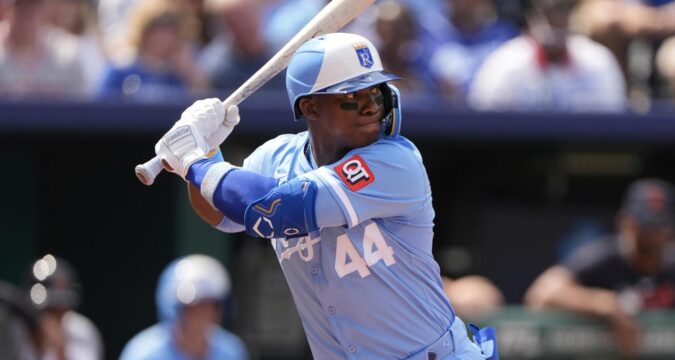
Rangers reclaman al jardinero Dairon Blanco de waivers de los Reales y Montgomery va a la IL
Associated Press
ARLINGTON, Texas (AP) — Los Rangers de Texas reclamaron al jardinero Dairon Blanco de la lista de waivers de los Reales de Kansas City el domingo y colocaron al zurdo Jordan Montgomery en la lista de lesionados de 60 días para hacerle espacio en el roster al cubano de 32 años.
Blanco, a quien Kansas City designó para asignación la semana pasada, bateó para .257 con siete jonrones y 34 carreras impulsadas en 171 juegos de Grandes Ligas a lo largo de cuatro temporadas. Ha robado 59 bases en 73 intentos, y sus 64 apariciones como corredor emergente desde 2022 son la mayor cantidad en las mayores.
Blanco bateó para .253 y se robó 32 bases en Triple-A Omaha la temporada pasada.
Los Rangers firmaron a Montgomery con un contrato de un año el mes pasado mientras se recupera de una segunda cirugía de reconstrucción del codo. Integrante del único equipo campeón de la Serie Mundial de los Rangers en 2023, el zurdo tuvo marca de 4-2 con efectividad de 2.79 en 11 juegos de temporada regular con Texas después de que lo adquirieron en la fecha límite de cambios.
Ganó dos juegos en la Serie de Campeonato de la Liga Americana, incluido el séptimo y decisivo en Houston. Luego se fue en la agencia libre y firmó con los Diamondbacks, con quienes registró 8-7 y una efectividad de 6.23 en 2024 antes de perderse toda la temporada pasada.
En ocho temporadas en las Grandes Ligas con los Yankees de Nueva York , San Luis, Texas y Arizona, Montgomery tiene marca de 46-41 con efectividad de 4.03 en 166 juegos.
___
Deportes en español AP: https://apnews.com/hub/deportes

Brown suma 23 puntos, 9 rebotes y 8 asistencias en triunfo de Celtics 109-98 ante Cavaliers
Associated Press
CLEVELAND (AP) — Jaylen Brown anotó 23 puntos y Jayson Tatum tuvo 20 en su segundo partido desde que sufrió un desgarro del tendón de Aquiles derecho, lo que impulsó la tarde del domingo a los Celtics de Boston a una victoria por 109-98 sobre los Cavaliers de Cleveland en un duelo entre aspirantes de la Conferencia Este.
Brown también sumó nueve rebotes y ocho asistencias, mientras los Celtics construían una ventaja de 81-55 en el tercer cuarto, barriendo su serie de la temporada de tres partidos ante Cleveland. Tatum anotó seis puntos en el cuarto periodo y terminó con 6 de 16 en tiros de campo en 27 minutos.
Payton Pritchard agregó 18 puntos y Baylor Scheierman aportó 16 puntos y 10 rebotes, mientras Boston se colocó a tres partidos del líder del Este, Detroit. Neemias Queta capturó 11 rebotes.
Donovan Mitchell anotó 30 puntos y Evan Mobley tuvo 24 puntos y ocho rebotes por los Cavaliers, cuartos en la clasificación, que habían ganado una cifra máxima de la temporada de siete partidos consecutivos en casa. James Harden terminó con 19 puntos y 10 asistencias.
Boston, que inició una gira de tres partidos como visitante, estará sin el pívot Nikola Vucevic por al menos un mes después de que se sometiera a una cirugía el sábado por la fractura en el dedo anular derecho. ___
Deportes en español AP: https://apnews.com/hub/deportes
El crudo supera los 100 dólares por barril debido a afectación en los envíos por la guerra con Irán
CHICAGO (AP) — El crudo supera los 100 dólares por barril debido a afectación en los envíos por la guerra con Irán.
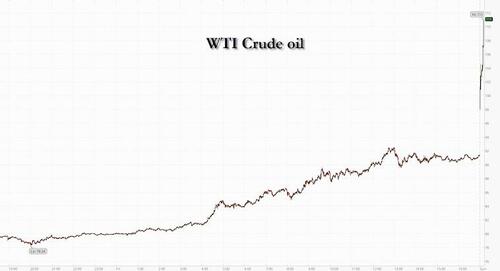
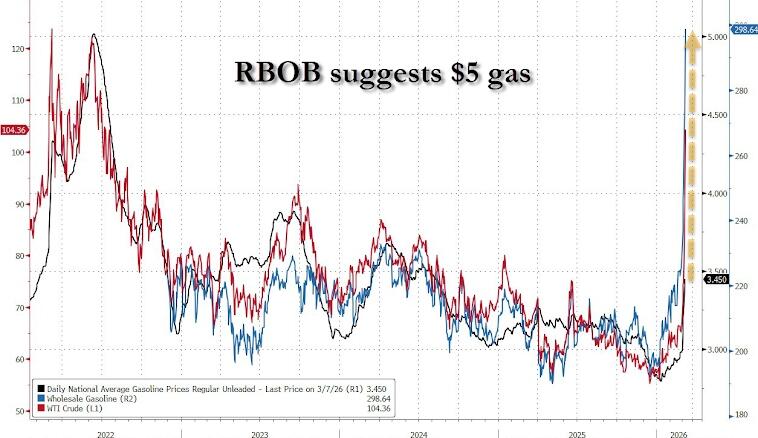
$5 Gas Imminent As Oil Prices Explode Higher, Equity Futures Puke On Dashed De-Escalation Hopes
$5 Gas Imminent As Oil Prices Explode Higher, Equity Futures Puke On Dashed De-Escalation Hopes
It’s Sunday night and the much-hoped for de-escalation has not happened.
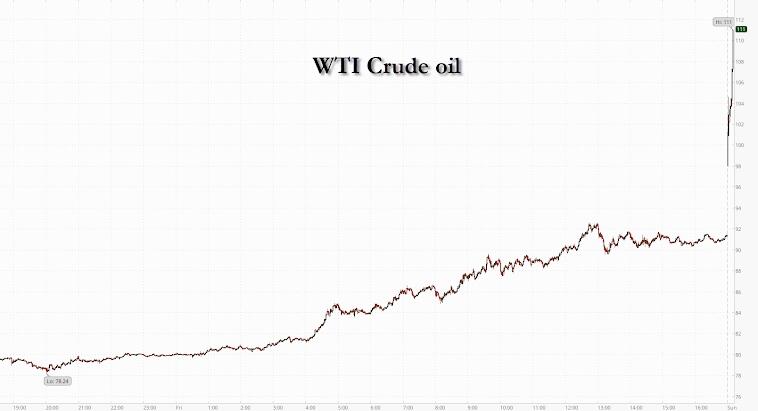
This has triggered an explosive move higher in WTI…
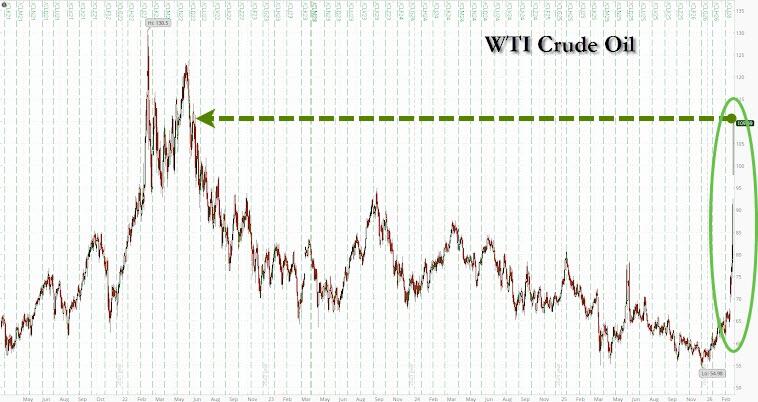
…topping $110 for the first time since 2022… (Goldman nailed that call)
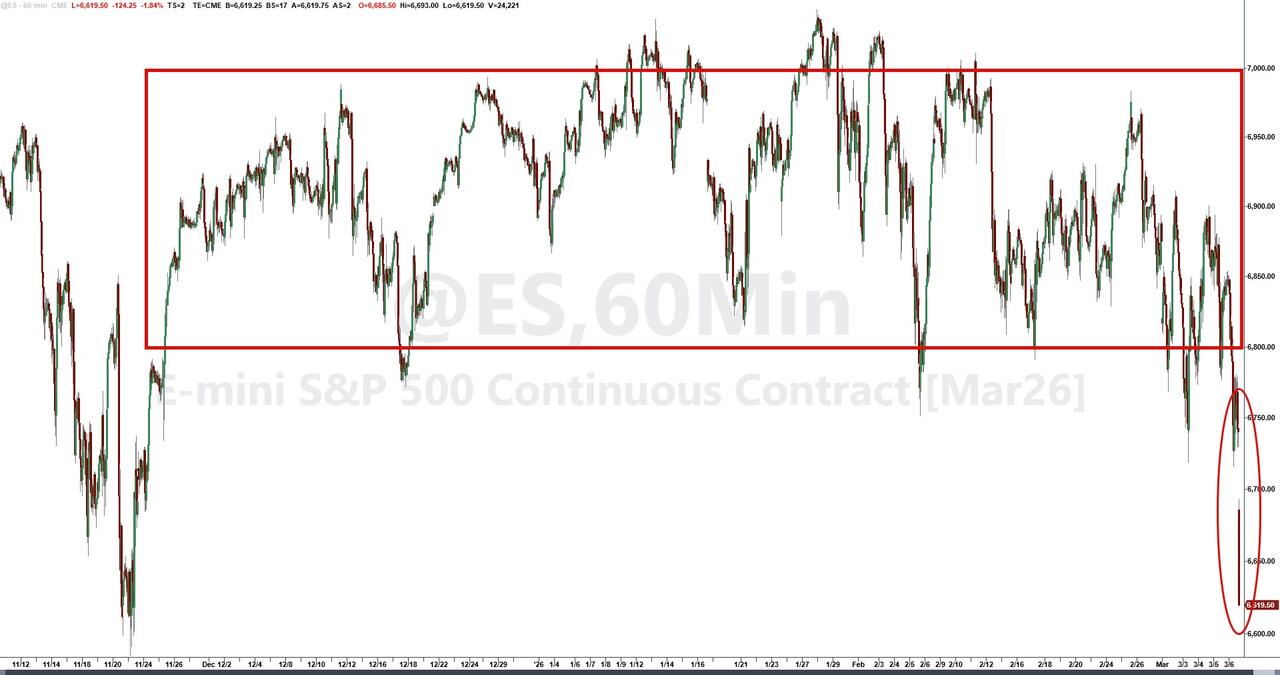
US equity futures have dramatically ‘broken the box’…
These moves come as the Trump administration said it is not prioritizing using the US Department of the Treasury to trade oil futures as it weighs ways to ease surging global energy prices, according to Yahoo Finance.
Officials have considered having Treasury buy or sell energy futures, but believe the agency would have limited ability to move such a large and active market.
Daily trading volumes have surged during the recent conflict, diluting the impact any single participant could have.
The White House is also reluctant to immediately tap the Strategic Petroleum Reserve.
Heavy drawdowns under former president Joe Biden left the reserve about 60% full, while repeated withdrawals have created maintenance issues.
Still, officials acknowledge that even a modest release could send a strong signal to calm markets.
Domestic gas (pump) prices soaring (and are about to go even higher)…
The report says that the administration is reviewing a wide range of responses.
Doug Burgum said “everything is being considered,” from immediate steps to longer-term measures, as officials try to contain rising fuel costs that pose both geopolitical risks and political pressure ahead of November’s midterm elections.
$5 gas prices at the pump is imminent!!
Given the current moves we are seeing, we suspect that laissez-faire attitude will shift rapidly and some kind of intervention is imminent.
Tyler Durden
Sun, 03/08/2026 – 18:16
https://www.zerohedge.com/markets/trump-team-downplays-treasury-role-oil-futures-market

David Mirković scores 22 points to help No. 11 Illinois to a 78-72 victory over Maryland
COLLEGE PARK, Md. — David Mirković had 22 points and 11 rebounds as No. 11 Illinois held off Maryland 78-72 on Sunday.
The Terrapins (11-20, 4-16 Big Ten) have had a desultory season under first-year coach Buzz Williams, losing 20 games for the first time since 1988-89, but they gave the Illini (24-7, 15-5) a battle. Illinois led 63-62 before Ben Humrichous made a 3-pointer that started a 7-0 run for the Illini.
The Terps pulled back within two, but a successful challenge of an out-of-bounds call enabled the Illini to keep the ball with 1:04 to play. Mirković worked free for a layup inside, and Maryland’s next possession went about as badly as possible when the Terrapins used most of the shot clock before Andre Mills misfired from 3-point range.
Maryland was down four in the final seconds when Darius Adams was unable to convert a layup.
The win gave Illinois a bye into Friday’s quarterfinals in the Big Ten Tournament. The Illini also tied a program record with their eighth road win in Big Ten play.
Mills scored 30 points for the Terps, who finished one game ahead of Penn State for last place in the conference. Adams added 14 points and Diggy Coit contributed 10.
Illinois won despite shooting 5 of 24 from 3-point range. Kylan Boswell and Keaton Wagler scored 11 points apiece.
Up next
Illinois: Awaits its quarterfinal opponent in the conference tournament.
Maryland: As the No. 17 seed in the Big Ten Tournament, the Terps will play in the event’s opening game Tuesday against 16th-seeded Oregon.
https://www.chicagotribune.com/2026/03/08/illinois-maryland-david-mirkovic/

El Aeropuerto Internacional de Kansas City reabre tras evacuación por amenaza
Associated Press
KANSAS CITY, Missouri, EE.UU. (AP) — El Aeropuerto Internacional de Kansas City reabrió el domingo por la tarde, horas después de que fue evacuado mientras las autoridades investigaban una posible amenaza, informó el Departamento de Aviación de Kansas City.
El portavoz del aeropuerto, Jackson Overstreet, señaló en un correo electrónico poco después de las 2 de la tarde que la terminal había reabierto. La evacuación comenzó tras una amenaza que surgió alrededor de las 11:15 de la mañana. Los vuelos que aterrizaron después de la evacuación fueron retenidos en la calle de rodaje durante el cierre, que, según Overstreet, duró unas dos horas.
En una publicación en redes sociales el domingo por la tarde, el secretario de Transporte, Sean Duffy, indicó que el incidente estaba bajo control y que “se están reanudando las operaciones normales”.
El director del FBI, Kash Patel, informó por redes sociales que el buró revisó la amenaza y determinó que “no era creíble”.
Logan Hawley, de 29 años, contó que esperaba abordar un vuelo a Texas cuando notó una gran presencia de policías y unidades K9 dentro de la terminal.
“De repente, había un trabajador del aeropuerto diciendo: ‘Evacúen de inmediato’. La gente se levantó rápido y salió corriendo de allí”, relató Hawley.
Agregó que el grupo, de aproximadamente 2.000 personas, fue escoltado hasta la pista.
______
Esta historia fue traducida del inglés por un editor de AP con la ayuda de una herramienta de inteligencia artificial generativa.