Category: News

Daniel DePetris: President Donald Trump should tread carefully with Saudi Arabia
When President Donald Trump first met Saudi Crown Prince Mohammed bin Salman (MBS) in Riyadh this spring, he was beaming with delight. Trump was feted by the Saudi royal family as if he were a royal himself. Surrounded by gold chairs and chandeliers, Trump threw praise at MBS, a man who seven years earlier was accused by the U.S. intelligence community of ordering the killing of Jamal Khashoggi, a prominent Saudi dissident and columnist at The Washington Post. MBS, Trump said, was an “incredible man,” a “friend” and someone who was willing to spend lavishly to boost U.S. industry. And spend he did; the Saudis agreed to invest $600 billion in the American economy.
Trump and MBS will meet each other again Tuesday, this time at the White House. It will be the crown prince’s first trip to Washington since the Khashoggi affair. The Trump administration is packaging this meeting as a sort of follow-up to the May session, where investment projects will be hammered out and the Middle East’s biggest security topics — maintaining the ceasefire in Gaza, broadening the Abraham Accords and containing Iran’s nuclear program — will be discussed. Expect the usual red-carpet treatment that a visiting dignitary typically receives when they enter the White House complex.
Yet if Trump isn’t careful, he could run the risk of giving more to his Saudi friend than is warranted. MBS is coming to Washington with the geopolitical equivalent of a long Christmas list, and the list includes everything from state-of-the-art F-35 fighter planes to a full-fledged U.S. security guarantee, which would compel the United States to defend Saudi Arabia in the event the Kingdom’s security is jeopardized. While some of these demands may already be in the works, Trump ought to ask himself the obvious question: Are concessions like these appropriate or even necessary to accomplish U.S. security objectives in the Middle East?
The risk is that Trump is so desperate to achieve groundbreaking accomplishments in the region that he’s willing to gift the Saudis whatever they ask for if it improves his ability to make diplomatic history.
Despite allegations from the White House to the contrary, Trump’s major diplomatic initiatives in the Middle East are either stagnating or at risk of collapsing entirely. The ceasefire in Gaza is a perfect example. The truce, struck last month, was supposed to stop the two-year war in the Palestinian enclave, get all the remaining Israeli hostages released and produce a process whereby Hamas is demilitarized, Gaza is reconstructed, the Palestinian Authority is reformed and an Israeli-Palestinian peace process is resurrected. Although the first stage of the agreement is largely complete — notwithstanding the occasional ceasefire breaches — the second stage is now bogged down as Arab states balk at providing their own troops to stabilize Gaza and Israeli Prime Minister Benjamin Netanyahu reiterates that a Palestinian state is a nonstarter for his government.
As the days go by, the yellow line inside Gaza that Israeli troops withdrew to as part of the ceasefire is now increasingly being seen as a potential new border between Israel and the battered enclave. Hamas, meanwhile, is consolidating its power in the parts of Gaza that Israeli forces no longer control.
Or take Lebanon. Although Trump had nothing to do with negotiating the ceasefire between Israel and Hezbollah, he still inherited it the moment he stepped into the Oval Office. That multipoint deal was designed to end the monthslong war, required a pullback of Israeli troops from southern Lebanon in exchange for a withdrawal of Hezbollah forces to the north and would eventually culminate in the Lebanese army demilitarizing Hezbollah. Yet implementation problems happen on a daily basis. Israeli troops still occupy roughly five points inside Lebanon and have increased airstrikes inside the country. In turn, Hezbollah refuses to hand over its weapons to the Lebanese state, arguing that Israel’s continued aggression means demilitarization is futile. And the Lebanese government is getting frustrated with the entire endeavor, blaming Israel for deliberately sabotaging the agreement.
Related Articles
Daniel DePetris: The death of a mayor brings Mexico’s cartel violence to the fore
Daniel DePetris: Is Donald Trump’s military campaign against drug traffickers in Venezuela legal?
Trump, of course, is being briefed about all of this. Although he may not care much about how Lebanon shakes out — the Israel-Hezbollah deal was a Joe Biden administration creation, after all — the last thing Trump wants to see is his ceasefire in Gaza fall apart. If that were to occur, all of those earlier proclamations from the administration about the emergence of a new peaceful dawn in the Middle East begins to look like a cruel joke.
Getting Saudi Arabia’s explicit endorsement, either through a massive aid package for Gaza’s reconstruction or participation in the interim foreign security force that is supposed to oversee Hamas’ disarmament, would therefore be a huge boost to efforts that currently appear to be floundering. The Saudis aren’t going to do any of this for free — if anything, MBS is likely to exploit the issue to extract security concessions from Washington.
Trump may be tempted to bite. What he should do instead is sit down and think this through because bringing Saudi Arabia into the U.S. security umbrella has far more costs to than benefits. After signing off on such an arrangement, the U.S. military would effectively be on the hook for defending a country whose interests aren’t fully aligned with Washington’s own. Americans would also be expected to fight and die on behalf of a foreign nation whose values are dramatically different and whose previous policies in the region — launching a war in Yemen, blockading Qatar and even abducting the prime minister of another country to force his resignation — was the precise opposite of promoting regional stability.
Does Trump, the so-called master negotiator, really think this would be a great deal for the United States?
Daniel DePetris is a fellow at Defense Priorities and a foreign affairs columnist for the Chicago Tribune.
Submit a letter, of no more than 400 words, to the editor here or email letters@chicagotribune.com.
https://www.chicagotribune.com/2025/11/18/opinion-donald-trump-mohammed-bin-salman-depetris/
Editorial: A redistricting truce between Illinois and Indiana? Yes, please
While many of us will be hunkering down to watch Illinois and Northwestern — or Michigan and Ohio State — duke it out Nov. 29, there’s a new kind of interstate rivalry brewing.
The great issue driving this animosity is political maps, and who can rig the system best to give their political allies an advantage.
These matchups include: California versus Texas — two giants at opposite ends of the political spectrum, both redrawing their congressional maps ahead of the 2026 midterm elections. Elsewhere, GOP-led Missouri is moving ahead with a new congressional map while Democrats in Maryland debate whether to join the mid-decade redraw. And then there’s the rivalry we care about most today: Illinois versus Indiana.
Yes, Indiana and Illinois get pitted against each other quite frequently, most recently driven by the Hoosier State’s bizarre campaign to redraw their state lines to include a handful of existing Illinois counties. That’s not happening, and while Indiana’s flirtation with mid-cycle redistricting appears to be fizzling, it gave Pritzker one more example to point to as he kept Illinois’ own redistricting options on the table.
“If Indiana does it … I think that would push Illinois toward redistricting,” Pritzker said Nov. 12 on the “Pivot” podcast. Why does Indiana’s decision matter? Aside from being a neighbor, Indiana has a similarly partisan legislative landscape — and Illinois Democrats often point to GOP-dominated states to justify their own maneuvers.
Thankfully, Indiana’s not going there, after much speculation that they might.
Gov. Mike Braun, Pritzker’s conservative opposite number in Indiana, had called for a special session at the start of December to consider, among other things, congressional redistricting. But Indiana Senate Pro Tem Rod Bray announced last week that the Senate would not convene, confirming that Republicans don’t have the votes for redistricting.
In other words, Indiana appears to be moving on. Illinois should, too, at least on congressional maps.
Pritzker has to recognize the unpopularity of mid-decade redistricting for purely political purposes in a state with some of the worst gerrymandering in the country. He and the Democrats in the General Assembly simply don’t have the moral high ground on this issue.
Perhaps, for now, the governors from our two great states can call a truce.
Maps are traditionally only redrawn once a decade, after the census releases new population data. Opening them up earlier isn’t necessarily bad — we’ve called for that to happen here in Illinois to address our rigged state legislative maps. But that kind of reform wasn’t what was on the table.
Instead, what we’ve seen this year is a wave of opportunistic map manipulation. Texas was the first mover, with the state legislature approving new congressional maps in August after weeks of pressure from President Donald Trump. Some Texas Democrats fled to Illinois to try to block the vote before ultimately returning to face the inevitable. California voters jumped in next, approving Prop 50 earlier this month as a counter.
Not only do we believe it would be wrong to open up the maps for any reason other than addressing unfairness at the state legislative level, but also the Democrats just don’t need the help. They already hold 14 out of Illinois’ 17 congressional seats.
Let’s hope Pritzker meant what he said about Indiana, and we can finally put this political stunt to bed.
Submit a letter, of no more than 400 words, to the editor here or email letters@chicagotribune.com.

Letters: Choose Chicago has been thoughtful and strategic in its promotion of neighborhoods
Regarding the editorial “Chicago tourism fundamentally is about downtown, not all 77 neighborhoods” (Nov. 16): The world knows Chicago as a city of communities, each and every one with its own unique history and culture.
This isn’t new. Tourism that’s inclusive and community engagement have been a part of Choose Chicago’s tourism initiatives and strategies for years and have been covered by the Tribune many times. Choose Chicago has worked closely with our Bronzeville community and other neighborhoods across several administrations. Our organization, cultural attractions and small businesses appreciate Choose Chicago’s efforts in making continued commitments and investments in ensuring that there are more seats at the tourism table.
Not all neighborhoods are created equal, and Choose Chicago has been thoughtful, strategic and forward-acting in how it has collaborated with us in Bronzeville. Choose Chicago has listened to local partners, our business owners and residents, as well as numerous international tourism journalists and professionals who have asked for Bronzeville, in addition to the central city, to be part of their coverage of Chicago. Together, we have highlighted the unique history of Bronzeville, where Black music, literature, art and food are celebrated every day in our small businesses.
Because Choose Chicago has honored the importance of neighborhoods and the central city to tourism, over the past several years, there has been growing connectivity, collaboration and a shared commitment to tourism between the central city and neighborhood leaders.
We are not Lincoln Park or Chinatown or Austin — we are Bronzeville. While every neighborhood is not necessarily a tourist destination, Chicago’s central city is not the only place that deserves to be highlighted or that tourists want to visit. Choose Chicago’s visitation data confirms that out-of-towners and visitors from across the region are visiting points of interest in the neighborhoods, such as the 26th Street commercial corridor in Little Village and Asia on Argyle in Uptown.
It is naive to think that everyone coming to Chicago only wants to stay downtown. Visitors want authentic experiences, and that is what neighborhoods such as Bronzeville provide.
Isabel Garcia, left, and Sylvia Larco, part of the Quetzal-Xochitl Mexican folkloric dance group, stand in Manuel Perez Jr. Plaza in Chicago’s Little Village neighborhood Oct. 8, 2021. Choose Chicago provided funding for the plaza’s renovation. (Chris Sweda/Chicago Tribune)
If you do not explore our neighborhoods, how would you ever see the studio where house music was created? Or visit the birthplace of the American labor movement? Or try some of Chicago’s many Michelin Bib Gourmand restaurants or the most recent neighborhood food joint that is blowing up on TikTok?
Chicago’s neighborhoods are where things happen. They are where we live and where we make history. We invite the Tribune Editorial Board back into the neighborhoods.
— Rhonda McFarland, executive director, Quad Communities Development Corp.
Chicago’s full story
At Destinations International, we have the privilege of working with more than 750 destination organizations across the globe, and we see every day which cities are preparing for the future — and which are clinging to a playbook from 20 years ago.
So when an editorial criticizes Choose Chicago for establishing an Inclusive Tourism and Community Engagement department, I’m reminded that progress often draws the loudest objections from those who least understand the direction in which the industry is heading.
Let’s be clear. Chicago is doing exactly what leading global destinations are doing — and in many cases, doing it better.
Across our industry, visitors are increasingly choosing destinations that reflect authentic culture, local character and diverse experiences. Numerous studies, including our own Destinations International Community Alignment Research, show that travelers want to spend time (and money) in neighborhoods that feel unique, creative and grounded in real stories. Chicago has 77 such neighborhoods — a competitive edge most cities would envy.
Choose Chicago’s new department ensures that the city showcases its full identity, not just the postcard skyline. It guarantees that the economic benefits of tourism extend to all corners of the city, not merely the downtown core. That is not just good policy — it’s good business. Communities with strong resident support for tourism consistently outperform those without it in long-term visitor spending, job creation and brand strength.
And let’s not overlook what’s ahead. Chicago is preparing for two globally significant moments:
The 2026 opening of the Obama Presidential Center on the South Side, a once-in-a-generation cultural and civic milestone.
The Route 66 Centennial, which will draw millions of nostalgic travelers to neighborhoods across the city.
Any editorial arguing that Chicago should not invest in community engagement and inclusive storytelling during a moment like this is, in all honesty, arguing that the city should bench its strongest players just as the game is getting good.
Choose Chicago is doubling down on exactly the right strategy: Celebrate Chicago’s diversity, uplift its neighborhoods and ensure that tourism benefits are shared broadly. That isn’t political — it’s professional. It’s what the data tells us. It’s what the industry demands. And it’s what successful global destinations are doing at this very moment.
If anything, Chicago deserves credit for leading, not lagging. The city has always stood tallest when it embraces its full story. Choose Chicago is simply making sure the world sees it.
— Don Welsh, president and CEO, Destinations International
World Cup tourism
The battle to attract high-spending international travelers has never been more competitive. Fortunately, Chicago is in the game. And contrary to Sunday’s Tribune editorial, competing for some of the anticipated millions of 2026 World Cup visitors makes perfect sense — even for a city that isn’t hosting games. International visitors stay an average of 14 nights, visit multiple destinations and spend north of $4,000 per person. With games held across the United States — and three to five days in between each country’s matches — destinations across the country stand to benefit if they play their cards right.
Choose Chicago’s “Kick Back in Chicago” campaign is a savvy way to attract travelers on their “days off” and is a model for other non-host cities seeking to capitalize on the world’s greatest sporting event.
— Geoff Freeman, president and CEO, U.S. Travel Association
Neighborhood sites
Contrary to the editorial insisting that Choose Chicago promotion should be focused on downtown, there are many attractions in our city throughout the 77 neighborhoods and along the entire lakefront. Among them: Wrigleyville; the University of Chicago campus and, soon, the Obama Presidential Center; Lincoln Park Zoo; music venues and fests such as the Salt Shed and Englewood Jazz Festival; theaters such as Steppenwolf; comedy clubs; specialty movie theaters such as the Music Box; shopping in Wicker Park and Andersonville; restaurants all over; Chinatown; and the National Museum of Mexican Art and Griffin Museum of Science and Industry. These sites can and do draw and delight visitors from out of town.
The Bean, the Art Institute, the Riverwalk, etc., will not suffer if a little attention is given to inviting people to venture beyond the Loop, the Museum Campus and Boule Mich.
We live in a large city where it’s not too hard to get around. Let the world know!
— Howard Mandel, Chicago
The ultimate goal
Regarding the editorial on Chicago’s tourism agency’s efforts to spread tourism opportunities throughout all city neighborhoods, such a strategy simply dilutes the efficacy of drawing tourists to where they really want to go: downtown. While no one wants a plan to be discriminatory, the agency’s strategy is akin to randomly pulling little old ladies out of lines at the airport for security searches.
Sure, you won’t be accused of discriminating, but you may be losing sight of the ultimate goal.
— Terry Takash, Western Springs
Loss of museum
The Tribune Editorial Board laments the fact that the Lucas Museum going to Los Angeles was a loss for Chicago. The board is correct. But blame for this significant loss should be attributed to the small advocacy group Friends of the Parks. Instead of the Lucas Museum and its attendant visitation, tourism impact and contribution to jobs creation, we have essentially an unused parking lot and likely will for many, many years to come.
The Friends of the Parks’ actions are duly noted.
— Philip Bernstein, Chicago
Note to readers: As part of our annual Thanksgiving tradition, we’d like to hear from you about what is making you feel thankful this year. (Sincere thoughts only, please.) Email us a letter of no more than 400 words to letters@chicagotribune.com. Be sure to include your full name and your city/town and use the subject line “Thankful.”
Submit a letter, of no more than 400 words, to the editor here or email letters@chicagotribune.com.
https://www.chicagotribune.com/2025/11/18/letters-111825-choose-chicago-tourism/
Andy Shaw: The paradox of billionaire philanthropists
Illinois’ multimillionaires are a paradoxical group. Beginning in 2009, they helped resuscitate the Better Government Association with sizable contributions while, at the same time, they were vigorously fighting city and state efforts to raise taxes they could easily afford to pay because they didn’t trust the politicians who’d be spending their money.
And that is the conundrum that epitomizes the permanent battle between progressive Democrats and their activist base, whose mantra is “tax the rich,” and conservative Republicans and their wealthy donors who categorically reject higher taxes.
It’s not about greedy rich people hoarding their dollars; in reality, they’re extraordinarily generous philanthropists who donate billions to civic, social and humanitarian causes they believe are admirable and well-managed.
But not to what they consider inefficient, bloated, self-serving city and state governments that simply don’t pass their smell test.
So is there a way to entice wealthy Chicagoans to voluntarily support a few valuable and necessary city programs that might, as a collateral benefit, temper the debate over anti-business taxes? I think it’s possible.
Let’s start with billionaire Ken Griffin, founder of financial giant Citadel and Florida’s most famous Illinois expat. He left Chicago with his company a few years back, angry over what he called a “dysfunctional” political climate, punishingly high taxes and violent crime.
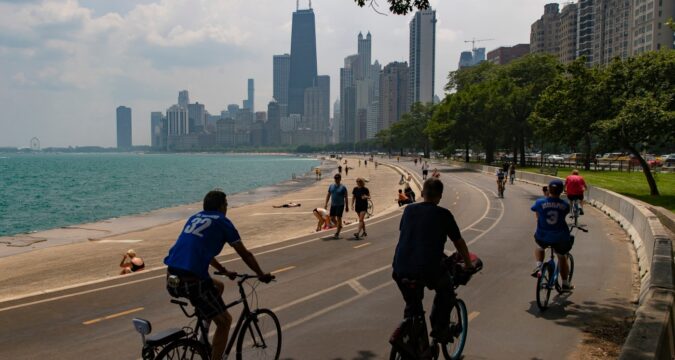
He poured tens of millions into campaigns to block progressive tax proposals and elect officials who promised to hold the line on “confiscatory” levies. But when he was solicited by then-Chicago Mayor Rahm Emanuel, Griffin willingly donated almost $12 million to improve the entire Lakefront Trail that covers the 18-mile ribbon of concrete and scenery along Chicago’s most valuable natural resource.
Ken Griffin, left, and then-Chicago Mayor Rahm Emanuel arrive at a Chicago Police Department Strategic Decisions Support Center on April 11, 2018. (Nancy Stone/Chicago Tribune)
That contribution to Emanuel’s Park District, a unit of government, is Chicago in a nutshell: billionaires battling taxes but bankrolling public parks; loathing “big confiscatory government” but loving big civic and even a few targeted government projects as long as they can write the check to a specific, well-defined initiative and, yes, frequently slap their name on it.
Griffin’s generosity isn’t in doubt. His gifts have improved the Art Institute, the Museum of Science and Industry, the University of Chicago and now the city’s prized bike path.
Chicago’s cultural and educational institutions are far better off for his largesse. But his charitable impulses raise an enduring civic riddle: Why do so many of our wealthiest citizens have so little trust in government that they’ll only occasionally fund its work when they know where every dime is going?
The answer lies in a deeply American conundrum — one that’s especially sharp in Illinois — where the words “government” and “trust” have rarely appeared in the same sentence without irony.
Griffin and his wealthy peers are hardly alone in thinking Springfield and City Hall are black holes for tax dollars.
Illinois’ sorry record of corruption and mismanagement has given them plenty of ammunition. We’ve seen pension crises, patronage armies, insider contracts and tax increment financing deals that made developers rich while neighborhoods languished.
Every time another clouted relative lands a six-figure job or another public project runs billions over budget, a rich donor somewhere mutters, “And they want me to pay more for this?”
And every time a Michael Madigan or an Edward Burke is convicted in a corruption scandal, their skepticism and cynicism deepen.
So they do what they’ve always done best — take matters into their own hands. They endow a new hospital wing, underwrite a scholarship program, rebuild a park or museum, or in Griffin’s case, bankroll a smoother stretch of asphalt for cyclists and joggers. It’s civic pride on their own terms: targeted, tangible and relatively free of bureaucracy.
The Kenneth and Anne Griffin Court at the Modern Wing of the Art Institute of Chicago in 2012. (Alex Garcia/Chicago Tribune)
And in fairness, who can blame them? When a billionaire writes a check to the Chicago Park District, he gets a visible result and a thank you note. When he writes a bigger one to the Illinois Department of Revenue, it disappears into a fiscal fog bank.
Philanthropy fills some noble gaps, but it can’t patch the structural holes that taxes are meant to fill. Bike paths are wonderful, but they don’t pay teachers, fix bridges, or keep police and firefighters on the job.
Private generosity makes a city more livable, but public investment makes it workable. And when too many of the city’s biggest benefactors decide government is irredeemable and move their residencies and business addresses to tax- and regulation-friendly states such as Florida, we’re left with fewer tax and philanthropic dollars and more empty offices.
Rebuilding trust in a transparent, efficient, accountable government is the real long-term project Illinois can’t afford to outsource. It’s the real road to recovery. And unlike a bike trail, it starts not with a billionaire’s donation but with a collective decision to demand better government — and to believe it’s still possible.
But that’s a long-term project many view as more rhetoric than reality — dubious at best.
So in the meantime, here’s a thought Mayor Brandon Johnson and the City Council might consider as they try to fill a billion-dollar budget hole without raising taxes that make the business climate worse than our winter weather and the citizen environment more inhospitable than a toxic waste dump.
Settle on five of the most important programs, projects and initiatives that need funding. Maybe more low-income housing, aid for people who are unhoused, affordable day care, community safety, job training and economic development, just to name a few worthy objectives.
Then, and this is the key, provide a realistic detailed game plan for each one: overall cost, personnel requirements, execution and evaluation strategy, efficiency and accountability guidelines, oversight, implementation timetable and deliverables.
And finally, ask the city’s major philanthropists to commit the necessary dollars to their favorite projects — to put skin in the game without feeling scalped.
Perhaps this is Pollyanna-ish, but some pipe dreams, including Emanuel’s Griffin gambit, produce valuable results — Millennium Park is another example — so it’s worth raising the issue to see if it has as much traction as the new lakefront lanes.
Andy Shaw is a semi-retired Chicago journalist, good government watchdog and inveterate dreamer.
Submit a letter, of no more than 400 words, to the editor here or email letters@chicagotribune.com.
https://www.chicagotribune.com/2025/11/18/opinion-ken-griffin-chicago-corporate-head-tax/

Thanksgiving wines made simple: 3 Chicago pros, 9 picks, 1 easy guide
Thanksgiving is a celebration of abundance, but when it comes to choosing wine to share with family and friends, it’s hard not to feel overwhelmed by options. We all want crowd-pleasing picks. But this year, value is especially top of mind, too.
To help demystify the holiday wine hunt, I asked three Chicago wine professionals to find wines from a favorite local retailer that deliver pleasure and versatility at approachable prices. Each pick sits between $20 and $35 — not cheap — but a sweet spot where value and character intersect.
They all pointed to small, independent shops with focused selections and passionate, knowledgeable staff.
“I want to walk into a store that’s tightly curated,” says Chris Farrell, a sommelier at Indienne in the River North neighborhood, “where I’m choosing between a few great bottles instead of 50, and where the person behind the counter really knows what’s on the shelf.”
If you don’t find these exact wines in your favorite store, don’t worry. This guide is a blueprint, not a scavenger hunt. A great Côtes du Rhône can easily stand in for Gigondas; cava might replace prosecco; or a pinot blanc from Oregon could play the same role as one from Alsace.
Thanksgiving wine guide
Nicole Ramírez, server and sommelier at Alpana
Growing up, Thanksgiving was a “big family blowout” with traditional American Thanksgiving foods like turkey, explains Ramírez, but also nodded to her family’s Puerto Rican and Mexican roots — lechon or arroz con gandules, perhaps. Over the years, Thanksgiving has become a quieter, more intimate holiday. “The past few years, it’s just been my partner and I,” Ramírez says, where she’ll cook a much smaller version of a Thanksgiving meal. “This year, my boyfriend stopped eating meat so we’re going more veggie-forward,” she says, maybe gnocci but with traditional side dishes like Brussels sprouts and cornbread.
Recommended retailer: Off Premise, Lincoln Park (1128 W. Armitage Ave., 773-770-3540, offpremisechicago.com)
Ramírez points to Off Premise where “(owner) Adam Kamin and (wine buyer) Jackie Trabilsy are both so smart,” she says. They travel constantly and spotlight standout bottles from small producers around the world, explains Ramírez. “Oftentimes, I’ll message Jackie what I’m having for dinner and then pick up whatever she recommends — I just trust her so much,” she adds.
Guiding principle: Because the traditional Thanksgiving spread is such a mishmash of foods, “err on the side of lighter,” says Ramírez. “Those really big, bold reds, and big, buttery white wines, can overpower a lot of foods.”
“When in doubt, bubbles are always a safe bet,” Ramírez says. “Bubbles go with everything.”
Ramírez’s picks:
Venturini Baldini NV Marchese Lambrusco ($22)
“People don’t drink enough Lambrusco,” Ramírez says. Secco, or dry styles of the lightly sparkling red have a little bit more body and structure than you might find with light-bodied, fruit-forward sparkling wines like prosecco. “It’s bright, fun and inviting,” she says, “but also a wine that can carry you through the whole meal.”
Ken Forrester 2024 Old Vine Reserve Stellenbosch Chenin Blanc ($25)
Ken Forrester Old Vine Reserve Stellenbosch Chenin Blanc. (Ken Forrester)
“I love chenin blanc — they’re such pretty wines, but they’re shape shifters too,” she says. “They can be dry or sweet, a dessert wine or even bubbly.” Ken Forrester’s dry chenin is a favorite, she says, “with enough body to hold up to mac and cheese or some of those more buttery, unctuous dishes.”
Brotte 2022 La Marasque Gigondas ($35)
“I love Gigondas, it’s a wine region that I lean towards a lot at the restaurant,” Ramírez says. “It’s like the little sister to Châteauneuf-du-Pape,” she says, “you get the same big body and beautiful red-fruit and spice of the southern Rhône, but it’s not overpowering,” she said. “My boss, Alpana Singh, always says that Châteauneuf-du-Pape is Beyoncé but Gigondas is Solange.” And this one is especially budget friendly, she adds.
Thanksgiving 2025: 70 Chicago restaurants offering dine in or take out holiday meals
Marsha Wright, corporate wine director at DineAmic Hospitality
Wright remembers Thanksgiving at her grandmother’s house as a bustling affair, often upwards of 20 people crowded around a long table for the adults and a smaller side table for the kids. Everyone brought a dish, “staples like mashed potatoes, sweet potatoes or collard greens,” she says. And while Grandma always cooked a turkey and ham, it was Grandpa, “we call him Johnny-Boy,” she says, who carved them. The kids drank soda, and the adults shared “maybe a $7.99 Chianti,” she laughs. “It wasn’t the good stuff, but it was OK.”
Recommended retailer: Cellar 406 (406 75th St., Downers Grove, 630-968-2088, cellar406.com)
Small wine shops, especially in the suburbs, take pride in stocking wines you wouldn’t find at big-box stores, says Wright. “I’m looking to find wines that are delicious but off the beaten path and made in small quantities — 5,000 cases rather than 5 million,” she says. At Cellar 406, “owner Charlene Pontrelli really takes the time to explain the story behind each wine,” Wright says.
Guiding principle: White wines with freshness and acidity are key to balancing a heavy Thanksgiving feast, explains Wright. While chardonnay tends to be a standby, she prefers “something more crisp and bright” — think dry riesling, sauvignon blanc, or, in this case, pinot blanc.
Gaspard 2024 Loire Gamay ($22)
Gaspard Loire Gamay. (Jenny & Francois Selections)
People gravitate toward Beaujolais for Thanksgiving because gamay’s light body and delicate tannins are an easy match with almost everything on the table, explains Wright. But gamay from the Loire is still a bit of an insider secret in the U.S. “This one’s quite youthful,” says Wright, with a bright red-berry character that makes it refreshing slightly chilled.
Sorgente NV Extra Dry Prosecco ($25)
Prosecco is an ideal predinner libation while cooking a big Thanksgiving dinner, says Wright. This one “is bright and refreshing with zesty citrus flavors” but “a creamy mouthfeel” that’s also substantial enough to enjoy throughout the meal too, she says.
Lucien Albrecht 2023 Alsace Pinot Blanc ($18)
For the main event, Wright turns to an Alsatian pinot blanc that’s “refreshing and aromatic.” Its lively acidity cuts through the richness of a crispy-skinned roast turkey or creamier side dishes, but it’s also a unique match for vegetables like Brussels sprouts or green beans, she explains. It’s the kind of wine that “just makes you want to have another sip.”
Thanksgiving 2025: 35 Chicago restaurants and bakeries offering pies and dessert
Chris Farrell, sommelier at Indienne
“Growing up, my father was one of six siblings, so Thanksgiving always meant big family gatherings,” Farrell says. Since moving to Chicago seven years ago, however, he’s enjoyed finding smaller communities to celebrate with. He and his partner host a yearly Friendsgiving — “a straggler’s Thanksgiving,” he says. Some years it’s a home-cooked meal but other times it might be a BYO dinner in Chinatown. This year’s theme is “gobblegool,” he says, “so really kitschy Italian American classics … Thanksgiving doesn’t have to be about turkey,” explains Farrell. “It’s more about the convivial spirit of Thanksgiving and taking time to be thankful for the people you’re around.”
Recommended retailer: Bottles Up! (3164 N. Broadway, 773-362-4999, bottlesupchicago.com)
Farrel discovered the space that’s now Bottles Up! while apartment hunting in Lakeview. “I noticed a wine store across the street, went in and ended up talking with Melissa Zeman for about 25 minutes … 60% of the reason I got the apartment was just to be close to the store,” says Farrell. The space is “a real community hub,” he says, with free tastings, classes and local art. “I call her the badass wine fairy,” says Farrell, praising her warmth and energy. “She makes you feel like part of the family.”
Guiding principle: “When it comes to big gatherings like Thanksgiving,” says Farrell, “cast your net wide by offering a few super versatile wines” and just leave them in the middle of the table for guests to sample and explore. Keep it simple, he says, but “something sparkling, something white and something red” offer just enough variety to match the variety of foods on the menu.
Bodet-Herold NV Aerlinn Vin de France Brut Nature Rosé ($35)
This pétillant-naturel, a more rustic, lower-intervention precursor to Champagne-style sparkling wine, is “a fun way to have something off the beaten path,” says Farrell, “with lively acidity that’s especially good for Thanksgiving dishes.” Made from the grolleau grape by a small family producer in the Loire Valley, it’s reminiscent of “crunchy red fruit,” says Farrell, “with a pillowy, plush bubble that doesn’t feel sharp or forced.”
Bernard Baudry 2023 Le Domaine Chinon Blanc ($33)
Bernard Baudry Chinon Blanc. (Kermit Lynch Wine Merchant)
Bernard Baudry is revered in the Loire Valley for his cabernet franc, but for Thanksgiving, Farrell points to this chenin blanc for its “golden fruit texture, chamomile-tea herbaceousness and searingly high acidity.” With its balance of texture, freshness and fruitiness, he says, it’s ideal for anyone who finds oaky chardonnay too heavy or sauvignon blanc too sharp. “It fits right in the middle,” he says.
Bedrock Wine Co. 2023 Old Vine Zinfandel ($32)
Bedrock Wine Co. Old Vine Zinfandel. (Bedrock Wine Co.)
It wouldn’t be Thanksgiving without a nod to American wine, says Farrell, who calls Bedrock’s Old Vine Zinfandel “one of the best examples of what American wine can be … It has this unique kaleidoscope of fruit spectrum, ranging from red and blue, to black and purple,” he says, but an herbaceousness and bright acidity that’s approachable and elegant.
Anna Lee Iijima is a freelance writer.
https://www.chicagotribune.com/2025/11/18/thanksgiving-wine-recommendations/

Winnetka 4-bedroom home with skylights: $2M
Address: 1370 Sunview Lane, Winnetka
Listed: Oct. 6, 2025
Price: $1,995,000
Listing agents: Allison Silver and Janet Borden of Arrow Home Advisors, Compass, 847-780-7390
This four-bedroom ranch home in Winnetka was designed by the homeowner and W.D. Murphy Associates and backs onto a golf course. There are skylights and hardwood flooring throughout the home. A vaulted room with skylights on the second floor could be used as a fitness or art studio. A sunroom overlooks the golf course, and the library has custom cherrywood shelving and a marble gas fireplace. The primary suite has separate walk-in closets and built-in cabinets. The home, which has three full bathrooms and two half baths, also has a cooled wine room, a three-car heated garage and a new roof.
This four-bedroom, five-bathroom ranch home in Winnetka recently went on the market for nearly $2 million. (Slater Media 808)
This four-bedroom, five-bathroom ranch home in Winnetka recently went on the market for nearly $2 million. (Slater Media 808)
This four-bedroom, five-bathroom ranch home in Winnetka recently went on the market for nearly $2 million. (Slater Media 808)
This four-bedroom, five-bathroom ranch home in Winnetka recently went on the market for nearly $2 million. (Slater Media 808)
This four-bedroom, five-bathroom ranch home in Winnetka recently went on the market for nearly $2 million. (Slater Media 808)
This four-bedroom, five-bathroom ranch home in Winnetka recently went on the market for nearly $2 million. (Slater Media 808)
This four-bedroom, five-bathroom ranch home in Winnetka recently went on the market for nearly $2 million. (Slater Media 808)
This four-bedroom, five-bathroom ranch home in Winnetka recently went on the market for nearly $2 million. (Slater Media 808)
This four-bedroom, five-bathroom ranch home in Winnetka recently went on the market for nearly $2 million. (Slater Media 808)
Some listing photos are “virtually staged,” meaning they have been digitally altered to represent different furnishing or decorating options.
To feature your luxury listing of $1,000,000 or more in Chicago Tribune’s Dream Homes, send listing information and high-res photos to ctc-realestate@chicagotribune.com.
https://www.chicagotribune.com/2025/11/18/dream-home-winnetka-sunview-lane/

Rob Elliott: As the government reopens, Illinois farmers are still left waiting
Farming is harder than it has been in decades. Since 2022, corn and soybean prices have dropped by as much as 30%, while input costs have only gone up. That squeeze is felt every day on family farms such as mine, which has operated for more than a century in Warren County. Next year, farm income could fall another 23% — a $40 billion decline, one of the steepest drops in the past 30 years. For corn farmers such as me, and thousands more across Illinois, the situation is especially dire: Corn income has fallen 45% since 2022, reaching its lowest level in 15 years.
Farmers are experts in navigating uncertainty. Weather, markets, pests — we plan for the unpredictable. But what’s harder to plan for is a government that can’t seem to function. Now that Congress is finally getting back to work, the first order of business should be passing an emergency relief package that gives farmers some stability, which must include a provision that would secure the future of the crop protection tools we depend on.
That need is growing more urgent. Threats to the future availability of essential crop protection tools such as glyphosate — the backbone of effective weed management and consistent yields — persist. As the nation’s leading producer of soybeans and second-largest producer of corn, Illinois farmers depend on crop protection products such as glyphosate to deliver consistent, reliable yields year after year. When so much is already unpredictable, this certainty when it comes to our tools matters.
Agriculture powers our state’s economy, especially outside Chicagoland: It contributes $51 billion annually and supports thousands of jobs. Losing access to proven tools would only deepen the uncertainty we’re already facing and force some farmers to rethink whether they can keep their operations alive.
This commonsense fix in the emergency relief package for farmers would reaffirm that pesticide labels are governed by science, not politics. The Environmental Protection Agency already sets strict, science-based standards for how these products can be used safely. Farmers follow those labels because they’re grounded in decades of research and practical experience and reinforced through rigorous state licensing that tests our understanding of environmental safety, proper use and compliance with complex label requirements. Without clear federal guidance, though, we risk a maze of conflicting government rules that make it nearly impossible to know what’s legal from one field to the next.
That kind of confusion helps no one. It would raise costs, disrupt production and drive food prices higher for families everywhere. Despite what some online activist groups might claim, the fix under discussion doesn’t weaken oversight — it simply ensures that the EPA’s science remains the national standard while still allowing states to regulate pesticides within their borders if they choose. That kind of science-based policy gives farmers the clarity we need to plan ahead and trust that the same rules apply from one season to the next.
I’ve farmed this ground for nearly 50 years. I’ve seen high and low prices, floods and droughts, and everything in between. What’s wearing us down now isn’t the weather — it’s Washington’s paralysis. Now that the government has reopened, Congress must act to protect the science-based tools that farmers depend on. It’s critical to us here in Illinois — and to growers across the country who are facing the same realities.
Farmers will keep doing our part to feed the country. We just need Washington to do its part, too.
Rob Elliott is a partner in Elliott Farms near Monmouth in Warren County, Illinois. His family has farmed in the area for more than a century. He also helps run Elliott Brothers Seed and has served on the boards of the Illinois Corn Growers Association and the National Corn Growers Association.
Submit a letter, of no more than 400 words, to the editor here or email letters@chicagotribune.com.
Una de las 25 niñas secuestradas en una escuela en Nigeria logra huir y regresa a casa, según funcionario
KEBBI, Nigeria (AP) — Una de las 25 niñas secuestradas en una escuela en Nigeria logra huir y regresa a casa, según funcionario.

China’s Expanding Space And Arctic Reach Raises Western Concerns
China’s Expanding Space And Arctic Reach Raises Western Concerns
As the world moves closer to The Matrix, China is moving closer to Star Wars. The country’s drive to gain autonomy in critical technologies has pushed it deeper into space, the deep sea and the Arctic, according to a new article from the South China Morning Post.
After the Yinhe incident and later exclusion from Europe’s Galileo programme, Beijing built the BeiDou navigation system, now a 64-satellite network used over a trillion times daily. This move from dependence to autonomy now defines its national strategy. Recent five-year plans highlight deep-sea, polar and aerospace projects as “forward-looking and strategic,” and aim to make China a “major space power,” including an “ice Silk Road” to strengthen its polar role.
Analysts say China’s capabilities now rival global leaders. Li Hanming says “China’s space technology is at the same level as other leading players, such as the European Union, United States or Russia.”
BeiDou sits alongside other global navigation systems, and Tiangong mirrors the ISS. Commercial progress is rapid as well: LandSpace is testing a reusable first-stage rocket, prompting US worries. Brigadier General Brian Sidari warned it would be “concerning once they figure out that reusable lift,” since it could enable large satellite constellations. China’s Qianfan system has about 90 satellites but aims for 15,000 by 2030.
SCMP writes that China’s Arctic footprint is also expanding. The Tan Suo San Hao recently completed another Arctic mission, with state media saying China is now the only country capable of continuous manned deep-sea dives in dense Arctic ice zones. New icebreakers, research stations and private cruise operations bolster its presence.
Europe fears it is losing ground; a Mercator Institute study warned that “China’s footprint in the Arctic and space demands urgent attention,” citing risks to security and access to key minerals and energy. Katja Bego notes Europe’s slow investment has “helped open the door to actors with fewer scruples, such as China.”
China’s growing cooperation with Russia heightens these concerns. The two plan a joint lunar base and a lunar nuclear power plant, with Russian Arctic expertise complementing China’s ambitions. As Merics observed, “Russia’s contributions in the Arctic and space are substantial, and in many cases complementary to China’s capabilities.”
Western confidence in its technological lead is starting to waver. Charles Austin Jordan said, “That sentiment is primed to turn very quickly … even moderate progress by China … could quickly ignite severe anxieties.” Chinese experts argue the fears are exaggerated. Shan Guangcun says China is focused on reducing vulnerability after repeated restrictions: “Breaking through in these areas means freeing Beijing from dependence on others in core technologies,” and “Ensuring technological autonomy … has become a cornerstone of national security.”
He attributes Western reactions to shifting power dynamics, ideology and real concerns, saying “Some of the West’s anxiety reflects a natural wariness … some stems from ideological bias … some is based on genuine security concerns.” Li Hanming adds the US sees threat partly because “historically they themselves used space technology as a tool of deterrence.”
Tyler Durden
Tue, 11/18/2025 – 05:45
https://www.zerohedge.com/markets/chinas-expanding-space-and-arctic-reach-raises-western-concerns

Alcaraz se retira de las Finales de la Copa Davis por una lesión en el muslo
Associated Press
MADRID (AP) — Carlos Alcaraz, que encabeza el ránking de la ATP, anunció el martes que no disputará las Finales de la Copa Davis con España en Italia debido a una lesión en el tendón de la corva.
Alcaraz señaló que los médicos le recomendaron retirarse del torneo por países.
“Siento muchísimo anunciar que no voy a poder jugar con España en la Copa Davis en Bolonia”, afirmó en X. “Tengo un edema en el isquiotibial de la pierna derecha y la recomendación médica es no competir.”
El tenista murciano manifestó que regresaba a casa “dolido”.
“Siempre he dicho que jugar por España es lo más grande que hay, y me hacía mucha ilusión poder ayudar a pelear por la Ensaladera”, agregó refiriéndose al trofeo del torneo.
Alcaraz debía liderar a España en Bolonia frente a República Checa, cuarta preclasificada, en los cuartos de final de la Davis el jueves para intentar ganar su primera Davis. La temporada pasada, Alcaraz y España quedaron eliminados en la primera ronda de las finales en Málaga, empañando el último partido de la brillante carrera de Rafael Nadal.
Alcaraz, de 22 años, ha dicho que quiere “ganar la Copa Davis algún día… porque para mí, es un torneo realmente importante, importante.”
España ya tenía una tarea difícil ante una República Checa que cuenta con jugadores del top 20 de la ATP como Jiri Lehecka y Jakub Mensik. Los checos eliminaron a Estados Unidos en la ronda de clasificación en septiembre.
___
Esta historia fue traducida del inglés por un editor de AP con la ayuda de una herramienta de inteligencia artificial generativa.



