Category: News
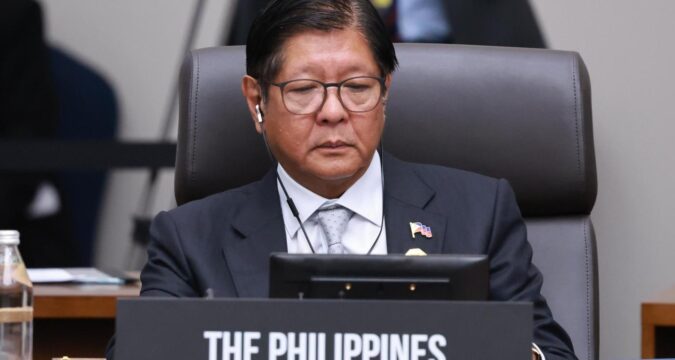
Hermana de presidente filipino lo acusa de usar drogas
Por JIM GOMEZ
MANILA (AP) — La hermana distanciada del presidente filipino Ferdinand Marcos Jr., una senadora, lo acusó públicamente el lunes de ser un adicto a las drogas desde hace mucho tiempo, cuya supuesta dependencia de la cocaína ha llevado a problemas en su gobierno, incluyendo corrupción, acusaciones que su portavoz dijo que eran un tema reciclado que hace tiempo ha sido desmentido.
La subsecretaria de Comunicaciones, Claire Castro, declaró que las acusaciones de la senadora Imee Marcos podrían ser un intento de distraer las investigaciones en curso sobre un escándalo de corrupción que involucra proyectos de control de inundaciones que podrían implicar a sus aliados en el Senado.
“Senadora Imee, espero que sea patriota y ayude en la investigación que su propio hermano ha estado realizando y condene a todos los corruptos”, indicó Castro. “No se ponga de su lado, no los oculte. Deje que el presidente Marcos trabaje para detener toda la corrupción”.
Una comisión independiente de investigación creada por Marcos, un comité del Senado y agencias gubernamentales han estado investigando acusaciones de que miembros influyentes del Congreso y el Senado han recibido enormes sobornos de empresas constructoras, que habían ganado contratos lucrativos para construir proyectos de control de inundaciones, que resultaron ser de baja calidad, incompletos o inexistentes. El escándalo ha provocado indignación en este país propenso a inundaciones y tifones.
La senadora es una aliada destacada del crítico severo y predecesor de su hermano, Rodrigo Duterte.
Duterte fue arrestado en marzo bajo una orden de la Corte Penal Internacional y trasladado a Holanda por presuntos crímenes de lesa humanidad debido a sus brutales campañas antidrogas que dejaron miles de muertos. Duterte ha negado cualquier delito.
La familia de Duterte y sus aliados han culpado a Marcos y su administración por lo que afirman fue el arresto y detención ilegal del expresidente por parte del tribunal global. Su hija, la vicepresidenta Sara Duterte, también es una de las críticas más vocales del actual presidente, pero es una aliada cercana de la senadora.
En un discurso el lunes por la noche ante una gran manifestación de un grupo religioso en un parque de Manila, la senadora señaló que la adicción a las drogas de su hermano comenzó cuando su padre, el homónimo del actual líder, aún era presidente y ha continuado hasta el día de hoy. Afirmó que ha afectado su salud y capacidad para gobernar.
El presidente y su hermana mayor eran hijos de un ex dictador que fue derrocado en un levantamiento “de poder popular” respaldado por el ejército en 1986.
Ella alegó que la esposa y los hijos del presidente también son consumidores de drogas y que ella y su hermano prácticamente no se hablan desde que él asumió la presidencia en 2022. Liza Marcos y sus hijos, que incluyen a un miembro de la Cámara de Representantes, no comentaron al respecto.
“Su adicción se convirtió en la causa de la avalancha de corrupción, la falta de dirección y decisiones muy equivocadas, la ausencia de responsabilidad y justicia”, manifestó la senadora sin ofrecer ninguna evidencia.
Dirigiéndose a los militares, la policía y otros funcionarios, dijo que deberían ayudar a “mejorar su condición”, añadiendo “No soy su enemiga. Su enemigo es él mismo”.
Castro criticó a la senadora por no mencionar a Rodrigo Duterte, quien ha reconocido haber usado fentanilo en el pasado, y las denuncias de que él y su hija, la actual vicepresidenta, están vinculados a la corrupción. Tanto Duterte como su hija han negado estar involucrados en corrupción, incluyendo su supuesta malversación de fondos confidenciales.
A principios del año pasado, Rodrigo Duterte declaró en un discurso que su sucesor era un adicto a las drogas, que una vez estuvo en una lista de las fuerzas del orden de presuntos consumidores de drogas. Marcos entonces se rió de las acusaciones de Duterte y dijo que no dignificaría la acusación con una respuesta, pero afirmó que su predecesor estaba usando fentanilo, un poderoso opioide.
En 2016, Duterte reconoció que usó fentanilo en el pasado para aliviar el dolor causado por lesiones de un accidente de motocicleta. Su abogado sostuvo más tarde que Duterte había dejado de tomar fentanilo antes de convertirse en presidente en 2016.
En 2021, cuando Marcos era aspirante a la presidencia, su portavoz mostró dos informes de un hospital privado y del laboratorio de la policía nacional que indicaban que Marcos había dado negativo en pruebas de cocaína y metanfetamina.
___________________________________
Esta historia fue traducida del inglés por un editor de AP con ayuda de una herramienta de inteligencia artificial generativa.
https://www.chicagotribune.com/2025/11/17/hermana-de-presidente-filipino-lo-acusa-de-usar-drogas/
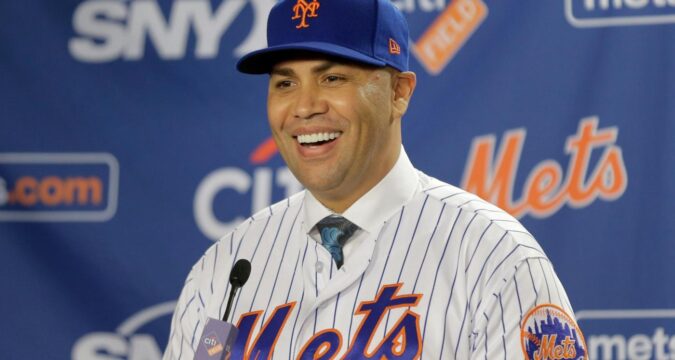
Hamels, Braun y Kemp aparecen en boleta del Salón de la Fama; Beltrán lidera 15 restantes
Associated Press
COOPERSTOWN, Nueva York, EE.UU. (AP) — Cole Hamels, Ryan Braun y Matt Kemp se encuentran entre los 12 nuevos candidatos en la boleta del Salón de la Fama del Béisbol publicada el lunes, y el puertorriqueño Carlos Beltrán encabeza a los 15 candidatos que se mantienen después de quedar a 19 votos de distancia en la votación de 2025.
Howie Kendrick, Daniel Murphy y Rick Porcello también están entre los elegibles por primera vez, junto con Shin-Soo Choo, el dominicano Edwin Encarnación, Gio González, Alex Gordon, Nick Markakis y Hunter Pence.
Beltrán recibió 277 de 394 votos para un 70.3% en la votación de 2025, cuando Ichiro Suzuki, CC Sabathia y Billy Wagner fueron elegidos.
Beltrán, quien fue seleccionado nueve veces al Juego de Estrellas, bateó para .279 con 435 jonrones y 1,587 carreras impulsadas a lo largo de 17 temporadas con Kansas City (1999-2004), Houston (2004, ’17), los Mets de Nueva York (2005-11), San Francisco (2011), San Luis (2012-13), los Yankees de Nueva York (2014-16) y Texas (2016).
Recibió un 46.5% de apoyo en su primera aparición en la boleta en 2023, luego subió a un 57.1% en su segunda.
Beltrán fue el único jugador mencionado por nombre en el informe de 2020 del comisionado de béisbol Rob Manfred, que concluyó que los Astros usaron dispositivos electrónicos en violación de las reglas para robar señales durante la carrera de Houston hacia el título de la Serie Mundial de 2017 y nuevamente en la temporada 2018. Tres días después de que se emitiera el informe, los Mets de Nueva York anunciaron que Beltrán ya no sería su manager, apenas dos meses y medio después de haber sido contratado.
Otros candidatos que se mantienen incluyen a las estrellas manchadas escándalos de esteroides Alex Rodríguez (146 votos, 37.1%) y el dominicano Manny Ramírez (135, 34.3%), junto con Andruw Jones (261, 66.2%), Chase Utley (157, 39.8%), Andy Pettitte (110, 27.9%), el venezolano Félix Hernández (81, 20.6%), el venezolano Bobby Abreu (77, 19.5%), Jimmy Rollins (71, 18%), el venezolano Omar Vizquel (70, 17.8%), Dustin Pedroia (47, 11.9%), Mark Buehrle (45, 11.4%), el venezolano Francisco Rodríguez (40, 10.2%), David Wright (32, 8.1%) y Torii Hunter (20, 5.1%).
Pettitte está en la boleta por octava vez después de duplicar el apoyo del 13.5% en 2024. Un jugador puede aparecer en la boleta hasta diez veces.
Los miembros de la BBWAA con diez o más años consecutivos de membresía son elegibles para votar. Las boletas deben tener matasellos del 31 de diciembre y los resultados se anunciarán el 20 de enero. Cualquiera que sea elegido será inducido el 26 de julio junto con cualquiera elegido el siete de diciembre por el comité de la era contemporánea del béisbol del salón, que considera a ocho jugadores cuyas mayores contribuciones al deporte fueron desde 1980 en adelante.
Hamels, un cuatro veces All-Star, tuvo un récord de 163-122 con una efectividad de 3.43 para Filadelfia (2006-15), Texas (2015-18), los Cachorros de Chicago (2018-19) y Atlanta (2020), lanzando un juego sin hits de los Filis contra los Cachorros el 25 de julio de 2015. Fue MVP de la Serie de Campeonato de la Liga Nacional de 2008 y de la Serie Mundial cuando Filadelfia ganó su segundo título, el primero desde 1980.
Braun, el MVP de 2011 y seis veces All-Star, bateó para .296 con 352 jonrones y 1,154 carreras impulsadas para Milwaukee de 2007 a 2020. Fue suspendido por los últimos 65 juegos de la temporada 2013 por violaciones del programa de drogas y el contrato laboral del béisbol. Una suspensión de 50 juegos por un supuesto resultado positivo en 2011 fue revocada después de que Braun impugnara la cadena de custodia de la muestra de orina.
Kemp, un tres veces All-Star, bateó para .284 con 287 jonrones y 1,031 carreras impulsadas para los Dodgers de Los Ángeles (2006-14, ’18), San Diego (2015-16), Atlanta (2016-17), Cincinnati (2019) y Colorado (2020).
Barry Bonds, Roger Clemens, Don Mattingly y Dale Murphy están siendo considerados por el comité de la era contemporánea junto con el boricua Carlos Delgado, Jeff Kent, Gary Sheffield y el mexicano Fernando Valenzuela.
___
Deportes en español AP: https://apnews.com/hub/deportes

Indignación en Israel luego que Netanyahu dice que gobierno supervisará investigación sobre ataques
Por MELANIE LIDMAN
TEL AVIV, Israel (AP) — Después de repetidos retrasos, el gobierno de Israel ha acordado iniciar una investigación sobre las fallas gubernamentales que llevaron al ataque liderado por Hamás el 7 de octubre de 2023, que desencadenó la guerra en Gaza.
Sin embargo, las preguntas sobre la independencia de la investigación generaron acusaciones el lunes de que el primer ministro Benjamin Netanyahu está tratando de evadir la responsabilidad personal en el peor ataque en la historia de Israel.
Tradicionalmente, Israel ha nombrado una comisión estatal de investigación independiente, liderada por un juez retirado, tras fracasos gubernamentales importantes.
Netanyahu ha resistido los llamados para una investigación de este tipo, diciendo solo que responderá a todas las preguntas cuando la guerra termine. En la decisión del domingo, afirmó que el alto al fuego que entró en vigor el 10 de octubre permite al gobierno iniciar la investigación.
Su gabinete aprobó la formación de un “comité gubernamental” diluido. Netanyahu supervisará la composición del equipo que dirigirá la investigación, lo que en efecto lo pone a cargo de la pesquisa. Se anunciarán más detalles sobre la investigación en 45 días.
Crítica pública
El líder opositor Yair Lapid calificó la decisión de insultante para las víctimas del 7 de octubre y para los cientos de soldados que han muerto en la guerra.
“El gobierno está haciendo todo lo posible para tapar la verdad y evadir la responsabilidad”, expresó Lapid.
El gobierno está “estableciendo una comisión que se investigará a sí misma”, señaló el Movimiento por la Calidad del Gobierno en Israel, crítico de Netanyahu. “Esto no es una comisión investigadora, es una comisión de encubrimiento”.
En el ataque del 7 de octubre, milicianos liderados por Hamás mataron a unas 1.200 personas y tomaron a más de 250 como rehenes. Casi 500 soldados han muerto en los combates desde entonces, mientras que funcionarios de salud palestinos dicen que más de 69.000 palestinos han muerto en la represalia israelí.
Según una encuesta del mes pasado de la institución con sede en Jerusalén Instituto de Democracia de Israel, casi tres cuartas partes del público apoyan una comisión de investigación completamente independiente. Incluso entre la base de derecha de Netanyahu, el 68% favoreció una comisión independiente. La encuesta cuestionó a 1.000 personas y tuvo un margen de error de 3,1 puntos porcentuales.
Miles de personas se manifestaron el sábado por la noche en Tel Aviv, muchos pidiendo una investigación independiente.
Netanyahu, quien está siendo juzgado por cargos de corrupción no relacionados con la guerra, dice que el poder judicial tiene demasiado poder y ha afirmado que una investigación independiente no tendría “el apoyo público más amplio posible”.
“La única manera de asegurar la confianza pública en el trabajo de la comisión es un acuerdo amplio sobre la composición de la comisión”, manifestó.
Hallazgos previos
El ejército israelí y otros cuerpos de seguridad han llevado a cabo varias investigaciones sobre sus fracasos del 7 de octubre.
Pero la nueva investigación también examinará la toma de decisiones gubernamentales y las suposiciones que crearon las condiciones para que ocurriera el ataque.
Muchas figuras de seguridad han dicho que el intento de Netanyahu de reformar el sistema judicial del país, que desencadenó manifestaciones masivas y divisiones públicas antes de la guerra, envió un mensaje de debilidad que animó a los enemigos de Israel a atacar. Netanyahu rechaza las acusaciones.
Muchos israelíes creen que los errores del 7 de octubre van más allá del ámbito militar, y culpan a Netanyahu por lo que consideran una estrategia fallida de disuasión y contención en los años previos al ataque. Esa estrategia incluía permitir que Qatar enviara maletas de dinero en efectivo a Gaza y marginar a la Autoridad Palestina, reconocida internacionalmente y rival de Hamás.
Una investigación militar israelí determinó que un concepto erróneo central era que Hamás, que tomó el control de Gaza de la Autoridad Palestina en 2007, estaba más interesado en gobernar el territorio que en luchar contra Israel.
La investigación también encontró que Hamás pudo llevar a cabo el ataque porque el ejército israelí malinterpretó las intenciones del grupo y subestimó sus capacidades.
Los planificadores militares habían imaginado que, en el peor de los casos, Hamás podría llevar a cabo una invasión terrestre desde ocho puntos fronterizos como máximo, pero Hamás logró hacerlo desde más de 60 puntos.
Muchos oficiales militares y policiales de alto rango en ese momento, incluido el jefe de estado mayor militar, el jefe de inteligencia militar y el ministro de defensa, han renunciado o han sido destituidos.
___________________________________
Esta historia fue traducida del inglés por un editor de AP con ayuda de una herramienta de inteligencia artificial generativa.

El Museo del Louvre cierra oficinas y una galería por preocupaciones de fragilidad estructural
Associated Press
PARÍS (AP) — El Museo del Louvre en París afirmó el lunes que cerrará temporalmente algunas oficinas de empleados y una galería pública debido a la fragilidad estructural.
El anuncio se produjo mientras el museo más visitado del mundo, ubicado en un antiguo palacio medieval, se prepara para ambiciosas renovaciones anunciadas a principios de este año. El Louvre también sigue recuperándose del robo de joyas de la corona valoradas en más de 100 millones de dólares el mes pasado.
El museo indicó en un comunicado que un informe técnico presentado el viernes señaló “una fragilidad particular de ciertas vigas que sostienen los pisos” del segundo nivel del ala sur del ala Sully del Louvre debido a “desarrollos recientes e imprevistos”. No dio más detalles.
La dirección del museo decidió bloquear el acceso a las oficinas del segundo nivel y reubicar temporalmente a los 65 empleados que trabajan allí durante tres días mientras los expertos evalúan los daños. El museo también está cerrando la Galería Campana —que se encuentra debajo de las oficinas y exhibe cerámicas griegas antiguas— como medida de precaución.
La modernización del ala Sully es una de las prioridades de los esfuerzos de renovación anunciados en enero.
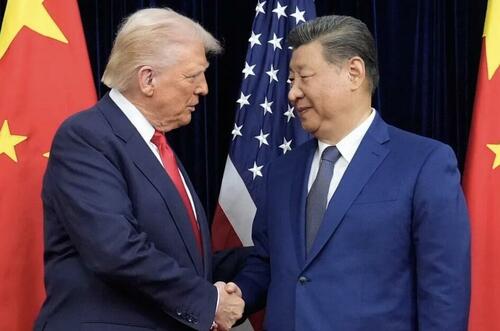
Still No Deal: Rare Earth Talks Between China And U.S. Drag On With Little Tangible Progress So Far
Still No Deal: Rare Earth Talks Between China And U.S. Drag On With Little Tangible Progress So Far
The US and China are still hashing out the details of how Beijing will loosen rare-earth export restrictions, weeks after a trade truce that Washington said would boost shipments, according to Bloomberg.
In other words, there’s still no rare earth mineral trade deal, despite the “truce” between the two countries.
Negotiators have until the end of November to finalize terms for “general licenses” China promised to issue for US-bound rare earths and other critical minerals, though the reason for the delay is unclear.
The White House framed the pledge as the “de facto removal” of China’s curbs imposed since 2023, calling it a major win for supply chains. Washington has already eased tariffs and paused some national-security measures, but China hasn’t publicly addressed the licensing promise, even as it confirmed other parts of the deal, including a one-year halt to new rare-earth controls.
Bloomberg writes that the outcome remains uncertain. Alicia Garcia Herrero said, “The deal is far from done,” noting Beijing can use licenses as leverage. Exporters say they’ve received no new guidance, with Christopher Beddor commenting, “Everyone is still in wait-and-see mode… I would not characterize the general licenses as a de facto removal of controls.”
The general-license system would allow repeated shipments over as long as three years, unlike the current requirement for case-by-case approvals. But buyers would still need to pass government vetting. The White House says these licenses will apply to restricted rare earths and metals such as gallium, germanium, antimony, tungsten, and graphite; China has also agreed to lift its ban on direct shipments to the US for the first three.
Recall days ago we wrote that disagreements were emerging over the deal and we have been skeptical that a deal would take place since the “truce” was first announced. We wrote that the so-called US–China “truce” looked far too fragile to last, and recent developments have only reinforced that view.
Even as both sides publicly celebrated their agreement, Beijing immediately began laying down new “red lines” — and Washington just as quickly took steps guaranteed to test them. Analysts, exporters, and investors all saw the same thing: a deal heavy on spin and light on substance, with China able to wield licensing power as leverage and the US racing to secure alternative supply chains.
In short, we argued that this ceasefire was never more than a temporary pause before the next escalation, and nothing since has suggested otherwise.
Tyler Durden
Mon, 11/17/2025 – 13:40

Illinois moves up to No. 8 in the men’s AP Top 25, while Purdue reclaims the top spot from Houston
Purdue moved back to No. 1 in the AP Top 25 men’s college basketball poll Monday ahead of Houston, which spent a single week there after leapfrogging the Boilermakers.
It’s hardly a two-team race for the top, though. Connecticut, Arizona and Duke also got No. 1 votes from the 61-member media panel in a poll that also saw No. 6 Louisville and No. 8 Illinois jump into the top 10.
The Boilermakers got 44 first-place votes after an impressive week that included a road win over then-No. 8 Alabama and a victory over Akron. Houston lost six of its No. 1 votes but still had 12 after beating Oakland and edging No. 22 Auburn in a matchup of Final Four teams from last season.
“We have a great group of guys,” said Purdue coach Matt Painter, who also picked up his 500th career win last weekend, “and just trying to go from one game to the other is really hard after you have such an emotional, big win on the road like we had.”
UConn remained No. 3 with three first-place votes after beating then-No. 7 BYU 86-84 on Saturday. That started a tough road for the Huskies that includes games against No. 4 Arizona on Wednesday and Illinois and No. 24 Kansas down the road.
The Wildcats swapped spots with Duke this week, moving up with two first-place votes thanks in part to a win over then-No. 15 UCLA. The Blue Devils received the remaining No. 1 vote ahead of their game against the Jayhawks on Tuesday night.
Louisville tied for the biggest climb in the Top 25, moving up six spots after beating then-No. 9 Kentucky 96-88 last week. Michigan fell one spot to seventh, while Big Ten rival Illinois also moved up six spots after beating then-No. 11 Texas Tech 81-77. BYU dropped two spots after its loss to the Huskies, while defending national champion Florida rounded out the top 10.
The losses by Alabama and Kentucky cost each three spots in this week’s poll, pushing them into the second 10. Gonzaga was next, followed by St. John’s and Texas Tech, which dropped four spots after its loss to Illinois.
Speaking of the Illini, they have climbed nine spots from No. 17 in the preseason poll, the highest they’ve been since they were No. 6 in the final poll two seasons ago. Staying there will be a test. Illinois plays plays the Crimson Tide on Wednesday night, UConn in a couple of weeks, No. 20 Tennessee the first week of December and then Ohio State, Nebraska and Missouri — all of them unbeaten this season — before Christmas rolls around.
“It’s the way you practice, the mental focus you have. Not reading all you guys’ stuff and the fans and everything else,” Illini coach Brad Underwood said when asked this week about how to keep early success in perspective. “I call it drinking the poison. And you can’t. You have to stay with what is vital and what is important.”
Rising and falling
The Illini joined Louisville and Gonzaga in making six-spot climbs this week, while the biggest falls came from Texas Tech and UCLA, which dropped four spots after a close loss to Arizona. N.C. State moved into the poll at No. 25 at the expense of Creighton.
Conference watch
The Big Ten, Big 12 and SEC led the way with six teams apiece in the Top 25, and the Big Ten and Big 12 had three each in the top 10. The ACC was next with four ranked teams, the Big East had two and the West Coast Conference one.
Watch list
San Diego State was the top team outside the Top 25, followed by Indiana, which appeared on 18 ballots. Keep an eye on Georgetown, which appeared on six ballots and entered the week 4-0; the Hoyas have not been ranked since the final poll of the 2014-15 season.
https://www.chicagotribune.com/2025/11/17/ap-top-25-mens-basketball-poll-illinois-purdue/
Cooling Labor Market Drives Uptick In Gig-Platform Hours
Cooling Labor Market Drives Uptick In Gig-Platform Hours
We haven’t heard much in corporate media about short-term, flexible, on-demand work, otherwise known as the gig economy, but a new Goldman note offers color into what’s happening with these part-time jobs as the labor market cools.
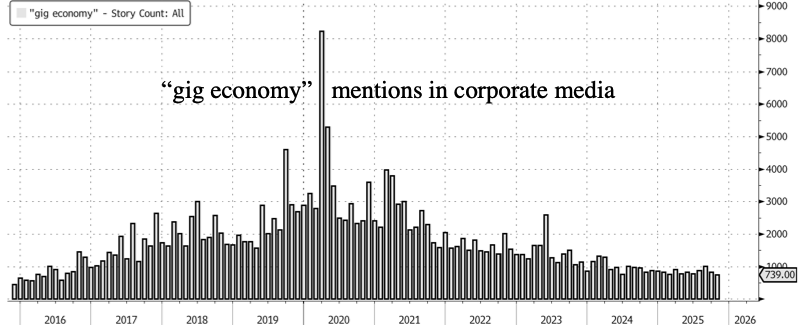
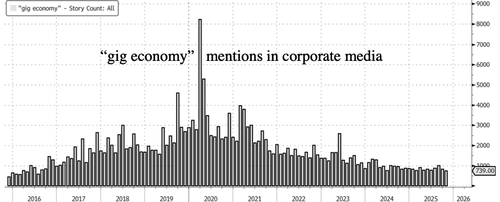
Let’s take a look at the news cycle for mentions of “gig economy.” Notice how the topic surged in the early days of the Covid pandemic, when it became all the rage as people lost their jobs due to government-mandated shutdown of the economy. Many quickly turned to gigs for supplemental income, like driving for Uber or delivering for DoorDash. Now, mentions in corporate media have fallen back to roughly 2016 levels.
However, as the labor market cools, analyst Jessica Rindels said gig-platform hours have increased, suggesting displaced or underemployed workers are turning to Uber, DoorDash, and other gig opportunities.
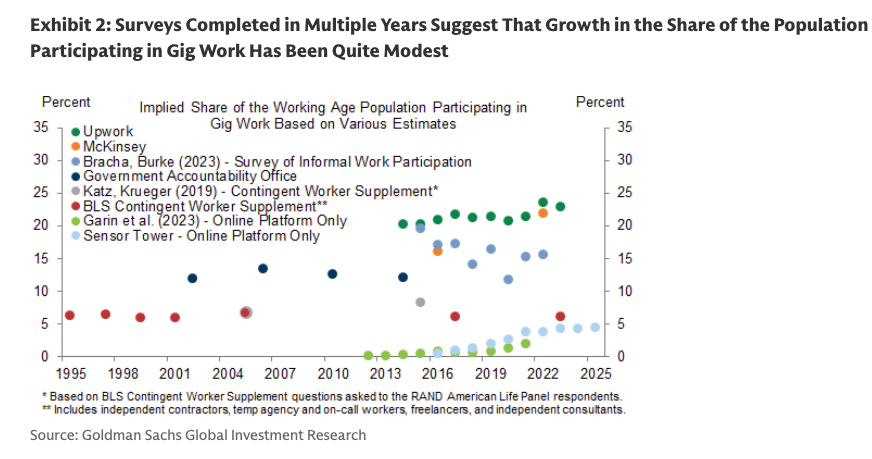
Estimates suggest that 5% to 15% of Americans work gig jobs, with 2% to 4% involved in platform-based gigs. Overall, gig work has grown only modestly in recent years, but platform gig work has expanded at a 5% to 8% annual pace.
Here are the key takeaways about current gig economy trends via Rindels (full report can be viewed by ZeroHedge Pro subs in usual place):
This Analyst takes a deeper look at the gig economy, including both traditional gig work as well as platform-based opportunities such as Uber. With the labor market cooling, we ask whether the gig economy provides a meaningful source of income support to those who experience job loss or reduced hours and what it can tell us about the current state of the labor market.
Estimates of employment in the gig economy are wide-ranging, but the most credible suggest that 5-15% of the US population participates in gig work, broadly defined as any income-generating work outside of standard, long-term, direct-hire employment. Estimates of participation in platform-based gig work such as Uber are lower at 2-4% of the population. Most surveys that have been run for multiple years suggest, perhaps surprisingly, that growth in total gig employment has been modest at best, though growth in the number of platform gig workers has been much faster at roughly 5-8% annualized over the past few years.
How do gig workers compare to workers in traditional jobs? Recent Fed research using the NY Fed’s Survey of Informal Work Participation (SIWP) finds that gig workers are more likely to be younger, female, work part-time, and to hold multiple jobs compared to workers in traditional jobs. Unique data from Gridwise, an app that allows platform gig workers to compare potential earnings across services, show that platform gig workers spent 14 hours per week on average doing gig work this year and earned roughly $18 per hour of work.
How is gig work reflected in the official employment statistics? While only a subset of gig workers should be captured by the establishment survey, they should all in principle be captured by the household survey. That said, the SIWP suggests that some gig work is not reported in the household survey and that roughly 15% of people reported as unemployed or not in the labor force actually do some gig work, which implies that the employment to population ratio would be roughly 65% rather than 60% if it fully included gig workers.
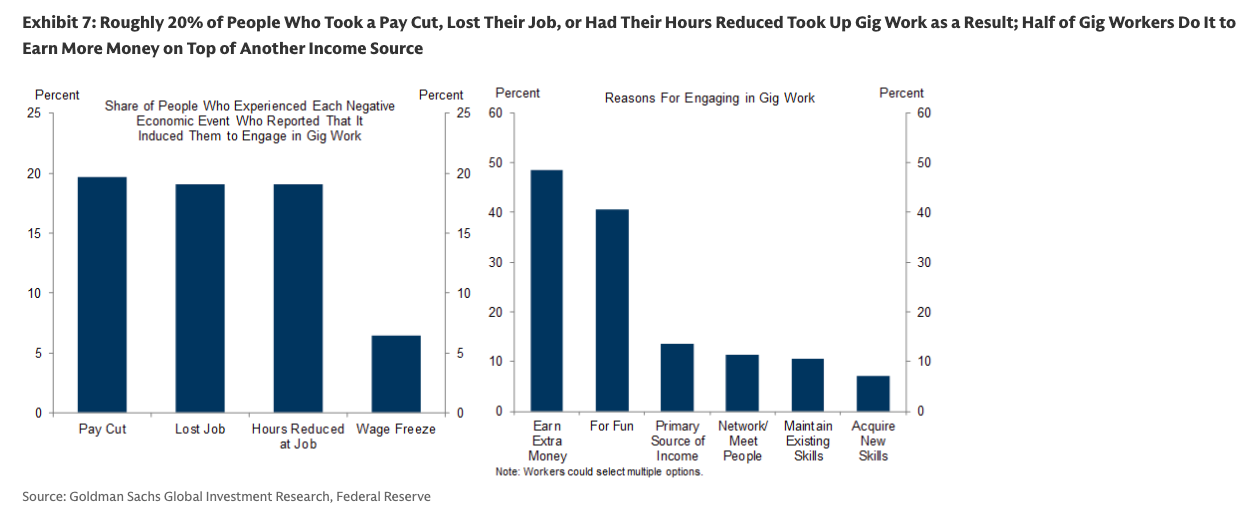
Recent academic research shows that many lower-wage workers face high income volatility due to unpredictable changes in the weekly hours their employers give them. Does the gig economy—especially platform-based work—offer a meaningful new source of income support with a low barrier to entry to those who face job loss or reduced hours? Data from the SIWP indicate that nearly 50% of gig workers do gig work to earn extra money versus just 15% who do it as a primary source of income, and that 20% of people who took a pay cut, lost their job, or had their hours reduced took up gig work in response. However, gig workers only earn 50-65% as much per hour of work as they did in previous traditional jobs, and the support available to some workers in normal times would likely be inadequate for all job losers in a recession.
What can the gig economy tell us about the current state of the labor market? As the broader labor market has cooled this year, platform-based gig work opportunities have held up so far. We find that hours worked on gig platforms increased more this year in cities where payroll growth has slowed, suggesting that some workers might have taken up gig work to cushion negative labor market outcomes.
Earlier on Monday, White House economic adviser Kevin Hassett told CNBC hosts about “mixed signals in the job market …”
“I think that there could be a little bit of almost quiet time in the labor market because firms are finding the AI is making their workers so productive that they don’t necessarily have to hire the new kids out of college,” Hassett said.
This all suggests that a cooling labor market could push more workers into the gig economy, which in turn could increase the conversation around gig jobs.
Tyler Durden
Mon, 11/17/2025 – 13:25
https://www.zerohedge.com/markets/cooling-labor-market-drives-uptick-gig-platform-hours
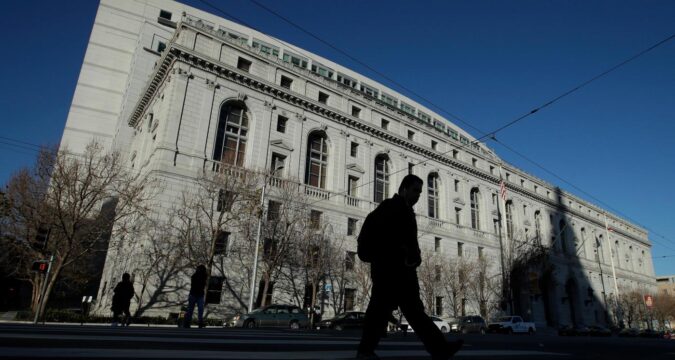
Corte Suprema de EEUU revisará política que restringe el número de solicitantes de asilo
Por MARK SHERMAN
WASHINGTON (AP) — La Corte Suprema de Estados Unidos aceptó el lunes revisar una política utilizada en administraciones pasadas para negar a los migrantes la oportunidad de solicitar asilo en la frontera mexicana hasta que hubiera espacio para procesar las solicitudes.
Los jueces escucharán la apelación de la administración Trump sobre los fallos de tribunales inferiores que anularon la práctica conocida como “metering”, en la cual los agentes fronterizos estadounidenses limitaban el número de personas que buscaban asilo en los cruces fronterizos al prohibir que los migrantes pusieran un pie en Estados Unidos.
La administración presionó para que interviniera la corte incluso después de que el presidente Donald Trump suspendió el sistema de asilo el primer día de su segundo mandato y los defensores de los migrantes dijeran que los fallos de los tribunales inferiores no tienen un efecto práctico continuo.
El caso se argumentará a finales del invierno o principios de la primavera.
Dicha restricción se utilizó por primera vez durante la administración del entonces presidente Barack Obama cuando un gran número de haitianos apareció en el cruce principal hacia San Diego desde Tijuana, México. La medida se expandió a todos los cruces fronterizos desde México durante el primer mandato de Trump en la Casa Blanca.
La práctica terminó en 2020, cuando la pandemia de coronavirus llevó al gobierno a restringir aún más severamente a los solicitantes de asilo. El presidente Joe Biden rescindió formalmente el uso del “metering” en 2021.
Aun así, el Departamento de Justicia dijo que quería que los jueces escucharan el caso porque los fallos judiciales quitaron “una herramienta que las administraciones de ambos partidos habían considerado crítica para controlar el procesamiento de extranjeros inadmisibles durante los aumentos en la frontera”.
La jueza federal de distrito, Cynthia Bashant, falló en 2021 que el “metering” violaba los derechos constitucionales de los migrantes y una ley federal que requiere que los funcionarios examinen a cualquier persona que se presente buscando asilo.
Un panel del Tribunal Federal de Apelaciones del 9º Circuito ratificó el fallo de Bashant en una decisión 2-1. Doce de los 29 jueces del tribunal de apelaciones con sede en San Francisco votaron para volver a escuchar el caso, una señal fuerte que pudo haber captado la atención de los jueces.
Las personas que buscan refugio en Estados Unidos pueden solicitar asilo una vez que están en suelo estadounidense, independientemente de si llegaron legalmente. Para calificar, deben demostrar un temor de persecución en su país por razones específicas, como su raza, religión, nacionalidad, pertenencia a un grupo social particular u opinión política.
Una vez que las personas obtienen asilo, no pueden ser deportadas. Pueden trabajar legalmente, traer a su familia inmediata, solicitar residencia legal y eventualmente buscar la ciudadanía estadounidense. Ofrece un futuro permanente en Estados Unidos.
_______
Esta historia fue traducida del inglés por un editor de AP con la ayuda de una herramienta de inteligencia artificial generativa.

Trump Offers Lifeline To UK ‘Thought Criminals’
Trump Offers Lifeline To UK ‘Thought Criminals’
Authored by Steve Watson via Modernity.news,
The Trump White House is mulling political asylum for British free speech activists branded “thought criminals” under Keir Starmer’s regime, in one example offering refugee status to those prosecuted for silent protests outside abortion clinics as well as expressing online dissent.
The transatlantic intervention, said to be largely influenced by Elon Musk continually pointing to cases of the UK punishing people for “thought crimes,” signals America’s readiness to shield allies from creeping authoritarianism.
Administration insiders are intently exploring the option of offering visas and refugee status, focusing on figures like Livia Tossici-Bolt, prosecuted in March 2023 for holding a sign near a Bournemouth abortion clinic reading “Here to talk if you want,” and Adam Smith Connor, convicted for a vigil outside Poole Magistrates Court.
A source close to the process called the plan “serious,” noting officials are “beginning to consider” extending protections to gender critical activists, immigration critics, and even pro-abortion campaigners hit with “thought crimes.”
The White House is considering offering political asylum to British “thought criminals”, The Telegraph understands.
Read more here ⬇️https://t.co/GF3IarnyIX pic.twitter.com/bvfc8UcDwv
— The Telegraph (@Telegraph) November 16, 2025
This echoes Trump’s October pledge to offer asylum to Europeans opposing mass migration, prioritising those “targeted for peaceful expression of views online.”
A source with knowledge of the decision-making affirmed: “There are some people inside the administration that are actively scouting for cases.”
Trump set a precedent earlier in the year by granting refugee status to white South Africans claiming racial discrimination, despite halting most other admissions post-January inauguration.
At the UN, Trump recently warned European officials “You’re destroying your countries. They’re being destroyed. Europe is in serious trouble. They’ve been invaded by a force of illegal aliens like nobody’s ever seen before. Illegal aliens are pouring into Europe.” He added that their countries were “going to hell” because of unchecked immigration.
In a GB News interview this past weekend, Trump once again directly tied the UK’s free speech crackdown to its immigration meltdown, declaring “If you don’t get [illegals] out, you’re not going to have a country left… You have areas in London where the police don’t even want to go anywhere near those areas. You have Sharia Law where they don’t even want to obey the laws of your country.”
The administration is also poised to revoke the visa of Imran Ahmed, boss of a Labour-linked NGO founded by Starmer’s chief of staff, after the group pushed online restrictions. Earlier, Starmer’s US trade deal bids nearly collapsed over Tossici-Bolt’s case, with a source insisting: “no free trade without free speech.”
This asylum initiative builds on Trump’s May 2025 dispatch of a U.S. Bureau of Democracy, Human Rights and Labour (DRL) team to London, led by senior adviser Samuel Samson, to meet arrested pro-life activists and affirm “the importance of freedom of expression in the UK and across Europe.”
The squad probed high-profile convictions like Lucy Connolly’s jailing for a social media post calling for asylum hotels to be set on fire after the Southport murders.
Trump’s moves expose the UK’s slide toward policing thoughts, from silent prayer bans to online censorship—offering a beacon for dissidents while pressuring allies to reclaim liberty before it’s lost to radical overreach.
* * *
Your support is crucial in helping us defeat mass censorship. Please consider donating via Locals or check out our unique merch. Follow us on X @ModernityNews.
Tyler Durden
Mon, 11/17/2025 – 13:05
https://www.zerohedge.com/geopolitical/trump-offers-lifeline-uk-thought-criminals

Chicago journalist Andrea Hanis, an editor who helped launch Blue Sky, dies at 56
Andrea Hanis was a versatile journalist who spent almost her entire career working for Chicago newspapers, including the Tribune, where in 2013 she launched Blue Sky Innovation, a digital hub focused on Chicago’s emerging innovation economy, and served as its editor.
Those who worked closely with Hanis recalled her high journalistic standards, her strong work ethic, her effervescent personality, her upbeat spirit and her ever-present sense of humor.
“Andrea was a wonderful colleague and a lovely person, and she had such a rich history in Chicago working for the Sun-Times, Crain’s and then for the Tribune,” said former Tribune senior vice president and editor Gerould W. Kern. “She had an infectious personality that was really kind of a tonic for a newsroom and for anyone who worked with her and around her. She took on complicated jobs and did them exceptionally well.”
Hanis, 56, died of complications from brain cancer on Nov. 12 while in hospice care at the Warren Barr Gold Coast rehabilitation and nursing facility on the Near North Side, said former Tribune Content Agency president Joyce Winnecke, a longtime friend. Hanis, who had battled brain cancer for the past 14 months, had been a Lincoln Park resident until June, when she moved to the Streeterville neighborhood, and she also had a weekend home in Lakeside, Michigan.
Born in 1969, Andrea Marie Hanis was a native of Whiting, Indiana, and graduated from Whiting High School in 1986. She earned a bachelor’s degree in 1991 from Indiana University, where she worked on the school newspaper, the Indiana Daily Student, as managing editor and news editor.
After college, Hanis worked for the Louisville Courier-Journal newspaper in Kentucky for two years before moving to Chicago in 1993 to take a job at the Chicago Sun-Times. She was an assistant editor in features and was the paper’s lifestyles editor.
In 1998, the Sun-Times tapped Hanis to be editor of its travel section. Hanis also wrote a weekly column for the section and oversaw and edited a cadre of freelance reporters and photographers.
Hanis joined Crain’s Chicago Business in 2004 as an assistant managing editor, tasked with orchestrating a new features section, dubbed the Business of Life. One of her columnists was former Tribune staff reporter Shia Kapos, who wrote the “Taking Names” column for Crain’s starting in 2006 and who now writes the “Illinois Playbook” column for Politico.
“She was my boss and then became one of my closest friends. And when you’re a journalist, you hope that your editor is a great wordsmith to make your stories better, and then you also hope that your editor, who is your boss, is a great boss,” Kapos said. “But Andrea was one of the rare journalists who was an incredible wordsmith and the perfect boss. She was tough and she could be sharp at times, but she never made you feel bad about yourself in any way. She was great to work for. And we loved pulling together the Business of Life section because it was something new and different that hadn’t been done in Chicago.”
In 2011, Hanis joined the Tribune’s business section as its planning editor. Two years later, she took on a bigger role as editor of the business section’s new Blue Sky Innovation digital hub.
“We launched this startup, Blue Sky Innovation, looking at the startup and innovation space in Chicago because we were just coming out of the recession and so the whole idea of green shoots and businesses was important. But (Blue Sky) was also, in and of itself, a green shoots start-up for us,” Kern said. “So this was a very nontraditional kind of thing for us to do, and she took it and ran with it and did, I think, a fabulous job with it.”
Amina Elahi, a Blue Sky Innovation reporter from 2014 until 2017 who now is Louisville Public Media’s managing editor for news, said Hanis’ leadership and mentorship were “very influential” for her. Elahi said she regularly passes to her own staff what she learned from Hanis.
“She had very high standards in editing and in the stories she would green-light, and despite all of that, it was always fun to work with her,” Elahi said.
Several colleagues noted that one of Hanis’ mantras in running Blue Sky Innovation was “identify and destroy nonsense.” That line was emblematic, colleagues said, of how she approached the stories covered.
In 2019, Blue Sky Innovation’s staff members, including Hanis, were transferred to other duties. She took on an assignment writing editorials for the Tribune. The following year, she was one of several journalists to accept a voluntary separation package and left the Tribune.
In 2021, Chicago Daily Law Bulletin president and publisher Peter Mierzwa hired Hanis to be the editor of the venerable legal newspaper. He called her “a natural mentor, always willing to guide younger staff members, helping them grow not only as journalists but as professionals.”
“At her core, Andrea was a journalist through and through — someone whose deep roots in reporting, editing and storytelling shaped every decision she made,” he said. “Those of us who worked closely with her will especially remember her humor: smart, warm and often punctuated by an unmistakably genuine laugh that could brighten even the busiest newsroom. We shared a vision for change in our news operation, and her commitment to accountability, reliability and doing the work the right way helped bring that vision closer to reality.”
About a year ago, Hanis resigned from the Daily Law Bulletin amid her cancer treatment. She had no immediate survivors.
Winnecke and her husband are planning a memorial service for Hanis, to be held in January.
Bob Goldsborough is a freelance reporter.
https://www.chicagotribune.com/2025/11/17/journalist-andrea-hanis-obituary/