Category: News

Don’t Fall In The China Trap
Don’t Fall In The China Trap
Authored by James Rickards via DailyReckoning.com,
Is the Chinese economy collapsing? Or is something worse waiting in the wings?
The short answer is that we could be looking at something much worse than a crashing economy. China could be part of a collapse of the global monetary system.
We’ll begin the analysis with the latest official economic releases from China. These releases showed some of the weakest performance by the Chinese economy since the 2020 pandemic collapse.
Things Aren’t Looking Good
Industrial production growth for October declined to 4.9% (year-over-year) from a prior level of 6.5%. This was the weakest reading since August 2024. Some sectors receiving state support such as autos, computers, shipbuilding and telecommunications did better than average, but the broader manufacturing sector slowed materially, and mining output also weakened.
Retail sales in October were also fragile. There was overall growth of 2.9%, but certain sectors crashed, including household appliances (- 14.9%), building materials (- 8.3%), and automobiles (- 6.6%).
Sectors showing strength included jewelry (+37.6%, although this can be partly a proxy for buying gold in the form of jewelry) and cosmetics (+9.6%). This was the smallest increase in retail sales in years and is especially weak considering that October traditionally marks the beginning of a seasonal buying surge.
The most disastrous data came from fixed-asset investment (FAI), which showed a 1.7% year-to-date decline. This is the steepest decline since the pandemic crash year of 2020.
Property investment fell at -14.7% while infrastructure investment (long the pillar of Chinese growth) went negative at -0.1%. Manufacturing investment was positive at +2.7%, but that was only half the rate from earlier this year.
The bottom line is that all three pillars of investment – fixed assets, property and manufacturing – are slowing at the same time. Investment is one of the most powerful drivers of Chinese growth. While developed economies typically attribute about 25% of their GDP to investment, the Chinese component is closer to 45%. If investment is crashing in China, then overall growth is crashing along with it.
Real Estate Is Crashing Too
This recent data comes on top of the multi-year crash in property values. This crash has caused equity on many properties to be wiped out. To the extent that vanished equity represented the life’s savings of many everyday Chinese citizens, the impact on consumption and the reluctance to make new real estate investments is profound.
The real estate crash goes beyond individual owners and has led to the collapse of several of the largest builders and property investment companies in China including the Evergrande Group ($19 billion in losses), Country Garden ($11 billion in losses), Fantasia Holdings (recent $1 billion operating loss), Sunac (filed for bankruptcy in 2023), and several others.
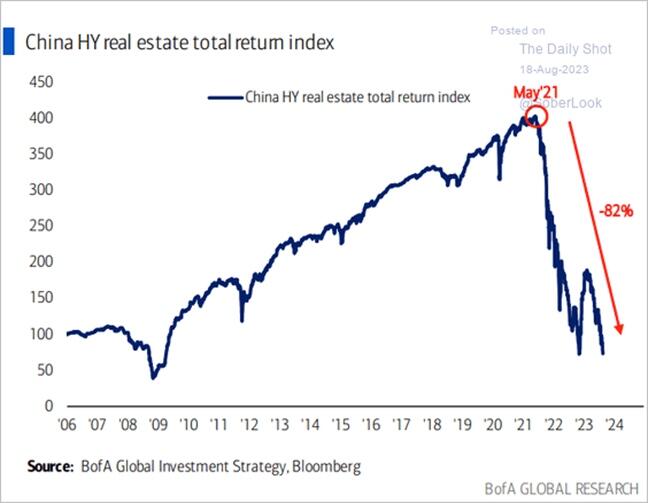
The financial collapses of China Evergrande, Country Garden, and Sunac all come against the background of a broader crash in real estate debt and real estate-backed wealth management products. This chart shows that a major Chinese high-yield real estate index collapsed 82% in recent years and has never recovered.
The real estate collapse arrived at the same time as several failed “reopenings” of the Chinese economy after COVID and several “stimulus” plans after that. A major economic reopening was announced in 2022 after pandemic lockdowns were eased. This was a failure. Then China announced other major stimulus plans – so-called bazookas – including rate cuts, reductions in bank reserve requirements and subsidies to favored industries. These failed in 2024 and again in 2025. As in the United States, lower interest rates are not a sign of stimulus. They are associated with recession and depression.
Negative Growth?
Chinese economic data must be considered in light of Goodhart’s Law. This economic rule says that when a metric becomes the object of policy, it loses value as a metric.
This applies to Chinese GDP. The Chinese GDP growth rate has declined from 10.0% per year in the early 2000s to 5.0% in 2024. The GDP growth rate (year-over-year) for the third quarter of 2025 was 4.8%. The Chinese clearly target the GDP growth rate and currently have a target of 5.0% growth. This means that growth is almost certainly lower, and the Chinese are using statistical sleight-of-hand or outright lying to make it appear they are at or near their target.
As noted above, about 45% of Chinese GDP comes from investment. However, much of that investment is wasted on ghost cities, white elephants and lavish projects that can never hope to provide any return on investment. If this wasteful investment were written off (as would be required under GAAP), Chinese growth would be cut from 4.8% to about 2.5%. Taking into account other manipulations and Goodhart’s Law, it’s entirely possible that China’s GDP growth is negative today. That outcome is not widely understood and would come as a shock to the panda-huggers on Wall Street.
Caught in the Middle-Income Trap
At an even higher level, China is stuck firmly in the middle-income trap. Absent pervasive corruption or war, countries can move readily from low income (annual per capita GDP of about $5,000) to middle-income (annual per capita GDP of about $15,000) through a combination of urbanization, infrastructure and cookie-cutter assembly-style manufacturing.
The breakout to high-income status (annual per capita GDP of $25,000 or more) comes only from proprietary technology and high-value-added manufacturing. Only a few countries (Singapore, Taiwan, South Korea, Hong Kong) have ever made this leap since World War II. China is good at stealing technology, but they are not good at creating it or applying it in their manufacturing sector. This is another major headwind to Chinese growth.
Other Headwinds to Growth
China has other significant growth hurdles independent of the issues noted above. China is now in the early stages of the greatest demographic collapse in the history of the world, even greater than the Black Death of the 14th century.
China’s current population of about 1.4 billion is expected to decline by half in the next fifty years. That’s a loss of 700 million people. This is due to a combination of the one-child policy (which began in 1980), sex-selective abortions and infanticide (which killed twenty million girls), and the decline in births per woman as the result of education, urbanization and job equality.
The simplest formula for estimating economic growth is (work force x productivity). There has been a global decline in productivity for reasons economists do not completely understand. If China combines this decline in productivity per worker with a decline of several hundred million workers, then its economy will likely decline by half or more. This is not a catastrophe that will suddenly strike in 2080. It’s happening now and will grow worse with time.
Chinese growth will also be hindered by an excessive debt-to-GDP ratio. That ratio is estimated at 300%, more than double the U.S. ratio of 123%. Any ratio > 90% retards growth. It’s impossible to borrow your way out of a debt trap. The only solutions are default, hyperinflation, or reducing the ratio with less government spending.
All three hurt growth or destroy capital in different ways. The only certainty is that growth will be weak for decades, unless there’s a total collapse in asset values and debt in which case the system may be reset after wiping out trillions of dollars in wealth.
Investors: Stay Away from China
On top of this economic catastrophe comes political turmoil. The best information available is that Chinese President Xi Jinping has been subject to a soft military coup in which he is now subordinate to the PLA leadership. Xi’s allies have been mostly purged. What comes next in terms of Chinese leadership is unclear. But uncertainty that will deter foreign capital from investing in China is almost certain.
And China is not alone. The weakness in the Chinese economy today comes in the context of negative growth in Japan and the UK along with barely positive growth in the EU. Unemployment is rising, world trade is shrinking, and commercial bank lenders are tightening lending standards among surprise credit losses.
Don’t believe the Wall Street narratives about how China is winning the AI race and is building a technological juggernaut. It’s not. China is stuck in the middle-income trap and has a unique combination of a crashing economy, trade wars, collapsing demographics, excessive debt, political turmoil, no rule of law and the flight of foreign capital all amid a world of no growth. Investors should keep as far away from China as possible.
Tyler Durden
Fri, 11/21/2025 – 17:40

Imprisoned ex-Speaker Michael Madigan formally disbarred after nearly 60 years as a lawyer
Nearly 60 years after earning his law degree, imprisoned former House Speaker Michael Madigan was formally disbarred this week in a one-paragraph notice buried in a monthly list of attorney discipline from around the state.
Madigan, the notice from the Illinois Supreme Court stated, was disbarred by his own consent following his conviction in February on federal corruption charges, including “conspiring with others to defraud the people of Illinois of their intangible right to his honest services through bribery and false and fraudulent pretenses.”
Attorneys who are disbarred by consent typically have agreed to strike their names from the roll of attorneys in the face of pending disciplinary charges before the Illinois Attorney Registration and Disciplinary Commission.
Though certainly expected, it marked a quiet end to a legal career that began on Nov. 7, 1967, and not only contributed to Madigan’s rise to power, but also his ultimate downfall.
Madigan, 83, was sentenced in June to 7 1/2 years in prison. He reported Oct. 13 to a medium-security camp in Morgantown, West Virginia, where his exact release date has yet to be calculated, according to the U.S. Bureau of Prisons.
After a trial that stretched nearly four months, Madigan was convicted by a jury Feb. 12 on bribery conspiracy and other corruption charges. The jury found him guilty on 10 of 23 counts, including a multipronged scheme to accept and solicit payments from ComEd to Madigan associates for do-nothing subcontracts.
Madigan also was convicted on six out of seven counts — including wire fraud and Travel Act violations — regarding a plan to get then-Chicago Ald. Daniel Solis, who testified at length in the trial, appointed to a state board in exchange for Solis bringing Madigan business for his private law firm.
The jury acquitted Madigan of several other schemes alleged in the indictment and deadlocked on other counts, including the overarching racketeering charge.
After graduating from the University of Notre Dame in 1965, Madigan attended Loyola University School of Law, where he first began making political connections that would shape his young career.
While still in school, Madigan worked as a law clerk in the city of Chicago Law Department, a spot right next to the office of then-Mayor Richard J. Daley, the powerful Democratic Party boss.
“We developed an acquaintance relationship,” Madigan testified, adding: “He knew my father,” who was a longtime 13th Ward operative.
After earning his law degree in 1967, Madigan’s career started in the Law Department before leading to another job as a hearing officer at the Illinois Commerce Commission, which oversees utilities, according to his testimony. Two years later, Madigan won his first election as 22nd District representative in the Illinois House.
It wasn’t until 1982, a year before his rise to the speakership, that Madigan formed a law firm with his friend from Loyola, Vincent “Bud” Getzendanner, that focused on appealing property taxes for large commercial buildings in the Chicago area.
Both Madigan and Getzendanner testified that the firm had tight protocols in place to make sure that clients who had any business before the legislature, especially the state House, were flagged.
But Getzendanner also testified Madigan was the “big driver” of getting business for the firm, a comment that prosecutors seized upon when it was their turn to question him.
“Fair to say Mr. Madigan was the rainmaker for the firm?” Assistant U.S. Attorney Sarah Streicker asked. Getzendanner said it was.
He brought more business in than any other attorney at the firm? Streicker asked.
“Any other single attorney, yes.”
Related Articles
Ex-House Speaker Michael Madigan appeals corruption conviction, says feds criminalized state politics
Ex-AT&T Illinois boss accused of bribing then-Speaker Michael Madigan enters ‘very generous’ deferred prosecution deal
Ex-House Speaker Michael Madigan reports to federal prison in West Virginia
Appeals court denies bond for ex-Speaker Michael Madigan pending appeal; must report to prison Oct. 13
Former City Club of Chicago leader Jay Doherty reports to prison in Madigan bribery case
Jurors in the trial watched a series of undercover FBI videos from Madigan’s firm as he sought business from rich developers, including one from August 2014 about a planned Chinatown hotel project.
“We’re not looking for a quick killing here,” Madigan said near the end of the meeting. “We’re interested in a long term relationship.”
Two years later, Solis was wearing a hidden video camera for the FBI when Madigan pulled him into his office before a meeting with a different developer and chastised him for bringing up the term “quid pro quo” in an earlier call.
“Over the phone, you made a comment that there was a quid pro quo,” Madigan said on the recording played for the jurors. “You shouldn’t be talking like that. You’re just recommending our law firm because if they don’t get a good result on their real estate taxes, the whole project will be in trouble.”
“Absolutely, absolutely,” Solis said, “Yeah.”
jmeisner@chicagotribune.com
https://www.chicagotribune.com/2025/11/21/madigan-disbarred-conviction/
FAA advierte a pilotos sobre riesgos de volar sobre Venezuela
Por KONSTANTIN TOROPIN y JOSH FUNK
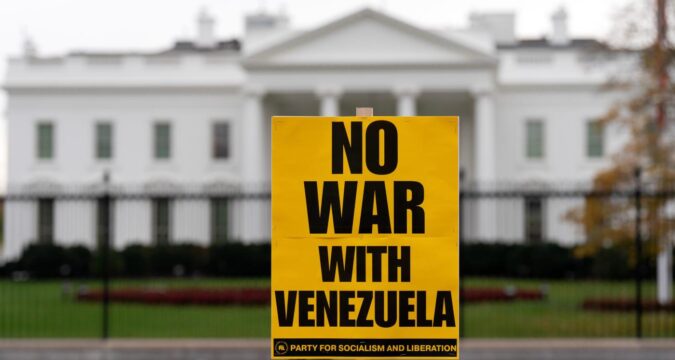
WASHINGTON (AP) — La Administración Federal de Aviación de Estados Unidos advirtió el viernes a todos los pilotos que “ejerzan precaución” al volar sobre Venezuela “debido al empeoramiento de la situación de seguridad y la creciente actividad militar” alrededor del país.
El mensaje indica que amenazas no especificadas “podrían representar un riesgo potencial para las aeronaves a todas las altitudes”, así como para los aviones que despegan y aterrizan en el país, e incluso para las aeronaves en tierra.
La advertencia se produce luego de que el gobierno de Estados Unidos ha intensificado la presión sobre el presidente venezolano Nicolás Maduro. El ejército estadounidense ha realizado vuelos de bombarderos hasta la costa de Venezuela, a veces como parte de un ejercicio de entrenamiento para simular un ataque, y ha enviado el portaaviones USS Gerald R. Ford a la región.
El portaaviones y varios destructores fueron la última adición al mayor despliegue naval de Estados Unidos en el mar Caribe cerca de Venezuela en generaciones. El gobierno de Trump no considera a Maduro, quien enfrenta cargos de narcoterrorismo en Estados Unidos, como el presidente legítimo del país sudamericano.
El ejército de Estados Unidos también ha atacado a pequeñas embarcaciones en el mar Caribe y el océano Pacífico a las que acusa de transportar drogas con rumbo a Estados Unidos, y ha matado a más de 80 personas desde que comenzó su campaña naval a principios de septiembre.
Mary Schiavo, ex inspectora general del Departamento de Transporte, afirmó que la FAA emite este tipo de aviso cada vez que hay un conflicto militar, pero espera que los pilotos presten atención.
“No lo tomaría necesariamente como que algún tipo de ataque es inminente, porque he visto que se emiten muchas veces antes. Pero como piloto, ciertamente lo tomaría en cuenta”, expresó Schiavo.
Schiavo señaló que Estados Unidos podría estar previendo una acción militar por parte de Venezuela o podría estar planeando acciones adicionales contra embarcaciones. Dijo que es difícil interpretar este aviso y saber qué hay detrás de él.
El Pentágono, al ser consultado sobre la nueva advertencia, remitió las preguntas a la FAA, que simplemente confirmó que la advertencia fue emitida y que duraría 90 días.
___
Esta historia fue traducida del inglés por un editor de AP con la ayuda de una herramienta de inteligencia artificial generativa.

Former Chicago Bulls player Zach LaVine sells Chicago condo for $6.4M
Former Chicago Bulls guard Zach LaVine, who played for the team for parts of eight seasons, on Friday took a loss on his three-bedroom, 4,500-square-foot condominium on the 28th floor of the building at 9 W. Walton Street, selling it for $6.4 million.
The 6-foot-5-inch LaVine, 30, played for UCLA before being drafted by the Minnesota Timberwolves. The Bulls traded for LaVine in 2017 in a deal that sent Jimmy Butler to the Timberwolves. In February, the Bulls traded LaVine to the Sacramento Kings.
Through an opaque land trust, LaVine paid $6.9 million in September 2022 to buy his 28th-floor unit from former Chicago Bears star linebacker Khalil Mack. LaVine first listed it in March for that same $6.9 million asking price, and went under contract to sell it in September.
The condo is a half-floor home that also has a 750-square-foot wraparound terrace with a hot tub and overhead heaters. Features include 3-1/2 bathrooms and a living room with custom millwork, O’Brien Harris shelving, a a 60-foot linear ventless fireplace framed in Iceland book matched porcelain. The condo’s kitchen has a 60-inch Wolf range, two full-size ovens, a steam oven, a warming drawer, a built-in Wolf coffeemaker, two full-size Gaggenau refrigerators, two Miele dishwashers and a 14-foot waterfall island made from Azul Imperial Quartzite.
Other features in the unit include heated stone hallways with inlaid runners, heated bathroom floors throughout and a primary bedroom suite with a sitting room, a built-in bar, a Sub-Zero beverage refrigerator and a primary bathroom with princess white quartzite counters, a towel-warming drawer, custom cabinetry, a dual shower with a TV and a rain shower, and a custom bathtub with a pop-up TV lift and a built-in champagne bucket.
Listing agent Nancy Tassone could not be immediately reached for comment. Jeffrey Lowe of Compass represented the buyer, whose name does not yet appear in public records.
The unit had a $119,590 property tax bill in the 2024 tax year. It also receives a $4,937-a-month bill for homeowners association dues, which is $59,244 a year in building assessments.
In addition to LaVine and, before him, Mack, other Chicago athletes who have owned in the building at 9 W. Walton have included former Chicago Blackhawks star Jonathan Toews, who sold a 29th-floor unit in 2019 for $6.95 million just one year after buying it; his teammate, former Blackhawks star Patrick Kane, who bought a 25th-floor unit in 2019 for $6.46 million; and former Chicago Cubs star Jason Heyward, who sold a 19th-floor unit in 2020 for $7.2 million. And other big names having owned in the building include billionaire Ken Griffin, who famously paid $58.75 million in 2017 for 9 W. Walton’s top four floors, and Gov. JB Pritzker, who late last year bought the top two floors from Griffin for $19 million.
Goldsborough is a freelance reporter.
https://www.chicagotribune.com/2025/11/21/chicago-bulls-zach-lavine-chicago-condo/

St. Charles man allegedly took over 400 unauthorized upskirt videos across western suburbs, police say
A St. Charles man allegedly took more than 400 unauthorized upskirt videos at locations across Chicago’s western suburbs from 2017 to 2025, according to the Geneva Police Department.
Jascent M. Harvey, 29, was arrested on Oct. 3 by Geneva police detectives, a news release from the department on Friday said, after an investigation found he allegedly used his phone to secretly record a video up a woman’s skirt at a Geneva store.
His phone was forensically searched, a review of which took several weeks, the news release said. Investigators said they ultimately uncovered more than 400 upskirt videos taken from 2017 to 2025, according to the release.
According to the Geneva Police Department, the locations at which the alleged recordings occurred include retail stores, banks and office buildings in Algonquin, DeKalb, Geneva, Elgin, Naperville, South Elgin, St. Charles and Wheaton; public libraries in Batavia, DeKalb, Elburn, Geneva, St. Charles, North Aurora, West Chicago, Sycamore and Wheaton; and government buildings in DeKalb, Elgin and Aurora.
Geneva police are asking women who may have interacted with Harvey and who believe they might have been recorded to email PDInvestigations@geneva.il.us.
Harvey has since been charged with one count of burglary and one count of unauthorized video recording of intimate parts, both felonies, the department said.
Harvey’s attorney did not immediately return a request for comment.
After his first court appearance on Oct. 4, Harvey was released with special conditions but no pretrial supervision, Kane County court records show. His next court date is set for Dec. 17.
Stop The Presses – And Start Telling The Truth About Bias
Stop The Presses – And Start Telling The Truth About Bias
Authored by John Tillman via RealClearPolitics,
Is a culture change coming to the news media?
So it might seem, now that Bari Weiss has been appointed editor-in-chief of CBS News. Another sign is Jeff Bezos’s decision to reorient the Washington Post’s opinion page. The hope is that both outlets will move away from their blatant far-left coverage, not only bringing in some right-leaning voices, but restoring some measure of objective journalism. Other outlets are wondering if they should follow suit.
Spoiler alert: It won’t work.
That’s not the kind of culture change the media needs. Instead of fighting bias, media outlets should admit their bias, and frankly, they should own their bias. That’s the only way to make the media honest – and it’s what Americans actually want.
Make no mistake: The media landscape in this country is broken. A miniscule 8% of Americans have strong trust in the media, according to Gallup. People can’t abandon legacy outlets fast enough. But they’re not fleeing because so many outlets are biased. Everyone knows they are, and for the record, they always have been. Most outlets are strongly biased toward to the left. A few are strongly biased toward the right. What Americans don’t like is that all these bias outlets pretend to be unbiased and objective.
Americans are reacting to the media’s hypocrisy. And notice where they’re heading. It’s not to some up-and-coming or diamond-in-the-rough “objective” news sites – those don’t exist. No, Americans are rushing to outlets that are brutally honest about their political biases.
In a sense, the media landscape is reverting to the mean. The whole concept of “objective journalism” was created in the 1920s and 30s, but before then, newspapers were proud of their biases and very public about it. They were explicitly affiliated with political parties, movements, ideologies, or even individual leaders. Virtually every media outlet advanced a party line – and Americans loved it. For the record, it also strengthened America, by contributing to the vigorous clash of ideas that defines our pluralistic experiment in self-government.
By contrast, supposedly “objective” media is a historical anomaly, and it makes a mockery of our vibrant democracy. It pretends like a small group of well-educated journalists have a corner on the truth – and the wisdom to tell truth from lies. Ultimately, it says that journalists can put aside their biases. But none of this is true. Journalists are human, and humans have opinions. We should test those opinions by clashing them against each other, not give the false impression that some opinions are really objective truth.
Alas, the legacy media is too bought in to the idea of objective journalism, even as journalists report in profoundly biased ways. It’s killing them. So, on Nov. 19, I’m launching a project that will tell Americans exactly how biased reporters are – and I believe it will help the media.
It’s called MediaPedia, and its centerpiece is a bias rating system for American journalists. We developed an artificial intelligence model that ranks how liberal or conservative reporters are, based on their coverage. The AI system looks at eight criteria, from the sources they use to the tone they take, then gives them a score. A score between 0 and -50 means a reporter is liberal. A score between 0 and +50 is conservative. For the record, my team is resisting our own biases by using an AI model. Unlike other ranking systems, we don’t want biased humans making biased calls.
MediaPedia will start by ranking journalists at five major legacy outlets: the Wall Street Journal, the New York Times, the Washington Post, the Associated Press, and Reuters. We have plans to add more outlets, including broadcast media and podcasts. Ultimately, we want to give Americans a window on as many journalists as possible, so they know exactly what angle the media’s coming from.
No doubt, some journalists will view MediaPedia as an attack, but it’s really an attempt to help them. Journalists should be honest about their biases, and it’s the only way to regain Americans’ trust. As counterintuitive as it seems, people are more willing to trust an openly biased reporter than a journalist who covers his bias under a cloak of objectivity.
At the end of the day, trust depends on honesty, and honesty is the real culture change that media needs. It’s not simply a matter of moving outlets in a different direction. What matters far more is admitting that every media outlet already has a direction – because America moves forward when the media is honest.
* * * Meanwhile, you can support ZeroHedge here
Tyler Durden
Fri, 11/21/2025 – 17:00
https://www.zerohedge.com/political/stop-presses-and-start-telling-truth-about-bias

‘Ripped from our community’: Transgender Day of Remembrance honors those who died by violence
In the past year, 367 transgender men and women around the globe lost their lives. They were tortured, beaten, strangled, burned alive or died by suicide.
Thursday night at Metropolitan Community Church Illiana in Portage, they were remembered during a ceremony honoring Transgender Day of Remembrance, where participants wove brightly colored strips of batik fabric into a loom, bringing together the threads of lives that were ripped apart.
The Rev. Michael Cooper, pastor at the church, said he has been holding the service for at least 14 years. Each year, the service includes a symbolic representation of the lives lost, which accompanies the recitation of their names and brief information about each victim.
Rev. Michael Cooper, of Metropolitan Community Church in Portage, holds strands of pink and blue fabric representing members of the transgender community who were lost over the past year, as a tapestry is woven to recognize Transgender Day of Remembrance on Thursday, November 20, 2025. (Kyle Telechan/for the Post-Tribune)
“The lives of our trans brothers and sisters were ripped from our community, so we are picking up those threads for healing and as a call for justice,” he said shortly before the service began.
The art created by the strips of fabric, he said, will be completed as a tapestry for the church’s worship space.
The Transgender Day of Remembrance, speakers at the program said, began after Rita Hester, a trans woman living in Boston, was murdered on Nov. 28, 1998, in her home. The Nov. 20 date of recognition started as a vigil by transgender advocate Gwendolyn Ann Smith to remember the people in the trans community who lost their lives to violence.
Charlotte Nowacki of Gary, who attended the service with her wife Trulie, said as a trans woman, commemorating the Transgender Day of Remembrance is an obligation to honor the people in the trans community whose lives were cut short.
She and others participating in the program noted the increased challenges for the trans community since the election of President Donald Trump and politicians on the state level, who have used the trans community as a political scapegoat while stripping away health care and other rights.
“A lot concerns me, really, with the current administration. I don’t know what’s going to happen next,” she said. “There’s a lot of uncertainty, but I try to stay positive about it.”
That, she said, includes limiting her time on social media and reading the news, and spending time with friends and her fellow parishioners at MCC.
Congregant Charlotte Nowacki reads off the names of members of the transgender community who were lost over the past year during an annual ceremony for Transgender Day of Remembrance at Metropolitan Community Church in Portage on Thursday, November 20, 2025. (Kyle Telechan/for the Post-Tribune)
Nowacki recited a prayer as the service began for its 20 or so participants, noting the daily struggles for those whose identities do not match up to how others demand they look or act.
“In times when those struggles meet the extreme of violent acts, in those times when those struggles crush the fragile soul of a vibrant life, our act of resistance, O God, our act of mending their loss is to gather in their memory, to speak their names, to let that painful last thread of their story be revealed,” she said.
Participating in the service never gets easier, and the list of names doesn’t get shorter, either, said Wendy Bruce of Portage, who has been involved with the event for seven years.
Metropolitan Community Church members weave pieces of blue and pink fabric, each representing one member of the transgender community who was lost in the past year, into a tapestry during an annual ceremony for Transgender Day of Remembrance at the Portage church on Thursday, November 20, 2025. (Kyle Telechan/for the Post-Tribune)
Bruce recently was in Indianapolis, lobbying Indiana Secretary of State Diego Morales to preserve the ability to change gender markers on driver’s licenses and state ID cards. The process now involves downloading a form from the Secretary of State’s website, having it signed by a medical provider, and bringing it to the Bureau of Motor Vehicles.
The state office, Bruce said, wants to ban the ability to make that change completely, which will only increase trans flight to other states.
“We’re being persecuted off the face of the earth. I’m trying to understand why. I don’t know,” she said. “I would say to the haters, are your NIPSCO bills going to be lower? Are your taxes any cheaper?”
In all, 35 transgender people in the United States lost their lives in the past year, Bruce said, including a woman who was recently killed in Indianapolis.
“We’re honoring the people who were attacked simply for who they are,” she said.
Rev. Michael Cooper of Metropolitan Community Church, on left, joins congregants to weave a tapestry in memory of members of the transgender community lost over the past year during an event to recognize Transgender Day of Remembrance at the Portage church on Thursday, November 20, 2025. (Kyle Telechan/for the Post-Tribune)
This year has been one of increasing pressure for the LGBTQ community, particularly for trans brothers and sisters, said church member Steve Dyke, who provided the welcome as the service began.
Trans rights, Dyke said, are being “ripped from the tapestry of the American dream,” pursuits that are being undermined by extremism and closed borders for those seeking asylum from transphobia and anti-trans violence in their countries of birth.
“This is our night to remember those whose last vision of this world was one of fear, hate and violence,” Dyke said. “Tonight we seek to create the thread that darns the brokenness left in our community this past year and that begins the new tapestry of our justice work and caring work for the coming year.”
alavalley@chicagotribune.com

Arizona State commit Justin Warlow, Lockport’s three-time state runner-up, looks to next step. ‘A new journey.’
Justin Wardlow has had a career full of success at Lockport. He’s also had more than his fair share of heartbreak.
As a freshman, Wardlow advanced to the state championship match but was injured in the semifinal and could not compete. The last two seasons, he’s lost in the finals. The three-time state runner-up actually faced the same result four years in a row, also placing second in eighth grade.
Wardlow, a senior 150-pounder, is hoping that not stressing about the final result will lead to a different outcome this season.
“I was talking to my college coach and my club coach about a new journey of Justin Wardlow,” he said. “I want to constantly have fun, wrestle fearlessly and go score as many points as possible.
“If that includes me winning state, that’s going to come. That’s always the goal, but I don’t want to put all my emphasis on it.”
Wardlow, an Arizona State recruit, has a chance to join his Lockport coach, Jameson Oster, as the only Porters to win four state medals in the history of the boys wrestling program. Senior Claudia Heeney has the opportunity to do the same thing on the girls side this season at Lockport.
Senior Justin Wardlow, a three-time state runner-up, poses in front of the wall honoring past Lockport greats before a practice at Lockport on Monday, Nov. 17, 2025. (Steve Millar / Daily Southtown)
Wardlow is constantly setting a lofty standard for the rest of the Porters, according to fellow senior Anthony Sutton.
“It’s motivating being friends with him,” Sutton said. “He pushes you on and off the mat. He’s an inspiration to everyone in the room and he makes all of us work harder.”
Last season, Wardlow went 45-4 and rolled into the state championship match in dominating fashion. In the finals, though, he was upset 1-0 by Joliet West’s Carson Weber, who Wardlow had beaten twice earlier in the postseason.
Oster confirmed that Wardlow took the loss in stride, not letting the heartbreak overwhelm him.
Lockport’s Justin Wardlow, front, escapes from Marmion’s Zach Stewart in the 138-pound final pound of the Class 3A state meet at the State Farm Center in Champaign on Saturday, Feb. 17, 2024. (Vincent D. Johnson / Daily Southtown)
“He’s always been a mature kid,” Oster said. “He usually deals with losses well. He’s pretty analytical when it comes to wrestling. He’s always going back and watching film and breaking down what he could have done better.”
Wardlow and his coaches have seen him struggle to kick into full gear in championship matches, perhaps tensing up in the big moment.
“We’re focusing not as much on technical changes but mental tactics,” Oster said. “He had beaten the kid he lost to last year multiple times, so I don’t think it was a matter of skill.
“I don’t know if he put too much pressure on himself or what, but he’s got to go out there and act like it’s any other match. That’s the game plan.”
Lockport’s Justin Wardlow, left, wrestles against Andrew’s Trevor Silzer during the Class 3A Lockport Regional on Saturday, Feb. 4, 2023. (Steve Johnson / Daily Southtown
Wardlow is embracing that mindset. With his college plans secured and a lengthy resume of high school accomplishments in hand, Wardlow now has the belief that one match won’t define him.
“I’m always hungry to constantly improve and get better,” he said. “This year, more importantly, I’m not putting all that stress on myself and all the focus on winning or losing, especially at state.
“It’s all about getting better and having fun. I don’t want to focus too much on the outcome.”
Next year, Wardlow will live out a dream by competing for a major Division I program.
“I can’t wait to wrestle in college and get my degree,” Wardlow said. “It’s like the night before Christmas. You just keep building up to that time when you’re going to do down there and it’s going to be a blast.”
First, there’s one more chance for him to end a high school season with tears of joy rather than heartbreak.
“For me to win state this year, it would mean a lot,” Wardlow said. “It would be a nice little checked box going out of high school. That’d be awesome.”
https://www.chicagotribune.com/2025/11/21/justin-wardlow-lockport-ihsa-boys-wrestling-arizona-state/

Trump y Mamdani se reúnen en la Casa Blancal y afirman que ambos se preocupan por la asequibilidad
Por MICHELLE L. PRICE
WASHINGTON (AP) — El presidente de Estados Unidos, Donald Trump, ha calificado al alcalde electo de la ciudad de Nueva York, Zohran Mamdani, como un “lunático comunista al 100%” y un “completo chiflado”. Mamdani ha llamado al gobierno de Trump “autoritario”, y se ha descrito a sí mismo como “la peor pesadilla de Donald Trump”.
Sin embargo, su primer encuentro el viernes en la Casa Blanca se centró más en sus objetivos compartidos que en sus diferencias explosivas. Discutieron sobre la asequibilidad de la vivienda y el costo de los alimentos y los servicios públicos, luego de que Mamdani utilizara con éxito la frustración por la inflación para ganar las elecciones, al igual que lo hizo Trump en los comicios de 2024.
“Vamos a ayudarlo, para que el sueño de todos se haga realidad, tener una Nueva York fuerte y muy segura”, dijo el presidente a los periodistas con Mamdani a su lado en el Despacho Oval.
“Lo que realmente aprecio del presidente es que la reunión que tuvimos no se centró en los puntos de desacuerdo, que son muchos, sino también en el propósito compartido que tenemos de servir a los neoyorquinos”, expresó Mamdani.
El presidente restó importancia a las críticas de Mamdani sobre sus redadas migratorias y a las afirmaciones de que Trump se comportaba como un déspota. En cambio, Trump dijo que la responsabilidad de ocupar un cargo ejecutivo en el gobierno hace que una persona cambie, diciendo que ese había sido su caso.
“Creo que va a sorprender a algunas personas conservadoras, de hecho”, dijo Trump, quien luego pareció no molestarse mucho cuando los periodistas le pidieron a Mamdani que aclarara sus declaraciones pasadas en las que indicó que pensaba que el presidente actuaba como un fascista.
Mamdani, un socialdemócrata que asumirá el cargo en enero, dijo que buscó la reunión con Trump para hablar sobre formas de hacer que la Ciudad de Nueva York sea más asequible. Trump ha dicho que podría querer ayudarlo, aunque también ha etiquetado falsamente a Mamdani como “comunista” y ha amenazado con retirar fondos federales a su ciudad natal.
Para Mamdani, una reunión con el presidente de Estados Unidos le brindó la oportunidad de estar cara a cara con la persona más poderosa del mundo.
La reunión le dio a Trump una oportunidad para hablar sobre la asequibilidad en un momento en que está bajo una creciente presión política para demostrar que está atendiendo las preocupaciones de los votantes sobre el costo de vida.
“Algunas de sus ideas son realmente las mismas ideas que tengo”, dijo el presidente sobre Mamdani en relación con los problemas inflacionarios. ___
Los periodistas de The Associated Press Aamer Madhani en Washington y Anthony Izaguirre en Nueva York contribuyeron a este despacho.
___
Esta historia fue traducida del inglés por un editor de AP con la ayuda de una herramienta de inteligencia artificial generativa.

Residents in Lake Bluff and Lake Forest likely to see higher property taxes with levy increases
Lake Forest and Lake Bluff residents will face higher property taxes next year, with local governments set to increase their respective levies.
The Lake Forest City Council voted for initial approval of a 4.51 % property tax increase at its Nov. 17 meeting. Finance Director Katie Skibbe said the increase would amount to about $165 on a $1 million home.
Skibbe said the city levies not only for itself but also for the Lake Forest Public Library, with the city representing about 22% of the total property tax bill and the library accounting for another 3%.
Separately, the City Council approved a series of fee increases for next year, mostly affecting the Deerpath Golf Course, parks and recreation services, and the use of Lake Forest police officers for private event security. Final approval is expected at the council’s Dec. 1 meeting.
In Lake Bluff, the village’s portion of the property tax levy is expected to rise nearly 3.3 %. That would result in an approximate $134 increase on an $850,000 home, according to Village Finance Director Bettina O’Connell.
The first reading of the levy increase is scheduled for the Nov. 24th board meeting.
(Like Lake Forest, the village also issues the levy for the public library.)
The village represents about 9 % of the overall Lake Bluff property tax bill, O’Connell said. While there are no current plans for additional fee increases, a water rate hike is still under consideration.
Also set to set their levy amounts in December include the Lake Bluff Park District, the three local public school districts, and the Lake Bluff Library.
Daniel I. Dorfman is a freelance reporter for Pioneer Press.
https://www.chicagotribune.com/2025/11/21/lake-bluff-lake-forest-tax-levies/