Category: News

The Uproar Over 4 Dollar Fries Shows Just How Severely America’s Standard Of Living Has Eroded
The Uproar Over 4 Dollar Fries Shows Just How Severely America’s Standard Of Living Has Eroded
Authored by Michael Snyder via The Economic Collapse blog,
Once upon a time potatoes were what the poorest people in society would eat because they were so inexpensive. But now we are being charged an average of $4.19 for a carton of medium fries at McDonald’s. There are many that are very upset about the rapidly rising cost of fries, and this is yet another example that shows that our standard of living is being absolutely shredded. As costs rise, the labor market just continues to get even weaker. So we are being hit with much higher prices at the same time that paychecks are stagnating and mass layoffs are occurring all over the nation. So what is going to happen to our standard of living if these trends continue to intensify during the months ahead?
By about a two to one margin, middle-income Americans feel like their financial situations have gotten worse over the past year…
The University of Michigan’s consumer sentiment survey showed that 44% of middle-income respondents said their financial situation was worse than it was a year ago, while 23% said it was better, based on a three-month average ending in September. Those who feel worse off overwhelmingly said it was because of higher prices.
Federal bureaucrats continue to insist that inflation is low, but everyone can see that is simply not true.
Compared to the year just prior to the pandemic, so many of the things that Americans regularly spend money on have gone up dramatically.
During a recent segment on Fox Business, viewers were shown how much some of the most popular menu items at McDonald’s increased in price from 2019 to 2024…
McDonald’s Price Increases from 2019 to 2024:
Medium French Fry $1.79 -> $4.19
McChicken $1.29 -> $3.89
Big Mac $3.99 -> $7.49
10 McNuggets $4.49 -> $7.58
Cheeseburger $1.00 -> $3.15
Some of this is over a 200% increase in price. This isn’t inflation — it’s legalized robbery.
$4.19 for a carton of medium fries is obscene!
For years, many of us warned that the very foolish decisions that our leaders were making would lead to very painful inflation.
Needless to say, that is precisely what happened.
A cheeseburger at McDonald’s is now more than three times as expensive as it was in 2019.
How are young families supposed to afford that?
How is anyone supposed to afford that?
We have never seen the price of cheeseburgers go up so rapidly.
Not even during the Carter administration did we see this sort of “burger inflation”.
Unfortunately, this is just the beginning, because the size of the U.S. cattle herd has dropped to the lowest level in about 75 years…
Tyson Foods will close a major beef plant in Lexington, Nebraska, with about 3,200 employees in January after U.S. cattle supplies dropped to their lowest level in nearly 75 years, the meatpacker said on Friday.
The closure in the heart of cattle-feeding country signaled that supplies will remain tight, forcing meatpackers to pay steep prices for cattle to process into steaks and hamburgers.
You may think that you will just switch to turkey.
Well, the price of a frozen turkey is 40 percent higher than it was last year…
The USDA recently projected that wholesale prices for frozen whole turkey hens will reach $1.32 per pound in 2025. That’s a 40 percent increase from 2024’s price of 94 cents per pound.
“The 2025 rise in price is a response to lower production with HPAI pressures combined with steady demand,” according to a report from the American Farm Bureau Federation.
When talking heads on television tell us that “inflation is low”, I just want to scream.
Since 2019, the annual income needed to afford a median-priced home in rural U.S. counties has more than doubled…
Homeowners need an annual income of $74,508 to afford a median-priced home in rural U.S. counties, up a staggering 105.8% from before the COVID-19 pandemic. Prior to the pandemic, rural buyers only needed to earn $36,206, according to Redfin’s analysis, which compares the third quarter of 2025 with the third quarter of 2019.
The income needed to afford a median-priced home in suburban counties rose 90.9% to $102,120 during that same period. Previously, potential buyers only needed an annual salary of $53,482. The income needed to afford a home in urban counties climbed 87.5% to $118,300. Buyers needed an annual salary of $63,103 prior to the pandemic.
Take a close look at those numbers again.
They are completely and utterly outrageous.
Let me ask you a question.
Has your income doubled since 2019?
If not, you are falling behind.
Vehicle prices have soared into unprecedented territory too…
Car prices are trending up and the average cost of a new car is at an all-time high, approaching the $50,000 mark for the first time.
The average transaction price for a new vehicle in October was $49,105, according to data from Edmunds.
In the old days, you could buy an entire house for $50,000.
But now thanks to the widespread adoption of “planned obsolescence”, $50,000 will just get you a “new vehicle” that has been designed to start breaking down shortly after the warranty expires.
Meanwhile, the employment market just keeps getting weaker and weaker.
At this point even the government is admitting that the unemployment rate just reached the highest level that we have seen since the early days of the last pandemic.
Young people are being hit particularly hard, and we are being told that this is the toughest market for college graduates in a very long time…
Rising youth unemployment could be an “early indicator that the economy is slowing down or maybe even heading towards a recession,” said Anders Humlum, assistant professor of economics at the University of Chicago.
A college degree is often considered the best pathway to a well-paying job, but that may no longer be as true as it once was, experts say.
“For the first time in modern history, a bachelor’s degree is no longer a reliable path to professional employment,” Gad Levanon, chief economist at the Burning Glass Institute, told CNBC.
I feel very badly for college graduates that are searching for work in this very tough environment.
In fact, I feel very badly for anyone that is searching for work in this very tough environment.
Nobody can deny that economic activity is slowing down all around us…
There are not as many goods moving around the country. Ship counts from Asia to the US are down roughly 30% from last year. Railcar loadings are down roughly 6% against last year. The trucking industry also continues to see shrinking capacity. If there are fewer things to move around the country, then the industry will likewise need fewer drivers, loaders, and various workers. Idle trains and empty containers don’t need a lot of people to mind them.
When less stuff is being moved around the country, that means that the economy is slowing down.
We can all feel it.
Looking ahead, an alarmingly high percentage of Americans are convinced that they will be even worse off next year…
A report by Primerica found that in the third quarter of 2025, just 21% of middle-income Americans believe they’ll be better off financially in the next year, while 34% believe they’ll be worse off and 33% expect their situation to remain the same.
Those figures are notably more pessimistic than the firm’s data from the third quarter of 2020 showed, when 33% of middle-income Americans thought they would be better off financially in the next year versus just 17% who thought they would be worse off and 40% expected they would be about the same.
The mood of the entire country has changed dramatically.
I have heard from so many people that have cut back everywhere that they can, but it still isn’t enough.
Even many households that are bringing in six figure incomes have shifted into survival mode…
The effort to keep up with higher prices feels relentless to Teri Kopp, who lives in Southbury, Conn., and works as an administrator at a synagogue. “I’m tired,” she said.
Kopp and her husband Bill, an HVAC technician, earn a combined $115,000 a year. They often sit in the dark with only strings of LED lights on to save on electric costs. She is considering painting rocks to send to friends as Christmas gifts. Their biggest vacation this year, a road trip to Maine, was mostly covered by cash back from a shopping-rewards program.
Kopp, 59 years old, doesn’t see any way to quickly pay off the $15,000 in credit-card debt the family took on largely to cover medical bills for knee surgeries. She also has $30,000 in debt from her daughter’s undergraduate degree in biology, which has yet to yield any job offers in a tough labor market for new graduates.
It took a long time for us to get here.
We borrowed and spent tens of trillions of dollars that we did not have, and the Federal Reserve just kept shoveling more cash into the financial system.
As a result, the cost of living is out of control and our system is reaching a breaking point.
Our leaders kept kicking the can down the road, but in the process they kept making our long-term problems even worse.
Now a carton of medium fries is more than 4 dollars, and America’s middle class is being systematically destroyed.
Michael’s new book entitled “10 Prophetic Events That Are Coming Next” is available in paperback and for the Kindle on Amazon.com, and you can subscribe to his Substack newsletter at michaeltsnyder.substack.com.
Tyler Durden
Tue, 11/25/2025 – 12:50

Productos de compañía de fórmula para bebés podrían estar contaminados con bacteria del botulismo
Por JONEL ALECCIA
Pruebas de la fórmula infantil de ByHeart relacionadas con un brote de botulismo que ha enfermado a docenas de bebés mostraron que todos los productos de la compañía podrían haber estado contaminados.
Pruebas de laboratorio de 36 muestras de fórmula de tres lotes diferentes mostraron que cinco muestras contenían el tipo de bacteria que puede llevar a la rara y potencialmente mortal enfermedad, avisó la compañía el lunes en su sitio web.
“Basándonos en estos resultados, no podemos descartar el riesgo de que toda la fórmula de ByHeart de todos los lotes de productos pueda haber estado contaminada”, escribió la compañía.
Al menos 31 bebés en 15 estados que consumieron la fórmula de ByHeart han enfermado en el brote que comenzó en agosto, según funcionarios de salud federales y estatales. Además, otros bebés que bebieron fórmula ByHeart fueron tratados por botulismo en meses anteriores, desde noviembre de 2024, aunque no se cuentan en el brote, declararon los funcionarios.
El Clostridium botulinum tipo A, el tipo de bacteria detectada, puede estar distribuido de manera desigual en la fórmula en polvo. No todos los bebés que lo ingieren se enfermarán, aunque todos los menores de 1 año están en riesgo, según expertos médicos.
ByHeart retiró toda su fórmula a nivel nacional el 11 de noviembre. Sin embargo, algunos productos han permanecido en los estantes a pesar del retiro, según funcionarios estatales y la Administración de Alimentos y Medicamentos (FDA).
Los padres y cuidadores deben dejar de alimentar a los bebés con la fórmula de inmediato y monitorear a los niños en busca de síntomas, que pueden tardar hasta 30 días en aparecer.
El botulismo infantil ocurre cuando los bebés ingieren esporas que germinan en su intestino y producen una toxina. Los síntomas incluyen estreñimiento, dificultad para succionar o alimentarse, párpados caídos, expresión facial plana y debilidad en los brazos, piernas y cabeza. La enfermedad es una emergencia médica y requiere tratamiento inmediato.
Al menos 107 bebés en todo el país han sido tratados por botulismo con un medicamento intravenoso conocido como BabyBIG desde el 1 de agosto, indicaron funcionarios de salud. En un año típico, menos de 200 bebés son tratados por la enfermedad.
Para reportar una enfermedad relacionada con el brote, contacte a la FDA o complete un formulario en línea de MedWatch.
Los consumidores que compraron ByHeart en el sitio web de la compañía a partir del 1 de agosto pueden recibir un reembolso completo, una expansión de su política anterior, dijo la compañía.
___________________________________
The Associated Press recibe apoyo para sus coberturas de salud y ciencia de parte del Departamento de Educación Científica del Instituto Médico Howard Hughes y la Robert Wood Johnson Foundation. La AP es la única responsable del contenido.
___________________________________
Esta historia fue traducida del inglés por un editor de AP con ayuda de una herramienta de inteligencia artificial generativa.

Cada vez menos personas buscan ayuda para la adicción a la marihuana en EEUU, revela estudio
Por LAURA UNGAR
Megan Feller fumaba marihuana varias veces al día y no podía comer, dormir ni funcionar sin ella. Pero en ese momento, no veía la necesidad de buscar ayuda.
“No pensaba que el cannabis fuera un gran problema”, afirmó la joven de 24 años. “Era algo socialmente aceptado”.
Esta actitud es común. En Estados Unidos, cada vez más estados legalizan la marihuana, por lo que su uso se ha normalizado y los productos se han vuelto más potentes. Pero hay menos personas adictas que buscan ayuda para ello.
En los últimos años, el uso de marihuana entre los adultos jóvenes alcanzó niveles históricos, según una encuesta respaldada por el gobierno federal. El uso diario incluso superó al consumo diario de alcohol: casi 18 millones de estadounidenses informaron en 2022 que usan marihuana diariamente o casi, en comparación con menos de 1 millón hace tres décadas.
Los estudios muestran un aumento proporcional en el trastorno por uso de cannabis, cuando las personas ansían consumir marihuana y pasan mucho tiempo usándola, a pesar de que ello les provoca problemas en el hogar, la escuela, el trabajo o en las relaciones. Es una condición que, según los investigadores, afecta a aproximadamente tres de cada 10 usuarios de marihuana y puede ser leve, moderada o severa.
Y se trata de una adicción, a pesar de la idea común, pero errónea, de que no es posible volverse adicto a la marihuana, señaló la doctora Smita Das, psiquiatra de adicciones de la Universidad de Stanford.
Mientras tanto, la aceptación generalizada de la droga ha alimentado un estigma sobre buscar tratamiento, afirmó la doctora Jennifer Exo de la Fundación Hazelden Betty Ford en Minnesota.
“Existe la creencia generalizada de que no puedes volverte adicto, de que en realidad no puede ser un problema”, comentó. “Tiene que ver con este mito de que el cannabis es seguro, natural e inofensivo”.
Marihuana más fuerte, problemas más grandes
Aunque la marihuana no es tan dañina como las drogas más duras, su uso frecuente o intensivo se ha vinculado a problemas con el aprendizaje, la memoria y la atención, así como a náusea crónica, vómitos y problemas pulmonares entre quienes la fuman. Algunas evidencias también la han vinculado a un inicio más temprano de la psicosis en personas con factores de riesgo genéticos para trastornos psicóticos como la esquizofrenia.
Y la marihuana de hoy no es la misma que la del pasado.
Muchas personas recuerdan a parientes mayores que “fumaban unos porros, comían algo y se dormían”, dijo Exo. “Pero es algo absolutamente diferente”.
En la década de 1960, la mayoría de la marihuana que la gente fumaba contenía menos del 5% de THC, el ingrediente que causa el efecto psicoactivo. Hoy en día, la potencia de THC en la hoja de cannabis y los concentrados que se venden en dispensarios puede alcanzar el 40% o más, según el Instituto Nacional sobre el Abuso de las Drogas.
En muchos casos, los adolescentes vapean potentes concentrados de marihuana, comentó Exo, en lugar de comer brownies hechos con hoja de cannabis o dar una calada a una pipa de agua.
Más acceso a la marihuana, aumento de visitas a urgencias
La marihuana también es cada vez más accesible. Aunque su posesión sigue siendo un delito federal, 24 estados permiten el uso recreativo por parte de adultos y, hasta finales de junio, en 40 se permitía el uso médico, según la Conferencia Nacional de Legislaturas Estatales. Los dispensarios abundan y más personas pueden tener marihuana en casa.
La investigación vincula la legalización de la marihuana recreativa con el aumento de visitas a urgencias por “intoxicación aguda por cannabis”, en la que los pacientes pueden experimentar un ritmo cardíaco acelerado o sentirse mareados, confundidos o paranoicos.
En un estudio realizado el año pasado y centrado en Michigan se encontró que la legalización se vinculó con un aumento inmediato en la tasa de visitas a urgencias por esta condición entre personas de todas las edades, especialmente adultos de mediana edad.
Das comentó que el mayor acceso al cannabis, junto con un número creciente de productos derivados de la planta y que cuentan con mayor potencia, contribuyen al aumento de visitas a urgencias. Los comestibles como las gomitas pueden plantear un problema particular porque tardan un poco en hacer efecto, por lo que las personas pueden consumir más porque aún no sienten los efectos de la droga.
“Entonces, de repente, sufren de toxicidad por cannabis”, señaló.
Por qué suele pasarse por alto el tratamiento
Feller probó la marihuana por primera vez a los 16 años y rápidamente pasó de fumar la planta a usar cartuchos de vapeo que eran fáciles de esconder en su bolsillo. En poco tiempo, apenas podía vivir sin ella.
“Durante años, me despertaba cada mañana, y hasta que fumaba marihuana, vomitaba”, dijo. En lugar de intentar drogarse, la usaba “para hacer que estos otros síntomas desaparecieran”.
Feller también bebía mucho y sus padres la enviaron a un centro de tratamiento cuando tenía alrededor de 18 años. No le fue útil porque no estaba lista para mejorar. Su consumo de sustancias empeoró tras la muerte de su madre.
A los 22 años, Feller ingresó a Hazelden por su cuenta, pero solo para dejar el alcohol, lo cual logró.
Siguió usando marihuana de forma intermitente, luego buscó tratamiento para el trastorno por uso de cannabis y se ha mantenido sobria de la marihuana durante casi un año.
“Ahora soy mucho más feliz”, dijo. “No me siento encadenada a una sustancia”.
Este tipo de tratamiento a menudo se pasa por alto, comentó Brian Graves, investigador en la Universidad Atlántica de Florida.
Él y sus colegas publicaron un estudio este año que muestra que la proporción de personas de su muestra representativa a escala nacional que recibieron tratamiento para el trastorno por uso de cannabis disminuyó del 19% en 2003 al 13% en 2019. En un estudio anterior también se encontró una marcada disminución y se señalaron razones como “la expansión de la legalización del cannabis y actitudes más tolerantes”.
Los expertos afirman que las personas deben saber que, al igual que el alcohol, la marihuana puede ser mal utilizada y causar un daño real.
“Otro aspecto importante es ayudar a las personas a entender el riesgo antes de comenzar”, comentó Exo, “y luego, a sentirse lo suficientemente seguras para decir: ‘Oye, necesito ayuda para manejar esto’”.
Muchas personas esperan hasta que su uso de marihuana cause problemas en distintos aspectos de sus vidas antes de buscar tratamiento, si es que alguna vez lo hacen.
“Si estás cambiando tu vida por la marihuana, podría haber un problema”, añadió Feller. “Hay recursos para obtener ayuda y no estás solo”.
___
El Departamento de Salud y Ciencia de The Associated Press recibe apoyo del Departamento de Educación Científica del Instituto Médico Howard Hughes y de la Fundación Robert Wood Johnson. La AP es la única responsable de todo el contenido.
___
Esta historia fue traducida del inglés por un editor de AP con la ayuda de una herramienta de inteligencia artificial generativa.

Expulsión insólita: Gueye se une a Zidane, Simunic y Hazard tras golpear a su compañero
Por STEVE DOUGLAS
MANCHESTER, Inglaterra (AP) — La expulsión de Idrissa Gueye del Everton por abofetear a su compañero de equipo en la cara durante un partido de la Liga Premier se une a la lista de las tarjetas rojas más extrañas del fútbol.
Aquí hay algunas otras:
El cabezazo de Zidane
Probablemente la tarjeta roja más famosa en el fútbol ocurrió en una final de la Copa del Mundo y con uno de los mejores jugadores de todos los tiempos.
Fue durante el tiempo extra en el partido por el título de 2006 entre Francia e Italia cuando la estrella francesa Zinedine Zidane recibió algunos insultos del oponente Marco Materazzi. Zidane se giró hacia Materazzi, se acercó y le dio un cabezazo en la parte superior del pecho al defensor italiano, derribándolo al suelo. El incidente aparentemente fue pasado por alto por el árbitro en el campo, pero después de unos minutos de confusión —durante los cuales el cuarto árbitro podría haber visto una repetición en un monitor de televisión— Zidane recibió una tarjeta roja en el que fue el último encuentro de su carrera. Francia terminó perdiendo la final en penales.
Desde entonces, se ha especulado durante mucho tiempo que fue la primera revisión de video —no oficial—, más de una década antes de la introducción del sistema VAR antes de la Copa del Mundo de 2018.
Tres tarjetas amarillas
La tarjeta roja del defensa central croata Josip Simunic en la misma Copa del Mundo de 2006 fue menos espectacular, pero generó muchas dudas.
Durante un salvaje empate 2-2 entre Croacia y Australia, El árbitro Graham Poll le dio una segunda tarjeta amarilla a Simunic a los 90 minutos. Sin embargo, Poll no sacó inmediatamente la roja y el juego continuó, solo para que Simunic recibiera otra amonestación, por disentir, después del pitido final y finalmente recibir una roja. Simunic parecía desconcertado y Poll no arbitró en otro partido de ese torneo.
Más tarde dijo que pensó que había mostrado la segunda tarjeta amarilla a un jugador de Australia y no a Simunic, quien nació en Australia y hablaba con acento australiano.
Hazard y el recogepelota
Eden Hazard era mejor conocido por sus carreras zigzagueantes durante su tiempo lleno de trofeos en el Chelsea de 2012 a 2019, pero también hubo una tarjeta roja inusual en ese período.
En un partido de la Copa de la Liga Inglesa en 2013, el Chelsea necesitaba dos goles tardíos contra el Swansea cuando el balón salió de juego y quedó en posesión de un recogepelotas, quien cubrió el balón con su cuerpo mientras Hazard se acercaba. En un intento por recuperar el balón, Hazard inicialmente intentó agarrarlo con las manos, pero luego apuntó una patada bajo el cuerpo del recogepelotas. El chico se retorció de dolor, sosteniendo sus costillas e incluso quejándose al árbitro. Si Hazard conectó con el balón o con las costillas del recogepelotas no importó: fue expulsado. No se tomó ninguna acción contra Hazard después de que el chico fue entrevistado por la policía.
Identidad equivocada
No fue solo el marcador de 6-0 lo que proporcionó el elemento ridículo a la contundente derrota del Arsenal ante el Chelsea en 2014 en la Liga Premier. A los 14 minutos, el mediocampista del Arsenal Alex Oxlade-Chamberlain manejó descaradamente el balón en el área de penal mientras hacía una salvada en picado para desviar un disparo de Eden Hazard. Oxlade-Chamberlain escapó de cualquier sanción, pero solo porque el árbitro Andre Marriner eligió en su lugar mostrar la tarjeta roja al defensor Kieran Gibbs. Se vio a Oxlade-Chamberlain diciendo “fui yo” a Marriner, pero el árbitro ignoró las protestas, mientras que sus asistentes tampoco detectaron el error. Marriner admitió más tarde, a través de un comunicado, haber cometido un error.
Pelea en Newcastle
La confrontación entre Gueye y Keane no fue nada comparada con la pelea entre los entonces compañeros de equipo del Newcastle Lee Bowyer y Kieron Dyer durante un partido de la Liga Premier contra el Aston Villa en 2005. La pareja se enfrentó lejos del balón, se agarraron del cuello y comenzaron a lanzarse puñetazos al final del complemento. Se necesitó la intervención de otros jugadores del Newcastle y del mediocampista del Villa Gareth Barry para que Bowyer y Dyer fueran separados. Ambos recibieron tarjetas rojas y eso redujo al Newcastle a ocho jugadores, porque el equipo ya había tenido un hombre expulsado.
___
Deportes AP: https://apnews.com/hub/deportes

Stocks Hit Session Highs On Report Hassett Emerges As Trump’s Next Fed Chair Pick
Stocks Hit Session Highs On Report Hassett Emerges As Trump’s Next Fed Chair Pick
White House National Economic Council Director Kevin Hassett is the front runner to succeed Fed Chair Powell, according to Bloomberg, citing people familiar with the matter. Speaking on CNBC earlier, Treasury Secretary Bessent said that President Trump could announce his choice before Christmas.
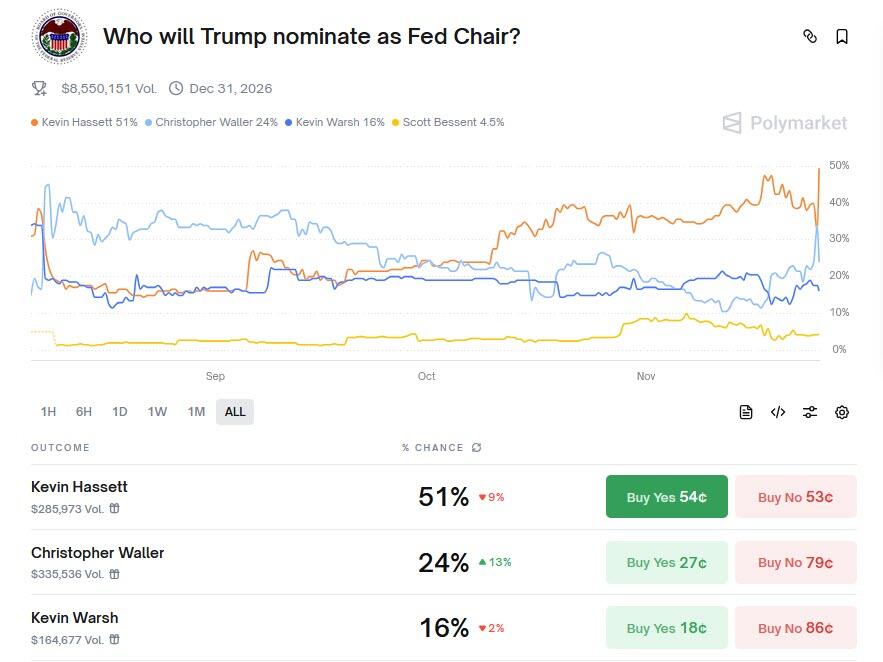
The pick could very well be a trial balloon: for a long time the frontrunner was viewed as Fed governor Chris Waller, although his odds faded in recent weeks, amid speculation that Hassett was Trump’s favorite, and sure enough, Hassett’s odds spiked to a contract high 50% on Polymarket.
With Hassett, Trump would have a close ally whom the president knows well and trusts installed at the central bank, the BBG sources – who may well be leaking information at Trump’s behest – said.
“Hassett is seen as someone who would bring the president’s approach to interest rate cutting to the Fed, which Trump has long wanted to control”, Bloomberg reported, citing sources.
Hassett is also closely aligned to Trump’s view on the economy, including that interest rates need to be lowered. He told Fox News on Nov. 20 that he would “be cutting rates right now” if he were the chair of the Fed because “the data suggests that we should.” Hassett has also criticized the central bank for losing control of inflation in the wake of the pandemic.
The Fed has repeatedly served as a punching bag for Trump, with the president lambasting Powell for being “too late” to cut borrowing costs and publicly musing about firing him. The president has also assailed renovations on the central bank’s campus and the White House is currently engaged in litigation over Trump’s attempted dismissal of Fed Governor Lisa Cook.
That’s put pressure on Treasury Secretary Scott Bessent, who is leading the selection process for the next Fed chair, to carefully balance candidates who are in favor of slashing borrowing costs and have the trust of both the president and financial markets.
Since the summer, Bessent has run the selection process to replace Powell, interviewing nearly a dozen candidates that have now been whittled down to five contenders: Hassett, Warsh, Waller, Fed Vice Chair for Supervision Michelle Bowman and BlackRock’s Rick Rieder.
Bessent said interviews with those candidates will end this week. A smaller subset of finalists will soon meet with White House Chief of Staff Susie Wiles and Vice President JD Vance.
Still, Trump is known to make surprise personnel and policy decisions, meaning a nomination is not final until it’s made public, and as anything Trump, there is a substantial chance of a major surprise when the announcement arrives.
The next chair is likely to be named to a 14-year Fed governor term that opens on Feb. 1. The term that expires at that time is currently held by Stephen Miran, who is on unpaid leave from the White House Council of Economic Advisers. Powell’s term as chair of the central bank ends in May 2026, though he could remain on the board for two more years as a governor.
The BBG report that a dovish replacement is coming helped push stocks to session highs…
… and sent 10Y yields below 10%, in a steepening move that send short-end yields even lower.
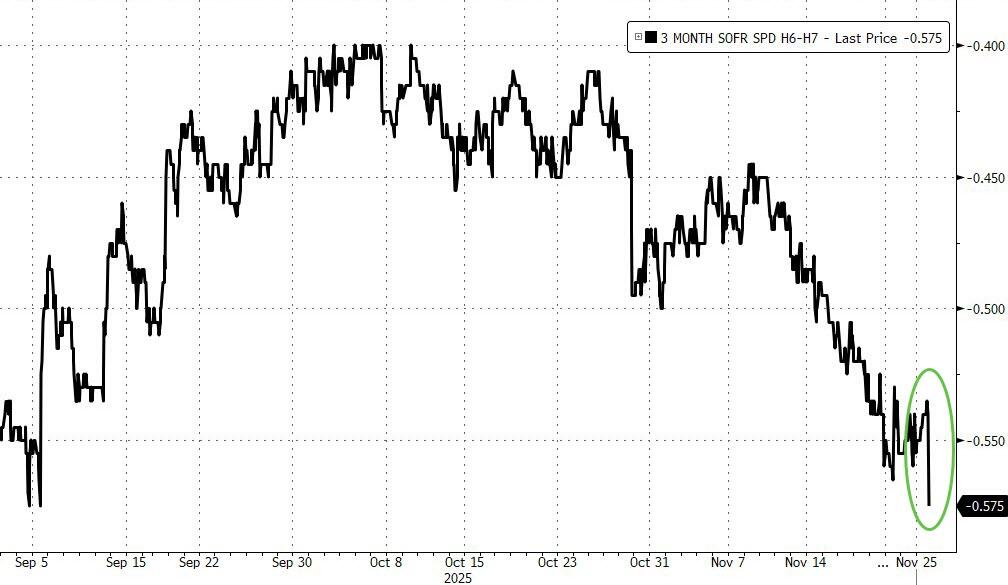
Additionally, BBG notes that spread sellers in SOFR have also emerged, with notable interest in the March 2026/March 2027 12-month spread, covering the year after Fed Chair Powell’s term ends.
Tyler Durden
Tue, 11/25/2025 – 12:38

Brayden Borrowman, who wants to support Ethan Vahl, sets goal as Oswego’s senior leader. ‘Make the most of it.’
Are the pieces in place for Oswego to keep improving?
They could well be.
Brayden Borrowman, for one, looks forward to having a hand in helping solve that puzzle for the Panthers, who last year improved from four wins to 13 in the first season for coach Nick Oraham.
The 6-foot-7 Borrowman understands the process begins with talented 6-3 guard Ethan Vahl, one of the top sophomores in the state. Vahl’s efforts, though, need complementary support.
“I’ve worked incredibly hard on my shot,” Borrowman said, mindful of his many shooting sessions before school since last season. “It’s my senior year. I’ve got to make the most of it.
“I’ve played basketball my whole life and the 3-pointer is a big part of my game.”
Oswego’s Brayden Borrowman (30) shoots a free throw with 20.7 seconds left against West Aurora during a Hoops for Healing Tournament game in Oswego on Monday, Nov. 24, 2025. (Jeremy Toney / The Beacon-News)
Vahl was at the forefront Monday, scoring a game-high 30 points in three quarters after two fouls in the first minute forced him to sit out nearly a full quarter of a 51-48 squeaker over West Aurora.
Borrowman, a senior guard/forward who averaged between three and four points last winter, scored all 10 of his points in the second half. It included a pair of 3-pointers as only other double-digit scorer for Oswego (1-0).
It came in the season and Hoops for Healing Tournament opener hosted by the Panthers and Oswego East as Vahl faced childhood friend Travis Brown, a junior guard who led the Blackhawks (0-1) with 19 points.
“We’ve been friends since second grade,” Vahl said. “I’ve been eager to play West Aurora since the schedule came out.”
Oswego’s Ethan Vahl (3) saves the ball and throws it off West Aurora’s Travis Brown (1) during a Hoops for Healing Tournament game in Oswego on Monday, Nov. 24, 2025. (Jeremy Toney / The Beacon-News)
Junior guard Jaden Matthews-Thomas added 16 points for West Aurora, which shot 0 of 18 from beyond the 3-point line and only 8 of 16 from the line.
“You don’t survive in basketball these days not making a 3-pointer,” West Aurora coach Michael Fowler said. “We struggled at the free-throw line, too. Our defense kept us in it.”
Vahl, who had scored the first basket of the season for Oswego, re-entered the game early in the second quarter and finished the first half with 16 points as the Panthers led 27-22.
“It’s adversity,” Vahl said of the fouls. “I feel like I do a good job of handling that. I just kept playing.”
Oswego’s Brayden Borrowman (30) looks to pass the ball into the post against West Aurora during a Hoops for Healing Tournament game in Oswego on Monday, Nov. 24, 2025. (Jeremy Toney / The Beacon-News)
“Not a ton is gonna faze that kid,” Oraham said. “They were sending three at him late in the game. The kid just responds. I’m glad he’s on our side.”
Borrowman, meanwhile, also had a slow start, going scoreless in the first half.
“He had a couple good looks that, he’ll be the first to tell you, he expects those to go in,” Oraham said.
A 3-pointer by Borrowman in the third quarter gave the Panthers their biggest lead at 39-26.
“Brayden keeping some possessions alive in the third quarter on the offensive glass was big,” said Oraham, also was impressed by the strong rebounding of 6-11 sophomore Cole Jansons and 6-7 junior Niko Jurkovic.
With Oswego’s football team playing Mount Carmel on Saturday for the Class 8A title, the Panthers were without starters Mariano Velasco and Graham Schwab and key reserve Caleb Miller.
Oswego’s Brayden Borrowman (30) dribbles to the basket against West Aurora during a Hoops for Healing Tournament game in Oswego on Monday, Nov. 24, 2025. (Jeremy Toney / The Beacon-News)
West Aurora, paced by five steals from Brown, pulled within 49-48 on his two free throws with 30 seconds left. Borrowman, though, answered 10 seconds later with two free throws to ice it.
“He’s been at everything, worked extremely hard,” Oraham said of Borrowman. “He’s showing up at 5:30 in the morning, getting 400 shots up before school, and was voted a captain by his peers for a reason.
“They understand and appreciate the work that he’s put in.”
Vahl has Division I offers from Incarnate Word and Eastern Illinois, while Borrowman has some NCAA Division III interest.
“There were a little bit of nerves at the start,” Borrowman said. “It’s West Aurora and a bit of a rivalry. I just try to play hard, get in a rhythm. I’ve just gotta see one go in the rim and the rest gets easier for me. All you have to do is get in a rhythm.”
https://www.chicagotribune.com/2025/11/25/brayden-borrowman-oswego-west-aurora-ihsa-boys-basketball/

Markham sues Park District over alleged finance mismanagement
Markham city officials filed a lawsuit and temporary restraining order against the Markham Park District Oct. 20, alleging the park board has mismanaged its funds and violated a 2012 intergovernmental agreement.
But several Park District officials said they were blindsided by the city’s move. Executive Director Quintina Brown and program director LaKeya Webb said the Park District has relied on city grants for more than a decade and that Mayor Roger Agpawa has made several promises to fund district programs and facilities, but has backed out several times.
Instead, Brown said, Agpawa started cutting city funds to the district this year without warning.
The lawsuit attempts to temporarily restrict the Park District from enforcing a disputed resolution passed in September, transferring possession of its assets and taking on new financial obligations. The lawsuit also argues for the district to turn over its property, net tax revenues and other assets to the city.
The Park District has until Dec. 10 to respond in court to the city’s allegations.
The dispute centers on an intergovernmental agreement created in 2012 when the Park District and city agreed to collaborate on park operations and funding because the Park District lacked home rule authority, which limits the district’s ability to levy its own taxes and provide a full range of services.
As part of the 2012 negotiations, the Park District agreed that all operations, programs and financial decisions would be made by the city. This required the district to hand over ownership of facilities and for the city to take on full operational and maintenance responsibility for facilities, programs and services.
The city also agreed to take on insurance payments for Park District employees, to the best of its ability.
In exchange, the park board agreed to annually levy property taxes, make all debt service payments and pay the city twice a year an amount equal to the net tax revenue. This payment included the district’s leftover tax revenue after paying other obligations such as debt and administrative expenses.
The city alleged in the October lawsuit that the Park District failed to transfer its property and to make its payments, according to the court documents.
The city argued it has held its end of the deal by providing the Park District almost $5.5 million in funding since the agreement began in February 2012, according to court documents. This creates more debt for both the Park District and the city, attorneys argue in the filing.
“These actions have caused dissipation of public funds, not provided services to the residents, and disrupted public park operations,” they wrote.
City officials stated they asked the Park District to correct its noncompliance in June, but instead, the park board voted 3-1 in September to terminate the 2012 agreement, which the city alleged created another violation.
For the agreement to be terminated, either the Park District or city are required to give the other party at least six months notice, according to the 2012 document.
The city said it received no notification of termination and thus the agreement was automatically extended to 2042 after its initial 10-year term that ended in 2022.
But in the September resolution, the Park District argued that in the 13 years since the agreement was adopted, neither the city nor the Park District made “any effort to exercise the rights and obligations” described in the agreement, rendering it no longer in effect.
The district’s resolution states that in 2013 and 2014, the city did not intend to follow the agreement and instead established annual financial grants to the district. These grants continued from 2014 through 2024 and ranged from $60,000 to $354,525, as stated in the resolution.
Park District officials state based on those actions, the agreement had been abandoned and substituted with financial grants.
Brown, the executive director, said the Park District has faced several funding cuts from the city this year. She said the city terminated employee insurance in November, along with a summer youth employment program in June without notice.
The insurance was terminated, she said, following a July notice from City Administrator Derrick Champion stating the Park District owed $60,000 for health insurance. Brown said when she asked for a line item list that totaled to the owed amount, Champion refused, and the district did not want to pay the amount without knowing how it was calculated.
“The Park District treasurer felt that was like an off the top of their head number,” Brown said. “He said, nothing is exactly $60,000.”
Brown said the city and previous mayors agreed for more than a decade to help pay for the employee insurance and not charge the district, so she said it was a shock to receive the insurance bill over the summer.
The insurance loss, she said, affects the health and mental well-being of the district’s employees.
Brown said the city also terminated a district summer youth program in June, a program that began in 2021 and had four youth employees, one of which was the mayor’s granddaughter.
“So now you have to call these kids, you have to call the parents, and let them know there’s no job when they could have gotten a job doing something else,” said Kenneth Muldrow, a former park board president.
Brown said the city’s allegations, specifically Agpawa’s actions, are a complete turnaround from past collaborative work.
“We’re doing what we have to do to make sure that we’re not mismanaging or mishandling anything, so I don’t know where he got this from,” Brown said.
She said Agpawa was the first mayor to give the park employees salary raises under city funding. She said he also offered for city employees to assist the Park District, such as Everett Simmons, the assistant superintendent for the city’s public works, who stepped in to help the park district after the district’s former superintendent retired in 2021.
But last October, Brown said, Agpawa told the Park District that Simmons had until the end of the year to return to city work.
Webb said Agpawa has made similar promises multiple times and revoked them later. She said he told the district not to raise taxes to pay for improvements because the city would pay for it. She said in one meeting, he told her the city could pay to fix basketball courts, but did not.
“He told us that, oh don’t worry about that, we got that,” Webb said. “He said ‘the city has so much money that it’s ridiculous, and we’re going to take care of that. Don’t raise the tax.’”
“Every time we sat down for a meeting it was, ‘we got you, we’re going to do this for you,’ but it was all a setup to make us look bad,” Webb said.
Cook County Judge David B. Atkins scheduled a hearing for 11:30 a.m. Jan. 23, 2026, in Courtroom 2102 of the Richard J. Daley Center.
awright@chicagotribune.com
https://www.chicagotribune.com/2025/11/25/markham-sues-park-district-finances/

Bailey students gobble up challenges to boost playground
Students at Lake Station’s Bailey Elementary scampered under a giant inflatable eagle and mingled with Tommy the Turkey Friday as they celebrated a goal many thought unattainable.
At a PTO meeting in early November, Principal Kimberly Hayes suggested the students raise money for playground improvements. She targeted a goal of $7,500 by the end of November.
“They laughed at me,” said Hayes, because the month includes the Thanksgiving break and is loaded with many family events and travel planning.
Bailey Elementary kids race around the school parking lot Friday, Nov. 21, 2025, during the school’s Turkey Trot. (Carole Carlson/For the Post-Tribune)
Led by first-grade teacher Lisa Richardson, students romped around the parking lot in the school’s first Turkey Trot after shattering Hayes’ goal by raising $10,000 in donations with a week left to go.
Kids ran laps around the giant Edison eagle and later met Tommy the Turkey, who visited from Erin’s Farm.
Richardson bounced around in an inflatable turkey, high-fiving students as they walked and ran.
The money came mostly from small donations with the exception of a single $800 contribution, Hayes said.
Parents delivered a plea on social media and students embraced the school’s daily challenges that brought incentive rewards like pizza, cookies, and a chance to be the school principal for an hour.
“People really wanted to give to our school because we really needed a playground,” said Ruth Alvarez,10, who’s president of the student council.
“They gave us challenges like ice cream sundaes we’d earn,” she said of the incentives students received.
Bailey Elementary students meet Tommy the Turkey from Erin’s Farm Friday, Nov. 21, 2025, as they celebrate a Turkey Trot at the school. (Kimberly Hayes/provided)
Tessa Laviolette, president of the PTO, said the challenges were a big key to success. “I had a feeling we would reach $7,500,” she said.
Hayes hopes work can start on the new playground upgrades in the spring. Bailey is one of two elementaries in Lake Station and has an enrollment of about 260 students.
Brian Coleman blows a bubble at first-grade teacher Lisa Richardson Friday, Nov. 21, 2025, during Bailey Elementary’s Turkey Trot (Carole Carlson/For the Post-Tribune)
They plan to add sitting areas with benches and tables, sensory pathways on a concrete walkway and new play equipment. They also plan a refresh for the basketball court and a mural on the rear of the school.
Meanwhile, Hayes has a busy calendar ahead as she plans to share her principal’s role with dozens of kids who earned an hour in her chair.
“I have probably 60 kids that I owe a principalship for,” she said.
Carole Carlson is a freelance reporter for the Post-Tribune.
https://www.chicagotribune.com/2025/11/25/bailey-students-gobble-up-challenges-to-boost-playground/

Island Lake celebrates refurbished village star, craft fair: ‘It’s a tradition’
There’s a new star in Island Lake, worthy of movie-star treatment from the cell phone paparazzi.
The newly refurbished historic star on Island Lake’s water tower was illuminated Saturday for an audience at the 60th anniversary celebration of the landmark with a grand countdown at the Culver’s viewing spot at 203 E. State Road.
Historical Society of Island Lake President Connie Mascillino said the original star was installed on the water tower in 1965 as a good-faith neighborly gesture “to kind of signify the rebirth of the village after the (Palm Sunday Tornado) went through.
“The star symbolized … the village coming together and recovering from the 1965 tornado, so every year, when we light it, that reminds us of the resilience of the people and the community of Island Lake,” Mascillino said.
Island Lake Public Works Director Chris Carlsen said the star with new lighting technology cost the village less than $1,000 thanks to the use of in-house staff labor. The star was taken down on Oct. 17 for the weatherproof makeover and redone “with all new fixtures,” he said.
“It’s a part of Island Lake,” Carlsen added.
Right, hugging her therapeutic service dog, mini goldendoodle female pup Ivy, 2, is vendor Wendy Jean Massie of Park City at the 2025 Island Lake Holiday Craft Fair in Island Lake on Nov. 22, 2025. (Karie Angell Luc/Lake County News-Sun)
The new light does not have to be merely dazzling white. With a swipe of technology, the colors can be changed and switched out for special occasions and holidays, such as Independence Day and Veterans Day.
The renovated star was reinstalled on the water tower on Nov. 11, Veterans Day.
“Just to have different colors up there — red, white and blue — is going to celebrate and thank our veterans,” said Island Lake Mayor Richard McLaughlin, an Army veteran. “Anything we can do to help the vets. We’re a vet-friendly town here. We have to honor their history as well.”
The star-lighting was a big topic of conversation at the weekend’s annual Island Lake Holiday Craft Fair at the Village Hall.
From left to right, Beverly Amaro of Island Lake, who grew up in Island Lake, and Kelley Marshall, of Cimarron, Kansas, who also grew up in Island Lake (and is of the Wauconda High School Class of 1980), bring a Chicago Cubs-themed purchase to the car at the 2025 Island Lake Holiday Craft Fair in Island Lake on Nov. 22, 2025. (Karie Angell Luc/Lake County News-Sun)
An estimated 40 vendors and artisans filled several rooms throughout the municipal complex. A food truck was parked outside.
Beverly Amaro of Island Lake, and Kelley Marshall, of Cimarron, Kansas, who also grew up in Island Lake, were a couple of the enthusiastic shoppers.
Marshall purchased a Chicago Cubs-themed wooden figure and planned to bring it back to Kansas. She said she was looking forward to the opportunity to “antagonize my Kansas City Royals fans in my neighborhood.”
Amaro said, “This is really awesome. I really like it. They have so many really unique gifts.”
Isabella Alvarez, 5, a kindergartner of Island Lake and her grandmother Lorraine Cristino of McHenry, make a purchase at the craft table of Kim Sroka of McHenry, of the small business, Move Like A Jellyfish, at the 2025 Island Lake Holiday Craft Fair in Island Lake on Nov. 22, 2025. (Karie Angell Luc/Lake County News-Sun)
Referring to the refurbished star on the water tower, Marshall said, “It’s cool. It’s a tradition. Heck yeah. I’m just glad I got to be at home while this is happening here.”
Benjamin Siracusa, 14, a high school freshman of McHenry has the acoustic guitar (self-taught) to help pass the time between customers. On left is Benjamin’s grandmother Sandy Olesak of Johnsburg also staffing the Temperance Crystals business at the Island Lake Holiday Craft Fair in Island Lake on Nov. 22, 2025. (Karie Angell Luc/Lake County News-Sun)
https://www.chicagotribune.com/2025/11/25/island-lake-craft-fair/

Review: Paul McCartney is still a legend, his songs bringing a Chicago audience together
Jojo got back. Sweet Loretta Martin, too. So did everyone fortunate enough to witness Paul McCartney amaze a standing-room-only audience at United Center on Monday during the first of a two-night stand in.
Bringing the latest leg of his Got Back Tour to a close at his first local appearance in eight years, the 83-years-young legend presided over a joyful celebration that inspired, uplifted and unified. The blueprint-worthy presentation featured no wardrobe changes, no backing tracks, no pompous boasts, little downtime and a minimum of frills.
More remarkable was how McCartney, a crack four-piece backing band and a three-piece horn section caused the doom and gloom in the world to disappear for almost three hours. In their place? Warmth and hope.
The happiness and passion on display went beyond sentiments expressed in the lyrics. It extended to scenes in the crowd and bonding experiences shared across generations. Within arm’s reach of my seat, a father beamed as his teenage daughter mouthed words to nearly every tune and never sat down. A son doted on his octogenarian mother and recorded him dancing with her. Another father grinned while his child watched a cultural icon.
Lacking any apparent ego or agenda, the ex-Beatle operated with a mix of effortlessness, modesty and courteousness that belied his achievements. If not for infrequent occasions of seeing him wipe his brow, one might wonder if he broke a sweat. He switched between bass, electric guitar, acoustic guitar, ukulele, piano and grand piano as if he was changing his socks.
In addition to reigning as one of the finest songwriters in the universe, McCartney might very well be uneclipsed when it comes to his enthusiasm for music and the goodwill it can generate. A mention of crafting “Blackbird” in support of civil rights activists and a story of the Beatles refusing to perform at a segregated concert in Jacksonville, Florida — and how the group became the first entertainers to integrate an audience there — were the closest he came to sociopolitical statements.
Instead, the medium served as the message. And what a medium: indelible melodies, adhesive hooks, lilting choruses, bursting colors. His bottomless bag of eternal songs included more than 20 Beatles classics and a healthy stock of solo and Wings favorites. Plus, a couple of deep cuts for extra variety. The majority were sent up with carefree innocence and magnetic flair.
As far as nostalgic trappings go, McCartney’s set seemed immune to nostalgia given how deeply he invested himself in the material. Nothing forced. Nothing slack. Nothing staged out of obligation. Not to mention that he drew from a catalog that supplied the foundation for most pop and rock created since the mid-1960s.
You know it well: “Love Me Do.” “Help!” “Getting Better.” “Got to Get You into My Life.” “Drive My Car.” “Ob-La-Di, Ob-La-Da.” “Hey Jude.” And the mental jukeboxes and sing-a-longs they automatically trigger.
Paul McCartney performs at the United Center, Nov. 24, 2025 in Chicago. (Armando L. Sanchez/Chicago Tribune)
McCartney surveyed his entire career, bypassing songs from only one decade (the ’90s). He touched on the current time frame with a fully realized “Now and Then” that improved upon the stitched-together, posthumous Beatles studio rendition that debuted in 2023. The singer also whisked fans on a trip back to Liverpool, England, to revisit a period before the Fab Four solidified.
Clustered close together using acoustic instruments and a stand-up drum kit, the band sailed through the hybrid doo-wop skiffle “In Spite of All the Danger,” the first song McCartney, John Lennon and George Harrison recorded together. The tour then shifted to London when the quintet lit into the familiar chiming verse of “Love Me Do,” the first tune the Beatles captured at Abbey Road Studios with their irreplaceable producer George Martin. Some 63 years later, its pleasing harmonies and shuffling beats still make a lasting impression.
Few, if any, pop stars transcend eras in as natural a manner as McCartney. Let alone stay in as much demand. In 2025 alone, he headlined 20 large concerts and three club gigs. He contributed a track to the brand-new AI protest compilation “Is This What We Want?” He co-authored “Wings: The Story of a Band on the Run.”
That book chronicles the account of his second ensemble. His first, the Beatles, are again in the news. Last week, the group released the “Anthology 4” collection and a 12LP doorstop with all four volumes. The remastered “The Beatles Anthology” documentary series begins streaming on Wednesday. McCartney provided a clever variation on a sneak peek.
Vintage Beatles footage and animations were projected on backdrop screens during several songs. They evoked delightful moods and doubled as reminders of important shifts — and of those who died. Raised up on an elevated platform and perched amid a starry galaxy visual, McCartney paid tribute to Lennon with an unaccompanied “Here Today” that expressed feelings he never said to his old partner. Harrison received a heartfelt homage via a reimagined “Something.” It initially proceeded in stripped-down fashion with a lone ukulele until the band entered at the midpoint.
Dressed in a double-breasted suit coat, vest and button-down shirt, McCartney looked as smart as nearly all the songs sounded. Understandably, he no longer reaches the highs of his earlier days or projects with a power that easily carries above louder swells. On a few occasions, nearly all solo ventures or mellow ballads, his voice subtly quivered or faded. These proved minor issues. Intermittent raggedness also underscored the fact that memorable rock ‘n’ roll thrives on emotion, not perfection.
McCartney’s tunefulness and pitch remained practically unassailable. Ditto his ears, which detected a problem — quickly fixed — with his piano soon after the onset of the marching “Let ‘Em In.” He belted falsetto exclamations, interjected affirmations and delivered extended “oohs” and “yeahs” with fervency. His notes spanned a wide range, his composure and exuberance reflective of the fluency of his band.
Paul McCartney performs at the United Center, Nov. 24, 2025, in Chicago. (Armando L. Sanchez/Chicago Tribune)
Per usual, drummer extraordinaire Abe Laboriel Jr. led the charge. He waved sticks like magic wands and demonstrated an uncanny sense of groove, command, swing and force. His percussion and McCartney’s guided-missile Hofner bass lines comprised the equivalent of a rhythmic wrecking crew. Calling on the brassiness of the Hot City horns when needed, the collective explored everything from jazzy R&B (“Coming Up”) and anthemic power pop (“Jet”) to boogie-woogie (“Lady Madonna”), kaleidoscopic soul (““Being for the Benefit of Mr. Kite!”), swirling incantations (“Hey Jude”) and slashing rock (“Helter Skelter”) with abandon.
The vocalist’s parting shot, the medley of three songs that formally conclude the Beatles’ trailblazing “Abbey Road” album, shouldn’t have surprised anyone. It’s been his go-to finale for multiple consecutive tours. But hearing that famous repeating two-word chorus — “Love you, love you, love you, love you” — in both the tenor of this show and context of global events took on added significance and invited deeper reflection.
Now, more than ever, love is all we need, implied Sir Paul McCartney, its most decorated ambassador and esteemed practitioner.
Bob Gendron is a freelance critic.
Setlist from the United Center on Nov. 24:
“Help!” (The Beatles)
“Coming Up”
“Got to Get You into My Life” (The Beatles)
“Drive My Car” (The Beatles)
“Letting Go” (Wings)
“Come on to Me”
“Let Me Roll It” into “Foxey Lady” (Jimi Hendrix cover)
“Getting Better” (The Beatles)
“Let ‘Em In” (Wings)
“My Valentine”
“Nineteen Hundred and Eighty-Five” (Wings)
“Maybe I’m Amazed”
“I’ve Just Seen a Face” (The Beatles)
“In Spite of All the Danger” (The Quarrymen)
“Love Me Do” (The Beatles)
“Dance Tonight”
“Blackbird” (The Beatles)
“Here Today”
“Now and Then” (The Beatles)
“Lady Madonna” (The Beatles)
“Jet” (Wings)
“Being for the Benefit of Mr. Kite!” (The Beatles)
“Something” (The Beatles)
“Ob-La-Di, Ob-La-Da” (The Beatles)
“Band on the Run” (Wings)
“Get Back” (The Beatles)
“Let It Be” (The Beatles)
“Live and Let Die” (Wings)
“Hey Jude” (The Beatles)
Encore
“I’ve Got a Feeling” (The Beatles)
“Sgt. Pepper’s Lonely Hearts Club Band (Reprise)” (The Beatles)
“Helter Skelter” (The Beatles)
“Golden Slumbers” (The Beatles)
“Carry That Weight” (The Beatles)
“The End” (The Beatles)
https://www.chicagotribune.com/2025/11/25/paul-mccartney-got-back-chicago/