Category: News

Elizabeth Shackelford: Donald Trump’s Black Friday approach to foreign policy
Black Friday is a day given over to short-term interests, impulsiveness and exploitation, driven by the message that if consumers don’t act now to take what they want, they’ll lose out. It is a transactional, shortsighted, quick means to a good-enough end.
Giving Tuesday, which follows Black Friday, offers a different perspective. It encourages giving rather than taking. This is not done for purely altruistic reasons but on the understanding that investing in our communities — not just in ourselves — makes us all stronger and better off in the long run.
Consider a donation to the American Civil Liberties Union. It isn’t because we feel sorry for those whose civil liberties are at risk. Rather, we understand that, when the civil liberties of others are at risk because of the color of their skin or sexual orientation, our society is neither free nor fair, and all of our civil liberties could be at risk in the future. A donation to an organization that fights homelessness or drug addiction isn’t just about helping those who struggle. It’s also about strengthening and improving our community because we are all better off when we are all productive and secure.
One can take either approach to foreign policy as well. The world order established in the wake of World War II reflects a Giving Tuesday take on foreign policy. Countries came together to establish the United Nations to promote global cooperation for collective benefit. That approach sees a world of sociopolitical integration, in which the security and prosperity of individual countries depend and rely on the security and prosperity of others. It recognizes our interconnectivity and compels us to manage it effectively, not just for our own individual gain. In this world order, humanitarian aid and development and the allies to promote them are not altruistic but essential.
Another kind of foreign policy is the Black Friday kind: selfish, transactional and short-term. It might benefit a country on a brief political cycle, but it doesn’t provide long-term solutions or stability. Its quick answers can lead to long conflicts. This was the type of world order that set the stage for two World Wars and that the post-WWII order was designed to end. And yet, this is the kind of world that the Trump administration is seeking to return to.
The Russian “peace deal” that the administration just tried to force on Kyiv offers a clear example, though widespread pushback from members of Congress and our allies thankfully forced a return to the negotiating table. The original 28-point plan, and President Donald Trump’s framing of it as an ultimatum, would have given the United States some shallow, short-term gains, such as reconstruction profits and investment opportunities. But it would have done so at the cost of Europe’s future peace, since it would have rewarded Russia’s aggression with even more territory than it already stole and left Ukraine incapable of defending itself in the future. From trade to security partnerships, Europe’s stability affects us at home, so that would have cost us in the long run too.
The shuttering of the U.S. Agency for International Development and the cancellation of 83% of all foreign aid contracts earlier this year were other signs of a Black Friday approach. Secretary of State Marco Rubio touted the money the United States would save, but without acknowledging the deep costs to America’s global reputation and reach in the long run. Even if you aren’t bothered by the millions of lives that it will cost, consider its impact on us at home. That aid work was the foundation of the access and influence that made it possible for the U.S. government to work with partners to fight shared threats — from pandemics to terrorism — before they reach our shores.
These are but two of many examples of how the United States has succumbed to a short-term, selfish view of foreign policy that won’t serve us well. Today, we seek the path of least resistance to bully our way to influence, to continue expanding our executive authority so our government can compete with authoritarian governments around the world, on their terms, not ours.
We’re mistaken if we think this is a path to greatness. We aren’t going to out-China China or out-Russia Russia. We can only succeed if we double down on what once set us apart, which was at least an aspiration to build a world that served our own self-interest by promoting security and prosperity for all.
Like our government, Americans are susceptible to short-term thinking. But the impact on us of the health and security of our global community is tremendous and will only grow. This is why I encourage all Americans to take that long-term, community view of Giving Tuesday and apply it to our role in the world. Take time to tell your elected representatives in Washington to use their power to foster this approach too. Demand to know how we’re using our troops and money around the world and why.
Our government will stop thinking short term only if the public that elects it insists that it do so. It isn’t about altruism — it’s about our world and our future in it.
Elizabeth Shackelford is a senior adviser with the Institute for Global Affairs at Eurasia Group and a foreign affairs columnist for the Chicago Tribune. She is also a distinguished lecturer with the Dickey Center at Dartmouth College. She was previously a U.S. diplomat and is the author of “The Dissent Channel: American Diplomacy in a Dishonest Age.”
Submit a letter, of no more than 400 words, to the editor here or email letters@chicagotribune.com.
Dr. Liz Peterson: Stay healthy with regular checkups
I started working as a doctor in 1981. Back then, I helped children learn lifelong healthy habits — such as brushing their teeth, wearing seat belts and eating good food. I believed that staying healthy starts with prevention — and I still believe that today.
Now, after many years of observing care for older adults, I’ve seen how important it is to keep up with good habits. Good habits and regular care help us stay healthy as we age. Making smart choices and seeing your doctor often can make a big difference.
One day, I went to my doctor for a regular visit. She found that I had warning signs for diabetes. With her help, I changed how I ate and moved more. I lost 44 pounds and got healthier. That one visit helped me avoid bigger problems later on.
Many people have stories like mine. Some find cancer early; others catch heart problems before they get worse. These checkups aren’t just for when you feel sick — they help you stay well.
People sometimes miss or skip health checkups because of the cost, the travel or confusion over their health insurance benefits. For those who qualify for both Medicare and Medicaid, the two plans can work together to provide coverage for their needs. Being dual-eligible can provide greater health care coverage. Medicaid also covers some expenses that Medicare does not, such as long-term nursing home care and personal care services.
Dual Eligible Special Needs Plans, or D-SNPs, are a type of Medicare Advantage plan designed to help those eligible for both Medicare and Medicaid get their needs met under a single, easy-to-manage plan. The benefits are geared to support the health and well-being of dual-eligible individuals. D-SNPs often include important benefits, such as $0 copays on hundreds of prescription drugs, plus dental, vision and hearing coverage. Some may also provide an allowance to assist with everyday needs such as vitamins, first-aid supplies or pain relievers.
By supporting Medicare Advantage members’ daily needs, D-SNPs can make care more affordable, easier to use and less confusing, so people can focus on what matters most — their health.
From now until Dec. 7, you can look at your Medicare Advantage and drug plan options. If you have both Medicare and Medicaid, this is a great time to learn about D-SNPs and how they can help you.
Even if you feel fine, it’s smart to get checkups and talk to your doctor. Finding problems early can save you trouble later. If you’re not sure what benefits you qualify for, ask questions and explore your options.
If you are eligible for both Medicare and Medicaid, ask a licensed sales agent about D-SNPs. You might get extra help with your health and daily needs. (Humana.com/dual has information about how to qualify for both Medicare and Medicaid.)
Health isn’t just about medicine. It’s also about support, such as rides to the doctor, or help with paying for everyday needs and covered screenings.
Dr. Liz Peterson is Humana’s vice president of health services for Chicago. A pediatrician by training, Peterson earned her undergraduate and medical degrees from Indiana University and completed her pediatric residency at Methodist Hospital in Indianapolis. Before joining Humana in 2012, she held leadership roles spanning commercial, Managed Medicaid and Medicare Advantage plans, as well as multispecialty medical groups.
Submit a letter, of no more than 400 words, to the editor here or email letters@chicagotribune.com.
https://www.chicagotribune.com/2025/11/28/dr-liz-peterson-stay-healthy-with-regular-checkups/

Melinda Roth: Student-athletes betting on pro sports. What could go wrong?
While everyone who pays attention to sports has been focused on games and front-page betting scandals, the NCAA quietly approved allowing student-athletes to bet on professional sports. What could possibly go wrong?
Thankfully on Nov. 21, a day before sports betting was going to be permitted, two-thirds of Division I schools rescinded their approval.
Over half a million student-athletes play college sports. This means over half a million students would have been eligible to bet without fear of sanction from their coaches, schools or even the governing body of college sports.
Sports betting is a huge business in this country, with legalized sportsbooks operating in 39 states plus D.C. and Puerto Rico. Over $150 billion was legally wagered in the U.S. in 2024. That is roughly the same size that Americans spend on the pet sector. Except in the pet sector, we are taking care of our loved ones. With sports betting, we are permitting our loved ones to engage in behavior that is leading to growing addictions and severe detrimental financial and emotional consequences. And now, we still may be unleashing this on those who thrive on the short-term thrill-seeking that sports betting provides.
We also now have the prediction markets, which, while structured like financial derivative products, are also akin to sports betting. For those in states such as California and Texas that have not legalized sports betting yet or in states that have legalized sports betting but require the bettor to be at least 21 years old, there is the possibility for anyone who is 18 years old in any state to use the prediction markets. This marketplace now offers sports event contracts, which can look and feel exactly like sports betting and are available to anyone with an account on financial platforms such as Robinhood and Kalshi and soon DraftKings, FanDuel, Polymarket and more.
Changes in college sports allow players to profit from the use of their own name, image and likeness, known as NIL, as well as allowing Division I universities that opted into the House settlement to pay their student-athletes directly. Beyond scholarships for tuition, many student-athletes are therefore able to monetize their athletic performance. These earnings should be protected and invested in their future and not used to chase the typically losing proposition of sports betting. In fact, a recent study shows that for the states that have legal sports betting, every dollar a sports bettor uses to gamble displaces their investments by slightly more than $2. As a hypothetical, someone who bets $100 a week (or $5,200 a year) would have, but for the sports betting costs, invested over $10,400.
Furthermore, sports betting is regressive and hurts those of lower-income levels more than those in the upper-income brackets. Studies have shown that those financially constrained households that engage in sports betting increase their credit card balances, reduce their credit card payments and increase bank account overdrafts. The data is stark for these financially constrained households as they are not substituting sports betting expenditures from other sources of entertainment but instead taking on more debt to finance sports betting habits.
Do we really want our student-athletes possibly developing gambling habits, a known addiction, and suffering the detrimental financial consequences of such an addiction while they are in school?
The NCAA and possibly Congress or the administration should step in and clarify this further. No support system exists for student-athletes — and the support system for nonathlete people who bet on sports is weak and almost nonexistent, depending on the state.
Moreover, college athletic programs are increasingly associated with professional athletes; for example, NBA star Stephen Curry was hired by his alma mater, Davidson College, as an assistant general manager for both men’s and women’s basketball. Such roles, as well as university alumni moving to the professional ranks or becoming draft-eligible, blend the lines between professional and collegiate sports and add possible integrity issues to sports betting. There have been a number of scandals not only in professional basketball and baseball in recent months, but also with numerous college athletes associated with gambling rings.
Student-athletes work hard on the field and in the classroom too. The NCAA’s rule change appeared to be shortsighted and adopted without any forethought of the negative consequences it will have for student-athletes. There has been little focus or news on this issue. The rule seemed to benefit mostly the sportsbooks, which already have more than enough customers.
Thankfully, for now, at least two-thirds of the Division I schools have come to their senses and realized what a can of worms this would open.
Melinda Roth is a visiting associate professor at Washington and Lee University School of Law.
Submit a letter, of no more than 400 words, to the editor here or email letters@chicagotribune.com.
https://www.chicagotribune.com/2025/11/28/opinion-ncaa-student-athletes-sports-betting/

Letters: More Democrats should be up in arms over US Rep. Jesús ‘Chuy’ Garcia’s last-minute electoral maneuver
U.S. Rep. Jesús “Chuy” Garcia pulled an underhanded move when he legally but undemocratically pulled out of the upcoming election after petition signatures were due, positioning his aide to run unopposed.
Just as spineless and unprincipled is the Democratic Party’s lack of broad censure for this unscrupulous behavior on the part of a U.S. representative.
I feel strongly that our current president is a serous threat to democracy. That is no excuse for the party I have supported my entire life to engage in its own subversions of democracy.
— Anna Fillmore, Chicago
Undermining of election
Shame on U.S. Rep. Hakeem Jeffries, the House minority leader, for supporting U.S. Rep. Jesús “Chuy” Garcia’s retirement action that bypassed a basic tenet of democracy. It’s one thing to acknowledge Garcia for his tenure and service, but it’s a disgrace to support this undermining of the election process.
Jeffries should no longer be considered a leader. And Garcia’s blatant act may be titled “Garcia-Gate” — it’s opening and closing the gate for the exclusive admit of his chief of staff Patty Garcia. She won’t get my vote.
Patty Garcia should withdraw now. Let’s start the process over and conduct it with integrity and respect.
— John Barrett, Hinsdale
Garcia acted like a king
I would like to suggest that the next “No Kings” protest have a likeness of U.S. Rep. Jesús “Chuy” Garcia included. No kings indeed!
— David Bohac, Willow Springs
Let the people decide
U.S. Rep. Jesús “Chuy” García may have followed Illinois election law when he announced his retirement after the filing deadline, but the outcome should concern anyone who values democracy. In a safely Democratic district, the primary is effectively the election. Because Garcia waited until no one else could file, voters were deprived of a real choice. That weakens trust in the system, even if it is technically permissible.
We are seeing the same instinct nationally. Influential Democrats, including U.S. Rep. Alexandria Ocasio-Cortez and New York Mayor-elect Zohran Mamdani, recently urged progressives not to challenge party leadership in the House. When President Joe Biden stepped aside late in the 2024 race, the party had no practical way to hold presidential primaries.
Primaries are not a distraction. They are one of the few tools voters have to hold power accountable. If Democrats want to defend democracy, we must practice it within our own party.
Let the people decide.
— Justin Ford, candidate, 9th Congressional District, Chicago
Lawmakers’ brave act
We neighbors and residents of Chicago’s Loop want to affirm our support for the six Democratic lawmakers who reminded our military and intelligence community that when it comes to a choice between following illegal orders and following the law, their duty is to follow the law.
The Donald Trump administration has placed our military in a difficult position with warlike posturing at home, as we Chicagoans know so well, and with warlike behavior where war has not been declared abroad, in the waters near Venezuela.
In these circumstances, when push comes to shove, the military is the necessary foundation of our democracy. The lawmakers who spoke out clearly understand that fact, and we are in their debt for speaking truth to power.
So thank you to U.S. Sens. Mark Kelly and Elissa Slotkin and Reps. Jason Crow, Maggie Goodlander, Chris Deluzio and Chrissy Houlahan for your extraordinary courage at this perilous time.
— Basel Al-Aswad, Deborah Gaebler Spira, Ghenno Senbetta and Neal Spira, Chicago
A double standard
Is it just me or does anyone else think it’s ironic that President Donald Trump called the six federal lawmakers traitors to our country for recording a video reminding our military personnel that they have a duty to refuse illegal orders?
Trump posted: “Seditious behavior from traitors! Lock them up.” He said it was “punishable by death.”
On Jan. 6, 2021, the United States Capitol was attacked by a crowd attempting to stop a joint session of Congress from certifying the results of the 2020 presidential election. More than 1,500 people were charged with federal crimes relating to Jan. 6. On Jan. 20, 2025, the first day of his second term, Trump granted clemency to all of those who were convicted or were awaiting trial or sentencing related to this attack.
Former House Speaker Nancy Pelosi, who was among the lawmakers forced to flee during the attack, called Trump’s actions “an outrageous insult to our justice system and the heroes who suffered physical scars and emotional trauma as they protected the Capitol, the Congress and the Constitution.”
Ironic? To me, it just seems like a little bit of a double standard.
— Diane Knable, Wheaton
Act close to seditious
History will not be kind to those who recently participated in a brazen act of faux defiance. The amateurish Benedict Arnold group of six in Congress, headed by Sen. Elissa Slotkin of Michigan, released a video calling on the U.S. military and U.S. intelligence agencies to ignore “illegal orders” from the commander in chief. What illegal orders were they referring to?
The orders to bomb Iran’s nuclear facilities? The bombing of boats suspected of bringing drugs to this country? The orders to shut down our borders and deport immigrants in the country illegally, per well-established federal law? The chief executive is duty-bound to faithfully execute the laws of the United States.
The six lawmakers cited no such orders. So why did they air the video for consumption? Their intent is to cajole the agents of government bodies to defy the president. That would jeopardize the proper functioning of the government.
The six hide behind the U.S. Constitution. They are throwing stones from their glass houses.
It is a dangerous and reckless gambit as close to a seditious act as one can commit.
— Bill Anderson, Schaumburg
Dabrowski’s positions
Thank you to gubernatorial candidate Ted Dabrowski for pointing out the negatives of the Democratic monopoly in Springfield and the sad financial condition of our state (“Illinois Republicans want their party to make arguments, not excuses,” Nov. 19). Thank you also for stating a common-sense approach to issues that matter. Sadly, the Republican Party last time around gave us a Trumpist who focused on berating Chicago and emphasizing his anti-abortion rights stance.
Perhaps in a future op-ed, Dabrowski could state his positions on the Immigration and Customs Enforcement activity in our region and his views on our president, who pardoned so many justifiably convicted people, carried out deadly attacks on drug smuggling suspects, recently gave Saudi leader Crown Prince Mohammed bin Salman a pass on the murder of journalist Jamal Khashoggi simply because he was “extremely controversial” and who has weaponized the Department of Justice against political opponents.
Good luck to Dabrowski in his campaign. I am hoping for a Republican I can support.
— Matt Foster, Orland Park
Insult to journalist
On Nov. 14, during questioning aboard Air Force One, President Donald Trump called reporter Catherine Lucey of Bloomberg News “piggy.” He told her, “Quiet, piggy!” when she asked a question he didn’t like.
It is unfortunate that Lucey could not slap Trump across the face. Had she done so, there would have been consequences for her. But no jury would convict her, since a slap in the face is the expected and justified reaction to such an insult from a man.
— Blaise J. Arena, Des Plaines
Submit a letter, of no more than 400 words, to the editor here or email letters@chicagotribune.com.
https://www.chicagotribune.com/2025/11/28/letters-112825-chuy-garcia/

Aurora expands number of gambling machines allowed in local businesses
Aurora is expanding the number of gambling terminals allowed in local establishments, despite the city’s Hollywood Casino location being against the change.
City code previously allowed licensed establishments to have up to five “video gaming” terminals, but now that number has been increased to six. The change, approved by the Aurora City Council on Tuesday, also raised the total number of allowed terminals within city limits by 40 for a total of 240.
The increased cap on video gambling terminals is expected to bring in new revenue both for the local businesses they are installed in and for the city through taxes and licensing fees.
“A lot of times, when we help businesses, they are the big, large companies from out of town,” Ald. Daniel Barreiro, 1st Ward, said at the Tuesday meeting. “Very rarely do we get an opportunity to help local small businesses.”
There are 38 licensed businesses within Aurora with gambling terminals, and nearly all have the maximum currently allowed under city code, Deputy Chief of Staff Nicholas Richard-Thompson told a committee of the Aurora City Council in October. Businesses have been asking the city to increase the allowed number of machines, he said, which state law allows.
The city could annually bring in an additional $56,000 from licenses and an additional $155,000 from an existing tax on the machines because of the change, Aurora Chief of Staff Shannon Cameron said at the time.
The increase to the total number of allowed gambling terminals within city limits would allow all existing licensed businesses with the terminals to increase to the new cap, according to Richard-Thompson. He said at the time that it would also give three new businesses the chance to apply for a license and install their own terminals, and that applications would be accepted on a first-come, first-serve basis.
The now-approved proposal previously went before the Aurora City Council on Oct. 28, but a final vote was delayed to discuss the change with Hollywood Casino-Aurora, which is building a $360 million new location across the street from Chicago Premium Outlets mall in the city.
When the proposal was brought up at Tuesday’s City Council meeting, both Richard-Thompson and Aurora Mayor John Laesch said that casino officials were against the increase in allowed gambling terminals. While Laesch suggested delaying the change, he said, casino officials told him they would always be opposed.
“They’re going to always oppose any other competition of any form. That was the message that was relayed,” Laesch said.
Ald. Edward Bugg, 9th Ward, said he saw the need for this change for small businesses, especially social clubs as this is “more of a lifeline” for them. But he also said that everyone “understands the importance of the casino” and referenced money that often goes to nonprofits through the city’s tax on gambling.
Any industry moving locations creates unknowns, Bugg said, so he suggested further delaying the change.
According to Richard-Thompson, research shows that those who go to casinos and those who go to social clubs are different types of people, so it is unlikely the change will impact the casino. Those looking to gamble likely won’t think to go anywhere but the casino, he said, while someone going to a bar might use a machine just because it happens to be there.
Ald. Carl Franco, 5th Ward, said he wasn’t against the change but was concerned about a new business coming in close to the new casino that wanted to have gambling machines. If that happens, Richard-Thompson said, it would need to come before the Aurora City Council for approval so the issue could be addressed at that time.
Ald. Juany Garza, 2nd Ward, was previously concerned about the change because of the societal issue of gambling addictions, but she said Tuesday that after speaking with social clubs and businesses that wanted the change, she was now in favor of it.
“If they feel they can make a little bit more money with an extra machine, I’m OK with that,” Garza said.
The Aurora City Council voted 8–1 in favor of the change, with Bugg voting against. Alds. Ted Mesiacos, 3rd Ward, Patty Smith, 8th Ward, and Shweta Baid, 10th Ward, were not at the meeting so did not vote.
Aurora this year has taken a number of other steps to increase or stabilize revenue, including an increase to the city’s hotel tax and the local continuation of a grocery tax set to otherwise expire statewide at the end of the year. This comes amid budget concerns, with Aurora officials proposing significant cuts in 2026, including to staffing.
rsmith@chicagotribune.com

Bodycam footage from Operation Midway Blitz released: ‘It’s all about arresting people’
Footage from nearly four dozen body cameras worn by immigration agents during Operation Midway Blitz was released to the public on Wednesday, capturing in shaky, first-person style the abject chaos on the streets as residents and protesters were tear-gassed, hit with pepper balls and arrested during protests of immigration enforcement actions.
The group of videos made public through the Loevy & Loevy law firm includes footage from agents who responded to controversial arrest operations in the Little Village and Irving Park neighborhoods.
The videos show agents lobbing flash grenades at protesters outside the Broadview immigration detention center and interrogating Chicago residents on city sidewalks.
Federal agents in tactical gear fire pepper spray balls and lob flash grenades to clear protesters from the street outside the U.S. Immigration and Customs Enforcement holding facility in Broadview on Sept. 19, 2025. (Loevy & Loevy)
In one clip, Border Patrol Cmdr. Gregory Bovino tells agents to force an angry crowd back from a perimeter fence outside the Broadview immigration detention center and arrest anyone who doesn’t comply.
Another depicts agents in a lengthy high-speed vehicle pursuit through Chicago’s East Side neighborhood that ended in a crash and one agent chasing the vehicle’s suspected passenger into a nearby Walgreens.
U.S. District Judge Sara Ellis ordered the 43 videos released after she relied heavily on them in issuing a preliminary injunction last week restricting the use of tear gas and other chemical munitions by agents on the public and media.
In her 233-page opinion, Ellis wrote that, over and over, body-worn camera footage from the agents undermined what was eventually put in their use-of-force reports, rendering their statements unreliable.
The reports also misidentified “neighborhood moms and dads, Chicago Bears fans, people dressed in Halloween costumes, and the lawyer who lives on the block” as professional agitators, Ellis wrote, while the body cameras at times captured the agents’ apparent glee in deploying tear gas and other munitions on residential streets.
“Just start throwing s—,” one agent told another during an incident on the East Side in October, according to Ellis’ report.
The judge also revealed for the first time that one body-worn camera video captured an immigration agent using the AI tool ChatGPT to “compile a narrative for a report based on a brief sentence about an encounter and several images.”
“To the extent that agents use ChatGPT to create their use of force reports, this further undermines their credibility and may explain the inaccuracy of these reports when viewed in light of the BWC footage,” Ellis wrote.
The judge’s ruling came after media groups sued the Department of Homeland Security over the treatment of protesters and reporters. The 7th U.S. Circuit Court of Appeals issued a stay, calling the ruling “overbroad” and said it improperly targets virtually the entire executive branch, including President Donald Trump.
The 7th Circuit has issued an expedited appeal schedule.
Broadview clashes
Several of the body-worn camera clips show agents clashing with protesters in Broadview.
A roughly 12-minute video from Sept. 19 shows at least two dozen agents in tactical gear — camouflage, helmets, gas masks — stepping out of the suburban detention center’s fenced parking lot to clear protesters from the street.
Agents unleash a barrage of pepper spray balls and lob flash grenades, filling the night sky with plumes of white smoke.
“Stay on the line, shoulder to shoulder,” the agent wearing the camera says as he repeatedly fumbles with the pin of a ball-shaped grenade in his right hand, the word “stinger” printed on the side, which he eventually throws into the street. “Stay in line. Stay in line. Good job.”
A man with a megaphone shouts at the agents: “You guys are pathetic. What are you doing?”
At one point, the camera catches a glimpse of two agents who appear to be carrying a person toward the detention center.
“Leave that gate open, brother,” the agent says. “They got one.”
Two agents yell at a man standing at the fence across from the building to move.
“I can’t see,” he responds, holding his face.
The man’s eyes are closed, hands raised, as the agent wearing the camera approaches.
“I just need to leave,” the man tells the agent.
“Do not cause any violence. Do not come back. You understand?” the agent responds. “You come back, you will be arrested.”
Agents eventually withdraw to the fenced lot, where they’re told to check their gear and note any uses of nonlethal force.
A week later, on Sept. 27, a video clip shows agents donning gas masks to a soundtrack of reggaeton playing from someone in the crowd of protesters.
Border Patrol Cmdr. Gregory Bovino, not pictured, tells a group of agents to force an angry crowd back from a perimeter fence outside the U.S. Immigration and Customs Enforcement holding facility in Broadview during a Sept. 27, 2025, protest. “I think if we push this whole (expletive) block back, that ought to teach ’em a lesson,” Bovino says on an agent’s body-worn camera recording. “And if it doesn’t, we arrest.” (Loevy & Loevy)
“Great. Here we go,” an agent says with a chuckle. “They’re gonna gas them.”
“I didn’t bring my gas mask,” another one says, adding that he didn’t expect to be going to a protest.
“I grabbed one today, but there were no more filters left, so doesn’t really help me any,” the first agent says.
The agent who didn’t bring a mask starts putting on a pair of gloves.
Someone in the group comments, “We’re going to do this the fun way,” eliciting a laugh from the agent filming with the body camera.
Later in the same footage, Bovino is heard saying off-camera: “This might be a good one, guys. So stay alert. Stay alert for weapons.”
The camera captures agents tussling with one man who is seen running toward them. They take him to the ground and zip-tie his hands behind his back.
“Can I lift my head so I can breathe?” he asks. “I’m asking. Hey, lift my head so I can breathe.”
One of the agents briefly pulls him up by his shoulders as another says, “In a second.”
In a separate video clip recorded later that night, agents rush to the sidewalk beyond a controversial security fence the agency erected, only to tear it down last month following a court order.
Warning: This video contains graphic content.
Agents appear to surround one person on the grass, while another shoves a man to the ground.
“What the (expletive)? I’m a reporter, you piece of (expletive),” the man says.
“We told you to get back,” an agent replies.
The man says he tried to get back.
“You did this to yourself,” the agent says, calling the man a slur used against people with mental disabilities.
“I didn’t do anything,” the man pleads, a cellphone clasped in his hands as agents attempt to cuff him.
Agents lift the man to his feet. A lanyard — similar to the press badges reporters wear — hangs around his neck.
Eventually, the agents slowly back toward the perimeter fence as protesters return to the street.
A man who is heard identifying himself as a reporter, left, is shoved to the ground and detained by federal agents during a Sept. 27, 2025, protest outside the U.S. Immigration and Customs Enforcement holding facility in Broadview. “We told you to get back,” an agent tells the man, who replies, “I tried.” (Loevy & Loevy)
One woman is heard taunting the agents: “Nice costume, did you order that on Temu?” And later: “I want to get one just like it for Halloween.”
Inside the 8-foot-high security fence, Bovino is seen briefing the agents.
“How you boys doing? You up?” he asks. “All right, guys, you know what? … I think this is getting dangerous for this facility. I think they’re too close. What do you guys think about pushing this whole crowd all the way back to that stop sign?”
An agent suggests they could keep protesters back from the fence for an hour with an “arrest team” behind them, “in case we get agitators throwing rocks or whatever.” They also agree to establish a “limit line.”
“Somebody even steps across it, they get it,” Bovino says. “It’s all about arresting people. I think if we push this whole (expletive) block back, that ought to teach ’em a lesson. And if it doesn’t, we arrest.”
Border Patrol Cmdr. Gregory Bovino tells agents to force an angry crowd back from a perimeter fence outside the U.S. Immigration and Customs Enforcement holding facility in Broadview during a Sept. 27, 2025, protest. (Loevy & Loevy)
Two days later, the body-camera footage shows agents tear-gassing people in Broadview. They shout “move back” at protesters who are standing on a sidewalk and not blocking any entrance.
“Do you want to be arrested?” one agent asks.
“Arrest me for what?” one man responds.
With the protesters pushed back down the block, the agents and demonstrators spent the next several minutes staring at each other. A woman can be heard asking if anyone needs a medic, while one man asks the agents if they feel good about their jobs.
The protesters make no moves toward the agents and some are talking about going home, when suddenly a projectile is fired at the crowd.
“What are you shooting for?” a protester shouts.
Rabbi Michael Ben Yosef gets on a megaphone and asks the agents if he can cross their line to get his car.
“Please, sir,” he said. “You made your point. I want to leave.”
An agent approaches the rabbi and asks him to speak to the crowd.
The rabbi speaks to the agents and protesters, telling both sides it’s time to end the protest so people can leave without anyone being injured or arrested.
“This is not the way it should be,” Ben Yosef said. “We’re Americans. We don’t hurt people.”
An agent appears to show the rabbi a path out, but as Ben Yosef turns the sound of projectiles can be heard and he throws his hands in the air in a gesture of surrender.
He is eventually allowed to cross the street and leave.
Street arrests and a ChatGPT report
An Oct. 3 video clip captures an agent typing something into ChatGPT on his phone while riding in the passenger seat of a vehicle.
The footage shows the time on his phone, 8:48 a.m., and one of the messages he sends to the AI Chatbot: “Long format like yesterday’s.”
ChatGPT’s response reads:
“Got it. Here’s the long-format narrative written in line with your Operation At Large / Midway Blitz go-by, incorporating all the identifiers from the documents you provided:”
The AI bot’s response notes the hour, 0840, and says the agent “with over six years of experience and having conducted thousands of interviews and apprehensions of illegal aliens, was operating in the area of 2803 S Cicero Ave, Cicero, IL, 60804. I was wearing full … uniform with visible identifiers … an unmarked government vehicle.”
A few words are hidden by the way the agent holds the phone with his right hand.
“During surveillance in the area, I observed a male subject loitering while seated in a vehicle. Based on his behavior, I approached and initiated a consensual encounter. The—”
The text goes on, but he doesn’t scroll. The agent opens his notifications to three missed messages from “Allmightywhity” and a missed message from “parsons520” in another app. He presses a record button and holds the phone up toward his face three times. There is no audio accompanying the video up to this point.
After passing a McDonald’s, driving through a parking lot, the agents inside the car discuss a man they see outside who is injured.
“Do not take custody of the injured guy. Do not,” one of them says. “Pull closer, do not drop us off, please,” as they approach a stop sign. “Keep going closer.”
Something happening outside appears to make them change their plans, as the driver is given directions: “Turn right, and go back into the parking lot.”
“Don’t get involved?” one asks.
“Negative,” another responds.
The car, driving on 29 Street, passes a sign for Cicero Market Place at 2601 S. Cicero Ave., where the McDonald’s is located, as well as a Sam’s Club and a Home Depot. The latter’s address is 2803 S. Cicero Ave. — the same in the agent’s messages with ChatGPT. It is 8:50 a.m.
A separate Oct. 3 video begins with agents driving in a car, before suddenly pulling over to speak with two men walking down the street. The younger man shields the older man.
“De donde eres?” the agent asks. Where are you from?
The younger man, who has placed his body between the older man and his agent, says he’s a U.S. citizen. The agents ask if they can speak with the older man, but the younger man refuses.
“Please,” the younger man says. “He has a disabled child.”
“That’s not my problem,” the agent answers.
The agents threaten to arrest the younger man, who appears terrified and is shaking.
“Relax, relax,” the older man tells him in English.
The older man sighs and seems to accept the situation, when the agents grab the younger man and tackle him to the ground. They handcuff the younger man, as the older man pleads with them. “Please, please,” he can be heard saying to the agents.
An agent then tackles the older man, as an onlooker shouts at them. Both men are arrested and put in the back of an SUV.
The younger man tries to say something once in the car.
“Quiet!” the agent screams. “You had your chance to be peaceful.”
An agent directs the driver to head to Little Village and find a place to park so the agents can make some phone calls.
In an Oct. 23 video clip, a young woman approaches a car carrying at least three agents. Horns honk loudly in the background.
“Can I help you with something?” an agent asks her from the backseat.
The woman holds up a phone, presumably recording, telling the agents to leave. Outside, it’s a sunny day in what appears to be a residential neighborhood.
The agent driving the car says, punctuating his words with his finger pointed at her: “If you guys keep following us, we’re gonna arrest you.” He repeats it. “You’ve been warned.”
The agent wearing the body camera, sitting in the back seat, turns to look at one of the cars behind them through the rear window.
“Get back in the car with your kids,” he tells the woman.
“She’s got kids in the car?” a third agent asks.
“Yes, two toddlers, crawling around the back seat.” He shifts the camera and moves it behind a covering on one of the side windows. “I’m recording her with my bodycam.”
Shortly after, the woman walks away.
East Side chase and crash
A particularly harrowing video clip from Oct. 14 shows agents in a vehicle speeding along mostly residential streets in Chicago’s East Side neighborhood. The agents are chasing a red Ford Escape. One agent is heard saying over his radio that someone in the car “hit two agents and our vehicle as well.”
Tires screech at every turn. The engine revs. An occasional car horn or whistle is heard as the agents’ SUV speeds down streets and alleys, bouncing over speed bumps. Their unmarked SUV is not equipped with lights or sirens.
Border Patrol agents run into a Walgreens to arrest a person accused of being in a vehicle that struck agents after a lengthy high-speed vehicle chase through Chicago’s East Side neighborhood on Oct. 14, 2025. (Loevy & Loevy)
Sitting in the front passenger seat, the agent whose body camera recorded the footage retrieves a spike strip and encourages his colleague to get in front of the Escape so he can throw the strip out the window.
The high-speed chase continues for 18 minutes. Its conclusion comes, first, when the agents’ SUV hits a curb while making a sharp turn. A flapping sound suggests a flat tire.
Suddenly, there is a loud screech and a crash, its force strong enough for airbags to deploy inside the agents’ vehicle. The agent in the front passenger seat hurries out of the car and, gun drawn, runs after one of the Escape’s occupants. His partner is seen heading in a different direction after another occupant.
The agent runs to a Walgreens, where he tells a stunned-looking employee at the front door: “He just assaulted an agent.”
Shoppers yell at the agent. One man bellows: “What are you Nazi (expletives) doing in our neighborhood?”
A Border Patrol agent runs through a Walgreens with his gun drawn to arrest a person accused of being in a vehicle that struck agents after a lengthy high-speed vehicle chase through Chicago’s East Side neighborhood on Oct. 14, 2025. (Loevy & Loevy)
The agent raises his handgun and orders them to get back. He looks behind a store counter, where four people duck for cover. One of the four is the person he says he was chasing. He slaps handcuffs on the person.
“Call the police,” a woman in the store pleads.
“We are the police!” the agent yells back. “We are here fighting for your crimes!”
The agent leads the person in handcuffs from the store. He and his fellow agents return to the crash site. A growing crowd has gathered, shouting for agents to leave.
A Border Patrol agent runs into a Walgreens to arrest a person accused of being in a vehicle that struck agents after a lengthy high-speed vehicle chase through Chicago’s East Side neighborhood on Oct. 14, 2025. (Loevy & Loevy)
Separate footage shows the crowd and agents gathered near the damaged vehicles near 105th Street and Avenue N.
“CPD’s going to do some sort of accident thing?” an agent asks.
“They haven’t said anything,” another agent responds.
“’Cause this is going to get spicy real quick,” the first agent says.
For more than an hour, a large group of immigration agents remained on scene as an angry neighborhood crowd grows, yelling insults and filming the fracas. At one point, an agent circles around and reminds his colleagues to turn on their body cameras.
Later, the video shows agents throwing tear gas, causing plumes of smoke to rise above the street where residents gathered and local law enforcement had responded.
“Let’s go!” agents shout, seeking to clear out the area as smoke from the gas still lingered.
“Good times,” one agent says as he gets in his vehicle to leave.
https://www.chicagotribune.com/2025/11/28/bodycam-footage-from-operation-midway-blitz-released/

Loop 3-bedroom home with marble and wide-plank hardwood flooring: nearly $2.5M
Address: 363 E. Wacker Drive, No. 1506, Chicago
Price: $2,450,000
Listing date: Sept. 25, 2025
Listing agent: Rafael Murillo, Compass/RM Luxury Group, 312-375-4199
This three-bedroom, two-and-a-half-bath home in the St. Regis Residences is available fully furnished with pieces from Michael Aram and offers north-facing skyline and cityscape views. The open-concept home features floor-to-ceiling windows that let in natural light and marble and wide-plank hardwood flooring throughout. The den can be used as a family room or home office, and the chef’s kitchen has Gaggenau and Thermador appliances, Snaidero cabinets and cantilever countertops. In the bathrooms are full-height stone walls, Robern medicine cabinets and spa-inspired details. Amenities in the St. Regis include an outdoor pool and hot tub, sky lounge, golf simulator, cinema, fitness center with steam and sauna rooms, private dining areas, wine vault, Tesla vehicles on-demand and a dog lounge with an indoor run.
This three-bedroom, two-and-a-half-bath home in the St. Regis Residences recently went on the market for nearly $2.5 million. (RM Luxury Group)
This three-bedroom, two-and-a-half-bath home in the St. Regis Residences recently went on the market for nearly $2.5 million. (RM Luxury Group)
This three-bedroom, two-and-a-half-bath home in the St. Regis Residences recently went on the market for nearly $2.5 million. (RM Luxury Group)
This three-bedroom, two-and-a-half-bath home in the St. Regis Residences recently went on the market for nearly $2.5 million. (RM Luxury Group)
This three-bedroom, two-and-a-half-bath home in the St. Regis Residences recently went on the market for nearly $2.5 million. (RM Luxury Group)
This three-bedroom, two-and-a-half-bath home in the St. Regis Residences recently went on the market for nearly $2.5 million. (RM Luxury Group)
This three-bedroom, two-and-a-half-bath home in the St. Regis Residences recently went on the market for nearly $2.5 million. (RM Luxury Group)
Some listing photos are “virtually staged,” meaning they have been digitally altered to represent different furnishing or decorating options.
To feature your luxury listing of $1,000,000 or more in Chicago Tribune’s Dream Homes, send listing information and high-res photos to ctc-realestate@chicagotribune.com.
https://www.chicagotribune.com/2025/11/28/loop-home-of-the-week-marble-flooring/

As the immigration blitz wound down, an Uptown couple breathed a sigh of relief. Then they were torn apart.
Standing before a federal judge in Chicago’s Loop, Eva Gurtovaia took her oath of allegiance to the United States. She was now officially a citizen, a moment she and her husband, Enes Abak, had been looking forward to for months.
Loved ones filled the courtroom. None, though, was hers. Abak couldn’t be there to watch.
No, he was across state lines in federal custody.
Thirty hours before Gurtovaia took her oath, Abak was headed to work when federal immigration agents detained him, Gurtovaia, 38, told the Tribune. Though Abak didn’t yet have legal status, the 29-year-old was authorized to work in the U.S. and had a hearing in immigration court set for early next year. He and Gurtovaia had been building toward their future together — had been planning to start a family — and were taking painstaking care to ensure that future would be in Chicago.
The couple even breathed a sigh of relief as the immigration blitz that had wracked the city and its suburbs for months started to wind down. U.S. Border Patrol chief Gregory Bovino and his agents moved on to other cities. Maybe they didn’t have to stress anymore, at least for a while, Gurtovaia thought.
But then the crackdown came to their door anyway.
A framed picture of Enes Abak and Eva Gurtovaia sits on a television stand at their home in the Uptown neighborhood of Chicago on Nov. 26, 2025. (John J. Kim/Chicago Tribune)
“He’s my best friend,” Gurtovaia recalled in an interview Wednesday night, sitting in her and Abak’s dimly lit Uptown apartment. Beside her, their two cats jumped and paced over their couch and coffee table, now and then rubbing against a picture frame of the couple. “He’s everything.”
Abak’s detention is a sign that the government’s immigrant enforcement has not fully vanished despite Bovino’s exit.
Abak had left for work around 7:30 a.m. Tuesday morning. For the past couple of months, the Kurdish immigrant had been working as a manager at an auto repair shop. Before that, he primarily relied on delivering DoorDash and GrubHub orders for an income, Gurtovaia said. Abak had a work authorization card valid through January 2029, according to the work permit issued to him, as viewed by the Tribune.
That day, Abak only got as far as his car when federal agents quickly detained him and drove away, according to Gurtovaia.
The 46th Ward office, in a community alert posted to social media Tuesday, stated it had received reports of officers wearing uniforms labeled “ICE” detaining someone in Uptown earlier that morning. Per witnesses, officers were observed “moving through the alley and garden areas” of the 4600 block of North Kenmore Avenue, according to the alert.
The Department of Homeland Security did not immediately return a request for comment.
Even before she knew her husband had been detained, Gurtovaia had a feeling something was wrong when he didn’t call her that Tuesday as he always did when he arrived at work.
Instead, he called her from the U.S. Immigration and Customs Enforcement facility in Broadview.
“He told me that they took him,” Gurtovaia remembered. Then he told her to be strong and to take care of herself. “We don’t understand why they took him.”
Ald. Angela Clay, 46th, right, congratulates Eva Gurtovaia, center, on her naturalization as a U.S. citizen as Eleana Molise, 46th Ward director of housing and community service, looks on Nov. 26, 2025, in Chicago. Gurtovaia’s husband, who has a pending asylum case, was detained by Immigrations and Customs Enforcement in Uptown the day before. (Dominic Di Palermo/Chicago Tribune)
Immigration attorneys have previously told the Tribune that, despite pending asylum hearings, work authorization or temporary protected status applications, if someone entered the country illegally or is without granted status, they have no protections from immigration enforcement under a second Trump administration — even as they seek to stay in the U.S. through legal avenues.
In 2022, Abak immigrated to the United States from Turkey. He was released on parole by immigration officials and given a court date in May of this year, Gurtovaia said.
For more than 40 years, a conflict between militants and state forces has continued in Turkey, spreading beyond the country’s borders into Iraq and Syria and killing tens of thousands of people. The Kurdistan Workers’ Party — which is designated a terrorist organization by Turkey, the United States and the European Union — launched the armed insurgency in 1984.
The Kurds are among the largest stateless ethnic groups in the world, with some 30 million concentrated in a territory straddling Turkey, Iran, Iraq and Syria. They are a minority in each country and have often suffered persecution, which has fueled armed Kurdish uprisings.
Abak, who is Kurdish, fled Turkey for political asylum, Gurtovaia said.
His next hearing in Chicago’s immigration court was set for Jan. 13, according to the Executive Office of Immigration Review.
“He was just working hard,” Gurtovaia said.
Gurtovaia, an immigrant herself, came to the U.S. eight years ago after winning a green card lottery in 2017. Born and raised in Russia, Gurtovaia, who is half Ukrainian and half Belarusian, decided to leave her home country after Russian President Vladimir Putin invaded Ukraine in 2014, she said.
Ald. Angela Clay, 46th, left, embraces Eva Gurtovaia, 38, after Gurtovaia’s naturalization as a U.S. citizen on Nov. 26, 2025, at Dirksen Federal Building in Chicago. Gurtovaia’s husband, who has a pending asylum case, was detained by Immigrations and Customs Enforcement in Uptown the day before. (Dominic Di Palermo/Chicago Tribune)
After both landing in Chicago, Gurtovaia and Abak met in April 2023 through Facebook dating. Gurtovaia said she fell in love with him immediately. A year and a half later, they got married on Nov. 15, 2024. In the months since, they’ve been trying to save money for fertility treatment to start their family, Gurtovaia said.
They had also been saving up so Gurtovaia could apply to become a naturalized citizen. A naturalized spouse opens up the possibility of an immediate relative visa, which enables someone to get a lawful “green card” status sooner without needing to go through the rigors of the asylum process, according to Fred Tsao, senior policy counsel with the Illinois Coalition for Immigrant and Refugee Rights.
Becoming a citizen also posed an extra level of security, Gurtovaia said.
“I consider this place as my home, but before the change of administration, I didn’t feel like I had to be in a rush to file for my citizenship,” Gurtovaia said. “But since things have changed completely.”
Gurtovaia didn’t sleep well through Operation Midway Blitz. She’d wake up at 3 or 4 a.m., hear a sound and think to herself, “Oh my God, it’s ICE.” Abak didn’t work for more than a month because he was scared, Gurtovaia said. But when the monthslong mass deportation mission started to move elsewhere, the couple relaxed.
“Maybe we can celebrate Thanksgiving … (and) sleep peacefully without shaking,” Gurtovaia recalled herself wondering.
A picture of Enes Abak and Eva Gurtovaia is held by magnets on the refrigerator at their home in the Uptown neighborhood of Chicago on Nov. 26, 2025. (John J. Kim/Chicago Tribune)
In a statement to the Tribune, Brandon Lee, communications director for the Illinois Coalition for Immigrant and Refugee Rights, emphasized that although the blitz has wound down, immigration enforcement persists.
“While Bovino and his henchmen have moved on to terrorize other cities, ICE activity continues in Chicago and the suburbs,” he stated. “Illinoisians must remain vigilant and continue looking out for their neighbors.”
Through her naturalization ceremony on Wednesday, all Gurtovaia could think about was Abak. As of Wednesday night, Abak was in ICE custody at a detention facility in El Paso, Texas, according to ICE detainee records online.
“I felt so sad,” she said. “How can it be that I’m here, and he’s in the detention center? We are the same. … The only difference is that I got my luck, and he didn’t.”
The Tribune’s Adriana Perez and The Associated Press contributed.
https://www.chicagotribune.com/2025/11/28/immigration-chicago-blitz-ice-deportation-uptown/
Editorial: Support the shops that support Illinois
Nestled in the back of a cottage in the hamlet of Richmond, Illinois, just minutes from the Wisconsin border, is a room dedicated solely to chocolate.
In this special place, on stone slabs, generations of skilled artisans hand-dip the good stuff, creating confections that rival the finest gourmet candies just about anywhere. Customers come back year after year not just for sweets, but for the feeling that some things still run on care and quality rather than volume.
Anderson’s Candy Shop has been around for more than 100 years. The business, first located on Armitage Avenue in Chicago, moved roughly 60 miles north to a popular tourist route on the way to Lake Geneva and other cheesehead holiday spots.
Katie Anderson-Tedder is the fourth generation to run the shop, which also has a smaller location in suburban Barrington. She juggles life with three kids alongside running the business and makes it look easy.
These days, it’s anything but simple.
Anderson told us this holiday season feels unusual. On the one hand, prices are high everywhere and consumers are feeling the pinch. Sure, folks are still shopping, but the average spend per customer is expected to drop 10% year over year this holiday season, according to Deloitte’s 2025 Holiday Retail Survey. Shoppers are seeking deals and discounts in the expectation that the economy is going to weaken, and even Black Friday and Cyber Monday spending is projected to decline after four years of growth, according to Deloitte.
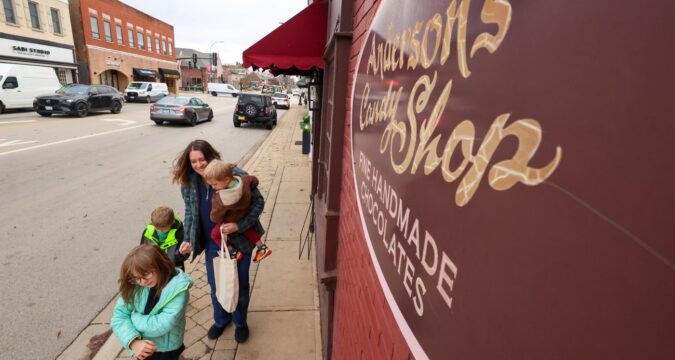
Arthur Tedder, 5, hands a package to Xander Novak, left, as Tedder and his mom, Katie Anderson-Tedder, and his siblings arrive at the family’s candy shop, Anderson’s Candy Shop in Barrington on Nov. 26, 2025. Anderson-Tedder is co-owner of the candy shop, which has been in her family for four generations. (Stacey Wescott/Chicago Tribune)
Yet while Anderson knows shoppers are being more frugal, she hopes there might be a silver lining for smaller shops.
“Because prices are high and consumers are having to be judicious with their spending, we have found it’s causing them to really examine where their money goes,” she said. “And that can be good for brands like ours.”
She might be onto something. Businesses like Anderson’s aren’t just shops — they’re what make Illinois towns livable and lovable. We’re hearing from many people in the Chicago area who are shopping locally this holiday season, wanting to invest in the shops that give our downtowns and neighborhood shopping districts their personality and vibrancy.
And while shoppers may not realize it, these local storefronts aren’t just charming — they’re doing the heavy lifting in Illinois’ economy.
At present, they’re our economic lifeblood; one of the few bright spots in Illinois’ economy in recent years. Businesses with fewer than 50 employees have been the only firms to add jobs on net since the onset of the pandemic, accounting for the creation of more than 170,000 positions, according to an Illinois Policy Institute analysis of Census Bureau data. Businesses with more than 500 employees lost 11,000 jobs on net last year.
We’re rooting for businesses of every size, but Illinois’ economy is leaning hardest on its smaller employers, and they deserve recognition for it. We also feel protective of our small businesses. Volatility and uncertainty hit all employers, but those with smaller margins and less room for error are particularly susceptible.
“If we lose any shopping days in that period between Thanksgiving and Christmas to bad weather or an economic scare in the news, it really hurts,” Anderson said.
As if we needed another reason to hope for mild weather this holiday season.
The name of the shopping game in today’s culture and economy is convenience, but we also want to live in communities with personality. We also enjoy quality. If we want these places to survive for our kids, we need to support them not just with nostalgia — but with purchases.
Submit a letter, of no more than 400 words, to the editor here or email letters@chicagotribune.com.

The Dangers Of AI: Visualizing The Top Risks Companies Face
The Dangers Of AI: Visualizing The Top Risks Companies Face
Companies are rushing to implement AI, but it’s not all smooth sailing.
More than half of businesses say the dangers of AI have led to at least one negative consequence.
But which issues plague businesses the most?
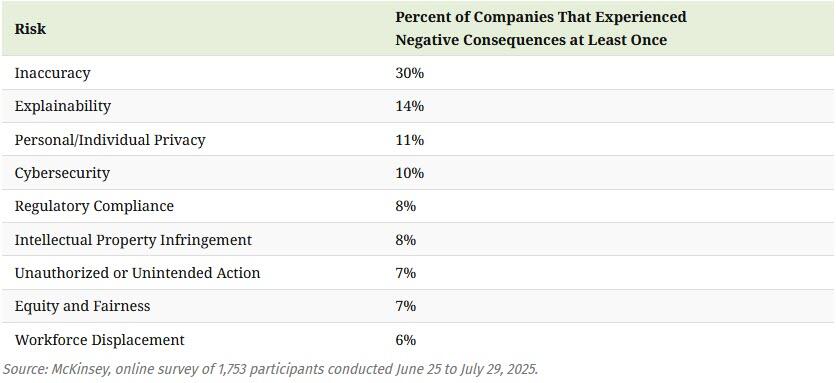
This infographic, via Visual Capitalist’s Jenna Ross, breaks down the most common risks.
It’s a preview of the brand-new executive guide from Terzo and Visual Capitalist, AI’s Illusion of Truth: The Data Behind AI Errors.
The Top Dangers of AI
Inaccuracy is the biggest risk companies report, with almost a third experiencing a negative consequence at least once.
Source: McKinsey, online survey of 1,753 participants conducted June 25 to July 29, 2025.
The other dangers of AI are reported on a much lower scale. Explainability, which is the ability for people to understand an AI system’s inner workings, has affected half as many companies as inaccuracy has.
The Knock-On Effects of Errors
AI inaccuracy can lead to much bigger issues. It undermines trust in AI systems, causes operational inefficiencies, and can lead to flawed strategic decisions. When AI generates incorrect outputs, the damage is often amplified through cascading processes.
It also has the potential to create legal issues. As the Harvard Law School recently pointed out, many insurance companies are adding limitations or excluding coverage for AI-related losses. This means that leaders may not be covered under traditional Directors & Officers policies for any liabilities that arise from AI errors.
Next Steps for Leaders
Many companies have started taking steps to combat the dangers of AI. In fact, 54% of businesses are actively working to mitigate AI inaccuracies.
Leaders can take charge by ensuring their teams have humans in the loop to review AI’s output before it is used.
See the data behind AI’s errors and how to get 99% accuracy in the free executive guide, AI’s Illusion of Truth.
Tyler Durden
Fri, 11/28/2025 – 05:45
https://www.zerohedge.com/ai/dangers-ai-visualizing-top-risks-companies-face