Category: News

‘Zootopia 2’ roars to record-setting global box office with $556M opening
“Zootopia 2” had a roaring, record-setting opening at the box office.
The animal city sequel from the Walt Disney Company brought in $96 million in North America over the weekend, earned $156 million over the five-day Thanksgiving frame, and scored a staggering $556 million globally since its Wednesday opening, according to studio estimates Sunday.
That made it the highest international opening ever for an animated movie, the fourth highest global debut of any kind, and the top international opener of 2025.
“Wicked: For Good” stayed aloft in its second weekend for Universal Pictures, earning another $62.8 million domestically over the weekend for a North American total of $270.4 million. The second half of the “Wicked” saga has brought in $393 million internationally.
The pair of sequels combined to make the Thanksgiving weekend a glimmering exception to an otherwise dark year at movie theaters.
“Zootopia 2” arrives almost a decade after the original, a hit that outpaced expectations and had a March domestic opening of $75 million.
Like the first, it features the duo of bunny cop Judy Hopps (Ginnifer Goodwin) and small-time hustler fox Nick Wilde (Jason Bateman).
Top 10 movies by domestic box office
With final domestic figures being released Monday, this list factors in the estimated ticket sales for Friday through Sunday at U.S. and Canadian theaters, according to Comscore:
1. “Zootopia 2,” $96.8 million.
2. “Wicked: For Good,” $62.8 million.
3. “Now You See Me: Now You Don’t,” $7 million.
4. “Predator: Badlands,” $4.8 million.
5. “The Running Man,” $3.7 million.
6. “Eternity,” $3.2 million.
7. “Rental Family,” $2.1 million.
8. “Hamnet,” $880,000.
9. “Sisu: Road to Revenge,” $810,000.
10. “Nuremberg,” $749,325.
https://www.chicagotribune.com/2025/11/30/zootopia-2-box-office/

Lawmakers voice support for congressional reviews of President Donald Trump’s military strikes on boats
WASHINGTON — Lawmakers from both parties said Sunday they support congressional reviews of U.S. military strikes against vessels suspected of smuggling drugs in the Caribbean Sea and eastern Pacific Ocean, citing a published report that Defense Secretary Pete Hegseth issued a verbal order for all crew members to be killed as part of a Sept. 2 attack.
The lawmakers said they did not know whether last week’s Washington Post report was true, and some Republicans were skeptical, but they said attacking survivors of an initial missile strike poses serious legal concerns.
“This rises to the level of a war crime if it’s true,” said Sen. Tim Kaine, D-Va.
Rep. Mike Turner, R-Ohio, when asked about a follow-up strike aimed at people no long able to fight, said Congress does not have information that happened. He noted that leaders of the Armed Services Committee in both the House and Senate have opened investigations.
“Obviously, if that occurred, that would be very serious and I agree that that would be an illegal act,” Turner said.
Turner said there are concerns in Congress about the attacks on vessels that the Trump administration says are transporting drugs, but the allegations regarding the Sept. 2 attack “is completely outside anything that has been discussed with Congress and there is an ongoing investigation.”
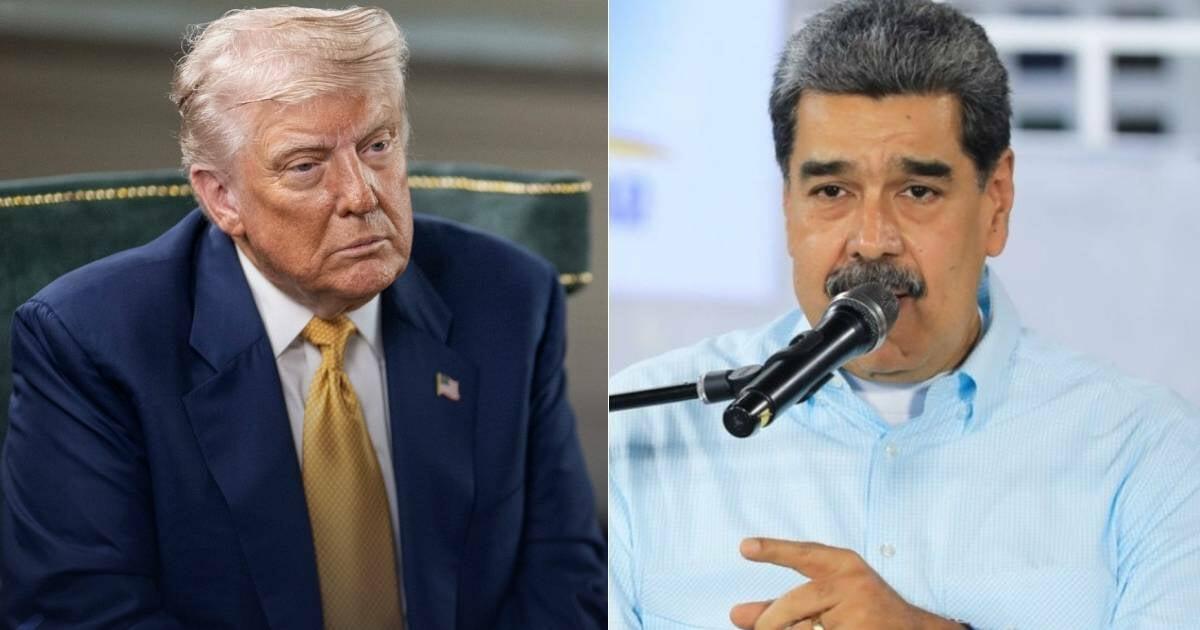
The comments from lawmakers during news show appearance come as the administration escalates a campaign to combat drug trafficking into the U.S. On Saturday, Republican President Donald Trump said the airspace “above and surrounding” Venezuela should be considered as “closed in its entirety,” an assertion that raised more questions about the U.S. pressure on Venezuelan leader Nicolás Maduro. Maduro’s government accused Trump of making a ”colonial threat” and seeking to undermine the South American country’s sovereignty.
After the Post’s report, Hegseth said Friday on X that “fake news is delivering more fabricated, inflammatory, and derogatory reporting to discredit our incredible warriors fighting to protect the homeland.”
“Our current operations in the Caribbean are lawful under both U.S. and international law, with all actions in compliance with the law of armed conflict—and approved by the best military and civilian lawyers, up and down the chain of command,” Hegseth wrote.
Republican Sen. Roger Wicker of Mississippi, chairman of the Senate Armed Services Committee, and its top Democrat, Rhode Island Sen. Jack Reed, said in a joint statement late Friday that the committee “will be conducting vigorous oversight to determine the facts related to these circumstances.”
That was followed Saturday with the chairman of the House Armed Services Committee, Republican Rep. Mike Rogers of Alabama, and ranking Democratic member, Washington Rep. Adam Smith, issuing a joint statement saying the panel was committed to “providing rigorous oversight of the Department of Defense’s military operations in the Caribbean.”
“We take seriously the reports of follow-on strikes on boats alleged to be ferrying narcotics in the SOUTHCOM region and are taking bipartisan action to gather a full accounting of the operation in question,” Rogers and Smith said, referring to U.S. Southern Command.
Rep. Don Bacon, R-Neb., asked about the Sept. 2 attack, said Hegseth deserves a chance to present his side.
“We should get to the truth. I don’t think he would be foolish enough to make this decision to say, kill everybody, kill the survivors because that’s a clear violation of the law of war,” Bacon said. “So, I’m very suspicious that he would’ve done something like that because it would go against common sense.”
Kaine and Turner appeared on CBS’ “Face the Nation,” and Bacon was on ABC’s “This Week.”

Leaves continue to plague South Shore Line with gooey residue
Gooey leaves on the rails have caused the South Shore Line’s on-time performance to plummet in November, leaving railroad officials scrambling for additional ways to address the problem.
Assistant Chief Transportation Officer Sara Krga said the railroad is doing better than last year, 88 wheels damaged by slipping last November compared to 28 so far this month.
“Last year at this time, we really struggled through the leaf season,” President and General Manager Michael Noland said.
Krga walked the Northern Indiana Commuter Transportation District board through ways the railroad is trying to lessen the impact.
“It’s a really a phenomenon that’s primarily, not exclusively, limited to our single-level cars,” Noland said.
Bilevel cars are heavier and are not affected as much as single-level cars, Krga said. Single-level trains are running at 65 mph vs. 79 mph for the bilevel cars, slowing to 45 mph for flag stops so the trains can stop in time if there’s a rider waiting.
When a wheel slips and slides, it develops a flat spot. When that happens, federal rules require the train speed to be limited to 10 mph, Noland said, so another train has to be brought in to finish the route while the train with the damaged wheel limps back to the shop to be repaired.
The railroad is getting better at recovery times, Noland said, but wants to get even better.
“We took a lot of information from last year and really tried to get ahead of it this year,” Krga said, including a lot of ride-alongs with the engineers.”
This year, the railroad purchased a brush affixed to the front of a train to scrub off leaf and oil residue.
The South Shore Line’s counterpart in Boston has a special schedule for leaf season, which is something that might be done here next year, Noland said. “We’re not unique in running into leaf spots.”
Another possibility is to drop a ton of money into a laser train to burn off the leaf residue on the rails. Or the railroad could use a high-powered water sprayer on the front of the train, effectively power-washing the rails.
Among the comments Noland has received is, “You guys have been running for 108 years, why are you just seeing this now?” It’s because of the Double Track NWI project allowing more trains to run and on a tighter schedule. “We’re running to the full capacity of the RR, and this is one of the byproducts we’ve identified,” Noland said.
Although on-time performance has plummeted this month, ridership and ticket numbers are improving over last year, Director of Strategic Planning and Grants Kelly Wenger said.
“Overall, I think, we’re looking very good, very strong,” she said.
Fares increased on July 1 for the first time in years. Despite the increase, ticket sales are up 19.2% over last year, Wenger said.
Revenue is up 30.5%, she said, with digital sales accounting for nearly 93% of total sales.
Ridership is up 16.5% over 2024, including a 20.9% increase on weekends.
“It’s a really nice increase, this year over last year. It’s a really strong recovery year for us,” Wenger said.
One statistic she’s tracking is the number of bikes on trains in winter months. So far this year, 9,118 riders have taken bikes on trains compared to 6,338 in all of 2024. Last winter, 302 hardy souls took bikes on the train in February.
Getting bikes on trains is easier now, with two slots for bikes on every car so people can get on and off faster, Wenger said.
Noland took time to express pride in the South Shore Line’s planned start of the Monon Corridor – formerly known as the West Lake Corridor – route in March.
New starts usually start slow and build up service as demand increases, but this one is different. “We have always said that WL starts out with five trips in the morning and five trips coming back,” Noland said.
In addition, the railroad is adding a two-car shuttle train to take riders from Munster/Dyer to Hammond so riders can board trains along the traditional route, now called the Lakeshore Corridor, Noland said.
The railroad will have full off-peak and weekend service on the Monon Corridor route, too, he said.
A schedule for the Monon Corridor route has been posted on the South Shore Line website so riders can make plans for child care and whatever other adjustments they need to ride the new service when the trains begin operating.
“We’re excited to get this piece of info out to the public,” Noland said.
Doug Ross is a freelance reporter for the Post-Tribune.

Presidente venezolano Maduro parece desesperado, pero su estrategia es difícil de descifrar
Por REGINA GARCÍA CANO
CARACAS (AP) — Las frases en inglés alguna vez molestaron tanto al presidente venezolano Nicolás Maduro que instó a la audiencia de su mensaje anual a la nación a eliminar gradualmente palabras como “skatepark” (parque de patinaje y BMX) y “fashion” (moda).
Pero mientras la Casa Blanca reflexiona ahora sobre si el ejército estadounidense debería atacar a Venezuela, Maduro adopta el inglés, canta “Imagine”, de John Lennon, aboga por la paz, y baila al ritmo de un remix de su último eslogan en inglés: “No War, Yes Peace” (No guerra, sí paz”).
Si bien su cambio de postura es visto como una señal de desesperación por los partidarios de la oposición política en Venezuela, cuyos líderes han reiterado a quienes los apoyan en Washington que la amenaza de una acción militar quebrará el círculo íntimo de Maduro, meses de presión aún no han producido deserciones ni una transición de gobierno.
Lealtad vs. castigo
Detrás de esta habilidad para mantenerse en el poder se esconde un sistema que castiga severamente a los aliados desleales y permite que ministros, jueces, líderes militares y otros funcionarios leales se enriquezcan.
“Hay una habilidad que tiene la Revolución Bolivariana que es la capacidad de cohesión contra la presión”, dijo Ronal Rodríguez, investigador del Observatorio de Venezuela de la Universidad del Rosario, de Colombia, al referirse al movimiento político conocido como “chavismo” que Maduro heredó del fallecido presidente Hugo Chávez. “Cuando la presión viene del exterior, se logran cohesionar, se logran defender, se logran proteger”.
Lo que sustenta el principio de lealtad o castigo son redes de corrupción —avaladas por Chávez y Maduro— que otorgan a los leales la libertad de enriquecerse. Esta política ha frustrado intentos previos de derrocar a Maduro y le ha ayudado a él y a sus allegados cercanos a eludir sanciones económicas, obtener indultos presidenciales estadounidenses y proclamar la victoria en unas elecciones que perdieron rotundamente.
Rodríguez explicó que la prisión y la tortura pueden formar parte del castigo, que suele ser más severo para quienes son acusados de delitos y tienen afiliación militar. Esta estrategia ha sido crucial para que Maduro mantenga el control del ejército, al que permite traficar drogas, petróleo, fauna silvestre y una gran variedad de bienes a cambio de cuarteles a prueba de golpes.
“Ha sido una herramienta muy efectiva porque el chavismo siempre ha podido prescindir de aquellos actores que en algún momento tratan de levantarse, y a todos los actores (les) ha podido sacar dinámicas de corrupción”, agregó Rodríguez.
Ejército apoya a Maduro
La oposición política venezolana —liderada por María Corina Machado, Premio Nobel de la Paz— contaba con el apoyo del ejército para derrocar a Maduro tras la evidencia creíble de su derrota en las elecciones presidenciales de 2024. No obstante, el ministro de Defensa, Vladimir Padrino López, y otros líderes militares apoyaron a Maduro, tal como lo hicieron en 2019 durante una revuelta en los cuarteles protagonizada por un grupo de soldados que juraron lealtad a Juan Guaidó, el líder opositor reconocido en ese momento por el primer gobierno de Donald Trump como el presidente legítimo de Venezuela.
Desde que regresó al cargo, Trump ha incrementado la presión sobre Maduro y sus aliados, e incluso ha duplicado a 50 millones de dólares la recompensa por información que conduzca a su arresto por cargos de narcotráfico. Una acusación formal de 2020 imputó a Maduro de liderar el Cártel de los Soles, al que el Departamento de Estado de Estados Unidos designó el lunes como organización terrorista extranjera.
Maduro niega las acusaciones.
El sábado, Trump dijo que el espacio aéreo “sobre y alrededor” del país sudamericano debería considerarse “cerrado en su totalidad”. El gobierno de Maduro respondió al acusar a Trump de realizar una “amenaza colonial”, y movilizó a sus partidarios en torno a lo que llamó un atentado contra la soberanía nacional.
Presuntas embarcaciones con drogas bombardeadas
A principios de septiembre, el ejército estadounidense comenzó a bombardear embarcaciones que el gobierno de Trump ha acusado de transportar drogas en el mar Caribe y el océano Pacífico Oriental, y ha matado a más de 80 personas en los ataques.
Muchos, incluido el propio Maduro, ven las acciones militares estadounidenses como un intento de acabar con el control del chavismo sobre el poder. La oposición no hizo más que acrecentar esta percepción al renovar su promesa de destituir a Maduro.
Dos semanas después del primer ataque marítimo, la lealtad del chavismo se puso a prueba directamente cuando el piloto de Maduro rechazó los intentos de Estados Unidos de unirse a un complot para capturar al presidente venezolano y entregarlo bajo custodia para que enfrentara los cargos.
“Los venezolanos estamos hechos de otra ksa”, escribió Villegas, miembro de la guardia de honor presidencial de élite, a un oficial estadounidense retirado que intentaba reclutarlo. “Y lo que menos somos es traidores”.
El martes, simpatizantes del partido gobernante marcharon en Caracas para demostrar lo que describieron como el “espíritu antiimperialista” del chavismo. La marcha culminó con una ceremonia en la que Maduro alzó una espada enjoyada que perteneció a Simón Bolívar, héroe sudamericano de guerras de independencia de varios países, y guio a los asistentes, incluidos ministros del Gabinete, a jurar defender la paz y la libertad en nombre de Dios.
Susan Shirk, profesora investigadora de la Universidad de California en San Diego, dijo que los líderes autoritarios tienen un “fetichismo por la unidad” y prefieren las demostraciones públicas de lealtad para evitar divisiones entre los líderes y la agitación social. Explicó que la división puede llevar a la gente a creer que el riesgo de protestar ha disminuido.
“Tenemos que permanecer unidos”
El secretario de Defensa de Estados Unidos, Pete Hegseth, ha declarado que la designación del Cártel de los Soles ofrece a Trump opciones adicionales para lidiar con Maduro. Hegseth no ha proporcionado detalles sobre esas opciones, pero funcionarios del gobierno han señalado que les cuesta ver una situación en la que Maduro permanezca en el poder como un desenlace aceptable.
David Smilde, profesor de la Universidad de Tulane, quien ha estudiado a Venezuela durante más de tres décadas, explicó que sólo quienes no comprenden el chavismo pensarán que una demostración de fuerza provocará un cambio de gobierno.
“Este es exactamente el tipo de cosas que los une”, agregó Smilde sobre el despliegue de las fuerzas militares estadounidenses. “También hablan de la recompensa de 50 millones de dólares, pero, ¿Qué militar en su sano juicio confiaría en el gobierno estadounidense? Y, en términos más generales, si toda la premisa de la operación es que las fuerzas armadas venezolanas son un cártel de la droga, ¿Qué motivación podrían tener para volverse contra Maduro y participar en un cambio de régimen?”.
La presidencia de Maduro, en su totalidad, ha estado marcada por una crisis política, social y económica que ha sumido a millones en la pobreza y ha empujado a más de 7,7 millones de personas a migrar. La crisis también ha provocado un desplome del apoyo al partido gobernante en todo el país.
Como la lealtad mantiene intacto a su círculo íntimo a pesar de la creciente presión estadounidense, Maduro también ha buscado mantener su reducida base mediante prácticas establecidas desde hace mucho tiempo que incluyen el organizar marchas en la capital.
Zenaida Quintero, portera escolar, ha visto el país desmoronarse bajo el mandato de Maduro, con vívidos recuerdos de la grave escasez de alimentos que experimentaron los venezolanos a finales de la década de 2010. No obstante, su apoyo a Maduro no ha flaqueado, y su compromiso se resume en un hecho: fue elegido personalmente por Chávez para liderar la Revolución Bolivariana.
Quintero, de 60 años, indicó que Maduro, como Chávez, no abandonará a quienes los apoyan.
“Yo le tengo confianza”, dijo Quintero sobre Maduro. “Tenemos que mantenernos unidos. Nosotros tenemos que defendernos”.

Trump Rejects Maduro Request For Amnesty In Newly Disclosed Phone Call
Trump Rejects Maduro Request For Amnesty In Newly Disclosed Phone Call
President Donald Trump has reportedly rejected Venezuelan President Nicolás Maduro’s request for broad amnesty during a newly disclosed phone conversation last week, telling Maduro and his top advisers to drop their demands and swiftly exit Venezuela as US military pressure intensifies, which has lately included an order to halt all flights in the country’s sovereign airspace.
According to people familiar with the exchange who spoke to The Wall Street Journal, Trump and Maduro discussed a sweeping amnesty plan, during which time Maduro is said to have sought blanket legal protection for himself, his senior officials, and their families. “Trump told Maduro that if he didn’t leave willingly, the US would consider other options including the use of force, according to people familiar with discussion,” WSJ wrote.
Many of those same officials are at this moment under US sanctions or face criminal charges related to corruption and narcotics trafficking.
President Trump is said to have dismissed the proposal while warning Maduro that the United States would ramp up military action if he refused to step down. This is consistent with prior Washington regime change operations in places like the Middle East, which has seen many longtime rulers overthrown – including Saddam Hussein, Muammar Gaddafi, and Bashar al-Assad.
A number of top-ranking Maduro officials have been called out by the Trump administration, and urged to leave the country immediately – including Interior Minister Diosdado Cabello, Defense Minister Vladimir Padrino, Vice President Delcy Rodríguez, and National Assembly President Jorge Rodríguez.
Trump while speaking at Mar-a-Lago during Thanksgiving, apparently days after the secretive Maduro phone call, hinted that US ground operations against Venezuela could begin soon. “The land is easier. That’s going to start very soon. We warned them, stop sending poison into our country.”
According to some of the details of the newly disclosed call via The New York Times:
The conversation took place late in the week, two of the people said. It included a discussion about a possible meeting between the two men in the United States, according to the people with knowledge of the matter, who were granted anonymity because they were not authorized to discuss the matter publicly. There are no plans at the moment for such a meeting, one of the people said.
The phone call, which included Secretary of State Marco Rubio, came days before a State Department designation of Mr. Maduro as the leader of what the administration considers a foreign terrorist organization, the Cartel de los Soles, came into effect.
After this, Trump announced that the airspace over Venezuela should now be considered closed. “To all Airlines, Pilots, Drug Dealers, and Human Traffickers, please consider THE AIRSPACE ABOVE AND SURROUNDING VENEZUELA TO BE CLOSED IN ITS ENTIRETY. Thank you for your attention to this matter! PRESIDENT DONALD J. TRUMP,” Trump wrote on X.
Earlier this month, the Federal Aviation Administration (FAA) warned pilots to “exercise caution” near Venezuela’s airspace due to the “worsening security situation and heightened military activity.
🚨Alert: In Emergency Phone Conference between President Trump and Dictator Maduro, Trump tells Maduro the only way to stop an attack is to step down and leave the country NOW!! pic.twitter.com/IIgtKdC9fd
— US Homeland Security News (@defense_civil25) November 30, 2025
The Pentagon has been deploying warships and other military assets in the Caribbean this year. The deployment centers around bolstering Hemispheric Defense, and the Trump administration has formally characterized Nicolás Maduro as the head of a terrorist organization and considers his government illegitimate.
Quick response after the US orders what’s effectively a total airspace closure over the Latin American country:
0 planes over Venezuela after Trump shuts its airspace pic.twitter.com/wyUwzcTcjy
— RT (@RT_com) November 30, 2025
This policy hearkens back to the first Trump administration, during which time there appeared to be clandestine efforts to foment unrest or else a military coup. These activities didn’t amount to much, however, and Maduro had vehemently denounced external meddling and vowed to go after and punish collaborators.
Last year, on the Trump campaign trail, the would-be second term president didn’t mention anything in his policy platform about sweeping regime change action in Venezuela – which likely would have been met with a lot of opposition within the MAGA movement.
Tyler Durden
Sun, 11/30/2025 – 14:35

Pope Leo XIV doubles down on insistence for 2-state solution to resolve Israeli-Palestinian conflict
ABOARD THE PAPAL PLANE — Pope Leo XIV doubled down Sunday on the Holy See’s insistence on a two-state solution to resolve the Israeli-Palestinian conflict, saying in his first airborne news conference that it was the “only solution” that could guarantee justice for both sides.
Leo made the comments as he flew from Istanbul to Beirut for the second and final leg of his maiden voyage as pope. Though Leo has been fielding journalists’ questions at informal gatherings at his country house, the brief encounter marked his first news conference as pope and followed the tradition of his predecessors of using his foreign trips to engage with the media.
Because of the short flight, the news conference was limited to two questions from Turkish journalists. When Leo returns to Rome on Tuesday, the encounter will presumably be longer.
The American pope was asked about his private talks with Turkish President Recep Tayyip Erdogan upon his arrival in Ankara and whether they discussed the wars in Gaza and Ukraine.
Leo confirmed they had, and said that Turkey had an “important role to play” in both conflicts, noting that Erdogan’s government had already helped facilitate low-level negotiations between Russia and Ukraine to end the war.
“Unfortunately we still haven’t seen a solution. But today there are new, concrete proposals for peace.” He said that the Holy See hopes that Erdogan would pursue his dialogue with Ukraine, Russia and the United States to help reach a ceasefire and end the nearly four-year war.
On Gaza, he repeated the Holy See’s longstanding position supporting a two-state solution for Israel and the Palestinians. The creation of a Palestinian state in east Jerusalem, the West Bank and Gaza has long been seen internationally as the only way to resolve the conflict.
The Holy See had recognized a Palestinian state in 2015, but the push for a two-state solution received new impetus this year during the Israel-Hamas war in Gaza. Several more countries formally recognized a Palestinian state during the U.N. General Assembly.
“We know that in this moment, Israel doesn’t accept this solution, but we see it as the only one that can offer a solution to the conflict that they are living in,” he said. “We are also friends with Israel and we try with both sides to be a mediating voice that can help bring them closer to a solution with justice for all.”
There was no immediate response from the office of Israeli Prime Minister Benjamin Netanyahu. He has long asserted that creating a Palestinian state would reward Hamas and eventually lead to an even larger Hamas-run state on Israel’s borders.
Earlier this month, Netanyahu said that Israel’s opposition to a Palestinian state has “not changed one bit” and isn’t threatened by external or internal pressure.
“I do not need affirmations, tweets or lectures from anyone,” he said.
Leo had avoided any direct mention of the Gaza conflict while in Turkey. And in his brief remarks to journalists summarizing his trip so far, he omitted any reference to his visit to Istanbul’s Blue Mosque, his most visible engagement with Turkey’s Muslim majority.
Rather, Leo focused on the main reason for coming to the region: to commemorate the 1,700th anniversary of an important A.D. 325 gathering of bishops from across the Roman Empire in present day Iznik, Turkey. There, the bishops agreed on a common creed, or profession of faith.
The Nicaean Creed is still recited today by millions of Christians around the world and, despite schisms and other divisions, is a rare point of agreement among Catholic, Orthodox and most Protestant believers.
Leo participated in a commemoration of the Council of Nicaea in Iznik and otherwise spent his time in Istanbul meeting with various Orthodox patriarchs. During a joint meeting Saturday, he proposed that they come together in an important way in 2033 in Jerusalem, to commemorate the 2,000th anniversary of Christ’s crucifixion and resurrection, as a new visible sign of their unity.
“Obviously is an event that all Christians want to celebrate,” he said. “We have years to prepare,” he added, but said the various patriarchs welcomed the proposal.
The Santa Rally Recipe: Fed Put In Full Force
The Santa Rally Recipe: Fed Put In Full Force
By Peter Tchir of Academy Securities
The market figured out a holiday recipe that works well:
A Healthy Dose of Fed Puts.
A Dash of Trade Hopes.
A Smidge more Fed Puts because you can never have enough Fed Puts.
In the past 5 trading days (including Friday November 21st):
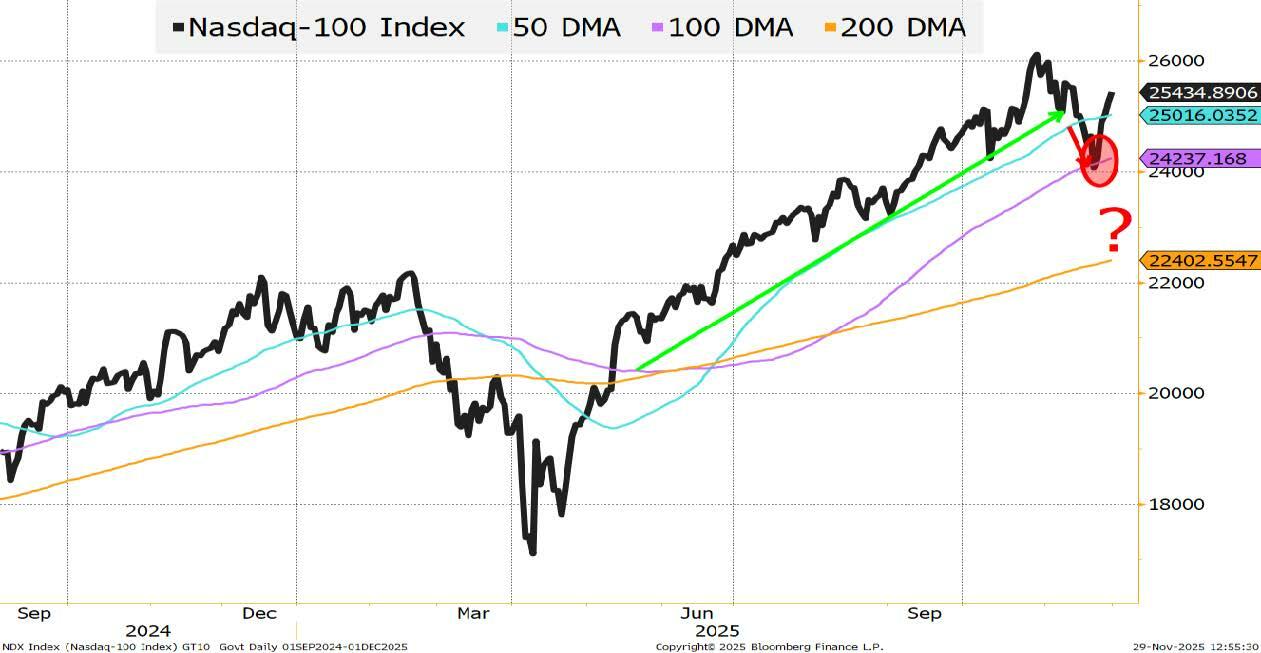
The Nasdaq 100 is up 5.7% (outpacing the “rotation” trade of the S&P 500 Equal Weight which is up 3% in those same trading days).
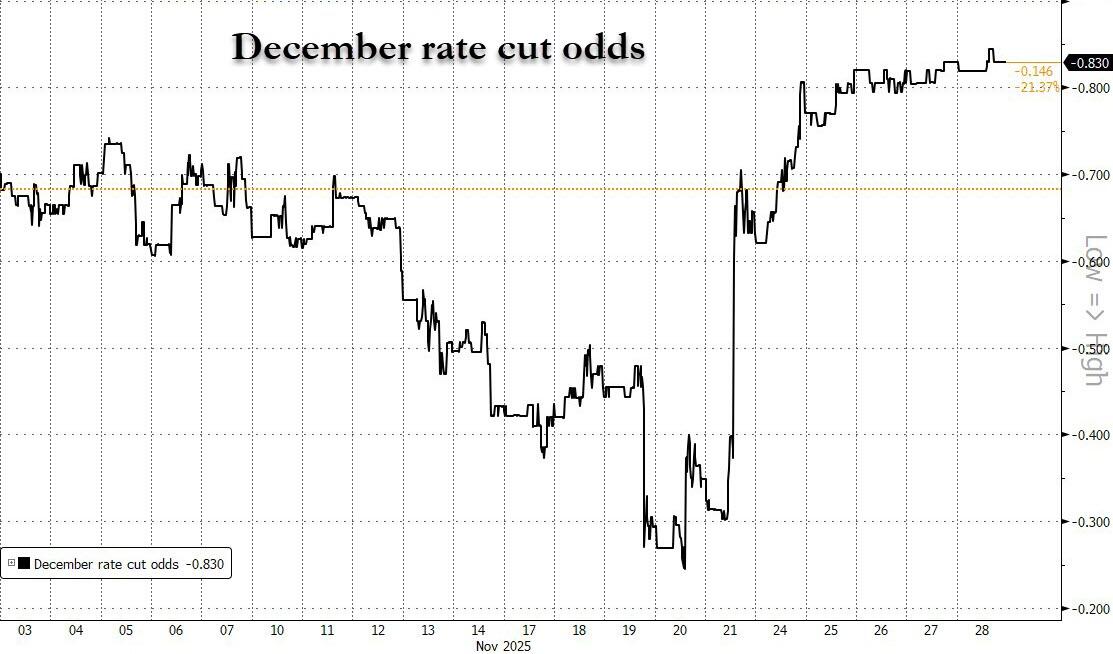
The probability of a Fed cut at the December meeting spiked to 83% from 35% (well within the range where the Fed would be unlikely to disappoint). 10s rallied as well, though “only” from 4.07% to 4.02%.
Bitcoin, which traded below $82,000 on the 21st, has reclaimed the $90k threshold.
Credit spreads joined in the party as CDX went from 56 to 51. That was matched by the Bloomberg Corporate Bond OAS, which tightened from 85 to 80.
There were a couple of other “events” during the week that created some interesting movements (at least briefly). First, and possibly most interesting longer-term, was the sudden need to understand a TPU versus a GPU.
We were able to talk about this, the Fed, and risks to the economy in the first segment of last week’s Bloomberg TV interview. The second segment focuses more on geopolitical issues.
Briefly (only briefly) did the TPU vs GPU story seem to help answer the questions posed last weekend: Is the pAIn Over? Are we at the end of “Free” Money?
Any questions on spending and risks to growth were overwhelmed by the Fed Put (and some signs that the administration would let/even encourage chip sales not just to the Middle East, but also to China).
In addition, please see the link to our November ATW that we released this week. We are focused on the U.S. pressure being put on the Maduro regime.
The Fed Put is In Full Force
You may not believe in Santa, or the Santa rally, but the Fed Put might be the strongest it has been in some time.
The recognition that the Fed Put is in full effect started last Friday, with Williams coming across more dovish than most supposed.
It continued over the weekend as more Fed speakers seemed to shift to the dovish side of the ledger.
Then, finally, it was reported that Kevin Hassett would get the nod to be the next Fed chair.
The market, correctly, interpreted this as a signal that the Treasury, the Fed, and the admin would work more closely together – helping pave the way for lower yields and easier monetary conditions.
There is “chatter” that Hassett will act as a “shadow” chair at the December meeting ensuring a cut.
The most material change in the week leading up to this barrage of dovishness wasn’t in the data, but in equity prices.
If you could point to some serious change in the data, we could argue that the Fed Put isn’t real, and that they are just “data dependent.” But that wasn’t the case at all. What seemed to drive the rush to get easy money back on track was the performance of equities, and the risk that they were breaking through some serious support levels, causing concern of further downside. Not something that the admin or the Fed wants – especially in an illiquid holiday season.
The Nasdaq 100 had not broken below its 50-Day Moving Average since the rally that started with the admin retracting the Liberation Day tariffs. It crossed that technical threshold, and almost immediately fell to the 100-Day Moving Average, which it also breached (almost like a hot knife through butter). For many technicians, that put the 200-Day Moving Average in play, which would have been a further 7% decline. It is impossible, at least for me, to look at this chart and think anything other than that the Fed Put is not just alive and well, but it will also flourish under this admin. The admin did go from talking about “Main Street over Wall Street” at the time of the Liberation Day tariffs, to changing track and cheering the stock surge. The admin has continued to point to stocks as a benchmark (not truly unique to this admin, but this admin seems to have a better understanding of markets, and the machinations that can help markets, than prior administrations).
There are a few things that I find surprising about the market reaction (and the Fed hitting the “panic” button):
I did believe the market pullback had more to do with concerns about the AI spend, than it did about the Fed not cutting in December (obviously, given the market reaction, that assessment was wrong).
We have not wavered in our assessment that we will likely see Fed Funds effective at 2.875% (100 bps lower than today) by next summer. We did not think that whether we get a December cut or not would matter much (yes, it clearly did). The market is “only” pricing in three cuts between now and September 2026 – that seems too few/too slow. More potential for the markets to get surprised to the upside by easy money and looser financial conditions.
There is a sense of “irony” or “paradox” or “Catch 22” (or some other word) that fears about the stock market seemed to trigger the shift to the dovish side, and now we will potentially get a cut while stocks may be at all-time highs.
Is the Fed Enough?
I do believe that the risks to spending are greater than the benefits of a 25 bps rate cut, BUT:
December, with low liquidity and strong seasonals, tends to support strength.
A market that was already set up for a nice end of year rally is likely to reset itself to that mindset (it is an “easy” and comfortable way to finish the year).
The government shutdown did end, so with backpay, we could see some boosts to the economy.
While questions are mounting about domestic AI spend and valuations, the potential for selling chips to other countries has grown in scale and scope of late.
Chips for Everyone
While the questions surrounding TPUs vs GPUs were interesting, they did little for markets. Just like DeepSeek was quickly brushed off as some “one-off” type of thing, the market continues to see demand for high-end chips as “virtually” insatiable.
While some questions remain about the longer-term risk of selling chips to competitors (like China) or even some countries that we don’t fully align with (parts of the Middle East), we seem to be set to sell those high-quality chips to those countries.
This will:
Substantially change the trade balance with many countries. This is one of the administration’s top goals (though I’m not sure how making something in Taiwan and shipping it across the Strait to China exactly works, but it does for now – and makes, at least to me, the imperative to manufacture more and better chips in this country even more obvious – thinking ProSec™).
Allow for growth.
Highlight the competitive advantage other countries have in electron production. The production of electricity is increasingly recognized as a potential roadblock to the planned growth of AI and Data Centers. Countries like Saudi Arabia are better prepared for this need for electricity than we are (once again, highlighting the need for ProSec™). China too has been growing its electricity production through any and all means possible, including, but not limited to, coal, solar, nuclear, and aggressive development work on fusion.
It is clear that the Middle East will want to buy and use the U.S. chips (designed in the U.S. even if not fully produced in the U.S.). It is less clear that China will go down that path aggressively or not. This could be a test to see if China is truly committed to developing their own industry, even at the risk of working with inferior equipment in the near-term, or whether the need is so great, that they will delay the progress of their own chip industry. The latter would be nice and a big win in the trade wars – but I’m not sure how likely it is, or whether or not we will regret the decision down the road.
Bottom Line
We can all sleep more comfortably and enjoy the holidays a little more with the Fed Put on full display. Who needs to see the tree at Rockefeller Center when the Fed Put is obvious every time we glance at our screens.
I think there are issues regarding valuations, spending, and the state of the consumer/economy, but with earnings season behind us, little “new” or useful data, strong seasonality, and a Fed that seems determined to cut, we should be in for a “normal” December – rather than what we seemed to be facing as markets started to trade on November 21st!
What a difference a week can make!
Things could change – the fears expressed recently are real, but it seems we will be given the opportunity to get our portfolio ready for the new year to capture the opportunities that are unfolding as we speak (especially making things domestically that we need for “security”).
Tyler Durden
Sun, 11/30/2025 – 14:00
https://www.zerohedge.com/markets/santa-rally-recipe-fed-put-full-force

Saturday snow breaks record in Chicago, NWS confirms
As Chicagoans woke up to “Winter Wonderland”-like conditions Sunday, snowfall recorded at Chicago O’Hare International Airport Saturday was confirmed as a record 8.4 inches, the highest snowfall on a single calendar day in November since 1951, according to the National Weather Service.
The snow was likely to taper out by 11 a.m. Sunday and the temperature was expected to warm up to around 32 degrees at noon, with 25 to 30 mph winds that will decrease throughout the day. A Winter Weather Advisory was in place until noon Sunday with snow contributing to slippery roads and low visibility, according to NWS.
The last time O’Hare Airport saw so much snow on a single day in November was 74 years ago, Nov. 6, 1951, when 8 inches fell, according to the NWS. Snowfall reached 8.6 inches at O’Hare by 6 a.m. on Sunday. Amid the record-breaking snowfall, O’Hare airport had 1,322 flight cancellations and Midway airport had 250 cancellations, according to FlightAware data as of Sunday morning.
Cook County also recorded its first cold-related death of the season preceding Saturday’s snowfall, when a 68-year-old woman was found dead on Friday near Worth Public Library. The autopsy found the woman died from a combination of hypothermia and heart disease, and ruled it an accident.
But despite the brisk snow, the weather is not unusual for this time of year, according to NWS meteorologist Zachary Yack.
“It’s definitely on the higher-end,” said Yack, noting O’Hare’s record-breaking snowfall yesterday, “but it’s something we, again, expect to see starting to get into this time of year.”
Snow is likely to fall again on Monday in the late afternoon through the evening’s rush hour with about two to four inches of snowfall, according to NWS.
The Department of Streets and Sanitation deployed over 250 salt spreaders in response to the winter weather system with a focus on arterial streets, DuSable Lake Shore Drive, bridges and overpasses. The fleet will clear residential streets at around 11 a.m. today.
An overnight parking ban for motorists will begin at midnight tonight, Dec. 1, and won’t expire until April 1, 2026, according to DSS. The Winter Overnight Parking Ban, which will cover 107 miles of the city’s main streets from 3 a.m. to 7 a.m., is designed to ensure main roads remain clear for snow removal during winter storms and is enforced regardless of snow.
Signage is permanently posted along streets impacted by the ban, and a full map of the streets can be found on the DSS website.
“Having this consistent rule for overnight parking allows snow removal crews to plan and execute their operations more effectively, and we ask residents and visitors to please follow the posted parking restriction signs so critical routes can be fully salted and plowed during winter weather events,” said DSS Commissioner Cole Stallard in a statement.
Violators will be towed and may face over $200 in fees and tickets, according to DSS.
https://www.chicagotribune.com/2025/11/30/record-snowfall-sunday-weather/

Un Hamburgo con 10 hombres sorprende a Stuttgart en la Bundesliga
Por CIARÁN FAHEY
BERLÍN (AP) — Fabio Vieira anotó en el tiempo de descuento para que Hamburgo diera la sorpresa al vencer el domingo 2-1 Stuttgart, la tercera victoria de la temporada para el equipo recién ascendido en la Bundesliga.
Stuttgart apretaba por un gol tardío para someter a un Hamburgo en inferioridad numérica, pero el tiro libre de Angelo Stiller fue directo a un oponente y Fabio Baldé se escapó por la izquierda antes de pasarle el balón a Vieira. El volante portugués hizo enloquecer a los aficionados locales al depositar el balón en el fondo de la red a los 94 minutos.
Hamburgo se defendía con todo tras expulsión de Alexander Rössing-Lelesiit, un extremo noruego de 18 años, a los 81 minutos al recibir su segunda tarjeta amarilla por una entrada a destiempo sobre Josha Vagnoman.
Rössing-Lelesiit gestó una jugada brillante para asistir a Robert Glatzel en el primer gol a los 17 minutos, desairando a varios defensores y luego mantener el equilibrio después de una falta para ceder el balón a su compañero mejor posicionado.
Deniz Undav anotó nuevamente para igualar el marcador para Stuttgart.
Undav, de 29 años, empezó el partido en el banco de suplentes tras la victoria de Stuttgart en la Europa League sobre Go Ahead Eagles el jueves en la Liga Europa, pero ingresó a los 40 por el lesionado Chris Führich.
Undav aprovechó el rebote para igualar a los 54 después de que Daniel Heuer Fernandes había repelido el primer remate de Jamie Leweling.
Fue el sexto gol del delantero alemán en tres partidos de liga para Stuttgart, así como aportar dos asistencias en la victoria 4-0 sobre Go Ahead Eagles.
Pero Vieira tuvo la última palabra.
Eintracht Frankfurt recibía más tarde Wolfsburgo y Mainz visitaba a Friburgo más tarde.
Bayern Múnich lidera después de 12 jornadas y estableció un nuevo récord el sábado con 44 fechas seguidas como líder, incluyendo la temporada pasada.
Ha sido el segundo fin de semana consecutivo en que los aficionados permanecen en silencio durante los primeros 12 minutos de los partidos en protesta contra las propuestas del gobierno alemán para endurecer la seguridad en torno a los partidos con el posible uso de entradas personalizadas, mayor vigilancia incluyendo software de reconocimiento facial y prohibiciones centralizadas en los estadios para los aficionados supuestamente problemáticos. Las propuestas se discutirán en una conferencia del ministerio del interior del 3 al 5 de diciembre.
___
Deportes AP: https://apnews.com/hub/deportes

Long-lost Rubens painting depicting crucifixion sells for $2.7M
VERSAILLES, France — A long-lost painting by Baroque master Peter Paul Rubens, which was hidden for more than four centuries, sold at 2.3 million euros ($2.7 million) at an auction Sunday in Versailles.
The painting was recently found in a private townhouse in Paris. It depicts the crucifixion of Jesus Christ.
It was part of a French collection and was initially thought to be from one of the many Rubens workshops that existed at the time. The artwork was rarely valued at more than 10,000 euros ($11,500).
“I immediately had a hunch about this painting, and I did everything I could to try to have it authenticated,” auctioneer Jean-Pierre Osenat told The Associated Press. “And finally, we managed to have it authenticated by the Rubenianum, which is the Rubens committee in Antwerp.”
Nils Büttner, an expert known for his research on Rubens, explained before the auction that the master often painted crucifictions but rarely depicted “the crucified Christ as a dead body on the cross.”
“So this is the one and only painting showing blood and water coming out of the side wound of Christ, and this is something that Rubens only painted once.”
The Osenat auction house said the painting’s authenticity and provenance were confirmed after scientific analysis. It said microscopic examination of the paint layers revealed not only white, black, and red pigments in the areas representing flesh, but also blue and green pigments, whose use is typical in Rubens’ depictions of human skin.
Art expert Eric Turquin told a packed house the painting had virtually disappeared in the early 1600s. It is known to have belonged to 19th-century French classic painter William Bouguereau before it was passed down in the family.
https://www.chicagotribune.com/2025/11/30/long-lost-rubens-painting-sells/