Category: News

Spending Slowdown Hits Apple App Store In Major Markets
Spending Slowdown Hits Apple App Store In Major Markets
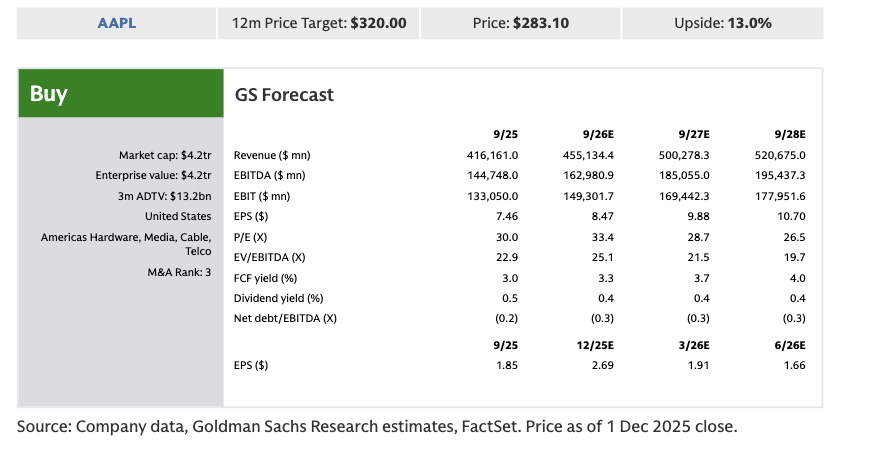
Apple App Store spending cooled in November, dragged down by weakening demand across several of Apple’s largest global markets, which together account for more than half of all App Store revenue.
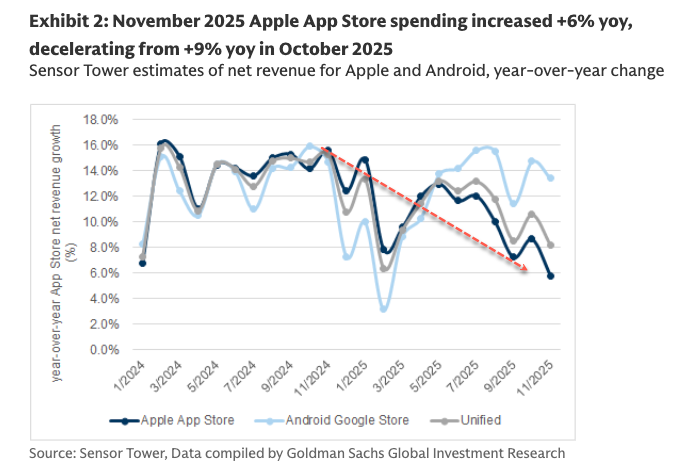
Goldman analysts led by Michael Ng published a note Tuesday citing Sensor Tower data showing Apple App Store spending last month rose just 6% YoY, down from 9% in October and half the growth rate seen in July.
Sensor Tower data showed that Games, the App Store’s largest category (44% of revenue), drove most of the slowdown, falling 2% YoY after growing 3% the previous month.
“Weakening consumer demand for products and services. Apple’s products and services are typically sold to consumers, and any weakness in the macroeconomic environment could reduce demand for Apple products and services,” Ng said.
There was no definitive explanation beyond the softer “macroeconomic environment” for the App Store slowdown.
By geography, four of Apple’s top five markets – the US, Japan, the UK, and Canada – experienced a broad-based slowdown in App Store spending. This raises near-term downside risk and could weigh on App Store revenue.
However, despite slowing App Store spending growth rates, Ng still expects Apple’s F1Q26 Services revenue to meet guidance (14% YoY) because other Service lines – including iCloud+, AppleCare+, Apple Music, Apple Pay, and broader subscriptions – continue to perform well.
Here are the key takeaways from the App Store spending slowdown:
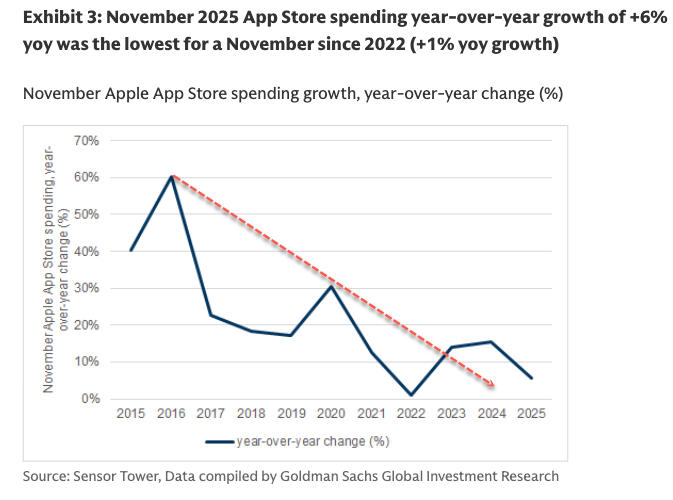
November 2025 App Store net revenue grew +6% YoY, decelerating from +9% in October. November marks the slowest month of 2025 and sits below the 2022–2024 average November growth rate of +10% YoY.
By category, the slowdown was primarily driven by Games (-2% YoY vs. +3% YoY in October), which represent ~44% of total revenue. Among the next largest categories: Entertainment (15% of total) accelerated to +5% YoY (from +4%), while Photo & Video (8% of total) decelerated slightly to +16% YoY (from +17%).
By geography, spending slowed across Apple’s largest markets: the US (36% of total) cooled to +3% YoY (from +8%), Japan (10%) fell to -2% (from +4%), while China (20%) improved slightly to -1% (from -2%).
Notice that the App Store spending slowdown has persisted for much of the year.
Whoops.
Not good.
The question of why consumers are cutting back on gaming apps is a big one. It’s happening across Apple’s major markets, which could point to more financially pressured consumers, smartphone fatigue, or competitive app stores soaking up market share. Whatever the cause, the drop in demand signals Tim Cook will have to take corrective measures heading into 2026.
Tyler Durden
Wed, 12/03/2025 – 13:45
https://www.zerohedge.com/technology/spending-slowdown-hits-apples-app-store-major-markets

¿Por qué Trump quiere expulsar a los inmigrantes somalíes de EEUU? Esto hay que saber
Por The Associated Press
El presidente de Estados Unidos, Donald Trump, calificó a los inmigrantes somalíes que viven en Estados Unidos como “basura” y quiere que se vayan, afirmando sin pruebas que “no contribuyen en nada”.
El mandatario expresó tales calificativos el martes después de que una persona familiarizada con la planificación dijera que las autoridades federales preparaban una operación de control migratorio en Minnesota, centrada principalmente en los inmigrantes somalíes que viven ilegalmente en el país. Casi el 58% de los somalíes de Minnesota nacieron en Estados Unidos. Y de los nacidos en el extranjero, el 87% son ciudadanos estadounidenses naturalizados.
Este es un vistazo a Somalia, que también es uno de los países a los que el gobierno de Trump pausó esta semana todas las solicitudes de inmigración. Cuando se le interrogó en un evento público el miércoles sobre las declaraciones de Trump, el primer ministro del país no hizo ningún comentario.
Más de tres décadas de guerra
Los somalíes han huido de la nación del Cuerno de África durante décadas, desde que la caída del dictador Siad Barre generó enfrentamientos entre caudillos, una guerra civil más amplia y el surgimiento del grupo extremista al-Shabab, vinculado a Al Qaeda.
La inseguridad generalizada ha provocado que millones de somalíes huyan dentro del propio país o a países vecinos. Muchos esperaron durante años en remotos campos de refugiados en lugares como Kenia antes de tener la oportunidad de emigrar a Estados Unidos u otros lugares. Muchos otros permanecen en esos campos.
Dentro de Somalia, la amenaza actual proviene principalmente de al-Shabab, que controla algunas áreas rurales y ataca periódicamente la capital, Mogadiscio, con ofensivas devastadoras. En 2017, un atentado con camión, perpetrado en el corazón de Mogadiscio, mató a más de 100 personas. Otro en 2019 mató a decenas más. Los objetivos también han incluido el palacio presidencial y hoteles.
Durante décadas, no hubo embajada de Estados Unidos en Somalia debido a la inseguridad. La sede diplomática regresó en 2019, ubicándose en un complejo altamente fortificado junto al mar alrededor del aeropuerto de Mogadiscio, donde se encuentran otras oficinas diplomáticas o humanitarias.
En los últimos años, el frágil gobierno federal de Somalia emprendió lo que su presidente califica como una “guerra total” contra al-Shabab. Pero el grupo extremista mantiene su resistencia en medio de la compleja dinámica de clanes del país, y algunas armas llegan desde Oriente Medio a través del golfo de Adén.
La inestabilidad general en Somalia ayudó a crear el fenómeno de los piratas somalíes, quienes a principios de este mes secuestraron un buque comercial en el océano Índico por primera vez en un año y medio, lo que generó temores sobre un resurgimiento.
Para muchas personas, es una lucha por sobrevivir
Aunque Mogadiscio ha mostrado algunos signos de resurgimiento, a menudo impulsados por somalíes que regresan con inversión e ideas, gran parte de la población del país, de aproximadamente 19 millones, enfrenta circunstancias extremadamente difíciles. La inseguridad generalizada ha limitado durante mucho tiempo la reconstrucción y la inversión.
Somalia tiene uno de los sistemas de salud más débiles del mundo, según la Organización Mundial de la Salud y otros socios. Y ahora, donantes de larga data como Estados Unidos y Reino Unido se han retirado, especialmente con el desmantelamiento de la Agencia de los Estados Unidos para el Desarrollo Internacional, realizado este año por el gobierno de Trump.
The Associated Press visitó recientemente los pocos hospitales públicos que quedan en Mogadiscio, a los que algunos somalíes deben viajar durante días para recibir atención. Muchas áreas rurales tienen poca asistencia. Es posible que las que están bajo el control de al-Shabab no tengan ninguna.
Un clima duro y cambiante
A medida que África se enfrenta a mayores afectaciones por el cambio climático, Somalia es uno de los ejemplos más visibles.
Las sequías matan periódicamente a miles de personas junto con los camellos y otros tipos de ganado que ayudan a mantener vivas a las comunidades y las economías. Las inundaciones arrasan los valles fluviales. Los ciclones del océano Índico rugen en la costa, la más larga de África. De vez en cuando, las langostas devoran la vegetación.
“En Somalia, el cambio climático y el conflicto están cada vez más entrelazados”, afirmó el International Crisis Group, señalando que los combatientes de al-Shabab utilizan el acceso al agua como otro medio para “cobrar impuestos” a los residentes de comunidades vulnerables. En algunos casos, durante la sequía más reciente, que duró varios años, al-Shabab destruyó infraestructura hídrica, enfureciendo a las comunidades.
___
Esta historia fue traducida del inglés por un editor de AP con la ayuda de una herramienta de inteligencia artificial generativa.
Lansing educators awarded for heroism during fiery vehicle crash
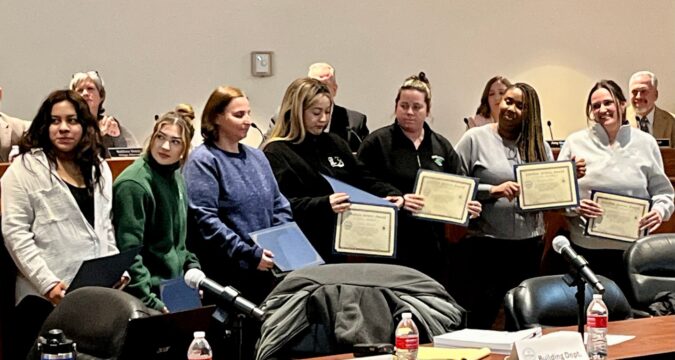
After coming to the aid of high school students involved in a fiery car crash the day before Halloween, eight Lansing Elementary District 158 employees were honored Tuesday at a Village Board meeting.
“It really is a nice collaborative effort of the village to celebrate, you know, people in the community willing to step up and support and care for each other in circumstances when they really don’t have to,” District 158 Superintendent Nathan Schilling said before the educators were honored.
Schilling said a black SUV with three Thornton Fractional South High School students was being driven on Greenbay Avenue Oct. 30 when it crashed head-on into a tree near Lester Crawl Primary Center.
The SUV caught fire, and while the 16-year-old driver and front passenger were able to exit, the student in the back seat was left trapped, Schilling said.
By luck, Schilling said, the crash occurred while the eight Lester Crawl staff members were outside facilitating bus pick up and drop off for students in half-day programs. Paraprofessional Ashley Ellis was able to pull the student out of the back seat while other staff helped the teenagers over a barricade to a grassy area near the school.
Multiple staff members, including Lester Crawl Principal Crystal Briney, kept the students comfortable while contacting their parents, school and first responders. The students in the front of the vehicle only had minor injuries, while the student in the back seat had a broken leg, Schilling said.
Lansing police Chief Alfred Phillips confirmed the driver was issued several citations as a result of the crash.
District 158 Superintendent Nathan Schilling, left, and Lansing village officials give a standing ovation Tuesday to school staff members who helped students involved in a vehicle crash. (Olivia Stevens/Daily Southtown)
A 16-year-old Thornton Fractional High School student crashed an SUV into a tree near Lester Crawl Primary Center on Oct. 30, 2025. (Village of Lansing)
Briney and Ellis along with parent educator Angelique Carrillo, library resource center Director Jean Draves, and paraprofessionals Laci Boshears, Kristen Russell, Chantal Romero and Diana Romero were all honored for their “extraordinary action and heroism” in response to the crash.
Schilling said many of the students who attend Lester Crawl receive special education services and have “some pretty substantial needs” that the recognized staff members work to address every day.
“All we really saw was that same spirit of selflessness and support, just in a different context,” Schilling said. “They certainly didn’t ask for recognition as a result of this, but we thought it was very important to provide that for them.”
Schilling also noted that in spirit of Halloween, the staff members came to the aid of the teenagers while dressed up as characters from the Super Mario Brothers franchise.
“What everybody saw that day, and this only adds to how our students and our families and the community see them, was an emergency being responded to and people being cared for by super heroes,” he said.
Lansing Mayor Brian Hardy lauded the eight district staff as “remarkable individuals” before handing them each Civilian Service Awards, presented for personal assistance by a civilian in apprehending a criminal or taking action to aid people in danger.
Angelique Carrillo, a parent educator who was at Lester Crawl Primary School at the time of the crash, shakes the hand of Lansing police Chief Alfred Phillips during Tuesday’s Village Board meeting. (Olivia Stevens/Daily Southtown)
“Thank you again for being out there, being there at the right time, but also for stepping up and saving someone in need who needed help and support,” Hardy said.
ostevens@chicagotribune.com
https://www.chicagotribune.com/2025/12/03/lansing-educators-heroism-fiery-crash/
Gary council approves incentive pay program for city employees
With about 50 city firefighters and police officers watching, the Gary Common Council unanimously approved an employee incentive pay program at its last meeting of the year.
According to the ordinance documents, incentive payments are available to full or part-time employees who have worked for the city for at least 90 days before Dec. 19, and they must be employed by the city on Dec. 19, when the payments are made. Part-time employees will receive $500 through the program, full-time civil employees will receive $2,000 and public safety employees will receive $7,500.
Incentive pay will come from three TIF revenues, which the Gary Redevelopment Commission has approved, and the casino operating fund. The employee incentive pay budget is more than $3.5 million, according to ordinance documents.
Before the council’s Tuesday vote, Gary Mayor Eddie Melton urged members to approve the program.
“This ordinance is about recognizing the hard work and resilience of our employees during a challenging year, marked by staffing shortages, failing building infrastructure and increased service demands,” Melton said. “Incentive pay acknowledges that despite these challenges, our employees consistently have shown up.”
In 2024, the Gary Common Council approved a similar, more than $2.6 million employee incentive pay program for city employees, using American Rescue Plan Act funds, according to Post-Tribune archives. At the time, Melton told council members that his administration wanted to recognize its employees and ensure they wouldn’t be poached from “other communities to work with their police and fire departments.”
As the Indiana General Assembly’s 2026 session approaches in January, Melton said he’s expecting to see bills that might impact the city’s revenue, and he wants employees to continue to work hard. He also said the goal is for the city to continue to increase its tax base and bring more residents and businesses to the city.
“We want to make sure that folks understand that in order to pay our police and our officers more, which they deserve compared to other reasons and other municipalities, we have to increase that revenue,” Melton said. “But today, we’re using the tools … to make that happen as a gesture to our employees.”
Before the council’s Tuesday vote, Councilman Darren Washington, D-at large, showed his support for the incentive pay program, saying it’s an “excellent opportunity” and use of TIF funds.
“Hopefully, we’ll pass it tonight to show the public safety community that we really appreciate the work that they’re doing,” Washington said.
In a Wednesday morning Facebook post, Melton thanked the council for approving the incentive pay program, saying that the more than 600 city employees are “the backbone of Gary.”
“And to all of our workers: even when people count Gary out, we do what we’ve always done — we fight, we rise, and we keep building,” Melton said in his post. “You are part of history. Together, we are writing the greatest comeback story in American history. Thank you for giving your best to the people of Gary. Let’s keep moving forward — strong, united, and unshaken.”
mwilkins@chicagotribune.com
Alargan condena de estadounidense encarcelado en Rusia por golpear a guardias
MOSCÚ (AP) — Un tribunal ruso alargó el miércoles la condena a un estadounidense encarcelado allí tras ser condenado por golpear a un policía y luego de agredir a guardias de prisión, informaron los medios de comunicación.
Robert Gilman, identificado en los medios rusos como un exmarine de Estados Unidos, recibió inicialmente una sentencia de tres años y medio en 2022 cuando fue condenado por golpear a un policía después de ser sacado de un tren por causar disturbios.
Posteriormente, fue condenado por atacar a un inspector de prisión durante una revisión de celda, golpear a un investigador y agredir a un guardia, y fue sentenciado en octubre de 2024 a ocho años y un mes.
Un tribunal en Voronezh, una región en el suroeste de Rusia donde Gilman está cumpliendo su condena, extendió su pena a 10 años después de que fuera declarado culpable de golpear a dos guardias de prisión.
El diario financiero Kommersant informó que Gilman se declaró culpable de los cargos y se disculpó con los guardias a los que se le acusó de agredir. El periódico dijo que explicó sus acciones diciendo que quería permanecer en la prisión donde estaba cumpliendo su condena y evitar ser trasladado a otro penal.
Gilman es uno de los pocos estadounidenses que permanecen detenidos en Rusia después de una serie de intercambios de prisioneros de alto perfil en los últimos años.
___________________________________
Esta historia fue traducida del inglés por un editor de AP con ayuda de una herramienta de inteligencia artificial generativa.

Building off nice growth spurt, senior guard Nathan Palmer picks up pace for Geneva. ‘Just had to be patient.’
Coming from an athletic family, Geneva’s Nathan Palmer had reason to believe in himself.
Four games into the 6-foot guard’s senior season, he’s demonstrating why.
Last week, Palmer averaged 14.7 points over three games and was named MVP of the Bob Schick Thanksgiving Tournament, a step up from his role last winter coming off the bench
“I was in the weight room a lot this past offseason,” Palmer said. “I just worked on my game a lot, practicing to make sure I got my shot right. I knew my time was coming.
“I just had to be patient with the work.”
Palmer kept it going Tuesday night, scoring a game-high 14 points in little more than a half as the Vikings cruised to a 50-34 nonconference victory over visiting Bartlett.
Geneva’s Nathan Palmer (3) steals the ball and races away from Bartlett’s Joey Cwik during a nonconference game in Geneva on Tuesday, Dec. 2, 2025. (Jon Langham / The Beacon-News)
Making his presence felt all over the floor, Palmer grabbed three rebounds, picked up three steals and dished out three assists for Geneva (4-0).
“That’s what I’m trying to do,” Palmer said. “I want to be an all-around player. Helping out with rebounding has been a big emphasis. (Coach Scott) Hennig has been telling everyone, ‘Just go in and crash the boards.’ On steals, I just try to be aggressive.”
Two of those assists came on feeds that 6-7 senior forward Kyle Suger put down for dunks.
“Coach always says strength to the basket and he’s right,” said Suger, who’s not averse to shooting a 3-pointer either. “I’m 6-7. If I’m open, I’ll shoot it, but my strength is going to the basket to get some dunks. It’s great, gets the crowd into it.”
Geneva’s Kyle Suger (11) dunks the ball in the second quarter against Bartlett during a nonconference game in Geneva on Tuesday, Dec. 2, 2025. (Jon Langham / The Beacon-News)
The dunks helped fuel a 14-0 run for Geneva that extended a 5-3 edge to a 19-3 advantage on the way to a 27-7 halftime lead.
Junior guard Joey Cwik scored 10 points for the struggling Hawks (0-4), who were overmatched.
And twice, Palmer made a steal and took it in for a layup the other way.
“He does a great job of passing the ball, shooting the ball,” Hennig said of Palmer. “He’s just gotten stronger and quicker. He’s grown. About 18 months ago he was probably 5-8 or 5-9.
Geneva’s Gabe Jensen (2) puts up a shot over Bartlett’s Anderson Maloche during a nonconference game in Geneva on Tuesday, Dec. 2, 2025. (Jon Langham / The Beacon-News)
“He’s a late bloomer, but a really good basketball player and I think he’s shown that in the last few games.”
Palmer’s parents were both college athletes. His dad, Shaun, pitched for Troy’s baseball team. His mom, Melissa, played soccer at Northern Illinois. But, according to Hennig, “it’s a basketball family.”
Nathan’s oldest sister Kate, a recent Illinois Wesleyan graduate, played four years in college. His sister, Leah, is a redshirt freshman playing for Lewis.
“They were a big influence on me,” Nathan said. “They both killed at Geneva.”
Nathan, who gave up baseball in eighth grade to focus on AAU basketball in the summer, plays for Mercury Elite and would like to follow suit at the next level.
“It’s what I want to do, we’ll see what comes,” he said.
Geneva’s Nathan Palmer (3) drives against Bartlett’s Brandon Pelz during a nonconference game in Geneva on Tuesday, Dec. 2, 2025. (Jon Langham / The Beacon-News)
Sugar has noticed his friend’s improvement.
“We’ve played together since fourth grade,” Sugar said. “I remember back in the day, he was always the shortest guy on the team but it never held him back. He was really shifty, great scorer.
“His height now helps him get more shots over people and helps with his defense, so I’m not shocked it’s happening for Nate.”
Palmer believes Geneva has the all-around talent that could carry this team far as well, with three senior starters back in guards Dane Turner and Gabe Jensen and post Ben Peterson.
His role will be even more important than last season, when the Viking finished 29-5.
“He was our eighth or ninth guy,” Hennig said. “He’s just a basketball guy. He works and works and works and he’s gotten taller and stronger. Skill-wise, he’s fantastic. He does what he’s asked.”
https://www.chicagotribune.com/2025/12/03/nathan-palmer-geneva-bartlett-ihsa-boys-basketball/

Bruce Dold, former Chicago Tribune editor and ‘consummate newspaperman,’ dies at 70
Bruce Dold, who rose from suburban reporter to editor and publisher during his prodigious four-decade career at the Chicago Tribune, had only a handful of bylines after his name took its place on the masthead.
But the Pulitzer Prize-winning journalist left an indelible mark on the newspaper and the city, tackling the issues of the day, promoting civil discourse and influencing public policy.
From clearheaded editorials that found common ground to the groundbreaking endorsement of Chicago’s own Barack Obama for president, Dold led the Tribune into the new millennium with a reverence for the newspaper’s storied history, and an open mind for the future.
Dold even took on the ultimate challenge of balancing journalism and business interests in a dual editor-publisher role as the newspaper industry grappled with declining revenue and downsizing in the digital media age.
“He was really the consummate newspaperman,” said Tribune writer Rick Kogan, a colleague, friend and regular golfing buddy of Dold’s. “His passion for the Chicago Tribune was immense and unwavering.”
A longtime resident of west suburban La Grange Park, Dold, 70, died Wednesday after a four-year battle with esophageal cancer.
A New Jersey native, Dold came to the Midwest in 1973 to attend Northwestern University, where he decided to pursue a career in journalism. Inspired by the powerful reporting that broke the Watergate scandal and brought down President Richard Nixon’s administration, he earned his bachelor’s and master’s degrees at the Medill School of Journalism.
In 1978, he joined the Chicago Tribune, starting as a reporter for the Suburban Trib before moving on to the flagship newspaper, where he primarily covered politics. Among his reporting highlights, Dold cited the power struggle of the Council Wars, as they were dubbed, following Chicago Mayor Harold Washington’s 1987 death.
“While the city was in grief, all the aldermen were scurrying around and trying to pick a puppet who was going to run the city for them,” Dold told the Tribune upon his elevation to editor in 2016. “It was the richest story I’ve ever seen in my life, and I got an opportunity to do that because I worked for the Chicago Tribune.”
Former Northwestern University spokesperson Alan Cubbage, who attended Medill’s Master of Science in Journalism program with Dold in 1978, competed against his former classmate in the suburbs while working for the Daily Herald.
He remembers the younger Dold as a friendly fellow graduate and a dogged reporter.
“One of the reasons I left journalism is I kept getting scooped by Bruce Dold,” Cubbage said. “He was just a really good reporter who had lots of sources and covered the beat really well, and it was always kind of tough to go up against him.”
Dold joined the Tribune’s editorial board in 1990, starting on a path that would lead him to the top of the Tribune’s masthead, and of his profession. In 1994, Dold earned the Pulitzer Prize for editorial writing for his series on the murder of a 3-year-old boy by his abusive mother and the failure of the Illinois child-welfare system to save him.
Chicago Tribune editorial writer Bruce Dold is congratulated April 12, 1994, after winning the Pulitzer Prize for editorial writing on the subject of violence against children. (Chris Walker/Chicago Tribune)
The editorials, which accompanied a yearlong newsroom exploration of the circumstances behind Joseph Wallace’s death – itself a Pulitzer finalist for public service journalism – catalyzed new legislation in Illinois to protect children from abuse and neglect.
At the time of his award, Dold praised the newsroom in a Tribune story celebrating the honor.
“Sometimes the best stuff we do on the editorial board is kind of piggybacking on the best reporting that goes on in the newsroom,” Dold said. “This was a case of it.”
Dold was named editorial page editor in 2000, guiding the Tribune’s opinion page. One of his first moves was replacing his vacant slot on the editorial board. He didn’t have to look far, hiring John McCormick, a friend, neighbor and carpooling buddy who previously served as Midwest bureau chief of Newsweek.
“Fortunately for me, his worldwide search only extended four blocks from his house,” said McCormick, who became deputy editor in 2001, and eventually succeeded Dold as editorial page editor.
In 2001, Dold wrote a piece explaining what he believed to be the editorial board’s mission.
“We should have a sense of civic commitment, but shouldn’t assume government has all the answers,” Dold wrote. “I believe the newspaper is one of the few places that has the independence and the influence to demand that government be accountable to the governed.”
Those guiding principles served the Tribune editorial board under Dold’s leadership, winning a Pulitzer in 2003 and earning finalist honors in 2009, 2010 and 2011.
In 2008, Dold steered the editorial board into uncharted political waters when it endorsed Chicago’s own Barack Obama for president, marking the first time in the Tribune’s history that the paper — a founding voice of the Republican party — backed a Democrat for the highest office in the land.
The editorial board also endorsed Obama for reelection in 2012, praising Obama’s “steadiness” in leading the country out of an inherited recession, among other accomplishments.
“It was a big deal for the paper,” McCormick said. “Bruce was the prime mover on those endorsements, both of them, that’s unarguable to anybody who was in the room.”
For years, that room was a stately, wood-paneled office on the fourth floor of the century-old neo-Gothic Tribune Tower, where politicians, titans of industry, celebrities and other leaders would gather around a large hexagonal table with rich leather inlays while seeking the support of the editorial board, under the watchful eye of an Abraham Lincoln portrait.
Everyone from Donald Trump and Bill Clinton to Obama sat in green leather chairs at that table with Dold during their respective presidential campaigns.
“Bruce made a lot of politicians squirm in that room, always in a quiet voice,” McCormick said.
Making your case before Dold for a favorable Tribune editorial inside Chicago’s erstwhile cathedral of journalism could, at times, be an intimidating endeavor, according to Guy Chipparoni, a politically connected public relations consultant.
“He would sit there with John McCormick to his left, their hands folded on the table, and he’d just say, ‘you may begin,’” Chipparoni said. “He was as warm as he could be, but it was like meeting with the College of Cardinals.”
Beyond the editorial boardroom, Dold faced a greater challenge after Tribune Co. emerged from Chapter 11 bankruptcy and spun off its publishing division in 2014, ushering in a series of ownership changes.
In February 2016, two weeks after technology entrepreneur Michael Ferro became the largest shareholder and chairman of Tribune Publishing, Dold was elevated to editor-in-chief at the Chicago Tribune.
Dold soon added the dual role of publisher, leading the Chicago Tribune through tumultuous times as it navigated the rapidly changing media landscape. That meant downsizing editorial operations amid declining revenues at the newspaper.
McCormick, who became editorial board editor when Dold was promoted, described his longtime friend and colleague as being caught in a “pincerlike assault” between the business and journalism sides of the industry.
These were not the best of times for the Tribune or Dold, but it was a responsibility he bore while nurturing young journalists, staying engaged and keeping a steady hand at the helm.
Chicago Tribune Editor-Publisher Bruce Dold on his final day in the Tribune offices, April 30, 2020. (Peter Tsai/Chicago Tribune)
His 42-year career at the Chicago Tribune came to an abrupt end in February 2020 after investment firm Alden Global Capital bought out Ferro’s stake and became the controlling shareholder of Tribune Publishing.
Emblematic of the changes, the Chicago Tribune exited Tribune Tower in 2018, and the Michigan Avenue landmark has since been converted into million-dollar condos. The editorial board subsequently moved with an itinerant newsroom to Prudential Plaza, the now-demolished Freedom Center printing plant and its current home on West Jackson Boulevard in the Loop.
Chris Jones, the Tribune’s longtime theater critic, who added the role of editorial page editor in 2021, oversees a downsized four-member editorial board, which holds court in more modest accommodations.
“Bruce had a commanding presence, and it’s not easy to live up to,” Jones said. “I think he also had a kind of a moral sensibility, and that is also something that we try to live up to on a daily basis.”
While in hospice care in recent weeks at his daughter Kristen Christman’s house in Winnetka, Dold received an outpouring of letters from former colleagues, friends and people he knew over his long career.
Among the letters was a handwritten note from former President Obama.
“It was the most beautiful letter I’ve ever read,” said Megan Dold, his daughter. “He said, ‘you were always a terrific journalist (even when you were after me), and that kind of integrity is sorely missed these days.’ It was amazing. He took a lot of comfort in that.”
Kogan said Dold never lost the “insatiable curiosity” that made him a good newspaperman. But more than anything, Kogan said, he was simply a good man.
Outside the newsroom, Dold, a former college DJ, loved music of all kinds, from Billie Holiday to the Grateful Dead, with an expansive record collection numbering in the thousands. But the New Jersey native had a special place in his heart for Bruce Springsteen, bringing his wife and daughters to see the Boss perform at Wrigley Field in August 2023.
“He loved Bruce Springsteen,” Megan Dold said. ”He was very proud to be from New Jersey. It was Bruce and Bruce. He knew every lyric.”
Dold was also an avid golfer and devoted family man, who took his wife, Eileen, and two young daughters to the White House when he won the Pulitzer Prize, and somehow managed to make it home for dinner most nights, despite the demands of his career, Megan Dold said.
In recent years, he reveled in being a grandfather, spending his last weeks surrounded by family.
“His grandkids were his pride and joy, and even while he was in bed, they’d come and play checkers with him,” said Kristen Christman.
He is survived by his wife, two daughters and five grandchildren.
“The thing about Bruce I will always remember is that he was a human being before he was an editor,” Kogan said. “His great gift, I think, was his humanity.”
A memorial service is scheduled for 10 a.m. on Dec. 12 at St. Francis Xavier Catholic Church in La Grange.
rchannick@chicagotribune.com
https://www.chicagotribune.com/2025/12/03/bruce-dold-tribune-obituary/
“Deckchairs” On The Titanic?
“Deckchairs” On The Titanic?
By Michael Every of Rabobank
The conclusion to yesterday’s Global Daily was that we are still in a systemic metacrisis. True, many market metrics don’t show it – but how many deckchairs told the Titanic’s passengers they were heading for the iceberg? Markets have a vital role, as do chairs, but expecting them to reflect the potential enormity of what’s going on could end up with you being in very cold water.
Here are two recent headlines to send a shiver down spines: ‘Fear and loathing come for Bitcoin as big investors ponder selling’ (Australian Financial Review); and, ‘It’s time to sound the alarm on growing fiscal and financial risk’ (Financial Times) as “Rising public debt is one concern – another is how it is being financed.” Of course, things look healthier in other areas.
Let’s continue with central banking. The RBA Governor said rates might have to go back up if inflation does. Who knew? Not the RBA or the markets reassured by its projections. Trump says he’ll nominate the next Fed Chair in early 2026’: it seems Hassett is frontrunner. That opens the door to new Fed purpose as well as personnel. Markets are slow to grasp the full implications.
Russia said talks with the US about a Ukraine peace plan were “constructive”, but “no compromise” had been reached on territorial issues. However, we see serious concerns this ends up in an ugly –and expensive– deal which weakens Europe. Pressure is also increasing for NATO to spend more, faster: but with whose money? The European Commission is making a late offer to win Belgian backing for its Russian asset loan scheme, which the ECB is refusing to back – critics argue it’s a de facto asset confiscation that could damage Europe’s reputation as well as ensuring there’s no peace deal. It is, in effect, ‘victor’s terms’ when Europe has won nothing.
Worse, in response to Europe’s hardline political rhetoric and slimline actions, Putin warned that he doesn’t want war, but if Europe does, Russia is ready – and will defeat it. That’s as Ukrainian drones attacked their third Russian shadow fleet ship this week and Putin stated he will retaliate against Ukrainian shipping and those countries helping it, i.e., Europeans. There’s little middle ground between those two outcomes, but markets are assuming a geopolitical median.
Meanwhile, Europe bewails it “would have given almost anything for peace, but Beijing had a different calculus” – including siding with China vs. the US (where The Economist says ‘Trumpworld thinks Europe has betrayed the West’ – watch Macron in China for more on that ahead); and India, which the EU wants to build deeper ties with as a counterbalance, just ratified a strategic defence partnership with Russia.
The Honduran election currently has the centrist candidate whom Trump didn’t want to win ahead, promising fireworks(?) We are all waiting to see what happens in Venezuela. US lawmakers say they will force a vote on the War Powers Act if Trump attacks it, but the current -anti-terror designation may be workaround – and Trump just said any country trafficking drugs into US could be attacked. That includes a few famous names.
Trump signed a bill to deepen US-Taiwan ties, as the island’s opposition party blocked government plans to increase defence spending. That’s as tensions between Japan and China over PM Takaichi’s recent comments continue to remain high. Even the 1951 San Francisco Peace Treaty between the US and Japan is being drawn in –China publicly rejecting it– with potentially worrying parallels to the historical legalese heard around the Russia-Ukraine issue before February 2022. If peace treaties are no longer valid, borders can only be set by threat of or actual force.
That’s as a new Chinese naval flotilla, including an assault ship, is in the Philippines Sea and may be heading for Australia, the latter armed with dangerously high house prices. If you think markets are pricing for these kind of grey rhino risks —how?!— ask your trader or broker what their view of the 1951 San Francisco Peace Treaty is. I’m sure it will be enlightening.
In the Middle East, a new Israel – Hezbollah confrontation appears worryingly close. Whether that spreads to Iran remains to be seen: ‘optimists’ suggest it’s a story for 2026. Markets are better at pricing those kind of oil risks and seem relaxed so far.
In geoeconomics, floods in Thailand have paralyzed IT goods trade flows globally; US Treasury Secretary Bessent praised Bank Santander for pulling its credit lines from oil trader Gunvor following US claims that the firm, now with new leadership, was a ‘Kremlin Puppet’; Costco is suing the Trump admin for “full refund” on its tariffs, upping the ante; Macron wants to rebalance trade with China as it floods Europe with imports —how?– as German firms are doubling down on their investments in China; China’s state media boasted its “dirt cheap” hypersonic missiles could upend global defence markets; and Russia said it’s ready to address India’s concerns over their massive bilateral trade deficit – see how trade deals and defense pacts go together?
In the (political!) economy, Michael Dell donated $6.3bn for ‘Trump Accounts’ for children – patriotism, or akin to EM billionaires whose governments ‘encouraged’ them to ‘share the load’? The Trump admin also took a $150M stake in chip startup, a once shocking headline already becoming normalized. Yet overlooked by markets, because it isn’t a number on a Bloomberg screen, China’s local government debt has reportedly risen to $18.9tn, implying total public debt to GDP is far above 200% and rising, vs. the US’ ≈100% and rising, with China’s private sector debt also around 200%, as in the US. That underlines *China’s structural* necessity to maintain capital controls and a vast, neo-mercantilist trade surplus. The FT touched on that recently; then it moved on to play with the next shiny bauble rather than nailing down the ensuing logical conclusions as principles for its flow of policy recommendations. But their deckchair has a wonderful rear view.
In (economic!) politics, two former EU political heavyweights, Mogherini and Sannino, are in custody over a fraud probe. The UK is mulling a ban on crypto cash in politics, which will put Reform UK’s Farage in the firing line; the UK’s now-headless Office of Budget Responsibility said it had warned the Treasury over budget ‘misconceptions’ (like a deficit being a surplus); and UK jury trials are to be scrapped for crimes with sentences of less than three years, reversing ancient precedent, to make the trial process 20% faster. In France. ‘Macron denies ‘Ministry of Truth’ plan in standoff with far right’ (Euractiv). In the US, a new immigration crackdown and perhaps a global travel ban loom. India’s government is demanding the installation of state apps on all smartphones; and ‘China looks to AI and big data to guard against Western values’ (SCMP), as Xi “tells Politburo that new technology should be applied to promote socialist ideology.” How do markets price for all the above – or do none matter(?)
To conclude, even if some deckchairs are collapsing, we can continue to sit comfortably on most of them for now. However, that doesn’t mean we shouldn’t be thinking about the direction of travel and what may lie ahead of us. It isn’t an iceberg per se, and there will be both upsides and downsides. Just don’t assume it will be plain sailing.
Tyler Durden
Wed, 12/03/2025 – 13:25

Partido de Milei se empodera en Cámara de Diputados para segundo tramo de su mandato
Associated Press
BUENOS AIRES (AP) — Luego de transitar la mitad del mandato con poco peso en el Congreso, el partido La Libertad Avanza del presidente Javier Milei se convirtió el miércoles en la primera minoría de la Cámara de Diputados, lo que le permitirá bloquear intentos de juicio político y avanzar en reformas clave para su programa económico.
La nueva composición de la cámara baja quedó confirmada con la asunción de 127 diputados electos en los comicios legislativos del 26 de octubre en los que Milei se impuso en la mayoría de los 24 distritos del país sudamericano.
El partido gobernante conformó un bloque de 95 legisladores, 16 más de los que tenía antes de la votación, lo que le permitió desplazar al opositor peronismo —con 94 congresistas— como primera minoría en Diputados. El oficialismo alcanzó el número la víspera luego de que cuatro legisladores electos por otras fuerzas políticas se sumaran a su bloque.
Milei, que siguió exultante la jura de sus diputados desde un palco del recinto, había asumido en 2023 con apenas un puñado de senadores y diputados. El oficialismo pagó esa debilidad con resonantes derrotas legislativas que frenaron el impulso reformista del mandatario ultraliberal y pusieron en duda el éxito de su plan económico promercado.
Al convertirse en primera minoría en Diputados el oficialismo puede bloquear cualquier intento de juicio político contra Milei y sostener los vetos presidenciales. A su vez, con la suma de los legisladores de otras fuerzas políticas afines podrá reunir los 129 diputados necesarios para el quórum que habilita las votaciones.
El presupuesto nacional para 2026 y las reformas laboral y del Código Penal son los proyectos que el oficialismo confía en debatir durante el período extraordinario de sesiones que comenzará el 10 de diciembre.
“Libertad, Libertad”, cantaron los nuevos legisladores guiados por Milei, que agitaba los brazos.
En el Senado, el oficialismo también amplió sus bancas —de siete a 19—, pero no pudo arrebatarle al peronismo la primera minoría.
El otro dato color de la jornada lo aportaron los nuevos diputados del peronismo de centroizquierda, que al momento de jurar pidieron por la libertad de la expresidenta Cristina Fernández (2007-2015), quien cumple en prisión domiciliaria una condena de seis años por corrupción.

Felon left loaded gun in car at Naperville bowling alley, police say
A convicted felon who allegedly left a loaded handgun in his car while at a Naperville bowling alley was arrested on felony charges by Naperville police.
Asante Glover, 35, of Chicago, will remain in the DuPage County jail while awaiting trial on one count each of unlawful pssession of a firearm by a repeat felony offender and unlawful possession of a weapon by a felon-prior conviction, a news release from the DuPage County state’s attorney’s and Naperville Police Department said.
Naperville police doing a routine check of the parking lot at the Lucky Strike Naperville at 1515 Aurora Ave. about 9:05 p.m. Nov. 28 and saw a silver gun protruding from beneath the driver’s seat of a Mercedes SUV, the release said.
When the driver, later identified as Glover, returned about 11:35 p.m., the officers stopped him, made him get out of the SUV and recovered a loaded Glock .45-caliber handgun with a bullet in the chamber and a fully loaded magazine, the release said.
“The law is very clear, as a convicted felon Mr. Glover is prohibited from legally owning a firearm,” State’s Attorney Robert Berlin said in a statement. “What I find particularly disturbing in this case is the allegation that Mr. Glover was in possession of a loaded firearm at a family-friendly recreation facility during an extremely busy holiday weekend.”
Glover’s next court appearance is scheduled for Dec. 18.
https://www.chicagotribune.com/2025/12/03/bowling-alley-gun-naperville-felon/