Category: News

Putin llega a Nueva Delhi en visita oficial para fortalecer lazos entre Rusia e India
NUEVA DELHI (AP) — El presidente ruso Vladímir Putin aterrizó en India el jueves en una visita de estado destinada a fortalecer los lazos bilaterales y económicos entre los dos países.
El primer ministro indio Narendra Modi recibió al líder ruso en un aeropuerto de Nueva Delhi, dándole un abrazo de oso y un apretón de manos firme con el entusiasmo de un viejo amigo.
Modi será el anfitrión de Putin para una cena privada esta noche en su residencia oficial decorada.
El viernes, los dos líderes mantendrán conversaciones como parte de la 23ª Cumbre India-Rusia y discutirán el fortalecimiento de la cooperación económica, principalmente en defensa, energía y la movilidad de mano de obra calificada.
La visita de Putin se produce en un momento sensible de la política global, cuando hay un renovado impulso por parte de Estados Unidos para un acuerdo de paz que ponga fin a la guerra entre Rusia y Ucrania. La visita pondrá a prueba los esfuerzos de Nueva Delhi para equilibrar las relaciones con Moscú y Washington mientras la guerra en Ucrania, que lleva casi cuatro años, continúa.
Putin visitó India por última vez en 2021. Modi estuvo en Moscú el año pasado, y los dos líderes se reunieron brevemente en septiembre en China durante una cumbre de la Organización de Cooperación de Shanghái.
___________________________________
Esta historia fue traducida del inglés por un editor de AP con ayuda de una herramienta de inteligencia artificial generativa.
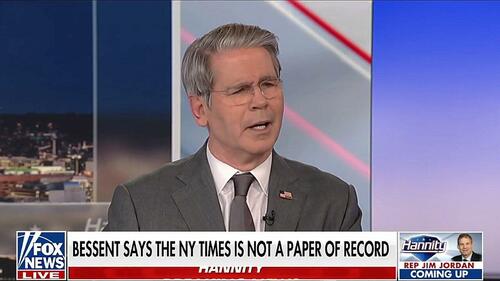
Treasury Boss Bessent Nukes NYT Hypocrisy Over Desperate Trump Health Smears
Treasury Boss Bessent Nukes NYT Hypocrisy Over Desperate Trump Health Smears
Authored by Steve Watson via Modernity.news,
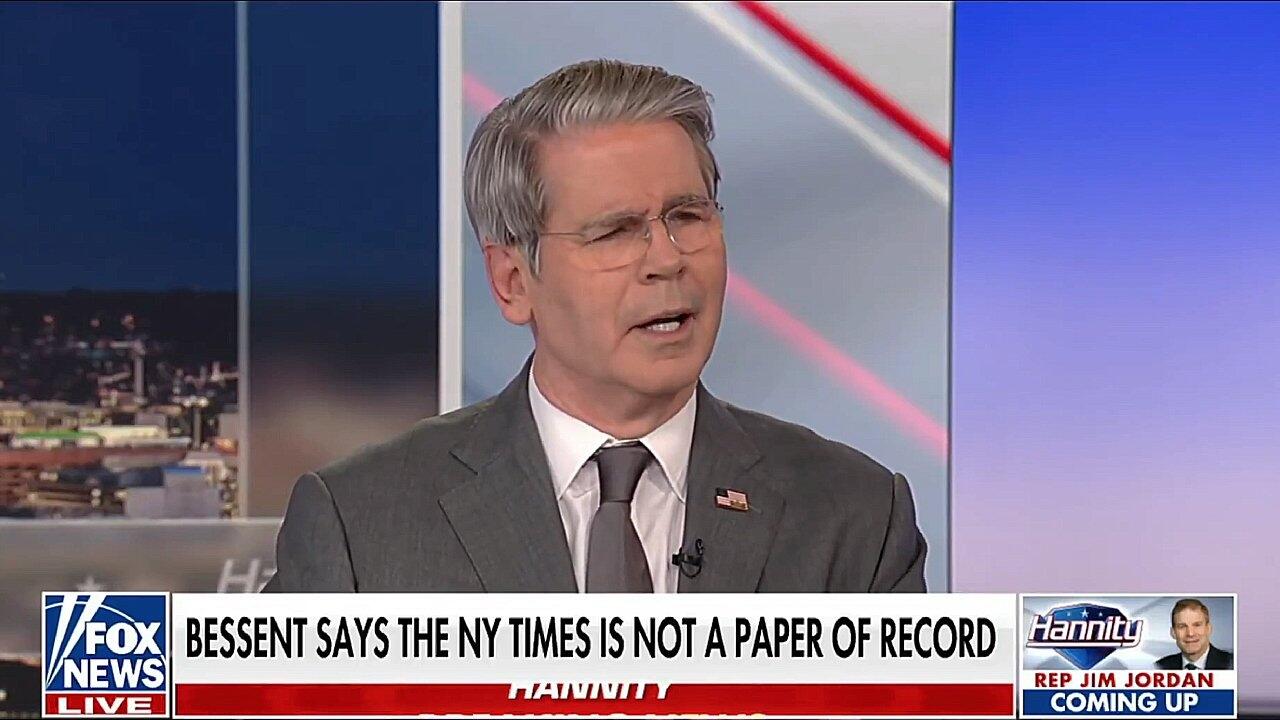
Treasury Secretary Scott Bessent delivered a brutal takedown of legacy media frauds Wednesday, calling out The New York Times for their shameless double standard on presidential fitness.
Fresh off a three-hour cabinet marathon with President Trump, Bessent faced down a Times hack at their own summit and laid bare the hypocrisy. The same outlet that buried Joe Biden’s dementia for years now peddles baseless panic about Trump’s vigor.
It’s the latest desperate ploy from a press corps still seething over their 2024 election wipeout, desperate to undermine a leader who’s delivering on all fronts.
? BREAKING: In a mic drop moment, Sec. Scott Bessent just PUMMELED the NYT to their faces for a HUGE double standard on Donald Trump’s health
“WHERE was the New York Times? We just had a 3 hour cabinet meeting yesterday!”
“For 10 MONTHS Biden did not have a cabinet meeting.… pic.twitter.com/HyPWjPWFUF
— Eric Daugherty (@EricLDaugh) December 3, 2025
The fireworks erupted Tuesday at the NYT’s glitzy DealBook Summit, where Bessent squared off against financial columnist Andrew Ross Sorkin. Sorkin, parroting his paper’s latest hit piece “Signs of Fatigue: Trump Faces Realities Of Aging in Office”, tried to corner Bessent on Trump’s supposed “mental decline” and reduced visibility. Big mistake. Bessent didn’t flinch—he fact-checked the fraud live on stage.
“You had what was one of the greatest scandals of all time, that the coverage of the Biden administration, Joe Biden’s diminished capacity, and the cover up. And that’s why it’s probably fair to raise these questions. Where was the New York Times? We just had a three-hour cabinet meeting yesterday, Andrew.”
He didn’t stop there, dismantling the 25th Amendment fever dreams, noting “For ten months, the Biden administration did not have a cabinet meeting… How are you going to invoke the 25th Amendment if the cabinet secretaries never see the president, which they didn’t?”
“I hear from people in the Treasury Building that I see President Trump more in a day than my predecessor saw Joe Biden in half a year!” Bessent urged while Sorkin squirmed, mumbling about “fair questions.”
Post-summit, Bessent doubled down in a further interview, admitting the Times’ lies hit him like a freight train. He couldn’t let it slide—not when the “paper of record” was torching its own credibility in real time.
“He immediately went into attack and gotcha mode! I couldn’t take the hypocrisy,” Bessent declared.
? NOW: Scott Bessent says he COULDN’T TAKE the New York Times lying to his face on stage – “So I just had to fact-check him!”
“He immediately went into attack and gotcha mode! I couldn’t take the HYPOCRISY.” ?
“He just played to the audience…the NYT are so far from the… https://t.co/i1IGBfZFWp pic.twitter.com/nNMnLDNZvD
— Eric Daugherty (@EricLDaugh) December 4, 2025
“He just played to the audience…the NYT are so far from the truth,” Bessent continued, noting “How are people gonna construct the narrative of this second Trump presidency when the supposed ‘paper of record’ is so far off?!”
Bessent also described Trump’s unbreakable stamina, relating “He’ll call me, ‘Scott, I didn’t wake you, did I?’ No, sir, I’m always awake at 1:52AM on a Tuesday!”
He added, “We did the trip to Alaska. We did a round trip one day, and we arrived back…our batteries are out. We land at Andrews, and the president’s like, ‘oh, it’s morning in Europe now.’ I think we had spent probably 20 hours in the air in Alaska. And he said, ‘let’s start making phone calls and call the European leaders!’ So we had to sit on the tarmac for two more hours while he made phone calls!”
? JUST IN: Scott Bessent PUMMELS the media for latching on to the theory that Donald Trump’s health is “deteriorating”
“He’ll call me, ‘Scott, I didn’t wake you, did I?’ No, sir, I’m always awake at 1:52AM on a Tuesday!” ?
“We did the trip to Alaska. We did a round trip one… pic.twitter.com/4dwZnCXtLM
— Eric Daugherty (@EricLDaugh) December 4, 2025
“He never stops working for the American people. And it’s incredible,” Bessent urged.
Democrats and their media allies spent four years gaslighting the nation about Biden’s “sharp as a tack” facade, even as he shuffled through pressers like a man who’d lost his mind.
Now, with Trump back in the Oval Office acing cognitive tests and grinding 20-hour days, the smears fly: fatigue, decline, 25th Amendment whispers.
Trump himself torched the “crazy lunatics” in the press room, ranting: “I sit here and do four news conferences, I answer questions from very intelligent lunatics– you people.”
He mocked their flip, noting “You always find something new. Like, ‘Is he in good health? Biden was great, but is Trump in good health?!’ YOU PEOPLE ARE CRAZY!”
White House doctors backed him up with October MRI results showing “perfectly normal” cardiovascular health—no abnormalities for a 79-year-old. Press Secretary Karoline Leavitt hammered it home, noting Trump’s “the most accessible president in history,” spotted “almost every single day.” Meanwhile, Biden’s crew dodged press for eight months straight, peddling “cheap fakes” excuses for his vacant stares.
CNN’s Scott Jennings piled on, nailing the Democrats’ gall in a viral clip. “It’s astonishing, frankly, that Democrats have the gall to push conspiracies about President Trump’s health after the Biden cover-up. Sorry to disappoint Democrats, but I was in the Oval Office recently — there is nothing wrong with this man,” Jennings stressed.
“This is an attempt to create a narrative that doesn’t exist because Democrats are so butthurt living through the White House claiming Biden was fine,” Jennings asserted, adding “They want to transfer that to Trump.”
It’s astonishing, frankly, that Democrats have the gall to push conspiracies about President Trump’s health after the Biden cover-up.
Sorry to disappoint Democrats, but I was in the Oval Office recently — there is nothing wrong with this man. pic.twitter.com/kByIPFS8R9
— Scott Jennings (@ScottJenningsKY) December 2, 2025
Your support is crucial in helping us defeat mass censorship. Please consider donating via Locals or check out our unique merch. Follow us on X @ModernityNews.
Tyler Durden
Thu, 12/04/2025 – 09:00

Solicitudes de beneficios por desempleo en EEUU caen a su nivel más bajo desde septiembre de 2022
Por MATT OTT
WASHINGTON (AP) — Las solicitudes de beneficios por desempleo en Estados Unidos cayeron a su nivel más bajo en más de tres años la semana pasada, lo que podría complicar la próxima decisión de la Reserva Federal sobre las tasas de interés.
El número de estadounidenses que solicitaron beneficios por desempleo para la semana que terminó el 29 de noviembre cayó a 191.000 desde los 218.000 de la semana anterior, informó el jueves el Departamento de Trabajo. Ese es el nivel más bajo desde el 24 de septiembre de 2022, cuando las solicitudes fueron de 189.000. Los analistas encuestados por el proveedor de datos FactSet habían pronosticado solicitudes iniciales de 221.000.
Las solicitudes de ayuda por desempleo se consideran un indicador de los despidos y son un reflejo casi en tiempo real de la salud del mercado laboral. Los despidos anunciados recientemente por grandes empresas como UPS, General Motors, Amazon y Verizon suelen tardar semanas o meses en implementarse por completo y pueden no reflejarse en los datos del jueves.
El promedio de cuatro semanas de solicitudes, que suaviza parte de la volatilidad semanal, cayó en 9.500 a 214.750.
El número total de estadounidenses que solicitaron beneficios por desempleo para la semana anterior que terminó el 22 de noviembre disminuyó en 4.000 a 1,94 millones, informó el gobierno.
___________________________________
Esta historia fue traducida del inglés por un editor de AP con ayuda de una herramienta de inteligencia artificial generativa.

Valparaiso’s Maddux Wagner continues to grow. The 6-foot-8 junior ‘has a great future ahead of him.’
The operative word for Valparaiso junior Maddux Wagner is “growth.”
The 6-foot-8 guard/forward has sprouted up 5 inches since the end of his freshman year. Meanwhile, Wagner began last season on the junior varsity team but became a full-time varsity player after scoring 16 points in a start against Lake Central on Jan. 24.
Valparaiso coach Ben Lieske has seen even more from Wagner.
“Just stay ready, stay locked in, cheer on your teammates — that’s a big step in the right direction for him,” Lieske said. “That humility is one of the reasons why he’s grown so much. He’s such a talented basketball player, and he’s willing to step up in any way. One of the things I love about him is just what a humble person he is.
“But he’s also hardworking. He gets in early to get shots up, or he stays late. He’s not afraid to have a game where he’s not getting a lot of points but he’s just cheering his teammates on. That’s pretty admirable too.”
Of course, that doesn’t mean Wagner can’t put up numbers. He averaged 7.5 points and 7.1 rebounds last season, with most of that production coming in the final month-plus.
“We couldn’t keep him off the floor because he was too valuable,” Lieske said. “It took me a while to realize it, but I finally figured it out. He was one of the keys to our success throughout the end of that season.”
That will be even more true this season. He posted 18 points and six rebounds during the Vikings’ season-opening overtime win at West Side on Nov. 26.
“He’s only continued to grow with that success,” Lieske said. “He had a great summer with us and in his AAU season. He’s getting the attention of college coaches. He’s had them in here all fall looking at him, at the NAIA and DI level.
“He has a great future ahead of him because he’s humble, he’s a hard worker and he’s a team-first player — and he can shoot from the outside.”
Wagner looks back at last season as a turning point.
“All season, I just slowly started to get better as the season went on,” Wagner said. “A couple of games in, I started coming in in the morning, shooting around. I saw a lot of improvement from that with my shot. I started locking in in practice and just trying to be the best I could.”
Wagner was growing taller too.
“That’s when I really started realizing basketball could be my thing,” he said. “Freshman year, I was kind of baseball first. But at the end of the summer, I was like, ‘Dang, I got tall.’ Once I got tall, I was like, ‘Basketball might be my thing.’ I’ve gone away from baseball, and that summer I started focusing on basketball.
Valparaiso’s Maddux Wagner, right, tries to slow down Merrillville’s Kelvion Brown during a Class 4A sectional opener in Valparaiso on Tuesday, March 4, 2025. (Andy Lavalley / Post-Tribune)
“The fast growth, I was uncoordinated. I was still getting used to my body. I’m still getting used to it now. I have some moments, but I’ve gotten a lot better now. I’m hoping I can grow a little bit more.”
Wagner’s teammates have recognized his growth. They voted him a team captain along with senior guard Michael Reeves and senior guard/forward Jonny Klumpe.
“That’s not common as a junior,” Lieske said. “That’s a sign of his leadership.”
It’s a role Wagner has embraced, especially with the composition of Valparaiso’s roster. Six players made their varsity debut against West Side.
“I definitely had to take more of a leadership role this season,” Wagner said. “Last season, I didn’t get called up until later in the season, and I was the youngest guy on the team. So even though I was a starter, I wasn’t much of a leader vocal-wise and was just on the court.
“This year, I’ve definitely become more of a vocal leader, and on the court, people definitely trust me more on what to do. I’m just going to continue to get better at that. It comes naturally. If I see someone struggling, I just have the natural thought to help. Let me give them tips or help where to rotate or how to run the play.”
Wagner has impressed Reeves.
“Maddux is a great teammate and someone that you always want on your team,” he said. “He plays hard all the time, and he has a bright future ahead of him.”
Wagner, whose older sisters Serena and Kennedy are former Valparaiso volleyball stars and have played at the Division I level, is focused on the present.
“I try to be the best I can and be the best for the team,” he said. “That’s my main focus. As long as the team’s winning and I’m contributing in some way, I’ve succeeded in doing my role.”
https://www.chicagotribune.com/2025/12/04/basketball-valparaiso-maddux-wagner-feature/
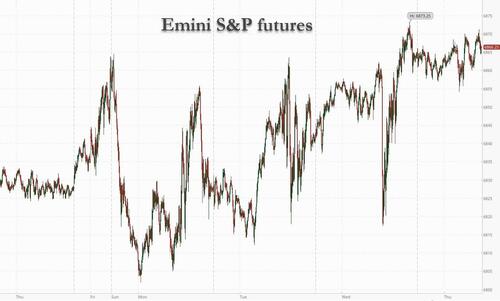
Futures Rise, S&P Set For 8th Gain In 9 Days
Futures Rise, S&P Set For 8th Gain In 9 Days
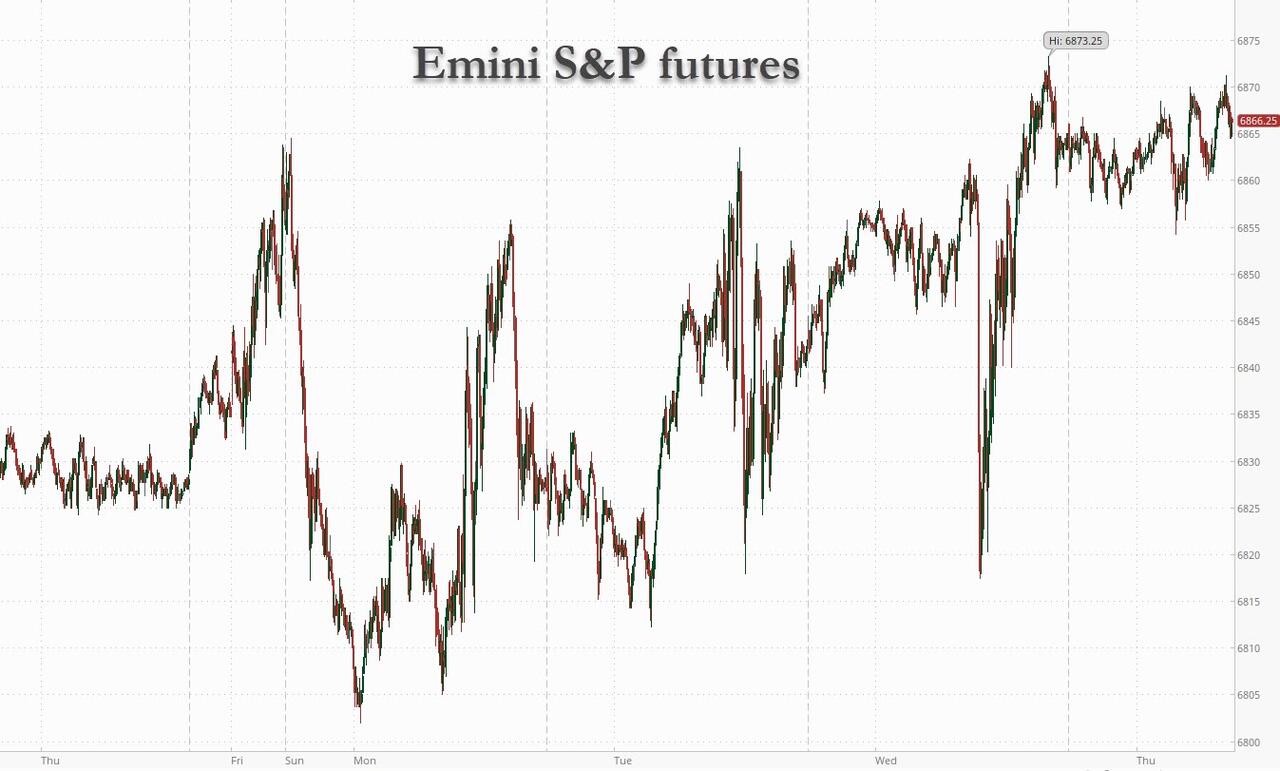
US equity futures rise, trading less than a percent away from a new record high amid signs of a leadership rotation with Big Tech not leading the bounce this time. As of 8:00am ET, S&P and Nasdaq 100 contracts are higher by about 0.1% after climbing in seven of the past eight sessions and extend on Wednesday’s gains when bad news was good news as a soft ADP jobs report bolstered expectations for a Fed rate cut next week. Challenger job cuts data for November showed job cuts fell 53% to 71,321 last month from October, but rose 24% from the 57,727 job cuts announced in the same month last year. Pre-market, Mag 7 were up a touch, led by TSLA (+0.9%), META (+0.6%) and NVDA (+0.5%). Salesforce is higher after its forecast beat and it gave a positive view on AI adoption. Bond yields were up modestly, USD unchanged, reversing an earlier drop to a one month low. Commodities are mixed: Oil and base metals are mostly higher; gold/silver are lagging. Bitcoin trades around $93, rebounding almost $10K from its low just days ago. Today’s calendar includes November Challenger jobs cuts (7:30am), weekly jobless claims (8:30am) and September factory orders (10am)
In pre-market trading, tech stocks were broadly steady with all Magnificent Seven megacaps apart from Apple posting modest gains, while Salesforce climbed on signs that customers are embracing its artificial intelligence tools.
Mag 7 stocks mostly higher (Tesla +0.6%, Nvidia +0.4%, Meta +0.8%, Alphabet +0.6%, Microsoft +0.4%, Amazon +0.1%, Apple -0.04%)
Axogen (AXGN) rises 5% after the provider of medical and surgical instruments said the FDA approved its biologics license application for its Avance nerve graft to treat peripheral nerve discontinuities.
Bill Holdings Inc. (BILL) gains 3% after activist investor Barington Capital Group has taken a stake in business payments firm.
Costco falls (COST) 1.1% after the retailer reported total comparable sales for November that missed the average analyst estimate.
Dollar General (DG) rises 4% after the company raised its full-year outlook, highlighting value-focused retailers are winning over consumers hunting for deals.
Guidewire (GWRE) jumps 5% after the software company’s first-quarter results and second-quarter revenue forecast topped analysts’ expectations.
Hormel (HRL) rises 6% after the protein producer’s 3Q adj. EPS forecast beat the company’s recently lowered guidance, as well as the Street consensus.
MBX Biosciences (MBX) slips 3% after Goldman Sachs initiated coverage of the drug developer with a sell rating, citing risk to the firm’s data readout in the near term.
Salesforce Inc. (CRM) is up 1.9% after the software company gave an outlook for revenue in the current period that topped analysts’ estimates, suggesting it is persuading customers to buy its AI tools.
Snowflake (SNOW) falls 8% after the software company issued a forecast for operating margin in the current quarter that fell short of the average analyst estimate. Analysts noted a deceleration in product revenue growth.
UiPath (PATH) rises 8% after the software company’s third-quarter results beat expectations. It also gave a forecast.
UniQure (QURE) falls 13% after saying the FDA indicated that data from its Phase I/II studies of an investigational gene therapy for Huntington’s disease are unlikely to provide primary evidence to support a biologics license application submission.
ZIM (ZIM) rises 3% after Globes reports that Hapag-Lloyd submitted a bid to purchase the shipping company, without saying where it got the information.
Fed rate-cut expectations have fueled a broad rebound after November’s slump, with investors turning to defensive and other sectors as worries over stretched tech valuations persist. The small-cap Russell 2000 index is now just shy of a record high, while the Nasdaq 100 remains about 2% below its peak.
“We’re expecting a broadening of the rally for sectors that have so far been lagging,” said Amelie Derambure, senior portfolio manager at Amundi SA in Paris. “The Russell is very sensitive to interest rates, so the figures reinforced the market’s idea that the Fed will be able to lower rates, in a non-recessionary context.”
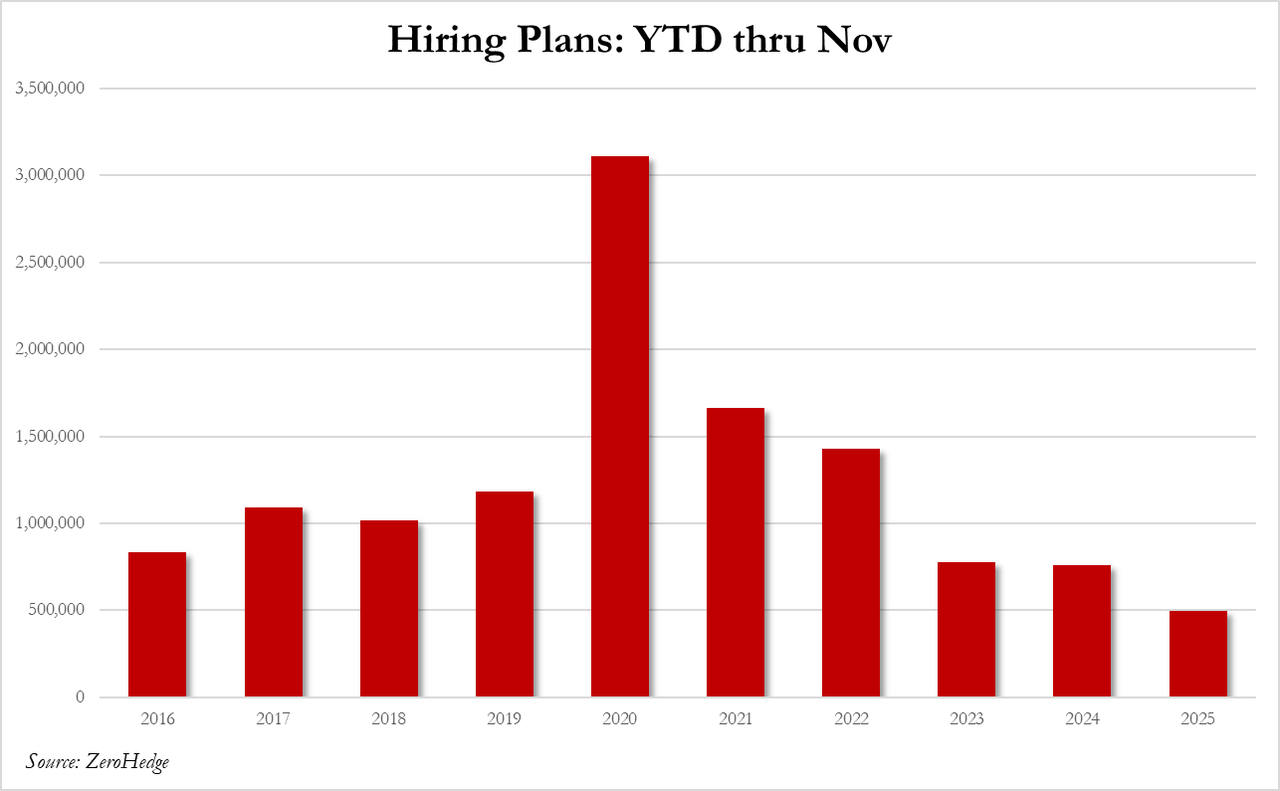
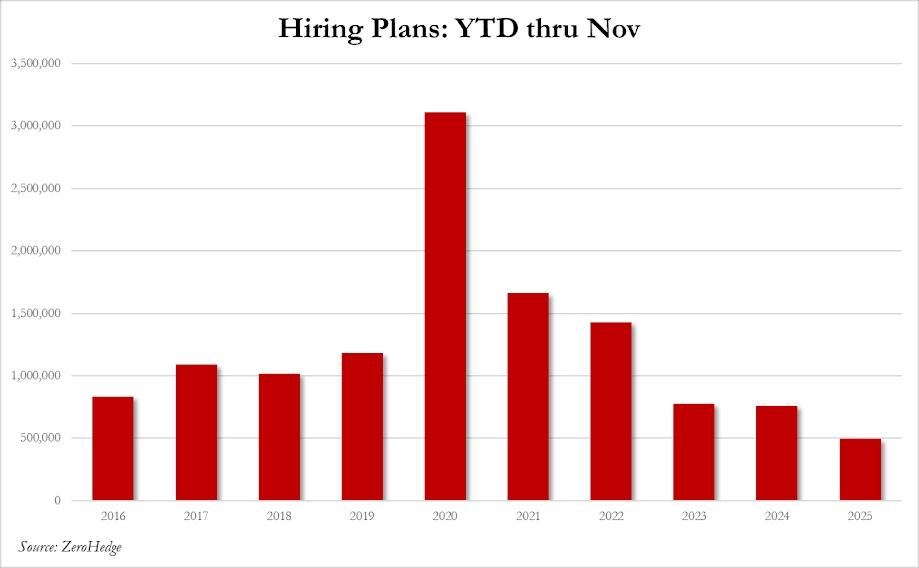
A report on corporate job-cut announcements from Challenger, Gray & Christmas Inc. added to evidence that the US labor market is softening. Announced layoffs fell last month after surging in October, but were still the highest for any November in three years, according to the outplacement firm. Meanwhile, YTD hiring plans are the lowest since 2010.
With official data still delayed, private indicators have increasingly pointed to employment coming under pressure from company belt-tightening and weaker spending. Worries about the jobs market and expectations that President Donald Trump will choose a Fed chair who shares his dovish stance have shifted market pricing toward as many as four rate cuts through 2026. Still, with the broader economy resilient, easier policy should continue to support stocks.
“Retail momentum stocks and crypto are still way below the recent peaks, though both have recovered from the recent lows,” wrote Mohit Kumar, chief economist and strategist for Europe at Jefferies. “We see sentiment remaining positive into year-end.”
Meanwhile, Goldman Sachs is looking past this month’s decision to what it calls a “foggy” Fed rate path in 2026. Risks to its terminal-rate range are skewed to the downside amid labor-market weakness, the bank wrote. They still expect two rate cuts next year. JPMorgan strategists expect the market to be boosted by higher equity demand next year. They project a supply-demand “improvement” of around $700 billion in 2026, which would be the strongest year since 2023.
Europe’s Stoxx 600 is 0.3% higher with the DAX outperforming. Autos and industrial stocks are leading the way in Europe while utilities and healthcare dip. Automakers gain as Bank of America upgrades some stocks. Here are some of the biggest movers on Thursday:
Mercedes, Renault gain as much as 4.4% and 4.8% respectively while holding company Porsche SE rises 5.7%, as Bank of America upgrades the stocks due to a more positive view on the European autos sector.
Storytel gains as much as 6.5% after SEB initiated coverage of the Swedish audiobook and publishing house with a buy rating, saying the company has improved the quality of its subscriber base and its internal efficiency.
Cosmo shares rise as much as 5.5%, adding to Wednesday’s 20% jump following positive late-stage trial results for the life science company’s experimental treatment for male hair loss.
Balfour Beatty shares rise as much as 2.4% after the engineering and construction group said it expects to grow its order book by 20% in 2025 and confirmed more buybacks are on the way in 2026.
Philips shares drop as much as 8.6% after Citi analysts noted tariff and China challenges for 2026.
Trustpilot shares fall as much as 21% after Grizzly Research published a report on the consumer-review company.
Earlier in the session, Asian stocks rose for a third straight day, led by gains in Japan as regional tech shares tracked their US peers higher. The MSCI Asia Pacific Index advanced as much as 0.9%, with SoftBank Group and Keyence among the biggest contributors. Shares fluctuated in China and Hong Kong, while South Korean stocks slipped. India’s benchmark struggled to hold early gains even as the rupee strengthened against the dollar. Sentiment across the region is improving on rising expectations of a Federal Reserve rate cut this month after the latest US jobs data. Meanwhile, a slightly weaker yen is providing an extra lift to Japanese exporters. Semiconductor shares are showing signs of weakness, with South Korea’s tech-heavy stock index slipping more than 1% as foreign funds take profit. A Microsoft Corp. update is also weighing on sentiment, after a media report that the firm lowered expectations for business customers buying on the cloud unit’s marketplace for artificial intelligence models and agents.
In FX, the dollar gives up earlier gains, Aussie outperforming on bets the central bank may pivot back to rate hikes.
In rates, global bonds weakened, driven by rising yields in Japan. Sentiment shifted as some senior government officials signaled they wouldn’t oppose a Bank of Japan rate hike this month. Treasury yields are rising across the curve. German bonds falling on growing government uncertainty. Gilts are outperforming after very weak construction activity data sparks a small increase in BOE rate-cut bets.
In commodities, oil prices are higher, albeit with some volatility. Brent is trading around $63/barrel. Gold is recovering ground and now trading close to $4,200/oz. Bitcoin, meanwhile, held above $93,000. The dollar was little changed.
US economic calendar includes November Challenger jobs cuts (7:30am), weekly jobless claims (8:30am) and September factory orders (10am)
Market Snapshot
S&P 500 mini and Nasdaq 100 mini little-changed
Russell 2000 mini steady
Stoxx Europe 600 +0.3%
DAX +0.8%
CAC 40 +0.4%
10-year Treasury yield +2 basis points at 4.08%
VIX +0.1 points at 16.17
Bloomberg Dollar Index little changed at 1212.82
euro little changed at $1.1668
WTI crude +0.4% at $59.21/barrel
Top Overnight News
Donald Trump’s aides are considering having Scott Bessent also head the National Economic Council if Kevin Hassett becomes Fed chair, people familiar said. BBG
Trump’s administration ordered an enhanced vetting of H-1B visa applicants, with new H-1B visa screening based on any involvement in censorship or free speech, according to the State Department memo.
Trump said he may work out another trade deal with Canada and Mexico. BBG
Vladimir Putin said Russia didn’t agree with some points of the US peace proposal for Ukraine, Tass reported, citing his interview with a local media outlet. Earlier, Trump called the meeting between Steve Witkoff and Putin “reasonably good” but next steps remain unclear. BBG
Emmanuel Macron met Xi Jinping in Beijing and urged China to boost investments in France, as both sides look to rebalance their economic ties. BBG
Cambricon plans to more than triple its production of AI chips to half a million units in 2026, people familiar said. The Beijing-based company aims to rival Huawei in China and fill a void left by Nvidia’s forced exit. BBG
Bank of Japan Governor Kazuo Ueda said on Thursday there was uncertainty on how far the central bank could raise interest rates due to the difficulty of estimating the country’s neutral rate of interest. RTRS
The Indian rupee will regain some lost ground against the U.S. dollar over the next three months, but a reversal in the currency’s fortunes hinges upon India and the U.S. agreeing to a trade deal. RTRS
Paramount more than doubled its breakup fee to $5 billion in its offer to acquire Warner Bros., signaling confidence it can clear regulatory hurdles. BBG
Meta Platforms Inc. has been hit by a full-scale European Union antitrust investigation over how its AI features in WhatsApp may be harming competition, in the latest probe into Big Tech’s dominance on the continent. The bloc’s digital chief signaled she wants to conclude several ongoing investigations into tech giants this month including Elon Musk’s X. BBG
For all the focus on ADP (historically very noisy), the Indeed Hiring Lab data actually picked back up in the last couple of weeks (need more data). Notable was the a re-acceleration in open jobs in construction (see below). What if AI adoption is slower or less transformative in the near term… the labor market re-accelerates… and inflation proves hotter in 2026? Not at all my base case but inversion an in important part of the process: Goldman
Trade/Tariffs
US President Trump said they will either let the USMCA expire or maybe work out another deal with Mexico and Canada.
US halted plans to sanction the Chinese spy agency to maintain the trade truce, and the Trump administration will also not enact any major new export controls against China, while the Trump admin is preparing to hold a high-level meeting to decide whether to provide licenses to allow NVIDIA (NVDA) to export the H200 to China, according to FT.
Chinese Commerce Ministry, on rare earth export controls, said as long are export license applications are for civilian use, they will be approved.
Chinese President Xi said in a meeting with French President Macron that China and France are far-sighted, responsible and independent major countries, while he added that China and France should uphold multilateralism and that China is willing to eliminate interferences and stick to equal dialogues with France. Xi also commented that both countries should support each other on core interests and agreed to expand practical cooperation, as well as consolidate cooperation on airspace and nuclear energy. Furthermore, he said both countries aim to expand two-way investment and that China will expand domestic demand in the 15th five-year plan and will also expand market access and opening-up.
India’s Trade Minister said exports of autos, electronic goods, textiles and machinery to Russia are expected to increase. India also aims to expand and diversify exports to Russia to address the trade imbalances. India has secured a USD 2bln submarine deal, Bloomberg reported during the visit of Russian President Putin.
A more detailed look at global markets courtesy of Newsquawk
APAC stocks were mostly higher following the positive momentum from Wall St, where all major indices rose amid a weaker dollar and softer yield environment, but with some of the gains in the region capped amid a quiet calendar and lack of major fresh macro catalysts. ASX 200 edged higher in rangebound trade with strength in materials and resources offsetting the losses in the real estate and consumer sectors, while the mining industry was among the outperformers aside from the gold-related stocks. Nikkei 225 rallied above the 50k level as the tech-related momentum in Japan continued, despite higher yields and bets for a December BoJ rate hike. Hang Seng and Shanghai Comp were mixed amid weakness in auto names and after another liquidity drain by the PBoC, while PBoC Governor Pan noted in an Op-Ed that China must maintain prudent monetary policy and should avoid excessive policy adjustments.
Top Asian News
PBoC Governor Pan said in a People’s Daily op-ed that China must maintain prudent monetary policy and should avoid excessive policy adjustments, while he also suggested preventing overreach from leading to long-term side effects of policies.
BOJ
BoJ is likely to raise interest rates in December, a decision Japan’s government will likely tolerate, according to sources cited by Reuters.
Key members of Japanese PM Takaichi’s government would not try to prevent a BoJ hike in December, Bloomberg reports, citing sources.
BoJ is carrying out an assessment of the level of neutral interest rate, according to Jiji.
BoJ Governor Ueda reiterated that they can only estimate the neutral rate with a wide range thus far, while he added they cannot specify a terminal rate and are working on narrowing the estimate on the neutral interest rate, with the findings to be disclosed if successful. Furthermore, he said for now, they have to work with the current estimate set in a fairly wide range, and there is uncertainty on how far interest rates can eventually be raised.
European equities opened higher, reflecting positive APAC momentum, though morning news flow has been light. Markets expect Kevin Hassett to be named the next Fed Chair, with some concerns that he could be influenced by President Trump on rates. Meanwhile, Reuters and Bloomberg reported hawkish signals suggesting the BoJ is likely to raise rates in December with government approval. Sectors are mixed with a positive tilt: Autos, Industrial Goods & Services and Technology lead. At the bottom: Utilities, Basic Resources and Health Care.
Top European News
BoE Decision Maker Panel Survey (Nov): Expectations for year-ahead CPI inflation remained unchanged at 3.4%; Expected year-ahead wage growth rose slightly, by 0.1ppt to 3.8% in the three months to November
FX
DXY is trading near the lower end of its 98.798–99.029 intraday range, pressured by JPY strength after Reuters and Bloomberg reported the BoJ is likely to hike rates in December with government approval. Money markets were already pricing a 66% chance of a hike following Governor Ueda’s recent hawkish remarks. USD/JPY slipped from 155.54 to a 154.77 low, with next support at the 1 December trough of 154.66.
AUD is firmer amid continued hawkish repricing of RBA expectations.
G10 FX is otherwise mostly flat and taking its cue from the USD, with few fresh drivers. EUR and GBP were little moved by Construction PMI releases.
PBoC set USD/CNY mid-point at 7.0733 vs exp. 7.0554 (Prev. 7.0754)
Chinese State-owned banks reportedly bought USD on the onshore spot market this week in a bid to rein in CNY strength, according to Reuters sources.
RBI to tolerate a weaker rupee as dollar inflows diminish, according to Reuters sources.
Fixed Income
Fixed income benchmarks are lower following the hawkish BoJ reports, though the associated softening in risk sentiment has provided a modest haven bid as the morning has unfolded.
JGBs underperformed, falling as much as 42 ticks to a new contract low of 134.08. The move pushed the 20yr yield to its highest since June 1999 and the 30yr yield to a record high, with selling driven by reports that boosted December BoJ hike odds to above 65%.
The bearish tone extended into USTs and Bunds (now trading the Mar’25 contract), which hit lows of 112-27 and 128.46, down eight and 16 ticks respectively. European newsflow was limited; French and Spanish supply saw no major reaction, with Spain’s auction strong and France’s slightly softer versus prior.
For USTs, focus beyond the BoJ remains on the Fed Chair narrative. The FT noted bond investors have expressed concern to the Treasury over Hassett’s potential appointment due to his perceived alignment with the President. Kalshi odds for Hassett have slipped to ~75% from above 80% earlier in the week.
Spain sells EUR 2.88bln vs exp. EUR 2.5-3.5bln 2.70% 2030, 0.85% 2037 Bono and EUR 0.481mln vs exp. EUR 0.25-0.75bln 1.15% 2036 I/L.
France sells EUR 5.06bln vs exp. EUR 3.5-5.5bln 4.75% 2035, 0.50% 2040, 4.50% 2041, 3.25% 2055 OAT.
UK sells GBP 1bln 4.25% 2039 Gilt via tender: b/c 3.88x, average yield 4.813%.
Commodities
Crude benchmarks were firmer through the APAC session despite constructive comments from US and Russian officials after their recent Moscow meeting. Both benchmarks climbed to highs of USD 59.42/bbl (WTI) and USD 63.08/bbl (Brent) before easing to USD 59.11/bbl and USD 62.74/bbl as risk sentiment softened following the hawkish BoJ reports.
XAU posts modest gains early in APAC, reaching USD 4,217/oz before sliding to USD 4,176/oz and remaining below USD 4.2k/oz. Despite a recent soft ADP print and mixed services PMI, gold has unwound its data-driven uptick as broader risk sentiment improves.
3M LME copper traded within a USD 11.43k–11.53k/t range in APAC before retreating from Wednesday’s all-time high of USD 11.54k/t, now at session lows around USD 11.35k/t. The pullback follows Rio Tinto’s raised 2025 copper production guidance and Goldman Sachs’ scepticism over the recent rally.
Geopolitics: Middle East
Israel identified the body of the hostage received from Gaza as Thai national Sontisek Rintalk and said the body of the last Israeli hostage, Ran Gvili, remains in Gaza.
Iraq has decided to freeze the money of “terrorists”, including Hezbollah and the Houthis, via the Official Gazette
Geopolitics: Ukraine
US President Trump said the meeting between Russian President Putin, Special Envoy Witkoff and Kushner was a reasonably good meeting and “we’ll see what happens”, while he added that Russian President Putin wants to end the war.
White House official said the US and Russia had a thorough and productive meeting, while Witkoff and Kusher briefed Trump after the meeting with Putin on Tuesday and are to meet Ukrainian representatives in Miami on Thursday.
Russian President Putin said the meeting with US’ Witkoff and Kushner was necessary and very useful, but it is “too early to say”; said Russia will take control of Donbas and Novorossiya by military means or otherwise.
Russian Foreign Ministry Spokesperson said the attacks on tankers in the Black Sea and CPC are aimed at disrupting the peace talks in Ukraine.
A Ukrainian official has reportedly cautioned that Thursday’s meeting between Ukraine’s Umerov and US’ Witkoff is a “debrief” by the US and not “a negotiating session…”, FT reported.
Geopolitics: Other
Venezuela’s President Maduro said he had a conversation with US President Trump about 10 days ago, while he added that steps are being taken towards a respectful dialogue between both countries.
China is said to be gathering military ships across East Asia in a show of maritime force, according to Reuters sources
US Event Calendar
7:30 am: Nov Challenger Job Cuts YoY, est. 48%, prior 175.3%
8:30 am: Nov 29 Initial Jobless Claims, est. 220k, prior 216k
8:30 am: Nov 22 Continuing Claims, est. 1962.61k, prior 1960k
10:00 am: Sep Factory Orders, est. 0.3%, prior 1.4%
10:00 am: Sep F Durable Goods Orders, prior 0.5%
10:00 am: Sep F Durables Ex Transportation, prior 0.6%
10:00 am: Sep F Cap Goods Orders Nondef Ex Air, prior 0.9%
10:00 am: Sep F Cap Goods Ship Nondef Ex Air, prior 0.9%
DB’s Jim Reid concludes the overnight wrap
Markets continue to be in consolidation mode, with the S&P 500 (+0.30%) and the STOXX 600 (+0.10%) both posting modest gains yesterday. The session had started on the back foot as the ADP’s report of private payrolls showed the biggest monthly drop since March 2023, but most assets recovered by the end of the session, as data cemented the view that the Fed would likely cut rates at next week’s meeting. So lots of assets were up by the close, with the 10yr Treasury yield (-2.3bps) down to 4.06%, whilst Bitcoin (+2.30%) reached a two-week high of $93,722 and the small-cap Russell 2000 rose +1.91%. In Japan this morning a strong 30yr auction has led to a decent long-end rally even as other parts of the curve sell off.
In terms of that ADP report, the headline was that private payrolls fell by -32k in November, undershooting expectations for a +10k rise. The losses were largely concentrated around small businesses (-120k), which saw their largest decline in employment since the pandemic, although payrolls from medium (+51k) and large businesses (+39k) fared better. There were also some questions about regional distortions as the aggregate decline came due to outsized losses in regions along the Atlantic coast. Still, the negative signal from the ADP report received more attention than usual because of the data backlog from the shutdown. So we aren’t getting the usual payrolls this Friday, and the ADP is one of the final pieces of information the Fed will get on the labour market ahead of next week’s decision.
That dovish momentum from the ADP report then got a further boost from the ISM services print. The headline measure was a bit stronger than expected at 52.6 (vs. 52.0 expected), but crucially, the prices paid component fell to a 7-month low of 65.4 (vs. 68.0 expected), which eased concerns about tariff-driven inflation. That component has been strongly correlated to inflation with a lag, so the bigger-than-expected decline helped solidify expectations for a Fed rate cut. Moreover, the employment component remained in contractionary territory at 48.9, so again that echoed the weaker message from the ADP print.
Those prints helped US Treasuries to rally across the curve, with the 2yr yield (-2.4bps) down to 3.49%, whilst the 10yr yield (-2.3bps) fell to 4.06%. And in turn, that saw the dollar index (-0.49%) post its worst day in seven weeks and fall to its weakest level since October 28, the day before Fed Chair Powell said that a December rate cut was “not a foregone conclusion”. This morning, 2 and 10yr US yields are back up +2bps, nearly wiping out yesterday’s gains.
Meanwhile for equities, the S&P 500 (+0.30%) continued to move higher, closing less than 1% beneath its record high from late-October. However, there were some fluctuations over the session, and Microsoft (-2.50%) shares fell after tech news outlet The Information reported that Microsoft had lowered their AI software sales quota. That was pushed back on by a spokesperson for Microsoft, and the share price recovered a bit when CNBC reported they hadn’t lowered the quotas. However, Microsoft shares then sold off again into the close, reviving investor fears about AI valuations. Nevertheless, that wasn’t enough to knock the broader market. The Magnificent 7 (+0.12%) still rose on the day thanks to a +4.08% gain for Tesla. And it was a strong day for market breadth with two thirds of the S&P 500 stocks higher on the day and the small cap Russell 2000 rising +1.91%.
Over in Europe, it was also a data heavy day with the final PMI releases. Those were broadly positive, and the final composite PMI for the Euro Area was revised up to 52.8 (vs. flash 52.4), its highest level in two-and-a-half years. So that continues the positive momentum seen in the PMIs over recent months, and helped to bolster sentiment, with upward revisions in Germany, France and the UK for the composite PMI. In turn, that helped the STOXX 600 (+0.10%) to just about post a modest gain, although it was a pretty subdued day across the continent, with the FTSE 100 (-0.10%), the CAC 40 (+0.16%), and the DAX (-0.07%) all seeing little movement.
There was also little movement in European fixed income, with 10yr bund yields (-0.2bps) barely moving. However, we did hear from ECB Chief Economist Lane, who discussed how the ECB should react to medium-sized inflation shocks, and energy price shocks in particular. He argued that inflation risk wasn’t one-way and that the bank had recently seen some upside surprises, so his comments offered support for the view that rates are likely to be kept on hold through the energy-induced inflation undershoot in 2026.
On the geopolitical front, the perception was that the prospect of a breakthrough in the talks on Ukraine continued to ebb yesterday, with the Polymarket chances of a ceasefire by end-March falling back to just 22%, having been at 27% when we went to press yesterday. In turn, there was a reaction among assets more sensitive to the conflict, with the STOXX Aerospace & Defense index up +2.26%, whilst Brent crude oil prices (+0.35%) were up to $62.67/bbl.
In Asia, Japanese stocks are leading the way, with the Nikkei rising by +2.00% and the Topix increasing by +1.86%, both outperforming their regional counterparts. The ASX (+0.27%) is also higher, with the Hang Seng flat and the Shanghai Comp -0.20% lower. The KOSPI is the largest underperformer, down -0.71%. US futures are flat.
Early morning data revealed that Australia’s household spending significantly exceeded expectations in October, marking its largest increase since January 2024, thereby strengthening the argument for an interest rate hike next year. Spending rose by +1.3% from September, surpassing economists’ forecasts of a +0.6% increase. Year-on-year, consumption has increased by +5.6%, compared to the anticipated +4.6% rise. 2yr and 10yr Aussie yields are up +7.5bps and 6bps respectively.
In the bond markets, Japan’s 30-year bonds gained following an auction that attracted the highest demand since 2019, as elevated yields drew in investors. The yield on the 30-year bond decreased by -3bps to 3.39% after the bid-to-cover ratio surged to 4.04, up from 3.125 at the previous auction in November. This strong outcome for the 30-year auction followed a successful sale of 10-year debt earlier in the week, which also saw robust demand. However the rally at the long end today seems to have been funded from elsewhere in the curve with the 10yr yield +3.8bps higher this morning.
To the day ahead now, and we’ll get the US weekly initial jobless claims, the November construction PMIs from the UK and Germany, and Eurozone retail sales for October. Central Bank spearers include the Fed’s Bowman, the ECB’s Kocher, Cipollone and Lane, and the BOE’s Mann. Notable earnings include Kroger, Dollar General and HPE.
Tyler Durden
Thu, 12/04/2025 – 08:50
https://www.zerohedge.com/markets/futures-rise-sp-set-8th-gain-9-days
Identifican a ejecutivo chino como sospechoso en caso de contaminación radiactiva en Indonesia
Por EDNA TARIGAN
YAKARTA, Indonesia (AP) — Las autoridades indonesias dijeron el jueves que un ejecutivo chino de una empresa de fundición de metales es sospechoso en un caso de contaminación por cesio-137 que provocó el retiro de algunas exportaciones a Estados Unidos.
Lin Jingzhang, director de PT Peter Metal Technology (PMT), fue designado como sospechoso, señaló Bara Hasibuan, portavoz del grupo de trabajo de investigación.
“La Dirección de Delitos Específicos de la Unidad de Investigación Criminal de la Policía Nacional de Indonesia ha nombrado a Lin Jingzhang, ciudadano de la República Popular China que se desempeña como director de PT Peter Metal Technology, como sospechoso”, afirmó Hasibuan.
Los investigadores no han podido contactar a los representantes de la fábrica de procesamiento de metales, que se encuentra en el Parque Industrial Cikande, en la provincia de Banten en la isla de Java, debido a que todo el cuerpo directivo regresó a China. Sin embargo, Lin acordó cooperar con la investigación y regresará a Indonesia para ser interrogado, dijo Hasibuan.
La empresa, que produce acero inoxidable a partir de chatarra y desechos de acero, recibió al menos 3.000 toneladas de materias primas de docenas de proveedores durante sus 10 meses de operaciones en Indonesia. Toda su producción de acero inoxidable se exporta a China.
“La conclusión preliminar sobre el origen de la contaminación por cesio-137 es que provino de una fuente local a través de la compra de bienes usados y chatarra, entre los que había equipos industriales usados del país que contenían cesio-137 obtenido legal o ilegalmente, sin pasar por un almacenamiento, supervisión y eliminación adecuados de acuerdo con las regulaciones aplicables”, explicó Hasibuan.
Durante la investigación, la policía descubrió que los recolectores de chatarra que suministraron el material no sabían que éste estaba contaminado con radiactividad y lo vendieron a empresas de fundición.
“Fue durante el proceso de fundición que ocurrió la contaminación aérea. Por eso encontramos que el horno de la fábrica de PMT emitía 700 microsieverts por hora. A partir de esto, concluimos que PMT era la fuente”, señaló Sardo Sibarani, un oficial de policía del grupo de trabajo.
Los investigadores no han podido determinar el origen de los desechos que contenían el cesio-137, ya que solo se encontró escoria de acero durante una serie de inspecciones en el sitio de la fábrica.
La contaminación se descubrió a principios de este año con un informe inicial presentado por las autoridades holandesas sobre rastros de radiación hallados en contenedores provenientes de Indonesia. En el informe se indica que se encontraron varias cajas de zapatillas contaminadas.
En agosto, la Administración de Alimentos y Medicamentos de Estados Unidos (FDA, por sus siglas en inglés) emitió una alerta de seguridad en la que advertía a los consumidores que no comieran ciertos camarones congelados importados de PT Bahari Makmur Sejati, una empresa cercana al Parque Industrial Cikande, después de que se detectara cesio-137 en contenedores la empresa que envió a Estados Unidos.
Alrededor de 20 fábricas vinculadas al parque industrial de Cikande se vieron afectadas, entre ellas, instalaciones que procesan camarones y fabrican calzado, según las autoridades. Nueve empleados que trabajaban en el parque industrial fueron diagnosticados con exposición a cesio-137. Recibieron tratamiento en un hospital gubernamental en Yakarta y todas las instalaciones afectadas en el área industrial han sido descontaminadas.
___
Esta historia fue traducida del inglés por un editor de AP con la ayuda de una herramienta de inteligencia artificial generativa.
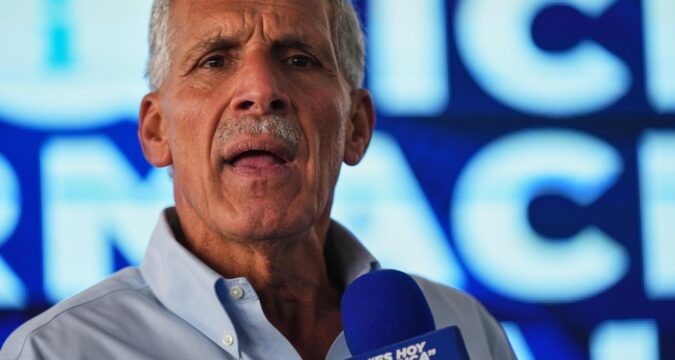
Lento conteo de votos da exigua ventaja a conservador Asfura en comicios presidenciales de Honduras
Associated Press
TEGUCIGALPA (AP) — El candidato conservador Nasry Asfura encabezaba el jueves la elección presidencial en Honduras con una leve ventaja de apenas 8.815 votos sobre el también conservador Salvador Nasralla, mientras el país centroamericano seguía expectante al desenlace del conteo.
Los resultados preliminares otorgaban a Asfura, del Partido Nacional, 40.06% de los sufragios frente a 39,73% de Nasralla, del Partido Liberal, tras escrutarse 84,55% de las actas. La candidata oficialista Rixi Moncada seguía rezagada con 19,17% de respaldo.
El Consejo Nacional Electoral (CNE) tiene un máximo de 30 días para emitir una declaración final sobre el ganador de los comicios.
Los dos candidatos en pugna —que se han alternado a la cabeza del conteo— han respetado el llamado del órgano electoral a no declararse ganadores, aunque ambos aseguraron tener todas las actas y se consideran triunfadores.
Las elecciones generales en Honduras se celebraron el domingo para elegir al nuevo presidente y tres designados presidenciales o vicepresidentes, 128 diputados e igual número de suplentes y los 298 alcaldes y vicealcaldes.
El martes el sitio web que las autoridades electorales hondureñas establecieron para compartir los resultados de la votación experimentó “problemas técnicos” que causaron su caída, dejando al público sin información sobre los resultados de la contienda presidencial y otras votaciones extremadamente cerradas, informó el CNE.
Ese mismo día funcionarios de Estados Unidos confirmaron que el expresidente Juan Orlando Hernández, quien cumplía una sentencia de 45 años en prisión por tráfico de drogas, había sido liberado luego de recibir un indulto por parte del mandatario Donald Trump.
Trump otorgó días antes de la elección su respaldo a Asfura, diciendo que era el único candidato con el que podía trabajar.
Pakistán permite a la ONU enviar ayuda a Afganistán por dos cruces fronterizos
Por RIAZ KHAN
PESHAWAR, Pakistán (AP) — Pakistán permitirá que las Naciones Unidas entreguen suministros de ayuda a Afganistán a través de dos cruces fronterizos que han estado cerrados durante casi dos meses, informó un funcionario del gobierno el jueves.
Mohammad Anas, portavoz de la administración del distrito de Khyber en el noroeste, dijo a The Associated Press que los cruces fronterizos en Chaman y Torkham estarán abiertos de inmediato para los envíos de ayuda solicitados por la ONU. La frontera permanecerá cerrada para el comercio y los viajes.
Las entregas iniciales incluirán alimentos, seguidos de suministros médicos y otros artículos esenciales.
Todos los cruces fronterizos se cerraron a principios de octubre después de que las fuerzas afganas atacaran puestos militares paquistaníes en represalia por los ataques paquistaníes en el interior de Afganistán. Aunque un alto el fuego mediado por Qatar sigue en vigor, las negociaciones entre las dos partes en Qatar e Istanbul han fracasado, con ambas partes culpándose mutuamente.
Desde el mes pasado, los cruces de Chaman y Torkham solo habían estado abiertos para los refugiados afganos que regresaban a casa.
El hecho se produce días después de que el ministro de Relaciones Exteriores de Pakistán, Ishaq Dar, dijera que había recibido una solicitud de las Naciones Unidas para permitir el uso de los cruces fronterizos en el noroeste y suroeste para entregar alimentos y medicinas necesarios para el pueblo afgano.
En Kabul, el portavoz del gobierno afgano, Zabiula Muyahid, indicó que los cierres fueron “impuestos ilegalmente por el lado paquistaní como un medio de presión política y económica, causando un daño grave a los pueblos de ambos lados”. Escribió en la plataforma X que las rutas comerciales se reabrirán solo después de que Pakistán proporcione “fuertes garantías” de que no serán bloqueadas nuevamente.
Chaman y Torkham son rutas comerciales vitales para Pakistán también, que utiliza la ruta para el comercio con los países de Asia Central. Islamabad dice que la frontera con Afganistán solo se cerró debido al apoyo de Kabul a los talibanes paquistaníes, conocidos como Terik-e-Talibán-Pakistán o TTP.
Pakistán ha presenciado un aumento en los ataques militantes, muchos reivindicados por el TTP, que está designado como una organización terrorista por Estados Unidos y las Naciones Unidas. Es un grupo separado pero aliado de los talibanes afganos, y se ha envalentonado desde que los talibanes afganos regresaron al poder en 2021.
Los cierres han causado grandes pérdidas para los comerciantes de ambos lados.
Desde octubre, las autoridades afganas han promovido rutas comerciales alternativas, mientras que los sindicatos paquistaníes enfatizan que los cruces son los caminos más cortos y eficientes para el comercio.
___________________________________
El corresponsal Abdul Qahar Afghan en Kabul contribuyó con esta nota.
___________________________________
Esta historia fue traducida del inglés por un editor de AP con ayuda de una herramienta de inteligencia artificial generativa.
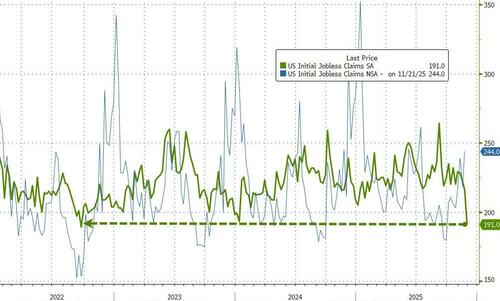
‘No Hire, No Fire’ Economy Confirmed As US Jobless Claims & Hiring Plans Plummet
‘No Hire, No Fire’ Economy Confirmed As US Jobless Claims & Hiring Plans Plummet
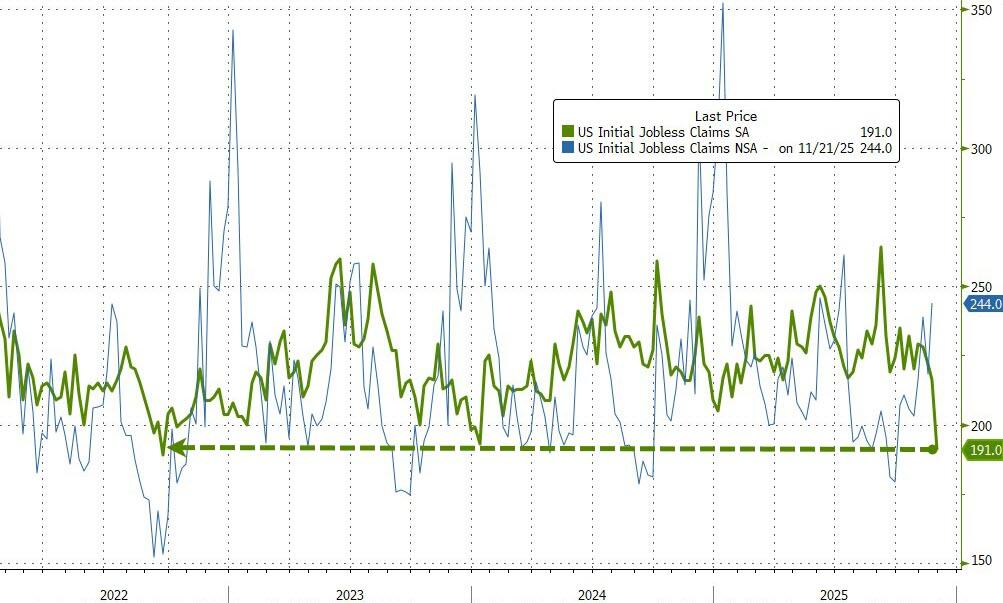
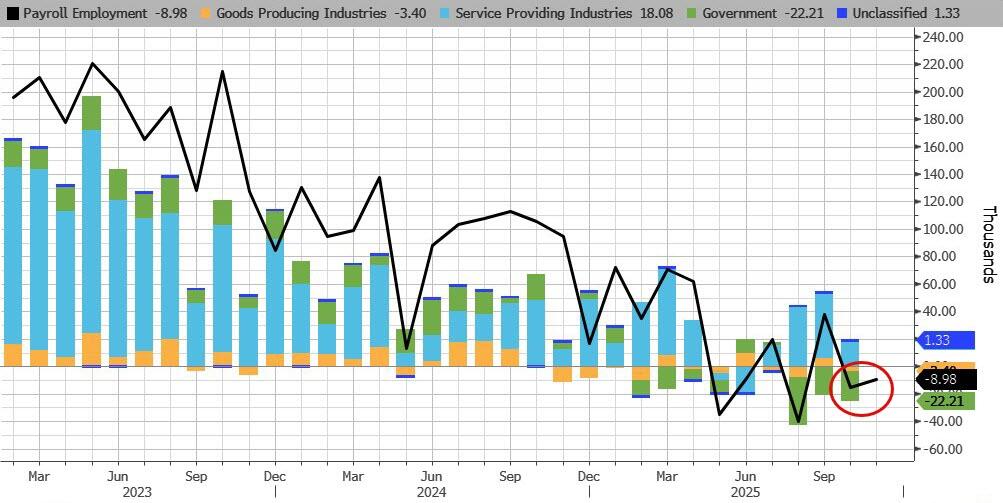
With the spice flowing once again (post shutdown), initial jobless claims continue to signal no labor market pain at all… plummeting last week to 191k (the lowest since Sept 2022 and before that the lowest since 1969!!)
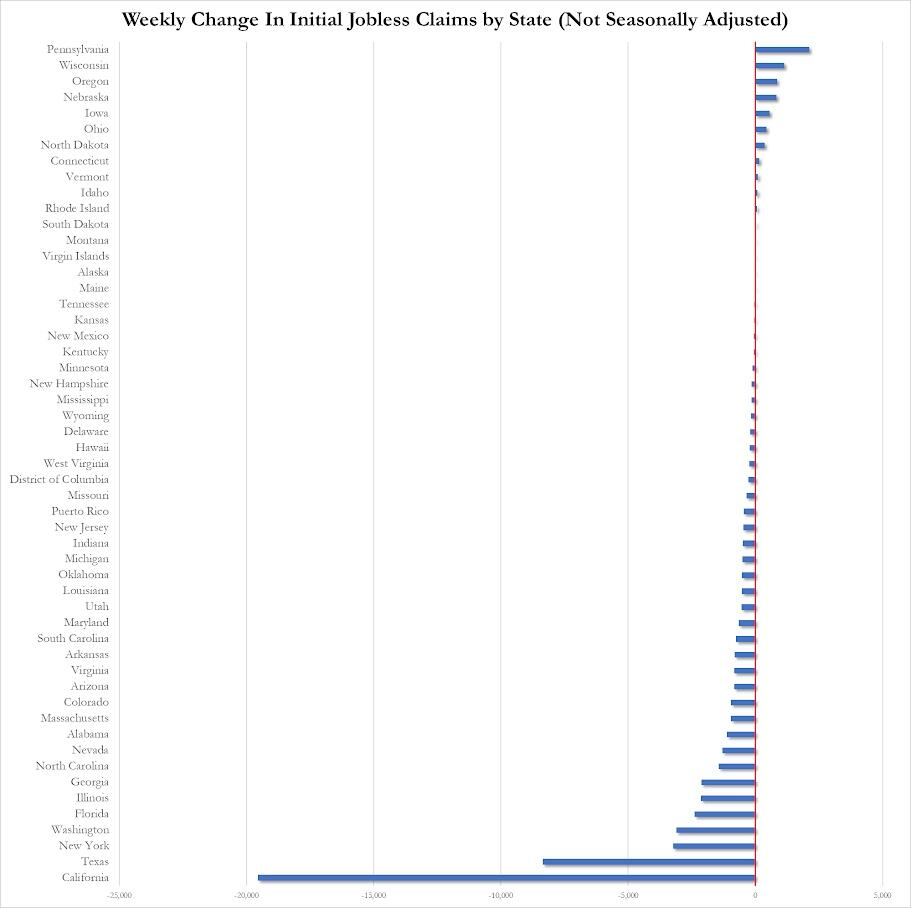
Distortions around Thanksgiving likely skewed the reading, with California, Texas, and New York saw the largest drop in non-seasonally adjusted claims.
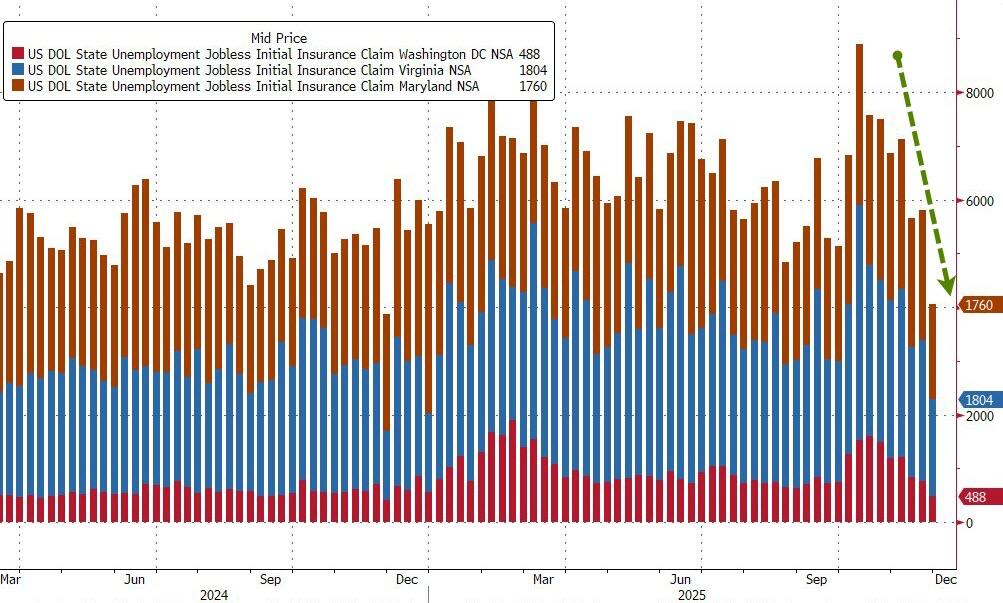
It appears a lack of government firings is helping as the ‘Deep Tristate’ initial claims tumbled to its lowest since Nov 2024…
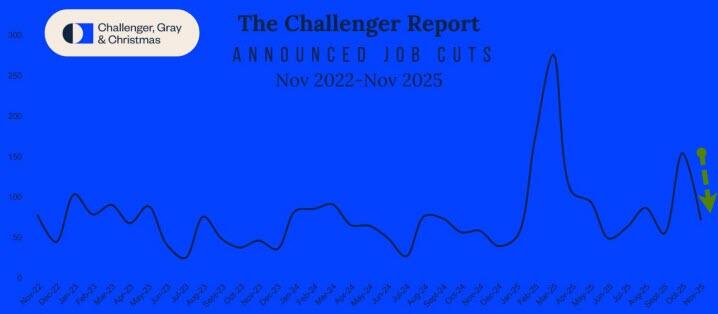
This lack of firing comes as ADP reports the biggest manufacturing sector job losses since COVID and Challenger, Gray & Christmas reports U.S.-based employers announced 71,321 job cuts in November, up 24% from the 57,727 job cuts announced in the same month last year.
“Layoff plans fell last month, certainly a positive sign. That said, job cuts in November have risen above 70,000 only twice since 2008: in 2022 and in 2008,” said Andy Challenger, workplace expert and chief revenue officer for Challenger, Gray & Christmas.
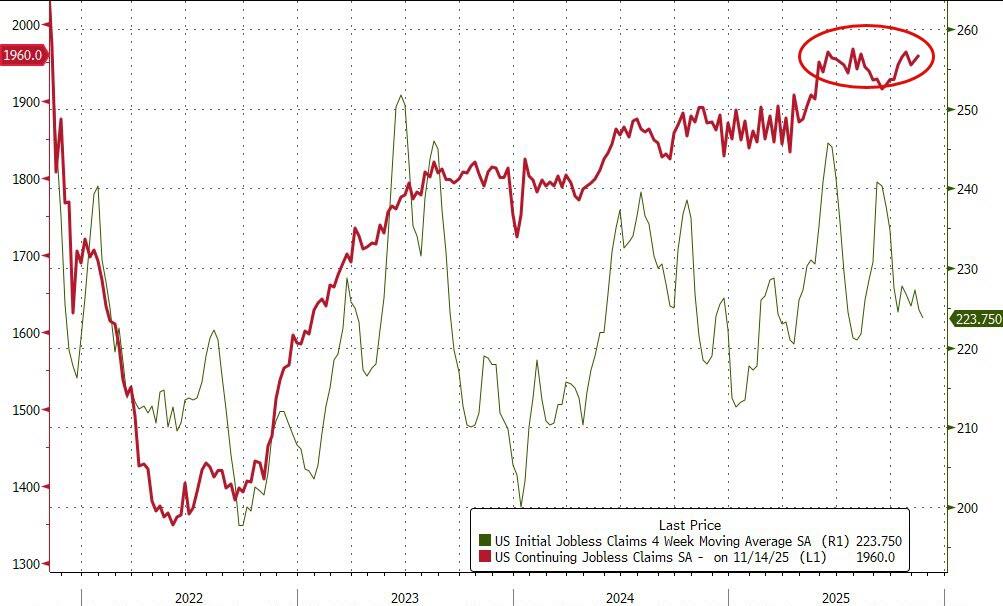
Continuing jobless claims continue to oscillate just above the 1.9 million Maginot Line…
Yet another alternative labor market signal points to weakness (more in line with ADP’s job losses) as Revelio shows 9k job losses in November…
Hiring Plans Plummet
Through November, global outplacement and executive coaching firm Challenger, Gray & Christmas reports that U.S. employers have announced 497,151 planned hires, down 35% from the 761,954 announced at this point in 2024.
It is the lowest year-to-date total since 2010…
WARNing
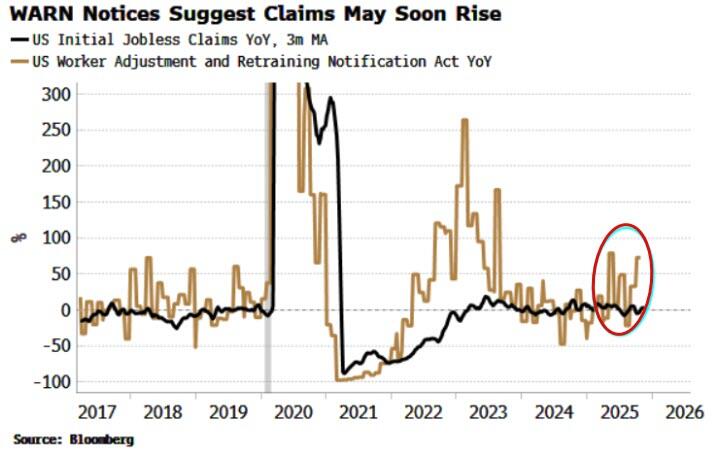
Additionally, WARN notices, which have previously led unemployment claims, are rising again.
As Bloomberg’s Simon White notes, The WARN Act obliges employers with more than 100 full-time workers to provide written notice to the state and the workers themselves at least 60-90 days ahead of planned plant closings and mass layoffs. It is one of the best real-time reads on the labor market, and has remained very low and steady, around an average of 220-230k, over the past two years.
As the chart below shows, WARN notices has led previous rises in claims. It has also given some false positives, but given the likely impact on yields should we see a sudden deterioration in employment, the recent rise is notable.
That the slowing in the jobs market is set to gather pace is captured in other indicators.
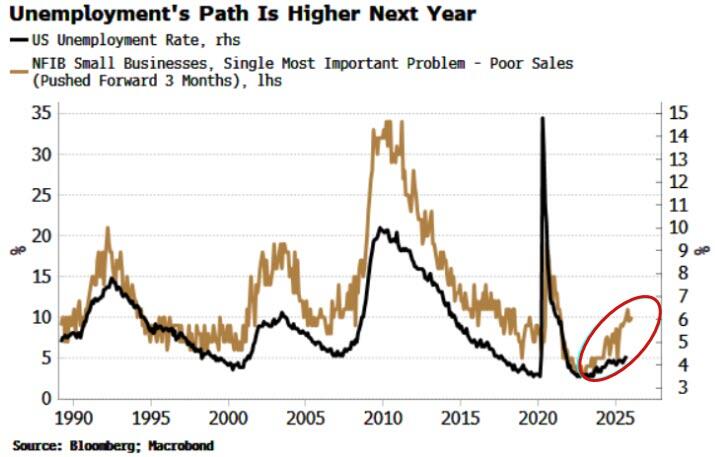
The NFIB small business survey polls respondents on whether they think the single most important problem they face is poor sales.
That has been rising, which often precedes the unemployment rate. Small businesses employ about half the workforce in the US and given the plunge in small business jobs reported by ADP yesterday, it seems labor market pains are starting to accelerate under the surface.
In short – the labor market remains a riddle, wrapped in a mystery, inside an enigma with every indicator pointing in different directions – choose your own adventure.
Tyler Durden
Thu, 12/04/2025 – 08:36

Bucks: Doc Rivers niega que Antetokounmpo está hablando con el equipo sobre su futuro
Por STEVE MEGARGEE
MILWAUKEE (AP) — El entrenador de los Bucks Doc Rivers afirmó el miércoles que no se han producido conversaciones entre los directivos del equipo y Giannis Antetokounmpo sobre la posible salida del dos veces MVP de Milwaukee.
Rivers habló antes de la victoria de los Bucks por 113-109 sobre los Pistons de Detroit, saliendo al paso a un informe de ESPN que indicaba que Antetokounmpo y su agente, Alex Saratsis, habían comenzado a sondear con los Bucks sobre el futuro del superestrella y si es mejor que se quede en Milwaukee o juegue en otro lugar.
“No hemos tenidos conversaciones”, indicó Rivers. “Giannis nunca ha pedido ser traspasado, nunca. No puedo dejar eso más claro”.
Antetokounmpo disputó apenas tres minutos el miércoles antes de que una distensión en la pantorrilla derecha lo enviara al vestuario. Rivers comentó después del partido que Antetokounmpo estaba sometiéndose a una resonancia magnética y añadió que creía que los Bucks habían descartado cualquier posibilidad de que el astro hubiera lesionado su tendón de Aquiles.
El futuro de Antetokounmpo ha sido objeto de mucha conjeturas en la NBA desde que los Bucks sufrieron su tercera eliminación consecutiva en la primera ronda de los playoffs la temporada pasada.
ESPN informó antes de la temporada que los Bucks y los Knicks de Nueva York entablaron conversaciones de intercambio sobre Antetokounmpo en agosto, pero nunca lograron avanzar en un posible acuerdo. Según ESPN, Antetokounmpo había indicado que Nueva York era el único lugar donde quería jugar fuera de Milwaukee.
Después de ese informe, Antetokounmpo expresó confianza en lo que los Bucks podrían lograr esta temporada y dijo que estaba “comprometido”, pero también reconoció la posibilidad de que eventualmente pudiera cambiar de opinión.
“Creo en este equipo”, afirmó Antetokounmpo en ese momento. “Creo en mis compañeros. Estoy aquí para liderar a este equipo a donde podamos llegar. Definitivamente va a ser difícil. Vamos a tomarlo día a día, pero estoy aquí. Todo lo demás no importa. Creo que he comunicado con mis compañeros, he comunicado con las personas que respeto y amo, que en el momento en que piso esta cancha, en esta instalación, llevo esta camiseta. El resto no importa. Estoy comprometido con lo que tengo frente a mí”.
“Ahora, si en seis, siete meses cambio de opinión, eso también es humano. Tienes derecho a tomar cualquier decisión que desees. Pero estoy comprometido. Estoy comprometido con este equipo. Estoy comprometido con estos chicos, este grupo, y con mi cuerpo técnico y conmigo mismo”, añadió.
Desde entonces, los Bucks han tenido dificultades.
Los Bucks (10-13) habían perdido ocho de nueve partidos antes de remontar un déficit de 18 puntos el miércoles contra los Pistons, líderes de la Conferencia Este.
El delantero Bobby Portis comentó que los Bucks tuvieron una reunión de equipo el miércoles por la mañana.
Esa mala racha incluyó una serie de siete derrotas en las que Antetokounmpo se perdió cuatro partidos debido a una distensión en el aductor izquierdo.
“Vamos a llamar a las cosas por su nombre”, dijo Rivers. “No estamos jugando bien. Tuvimos una dura derrota (en Washington) la otra noche, y ahora, este es el tema de conversación. No es más cierto de lo que era este verano. ¿Afecta a nuestro equipo y a nuestros jugadores? Espero que no. Puedo decirles después de escuchar a nuestros chicos hablar hoy, que no lo hace. Pero eso no significa que no lo hará. No puedo responder a eso”.
Rivers reiteró su creencia de que Antetokounmpo no tiene interés en irse.
“Lo que sigo diciendo es que voy a la fuente”, expresó Rivers. “Hablo con la fuente todos los días, todos los días, y él ama Milwaukee y ama a los Bucks”.
Antetokounmpo llevó a los Bucks a su primer título en medio siglo en 2021, anotando 50 puntos en el sexto partido decisivo contra los Suns de Phoenix. Pero los Bucks sólo han ganado una serie de playoffs desde entonces y han perdido en la primera ronda de la postemporada en cada uno de los últimos tres años.
___
Deportes AP: https://apnews.com/hub/deportes