Category: News
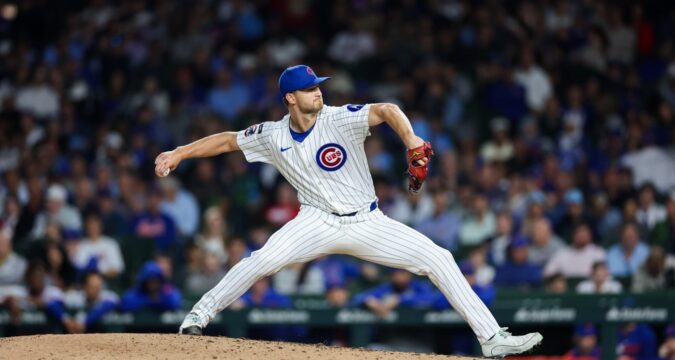
Michael Soroka — who made 1 start for Cubs after deadline trade — goes to Diamondbacks on $7.5M, 1-year deal
PHOENIX — The Arizona Diamondbacks have agreed to terms with right-hander Michael Soroka on a $7.5 million, one-year deal, a person familiar with the deal told The Associated Press on Monday.
The person spoke to the AP on condition of anonymity because the deal is pending a physical.
The 28-year-old Soroka is expected to bolster the back of the Diamondbacks starting rotation. He was 3-8 with a 4.52 ERA last season, starting 16 games for the Washington Nationals before getting traded to the Chicago Cubs, where he pitched mostly out of the bullpen.
Soroka’s first start in a Cubs uniform certainly didn’t play out as the front office had envisioned when he was acquired at the trade deadline. He landed on the 15-day injured list with a right shoulder strain after lasting just two innings a day earlier. Soroka made six appearances in all for the Cubs.
A 2019 All-Star with the Atlanta Braves, Soroka was one of the game’s best young pitchers, finishing with a 13-4 record and a 2.68 ERA that season. But he tore his right Achilles twice — once in 2020 and again in 2021 — which kept him off the mound for more than two full seasons.
With the White Sox in 2024, 16 of his 25 appearances came out of the bullpen, where he thrived (2.75 ERA and 60 strikeouts in 36 innings).
https://www.chicagotribune.com/2025/12/08/michael-soroka-diamondbacks-deal/
Michael Soroka — who made 1 start for Cubs after deadline trade — goes to Diamondbacks on $7.5M, 1-year deal
PHOENIX — The Arizona Diamondbacks have agreed to terms with right-hander Michael Soroka on a $7.5 million, one-year deal, a person familiar with the deal told The Associated Press on Monday.
The person spoke to the AP on condition of anonymity because the deal is pending a physical.
The 28-year-old Soroka is expected to bolster the back of the Diamondbacks starting rotation. He was 3-8 with a 4.52 ERA last season, starting 16 games for the Washington Nationals before getting traded to the Chicago Cubs, where he pitched mostly out of the bullpen.
Soroka’s first start in a Cubs uniform certainly didn’t play out as the front office had envisioned when he was acquired at the trade deadline. He landed on the 15-day injured list with a right shoulder strain after lasting just two innings a day earlier. Soroka made six appearances in all for the Cubs.
A 2019 All-Star with the Atlanta Braves, Soroka was one of the game’s best young pitchers, finishing with a 13-4 record and a 2.68 ERA that season. But he tore his right Achilles twice — once in 2020 and again in 2021 — which kept him off the mound for more than two full seasons.
With the White Sox in 2024, 16 of his 25 appearances came out of the bullpen, where he thrived (2.75 ERA and 60 strikeouts in 36 innings).
https://www.chicagotribune.com/2025/12/08/michael-soroka-diamondbacks-deal/

Magnitude 7.6 quake triggers a tsunami on Japan’s northern coast
TOKYO — A powerful 7. 6-magnitude earthquake struck late Monday off northern Japan, triggering a tsunami of up to 27 inches in Pacific coast communities and warnings of potentially higher surges, the Japanese Meteorological Agency said.
Several people were injured, media reports said.
The quake struck at about 11:15 p.m. in the Pacific Ocean about 50 miles off the coast of Aomori, the northernmost prefecture of Japan’s main Honshu island, the agency said.
A tsunami of 70 centimeters was measured in Kuji port in Iwate prefecture, just south of Aomori, and tsunami levels of up to 50 centimeters struck other coastal communities in the region, the agency said.
The agency issued an alert for potential tsunami surges of up to 10 feet in some areas, and Chief Cabinet Secretary Minoru Kihara urged residents to immediately head to higher ground or take shelter inside buildings or evacuation centers until the alert is lifted.
Several people were injured at a hotel in the Aomori town of Hachinohe and a man in the town of Tohoku was slightly hurt when his car fell into a hole, public broadcaster NHK reported.
Kihara said nuclear power plants in the region were conducting safety checks and that so far no problems were detected.
Several cases of fires were reported in Aomori, and about 90,000 residents were advised to take shelter at evacuation centers, the Fire and Disaster Management Agency said.
Satoshi Kato, a vice principal of a public high school in Hachinohe, told NHK that he was at home when the quake struck, and that glasses and bowls fell and smashed into shards on the floor.
Kato said he drove to the school because it was designated an evacuation center, and on the way he encountered traffic jams and car accidents as panicked people tried to flee. Nobody had yet come to the school to take shelter, he said.
Prime Minister Sanae Takaichi, in brief comment to reporters, said the government set up an emergency task force to urgently assess the extent of damage. “We are putting people’s lives first and doing everything we can,” she said.
The quake struck about 50 miles northeast of Hachinohe, and about 50 kilometers (30 miles) below the sea surface, the meteorological agency said.
It was just north of the Japanese coast that suffered the magnitude 9.0 quake and tsunami in 2011 that killed nearly 20,000 people.
https://www.chicagotribune.com/2025/12/08/quake-tsunami-japan/
Magnitude 7.6 quake triggers a tsunami on Japan’s northern coast
TOKYO — A powerful 7. 6-magnitude earthquake struck late Monday off northern Japan, triggering a tsunami of up to 27 inches in Pacific coast communities and warnings of potentially higher surges, the Japanese Meteorological Agency said.
Several people were injured, media reports said.
The quake struck at about 11:15 p.m. in the Pacific Ocean about 50 miles off the coast of Aomori, the northernmost prefecture of Japan’s main Honshu island, the agency said.
A tsunami of 70 centimeters was measured in Kuji port in Iwate prefecture, just south of Aomori, and tsunami levels of up to 50 centimeters struck other coastal communities in the region, the agency said.
The agency issued an alert for potential tsunami surges of up to 10 feet in some areas, and Chief Cabinet Secretary Minoru Kihara urged residents to immediately head to higher ground or take shelter inside buildings or evacuation centers until the alert is lifted.
Several people were injured at a hotel in the Aomori town of Hachinohe and a man in the town of Tohoku was slightly hurt when his car fell into a hole, public broadcaster NHK reported.
Kihara said nuclear power plants in the region were conducting safety checks and that so far no problems were detected.
Several cases of fires were reported in Aomori, and about 90,000 residents were advised to take shelter at evacuation centers, the Fire and Disaster Management Agency said.
Satoshi Kato, a vice principal of a public high school in Hachinohe, told NHK that he was at home when the quake struck, and that glasses and bowls fell and smashed into shards on the floor.
Kato said he drove to the school because it was designated an evacuation center, and on the way he encountered traffic jams and car accidents as panicked people tried to flee. Nobody had yet come to the school to take shelter, he said.
Prime Minister Sanae Takaichi, in brief comment to reporters, said the government set up an emergency task force to urgently assess the extent of damage. “We are putting people’s lives first and doing everything we can,” she said.
The quake struck about 50 miles northeast of Hachinohe, and about 50 kilometers (30 miles) below the sea surface, the meteorological agency said.
It was just north of the Japanese coast that suffered the magnitude 9.0 quake and tsunami in 2011 that killed nearly 20,000 people.
https://www.chicagotribune.com/2025/12/08/quake-tsunami-japan/

NBA Cup quarterfinals begin this week — and Thunder are playing for more than a title and $500K per player
All eight teams left in the running for the NBA Cup are now playing for a shot at going to Las Vegas for the tournament semifinals, along with a chance of picking up more than $500,000 per player as a reward for claiming the title.
And for the Oklahoma City Thunder, there’s something more: History is at stake.
The NBA Cup quarterfinal games — Miami at Orlando, New York at Toronto, Phoenix at Oklahoma City, and San Antonio at the Los Angeles Lakers — are scheduled for Tuesday and Wednesday. The winners will head to Vegas for semifinal games this weekend.
If the Thunder beat the Suns, they’ll improve to 24-1 this season and tie Golden State for the best 25-game start in NBA history.
There are also cash incentives: Players on the quarterfinalist teams have already assured themselves of $53,093 apiece in a bonus, with two-way players getting half that much. A trip to the semifinal round doubles that to $106,187.
A semifinal win guarantees players $212,373 in bonus money, and players with standard contracts on the Cup-winning roster will get $530,933 apiece. Again, two-way players get half of whatever the bonus amount is.
Where to watch and listen
All seven remaining games — the quarterfinals, semifinals and title game — are on Amazon Prime. Some quarterfinal games will also get local-market coverage, while the semifinals and final are Prime-exclusive.
ESPN Radio will also broadcast the three games from Las Vegas — the semifinals on Saturday and the title game on Dec. 16.
Miami Heat at Orlando Magic
Tuesday, 5 p.m.
Records: Heat 14-10, Magic 14-10
Season series: Magic lead 2-0 (Magic 125, Heat 121 in Orlando on Oct. 22; Magic 106, Heat 105 in Orlando on Dec. 5).
NBA Cup history: Heat are 7-5 all-time in Cup games, in quarterfinals for first time, qualified for knockout stage this year by winning Eastern Conference wild-card at 3-1; Magic are 10-3 all-time in Cup games, in quarterfinals for second consecutive year, won East Group B this year at 4-0, seeking first semifinal appearance.
Outlook: It’ll be the third of five meetings between the Sunshine State rivals this season, and the first two were down-to-the-wire thrillers in Orlando. … Heat have lost three straight for the first time this season. … Magic just got Paolo Banchero back from injury, then lost Franz Wagner to injury in a loss at New York on Sunday.
New York Knicks at Toronto Raptors
Tuesday, 7:30 p.m.
Records: Knicks 16-7, Raptors 15-10
Season series: Knicks lead 1-0 (Knicks 116, Raptors 94 in New York on Nov. 30).
NBA Cup history: Knicks are 10-4 all-time in Cup games, are the only team in the NBA to reach the Cup quarterfinals in all three years of the event, won East Group C with 3-1 record, seeking first semifinal berth; Raptors are 6-6 all-time in Cup games, in quarterfinals for first time, won East Group A this year at 4-0.
Outlook: Knicks have won seven of their last eight games and 14 of their last 18. … Knicks are 0-2 in quarterfinal games in Cup play, losing by a combined 32 points. … Raptors have had wild ups and downs this season. They started 1-4, then went unbeaten in four Group Stage games in Cup play during a stretch where they went 13-1. Problem is, they’re 1-5 since that stretch.
Phoenix Suns at Oklahoma City Thunder
Wednesday, 6:30 p.m.
Records: Suns 13-10, Thunder 23-1
Season series: Thunder lead 1-0 (Thunder 123, Suns 119 in Oklahoma City on Nov. 28).
NBA Cup history: Suns are 9-4 all-time in Cup play, in quarterfinals for second time (2023), seeking first semifinal appearance, qualified for knockout stage this year by winning Western Conference wild-card at 3-1; Thunder are 10-5 all-time in Cup play, in quarterfinals for second consecutive year, lost last year’s final to Milwaukee, won West Group A this year at 4-0.
Outlook: Oklahoma City needs a win to match Golden State (24-1 in 2015-16) for the best 25-game start in NBA history. … Thunder guard Shai Gilgeous-Alexander has scored 445 points in Cup games, second-most in tournament play behind Milwaukee’s Giannis Antetokounmpo (453). … Phoenix is 10-0 when holding teams to 113 points or less, 3-10 otherwise.
San Antonio Spurs at Los Angeles Lakers
Wednesday, 9 p.m.
Records: Spurs 15-7, Lakers 17-6
Season series: Lakers 1-0 (Lakers 118, Spurs 116 in Los Angeles on Nov. 5).
NBA Cup history: Spurs are 5-7 all-time in Cup games, are in quarterfinals for first time and won West Group B this season at 3-1; Lakers are NBA-best 13-2 in Cup games, are in quarterfinals for second time, won West Group C this season at 4-0 and won the inaugural title when the event was called the In-Season Tournament in 2023.
Outlook: Lakers guard Austin Reaves is having a breakout season and looking very much like an All-NBA player, plus has appeared in more Cup game wins (13 wins in 15 contests) than anyone still in this year’s tournament. … LeBron James is coming off a season-high 29 points in Lakers’ win at Philadelphia on Sunday. … Spurs are 8-4 with Victor Wembanyama in the lineup — and have more than held it down since he strained his calf, going 7-3 in his absence.
https://www.chicagotribune.com/2025/12/08/nba-cup-quarterfinals-how-to-watch/
NBA Cup quarterfinals begin this week — and Thunder are playing for more than a title and $500K per player
All eight teams left in the running for the NBA Cup are now playing for a shot at going to Las Vegas for the tournament semifinals, along with a chance of picking up more than $500,000 per player as a reward for claiming the title.
And for the Oklahoma City Thunder, there’s something more: History is at stake.
The NBA Cup quarterfinal games — Miami at Orlando, New York at Toronto, Phoenix at Oklahoma City, and San Antonio at the Los Angeles Lakers — are scheduled for Tuesday and Wednesday. The winners will head to Vegas for semifinal games this weekend.
If the Thunder beat the Suns, they’ll improve to 24-1 this season and tie Golden State for the best 25-game start in NBA history.
There are also cash incentives: Players on the quarterfinalist teams have already assured themselves of $53,093 apiece in a bonus, with two-way players getting half that much. A trip to the semifinal round doubles that to $106,187.
A semifinal win guarantees players $212,373 in bonus money, and players with standard contracts on the Cup-winning roster will get $530,933 apiece. Again, two-way players get half of whatever the bonus amount is.
Where to watch and listen
All seven remaining games — the quarterfinals, semifinals and title game — are on Amazon Prime. Some quarterfinal games will also get local-market coverage, while the semifinals and final are Prime-exclusive.
ESPN Radio will also broadcast the three games from Las Vegas — the semifinals on Saturday and the title game on Dec. 16.
Miami Heat at Orlando Magic
Tuesday, 5 p.m.
Records: Heat 14-10, Magic 14-10
Season series: Magic lead 2-0 (Magic 125, Heat 121 in Orlando on Oct. 22; Magic 106, Heat 105 in Orlando on Dec. 5).
NBA Cup history: Heat are 7-5 all-time in Cup games, in quarterfinals for first time, qualified for knockout stage this year by winning Eastern Conference wild-card at 3-1; Magic are 10-3 all-time in Cup games, in quarterfinals for second consecutive year, won East Group B this year at 4-0, seeking first semifinal appearance.
Outlook: It’ll be the third of five meetings between the Sunshine State rivals this season, and the first two were down-to-the-wire thrillers in Orlando. … Heat have lost three straight for the first time this season. … Magic just got Paolo Banchero back from injury, then lost Franz Wagner to injury in a loss at New York on Sunday.
New York Knicks at Toronto Raptors
Tuesday, 7:30 p.m.
Records: Knicks 16-7, Raptors 15-10
Season series: Knicks lead 1-0 (Knicks 116, Raptors 94 in New York on Nov. 30).
NBA Cup history: Knicks are 10-4 all-time in Cup games, are the only team in the NBA to reach the Cup quarterfinals in all three years of the event, won East Group C with 3-1 record, seeking first semifinal berth; Raptors are 6-6 all-time in Cup games, in quarterfinals for first time, won East Group A this year at 4-0.
Outlook: Knicks have won seven of their last eight games and 14 of their last 18. … Knicks are 0-2 in quarterfinal games in Cup play, losing by a combined 32 points. … Raptors have had wild ups and downs this season. They started 1-4, then went unbeaten in four Group Stage games in Cup play during a stretch where they went 13-1. Problem is, they’re 1-5 since that stretch.
Phoenix Suns at Oklahoma City Thunder
Wednesday, 6:30 p.m.
Records: Suns 13-10, Thunder 23-1
Season series: Thunder lead 1-0 (Thunder 123, Suns 119 in Oklahoma City on Nov. 28).
NBA Cup history: Suns are 9-4 all-time in Cup play, in quarterfinals for second time (2023), seeking first semifinal appearance, qualified for knockout stage this year by winning Western Conference wild-card at 3-1; Thunder are 10-5 all-time in Cup play, in quarterfinals for second consecutive year, lost last year’s final to Milwaukee, won West Group A this year at 4-0.
Outlook: Oklahoma City needs a win to match Golden State (24-1 in 2015-16) for the best 25-game start in NBA history. … Thunder guard Shai Gilgeous-Alexander has scored 445 points in Cup games, second-most in tournament play behind Milwaukee’s Giannis Antetokounmpo (453). … Phoenix is 10-0 when holding teams to 113 points or less, 3-10 otherwise.
San Antonio Spurs at Los Angeles Lakers
Wednesday, 9 p.m.
Records: Spurs 15-7, Lakers 17-6
Season series: Lakers 1-0 (Lakers 118, Spurs 116 in Los Angeles on Nov. 5).
NBA Cup history: Spurs are 5-7 all-time in Cup games, are in quarterfinals for first time and won West Group B this season at 3-1; Lakers are NBA-best 13-2 in Cup games, are in quarterfinals for second time, won West Group C this season at 4-0 and won the inaugural title when the event was called the In-Season Tournament in 2023.
Outlook: Lakers guard Austin Reaves is having a breakout season and looking very much like an All-NBA player, plus has appeared in more Cup game wins (13 wins in 15 contests) than anyone still in this year’s tournament. … LeBron James is coming off a season-high 29 points in Lakers’ win at Philadelphia on Sunday. … Spurs are 8-4 with Victor Wembanyama in the lineup — and have more than held it down since he strained his calf, going 7-3 in his absence.
https://www.chicagotribune.com/2025/12/08/nba-cup-quarterfinals-how-to-watch/
Car prices are going up, but how much of it is from tariffs?
New car prices didn’t spike after President Donald Trump announced sweeping tariffs in the spring, as some experts and dealers projected.
But prices on many models are now pushing notably higher — and analysts said carmakers recouping Trump’s higher import costs is a key factor.
Consider a recent analysis that found automakers are implementing more aggressive price increases on 2026 model-year vehicles compared to when 2025s were hitting dealership lots last year.
Cloud Theory, which tracks car inventory on dealer websites across the country, found the average marketed price increase on 2026 models was nearly $2,000, compared to an approximately $400 uptick during last year’s model year changeover. This year, 23 models have at least a $2,000 price hike; last year there were just nine.
“What I think is different this year is you have a lot of cost increases that are $1,000 or $1,500 or more, $2,000 or more,” said Rick Wainschel, Cloud Theory’s vice president of data and analytics, whose analysis looked at 2026 models with at least 2,000 vehicles in inventory.
“I think that’s a big change and a big shift that’s occurred, and it’s hard to point to any other catalyst for that (except for) tariff costs that the OEMs have had to absorb for the last eight months, and will likely have to absorb going forward,” he said.
Any increase comes on top of average car prices that were already hovering around $50,000. Pair that with stubbornly high interest rates, and the average monthly car payment is now $766, according to Edmunds.com Inc., up more than 3% from a year ago. A record share of subprime borrowers has been falling behind on their auto loans this fall.
Yet the huge car sticker price increases tied to tariffs — which analysts originally warned might tally anywhere from an extra $5,000 to $15,000 per vehicle — haven’t come to pass.
Among the reasons: competitive pressures between rival automakers, concern over blowback from Trump, large pre-tariff vehicle inventories that gave companies a lag time before pricing adjustments were needed, as well as policy adjustments that reduced the pain of the tariffs themselves.
Automakers opted to absorb many of the extra costs in the near term.
But if you’re shopping for a new car right now or plan to in the coming months, experts said it is likely tariffs will cost you in one way or another, even if it’s tough to discern exactly how. Automakers haven’t been eager to publicly disclose any connection between tariffs and their pricing adjustments.
Vehicle destination charges — those mandatory fees for transporting the car to the dealership — are rising, revealing one area where automakers “might be trying to make up a little bit of the costs,” said Erin Keating, an executive analyst at Cox Automotive Inc.
There are also signs of automakers pulling features out of certain models in a bid to trim costs while holding the same sticker price, a phenomenon known as shrinkflation. And then there are indications of carmakers offsetting their tariff costs with higher 2026 model-year MSRPs.
“Automakers really held their prices throughout the ’25 model year, and we’re starting to see a bit (of an impact) in ’26,” said Stephanie Brinley, an auto analyst with S&P Global Mobility. “But it’s being wrapped up in different ways, so it’s very difficult to suss out.”
Car companies often adjust pricing on new model-year vehicles, whether due to minor repackaging of features and trim levels, or full overhauls that include new technology and freshened sheet metal. Brinley said that means there’s no clear way for consumers to figure out where those extra tariff costs might’ve been tacked on.
Keating agrees the tariff impacts have been hard to pin down. Average car prices have been rising steadily much of this year — with September reaching an all-time high above $50,000 — but she said some of that uptick would have been expected anyway because of normal inflation.
The analyst now feels confident those initial shocking projections of price hikes in the 10% to 15% range aren’t going to happen: “The market just won’t bear it,” she said.
Automakers appear to be settling into their new normal under Trump. They’ve secured at least some tariff relief on parts and vehicles imported from certain countries, while simultaneously feeling the benefits of Trump’s moves to loosen federal vehicle emissions and fuel economy standards.
A September J.P. Morgan report estimated combined tariff costs on vehicles and parts will amount to $41 billion in the first year, rising to $45 billion in year two and $52 billion in year three.
The bank expects automakers and consumers to ultimately share the burden equally, which could lead to a 3% increase in new vehicle prices: “This will hit consumers hard,” the report said, “especially as many are already struggling to afford new vehicles.”
Wainschel, the Cloud Theory analyst, said average prices listed on dealer websites have only increased a few hundred dollars per vehicle since the tariffs took effect in early April. But that’s because automakers have pushed an increasing number of affordable models and trims into the market, which has helped hold the overall average price down.
If the current mix of vehicle types listed for sale was the same as it was back in April, Wainschel said, average prices would, in fact, look approximately $1,300 higher now: “So there are some things that are masking the increases that are taking place, the segment mix being a big part of it.”
Brendan Harrington, president of Autobahn Fort Worth in Texas, which sells Porsche, BMW, Mini, Volvo, Volkswagen, Jaguar and Land Rover brands, said big price hikes didn’t occur early on as companies fretted over losing market share.
But now, carmakers are beginning to make larger changes in response to tariffs, he said, including trimming back slower-selling models and increasing MSRPs where they can. He said Porsche and Land Rover are two examples of brands that have upped prices in response to tariffs.
And carmakers are also passing through higher destination charges, he said — increases that are adding $200 to $300 to the cost of a car. Tariffs also are contributing to steadily rising costs for Harrington’s parts and service departments.
“Until now, every OEM has really tried to hold the line,” he said. “But we are seeing prices now come up.”
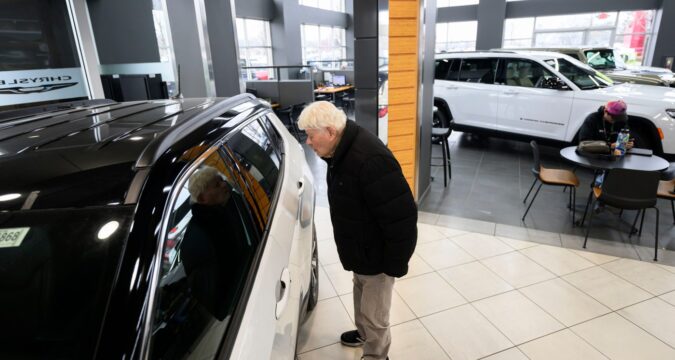
Cars sit in the showroom at the Golling Chrysler Dodge Jeep Ram dealership in Bloomfield Hills, April 10, 2025. (David Guralnick/Detroit News)
https://www.chicagotribune.com/2025/12/08/car-prices-tariffs/
Car prices are going up, but how much of it is from tariffs?
New car prices didn’t spike after President Donald Trump announced sweeping tariffs in the spring, as some experts and dealers projected.
But prices on many models are now pushing notably higher — and analysts said carmakers recouping Trump’s higher import costs is a key factor.
Consider a recent analysis that found automakers are implementing more aggressive price increases on 2026 model-year vehicles compared to when 2025s were hitting dealership lots last year.
Cloud Theory, which tracks car inventory on dealer websites across the country, found the average marketed price increase on 2026 models was nearly $2,000, compared to an approximately $400 uptick during last year’s model year changeover. This year, 23 models have at least a $2,000 price hike; last year there were just nine.
“What I think is different this year is you have a lot of cost increases that are $1,000 or $1,500 or more, $2,000 or more,” said Rick Wainschel, Cloud Theory’s vice president of data and analytics, whose analysis looked at 2026 models with at least 2,000 vehicles in inventory.
“I think that’s a big change and a big shift that’s occurred, and it’s hard to point to any other catalyst for that (except for) tariff costs that the OEMs have had to absorb for the last eight months, and will likely have to absorb going forward,” he said.
Any increase comes on top of average car prices that were already hovering around $50,000. Pair that with stubbornly high interest rates, and the average monthly car payment is now $766, according to Edmunds.com Inc., up more than 3% from a year ago. A record share of subprime borrowers has been falling behind on their auto loans this fall.
Yet the huge car sticker price increases tied to tariffs — which analysts originally warned might tally anywhere from an extra $5,000 to $15,000 per vehicle — haven’t come to pass.
Among the reasons: competitive pressures between rival automakers, concern over blowback from Trump, large pre-tariff vehicle inventories that gave companies a lag time before pricing adjustments were needed, as well as policy adjustments that reduced the pain of the tariffs themselves.
Automakers opted to absorb many of the extra costs in the near term.
But if you’re shopping for a new car right now or plan to in the coming months, experts said it is likely tariffs will cost you in one way or another, even if it’s tough to discern exactly how. Automakers haven’t been eager to publicly disclose any connection between tariffs and their pricing adjustments.
Vehicle destination charges — those mandatory fees for transporting the car to the dealership — are rising, revealing one area where automakers “might be trying to make up a little bit of the costs,” said Erin Keating, an executive analyst at Cox Automotive Inc.
There are also signs of automakers pulling features out of certain models in a bid to trim costs while holding the same sticker price, a phenomenon known as shrinkflation. And then there are indications of carmakers offsetting their tariff costs with higher 2026 model-year MSRPs.
“Automakers really held their prices throughout the ’25 model year, and we’re starting to see a bit (of an impact) in ’26,” said Stephanie Brinley, an auto analyst with S&P Global Mobility. “But it’s being wrapped up in different ways, so it’s very difficult to suss out.”
Car companies often adjust pricing on new model-year vehicles, whether due to minor repackaging of features and trim levels, or full overhauls that include new technology and freshened sheet metal. Brinley said that means there’s no clear way for consumers to figure out where those extra tariff costs might’ve been tacked on.
Keating agrees the tariff impacts have been hard to pin down. Average car prices have been rising steadily much of this year — with September reaching an all-time high above $50,000 — but she said some of that uptick would have been expected anyway because of normal inflation.
The analyst now feels confident those initial shocking projections of price hikes in the 10% to 15% range aren’t going to happen: “The market just won’t bear it,” she said.
Automakers appear to be settling into their new normal under Trump. They’ve secured at least some tariff relief on parts and vehicles imported from certain countries, while simultaneously feeling the benefits of Trump’s moves to loosen federal vehicle emissions and fuel economy standards.
A September J.P. Morgan report estimated combined tariff costs on vehicles and parts will amount to $41 billion in the first year, rising to $45 billion in year two and $52 billion in year three.
The bank expects automakers and consumers to ultimately share the burden equally, which could lead to a 3% increase in new vehicle prices: “This will hit consumers hard,” the report said, “especially as many are already struggling to afford new vehicles.”
Wainschel, the Cloud Theory analyst, said average prices listed on dealer websites have only increased a few hundred dollars per vehicle since the tariffs took effect in early April. But that’s because automakers have pushed an increasing number of affordable models and trims into the market, which has helped hold the overall average price down.
If the current mix of vehicle types listed for sale was the same as it was back in April, Wainschel said, average prices would, in fact, look approximately $1,300 higher now: “So there are some things that are masking the increases that are taking place, the segment mix being a big part of it.”
Brendan Harrington, president of Autobahn Fort Worth in Texas, which sells Porsche, BMW, Mini, Volvo, Volkswagen, Jaguar and Land Rover brands, said big price hikes didn’t occur early on as companies fretted over losing market share.
But now, carmakers are beginning to make larger changes in response to tariffs, he said, including trimming back slower-selling models and increasing MSRPs where they can. He said Porsche and Land Rover are two examples of brands that have upped prices in response to tariffs.
And carmakers are also passing through higher destination charges, he said — increases that are adding $200 to $300 to the cost of a car. Tariffs also are contributing to steadily rising costs for Harrington’s parts and service departments.
“Until now, every OEM has really tried to hold the line,” he said. “But we are seeing prices now come up.”
Cars sit in the showroom at the Golling Chrysler Dodge Jeep Ram dealership in Bloomfield Hills, April 10, 2025. (David Guralnick/Detroit News)
https://www.chicagotribune.com/2025/12/08/car-prices-tariffs/
Rickards: 8 Events Driving The Gold Frenzy
Rickards: 8 Events Driving The Gold Frenzy
Authored by James Rickards via Investors Daily,
Events are moving quickly in the gold market. You know about the run-up in the price of gold; it has become a mainstream media story. But the gold situation is bigger than that. There are important developments almost daily that will sustain the gold bull market for years to come. Let’s look briefly at the gold price action and then turn to these breaking developments.
Gold is in its third great bull market. There really were no bull or bear markets from 1870 to 1971 because the world was on a gold standard at a fixed price. The global gold standard had flaws. Some countries joined earlier than others. The U.S. did not formally adhere to a gold standard until 1900, but the UK and the London gold market maintained a steady price from 1815 after the Napoleonic Wars until 1914 after which the U.S. maintained a world price.
There were breaks in the system in 1931-1934 when the UK and U.S. devalued their currencies against gold, but a new fixed priced was established. A true floating rate market in gold did not emerge until Richard Nixon closed the gold window in 1971.
The first bull market (1971 – 1980) saw gold soar 2,200% in eight years. The second bull market (1991 – 2011) witnessed a gold price rally of 670% in twelve years.
The third bull market (which we are in today) can be more difficult to date. If one begins at the interim low of $1,050 per ounce in December 2015 until today’s price of $4,220 per ounce, then the gain is 300% over ten years, which is less than the two prior bull markets. Of course, this bull market is far from over and material gains in the near future should be expected.
However, gold moved in a range of $1,000 per ounce to $2,000 per ounce during almost all of the 2015 – 2025 period until July 1, 2023, when a breakout above $2,000 per ounce began. If we date the bull market from that point, we see a rally of 110% in just over two years.
10k Per Ounce or Higher
If we take the average gain for the first and second bull markets, which is over 1,400%, and take an average duration of ten years and apply those metrics to a baseline of $2,000 per ounce in 2023, that suggests gold will reach $28,000 per ounce by 2033. Of course, this method is arbitrary. Gains could be much larger and come much faster. A replay of the 1971 – 1980 scenario would put gold close to $100,000 per ounce by 2032.
From $1,000 to $2,000 = 100% gain
From $2,000 to $3,000 = 50% gain
From $3,000 to $4,000 = 33% gain
From $4,000 to $5,000 = 25% gain
From $9,000 to $10,000 = 11% gain
With this as background, it’s entirely reasonable to suggest gold could reach $10,000 per ounce by late 2026 on its way much higher. What few investors may realize is that each $1,000 increase in the price of gold is easier than the one before. The price gain is the same at each milestone, but the percentage increase is smaller because each increase is working from a higher base. Going from $4,000 to $5,000 per ounce is a 25% gain. But going from $9,000 to $10,000 per ounce is only an 11% gain. This is why the push to $10,000 per ounce will go slowly at first and then quickly.
Underreported Events to Consider
That much is widely known.
What is less well known is series of underreported events that will turbocharge the price gains ahead.
Here is a summary of those events:
Central banks remain net buyers of gold as they have been since 2010. This puts an informal floor under the price of gold while still allowing unlimited upside.
Mining output has been flat for last six years. This does not mean “peak gold”, but it shows that gold is getting harder to find and more expensive to mine. Supply constraints + expanding demand = higher prices.
The copper-to-gold price ratio is at an all-time low. This speaks to the relative role of industrial metals versus precious metals. The gold price can rise in recessionary scenarios and depressions. Gains are not limited to periods of inflation and hot economies.
Russia has demonstrated that it can survive Western dollar-based financial sanctions by holding over 25% of its reserves in physical gold. That’s a lesson the world and especially the BRICS are internalizing.
Digitally tokenized gold has become a huge new source of demand. Tether is leading the way with its XAUt token that has a current market cap (tied to the price of gold) of $2.2 trillion. The gold held in vaults to support the token now exceeds 16.2 metric tonnes, more than some countries. This gold is not traded, and the token is only redeemable for cash, not physical gold. This means Tether is the ultimate buy-and-hold gold investor and their gold is effectively off the market.
Italy has recently taken steps to asset that Italian gold (2,452 metric tonnes; the third largest gold reserve in the world after the U.S. and Germany) belongs to the Italian people and not to the Bank of Italy. That dispute has cooled down, but its mere existence shows that a global struggle for possession of physical gold is underway.
Television and media personality Tucker Carlson has launched an online gold dealing operation. That’s only one among many online dealers, but it shows that gold ownership is reaching a wider audience and we are getting closer to the retail frenzy stage of price appreciation.
The U.S. Treasury is giving serious consideration to revaluing its gold reserves by causing the Federal Reserve to restate the value of its gold certificate given when the Treasury took the Fed’s gold in 1934. The current value of the certificate is $42.22 per ounce. If revalued to $4,200 per ounce, this would not change the world price of gold (it’s just an accounting entry), but it would add about $1 trillion to the Treasury’s account at the Fed and it would show that the U.S. respects gold as a legitimate monetary asset.
Other material developments in the gold markets are occurring almost daily. We expect this to continue. If you have not invested in gold yet or if your allocation is small, it’s not too late to invest. The biggest gains are still ahead and will happen sooner than later.
Tyler Durden
Mon, 12/08/2025 – 14:05
https://www.zerohedge.com/precious-metals/rickards-8-events-driving-gold-frenzy
Rickards: 8 Events Driving The Gold Frenzy
Rickards: 8 Events Driving The Gold Frenzy
Authored by James Rickards via Investors Daily,
Events are moving quickly in the gold market. You know about the run-up in the price of gold; it has become a mainstream media story. But the gold situation is bigger than that. There are important developments almost daily that will sustain the gold bull market for years to come. Let’s look briefly at the gold price action and then turn to these breaking developments.
Gold is in its third great bull market. There really were no bull or bear markets from 1870 to 1971 because the world was on a gold standard at a fixed price. The global gold standard had flaws. Some countries joined earlier than others. The U.S. did not formally adhere to a gold standard until 1900, but the UK and the London gold market maintained a steady price from 1815 after the Napoleonic Wars until 1914 after which the U.S. maintained a world price.
There were breaks in the system in 1931-1934 when the UK and U.S. devalued their currencies against gold, but a new fixed priced was established. A true floating rate market in gold did not emerge until Richard Nixon closed the gold window in 1971.
The first bull market (1971 – 1980) saw gold soar 2,200% in eight years. The second bull market (1991 – 2011) witnessed a gold price rally of 670% in twelve years.
The third bull market (which we are in today) can be more difficult to date. If one begins at the interim low of $1,050 per ounce in December 2015 until today’s price of $4,220 per ounce, then the gain is 300% over ten years, which is less than the two prior bull markets. Of course, this bull market is far from over and material gains in the near future should be expected.
However, gold moved in a range of $1,000 per ounce to $2,000 per ounce during almost all of the 2015 – 2025 period until July 1, 2023, when a breakout above $2,000 per ounce began. If we date the bull market from that point, we see a rally of 110% in just over two years.
10k Per Ounce or Higher
If we take the average gain for the first and second bull markets, which is over 1,400%, and take an average duration of ten years and apply those metrics to a baseline of $2,000 per ounce in 2023, that suggests gold will reach $28,000 per ounce by 2033. Of course, this method is arbitrary. Gains could be much larger and come much faster. A replay of the 1971 – 1980 scenario would put gold close to $100,000 per ounce by 2032.
From $1,000 to $2,000 = 100% gain
From $2,000 to $3,000 = 50% gain
From $3,000 to $4,000 = 33% gain
From $4,000 to $5,000 = 25% gain
From $9,000 to $10,000 = 11% gain
With this as background, it’s entirely reasonable to suggest gold could reach $10,000 per ounce by late 2026 on its way much higher. What few investors may realize is that each $1,000 increase in the price of gold is easier than the one before. The price gain is the same at each milestone, but the percentage increase is smaller because each increase is working from a higher base. Going from $4,000 to $5,000 per ounce is a 25% gain. But going from $9,000 to $10,000 per ounce is only an 11% gain. This is why the push to $10,000 per ounce will go slowly at first and then quickly.
Underreported Events to Consider
That much is widely known.
What is less well known is series of underreported events that will turbocharge the price gains ahead.
Here is a summary of those events:
Central banks remain net buyers of gold as they have been since 2010. This puts an informal floor under the price of gold while still allowing unlimited upside.
Mining output has been flat for last six years. This does not mean “peak gold”, but it shows that gold is getting harder to find and more expensive to mine. Supply constraints + expanding demand = higher prices.
The copper-to-gold price ratio is at an all-time low. This speaks to the relative role of industrial metals versus precious metals. The gold price can rise in recessionary scenarios and depressions. Gains are not limited to periods of inflation and hot economies.
Russia has demonstrated that it can survive Western dollar-based financial sanctions by holding over 25% of its reserves in physical gold. That’s a lesson the world and especially the BRICS are internalizing.
Digitally tokenized gold has become a huge new source of demand. Tether is leading the way with its XAUt token that has a current market cap (tied to the price of gold) of $2.2 trillion. The gold held in vaults to support the token now exceeds 16.2 metric tonnes, more than some countries. This gold is not traded, and the token is only redeemable for cash, not physical gold. This means Tether is the ultimate buy-and-hold gold investor and their gold is effectively off the market.
Italy has recently taken steps to asset that Italian gold (2,452 metric tonnes; the third largest gold reserve in the world after the U.S. and Germany) belongs to the Italian people and not to the Bank of Italy. That dispute has cooled down, but its mere existence shows that a global struggle for possession of physical gold is underway.
Television and media personality Tucker Carlson has launched an online gold dealing operation. That’s only one among many online dealers, but it shows that gold ownership is reaching a wider audience and we are getting closer to the retail frenzy stage of price appreciation.
The U.S. Treasury is giving serious consideration to revaluing its gold reserves by causing the Federal Reserve to restate the value of its gold certificate given when the Treasury took the Fed’s gold in 1934. The current value of the certificate is $42.22 per ounce. If revalued to $4,200 per ounce, this would not change the world price of gold (it’s just an accounting entry), but it would add about $1 trillion to the Treasury’s account at the Fed and it would show that the U.S. respects gold as a legitimate monetary asset.
Other material developments in the gold markets are occurring almost daily. We expect this to continue. If you have not invested in gold yet or if your allocation is small, it’s not too late to invest. The biggest gains are still ahead and will happen sooner than later.
Tyler Durden
Mon, 12/08/2025 – 14:05
https://www.zerohedge.com/precious-metals/rickards-8-events-driving-gold-frenzy