Category: News

Ex-etiquette: Daughter needs her sleep and nourishing food
Q. My daughter comes home from her dad’s house telling me that her father lets her stay up until 10 o’clock at night and doesn’t cook dinner. She’s 6. She needs her sleep and nourishing food. I get so worked up; I don’t want her to go. And I don’t know exactly what to say to her when she tells me these things. What’s good ex-etiquette?
A. Do the logical thing first. Get on the phone — and I mean talk, don’t text — and ask dad what’s the story. Don’t accuse him. Explain what your daughter has been saying.
One of my clients made a joke about it when she asked her co-parent what was going on and it took the sting out of the questioning. She said, “So, I hear bedtime is 10 o’clock on school nights at your house,” with a little laugh. “Our daughter is full of surprises. Got any insight for me?”
Her co-parent returned the explanation in the same voice his co-parent had used –laughing, with a to-the-point explanation: “Well, that’s only half the truth. I did let her stay up to 10, but it was on Saturday night when her cousins were visiting.”
No fighting, no arguing. They then had a further conversation about staying on the same page as their daughter goes back and forth between their homes, because they recognize that she is getting older and starting to notice.
Now, what to say to your daughter. Try to convey the message that “equal doesn’t mean identical.” That’s a phrase I repeat often to co-parents. Your child doesn’t need two copies of the exact same life, just two homes that communicate the same message: “We both care about your well-being.”
It’s not about matching routines down to the minute. It’s about creating environments in both homes where the child feels secure, valued and protected. Parents may do things differently — one might serve breakfast at the table, the other on the go — but if both households operate with steady respect, similar values around safety and unconditional love, children learn that “different” can still be safe. That’s the heart of collaborative co-parenting: not carbon copies but connected care.
So, if your daughter says something like “Daddy lets me eat in front of the TV,” you can say, “Every home does things a little differently. That’s OK. Here, we eat at the table.”
Related Articles
Terry Savage: How income can affect Medicare premiums
Answer Angel: Sequins all the time? Sure!
The Kid Whisperer: How to set a limit with another adult
Ask Anna: Is he wasting my time?
Asking Eric: He is too cheap
For your particular problem — a later bedtime — explain that, “Your dad and I were recently talking, and he explained that this was a one-time thing on the weekend when your cousins were visiting. That’s not the same as staying up late on a school night, honey. When you have to do schoolwork the next day, you must get your sleep to do well. Your dad and I agree on that.”
What that message conveyed is that you and dad talk, so if she’s going to tell stories, you or dad will know about it. It also clarified why dad made the choice to let her stay up and you understood his reasoning. Plus, it reiterated the reason why there is an earlier bedtime on school days — and that you and dad agree. That’s good ex-etiquette.
https://www.chicagotribune.com/2025/12/08/ex-etiquette-staying-up-too-late-at-dads-house/
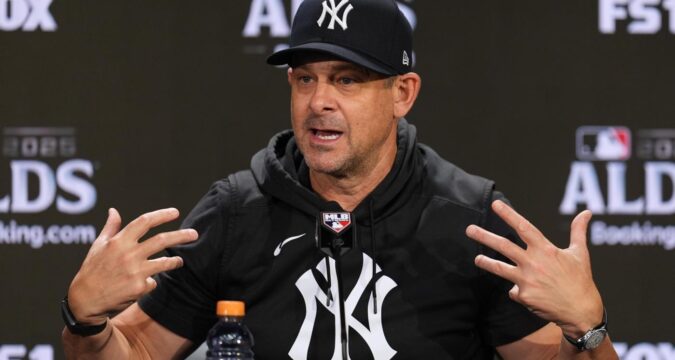
El manager Aaron Boone cree que la diferencia entre sus Yankees y los Azulejos es mínima
Por KRISTIE ACKERT
ORLANDO, Florida, EE.UU. (AP) — Los Yankees de Nueva York pasaron la mayor parte de la temporada 2025 persiguiendo a los campeones de la Liga Americana, los Azulejos. Desde una barrida en verano hasta un golpe en la postemporada, Toronto se convirtió en el referente que los Yankees no pudieron superar.
Se le preguntó a Aaron Boone cómo su equipo cerrará esa brecha de cara a 2026.
“Jugar mejor contra ellos es la respuesta más simple”, dijo el manager de Nueva York el lunes en las reuniones de invierno del béisbol. “Nos patearon el trasero. … Eso terminó realmente perjudicándonos”.
Aun así, Boone señaló que los Yankees tuvieron el mismo récord de temporada regular que sus rivales del Este de la Liga Americana, 94-68.
“Quiero decir, terminamos con récords idénticos el año pasado. No quiero restar importancia al hecho de que nos patearon el (trasero) el año pasado — no lo saquen de contexto. Diría que la brecha es pequeña”, dijo Boone. “Tuvimos exactamente el mismo récord. Pero obviamente fueron un gran equipo el año pasado, a un paso de ganar el campeonato mundial”.
Los Azulejos ganaron el título del Este en un desempate directo sobre Nueva York. Vencieron a los Yankees 3-1 en su Serie Divisional al mejor de cinco y luego ganaron el banderín de la Liga Americana antes de perder el decisivo séptimo juego de la Serie Mundial ante los Dodgers de Los Ángeles en entradas extras.
“Sin duda demostraron ser el mejor equipo este año, y esperamos poder cerrar esa brecha y superarlos a ellos y a otros este año”, dijo Boone.
Para lograr eso, los Yankees necesitan abordar los huecos en su alineación este invierno. Aunque el gerente general Brian Cashman ha dicho que volver a firmar a Cody Bellinger es una prioridad, Boone dijo que no ha estado reclutando al versátil ex Jugador Más Valioso de la Liga Nacional.
“Por lo general, no recluto tanto a los chicos que ya hemos tenido. Ellos saben quiénes somos. Saben de qué se trata”, dijo Boone. “Ciertamente, si llega un punto en el que — y esto no es solo para Cody, esto es con cualquiera — cuando lleguemos a un punto en el que estemos avanzando o en conversaciones, ciertamente tendré esas pláticas con los chicos donde lo vea adecuado”.
Boone también reaccionó a los comentarios recientes del ex lanzador derecho de los Yankees, Sonny Gray, quien dijo después de ser cambiado el mes pasado de San Luis a Boston que nunca quiso lanzar para los Yankees en primer lugar hace años y que estaba contento de estar ahora con los rivales Medias Rojas en un equipo donde es fácil odiar a los Bombarderos del Bronx.
Gray tuvo dificultades en Nueva York después de ser adquirido de los Atléticos de Oakland en un intercambio en 2017. Boone admitió que, en ese momento, sabía que el Bronx no era el “mejor” lugar para Gray.
“Ahora está en Boston. De todos modos, se supone que no debe gustarle”, dijo Boone. “Dicho esto, siempre me ha gustado mucho Sonny, me he llevado bien con él. Si va a animar un poco la rivalidad, no hay nada de malo en eso.
“Pero me sorprendió un poco lo profundo que llegó”.
Boone sabe que el objetivo siempre está en los Yankees desde Boston, Toronto y alrededor del Este de la Liga Americana. Eso es lo que recordará a sus jugadores cuando comience el entrenamiento de primavera de 2026.
“Tienes que jugar bien, especialmente en nuestra división, si vas a tener una oportunidad de ganar la división y hacer algo grandioso”, dijo.
___
Deportes en español AP: https://apnews.com/hub/deportes

Review: In ‘Marjorie Prime’ on Broadway, the disquieting robot future is here
NEW YORK — The central premise of “Marjorie Prime,” now on Broadway with Cynthia Nixon, June Squibb, Danny Burstein and Christopher Lowell, is that technology might allow the creation of bespoke robots allowing, say, a grieving widow with dementia to talk to something that looks and talks exactly like her late husband. Not only would he be restored to her in three dimensions, he could be ordered up looking tanned, handsome and hot, as he did in his prime. The play begins with an elderly woman, played by Squibb, having just such a conversation with just such a strong-jawed dude (Lowell).
I first saw this Jordan Harrison play in 2015 at Writers Theatre in Glencoe. The premise certainly was intriguing but it felt futuristic and, well, safely remote. My reaction at the time was mostly of curiosity, including the quip “Beats interacting with strangers in a nursing home, wouldn’t you say?”
Now? The play is far more disquieting as a consequence of the passage of time. In fact, I can’t ever remember ever seeing a play whose impact felt so utterly different a decade later.
These things are almost here now, thanks to the advances in artificial intelligence and other forms of human mapping that use our history and our actions to such an extent that they could replicate us after death. Once you have those guts, the rest is just sculpted plastic.
Harrison’s 80-minute play, directed with an eye on what matters most by Anne Kauffman, has a new urgency that sends your head spiraling in all kinds of directions. As you watch, you likely will first think about how dementia care — heck, how all kinds of senior care — could be immeasurably improved by these robots that can work 24-hour shifts. But after a while, since Harrison leads you by the hand that way, your head will go to the problems: Who would win the fight to program these things?
Imagine, for example, two warring siblings with different views of their father. His “Prime” version could reflect just one of their dubious take on his identity, leading his widow down the kind of garden path that strikes me as dangerous for the entire human race. Taking that a step further, the play explores the likelihood that we won’t even be able to control representations of ourselves after we are dead. For some, that’s already the case, god help us.
Harrison explores this issues with a simple, four-character play that begins with the aforementioned conversation but then focuses on Marjorie’s daughter and son-in-law, played by Nixon and Burstein, nice people in their late 50s who are trying to figure out how they feel about this technology and, just as importantly, what it might mean for them in their own future. (I won’t give that away, but the play, like the world, only spins forward.)
Kauffman is one of America’s most humanistic stage directors and both Nixon and Burstein forge likable characters, focused on the vulnerability those of us close to 60 years old feel when it comes to the demise and loss of our parents. I should note that I walked into 2nd Stage’s Hayes Theatre having just spent extended time with my 102-year-old mother, so that certainly was in my head, although she was not talking to any robots. Yet. She does talk to carers though and they have only limited, quickly crammed knowledge of her rich life. A robot of my dad perhaps could write a book.
You see where this play takes you?
Nixon’s Tess is vulnerable enough for you to sense the fear in her eyes, but this is an actress with a steely core and, indeed, Nixon turns on a dime when her character realizes, as I think many of us have or will, that this brave new world of now is short on both guardrails and moral principles.
“Am I supposed not to notice she is being nicer to that thing than me?” Tess snaps at one point, bringing up another salient A.I. issue.
Squibb, 96, whose Broadway career stretches back to her role as Electra in the original 1960 production of “Gypsy,” is excellent. For the record, she is the oldest actress ever to open a Broadway show. With Mike Nussbaum gone, she is singular.
Comparisons surely will be made with another Broadway show about robots, “Maybe Happy Ending,” a quite lovely musical that also uses them as proxies for a study of mortality. The singing robots have degraded batteries, though; the ones in “Marjorie Prime” appear to go on forever. It’s the humans who die first.
Chris Jones is a Tribune critic.
cjones5@chicagotribune.com
At the Hayes Theater, 240 W. 44th St., New York; 2st.com
https://www.chicagotribune.com/2025/12/08/review-marjorie-prime-broadway/

Fiscal General de Honduras pide que se ejecute orden de captura de expresidente Hernández por lavado
Por MARLON GONZÁLEZ
TEGUCIGALPA (AP) — El fiscal general de Honduras pidió el lunes que se ejecute una orden de captura contra el expresidente Juan Orlando Hernández por presunto lavado de activos y fraude.
La orden había sido emitida en 2023 por un juez de la Corte Suprema.
Hernández, de 57 años, fue liberado el 1 de diciembre en Estados Unidos, donde cumplía una pena de 45 años de cárcel por narcotráfico, tras ser indultado por el presidente estadounidense Donald Trump.
“Exhorto a los organismos de seguridad del Estado y a nuestros aliados internacionales, como ser la Interpol, a ejecutar la orden de captura internacional contra el expresidente Juan Orlando Hernández, acusado por los delitos de lavado de activos y fraude en el caso Pandora II. Nuestra lucha es frontal”, escribió Zelaya, promovido en ese cargo por el partido oficialista Libertad y Refundación (Libre) de izquierda.
El caso Pandora II se refiere a una red de corrupción integrada por ex altos funcionarios que entre 2010 y 2013 participó en la ampliación y aprobación de desembolsos de fondos públicos por más de 288 millones de lempiras (un poco más de 11 millones de dólares) a distintas fundaciones, de acuerdo con una investigación de la Unidad Fiscal Especializada Contra Redes de Corrupción (UFERCO).
Según la UFERCO, el expresidente Hernández (2014-2022) se benefició con esos desembolsos al recibir para su campaña política al menos 62 millones de lempiras (más de 2,3 millones de dólares) a través de la utilización de diferentes artificios, entre ellos la creación de empresas fantasmas, el uso prestanombres y contratos ficticios.
El pedido del fiscal se produjo un día después de que Libre emitiera un comunicado rechazando el indulto de Trump.
El viernes Hernández agradeció el indulto a Trump en un video en el que además sostuvo que era inocente de todos los cargos que se le imputaron y que fue víctima de una “conspiración” orquestada por los delincuentes que él combatió desde el poder y la izquierda, en referencia al gobierno de la actual mandataria Xiomara Castro.
Denunció que durante su juicio se ocultaron evidencias, se bloquearon testigos y se enterraron informes oficiales que mostraban supuestamente su inocencia. Destacó que en sus dos periodos de gobierno se crearon leyes para combatir al crimen organizado y se estrechó la cooperación en seguridad con Estados Unidos.
Hernández fue arrestado a pedido de Estados Unidos en febrero de 2022, semanas después de que Castro asumiera la presidencia. Dos años después un tribunal federal de Nueva York lo condenó por aceptar sobornos de narcotraficantes para que pudieran pasar por Honduras unas 400 toneladas de cocaína con destino a Estados Unidos.
Hernández sostuvo en todo momento que era inocente.
Corrección: APAlertaNoticioso Fiscal General de Honduras pide que se ejecute orden de captura de 2023 contra expresidente Hernández por lavado y fraude
TEGUCIGALPA (AP) — Corrección: APAlertaNoticioso Fiscal General de Honduras pide que se ejecute orden de captura de 2023 contra expresidente Hernández por lavado y fraude.

Japan Urges More Support From Trump In Spat With China
Japan Urges More Support From Trump In Spat With China
Several reports say that Japan is currently pressing the United States to step up its public support for Prime Minister Sanae Takaichi amid the spat with China unleashed in the wake of her recent controversial comments about willingness to defend Taiwan.
The Japanese government has reportedly disappointed by what it views as insufficient backing from Washington, after American Ambassador to Tokyo George Glass told reporters last month that Trump and his team “have her back”.
“This is a classic case of Chinese economic coercion, and I just want to say directly from the president and from myself and from the embassy for the Prime Minister, we have her back,” Glass had previously said after a meeting with Foreign Minister Toshimitsu Motegi.
Takaichi had last month said before parliament that a Chinese attack on Taiwan could present an existential threat which would allow for the deployment Japanese military forces in support of pro-independence allies.
Since then, China – which remains Japan’s largest trading partner – embarked on a series of punitive measures on the economic, tourism, and cultural exchange fronts. Things have also heated up on the military and maritime fronts of late.
Shigeo Yamada, Japan’s ambassador to the US, has a result of Beijing’s ratcheting anti-Tokyo actions directly requested stronger public expressions of support from the Trump administration.
But this apparently hasn’t come. Instead, Trump has reportedly been urging Tokyo to take steps to lower the temperature, especially after a last month phone call with China’s President Xi Jinping:
Later the same day, Trump set up a call with Takaichi and advised her not to provoke Beijing on the question of Taiwan’s sovereignty, said Japanese officials and an American briefed on the call. The advice from Trump was subtle, and he didn’t pressure Takaichi to walk back her comments, those briefed on the calls said.
On Sunday Japan summoned China’s ambassador to protest a dangerous weekend incident in southern waters off Japan wherein Chinese military aircraft allegedly targeted Japanese fighter jets with fire-control radar on at least two separate occasions.
Japan’s Ministry of Foreign Affairs blasted the actions of the Chinese J-15 fighters as dangerous and “deeply regrettable”. But Beijing has shot back, describing that Japanese aircraft had obstructed safe flight operations centered on the PLA Navy’s Liaoning aircraft carrier.
🚨🇯🇵🇨🇳 China’s next mistake will be its last mistake!
Japan’s Defense Minister has issued a sharp protest to Beijing after Chinese J-15 jets from the aggressive Liaoning carrier repeatedly locked fire-control radar onto Japanese F-15 fighters in international airspace southeast… pic.twitter.com/ieoRZZVo8T
— Terror Alarm (@Terror_Alarm) December 6, 2025
Meanwhile China continues to take measures, sinking relations with Tokyo further. “A passenger ferry named after an ancient monk seen as a symbol of Sino-Japanese cultural exchange has suspended its service as Beijing continues its retaliation for Japanese Prime Minister Sanae Takaichi’s remarks on Taiwan,” reports South China Morning Post of the latest development. Already Beijing has called on all its citizens to avoid travel and tourism to Japan.
China’s embassy has also delivered a new, blistering statement: “China solemnly demands that Japan stop smearing and slandering, strictly restrain its frontline actions, and prevent similar incidents from happening again,” it said.
Tyler Durden
Mon, 12/08/2025 – 21:20
https://www.zerohedge.com/geopolitical/japan-urges-more-support-trump-admin-spat-china
Increíble regreso de Caribes en el único encuentro programado en Venezuela
Por The Associated Press
Los Caribes de Anzoátegui explotaron este lunes con un ataque de seis carreras en el cierre de la novena entrada para remontar una desventaja de cinco carreras y dejar en el terreno a los Navegantes del Magallanes, logrando una improbable victoria por 8-7 en el único encuentro disputado en la Liga Venezolana de Béisbol.
El juego estaba originalmente programado para el domingo, pero fue suspendido por lluvia y reprogramado para este lunes, que era una jornada prevista como día de descanso.
Abajo por cinco carreras en su última oportunidad, Balbino Fuenmayor conectó un jonrón de tres anotaciones para acercar a los Caribes, y Herlis Rodríguez añadió otro cuadrangular de tres carreras para dejar en el terreno a los Navegantes y desatar el festejo de los locales y su afición tras la increíble remontada.

Chicago Cubs’ Jed Hoyer expects ‘interesting things’ at winter meetings — and may be looking for offensive upgrades
ORLANDO, Fla. — Chicago Cubs president of baseball operations Jed Hoyer always tries to tell himself the same thing at the start of Major League Baseball’s annual winter meetings.
There is no finish line at the end of the three-day gathering.
“People take things a hair more seriously when they’re here and try to move the ball forward, so this is sort of the beginning of the real offseason in a lot of ways,” Hoyer said Monday in Orlando. “And as a result, people are more willing to exchange ideas, be creative and work late and sort of be in the same place. So interesting things always happen. There’s always ideas or things that come up here that haven’t before, which is one of the nice things about the winter meetings. That’s kind of how it is already, and I expect it to continue.”
The Cubs’ priorities at the winter meetings remain focused on pitching.
After signing veteran Phil Maton, Hoyer believes the Cubs will be in the market for another high-leverage reliever.
“Whether we end up signing someone or not, I don’t know,” Hoyer said. “Depends on how other teams value them, honestly. But we can definitely be in that market and we’re obviously going to sign more relievers.”
Chicago Cubs president of baseball operations Jed Hoyer responds to questions during the Major League Baseball winter meetings Tuesday, Dec. 5, 2023, in Nashville, Tenn. (AP Photo/George Walker IV)
Shota Imanaga’s return by accepting the Cubs’ qualifying offer “gave some clarity, as far as available dollars,” Hoyer said of the rotation, “and we knew going in there was a possibility that could happen.” Hoyer stated the Cubs are “definitely” still looking for another starter but also hybrid pitchers who can start and be used out of the bullpen, citing Colin Rea as an example.
Although their focus is on pitching, the Cubs must build a quality bench and look for potential offensive upgrades, depending on how the free agent and trade markets develop. Part of the Cubs’ offensive improvement for 2026 will center on their younger hitters continuing to develop.
Asked what makes the Cubs confident they can get the offensive version of Matt Shaw they saw in the final 2 1/2 months of the season over a full season rather than the first half performance, Hoyer downplayed connections the Cubs might have to third basemen on the market without referencing any of those free agents by name. That third base free-agent group notably features Alex Bregman and Eugenio Suárez.
“Honestly, I’ve been surprised by the number of media reports that link us to different guys,” Hoyer said. “There’s zero lack of confidence in that. Actually, I would say the opposite. I think that when you look at his overall second-half numbers and what he did in the minor leagues, those struggles are to be expected at the beginning. The outliers are the ones that don’t have that. What he did on defense was amazing.
Related Articles
Michael Soroka — who made 1 start for Cubs after deadline trade — goes to Diamondbacks on $7.5M, 1-year deal
Will they acquire a top-of-the-rotation arm? 3 questions facing the Chicago Cubs ahead of the winter meetings.
Column: Cubs might be ready for Hot Stove spending, while White Sox could be shopping in the bargain bins
Column: Will Marquee Sports Network’s cost-cutting affect the Chicago Cubs’ offseason spending plans?
Column: Shirtless Ben Johnson is exactly what Chicago needed on a snowy holiday weekend
“I actually thought there were a lot of huge positives last year. If you had told me at the beginning of the year this was going to be the totality of his season, I would’ve been like, I’m good, we’re in a good place.”
A union between the Cubs and Bregman would make sense. They could use more proven production that Bregman could provide to replace Kyle Tucker, and Shaw still gives them value with his ability to play multiple infield positions. Signing a hitter like Bregman can also help the organization avoid going into the next offseason with shortstop Dansby Swanson as their only player on a guaranteed multi-year deal. The two sides nearly found common ground this past spring, when the Cubs offered him four years, $115 million with opt-outs after 2026 and 2027; Bregman ultimately signed with the Boston Red Sox to a three-year deal, including an opt-out following the 2025 season that the 31-year-old triggered to become a free agent again.
The Cubs, though, have been saying all the right things about Shaw and their long-term belief in him since the season ended. They will need Shaw to take another step forward in his offensive maturation, which for Hoyer means more consistency from the 24-year-old.
Shaw posted a .198/.276/.280 slash line with two home runs, 11 doubles, 15 RBIs and a .556 OPS in 232 plate appearances in the first half, which included a demotion to Triple A, compared to a .258/.317/.522 mark and 11 home runs, 10 doubles, three triples, 29 RBIs and an .839 OPS in 205 plate appearances in the second half.
“His downs were pretty down, learning how to kind of smooth that out a little bit,” Hoyer said of Shaw. “That doesn’t mean the second year can’t be a huge year, but I expect, sort of guys learn to league, learning what pitchers are doing to them, they learn their own swing, I expect kind of more gradual improvement.”
https://www.chicagotribune.com/2025/12/08/chicago-cubs-jed-hoyer-winter-meetings/

Gen Z, Socialism, And The System That Failed Them
Gen Z, Socialism, And The System That Failed Them
Authored by Steve Cortes via Cortes Investigates,
There’s real angst among older Americans about Gen Z’s openness to socialism. For those of us shaped by the Cold War, this flirtation with Marxism-lite feels alarming.
But we need to pause and rethink what we’re actually seeing.
Gen Z isn’t embracing socialism because they dream of five-year plans. They’re listening because the “capitalism” they were sold was already broken—rigged for insiders, punishing for everyone else.
They’ve been:
Systematically lied to, about major issues
Shut out of real opportunity
Raised in an economy designed to reward incumbents, not strivers
Also, they didn’t come pre-programmed. They don’t warm to inherited allegiances. The ideological labels—capitalism, socialism, Zionism, democracy, equity—don’t trigger the same instincts in them. In many cases, they don’t trigger anything at all.
Because maybe they don’t even know (or care) that they’re supposed to be pro-this or anti-that. They weren’t around for the Cold War. They didn’t watch the Berlin Wall fall. They weren’t raised on 9/11 flags or 20th-century partisan scripts.
What they were around for was collapse.
They saw their parents lose homes in 2008. They saw entire towns swallowed by fentanyl. They got locked in their bedrooms by “experts” who wrecked their lives and walked away clean. They were force-fed contradictions: “trust the science,” “speech is violence,” “men are women,” “America is evil,” “conform or else.”
They weren’t around for the great debates of the last century. They were around for the fallout. So no—don’t expect them to fall in line.
I polled over 2,000 young adults, aged 18–25. The results were eye-opening. Yes, 43% said they view socialism positively, vs. 33% negatively. The other 24% weren’t sure. Even among young Trump voters, it was a 40–40 split.
But they’re not drawn to socialism because they want state control. They’re drawn to something else—something different—because what’s here now DOES NOT WORK FOR THEM! What they’ve seen isn’t free enterprise. It’s a crony system where power protects power.
Still, don’t confuse them for leftists. They are, in many ways, anti-woke populists in the making:
67–21% say trans violence is a systemic issue
69–24% fiercely back free speech—even if it’s “offensive” or “untrue”
They reject males in female sports
66–21% say we intervene too much overseas
70–20% are deeply concerned about the national debt
They want sovereignty. Clarity. Reality. But what they get is a system that works for the already successful—and nobody else.
88% say they want to buy a home in their 20s or 30s. Most know they won’t. First-time homebuyer age just hit 40, a historic high.
They’re facing a brutal job market. The unemployment rate for 20–24-year-old college grads is now 9.5%, the highest in over a decade, except for the lockdowns. Automation is crushing entry-level candidates. Goldman Sachs economist Joseph Briggs just warned that “Gen Z professionals, especially those in junior tech roles, are at the frontlines of job displacement as companies rapidly automate entry-level tasks.”
So yeah, they’re open to something new. They’re not ideologues—they’re pragmatists who’ve seen the receipts.
And they’ve seen that the elite don’t believe in capitalism either—at least not when it applies to them. When things go bad, it’s bailout time. In 2008, Wall Street big shots all got rescued. Masses of regular Americans lost homes. Nothing changed.
Palantir CEO Alex Karp explained it bluntly: “these business leaders make completely stupid decisions, and they get bailed out, a year later they’re getting huge bonuses. And what do the American people get? Nothing.” As a consequence, “no one believes the institutions are credible,” and certainly not skeptical young adults.
So no—Gen Z doesn’t trust institutions. At all. And why should they?
They were told:
“There are 56 genders”
“America was founded for slavery”
“White men are inherently guilty”
“The science is settled—until it’s not”
“Shut up, mask up, and be grateful”
And through it all, they were punished for asking questions.
So when they don’t pledge allegiance on cue, don’t act surprised.
They don’t arrive with preloaded scripts. No automatic “stand with” or “stand against.” No guilt-based loyalty tests. They weren’t raised on legacy narratives.
They look at what’s happening—who’s suffering, who’s in power, who’s lying—and they judge in real time.
They’re not picking sides because someone told them to. They’re asking questions older generations were told never to ask. They don’t trust official narratives—because none of the storytellers have earned their trust.
They are skeptical of every flag, every faction, every moral claim. And based on what they’ve lived through, they should be.
That doesn’t mean they’re always right. It means they’re not controlled.
This generation is done playing someone else’s war game with someone else’s talking points.
If you want their support, you’ll have to earn it — with authenticity and transparency.
So when they say they’re open to socialism, what they really mean is:
“We want a system that actually works. And this one doesn’t.”
So…let’s lead them and persuade them of a better economy, built on widely-dispersed prosperity that prioritizes American workers and small businesses. One that protects against predatory trade practices and halts the flood of foreign workers inot our homeland.
Localism. Ownership. Sovereignty. They want a system that rewards real work—not credentials, not connections, not corporate lies.
They’re cynical, skeptical, and absolutely justified.
And now it’s on us — especially Gen X, to do what no one else has done:
Tell the truth. Smash the oligopolies. Kill the sacred cows. Restore an economy that works for Main Street, not just Davos.
Gen Z doesn’t need a pep talk.
They need proof.
Steve Cortes is president of the League of American Workers. He directs political campaigns on media, polling, and Hispanic outreach, including Trump 2016/2020 and Vance 2022 US Senate. He is a former broadcaster for Fox News and CNN.
Tyler Durden
Mon, 12/08/2025 – 20:55
https://www.zerohedge.com/political/gen-z-socialism-and-system-failed-them
Imponen cadena perpetua y 20 años de prisión a ex viceprimer ministro cubano en dos juicios
Por ANDREA RODRÍGUEZ
LA HABANA (AP) — Un tribunal cubano condenó al ex viceprimer ministro y extitular de Economía, Alejandro Gil Fernández, a una cadena perpetua y a 20 años de prisión en dos causas separadas por delitos que van desde el espionaje a la falsificación de documentos.
Una nota del Tribunal Supremo Popular —la Corte Suprema— indicó el lunes que se habían notificado las sentencias contra quien fuera uno de los más cercanos colaboradores del presidente Miguel Díaz-Canel hasta su caída a comienzos de 2024.
En una primera causa desarrollada entre el 11 y 13 de noviembre por delitos de espionaje, actos en perjuicio de la actividad económica y violación de la protección de documentos clasificados el tribunal le impuso una sanción de privación perpetua, indicó el comunicado.
Agregó que en la segunda, que realizó entre el 26 y el 29 de noviembre por delitos que iban del cohecho al tráfico de influencias, se determinó una pena de 20 años de cárcel. Las sentencias pueden ser apeladas.
“Una vez resueltos los recursos contra las sentencias –obligatorios cuando se trata de castigos tan severos—, de ratificarse su responsabilidad se le formará una sanción conjunta y única a ejecutar entre todas las penas impuestas”, expresó la nota del Tribunal Supremo.
Gil fue el funcionario de más alto rango en ser separado de su cargo desde 2009, cuando se desplazó al entonces vicepresidente Carlos Lage y al entonces canciller Felipe Pérez Roque debido a filtraciones de información a otro país, aunque a ellos dos no se los enjuició. Ambos desaparecieron de la vida pública, pero permanecen en libertad.
El Tribunal Supremo aclaró además en su nota que como sanciones accesorias se procedió a la confiscación de bienes.
Aunque cuando se ventiló el inicio del proceso en octubre se habló de otros implicados, en la nota judicial de este lunes solo se mencionó a Gil. Las vistas orales se desarrollaron a puertas cerradas, incluso ante el pedido de una hija del exfuncionario de que se abriera al público.
Gil era titular de Economía y Planificación desde 2018, responsabilidad a la que agregó la de viceprimer ministro en 2019. Fue cesado en febrero de 2024 mediante un escueto anuncio y sin que se diera ninguna explicación oficial.
El exfuncionario se desempeñó como directivo de varias empresas estatales antes de ascender a los primeros puestos del gabinete. Fue la cara visible del programa de unificación monetaria y cambiaria, así como de una reforma financiera en 2021 que desató un proceso inflacionario.
Según el comunicado del Tribunal Supremo, Gil “se aprovechó de las facultades otorgadas” para obtener beneficios personales, “recibiendo dinero de firmas extranjeras y sobornando a otros funcionarios”.