Category: News

Can Myles Garrett set the NFL sack record vs. the Chicago Bears? Here’s what the numbers say.
Cleveland Browns pass rusher Myles Garrett is in rare territory.
His 20 sacks through 13 games puts him just 2½ shy of the single-season NFL record set by Michael Strahan in 2001 and matched by T.J. Watt in 2021. Garrett has four games to tie or surpass the record. (Unofficially, the Detroit Lions’ Al “Bubba” Baker recorded 23 sacks in 1978, but sacks didn’t become an official statistic until 1982.)
Garrett has recorded a sack in each of the last seven games. Three times in that stretch he recorded three or more.
Garrett has a 16.7% pressure rate this season, per NFL Pro. Remarkably, that’s only the fourth-best mark of his career going back to his second season in 2018 (which is as far back as NFL Pro’s numbers go). His career-high pressure rate was 19.2% in 2019, when he totaled 10 sacks in 10 games before being suspended for the final six games.
Garrett has lined up on the right side of the defensive formation — against the left offensive tackle — on 82% of his snaps. So he’ll likely spend the majority of Sunday’s game at Soldier Field going against Chicago Bears left tackle Ozzy Trapilo. He will switch sides at times to mix it up, though, so right tackle Darnell Wright also should expect to see Garrett across from him.
“He’s just a complete player,” Bears coach Ben Johnson said. “When you look at the size and strength and speed, it’s just a unique package where he really has it all.”
Could Myles Garrett set the sack record Sunday?
Browns defensive end Myles Garrett (95) celebrates after sacking 49ers quarterback Brock Purdy on Nov. 30, 2025, in Cleveland. (AP Photo/Sue Ogrocki)
Don’t put it past him.
Garrett has feasted on the Bears with 5½ sacks in three career games. That includes 4½ sacks during Justin Fields’ starting debut in 2021. The last time he faced the Bears in 2023, Garrett had no sacks but seven quarterback pressures.
Three sacks from Garrett on Sunday is definitely not out of the question. Just this season he has had games with three, four and five. A player doesn’t get to 20 sacks without those monster efforts.
Bears quarterback Caleb Williams has been sacked just 20 times through 13 games — quite an improvement over last year’s 68 sacks in 17 games. Williams has faced a 32.1% pressure rate, per NFL Pro, which ranks 22nd-highest among 34 qualified quarterbacks.
So while it feels like Williams often is running for his life while playing Houdini, overall the Bears have given him relatively clean pockets compared with some of his peers. He has been sacked three times or more in only two games this season.
“I’m going to try and make sure that he doesn’t get the sack record on us and on me,” Williams said Wednesday.
Easier said than done. There’s at least a small possibility fans could see history Sunday at Soldier Field.
The only player to record multiple sacks against the Bears this season was Minnesota Vikings defensive lineman Javon Hargrave, who had two in Week 1.
Micah Parsons challenged the Bears more than the stat sheet indicates.
Bears quarterback Caleb Williams catches his footing as Packers defensive end Micah Parsons defends in the fourth quarter Dec. 7, 2025, at Lambeau Field in Green Bay. (John J. Kim/Chicago Tribune)
Parsons had no sacks and only one tackle Sunday in the Green Bay Packers’ 28-21 victory over the Bears, but that doesn’t tell the whole story.
Parsons recorded eight pressures in 30 pass-rush attempts for a 26.7% pressure rate. It was his seventh game this season with a pressure rate better than 20%. Green Bay used him all over the formation, including on the interior at defensive tackle.
The eight pressures were tied for the most the Bears have allowed by a single player this season. The Cincinnati Bengals’ Joseph Ossai also had eight in Week 9. The Lions’ Aidan Hutchinson recorded seven pressures in Week 2.
Caleb Williams’ accuracy issues continue.
Bears quarterback Caleb Williams winds up to throw in the first quarter against the Packers on Dec. 7, 2025, at Lambeau Field in Green Bay. (John J. Kim/Chicago Tribune)
Williams’ targets this season are averaging 3.8 yards of separation. That’s tied for the best in the league with the Denver Broncos’ Bo Nix. Williams has thrown into what Next Gen Stats describes as “tight windows” just 10.7% of the time, the lowest mark in the league.
That makes it all the more concerning that he’s completing 57.8% of his passes, ahead of only Minnesota’s J.J. McCarthy.
Next Gen Stats uses its models to estimate an expected completion percentage, given where the receiver and defenders are on the field. Williams is last in the NFL with a minus-8% completion percentage over expected.
“There’s certainly some (throws) that you can talk about each week where you feel like guys are open and we can certainly give them a ball on time and give them a chance to run after catch and all that,” Johnson said this week.
Can Williams set a Bears record?
Williams probably won’t reach 4,000 passing yards this season unless something unusual happens. That number has eluded Bears quarterbacks for more than 100 years. They remain the only franchise that has never had a 4,000-yard passer.
With 2,908 yards through 13 games, Williams needs to average 273 over the final four games to reach 4,000. He has topped 273 yards just three times this season.
The single-season franchise record, however, is slightly more attainable. Erik Kramer set the mark in 1995 with 3,838 yards. Williams needs to average 232.5 over the final four games to match that. Through 13 games, he’s averaging 223.7 yards.
Williams’ 3,541 passing yards last season ranks fifth in franchise history. On his current 2025 pace, he would finish with 3,803, which would rank third on the franchise list — with Jay Cutler’s best mark of 3,812 in 2014 (second in franchise history) within sight.
https://www.chicagotribune.com/2025/12/11/chicago-bears-myles-garrett-numbers/
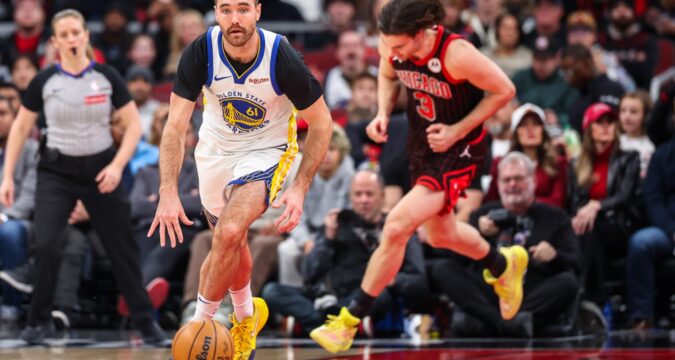
How a season at Northwestern helped propel Pat Spencer from NCAA lacrosse star to Golden State Warriors starter
Pat Spencer still sticks out on the basketball court.
That was true six years ago when he put on a Northwestern jersey for the first time as a graduate transfer. And it was true again Sunday night, when the former Wildcat stepped onto the United Center court for the Golden State Warriors and peppered the Chicago Bulls with 12 points in a 123-91 blowout.
It’s not hard to define why Spencer draws the eye. He wears No. 61, like the kid who showed up late to his rec league and had to dig a jersey out of the back of the closet. He runs with a grounded explosivity, hardly disguising his past as the onetime greatest college lacrosse player in the country. His teammates watch him from the sidelines with barely contained glee, celebrating the fact that they’ll never — and they mean never — play alongside another guy quite like him.
By now, Spencer’s story is akin to a fable in the NBA. This is an athlete who walked away from the top of another sport to give competitive basketball another shot at age 22. A little more than six years later, he’s starting games in the NBA.
That’s not supposed to work. None of this is supposed to work. But here Spencer is anyway — bumping chests and stealing offensive rebounds off All-Stars, sinking dagger 3s and shouting “I’m that (expletive)” into the stands, daring anyone to tell him that anything is impossible.
“I’m a believer,” Spencer told the Tribune. “And if things get hard, I just rely on the work. A road block is just a road block. You’ve got to figure out a way around it.”
In late spring 2019, Northwestern coach Chris Collins received a phone call from longtime friend Jimmy Patsos.
Collins trusted Patsos — a coach for nearly four decades — with anything related to basketball. So he knew to take his friend seriously when he broke the ice bluntly: “Hey, don’t hang up on me. I want you to hear me out on this.”
There was this lacrosse star out of Loyola Maryland. He was the best the sport had to offer — four-time Patriot League offensive player of the year and winner of the Tewaaraton Award (the sport’s equivalent to the Heisman Trophy). He had just been drafted No. 1 in the Premier Lacrosse League. And he didn’t want to go.
Lacrosse didn’t offer a real future. The PLL was in its inaugural season in 2019, with average salaries below $40,000. The league was an exciting prospect for die-hard fans. For Spencer, it felt like a dead end.
Loyola Maryland’s Pat Spencer, right, withstands pressure from Lehigh’s Ian Strain on April 29, 2018, in Baltimore. (Amy Davis/ Baltimore Sun)
There was more to it too. Spencer loved lacrosse. But he loved basketball more. He was a mainstay at the rec center gym on campus in Baltimore. The moment the lacrosse season ended, he signed himself up for local pro-am leagues.
As a preps prospect, Spencer pinned his NCAA dreams on lacrosse mostly because he didn’t crack 6 feet until his junior year of high school. But at 22, Spencer was thinking about the future. He had filled out to a 6-2 frame that could potentially keep up as a guard. And with one year of non-lacrosse eligibility remaining, he was seeking a new home to test himself as a basketball player — preferably a Power 5 program that could prepare him for the pros.
“He just needs a school,” Patsos told Collins. “He just needs someone to give him a chance.”
The timing was right. Collins had a scholarship to give. After six years with the Wildcats, he was in the first year of a rebuild around freshmen and sophomores. His locker room craved leadership more than anything else.
Collins did not watch a single minute of film before inviting Spencer to Evanston — or before offering him a scholarship. (To this day, he’s not sure if any such tape actually exists.) The coach was focused on something else.
There’s something intangible that defines the upper echelon of competitive athletes. Collins’ father learned it well when he coached Michael Jordan on the Bulls in the 1980s. He learned it himself as a coach with USA Basketball watching Kobe Bryant and LeBron James cohabitate the court at the Olympics.
Collins saw something familiar in Spencer — a winner.
“I knew that there was that same wiring to him,” Collins told the Tribune.
Northwestern guard Pat Spencer (12) drives around Illinois guard Alan Griffin on Feb. 27, 2020, at Welsh-Ryan Arena in Evanston. (Armando L. Sanchez/Chicago Tribune)
One of the first things Collins learned that summer was that Spencer hated drills.
The early weeks of summer training are monotonous. Teams walk through the basic mechanics of the system. Shell drills and wind sprints dominate practices. And after four straight summers of playing nothing but pickup, Spencer was bored out of his mind.
The guard nagged Collins during water breaks and film sessions: “When are we going 5-on-5? When are we competing? When are we going to play basketball?”
Spencer had a lot of work to do. His physique was still filled out for lacrosse — thick torso, burly chest, a stark farmer’s tan on both arms. He lacked verticality. His shot needed work. He wasn’t acclimated to the intricacies of defensive shifts and sets. But despite Spencer’s lack of playing experience, his feel for the game transferred almost immediately.
Many offensive fundamentals of lacrosse are intertwined with the basics of basketball. Attackers utilize screen actions to create spacing. The sports even share similar vocabulary — pick-and-roll, drive-and-kick. In summer workouts, Collins noticed that Spencer manipulated screens with the adept confidence of a veteran guard. By opening day, he had won the starting point guard position.
Collins still believes Spencer could have grown into a All-Big Ten player if he had one more year of eligibility. But even on its own, that solo season showcased his potential.
Warriors guard Pat Spencer, left, makes a pass past Bulls guard Jevon Carter in the third quarter Sunday, Dec. 7, 2025, at the United Center. (Dominic Di Palermo/Chicago Tribune)
“It just reaffirmed my belief in myself,” Spencer said. “It was a testament to the fact that — look, I can’t even shoot the ball yet. My body’s not where I wanted it to be yet. And I’m still able to do what I was doing. It reaffirmed that, OK, if I put my head down and start working, I’m going to make this thing happen.”
It might sound like all this was easy for Spencer. It wasn’t.
The Wildcats won only eight games that season. They went 3-17 in conference play. Spencer’s first and final season of college basketball ended with a brutal 74-57 blowout to Minnesota in the first round of the Big Ten Tournament.
Spencer hated it. He tried to be patient, to remember that this was all a learning process. It didn’t work. During most losses, he found himself on the bench or on the court, attempting to force some semblance of calm into his body, repeating the same mantra: Keep it cool.
“I didn’t do well with it,” Spencer said. “That’s one thing both parties would probably tell you deep down. No regret, but just going back I probably would have done a couple things differently in the locker room to help those guys. They were on the trajectory of being young: ‘We’re going to grow and get through this and figure this out.’ And I’m in here thinking, ‘I got one damn year to figure it out.’”
Collins knew this was a byproduct of Spencer’s environment. He was used to lacrosse, in which helmets and pads allow players to handle each other more roughly. The guard often crashed into his own teammates during contentious moments, clashing physically in a way meant to galvanize rather than discourage.
Spencer still hasn’t fully trained himself out of those tendencies — just ask Houston Rockets big man Alperen Şengün, who was on the receiving end of a headbutt from the point guard during Game 5 of a first-round playoff series in May.
But Collins never wanted to temper that passion. It’s why he brought Spencer to Evanston in the first place. The young players on that roster needed to learn to see losing as an impossibility. And one freshman in particular latched onto Spencer’s leadership style: Boo Buie, the program’s future all-time leading scorer.
Northwestern coach Chris Collins talks with guard Boo Buie during overtime of a Big Ten Tournament quarterfinal against Penn State on March 10, 2023, at the United Center. (John J. Kim/Chicago Tribune)
Spencer and Buie both believed there was more for Northwestern basketball. And although Spencer wasn’t on the court for the victories of the ensuing seasons — qualifying for back-to-back NCAA Tournaments, knocking off No. 1 Purdue, Collins winning Big Ten Coach of the Year— his presence lingered in the locker room long after he left Evanston.
“What I wanted more than anything was for our players to see that fire and see that competitiveness and understand that’s what it takes to win,” Collins said. “That’s what he gave us.”
Northwestern was only the first in a series of stops on the way to the NBA. That season mostly showed Spencer what he lacked. His long-range shooting was almost nonexistent. He made only 12 3-pointers for Northwestern on 23.5% shooting from behind the arc.
When the COVID-19 pandemic shut down the basketball world days after his last NCAA game, Spencer saw it as yet another opportunity. He secured access to a gym with his brother Cam — who now plays for the Memphis Grizzlies — and the pair logged three-hour two-a-day sessions with a shooting coach. Some weeks they took a rest day. Most of the time, they worked through the week.
Later that year, Spencer went to Germany to play his first professional minutes with the Hamburg Towers. His five appearances abroad were enough to gain attention in the G League, in which he bounced from the Capital City Go-Go to the Santa Cruz Warriors.
It took awhile to stick. He earned a full NBA contract with the Warriors last season — crucially subbing into the rotation in the playoffs — only to be waived over the summer and re-signed to another two-way deal in September. Then Steph Curry went down with a quad injury, opening and a hole in the lineup. Spencer was right back in the rotation.
The answer wasn’t always yes. But Spencer kept coming back, assured and insistent, reminding the Warriors again and again that they needed him.
Warriors guard Pat Spencer reacts after making a basket during the fourth quarter against the Cavaliers on Saturday, Dec. 06, 2025, in Cleveland. (Jason Miller/Getty Images)
“It’s just fun watching a guy who has had to fight for everything finally get his moment — and not only seize it but grab it by the neck,” Warriors coach Steve Kerr said after Spencer dropped 19 points in his first career start Saturday against the Cleveland Cavaliers. “This guy is a competitor. He loves the competition, he loves to play, his teammates love playing with him. It’s beautiful to watch.”
More than six years ago, during that first visit to Evanston, Spencer told Collins his plan.
This wasn’t a one-off. He didn’t just want to play college ball. He wanted to play in the NBA. It wasn’t a dream. It was a goal meant to be completed.
Collins didn’t say anything. He wanted the kid to come to Northwestern. But he couldn’t quiet his own internal disbelief at Spencer’s brash confidence: Don’t get ahead of yourself. Let’s see if you can keep up with the Big Ten. Maybe get on a team in Europe, make a nice career for yourself abroad.
Six years later, Collins is glad he didn’t say a word. It probably wouldn’t have mattered if he did. Spencer doesn’t listen to doubters or detractors. And every time he steps on the court, the guard quietly proves himself right. This was always the plan. This was always attainable. It just took the right amount of time — and work — to be rewarded.
“I don’t think there’s anything else that makes me smile more than when I turn on a Warriors game and see him out there,” Collins said. “Not a single piece of this was handed to him.”
Spencer still isn’t sure what comes next.
Related Articles
Indiana’s Stephen Daley likely to miss the College Football Playoff after getting injured while celebrating
Former Michigan football coach Sherrone Moore jailed, hours after his firing
Keaton Wagler’s 23 points lead No. 13 Illinois to 88-80 victory over Ohio State in Big Ten opener
Notre Dame’s AD on the CFP’s ‘musical chairs,’ a ‘strained’ relationship with the ACC and opting out of bowls
Chicago Tribune Silver Football: Winners of the annual award for best Big Ten football player
He’s an NBA player, and a starter at that, albeit perhaps temporarily. That goal is more than accomplished. He has adapted his game to the NBA, slimming down to improve his agility, honing his shot to knock down more 3s in 17 games with the Warriors this season than in his entire stint with Northwestern.
But Spencer is still playing on borrowed time. He has logged 17 of his 50 eligible games as a two-way player. Eventually, the Warriors will need to convert him to a full-time contract — or send him back to the G League. Only one of those options is acceptable to the guard.
Spencer doesn’t want much. He isn’t in this for the fame and fortune. The guard still drives the same 2011 Honda CRV that shuttled him between lacrosse and basketball practices in high school. He prides himself on simplicity.
“Look, this is cliche, but if you told me I could live and my family would be taken care of and I could do all of this for free — then I would do it,” Spencer said.
If he’s honest, there’s only one thing Spencer wants: more time.
Time on the court. Time with the ball in his hands. Time to prove that this is where he has always belonged.
https://www.chicagotribune.com/2025/12/11/pat-spencer-northwestern-golden-state-warriors/
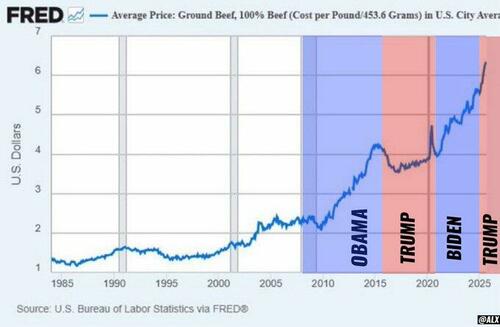
“Democrats Know Their Constituents Can’t Read Charts. That’s Why…”
“Democrats Know Their Constituents Can’t Read Charts. That’s Why…”
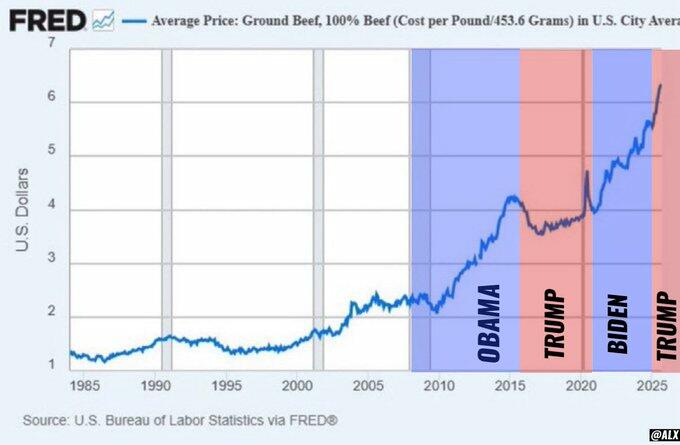
Another attempted “gotcha moment” on X by Democrats backfired, revealing that their political strategists and whoever handles their social media accounts lack the most basic chart-reading skills. However, X users pointed out that these political operatives aren’t DEI fools; instead, they seem incapable of telling the truth.
The X account for the Senate Majority PAC, which focuses on supporting left-wing Senate elections, posted four decades of USDA average beef price charts, trying to pin the rise on Trump.
“Let’s be honest for a second. Republicans don’t care about the price of beef because they don’t answer to working Americans,” SMPAC wrote on X.
Let’s be honest for a second.
Republicans don’t care about the price of beef because they don’t answer to working Americans. pic.twitter.com/i5ed769k6O
— Senate Majority PAC (@MajorityPAC) December 9, 2025
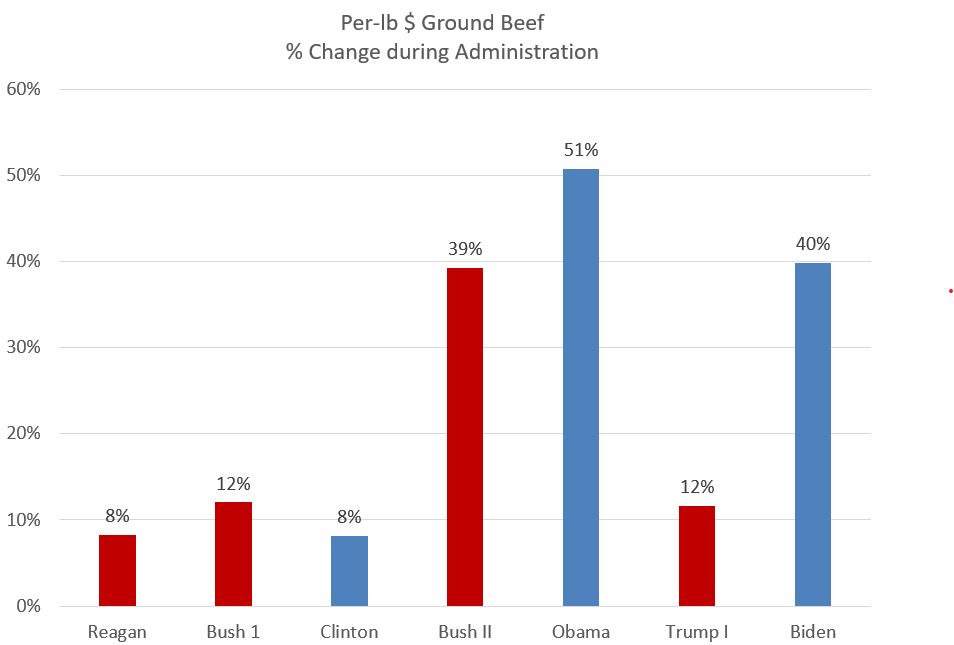
Just like eggs earlier this year and power bills this fall, Democrat operatives are seizing any opportunity to blame Trump for soaring prices that mainly occurred in the previous four years.
X user ALX shows why context matters.
Via X user Peter Shrink…
Comments…
The better question is: Is there a single democrat that is capable of telling the truth?
They’re not idiots, they’re partisans. They’ll lie, cheat and steal to stay in power. The last 8 years have proven that.
— Scott Wickstrum (@swickstrum) December 10, 2025
The way they’ve shared this same chart related to other groceries on other official accounts and then deleted it several times every few weeks will always be hilarious.
— krish kothari (@wisekrish) December 9, 2025
The operatives can read a chart just fine. What’s at issue: Their presumptions about whether their own constituency can read charts.
— Craig S. Bell (@craig_s_bell) December 10, 2025
That chart doesn’t show what they think it does.
— Rebelgate (@Just_Pops) December 9, 2025
And this…
The Democrats know that their constituents don’t know how to read charts. That’s why they keep posting these things.
— Dadof7 (@dm6013) December 9, 2025
SMPAC’s chart isn’t the first time Democrats have either misread charts or tried to deceive the public with them, and they’ve been called out time and time again:
Propaganda Blunder: Democrat Senator Accidentally Highlights Biden’s Epic Failure
Kyle Bass, founder and chief investment officer of Hayman Capital Management, recently pointed out another propaganda blunder the Democratic Party made with grocery prices…
Do you understand what you are showing here? It’s identical to grocery prices. 🤦 pic.twitter.com/8PpfJSniUX
— 🇺🇸 Kyle Bass 🇹🇼 (@Jkylebass) November 26, 2025
SMPAC failed to mention Trump’s moves to open global supply chains and address the cattle-shortage crisis to lower supermarket beef prices.
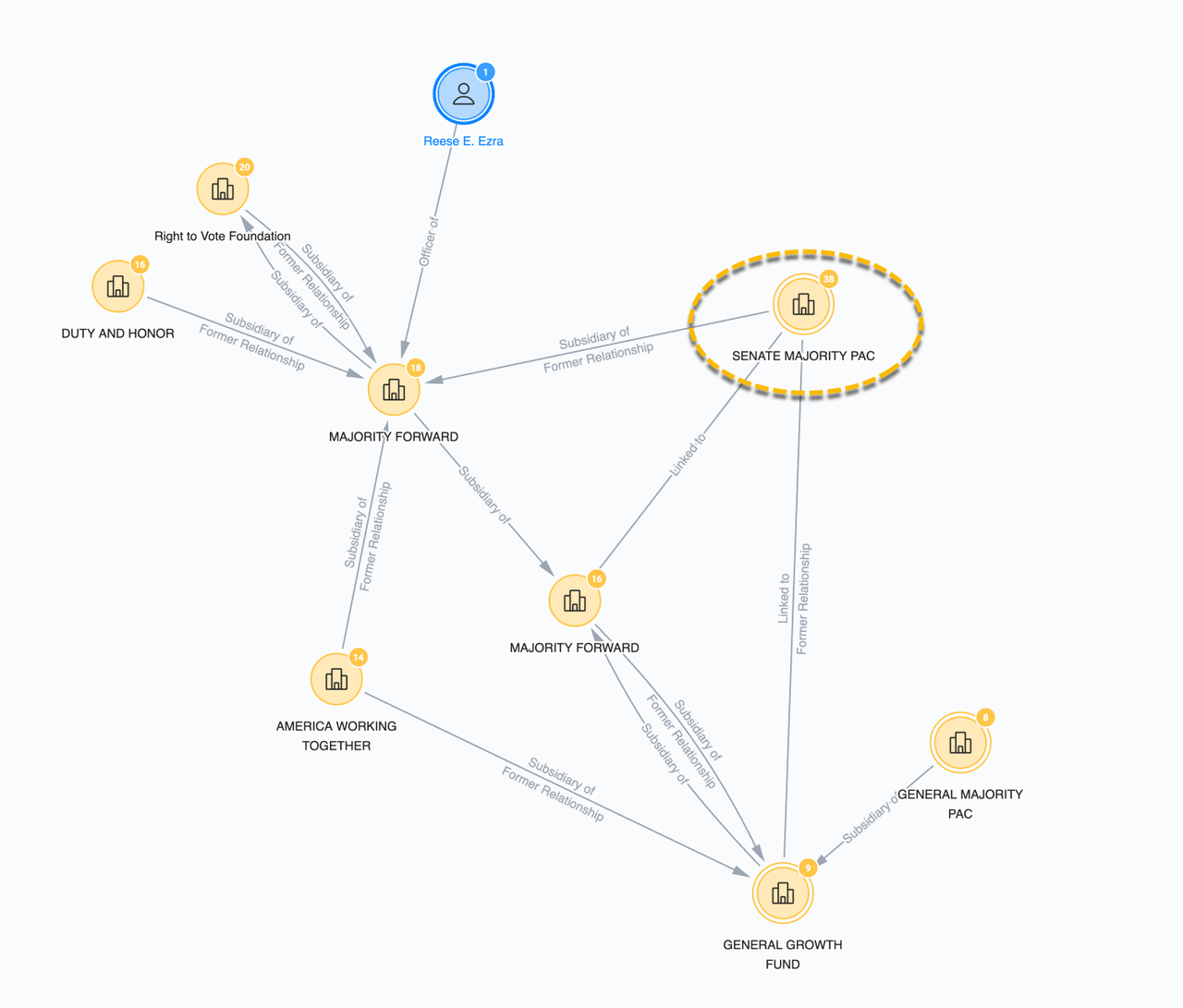
SMPAC’s organizational structure… and there’s a familiar name.
The Biden-Harris regime had four full years to fix the beef problem, yet failed to act; instead, they focused on nation-killing progressive policies, if that’s ‘green’ or open borders, that have caused the current mess we’re in today.
Tyler Durden
Thu, 12/11/2025 – 06:55
https://www.zerohedge.com/political/democrats-know-their-constituents-cant-read-charts-thats-why
EEUU y Japón realizan ejercicios aéreos conjuntos; China aumenta actividad militar cerca de Japón
Por MARI YAMAGUCHI
TOKIO (AP) — Bombarderos estratégicos de Estados Unidos se unieron a una flota de aviones de combate japoneses en maniobras militares conjuntas que buscan demostrar su cooperación en torno al espacio aéreo de Japón, dijeron el jueves funcionarios de defensa, mientras las tensiones con China se intensifican.
El ejercicio, que mostró el poder aéreo conjunto de Tokio y Washington, se llevó a cabo un día después de que bombarderos chinos y rusos volaran juntos alrededor del oeste de Japón, lo que llevó a las autoridades niponas a desplegar aviones de combate, aunque no se produjeron violaciones del espacio aéreo. También sigue al incidente del sábado en el que aviones militares chinos bloquearon con radar a aviones japoneses, otro incidente que empeoró el deterioro en las relaciones entre Tokio y Beijing.
La Fuerza de Autodefensa Aérea de Japón y el ejército de Estados Unidos llevaron a cabo las maniobras el miércoles, ya que “el entorno de seguridad que rodea a nuestro país se está volviendo aún más hostil”, señaló el Estado Mayor Conjunto japonés.
Los aliados “reafirmaron la fuerte determinación de prevenir intentos unilaterales de cambiar el statu quo por la fuerza y la disposición entre las fuerzas de autodefensa y las fuerzas estadounidenses”, agregó.
Dos bombarderos estratégicos B-52 de Estados Unidos y tres aviones de combate furtivos F-35 japoneses, además de tres cazas F-15, realizaron sus ejercicios de vuelo conjunto cerca del espacio aéreo occidental de Japón, sobre las aguas entre el país y Corea del Sur, de acuerdo con las autoridades.
Tensión en materia de seguridad
El Estado Mayor Conjunto negó que el ejercicio fuese una respuesta a un incidente específico, pero citó el reciente bloqueo de radar de aviones militares chinos a japoneses y las maniobras conjuntas de bombarderos de China y Rusia el martes como ejemplos del deterioro del entorno de seguridad alrededor de Japón.
Las relaciones entre Japón y China empeoraron después de que la primera ministra japonesa, Sanae Takaichi, dijo a principios de noviembre que su ejército podría responder si China tomara medidas contra Taiwán, la isla autónoma que Beijing reclama como propia.
La disputa se intensificó durante el fin de semana, cuando otros ejercicios chinos independientes con un portaaviones cerca del sur de Japón llevaron a Tokio a desplegar aviones y a protestar porque sus aparatos fueron el objetivo de repetidos bloqueos de radar, un movimiento considerado una posible preparación para disparar.
Tokio protestó ante Beijing, a quien exigió una explicación y medidas preventivas. China negó la acusación y dijo que los aeroplanos nipones interfirieron y pusieron en peligro a sus soldados.
Washington enfatizó su “inquebrantable” alianza con Japón señalando que el incidente no era “propicio para la paz y la estabilidad regionales”.
La maniobra se llevó a cabo un día después de que bombarderos estratégicos chinos y rusos realizaran un vuelo conjunto de larga distancia desde las aguas entre Japón y Corea del Sur hasta el Pacífico, según el Estado Mayor Conjunto.
___
Esta historia fue traducida del inglés por un editor de AP con la ayuda de una herramienta de inteligencia artificial generativa.

Best classical and jazz of 2025: Our top 10 included a tasty concept at Ravinia, improv and a ‘moving’ performance at the CSO
As far as local performing arts went, 2025 could be oddly charmed. New venues opened; huge, ambitious festivals took off like jetliners; halls filled up and sold out.
Those are small victories against a bleak national outlook. Arts organizations of every size must contend with the nearly overnight overhaul of the NEA and vanishing nonprofit support. The notion that the arts will regain pre-pandemic levels of support has never seemed more distant. Meanwhile, major blows to arts journalism this year robbed the industry of thoughtful advocacy and investigative attention right as it needs it most.
So, yes, celebrate the victories. There was, indeed, much to celebrate, some of it below. But the arts need your support — yes, yours — more than ever.
One audience member’s highlights:
Best double-bill
It was a thrill to see 2,500-seat Orchestra Hall at capacity in April for two era-defining female bandleaders: pianist Hiromi, helming her rocketship Sonicwonder band, and harpist Brandee Younger, previewing her stacked 2025 album “Gadabout Season.”
Best “hometown pride” moment
Speaking of COVID, our own Chicago Symphony benefitted from a pandemic scheduling shuffle when it, instead of the originally planned New York Philharmonic, appeared at the prestigious, once-a-generation Mahler Festival in Amsterdam in May, with Dutch conductor Jaap van Zweden. (CSO music director designate Klaus Mäkelä was also there with the Concertgebouw Orchestra, the festival’s host and the other A-class ensemble he will assume leadership of in 2027. He led a fresh, revelatory Mahler 1, but his bombastic Mahler 8 left something to be desired.)
After a strong local preview in April, van Zweden led the orchestra in a Mahler 6 that left me white-knuckling the arms of my seat. Van Zweden emanated such radioactive intensity from the podium that a violinist sitting on the outside of the ensemble broke a string just a few minutes into the first movement; he left to replace it and hustled back, only to find the Concertgebouw stage so tightly packed that it was nearly impossible to return to his seat. Not long after that, van Zweden lost hold of his baton, flinging it 20 feet in the air before it crash-landed in the second violins.
So, I was squirming and sweating in my seat when the CSO took the stage the next night, May 15, for Mahler 7. What unfolded next was taut, soulful, fleshy, eerie, hair-flattening — everything one wants from Mahler and then some.
After the final bars, I let out the breath I’d been holding and slipped a glance at the German critic next to me. He gave me a Mona Lisa smile and an approving nod. Yes, that’s our Chicago Symphony.
Kangmin Justin Kim and Eric Ferring in Haymarket Opera Company’s production of “Artaserse” in Jarvis Opera Hall at DePaul University. (Elliot Mandel)
Best local debut
There’s nothing quite like a “star-is-born” moment at the opera. Countertenor Key’mon Murrah had his in June, playing the wronged, saintlike Arbace in Haymarket Opera’s “Artaserse.” (Nota bene: Local label Cedille Records releases a recording of the production on March 13.)
Best fest
We were spoiled for choice this year when it came to festivals. Constellation’s Sound & Gravity Festival made a memorable maiden voyage, and Ear Taxi, a contemporary classical music mega-fest, returned in a smart new configuration.
But the best-run festival I encountered this year was Rhythm Fest, a blowout birthday bash for Third Coast Percussion in June. It dispensed with travel-and-ticketing headaches by posting up for just a day at the Epiphany Center for the Arts, utilizing six different spaces on the campus. It surely would have only worked for the kind of music the quartet assembled — solo and small-ensemble acts from its wide roster of collaborators — but boy, did it work.
Chef Mika Leon (left) serves up her toston with ropa vieja during the Breaking Barriers series at Ravinia Festival in Highland Park on Friday, July 25, 2025. (Chris Sweda/Chicago Tribune)
Related Articles
Best rock, pop and hip hop of 2025: Amid a jammed year of concerts, this top 10 stood out
Best theater of 2025: Storefront shows and Court Theatre reign in our top 10
Best dance of 2025: From Joffrey to Trinity, a year of big swings for Chicago dance
Best concept
This field ends in a three-way tie. From July 25 to 27, Ravinia hosted “Women Leaders in Food and Music,” the latest iteration of its Breaking Barriers Festival. Audiences sampled bespoke bites by female chefs at the Friday and Saturday concerts, the second of these encouraging in-the-moment eating inside Ravinia’s Bennett Gordon Hall. Between bites, attendees whispered their hopes for a redux. I certainly did.
As far as cross-disciplinary concert presentations go, that week in July had already been charmed. Bill Barclay, most known to local audiences as the creator of 2022’s “The Chevalier,” returned to Chicago’s Salvage One July 20 and 21 with “Secret Byrd,” a “Sleep No More”-style immersive performance that reimagines a clandestine Catholic mass in Elizabethan England. The audience was offered bread and wine; some of us were invited to take a seat at a table with the singers of the Gesualdo Six during the ordinary. When a shadowy authority pounded on the door, we all hid in silence until the threat passed.
Earlier that year, Chicago Fringe Opera proved you don’t need a lavish budget to leave an impression. “Op*erratic,” its sketch show improvising a 30-minute opera off audience suggestions, ran from May 28 to July 2 at a pizzeria. It was as fun as it was impressive. Keep your eyes and calendars open for a February redux, exact dates to be announced.
Best solo set
Pianist Jason Moran explores the jazz canon like no one else: shrinking it down, blowing it up, testing its durability. This time, the object of his investigation was Duke Ellington, in a project he toured to Rockefeller Memorial Chapel as part of the Hyde Park Jazz Festival.
Incoming music director Klaus Mäkelä conducts the Chicago Symphony and violist Antoine Tamestit at Symphony Center in Chicago on Oct. 16, 2025. (Todd Rosenberg)
Best orchestral soloist
This was the year of bringing theater to the CSO. We saw Esa-Pekka Salonen do so dazzlingly in February, with a lighting-designed “Bluebeard’s Castle.” At the other end of the spectrum was a disappointing Goodman collaboration for October’s “Soldier’s Tale,” the company’s uneven preparation paling against the CSO corps’ polish.
On this point, violist Antoine Tamestit wins the Tony. From Oct. 16 to 18, he played “Harold in Italy” with Klaus Mäkelä and the CSO in a very mobile performance that surely would have delighted composer Hector Berlioz: dashing down stairs, huddling near the harpist, fleeing from brass-and-percussion thunderclaps, and doing it all with sensitive phrasing and élan.
Best local premiere
In an interview in his South Loop apartment, triple-threat composer, bass-baritone and conductor Damien Geter told me he considered the Ear Taxi performance of his “African American Requiem” on Oct. 18 his “big coming out” since moving to Chicago. What an unveiling it was: Geter’s compositional voice is moving and immediate, with moments of heart-stopping pain but also soaring triumph.
Best freely improvised set
Twenty years ago, the Empty Bottle’s jazz and improvised music series wound down, after matchmaking some of the best bills this side of New York for a decade. On Nov. 1, the club hosted another fête for old times’ sake, this time commemorating the release of a six-disc box set documenting the series. (Look for a fuller story on this project soon.)
A standout performance paired reedist and series co-curator Ken Vandermark with electronic artist Damon Locks, a fixture in today’s creative music scene. Like so many great improvisations, their set curved itself into an emotional arc, Vandermark sometimes assuming the cyclical, self-echoing ethos of Locks’ electronics. Shot through with heaven-sent lyricism, it ended in an ecstatically danceable climax, Damon vocalizing along in a stage-shaking baritone.
Conductor Petr Popelka leads the Chicago Symphony Orchestra at Symphony Center, Dec. 4, 2025. (Chris Sweda/Chicago Tribune)
Best guest conductor
A late entry in this field is Czech conductor Petr Popelka. His demanding CSO stand in December included the 2025/26 season’s sole premiere, Matthew Aucoin’s “Song of the Reappeared,” as well as heavy-hitters by Strauss and Brahms. As graceful as they were specific, his gestures balanced the CSO’s signature richness with a prima ballerina’s refinement.
And some honorable mentions:
The orchestral arrangement of “Black Being” with Flutronix and the Chicago Sinfonietta, an inauguration-night balm (Jan. 20); “The Women of Chicago’s Black Renaissance,” a thoughtfully presented, explosively virtuosic piano recital by Michelle Cann at the Logan Center for the Performing Arts (Jan. 24); homegrown tenor Karim Sulayman in a chanson evening at Art Song Chicago (Feb. 27); Missy Mazzoli’s uncompromising and excellent “The Listeners” at Lyric Opera (March 30-Apr. 11); Klaus Mäkelä and the CSO’s Dvořák 7, one of the best standard-rep performances of the year; ironic that the best local opera production of the year was by a Canadian company, but Volcano’s reboot of Scott Joplin’s “Treemonisha” at Harris Theater was just that good (May 2-4); the young yet already peerless Isidore String Quartet at Ravinia (June 22); quite possibly CSO music director designate Riccardo Muti’s best Verdi Requiem yet (June 1-24); “Working,” a Studs Terkel tribute at The CheckOut, a 7-Eleven-turned-venue (Sept. 19); Sullivan Fortner and His Galactic Friends’ healing Sun Ra tribute at the Logan Center for the Arts (Oct. 10); and Nova Linea Musica’s presentation of Owls, a two-cello string quartet that is one of the tightest, most inventive chamber groups working today, in any configuration (Oct. 29).
Hannah Edgar is a freelance critic.
https://www.chicagotribune.com/2025/12/11/best-classical-jazz-2025/

Best rock, pop and hip hop of 2025: Amid a jammed year of concerts, this top 10 stood out
If your ears need a rest, we hear you. Chicago hosted an astonishing number of concerts in 2025.
There was no shortage of events that lured fans from the city, the Midwest and places further afield. On that list: Lollapalooza, Riot Fest, Lyrical Lemonade Summer Smash, Beyoncé, Lady Gaga, K-pop stars Stray Kids and Paul McCartney. The last joined a surprising number of septuagenarian and octogenarian legends — Robert Plant, Paul Simon, Patti Smith, Neil Young, and the principal members of AC/DC and Kraftwerk included — who turned in memorable performances during the twilight of their careers.
Bummers and busts happened, but the disappointments help put into perspective the very good and the remarkable.
Jason Isbell at the Auditorium Theatre, Feb. 15
With his skills and accomplishments with an amplified band well-documented, Jason Isbell executed the equivalent of a 180-degree reversal at his first-ever local solo appearance. Seated for the duration, the Alabama native mesmerized with a handful of acoustic guitars, descriptive storytelling and, in what emerged as a pleasant revelation, spotlit vocals whose command and expressiveness matched that of his virtuosic six-string abilities. The bare-bones intimacy and pin-drop quiet acoustics reinforced Isbell’s standing as one of the finest songwriters of his generation. His no-frills presentation and willingness to take risks — he played seven songs from his then-unreleased “Foxes in the Snow” LP for an audience unfamiliar with nearly all of them — served as reminders that spectacle doesn’t always carry the day.
Jack White at Salt Shed, April 10
You could tell Jack White was feeling it at the first of a sold-out two-night stand at Salt Shed before he played a note. He began by greeting the crowd like dearly missed friends before throwing himself into high-voltage songs as if he’d recently discovered the menacing thrills that come with plugging instruments into loud amplifiers and stomping on effects pedals. White and his formidable three-piece backing band served everything raw. Gleeful disrupters, they shredded scripts and torched boundaries. They pulled apart and reconstructed solo fare, White Stripes favorites and cover tunes. Unable to stand still, White increased the energy with animated movements and man-of-a-thousand-voices declarations. The guerilla-style ambush implied rock ‘n’ roll’s vocabulary still has room to expand.
Sakara Heade, from left, her daughter Micah Heade, and Adelia White, all from Detroit, walk toward Soldier Field before the first Chicago night of Beyoncé’s Cowboy Carter performance, May 15, 2025. (Armando L. Sanchez/Chicago Tribune)
Beyoncé at Soldier Field, May 15
Less than two years removed from her blockbuster “Renaissance” shows at the same stadium, what would Beyoncé do for an encore? Go bigger, of course. All the while challenging common assumptions about identity and music. The lion’s share of her “Cowboy Carter” extravaganza unfolded as an intelligent reckoning of American history, culture and language. As much a reclamation of whitewashed history and assertion of long-overdue recognition as a joyous concert that seamlessly blurred lines between genres, it established new standards for visual symbolism in the larger pop sphere. For all the instantly sharable appeal of the snazzy costumes, choreographed routines and mechanical bulls, Beyoncé’s outsized confidence and defiant attitude left the deepest impressions. Backed by an ace band and dance squadron, this was the global superstar gone maverick — a rebel with a cause.
Paul Simon at Symphony Center, May 21
Few aspects of Paul Simon’s opening of a three-night stand work on paper. A singer whose once-harmonious voice showed clear signs of thinness and frailty. A first set devoted to a start-to-finish interpretation of the recent “Seven Psalms,” the least commercially successful album of Simon’s career. The decision to bypass classics for deep cuts. Yet practically every moment captivated. Simon chased mystery with the intrepidness of a youthful voyager. Ruminating on mortality, faith, doubt and home, he revealed how little we really control or know. And his acoustic hymns and calm deliveries landed with a quiet, reflective beauty on a par with Zen meditation. Part soothing balm and part spiritual exploration, Simon’s “conversation” doubled as an unspoken dialogue we often have with ourselves and the universe.
Paul Simon performs at Symphony Center in Chicago on May 21, 2025. (Chris Sweda/Chicago Tribune)
Kendrick Lamar at Soldier Field, June 6
Kendrick Lamar started the year with five Grammy Awards and the most-watched Super Bowl halftime show in history. When his record-shattering Grand National Tour pulled into Soldier Field in June, Lamar justified the acclaim and attention. To quote hip hop pioneers Eric B. and Rakim, he “let the rhythm hit ‘em.” Leveraging extraordinary focus, diction and phrasing, Lamar let words to bob and weave, jab and pummel. His broad storytelling arc spanned an array of emotions, and his vocal dynamics mirrored the smooth hydraulics of the 1987 Buick GNX coupe that functioned as a central prop. Even the inadvisable decision to interweave his program with that of co-headliner SZA couldn’t derail the primacy of a rapper who just might be the GOAT in his field.
Nine Inch Nails at the United Center, Aug. 19
The fact that Nine Inch Nails felt more relevant at the opening of their two-night run at the United Center than during their ‘90s heyday is a credit to leader Trent Reznor’s vision — and sobering reflection of where we’ve headed as a society. No longer coming across as personal screeds, Reznor’s toxic songs spoke to systemic shifts in modern technology, communication, industry, wealth, health care and politics. In the same manner that novels such as George Orwell’s “1984” foresaw the future, Nine Inch Nails’ dystopian-minded setlist echoed present circumstances despite being almost entirely comprised of decades-old works. The band’s lean attack and chiaroscuro lighting underscored the stakes: What were once distressful warning signals had transformed into bleak truths.
Dua Lipa performs at the United Center in Chicago on Sept. 5, 2025. (Chris Sweda/Chicago Tribune)
Related Articles
Best classical and jazz of 2025: Our top 10 included a tasty concept at Ravinia, improv and a ‘moving’ performance at the CSO
Best theater of 2025: Storefront shows and Court Theatre reign in our top 10
Best dance of 2025: From Joffrey to Trinity, a year of big swings for Chicago dance
Dua Lipa at the United Center, Sept. 5
Few entertainment realms are currently more competitive than contemporary pop. Dua Lipa separated herself from the pack when she spearheaded a disco-laden dance party at the United Center in September. Composed and disciplined, she represented a maturer, sleeker kind of female diva. Somebody unbeholden to fleeting trends or tawdry humor. Someone who regarded a strong vocal range as a primary asset and didn’t airbrush imperfections. A confident, charismatic personality who valued accessibility and sincerity, her celebrity status and gorgeous appearance be damned. Lipa’s black-tie soulfulness and finger-wagging playfulness dovetailed with her tasteful sense in fashion and lighting. With such fluid and harmonious execution, she set a high bar for herself to follow — and offered plenty of reasons to watch what she does next.
Lady Gaga at the United Center, Sept. 15
Because Lady Gaga craved a more intimate connection with her fanbase of “little monsters,” she hosted her Mayhem Ball in arenas instead of stadiums. The multi-hyphenate took full advantage of the smaller confines. Her all-out spectacular shattered the limits on what’s possible in a touring production, integrating grand theatricality, surrealist fantasy, gothic horror, lavish scenery, epic narratives and gripping music into a cohesive whole. It dazzled with imaginative costumes, cutting-edge props, on-point choreography and Gaga’s rich singing. It cleverly referenced a litany of literary, visual and operatic works. And it inspired deeper thinking with its mind-bending originality and relevance, especially via the ways it addressed fame, mustered bliss and challenged fear. If that weren’t enough, Gaga re-contextualized the meaning of select songs and rearranged others to magnificent effect. If you have an opportunity to attend this ball when it swings through parts of the U.S. early next year, book your ticket.
Robert Plant performs with Saving Grace at the Vic Theatre on Nov. 12, 2025. (John J. Kim/Chicago Tribune)
Robert Plant at the Vic Theatre, Nov. 12
Robert Plant remains the premier example of why following one’s creative muse begets more rewards and adventures than following the nostalgic reunion route. He could rake in millions per gig if he re-teamed with guitarist Jimmy Page under the Led Zeppelin banner. However, it’s unlikely he’d be as enthused or enthralled as he was delving into more than a century’s worth of “lost and found” music with his latest ensemble, Saving Grace. Demonstrating superb chemistry and ease, the collective of friends from the Welsh Borders whisked fans on sonic journeys to the United Kingdom, Africa and the Deep South. It cracked open the DNA of English ballads, psychedelic dirges, gospel traditionals, Zeppelin chestnuts and more. At 77, Plant, who sang with nuance and texture, remains insatiably curious about ideas and correlations. A lesson for us all.
Paul McCartney at the United Center, Nov. 24
Eight-plus years passed between Paul McCartney’s prior Chicago-area appearance and his two-show engagement before Thanksgiving. A long time for any musician, and a veritable eternity for a rock ‘n’ roller born in June 1942. If you didn’t know better, you’d have been hard-pressed to believe McCartney’s age, the way he acted and sounded at an unforgettable night at the United Center. Stamina? He bopped, sang, triggered bass lines, strummed guitar chords and banged piano keys for just shy of three hours. Warmth? He brought love, happiness and hope to a fractured world. Songs? Completely invested in their aims, he and his crackerjack band made close to three dozen Beatles, Wings and solo McCartney tunes fresh, addictive and timeless. Memories? He bonded disparate generations together through melodies, harmonies and sing-along hooks. If this happens to be Macca’s final Chicago trip, what a parting gift.
A music critic’s guide to the 10 best music venues in Chicago
Bob Gendron is a freelance critic.

EU Opens Antitrust Probe Into Google’s Use Of Publisher, YouTube Content For AI
EU Opens Antitrust Probe Into Google’s Use Of Publisher, YouTube Content For AI
Authored by Vismaya V via Decrypt.co,
The EU has launched an antitrust investigation into whether Google exploited publisher and YouTube content to fuel its AI products without fair compensation or consent.
Regulators warn that the practices may give Google an unlawful competitive edge over rival AI developers across Europe.
This is the EU’s second investigation against Google in a month, as Brussels cracks down on Big Tech’s AI practices.
The European Commission launched a formal antitrust investigation this week into whether Google breached EU competition rules by using web publisher and YouTube content to power its artificial intelligence services without fair compensation or consent.
“The Commission will investigate to what extent the generation of AI Overviews and AI Mode by Google is based on web publishers’ content without appropriate compensation for that, and without the possibility for publishers to refuse without losing access to Google Search,” a Tuesday statement said.
Publishers must either let Google use their content for AI summaries without payment or risk losing visibility in Search.
YouTube creators face a similar dilemma, as uploading gives Google automatic AI-training rights with no compensation while rival AI developers are barred from using the same content.
“AI is bringing remarkable innovation and many benefits for people and businesses across Europe, but this progress cannot come at the expense of the principles at the heart of our societies,” Teresa Ribera, Executive Vice-President for Clean, Just and Competitive Transition, said in the statement.
Even Alex Chandra, partner at IGNOS Law Alliance, told Decrypt the investigation “reflects a deeper, structural ambition: to subject globally scalable digital business models to the EU’s regulatory and competitive framework.”
“If the Commission is not very disciplined (transparent about burden-of-proof, consistent across geography and business model) this could become less about “fair competition” and more about “favoring what fits European regulatory and economic priorities,” he said.
If proven, the practices under investigation may breach EU competition rules that ban dominant companies from using their market power to distort competition.
The regulator said it will carry out its investigation as a matter of priority, but provided no legal deadline for concluding the probe.
Big tech cornered
The investigation comes less than a month after the Commission formally launched proceedings to assess whether Google applies fair, reasonable, and non-discriminatory conditions of access to publishers’ websites on Google Search under the Digital Markets Act.
In September, the Commission fined Google $3.1 billion (€2.95 billion) for breaching EU antitrust rules by favoring its own advertising technology services over competing providers.
Europe’s competition regulator has opened a formal investigation into tech giant Meta over policy changes that allow the company’s own AI chatbot to operate on WhatsApp while blocking rivals from doing the same. The European Commission announced Thursday it’s examining whether Meta violated antitrust rules by effectively reserving WhatsApp’s AI chatbot access for itself. The action targets updated business terms WhatsApp rolled out in late October, which ban third-party AI companies from distri…
The Commission ordered Google to end its self-preferencing practices and implement measures to address conflicts of interest across the adtech supply chain.
Last week, the Commission also opened an investigation into Meta over policy changes that allow its own AI chatbot to operate on WhatsApp while blocking rivals from doing the same.
Tyler Durden
Thu, 12/11/2025 – 06:30
https://www.zerohedge.com/ai/eu-opens-antitrust-probe-googles-use-publisher-youtube-content-ai

Review: The intriguing horror of ‘Dust Bunny’ slowly reveals itself
TV legend Bryan Fuller, known for his cult classic television series like “Pushing Daisies” and “Hannibal,” just earned an Independent Spirit Award nomination for his first feature, “Dust Bunny.” It’s somehow a surprise that the well-known TV creator just directed his first film after spending almost three decades working in television, on series like “Dead Like Me” and “American Gods.” Now, he turns to the world of indie movies, reuniting with actor Mads Mikkelsen, his Hannibal Lecter, on the dark fairy tale “Dust Bunny.”
Fuller has a thing for idioms, exploring these tropes to their most extreme ends (e.g., “pushing daisies”), and so in “Dust Bunny,” he imagines what those bits of fluff could be if our nightmares came to life. He also posits an outlandish notion: what if a kid hired an assassin to kill the monster under her bed?
Aurora (Sophia Sloan) is an imaginative young girl who hears things that roar and scream in the night, the dust bunny under her bed a ravenous, monstrous thing. When her parents go missing, she’s convinced they’ve been eaten by the monster bunny, and seeks out the services of an “intriguing neighbor” (Mikkelsen, that’s how he’s credited), whom she has seen vanquishing dragons in the alley outside. With a fee that she purloins from a church collection plate, she implores him for help, and he agrees, as he learns more about this young girl’s challenging childhood.
At first, “Dust Bunny” feels a little light, the story skittering across its densely designed surface, with very little dialogue in the first half. But it grows and grows, more bits and pieces of story accumulating together as Fuller reveals this strange, heightened world. We meet Intriguing Neighbor’s handler Laverne (Sigourney Weaver), revealing the larger, Wick-ian world of killers that he inhabits. Wicked Laverne chomps through her scenes like the monster bunny chomps through the floorboards — literally, as she consumes charcuterie, dumplings and “suckling pig tea sandwiches” with gusto. Indeed, some monsters are seated across the table, Cheshire cat grinning in florals.
The film is essentially “Leon: The Professional” meets “Amelie” (one of Fuller’s favorite films), but with his distinct wit and flair. But that style also means that “Dust Bunny” is quite fussy and mannered, and if you don’t buy into the film’s arch humor and stylized world, you’re liable to bounce right off of it. As Fuller opens the world up, revealing a sly FBI agent (Sheila Atim) and more and more baddies (David Dastmalchian, Rebecca Henderson), the story becomes more intriguing beyond its unwieldy childhood trauma metaphor, but there’s also not quite enough embroidered on this tapestry. It feels shallow, the world only gestured toward, not fleshed out.
This image released by Roadside Attractions shows Sophie Sloan, from left, Mads Mikkelsen and Sigourney Weaver in a scene from “Dust Bunny.” (Roadside Attractions via AP)
Fuller demonstrates a strong command over his visual domain, but the pat allegory he presents about the monsters with whom we have to learn to live feels a bit muddled. Sloan and Mikkelsen are terrific together, but you feel that there is much more they could sink their teeth into here, and perhaps the limits of the story reveal the limits of the budget, carefully wallpapered over with opulent production design — explosions of patterns and color crafted by Jeremy Reed, captured with shadowy but lush cinematography by Nicole Hirsch Whitaker.
Fuller’s foray into film feels like a first feature — a bit of a surprise for someone so experienced. But the project sports his signature style, even if it doesn’t add up to much more than a neat kiddie-centric hard-R genre exercise.
Katie Walsh is a critic for Tribune News Service.
“Dust Bunny” — 2 stars (out of 4)
MPA rating: R (for some violence)
Running time: 1:46
How to watch: In theaters Dec. 12
https://www.chicagotribune.com/2025/12/11/review-dust-bunny-movie/

Letters: The Christmas Tree Ship event was marred by political staging. Please keep it rooted in community.
For the past 10 years, the arrival of the Coast Guard Cutter Mackinaw has marked the beginning of winter and Christmas for me. As the daughter of a Cold War-era Navy captain, I’ve always appreciated the quiet professionalism of the Coast Guard and the community spirit of the volunteers from local charities, the Chicago Yacht Club and nearby parishes. Every year, they unload more than 1,200 trees for families who need a little help during the holidays. It’s one of Chicago’s most heartfelt traditions — simple, generous and rooted in Christmas spirit.
This year was different. When I arrived at Polk Brothers Park, I saw an admiral, more than a dozen captains, rows of uniformed personnel on deck, color guards, the Secret Service and more than 50 Chicago police officers. This scale has never been part of this event.
The Coast Guard handled everything with complete professionalism. The concern is not the military — it is the unintended consequences of a political visit. When Kristi Noem, the secretary of homeland security, chose to attend, most civilians wouldn’t know that military protocol obligates senior officers to appear alongside her. Their presence automatically triggers expanded security, multiple agencies and a much more complex environment.
And that shift has real consequences. A tradition designed for volunteers, families and children was suddenly surrounded by layers of law enforcement and protective protocol and protest. In effect, the event became a high-security, high-risk atmosphere — which is utterly absurd for a beautiful and quaint charitable Christmas event. No one acted improperly, but the ripple effects were undeniable.
The next morning, Polk Brothers Park was clean again in a fresh half foot of snow. Without cameras or motorcades, the cutter and its crew looked like themselves again: steady, solid and serving Chicago in its unwavering way.
I hope future Christmas Tree Ship events remain rooted in community, not political staging. Chicago doesn’t need spectacle for this tradition to matter. Deserving families need the volunteers, parish members, club partners and Coast Guard men and women who make their Christmases meaningful — without needless security escalations.
— Kathy Gregg, Chicago
‘All … are citizens’
The opening text of the 14th Amendment of our Constitution seems clear. “All persons born or naturalized in the United States … are citizens of the United States” Once again, politicians are deciding to interpret laws to suit the results they would like to achieve. In this case, the word “all” seems relatively easy to understand.
Here’s hoping our highly educated but clearly divided Supreme Court can help us understand what the word “all” actually means. Of course, as we are constantly reminded, there are Democratic and Republican dictionaries that have drastically different definitions of even the simplest words.
Another approach might be to follow the constitutional rules on modifications and seek to alter this great body of work by seeking an amendment approved by 38 states to redefine the Constitution regarding birthright citizenship. Let the people decide how they want the laws interpreted. However, as our elected leaders prove time and time again, they simply do not have the time or patience to do things the proper way when it interferes with their personal agendas and schedules.
— Ken Stead, Aurora
Investing in children
The new Trump Accounts for children will provide financial protection in the long run.
Long-term financial prosperity and wealth depend on a person’s creativity, hard work and luck. But society must take action to ensure a safety net for future young adults.
Trump Accounts are investment accounts for qualifying children, with an initial contribution of $1,000 from the U.S. Treasury for those born between Jan. 1, 2025, and Dec. 31, 2028. Children age 10 or younger who do not quality for the federal government’s seed money may receive a $250 Dell family grant.
These small initial amounts potentially could grow to thousands of dollars by the time the children turn 18, at which point the recipients can use the funds to further build their future, such as by investing in education, starting a business, etc.
Many children grow up in poverty and are left without resources when they become adults. Trump Accounts will provide a safety net for the young adults of the future. I believe that they will be key to ensuring financial security for future generations.
— Tawsif Anam, Madison, Wisconsin
Barriers to babies
The Trump administration has done a surprisingly positive thing by creating a savings account program that is “designed to promote saving for a child’s future,” according to a Dec. 5 editorial (“‘Trump Accounts’ give babies a boost, but do nothing to help parents with today’s costs”). It sounds like a pretty progressive idea if parents actually take advantage of the program.
Ironically, though, because of Republican policies such as abortion restrictions and inadequate health care coverage, more than 30% of counties in the U.S. (it’s even higher in red states) do not have labor and delivery services. So, for a large segment of the population, simply having a baby is almost impossible. And for them, this great savings account program is irrelevant.
As with most of what President Donald Trump’s administration has done, this is extremely shortsighted and damaging, especially for disenfranchised Americans.
— Judy Weik, Oak Park
One-note cartoons
I often enjoy reading the opinion pieces and editorials, including both sides of various issues. However, the political cartoons could be summed up this way: “We hate Donald Trump, his administration and everything he stands for.”
Print it once, full page, and move on. Then direct readers to the actual cartoon section that often is humorous and might leave us with a smile for the day.
— Joe Juszak, Sugar Grove
Targeting disabilities
I want to point out that the article “Local parents, disability advocates condemn Trump’s use of ‘R-word’” by Angie Leventis Lourgos, published in print Dec. 8, only appears to focus on people with Down syndrome. I just want to note that there are many other people with intellectual and physical disabilities for whom that slur is used to separate and make less of. That should be condemned too.
My daughter has a genetic mutation and is considered on the autism spectrum. The R-word does not describe the sweet, loving girl and young woman she is becoming. My family and I are fortunate to have her in a school that works to bring out her potential, including ways to communicate better.
Life can be hard, even cruel, for people with disabilities and their families. Traveling with our loved ones can be hard at airports and public rest stops, especially around the holidays. People are often uncomfortable around people with disabilities because they act and sound different. Small kindnesses due to awareness and understanding are appreciated and make a huge difference. Lack of awareness and small slights hurt deeply. It’s very sad to see our loved ones made less by leaders in our society.
Where does this trend take us? No place good, I’m sure.
— Stephen Davidow, LaGrange Park
My father’s example
My father served in Europe during World War II and came home with a Bronze Star. He never talked about the battles. When I asked if he ever killed anyone, he got quiet. He said, “I may have wounded someone, but never killed anyone.” He didn’t want his 8-year-old daughter to think of her father as a killer.
However, once when he and I were driving, he told the story of clearing an area when he came across a badly wounded German soldier. He didn’t kill him. He stopped to check on him and tried in broken German to tell him that he would return to help. After the fighting ended that day, after dark, he convinced a medic to go with him, slowly driving a Jeep through the woods to find the soldier. He and the medic loaded the solder into the Jeep and took him back to the unit to get medical help.
They returned to a celebration of their courage; the other men made sure that they got extra rations. As he told the story, tears ran down my father’s face. He always felt that moment defined him as a decent man, a true man, a good man. He was 21. After he returned, even as a farm boy and thus a hunter, he never picked up a gun again. He had enough of the “fog of war.”
I was raised by a real man. A man of courage and decency. So I recognize posers when I see them. Defense Secretary Pete Hegseth is an incompetent, pompous ass, and President Donald Trump is a draft-dodging, vicious bully.
— Karen Evans, Glen Ellyn
Note to readers: We’d like to know your hopes for the new year. Please send us a letter, of no more than 400 words, to letters@chicagotribune.com by Sunday, Dec. 28. Include your full name and city/town.
Submit a letter, of no more than 400 words, to the editor here or email letters@chicagotribune.com.
https://www.chicagotribune.com/2025/12/11/letters-121125-christmas-tree-ship-kristi-noem/

Daniel DePetris: The good and the bad in Donald Trump’s national security strategy
On most days, the words “Donald Trump” and “strategy” don’t fit in the same sentence. Combined, they’re an oxymoron in the truest sense. After all, strategy denotes a well-thought-out plan with concrete goals, realistic ways of achieving those goals and a set of principles that serve as an anchor as the president goes about the job. Trump, however, is the personification of an anti-strategy president whose version of a well-crafted policymaking process is writing a long screed on his Truth Social media platform.
Even so, every president needs to publish a national security strategy during their term. Trump did so in his first term, and that document stressed great power competition at every opportunity. President Joe Biden committed his own strategy to paper, citing China as an aspiring global hegemon that the United States needed to cooperate with when possible and contain when needed. Trump’s second-term strategy, published last week, goes beyond that relatively uncontroversial theme by stressing U.S. sovereignty and power above all other considerations.
There are some items in Trump’s national security strategy that are positive and frankly refreshing. It ditches the rules-based order pablum we often hear from U.S. politicians ad nauseam, a construct that elevates universal values and suggests that international politics are governed by a set of hard-and-fast laws, rules and conventions. But the world doesn’t work like that; power and interests, not the United Nations charter, govern how states behave. And the United States, a country that wrote the rules after World War II, isn’t exactly shy about abandoning those rules when it suits our agenda. If you don’t believe me, just look at the 2003 war in Iraq, which wasn’t authorized by the U.N. Security Council, or Washington’s support for some nasty autocrats who are deemed strategically important (rightly or wrongly). At least we’re no longer pretending a rules-based order exists.
Moreover, Trump’s overall goals in the strategy are quite conventional. In the Western Hemisphere, the Trump administration seeks to make the lives of cartels, drug traffickers and human smugglers miserable; preserve its superior position in the region relative to other non-hemispheric powers such as China and Russia; and ensure strategic locations such as the Panama Canal are secure. In Europe, U.S. officials are pressing the issue of burden sharing and incentivizing Washington’s European allies to take more responsibility for their own security. In East Asia, the United States hopes to maintain a stable balance of power with China, whose own military capability is exceedingly more impressive than it was a decade earlier. And in the Middle East, striking peace agreements is the primary objective. It’s hard to see why anyone would have an issue with any of this.
Yet to describe the White House strategy document as all roses would be a gross oversimplification as well. The White House and the president himself preach the value of noninterventionism in other states’ domestic politics, but this is hard to square with Trump’s incessant meddling in foreign elections. Before Argentines went to the polls in October, Trump endorsed Argentine President Javier Milei’s party and threatened to revoke a $20 billion bailout package if the results weren’t to his liking (they were). In November, days before Hondurans were set to vote for a new president, Trump waded in and endorsed Nasry “Tito” Asfura, a right-wing politician. And again, Trump used his favorite tool: coercion. “If Tito Asfura wins for President of Honduras … we will be very supportive,” Trump wrote Nov. 28. “If he doesn’t win, the United States will not be throwing good money after bad, because a wrong Leader can only bring catastrophic results to a country, no matter which country it is.” The votes in this tight race are still being counted.
Trump’s policy in Latin America is also working at cross purposes with his lofty objectives. As the national security strategy stresses, the United States aims to get more Latin American countries to buy into the U.S. sphere of influence. That’s all well and good.
But U.S. activities in the hemisphere are complicating precisely what the Trump administration wants to achieve. Trump’s decision over the summer to institute arbitrary tariffs on Brazil, Latin America’s largest economy, in an attempt to coerce Brazilian President Luiz Inácio Lula da Silva into dropping the prosecution of his political adversary, Jair Bolsonaro, has been incredibly counterproductive. First, the economic pressure failed to push the Brazilian government into dropping Bolsonaro’s case. Second, with the U.S. market more expensive, the tariffs accelerated trade activity between Brazil and China, which while not a bad thing in its own right is still indicative of the Trump administration’s often-unsophisticated, ham-fisted approach. And third, the U.S. economic penalties have provided Brazilian foreign policy officials with even more reason to pursue a multivector foreign policy that doesn’t fully align with Washington.
Related Articles
Daniel DePetris: Donald Trump’s peace plan for Gaza is on life support
Daniel DePetris: The Trump administration’s proposal for the war in Ukraine is its latest half-baked plan
The ongoing U.S. strikes on boats in the Caribbean and Pacific Ocean aren’t doing the U.S. any favors either. Sure, there are some countries in the region, such as Trinidad and Tobago as well as the Dominican Republic, that are supportive of the Trump administration’s militarized war on drugs. But the vast majority are firmly opposed due to the moral aspects involved as well as the actions’ ineffectiveness on a more practical level. Colombian President Gustavo Petro has feuded with Trump over what he calls state-sanctioned murder, and Colombian intelligence officials have reportedly limited counternarcotics cooperation with Washington in response. Brazil is aghast at the tactics. And Mexico, one of the most important U.S. counternarcotics partners in the world, has no intention of lending a hand in these strikes.
The good news: Trump’s second national security document could have been much, much worse. It also could have been better.
Whether it matters at all will be determined by Trump’s capacity to see it through.
Daniel DePetris is a fellow at Defense Priorities and a foreign affairs columnist for the Chicago Tribune.
Submit a letter, of no more than 400 words, to the editor here or email letters@chicagotribune.com.
https://www.chicagotribune.com/2025/12/11/column-donald-trump-national-security-strategy-depetris/