Category: News

Kraken Robotics Demos Next-Gen Tech For Maritime And Defense Operations
Kraken Robotics Demos Next-Gen Tech For Maritime And Defense Operations
At a time when waterways like the Strait of Hormuz have occupied almost every headline and have been the impetus behind a good portion of the ongoing conflict in Iran, Kraken Robotics has successfully completed a new demonstration of its autonomous mine countermeasure technology, highlighting the growing role of unmanned systems in maritime security.
The company announced that its KATFISH towed synthetic aperture sonar system, along with its autonomous launch and recovery system (LARS), was fully integrated and tested aboard SEFINE’s RD-22 unmanned surface vessel. The demonstration was carried out in partnership with SEFINE SISAM, the company’s Strategic Unmanned Systems Research Center, during the first quarter of 2026 off the coast of İstanbul, Türkiye.
The trial showcased how autonomous platforms can be used to detect and classify underwater threats more efficiently. According to Kraken Robotics, the exercise focused on identifying mine-like objects and monitoring critical subsea infrastructure—capabilities that are becoming increasingly important as global attention turns to protecting maritime routes and underwater assets.
Bernard Mills, Kraken’s Executive Vice President of Defence, said the demonstration reflects the urgent need for advanced tools to secure key waterways. He noted that combining SEFINE’s multi-role unmanned surface vessel with Kraken’s sonar and launch system allows navies to deploy high-performance mine countermeasure technologies more quickly and with greater flexibility.
During the test, the KATFISH system delivered high-resolution sonar imagery with precision down to 3 by 3 centimeters, scanning areas up to 200 meters on each side. The data was transmitted live to an onshore command center, where operators used SEFINE SISAM’s mission planning software to analyze and classify potential threats in real time.
The event drew representatives from multiple navies and government organizations, underscoring international interest in next-generation autonomous defence systems.
This latest demonstration builds on earlier trials conducted in November 2025, when the same KATFISH and LARS setup was deployed from a Royal Navy ARCIMS unmanned surface vessel. Together, these successful integrations mark a significant step toward more agile, modular, and cost-effective solutions for modern mine countermeasure operations.
Kraken Robotics develops advanced subsea technologies, including 3D imaging sensors, robotic systems, and power solutions designed to operate safely and efficiently in challenging ocean environments. Its portfolio—featuring synthetic aperture sonar, sub-bottom imaging, LiDAR, and high-density pressure-tolerant batteries—supports applications in ocean safety, infrastructure inspection, and subsea energy storage.
Tyler Durden
Wed, 04/08/2026 – 04:15

UK Schools Rake In Record £572 Million For Non-English Speaking Pupils
UK Schools Rake In Record £572 Million For Non-English Speaking Pupils
Authored by Steve Watson via Modernity.news,
Mass immigration is once again exposing the true cost to British taxpayers, with UK schools now receiving a record £572 million to support pupils who do not speak English as their first language.
The bill has soared by £157 million since modern records began in 2020, according to Department for Education figures. This comes as the number of such pupils has climbed to 1.8 million – one in five children nationwide – up from 1.2 million a decade ago.
As revealed in a Daily Mail report, two schools alone – one in Manchester and one in Northampton – each collected at least £500,000 this year for translators, bilingual teaching assistants and support materials. Manchester Academy topped the list with over £670,000.
Schools are pocketing up to £700,000 each to teach pupils who don’t speak English as their first language as bill hits all-time high of £572million https://t.co/4CqpGL8bOG
— Daily Mail (@DailyMail) April 4, 2026
The funding is not ring-fenced and councils admit it can be spent on “almost anything” within a school’s overall budget. Nationwide, the average payout sits at around £27,418 per school, or roughly £320 per eligible pupil.
This latest education bombshell ties directly into the wider crisis of unchecked migration straining every corner of British life.
As we’ve highlighted, migrants are set to swallow 40% of all new UK homes by 2030, based on Conservative analysis of Office for Budget Responsibility projections.
With net migration forecast at 1.2 million between 2026 and 2030, around 500,000 extra homes will be needed just to house new arrivals – equating to nearly four in ten of all projected builds.
And this is just the tip of the iceberg when it comes to taxpayer exploitation.
A whopping 1.3 million migrants are on Universal Credit, with over half unemployed – directly contradicting years of claims that immigration delivers a net economic boost.
Benefits costs have doubled in just five years, prompting Reform UK leader Nigel Farage to slam the prioritisation of migrant payouts over British pensioners.
A massive 1.158 million foreign claimants are draining public funds on an industrial scale
As we’ve further documented, small UK towns are finding themselves suddenly inundated with hundreds of illegal migrants and the social fallout is evident with foreigners accounting for 79 per cent of theft arrests and 40 per cent of violent suspects on UK trains, and migrants being 3.5 times more likely to be arrested for sex crimes than native Brits.
Back in the classroom, the education funding surge has sparked sharp criticism. Chris McGovern of the Campaign for Real Education told the Daily Mail: “Stop pitying them, we obsess about it far too much and we don’t need to fret about them – we need to worry about the white working-class kids.”
He added: “Of course children who don’t have the requisite English language skills need to be assimilated and have time and money spent but that should come before they enter the school system.”
McGovern continued: “We have consistent and obvious annual evidence that it is the white working-class children who perform worse and need numeracy and literacy support, if there is money to be going around. A lack of imagination is the big problem with the educational world but however we tackle it we need to focus on the right group – don’t pity the immigrant, they are the education system’s biggest success story.”
Just one in five white working-class pupils achieve a good pass in English and maths, compared to 45.4 per cent across all demographics. Yet the system continues to pour resources into English as an Additional Language (EAL) provision, which now features in Ofsted inspections.
A Department for Education spokesman responded: “Every child deserves a high-quality education, including children who speak English as an additional language. We trust schools, who know their pupils best, to make decisions about how to invest their funding to support every child while getting the best value for money from overall resources.”
Critics argue the real priority should be British children whose communities are being transformed beyond recognition. The same open-borders policies driving the housing crunch, welfare explosion and crime spikes are now turning classrooms into translation hubs at massive public expense.
Britain cannot keep subsidising mass immigration while its own working-class children and struggling towns are pushed to the back of the queue. The numbers don’t lie – and neither do the consequences.
Your support is crucial in helping us defeat mass censorship. Please consider donating via Locals or check out our unique merch. Follow us on X @ModernityNews.
Tyler Durden
Wed, 04/08/2026 – 03:30
https://www.zerohedge.com/political/uk-schools-rake-record-ps572-million-non-english-speaking-pupils

Russia Ferries 175 Russian Nuclear Scientists Out Of Iran Via Land Border With Armenia
Russia Ferries 175 Russian Nuclear Scientists Out Of Iran Via Land Border With Armenia
Russia has announced that it has successfully evacuated a last main group of Russian workers from Iran’s Bushehr Nuclear Power Plant (NPP), which has been hit several times by US-Israeli strikes throughout the over one-month long war.
A group of 175 Russian employees of Rosatom Atomic Energy Corporation were evacuated via land route through northern Iran, before taking a flight out of the Armenian capital of Yerevan to Moscow.
According to TASS, “Earlier, Alexey Likhachev, director general of Russia’s Rosatom Atomic Energy Corporation, said that evacuation buses left the Bushehr facility about 20 minutes after a US strike hit the area on Saturday, and headed for the Iran-Armenia border.”
Moscow had requested that the US impose a ceasefire for the site while the Russian staff were evacuated. They were then driven to the Norduz-Agarak border crossing (a very long overland route). Already several rounds of Russians at Iran’s nuclear facilities were taken out of the country.
Russia’s foreign ministry thanked Armenian authorities “for their kind attitude and quick handling of exit procedures” for Rosatom personnel.
Apparently some key Russian personnel have agreed to stay at the facility. “Some of Rosatom’s personnel expressed readiness to continue working in Iran, Rosatom’s Likhachev had said on Sunday. The first power unit of the Bushehr NPP remains operational, Rosatom has also said.
As for the requested local ceasefire for the site, it’s unclear whether or not that was ever enacted. Israel has shown more of a penchant for hitting nuclear facilities in Iran of late.
Meanwhile, IAEA Director General Rafael Grossi has also urged “maximum restraint” during the conflict in order to prevent the risk of a nuclear accident.
Just like war in Ukraine has threatened nuclear power sites, so has the Iran conflict raised concerns over nuclear fallout and radiation – in the instance of a strike leading to major accident.
Tyler Durden
Wed, 04/08/2026 – 02:45
Germany’s 67-Point Climate Plan: Fatal Yet Highly Effective
Germany’s 67-Point Climate Plan: Fatal Yet Highly Effective
Submitted by Thomas Kolbe
Travel is said to broaden the mind. At least, this wisdom applies to those willing to leave their routines behind and not stubbornly defend their claimed spot by the pool. In the case of Economics Minister Katharina Reiche, the “aha” moment arrived at breathtaking speed. She is currently traveling in North America, specifically in Ontario, Canada.
This week, the CDU politician toured the site of a so-called SMR, a small modular reactor. Apparently deeply impressed by the technology and the high efficiency of energy generation—which occurs almost emission-free and without waste—she came out on the sidelines of the CERAWeek energy conference as a converted nuclear energy supporter.
As noted: travel broadens the mind. Little is known about the travel habits of her cabinet colleagues, yet it appears they prefer monotonous package trips over stimulating cultural journeys.
The contrast could hardly be greater:
Almost simultaneously, Environment Minister Carsten Schneider of the SPD presented a comprehensive set of measures to deepen the climate strategy. Schneider thereby proves that one can settle comfortably into a simulated pseudo-reality. Berlin mobilizes all resources to perpetuate the long-failed energy transition into the future. The return to nuclear power is not part of the plan.
German politics has become dysfunctional, having constructed an ideologically dystopian pseudo-world whose stimulus-response patterns are no longer causally connected to the surrounding environment.
The devastating signals from the German economy—the ongoing insolvencies and job cuts, clearly linked to the energy crisis and disastrous climate policies—are shielded from public scrutiny by political protective membranes.
It almost seems as if the Berlin Degrowth Club is actively wishing for deindustrialization to free up capacity for its own clientelist networks. The climate plan complements this green control ideology precisely.
An astounding 67 points make up this expanded action framework, designed to help Germany reach its target and cut CO2 emissions by 80% by 2030.
By then, Schneider must cut an additional 25 million tons of CO2 to meet the ambitious deindustrialization goals. Environmental groups find the plan far from sufficient, and their criticism was immediate.
The Thunberg faction of Fridays for Future appeared visibly dissatisfied with the minister’s presentation. The German Environmental Aid (DUH), always present when it comes to taxing German taxpayers and pushing entire industries over the cliff with an army of lawyers, voiced even sharper criticism.
It threatened to take the government to court if the 2030 climate target is not met.
The situation highlights the precarious position of the Federal Republic. By enshrining the Net-Zero target in the constitution, the party cartel has embedded a suicidal time bomb deep within the state’s foundations. DUH careerists now hold the fuse, using it as leverage to maximize Germany’s decline.
A battlefield, then, for the eco-socialist NGO complex, whose parliamentary arm, Green faction leader Katharina Dröge, called Schneider’s climate program a brazen deception. Apparently, more is never enough; Schneider nevertheless offered a lifeline for companies thriving on the endless subsidies of the green machinery.
The highly subsidized wind sector alone is set to expand by 2,000 additional large turbines by 2030. These are unmistakable signs of the green triumph, disfiguring the landscape with potentially enormous aesthetic losses.
In addition, the existing infrastructure of over 200,000 electric vehicle charging stations is set to be massively expanded with public funds. Nine million private parking spaces, Schneider notes, could be integrated into the EV network. Naturally, all funded by taxpayers.
The federal government is providing an additional €8 billion on top of existing subsidies, including purchase incentives for 800,000 EVs. Still not enough for the green subsidy hunters? The answer is likely a firm no.
The enormous green complex is accustomed to billions in subsidies. Criticism from environmental groups is therefore almost understandable—they crave ever higher doses.
That public budgets are rapidly deteriorating in the recession is irrelevant to these circles. In the heart of the saturated NGO complex and climate industry, there is plenty of excess—funded by the anonymous army of taxpayers, the very people met with maximum contempt.
Ignoring criticism from his own ranks, Schneider defends his program. It will supposedly deliver a boost to climate protection and reduce dependence on expensive and unreliable oil and gas imports. The plan is projected to save seven billion cubic meters of natural gas and roughly four billion liters of gasoline annually.
If policymakers stick to Agenda 2030, no additional measures will be needed. Fuel, heating, and vacations will become luxury goods in an increasingly pauperized society, with consumption naturally declining. One can rightly say: the climate agenda works. It is fatal, yet highly effective.
Geopolitical strategy, ecological ambition, and energy efficiency merge in Berlin’s fantasy world into yet another guillotine descending on the German middle class.
According to the Environment Ministry, the plan serves multiple purposes. It is meant to pacify the militant NGO complex, pushing for faster industrial destruction, while Berlin naively assumes the majority of Germans still do not see through the political camouflage behind the CO2 narrative. Thus, officials are convinced that by preaching a fusion of ecology and economy, they can deliver a small economic miracle.
Finally, it should be noted: The CO2 saved in Germany will immediately contribute to dirtier industrial production elsewhere, yet the Berlin climate clan does not care. In the land of unlimited green subsidies, the extraction machine runs at full speed, and the chancellor was wrong to claim the lemon had been fully squeezed. Germany is only at the beginning.
* * *
About the author: Thomas Kolbe is a German graduate economist. For over 25 years, he has worked as a journalist and media producer for clients from various industries and business associations. As a publicist, he focuses on economic processes and observes geopolitical events from the perspective of the capital markets. His publications follow a philosophy that focuses on the individual and their right to self-determination
Tyler Durden
Wed, 04/08/2026 – 02:00
https://www.zerohedge.com/economics/germanys-67-point-climate-plan-fatal-yet-highly-effective
War Unicorn Hermeus Raises $350 Million For Unmanned Supersonic Fighter Jets
War Unicorn Hermeus Raises $350 Million For Unmanned Supersonic Fighter Jets
Atlanta-based aerospace startup Hermeus Corp. has secured $350 million in a funding round that values the builder of uncrewed supersonic and hypersonic fighters at north of $1 billion, according to a Bloomberg report.
Today we’re announcing a $350 million Series C financing led by @khoslaventures, bringing us to a $1B valuation.
Our mission is straightforward: build today’s fastest aircraft for the American Warfighter. The concept is simple but the task is monumental.
We still have so much… pic.twitter.com/60YSZ3Qpxh
— Hermeus (@hermeuscorp) April 7, 2026
Bloomberg reports that the company will use the proceeds from the latest funding round to build two more supersonic jets, called “Quarterhorse,” and to expand manufacturing as it works on an uncrewed aircraft designed to fly at Mach 3 or faster.
Meet Quarterhorse Mk 2.1: an F-16-sized jet built to break the sound barrier.
It’s the first of three jets in the Mk 2 lineup. Instead of waiting years between tests, we build and fly them in rapid succession. Real data from one flight feeds directly into the next, letting us… pic.twitter.com/g6qA07QbrS
— Hermeus (@hermeuscorp) February 24, 2026
The company is also working on a hypersonic uncrewed jet called “Darkhorse.”
DARKHORSE: Radically Accelerate Air Power
Hypersonic aircraft represent a major step change in defense capabilities, bringing unprecedented responsiveness and survivability to the United States and our allied partners.
[ Video: Artist’s Conception ] pic.twitter.com/dpY5KSBbC7
— Hermeus (@hermeuscorp) January 18, 2024
The round was led by Khosla Ventures and included investors such as Founders Fund, Canaan Partners, RTX Ventures, and In-Q-Tel. The company says it has now raised more than $500 million in total and is valued at $1 billion.
Hermeus says the aircraft is designed to deliver fighter-jet-level payload capacity in a cheaper, unmanned platform for defense use.
Founded in 2018, Hermeus is part of the rising class of startups in the defense space that we have called “war unicorns,” as the Department of War resets the procurement process and focuses on funding a new era of defense startups rather than bloated legacy defense primes that are highly skilled at squandering taxpayer funds.
Vinod Khosla, the founder of Khosla Ventures, told the outlet, “The US is very far behind anything in Russia or China on hypersonic flight and weapons. So it becomes imperative that we have a strategy, and that’s what Hermeus is doing.”
Hermeus is trying to close the gap in hypersonic aviation as the US remains behind Russia and China. The US is still in the testing phase of hypersonic weapons, while Russia and China have already fielded such weapons.
Tyler Durden
Tue, 04/07/2026 – 23:00

US Scientists Crack Superconductor Code – Zero Energy Loss Moves Closer To Reality
US Scientists Crack Superconductor Code – Zero Energy Loss Moves Closer To Reality
Authored by Prabhat Ranjan Mishra via Interesting Engineering,
Researchers in the United States have unlocked secrets of high-temperature superconductors.
Researchers at the U.S. Department of Energy’s (DOE) Argonne National Laboratory have discovered how tiny changes in superhydride structure enable superconductivity at near room temperatures but extreme pressure – offering clues for designing more practical superconductors.
“These experiments show what the upgraded APS can do. We can now study atomic-level structures with unprecedented detail in materials under extreme pressure,” said Maddury Somayazulu, Argonne physicist.
Superconductors allow electricity to flow without resistance
Researchers revealed that superconductors allow electricity to flow without resistance, meaning no energy is lost as heat. This property makes them useful for technologies such as MRI scanners, particle accelerators, magnetic-levitation trains and some power-transmission systems.
They also highlighted that most superconductors, however, only work at extremely low temperatures – often hundreds of degrees below zero Fahrenheit. Keeping materials that cold requires complex and costly cooling systems, which limits where the superconductors can be used.
Now, researchers in the U.S. have helped take a step toward easing that limitation. They have gained new insight into a class of materials called superhydrides that can become superconducting at much higher temperatures – around 10 degrees Fahrenheit.
In the new study, Hemley and his fellow researchers explored whether changing the material’s chemistry could lower the pressure needed for superconductivity. They added a small amount of yttrium to the lanthanum superhydride to make it more stable and reduce the pressure required.
“To reach these extreme pressures, we squeezed a tiny sample between two diamonds,” said Maddury Somayazulu, a physicist at the APS. The team’s diamond-anvil device can generate pressures as high as five million atmospheres.
Forming superconducting material at high pressure and temperature
After forming the superconducting material at high pressure and temperature, the team used high-energy X-rays from the APS to study its structure (at beamlines 16-ID-B and 13-ID-D).
”We focused an intense X-ray beam onto a sample only a few micrometers thick and about ten to twenty micrometers across,” said Vitali Prakapenka, a beamline scientist and research professor at the University of Chicago. One micrometer is about 1/70th the width of a human hair.
The recent APS upgrade made these measurements possible. Its brighter, more tightly focused X-ray beam allowed researchers to study extremely small samples while changing the pressure, according to a press release.
“That beam allowed us to separate signals coming from the tiny sample itself as opposed to those coming from the surrounding materials and diamond anvils,” Prakapenka said.
The team found that small differences in how atoms are arranged in a crystalline lattice can strongly affect superconductivity. They identified two different crystal structures, each becoming superconducting at a slightly different temperature, as per the release.
“These experiments show what the upgraded APS can do,” Somayazulu said. ”We can now study atomic-level structures with unprecedented detail in materials under extreme pressure.”
Researchers also highlighted that although the pressures used in the experiments are still very high — about 1.4 million times atmospheric pressure — the researchers see this as part of a longer path forward. They are adding more elements to lower the pressure further with the goal of making these materials practical.
Tyler Durden
Tue, 04/07/2026 – 22:35

As Los Angeles Hits “Breaking Point” Population Exodus, Houston’s GDP Rockets Higher
As Los Angeles Hits “Breaking Point” Population Exodus, Houston’s GDP Rockets Higher
California – which spends nearly 40% of taxpayer revenue ($95.5 billion, not including federal funds) on social services that’s rife with fraud – and which spends roughly 25% of its $95.5 billion Medi-Cal budget (free healthcare) on illegal immigrants, is in the midst of a massive population exodus due to housing affordability, crime, taxes, wildfires, parental rights, and homelessness.
And while San Francisco and Los Angeles compete for the biggest cesspool in the country, LA county just took the crown when it comes to population loss.
According to the latest US Census data, Los Angeles county lost over 53,000 residents – marking the largest decline in any US city between July 1, 2024 and July 1, 2025 – while the overall population loss from 2020 to today is roughly 300,000 people.
“There is a real sense of burnout. They are paying insane taxes and getting absolutely nothing in return,” according to real estate developer Robert Rivani in a comment to Fox Business. “People feel like they’re living in a place that’s draining them financially and in exchange they’re dealing with rising crime, shrinking services, and a sense that everyone around them is trying to leave too.”
“It isn’t just one factor, it’s the breaking point phenomenon. The taxes, the lack of safety, the red tape,” Compass Real Estate agent Chad Carroll told the outlet. “I have a client from California whose home was broken into twice in the past six months. The whole political landscape there is destroying the state.”
“These are individuals who have spent their lives building businesses and wealth,” he added, “and they feel that California has become a place that takes everything and gives back very little in terms of safety, infrastructure and opportunity.”
Houston We Have The Opposite Of A Problem
Meanwhile, Houston is undergoing a transformation. Not only can you actually get homeowner’s insurance (13% of realtors said they’ve had at least one home fall out of escrow because a buyer couldn’t find insurance),
Let’s compare to Los Angeles:
Housing Affordability & High Cost of Living: LA housing is 2.5–3× more expensive than Houston (median ~$900k+ vs ~$340k).
High Taxes: Houston has no state income tax. Los Angeles has a top rate of 13.3%.
Crime, Homelessness & Public Safety: Houston has far lower homelessness (~14× lower rate) and better recent crime trends.
Parental Rights & Education Policies: Houston/Texas has stronger parental notification and consent laws.
Wildfires, Natural Disasters & Insurance Crisis: Los Angeles faces severe wildfire insurance non-renewals and premium spikes. Houston does not.
Jobs, Wages & Economic Opportunity: Houston has stronger job growth and better cost-of-living-adjusted wages.
Traffic, Congestion & Infrastructure: Los Angeles has significantly worse traffic (83 vs 56 hours lost per year).
Broader Quality-of-Life: Houston has lighter regulations, faster permitting, and lower energy costs.
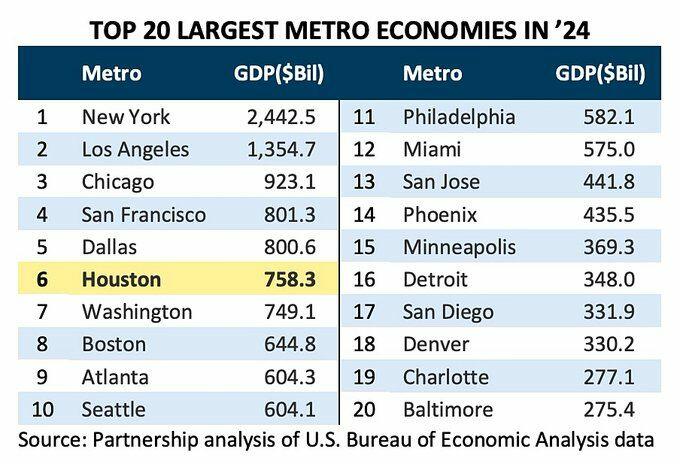
About that job growth: Houston real estate experts @Houstonomics just revealed that Houston became the 6th largest metro economy in 2024 (most recent data), and became the second fastest growing city out of the country’s 20 largest metro economies.
In a Saturday post on X (via Capital.news), they note: The numbers are in, and they demand attention.
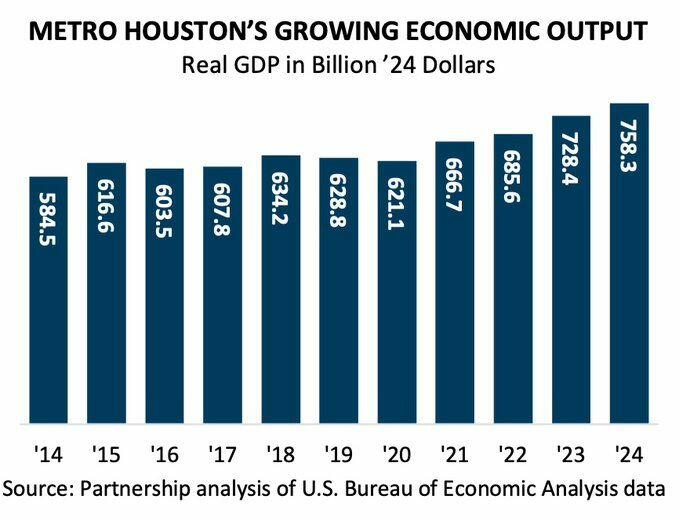
Metro Houston’s GDP hit $758.3 billion in 2024, crossing three-quarters of a trillion dollars in real, inflation-adjusted terms for the first time on record. That makes Houston the 6th largest metro economy in the United States, ahead of Washington D.C. and closing in fast on the cities above it.
But the size of the number is not the real story. The velocity is.
Houston grew at 4.1% in 2024, nearly double the national rate of 2.8%. Over the prior two years, only Seattle grew faster among the 20 largest metro economies. In absolute dollar terms, Houston added $72.6 billion in output, second only to New York City. That is not an oil town riding a commodity cycle. That is a diversified industrial powerhouse firing on all cylinders.
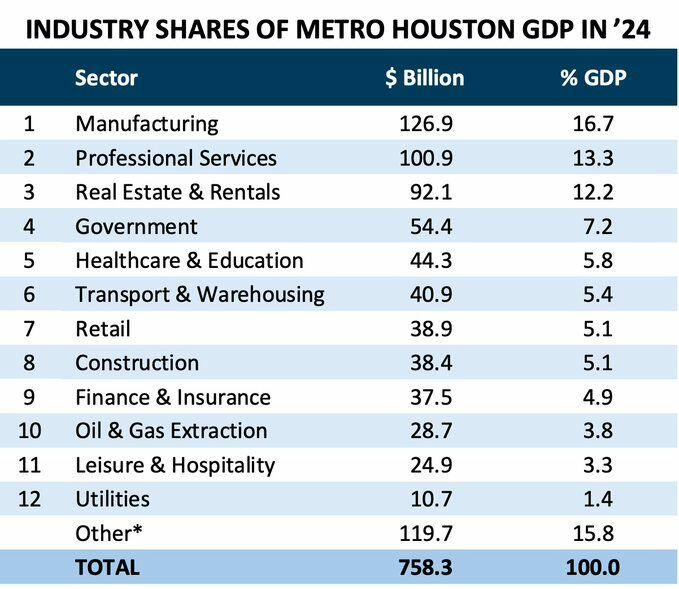
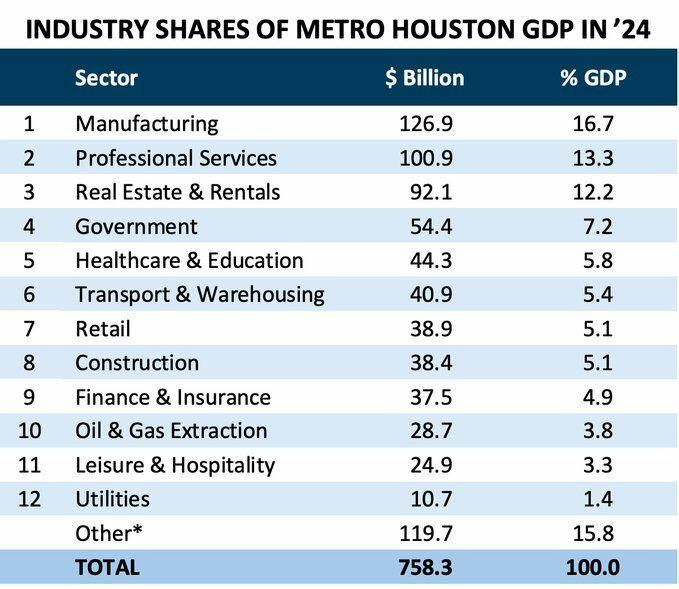
The conventional wisdom about Houston has always centered on energy. And yes, energy is still woven into the fabric of this city. But oil and gas extraction has fallen from 7.7% of GDP in 2014 to just 3.8% today, even as total output has grown. The city has not abandoned energy. It has grown everything else around it faster.
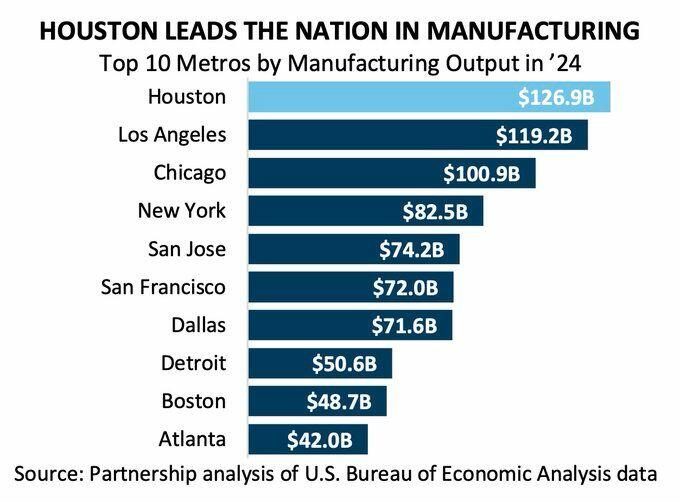
Manufacturing tells that story best. Houston produced $126.9 billion in manufactured goods in 2024, leading every metro in the country for the third straight year. More than Los Angeles. More than Chicago. More than double Detroit. Recent project announcements from Foxconn, Eli Lilly, and Tesla signal that this base is expanding well beyond its petrochemical roots.
Worker productivity reinforces the picture. The average Houston worker generates $221,000 in economic output per year, nearly 19% above the national average. That figure has risen 11.1% since 2019, outpacing the 7.9% national gain. Houston achieves this not through a narrow concentration of tech billionaires, but through the rare combination of skilled blue-collar workers and world-class industrial capital operating at scale.
Then there is trade. Nearly one in four dollars produced in Houston gets exported to global markets. No other major metro comes close. Dallas and Chicago export roughly 6% of their output. Houston exports 24%. The Port of Houston connects this industrial base to the world, and the world keeps buying.
The investment community is paying attention. In 2025, the Greater Houston Partnership recorded 683 new business announcements, a 26.5% increase over the prior year. Of the 683 announcements tracked in ’25:
35 disclosed employment figures totaling 14,834 new jobs.
42 reported $10.5B in capital investment.
665 disclosed 602.8M SF in space occupancy.
Of those, 117 came from foreign-owned firms, the highest volume on record. Companies from around the world are choosing Houston not as a backup plan, but as a primary destination.
The Purchasing Managers Index has shown continuous expansion for 68 consecutive months. Vehicle sales hit an all-time regional record. Sales tax revenues rose 5.9% in 2025, even after adjusting for inflation. The macro data and the street-level data are telling the same story.
Houston is not having a moment. It is building a permanent position at the top tier of American economic geography. The city that the coastal consensus once dismissed as a boom-bust energy town has quietly become one of the most productive, most export-oriented, most globally connected industrial economies on the planet.
The data is out. The question is whether the rest of the country is paying attention.
Data sourced from the Greater Houston Partnership, “Houston:The Economy at a Glance,” March 2026.
It is in population growth. Wait until Elon Musk gets that Chip plant up and running. https://t.co/Fnt8u9v7aW
— Houstonomics (@Houstonomics) April 4, 2026
Tyler Durden
Tue, 04/07/2026 – 22:10

Why Military Bases Should Never Have Been Gun-Free Zones
Why Military Bases Should Never Have Been Gun-Free Zones
Authored by John R. Lott Jr. via RealClearPolitics,
It may sound hard to believe, but except for a very limited group of personnel, the military has treated its bases as gun-free zones. Until Thursday, only designated security forces – such as military police – could carry firearms while on duty. Commanders punished any other soldier caught carrying a weapon severely, with penalties ranging from rank reduction and forfeiture of pay to court-martial, dishonorable discharge, criminal conviction, and even imprisonment.
That changed with a statement from Secretary of War Pete Hegseth.
“Before today, it was virtually impossible. Most people probably don’t know this. It is virtually impossible for War Department personnel to get permission to carry and store their own personal weapons aligned with state laws where we operate our installations. I mean effectively our bases are gun-free zones unless you’re training or unless you are a military policeman.”
Consider the attacks at Holloman Air Force Base (2026), Fort Stewart (2025), Naval Air Station Pensacola (2019), the Chattanooga recruiting station (2015), both Fort Hood shootings (2014 and 2009), and Navy Yard (2013). Across these attacks, 24 people were murdered and 38 wounded. In each case, unarmed personnel – including JAG officers, Marines, and soldiers – had to hide while the attacker continued firing.
Yet when the military deployed U.S. troops to Iraq and Afghanistan, it required them to carry their weapons at all times – even on base. Those soldiers needed to defend themselves against real threats, and there are no known cases of them turning those weapons on each other. The policy worked. Soldiers carried firearms without creating internal violence.
So why make it easier for attackers to target troops at home? Why force soldiers – like those at Fort Stewart – to confront armed attackers with their bare hands?
It wasn’t always this way. In 1992, the George H.W. Bush administration started reshaping the military into a more “professional, business-like environment.” That shift led to tighter restrictions on firearms. In 1993, President Clinton rewrote and implemented those restrictions, effectively banning soldiers from carrying personal firearms on base.
If civilians can be trusted to carry firearms, military personnel certainly can. As Hegseth noted, “Uniformed service members are trained at the highest and unwavering standards.”
Why would a soldier risk such severe penalties? Because those penalties do not deter attackers. Someone planning to murder fellow soldiers will not stop because of gun laws. Most mass attackers expect to die during the assault, so the threat of additional punishment carries no weight. Even if they survive, they already face multiple life sentences or the death penalty.
But those same rules weigh heavily on law-abiding soldiers. A soldier who carries a firearm for self-defense risks becoming a felon and destroying his or her future. These policies disarm the innocent while signaling to a determined attacker that no one else will be armed.
Military police guard base entrances, but like civilian police, they cannot be everywhere. Military bases function like cities, and MPs face the same limitations as police responding to mass shootings off base.
Uniformed officers are easy to identify, and that gives attackers a real tactical advantage. Attackers can wait for an officer to leave the area or move on to another target – either choice reduces the chance that an officer will be present to stop the attack. And if the attacker strikes anyway, whom do you think they target first?
Research shows that civilians with concealed handgun permits are more likely to stop active shooting attacks. By contrast, although police stop fewer attacks, attackers kill them at much higher rates – police are twelve times more likely to be killed.
After the second Fort Hood terrorist attack, Army Chief of Staff Gen. Mark Milley – then commander of Thirds Corps at that base – testified to Congress: “We have adequate law enforcement on those bases to respond … those police responded within eight minutes and that guy was dead.” But those eight minutes proved far too long for the three soldiers who were murdered and the 12 others who were wounded.
Time after time, murderers exploit regulations that guarantee they’ll face no armed resistance. Diaries and manifestos of mass public shooters show a chilling trend: They deliberately choose gun-free zones, knowing their victims can’t fight back. While we don’t yet know if the Fort Stewart shooter made that same calculation, his actions fit a pattern seen in dozens of other cases. It’s no coincidence that 93% of mass public shootings happen in places where guns are banned.
Ironically, soldiers with a concealed handgun permit can carry a concealed handgun whenever they are off base so that they can protect themselves and others. But on the base, they and their fellow soldiers had been defenseless. Fortunately, that has all now changed.
Allowing trained service members to carry on base restores a basic ability to defend themselves and others when seconds matter most. Policies that disarm the very people we trust in combat do not enhance safety – they leave our troops unnecessarily vulnerable where they should be most secure.
John R. Lott Jr. is a contributor to RealClearInvestigations, focusing on voting and gun rights. His articles have appeared in publications such as the Wall Street Journal, New York Times, Los Angeles Times, New York Post, USA Today, and Chicago Tribune. Lott is an economist who has held research and/or teaching positions at the University of Chicago, Yale University, Stanford, UCLA, Wharton, and Rice.
Tyler Durden
Tue, 04/07/2026 – 21:45
https://www.zerohedge.com/military/why-military-bases-should-never-have-been-gun-free-zones
Living In Any New York Borough Now Requires A Six Figure Income
Living In Any New York Borough Now Requires A Six Figure Income
Living in New York City without financial assistance now requires a six-figure income in every borough, according to Bloomberg.
The Fund for the City of New York’s latest “self-sufficiency standard” shows that in 2026, a family of four with two school-age children needs about $133,000 a year to cover basic expenses without outside help. Still, 46% of households fall short of that level.
A separate report from Mayor Zohran Mamdani’s office found that economic strain is even more widespread. In 2022, more than 5 million residents—62% of the population—were unable to both meet essential costs and save for emergencies. For families with children, the median income required rises to $159,197.
Together, the findings point to a deepening affordability crisis. Mamdani has proposed measures such as free universal childcare, fare-free buses, and rent freezes to ease the burden. He also noted that Black and Latino communities are disproportionately affected.
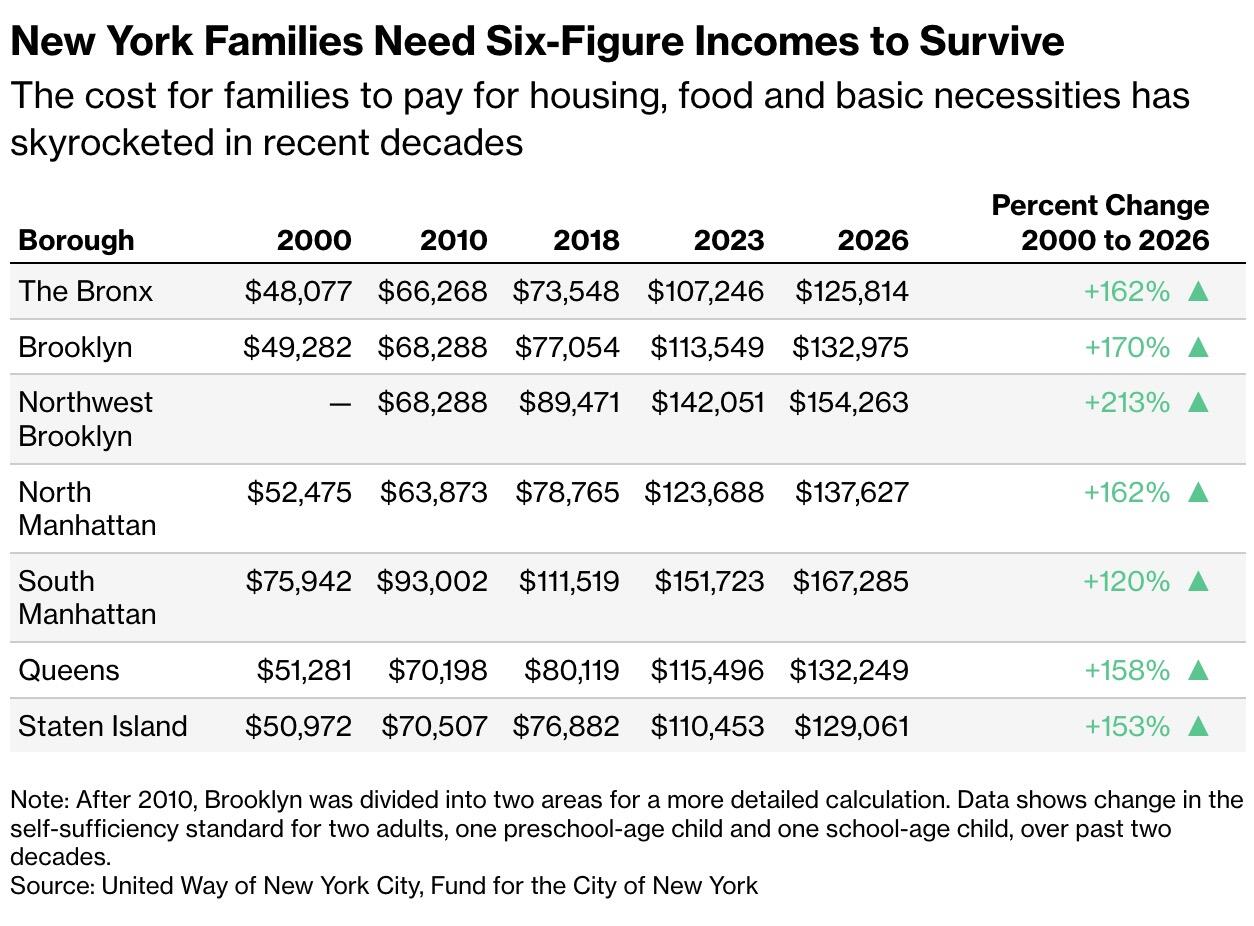
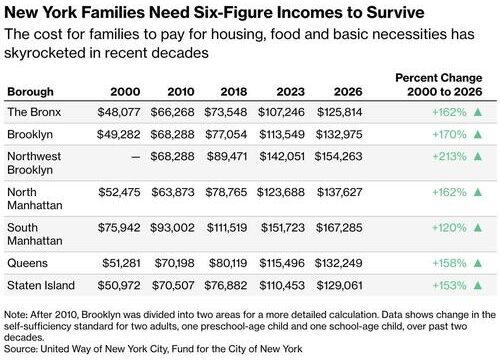
Costs have surged dramatically over time. In the Bronx, a two-parent household with two children now needs about $125,814 annually—up 162% from 2000. In Northwest Brooklyn, that figure reaches roughly $154,000, more than triple the borough’s earlier benchmark. Every borough has seen similar triple-digit increases.
Having children significantly raises expenses. Nearly half of married couples with kids earn below what they need, while households with two adults and no children were the only group consistently meeting costs in 2022.
Bloomberg writes that the impact is especially severe for younger residents. About 1.2 million children—73% of those under 18—live in families below the true cost-of-living threshold. Rising expenses have also driven families out: the number of children under five dropped 18% between 2020 and 2024.
Single parents face the greatest financial pressure. In 2022, 84% of those with one child fell short of the income needed to get by, rising to 94% for two children and 99% for three.
Recall, Zero Hedge contributor Quoth the Raven recently wrote about exactly how Mamdani’s “tax fantasy” has already failed elsewhere in the United States. Now it looks like it’s failing in New York.
Tyler Durden
Tue, 04/07/2026 – 21:20
https://www.zerohedge.com/markets/living-any-new-york-borough-now-requires-six-figure-income

Education Department Ditches Title IX Agreements That Pushed ‘Transgender Agenda’ In Multiple Schools
Education Department Ditches Title IX Agreements That Pushed ‘Transgender Agenda’ In Multiple Schools
Authored by Troy Myers via The Epoch Times (emphasis ours),
The Department of Education announced April 6 that it rescinded agreements between previous administrations and multiple school districts that aimed to enforce civil rights laws with regard to students who identify as transgender.
The Department of Education building in Washington on Nov. 18, 2024. Jose Luis Magana/AP Photo
Previous administrations had distorted the law to police discrimination based on gender identity, instead of sex, for which it was intended, saddling schools with potential violations of Title IX for not using students’ preferred pronouns or questioning a student’s preferred gender, the department said in a news release.
“Today, the Trump Administration is removing the unnecessary and unlawful burdens that prior Administrations imposed on schools in [their] relentless pursuit of a radical transgender agenda,” Assistant Secretary for Civil Rights Kimberly Richey said in the news release.
Resolution agreements are used by the Education Department’s Office of Civil Rights to require schools to enforce compliance with federal civil rights laws such as Title IX, which prohibits discrimination on the basis of sex in any school, program, or activity that receives federal funding.
With the termination of the agreements—made with the Cape Henlopen School District in Delaware; Delaware Valley School District in Pennsylvania; Fife School District in Washington state; and La Mesa-Spring Valley School District, Sacramento City Unified, and Taft College in California—the Education Department will no longer play a role in policing discrimination on gender identity.
The resolutions with those schools were based on ideologically driven, illegal, and heavy-handed manipulations of Title IX under previous administrations, the news release stated.
“While prior Admins distorted Title IX to pander to political ideology and police ‘misgendering,’ we’re investigating allegations of girls injured by men on their sports team or feeling violated by men in their intimate spaces,” Education Secretary Linda McMahon wrote in a post on X.
Monday’s decision to terminate the agreements is another step in protecting students and restoring common sense, Richey added in the news release.
In 2024, the Biden administration expanded the scope of Title IX to enforce discrimination based on gender identity. A federal court in January 2025 found that change to be illegal.
Once President Donald Trump took office for his second term in January 2025, he returned to enforcing his first administration’s enforcement of Title IX on the basis of sex.
The Trump administration has filed lawsuits against California, Oregon, and Minnesota over the states’ policies on transgender students, including those allowing transgender-identifying male students to participate in women’s sports and to access women’s locker rooms.
Investigations were also opened against other states, such as New Jersey, over concerns that boys are being allowed to use girls’ restrooms and locker rooms.
“Young women should not have to sacrifice their rights to compete for scholarships, opportunities, and awards on the altar of woke gender ideology,” Assistant Attorney General Harmeet Dhillon previously said.
Tyler Durden
Tue, 04/07/2026 – 20:55