Category: News

Efforts to require Asian American history in schools after anti-Asian hate starting to pay off
When high school students in the West Hartford Public Schools district study World War II in the coming year, they will learn about more than just the typical hallmarks like Japanese American detention camps. They will also hear about Sadao Munemori, a soldier who died protecting comrades from a grenade. The 22-year-old posthumously became the first Japanese American awarded the Medal of Honor.
Lessons like this that delve beyond places have left teachers “humbled,” said Jessica Blitzer, the district’s social studies department supervisor who helped design curriculum for secondary grade levels.
“It’s one of those moments where you think ‘How have we not been doing that?’ These are moments where you realize this is really important, particularly given the population that we have in West Hartford, which is incredibly diverse in many ways,” Blitzer said.
Three years after Connecticut became the third state to require Asian American and Pacific Islander history in K-12 education, a developed curriculum is being put into motion. For now, instruction is being rolled out in every grade except fourth and fifth. Most of the district’s 9,300 students will have lessons integrated year-round. It will not be “the heritage month approach,” Blitzer said.
Since pandemic-fueled anti-Asian hate surged in 2020, Asian American, Native Hawaiian and Pacific Islander advocates have mobilized to make AAPI history mandatory learning through legislation or state education boards. Today, most AAPI adults want educators to teach history through the lens of racism, slavery and segregation, according to a 2024 survey. There have been some successes, with around a dozen states passing statutes requiring curriculum.
Beyond well-known events, classes are diving into topics like stereotypes of South Asians and Vietnamese refugees. But as efforts arise, so has disagreement among Asian Americans.
More progressive voices question the fairness and optics of seeking approval from lawmakers who have rejected history focused on other historically marginalized groups, such as expanded Black history curriculum that some critics more recently maligned as woke ideology or likened to critical race theory.
How teaching AAPI history finally came to the forefront
AAPI organizations devastated by reports of thousands of verbal and physical attacks, including the 2021 Atlanta spa shootings that left six Asian women dead, ramped up lobbying for more inclusive education. The hope was teaching about AAPI contributions would foster understanding. In July 2021, Illinois became the first state to mandate Asian American history. In 2022, New Jersey and Connecticut followed.
An expanded look at history includes reading accounts of new immigrants in San Francisco and Wong Kim Ark’s Supreme Court fight for birthright citizenship. It also includes studying living figures like Chinese American architect Maya Lin.
Jason Oliver Chang, director of the University of Connecticut Asian and Asian American Studies Institute, helped develop legislation and train teachers. He remembers how lawmakers were moved by student testimonials.
“They were talking about their experiences sort of living two lives — one at school, one at home — feeling invisible and not feeling seen by their peers or respected by their peers,” Chang said. “Any time there’s a mention of someone that looks like them in a school curriculum, it’s that they’re the bad guys.”
President Donald Trump has intensified scrutiny of how schools address race, threatening to withhold federal funds over diversity initiatives. The guidance has left some educators uncertain, despite some anti-DEI measures being blocked or put on hold by federal judges. Concerned teachers should stick to the framework and consult with colleagues, advises Kate Dias, president of the Connecticut’s largest teachers’ union.
“Almost every person who teaches content of this nature does not do it in a way to say, ‘Here’s all the injustices of the world,’ ” Dias said. “The the call to action is ‘You need to now look at this information and you need to decide what it means.’ ”
Working with critics of race-conscious curriculum
Requiring AAPI history in schools has garnered bipartisan support. But in some conservative states, divisions have arisen over lawmakers who don’t see systemic racism and social justice as essential to history.
When Florida adopted AAPI history legislation in 2023, critics saw it as hypocritical given the state denied Advanced Placement African American studies for being “critical race theory.”
In Arizona, failed legislation mandating AAPI and Native Hawaiian history lessons was endorsed by the Japanese American Citizens League. The Arizona chapter came out against it.
Chapter leaders asserted the bill’s co-sponsor, state Republican Sen. John Kavanagh, and other supporters were only interested in rubber-stamping a sanitized history and ignoring African American and LGBTQ+ history.
Kavanagh equates talk of systemic racism with indoctrination. He previously supported barring college groups based on racial or ethnic identity and high school ethnic studies classes that seemed politicized.
He says teaching the history must be done in a “neutral, thorough manner.”
“I certainly have no problem teaching the history of Blacks or Hispanics or anybody,” Kavanagh said. “I don’t think there should be a course in a high school teaching students that this country is systemically racist when it’s not.”
The Arizona chapter of Make Us Visible, a national organization trying to establish AAPI history in every state, has faced criticism for not calling out right-leaning legislators. Astria Wong, chapter director, dismissed it.
“It’s really a good thing that even a conservative senator will support it. That means there is some bones in it,” Wong said. “It should be bipartisan anyway.”
Amber Reed, co-executive director of AAPI New Jersey, finds it upsetting.
“What teacher wants to suddenly start teaching Asian American history while sort of being discouraged from teaching African American history or Latinx history, the history of all of our communities,” Reed said.
A ‘deeper, richer’ look at American history
Before next summer, West Hartford Public Schools will assess how to improve curricula.
The goal is not to teach just “doom and gloom” to the student body — of which white children make up about 55%, Hispanics 21% and Asians and Black students more than 10% each — but a balanced look at history, said assistant superintendent Anne McKernan.
“There’s resistance, there’s perseverance, there’s greatness,” McKernan said. “As I look through the changes in elementary and the changes in secondary, it’s a richer look.”
Elementary grades are using books to learn culture, reading comprehension and vocabulary, said Erika Hanusch, district literacy and social studies curriculum specialist. For example, kindergartners are reading the picture book “Dumpling Soup” by Jama Kim Rattigan. Centered around a family in Hawaii, the characters come from different Asian backgrounds.
“It’s really more so embedded through story and lens,” Hanusch said. “And it’s giving teachers and students that natural opportunity to learn a little bit more about the where and the who and the traditions that come from those stories.”
___ Tang reported from Phoenix.
https://www.chicagotribune.com/2025/12/12/asian-american-history/

Daywatch: Bitter temperatures, subzero wind chills on tap for the weekend
Good morning, Chicago.
Bundle up, Chicago.
As the city’s quickest start to winter in nearly 50 years persists, this weekend is due to bring another round of bitter cold weather, officials say.
Expect temperatures to plunge starting tonight. After highs in the low 30s, the cold will begin to set in overnight into Saturday, according to David King, a meteorologist with the National Weather Service in Chicago.
Through the start of the weekend, there’s a chance of snow, but most accumulation is expected southwest of the city, King said. It’s after that system that forecasters predict the bone-chilling temperatures to really set in.
Here are the top stories you need to know to start your day, including the Senate voting down dueling health proposals, what the Bears said about the frigid forecast for Sunday’s game and the CTA Holiday Train spotted around the city.
Today’s eNewspaper edition | Subscribe to more newsletters | Asking Eric | Horoscopes | Puzzles & Games | Today in History
A protester celebrates outside the Indiana Senate Chamber after a bill to redistrict the state’s congressional map was defeated, Dec. 11, 2025, at the Statehouse in Indianapolis. (Michael Conroy/AP)
Illinois Democrats applaud as GOP-led Indiana Senate rebuffs President Trump’s push for new redistricting map
The heavily Republican-led Indiana Senate yesterday rejected a mid-decade redistricting plan aimed at giving the state two additional GOP U.S. House members in a sharp rebuke to President Donald Trump’s pressure to try to help maintain a congressional majority in next year’s midterm elections.
Related:
Pages from the U.S. Affordable Care Act health insurance website healthcare.gov are seen on a computer screen in New York, Aug. 19, 2025. (AP Photo/Patrick Sison, File)
The Senate voted down dueling health proposals. Here’s what’s at stake for Americans.
When senators voted on rival health bills yesterday, they had two chances to address expiring COVID-era subsidies that will result in millions of Americans saddled with higher insurance costs in the new year.
But the Senate rejected both, and hopes of solving the problem this year are running dry. Affordable Care Act subsidies will end in three weeks, more than doubling the premiums for many with health coverage through the 2010 law known as “Obamacare.”
Soybeans are harvested near Cerro Gordo, Sept. 20, 2024. (E. Jason Wambsgans/Chicago Tribune)
Illinois farmers welcome Trump aid package but say more needs to be done to save struggling industry
While farming associations and officials applauded President Donald Trump’s announcement earlier this week to provide $12 billion in aid to farmers struggling under his far-reaching tariff policies, some Illinois farmers say more needs to be done.
Border Patrol agents transfer a person to a van after he was detained during immigration enforcement actions on Oct. 31, 2025, in Niles. (Armando L. Sanchez/Chicago Tribune)
Chicago appeals court blocks release of hundreds of Operation Midway Blitz detainees pending individual review
A federal appeals court in Chicago issued a mixed opinion yesterday in a high-profile immigration case, blocking the immediate release of hundreds of people detained during Operation Midway Blitz, but allowing the extension of a consent decree governing so-called warrantless arrests.
Families walk to Haugan Elementary School in Albany Park on Dec. 9, 2025, in Chicago. (Stacey Wescott/Chicago Tribune)
‘No space for us’: Parents claim overcrowding at Haugan Elementary but CPS disagrees and denies expansion
Every morning, Mirella Gomez walks her three children to school at Helge A. Haugan Elementary in Albany Park. One by one, she kisses them on the forehead and whispers a gentle reminder in Spanish to take care of themselves before sending them off for the day.
Since August, her daughter has been telling her stories about crowded spaces in the school, but it wasn’t until Monday that she saw the reality for herself.
Rangers reliever Hoby Milner works against the Diamondbacks on Aug. 13, 2025, in Arlington, Texas. (AP Photo/Tony Gutierrez)
Chicago Cubs add Hoby Milner to revamped bullpen on a 1-year, $3.75 million deal
The Chicago Cubs added Hoby Milner to their bullpen yesterday, agreeing to a one-year, $3.75 million contract with the left-hander, according to a person familiar with the deal.
FIFA President Gianni Infantino speaks during the match schedule reveal for the 2026 soccer World Cup in Washington on Dec. 6, 2025. (AP Photo/Chris Carlson)
FIFA accused of ‘monumental betrayal’ over 2026 World Cup ticket prices
Soccer fans have accused FIFA of a “monumental betrayal” after the latest prices for World Cup tickets began to circulate yesterday.
The governing body allocates 8% of tickets to national associations for games involving their team to sell to the most loyal fans. And a list published by the German soccer federation revealed prices ranged from $180-$700 for varying group stage games. The lowest price for the final was $4,185 and the highest was $8,680.
Those group-stage prices are very different from FIFA’s claims of $60 tickets being available, while the target from United States soccer officials when bidding for the tournament seven years ago was to offer hundreds of thousands of $21 seats across the opening phase of games.
A Bears fan brave the frigid temperatures during a 35-13 loss to the Bills on Dec. 24, 2022, at Soldier Field. (E. Jason Wambsgans/Chicago Tribune)
Bears are chill about frigid forecast for Sunday’s game: ‘It’s Chicago, man. It’s cold here every day.’
Several Chicago Bears players and coaches have either warmed to the idea that they’ll host the Cleveland Browns in bitterly cold conditions Sunday at Soldier Field — or they push it out of their minds entirely.
“There’s nothing really to talk about,” defensive backs coach/passing game coordinator Al Harris said. “Both teams are going to be out there. Whatever. If it’s 100 degrees or it’s negative 100, both teams are out there.”
A train ride is one of the most popular attractions at the Fox Valley Park District’s Holiday Express celebration, which will return to Blackberry Farm in Aurora starting Thursday.
Holiday Express at Blackberry Farm in Aurora canceled on Saturday and Sunday due to expected frigid weather
Due to “dangerously low temperatures expected this weekend,” Fox Valley Park District officials said they have made the decision to cancel all Holiday Express events scheduled for Saturday and Sunday at Blackberry Farm in Aurora.
People wear face masks as they stand on the corner of Foster Avenue on Jan. 13, 1979. (Sally Good/Chicago Tribune)
Vintage Chicago Tribune: Do you remember when 90 inches of snow fell almost 50 years ago?
Here’s a look back at what effect all that snow and cold had on Chicago and the suburbs during the most wintry season ever.
The CTA Holiday Train stops at the outbound Damen Blue Line station, as seen from The Robey hotel in Chicago. (John J. Kim/Chicago Tribune)
Photos: All aboard the CTA Holiday Train!
See photos of the holiday train traveling through the city.
Letter: Orland Park’s Original Pancake House evokes memories of Mom’s kitchen
It was a cold day in Orland Park. The clouds were grey and the weather was a migraine headache waiting to happen.
I found myself at the reopening of The Original Pancake House in Orland Park. A young lady with a youthful smile greeted me. I told her I am a bachelor and I don’t want to take up a lot of room.
The counter is clean and the silverware is shiny and spotless. The menu is clean, void of fingerprints and grease. The coffee had a wonderful serving temperature, not too hot but hot enough to make it pleasurable. I ask for French vanilla creamer, they had it!
I play it safe with a vegetarian omelette. About eight minutes later my meal is served. A beautiful presentation with an omelette so yellow it reminds me of summer sunflowers in their full majesty. I sample the omelette, always reminded by my primary care physician telling me to watch my salt. No salt or pepper was needed. A confident cook prepared this breakfast.
While dining my coffee cup is never empty. I try the potatoes. They are cooked in fresh oil. I try the pancakes. They are fluffy and don’t have the consistency of rubber band. I am asked how my breakfast is. No fake smile, just genuine concern. I tell the waiter I am impressed.
My waiter says have a nice day and I truly believe he means it. I pick up my bill and rinse my hands off in a spotless restroom. As I exit I pay my bill and feel comfortable with the final price.
Nothing compares to the memories of my mother’s kitchen, but this came close. I recommend it. By the way, watching the passing traffic on LaGrange Road was oddly pleasing.
Terrence Camodeca, Orland Park

Nuclear Reactors For Investors
Nuclear Reactors For Investors
Submitted by Steffan Szumowski from The Nuclear Review
“We’re designing a Liquid Metal Reactor”
“Our design will utilize proven technologies”
“The design makes our reactor ‘walk-away safe’”
There’s a growing list of public and private companies that are working to build reactors for various purposes. These reactors vary widely in their design, size, output, and potential purpose. Everything is on the table: from using the same designs we’ve used for decades to novel ideas still only on the drawing board.
This article is designed to serve as a point of reference when reading about a new company and the reactor they’re designing. Some of the features companies discuss are less novel than they sound, and vice versa. Hopefully, the information provided here can provide a more clear picture for the investor to make an informed decision.
Reactor Designs Features
Skipping the nuclear physics details, since the basic principles are consistent across the designs we’ll explore, a nuclear reactor facilitates the controlled fission of uranium atoms, harnessing the resulting energy for various applications. After that, the differences we see in reactor designs are mostly in the choice of the fuel, moderator, and coolant.
If we include all the variations that have been used over time and the novel ideas yet to be produced, this will get out of hand. We’ll only be focusing on the most common options.
Fuel
Uranium is king when it comes to fuel for nuclear reactors. Compared to the other fuel options, thorium and plutonium, uranium wins out mostly due to natural abundance and path dependence. You don’t just drop in a chunk of uranium from the ground though. It’s often enriched and comes in a few different forms:
Uranium Oxide (UO2) – The most common fuel for water-cooled reactors. The pellets are stacked inside fuel rods and loaded into the reactor core, and then replaced about every two years. The design holds major historical preference, but is less useful in high temperature applications, such as in reactors intended for industrial heat processes.
Uranium Zirconium (U-Zr) – This alloy improves on the UO2 fuel design in respect to thermal conductivity. U-Zr has improved conductivity and no oxygen, which makes it ideal for use in reactors with liquid sodium. But, with a lower melting point, it isn’t able to be used in gas-cooled reactors.
Uranium Zirconium Hydride (U-ZrH) – This fuel is unique with its addition of hydrogen. The hydrogen acts as a balance to help shutdown reactors when temperature gets out of control and spikes up. This is why U-ZrH is typically found in research reactors at universities and national laboratories; when combined with additional cooling measures and engineered hydrogen management, the fuel offers a near “walk-away safe” capability.
Mixed Oxide (MOX) – Plutonium Oxide (PuO2) can be mixed with UO2 to create MOX for use in many types of reactors, including those that would normally operate on UO2 pellets. MOX is not widely used in the US, and is instead more extensively used in the French commercial fleet. It enables useful consumption of old nuclear weapons materials and recycling of spent nuclear fuel.
Tri-structural Isotropic (TRISO) – The “Cadillac” of reactor fuel is the newer TRISO design, which is a spherical UO2 pellet encased in layers of pyrolytic carbon and silicon carbide. This provides enhanced durability for fuel failures. Its costs are comparatively high, considering the overall fuel density is only 5% that of UO2 fuel, but this is potentially countered by reduced protective design features of the reactor plant due to the fuel’s superior integrity.
A frequent topic of discussion is also the enrichment levels of fuel, especially with some of the newer reactor designs requiring more highly enriched fuel than has traditionally been used in the commercial fleet. The enrichment in nuclear fuel refers to the percentage of fissionable, or fissile, material in the fuel. This fissile material is the uranium isotope U-235, with the majority of the rest of the uranium in the fuel being non-fissile U-238. Enriched fuel is usually required, since natural uranium mined from the ground is around 0.7% U-235, and most reactors need enrichment levels around 3-5%. The sub-5% enrichment level is referred to as Low Enriched Uranium (LEU). Some of the newer commercial reactors though require High-Assay LEU (HALEU), which is enriched to around 15-20% U-235. There are even higher levels of enrichment, usually reserved for government-sponsored research and military use due to proliferation concerns.
Moderator
The moderator is used in “thermal” reactors to slow down the neutrons flying around in the core, which allows them to more easily interact with uranium and cause fission. Most of the current global fleet operates on this principle. Moderators have typically been:
Light water (H2O) – This is just normal water with additional filtering and chemistry controls. Abundant, cheap, and excellent for slowing down neutrons given hydrogen has similar mass to the fission-inducing neutrons.
Heavy water (D2O) – Better suited for moderating than H2O due to the deuterium (an isotope of hydrogen) having a significantly smaller chance of absorbing one of those fission-inducing neutrons. It’s not used as much in the global reactor fleet (mostly used in Canadian reactors) due to its complicated and expensive production process.
Graphite – Used as a moderator in the form of solid blocks. Use of graphite also means a second material will need to be used for the coolant, compared to H2O/D2O that fill both the moderator and coolant roles. Graphite holds a heat tolerance advantage over water moderators, enabling higher core temperatures and better thermal efficiency.
Compared to thermal reactors, “fast” reactors operate without a moderator, allowing neutrons to maintain their higher, “fast” energy. This enables the use of a broader range of fuels, while also offering the potential for reactors to breed more fuel than they consume. They can also operate at higher temperatures than most thermal reactors, enabling additional potential applications. Fast reactors aren’t without their disadvantages though, as most of them intend to use HALEU, contributing to higher start up costs and a growing concern for a current lack of that fuel’s supply chain. Lastly, there are engineering and operational challenges with handling high-energy neutrons and materials, some of which may be unquantifiable until actual system operation can be further observed.
Coolant
All reactors have a coolant to meet two main objectives: first, to get the energy from fission out of the core to prevent overheating, and second, to transfer that heat to the secondary system for electrical generation or other industrial purposes. Coolants are usually:
H2O or D2O – The most frequently used coolant for the current global fleet. The material is cheap and abundant, but requires high pressurization to prevent boiling for non-BWRs, and its moderation ability is a downside for fast reactor applications.
Liquid Sodium – Significantly higher boiling point and thermal conductivity compared to water. This enables lower operating pressures and higher thermal efficiencies. There’s a horrible potential downside though, as sodium reacts violently when exposed to water or air.
Molten Salt – Similar to sodium with its higher thermal conductivity, but with an advantage of a melting point almost twice as high as sodium. The downsides are less precedence in nuclear history and a much higher melting point, leading to solidification concerns. Molten salt also has a complex structure, such as toxic and expensive beryllium, the requirement for enriched lithium, and tritium production concerns. Tritium in particular has received significant attention in recent years, as it is one of the main points of contention for how to handle the cooling water used during and after the Fukushima disaster.
Inert Gas – Helium and carbon dioxide have been used in gas-cooled reactors with graphite as the moderator. The balance here is less corrosion and radiation than sodium and salt reactors while still gaining high thermal efficiency, but the smaller power density leads to the requirement of having to construct much larger reactor cores.
Reactor Design Combinations
Put all these different fuels, coolants, and moderators together, and what do you get? The four major reactor designs that most investors will come across when evaluating companies in the nuclear industry:
Light Water Reactor (LWR)
The US’s current fleet is made of two subsets of the LWR category: the pressurized water reactor (PWR) and boiling water reactor (BWR). Both of these designs use light water as the coolant and moderator, with UO2 as the fuel. LWRs have the most reactor-years of operation and experience, with no close second.
PWRs use a pressurized system to enable higher operating temperatures without boiling the coolant. The water passes through the core (primary loop) to take away fission heat and transfer that energy through a heat exchanger to the secondary water system (secondary loop). There, the water is allowed to boil so the steam can drive a turbine for electricity production. Radiological concerns are therefore minimized to the primary loop, but additional systems are needed to maintain pressure and obvious concerns come with operating at significantly higher pressures.
BWRs operate by letting the water boil in the core and using that steam to directly spin a turbine. This enables the BWR to have a simpler system, but radiological concerns now include all the way out to the electrical generation system, versus just within the primary loop.
Companies building/developing LWRs: Cameco (Westinghouse), NuScale, GE Vernova, Holtec, Hadron, Rolls-Royce
Sodium-Cooled Fast Reactor (SFR)
These reactors gained runtime under multiple test reactors, including Phénix and Superphénix in France, Joyo and Monju in Japan, and the FFTF and EBR-II reactors in the US. Unmoderated and liquid sodium cooled, SFRs can use multiple types of fuel, such as U-Zr and MOX. Their initial operations were marred most notably by difficult-to-repair leaks, leading Admiral Rickover to shun one of the earliest sodium reactors in favor of PWRs for his nuclear submarine program. SFRs offer potential benefits though with higher temperatures and thermal efficiencies, which leads to additional use cases in industrial applications. Lastly, there is potential for them to act as breeder reactors which can produce more fuel than they consume.
Companies building/developing SFRs: TerraPower, Oklo, Aalo
Molten Salt Reactor (MSR)
These reactors have the least experience among current reactor designs. MSRs can operate as thermal reactors with almost any fuel, a graphite moderator, and molten salt as the coolant. Newer designs also have the MSRs operating as fast reactors. These designs can even have a novel fuel dissolved directly into the molten salt coolant itself with no moderator. The thermal reactor version has similar use cases to SFRs, due to the high operating temperature.
Companies building/developing MSRs: Kairos, Terrestrial, Natura
High Temperature Gas-Cooled Reactor (HTGR)
It is important to note that HTGRs are different from their predecessors, the Gas-Cooled Reactor (GCR). The older GCRs were only focused on generating electrical power for commercial grids. They had to be significantly larger than PWRs due to using less-enriched uranium and poor energy density of the coolant, usually carbon dioxide. The newer HTGRs are designed to use enriched uranium, usually TRISO fuel, with graphite moderation and helium cooling. Precedence for HTGRs can be found in reactors like Fort St. Vrain in the US and the Thorium High-Temperature Reactor-300 (THTR-300) in Germany. The current designs being developed haven’t varied much from previous HTGRs, which may yield easier licensing processes. The higher operational temperatures of HTGRs will allow for more uses than just electricity.
Companies building/developing HTGRs: X-energy, Radiant, Valar, Terra Innovatum, Nano Nuclear, BWXT
Considerations for the Potential Investor
The likely question an investor would ask at this point is: which one is best? Unfortunately there is no good answer to this question. They all have distinct advantages and disadvantages that need to be compared to the company’s intended market, and then backtested to try and infer the reactor’s chance of success. Here are a few topics to help evaluate a company’s project:
Capacity Factor
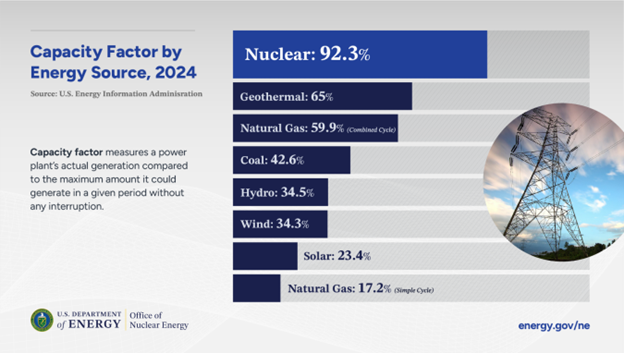
The capacity factor is a measure of how consistently a reactor achieves its maximum rated output. The champions of the capacity factor are large LWRs, with a well-documented recent history of over 90%. This contrasts greatly with some of the other reactor designs, such as SFRs that saw significantly lower capacity factors due to ongoing material management issues, such as leaks. A lower capacity factor will mean operational delays, additional costs, and less revenue. HTGRs are better off than SFRs, however still not as consistently high as LWRs, and MSRs are still relatively untested.
Important to additionally note is the time it takes to achieve a high capacity factor. LWRs did not achieve a 90% capacity factor in their first year of operation. Some new reactors struggled to achieve capacity factors in the teens in their first years of testing. It took multiple decades of experience to gain the capacity factors that we see today. Also, the experience that has been gained is on the equipment and designs we currently use, not what is still on the drawing board. It is almost inappropriate to assume that a reactor that has never been operated can achieve a high capacity factor on its first day of operation.
Of particular concern should be when a company describes a feature of their reactor as novel. This can directly translate to future engineering and licensing issues, in addition to operational concerns (likely unaccounted for), leading to new costs.
Power Rating
A more minor, yet still important, point to be mindful of; particularly when evaluating the intended market for a reactor. The term for describing the output of a reactor goes by multiple names, including power rating, nameplate rating, thermal power (MWt or MWth, interchangeable), and electric power (MWe).
The number to be asking and looking for is the MWe, as this number describes the actual energy that a commercial reactor would output to a connected load or electrical grid, and could be used for revenue projections based on electricity rates. The number frequently given in lieu of the MWe is MWt, which is a measure of the power generated inside the reactor core. This number does not reflect what the usable output of the reactor will be, and is a poor gauge of the reactor’s potential application.
While not exact, as efficiency varies based on reactor design, a rule of thumb for converting MWt to MWe is to divide the MWt by three. So, a reactor marketed as rated to 300 MWt is about 100 MWe. This MWe number could then be taken and compared to the output of a diesel generator or coal/gas/solar/wind system, to see where replacement opportunities may exist.
The Small Modular Reactor (SMR)
The term used to have some definition to it, with the hallmarks of a small footprint and lower power output. The SMR also offered a wide range of new possible applications, including, but not limited to: remote communities, process heat, mining operations, military installations, marine propulsion, disaster response, and desalination.
But recently, some of the designs claiming the SMR label have swelled in size and rating, while the large reactor designs have gained modularity features. This has led to a loss of significance of the term SMR, as it now applies to an ever-widening array of designs. At this point, it seems to be mostly used as a marketing tactic, with its mention still catching the attention of most investors.
While some companies have progressed through the licensing process, none of them have actually successfully built and operated their SMR. This means there is no means of projecting potential engineering, licensing, construction, or testing problems that should be very reasonably expected. The only example to extrapolate potential issues from is the Vogtle 3 and 4 reactors. They had the most experienced reactor planning, engineering, and construction teams they could ask for, and yet through a combination of regulatory struggles, engineering complications, and construction management failures, they were built at a miserably slower speed than projected and at a dramatically higher cost.
Even with this recent example on full display for everyone, most new reactor production companies promise commercialization of their designs within the next five years. This is likely beyond achievable for many.
Precedence vs Innovation
This has arguably been one of the more divisive approaches to the development of newer and smaller reactors. Should the team pursue a more advanced reactor with innovative design aspects and novel safety features? Or, should they stick to what works, not fix what isn’t broken, and try not to reinvent the wheel?
Precedence offers familiarity. LWR designs benefit from decades of operational history. This reduces uncertainty in licensing, construction, and operation. These designs still face problems, as discussed above, but due to recently completed construction and testing programs, uncertainties have been greatly diminished. It’s no coincidence the most recently certified reactor designs are LWRs from NuScale and Cameco’s Westinghouse.
On the other hand, innovation brings the potential of disruptive advancements. Designs like SFRs, MSRs, and HTGRs promise higher thermal efficiencies, broader fuel flexibility, and potential new applications beyond electricity generation. Yet, innovation also brings uncertainty. The NRC is still unfamiliar with these designs, leading to prolonged approval times and rejection in some cases such as with the Aurora SFR from Oklo. Engineering and construction challenges will likely reveal themselves later in the process, resulting in cost overruns. The argument can be further tipped back in favor of novel designs though, as more safe design features like TRISO fuel could increase chances of licensing success.
For investors, this balance demands careful evaluation. A company pursuing innovation should have strong partnerships, a credible roadmap, and a clear path to de-risk novel aspects. Conversely, companies relying on precedence must show a competitive edge in cost, efficiency, or scalability compared to peers.
Conclusion
Investing in the next generation of nuclear reactor technologies is about as exciting as it gets. The spectrum of designs from tried-and-true LWRs to innovative MSRs offers opportunities to shape the future of energy. Yet, diversity in a highly technical industry brings an equally high degree of difficulty when it comes to choosing which company to invest in.
Successful investments in this space demand more than enthusiasm; they require discernment. The key lies in understanding concepts like capacity factor, licensing hurdles, construction timelines, and operational precedents. Companies championing well-understood designs bring the advantage of reduced uncertainty, but may face limitations in application and heavier competition. Meanwhile, pioneers of novel reactor concepts promise groundbreaking advancements but must navigate uncharted engineering, regulatory, and market waters.
Ultimately, the winners in this field will be those who can bridge the gap between vision and execution, and manage expectations. Serious advantages are also held by companies with operational test reactors at national laboratories and universities. They’re gaining the actual runtime needed to improve their designs and manage future risks. For investors, due diligence is paramount. Look for companies with clear roadmaps, realistic timelines, and strategic partnerships that can mitigate risks while capitalizing on opportunities.
Tyler Durden
Fri, 12/12/2025 – 07:20
https://www.zerohedge.com/markets/nuclear-reactors-investors
Alemania convoca a embajador de Rusia por presunto sabotaje, ciberataques e interferencia electoral
Associated Press
BERLÍN (AP) — Berlín convocó al embajador de Rusia el viernes tras acusaciones de sabotaje, ciberataques e interferencia en las elecciones alemanas, dijo un portavoz del Ministerio de Exteriores de Alemania.
Alemania también ha acusado a Moscú de llevar a cabo campañas de desinformación.
Por el momento, no había más detalles disponibles.
___
Esta historia fue traducida del inglés por un editor de AP con la ayuda de una herramienta de inteligencia artificial generativa.

5 things to watch in the Chicago Bears-Cleveland Browns game at Soldier Field — plus our Week 15 predictions
At this point, every game is big for the Chicago Bears.
Coach Ben Johnson’s team returns to Soldier Field for a matchup against the Cleveland Browns on Sunday. With only four games remaining, the Bears — who hold the seventh and final playoff spot in the NFC — need to keep winning if they’re going to reach the postseason.
This game will pit two much-discussed young quarterbacks against each other. There is, of course, the 2024 No. 1 pick in Caleb Williams suiting up for the Bears. On the other side, Browns rookie Shedeur Sanders will make his fourth NFL start after beginning the season buried on the depth chart.
The Bears (9-4) square off against the Browns (3-10) on Sunday at Soldier Field (noon, Fox-32). Here are five things to watch ahead of Week 15 — plus the Tribune’s predictions for the game.
1. A must-win game for the Bears?
The Bears are in the midst of a tight playoff race. As it stands heading into Week 15, the Bears are the No. 7 seed in the NFC, hanging on by a thread. The San Francisco 49ers are right ahead of them with an identical 9-4 record, and the Detroit Lions are a game back at 8-5.
Three of the Bears’ four remaining games come against teams with winning records firmly in the playoff race. Sunday’s game is the lone exception.
The Browns are the worst team remaining on the schedule. Ben Johnson noted this week that his team probably needs at least two more wins to put itself in position for a postseason spot. So does that make Sunday’s game a must-win?
Ask any NFL player and they’ll say every game is a must-win. But safety Kevin Byard III, a team captain, said the veterans on this Bears team aren’t letting the youngsters on the roster look too far ahead.
“Some people would call this a classic trap game or whatever it may be,” Byard said. “I don’t really believe in trap games in the league. I think every single week you have to bring your best ball regardless of records. This is the National Football League and every team and everybody’s playing for something regardless of what the record is.”
The fact is, the path to two more wins probably becomes much harder if the Bears can’t take care of business against the Browns. The Bears close out the season with a rematch against the Green Bay Packers at Soldier Field, a trip to San Francisco and a finale against the Lions in Chicago.
The Browns might have one of the worst records in the NFL, but their defense is among the best. Their defense ranks second in yards per game and first against the pass. It has the second-best sack rate in the NFL and allows the second-fewest number of first downs. The Browns’ struggles on offense are what has held them back.
Despite the Browns’ bad record, this will not be an easy win.
“We have goals and we know what’s out in front of us,” Johnson said. “It’s just that awareness that every game matters. That’s where this week, you go from an emotional rivalry game like we just played (against the Packers), this week is equally important. We need this win. We desperately need this win.”
2. Player in the spotlight
Browns defensive end Myles Garrett looks on during the fourth quarter against the Titans on Sunday, Dec. 7, 2025, in Cleveland. (Nick Cammett/Getty Images)
Browns DE Myles Garrett
Garrett has a chance to make history this season, and it’s not out of the question that he could do it Sunday in Chicago.
With 20 sacks through 13 games, Garrett is three shy of setting a single-season record. Michael Strahan (2001) and T.J. Watt (2021) share the single-season mark at 22½ sacks. Garrett has recorded three or more sacks in a game three times this season, so it isn’t crazy to think he could set the record Sunday.
“He’s done an incredible job,” Johnson said. “And just to look at the number of double teams, triple teams, as you see on tape, and yet, he still has 20 sacks on the season, it’s pretty remarkable. And it’s a special season for him, no doubt.”
Can Myles Garrett set the NFL sack record vs. the Chicago Bears? Here’s what the numbers say.
The Bears are hoping the special season doesn’t become historic this weekend. Williams has been much improved in the sack department, thanks in large part to a revamped Bears offensive line. Williams has been sacked 20 times in 13 games after leading the NFL with 68 a year ago. Only twice this season has Williams been sacked three times in a game.
Whether or not Garrett sets the record, though, the six-time Pro Bowler is going to be a major focus for the Bears offense this week.
“He provides a very unique challenge — those guys just don’t grow on trees,” offensive coordinator Declan Doyle said. “He’s a guy that we’re very aware of. You study a lot of tape during the week, and just having a plan to handle him. But that’s really the main thing is we maintain focus on that player throughout the game and we know where he is.”
While Garrett will line up on both sides of the formation, he primarily has lined up opposite the offense’s left tackle. That could mean quite a challenge for Bears rookie left tackle Ozzy Trapilo, who has just three NFL starts under his belt.
Browns quarterback Shedeur Sanders throws a pass under pressure from the Titans on Sunday, Dec. 7, 2025, in Cleveland. (Sue Ogrocki/AP)
3. Sanders will make NFL start No. 4.
Sanders’ much-publicized rookie season has been quite an odyssey.
To recap, there were first-round expectations for him ahead of the draft, followed by a draft-day prank call while livestreaming to the world. Then he fell all the way to the fifth round of the draft, he began the offseason as the fourth-string QB in Cleveland and, finally, he earned his shot in November thanks to injuries to and trades of quarterbacks ahead of him on the depth chart.
The Browns traded Joe Flacco ahead of the trade deadline. Then Dillon Gabriel’s November concussion opened the door for Sanders. But even with Gabriel back healthy, the Browns are moving ahead with Sanders as their starter.
After all that, Sanders is coming off his best game as a pro. He threw for 364 yards with three touchdowns and an interception in a loss to the Tennessee Titans on Sunday. It was the first 300-yard performance from a Browns rookie quarterback since Baker Mayfield in 2018.
“Really the last three games with the new quarterback, you can feel their offense picking it up a little bit,” Johnson said. “He’s a dangerous player.”
In four appearances this season, Sanders has thrown for five touchdowns and three interceptions. The Bears defense leads the NFL with 18 interceptions. Defensive coordinator Dennis Allen will probably try to cause some confusion for the rookie QB.
“We’re always looking for opportunities to take the ball away, regardless of who’s playing,” Allen said.
Titans linebacker Cody Barton tackles Browns tight end Harold Fannin Jr. on Sunday, Dec. 7 2025, in Cleveland. (Kirk Irwin/AP)
Rookie tight end Harold Fannin Jr. has really benefited from Sanders’ emergence. Fannin caught eight passes for 114 yards and a touchdown last week.
A year ago at Bowling Green, Fannin led not only tight ends but also all FBS players with 117 receptions and 1,555 receiving yards in 2024. As so often happens with a player at a smaller school, Fannin slipped into the third round of the draft despite his absurd college production. Now, Fannin leads all Browns players with 59 catches for 619 yards and four touchdowns.
Allen said Fannin plays faster than his 40 time might indicate.
“He runs good routes and really, he does a great job after the catch,” Allen said. “I mean, he’s a violent runner after the catch. He can make you miss. He can run over you, run through you. So I think he’s certainly a weapon in their offense.”
He could be Sanders’ favorite target again Sunday.
Bears fans brave the frigid temperatures during a 35-13 loss to the Bills on Dec. 24, 2022, at Soldier Field. (E. Jason Wambsgans/Chicago Tribune)
4. Keep an eye on …
The cold weather.
Temperatures could flirt with a record cold Sunday. As of Thursday evening, the National Weather Service predicted a high of 13 degrees with wind chills below zero.
The temperature would have to be just 1 degree below that expected forecast to tie for the 10th-coldest game at Soldier Field.
Temperatures that cold undoubtedly will have an effect on the game. Both teams, of course, will be dealing with the same conditions. Wind gusts up to 20 mph could make the kicking game a little more challenging. The same could be said of the passing attack.
“Obviously the ball and the kicking game could be affected based on the weather,” Bears special teams coordinator Richard Hightower said. “The ball’s harder, doesn’t travel as far. But I’ll tell you what, their specialists and our specialists have both played in it.”
The Bears already have some experience in the elements. The Black Friday game in Philadelphia was extremely windy, and they battled cold temperatures a week ago in Green Bay. The Browns also play outdoors and are no strangers to the cold.
But Sunday is looking like it will be a different animal.
Bears wide receiver Rome Odunze warms up before a game against the Steelers on Nov. 23, 2025, at Soldier Field. (Eileen T. Meslar/Chicago Tribune)
5. Injury updates: Will WR Rome Odunze and CB Tyrique Stevenson be back?
Bears cornerback Kyler Gordon has not practiced yet this week after suffering a groin injury in pregame warmups in Green Bay. Asked whether Gordon, who has missed all but three games this season, will play again this year, Johnson said it’s “to be determined.”
In positive injury news, Odunze and Stevenson have both been back at practice this week, albeit in a limited capacity. Odunze missed last week’s game with the foot injury, while Stevenson has missed two consecutive games with a hip injury.
Meanwhile, the Browns have had nearly a dozen starters on their injury report this week. The offensive line is particularly banged up. Starting guards Joel Bitonio (knee/back) and Wyatt Teller (calf) have not practiced this week, nor has starting right tackle Jack Conklin, who is in concussion protocol. Additionally, tight end David Njoku (knee) has yet to practice this week.
The Browns added backup guards Teven Jenkins (shoulder) and Zak Zinter (back) to their injury report Thursday. Both were limited in practice. Jenkins, the former Bears guard, will be making his return to Soldier Field for the first time since leaving in free agency.
The Browns defense is working through several injuries too. Four-time Pro Bowl cornerback Denzel Ward (calf) has not practiced this week, nor has defensive tackle Mason Graham (rib), who was the No. 5 pick in this year’s draft. Cornerback Tyson Campbell (shoulder) and safety Grant Delpit (illness/groin) were limited Thursday.
Both teams will release updated injury reports Friday.
Predictions
Brad Biggs (9-4)
This sets up as the kind of game in which defensive coordinator Dennis Allen can lay some traps for Browns quarterback Sheduer Sanders. The rookie is coming off a 364-yard game against the lowly Tennessee Titans. He has breathed some life into the Browns offense, involving tight end Harold Fannin Jr. and wide receiver Jerry Jeudy, and that’s much better than the dink-and-dunk the Browns had going with fellow rookie quarterback Dillon Gabriel. But Sanders is completing only 52.4% of his passes, and the Bears probably can force him into some mistakes that set them up with short fields. But it will be interesting to see how the Bears offense responds against one of the league’s best defenses.
Bears 23, Browns 14
Sean Hammond (10-3)
The Bears need this game, and I don’t anticipate a letdown. As Brad noted, Allen is going to keep Sanders guessing. I’d expect some exotic blitzes now and then, particularly on third down. It wouldn’t surprise me if the Bears defense finishes this game with two or more takeaways. On the other side, the Bears need to establish the run and find ways to avoid third-and-long. The cold weather might make this more of a low-scoring affair.
Bears 20, Browns 17
Phil Thompson (8-5)
The Browns can’t make up their minds. Are they the stout team that held the Green Bay Packers to a 13-10 loss in Week 3, or the team whose rally bid fell a two-point conversion shy in a 31-29 loss to the Tennessee Titans last week? The defensive numbers say the Browns will be a very tough out, but no need to panic. Their offense is still inconsistent, banged up (former Bears lineman Teven Jenkins will have to start) and turnover-prone (two giveaways in each of the last three games).
Bears 24, Browns 20
https://www.chicagotribune.com/2025/12/12/chicago-bears-cleveland-browns-predictions/
Column: A handy viewer’s guide to bowl season, from best Big Ten-SEC matchup to Snoop Dogg to extra mayo
College bowl season arrives Saturday, and this year’s mix of the CFP games and a few dozen other meaningless bowls is chock full of storylines.
Unfortunately many of those storylines involve big-name coaches who won’t be coaching, from Lane Kiffin to Marcus Freeman to Sherrone Moore.
The Kiffin-to-LSU saga will be front and center during the Ole Miss playoff games and LSU’s appearance in the Texas Bowl. Notre Dame’s decision to decline a bowl invite will be a big part of the Pop-Tarts Bowl narrative and any playoff game involving Alabama and Miami. Moore’s shocking firing and arrest Wednesday will no doubt be discussed during Michigan’s matchup with Texas in the Citrus Bowl and in any bowl with a coach rumored to be a possibility to replace Moore in Ann Arbor, Mich.
In addition to the coaches, hundreds of kids will be playing for the chance to end their season on a high note and perhaps increase their visibility for the transfer portal or NFL draft.
After a long season of debating everything from Bill Belichick’s girlfriend to the CFP rankings, it’s finally time to sit back and enjoy the good, bad and ugly of the college bowl season, which is brought to you by the likes of ESPN, TNT and the CW, in conjunction with the SEC, Big Ten and corporate sponsors galore and cities begging you to come see their downtowns and spend money.
I’ve long argued there are too many bowl games rewarding mediocre teams and have offered to pare them down to a dozen or so. Yet I always find myself watching all or parts of bad bowl games, making me part of the problem. It’s a conundrum.
But as long as there is a football game on a screen, some of us will feel obligated to watch. The CFP games are important and deserving of the most eyeballs, but for those looking for an old-fashioned bowl-watching experience during which they can relax and not miss much with a brief nap, here’s our guide to the 2025 bowl scene.
Best Big Ten-SEC matchup: Cheez-It Citrus Bowl, Texas vs. Michigan, Dec. 31
Biff Poggi replaces the quickly vanquished Moore and will lead the Wolverines into their record-setting seventh Citrus Bowl appearance. (It began as the Tangerine Bowl in 1947 before branching out to be more inclusive of all fruits rich with vitamin C.) Michigan will face a powerful Texas team led by quarterback Arch Manning, a onetime Heisman favorite who remains fourth on the Manning Family depth chart behind Uncle Peyton, Uncle Eli and Grandpa Archie. If we’re lucky, Matthew McConaughey, the Longhorns’ Minister of Culture,” will make an appearance on the sideline and utter his catchphrase, “all right, all right, all right.” Reliable Cheez-It sources report that if the game sucks, stick around for multiplatinum singer-songwriter Jordan Davis, who will perform a postgame concert.
Vanderbilt quarterback Diego Pavia runs the ball against Charleston Southern on Aug. 30, 2025, in Nashville, Tenn. (George Walker IV/AP)
Worst Big Ten-SEC matchup: ReliaQuest Bowl, Iowa vs. Vanderbilt, Dec. 31
This will be the penultimate episode of “The Diego Pavia Show,” showcasing Vanderbilt’s Heisman Trophy finalist to the nation one last time before he plays in the Senior Bowl, gets drafted in the middle rounds and becomes a career NFL backup and future insurance ad spokesperson. Vanderbilt would be the best story in the CFP if there were a 16-team field but instead will have to whomp Iowa to prove playoff expansion is needed.
Snoop Dogg attends the women’s gymnastics qualifications at Bercy Arena on July 28, 2024, in Paris. (Arturo Holmes/Getty Images)
Best game for rapping: Snoop Dogg Arizona Bowl, Fresno State vs. Miami (Ohio), Dec. 27
The Snoop Dogg Bowl is presented by Gin & Juice By Dre and Snoop, which is an offshoot of their 1994 song “Gin and Juice,” which was ranked No. 8 on VH-1’s all-time hip-hop songs. Few knew when Snoop Dogg sang about having “my mind on my money and my money on my mind” that he would one day become a mainstream pop-culture icon, a coach on “The Voice,” an Olympics TV host and a famous celebrity football fan. Unfortunately, Snoop Dogg Bowl fans are advised to leave their gin at home instead of smuggling it into Arizona Stadium in a brown paper bag. According to the stadium rules, “it is unlawful for a person to consume spirituous liquor from a broken package in a public place, through a thoroughfare, or gathering.” Kind of kills the vibe, right?
Best game for napping: Tony the Tiger Sun Bowl, Arizona vs. Duke, Dec. 31
This is the 92nd edition of the Sun Bowl, which has been sponsored by John Hancock, Wells Fargo, Vitalis, Brut, Hyundai and now Kellogg’s Frosted Flakes, the home of Tony the Tiger. But no matter who is playing in it or what corporation is sponsoring it, the Sun Bowl always led to a nice, long nap around the third quarter when the sun is setting over the Franklin Mountains outside Sun Bowl Stadium. OK, maybe it was just the soothing voice of the great Verne Lundquist. Who knows?
Former NFL tight end Rob Gronkowski dances with his girlfriend, Camille Kostek, during halftime of a Patriots-Jets game at Gillette Stadium on Nov. 13, 2025, in Foxborough, Mass. (Maddie Meyer/Getty Images)
Worst pregame hype: The Bucked Up LA Bowl Hosted By Gronk, Boise State vs. Washington, Saturday
“Gronk” refers to former NFL player Rob Gronkowski, a famously inarticulate athlete still living off of his association with Tom Brady. The Bucked Up LA Bowl website informs us the game “brings the excitement of college football to Los Angeles with a matchup between the Mountain West Champion and a top Pac-12 team.” But Mountain West champ Boise State is playing Washington, which left the Pac 12 for the Big Ten two years ago. Maybe Gronk was thinking it’s Washington State, one of the two remaining teams in the Pac-12, which is playing Utah State in the Famous Idaho Potato Bowl? No matter. If you find yourself watching this game, you can at least tell your friends you were “bucked up” watching football.
Related Articles
Double-doubles from Hannah Hidalgo and Cassandre Prosper fuel No. 19 Notre Dame’s 97-48 rout of Morehead State
Former North Central College football coach Jeff Thorne remembered for ‘refusing to lose’
Michigan left scrambling to find a new coach after Sherrone Moore’s firing and arrest
Aidan Ellison bets on himself at NCC and wins Fred Mitchell Award: ‘I’m performing how I knew I always could’
No. 23 Nebraska matches best start in school history at 10-0. Up next: No. 13 Illinois on Saturday.
Best postgame tradition: Duke’s Mayo Bowl, Wake Forest vs. Mississippi State, Jan. 2
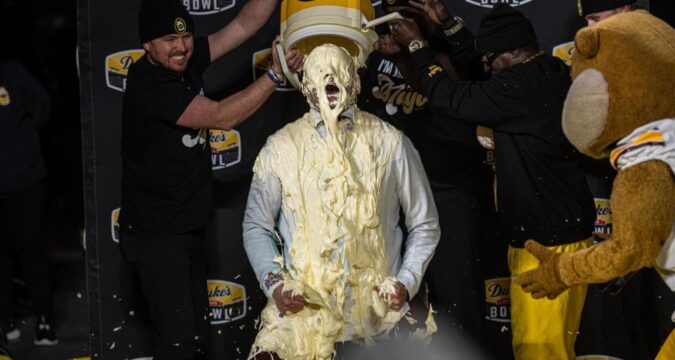
Dumping mayonnaise on the winning coach’s head is a tradition which dates all the way to 2021 and took another leap forward last year when rapper Flavor Flav dressed as mascot “Tubby” and gave Minnesota coach P.J. Fleck his “mayo bath.” An exhilarated Fleck responded with Flav’s trademark: “Yeah, boy!” This year’s favorite to wear the crown of soybean oil, eggs, water, distilled cider and vinegar, salt, oleoresin paprika, natural flavors and calcium disodium EDTAs is Mississippi State coach Jeff Lebby. While Ole Miss is headed to the college football playoff, Mississippi’s favorite safety school finished 1-7 in the SEC and with five total wins but earned its invite when Notre Dame and two Big 12 teams declined theirs. Mississippi State was picked for its Academic Progress Rate (APR). No, really.
Most depressing sponsor: Trust & Will Holiday Bowl, Arizona vs. SMU, Jan. 2
Trust & Will, the new title sponsor, is referred to by bowl-marketing honchos as “the leader in online estate planning.” There’s nothing like sitting back on the couch and watching a bowl game while thinking about which relatives will get your 401K and baseball card collection when you’re dead. For those planning on attending the Dead Bowl, the first 10,000 fans get free one-day-admission tickets to SeaWorld San Diego, which probably will be worth more than the ticket to the game.
Best hangover cure: Capital One Orange Bowl, Oregon vs. James Madison, Jan. 1
This first-round CFP matchup is the first game on New Year’s morning, and since Oregon is favored by 21 points over a non-Power 4 team gerrymandered into the playoff, it basically will be over by the time you wake up and remember what you did last night.
https://www.chicagotribune.com/2025/12/12/college-football-bowl-season-guide/
The Chicago Bulls offense is built on getting to the rim. So why aren’t they able to finish?
By the fourth quarter of a 125-120 loss to the Orlando Magic on Dec. 1, Chicago Bulls coach Billy Donovan was baffled.
The Magic seemingly had a hex on both baskets. At one end of the court, they couldn’t miss from close range, shooting 77% inside the restricted area.
And somehow that wasn’t the Bulls’ greatest problem. Because on their end, they couldn’t finish within the restricted area if the entire game depended on it — which it did.
Maybe it wasn’t a hex. Maybe Goga Bitadze had figured out how to shape-shift, stretching his already expansive arms like taffy to envelop the air around and above the Magic’s rim. Or perhaps the Magic were gifted with some preternatural ability to predict a shot’s trajectory before it was released.
Those would have been more helpful explanations for how the Magic blocked 11 Bulls shots, snuffing out their hopes of winning by dousing their scoring at the rim.
It would be one thing if this had been a freak occurrence, one of those nights when an opponent enters a flow state on defense. But that’s not the case for a Bulls team that’s losing a grip on what should be its greatest strength on offense.
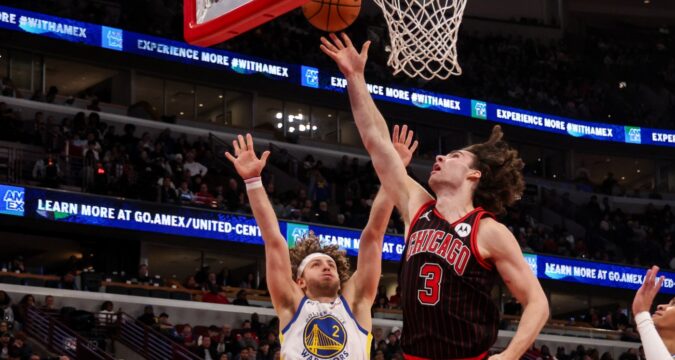
The Bulls take the second-most attempts (32.5 per game) in the NBA within the restricted area, the 4-foot half-circle that represents the highest-value shots on the court — yet those shots aren’t falling with enough regularity. The Bulls’ 59.9% shooting percentage in the restricted area is the worst in the league.
That doesn’t mean those shots are worthless. Because of the high volume, the Bulls still score 39 points per game at the rim.
But if they shot at even the league-median percentage within the restricted area, that scoring would spike by five points per game. For a team that has tallied half of its losses in clutch situations, that margin is crucial.
The Bulls can’t change their game plan. Getting downhill is the beginning and end of their offensive ethos. But until those shots start falling — and stop getting blocked — the offense will continue to stall.
“We have to get to the rim,” Donovan said. “That’s how you get fouled, that’s how you get offensive rebounds. But the decision-making when we get there has got to be better.”
Not built for the air
Bulls forward Matas Buzelis dunks the ball against the Pacers on Dec. 5, 2025, at the United Center. (AP Photo/Erin Hooley)
Jarace Walker went right, so Matas Buzelis went left.
That’s one of the easiest formulas for Buzelis to find his way to the basket. Overstep in one direction, see if the defender takes the bait and then sprint like hell before the defender turns back to see his mistake.
The window stayed open for a quarter of a second in a Nov. 29 game against the Indiana Pacers. But Josh Giddey had seen it, threading a pass just shy of Walker’s hip to lead Buzelis toward the rim. Buzelis grabbed the ball, cocked it behind his head and threw down a one-handed slam that has become his trademark.
The dunk is standard fare for Buzelis. But it’s an overall anomaly for the Bulls.
Heading into Friday’s game against the Charlotte Hornets, the Bulls have only 59 dunks in 23 games. That’s barely half the league average of 115.5, a little past the quarter-mark of the season. Only 10 teams had recorded fewer than 100 dunks through Wednesday — and the Bulls are the only team that hasn’t cracked 60.
Dunking isn’t a prerequisite for success. Some of the lowest-volume dunking teams are also the most successful — for instance the New York Knicks (17-7), who have balanced a sub-100 dunk total with their trigger-happy 3-point shooting, which ranks fourth in the league.
But for a team like the Bulls that is trying to live (or die) in the restricted area, this lack of vertical finishing is a clear weakness. A dunk isn’t just a sure-fire method of finishing a shot — it’s also an aggressive way to force opponents to contest and draw more fouls.
Like many of the Bulls’ central woes, this is a reflection of roster construction. The Bulls aren’t built to play above the rim.
Starting center Nikola Vučević was never a particularly bouncy big. Now in his 15th season, he has dunked only twice. The backcourt of Giddey and Coby White doesn’t bring the athleticism to regularly challenge at the rim. Buzelis (17) and reserve forward Julian Phillips (12) have combined for nearly half of the team’s dunks.
“It’s hard for me to speak on because I don’t ever dunk, so I don’t really know what it feels like,” Giddey said with a laugh.
This is a structural issue, which means it won’t be resolved this season. The Bulls can do more to get players such as Buzelis and Phillips above the rim — particularly by capitalizing on their off-ball movement, which can create lanes to the rim via back-door cuts when the offense is humming. And the return from injury of backup centers Zach Collins and Jalen Smith might marginally boost their dunking volume.
But for the rest of this season, the Bulls are resigned to the task of figuring out how to score at the rim without regularly getting above it.
“We don’t have high-flying fives like some other teams do — and that’s OK,” Giddey said. “We find other ways to score.”
Making better decisions
Magic guard Anthony Black blocks a shot by Bulls guard Josh Giddey on Dec. 1, 2025, in Orlando, Fla. (AP Photo/John Raoux)
The process starts with figuring out why they’re missing so many layups and jumpers in the restricted area.
Donovan attributes many of the shooting inefficiencies to the Bulls’ decision-making before the shot even goes up. He noted how wings and guards tend to pick up their dribble too early, forcing them to decide whether to shoot or pass while suspended in air rather than anchored on two feet.
This is a particular weakness for Giddey — and one he acknowledges. He summed up the issue simply: “We’re taking the tough ones.”
Opponents average 6.3 blocks per game against the Bulls. This isn’t entirely surprising — teams that take a higher portion of their shots at the rim also will experience a higher volume of blocked shots. But games like that loss to the Magic highlight how this tendency to get blocked can smother the Bulls’ chances inside.
When the Bulls get downhill, they need to either evade defenders to get off their shot or incite contact to draw a foul. They struggle to execute either option. That means a higher turnover rate and lower-quality looks — both at the rim and on the perimeter, where spray-out 3-pointers should be a welcome release valve.
“Sometimes we make really, really great decisions, and there’s other times where we’ve got to be better at that,” Donovan said. “That’s where we’ve got to get to work.
“We’re doing the right things in terms of getting there, but it’s those split-second decisions — ‘Do I shoot? Do I stop? Do I spray it out? Do I pass it to the next guy?’ — and that’s an area we’ve got to get better.”
Even when they aren’t falling, the Bulls can’t stop taking shots at the rim.
Related Articles
NASCAR settles federal antitrust lawsuit filed by two of its teams, including one co-owned by Michael Jordan
How a season at Northwestern propelled Pat Spencer from NCAA lacrosse star to an NBA starter
Caleb Williams, Connor Bedard, Derrick Rose and more: The 11 No. 1 draft picks made by Chicago’s pro teams
Chicago basketball report: Bulls offense is at a standstill — and this Notre Dame guard is averaging 25.9 ppg
Can the 9-14 Chicago Bulls salvage their season? ‘There’s enough in that locker room.’
Many of the Bulls players have safety-blanket shots, comfortable go-to options for young players still figuring out “their spots” on the court — an often elusive concept for an NBA player. But these are also often low-variable, low-reward shots.
Giddey loves a running, one-handed, shot-put floater from the free-throw line. Patrick Williams prefers his turnaround jumper. Buzelis falls back on a step-back jumper. Donovan has spent the better part of five years imploring his young players to give up these midrange shots for the greater good of the team. It hasn’t taken.
These shots might feel good, but in reality they’re too inefficient to rationalize bailing on a chance to attack the rim or kick back out for a look from the perimeter.
Sure, the Bulls shoot below 60% in the restricted area. But that’s still their highest-percentage shot on the floor. Their accuracy drops below 50% on non-restricted-area paint shots and below 40% for non-paint midrange shots. Even the corner 3 — the second-most valuable look on the court — is only a 40% option.
“The best shot in the game — besides the free throw — is at the rim,” Donovan said. “In the NBA, you’d say every single time you’re in the restricted area, it’s a good shot.”
But until those “good shots” start falling, the Bulls will remain stuck without a clear outlet to revive their scoring.
https://www.chicagotribune.com/2025/12/12/chicago-bulls-finishing-at-rim/
Alemania convoca al embajador de Rusia por acusaciones de sabotaje, ciberataques e interferencia en elecciones alemanas
BERLÍN (AP) — Alemania convoca al embajador de Rusia por acusaciones de sabotaje, ciberataques e interferencia en elecciones alemanas.

Trump Poised To Greatly Ease Federal Marijuana Regulation
Trump Poised To Greatly Ease Federal Marijuana Regulation
In a move seen as long overdue by many people on both sides of America’s left-right political divide, President Trump is expected to use an executive order to dramatically reduce federal restrictions on marijuana. The order, which may come in the next few weeks, will direct federal agencies to move toward reclassifying marijuana as a “Schedule III” drug, which would put it on the same level as common prescription painkillers. The shift would carry implications for not only for patients, medical researchers and recreational users, but the many companies seeking to thrive in the evolving US cannabis market as well.
Marijuana has been a Schedule I drug since the 1970 passage of the Controlled Substances Act. Schedule I drugs are defined as those without any “currently accepted medical use” and “high potential for abuse,” which means marijuana has spent 55 years being treated by the feds as if it were as medically useless and dangerous as heroin or meth. If marijuana moves to Schedule III, its new peers would be drugs like Tylenol with codeine, anabolic steroids and testosterone.
The Justice Department in 2024 recommended shifting cannabis to Schedule III, prompting a formal review by the Drug Enforcement Administration. However, progress has been stalled with legal challenges and agency delays, leaving the issue and industry in limbo. — Bloomberg
Trump reportedly discussed the move in a Wednesday phone call with House Speaker Mike Johnson (R-LA), marijuana industry executives, Health Secretary Robert F. Kennedy Jr, and Centers for Medicare and Medicaid Services chief Mehmet Oz, according to the Post’s sources.
Citing research and numbers, Johnson was said to have rattled off reasons not to ease regulations. Trump then let the cannabis executives counter Johnson’s arguments. Observers say that, as Trump ended the call, he seemed convinced by the deregulation rationales and ready to move forward. Of course, as with foreign policy and other issues, Trump’s always at risk of parroting the opinion of the last person to talk to him.
Cancer patients use marijuana to counter effects of the disease, and nausea, pain and loss of appetite resulting from treatment (University of Miami)
Advocates of legalization of the plant for use by cancer and other patients have long faced a Catch-22 objection from lawmakers who defend the status quo. Specifically, they deflect by saying they’d be more comfortable easing back on the war on pot if there were more research about its medical value. However, being a Schedule I drug makes it far more burdensome for university and other researchers to obtain and handle the plant, and to pursue that very research. Those varied burdens include advance approval from federal and state authorities — itself a lengthy and complicated process — heavy security for storage, and painstaking record-keeping to track every last milligram.
“People who have certain symptoms of cancer or side effects of cancer treatment might benefit from using cannabis,” says the American Cancer Society. “It can improve quality of life and reduce the number of emergency room visits for things like dehydration due to nausea and vomiting, or uncontrolled severe pain.” The plant is also used to address or alleviate many other conditions, from Lou Gehrig’s disease to Crohn’s disease, fibromyalgia, glaucoma, irritable bowel syndrome, Parkinson’s, PTSD, spinal cord injuries, and traumatic brain injuries.
David Bass, founder of Texas Veterans for Medical Marijuana, next to a casket he uses at demonstrations calling for legalization of marijuana for PTSD. He’s an Army veteran who was deployed to Iraq (Texas Observer)
“This would be the biggest reform in federal cannabis policy since marijuana was made a Schedule I drug in the 1970s,” DC attorney Shane Pennington told the Washington Post on Thursday. Pennington is representing companies involved in litigation over marijuana’s scheduling.
Trump has previously flirted with downshifting marijuana regulation.“We’re looking at reclassification and we’ll make a determination over the next — I would say over the next few weeks, and that determination hopefully will be the right one. It’s [a] very complicated subject,” Trump told reporters in August.
In September, marijuana stocks got high(er) after Trump’s Truth Social account published an informational video highlighting the health benefits to seniors of cannabidiol (CBD), an active ingredient in cannabis derived from the hemp plant. The video began with bold text proclaiming, “You can revolutionize senior healthcare,” and highlighted that CBD can “restore” the endocannabinoid system, touting benefits such as reduced pain, better sleep, and lower stress.
The same market response played out last night, with the AdvisorShares Pure US Cannabis ETF (MSOS) rocketing more than 38% higher at midnight ET.
Tyler Durden
Fri, 12/12/2025 – 06:55
https://www.zerohedge.com/markets/trump-likely-greatly-ease-federal-marijuana-regulation