
Category: News
Sign language Masses ‘rooted in compassion,’ build relationships with deaf community
It’s not always easy for Christians who are deaf or hard of hearing to find services and Masses that can accommodate their needs, but some churches are finding a way to do just that.
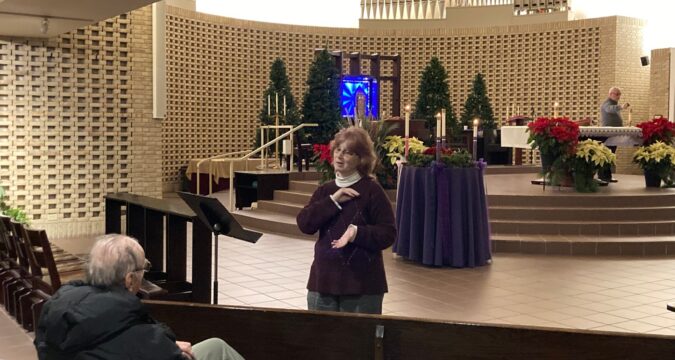
Our Lady of the Woods Catholic Church in Orland Park provides an American Sign Language interpreter at 5 p.m. every Saturday: Kathleen Ericksen, an interpreter, a leader of the parish’s special religions development program and lifelong faith formation coordinator. She’ll also interpret for the 8 a.m. Mass on Christmas Day.
But Ericksen says her work encompasses much more than Masses.
“As far as interpreting for people who are deaf and hard of hearing, it is a ministry rooted in the present, compassion and relationships. So the sign language interpreting extends beyond the walls of the church,” she said, although she also provides her services for wakes, funerals and sacraments.
She recently interpreted for someone who took a driving test at 82 years old, a person who is looking into a residential facility and someone who was in the hospital for eye surgery. “You build relationships – not just interpreting here – but get to know their families,” Ericksen shared. “In all of these moments, I strive to walk with them, ensuring they are seen, heard and fully included in the life of the Catholic church community.”
Ericksen, who began offering the service at Our Lady of the Woods 19 years ago, said she began by teaching religious education for the deaf and hard of hearing in Lemont. A parent asked if she could interpret at Our Lady of the Woods because it didn’t have an interpreter.
She was originally inspired to learn American Sign Language because of a neighbor who is deaf. She took community college classes and her skills “flourished” because of the Rev. Joe Mulcrone and his deaf community at St. Francis Borgia Catholic Church on Chicago’s North Side.
The Mass doesn’t differ from a traditional version. “I’m interpreting to get them to understand what’s happening in the Mass,” she said. “People who are deaf and hard of hearing have the right to have the same services that hearing people have.”
Two deaf adults typically attend the 5 p.m. Mass. Deaf parishioner Robert Lenart, who has been attending that service for about eight years, “appreciates being able to understand Mass,” he said via Ericksen.
The Metropolitan Chicago Synod’s Lutheran Deaf Ministry has faced some challenges in the last few years because of the COVID-19 pandemic, but a few churches in the area have services, including Gloria Dei Lutheran Church in Downers Grove, which offers interpreted worship services at its traditional service at 8:30 a.m. most Sundays. Its pastor, the Rev. Tim Robertson, also provides assistance at hospital visits, funerals, emergency services and other pastoral care, alongside an interpreter.
A deaf interpreter uses American Sign Language during an 8:30 a.m. Sunday traditional service at Gloria Dei Lutheran Church, 4501 Main St. in Downers Grove, that also features wide screens and Wi-Fi-assisted listening devices for deaf and hard-of-hearing members. The church streams this early service online, offering a picture-in-picture window for people at home or elsewhere. (Gloria Dei Lutheran Church)
Just one deaf person typically attends Gloria Dei’s in-person service, but it also provides large screens behind the altar and Wi-Fi-assistive devices for worshippers who are hard of hearing. “We have online worship, so we try to isolate (the interpreter) in a picture-in-picture window so no matter where they are worshipping, they can also worship with our deaf interpreter,” Robertson explained.
Gloria Dei doesn’t provide an interpreter on Christmas Eve because the deaf member typically spends the holiday with family. “We’ve had three or four people who have been deaf folk,” he added. “But more often than not, that one person …. She loves it and we love her. She can hear a little bit and she reads lips really well. We’re able to, with her beautiful ability to read lips, have some dialogue.”
Robertson knows a few signs such as please and thank-you, and he helped when three kids on his son’s baseball team were deaf. He also keeps in mind his time as an admission developer in Sioux Falls, South Dakota, which has a large deaf community because of a school there. “That church had 30 or 40 (deaf) people for a service, but there’s nothing like that here,” he said.
“I have a huge passion for those who are not in a faith community and remembering my friend Jason, who was part of the deaf community in Sioux Falls, telling me that one of the largest populations of unchurched people in our community is the deaf and hard of hearing. They’ll at least know a church does this.”
Among special Masses for people with special needs is an Advent Mass at the McDonough Chapel at St. Xavier University, 3700 W. 103rd St. in Chicago, led by the Rev. Adam MacDonald and coordinated by Joe Quane, executive director of Special Religious Development for the Archdiocese of Chicago.This year’s was Dec. 14. The Masses also take place during Lent.
“We purposely do it during Advent because a lot of our friends and families don’t go to service during Christmas. It’s chaotic, hard to park and sometimes their families don’t always feel welcome. Some people might make a comment to them or look at them and so they might not feel comfortable,” Quane shared.
He said the Mass is popular, drawing about 150 or 200 people. “For a lot of our families, it might be the only one they attend. Also, after each of our Masses, we have a social. We try to make it as sociable as possible, especially for our adult friends. They don’t have a chance to get out of the house” especially if they live in a group home. “One of the reasons we have these masses is to help our friends become more familiar with the liturgy so maybe they will come to their regular parish Masses.”
The Masses are adapted to encourage participation in a sensory-friendly environment with quieter music, such as a guitar, and no incense. Participants also prepare the altar, bring up flowers to the altar and light the candles.
In addition, gestures accompany the readings. “It’s called symbolic movement – not liturgical dancing – just to help them with the readings and give them a focus point. A lot of them had ADHD, so the movement is a way to focus and listen,” Quane explained.
Sermons are kept simple. “We usually have a very short homily that is message-based so the priest does a one- or two-sentence message and repeats it several times so it sets in. … They just want ‘What is Jesus telling us to do?’ repeated and in a very reverent way,” he said.
Special Mass details are available on the website, www.spred-chicago.org, or via 312-842-1039 or emailing SPRED@archchicago.org.
Our Lady of the Woods Catholic Church in Orland Park offers a hearing assistive device to parishioners who are deaf or hard of hearing. (Melinda Moore/Daily Southtown)
Quane often works with Mulcrone, director of the Catholic Office of the Deaf at the Archdiocese of Chicago. The priest leads a Mass for the deaf at 10:30 a.m. every Sunday at St. Francis Borgia as well as a Mass at 4 p.m. the third Sunday of the month (except December) at St. Julie Billiart Catholic Church, 7399 W. 159th St. in Tinley Park. He’ll also preside at a Mass at 8 p.m. Christmas Eve at St. Julie.
“He’s a wonderful individual and has done amazing things, especially with the deaf community,” Quane said. “It’s great to collaborate with him. … Our worlds collide a lot, especially in the world of disabilities.”
The Mass for the deaf at St. Julie began about 20 years ago and takes place in the church’s chapel, but the Christmas Eve Mass, which was first offered about 15 years ago, has moved into the sanctuary because it keeps growing.
“The first time we had 15 people. Last year we had about 100,” Mulcrone said. “If deaf people can come, we do the whole Christmas Mass. We do it in voice and sign. … It’s wonderful because people bring their hearing relatives who are in town and you see deaf people you don’t see the rest of the year. It’s a good celebration.”
One difference from a traditional Christmas Eve Mass is having deaf people give the readings and singing fewer hymns, including not singing the Glory.”
“They’ll do one or two that we sign and we sign ‘Silent Night,’” said Mulcrone, who is fluent in Sign Language. “It’s a really beautiful song itself. We have people who go with relatives and their families say ‘Why don’t we go?’ And we start signing at the end of the night and people are crying. Then we have doughnuts and coffee.”
Another difference is the deaf community has a custom at Christmastime of working with the Chicago Children’s Advocacy Center to collect new warm clothes for children who have been abused. “We donate to the advocacy center to these children who in most cases cannot go home. That has been part of our community for years,” he said.
The Rev. Tirso Villaverde of St. Julie Billiart is grateful Mulcrone, who turned 80 this year, celebrates a Mass for the deaf once a month as well as the 6 p.m. Sunday Mass and the Christmas Eve Mass, calling it “truly a gift.” He added, “I appreciate that he takes the time out to do so, especially on a special day like Christmas. It is an opportunity for the deaf community in the area to be able to celebrate and practice the faith.”
He said the church’s deaf ministry has done well because “this is one of the few places where the deaf Catholic community can go and be ministered to in a way that they can understand.”
Villaverde also worries about missed opportunities in other areas.
“I have long believed that the deaf Catholic community is one that we can lose because most diocese do not dedicated too many resources – or none at all – in developing a ministry to deaf Catholics,” Vallaverde said, adding that his nephew and wife are hard of hearing and depend on ASL to communicate and understand. “They have told me on occasion that it is hard for them to be able to participate at Mass when they cannot understand everything that is being spoken or sung. I am sure that other deaf Catholics feel the same way, and we can lose them to other denominations that provide ministry in ASL.”
Mulcrone said working with the deaf comes naturally to him, thanks to having deaf maternal grandparents. “It’s been my world since I was a little kid,” he said. “Christmas is great and wonderful, but I can’t even think about not celebrating Christmas with the deaf. I wouldn’t know what that was like. I’ve been working with the deaf in the archdiocese for 48 years, but for me this is Christmas and what it’s about and to be with these people and to share with these families to give them the opportunity to celebrate the Lord’s birth in their language, in their way.”
Melinda Moore is a freelance reporter for Pioneer Press.
https://www.chicagotribune.com/2025/12/21/sign-language-masses-deaf-community/
Clarence Page: It’s hard to hide the dysfunction of the Trump White House
Will someone please tell President Donald Trump that he’s not running against Joe Biden anymore? Almost a year into his second term, he can’t seem to let his former opponent go.
“Eleven months ago, I inherited a mess, and I am fixing it,” Trump said at the start of a televised speech Wednesday intended to reassure Americans with messages he has been pushing through months of sloganeering.
But happy days are not here again in Trump’s polling numbers. In the latest PBS News/NPR/Marist poll, 57% disapprove of the job he’s doing on the economy. Just 36% of poll respondents approve, a record low for both of his terms.
Yet Trump did his best to argue that down was up.
“When I took office, inflation was the worst in 48 years, and some would say in the history of our country,” Trump claimed. “Inflation has stopped, wages are up, prices are down, our nation is strong.”
That’s how Biden sounded in the spring of last year, as he tried to convince skeptical voters that the struggling economy was something closer to robust. But neither Biden nor his eventual Democratic replacement on the electoral ticket, Kamala Harris, could overcome the lived experience of millions of voters whose strained household budgets told them otherwise.
New plaques of explanatory text are beneath a framed portrait in the space for former President Joe Biden on the Presidential Walk of Fame on the Colonnade of the White House, Dec. 17, 2025, in Washington. (Mark Schiefelbein/AP)
Trump’s promises of lower prices for American consumers helped him to beat Harris. But now the shoe is on the other foot. Prices rose 3% in the 12 months ending in September, and consumer spending on big-ticket items fell markedly, partly because of Trump’s tariffs.
“We’re the hottest country anywhere in the world, and that’s said by every single leader that I’ve spoken to over the last five months,” he said. Have world leaders told him that in earnest, or are they playing to Trump’s mountainous self-regard?
Related Articles
Clarence Page: President Donald Trump’s obsession with Somali immigrants takes a sinister turn
Clarence Page: Border Patrol decamps from Chicago to create disorder elsewhere
Clarence Page: Jeffrey Epstein case exposes divisions in MAGA unity
Clarence Page: When federal authorities disrupt the peace in the name of preserving it
Clarence Page: Pete Hegseth’s war on ‘woke’ is an assault on American history
As Trump was overselling the fruits of his economic stewardship, another controversy was boiling up, this time within his own administration.
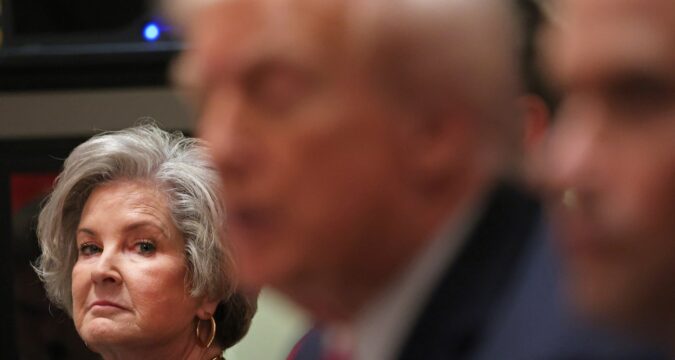
Trump’s savvy chief of staff, Susie Wiles, is generally viewed within Republican circles as a disciplined and effective political operator, a reputation grounded in her decades-long involvement in GOP campaigns and her central role in managing Trump’s 2024 campaign and early White House staff operations. That, in addition to her close proximity to the president, is why the widely talked-about interviews that she gave to Vanity Fair made headlines. In a more conventional administration, such an interview would be viewed as a scandal that would end careers, but of course the Trump White House is anything but conventional.
Among other fuel for gossip, or worse, she described Trump as having an alcoholic personality, acknowledged that Trump uses prosecutions as a means of “score settling,” described Budget Director Russell Vought as a “right-wing absolute zealot” and described Vice President JD Vance as “a conspiracy theorist for a decade.”
Yet, strangely for super-serious Washington, neither the president nor the other parties named by Wiles were eager to treat this flap as anything more serious than business as usual.
Wiles defended herself by claiming that Vanity Fair omitted “significant context” in order to create “an overwhelmingly chaotic and negative narrative.” While we can all feel for her, “chaotic” and “negative” are two words a lot of voters would agree do a nice job of summing up the Trump administration.
Email Clarence Page at cptimee@gmail.com.
Sign up to receive Clarence Page’s column in your inbox each week.
Submit a letter, of no more than 400 words, to the editor here or email letters@chicagotribune.com.
https://www.chicagotribune.com/2025/12/21/column-donald-trump-kennedy-center-susie-wiles-page/

All they want for Christmas
What was your favorite holiday present as a child? Was it the Millennium Falcon starship you coveted after seeing “Star Wars” in the late 1970s? A Buck Rogers “ray gun” from the ’50s? One of those cute Shirley Temple dolls, which the Tribune described in 1934 as having “curly yellow hair tied back from their smiling faces by a wee blue snood”?
Gift giving in the early 1900s tended toward the humble: teddy bears, yo-yos, perhaps a train or Erector set. But by the 1930s, the popularity of child star Shirley Temple started pushing us in the direction of “must-have gifts,” even as the Great Depression put a damper on how many luxuries families could afford. The same decade brought Parker Brothers’ Monopoly and the Red Ryder BB gun, letting kids play at going bankrupt or possibly shoot their eye out.
As wartime hit in the 1940s, gift giving turned practical with handmade objects like soaps, knitted hats and scarves, jams and jellies, as well as military-themed toys. The Slinky was a standout, launched just in time for the 1945 holiday season. Cheap, silly and fun, it became an instant hit.
A Buck Rogers Sonic Ray toy gun with an “uranium” chamber was on sale for $2.50 at Marshall Field’s department store in Chicago in 1948. (Louis Paus/Chicago Tribune)
A mechanical dog toy imported from Germany that shivered was a holiday gift idea in 1949. (Chicago Tribune historical photo)
The postwar consumer boom came next and would change everything. Considered the golden age of toys, the 1950s brought us Barbie, Matchbox cars, Legos, the Hula-Hoop, the Magic 8-Ball and Mr. Potato Head, advertised in the Tribune on Oct. 1, 1952, as “the most wonderful little friend a boy or girl ever had. Just stick a real, live potato on his beautiful plastic body, then select a set of eyes, a nose, a pair of lips, mustache, ears, hat and there you are! You will be friends for life.”
“The most fascinating toy in the world,” gushed another 1952 advertisement. “Youngsters, oldsters go completely hilarious playing Mr. Potato Head, the new fun game.”
In 1964, G.I. Joe became the first “action figure,” marketed to boys as “not a doll.” Barbie got a boyfriend — just Ken, according to the recent “Barbie” movie. Children yearned for the new Easy-Bake Oven, which somehow used light bulbs to produce real baked goods.
Kimmy Duke, 4, of Gary, looks at a doll while out shopping on Dec. 20, 1967. (Chicago Tribune historical photo)
A boy named Johnny gets a close look at a toy train he received at a Christmas party at Ridge Farm in Lake Forest on Dec. 18, 1953. (Jack Mulcahy/Chicago Tribune)
Your Vintage Tribune correspondent particularly remembers the Cabbage Patch Kids mania of the mid-1980s, which led to parents fighting in store aisles and a black market for the squishy dolls.
“Toy stores are reporting mob scenes when the popular items go on the shelf. At one Chicago-area store, security guards had to be called when a man threatened a woman with a baseball bat so he could buy the last Patch Kid doll in the store,” the Tribune wrote on Nov. 18, 1983. The Tickle Me Elmo doll from “Sesame Street,” which giggled when squeezed, would bring the doll craze into the 1990s.
Meanwhile, a technology boom that continues today was starting to change holiday gift giving, starting with Atari and Nintendo gaming systems climbing to the top of children’s wish lists.
May this look at the toys, gifts and novelty items from our archives light up your eyes with nostalgia this holiday season.
Have an idea for Vintage Chicago Tribune? Share it with Marianne Mather at mmather@chicagotribune.com and Kori Rumore at krumore@chicagotribune.com.
https://www.chicagotribune.com/2025/12/21/vintage-chicago-tribune-holiday-gifts/
Jodi Bondi Norgaard: When silence becomes a green light for normalizing cruelty
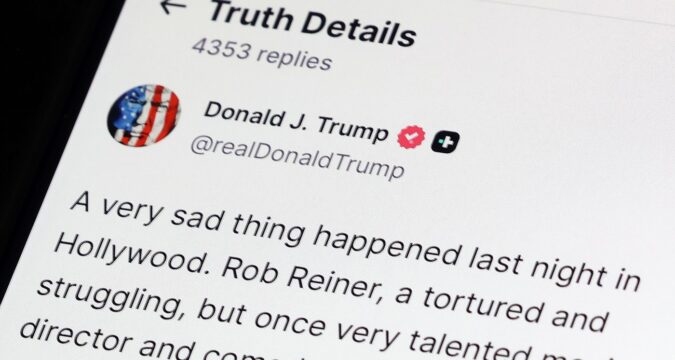
The reaction to President Donald Trump’s recent social media post was immediate and telling.
For many, the post was stunning in its cruelty, a line so clearly crossed it demanded condemnation. For others, it was dismissed, defended or waved away as exaggeration, provocation or “just how he talks.” That divide is the story. Because when words that demean, dehumanize and even invoke death can shock some while being excused by others, we are no longer arguing about tone. We are confronting a culture that has begun to normalize cruelty in plain sight.
In the post, Trump mocked the deaths of filmmaker Rob Reiner and his wife, framing them not with grief or restraint but as a political taunt. He attributed their demise to what he derided as a “mind crippling disease known as TRUMP DERANGEMENT SYNDROME,” turning disagreement into pathology and invoking death as a punch line. Disability language was weaponized. Human dignity was discarded. And suffering was treated as deserved.
The post was reckless and cruel, and the meaning was unmistakable: Nothing is off-limits anymore. Not illness. Not grief. Not even death itself.
We cannot make this normal.
Yet this is exactly the danger of the moment we are living in, a new “normal” settling in, one defined by public figures who no longer fear consequences for demeaning, dehumanizing and hateful speech. They don’t just insult individuals; they target entire communities and identities. And far too often, their targets are women, immigrants, people of color and people with disabilities, those whose dignity has always been treated as negotiable in America.
“Seriously retarded.” “Garbage.” “We don’t want them in our country.” “Quiet, piggy.”
These are not whispers from fringe extremists. They are slurs and degradations launched from the highest offices in the land, delivered by leaders who imagine themselves guardians of American greatness. They weaponize identity, casting whole populations as criminals, burdens or subhuman, and they do so with a smirk, confident that too many will excuse it as “just words.”
But words shape worlds.
As Harvard Law professor Cass Sunstein explains in a 1996 article “Social Norms and Social Roles,” even small shifts in behavior can trigger “norm bandwagons” and “norm cascades,” rapid cultural changes that occur once a tipping point is reached. When powerful leaders break norms publicly, they become that tipping point. Society absorbs the message that cruelty is acceptable, that mockery is leadership and that humiliation is entertainment.
What does it mean for our children when they hear a president use slurs for intellectual disability to describe a governor? What do young girls and boys learn when female reporters are called “stupid,” “ugly” or “piggy” for daring to ask questions? What do immigrant children internalize when leaders describe people who look like them as “leeches,” “entitlement junkies” or “garbage”?
Editorial: Bondi Beach. Brown University. The Reiners. A weekend of hellish violence.
This normalization of hate isn’t just rhetoric; it’s permission. Permission for cruelty. Permission for fear. Permission for exclusion.
Cristina Bicchieri, professor of social thought and comparative ethics at the University of Pennsylvania and author of “The Grammar of Society,” explains that social norms persist because people believe others believe in them. When leaders model open contempt, they shift shared expectations of what is acceptable or normal and cruelty spreads.
This is how the floor drops out — not with a single shocking act but with repetition, minimization and silence. Statements that once would have ended careers become content. Behavior that should provoke universal outrage becomes background noise.
We should all be alarmed by this. By the cruelty, the casual degradation and the insistence that this is normal political discourse. Because it isn’t, and it never has been. This is a moral crisis, not a partisan one.
The consequences are profound. Children model adult behavior; when cruelty becomes normalized, so do bullying, misogyny, racism and xenophobia. Marginalized communities absorb the harm first and worst through fear, trauma and harassment. And democracy itself corrodes. Cruelty becomes a brand. Authoritarian swagger becomes a leadership style. Governance loses the possibility of compassion.
So we must ask, as citizens and as humans: What kind of society do we want?
A nation where leaders mock disability or one where dignity is the norm? A culture where female journalists are demeaned or one where their voices are valued as much as men’s? A country where even death is weaponized or one where empathy still matters?
Because when leaders invoke suffering with contempt and others laugh it off, silence becomes a green light.
We are at a crossroads. Either we reject cruelty or we accept that the next generation will inherit it. We must resist desensitization. We must insist that dignity is nonnegotiable.
If we want a country where kindness still means something, where power is not measured by who you can demean, then we must say so loudly. Because if we cannot demand decency from the powerful, we have already surrendered the moral soul of the nation.
Silence is complicity. Outrage is a responsibility. And demanding better is not optional; it is how we save the soul of this nation.
Jodi Bondi Norgaard is the creator of the award-winning Go! Go! Sports Girls brand and the author of “More Than a Doll: How Creating a Sports Doll Turned into a Fight to End Gender Stereotypes.” She worked with the White House Gender Policy Council under the Joe Biden administration and the Geena Davis Institute on Gender in Media.
Submit a letter, of no more than 400 words, to the editor here or email letters@chicagotribune.com.
https://www.chicagotribune.com/2025/12/21/opinion-donald-trump-rob-reiner-post-hate-speech/

Shadi Bartsch: Hamstringing the humanities will hinder scientific discovery
It seems we’ve decided the humanities have less to give the human race — or more modestly, this country’s future — than the sciences.
This is a serious mistake. The sciences and the humanities are different faces of the human search for knowledge and not the opposites we have turned them into. If you hamstring one, you hamstring the other. And thinking of “sciences” and “humanities” as unrelated modes of inquiry is not only shortsighted; it’s also new to western civilization. Before the scientific revolution, investigations into the natural world and into the human condition were treated as different facets of our quest to know — a drive that Aristotle defined, in his “Metaphysics,” as characteristic of humankind by nature. But when we started treating science (and the technologies it birthed) as independent of other forms of knowledge, when we started treating meaning, history, culture and power as externalities, it cost us in discovery, in deployment and in avoidable harm.
There are so very many examples. Take eugenics, a canonical instance of what happens when measurement and quantification are treated as synonymous with truth, and a core humanistic question — “what is this category, historically and morally?” — is waved away. Eugenics, advanced as a scientific program, carried normative assumptions about “fitness” and hierarchy into policies that ranged from coercive sterilization to state violence. The humanities could have pointed at the time to the conceptual instability of race as a biological essence; the rhetorical sleight of hand by which social prejudice becomes “data”; the political uses of supposedly neutral expertise.
Or consider health and medicine. Again and again, epidemics have demonstrated that pathogens move through cultures, not just bodies. Anthropological and historical work on trust, rumor, religion, political legitimacy and the social meaning of risk has repeatedly improved the design of interventions, because it reveals why a technically sound policy can fail spectacularly when it ignores how people understand authority. “Follow the science” is not a plan if you do not also know how communities hear it, fear it, or translate it into local idioms of danger and care.
And artificial intelligence! We built machines that can translate, classify, predict and persuade at planetary scale, and only after doing so — after releasing them into the bloodstream of public life — did we remember to ask the questions that every decent civilization has always asked first: Who gets harmed? Who gets counted? What gets erased? We are shocked that algorithmic systems trained on historical data reproduce historical injustice; that predictive tools in policing and credit can harden inequities into automated fate; that facial recognition can perform unevenly across populations; that “optimization” can become an alibi for ethics.
But none of this should be surprising if we remember the 19th-century pattern: Build a technical instrument, declare it objective and then discover that it has quietly inherited the world’s prejudices because it was trained on the world as it is.
The success stories are there. During the 2014-16 Ebola outbreak in West Africa, anthropological insights — burial practices, trust networks, local authority structures and rumor ecology — proved crucial to designing interventions people would accept and that would work on the ground. The literature is explicit that community engagement and social understanding were not optional “cultural add-ons” but part of effective outbreak control.
Where science and the humanities are severed, the damage often takes one of three forms: category error (we measured the wrong thing, because we never interrogated the category); trust collapse (people refused the intervention, because science treated social meaning as noise); and delayed correction (harm had to become undeniable before the system could “see” it).
Where humanistic angles were allowed in, science tended to improve not by becoming less rigorous, but by becoming more self-aware: clearer about its concepts, its subjects, its incentives and its downstream effects.
The bitter irony is that we are now at a moment when universities, under financial and political pressure, are shrinking the very disciplines that could have helped us avoid such pitfalls: philosophy and ethics (where we learn to argue about ends), history (where we learn what “progress” has cost before), literature and rhetoric (where we learn how language makes realities) and the interpretive social sciences (where we learn how institutions distribute trust and harm). We say these are worthless expenses for society. Could we be more wrong?
This is not just about ethics and wayward science. It’s about how all forms of knowledge work together and should be understood as doing so. Niels Bohr did not derive quantum mechanics from yin-yang, but he found in that ancient symbol a powerful way to express complementarity — his insistence that opposing truths can coexist. Gunpowder, however, was born directly out of Chinese alchemy, where Taoist experiments in transformation accidentally reshaped global history.
Science uses metaphors: Who will unpack them? Science spawns technology: Who will measure that technology’s impact on the psyche? Science’s questions arise out of a future we envision for ourselves: Who does the envisioning?
It is hard to think of a worse time for humanities retrenchment. The sciences are extraordinary at generating data, but they cannot on their own generate the habits of mind that allow societies to interpret data responsibly or resist the distortions that often engulf it. Nor, as currently practiced, do they allow us to see how the world of the humanities is constantly contributing to scientific advance. Lop off the humanities, and we’ll all pay the price for this silly miscalculation of human interest.
Shadi Bartsch is a professor in humanities at the University of Chicago and former director of the Institute on the Formation of Knowledge.
Submit a letter, of no more than 400 words, to the editor here or email letters@chicagotribune.com.
https://www.chicagotribune.com/2025/12/21/opinion-humanities-higher-education-ai/
El gobierno israelí autoriza 19 nuevos asentamientos judíos en la ocupada Cisjordania
Associated Press
TEL AVIV, Israel (AP) — El gobierno israelí aprobó el domingo una propuesta para 19 nuevos asentamientos en la Cisjordania ocupada, según informó el ultraderechista ministro de Finanzas del país.
Los asentamientos incluyen dos que fueron previamente evacuados durante un plan de retirada en 2005, indicó el ministro de Finanzas, Betzalel Smotrich, quien ha impulsado una agenda de expansión de asentamientos en Cisjordania.
Smotrich escribió en X que esto eleva el número total de nuevos asentamientos en los últimos dos años a 69.
La decisión incrementa el número de asentamientos en Cisjordania en casi un 50% durante el mandato del gobierno actual, pasando de 141 en 2022 a 210, tras la aprobación actual, según Peace Now, un grupo de monitoreo que se opone a los asentamientos. Los asentamientos están ampliamente considerados como ilegales bajo el derecho internacional.
___
Esta historia fue traducida del inglés por un editor de AP con la ayuda de una herramienta de inteligencia artificial generativa.
How a garden store worker became part of the ‘Broadview Six’
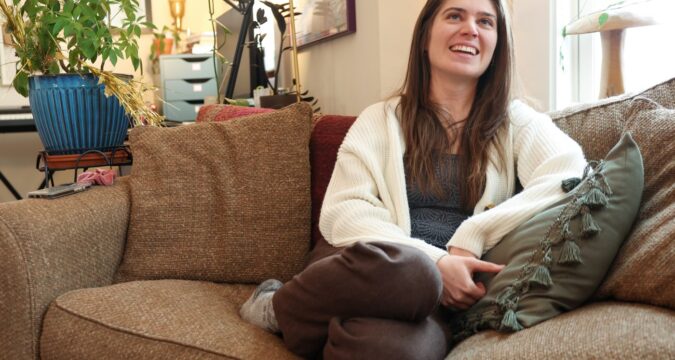
Joselyn Walsh was working from her Pilsen home last month when her phone began to ring. It was a special agent from the FBI, the caller said, and they needed to speak with her.
Unfamiliar with the number, the 31-year-old part-time researcher, part-time garden store worker dismissed the call as spam. But then her cell sounded again. This time, Walsh googled the 10 digits flashing up at her.
Sure enough, it was the FBI headquarters in Chicago. And they had a warrant out for her arrest.
“How is this possible?” Walsh wondered.
Walsh is among six protesters facing federal conspiracy charges in one of the most high-profile cases to emerge from Operation Midway Blitz, the Trump administration’s mass deportation mission in Chicago this fall. They are accused of conspiring to forcibly impede a federal immigration agent at a September protest at the U.S. Immigration and Customs Enforcement facility in Broadview.
Charged alongside four Democratic politicians and one political staffer, Walsh is arguably the least known of the group, known as the ‘Broadview Six.’ She said she doesn’t know her co-defendants and still doesn’t know why, among the hundreds that went to protest outside of the west suburban processing center during the two-month operation, she’s been singled out in federal court.
The case stands to test the impact and bounds of protest in the second Trump administration.
“I think (conviction),” said Steven Heyman, a law professor with the Chicago-Kent College of Law, “would send a real strong message that the government is capable of taking severe measures to suppress, I would say, legitimate dissent.”
Walsh remains confident in her innocence. But she’s keenly aware of what’s at stake.
“There’s the reality of wow, years in prison are on the line here,” she said. Still, the charges have also sharpened her resolve, spurring her to speak louder.
Weeks after her indictment, she continues to use her voice, often performing as part of a protest music collective and sometimes, returning to Broadview. Her co-defendants, by themselves and through attorneys, have denounced the charges as an attack on the First Amendment and maintained they will not be deterred. They’re not alone.
After an arraignment hearing in the case outside of the Dirksen U.S. Courthouse downtown just over a month ago, dozens of protesters gathered under the red sculpted arches of Federal Plaza.
“We support the Broadview Six!” they chanted.
Almost immediately after the Department of Homeland Security announced the launch of Operation Midway Blitz in early September, protests grew outside Broadview’s ICE processing center, where the federal government held detainees for days in what a class-action lawsuit described as dirty and unsafe conditions. The near daily confrontations brought tear gas, baton rounds and dozens of arrests.
The conspiracy charges against Walsh and her co-defendants stem from a protest outside the building nearly three months ago. Alongside Walsh, charged are congressional candidate Katherine “Kat” Abughazaleh, Cook County Board candidate Catherine “Cat” Sharp, 45th Ward Democratic Committeeman Michael Rabbit, Oak Park Trustee Brian Straw, and Andre Martin, who is Abughazaleh’s deputy campaign manager.
The group is accused of surrounding and damaging an ICE vehicle during a Broadview protest on the morning of Sept. 26. An 11-page indictment alleges the group “crowded together in the front and side of the Government Vehicle” and pushed against it “to hinder and impede its movement.”
Protesters surround a federal SUV and try to prevent it from driving to the U.S. Immigration and Customs Enforcement facility in Broadview on Sept. 26, 2025. (Stacey Wescott/Chicago Tribune)
Prosecutors further allege protesters scratched the car’s body, broke a side mirror and a rear windshield wiper and etched the word “PIG” into the paint.
The indictment includes the conspiracy count — which carries a maximum sentence of six years in federal prison — as well as several other counts of impeding a federal officer, each punishable by up to one year in federal prison.
Walsh started protesting in Broadview early on into the blitz. She flocked to the facility to sing.
A lifelong musician from rural Missouri, Walsh said she’d often read about the goings-on in the world growing up. But she was inspired to start taking action after 18-year-old Michael Brown was killed by a police officer in Ferguson, Missouri, while she was at college in St. Louis.
“(It) was this moment of, I think, recognizing how … power and control works in our country and in our world,” she said.
Since moving to Chicago six years ago, Walsh has grown into her advocacy. After working at a food and farming nonprofit in the city — work Walsh says was, and still is, important to her — she found herself wanting to delve into community organizing. She hit her stride through music.
Dave Martin, from left, Joselyn Walsh and Joseph Ozment sing pro-Palestinian carols with other activists near the State/Lake CTA station, Dec. 14, 2025, in Chicago. In October, a federal grand jury indicted six people, including Walsh, on conspiracy charges stemming from a protest outside the Broadview Immigration and Customs Enforcement facility. (Armando L. Sanchez/Chicago Tribune)
For the past two years, Walsh has performed in a citywide collective of people working to bring “the power of music to protests,” she said. Called Songs for Liberation, the group includes musicians and non-musicians alike (even “shower singers,” Walsh noted). The group started as Songs for Ceasefire in support of Palestine but has grown to encompass a broader mission to dissent through song.
“Protests don’t necessarily have a lot of music,” Walsh said. “But (we think it’s) a really powerful thing.”
The collective often performs at events and protests, sometimes by invitation and sometimes just by members’ interest, with appearances ranging from marches outside the Democratic National Convention last year to caroling outside Christkindlmarket.
The Broadview protests, which became a flash point against the Trump administration’s crackdown, were a natural fit for the collective. For weeks through the blitz, and even still today as immigration enforcement continues, some amalgamation of members would travel out to the facility and through the clashes and commotion and force, perform.
“No human is illegal here,” Walsh sang with the collective one morning in Broadview, her performance captured in a video posted online. A gas mask hung around Walsh’s arm as she strummed a guitar. “We refuse to be controlled by fear.”
Andrew Walsh isn’t surprised by his daughter’s activism. While she was a shy kid, he recalled that she’s always been fiercely compassionate. And she’s long been privy to conversations about morality and politics. Her mother is a minister. Andrew is a religion professor at a small college in Missouri, whose research focuses on the intersection of religion and social issues.
Andrew said he’s proud of his daughter. And terrified.
“(But) we can’t simply submit in fear,” he said. “Because if we all submit in fear, we’ve seen in history how that turns out.”
Sept. 26 started out just like any other day of protesting and singing, Walsh recalled, but what did stick out to her was that it felt like “there was a whole other level of random impunity.” That morning, federal agents fired baton rounds, tear gas and other less-lethal ammunition at about 200 people gathered outside the Broadview processing center, the Tribune reported at the time.
Walsh remembered leaving early after a foam baton round struck and put a hole in her guitar.
“We’re just singing and then all of a sudden, I feel this impact,” she said. After a moment of disbelief, Walsh walked away, drank water, spoke with some friends and ultimately, went home.
Joselyn Walsh, right, and other musicians play and sing in the protest area near the U.S. Immigration and Customs Enforcement holding facility on Oct. 10, 2025, in Broadview. (Stacey Wescott/Chicago Tribune)
Joselyn Walsh holds her guitar on Oct. 10, 2025, near a hole she said was caused by federal agents shooting pepper balls and baton rounds at musicians, protesters and reporters near the Immigration and Customs Enforcement holding facility in Broadview. (Stacey Wescott/Chicago Tribune)
Walsh, on the advice of her attorney, couldn’t speak to the crux of the indictment, though she did call the government’s allegations “totally baseless.”
In a video of the confrontation cited by the Department of Justice, a black SUV is seen slowly rolling through a crowd of people as they chant, “up, up with liberation, down, down with deportation!” As the car inches forward, footage shows some protesters hitting the hood and windows as they try to block its movement. In another video that has circulated widely online, a guitar briefly flashes into frame.
A request for comment sent to the Department of Justice was forwarded to an assistant U.S. attorney in Chicago, who declined to comment because the case was pending.
“Federal agents perform dangerous, essential work every single day to enforce our immigration laws and keep our communities safe,” Deputy Attorney General Todd Blanche said in an October statement when charges were announced. “When individuals resort to force or intimidation to interfere with that mission, they attack not only the agents themselves but the rule of law they represent.”
The FBI called Walsh a month later. She’d been continuing to protest, while balancing her research job and taking shifts at a Humboldt Park garden store. Also due to get married in June, Walsh and her partner have been planning a wedding and had a tasting set for the day the FBI rang. They canceled their appointment.
The news of her arrest warrant left Walsh shocked and confused.
“I’m just sitting here, wracking my brain, like what possibly could have happened?” she said.
There’s been a growing trend in protests giving way to conspiracy charges.
Last year, San Francisco prosecutors charged 26 protesters with federal conspiracy after they allegedly blocked the Golden Gate Bridge for hours to demand a ceasefire in Gaza. Amid the immigration protests in Los Angeles this summer, an activist was indicted on a federal conspiracy charge after he was accused of handing out face shields during an anti-ICE demonstration, though the charges have since been dropped. In Washington, nine people are facing a federal conspiracy charge tied to an immigration protest outside a Spokane DHS office earlier this year.
The First Amendment protects individuals’ right to express their views on the government, said Heyman, the Chicago-Kent College of Law professor. Those protections do not extend to “true threats of violence” or false and defamatory statements — but they do extend to sharp criticism, Heyman said.
In his estimation, “most of the kinds of criticisms that these protesters are making about ICE and the Trump administration (are) 100% protected by the First Amendment,” Heyman said.
Where problems arise is that, generally, conduct is not constitutionally protected, he said.
“If they’re physically blocking an ICE vehicle and surrounding it and trying to prevent it from passing and so forth, basically that’s not protected under the First Amendment,” he said. Still, he said he believes that prosecuting the protesters for felonies, especially for conspiracy, is “an extreme overreaction.”
But with Walsh’s case, there’s also the matter that two criminal laws are at issue — impeding by force and conspiracy — and the burden is on the government to prove the statutes were violated, Heyman said.
Recent weeks have seen other cases out of the blitz fail to hold up in court. Last month, a federal judge dismissed charges against a woman shot by a Border Patrol agent after she allegedly rammed his vehicle in Brighton Park. And this month, a case was dismissed against Lakeview comedy club manager whom federal authorities had accused of slamming the door on the leg of a Border Patrol agent during an October immigration arrest.
For the higher charge against the Broadview protesters, prosecutors would have to show that they actually engaged in a conspiracy, Heyman said. That could be done in two ways, by demonstrating protesters had an outright agreement to conspire or had reached an implicit understanding they were going to commit a crime, according to Heyman. He noted the latter is vague and could be hard to prove.
Joshua Herman, who is representing Abughazaleh in the case, wrote in an email statement to the Tribune that the particular statute invoked by prosecutors in their conspiracy charge also does not require proof of an “overt act” — only an unlawful agreement.
“How these specific individuals,” he stated, “who were amongst a crowd of other (protesters) could spontaneously form such an unlawful agreement is a question the government will need to answer.”
He added that the statute cited is also rarely used and, to his knowledge, hasn’t been employed to prosecute protest activity in this way, despite it being on the books for well over a century.
Heyman said it’s unlikely Walsh and her co-defendants would receive the maximum sentence should they be convicted. But the case in itself, he added, conveys intimidation.
“The Trump administration is trying to send the message that they will tolerate no opposition to their immigration crackdown,” Heyman said.
He compared the case to prosecuting political opponents.
At a status hearing for the legal battle earlier this month, defense attorneys asked federal prosecutors to turn over White House communications related to a “selective prosecution” argument.
Brad Thomson, Walsh’s attorney, contends that with this case, the government is prosecuting people for protesting together.
“That’s a real danger,” he said, “when you’re trying to have a society that has a robust discourse about the actions of the government.”
When the indictment against Walsh came to light, “it definitely rocked our community,” said Jack Sundstrom, a musician who’s performed with Songs for Liberation for the past six months. Sundstrom, like Walsh, performed with the collective in Broadview.
“It’s scary and terrifying, and it would be a lie to say that this isn’t something that keeps me up at night sometimes,” the 25-year-old Glenview resident said. But in his circle, he went on, there’s also “very much a sense of we’re going to keep doing this work.” He especially intends to keep organizing through music.
“As the song goes, the people united will never be defeated,” he said. “So I am going to continue doing what I do for as long as I can.”
Walsh hopes this doesn’t keep people from speaking out.
For her and her fiancé Joseph Ozment, it’s been a surreal few weeks since her charges were unsealed. But while scary, it’s been motivating, said Ozment, who’s also involved with Songs for Liberation.
“If they’re angry at us for this,” he said, “I think it’s for a good cause.”
They’ve also been reconciling what they’re facing with what they’re fighting for.
“I get to sleep in a warm bed,” Ozment said. “I know that … I’m not going to be whisked away in the middle of the night, and my family aren’t going to know where I am.”
The parallel, Walsh said, has only emboldened her more.
“It’s great that some of us have these rights,” she said, “and it’s awful that not all of us do. We need to keep fighting for that.”
https://www.chicagotribune.com/2025/12/21/broadview-six-protest-ice-charges/

Before Congress, Jonathan Jackson owned a construction firm. It got $750K from Pritzker’s Rebuild Illinois.
Before Jonathan Jackson entered Congress in 2023, a construction company he owned received nearly $750,000 through Gov. JB Pritzker’s landmark Rebuild Illinois infrastructure program, even though records show the company had scant experience and initially lacked the certification it needed to acquire state funds as a minority business.
The payments to Jackson’s 3 I Roadwork Inc. began in the year after he endorsed Pritzker’s first bid for governor in 2018. That endorsement came months after Pritzker’s campaign quietly hired Jackson as a $13,000-per-month political consultant.
The revelations about the state work and the political connections illustrate closer ties between the two Democrats than previously understood and as they both seek third terms next year — and as Pritzker’s name circulates as a potential candidate for president in 2028.
They also offer a rare look at how Jackson earned income in the years leading up to his 2022 run for Congress.
The findings also show how Jackson was helped financially by his longtime business partner, influential city developer Elzie Higginbottom, who led the construction project that benefited from the Rebuild Illinois funding. Higginbottom has been a political supporter of Jackson and backed Pritzker’s 2018 campaign.
Jonathan Jackson, who at the time was the national spokesman for the Rainbow PUSH Coalition, endorsed JB Pritzker for governor in January 2018. This image was included as part of a video Jackson posted at the time on his personal website. Pritzker won the Democratic primary two months later and was elected governor for the first time that November. (thejacksonfile)
In May, the Tribune reported Jackson — the third-oldest of five children born to civil rights leader the Rev. Jesse Jackson and his wife — has spent significant federal tax dollars to lease his congressional district office on the South Side from Higginbottom, who owns East Lake Management & Development Corp.
A statement from the governor’s office said the state agency that oversaw the grant, the Department of Commerce and Economic Opportunity, didn’t have a role in selecting specific firms that worked on the project. In addition, the statement said Pritzker had no personal knowledge that Jackson’s company would be hired with state grant funds and denied that political connections played a role.
“The Governor did not have discussions with Mr. Higginbottom or Congressman Jackson about this project and was not aware that Congressman Jackson’s company was hired as a subcontractor,” said Matt Hill, a spokesperson for the governor’s office.
Rep. Jackson, 59, declined to answer detailed questions. But his office released a general statement defending the congressman’s work before he was elected to office as that of a businessman who has worked to improve the lives of Chicago families.
“For decades, I have worked to help revitalize South Side neighborhoods by investing in properties to create housing and amenities for families,” Jackson said in the statement. “As a successful businessman, I invested my time and financial resources to improve the lives of the families who live on the South side of Chicago — a place that I have called home for my entire life.”
Higginbottom declined to answer detailed questions but his office also offered a general, written response.
“Over the past 50 years, Elzie Higginbottom and East Lake Management have partnered with and supported hundreds of black owned businesses and black entrepreneurs. Congressman Jonathan Jackson has long been an entrepreneur in Chicago, and we have been proud to support his efforts,” the statement said.
A project accelerated by state money
The excavating and hauling company that Jackson owned, 3 I Roadwork, was paid from 2019 through 2021 to help clear a 9.5-acre site on Chicago’s Near West Side. The land was being developed by Higginbottom under a 75-year lease with the Illinois Medical District for what is now an apartment building and hotel project called Gateway at Illinois Medical District.
People walk past a sculpture in the snow at the Gateway at Illinois Medical District development on Dec. 8, 2025, in Chicago. The 9.5-acre site was developed under a 75-year lease with the Illinois Medical District and now includes an apartment building and a hotel. (Armando L. Sanchez/Chicago Tribune)
Higginbottom had been working on the project for several years but progress was slow before Pritzker was elected governor. After Pritzker took office, the governor’s administration earmarked $5 million through the $45 billion Rebuild Illinois initiative to prepare the site just southwest of Harrison Street and Damen Avenue, records show. The state funds flowed through the Medical District, which is a relatively obscure government body, to Higginbottom’s firms, which used the grant money to pay contractors, including Jackson’s company.
The governor’s office has said the Medical District sought the grant. For its part, a top Medical District official has insisted that it did not play a role in getting the funds set aside in the Rebuild Illinois legislation, did not lobby for the $5 million and learned of the grant funding after the bill was signed.
“The Governor had no role in the Illinois Medical District’s contracting decisions,” Hill said. “And DCEO does not review or approve contractors or subcontractors for Rebuild Illinois grants.”
While less often in the public eye, Higginbottom remains a powerful figure in Chicago’s development and political circles. He’s described East Lake Management as the largest minority-owned real estate company in Illinois, and his companies own or manage thousands of apartments — many under Chicago Housing Authority contracts. He’s also contributed more than $3.9 million to politicians and political action committees in Illinois and across the nation in the last 30 years, both individually and through his companies, campaign records show.
His relationship with the Jackson family spans decades. In addition to being a friend of the Rev. Jackson, Higginbottom supported Jesse Jackson Jr.’s earlier congressional career before he resigned in disgrace, and Higginbottom entered into several business ventures with Jonathan Jackson.
Rep. Jonathan Jackson has spent significant federal tax dollars to lease his congressional district office in Chicago from longtime business partner Elzie Higginbottom. The office is located in the base of a tower at 435 E. 35th St. in Bronzeville, shown here on May 4, 2025, in the Theodore Lawless Gardens complex. (Brian Cassella/Chicago Tribune)
In addition to renting district office space from Higginbottom, the two men also co-owned properties that have housed grocery stores serving recipients of a federally subsidized nutrition program.
Among their other ventures is Higginbottom’s deal with 3 I Roadwork, which, state records show, helped meet a Rebuild Illinois requirement that at least 20% of grant funds be spent with minority-owned businesses. But a review of state and financial records shows that Jackson’s company was not certified by the city, county or state when the work began.
Ultimately, 3 I Roadwork secured a one-year, fast-track certification in 2021 through a state program that allows temporary approval based on endorsements by one of three private organizations. The firm never completed the more rigorous full certification process typically required for minority-owned contractors on state-funded construction projects, records show.
For several years in the late 1990s, Jonathan Jackson worked as a construction manager for Higginbottom. Since earning an MBA from Northwestern University’s Kellogg School of Management in 1991, Jackson has also held positions in finance, owned several wireless stores, taught college business courses and partnered with his brother Yusef in a beer distributorship. He has long been active in social justice causes and served as a national spokesperson for the Rainbow PUSH Coalition, the civil rights organization founded by his father.
Deep political ties
Both Jackson and Higginbottom not only backed Pritzker in the hotly contested 2018 Democratic primary for governor but also continued to support him after the Tribune in February 2018 revealed recordings made by the FBI 10 years earlier of Pritzker making insensitive remarks about prominent Black elected officials during conversations in 2008 with then-Gov. Rod Blagojevich as part of their investigation of the governor.
Campaign records show that months before Jackson endorsed Pritzker, Pritzker’s political organization had hired Jackson for “community outreach consulting” at the $13,000-per-month rate.
Pritzker’s campaign maintains that the payments were solely for Jackson’s political work.
“Gov. Pritzker did not pay Jonathan Jackson for an endorsement and has never paid for any endorsement,” Jordan Abudayyeh, a spokesperson for Pritzker’s political organization who used to work for the administration, said in a statement in September.
The Rev. Jesse Jackson, left, shakes hands with his son Jonathan Jackson as JB Pritzker stands between the two in an image that was included as part of a video Jonathan Jackson posted at the time on his personal website in January 2018. That month, Jonathan Jackson endorsed Pritzker for governor. (thejacksonfile)
In March 2017, just 16 days after Pritzker launched his exploratory committee to run for governor, Jackson incorporated Interfuse Communications. Within two months, the firm began receiving payments from Pritzker’s campaign, fees that ended up totaling $178,533 through June 2018 when his firm stopped working for the Pritzker campaign. The company dissolved in 2020, the year after Pritzker took office.
State and federal records show no evidence that Interfuse Communications had any other political clients.
Jackson publicly endorsed Pritzker at a Jan. 6, 2018, Rainbow PUSH meeting, saying, “JB stands for justice,” and praising Pritzker’s philanthropic work advocating for overturning wrongful convictions, expunging juvenile records and feeding the poor.
Jackson said at the meeting he seldom endorsed candidates but made an exception for Pritzker, whom he described as “my friend.” Jackson did not mention his consulting contract during the endorsement speech, according to a video posted on his personal website.
“We’ve got 73 days before the primary … to hit these streets,” Jackson told the crowd, proclaiming there was “a cruel and wicked man down in Springfield,” referring to then-Gov. Bruce Rauner, a Republican.
Pritzker addressed the same gathering that morning, a campaign spokesperson has confirmed.
Pritzker won the March 2018 Democratic primary and handily beat Rauner in the general election.
In this September’s statement, Abudayyeh said the campaign did not consider Jonathan Jackson’s support to be an official endorsement.
“During the 2017-18 campaign, Jonathan was a private citizen who was consulting for the Pritzker campaign; therefore, his public support of the Governor would not have equated to an endorsement,” she said in the statement. “Endorsements from the campaign were highlighted in press releases and announced to the public. There was no such press release for Jonathan Jackson’s support, because, like everyone employed by a campaign, your support is clear in your willingness to work for the candidate.”
But Jackson, who is described in the post on his personal website as a national spokesman for Rainbow PUSH, clearly considered the backing to be an official endorsement. The video is titled “Jonathan Jackson endorses Pritzker,” and he uses the word “endorse” in his speech as the video also shows pictures of Pritzker, Jackson and his father together onstage.
“There are many fine people running for governor,” Jackson said in the 2018 video. “But this is my friend and the person I’ve chosen to support and endorse: Mr. JB Pritzker.”
Nearly $750,000 in work
Around the same time Jackson was backing Pritzker in 2018, he was also reentering the construction business. Jackson incorporated 3 I Roadwork and reported making $50,000 that year, according to documents Jackson submitted to the state.
Elzie Higginbottom, shown on July 6, 2021, led the Gateway at Illinois Medical District project, which received $5 million in Rebuild Illinois funding. Jonathan Jackson’s 3 I Roadwork construction company was paid nearly $750,000 in state funds for work on the project. (Terrence Antonio James/Chicago Tribune)
In 2019, 3 I Roadwork began working on Higginbottom’s Gateway project before the Rebuild legislation was signed, records show, and was paid $74,276. That payment was not reimbursable under the infrastructure program.
Later that year, with Rebuild funding now approved, 3 I continued its work preparing and clearing the site for the Gateway project by excavating and hauling materials. In addition, it also later dug a stormwater detention basin spanning 20,800 square feet and reaching 10 feet in depth for the project.
Invoices submitted by Jackson’s company show charges for excavating and hauling away material and indicate the firm employed several workers. Yet the Illinois secretary of state’s office has no record of 3 I Roadwork-owned trucks, and the state does not register excavators. As public filings for the company list no major equipment purchases, it remains unclear whether the firm leased machinery or relied on subcontractors.
Rebuild Illinois state grants came with stringent requirements. Recipients had to submit plans detailing how they intended to meet Illinois’ target for directing 20% of grant funds to minority-owned businesses and 5% to female-owned businesses.
Filings with DCEO in early 2021 showed that 3 I Roadwork was slated to do $1,077,794 in work — an amount that would have exceeded the $1 million threshold required to satisfy the minority-business goal.
But before that could happen, 3 I Roadwork had to be officially certified by the state as a minority business.
Although some initial payments had been made for the project, the state had begun withholding additional payments until 3 I Roadwork obtained the required minority-business certification.
To help, 3 I got assistance from Carol Bell, a veteran Higginbottom aide who at the time was an executive at East Lake Management. Records show Bell took charge of obtaining the minority certification for 3 I Roadwork, just as she had with getting the firm its city business license.
But rather than pursue the state’s seven-year certification, the firm relied on the fast-track option, which grants a one-year approval mainly based on a certification from a private agency — in this case, the Chicago Minority Supplier Development Council. The longer route, by contrast, requires extensive financial disclosures, equipment inventories, personal federal tax returns, contract histories, lease documents and loan agreements. Processing typically takes 60 days, compared with about a week for fast-track applications.
The tax filings for 3 I Roadwork indicate the company was profitable. For 2019, it reported $352,588 in receipts and $156,321 in net income — figures obtained through a public records request. Nearly three-quarters of the firm’s revenue that year came from Higginbottom’s Gateway project.
People walk near a section of the Gateway at Illinois Medical District project in Chicago on Dec. 8, 2025, which includes an apartment building, left, and a hotel. (Armando L. Sanchez/Chicago Tribune)
Ultimately, for the Gateway project, 3 I Roadwork performed $747,479 in state-funded work — falling short of the state’s $1 million minority business goal — before ending its work in June 2021, state and Illinois Medical District records show. Additional contractors were hired to complete the work and meet the 20% requirement.
Neither Jackson nor Higginbottom answered questions about why 3 I Roadwork stopped working on the project before reaching the $1 million goal. It remains unclear whether the firm had any clients beyond Higginbottom’s companies.
Six months later, in January 2022, Jackson announced his campaign for Congress. He won the Democratic primary in June and the general election that fall. After taking office in January 2023, he became ineligible to serve as a paid officer of any business and sold his stake in 3 I Roadwork.
“Since my 2022 election, I closed my businesses and now maintain passive interests in real estate holdings and partnerships,” he said in his general statement.
A long, entwined history
The Jackson family and Higginbottom have assisted each other for decades.
Higginbottom first hired Jonathan Jackson in 1995, four years after Jackson completed his degree at Kellogg. Jackson worked as a construction manager at East Lake until 1999. Over the years, Higginbottom served as a director of Rainbow PUSH, helped raise money for the group, and donated $5,000 to help the elder Jackson pay a Federal Election Commission fine tied to his 1988 presidential campaign.
In 2013, the Rev. Jackson and Higginbottom traveled to Zimbabwe, where Higginbottom had been trying to do business. The two met with the country’s president, Robert Mugabe, even though then-President Barack Obama called Mugabe a dictator. The Rev. Jackson had enjoyed a 30-year friendship with Mugabe.
Against that backdrop, the construction work on the Gateway project is part of a broader pattern of business collaborations between Jonathan Jackson and Higginbottom. Higginbottom also provided Jonathan Jackson with private office space in a building on South Wabash Avenue for at least five years before he ran for Congress. Jackson did not pay the $1,000 monthly rent outlined in the lease, and owed $60,000 by the end of 2021, according to rent rolls Higginbottom submitted to the county as part of a property tax appeal.
A Jackson spokesperson, Robert Patillo, said earlier this year that Jackson disputes the $60,000 amount and said discussions with East Lake in 2022 led to a “mutual acknowledgment that the space in question was not actively used after a point, and no further rent was accrued.”
Both 3 I Roadwork and Interfuse Communications had at times listed that Wabash Avenue office as their addresses.
U.S. Rep. Jonathan Jackson of Chicago speaks outside the U.S. Capitol, March 5, 2025, in Washington. (Brian Cassella/Chicago Tribune)
Jackson’s 2022 congressional campaign benefited from additional support from the Higginbottom orbit. He received a $2,900 contribution from Higginbottom and assistance from Bell, who covered $13,395 in campaign costs — including space for Jackson’s primary-night event at the DuSable Black History Museum, catering, equipment rentals and photography, according to federal campaign records. She was later reimbursed by Jackson’s campaign and she received a $4,500 management fee, the campaign records show. In 2024, Higginbottom and his wife each contributed $6,600 to Jackson’s reelection bid.
Unanswered questions about consulting work
Jackson did not address how he came to work for Pritzker’s campaign or whether Higginbottom helped him secure the $13,000-per-month political consulting contract. Higginbottom’s ties to Pritzker’s campaign continued throughout 2018, culminating in his and his wife’s appointment to Pritzker’s inauguration committee.
Public filings provide no additional detail about the services Jackson performed for Pritzker’s campaign. In response to questions, a Pritzker campaign spokesperson said Interfuse Communications was hired to conduct outreach in Black neighborhoods.
“The scope of work campaign consultants do varies, but usually includes setting up meetings with community leaders, facilitating roundtables and listening sessions with community members, and organizing get out the vote efforts,” Christina Amestoy wrote in a statement in 2024 while she was a spokesperson for Pritzker’s campaign. She no longer works for the organization.
Interfuse continued receiving payments for two months after the 2018 Democratic primary, with a final $9,533 check issued June 1 — five months before the general election. Amestoy said the campaign decided not to renew the contract.
By contrast, another outreach consultant, APS & Associates, remained with the Pritzker campaign throughout the campaign cycle, receiving $218,532, or $11,500 a month. APS continues to work for Pritzker and other political and charitable clients. Unlike Interfuse, APS maintains a public website listing its staff and advertising extensive campaign experience.
“The campaign regularly evaluated its consulting contracts and chose not to continue the contract with Jackson,” Amestoy said.
Chuck Neubauer and Sandy Bergo are freelance reporters based in the Washington, D.C., area.
https://www.chicagotribune.com/2025/12/21/jonathan-jackson-pritzker-campaign-rebuild-illinois/

Editorial: Ban social media for teens younger than 16
At the advent of Facebook in 2004, you had to have a college email address to create an account. Mark Zuckerberg’s creation was a relatively controlled, college-age environment in which you could learn more about and interact with your peers.
Those days are long over, and kids as young as 13 now can log into a wide array of social media platforms.
Thus we are living through an age when kids don’t walk down the street alone, but they have full access to everything online. We warn them about strangers, monitor their whereabouts and pad their bike helmets, yet in the digital world, we offer almost no guardrails at all.
A growing international movement is forming in recognition of the need to do more. Australia’s ban on social media for under 16 went into effect Dec. 10 after years of warnings about youth mental health issues. Denmark has announced plans to move ahead with a ban for anyone younger than 15, and Norway is considering a similar move.
Leaders here need to pay attention. Many already recognize the myriad ills connected to social media usage.
Consider: The impressive former U.S. Surgeon General Vivek H. Murthy in 2024 called for a warning label on social media platforms due to their role in accelerating the mental health crisis among young people. Murthy also visited our offices in 2022 to make that point, among others.
“Right now, young people are being exposed to serious harms online and to features that would seek to manipulate their developing brains into excessive use, which may be part of the reason we’re seeing adolescents spending, on average, nearly five hours a day on social media,” he said in 2024.
This is not simply a matter of teenagers “wasting time” online. As Murthy suggests, algorithm-driven feeds are designed to maximize engagement, often at the expense of well-being, and younger users lack the impulse control to resist that pull. Who could?
“These sites were developed by some of the smartest engineers and technicians out there, and they were designed to maximize engagement time on the platforms,” he told this editorial board when he visited, metaphorically thumping our table. “How can we expect our young people to compete with them?”
A team of researchers found that when adolescents spend more than three hours a day on social media, they’re more likely to report mental health issues. In survey work from Boston Children’s Hospital’s Digital Wellness Lab, teens commonly reported that social media can worsen body image and interfere with schoolwork. Nearly half of teens said social media makes them feel worse about their bodies, and a third said it affects their grades.
The U.S. needs to follow the lead of other countries that are working diligently to protect kids online. Failure to do so means accepting an online culture that is hurting young Americans.
Online, they face social pressure at industrial scale. They often come across predatory and harmful content, and risk being coerced into sharing compromising messages and photos. In extreme cases, online harassment and exposure to dangerous material have been linked to tragic outcomes, including suicide.
We understand the temptation to put this back on the parents, recognizing the importance of moms and dads determining what their kids have access to. But expecting parents to navigate this ecosystem safely and effectively is unrealistic.
Parents aren’t failing and kids aren’t weak. The system is engineered to overpower both.
Bans make everyone uneasy, especially this editorial board, especially because we are so committed to freedom of expression. But overriding that principle is the fundamental need to protect kids from harm. This is not about policing speech; it’s about limiting access to products that end up exploiting developmental vulnerability. Social media companies’ incentives are so misaligned with what’s best for kids that collective action is the only lever left.
Society already restricts access to products deemed harmful to minors, such as alcohol, tobacco and gambling. You can’t buy cigarettes until you’re 18 and you can’t drink alcohol legally until you’re 21. We’d argue social media belongs in this category of powerful, habit-forming products. If you can’t even attend an R-rated movie on your own until you’re 17, kids shouldn’t be able to wander blindly into the wilds of the internet to fend for themselves when we know all too well the dangers they’ll face.
We’re not naive about the limits of enforcement and realize that bans are blunt and imperfect by nature. Kids are smart, and those who want to will figure out how to get around social media bans and launch accounts anyway. Google said Australia’s ban would be “extremely difficult” to enforce. No doubt. And, as with anything, the devil will be in the details with how such a policy is legislated. What, for example, qualifies as “social media”?
Should the ban be set at 14 or 15? Drawing those lines will be messy, but difficulty has never been a sufficient excuse for inaction when children’s safety is at stake. We think 14 would be a lot better than nothing but the evidence suggests to us that 16 is the right age.
We believe a ban would deter enough kids — and sound the alarm for enough parents — to make a difference. In this, the U.S. must not be an outlier but join the international community of concerned nations.
Of course, the tech companies in question will fight this tooth and nail. Indeed, they are already doing so. Their interests here — getting kids young so they’re customers for life — are in direct conflict with what’s best for America’s young people. They see the growing backlash from parents and advocates who have pointed out grave concerns about exposing kids to these networks too young. A 2023 investigation by The Wall Street Journal uncovered that TikTok fed users registered as 13 years old polarizing and violent content. An internal report indicates the company knows of the negative effects their platform can have on young people.
They’re playing catch-up now, with Meta implementing things such as teen accounts for ages 13-17, which are designed to provide more parental oversight and put more emphasis on making sure kids are only seeing content that’s safe for them, for example. Acknowledging that teens need more guardrails is a good step, but it can’t address the full scope of the problem, which is that heavy use of these platforms is incompatible with healthy mental, social and emotional development.
We can no longer give young kids free rein into every corner of the internet, abandoning them to whatever they may find there.
If you find yourself uncomfortable with the idea of forbidding social media for teens, ask yourself: Are you comfortable continuing to run a massive, unregulated social experiment on adolescent brains, or should we accept that imperfect guardrails are better than none at all?
Submit a letter, of no more than 400 words, to the editor here or email letters@chicagotribune.com.
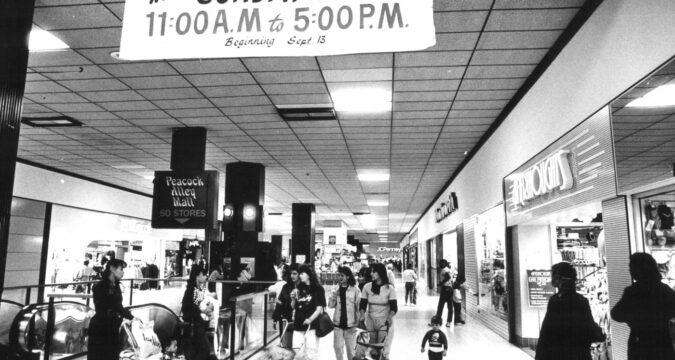
Letters: If Bears have cooled to Arlington Heights, they should consider the Southwest Side
If the Bears are looking beyond Arlington Heights, they should strongly consider looking back to Chicago and building at another prime location, on the Southwest Side of the city, that is ripe for redevelopment — the soon-to-be defunct Ford City Mall.
The infrastructure is either already there or easily added — a major airport (Midway) is blocks away, along with a cluster of associated hotels; there have been talks (and even plans) of extending the Orange Line from Midway to Ford City for years; and it is right by the major thoroughfares of Cicero Avenue and 79th Street. Moreover, the location is historic, as it was the site of a major manufacturing center for bomber engines during World War II. To cap it off, if you faced the stadium toward the northeast, you would still get a distant but visible view of the Chicago skyline.
Perhaps most importantly, the Bears would be able to buy the land for a song at this point — the mall was last sold in 2019 for $16.6 million.
— James Shine, Chicago
An Indiana stadium?
Bears President and CEO Kevin Warren has got to be kidding. A “world-class stadium” in Indiana? Talk about your textbook oxymoron.
For openers, how are fans going to get there? Oh, they could pay to take the Skyway or they could drive to the site on Interstate 80/94. Pick your poison, unless bumper-to-bumper semis going in excess of 70 mph is your idea of an easy drive. All those trucks on a Sunday night and all those Bears fans slightly tipsy after a game: Imagine the possibilities.
World-class? Hmm. The Bears think the 326 acres they own in Arlington Heights would be perfect, if only the General Assembly rolled over and gave them the power to negotiate property taxes with local governmental agencies. No doubt they’d get that authority in Indiana, but where, exactly?
For 326-plus acres of property across the state line, odds are it won’t be pristine prairie or farmland. Far more likely, the land will be a brownfield in need of major remediation. Check that. It’s Indiana. Passing a magic wand over the site should suffice for cleanup.
— Douglas Bukowski, Berwyn
Mayor’s ‘negotiation’
Mayor Brandon Johnson’s response to the news that the Bears will include Indiana as a potential site for a new stadium was to say, “The Bears belong in Chicago.” In the future, I think the mayor will be able to add another entry to his resume that no former Chicago mayor has ever been able to claim: the mayor who lost the Chicago Bears.
So much for the “collaborator in chief.” Saying his “door is always open” is not how you negotiate with a sports team looking for a new stadium, but then again, he has proved that he is simply not good at negotiating or governing, for that matter.
— Mike Kirchberg, Chicago
Their Decatur origins
Enough already with all the hand-wringing and political posturing over the location of the new Bears stadium. The solution is simple: The Bears should move back to Decatur.
— Joyce Keithley, Chicago
Rolling in her grave
One of my favorite memories of growing up in a household that loved their football was listening to my mother enthusiastically belting out the Chicago Bears fight song on Sunday afternoons. I assume some people still remember the old-timey gusto that went into singing the clever lyrics of “Bear Down, Chicago Bears,” especially the lines: “You’re the pride and joy of Illinois! Chicago Bears, bear down!”
I have to say that today, I hear my dear old mother rolling around in her underground Bear haven, having heard the news of the Halas Hall bigwigs proposing to move the team across the mighty Calumet to northwest Indiana, and she’s hissing out new lyrics, “You’re a bunch of skinflint Indianans, Hammond-Whiting Bears — come home!”
Monsters of Michigan City? I don’t think so.
— Dave Jones, Chicago
Delivery robot debate
Regarding the editorial “Chill out aldermen, the delivery robots are cute” (Dec. 11): I thought the only thing I needed to worry about this past summer was welcoming my newborn baby into our family and healing from the third-degree perineal tear she gave me. I was wrong.
One day as I was walking with my newborn strapped to my chest, I came head to head with a delivery robot. I lost the standoff. We were on a sidewalk with other people, next to a busy street filled with cars. I figured it would sense I was there and stop. It did not. It nearly ran into me and my newborn and left me with very narrow space to move around it. I grumbled under my breath and kept walking.
I was annoyed, but I resigned myself to accepting these new neighbors of ours without pondering if they posed any sort of problem beyond battling them out for sidewalk space. At the time, it seemed like a small inconvenience.
My husband, Josh, however, grew more and more troubled by them. He pointed out how they blocked sidewalks that are meant for people. It is annoying if you are able to go around them, but if you have a wheelchair or stroller, it may be impossible.
He started a petition at nosidewalkbots.org. The slogan is “Sidewalks Are for People” (pets too, but that wasn’t as catchy). The petition didn’t take off until just recently. Now it has over 3,000 signatures, with more added daily.
We have read reports of collisions with the robots, even to the point of needing stitches. That people with walkers can’t get around them and that the robots block pathways for kids in strollers or people in wheelchairs (snow or no snow). They are forcing people off sidewalks just to deliver food.
I get the novelty and awe of them. I do agree that they are cute. My 4-year-old loves them. However, at what point do things become a “real” problem? Shouldn’t we be able to make room for the people who need it?
While I believe that all the other questions or concerns raised about the delivery robots are debatable (job loss, privacy/surveillance concerns and data on whether they actually alleviate congestion), the problem that we should care about is accessibility. Let’s not overlook real problems caused by robots that are cute.
— Kaleene Robertson, Chicago
Civility isn’t weakness
I am both privileged and blessed to say that the Honorable William J. Bauer was my dear friend for more than 50 years. Our first real meeting took place in February 1971, in the chambers of Judge Abraham Lincoln Marovitz.
Bill, then a United States attorney, and I — representing an indigent criminal defendant — were on opposite sides of a fiercely contested case arising from a bank robbery and murder. At issue was whether due process could prevail over executive privilege. The case proved to be unique and precedent-setting. More importantly, it marked the beginning of a lifelong friendship grounded in mutual respect and integrity.
Much has been written about Bauer’s intellect, discipline and devotion to the rule of law. All of that is true. But it does not fully explain the man I knew. Bill possessed something rarer in our profession: courtesy without weakness and conviction without cruelty.
John Henry Cardinal Newman once described a true gentleman as one who never inflicts pain, who is fair in dispute, measured in word and tone, and guided by the long view — that we should conduct ourselves toward an adversary as if he might one day be a friend. That description fits Bill exactly.
Even in sharp disagreement, he never confused force with hostility or argument with animus. He listened carefully, spoke precisely and treated everyone in the room with dignity. He was rigorous without being unkind and confident without being dismissive.
In a profession not always known for gentleness, Judge Bauer understood that civility is not weakness but strength. I was fortunate to witness that strength — for more than five decades — in the courtroom and in friendship.
Bill’s example helped shape the character of the federal judiciary in Chicago and remains part of his lasting contribution to the city’s legal life.
— Robert P. Cummins, trial lawyer, Chicago
Note to readers: We’d like to know your hopes for the new year. Please send us a letter, of no more than 400 words, to letters@chicagotribune.com by Sunday, Dec. 28. Include your full name and city/town.
Submit a letter, of no more than 400 words, to the editor here or email letters@chicagotribune.com.
https://www.chicagotribune.com/2025/12/21/letters-122125-bears-stadium/


