Category: News

Multiple gunmen open fire at a South African pub, killing 9 and wounding 10
BEKKERSDAL, South Africa — Nine people have died and at least 10 others were wounded after a group of gunmen carried out a shooting at a South African pub during the early hours of Sunday, authorities said.
The incident occurred just before 1 a.m. in the township of Bekkersdal which is located 28 miles west of Johannesburg. It is the second mass shooting to happen in South Africa in three weeks.
About 12 unknown suspects in a white mini-bus and a silver sedan opened fire at pub patrons at KwaNoxolo tavern, in the Tambo section of Bekkersdal and continued to shoot randomly as they fled the scene, according to police.
“Some victims were randomly shot in the streets by unknown gunmen,” the police said of the incident that left nine people dead and 10 hospitalized.
Maj. Gen. Fred Kekana, the acting provincial commissioner of Gauteng, told the AP at the scene that the gunmen, some of whom wore balaclavas, had one AK-47 rifle and several nine-millimeter pistols.
Police did not release information about the victims, but police spokesperson Brigadier Brenda Muridili confirmed that an e-hailing driver was among those who were caught in the crossfire. She said the driver had just dropped off a client.
“He was shot and killed,” she told The Associated Press.
A manhunt for the suspects in the multiple gunshot event has been initiated by Gauteng Serious and Violent Crime Investigations in collaboration with the Crime Detection Tracing Unit.
There have been several mass shootings at bars — sometimes called shebeens or taverns in South Africa — in recent years, including a mass shooting carried out by multiple suspects in an unlicensed bar near the South African capital that left at least 12 people dead and 13 injured earlier this month.
Another shooting killed 16 people in the Johannesburg township of Soweto in 2022. On the same day, four people were killed in a mass shooting at a bar in another province.
With almost 26,000 homicides in 2024, or more than 70 per day on average, South Africa has one of the highest homicide rates in the world. Firearms are by far the leading cause of death in homicides. Although the nation of 62 million has comparatively stringent gun control laws, officials say many murders are carried out using illegal firearms.
Gumede reported from Johannesburg.
https://www.chicagotribune.com/2025/12/21/south-africa-pub-shooting/

‘A Lie And Propaganda’: Gabbard Fact-Checks Reuters’ Russia Scaremongering In Real Time
‘A Lie And Propaganda’: Gabbard Fact-Checks Reuters’ Russia Scaremongering In Real Time
On Saturday afternoon, Reuters posted an anonymously-sourced story pushing the idea that Russia is bent on reconstituting the Soviet Union. Before the metaphorical ink had dried, Director of National Intelligence Tulsi Gabbard pounced, condemning the story as “a lie and propaganda” on behalf of “warmongers” seeking to derail President Trump’s drive to end the long and bloody Ukraine war.
From selling the Iraq invasion to achieving a news and social media lockdown on Hunter Biden’s laptop, the Deep State has long used major media outlets like Reuters, the New York Times and Washington Post to inject their agenda-advancing narratives into America’s town square. Displaying the typical modus operandi with its Saturday night story, Reuters vaguely attributed the purported US intelligence conclusions about Russia to “six sources familiar with US intelligence.”
Tulsi Gabbard at her January Senate confirmation hearing (Kevin Dietsch/ Getty Images via NPR)
According to those sources, “US intelligence reports” are warning that, despite Putin’s outwardly earnest claims that he wants to end the Ukraine war — claims credited by Trump — Russia not only wants to conquer all of Ukraine but also other European territories that were part of the Soviet Union. “The reports present a starkly different picture from that painted by…Trump and his Ukraine peace negotiators,” wrote Reuters journalists Jonathan Landay, Erin Banco and John Irish. Shortly after Banco promoted the story on X, Gabbard lashed out:
“No, this is a lie and propaganda Reuters is willingly pushing on behalf of warmongers who want to undermine President Trump’s tireless efforts to end this bloody war that has resulted in more than a million casualties on both sides. Dangerously, you are promoting this false narrative to block President Trump’s peace effort, and fomenting hysteria and fear among the people to get them to support the escalation of war, which is what NATO and the EU really want in order to pull the United States military directly into war with Russia.
The truth is the US intelligence community has briefed policymakers, including the Democrat HPSCI member quoted by Reuters, that US Intelligence assesses that Russia seeks to avoid a larger war with NATO. It also assesses that, as the last few years have shown, Russia’s battlefield performance indicates it does not currently have the capability to conquer and occupy all of Ukraine, let alone Europe.”
The “Democratic HPSCI member” (House Permanent Select Committee on Intelligence) is Illinois Rep. Mike Quigley, who told Reuters that intelligence has “always” said “Putin wants more…The Europeans are convinced of it. The Poles are absolutely convinced of it. The Baltics think they’re first.”
Gabbard also used her appearance at this weekend’s Turning Point USA national conference to decry the “weaponization” of intelligence to slow-walk the West into World War III:
Earlier today, @DNIGabbard exposed evidence of deep state warmongers pushing weaponized intelligence to the propaganda media — all done in an effort to sabotage President Trump’s historic peace efforts.
Watch Director Gabbard @TPUSA, and then read her post below👇 https://t.co/y6AChmBHMl pic.twitter.com/6drBM6mYIZ
— Office of the DNI (@ODNIgov) December 21, 2025
The Reuters story is just the latest element of a broader campaign, on both sides of the Atlantic, to promote the implausible idea that Russia — which has taken nearly three years of grinding, yard-by-yard combat to control just 20% of Ukraine— has designs to plunge forward and conquer NATO countries next. In November, for example, Germany claimed Russia is positioning itself for war with NATO by 2029, or maybe in 2028. Reuters led that reporting too. On Wednesday, Putin delivered his own blistering condemnation of the hype, going so far as to call EU officials promoting that narrative “European swine,” adding:
“I have repeatedly stated: this is a lie, nonsense, pure nonsense about some imaginary Russian threat to European countries. But this is being done quite deliberately.”
The Gabbard-Reuters controversy comes just days after Trump told reporters that “we’re closer than we have been” to bringing peace to Ukraine. Observers voiced agreement with Gabbard that the timing of the Reuters story and similar claims from European officials is no coincidence:
“Notice the pattern Tulsi is calling out,” wrote the X geopolitical account The Islander. “Every time negotiations inch ahead, fear narratives suddenly flood the zone. That’s not coincidence, it’s escalation management. The question isn’t whether Russia wants war; it doesn’t, it’s who needs the public to believe it’s inevitable.”
Elon Musk, who has long tangled with Ukraine’s Zelensky government — from mocking Zelensky’s laughable claim that every dollar of US aid to his country is accounted for, to blasting Ukraine for suspending elections — also endorsed Gabbard’s rebuke of Reuters, joining others who lampooned the Deep State spectacle…
Director Gabbard is absolutely right
— Elon Musk (@elonmusk) December 21, 2025
Reuters? pushing neocon propaganda? Say it ain’t so!
— The Redheaded libertarian (@TRHLofficial) December 20, 2025
The story the MSM will report: Tulsi Gabbard says pic.twitter.com/Mv6fAwwS5B
— Nuclear Herbs (@NuclearHerbs) December 21, 2025
The US “Intel”-media complex’s collusion with the warmongers to propagandize and push more forever wars on the American people is a disgrace to journalism & our intelligence. It’s also the primary threat to US national security & our freedoms. It must be brought to an end. https://t.co/Zr0GP1EF8P
— Arta Moeini (@ArtaMoeini) December 20, 2025
Tyler Durden
Sun, 12/21/2025 – 09:55
Fed’s Soft Landing Talk Meets Hard Data
Fed’s Soft Landing Talk Meets Hard Data
Authored by Lance Roberts via RealInvestmentAdvice.com,
The Fed’s soft landing narrative is a key theme in financial media, particularly on Wall Street, which expects a resurgence in economic activity in 2026 to justify increasing forward earnings expectations.
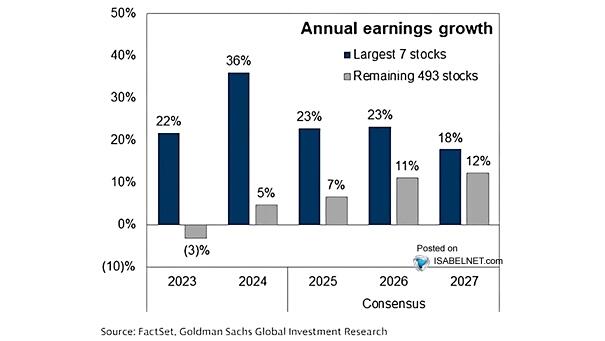
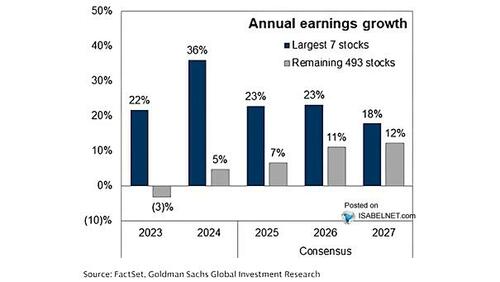
As shown, Wall Street currently expects the bottom 493 stocks to contribute more to earnings in 2026 than they have in the past 3 years. This is notable in that, over the past three years, the average growth rate for the bottom 493 stocks was less than 3%. Yet over the next 2 years, that earnings growth is expected to average above 11%.
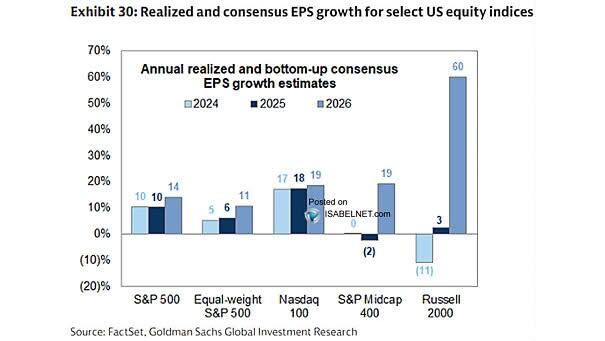
Furthermore, the outlook is even more exuberant for the most economically sensitive stocks. Small and mid-cap companies struggled to produce earnings growth during the previous three years of robust economic growth, driven by monetary and fiscal stimulus. However, next year, even if the Fed’s soft landing narrative is valid, they are expected to see a surge in earnings growth rates of nearly 60%.
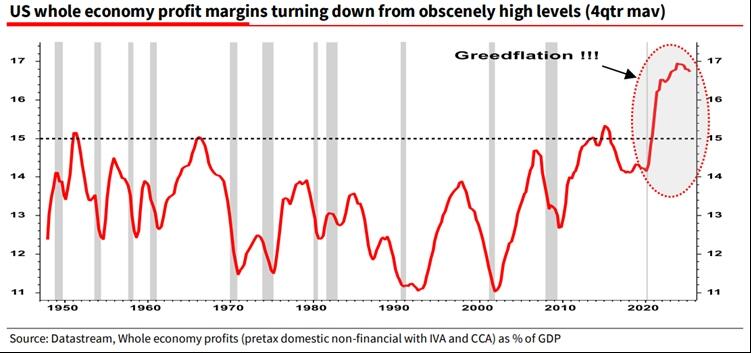
Notably, all this is occurring at a time when the entire economy’s profit margins have peaked and may potentially be turning lower.
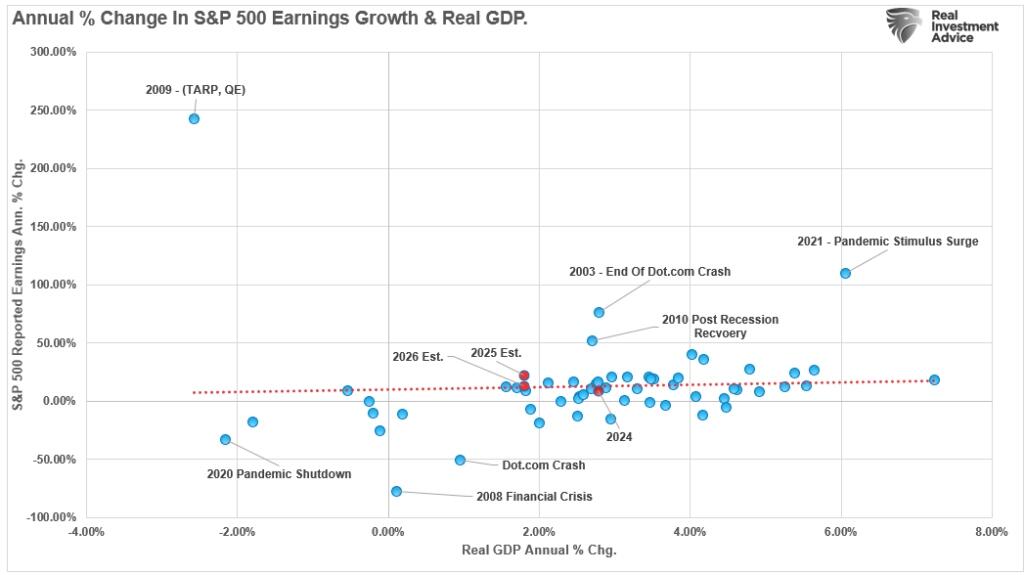
It should come as no surprise that there is a high correlation between economic growth and earnings, given that in a demand-driven economy, consumption is what generates revenues, and revenues ultimately develop earnings.
“A better way to visualize this data is to look at the correlation between the annual change in earnings growth and inflation-adjusted GDP. There are periods when earnings deviate from underlying economic activity. However, those periods are due to pre- or post-recession earnings fluctuations. Currently, economic and earnings growth are very close to the long-term correlation.”
The problem currently facing the Fed’s soft landing narrative is that it hopes the economy can slow without a recession, allowing inflation to return to its target. For now, investors have held the markets higher, hoping the Fed’s soft landing narrative comes to fruition, which would lead to a surge in economic activity. However, the latest employment, retail sales, and inflation trends suggest a potentially worse outcome, characterized by weakening demand and shaky consumer strength.
Those factors weaken the case for the Fed’s hopes of a soft landing and suggest an increase in market fragility.
Falling Inflation Tells a Demand Story
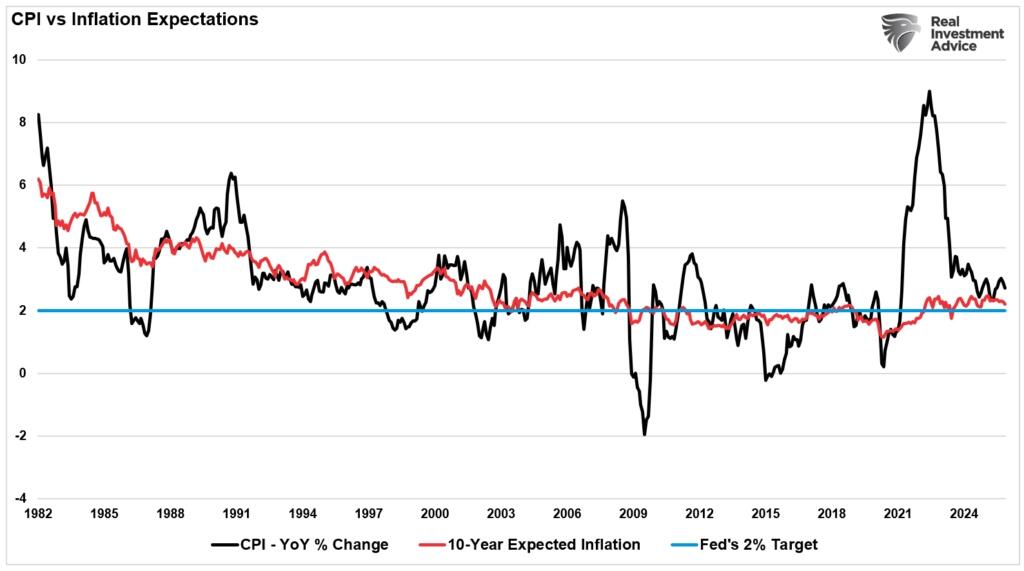
Let’s start with inflation. If economic growth were on the cusp of resurgence, expectations for inflation would be rising. However, as shown, those expectations never rose with “printed inflation,” because it was the “transitory effect” of massive monetary stimulus. The bond market’s view was that inflation would revert to its normalized levels as that monetary excess left the system, which has been the case. This is particularly notable, as inflation expectations have always been more accurate than the “inflation” bears we discussed yesterday.
In the Fed’s narrative of a soft landing, the trend in inflation expectations is crucial. Here is an essential point:
“The Federal Reserve WANTS inflation.”
Here is another critical point: So do you.
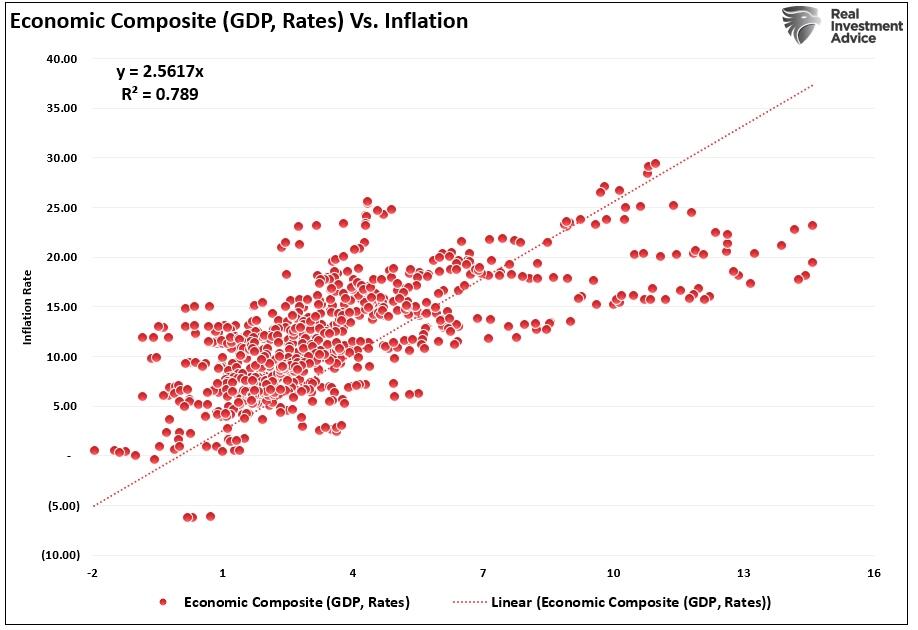
Without inflation, there can not be economic growth, increasing wages, and an improving standard of living. In other words, prices must always rise over time, which is why the Fed targets a 2% inflation rate, thereby supporting 2% economic growth. What we don’t want is “disinflation” or “deflation,” which would occur in conjunction with a recession, leading to job losses, falling wages, and reduced prosperity overall. As shown in the chart below, there is a high correlation between inflation, economic growth, and interest rates over time.
When inflation eases because demand weakens, the economy slows, producers lower prices to clear unsold goods, and employers become more restrictive in hiring and wage increases. Services that rely on discretionary spending lose pricing power, and banks become more stringent in their lending practices. These are not signs of a healthy expansion, but rather reflect a decline in spending power among households.
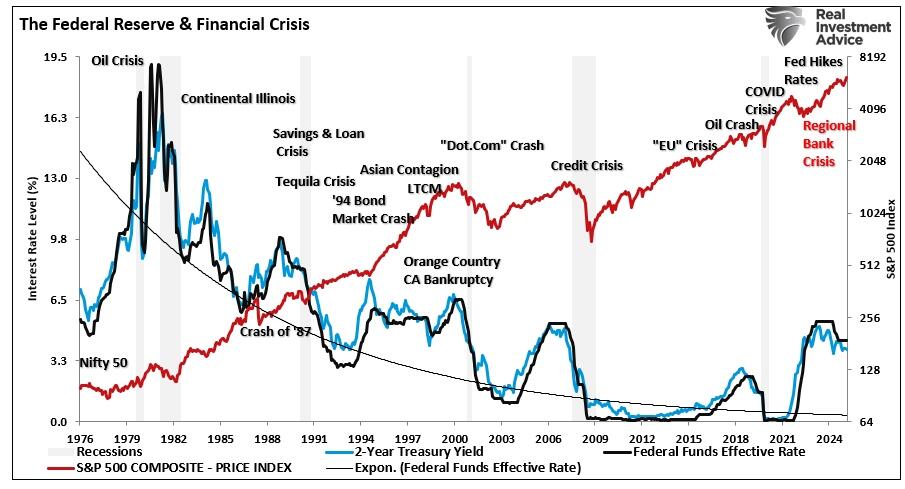
The Fed’s soft landing narrative is predicated on the hope that it can achieve its 2% inflation target without causing a more widespread slowdown. Historically, the Fed has failed in such attempts, as shown by the relationship between Fed rate-cutting cycles and economic and financial consequences.
As an investor, you need to distinguish between inflation caused by temporary supply/demand shocks, as we saw following the Pandemic, and inflation caused by organic economic activity. Supply/demand imbalances, such as higher input costs or a lack of supply caused by a geopolitical shock, can create a spike in inflation, which resolves itself when the shock is over. However, inflation caused by organic demand provides insight into the strength or weakness of the economy. Currently, we are focused on potential demand erosion as consumers cut back, employment weakens, and wages decline.
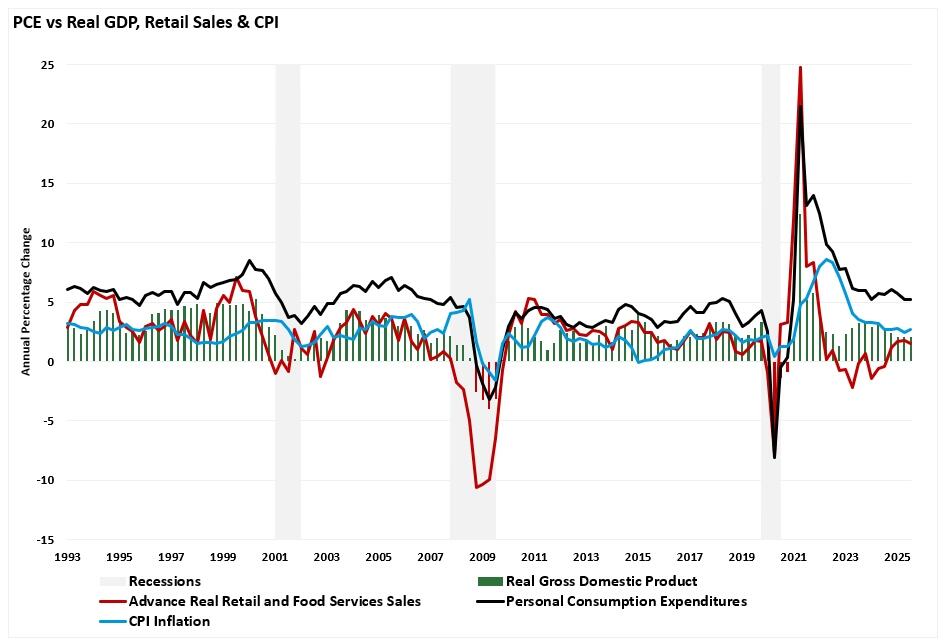
The retail sector provides early signals of demand weakness. Housing-related spending, auto sales, and discretionary purchases show stress, and many consumers face higher borrowing costs and lower savings. As shown, PCE, which accounts for nearly 70% of the GDP calculation, slowing inflation rates, and weak retail sales growth, all suggest that demand destruction is present in the economy. Such a development may further weigh on the Fed’s narrative of a soft landing.
As noted, the Fed’s soft landing narrative requires demand to slow moderately while avoiding recession. However, falling inflation driven by weakening demand and sluggish employment growth suggests a more profound weakness.
Retail Sales Growth Is Not What It Appears
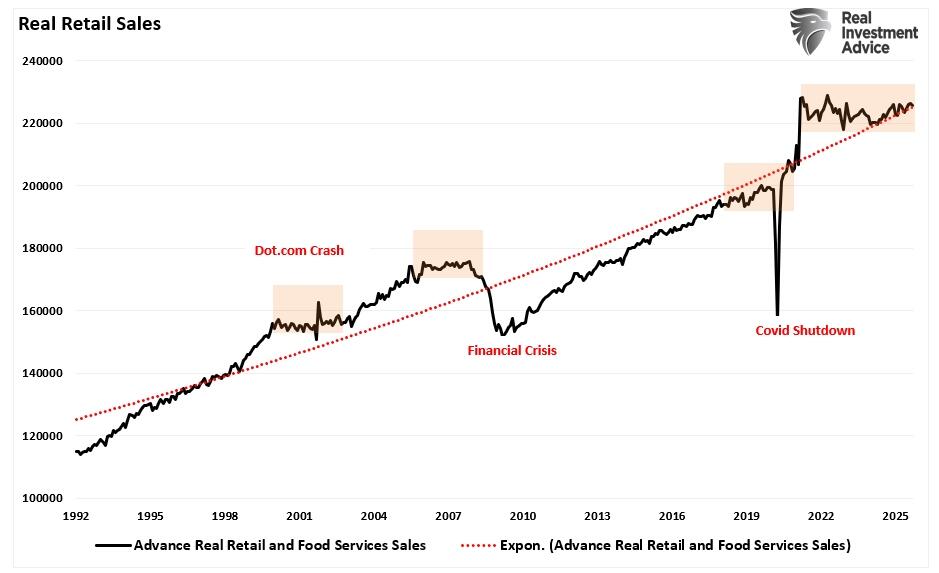
Headline retail sales reports often show month-over-month increases, which reporters interpret as evidence of resilient consumer strength. However, a look at the data tells a different story. For example, since 2022, real retail sales growth has effectively not grown. In fact, previous periods of flat retail sales growth were pre-recessionary warnings.
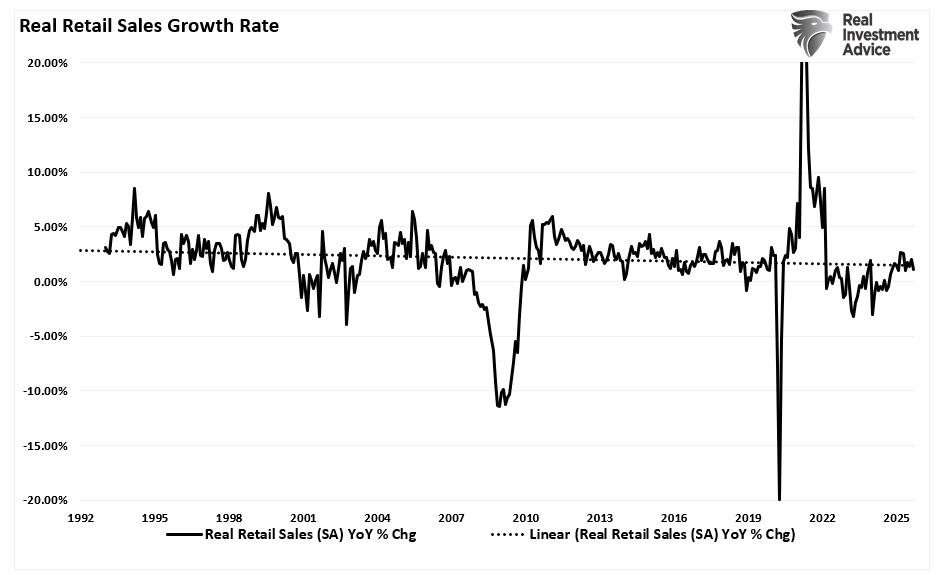
Secondly, the annual rate of change in real retail sales is at levels that have typically preceded weaker economic environments and recessions.
Notably, retail sales figures are subject to seasonal adjustments, which correct for typical spending patterns. During the holiday and back-to-school seasons, spending increases and the “adjustments” attempt to remove these effects. However, if the adjustment process overestimates normal seasonal strength, the adjusted result will appear firmer than it actually is. Secondly, another distortion comes from changes in price levels. If prices fall because demand weakens, nominal sales may rise while real volumes fall. Consumers buy less but pay lower prices. Nominal retail sales can mislead when viewed without context.
This is what we are currently seeing in the economy. As consumers pull back, businesses face the prospect of weaker revenue. That leads to slower hiring, lower investment, and falling confidence.
This matters for the Fed’s view of a soft landing. If consumer demand remains weak, the economy may slow more than expected, which increases the risk of recession. A “soft landing” requires growth to slow without tipping over, but current economic data points suggest a risk to that growth story.
The Market Risk If The Fed Is Wrong
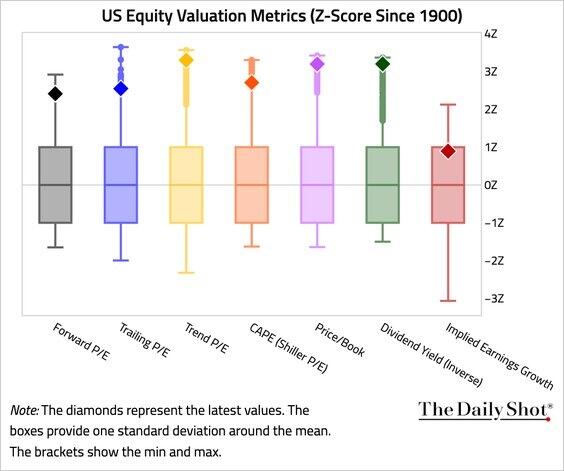
If the Fed’s soft landing narrative proves incorrect, the downside risk to investors increases significantly. The soft landing narrative has been factored into market prices, earnings expectations, and economic projections. Any deviation exposes valuations and portfolios to sharp repricing. With valuations already very elevated, the risk of a repricing event is not insignificant.
Wall Street’s forward expectations hinge on a growth rebound in 2026. Those projections assume that demand will return and margins will remain stable. However, there is no guarantee that either of those assumptions are accurate. If margins have already peaked, inflation declines as demand erodes, and employment falls, negative earnings revisions could be substantial. The year-over-year change in real retail sales, as shown in the chart, has hovered near recessionary warning levels. With consumers already strained by high debt service costs, weak wage growth, and declining savings, discretionary spending is under pressure, which directly affects earnings across cyclical sectors.
If demand weakens further, companies will face lower revenue and tighter margins. The margin compression will initially impact earnings, particularly for smaller firms with limited pricing power. A repricing of earnings expectations will follow, dragging valuations with it.
The Fed’s historical track record of avoiding recession during tightening and easing cycles is poor. Most rate-cutting cycles have been in response to financial or economic stress, not smooth slowdowns. If the Fed cuts rates next year, it likely won’t be in response to a soft landing. That shift in narrative would catch most investors leaning the wrong way.
Positioning for a soft landing assumes the Fed can control inflation without breaking demand. The data say otherwise. The risk, as always, is that the market wakes up to this reality too late. Therefore, investors should consider preparing for such a possibility in advance.
If the Fed’s soft landing narrative fails, investors will face a different environment than the one markets currently price. The assumptions behind strong equity valuations, tight credit spreads, and risk-on positioning will crack. If it does, that means you will need to act based on risk, not rhetoric. Here are some actions to consider.
1. Reduce Exposure to Overvalued Growth Assets: Tech and growth stocks led the rally on rate cut hopes and soft landing optimism. If earnings disappoint and rates stay higher, these valuations come under pressure.
Trim overweight positions in mega-cap tech.
Avoid speculative names with no earnings.
Focus on companies with strong cash flow and pricing power.
2. Increase Cash and Short-Term Treasuries: If growth slows and volatility returns, capital preservation matters. Cash gives you optionality. Short-term Treasuries offer yield without duration risk.
Rebalance toward 3-month to 1-year Treasury bills.
Hold cash equivalents yielding over 4.5 percent.
Avoid reaching for yield in low-quality credit.
3. Tilt Toward Defensive Sectors: Slower growth hits cyclicals and high beta sectors first. Defensive sectors hold up better in downturns.
Favor healthcare, consumer staples, and utilities.
Limit exposure to discretionary, financial, and industrial sectors.
Screen for dividend sustainability and balance sheet strength.
4. Prepare for Credit Stress: If recession risk rises, corporate credit spreads will widen. Junk bonds will suffer. Bank lending tightens further.
Exit high-yield bonds and floating-rate loans.
Review credit exposure in bond funds.
Consider higher-quality fixed income with lower default risk.
5. Be Patient and Opportunistic: If markets break, forced selling creates dislocations. You want dry powder ready.
Hold 10–20 percent in cash or equivalents.
Build watchlists of high-quality names at lower valuations.
Add in stages as prices adjust, not all at once.
You don’t need to predict a recession. Instead, prepare for the potential risk if the Fed’s hopes for a soft landing fade. You can always increase risk more easily than recovering from losses. Remaining disciplined, protecting capital, and looking for opportunities is always the best course of action.
Trade accordingly.
Tyler Durden
Sun, 12/21/2025 – 09:20
https://www.zerohedge.com/markets/feds-soft-landing-talk-meets-hard-data

Griffith man charged in burglary
A Griffith man faces decades in prison after kicking the door down to a couple’s apartment. His dog attacked the other man.
Ryan Wisniewski, 33, is charged with Level 1 felony burglary, Level 4 felony burglary, Level 5 felony possession of a destructive device, two counts of Level 5 felony battery, Level 6 felony residential entry and four misdemeanors.
He is being held without bail. It will be reset to $10,000 cash surety on Jan 3.
Police responded around 10:30 a.m. Dec. 16 to the 8000 block of Matterhorn Court in Crown Point.
The couple told police that Wisniewski kicked the door down a few times before. The woman said he and Wisniewski were “old high school friends,” the affidavit states.
Wisniewski went into a “psychotic rage,” the man said. Police described the dog as “pit bull-like.” The man had a 3-inch cut behind his ear.
Officers later found a Molotov cocktail in Wisniewski’s car.
https://www.chicagotribune.com/2025/12/21/griffith-man-charged-in-burglary/

Fired comptroller’s report critical of Lake County government
A scathing report compiled by the former Lake County Comptroller before he was fired demands that county government “solves its leadership problem” and modernizes how it leads and serves.
The report, released last month, came on the heels of the Lake County Council voting 6-1, with Councilman Ron Brewer, D-1, absent, to reduce the comptroller’s salary to $1 from $168,000 until the position is refilled. Council President Christine Cid, D-1, said that when the council set the position, it was because of former Comptroller Dan Ciecierski’s qualifications.
Ciecierski, who was hired in May 2024, however, was let go from the Auditor’s Office, she said, so unless and until the position is refilled with someone whose qualifications match his, the salary should be reduced.
Auditor Peggy Katona didn’t respond to a request for comment on the reasons why Ciecierski was let go.
Cid said she was in the dark about the reasons surrounding Ciecierski’s departure.
“Ok, well, I don’t know the total reason for (Ciecierski’s) departure,” Cid said. “I will say that I appreciated his confidence in moving things forward in the Auditor’s Office and with Oracle.”
Ciecierski, whose last day as comptroller was October 30, said he wrote the report, but declined further comment beyond saying the report speaks for itself.
“The report details what I found in my short tenure (in the Auditor’s office), and it is a 100% example of what happens there every single day,” Ciecierski told the Post-Tribune. “I’m extremely proud of the work my team and I did.”
Councilman Randy Niemeyer, R-7, said he’d asked Ciecierski before his firing to run a “detailed analysis of internal controls, procedures and different things that contribute to financial and fiscal health.” Niemeyer also asked him to include the work he’d been conducting on the 2022 and 2023 audits, he said.
Among the things Ciecierski enumerated in his report were “lack of robust internal controls and technical expertise, inconsistent application of policies and subject-matter knowledge gaps, difficulties in recruiting and retaining skilled personnel and a toxic political environment that hinders effective governance,” according to the report. To the point of internal controls, Ciecierski wrote that accounting software provider Cenifax is “simply unable to fulfill the needs of Lake County.”
“First, the financial burden they will encounter to establish, maintain, document, and test internal controls is most likely too large for their size,” Ciecierski wrote. “Second, the lack of any formal, practical accounting, internal control knowledge/general awareness is non-existent at every level of their organization.”
Cenifax also, according to Ciecierski, doesn’t have anyone on staff “with the slightest experience of a system similar to Oracle,” and only one of the Cenifax staff has any practical IT or program maintenance experience with it.” As such, the county would do well to get rid of Cenifax and hire a large consultancy such as Baker Tilly.
The County’s payroll practices leave much to be desired as well, he said. Employee paychecks, he noted, are calculated and paid accurately, but there’s no one consistently reporting payroll for audits. To that end, he wrote a job description for a payroll manager position for a 3,000-person organization with exempt and non-exempt personnel.
“The current Payroll Manager of Lake County has a high school degree with previous experience of 7 years in the Auditor’s Office,” Ciecierski wrote. “The work completed was mostly clerical in nature …”
As far as the County’s internal controls go, “the tone at the top” leaves much to be desired, he wrote. In a copy of an email he included in the report, he and David Kubiak, an employee in the Auditor’s office, were discussing cut-off dates for purchase orders toward the end of the year. County’s cut-off date, Ciecierski said in the email, is December 16.
“Maybe in the real world, but this is Lake County,” Kubiak responded. “If a higher up requests the purchasing department to create an emergency PO at the end of the year, I believe they are going to create it.”
In a second example, Ciecierski included an email conversation between Bookkeeping Supervisor Lynn Davies and him where he requested that processed claims be uploaded by scanner to and attached to the transactions. Assistant Real Estate Supervisor Linda Midkiff responded to the email and said his request wouldn’t be implemented because “the Bookkeeping department being understaffed.”
“Going forward, please discuss any changes you would like to make with me so I can consult with (Lake County Auditor) Peggy (Katona),” Midkiff wrote.
“Thanks, Linda. I am saving this email supporting the fact that you and Peggy have discussed not to implement a very easy internal control that is necessary to ensure accuracy of our data,” Ciecierski fired back. “Just so you are aware, the lack of understanding that you have for the white claims process is lending to this decision of not implementing the control.
“I will say that the small change of quickly scanning the source document into Oracle using the scanners each bookkeeper has at their desk (a process that already occurs in bookkeeping for other transactions) isn’t hard to do. It looks like extra work which is why I’m guessing someone cried about it.”
“Mr. Ciecierski began implementing recommended solutions from the report as part of his duties as Comptroller. However, his competence is not desired at Lake County, and he was abruptly terminated from the position, without cause,” Niemeyer read from a press release he put out about the report. “Lake County Government is where technological advancements have not led to greater efficiency, lower costs, or enhanced transparency. It’s time to put citizens first and dismantle the outdated political patronage system for good.”
Previously considered “unauditable,” Lake County was removed from the State Board of Accounts unauditable list for its 2022 budget, but its audit report found issues with payroll management, the Lake County Sheriff’s salary, and the Lake County Jail’s commissary fund, the Post-Tribune previously reported.
Michelle L. Quinn is a freelance reporter for the Post-Tribune.
Track Seized Oil Tanker: Skipper Approaches Galveston Offshore Lightering Area
Track Seized Oil Tanker: Skipper Approaches Galveston Offshore Lightering Area
President Trump’s gunboat diplomacy against Venezuela’s autocratic leader, Nicolás Maduro, has moved full steam ahead. U.S. forces have seized two sanctioned “dark fleet” oil tankers, with the latest interception carried out during an early Saturday morning operation by the U.S. Coast Guard off the coast of Venezuela.
The first seizure occurred earlier this month, involving the VLCC Skipper, and sent shockwaves through the Caribbean region. At the time, White House Press Secretary Karoline Leavitt said Skipper was en route to a U.S. port and that the United States intended to seize the oil.
However, with the second tanker now seized and its name yet to be released, Skipper had faded from the news cycle until now.
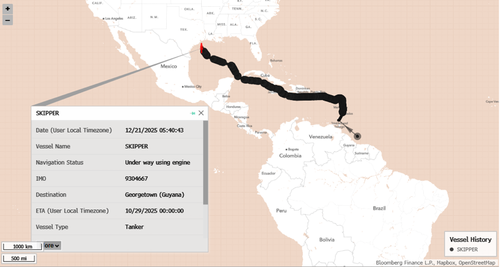
Research firm TankerTrackers provided an update on Saturday evening, indicating Skipper’s location is about 1 day from Galveston, Texas.
“An update on SKIPPER (9304667): We are tracking her movements by satellite imagery (just to confirm the AIS data) and can see that she is about a day away from reaching GOLA (Galveston Offshore Lightering Area) where she will have to transfer her 1.85 million barrels cargo onto three smaller tankers in order to feed oil refineries in ports such as Houston,” TankerTrackers wrote on X.
An update on SKIPPER (9304667): We are tracking her movements by satellite imagery (just to confirm the AIS data) and can see that she is about a day away from reaching GOLA (Galveston Offshore Lightering Area) where she will have to transfer her 1.85 million barrels cargo onto… pic.twitter.com/i4p5qOwSUP
— TankerTrackers.com, Inc. (@TankerTrackers) December 20, 2025
GOLA is a designated offshore zone in the Gulf of America, located several miles off the coast of Galveston, Texas, where large crude oil tankers, such as the Skipper, conduct ship-to-ship oil transfers known as lightering.
Given Leavitt’s comments about the U.S. seizing Skipper’s crude, we suspect the ship-to-ship oil transfer will take place at GOLA. In fact, when the tanker was just north of Saint Lucia in the eastern Caribbean Sea, we provided readers with a list of possible port calls in the Gulf of America.
We suspect yesterday’s seizure of the sanctioned tanker will soon follow a similar path.
Trump’s gunboat diplomacy is only ramping up. There will be more dark fleet oil tankers commandeered by U.S. forces, whose foreign policy objective is to accelerate regime instability in Caracas and materially weaken Cuba.
Tyler Durden
Sun, 12/21/2025 – 08:45

Chicago Botanic Garden selects Gretchen Baker as new president, CEO
The Chicago Botanic Garden is set to have new leadership next year, as its board of directors has selected Gretchen Baker as the institution’s next president and CEO.
Baker, currently the director of the Carnegie Museum of Natural History in Pittsburgh, will assume responsibility for daily operations of the 385-acre Garden in Glencoe beginning in March. She will succeed Jean Franczyk, who is retiring after leading the organization as president and CEO since 2016.
Born and raised in rural Illinois, Baker has studied botany and landscape architecture, according to a statement from the Garden.
“Plants have been braided into my entire career, from the Amazon rainforest to the landscape design studio to the dinosaur gallery,” Baker said in the statement. “I’m honored by the opportunity to lead the Chicago Botanic Garden and excited to devote my energies to advocating for plants and deepening our relationship to them.”
Baker previously held senior leadership roles at two Los Angeles–based museums and at the Field Museum in Chicago.
“Gretchen brings a wealth of experience and a deep commitment to the Garden’s mission,” said Michael R. Zimmerman, chair of the Garden’s board of directors. “We were equally impressed by her innovative ideas, passion for the natural world, and approachability.”
Jean Franczyk is retiring as president of the Chicago Botanic Garden in Glencoe. In her tenure there since 2016, her accomplishments include setting new attendance and membership records and launching a rebranding campaign. (Chicago Botanic Garden)
Baker’s appointment comes as Franczyk prepares to step down following nearly a decade at the helm of the Garden, a period during which the institution consistently attracted more than one million visitors annually.
A South Side Chicago native, Franczyk previously worked at several museums as well as in the administration of former Mayor Richard M. Daley before joining the Garden.
Her accomplishments included setting new attendance and membership records, launching a rebranding campaign, and expanding partnerships with organizations supporting agricultural and educational programs, per a Garden spokesperson.
The Garden also introduced a daily admission fee during that period, compared to the previous practice of charging only for parking. In recent months, some employees have discussed unionizing amid concerns about workplace issues, according to previous public statements.
“During her tenure, the Chicago Botanic Garden experienced an extraordinary period of growth, change, and commitment to helping grow a better world by connecting people to the power of gardens and green space,” the Garden said in a statement.
The Garden did not specify Franczyk’s future professional plans, stating only that she will be focusing on a limited number of select projects.
https://www.chicagotribune.com/2025/12/21/chicago-botanic-garden-to-get-new-leader-gretchen-baker/

Undrafted Jahdae Walker grabs game-tying TD for the Chicago Bears: ‘We put that in our rookie’s hands’
After Jahdae Walker caught the game-tying touchdown pass during the Chicago Bears’ 22-16 overtime win against the Green Bay Packers, the undrafted rookie wide receiver broke into the Jubi Slide — and it looked like his was dancing on air.
Inside, he really was floating.
“It meant the world, just because I’ve been trying to stay locked in and just focusing on what I can control,” he said. Caleb Williams’ 6-yard scoring toss to Walker with 24 seconds left in the fourth quarter was one of Walker’s first two career catches on the night. “And it just meant the world to me. It meant the world because (coach) Ben (Johnson) trusted me.”
“Ah, I love that for Jahdae,” Josh Blackwell said.
Improbable win puts Chicago Bears in control of the NFC North: Brad Biggs’ 10 thoughts on Week 16
Added DJ Moore, who caught the walk-off touchdown pass in overtime: “I loved it, man. We put that in our rookie’s hands at the end of the game and sent us to overtime.”
Walker has joined a group of “find a way” Bears, some previously unheralded, by helping pull off the team’s sixth fourth-quarter comeback this season.
Josh Blackwell had played the hero before. The special teams ace blocked a field-goal attempt that clinched a win in Las Vegas in Week 4. On the other hand, Walker, inactive for eight games, had barely seen the field — much less a target — before Saturday night.
But during a critical fourth-quarter sequence, Blackwell formed the bookends to an eight-play comeback drive, recovering an onside kick that Walker later capitalized on with his end zone grab.
Here’s how it unfolded:
The onside kick: Just after the two-minute warning, Cairo Santos kicked it from the Bears 35 to the 47. Packers wide receiver Romeo Doubs muffed the recovery and Blackwell scooped it up instead.
Blackwell said Doubs “just dropped the ball” and he was simply in the “right place, right time.
Bears recover the onside kick
GBvsCHI on FOX/FOX Onehttps://t.co/HkKw7uXVnt pic.twitter.com/gabjYXsJXB
— NFL (@NFL) December 21, 2025
The drive: Williams completed five straight passes — including a 20-yard toss to DJ Moore — but a few incompletions set up a fourth-and-4 at the Packers 6.
The touchdown: Walker and Olamide Zaccheaus lined up to the right. Zaccheaus stopped just short of the sticks, baiting Nate Hobbs and Keisean Nixon to bite on the short throw. Walker ran between the Packers defenders, cut to the right corner and hauled in Williams’ pass.
Walker said, “Before the play OZ, was like, ‘You about to get it.’ And I saw the corners talking, they was trying to in-and-out us. So I went vertical, and I saw both of them go to OZ. So I ran straight to the back pylon. Caleb threw a great ball.”
Packers coach Matt LaFleur said he’d have to look at the film to determine what went wrong. “It was the Zero blitz. Obviously somebody let their man go,” he said.
Bears coach Ben Johnson said coverage dictated whether Walker or Zaccheaus would be the primary target.
“The play before they Cover-Zeroed us, and Caleb was aware of that, and they came back on fourth down and did the same thing, Cover Zero,” he said. “On that particular play, Jahdae was our Zero answer.”
Bears receiver Jahdae Walker catches a touchdown against the Packers late in the fourth quarter Dec. 20, 2025, at Soldier Field. (Brian Cassella/Chicago Tribune)
Walker was a training camp darling, but he was buried on the depth chart. Still, he continued to impress teammates with his hustle and passion.
“We all love football, but you can just see it on his face,” Blackwell said. “He’s a little kid on the playground outside at practice, and he deserves that.”
When opportunities still didn’t materialize, Walker said his offensive coaches kept encouraging him.
Offensive coordinator Declan Doyle, wide receivers/assistant head coach Antwaan Randle El, offensive assistant in charge of quarterbacks and wide receivers Robbie Picazo and “everybody, they always tell me, like, ‘Be ready. You’re one play away from 50 snaps,’” Walker said. “So I’ll just try to be ready and control what I control.”
This week injuries kept Rome Odunze (foot) and Luther Burden III (ankle) on the sideline and forced Walker into the offense. Johnson had no qualms about relying on an untested rookie in such a do-or-die situation, even in a huge game with playoff implications: For the winner, it’s their NFC North division to lose.
“I know to the people that haven’t been in the building, it’s like ‘Oh my gosh, you’re going to the undrafted rookie on fourth down,’” Johnson said. “Well, we see what he does every single week. We see how he goes about his business. There’s a reason why we didn’t want to expose him to the waiver wire and (have) someone poach him after the preseason. We see a bright future for this guy.
“He’s done nothing but steadily improve over the course of the season. The coaches trust him. Caleb trusts him.”
Williams gave no thought to looking elsewhere than to his receiver who was open.
Related Articles
Improbable win puts Chicago Bears in control of the NFC North: Brad Biggs’ 10 thoughts on Week 16
Inside the Caleb Williams-to-DJ Moore OT touchdown for a Chicago Bears win that ‘blew up’ Soldier Field
Week 16 recap: Chicago Bears pull off improbable rally and stun Green Bay Packers 22-16 in overtime
Week 16 photos: Chicago Bears 22, Green Bay Packers 16 (OT)
Chicago Bears and Green Bay Packers have played 212 times in the past 100 years: How the rivalry has unfolded
“I didn’t second-guess,” he said. “I didn’t think Jahdae was out there — I knew he was out there.
“It wasn’t like, ‘Oh, Jahdae’s out there, I’m not going to (throw there). It was Jahdae’s out there and I’m going to throw this ball exactly where I’m going to throw it and he’s going to be exactly where he needs to be.”
That level of trust didn’t just form overnight. During camp, Williams and Walker lived together.
“When he first got here, I allowed him to stay at my house for a little bit until he found a spot,” Williams said of the 6-foot-3 undrafted rookie out of Texas A&M.
Williams and Walker have since studied the playbook and worked out together and just bonded as friends.
“It was fun,” Walker said. “I ain’t gonna lie, I ain’t never been in a place like that. It was fun, for sure. I love his dog. Little Supa. I love that little dog.”
Walker’s locker room stall at Halas Hall is just a few stalls away from Williams — and they’ve been tight-knit there as well.
“After practice, we play two-ball together and we haven’t lost yet,” Walker said emphatically.
“I love Jahdae, man,” Williams said. “His character, his energy is infectious.” And Walker’s “been working his tail off,” he added.
Williams said, “It wasn’t this week, but I told him a couple weeks ago, walking back from the indoor (facility), when your opportunity shows and presents itself, you need to go make the opportunity and secure your moment. …
“Go out there, make the plays for your career, for your life, for your family. And that’s something he did today.”
https://www.chicagotribune.com/2025/12/21/chicago-bears-jahdae-walker-touchdown/

Britain’s Ruling Class Loves To Cosplay As A Titan
Britain’s Ruling Class Loves To Cosplay As A Titan
Authored by Gerry Nolan via The Ron Paul Institute
From the podium, it’s Churchillian thunder: prepare for war, deter Russia, stand tall, lead the free world. Back in the engine room, it’s Whitehall with a calculator, sweating through its suit because the numbers simply don’t work. The Financial Times reports Starmer has delayed the Defence Investment Plan over “affordability,” kicking it into 2026, because the military’s wish list collided with the Treasury’s reality. Translation: the rhetoric is premium, the balance sheet is bargain-bin.
And then, because the universe has a sense of irony sharp enough to cut steel, enter Ajax; the £6-plus billion armored vehicle program that has become the British state’s spirit animal. Trials paused again. Fresh safety concerns. Soldiers injured. Crews sickened by vibration and noise. Endless reviews. Endless “lessons learned.” Endless press lines insisting this is all somehow progress.
If you want to understand modern Britain, don’t read strategy documents. Watch a procurement program that cannot stop hurting the people it is meant to protect.
Ajax was meant to be the backbone of Britain’s future armored forces, a next-generation reconnaissance and strike platform designed to replace ageing vehicles and restore credibility to the British Army’s maneuver capability. Instead, it has become a case study in institutional failure: spiraling costs, years of delay, fundamental design flaws, and a safety record so poor it forced repeated trial suspensions. Soldiers were not merely inconvenienced; they were physically harmed in testing, suffering hearing damage, sickness, and long-term health concerns.
This is not a marginal technical glitch. It is the predictable outcome of a system where industrial capacity has been hollowed out, accountability diffused, and procurement reduced to a paper exercise optimized for contracts, not combat. Ajax does not fail because Britain lacks engineers or soldiers. It fails because Britain no longer possesses a state machinery capable of translating ambition into functioning hardware at scale.
This is the farce at the heart of the Atlantic security sermon.
Britain speaks about Russia the way a fading aristocrat sneers at a rising industrial superpower… condescending, dismissive, utterly uncurious. For years we’ve heard the same insult recycled like a nervous tic: Russia is a “gas station,” a crude petro-state propped up by fumes and nostalgia. Yet here we are.
Russia the “gas station,” under the most comprehensive sanctions regime in modern history, has been forced—by Western institutions themselves—into an inconvenient admission: Russia now ranks as the fourth-largest economy in the world by purchasing-power parity.
So let’s pause and ask the question Britain’s elites refuse to face. If Russia is a glorified gas station, what exactly does that make Britain? A country that cannot publish a defence investment plan on time. A state that cannot field a functioning armoured vehicle without injuring its own troops. An economy that cannot sustain rearmament in spite of private finance gimmicks and accounting contortions. A political class that cannot reconcile its war talk with its industrial capacity.
If Russia is a gas station, Britain increasingly resembles a heritage museum complete with a gift shop, living off past glories while subcontracting its future.
Now let’s move to where the illusion truly collapses, production.
Wars are not won by hysterical speeches, theatrical bravado, summits, or moral pronouncements. They are won by output — steel, shells, access to critical minerals, drones, logistics, and the brutal arithmetic of throughput. On this front, the West has been dragged, kicking and screaming, into recognition of a reality it tried to meme out of existence.
Russia’s military-industrial base bureaucratically compressed, hardened, and scaled under pressure —now outpaces NATO’s collective ammunition production by a multiple. Western officials themselves have been forced to admit the gap, even as they scramble to promise future catch-up schedules that read more like aspiration than viable plan.
In sum, while Russia produces, Britain reviews glorified mission statements. And while Russia iterates, Britain delays indefinitely out of impotence. Russia fields game changing adaptations learned from battlefield within months. While Britain commissions another inquiry.
And this is where the mockery turns into indictment.
Because Britain is not merely weak. It is performatively Russophobic, a leading amplifier of a psychological contagion that has swept Western Europe. A political culture that replaced diplomacy with insult, respect with caricature, and strategic realism with adolescent moral posturing.
For decades, Russians asked for nothing exotic. Security guarantees. Recognition of reasonable red lines. A place in a shared European security architecture. Basic respect and dignity after the Cold War. They were met instead with NATO expansion, broken promises, regime-change evangelism, and the casual humiliation of a great civilization reduced to punchlines for Western domestic politics.
And now, after years of stoking this hysteria, inflaming this anger, and dismissing Russian concerns as paranoia, Britain offers the world a confession written in delays, budget shortfalls, and broken machinery.
For all the talk of deterrence, what they’re left with is cold reality, exposure. A state that talks war while failing at procurement is not projecting strength. It is advertising vulnerability at scale. A leadership class that cannot fund its own defence while demanding continental confrontation is not leading, but gambling with other people’s lives.
For a country in this position to posture as a peer adversary to Russia is not serious strategy. It is suicide pact dressed up as virtue. At this point, honesty would demand something radical in London: humility and sober realism.
A state in Britain’s position should not be lecturing the world, moralizing from the sidelines, or inflating its own strategic importance. It should be urgently repairing what it helped to destroy, namely trust, diplomacy, and the basic architecture of European security. It should be suing for peace, not performing toughness it cannot afford.
Because history is unforgiving to former empires that mistake memory for power.
Russia did not arrive at this moment through fantasy. It arrived through necessity, through sanctions, pressure, exclusion, and the steady realisation that the West no longer spoke the language of compromise, only command. Britain, by contrast, arrived here through illusion: convinced it was still a titan while outsourcing its industry, hollowing out its capacity, and replacing strategy with theatre.
This is the real danger now, not Russian strength, but Western self-deception.
A political class that cannot build, cannot fund, and cannot field its own defence has no business escalating confrontation with a civilization that can. When rhetoric races far ahead of reality, history does not intervene gently. It intervenes brutally. Britain is not preparing for a conflict with Russia. It is preparing for a reckoning with the reality of its own weakness.
And reality, unlike Whitehall briefings, legacy slogans, or moral posturing, does not negotiate.
Tyler Durden
Sun, 12/21/2025 – 08:10
https://www.zerohedge.com/geopolitical/britains-ruling-class-loves-cosplay-titan
El príncipe Guillermo lleva a su hijo al refugio para personas sin hogar que visitó con Diana
Associated Press
LONDRES (AP) — El príncipe Guillermo y su hijo mayor, el príncipe Jorge, se pusieron delantales para ayudar a preparar el almuerzo de Navidad en un refugio para personas sin hogar, una organización benéfica que el príncipe de Gales visitó por primera vez de niño junto con su madre, la fallecida princesa Diana.
El padre e hijo fueron vistos decorando un árbol de Navidad y ayudando con la preparación de las comidas en la cocina de The Passage, en el centro de Londres, en un video publicado en la cuenta de YouTube de Guillermo el sábado.
“Orgulloso de unirme a los voluntarios y al personal de The Passage en la preparación del almuerzo de Navidad, este año con otro par de manos que ayudan”, se leía en una publicación en la red social de Guillermo y su esposa, la princesa Catalina.
Guillermo es el patrón monárquico de The Passage, que visitó por primera vez cuando tenía 11 años con su madre, Diana. El heredero al trono ha visitado la organización benéfica en años recientes, pero esta fue la primera vez que Jorge, de 12 años, lo acompañó.
El joven monarca firmó un libro en la misma página donde Diana y Guillermo escribieron sus nombres hace 32 años, en diciembre de 1993.
Se mostró a Guillermo vertiendo coles de Bruselas en una bandeja para horno, mientras que Jorge ayudaba a colocar los budines de Yorkshire y a preparar una mesa larga para docenas de asistentes.
Guillermo lanzó su proyecto Homewards en 2023 para abordar el problema de la falta de vivienda.
______
Esta historia fue traducida del inglés por un editor de AP con la ayuda de una herramienta de inteligencia artificial generativa.