Category: News

Rick Steves’ Europe: Epiphany in Europe
Traveling during the holidays in Europe, you’ll find the season marked not by the number of shopping days left until Christmas, but by a long series of winter festivals – both pagan and Christian – that stretch from late November until early January.
Advent (stretching four Sundays before Christmas) starts things off, as people begin to anticipate the arrival (or advent) of the baby Jesus. (In Europe, this is truly the start of Christmas. While some American-style early commercialization has begun to bleed through, for the most part European advertisers seem reluctant to market the season any earlier.)
Next up is the Feast of St. Nicholas, celebrated mostly in Catholic countries with gift giving on December 5 and 6. In some countries, St. Nicholas’ feast is even bigger than Christmas Day. December 13 then brings Santa Lucia Day, a logical highlight in Europe’s darkest corner – Scandinavia – where young girls decked out in candles lead processions promising the return of the light.
December 25 is generally a day of quiet celebration and happy reunions with relatives and friends. Christmas in some European countries – including Italy and France – kicks off 12 more days of religious observance: the famous Twelve Days of Christmas. They end on January 6 with the Epiphany holiday, when the Three Wise Men were said to have finally brought their gifts to the baby Jesus.
In Italy, Epiphany is the time of “La Befana,” the legendary Good Witch of Christmas, who gives gifts to children. My Roman friend, Francesca, explained to me, “On the night before January 6, La Befana flies over the rooftops of Rome on her broom, and brings gifts to the good children or coal for the bad ones. (These days the “coal” is a crunchy black candy you buy from street-corner carts.) In return, Roman children leave her a gift of soft ricotta cheese, since she has hardly any teeth!”
According to Italian legend, the Three Wise Men stopped to ask La Befana for directions to Bethlehem and the Christ child, but she was too busy to help. As time passed, La Befana kept thinking about the strange visitors and their quest. With a sack filled with bread, she set out to find Jesus, too. Whenever La Befana saw a baby boy, she broke off a crust of bread and gave it to him, hoping he might be the Christ child. Befana – whose name means “gift-bringer” – still wanders, searching through Italy each Christmas season, leaving little goodies for the children.
The legend of La Befana may stretch back to pagan times. She first appeared in ancient Roman winter festivals as an aging Mother Nature, delivering her last gifts. Today, a good place to meet La Befana in person is at Rome’s lively square, Piazza Navona, at the Christmas bazaar known locally as the Befana Market.
France, not surprisingly, celebrates Epiphany in an edible way. For several days, from Christmas until the Feast of Epiphany, the French line up at bakeries to buy galette des rois, or the “Cake of Kings.” They bring these to dinner parties, and enjoy them as snacks and with mid-afternoon tea. The tradition of the treat dates back to the 14th century.
Each region in France has its own version of the galette des rois. In the north of France, galettes are puff-pastry cakes, usually filled with fragrant almond frangipane, a kind of custard. In Brittany, they resemble shortcake. And in the south of France, galettes are brioche – a sweet bread decorated with candied fruit, and flavored with brandy or orange-flower water.
What’s the reason for this enormous amount of pastry consumption? (Although honestly, who needs a reason to eat pastry?) Inside each galette hides a tiny trinket, usually made of porcelain. While these once had religious significance, today they range from miniature paintings of Picasso’s Guernica or Leonardo da Vinci’s Mona Lisa to figurines of Zorro or even Harry Potter. The trinkets hidden inside each galette are called fèves, named for the fava beans that were the original prizes. Today, fèves are highly collectible.
Traditionally, the cake is cut while the youngest child at the table designates who will get each piece (so there’s no cheating). Everyone takes careful bites of the pastry until someone finds the fève. The excited winner gets the fève, as well as a golden paper or plastic crown that tops the cake – and becomes king or queen for the day.
Related Articles
Visiting the Trevi Fountain now will cost more than just a coin toss with a 2-euro tourist fee
Travel ban extended by Trump administration
Rick Steves’ Europe: Celebrating Christmas in German
Rick Steves’ Europe: Tivoli: For 2,000 years, Rome’s great escape
Rick Steves’ Europe: Oslo, where Norway’s nature, history and culture mix it up
While the history of traditions like La Befana and galettes des rois may be clouded by myth, this much is true: The French and the Italians make Epiphany a delightful celebration, filled with goodies more fun than frankincense and myrrh.
(Rick Steves (www.ricksteves.com) writes European guidebooks, hosts travel shows on public TV and radio, and organizes European tours. This column revisits some of Rick’s favorite places over the past two decades. You can email Rick at rick@ricksteves.com and follow his blog on Facebook.)
https://www.chicagotribune.com/2025/12/23/rick-steves-europe-epiphany-in-europe/

California: Taxing People Who Aren’t There
California: Taxing People Who Aren’t There
Authored by Mike McDaniel via AmericanThinker.com,
As the old aphorism goes: “Don’t tax you; don’t tax me. Tax that fellow behind the tree.” Nobody likes paying taxes, but most Americans accept them as a necessary evil and are willing to pay their fair share, unless politicians waste those tax dollars in extraordinarily—well—wasteful ways, or steal them outright.
I refer, of course, to California, where, as the classic Eagle’s song Hotel California goes: “You can check out anytime you like, but you can never leave.”
California, it’s no secret, is in deep financial trouble. In 2022, Gavin Newsom bragged about a $97.5 billion dollar surplus. By the 2024-25 budget, that surplus turned into an estimated $73 billion deficit. By the end of 2025, it’s likely far worse and virtually no one trusts state government’s estimates.
Graphic: X Post
A substantial part of the problem has been grotesque government overspending and fraud that reportedly makes Minnesota’s fraud totals look like couch cushion change. Newsom’s high-speed-rail-to-nowhere debacle hasn’t helped. And worse, Americans get to vote with their feet and U-Hauls. California is losing a taxpayer every one minute and 44 seconds of every day. This includes billionaires, of which California used to have a reasonably large supply.
What to do; what to do? Newsom and the one-party Democrat legislature know: retroactively tax fleeing billionaires!
California Democrats are pushing the retroactive billionaire tax targeting the roughly 220 billionaires residing in California in 2025. It signals not just desperation in the face of crippling debt and overspending but a recognition that California is chasing its highest earners out of the state.
The “2026 Billionaires Tax Act” would impose a one-time 5% tax on individual wealth exceeding $1 billion. While technically using 2026 wealth figures, it would apply to billionaires who resided in California in 2025. So you cannot hope to flee… at least with your wealth intact. It is a penalty for those who stayed too long hoping that rational minds would prevail in California.
Democrats have long whined that the rich weren’t “paying their fair share.” Make the rich pay what they owe and our budget problems, state and federal, will disappear, they claim. It’s a topic Bill Whittle addressed in a classic video titled: “Eat the Rich!” Whittle, step by step, explored taking all the assets of the wealthy to fund one year of the federal government, and by that mechanism barely manages to do it, but points out that money covered—barely—a single year. All the assets of the wealthy are gone, every penny. From where—who—will the money to cover next year’s bills come? A one-time billionaire tax suddenly becomes eternal.
Californians can be certain if California gets away with a retroactive tax on billionaires, they’ll surely extend it to millionaires and then everyone else, and so will other blue states. But how does that work? How can a state tax people who don’t live there any more?
George Washington Law Professor Jonathan Turley explains:
The constitutionality of a retroactive tax has long been controversial. In Landgraf v. USI Film Products (1994), the Supreme Court declared “the presumption against retroactive legislation is deeply rooted in our jurisprudence… [e]lementary considerations of fairness dictate that individuals should have an opportunity to know what the law is and conform their conduct accordingly; settled expectations should not be lightly disrupted.”
Turley goes on to note several other Supreme Court decisions coming down on both sides of a bright line. And at Legal Insurrection, Mary Chastain notes that presidential candidate Gavin Newsom may have had a change of heart:
Dan Newman, a political adviser opposing the campaign to tax billionaires, said Newsom is against a plan to slap a one-time, 5% tax on roughly 200 Californians worth more than $1 billion to “replace lost federal dollars and protect essential services,” as described by the campaign’s website.
That’s a tough one for Newsom. On one hand the financial disaster he’s made of California is likely to figuratively kill him in a presidential race. On the other, if he does decide to run, and he wouldn’t lie about a thing like whether or not he’s already made that decision, he’s going to need every billionaire buck he can find. Fleecing them after they’ve fled the state isn’t going to fill his campaign coffers.
Maybe Newsom won’t get the chance to do to America what he’s done to California after all—but he just might.
Tyler Durden
Tue, 12/23/2025 – 17:40
https://www.zerohedge.com/political/california-taxing-people-who-arent-there

Sean Newcomb y Medias Blancas de Chicago acuerdan contrato de 4,5 millones por un año
Associated Press
CHICAGO (AP) — El zurdo Sean Newcomb y los Medias Blancas de Chicago acordaron el martes un contrato de un año por 4,5 millones.
El jugador de 32 años tuvo un récord de 2-5 con una efectividad de 2.73 y dos salvamentos en cinco aperturas y 43 apariciones como relevista la temporada pasada para los Medias Rojas de Boston y los Atléticos, quienes lo adquirieron el 27 de mayo por 100,000. Después del intercambio, tuvo un récord de 2-1 con una efectividad de 1.75 y un promedio de bateo de oponentes de .214.
Newcomb tiene un récord de 30-30 con una efectividad de 4.20 y cuatro salvamentos en 65 aperturas y 158 salidas como relevista para Atlanta (2017-22), los Cachorros de Chicago (2022), los A’s (2023-25) y Boston (2025).
El zurdo Ryan Rolison fue designado para asignación para abrir un espacio en la lista.
___
Deportes en español AP: https://apnews.com/hub/deportes

El Salvador aprueba 46ta. prórroga del régimen de excepción para seguir combatiendo a las pandillas
Por MARCOS ALEMÁN
SAN SALVADOR (AP) — El Congreso salvadoreño, controlado por el partido Nuevas Ideas del presidente Nayib Bukele, aprobó el martes la 46ta. prórroga del régimen de excepción que suspende garantías constitucionales de la población y durante el cual, según las autoridades, más de 90.600 personas han sido detenidas acusadas presuntamente de formar parte o colaborar con las pandillas.
La nueva prórroga, que estará vigente desde el 1 de enero y concluirá el 30 de enero de 2025, fue aprobada con 57 votos de Nuevas Ideas y sus aliados —dos diputados del Partido de Concertación Nacional y uno del Partido Demócrata Cristiano—. La diputada de oposición, Claudia Ortiz, votó en contra. Dos diputados de la derechista Alianza Republicana Nacionalista (Arena) se retiraron a la hora de votar.
Las autoridades aseguran que la aplicación de sus políticas de seguridad han permitido la reducción histórica en los índicies de homicidios, con más de 1.000 días sin la ocurrencia de este delito durante el gobierno de Bukele que asumió en junio de 2019.
El gabinete de Seguridad del gobierno de Bukele destacó la necesidad de continuar con el régimen de excepción para que no exista, según indicó, un retroceso en el avance en el combate contra las pandillas que por más tres décadas aterrorizaron a la población del país centroamericano.
Después de que las pandillas asesinaran a 62 personas en una sola jornada, el 27 de marzo de 2022, el Congreso aprobó un estado de excepción que, según organismos nacionales e internacionales, ha resultado en graves violaciones a los derechos humanos.
Las maras o pandillas operaban en el 90% del territorio, adonde impartían su propia justicia con la consigna de “ver, oír y callar”, recaudaban casi 2.000 millones de dólares en extorsiones y asesinaban a los que no les pagaban, según las autoridades.
La nueva prórroga mantiene la suspensión de derechos constitucionales como el de ser informado sobre los motivos de la detención o el de tener acceso a un abogado. Además, las fuerzas de seguridad pueden intervenir las telecomunicaciones sin orden judicial y se extiende la detención sin audiencia judicial de 72 horas a 15 días.
Dentro de la estrategia de combate a las pandillas, el Congreso también aprobó reformas al Código Penal para convertir en delito el pertenecer a una banda delictiva, lo que conlleva penas de 20 a 40 años de prisión. Los cabecillas pueden recibir condenas de hasta 60 años.
Sin embargo, organizaciones defensoras de los derechos humanos han registrado más de 6.000 denuncias efectuadas por víctimas bajo el régimen de excepción, y dicen haber documentado que 470 personas han muerto bajo custodia de las autoridades.
En 2015 El Salvador estaba considerado como uno de los países más peligrosos del mundo al registrar 6.656 asesinatos y una tasa de homicidios de 106 por 100.000 habitantes, pero en 2024 la nación centroamericana cerró con 114 homicidios, un promedio diario de 0,3, según cifras oficiales.
Las políticas de seguridad del presidente Bukele han llamado la atención de otros gobiernos de la región que han visitado el país para conocer las estrategias y hasta hablan en aplicarlas en sus respectivos países.
Recientemente, el presidente de Costa Rica, Rodrigo Chaves, visitó el país para reunirse con Bukele y recorrer el Centro de Confinamiento del Terrorismo CECOT, la mega cárcel de máxima seguridad que el mandatario salvadoreño ordenó construir para recluir a los pandilleros más peligrosos del país.
Bukele y Chaves también suscribieron un acuerdo de seguridad orientado a combatir las actividades del crimen organizado.

US Moves Special Operations Aircraft Near Venezuela: ‘Prepositioning For Action’
US Moves Special Operations Aircraft Near Venezuela: ‘Prepositioning For Action’
“They are prepositioning forces to take action,” David Deptula, a retired Air Force lieutenant general and dean of the Mitchell Institute for Aerospace Studies, told The Wall Street Journal on Tuesday of the ongoing US forces build-up in the southern Caribbean.
The WSJ commentary further assessed that “The movement of such assets indicates that the administration already has decided on a course of action” – though with President Trump it’s currently anyone’s guess as to precisely what that course of action will be.
Illustrative Air Force file image.
The report unveils that a fresh and large number of special-operations aircraft, troops and equipment have surged into the Caribbean this week, over and above the significant amount of assets – including warships and a nuclear powered aircraft carrier – which have already been in place for months.
The additional groups deployed included special forces, described in the following:
At least 10 CV-22 Osprey tilt-rotor aircraft, which are used by special-operations forces, flew into the region Monday night from Cannon Air Force Base in New Mexico, according to an official. C-17 cargo aircraft from Fort Stewart and Fort Campbell Army bases arrived Monday in Puerto Rico, according to flight-tracking data. A different U.S. official confirmed that military personnel and equipment were transported on planes.
It isn’t clear what types of troops and equipment the aircraft were transporting. Cannon is home to the 27th Special Operations Wing, while the 160th Special Operations Aviation Regiment, an elite U.S. special operations unit, and the 101st Airborne Division are based at Fort Campbell. The first battalion of the 75th Ranger Regiment is based at Hunter Army Airfield, at Fort Stewart.
An official statement from the US Southern Command (SOUTHCOM) negated to give specifics on the new units reportedly moving closer to Venezuela, but downplayed the movements as routine and standard.
“It is standard practice to routinely rotate equipment and personnel to any military installation,” said a SOUTHCOM spokesperson to WSJ. “And as a standard practice, due to operational security concerns, we do not disclose details or comment on U.S. assets or personnel operational movements and activities, nor disclose details of specific operations or routes.”
Currently there’s a lot of signaling from Washington, and the purpose of such stories as WSJ’s may be to continue instilling fear in Venezuela’s President Maduro. Of course, the White House is not going to push back at this moment on anything which touts the real threat facing Caracas. The US wants the government to feel the heat and pressure.
Meanwhile…
Venezuela’s military distributing rifles to the people in working-class districts. These militias will form an armed resistance to defend their nation if the US tries to occupy the country. pic.twitter.com/GCn0M3E8Fi
— Ollie Vargas (@Ollie_Vargas_) December 21, 2025
But the endgame remains unknown, and there’s been a good degree of confusion over this – given how long the Pentagon build-up has dragged on. Also given the Ford Carrier Group is positioned near Venezuela, the clock is ticking, and such a deployment is very costly which each passing day.
Tyler Durden
Tue, 12/23/2025 – 17:20

NWSL creates ‘high-impact player’ rule allowing clubs to sign stars such as Trinity Rodman over the salary cap
NEW YORK — The National Women’s Soccer League has created a rule to give clubs flexibility to sign “high-impact players” to contracts that go over the salary cap.
The issue has attracted attention as the Washington Spirit have attempted to re-sign Trinity Rodman, one of the league’s biggest stars.
“Ensuring our teams can compete for the best players in the world is critical to the continued growth of our league,” NWSL Commissioner Jessica Berman said. “The High Impact Player Rule allows teams to invest strategically in top talent, strengthens our ability to retain star players, and demonstrates our commitment to building world-class rosters for fans across the league.”
Hours later on Tuesday, the NWSL Players Association announced its opposition to the rule.
“Under federal labor laws, changes to compensation under the salary cap are a mandatory subject of bargaining — not a matter of unilateral discretion,” the union wrote in a post on Instagram.
The Spirit and Rodman struck a multiyear deal that was vetoed by the league. The NWSLPA filed a grievance in response, maintaining that the denial violated Rodman’s free agency rights.
The league’s rule would allow teams to exceed the salary cap by $1 million for a player, or players, who meet certain criteria, including their ranking among the world’s top soccer players and the most marketable athletes in any sport.
The league said the CBA allows it to use its discretion to establish the High Impact Player roster classification, adding the new rule would take effect on July 1.
https://www.chicagotribune.com/2025/12/23/nwsl-high-impact-player-rule-salary-cap/

Ask Anna: Partner and friend don’t get along
Dear Anna, I’m stuck in an uncomfortable spot between two people I care about, and I don’t know how to handle it without blowing something up.
My partner and my closest friend recently got into a pretty heated argument. It wasn’t about our relationship or someone crossing some huge moral line — it was more a clash of personalities and values that escalated, with a bit of politics thrown in for good measure. Voices were raised, things were said that probably shouldn’t have been, and now the damage feels … permanent.
Since then, my partner has made it clear they don’t want to be around my friend anymore. They’re not asking me to cut them off entirely, but they refuse to attend anything where my friend will be, and they get tense or withdrawn whenever my friend’s name comes up. My friend, meanwhile, thinks my partner overreacted and feels judged and unfairly dismissed.
I feel like I’m constantly managing the fallout — splitting my time, avoiding group plans, editing what I say to each of them so I don’t “pick a side.” It’s exhausting. I hate feeling like I’m living two separate lives, and I resent that a single argument has turned into an ongoing loyalty test I never signed up for.
Do I actually have to choose between my partner and my friend? Is it reasonable to expect them to coexist politely, or is that asking too much once a line has been crossed? And how do I set boundaries so I’m not the emotional middleman forever? — Managing Itinerant Denizens Does Limit Everything
Dear MIDDLE,
Oh man. As a child of divorced parents, I feel this hard. Being wedged between two people you care about after a blowup is one of the most quietly miserable positions in adult life. You didn’t start the fight, you didn’t consent to referee it, and yet here you are, running emotional interference for both of them while you suffer in uncertainty. Of course you’re exhausted.
Let’s clear one thing up immediately: You don’t have to choose. But you do have to stop letting their conflict turn you into the logistics manager of everyone’s feelings.
What happened here wasn’t a betrayal or a relationship-ending moral rupture. It was a clash. A loud one, sure, but still a clash. Adults are allowed to dislike each other. They are not, however, allowed to outsource the discomfort of that dislike onto you indefinitely.
Right now, your partner is drawing a boundary (“I don’t want to be around this person”), and your friend is nursing a bruise (“I feel judged and written off”). Both reactions are human. What’s not sustainable is you smoothing every edge so no one ever feels awkward again. That way lies burnout and resentment.
Here’s the reframe that might help: You’re not responsible for repairing their relationship. You are responsible for protecting your emotional bandwidth.
So what can you actually do?
First, normalize separate lanes. It’s OK — and often necessary — for your partner and your friend to occupy different parts of your life for a while. This doesn’t mean secrecy or double lives; it just means not forcing proximity that no one is ready for. You can say, calmly and kindly, to your partner: “I respect that you don’t want to spend time with them right now. But I also won’t step back from people who are important to me.” And to your friend: “I care about you, and I’m not asking you to change your feelings — but I can’t be involved in this argument.”
Second, set a boundary around being the messenger. If you find yourself translating grievances (“They didn’t mean it like that,” “They’re still upset about X”), stop. Gently but firmly. You can say: “I’m not going to carry messages or take sides. If you ever want to clear the air directly, that’s between you.” This alone will lower the temperature dramatically.
Third, check whether your partner’s boundary stays a boundary — or quietly becomes a veto. There’s a difference between “I don’t want to attend things with them” and “I don’t like when you see them.” One is self-protective. The other starts to encroach on your autonomy. If you feel pressure to shrink your friendships to keep the peace, that’s worth naming early.
Fourth — and this is the uncomfortable part — ask yourself whether this tension reveals something about values that matter long-term. Not because one argument defines anyone, but because patterns do. Is your partner generally rigid or flexible? Is your friend often inflammatory or misunderstood? You don’t need answers today, but it’s OK to quietly observe.
And finally, give yourself permission to step out of the emotional blast radius. This is not a loyalty test unless you let it be one. You’re allowed to say, “I love you both, and I’m opting out of the ongoing commentary.”
Related Articles
Ask Anna: How do you know if early chemistry means anything when he’s still dating around?
Ask Anna: Is he wasting my time?
Ask Anna: She signed up for Tinder
Ask Anna: What to do when your partner feels insecure about your past
Ask Anna: My girlfriend gets turned on by outside attention — what to do?
No one needs to be best friends. They just need to stop making you the cost of their discomfort. You’re not choosing between people — you’re choosing not to be the battleground.
(Anna Pulley is a syndicated Tribune Content Agency columnist answering reader questions about love, sex and dating. Send your questions via email (anonymity guaranteed) to redeyedating@gmail.com, sign up for her infrequent (yet amazing) newsletter or check out her books!)
https://www.chicagotribune.com/2025/12/23/ask-anna-partner-and-friend-dont-get-along/

Ex-etiquette: First holiday after a breakup
Q: The holidays are coming, and this is my first-year post-breakup. I’m stressed, more emotional than I have ever been, and overwhelmed and not looking forward to interacting with my children’s mother. What’s good ex-etiquette when you’re trying to manage your own stress while co-parenting through the holidays?
A: The holidays amplify everything — joy, grief, nostalgia and stress. When you’re newly separated, the weight of “doing the holidays differently” can feel enormous. The key to good ex-etiquette during the holiday season isn’t perfection. It’s managing your stress so your children feel anchored even when traditions change.
Start by grounding yourself in reality: This year will feel different. Different isn’t automatically worse but pretending that nothing has changed creates pressure for everyone. Children read your mood quickly. If you’re anxious, tense or resentful, they’ll absorb it. So, begin by taking the pressure off yourself. You don’t have to create the perfect holiday. You only have to create a peaceful one.
Next, keep communication with your co-parent predictable. The holidays are hard enough without emotional curveballs. Don’t negotiate when you’re upset. Don’t send texts late at night after consuming a bottle of your choice. Don’t use the holiday schedule as a battleground for unresolved feelings. Good ex-etiquette is proactive: confirm plans early, keep communication neutral, and avoid last-minute changes that increase stress. When negotiating for a time trade or switching a holiday, “look for the compromise” (Good Ex-etiquette for Parents Rule No. 10) but also,” “put yourself in your co-parent’s shoes” (Ex-etiquette Rule No. 7) and don’t ask them to do something you would never consider.
You also need emotional outlets outside your children. This is not the season to make your child your comfort partner. Share your feelings with a friend, therapist or support group, someone who can hold your emotions without absorbing them. When children sense they must cheer you up or keep you steady, holidays become heavy instead of joyful.
Create small rituals that soothe you. Five-minute breathing breaks. A walk after dinner. A warm cup of tea after the kids go to bed. These aren’t luxuries; they are coping tools. But, beware: The holidays are the time of year when many rely on their favorite substance to alter their outlook; it’s easy for that to get out of hand whether you are feeling down and unappreciated or celebrating that it’s finally over.
When your nervous system is calm, your decisions improve and your reactions soften. Your children feel that difference instantly.
Related Articles
Ex-etiquette: Honoring both relationships
Ex-etiquette: Daughter needs her sleep and nourishing food
Ex-etiquette: My ex and I constantly argue about our parenting styles
Ex-etiquette: How do I know if my children are truly safe?
Ex-etiquette: No room for the kids?
Finally, reframe the season. Instead of mourning what’s gone, think about the traditions you can create. Children don’t care about picture-perfect holidays. They care about connection. Keep them busy and do your best to stay busy, as well. A movie night. A special ornament. Pancakes for dinner. These small moments matter.
Good ex-etiquette reminds us that holidays after a breakup are not tests of your worth as a parent. They are opportunities to show your children that love, stability and warmth can exist even in times of change. Manage your stress, lead with kindness and give yourself permission to be human. That’s how new traditions and new peace begin. That’s good ex-etiquette.
https://www.chicagotribune.com/2025/12/23/ex-etiquette-holiday-breakup/

Hammond man faces drug charges after selling methamphetamine to police informant
A Hammond man faces multiple drug charges after selling methamphetamine to a police informant, followed by a search of his residence that resulted in a seizure of drug paraphernalia, according to court documents.
Timothy Westerfield has been charged with dealing methamphetamine between 1 and 5 grams; two counts of possession of methamphetamine less than 5 grams, with one of the charges including an enhancing circumstance; maintaining a common nuisance controlled substances; possession of a controlled substance with an enhancing circumstance; possession of a controlled substance; and resisting law enforcement.
A Hammond Police Department Detective worked with a confidential informant to make a drug purchase from Westerfield at his home in the 4600 block of Towle Avenue on Dec. 11, according to charging documents. The informant, who wore an audio and video recording device, went to the home and purchased 2.7 grams of methamphetamine from Westerfield, according to court records.
The informant identified Westerfield in a six-person photo lineup as the person who sold the drugs. The detective also identified Westerfield from “prior law enforcement contacts” and from the video and audio recordings, according to court records.
The detective then applied for a search warrant of the home, which was executed Dec. 17, according to court records.
When SWAT arrived to execute the search warrant, Westerfield was in the backyard. Westerfield ran inside when law enforcement approached, “and refused to come out after multiple requests, ultimately stating ‘come and get me,’” according to court records.
“He was ultimately pulled from the residence and taken into custody,” according to court records.
While his home was searched, police found a woman inside the garage loft area actively twisting closed a plastic baggie with 1.7 grams of methamphetamine, according to court records.
Inside the garage, there was a desk, where officers found an AR-Pistol under the desk and a baggie of a white, crystal-like substance on top of it. In the garage, officers found a safe, which had six digital scales, several zip-lock baggies, and seven opioid pills, according to court records.
Westerfield is currently being held without bail, according to court records.
akukulka@post-trib.com
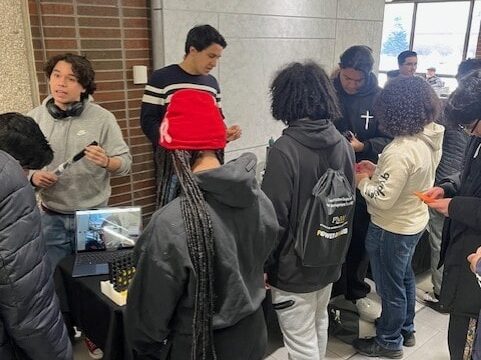
PNW offers STEM Discovery Day for area high schoolers
More than 200 area high school students immersed themselves in the fundamentals and real-world applications of artificial intelligence, cybersecurity robotics and more at a recent Purdue University Northwest annual “AI, Cybersecurity, and STEM Discovery Day” event.
The hands-on learning opportunity was presented by PNW’s colleges of Engineering and Sciences and Technology in partnership with One Region, Inc. and Salesforce to illuminate young learners on the different possibilities for various technological advancements in STEM fields and how they can prepare for careers that will be impacted by these technologies.
PNW students demonstrate different hands-on activities typically featured through the university’s STEM on the Road outreach initiative at the fall 2025 AI, Cybersecurity, and STEM Discovery Day. (Photo provided by Purdue Northwest)
Guided by PNW students and faculty and staff members, visiting high school students rotated through classroom and lab spaces on Dec. 5 in PNW’s Classroom Office Building, Donald S. Powers Computing Education Building and Audrey A. Potter Lab Building. Demonstrations and activities showcased cybersecurity exercises, robotics and mechatronics, and robot-human interaction. Student organizations, such as Society of Automotive Engineers Formula 1 Racing, Quantum Leap and Women in Information Technology, also shared more about how extracurricular opportunities enhance applied learning.
"AI, cybersecurity and robotics are already reshaping how we live and work,” said Grace Yang, chair of PNW’s department of Computer Science. “We want students to experience these fields with hands-on
activities, in real labs, alongside the people studying and building these technologies every day. Events like PNW’s AI, Cybersecurity, and STEM Discovery Day can spark curiosity, build confidence and help
students see clear pathways into high-demand STEM careers in our region.”
Visiting high school students represented over 15 different schools from Lake, La Porte and Porter counties in Indiana and Cook County, Illinois.
https://www.chicagotribune.com/2025/12/23/pnw-offers-stem-discovery-day-for-area-high-schoolers/