Category: News

If you’re looking for an underrated Naperville restaurant, check out this map
It is no secret that Naperville has become something of a foodie’s paradise, boasting everything from celebrity chef restaurants to high-end steakhouses to Korean, Filipino and French cuisines.
But some local spots are not getting the attention they deserve, according to Naperville resident Juan David Campolargo.
“In Naperville especially, you see so many restaurants that open and they just close so rapidly,” Campolargo said.
A major part of the issue, he said, is visibility. Particularly online visibility and what Google does or does not show you in a search.
“When discovery is dominated by algorithms that reward whoever already has momentum, it becomes much harder for new or independent places to survive long enough to ever be discovered at all, even by people who live a few blocks away,” he said.
To remedy the issue, Campolargo created the Naperville Underrated Food Map, a data-driven approach to highlighting restaurants that may not always appear at the top of a Google search.
“I just created this thing to hopefully help,” he said. “(The) real heroes are the restaurants and the people behind them. Keeping local places alive and making our town feel a little more connected is my humble goal.”
While Campolargo himself does not work in the restaurant industry, he has previously been involved in various food-related projects. There’s no particular reason why the 23-year-old undertakes the projects other than curiosity and a strong drive for problem solving, he said.
This screenshot shows the page a user can fill out when trying to find a new restaurant to check out via the online Naperville Underrated Food Map created by Naperville resident Juan David Campolargo. (Naperville Underrated Food Map)
For example, when Campolargo was a student at the University of Illinois Urbana-Champaign, he created a bot account on X, formerly known as Twitter, with the handle @UIUCFreeFood, which would advertise opportunities for free food around the campus. The account is still active with more than 2,000 followers, although it previously ran into trouble with university administration over misleading posts and an instance of alleged theft, something on which Campolargo declined to comment.
His most recent project with the Naperville Underrated Food Map, which can be found at www.juandavidcampolargo.com/projects/naperville-food-map, is a continuation of his problem-solving efforts.
“When you type ‘Where to eat?’ on Google, how does Google show you what it shows you? It’s a bunch of factors, right?” Campolargo said.
Those factors include how close a particular restaurant is to where a person is currently located, how many positive reviews a restaurant has received and whether that restaurant is part of a national chain.
What Campolargo focused on for his food map was “prominence,” which refers to businesses that have received significant positive ratings, a high number of reviews or are a well-established brand more likely to be pushed out by the algorithm.
“And then you have this reinforcing loop,” he said. “If you’re doing well and you’re popular, Google is great for you, but if you’re new or newer or independent, you don’t really have a chance to build prominence.”
In the context of the map, underrated is defined as “better than you’d expect given how certain places usually perform online,” Campolargo said.
For example, if you have 10 Thai restaurants in close proximity that all perform similarly and have a collective rating of 3.6, the average rating of those 10 restaurants together becomes the expectation. A restaurant that significantly exceeds that benchmark is considered underrated — not because it’s the best overall, but because it outperforms what diners might reasonably expect, Campolargo said.
Using a machine learning model, the map also considers more than just restaurant ratings. It also considers cuisine, price levels, review volume, neighborhood grid, chain vs. independent, restaurant type and location-level attention patterns. Using all those factors, the model learns the typical patterns for restaurants in the area, provides an expected rating for each place and then flags the ones that come out higher than expected.
Rosie’s Home Cookin’, for example, has an average rating of 4.7 whereas the average for American restaurants on the map is 3.83, meaning Rosie’s performs +0.87 better than similar restaurants in the area, marking it as underrated.
“If you think about it and explore the website, you will see the kind of places locals love once they try them, but that don’t always show up when you do the usual ‘restaurant near me’ search,” Campolargo said.
The goal of the map is simple: help people discover local restaurants and support the community by bringing more diners to businesses that may be overlooked otherwise.
“The people behind the restaurants, man, they work really, really hard day in, day out, feed so many people, pay taxes, make our city what it is,” Campolargo said.
You can check out the Naperville Underrated Food Map at www.juandavidcampolargo.com/projects/naperville-food-map.
cstein@chicagotribune.com
https://www.chicagotribune.com/2025/12/26/naperville-underrated-food-map-restaurants/
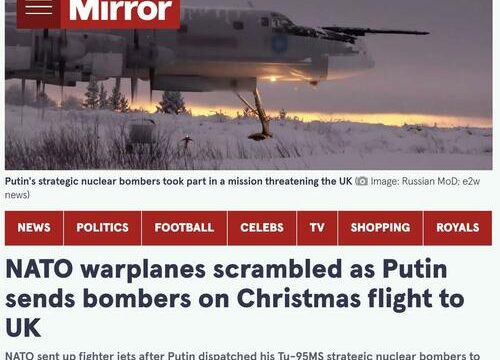
NATO Countries Scare Their Populations On Christmas With Hyped ‘Russian Nuclear Bombers’ Flight
NATO Countries Scare Their Populations On Christmas With Hyped ‘Russian Nuclear Bombers’ Flight
On Western Christmas, December 25, Russian nuclear-capable bombers conducted a “scheduled” flight over waters in the Arctic region, specifically in neutral waters of the Norwegian and Barents Seas. This prompted “fighter jets of foreign countries” to escort them and mirror them from afar, Russia’s defense ministry has confirmed.
While the country origins of the Western aircraft which responded remain unclear, the Kremlin had notified NATO in advance of the somewhat routine flight path. The bodies of water in question lie north of Scandinavia and northwest of Russia, which is quite far from the UK, and yet British media did what they do best: exaggerate and hype Russian nuclear bombers being “sent” by Putin “to the UK”…and on Christmas!
And never mind the fact that for Russia and its Orthodox Church, it is not Christmas. Russian Orthodox Christmas falls on January 7, according the Julian calendar ecclesiastical dating system.
These bodies of water lie far away from Britain, and is a standard flight path for Russia’s military. “At certain stages of the route, long-range bombers were escorted by fighter jets of foreign countries,” the Russian defense ministry disclosed.
The ministry further said that such flights “regularly take place in many regions and are in accordance with international law.”
Highlighting that these bombers were not at all ‘sent’ to the UK, one political commentator says as follows:
British media outlets like the Mirror and The Sun have reported that Russian nuclear-capable bombers flew a long-range patrol over the Norwegian Sea on Christmas Day Dec 25, 2025. Which was described as a deliberate act close to the notional “Santa Claus flight path”. NATO warplanes were scrambled to monitor the aircraft.
This is how the media spinned it! When it was two Russian Tu-95MS long-range bombers known as “Bears” that conducted a scheduled routine, seven-hour flight over “neutral waters” in the Barents and Norwegian Seas. The media made it sound like they were threatening NATO. When NATO was informed by the Russians the path that was taken.
The distant, far northern body of water in question…
Similar Russian bomber flights have recently occurred over the Sea of Japan, and in coordination with China’s military in the East China Sea, and such flight paths have even lately traversed the Black Sea.
Given the Ukraine proxy war is about to reach its fourth year, we are indeed living in dangerous times, but the situation is not helped when European press endlessly fearmongers and exaggerates. Of course, this is stoked by defense officials in London and Brussels, who keep pushing for bigger defense budgets, and for taxpayers to keep on funding Ukraine.
NATO apparently wanted young British boys and girls to know that its warplanes are keeping European skies safe from the ‘Russian aggressor’…
Tyler Durden
Fri, 12/26/2025 – 13:50

Evanston saw election, District 65 impasse, ICE operation and other newsmakers in 2025
Evanston saw its share of recurring and long-brewing storylines in 2025, but new ones made plenty of waves too. Here’s a look back at some of them.
Election brings subtle shifts
On April 1, incumbent Mayor Daniel Biss defeated his sole challenger, Jeff Boarini, by capturing nearly 63% of the vote.
Biss’ comfortable margin in securing his second term cemented his role atop Evanston’s politics. But that margin might also obscure the many tensions that simmered in the mayoral contest and in the city’s wards.
The year began with a mounting debate over Envision Evanston 2045, the city’s overhaul of its comprehensive plan and zoning. Biss spearheaded what he called a “bold” effort to transform Evanston, and he pushed for its adoption by April 1.
His critics, including Boarini, called the process rushed and saw the plan as out of character for the city. They had seized on a remark by Biss, who said it would be “immoral” not to act swiftly; he later said he regretted the phrase. The City Council pushed back the timeline in January after an uproar.
Still, the debate would persist as a potent issue, especially in northern Evanston, where residents had previously organized against Northwestern University’s efforts to commercialize its rebuilt Ryan Field.
On April 1, the 7th Ward would go on to elect Parielle Davis — who once created a campaign called “Better than Biss” that inveighed against the mayor for his role in approving Northwestern’s plans — to its open City Council seat.
Incumbents largely succeeded in holding onto their seats, thus preserving some of the dynamics of the previous council. The newcomers nonetheless injected new voices into Evanston’s long-brewing debates: Davis, as well as Shawn Iles, 3rd, and Matt Rodgers, 8th.
And soon the election dissolved into history, because another one looms. U.S. Rep. Jan Schakowsky, D-Evanston, announced in May she would not seek reelection. Biss, a former state legislator and no stranger to vying for higher office, launched a bid for Congress.
He’s one of more than a dozen candidates, including state Sen. Laura Fine, D-Glenview, activist Kat Abughazaleh, school board member Bushra Amiwala and retired FBI agent and crisis negotiator Phil Andrew to have emerged as potential successors.
Turmoil continues at D65
Evanston/Skokie District 65 opened 2025 by slashing $13.3 million in expenses for the 2024-25 school year, but as the next school year began, its quagmires persisted.
In fact, the district is ending the year deadlocked on two major issues: school closures and filling a vacant seat on its board. A decision on the first cannot happen without the second.
The Evanston/Skokie School District 65 Board of Education convening on its Dec. 1, 2025 board meeting. (Richard Requena/Pioneer Press)
District 65 must continue to cut costs as part of its Structural Deficit Reduction Plan, which calls for considering school closures. Some elementary schools operate with a student population below half their capacity, according to Pioneer Press reporting. So by late October, the board narrowed the potential closures to two or three schools.
In early November, however, one Board member resigned, leaving the Board to operate with six. In successive votes in November and December, the board twice deadlocked 3-3 on a proposal to close Kingsley and Lincolnwood elementary schools, as well as on a proposal to close only Kingsley.
The Board, however, has also deadlocked on choosing a replacement, meaning it hurtles toward the new year poised to leave the decision to the regional superintendent of schools. And district officials have said that without a decision on school closures before winter break, D65 will proceed not to close additional schools.
That leaves only one school that will shutter at the end of the 2025-26 school year, Dr. Bessie Rhodes School of Global Studies. The decision to close it was made by a previous Board.
With school closures effectively off the table, the district will likely, according to the Chicago Tribune, have to cut up to 78 positions to cover an approximately $5 million shortfall.
The district’s financial woes began in 2023, when it revealed that it had run a $7.5 million deficit in the 2022-23 fiscal year, and then it ran a $10 million deficit in the next, per previous reporting. The first disclosure came shortly after Devon Horton’s departure as superintendent.
Scrutiny of the district’s finances under Horton came to a head in October, when a federal grand jury issued a 17-count indictment accusing the then-superintendent of defrauding the district and pocketing the returns.
Working with three associates, Horton concealed his financial involvement in fraudulent contracts the district entered into, according to the indictment. It alleged he enriched himself with $81,000 in kickbacks, among other financial gains.
Horton and the three other men pleaded not guilty.
ICE operation spurs chaotic confrontations
The specter of a full-fledged operation by federal Immigration and Customs Enforcement descending on Evanston came true multiple times in the fall.
After the federal government launched its Operation Midway Blitz in September, Evanston residents encountered the masked agents several times and expressed their displeasure. On Oct. 31, a particularly chaotic confrontation ensued at Asbury Avenue and Oakton Street, where an Acura collided with a vehicle used by U.S. Customs and Border Patrol agents.
Evanston Mayor Daniel Biss, right, argues with U.S. Border Patrol Cmdr. Gregory Bovino as agents conduct an immigration enforcement action in a Home Depot parking lot, Dec. 17, 2025, in Evanston. (Armando L. Sanchez/Chicago Tribune)
A Border Patrol agent claimed the car had tailed the crew and then hit them. Other witnesses contended that the agents braked intentionally, resulting in the collision. A review of cellphone and Evanston police body camera footage by Pioneer Press revealed details of the fracas that followed.
The agents detained the sedan driver, as a crowd of witnesses began to record and protest the crew. One agent said, “Get back or I’ll shoot you.”
As the confrontation swelled, agents detained two people from the crowd. The videos show the forceful, violent nature of one of the arrests.
However, the Department of Homeland Security said that one detained man grabbed an agent’s genitals, though the man’s father called the claim a “bald-faced lie” in remarks to Pioneer Press.
The three detainees, all U.S. citizens, were driven around in a Border Patrol vehicle for hours and later released at FBI headquarters west of downtown Chicago without charges.
Operation Midway Blitz ebbed in November, but federal agents returned in force in mid-December. On Dec. 17, Border Patrol agents appeared at the Evanston Home Depot, where they detained a man and where Biss argued with Border Patrol Cmdr. Gregory Bovino.
Over the course of the fall, Biss encouraged attempts by the City Council to stymie immigration enforcement by banning ICE from city property and updating its Welcoming City Ordinance.
Evanston also drew attention for a different display of protest: a Nativity scene set up by the Lake Street Church. The original rendition had baby Jesus’ hands zip-tied in front of centurions labeled as ICE. Church officials said that the scene has seen two rounds of vandalism, as well as damage from heavy snowfall.
Northwestern, downtown, businesses
Northwestern, whose main campus sits in Evanston, saw upheaval aplenty in 2025.
President Michael Schill resigned his post in September after a turbulent tenure. In previous years he presided over a deal with pro-Palestinian protesters and the firing of football coach Pat Fitzgerald amid a hazing scandal.
In August, Fitzgerald — who has maintained that he didn’t know about the hazing and sued for wrongful termination — reached a settlement with Northwestern. Michigan State University named Fitzgerald its head coach on Dec. 1.
Henry Bienen, who’d served as president from 1995 to 2009, took over as interim president on Sept. 16. He announced on Nov. 28 that Northwestern made a pact with the federal government to bring back $790 million in frozen funding.
The agreement requires Northwestern to fork over $75 million, ending the months of trepidation among researchers and others after the Trump administration froze federal funding. Among other conditions, the university also agreed to keep following federal anti-discrimination laws and end the agreement with protesters.
Construction continued on Northwestern’s $850 million Ryan Field rebuild, set to finish in 2026. The project has drawn brickbats from neighbors who’ve decried the university’s plan to host commercial concerts there.
But many residents turned their attention toward downtown, where developers have circulated proposals to build residential high-rises.
After hearing impassioned supporters and detractors, the City Council in November narrowly approved a plan to build a 29-story tower on Davis Street with 419 residential units. At 299 feet, it would become Evanston’s tallest building, as well as the tallest residential structure in the suburbs.
Another proposal, which has yet to be finalized, calls for constructing a 27-story residential tower at 1711 Maple Avenue. It would occupy Church Street Plaza’s northern end, where a Chili’s restaurant beloved by Northwestern students closed Dec. 15.
The downtown dining scene lost another stalwart in October with the closure of Bob’s Pizza, whose Tuesday trivia nights drew politicians and students alike. However, the demise of the pies didn’t end the trivia operation, which moved to Prairie Moon.
https://www.chicagotribune.com/2025/12/26/evanston-election-district-65-ice-operation-in-2025/

Georgia Secretary Says 2020 Election Blunder ‘Does Not Erase Votes’
Georgia Secretary Says 2020 Election Blunder ‘Does Not Erase Votes’
Authored by Kim Jarrett via The Center Square,
Five years after the 2020 election, challenges in Georgia continue despite multiple audits.
The latest questions surround the December meeting of the Georgia State Election Board. Nearly two weeks after the meeting, some continue to claim Fulton County was fraudulent because tabulation tapes were not signed that included 315,000 votes.
Secretary of State Brad Raffensperger addressed the accusations in a social media post.
“Georgia has the most secure elections in the country and all voters were verified with photo ID and lawfully cast their ballots. A clerical error at the end of the day does not erase valid, legal votes,” Raffensperger said.
Other Republicans questioned Raffensperger.
Lt. Gov. Burt Jones, who is running for governor, criticized his opponent, Raffensperger, in a post Monday.
“If only Georgia had an official responsible for preventing clerical errors that undermine election integrity. Is there anyone in Georgia who has that job, Brad?” Jones said
U.S. Rep. Mike Collins, who is running for Senate, said he was “tired of empty words from weak leaders” in a social media post from his campaign page.
“President Trump is owed a massive apology,” Collins said. “Turns out over 300,000 early votes in the 2020 election were illegally certified but still included in the final results.”
An election cannot be overturned based on a rule, Robert Sinners communications director for the Secretary of State’s Office, told The Center Square.
“The basis for these claims is that Fulton County admitted to sloppy election administration and not following a State Election Board rule,” Sinners said in an email. “There is no mechanism in law to overturn the election based on not following this rule – as it wasn’t even part of the election code – it was a procedural rule.”
New procedures were put in place to ensure the mistake doesn’t happen again, Ann Brumbaugh, an attorney for the Fulton County Board of Registrations and Elections, told the State Election Board.
Sinners acknowledged improvements were needed.
“Based on the reports from appointed monitors who were on site in Fulton County reviewing the conduct of the election – there was sloppiness that needed improvement, but outright fraud was not a concern,” Sinners said.
The 2020 election was recounted twice, and then, subject to a 100% hand count, according to Sinners.
“This is in addition to more audits that took place in localized jurisdictions. I would say the 2020 election was the most scrutinized in history – at least in this state,” Sinners said.
Trump had repeatedly said the election that put Joe Biden in the White House was stolen. This month, the Department of Justice sued Fulton County and the state of Georgia, alleging that they had failed to turn over data about the 2020 ballots. Those cases are still pending.
Tyler Durden
Fri, 12/26/2025 – 13:25
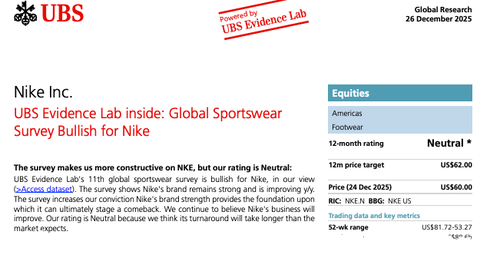
Amid Nike’s Worst Drawdown Since late 70s, UBS Flags Emerging Bullish Signals
Amid Nike’s Worst Drawdown Since late 70s, UBS Flags Emerging Bullish Signals
Nike was thrust into the news flow earlier this week after Apple CEO Tim Cook placed a buy order for 50,000 Class B shares at a weighted average price of $58.97. The stock has been locked in a four-year bear market, as recent earnings data point to softer demand in China and mixed channel trends in North America.
Looking past all the gloom, UBS analyst Jay Sole told clients Friday about UBS Evidence Lab’s latest global sportswear survey, which points to “bullish” trends for Nike.
Sole said the survey suggests “the brand is improving y/y and remains strong,” and that the turnaround could be just ahead. He has a “neutral” rating on the stock and believes the turnaround will take longer than the market expects. The survey results suggest Nike’s plan to prioritize re-entering the wholesale channel under new CEO Elliott Hill.
For context, Evidence Lab is UBS’s proprietary alternative data and analytics platform used by the bank’s clients to supplement traditional financial analysis. The data include large-scale consumer surveys, web traffic, app usage, geolocation, transaction data, pricing scrapes, and sentiment signals, providing actionable insights into brand health, demand trends, market share shifts, and competitive positioning.
Here is Sole’s complete insight into why “The Global Sportswear Survey Bullish for Nike”…
The survey makes us more constructive on NKE, but our rating is Neutral: UBS Evidence Lab’s 11th global sportswear survey is bullish for Nike, in our view. The survey shows Nike’s brand remains strong and is improving y/y. The survey increases our conviction Nike’s brand strength provides the foundation upon which it can ultimately stage a comeback. We continue to believe Nike’s business will improve. Our rating is Neutral because we think its turnaround will take longer than the market expects.
Survey results suggest 2 key elements of Nike’s strategy are working: Since Elliott Hill became CEO, Nike has prioritized re-entering the wholesale channel. In this year’s survey, a higher percentage of global consumers say Nike’s products are easy to find in stores and online. This percentage dropped from 2019 through 2022, but has rebounded to a new peak this year. We believe this is attributable to Mr. Hill’s channel strategy. Under Elliott Hill’s leadership, Nike has also refocused on sports. Likely as a result, the percentage of consumers who say Nike is “good for doing sports” bounced back to its 2019 peak level (Fig. 29).
5 other survey insights showing Nike’s brand strength and gains:
Nike holds the highest Net Promoter Score (NPS) among all brands and its scores are rising. The surprising fact is not only does Nike have the highest NPS globally, but it also has the best score in each of the four geographies studied (US, UK, Germany, China: Figs. 30, 67, 106, 153, 180). Plus, Nike’s NPS in each region are rising (Figs. 31, 68, 107, 144, 181).
Nike retains strong brand attributes. Nike ranks as the #1 or #2 brand globally in the “high-quality products,” “good for doing sports,” “prestigious brand,’ “innovative brand,” and “fashionable or cool brand” categories as well as others (Figs. 18-28).
Global purchase intentions are up y/y. Global consumers plan to buy more footwear as well as more apparel from Nike over the NTM (Figs. 14-15).
Global consumers’ impression of the Nike brand is improving. Plus, the rate of improvement relative to other brands’ looks good (Figs. 35-36). Gains in the US are particularly notable, in our view (Fig. 72).
Nike has the highest loyalty rate globally. Nike also has the highest conversion rate globally (Figs. 39-40).
Two modestly negative survey data points: The survey shows Nike has experienced slight erosion in global aided awareness within the 16-24 year-old age demographic (Fig. 10). This could be a consequence of Nike not being as “hot”of a brand over the last couple years as it was before that. Also, the Converse brand survey results are lackluster, in our view.
Valuation: Our $62 PT is based on 29x our $2.15 FY28 EPS estimate
For the full note, ZeroHedge Pro subs can view it here.
Sole’s view comes as the stock is locked in Nike’s worst declines since the late 1970s.
At some point, Nike will figure out how to sell more Air Force 1s in China and, if management is smart enough, stop selling “woke” propaganda.
Tyler Durden
Fri, 12/26/2025 – 13:00

Alsip Fire Department rescues 5 from apartment fire, including newborn
A fire on the first floor of an Alsip apartment building Monday afternoon trapped several residents on the floor above, the Alsip Fire Department said in a statement.
The Fire Department responded at about 4:30 p.m. Monday to the 4200 block of 115th Street. When firefighters arrived, several people were stranded on their balconies due to smoke in the hallways, the department said.
Five residents were evacuated from their balconies with ladders, and the fire was contained successfully,
“Because of the quick actions of the first arriving companies, the fire was contained to the original unit and 5 people were removed from their balconies including a newborn,” the department said.
elewis@chicagotribune.com
https://www.chicagotribune.com/2025/12/26/alsip-fire-department-rescues-5-balcony/
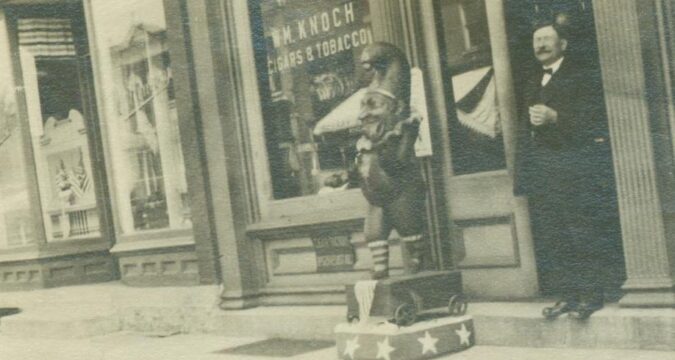
The Way We Were: Downtown cigar store/factory once employed 22 men
William Knoch stands in front of his cigar store at 42 W. Jefferson Ave. in downtown Naperville circa 1920. Knoch and his brother, George, launched their cigar-making factory and store in 1901, according to Naperville Heritage Society records. William would later buy out his brother and kept the business going until 1931. The building’s two back rooms were used to dry tobacco and make cigars and, at its peak, employed 22 men.
https://www.chicagotribune.com/2025/12/26/naperville-knoch-cigar-store-factory/

Lockport’s historic Gaylord Building awarded $30,000 grant for interactive waterways exhibit
The Gaylord Building in Lockport, a historic site along the Illinois & Michigan Canal, will be able to revitalize its exhibits with a $30,000 grant from the National Endowment for the Arts.
The grant will be used to reimagine the building’s first-floor main exhibit, which covers the impact of the I&M Canal on northeastern Illinois.
“It’s very stationary, so it’s not something you can easily change out. There’s large blocks of limestone in it,” said executive director Pam Owens. “It tells the story of the I&M Canal, and it’s great. It was an award-winning exhibit in 1999. It just needs a refresh.”
Another issue, she said, is the exhibit is now crowded enough that it can’t easily accommodate large groups, such as school groups.
“It’s difficult to even, say, have an entire classroom gather together in that space,” Owens said.
The goal is to use the grant to redesign the space, making use of digital kiosks to create more adaptable experiences that staff can easily update, replacing the fixed text panels.
“It will also allow us to build on those other stories that are part of the canal,” Owens said. “It might be that you would be like, OK, this time going through the exhibit I want to learn more about the Native American story. And so you can follow all of the panels, and it’s like having multilayered exhibits, where you can get just the story of the I&M Canal, or it could be a special exhibit where we’re going to talk about local breweries, or it could be about the Great Migration post-Civil War.”
The Gaylord Building is a site of the National Trust for Historic Preservation, a Washington D.C.-based nonprofit established by Congress that works to preserve historic buildings across the country.
The building dates from 1838, when it was constructed as a warehouse meant to hold building materials for the then-under-construction I&M Canal. When active, the canal ran 96 miles, connecting the Chicago River at Bridgeport to the Illinois River at LaSalle and Peru.
While the canal was later made defunct by improved shipping connections and parts of it have since been filled in, at the time it played an important role in Chicago’s development as a transportation hub.
“Back then, I mean, Illinois was the frontier,” Owens said.
The Gaylord Building in Lockport. (Evy Lewis/Daily Southtown)
A marker outside the Gaylord Building commemorates Gaylord Donnelly, who revitalized the building in the 1980s. (Evy Lewis/Daily Southtown)
After the canal was completed 10 years later, the building became a grain warehouse. Over the years, it was expanded multiple times and found multiple new lives, including as a brass foundry and a specialty print shop.
In the 1980s, the building was purchased by Gaylord Donnelly, whose grandfather had once owned the building and who began the process of renovating it and working to preserve it. His widow later donated the building to the National Trust for Historic Preservation.
Owens said work on more concrete plans for how the building can use the grant will begin starting in January.
“Ideally, we will have all of this done within a year,” Owens said.
There are other renovations she hopes to see the building undergo, including the creation of a fully immersive digital space.
“Eventually, we would like to take the rear part of this gallery and create an immersive experience, where everything is digital,” Owens said. “You could really go in and feel like you’re right there.”
elewis@chicagotribune.com
https://www.chicagotribune.com/2025/12/26/lockport-gaylord-building-interactive-exhibit/
La Grange adds safety requirements to bidding process for public works contracts
Submitting the lowest bid is no longer enough to win a public works contract in La Grange after officials added several new requirements last week.
“Current village purchasing policy requires certain construction projects to be competitively bid, specifically contracts in excess of $25,000 must be competitively bid,” Trustee Lou Gale said introducing the ordinance. “Quality workmanship, efficient operation, safety and timely completion of the projects are not necessarily ensured by awarding them solely on the basis of a low bid.”
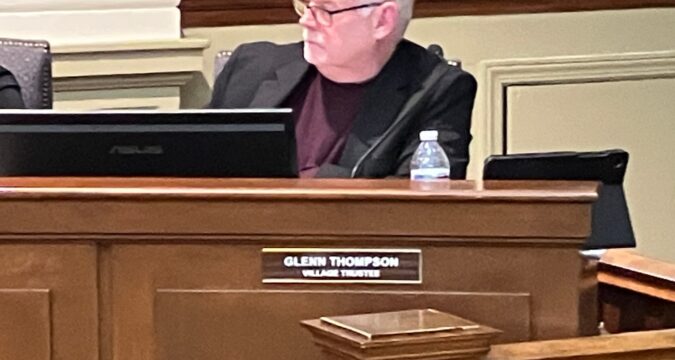
Gale joined Peggy Peterson, Shawana McGee, and Tim O’Brien in supporting the new ordinance, with Glenn Thompson and Beth Augustine dissenting in the 4-2 vote.
Changes to the bidding process include increasing the mandate for competitive bidding to $50,000 and adding other requirements, among them documentation that all contractors workers are covered under a worker’s compensation insurance policy, compliance with the Illinois Prevailing Wage Act and evidence of participation in an apprenticeship program related to the work on the project.
Another change proved problematic for Thompson and Augustine.
“Bidder must provide evidence of relevant experience on similar size and scope projects in the past five years that indicate the necessary capacity to perform the project and must provide adequate references verifying the quality of the work performed,” reads the change to existing ordinance, to be found on the Village web site, lagrangeil.gov.
Thompson referred to an earlier presentation from Baxter and Woodman about the potentially high costs involved with replacing lead service lines in the Village.
“We can’t use a new plumbing company until 2030 or 2031,” Thompson pointed out. “Any plumbing company that goes out to work on the water line replacement program will be five or six years into this program. We can never use them under the requirements of this project.”
Pointing out the new requirements included landscaping and maintenance contracts and put the same requirements on subcontractors, Thompson predicted problems would result, adding that apprenticeship program requirements and the Prevailing Wage Act mandate could factor be troublesome as well.
“I think we’re setting us up by going too far into detail,” he said. “We’ve brought in contractors from Indiana. Indiana is a right to work state. We’re going to now eliminate the use of all those contractors.”
Village President Mark Kuchler was strongly in favor of approving the changes without further delay, calling it a “model ordinance that has been looked at by our staff, by our village attorney. The one change that our staff really pushed was the dollar amount.”
Kuchler said nearby communities, including Countryside, had adopted similar ordinances.
Gale supported Kuchler’s position.
“I think the dollar threshold gives us the flexibility that folks are concerned about, it sets a line below which we’re not going to be beholden to these requirements, and I think setting clear qualifications for good, high quality work is good and something we should have,” he said.
The next meeting of the La Grange Board of Trustees will be 7:30 p.m., Jan. 12, at the La Grange Village Hall, 53 S. La Grange Rd.
Hank Beckman is a freelance reporter for Pioneer Press.
https://www.chicagotribune.com/2025/12/26/lagrange-public-works-contracts/

Why Christmas Is The Most Stressful Week For The Diesel Market
Why Christmas Is The Most Stressful Week For The Diesel Market
Authored by Charles Kennedy via OilPrice.com,
Holiday logistics lock in diesel demand regardless of price, draining already thin inventories.
Europe’s post-Russia diesel dependence makes year-end disruptions especially risky.
Christmas reveals structural fragility in distillate markets before crude prices reflect it.
Santa runs on diesel. Every year, the global holiday economy depends on a short, unforgiving surge in distillate consumption that powers trucks, ports, warehouses, refrigeration, and backup generation, all under winter operating conditions. That commercially driven holiday cheer strains logistics and exposes how thin the margin has become in some already-tight diesel markets, particularly in Europe.
After crude, diesel is the most economically important fuel in the system, and Christmas is when that reality asserts itself. In the U.S., distillate demand typically rises into December not primarily because of heating, but because freight intensity peaks at the same time inventories are already being seasonally drawn.
Recent weekly data show U.S. distillate supply running close to 4.0 million barrels per day, near the upper end of the post-pandemic range, according to the U.S. Energy Information Administration weekly petroleum status report. Commercial distillate stocks have hovered roughly in the 110- to 115-million-barrel range heading into late December, well below historical averages for early winter, based on EIA inventory data. That leaves little margin for error when logistics volumes increase in the final weeks of the year.
Europe’s position is even tighter.
Since the loss of Russian diesel flows, the region has become structurally dependent on long-haul imports from the U.S. Gulf Coast, the Middle East, and India. Northwest European gasoil inventories have struggled to rebuild to comfortable levels, a pattern tracked by Amsterdam-Rotterdam-Antwerp inventory reporting, and December freight demand reliably erodes whatever buffer exists.
On paper, supply appears to be enough, but in reality, the system is sensitive to disruption because replacement barrels travel farther, arrive later, and compete with the same shipping capacity needed to move goods.
Christmas matters because diesel demand during this period is not responding to price. Parcel delivery, food distribution, cold-chain logistics, and retail restocking all scale simultaneously.
Unlike gasoline, where weak consumer sentiment can soften demand, diesel consumption in late December is tied to physical throughput. Packages still move even if margins are thin. Missed deliveries turn quickly into lost sales, spoiled inventory, contractual penalties, and reputational damage. The demand is locked in by calendar and contracts, not price.
That shows up in crack behavior. In a normal year, diesel cracks widen in the winter as logistics and heating demand overlap.
In 2025, the signal has been much noisier. European diesel cracks softened in November amid mild weather and weak industrial activity, a trend flagged in ICE gasoil and ULSD crack spread tracking, yet physical premiums for prompt barrels have remained firm in several regional markets, according to European distillate market assessments. The divergence between paper cracks and physical pricing is exactly the kind of distortion Christmas amplifies, because immediate logistical needs trump macro drivers.
Refinery behavior also paints a similar picture.
Every December, operators would love to have operational flexibility, but holiday logistics force high utilization rates, particularly at distillate-heavy configurations. U.S. Gulf Coast refiners have often run above 90% utilization through late Q4, based on EIA refinery utilization data, prioritizing diesel yields even as gasoline margins slump. That optimization reduces slack in the system. When something goes wrong, weather, equipment failure, or pipeline constraints, there is less room to adjust or draw on inventories.
Exports add even more risk.
The U.S. has become Europe’s marginal diesel supplier, with distillate exports frequently running around 1.1 to 1.3 million barrels per day, according to EIA export flow data. Those barrels do not stop for Christmas. Any disruption along the export chain during this window, whether it’s fog in the Houston Ship Channel to Atlantic storms or congestion in Northwest European ports, happens when European buyers have the least flexibility and inventories are already drawn.
This is where “Santa runs on diesel” becomes very real.
The holiday economy is leveraged to distillate reliability. Diesel is found in every step, from long-haul trucking, regional distribution, last-mile delivery, refrigeration, and backup power to port equipment and warehouse operations. It is the fuel that fails last and hurts fastest when it does.
There is also a transition blind spot that becomes exposed every December. Electrification has made progress in urban delivery and short-haul fleets, but peak holiday logistics still fall back on diesel. Cold weather degrades battery range, charging infrastructure becomes congested, and payload constraints matter when volumes surge, issues documented in the U.S. Department of Energy cold-weather EV performance analysis. Even fleets with electric trucks routinely supplement with diesel during the holiday peak. In practice, the system falls back on oil and gas precisely when it is under maximum stress.
From a market perspective, diesel often shows stress before crude does. Brent prices below $60 do not mean the energy system is well supplied. As the IEA’s December oil market report suggests, weak crude prices can sit alongside tight distillate markets, volatile physical premiums, and localized shortages. Christmas makes that disconnect harder to ignore by concentrating demand and removing flexibility from the system.
Thin liquidity makes it worse. Christmas week is notorious for reduced trading activity, even as physical markets are under maximum strain, a dynamic regularly noted in year-end oil market liquidity analysis. Stresses surface first in local premiums, freight rates, and delivery delays rather than in headline futures prices. That is why year-end disruptions often feel sudden: the warning signs are there, but they are outside the most visible benchmarks, so often go unnoticed.
Looking into the New Year, this probably matters more than it usually does. Thin distillate inventories, high export dependence, and limited spare refining capacity suggest diesel markets could remain fragile even if crude stays range-bound, consistent with EIA short-term energy outlook projections.
While the holiday season doesn’t diesel’s vulnerability, it does bring it into full view. Diesel is where we see the stress first. Christmas just narrows the margin a bit more.
Tyler Durden
Fri, 12/26/2025 – 12:35
https://www.zerohedge.com/energy/why-christmas-most-stressful-week-diesel-market