Category: News

Zohran Mamdani is set to be sworn in as mayor as NYC rings in the New Year
Zohran Mamdani will become mayor of New York City as the clock ticks over into 2026 — but the celebrations are set to last through New Year’s Day.
The Democrat’s team is planning two separate swearing-in ceremonies Thursday — a small, private one with his family in an old subway station around midnight, followed by a large event in the afternoon that will include a public block party outside City Hall.
As a new mayor’s term begins immediately with the new year, it has been customary for the city’s incoming leaders to hold two events. Outgoing mayor Eric Adams held his initial swearing-in at Times Square shortly after the famous ball drop, while Adams’ predecessor, Bill de Blasio, took his first oath at home in Brooklyn.
For his part, Mamdani will take his initial oath at the former City Hall subway station in Manhattan — one of the city’s original stops on its subterranean transit system, known for its tiled arches and vaulted ceilings.
New York Attorney General Letitia James, a political ally and notable foe of President Donald Trump, will administer the oath of office.
The old City Hall stop was designed as the flagship station of the city’s first subway line, but was decommissioned in 1945. These days, outside of occasional guided historical tours, locals can usually only catch a glimpse of it by staying on the 6 train after its last stop downtown when it turns around to head north.
In a statement, Mamdani’s office said the choice to be sworn in at the station reflected his “commitment to the working people who keep our city running every day.”
“When Old City Hall Station first opened in 1904 — one of New York’s 28 original subway stations — it was a physical monument to a city that dared to be both beautiful and build great things that would transform working peoples’ lives,” Mamdani said.
“That ambition need not be a memory confined only to our past, nor must it be isolated only to the tunnels beneath City Hall: it will be the purpose of the administration fortunate enough to serve New Yorkers from the building above,” he said.
On Thursday afternoon, Mamdani will be sworn in again, this time by U.S. Sen. Bernie Sanders, one of his political heroes, on the steps of City Hall in a ceremony scheduled to kick off at 1 p.m. U.S. Rep. Alexandria Ocasio-Cortez, another political ally, will deliver opening remarks.
Mamdani’s transition formed an inaugural committee that includes actor John Turturro, playwright Cole Escola and writer Colson Whitehead, as well as advocates, small business owners and campaign workers who the incoming mayor’s office says have “provided perspective, guidance, and cultural sensibility” for the ceremony.
The public swearing-in will be accompanied by a block party along a stretch of Broadway leading up to City Hall. Mamdani’s office expects thousands of people to attend and says there will be performances, music and interfaith elements.
https://www.chicagotribune.com/2025/12/31/zohran-mamdani-sworn-in-nyc-mayor/

One dead in early Wednesday wreck on I-80 in Gary
Troopers with the Indiana State Police Lowell Post are asking for witnesses to come forward with information about a fatal wreck early Wednesday on Interstate 80 in Gary.
Around 2:30 a.m. Wednesday, troopers responded to a fatal crash in the westbound lane of I-80 at the 8.7-mile marker at Grant Street involving a semi and a car, according to a release on Facebook.
The three left lanes were closed for approximately five hours for scene cleanup. As of 7:15 a.m. Wednesday, the scene had been cleared, though traffic remained congested.
The truck was hauling 40,000 pounds of frozen food. The deceased was driving the car, while the truck driver was not injured. The name of the deceased has not yet been released by the Lake County Coroner’s Office.
ISP is requesting that anyone who witnessed the crash or has dashcam video of the incident contact the Lowell Post and speak with Trooper Hathaway at (219) 696-6242.
https://www.chicagotribune.com/2025/12/31/one-dead-in-early-wednesday-wreck-on-i-80-in-gary/

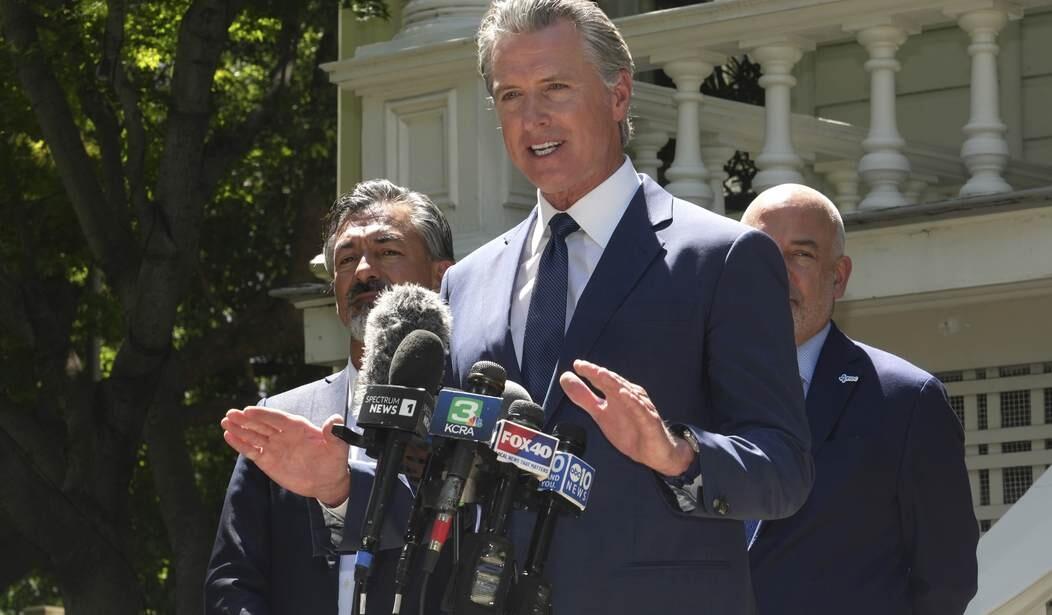
Newsom’s Massive Fraud Scandal No One Is Talking About
Newsom’s Massive Fraud Scandal No One Is Talking About
Authored by Matt Margolis via PJMedia.com,
Everybody’s buzzing about that Minnesota Medicaid mess with Gov. Tim Walz. Some are even calling it the largest fraud scandal ever. If only.
Blue-state fraud is undoubtedly a problem, and Walz should be held accountable if he did indeed look the other way. But what happened in the land of 10,000 lakes is tiny compared to the fraud in California under Gavin Newsom.
Heck, it makes Minnesota look like pocket change.
A fresh 92-page bombshell from the California State Auditor lays it all out.
“This latest report was issued by the state auditor, and that’s a nonpartisan position; that state auditor now puts eight state agencies on the high-risk list of agencies to watch out for, for things like fraud and mismanagement as well as waste,” Newsmax correspondent Heather Myers revealed last week.
“Here’s a look at that 92-page report. Newly added to the high-risk list is California’s food stamp program. If the state doesn’t get the improper payments under control, it could cost an extra $2.5 billion. Also on there is the Department of Finance, which was tasked with giving out COVID relief funds. Critics say $32 billion of that was taken by fraudsters. Then there are infrastructure issues like California’s deteriorating dams, and also the high-speed train that’s already cost taxpayers 18 billion without a single section of track complete.”
But wait, there’s more!
“Other reports cite $24 billion spent on the homeless issue that critics claim the state lost track of. More recently, there’s a report that says California cell phone users paid a surcharge for years to upgrade the state’s 911 system,” she added.
Tallied all up, California taxpayers lost $70 billion to fraud.
But here’s where things get really interesting. While pressure is on in Minnesota to get to the bottom of the state’s fraud, California seems to be under the radar.
Now get this. Right in the middle of the fraud apocalypse, a new ballot initiative seeks to impose a one-time 10% wealth tax on billionaires’ assets.
“Billionaires are threatening to leave California, and it’s all because of a possible new ballot initiative in the state. It’s a wealth tax. A healthcare labor group is behind this push, calling for a one-time tax on billionaires equal to 10 percent of their assets. And right now, it does not have enough signatures to get on the ballot,” CNN’s Abby Phillip reported Monday.
“These are big numbers, just to let people know what we’re talking about here. Larry Page, for example, he’s worth $258 billion. His estimated tax would be $12 billion. Peter Thiel, worth $27 billion. His estimated tax would be $1.2 billion. That’s not $1.2 in your pocket. It’s billions of dollars. So, I mean, should they or should they not?”
CNN’s Scott Jennings torched the whole scheme; it’s about covering up the fraud.
“And it is not for the public benefit,” he pointed out.
“In California, the state auditor just found $70 billion in fraud going on in the state. The reason they need a wealth tax is to cover up the fraud. The hole in the budget in California is due to fraud. That’s why they’re trying to tax people.” Boom. Panelists flipped out. Jennings doubled down. Why 5%? Why billionaires? Arbitrary envy tax to paper over Sacramento’s black hole. Imagine handing more cash to the clowns who blew $24 billion on tent cities.”
Make no mistake about it, he’s right. Newsom is going to run for president in 2028. Something tells me that $70 billion in fraud on Gavin’s watch is the kind of thing that won’t sit well in a primary, much less the general election.
Tyler Durden
Wed, 12/31/2025 – 11:15
https://www.zerohedge.com/political/newsoms-massive-fraud-scandal-no-one-talking-about
How a fast-moving $50 cash relief program buoyed needy families when SNAP payments were paused
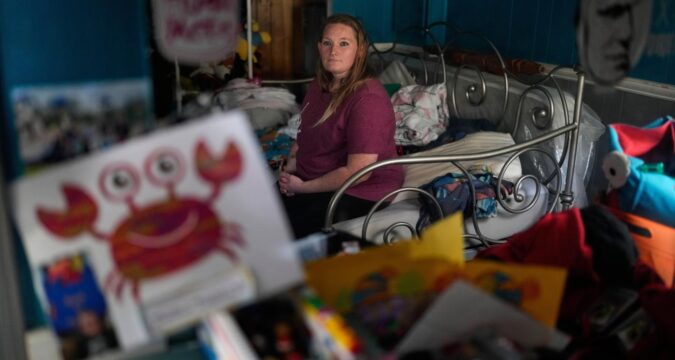
Finances already looked tight for Jade Grant and her three children as she entered the year’s final months.
“Everyone’s birthday is back-to-back,” the 32-year-old certified nursing assistant said. “You have holidays coming up. You have Thanksgiving. Everything is right there. And then, boom. No (food) stamps.”
Grant is among the nearly 42 million lower-income Americans who get help buying groceries from the Supplemental Nutrition Assistance Program, or SNAP. When the federal shutdown began in October, she wasn’t worried about losing her benefits — she said she is used to government “foolishness.”
But circumstances got dicey when the budget impasse entered its second month and President Donald Trump took the unprecedented step of freezing November SNAP payments. With one child who eats gluten free and another with many allergies, specialty items already drove up her grocery bill. Now Grant wondered how she’d put food on the table — especially with her youngest’s 6th birthday approaching.
Then Grant logged into Propel, an app used by 5 million people to manage their electronic benefits transfers, where she saw a pop-up banner inviting her to apply for a relief program. Within a minute she’d completed a survey and about two days later she got a virtual $50 gift card.
The total didn’t come close to her monthly SNAP allotment. But the Palm Bay, Florida, resident said it was enough to buy a customized “Bluey” birthday cake for her son.
Nearly a quarter of a million families got that same cash injection from the nonprofit GiveDirectly as they missed SNAP deposits many need to feed their households. The collaboration with Propel proved to be the largest disaster response in the international cash assistance group’s history outside of COVID-19; non-pandemic records were set with the $12 million raised, more than 246,000 beneficiaries enrolled and 5,000 individual donors reached.
Recipients are still recovering from the uncertainty of last month’s SNAP delays. Company surveys suggest many are dealing with the long-term consequences of borrowing money in early November when their benefits didn’t arrive on time, according to Propel CEO Jimmy Chen. At a time when users felt the existing safety net had fallen through, they credit the rapid payments for buoying them — both financially and emotionally.
“It’s not a lot. But at the same time, it is a lot,” Grant said. “Because $50 can do a lot when you don’t have anything.”
A ‘man-made disaster’ forces partners to try something new
It’s not the first partnership for the antipoverty nonprofit and for-profit software company. They have previously combined GiveDirectly’s fast cash model with Propel’s verified user base to get money out to natural disaster survivors — including $1,000 last year to some households impacted by Hurricanes Milton and Helene.
“This particular incident with the shutdown we saw as akin to a natural disaster,” Chen said, “in the sense that it created a really sudden and really acute form of hardship for many Americans across the country.”
The scope differed this time. The “man-made disaster,” as GiveDirectly U.S. Country Director Dustin Palmer put it, was not geographically isolated. The benefits freeze impacted more people than they usually serve. SNAP costs almost $10 billion a month, Palmer said, so they never expected to raise enough money to replace the delayed benefits altogether.
But 5,000 individual donors — plus $1 million gifts from Propel and New York nonprofit Robin Hood, as well as other major foundations’ support — provided a sizable pot. Palmer found that the issue resonated more than he expected.
GiveDirectly reports that the median donation was $100. Palmer took that response as a sign the issue hit close for many Americans.
“You and I know SNAP recipients. Maybe we’ve been SNAP recipients,” Palmer said. “So that was not a disaster in Central Texas where I’ve never been, but something in our communities.”
The greatest question revolved around the total sum of each cash transfer. Should they reach more people with fewer dollars or vice versa? Los Angeles wildfire survivors, for example, got $3,500 each from a similar GiveDirectly campaign. But that’s because they wanted to provide enough to cover a month’s worth of lodging and transit to those who lost their houses.
They settled on $50 because Palmer said they wanted a “stopgap” that represented “a meaningful trip to the grocery store.” To equitably focus their limited resources on the that would be missing the most support, Palmer said they targeted families with children that receive the maximum SNAP allotment. Propel’s software allowed them to send money as soon as the app detected that a family’s benefits hadn’t arrived at the usual time of the month.
Recipients decided whether their prepaid debit cards arrived physically, which might allow them to take cash out of an ATM, or virtually, which could be used almost immediately. The split is usually pretty even, according to Palmer, but this time more than 90% of recipients went with the virtual option.
“To me, that speaks to the speed and need for people,” Palmer said. “Just saying, ‘Oh yeah, I just need food today. I don’t want to wait to get it mailed.’”
Recipients lost trust when closely watched benefits were disrupted
Dianna Tompkins relies on her SNAP balance to feed her toddler and 8-year-old child.
“I watch it like a hawk, honestly,” she said.
But she said she entered “panic mode” when she missed what is usually a $976 deposit last month. She’s a gig worker, completing DoorDash and Uber Eats orders when she finds the time.
Her pantry is always stocked with non-perishables — canned goods, pastas, sauces — in case her unreliable van stops working and she can’t get to the store. But she couldn’t risk running out as uncertainty continued over the shutdown’s length and future SNAP payments.
GiveDirectly’s $50 bought her milk and bread — not much but a “big help,” she said. Her local food pantries in Demotte, Indiana, had proven inconsistent. One week they gave far more than expected, she said, but the following week they were “so overwhelmed” that it almost wasn’t worth visiting.
She said it’s “scary” the government “can just decide to not feed so many people.”
“At least I have my safety net but not everybody’s lucky,” she said. “I’ve never trusted the government and that’s just a new solid reason why I don’t trust them.”
Chen, the Propel CEO, said his company’s research suggests that November’s freeze damaged many recipients’ confidence in the government. Even with SNAP funded through the next fiscal year, Chen said, many respondents are concerned about another shutdown.
“Now it’s introduced this seed of doubt for people that this really fundamental thing that they use to pay for food may not be there when they need it,” Chen said.
The gap persists for many. Propel estimates that just over half of SNAP recipients got their benefits late last month. GiveDirectly launched an additional “mop-up” campaign to distribute cash retroactively for more than 8,000 people still reeling.
The delay disrupted the financial balancing act that Grant had going. She put off payments for her electricity bill and car insurance.
“Government shuts down and that just throws everything completely off,” she said.
https://www.chicagotribune.com/2025/12/31/cash-relief-program-snap-payments/

Proper battery disposal is now required by law in Illinois: Fear of fires is just one reason
As brand new gadgets come in and old ones are moved out of homes, one 2026 ban to note aims to keep the batteries in those items out of landfills for the safety of people and property.
Under the Portable and Medium-Format Battery Stewardship Act, producers of batteries are required to fund and manage the collection, transportation and recycling of certain batteries. That means consumers have to dispose of them properly, meaning it is illegal to throw them in garbage cans or recycling bins.
One of the reasons behind the statewide law signed by Gov. JB Pritzker in 2024 and taking effect this week is the risk of fire, which the city of Lake Forest has experienced.
According to the Lake Forest Fire Department, a lithium-ion battery was the likely culprit of a fire that started inside a garbage truck at the city’s Compost and Recycling Center in October.
Fire Chief Andy Rick said the improper disposal of batteries had caused multiple garbage truck fires in recent months, putting sanitation crews, equipment and the public at risk. No injuries were reported in that incident. The driver of the truck dumped the burning load onto the ground and moved the truck away before calling first responders.
But others have not been so lucky. Two police officers and a firefighter were injured in a garbage truck explosion in Arlington Heights in 2024.
Walter Willis, Solid Waste Agency of Lake County executive director, left, and Joe Martino, household chemical waste program and facility manager, display some of the batteries collected at the Gurnee recycling location. (Yadira Sanchez Olson/For the Lake County News-Sun)
An investigation by the Illinois Fire Department reported that while it was difficult to prove, “There’s a very high suspicion that this fire was started because of improper disposal of a lithium-ion battery in a recycling bin,” Arlington Heights Fire Chief Lance Harris said. “The amount of fire and the amount of heat that we had that day indicates that it was a lithium-ion battery, because when a lithium-ion battery goes into thermal runaway, it’s burning at around 750 degrees.”
Established collection sites, such as the Solid Waste Agency of Lake County, have equipment that can prevent such fires. SWALCO’s Executive Director Walter Willis said that through the program, the agency gets drums where batteries can be stored and then transported for recycling. These drums have the technology to snuff out a fire before it goes thermal, he said.
Retailers, such as Lowe’s, Staples and The Home Depot, are also collection sites for batteries, but Willis said the big batteries, like the ones in lawn equipment, e-scooters and e-bikes, should only go to SWALCO. And batteries that have been recalled should go back to the manufacturer.
The nonprofit battery recycling program Call2Recycle offers a drop-off locator on its website that allows for a Zip code to be entered and a type of battery for a list of the nearest recycling locations.
A new Illinois law makes it illegal to dispose of batteries in garbage or recycling bins. Instead, batteries are to be taken to a recycling center. (Yadira Sanchez Olson/For the Lake County News-Sun)
Lithium-ion batteries can be found in laptops, power tools, cell phones, and bigger items like e-bikes and drones.
The AAA, AA, C, D and 9-volt batteries, and button or coin batteries, which are known as single-use batteries that can be easily removed from electronic devices, are found in things like TV remote controls, wall clocks, watches, toys and flashlights.
Additionally, lithium-ion batteries contain valuable materials that can be recycled to produce new batteries, avoiding environmental and emissions impacts associated with the mining of more materials.
Fires caused by these batteries also release chemicals into the air that are not safe, Willis said.
These battery-related fires are becoming so prevalent that the National Fire Protection Association made the “Charge into Fire Safety: Lithium-ion batteries in your home” campaign the theme for the 2025 Fire Prevention Week.
Willis said one way to safely store batteries while collecting them to be recycled is to tape the ends of each terminal or contact point with household tape. Place them in a bag and then drop them off at the recycling center during a scheduled drop-off date or at one of the many mobile recycling events held throughout the year at different locations.
https://www.chicagotribune.com/2025/12/31/battery-disposal-guidelines/

Oil Heads For Worst Annual Loss Since COVID As US Crude Production Hits Record High
Oil Heads For Worst Annual Loss Since COVID As US Crude Production Hits Record High
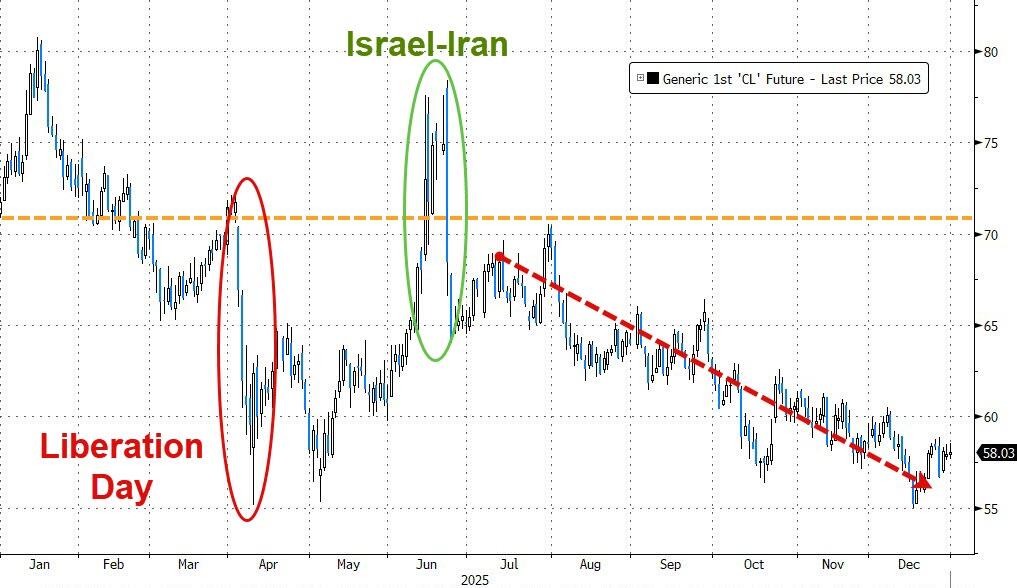
Oil futures are gaining in early U.S. trade, but on track to end the year substantially lower.
As Dow Jones reports, the unwinding of OPEC+ output cuts, along with higher non-OPEC production, fueled oversupply concerns in 2025, while U.S. sanctions and geopolitical tensions in the Middle East, Russia-Ukraine and more recently Venezuela led to frequent price spikes.
“The crude supply surplus will acquire greater transparency than was the case through most of the fall period as floating storage gradually finds its way into onshore facilities,” Ritterbusch and Associates says in a note.
But away from the geopolitical chaos, domestic supply and production remain key…
DOE
Crude -1.934mm
Cushing +543k
Gasoline +5.845mm
Distillates +4.977mm
Crude stocks fell for the 3rd week in the last 4 while product inventories saw their 8th straight weekly build in a row…
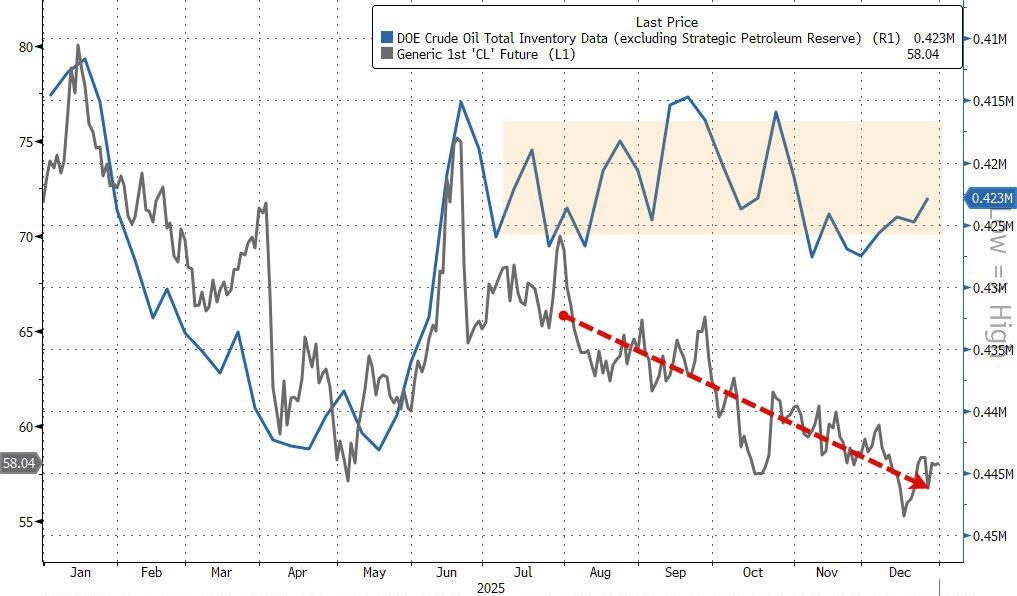
The US Crude Oil Total Inventory (excluding Strategic Petroleum Reserve) fell to 422,888 thousand barrels in the week ending Dec. 26, 2025, lowest since Oct. 31, 2025… decoupling from the crude price…
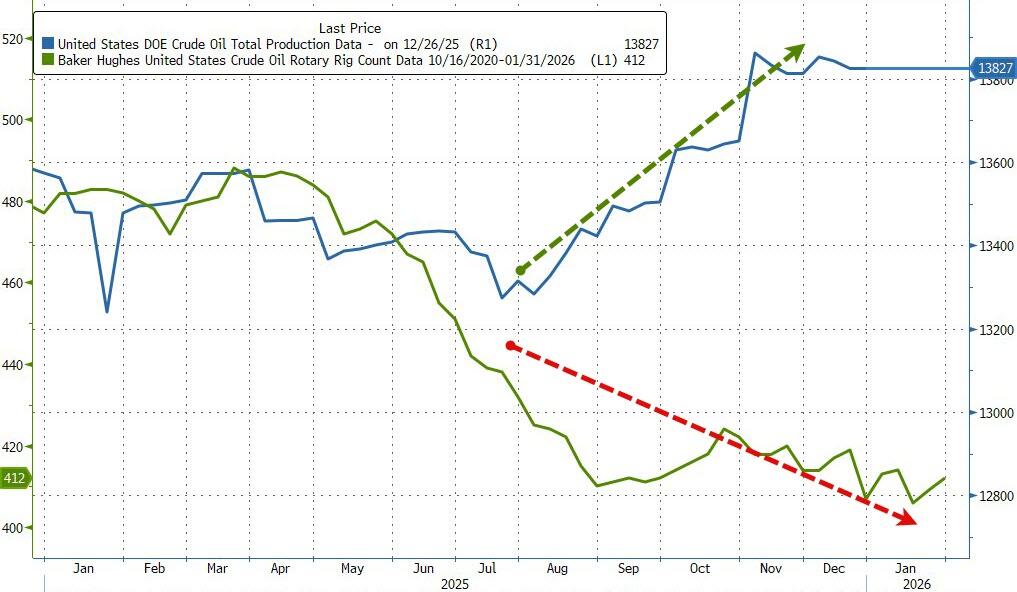
US crude production remains near record highs as the rig count has continued to slide all year…
Oil headed for its steepest annual loss since the start of the pandemic in 2020, in a year that has been dominated by geopolitical risks and steadily rising supplies across the globe.
OPEC+ roiled markets earlier this year by reversing its longstanding policy of defending prices and raised output, seeking to reclaim market share as countries including Brazil and Guyana boosted supply and the US pumped at record levels. The producer group is expected to hold off on output hikes during talks this weekend.
A punishing surplus is expected to weigh on prices in 2026 – Global oil markets have been been oversupplied this year.
“The oil market is set to remain oversupplied into 2026, with strong non-OPEC production from the US, Brazil, Guyana and Argentina outpacing uneven global demand,” said Kaynat Chainwala, an analyst at Kotak Securities Ltd. Prices should stay range-bound between $50 and $70, with risks over Venezuelan or Russian supply remaining supportive, she added.
Both the International Energy Agency and the US government see production exceeding consumption by just over 2 million barrels a day in 2025 and that surplus worsening in the coming year.
Tyler Durden
Wed, 12/31/2025 – 11:00

Somali Americans Face Audits For Potential Immigration Fraud
Somali Americans Face Audits For Potential Immigration Fraud
Authored by Kimberley Hayek via The Epoch Times,
The Trump administration is auditing immigration cases involving U.S. citizens of Somali origin to uncover potential fraud that might be grounds for revoking their citizenship, known as denaturalization.
“Under U.S. law, if an individual procures citizenship on a fraudulent basis, that is grounds for denaturalization,” Homeland Security Assistant Secretary Tricia McLaughlin said in a statement reported by Fox News then shared by the White House on social media.
Such denaturalization actions are rare, and the process often lasts years. Data from the Immigrant Legal Resource Center show an average of about 11 cases pursued annually between 1990 and 2017.
Since taking office in January, President Donald Trump has made enforcing immigration laws a priority, including ramped-up deportations, and visa and green card revocations.
Federal authorities have in recent months turned their focus to Minnesota’s Somali population, alleging it is an epicenter for fraud involving millions in federal funds for social services. FBI Director Kash Patel announced Sunday that the bureau has “surged” investigators and resources to Minnesota.
Meanwhile, the U.S. Department of Health and Human Services (HHS) announced Tuesday that it has stopped all child care payments to Minnesota. Nationwide, payments from the department’s Administration for Children and Families “will require a justification and a receipt or photo evidence before we send money to a state.”
The Small Business Administration said it plans to pause funding to the state pending investigation of suspected $430 million in Paycheck Protection Program (PPP) fraud, Administrator Kelly Loeffler posted to X on Dec. 29.
The House Oversight Committee is investigating an alleged cover-up of welfare fraud schemes in the state. HHS Deputy Secretary Jim O’Neill stated the department has “turned off the money spigot.”
Minnesota Gov. Tim Walz responded that his administration has “spent years cracking down on fraudsters” and accused Trump of “politicizing the issue to defund programs that help Minnesotans.”
The Justice Department has charged nearly 100 individuals in Minnesota’s fraud scandal, with 85 percent of Somali descent. Attorney General Pam Bondi credited independent journalist Nick Shirley for assisting in the investigations.
The FBI began deploying resources to Minnesota early in the probe, Patel said, as the White House raised alarms about fraud in the Somali community. Officials made public on Thanksgiving their concerns over ubiquitous scams.
The Labor Department sent a “strike team” to the state to investigate fraud, waste, and abuse. At least seven federal agencies are also involved in the probe.
Trump has denounced Minnesota as “a hub of fraudulent money laundering activity,” and moved to end temporary deportation protections for Somalis, citing gang activities. Reports suggest progressive policies and “Minnesota Nice” culture allowed such fraud to happen.
State lawmakers in Ohio have requested an investigation in their state, warning that similar fraud schemes may exist there, and urging law enforcement to “arrest, prosecute, jail, denaturalize, and deport all Somali fraudsters” in a letter state Rep. Josh Williams (R-Sylvania Twp.) shared with the state Department of Children and Youth on Dec. 30. The letter was signed by at least 40 other lawmakers.
Tyler Durden
Wed, 12/31/2025 – 10:45
https://www.zerohedge.com/political/somali-americans-face-audits-potential-immigration-fraud
American Heart Association revives theory that light drinking may be good for you
For a while, it seemed the notion that light drinking was good for the heart had gone by the wayside, debunked by new studies and overshadowed by warnings that alcohol causes cancer.
Now the American Heart Association has revived the idea in a scientific review that is drawing intense criticism, setting off a new round of debate about alcohol consumption.
A paper, which sought to summarize the latest research and was aimed at practicing cardiologists, concluded that light drinking — one to two drinks a day — posed no risk for coronary disease, stroke, sudden death and possibly heart failure, and may even reduce the risk of developing these conditions.
Controversy over the influential organization’s review has been simmering since it was published in the association’s journal Circulation in July.
Public health groups and many doctors have warned on the basis of recent studies that alcohol can be harmful even in small amounts. Groups including the European Heart Network and the World Heart Federation have stressed that even modest drinking increases the odds of cardiovascular disease.
In anticipation of new dietary guidelines, however, the Trump administration in September withdrew a report emphasizing the links between alcohol and at least seven cancers that found that the risk for oral and esophageal tumors begins rising at one drink a day.
The administration is relying instead on another report that concluded moderate drinkers had a lower risk of heart attacks and a lower-all-cause mortality than abstainers. But the report noted a higher breast cancer risk for women who drink.
Dr. Mariell Jessup, the chief science and medical officer at the heart association, said its review was focused on cardiovascular disease because that is the organization’s mission, adding that the review was not meant to serve as a guideline and that the group’s advice to patients has not changed.
“It says in all our guidelines right now, ‘If you don’t drink, don’t start.’ There’s not enough evidence to suggest conclusively that it prevents heart disease,” Jessup said in an interview.
But critics say even the suggestion of possible benefits for heart health is dangerous, because the risks of drinking are so great. They faulted how the heart association selected and weighed the studies it examined and said at least one author had ties to the alcohol industry in the past that should have disqualified him from participation.
“The cardiovascular benefits of moderate drinking are questionable at best,” said Dr. Elizabeth Farkouh, an internist and alcohol researcher. “But even if there was a benefit, there are so many other ways to reduce cardiovascular risk that don’t come with an associated cancer risk.”
Farkouh and her colleagues wrote a letter conveying their concerns to the AHA in July. She said the organization did not acknowledge receipt until this month, when asked about it by The New York Times.
The new review’s conclusion is at odds with the Centers for Disease Control and Prevention’s guidance on alcohol, which notes that “even moderate drinking may increase your risk of death and other alcohol-related harms, compared to not drinking.”
The review also seems to diverge from the heart association’s diet and lifestyle recommendation to consume “limited or preferably no alcohol,” along with its 2023 statement that recent research suggests there is “no safe level of alcohol use.”
No one disputes that heavy drinking is harmful. The debate — and it is a perennial one — concerns light to moderate drinking and whether that provides more protection from cardiovascular disease than not drinking at all. Heart disease is the leading cause of death among Americans.
Questions about light drinking are cropping up again because the U.S. dietary guidelines, which have long set parameters for safe alcohol use, are supposed to be updated by the end of the year.
The new guidance may be especially important for the alcohol industry, which is experiencing a slump in beer and wine sales, and more generally for Americans, who have greatly reduced their consumption. Only 54% still drink alcohol, and 53% say that even moderate drinking is bad for one’s health, a recent Gallup poll found.
There is no shortage of studies on the relationship between alcohol consumption and heart disease, but the quality of the evidence is variable, experts say. The results are often contradictory and interpretations differ.
The research has been financed at times by groups affiliated with the alcoholic beverage industry. Passions run high on both sides of the controversy, and scientists have been reluctant to run randomized controlled trials that deliberately expose participants to a harmful substance, even though such studies provide the most reliable evidence.
“There is a huge literature on this, but it’s almost entirely observational studies, which by definition are pretty weak,” said John Ioannidis, a professor at Stanford University who has written about why many studies’ findings are not reproducible.
Observational studies follow individuals and can find associations between a behavior, such as light drinking, and an outcome, such as heart disease or death, but cannot prove cause and effect.
When a scientific review is conducted, “a lot depends on which studies you choose,” Ioannidis said. “Experts don’t agree on what the best studies are.”
“Some are clearly horrible, some are good, but a lot are in the gray zone, and people may just cherry-pick and select those that agree more with their narrative.”
Critics of the new review said the authors had done exactly that, and had failed to consider or give adequate weight to studies that undermined the hypothesis that light drinking had benefits.
Until 10 years ago, the federal government’s dietary guidelines endorsed the idea that moderate drinking was linked to a lower risk of cardiovascular disease and lower overall mortality, and might even help maintain cognitive function.
But in 2020, the guidelines were changed to say for the first time that “emerging evidence” indicated that even moderate drinking was harmful, and may raise the risk of dying from some cancers and some forms of heart disease.
Those guidelines still say it is safe for men to have up to two standard servings of alcohol a day and for women to drink up to one serving. (A serving is defined as 0.6 fluid ounces of pure alcohol — equivalent to 12 ounces of regular beer, 5 ounces of table wine, or 1.5 ounces of distilled spirits.)
The Beer Institute maintains that current dietary guidelines should not be changed without objective and rigorous scientific review. WineAmerica, a national group that represents close to 500 wineries, says that the guidelines “allow our industry to promote responsible consumption.”
A J-shaped curve
The idea that a little alcohol is good for you was first put forth in the 1920s by Raymond Pearl, a scientist at Johns Hopkins University, who described the effects of alcohol as a J-shaped curve.
His observational study that introduced the curve found that heavy drinkers had the highest death rates (the top of the ‘J’). Light drinkers had the lowest death rates (the bottom of the J), while abstainers were more likely to have heart disease and die than light drinkers, though not as much as the heavy drinkers (the upward tip of the J on the left).
Dozens of subsequent studies replicated the trend, and for years it was taken as gospel that light drinking was good for your health.
But in the early 2000s, Kaye Middleton Fillmore, a sociologist at the University of California, San Francisco, started raising questions about who the abstainers and moderate drinkers in the studies were.
Were some abstainers already sick, she wondered, or had they quit drinking because of illness? And could the moderate drinkers be people who had adopted other healthy lifestyle behaviors, such as exercising regularly and eating in moderation, and had advantages including higher incomes and education?
More recent studies, called Mendelian randomization studies, have tried to control for these variables by studying people with genetic variants that change the way they metabolize alcohol so that drinking causes them discomfort and nausea.
They generally drink far less throughout their lives than other people, regardless of their socioeconomic class, prior illnesses or other behaviors. In these studies, such people were not found to be at higher risk for heart disease or early death, a finding that some experts said undermined the hypothesis that light drinking is beneficial.
But the heart association, in its July statement, gave short shrift to the Mendelian randomization studies “in favor of outdated, conflicting observational studies,” wrote Dr. Luis Seija, an internist who studies alcohol control policy and liver disease, in a post on his Substack newsletter, Last Call.
“This isn’t just an academic spat,” Seija wrote. People will “see headlines or quotes like ‘One to two drinks a day may reduce coronary artery disease.’ That’s the sound bite and exactly what the alcohol industry wants.”
Responding to criticism that important studies were left out of its review, the heart association said that the authors were not required to describe the inclusion and exclusion criteria.
In an interview with the Times, Dr. Gregory Marcus, the vice chair of the review’s writing group, said an overwhelming majority of studies consistently showed that light drinkers live longer than both heavy drinkers and teetotalers.
“Most studies that look at overall mortality have this J shaped curve.” He added, “It is remarkable.”
Some critics have also questioned whether the authors of the heart association’s review were sufficiently screened for past relationships with the alcohol industry.
Among the eight authors was Dr. Kenneth Mukamal, who headed a $100 million clinical trial of alcohol that was aborted by the National Institutes of Health when it became public that he and officials from the National Institute on Alcohol Abuse and Alcoholism had solicited $60 million in financing from alcohol manufacturers. NIH policies generally prohibit such solicitations.
The heart association said its policy required scientists only to disclose relationships with the industry during the year before they began the review. Mukamal was the opening speaker at a 2023 wine and lifestyle conference in Spain that fell within that period.
Asked by the Times about the conference, he said his expenses were covered by the University of Barcelona, one of the conference’s sponsors, and not by the wine industry. The website of the conference says that participants concluded that “the validity of the J curve was reconfirmed.”
There is one thing both sides in the debate agree on: Randomized controlled clinical trials would help resolve many lingering questions. But not all of them.
When patients with atrial fibrillation, a heart rhythm disorder, were instructed to stop drinking in a recent trial, their risk of experiencing a new episode dropped sharply.
Yet observational studies have found that people who drank one glass of wine a day are less likely to develop the disorder in the first place. The heart association review concluded that the effect of moderate drinking on atrial fibrillation “remains unknown.”
This article originally appeared in The New York Times.
https://www.chicagotribune.com/2025/12/31/heart-association-theory-light-drinking/
Justice Dept. now said to be reviewing 5.2 million pages of Epstein files
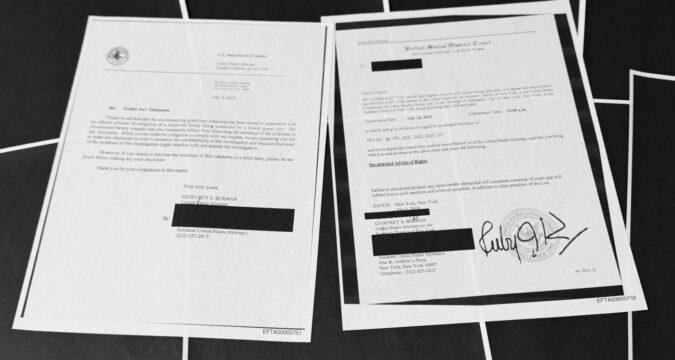
WASHINGTON — The Justice Department is seeking to enlist about 400 lawyers to review roughly 5.2 million pages of Epstein files documents, an effort that is drawing in prosecutors who work on national security and criminal cases, and in U.S. attorneys’ offices in New York and Florida, according to people familiar with the matter.
The number represents a more precise, and potentially much larger, figure than previous estimates provided by the department.
Congress required the Justice Department to release its files related to the investigations of convicted sex offender Jeffrey Epstein by Dec. 19. The department released about 100,000 pages on that date, and said in the days that followed that at least 1 million more documents still needed to be reviewed.
Since late November, the department has assigned nearly 200 lawyers from the national security division to review the documents and remove any information about victims, or anything that would compromise continuing investigations or national security. Now, Justice Department officials have told employees that they need more help to accomplish the task.
The document review is expected to take until at least Jan. 20, according to a person familiar with the matter. The Trump administration had already drawn the ire of Democrats and a few Republicans in Congress for appearing to break the law setting the deadline to release the documents.
The Justice Department has defended its handling of the matter. “We have lawyers working around the clock to review and make the legally required redactions to protect victims, and we will release the documents as soon as possible,” the department said on social media.
But the disclosure that only a fraction of the documents have been released has only added to the troubles surrounding the rollout of the material. After the initial release on Dec. 19, some photographs were removed from the online collection because of what the department described as concerns about them possibly containing information about victims.
One image showed a credenza with an open drawer containing other photos, including at least one of Donald Trump. Todd Blanche, the deputy attorney general, said the image was removed not to protect the president but because of concerns about whether that image contained any victims. The image was later restored to the collection.
This article originally appeared in The New York Times.
https://www.chicagotribune.com/2025/12/31/justice-dept-epstein-files/
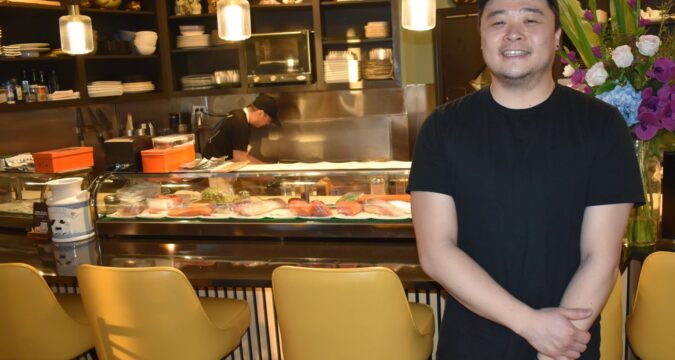
Down to Business: Wild Tuna, one of Naperville’s first sushi restaurants, still succeeding
Business: Wild Tuna
Address: 3344 S. Route 59, Naperville
Phone/website: 630-420-8801; www.wildtunasushi.com
Owner: Jeff Chiang, 37, of Naperville
Years in business: 20
What does your business do? “It’s definitely a restaurant but we definitely treat it as a ‘Cheers’ kind of bar. We feel that everyone knows each other. Over the past 20 years, my parents and I got to know so many different people,” Chiang said.
What’s the background? “My parents, Gene and Lena, owned it before me. They decided to retire so I took over in 2022. … I do a little bit of everything here. I cook. I make sushi. I do a little cleaning, a little schmoozing.”
Why did your parents open a sushi restaurant? “Twenty years ago, there was no sushi in this area. None. Now there are so many (sushi) restaurants. My parents had a Chinese restaurant, Yin’s Wok, at 95th and Book. Now it’s an Indian restaurant. … My parents are Chinese but they were born in Korea. They came here when they were pretty young.”
What were you doing before? “I was working here and I worked for a small start-up that started in Michigan. We had pre-made sushi put in coolers and delivered it to universities and hospitals. … Guaranteed fresh. … They started in Grand Rapids. I helped open the Chicago location. The name is Anu. I believe they only have locations in Michigan now.”
Yongquan Lin sharpens a knife he uses as a sushi chef at Wild Tuna in Naperville. Lin has been making sushi there for more than 10 years. (Steve Metsch/Naperville Sun)
Did you start here as a kid? “Yes, I was 16. I was hosting and I was a busboy. Now I’m the owner.”
What is sushi pizza? “Rice flour dough. Nice and crispy. Melt some cheese on top. Then we add some fresh tuna, fresh salmon, some avocado. Spicy mayo. … People think it’s kind of weird when they hear about it, but I recommend it.”
Why is sushi so popular? “It’s unique. You don’t get to eat a lot of raw protein in food. And, also, I feel like it can be very healthy as well. Also, it’s just appealing to look at it. It’s an art form.”
Does it take a while to learn? “From the basics to becoming a sushi chef takes about five years.”
Why does it take so long? “The technique involved. Also fileting the fish the correct way or making sushi the correct way. … And minimal waste, too.”
Where do you get your fresh fish from? “Everywhere. Spain. Japan. Korea. New Zealand. … We have distributors.”
How many types of sushi do you offer? “Eight to 10 different kinds of fish. Tuna is one of the more popular ones. Also, salmon.”
What do you like to order? “I like a variety. … I have to taste-test it once a day.”
Is fish delivered daily? “Every morning. It comes in on ice and we filet it right away, then prep it to be served. It’s about 90% prep. Making the sushi is more simple.”
What’s a first-timer’s typical reaction? “Wow, it’s so good.”
How much seating do you have? “Dining room has room for 60, another 20 at the bar and 10 at the sushi bar.”
Any future plans? “Stick with one location. I don’t want to spread myself too thin. Not yet anyway.”
You won’t go thirsty at the fully-stocked bar at Wild Tuna in Naperville. Owner Jeff Chiang said the restaurant has a “Cheers” feel, with many loyal patrons dining there often over the past 20 years. (Steve Metsch/Naperville Sun)
Is this a good location for business? “Route 59? Yes.”
What are your hours? “Tuesday through Thursday 12 to 9. Friday and Saturday, 12 to 10. Sunday is 4 to 8:30. We’re closed on Mondays.”
Do you offer carryout? “We do a lot of takeout and we do delivery. And we do third-party delivery as well.”
What about catering? “On occasion we have large parties where we do 300 to 500 rolls, a bunch of different kind of fish. We can do smaller events also. We do platters, party trays. … I’m trying to push the catering. We’re trying to do more events, parties. We can even do live sushi making on site.”
How many people work here? “We have about 20 employees.”
What about competition? “I don’t want to sound cocky, but (they) can’t do it the same because a lot of places take short-cuts. People can taste the difference. That’s my experience in trying other restaurants. The rice, the seaweed, even the sauces aren’t right.”
What’s your secret to success? “Multiple things. Working hard. Putting your best foot forward. And also building relationships with customers. Also, your food and service have to be consistent.”
When are you busy? “Friday and Saturday are the busiest. … Lunch is hit or miss, busier in the summer. We have a patio.”
What’s your advice for someone starting a business? “It’s not easy. Don’t expect it to be easy. … I’m here every day.”
Steve Metsch is a freelance reporter for the Naperville Sun. If you know of a business you’d like to see profiled in Down to Business, contact him at metschmsfl@yahoo.com.
https://www.chicagotribune.com/2025/12/31/naperville-sushi-restaurant-wild-tuna/