Category: News

Son charged with murder in Richton Park double homicide
The son of one of two people shot and killed Saturday night on Jackson Court in Richton Park has been charged in their deaths, according to court documents.
Javonte D. Morris, 21, faces two counts of first-degree murder, with court documents alleging he killed his mother, 38-year-old Nivia Phillips, and her boyfriend, 45-year-old Marcus T. Jones, after Phillips tried to kick him out of her apartment. The victims were identified by the Cook County medical examiner’s office.
Both were found unresponsive in Phillips’ apartment and pronounced dead at about 8:40 p.m. Saturday. The cause of death was listed as multiple gunshot wounds.
Court documents state Jones began telling Phillips’ cousin Friday, via text, that Morris had threatened Phillips’ life, “talking about he will smoke her.” Later that evening, Phillips allegedly texted the cousin that she was frustrated with Morris and intended to “put him out of the house,” while the cousin said she should have called the police.
Phillips texted the cousin again Saturday, according to court documents, saying Morris was talking about shooting her. During a subsequent call, the cousin reported hearing Morris threaten Phillips’ life, rack a firearm and say if police came, there would be a shootout, prosecutors said.
Phillips allegedly called 911 at 6:30 p.m., with Morris calling 911 himself two minutes later, reporting a shooting at the residence but not saying he was the shooter, prosecutors said. He left the apartment and was found standing behind a garage less than a mile away on Canterbury Court, prosecutors said.
Morris’ 4-year-old uninjured child was found hiding under a table at Phillips’ apartment and told police that her dad shot her grandmother and Jones after an argument, prosecutors said. The child told police Morris and Phillips were yelling at each other because Phillips was going to kick Morris out of the house, prosecutors said.
Police also found five shell casings in a bedroom and a pistol in the living room, court documents say. Morris was ordered to be detained while awaiting trial. The next court hearing is scheduled for 9:30 a.m. on Jan. 21 at the Cook County courthouse in Markham, 16501 S. Kedzie Pkwy.
ostevens@chicagotribune.com
https://www.chicagotribune.com/2025/12/31/son-charged-murder-richton-park-homicides/

These bipartisan bills were noncontroversial — until Donald Trump vetoed them
WASHINGTON — President Donald Trump issued the first vetoes of his second term on Tuesday, rejecting two low-profile bipartisan bills, a move that had the effect of punishing backers who had opposed the president’s positions on other issues.
Trump vetoed drinking water pipeline legislation from Republican Rep. Lauren Boebert of Colorado, a longtime ally who broke with the president in November to release files on convicted sex offender Jeffrey Epstein. He also vetoed legislation that would have given the Miccosukee Tribe of Indians of Florida more control of some of its tribal lands. The tribe was among groups suing the administration over an immigration detention center in the Everglades known as “Alligator Alcatraz.”
Both bills had bipartisan support and had been noncontroversial until the White House announced Trump’s vetoes Tuesday night.
Trump appeared to acknowledge the tribe’s opposition to the detention facility in a letter to Congress explaining his veto. “The Miccosukee Tribe has actively sought to obstruct reasonable immigration policies that the American people decisively voted for when I was elected,” Trump wrote.
Trump did not allude to Boebert in his veto of her legislation, but raised concerns about the cost of the water pipeline at the heart of that bill.
Boebert, one of four House Republicans who sided with House Democrats early on to force the release of the Epstein files, shared a statement on social media suggesting that the veto may have been “political retaliation.”
“I sincerely hope this veto has nothing to do with political retaliation for calling out corruption and demanding accountability. Americans deserve leadership that puts people over politics,” her statement said. Boebert added in another post: “This isn’t over.”
The Florida legislation had been sponsored by Republican Rep. Carlos Gimenez, whom Trump has endorsed. Gimenez and the Miccosukee Tribe were not immediately available for comment on Wednesday.
When asked whether the vetoes were punishment, the White House did not answer and instead referred to Trump’s statements explaining the vetoes.
Congress can override the vetoes by a vote of two-thirds of the members of the House and the Senate, but it’s unclear if there’s enough support in the Republican-controlled chambers to do so, especially heading into a midterm election year where many of them will be on the ballot and many GOP members will count on Trump’s backing.
Boebert’s legislation, the “Finish the Arkansas Valley Conduit Act,” aimed to improve access to clean drinking water in eastern Colorado.
While the congresswoman has long been a staunch supporter of Trump, she found herself at odds with the president with her support this year for legislation that required the Justice Department to release files related to Epstein.
Trump fought the proposal before reversing in the face of growing Republican support for releasing the files. Members of his administration even met with Boebert in the White House Situation Room to discuss the matter, though she didn’t change her mind.
Republican Rep. Jeff Hurd of Colorado, who co-sponsored the legislation, said he was “deeply disappointed” by Trump’s veto.
“This was a bipartisan, unanimous bill passed by Congress to uphold a long-standing federal commitment to southeastern Colorado,” Hurd said in a statement.
He said the legislation did not authorize any new construction spending or expand the federal government’s original commitment to the pipeline project, but adjusted the terms of repaying its costs.
Kinnard reported from Chapin, South Carolina.
https://www.chicagotribune.com/2025/12/31/bipartisan-bills-trump-vetoed/

Crew Paints Russian Flag On Iran-Linked Tanker To Avoid US Seizure
Crew Paints Russian Flag On Iran-Linked Tanker To Avoid US Seizure
The weird saga of the US-sought third tanker off Venezuela which was nearly boarded by US forces before fleeing into the Atlantic continues, after US officials have newly revealed more information.
US attempts to intercept the oil tanker Bella 1 in the Atlantic have been complicated after the ship’s crew painted a Russian flag on its hull. It has avoided and evaded the US Coast Guard for more than ten days after refusing to comply with an interception near Venezuela on December 21.
Reports based on US officials describe that the crew got creative in their evasion efforts, as they’ve added a Russian tricolor to the side of the vessel and so are now claiming it is operating under Russian jurisdiction.
This has created new complications, given Washington had secured a court order authorizing the ship’s seizure due to its alleged involvement in transporting Iranian crude. But now with the newly displayed flag Russian flag, this has made enforcement more difficult under international maritime law.
The tanker was traveling toward Venezuela without any cargo at the time that US Coast Guard forces tried to board it – and then it fled into open sea, after which US assets continued shadowing the ship.
Under the UN Convention on the Law of the Sea, authorities are allowed to board vessels that are flying false flags or lack proper registration – but in the scenario that Russia has officially registered the Bella 1, a forced boarding could risk diplomatic fallout and an international incident.
The tanker in question has been under US Treasury sanctions since 2024, as it has long been accused of transporting Iranian oil on behalf of Hezbollah, the Houthis, and Iran’s elite Islamic Revolutionary Guard Corps (IRGC).
The vessel is owned by Louis Marine Shipholding Enterprises, which is based in Turkey, and most of the crew are believed to be Russian, Indian, and Ukrainian.
The now apparently stymied attempt to apprehend the vessel comes soon on the heels of President Trump having ordered the US military to enforce a two-month “quarantine” of Venezuelan oil, signaling an intensification of gunboat diplomacy aimed at fostering regime instability in Caracas, with potential spillover effects that could ripple across the Caribbean into Cuba.
“While military options still exist, the focus is to first use economic pressure by enforcing sanctions to reach the outcome the White House is looking (for),” a US official told Reuters earlier this month.
The oil tanker Bella 1 is fleeing U.S. forces after the U.S. Coast Guard tried to intercept it in the Caribbean.
During the pursuit, the crew painted a Russian flag on the ship and now claim Russian status.
The tanker is under U.S. sanctions for carrying Iranian oil and was… pic.twitter.com/WOAMA35aRp
— Clash Report (@clashreport) December 30, 2025
“The efforts so far have put tremendous pressure on Maduro, and the belief is that by late January, Venezuela will be facing an economic calamity unless it agrees to make significant concessions to the U.S,” the U.S. official told Reuters.
According to analytics firm Kpler, Caracas has shipped nearly 900,000 barrels per day this year and relies on 400 dark-fleet tankers to transport the crude, much of which is bound for China.
Tyler Durden
Wed, 12/31/2025 – 12:15
https://www.zerohedge.com/geopolitical/crew-paints-russian-flag-iran-linked-tanker-avoid-us-seizure

Naperville Police Arrests for Dec. 23-26
The following items were taken from Naperville police reports and press releases. An arrest does not constitute a finding of guilt:
A 22-year-old man from Naperville was arrested on charges of aggravated criminal sexual assault/victim is 13 to 16 years of age and offender at least five years older and grooming at 12:45 p.m. Dec. 23 at the police station, 1350 Aurora Ave.
A 31-year-old woman from Warrenville was arrested on charges of driving on a canceled, suspended or revoked registration, driving on a revoked license, driving with expired license plates and driving without insurance at 7:12 p.m. Dec. 24 at South Route 59 and 79th Street.
A 36-year-old man from Chicago was arrested on a charge of driving on a revoked license at 10:33 p.m. Dec. 24 at North Route 59 and West Diehl Road.
A 27-year-old woman from Oswego was arrested on charges of obstructing identification and driving without a license/never issued at 12:25 a.m. Dec. 26 at West Diehl Road and Raymond Drive.
A 29-year-old man from Naperville was arrested on charges of driving under the influence of alcohol, driving without a registration/front or rear, driving without insurance, transportation or possession of open alcohol by a driver and improper use of registration/title at 1:22 a.m. Dec. 26 in the 1500 block of Fairway Drive.
A 36-year-old woman from Naperville was arrested on a warrant at 7:57 p.m. Dec. 26 in the 1500 block of Naperville Wheaton Road.
https://www.chicagotribune.com/2025/12/31/naperville-police-arrests-blotter-december-7/

Retired Blackhawks goalie Nikolai Khabibulin sells River North condo for $1.4M
Retired Chicago Blackhawks goalie Nikolai Khabibulin and his wife, Victoria, on Dec. 29 sold their three-bedroom, 2,333-square-foot condominium on the 37th floor of a River North high-rise for $1.355 million — some $407,500 less than they paid for it 20 years earlier. The sale price was close to $600,000 less than the amount they first had sought when listing the condo in June 2024.
The Russian-born Khabibulin, 52, signed a four-year, $27 million deals with the Blackhawks in 2005 but struggled to stay healthy and post consistent results, and he left the team in 2009 to sign a free agent deal with the Edmonton Oilers. He returned to play one final season with the Blackhawks in 2013.
The sale price received by the Khabibulins is another indicator of the softness in condo resale prices downtown. In River North, Nikolai and Victoria Khabibulin paid $1.7625 million in late 2005 for the east-facing unit, which is in the Pinnacle building. The unit has 3-1/2 bathrooms, floor-to-ceiling windows, two balconies, two primary bedroom suites, a recently renovated kitchen with quartz countertops, a breakfast bar and top-of-the-line appliances. Two parking spaces are included.
Now based in Paradise Valley, Arizona, the Khabibulins first listed the condo in June 2024 for $1.95 million and cut their asking price to $1.85 million in December of that year and then to $1.75 million in February. They cut their listing price further to $1.6 million in June, to $1.55 million in July and to $1.5 million in August.
Listing agent Julia Alexander did not respond to a request for comment on the sale. Jeffrey Lowe of Compass represented the buyers, who are not yet identified in public records.
The condo had a $25,795 property tax bill in the 2024 tax year. It also comes with $2,746-a-month homeowners association dues.
Goldsborough is a freelance reporter.
https://www.chicagotribune.com/2025/12/31/blackhawks-nikolai-khabibulin-river-north/

Southland crime: Sexual abuse in Homewood, online scam in New Lenox, and more
The following items were taken from police and court reports and news releases. An arrest does not constitute a finding of guilt.
Burbank
AGGRAVATED FLEEING: A Rolling Meadows man who outpaced an officer at 71 mph at 3:32 a.m. Nov. 23 on Cicero Avenue, while exiting a street takeover at Ford City Mall, is charged with aggravated fleeing, speeding and driving without headlights, police said. Xavier J. Barrera, 20, turned himself in Dec. 3 after learning Schaumburg police ordered his car towed as a felonious vehicle and impounded in Elgin, police said.
Evergreen Park
ELDER ABUSE: Jason M. Evans, 35, Evergreen Park, was arrested Dec. 3 and subsequently charged with aggravated battery to a person older than 60 after pushing down, hitting and throwing steak knives at the victim two days earlier in the 8800 block of Richmond Avenue, police said.
Frankfort
FORGED CHECK: A Joliet man accused of using another person’s driver’s license and insurance card Dec. 17 while trying to deposit a $4,300 check at a bank is scheduled to appear in Will County court Jan. 6, according to police and court records online. Anthony D. Harris, 60, 100 block of Oak Street, Fairmont, was arrested in the 19900 block of La Grange Road and is charged with forgery, identity theft and possessing fraudulent identification, according to police and court records.
Homewood
SEX ABUSE: Jacob Shankel, 26, Griffith, Indiana, was arrested Nov. 13 in the 17900 block of Dixie Highway and subsequently charged with aggravated criminal sexual abuse and child pornography, based on his relationship to a person younger than 17 and the recovery of nude photos and videos of a teen, police said.
AGGRAVATED DUI: Benyonna Saunders, 41, 500 block of Seneca Street, Joliet, was arrested Nov. 13 at Dixie Highway and Sycamore Drive on a charge of aggravated DUI stemming from a Dec. 29, 2024 crash that resulted in a passenger’s death, police said.
Lansing
AGGRAVATED BATTERY: A Nov. 27 domestic violence investigation in the 17900 block of Lorenz Avenue ended with the arrest of three family members, police said. Michael L. Hurtado, 23, 17900 block of Lorenz Avenue, Lansing, was charged with aggravated battery to a police officer, domestic battery and resisting arrest, Gisele L. Hurtado, 19, 2400 block of Indiana Avenue, Lansing, was charged with aggravated battery to a police officer and resisting arrest, and Erica J. Hurtado, 43, 17900 block of Lorenz Avenue, Lansing, was charged with assault, resisting arrest and obstruction, police said.
New Lenox
ONLINE SCAM: A Calistoga subdivision resident reported losing telephone service and finding bank passwords had been changed and a Sky Harbor subdivision resident reported losing telephone service Dec. 28 after they separately clicked an email link provided by a caller purporting to work for Verizon, who said it would cancel unauthorized phone purchases in Miami.
Oak Lawn
GUN POSSESSION: Ricky Smith was arrested and subsequently charged with aggravated unlawful possession of a weapon and possession of a firearm after an officer recovered a 9 mm Polymer80 pistol with a loaded magazine attached during a Dec. 12 stop at 53rd Court and Oak Street and determined he lacked a gun permit, police said. Smith was also charged with misdemeanor possession of a firearm lacking a serial number, police said.
Orland Park
FRAUD: Wael A. Nasria, 38, 8900 block of Silverdale Drive, Orland Park, was arrested Nov. 25 in that block and subsequently charged with unlawful possession of another’s credit/debit card with intent to defraud after officers recovered six cards belonging to other people, police said.
DUI CRASH: William P. Travis, 57, 4200 block of Fairfax Avenue, Tinley Park, was arrested during a Nov. 28 two-vehicle crash investigation at 143rd Street and Ravinia Avenue and subsequently charged with drunken driving, disregarding a traffic control device, failing to reduce speed to avoid a collision and failing to provide proof of insurance, police said.
DUI CRASH: Mary B. Mackey, 56. 11700 Glenview Drive, Orland Park, is scheduled to appear in Cook County court at Bridgeview Jan. 5, charged with drunken driving, failing to reduce speed to avoid a collision, illegally transporting alcohol and failure to provide proof of insurance, police said. Mackey was arrested Dec. 6 and taken to a hospital after a two-vehicle crash in the 11900 block of 143rd Street, police said.
Palos Hills
RESIDENTIAL BURGLARY: Jewelry and firearms were reported taken Dec. 10 during a burglary in the 7900 block of 102nd Street, with access made via the rear door, police said.
Park Forest
DUI CRASH: Deonnie B. Clark, 25, 200 block of Indiana Street, Park Forest, was charged Dec. 17 with aggravated drunken driving, failing to reduce speed to avoid a collision and improper passing in connection with a two-vehicle collision Dec. 15 in the 400 block of Illinois Street, police said.
Will County
WRONG WAY: A New Lenox woman who drove the wrong way on 159th Street is scheduled to be arraigned in Will County court Jan. 7, charged with drunken driving, improper lane use, improper turning, illegal transportation of alcohol and failure to provide proof of insurance, according to sheriff’s police and court records online. Mary K. Gremo, 57, 14000 block of Maple Road, was arrested Dec. 8 near the intersection of 159th and Wolf Road, sheriff’s police said.

High Electricity Prices Are A Choice Blue States Make Every Day
High Electricity Prices Are A Choice Blue States Make Every Day
Authored by Isaac Orr & Tom Pyle via RealClearEnergy,
Americans are anxious about their utility bills – and with good reason. Three quarters of U.S. residents are concerned about their electricity and gas bills rising this year, and 80% feel powerless over how much they are charged for utilities. For nearly two-thirds of U.S. billpayers, simply keeping the lights on has become a growing source of financial stress.
(don’t say her name three times in front of a mirror)
Those concerns are grounded in reality. U.S. electricity prices rose 27% during the Biden administration and another 11% between January and September 2025. Yet despite a national narrative eager to blame President Trump’s One Big Beautiful Bill Act (OBBBA), the real drivers of high electricity prices are far closer to home.
Electricity affordability is shaped primarily by state policy choices, and states choosing the most expensive path are overwhelmingly blue. So, blue-state residents are experiencing the pain much more than those in red states.
A new report from Always On Energy Research and the Institute for Energy Research finds that 86% of states with electricity prices above the national average voted for Democratic presidential candidates in 2020 and 2024. In contrast, 80% of the 10 states with the lowest electricity prices are reliably red. That’s not a coincidence. Those high prices reflect a consistent pattern of state-level energy policies that dictate emissions reduction targets at the expense of affordability, reliability, and physics.
States have the exclusive power to decide which resources supply their grids under the Federal Power Act. Governors, legislatures, and public utility commissions – not the White House – decide whether to impose renewable portfolio standards (RPS), enforce Net-Zero mandates, or prematurely retire reliable power plants. Those decisions directly determine how much families and businesses pay for electricity.
Today, 28 states enforce an RPS, requiring a certain percentage of retail electricity sales to come from renewable sources, and 16 states have 100% clean energy standards (CES) or carbon-free mandates. Many of these policies compel utilities to overbuild intermittent generation, such as wind and solar, thereby requiring significant investments in transmission, grid-scale storage, and backup generation to maintain reliability. The result is a higher total system cost, which is passed onto ratepayers in the form of higher electricity rates.
Consider that the U.S. average electricity price between January 2025 and August 2025 was 13.54 cents per kilowatt-hour. Each of the five most expensive states mandates 100% of their electricity come from renewable or carbon-free sources in the coming decades. Eight of the 10 states with the lowest electricity prices voted for the Republican presidential candidate in 2020 and 2024, and seven of the 10 don’t have renewable or carbon-free mandates.
New York is a prime blue state example, where electricity prices were 58% higher than the national average during the same period. The Progressive Policy Institute (PPI) found that New York experienced the second-fastest increase in electricity prices nationwide, with residential customers suffering a 36% increase between 2019 and 2024. PPI points to “the immense capital investment required to transform the grid and specific policy choices that increase the cost of energy production,” as well as the closure of the Indian Point nuclear plant.
It’s clear that Governor Kathy Hochul knows exactly which policy choices are driving up electricity costs — because she’s scrambling to roll them back. Ms. Hochul has delayed implementation of the state’s cap-and-tax mandates under the 2019 Climate Leadership and Community Protection Act (CLCPA), which includes a substantial renewable energy mandate requiring 70% renewable energy by 2030 and 100% carbon-free energy by 2040.
The state’s Department of Environmental Conservation defended the delay, arguing in court that the regulations would impose “extraordinary and damaging costs upon New Yorkers.” Ms. Hochul has approved two major natural gas pipelines and delayed implementation of the state’s ban on gas stoves in new buildings – a tacit admission that reliability and affordability still matter in New York.
California, however, remains committed to the most expensive path in the country with the fastest rate increase, now double the national average. For years, Governor Gavin Newsom and the California legislature have imposed on ratepayers a carbon-emissions reduction mandate, renewable mandates, solar cost-shifting through net metering, nuclear reactor closures, and EV charging subsidies.
For all of his climate-friendly posturing, Mr. Newsom signed a bill to ramp up oil drilling in Kern County, and his Energy Commission has delayed its plan to penalize refinery profits for five years. These reversals underscore a central truth: ideology will take a back seat to cost and reliability.
There’s a silver lining, however. While states can choose to raise electricity costs for their residents through bad policies, they can also choose to lower costs through good policies. For instance, Florida is the second-largest electricity producer in the country, behind only Texas. Residents require air conditioning for its hot, humid summers and heating in its mild winters. However, Florida delivers electricity at prices 2% below the U.S. average—mainly because it generates 75% of its power from imported natural gas. It has avoided aggressive climate mandates and delivers below-average electricity prices despite frequent hurricanes that require ongoing investment in the grid.
Louisiana and Kentucky have also invested in wise policies. Louisiana posted the third-lowest electricity rates in the U.S. in 2025, and Kentucky had the lowest rates east of the Mississippi River. Nearly three-quarters of Louisiana’s electricity is generated from natural gas, leveraging its abundant natural gas production and robust pipeline network. Kentucky, similarly, leverages its coal resources to generate 67% of the state’s electricity, with another 26% by natural gas. Neither has pursued aggressive carbon emissions reduction or renewable energy mandates.
Pinning the blame on the federal government and President Trump, as Democrats have been eager to do, ignores the vital role that states play in delivering affordable, reliable electricity. Secretary of Energy Chris Wright recognizes the same, stating on Fox News that “Electricity prices have risen very fast in blue states with restrictive renewable portfolio standards.”
The Department of Energy and President Trump can set the tone, but they don’t dictate the composition of state grids or the bills consumers receive each month. Those decisions rest squarely with governors, legislators, and regulators. Ultimately, it’s up to the states to prioritize reliable, affordable, dispatchable generation and drive down electricity prices.
High electricity rates aren’t an unavoidable consequence of modern life or federal policy. They are the predictable outcome of state-level choices that ignore reliability, undervalue dispatchable generation, and impose rigid mandates regardless of cost. Americans deserve leaders who recognize that keeping the lights on at a modest price isn’t optional. The states keeping electricity affordable today offer a roadmap for those willing to learn.
Isaac Orr is vice president of research at Always On Energy Research, a nonprofit energy modeling firm.
Tom Pyle is President of the Institute for Energy Research, a nonprofit energy research organization.
Tyler Durden
Wed, 12/31/2025 – 11:55
https://www.zerohedge.com/energy/high-electricity-prices-are-choice-blue-states-make-every-day

Column: Predicting three true outcomes in 2026
The future’s uncertain as we pass into early 2026. A friend’s Christmas card spelled out that feeling and the angst over the new year:
“We may have survived 2025, but here comes 2026. So hold on tight, kids.” That’s one of the scariest invitations to look forward to what comes next in a new year.
But what will emerge in 2026? We can count on three things happening this new year. Call them three true outcomes.
First, Illinois lawmakers will finally tackle property tax reform. We know this because of the howls coming from Cook County and the city of Chicago.
For decades, Lake Countians and property owners in other suburban counties have griped about rising taxes on their homes and businesses. Once, Lake County taxpayers paid their property tax bills on a yearly basis.
But as taxes continued to rise, county officials decided to split tax bills into one half due in the spring, the other half in September. That solved the problem of perception, but not the crunch of increasing taxes fueled by soaring property assessments. The issue, though, has been property assessments that have been rising faster than inflation.
In parts of Cook County, those property assessments more than doubled in 2025, with tax bills so high that senior citizen homeowners in some minority neighborhoods can’t afford to pay them. That’s a triple-witching of voter volatility because home insurance premiums skyrocketed last year, accompanied by soaring energy costs.
In Lake County, we’ve become used to billowing tax levies. We have some of the highest in the nation, if not the highest.
It’s usually a contest between Lake and a tony Connecticut county on the exurbs of New York City over who has reached the ignominious pinnacle of taxation. Of course, much of one’s property taxes in Illinois goes toward schools, and some of it for other taxing districts, the most in any state.
In Cook County, the finger-pointing has been between Assessor Fritz Kaegi blaming the Cook County Board of (Tax) Review for high homeowner assessments by chopping levies on commercial properties. The tax commissioners blame the assessor’s office. Homeowners are not amused.
So a legislative solution will be hammered out in Springfield, decades after disgraced House Speaker Michael Madigan, D-Chicago, promised property tax relief. Surely to be tackled by the super-majority Democrat legislature will be legislation curbing property tax sales and foreclosures. The debate over property-tax relief will be a drawn-out affair.
But rising taxes are not the party’s only issue that could give the state’s moribund Republican Party an opening in 2026. Nationally, many Democrats believe they have lost touch with Joe and Jane Six-pack, especially in the hinterlands and high-growth states.
After the drubbing Democrats received in the 2024 presidential election, there has been a bit of self-reflection. Our political parties do this after defeats.
Republicans did following the 1964 landslide by President Lyndon Johnson; Democrats when President Ronald Reagan won re-election overwhelmingly in 1984. In 1985, the Democratic Leadership Council was launched and adopted a pathway echoed after the 2024 debacle.
That being Democrats are inattentive to Americans’ worries about economic issues, blasé to national defense policies and overly reliant on social issues that few Americans besides progressive pols care about. Bill Clinton took that reassessment to heart and surprisingly defeated Republican incumbent President George H.W. Bush in 1992.
Some cracks in the state’s Democratic coalition have surfaced. The Illinois AFL-CIO, which represents some 1.7 million union members, last month failed to endorse candidates in the party’s heated March primary election for U.S. Senate, several Chicagoland congressional seats and state comptroller, where Lake County Treasurer Holly Kim of Mundelein is part of a quartet of candidates seeking to succeed retiring Comptroller Susana Mendoza of Chicago.
So expect Democrats to do the same deep cleanse in 2026. This despite the best efforts of Illinois Gov. JB Pritzker to keep the party on a leftward bent, while deep-blue Land of Lincoln remains surrounded by red states.
The third true outcome of 2026 is undoubtedly the easiest to forecast. President Donald Trump will say several goofy things, which will even have his supporters saying, “Wha?”
Like the other day when Trump met with Ukrainian President Volodymyr Zelenskyy about the nearly four-year-old war touched off by Russia’s invasion of Ukraine. Trump said Russian President Vladimir Putin “wants to see Ukraine succeed”.
That statement certainly was worthy of a bunker full of guffaws. Trump is either the most naïve president we’ve ever had when it comes to dealing with Russians and foreign policy, or he’s plain daffy.
We may know the answer to that more fully in 2026.
Charles Selle is a former News-Sun reporter, political editor and editor.
sellenews@gmail.com
X @sellenews
https://www.chicagotribune.com/2025/12/31/selle-column-new-year-predictions/

“Regulatory Theater”: Meta Created ‘Playbook’ To Obscure Scam Ads From Regulators, Avoid Forced Verification
“Regulatory Theater”: Meta Created ‘Playbook’ To Obscure Scam Ads From Regulators, Avoid Forced Verification
Last month Reuters revealed that roughly 10% of Meta’s annual revenue, or $16 billion, comes from advertising scams and banned goods – as the company only bans advertisers when its systems detect a 95% probability of fraud, while charging higher ad fees to suspicious buyers – a system critics describe as “pay to play.”
Data from fraud-reporting firm SafelyHQ shows Facebook is cited in 85% of scam reports that identify a platform, with more than 50,000 verified complaints collected so far, which CEO Patrick Quade suggests an implied victim count in the “tens of millions.”
Now, internal documents reviewed by Reuters indicate that Meta developed tools to both reduce scam advertising, and to limit regulators’ visibility into said ads after governments threatened measures that could severely cripple advertising revenue by forcing the company to reveal the identity of advertisers.
The efforts began last year after Japanese regulators highlighted a surge of scam advertising on Facebook and Instagram. The fraudulent ads included fake investment opportunities and artificial-intelligence-generated celebrity endorsements. Fearing that Japanese authorities might impose strict verification and transparency requirements that would materially affect its advertising business, the company launched an enforcement push aimed at reducing the number of fraudulent ads. At the same time, the documents show, the company focused on how those ads appeared to regulators.
The Ad Library and “Prevalence Perception”
Meta’s remedy centered on its ‘Ad Library,’ a public database designed to allow users to search for ads running on Facebook and Instagram. Meta employees realized Japanese regulators were using keyword searches in the library as a simple measure of the company’s effectiveness at tackling scams.
To improve performance on that measure, Meta staff identified the keywords and celebrity names most frequently used by Japanese Ad Library users. They then repeatedly ran those searches themselves, deleting ads that appeared fraudulent from both the Ad Library and Meta’s platforms.
Internally, the documents describe this work as managing the “prevalence perception” of scams. The stated objective was to make problematic content “not findable” for “regulators, investigators and journalists.”
The tactic produced rapid results. Within weeks, Meta staff reported finding fewer than 100 scam ads in a week, followed by several consecutive days in which searches returned none. A Japanese legislator publicly praised the apparent improvement, and Japan ultimately did not impose the advertiser-verification rules Meta had feared.
From Local Response to Global Strategy
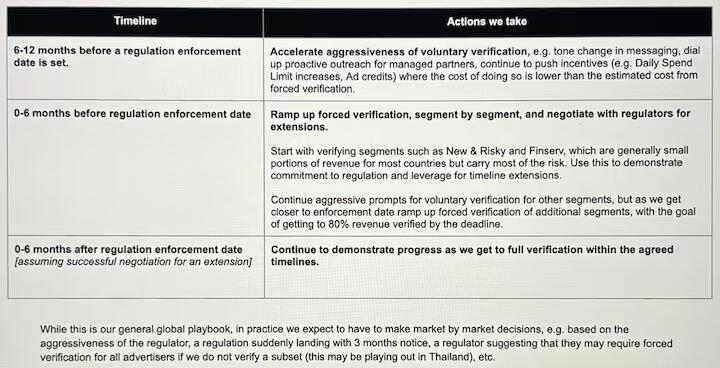
Given their success in dealing with Japan, Meta incorporated the approach into what internal documents describe as a “general global playbook” for responding to regulatory scrutiny worldwide. The same techniques – scrubbing Ad Library search results and reducing the discoverability of scams – were later deployed in markets including the United States, Europe, India, Australia, Brazil and Thailand.
This was all part of a broader strategy for delaying or weakening regulatory action, according to the report – with the playbook guiding Meta officials to offer voluntary measures, requesting time to assess their impact, and resisting universal advertiser verification unless laws leave no alternative.
Former Meta fraud investigator Sandeep Abraham, who left the company in 2023, said the approach distorts the transparency the Ad Library was meant to provide. Rather than offering an accurate view of advertising on Meta’s platforms, he said, it presents a curated picture optimized for regulatory review. Abraham described the tactic as “regulatory theater.”
Meta disputes that characterization. Company spokesman Andy Stone told Reuters that removing scam ads from the Ad Library is not misleading because the ads are removed from Meta’s systems overall. Fewer scams appearing in the library, he said, indicate fewer scams on the platform.
“To suggest otherwise is disingenuous,” Stone said.
Yet, the best solution would be costly – as Meta has long recognized that universal advertiser verification would significantly reduce scam activity. Internal analyses indicate the company could implement such a system globally in less than six weeks – yet the company has repeatedly balked at the cost. Executives estimated that universal verification would require roughly $2 billion to implement and could eliminate up to 4.8% of total revenue by blocking unverified advertisers. Despite generating $164.5 billion in revenue last year, nearly all from advertising, the company chose not to proceed.
Internal data show that unverified advertisers account for a disproportionate share of harm. One 2022 analysis found that 70% of newly active advertisers were promoting scams, illicit goods or low-quality products.
Instead of adopting verification, Meta chose what documents describe as a “reactive only” stance, accepting universal verification only where mandated by law.
Whack-a-Mole
Despite Meta’s playbook, Taiwanese regulators dropped the hammer – threatening steep fines for unverified financial scam ads. Meta rushed to comply with new rules requiring advertiser verification, which authorities said coincided with dramatic reductions in investment and impersonation scams.
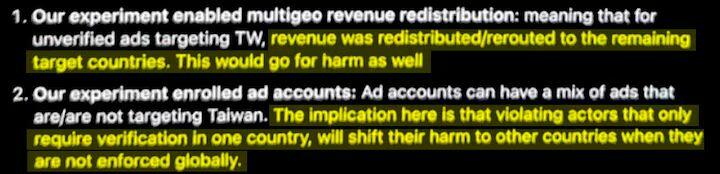
Meta’s own analyses, however, showed that much of the blocked fraudulent advertising was rerouted to users in other countries, displacing both revenue and consumer harm rather than eliminating it. Unless verification was enforced globally, staff warned, Meta would be relocating scams rather than eradicating them.
Even then, the documents show, the financial costs to Meta have remained small. Meta’s own tests showed verification immediately reduced scam ads in those countries by as much as 29%. But much of the lost revenue was recouped because the same blocked ads continued to run in other markets.
If an unverified advertiser is blocked from showing ads in Taiwan, for example, Meta will show those ads more frequently to users elsewhere, creating a whack-a-mole dynamic in which scam ads prohibited in one jurisdiction pop up in another. In the case of blocked ads in Taiwan, “revenue was redistributed/rerouted to the remaining target countries,” one March 2025 document said, adding that consumer injury gets displaced, too. “This would go for harm as well,” the document noted. -Reuters
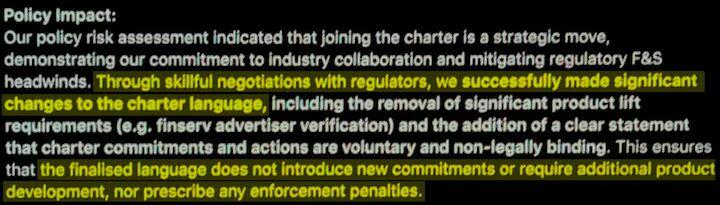
Hong Kong is another example – where Meta lobbyists moved quickly in 2024 to blunt a proposal by financial regulators that would have required verification of advertisers promoting investment products. To preempt stricter rules, Meta staff helped regulators draft a voluntary “anti-scam charter” and coordinated with Google to present what one lobbyist described internally as a “united front.” The final language, the documents note, imposed no new verification requirements or product changes. In an internal message celebrating the outcome, a Meta lobbyist wrote that regulators had relaxed measures that would have forced identity checks for financial advertisers, adding that officials expressed “huge appreciation” for Meta’s participation. Hong Kong regulators later said advertiser verification was only one of several tools available to platforms and emphasized that they lacked authority to mandate such requirements, while urging social media companies to do more to detect and remove fraudulent content.
In a statement, Hong Kong financial regulators said that “advertiser verification is one of many ways social media platforms can protect the investment public.”
In light of these findings, Meta has assigned scam handling its highest internal risk rating for 2025, citing regulatory, legal, reputational and financial exposure. One internal estimate warned that potential liability in Europe and Britain alone could cost as much as $9.3 billion.
Meanwhile, regulatory scrutiny has intensified – with European authorities having formally requested information about Meta’s handling of scam ads, and two U.S. senators urging federal agencies to investigate the company. The attorney general of the U.S. Virgin Islands has sued Meta, alleging it knowingly profited from fraud. Meta has said it strongly disagrees with the allegations.
For now, the documents suggest Meta believes its approach is working.
Tyler Durden
Wed, 12/31/2025 – 11:35