Category: News
Gold’s Bigger Picture In A Narrowing 2026
Gold’s Bigger Picture In A Narrowing 2026
Authored by Mathew Piepenburg via VonGreyerz.gold,
It’s that time of year again to put everything somehow together.
But looking back on the knowns of 2025 as we prepare for the inevitable unknowns of 2026, there is little need for the wringing of hands.
Preparation vs. Timing
This is because the more things change, the more they stay the same. And toward this end, we do know this much: Unprecedented and unsustainable debt has made the global financial system, its paper currencies and its bloated markets a bug looking for a wind-shield.
In short, and as history confirms, there is no avoiding the gravity of debt nor the ripple effects of its appalling misuse.
Mouse-clicked trillions to monetize debts just means slow but consistent currency destruction. Timing the same is not nearly as important as preparing for it, and the walls are narrowing/closing in on a broken monetary model.
Equally known is the fact that policy makers in such a desperate yet now mathematically obvious setting of their own making will do what they have always done throughout history.
That is, as conditions worsen, they will become increasingly desperate (perhaps even militant) to employ their favorite tools of manipulation, dishonesty and non-accountability for the fatal corners in which they’ve placed us and our debased paper currencies.
In the end, and as usual, the man on the street will pay for the sins of the clowns in power who have made the currencies by which they measure their wealth little more than melting ice-cubes.
Precious metal owners, of course, have seen this pattern recognition well ahead of the crowds. The historical, banking, and currency risks attendant to all slowly dying monetary systems means one thing: Real money will have more power than paper money. Or as I stated elsewhere: Rock now beats paper.
Looking Back
We saw 2025 begin with much fanfare out of DC to cut spending and impose a series of emergency measures (from gold-revaluation and tariff headlines to USAID and The GENIUS Act) out of the White House to make a clearly broken America great again.
“Our Currency, Your Problem.”
Critical to this laudable goal was the “External Revenue Service” and a wave of tariff measures designed to make the rest of the world pay for the overspending of a nation who for decades arrogantly maintained that an “our currency, your problem” policy would never end.
That is, after America waffled from a promised gold-backed dollar in 1944 to a welched fiat-dollar in 1971, it then conveniently imposed a petrodollar in 1973 to force global demand of an otherwise inflationary dollar before legally (and equally conveniently) price fixing the dollar’s only honest antagonists – gold and silver – on the COMEX exchange in 1974.
As owners of the world reserve currency, the U.S. could compel decades of demand for its dollar through oil, while simultaneously knee-capping precious metals on the New York COMEX and then export American inflation globally with impunity.
Or so we thought.
But with debt levels at $38T (unlike $250B in 1971) and a debt/GDP ratio at 124% (unlike 38% in 1971), the U.S. and its weaponized dollar is clearly not the same hegemon today that it was when John Connolly made the famous claim, “Our currency, your problem.”
In short, the U.S. went too far, and the world knows it.
Our Currency, Our Problem
When, for example, the U.S. attempted its Liberation Day tariffs in April of 2025, markets tanked. But far more importantly, no one showed up at Uncle Sam’s Treasury auction to buy his unloved IOUs.
Not very, well… liberating.
In other words, and thanks to decades of debt-addiction, inflation-exporting and the fatally short-sighted (stupid) idea of weaponizing the dollar in 2022, DC was forced to accept the inevitable yet now present karmic reality that “our currency is now OUR problem.”
Or stated even more simply, no one wants, trusts or fears the indebted and debased USD as they did in decades prior.
This IS a problem for DC…The U.S. is simply too much in debt to be all-powerful. 2025 and 2026 were and will be a much different world than 1944 or 1971. The US, in short, is not what it once was, and nor are its dollars or IOUs.
Who Wants an IOU from a Broke(n) Issuer?
Since the USA outsourced the American dream and manufacturing to China and the WTO circa 2001, it has lived essentially on debt and the assumption that the world, from Tokyo and Riyadh to Moscow and Shanghai, would always buy its IOU’s and hence its dollar.
By April of 2025, however, we learned this assumption was not only arrogant – it was false.
As U.S. markets plunged and crickets chirped at the April Treasury Auction, DC was forced to immediately retreat on its strong-armed tariff policy in order to restore calm on the NASDAQ as well as renew interest in its less-loved UST and USD.
Anywhere But the USA?
Around the same time as the DXY and dollar were cratering in 2025, the ABUSA—or “anywhere but the USA”—trade kicked into gear, as an already openly de-dollarizing BRICS+ wave was joined by booming stock markets in the UK, Japan and emerging markets, all of whom outperformed the US composites.
Even European stocks, suffering under genuine recessionary indicators from angry French farmers to Volkswagen shutdowns, rose 36% in dollar terms, including dividends, nearly doubling the S&P’s 19% in 2025.
AI Will Save Us?
Meanwhile, US markets pretended that AI, which had gone from expensive to just ridiculous, would somehow save us from, well, I guess humans themselves.
AI (whose prices vastly outpace revenues) accounted for 80% of US market gains in 2025. NVDA, at the center of a circular financing bubble in which concentrated tech names were investing over $350B in AI data centers, and pricing in what they assumed would be $2T in annual revenues which have yet to arrive.
A Ticking Credit Time Bomb
This dangerous AI spend/bubble is funded primarily in off-balance sheet debt via private credit pools and other SPVs, the magnitude of which screams of credit risk.
Speaking of private credit, this market of bad loans to an entirely unknown class of largely subprime borrowers now churning between hedge funds, private equity pirates, and VC supermen is literally screaming of default risk ahead.
Tapped-out borrowers in these hidden pools are paying their interest payments in “equity” rather than actual dollars.
No wonder Jeffery Gundlach sees private credit pools as the new weapons of mass destruction. Meanwhile, longer-sighted players like Michael Burry are short AI, and that value-driven “oracle from Omaha,” Warren Buffett, is sitting on over $380B in cash, the largest such defensive move in Berkshire Hathaway’s history.
Sadly, such credit risk is not merely a US market embarrassment. The global shadow-banking system is a $250T bubble providing increasingly defaulting credit outside an already sick, yet at least “quasi-regulated” banking system.
Instead, this “shadow lending system,” which has no capital requirements/security, also has zero depositor insurance or central bank access and is ticking like a time-bomb beyond our so-called financial “headlines.”
The Markets Will Save Us?
But hey, at least US markets (CAPE at 39.5 by October and 30% of its market-cap held by 10 companies) are still double-digit positive heading into 2026. Something must be strong in the USA despite the worst private labor data since 2008.
But sadly, the real wind beneath the US markets is not as clean or strong as the current numbers suggest.
Rigged Game
In fact, 2025 saw $1.3T of stock buy-backs—i.e. insiders (led by Apple and Google) buying their own shares to artificially increase share prices and “fudge up” Earnings per Share data by reducing share volume.
In essence, this once-illegal practice of artificial market manipulation boils down to executive insiders voting themselves a raise (they are paid on share prices). As Buffett himself observed: “This is deception, not talent.”
Meanwhile, these same C-suiters have also been quietly selling their other shares at market highs to cash out before a crash.
In such a totally rigged game, it sure is good to be on the inside.
For the rest us market outsiders, however, chasing these inflated market highs is an entirely personal choice.
Given that Pavlovian markets are entirely Fed-driven, so long as QE liquidity is mouse-clicked at the Eccles Building and rates are artificially compressed, a dovish Fed typically means this Frankenstein bubble can stumble, arms stretched forward, to even more frothy highs.
Looking Ahead
This brings us to the Fed in 2026. Will or can it tow the White House’s line to further rate cutting and more QE? The likely answer is yes, and not because of politics, but because of basic survival.
The Fed’s Real Mandate & Problem
The Fed’s real mandate is bond market stability, not inflation, which is an open lie, and not employment, which is equally so. Given that the post-2022, weaponized USD is openly unloved and untrusted, someone has to buy Uncle Sam’s debt, and that won’t be China or Japan.
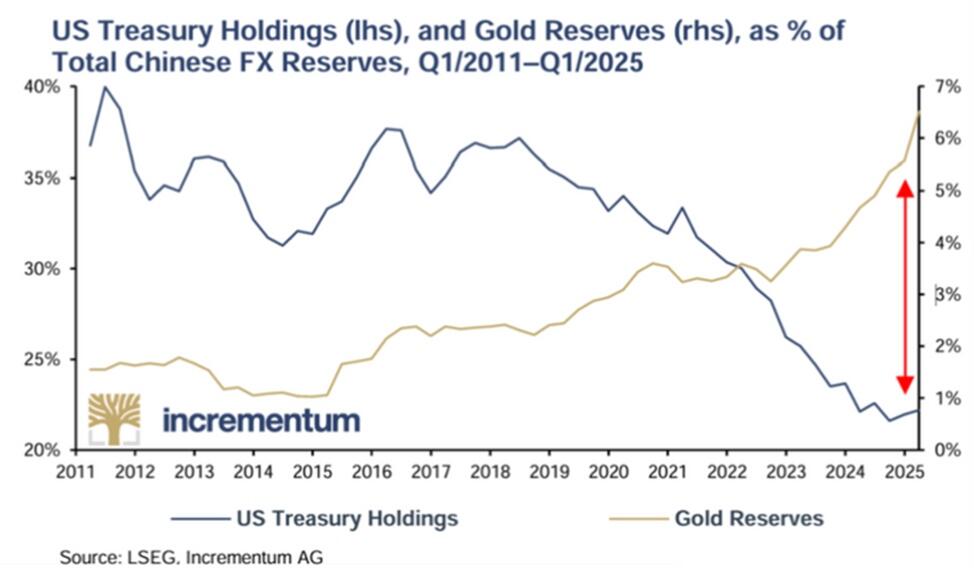
Japan has been dumping USTs to support its own broken credit markets and Yen, and China, well… it has been walking away from USTs (in favor of gold) in a staggering manner. Its FX reserves were once 40% USTs; by 2025, that figure had fallen to less than 1%:
Given the fact that less UST demand means lower bond prices and hence rising bond yields, Uncle Sam is in deep trouble heading into 2026.
Rising bond yields are an absolute terror to bankrupt debtors like the US, because it means the interest expense on its debt, already over $1T/year, gets even harder to repay.
The Bond Market’s Real Power
For this reason, DC needs to keep yields and rates down. The Fed has thus been pushing rates down in 2025, but as we also saw in 2001, yields still climbed despite the Fed’s rate cuts, a terrifying confirmation that the Fed’s tools are breaking down as the bond market, rather than Powell, takes the wheel.
In 2025, 70% of Uncle Sam’s IOUs were short-duration bonds, which need to be paid back soon. This will be entirely unsustainable going into 2026 unless Powell breaks out bazooka money printing and becomes a perma-buyer of our own debt with mouse-clicked dollars.
This should be a tailwind for precious metals.
Temporary QE – What a Joke
The “temporary QE” Powell announced in December of 2025 is as much of a joke as the “transitory inflation” he announced in 2022.
Instead, we can rationally expect that this temporary QE will become structural QE in 2026, and that the Fed’s balance sheet will expand massively, which could bring the DXY and dollar further south and hence the dollar’s percentage of global reserves even lower.
This, too, should be a tailwind for precious metals.
The Dollar—Weaker or Stronger in 2026?
Some, however, predict a “last-dance” for the dollar, and I have debated this issue for years with Brent Johnson and more recently with Henrik Zeberg. Their case for the strong dollar has obvious merits, and I won’t unpack all the details of our divergences here.
No hegemonic currency gives up easily or overnight. Ultimately, a DXY at 110 has a set-up. I don’t, however, see it anywhere near 130, 140 or 150 as the milkshake theory suggests.
Gold’s Endgame: More Important than Timing
Regardless of this dollar debate, however, the end-game for gold and silver is agreed by all—it’s merely the timing where the mugs-game of predicting and debating the dollar’s direction takes form.
That is, and regardless of the Dollar’s relative strength or weaknesses to other currencies in 2026, and regardless of the desperate move to create dollar-demand via a 2025 stable coin ruse, all paper currencies are losing purchasing power in absolute terms when measured against real money—namely gold.
And that, ladies & gentleman, explains a 2025 in which gold and silver broke more all-time-highs than Trump tweets in a typical day.
Golden Light-House Cutting Through the Fog
Wondering what to do about gold in 2026 is no mystery for those who own gold as a wealth preservation and store-of-value asset as opposed to a speculation trade.
Trading precious metals, of course, requires precise timing. (I know a few who actually do it well.) Preserving long-term wealth in precious metals, however, only requires common sense.
Egon von Greyerz has been making the case for gold for decades, while many “gold experts” were popping up on YouTube screens in 2025, only to capture an obvious price move. Where were they when gold was outperforming markets for the last 25 years?
But none of this really matters, because all-time-high gold and silver prices measured in paper currencies is almost comical, akin to measuring your weight on a broken scale.
For decades in general, and for 2025 in particular, we have tracked the obvious tailwinds for real money like gold in a setting of dying paper currencies like the dollar. There’s always a new headline or event to explain.
But the jig was up long ago. The bigger picture, which Egon saw decades ago, was always right before us.
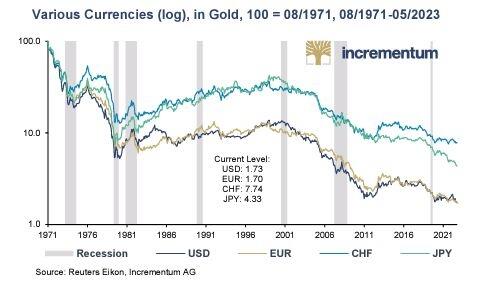
Since 1971, when the US insulted the world and its Constitution by taking away a gold standard, all the major currencies have lost more than 95% of their purchasing power when measured against gold.
The more recent evidence of this accelerating and now undeniable trend toward gold and silver has been almost too obvious, from a rising, BRICS-lead de-dollarization trend, unprecedented central bank gold-stacking and a COMEX meltdown this year, to the BIS’s Tier-1 gold status confirmation and the year-end desperation to artificially repress the silver price by systems terrified of what rising metals says about their dying currencies.
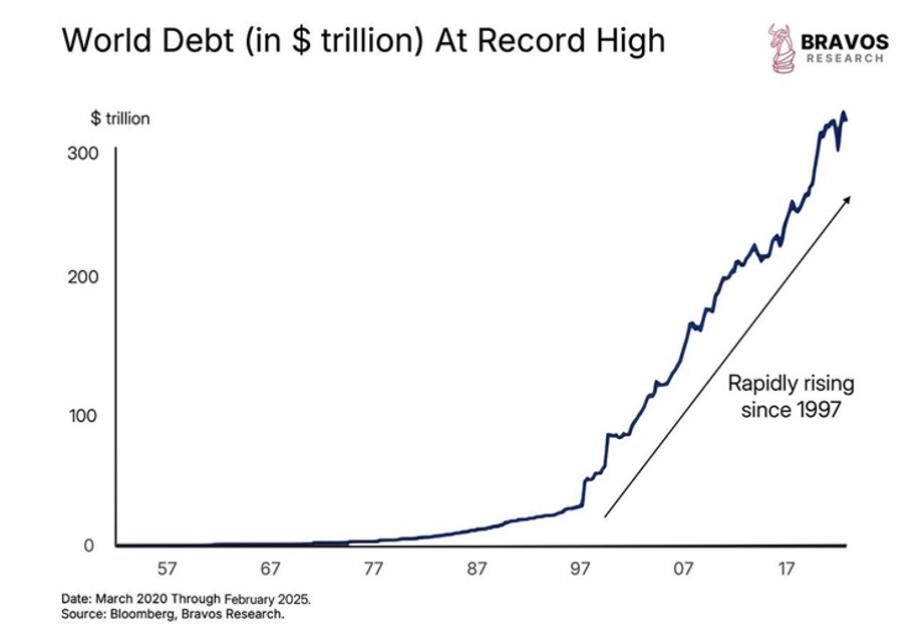
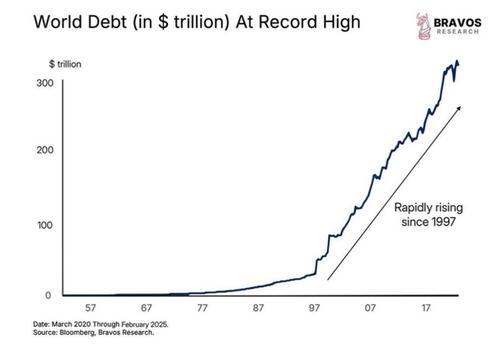
In short, a world soaked in over $300T in debt is, as Thomas Gresham warned centuries ago, naturally moving from bad (paper) money to real (gold/silver) money as a superior strategic reserve asset and store of value.
For those who understand the advantages of saving in real money and spending in fiat money, sitting around and speculating about the future price of gold and silver in dollars or euros, or trying to time its “peak-price” or potential retracements, is missing the far bigger picture.
Yes, gold can and will have pull-backs—but from what price? And yes, metal-poor exchanges can continue to try (with less and less effect) to manipulate the physical metals with paper contracts and leverage, but the end-game will never change.
That is, paper money will continue to be debased to monetize the debts of nations led by financial midgets, which means gold and silver will continue their secular rise.
This is not a bull market in precious metals, but simply a fatal turning point for paper currencies globally.
This explains why central banks to commercial banks are trying to get as much gold as possible today in preparation for the Uh-Oh’s happening now and tomorrow in a system tilting towards a reckoning of historical magnitude.
This, folks, is not sensationalism. This is history 101.
In this context, I will not make price targets in gold or silver for 2026. I never have in years prior, and never will in years to come.
But every day of every year, we have consistently said that these metals will rise materially in the years to come. This never meant in a straight line, but always in a longer-term direction north.
The more speculators worry about timing an entry or exit in metals rather than preserving their wealth in them, the more they risk missing that inflection point wherein real money like gold, with its infinite duration and fixed supply, simply becomes too rare and too expensive for most investors to meaningfully acquire.
Thus, if you are looking to trade in gold or silver, watch the tape, and best of luck to you.
But if you are looking to preserve a portion of your generational wealth in real rather than paper wealth, watch history—not just of yesterday, but the very history you are living in right now.
Tyler Durden
Thu, 01/01/2026 – 23:30
https://www.zerohedge.com/precious-metals/golds-bigger-picture-narrowing-2026
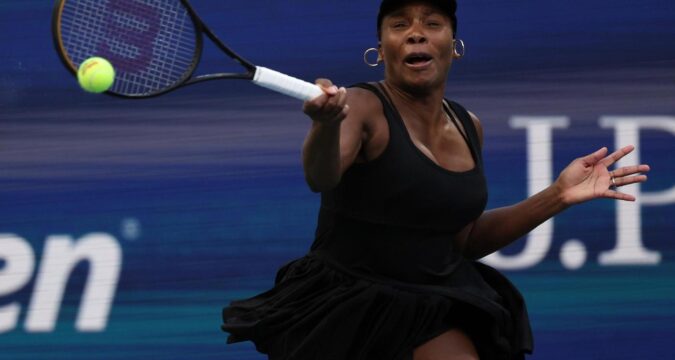
Venus Williams will return to Australian Open 5 years after her last appearance — and 28 after her 1st
MELBOURNE, Australia — Seven-time Grand Slam singles champion Venus Williams has received a wild-card entry for the Australian Open beginning Jan. 18 in Melbourne.
The tournament said Friday that the 45-year-old Williams would make a return to Melbourne Park 28 years after her first appearance. In 1998, she defeated her younger sister, Serena, in the second round before losing in the quarterfinals to fellow American Lindsay Davenport.
Venus Williams had announced in November that she would play in Auckland, New Zealand, where she also received a wild card, two weeks before the Australian Open. The Australian Open said Williams was also entered to play a tournament in Hobart, Australia, a week later and just before play begins at Melbourne Park.
She last appeared in Melbourne in 2021 and has finished runner-up in singles twice, losing to Serena in the final in 2003 and 2017.
“I’m excited to be back in Australia and looking forward to competing during the Australian summer,” Williams said. “I’ve had so many incredible memories there, and I’m grateful for the opportunity to return to a place that has meant so much to my career.”
Williams’ record at Melbourne Park is 54-21. This year will be the 22nd time she has appeared in the main draw.
The tournament said Williams is set to become the oldest woman to compete in an Australian Open main draw, surpassing the record held by Japan’s Kimiko Date, who was 44 when she lost in the first round in 2015.
In late December, Williams married Danish-born model and actor Andrea Preti in Palm Beach, Fla.
https://www.chicagotribune.com/2026/01/01/venus-williams-australian-open-return/

Jack Smith’s Twisted, Machiavellian Lawfare Mindset Paints Dystopian Future For The USA If Not Dispatched Quickly
Jack Smith’s Twisted, Machiavellian Lawfare Mindset Paints Dystopian Future For The USA If Not Dispatched Quickly
Authored by Sundance via The Last Refuge,
I don’t care if you support Donald Trump, Ron DeSantis or the Easter Bunny, any American who doesn’t realize the tenuous future of our union, after reviewing the information within this testimony, is going to forever live in a collapsed dystopian nightmare, if they vote for any political representative who supports it.
The House Judiciary Committee has released the [VIDEO] and [TRANSCRIPT] of special prosecutor Jack Smith’s deposition. What is outlined within it is alarming in the extreme. I strongly urge anyone with any platform to review the details and quickly highlight the content therein. There is no time to waste.
Jack Smith appeared before the committee with three personal lawyers to support him. The content of the deposition is chilling in the extreme. While many will focus on the granular details of the testimony, I wish to highlight one of the more alarming aspects to the bigger picture.
The predicate for Jack Smith to prosecute President Trump for his efforts to “interfere in the 2020 election”, and thereby “challenge all democratic norms”, essentially boils down to Jack Smith accusing President Trump of participating in a fraud when he challenged the outcome of the 2020 election.
To get beyond President Trump’s first amendment right to free speech, Jack Smith claims Trump knowingly understood that Joe Biden had won the election; President Trump was told by senior Republican advisors that Biden had legitimately won the 2020 election; President Trump rejected the reality of the “truthful information” presented to him, and instead chose to launch a psychological operation against the American people, i.e. “fraud.”
It is the charge of “fraud” which underpins the entirety of the case against Donald Trump, as pursued by Jack Smith. The charge itself is predicated on definitions of what constitutes truthful information, and within that subset of predicate you begin to realize just how important it is to professional leftists that they control information.
The case was dropped after the results of the November 2024 election, won by President Trump. However, if President Trump had not won that election, the prosecution would have continued.
Jack Smith notes in his testimony, in the most Machiavellian way, that his primary prosecution approach was to present “Republican” witnesses like Mike Pence, who Smith cunningly said he could not discuss as he was restricted from revealing grand jury testimony.
Smith was prepared to present witness testimony from Pence and other political “Republicans” who told President Trump that Joe Biden had legitimately won the election, and Trump needed to concede. This testimony then forms the baseline for the definition of “truthful information” that Trump rejected out of a malice mindset to continue clinging to power.
In essence, Smith defines what is “truth” (Biden won), then outlines how that truthful information was delivered and how President Trump dismissed it. Therefore, President Trump’s “mens-rea”, or state of mind, was one of promoting an intentional falsehood. According to the Lawfare approach selected by Smith, this mindset is the predicate that blocks President Trump from using his First Amendment right to speech as a defense.
Intentional fraud is not allowed under the protections of “free speech.” Jack Smith wanted to prove that President Trump was engaged in intentional fraud, and wanted to prove his mindset therein through the use of Republican political voices who delivered information to President Trump.
Jack Smith sought to define “truth”, and then counter the free speech defense by mob agreement on what constitutes the “truth.” Under this predicate, President Trump was being prosecuted for a thought crime, and Jack Smith sought to legally prove he knew his thoughts.
The only way Jack Smith could prove fraud would be to prove that President Trump believed the information about Joe Biden winning the election. Smith sought to prove Trump’s belief by presenting Republican voices who told President Trump he lost.
Whether you like or dislike President Trump, the issue here is alarming when contemplated.
A man tells you a chicken is a frog, you laugh. The man then brings 15 of your family members to tell you a chicken is a frog. You reject the absurdity of the premise, but the man brings forth hundreds more people to tell you the chicken is a frog, and if you do not accept that Chickens are Frogs, you will be defined as mentally impaired, institutionalized and become a ward of the state.
[Insert any similar metaphor needed, including “what is a woman.”]
When we consider the current state of sociological, societal or government manipulation of information, and/or the need for government to control information (mis-dis-mal-information) as an overlay, you can quickly see where this type of legal predicate can take us. Bizarro world becomes a dystopian nightmare.
Yes, it is also clear that Leftists, inside that closed-door committee hearing, are intending to impeach President Trump on these grounds if they successfully win the 2026 midterm election. However, that is not the critical takeaway from this deposition. Instead, the critical takeaway is how the Lawfare construct can be twisted and manipulated to create the legal means to the leftist ends.
Stop the Division!
We cannot allow these communist, Marxist and leftist-minded control agents get back into power.
It’s not about Trump. It’s about us.
Tyler Durden
Thu, 01/01/2026 – 22:00

40-Year Harvard Professor Pens Mic-Drop Indictment Of Institutional Anti-White Racism
40-Year Harvard Professor Pens Mic-Drop Indictment Of Institutional Anti-White Racism
A history professor who taught at Harvard University for 40 years wrote a scathing letter slamming the Ivy League institution over its “exclusion of white males.”
Professor James Hankins wrote in a piece titled “Whit I’m Leaving Harvard” that his decision to retire “was not a sudden one,” and that he’d made up his mind in 2021 after the COVID-19 pandemic lockdown and George Floyd riots – both of which dramatically changed Harvard’s graduate admissions process.
“In reviewing graduate student applicants in the fall of 2020 I came across an outstanding prospect who was a perfect fit for our program. In past years this candidate would have risen immediately to the top of the applicant pool,” he wrote. “In 2021, however, I was told informally by a member of the admissions committee that ‘that’ (meaning admitting a white male) was ‘not happening this year,”
Hankins said that in another instance, a white male student who he described as “literally the best” at Harvard – and who won the prize for graduating senior with the best overall academic record – was also rejected from the school’s graduate program because “He too was a white male.”
“I called around to friends at several universities to find out why on earth he had been rejected,” Hankins continued. “Everywhere it was the same story: Graduate admissions committees around the country had been following the same unspoken protocol as ours.”
“The one exception I found to the general exclusion of white males had begun life as a female.“
The deal was an even playing field, not extremely tilted in the other direction.
They broke the deal.
Therefore, there is no deal. https://t.co/ZDraFvZbYl
— Elon Musk (@elonmusk) December 29, 2025
Hankins gave his last lecture at the school two weeks ago, after finishing out a four-year retirement contract he signed in 2021 which has now expired.
Hankins called Harvard’s COVID restrictions “tyrannous invasions of private life” – as professors were forced to lecture in masks and give seminars on Zoom.
On top of that – he decried Harvard’s dropping their “two-book standard” of requiring staff to have published two books to prove their expertise in a subject area, blaming “feminist activists”
History professor James Hankins taught at Harvard for 40 years. (Sophie Park/Bloomberg)
“The two-book standard would be shelved in the late 1990s when we were under increasing pressure to hire more women faculty,” he wrote, adding “Feminist activists, at Harvard as elsewhere, were demanding that half of all new appointments be women. That, they claimed, was what liberal standards of equality required.“
Hankins wrote that women previously made up less than 10% of PhDs in the history department – however “equality required that standards be lowered.”
“Feminists denied vociferously that this was happening,” he continued, adding “The real problem, they said, was the inability of men properly to value female scholarship.”
“Soon the department was promoting an ever higher percentage of junior faculty,” he wrote. “The dynamic was similar to Congress voting to restrain its own spending.”
Tyler Durden
Thu, 01/01/2026 – 21:15
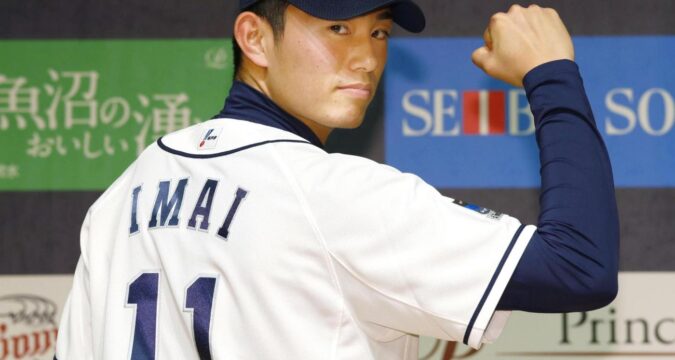
Japanese right-hander Tatsuya Imai and the Houston Astros agree to a 3-year, $54 million contract
Right-hander Tatsuya Imai and the Houston Astros have agreed to a thee-year, $54 million contract, a person familiar with the negotiations told The Associated Press on Thursday.
The person spoke to the AP on condition of anonymity because the agreement had not been announced.
Imai gets a $2 million signing bonus and salaries of $16 million this year and $18 million in each of the final two seasons. He can earn an additional $3 million in performance bonuses this year: $1 million each for 80, 90 and 100 innings.
His 2027 and 2028 salaries would escalate by the amount of performance bonuses earned in 2026, which could raise the deal’s value to $63 million over three years. Imai can opt out after the 2026 and 2027 seasons.
Under the posting agreement between Major League Baseball and Nippon Professional Baseball, a deal must be finalized by 5 p.m. EST Friday.
Imai receives the third-highest average annual value for a Japanese pitcher entering the majors behind Yoshinobu Yamamoto’s $27.08 million with the Los Angeles Dodgers in a deal that started in 2024 and Masahiro Tanaka’s $22.14 million with the New York Yankees in a contract that ran from 2014-20.
A 27-year-old righty, Imai went 10-5 with a 1.92 ERA last year with the Pacific League’s Seibu Lions. He struck out 178 batters in 163 2/3 innings.
Imai is 58-45 with a 3.15 ERA in eight seasons with Seibu, with 907 strikeouts in 963 2/3 innings. He is a three-time All-Star.
Imai pitched eight innings of a combined no-hitter against Fukuoka on April 18. He struck out 17 against Yokohama on June 17, breaking Daisuke Matsuzaka’s previous team record of 16 from 2004.
Under MLB’s posting agreement with NPB, Seibu will get a posting fee of $9,975,000 from the Astros and a supplemental fee of 15% of any earned bonuses, salary escalators and exercised options.
Imai joins an Astros rotation projected to include Hunter Brown, Cristian Javier and Lance McCullers Jr.
https://www.chicagotribune.com/2026/01/01/tatsuya-imai-houston-astros-contract/

Chicago Blackhawks open 2026 with emotional Make-A-Wish day for 2 teenage fans: ‘It doesn’t even feel real’
The Chicago Blackhawks wanted to start 2026 in a positive way, preferably with a home victory over the Dallas Stars on Thursday night.
No matter the result of the game, they won the hearts of two families that visited the United Center on New Year’s Day.
The Hawks and Make-A-Wish Illinois partnered to give a pair of teens an exclusive Hawks experience, spending the day with the team.
The Hawks ran some shootout drills to close their morning skate. Arvid Söderblom was the goaltender as the skaters prepared show off their stick skills.
First up: No. 98. Nope, not Connor Bedard, even though he was there in a Hawks tracksuit with fellow injured center Frank Nazar. Instead, it was Aubrey Meloy, 13, of Joliet.
Meloy, who has long QT syndrome — a condition that affects the heart’s electrical system — wanted a moment like this her whole life. She still has the stick Tyler Bertuzzi gave her at a previous game, as well as the memory of her touching his hand at the 2025 Winter Classic at Wrigley Field.
“It doesn’t even feel real, I don’t even feel like I’m really here,” Meloy said Thursday. “I feel like I’m floating. I’ve watched these guys play hockey on TVs at home, I watch (highlights) during lunch in school and it’s crazy that I’m here with them and they know me now. I feel so grateful and so honored that I get to do that.”
Meloy has used hockey as a way to stay connected to her father, who died from a heart attack in 2018. He played hockey growing up, and the sport has been passed down to the next generation of the family.
Meloy’s brother took her to see the Hawks in person for the first time on Dec. 19, 2023, a 3-2 win over the Colorado Avalanche. She’s a competitive figure skater, so she’s used to the rink.
The day at the United Center was much different: pads, sticks, pucks flying everywhere and skates that aren’t exactly meant for the performance spins she’s used to completing. Her initial thoughts about hockey were, well, she was a little confused.
“I didn’t know what was going on at all,” Meloy said. “I was like, it’s a puck.”
Her brother bought her a white Bedard sweater at the game. “Who’s this guy?” was her first thought. After doing her research, Bedard quickly became her favorite Hawks player.
“I was first walking around the United Center (and) I saw this face (everywhere) when we were walking.” Meloy said. “I started watching his videos and I was like, he’s pretty great,”
The energy at the United Center that night was “electric,” Meloy said. The Hawks not only won, but they won the Meloys over.
New Year’s Day 2026 was the cherry on top.
“She’s always going to be a fan, and I am (as well),” said Kristy Meloy, Aubrey’s mom. “We’re going to be reliving this for many months ahead.”
Aubrey collected the puck in front of Bedard, Bertuzzi and the other Hawks to begin her shootout attempt. It was a graceful skate for her, even with all the bulky pads and equipment.
“I’m so used to spinning around and doing jumps and all that and I’m in this heavy gear,” Meloy said. “Once I really got used to it, I was like, oh, OK, this isn’t that bad.”
She glided in her figure skates, sent a shot past Söderblom and scored the goal. Hawks players celebrated with stick taps for the Joliet kid.
“Someone asked me if they think figure skating harder than hockey,” Meloy said. “Now that I’m here, I think hockey is a lot harder.”
Up next was 16-year-old John “JT” Byers, of Keller, Texas. He was born with cystic fibrosis, a condition that once made playing hockey nearly impossible.
After treatment, he now plays for the Dallas Penguins 16U minor team. He attempted a behind-the-back shot on his shootout attempt, so he’s not lacking for confidence in his game.
“(I’ve been practicing that) for about a year and a half, just messing around with it,” Byers said. “I was going for flashy. Didn’t go the safe route. It didn’t turn out well for me, but I’m out here for the fun.”
He’s from Texas but made it abundantly clear that he’s no Stars fan. He dubbed Hockey Hall of Famer Marián Hossa as his favorite Hawks player.
“Where I started, I was originally a forward, I was very defensive because that’s who I am more as a player and (Hossa) matched my game,” Byers said. “I saw him win the Cups, he’s just an amazing player, best two-way player to ever do it.”
In addition to his play, Byers volunteers as a referee and mentor to younger players. He’s grateful to play hockey and wants to give that opportunity to others.
“I tell them how amazing it is and I hope that they can find the love for it the same way I do,” Byers said. “The game truly means a lot to me, and I really love being able to play it.
After overcoming his medical challenges to play the sport, he hopes his story can help children with that same dream.
“I hope it shows kids that no matter what challenges God sets for you in your life that you can overcome them and that you can pursue goals,” Byers said. “Even if it’s harder than other people, it’s about your mindset, not about your physical capabilities.”
The kids enjoyed their dream day with the Hawks. The team enjoyed the fans’ company just as much.
“They were awesome, they had great perspective,” Hawks coach Jeff Blashill said. “I was evaluating their shootout moves in case we need to improve our shootout record.”
Added team captain Nick Foligno: “You ring (the new year) in the right way with with a purposeful day like today, where these kids are going through something way worse than we’ll ever experience and be able to bring joy. Reminds us that there’s more to life and we obviously take (hockey) very seriously, but it is a game at the end of the day and these kids are battling real-life things.”
https://www.chicagotribune.com/2026/01/01/chicago-blackhawks-make-a-wish/

New York Times Rewrites History Again With Nikole Hannah-Jones
New York Times Rewrites History Again With Nikole Hannah-Jones
Former New York Times reporter and Howard University professor Nikole Hannah-Jones has long been controversial as a writer who expressly rejects objectivity and neutrality in journalism. That was most evident in her “1619 Project,” which was ridiculed by historians and law professors in claiming that slavery was the driving force behind American independence. Nevertheless, the project was awarded the Pulitzer Prize despite glaring historical errors. Yet, this month, Hannah-Jones is back on the pages of the New York Times again rewriting history. This time, she is praising cop-killer and 1960s revolutionary Assata Shakur.
Hannah-Jones has been a lightning rod in her writings, from declaring “all journalism is activism” to spreading conspiracy theories against the police.
Yet, mainstream media, including the Times, has run interference for Hannah-Jones, including the dean of the University of North Carolina trying to shut down criticism by reminding a reporter that they must all defend Hannah-Jones.
Hannah-Jones’s latest project of historical revision is a sorrowful memorial to Shakur, which shows the same disregard for facts in favor of a preferred narrative.
Born JoAnne Deborah Byron (and later adopting the names of Joanne Chesimard and Shakur), the violent revolutionary was a member of the Black Panther Party and the Black Liberation Army.
In 1977, she killed New Jersey police officer Werner Foerster, 34, a U.S. Army Vietnam veteran who left behind a widow and a young son.
She later escaped prison and fled to Cuba, where she died earlier this year. In 2005, she was declared a domestic terrorist. In 2013, the Obama Administration put her on the most wanted list.
You would know little of that from the New York Times column. After all, all journalism is activism, according to Hannah-Jones, and, if the facts do not fit the narrative, the facts have to go.
In her column, Hannah-Jones seems to dismiss the conviction as the result of an “all-white” jury. What is omitted is that Shakur had a long and violent criminal record. She was previously shot in the stomach during what was believed to be a drug-connected crime at the Statler Hilton in Manhattan.
She was sought in other crimes, including a 1971 bank robbery. When asked, Shakur later shrugged off such crimes as a type of racial reparations: “There were expropriations, there were bank robberies.”
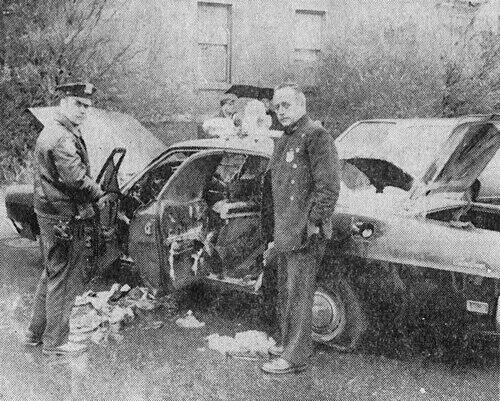
Police car after grenade attack
She was also linked to a grenade attack that injured two police officers after being identified by witnesses. In 1972, she was identified by Monsignor John Powis as one of the suspects in the armed robbery at Our Lady of the Presentation Church in Brownsville, Brooklyn. During the robbery, the priest was told “We usually just blow the heads off White men.”
She was also tied to the murder and ambushing of police officers for years before she was stopped on May 2, 1973 on the New Jersey turnpike by State Trooper James Harper who was backed up by Trooper Werner Foerster in a second patrol vehicle. The resulting shootout left Harper wounded and Foerster dead.
Her trials spanned a variety of charges ranging from bank robbery to kidnapping to attempted murder, and other felonies. However, while there were acquittals and a mistrial (due to a pregnancy) on different charges, she was ultimately convicted of murder before her escape.
Yet, the Times and Hannah-Jones brush over that history to gush about Shakur and the effort to shield her, even describing the criminal network as akin to the famed system used to free slaves before the Civil War: “Shakur had been hidden in the United States for several years by a sort of Underground Railroad.”
The Times column bewails how “freedom came with shattering costs for her and her family.” Not a single line of sentiment for the widow and son that her victim left behind in New Jersey, let alone the other victims in murders and attacks that she was connected to as part of the Black Liberation Army.
Of course, such sentiment is not allowed for true victims.
For example, Hannah-Jones was again published by the New York Times, warning in a column that memorials to Charlie Kirk are “dangerous.”
Hannah-Jones has also chastised other writers for covering shoplifting stories because “this is how you legitimize the carceral state.”
Yet, the New York Times is still actively involved in projects to rewrite history with Hannah-Jones. This is the same newspaper that barred columns from Senator Tom Cotton for arguing for the deployment of National Guard troops to quell violent riots, but published columns by “Beijing’s enforcer” in Hong Kong and a University of Rhode Island professor who previously defended the murder of a conservative protester.
It is the same newspaper that forced out a variety of editors who published opposing viewpoints or challenged biased coverage and journalistic activism.
The Times column ends with a line that is breathtaking in its ahistorical and amoral message: “Shakur, who saw herself as an escaped slave, died free.”
A convicted murderer and wanted terrorist died in one of the most blood-soaked, repressive regimes in the world . . . but Hannah-Jones and the New York Times want everyone to know that she “died free.”
That is comforting. As for Werner Foerster, he just died and was not mentioned once by name in the Times column.
Tyler Durden
Thu, 01/01/2026 – 20:30
https://www.zerohedge.com/political/new-york-times-rewrites-history-again-nikole-hannah-jones
US, Israel Set Firm 2-Month Deadline For Full Hamas Disarmament
US, Israel Set Firm 2-Month Deadline For Full Hamas Disarmament
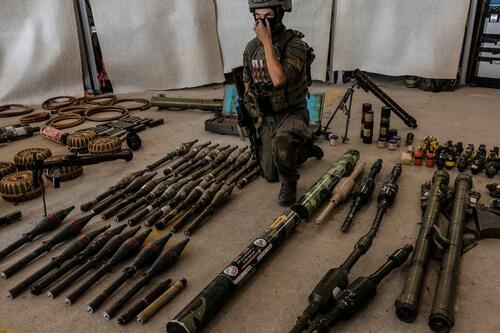
Israeli media is reporting that Israel and the United States have reached an understanding to give Hamas a two-month ultimatum to finally and fully disarm. The reports say the agreement came immediately after an overnight meeting between Israeli Prime Minister Benjamin Netanyahu and US President Donald Trump at Mar-a-Lago at the start of the week.
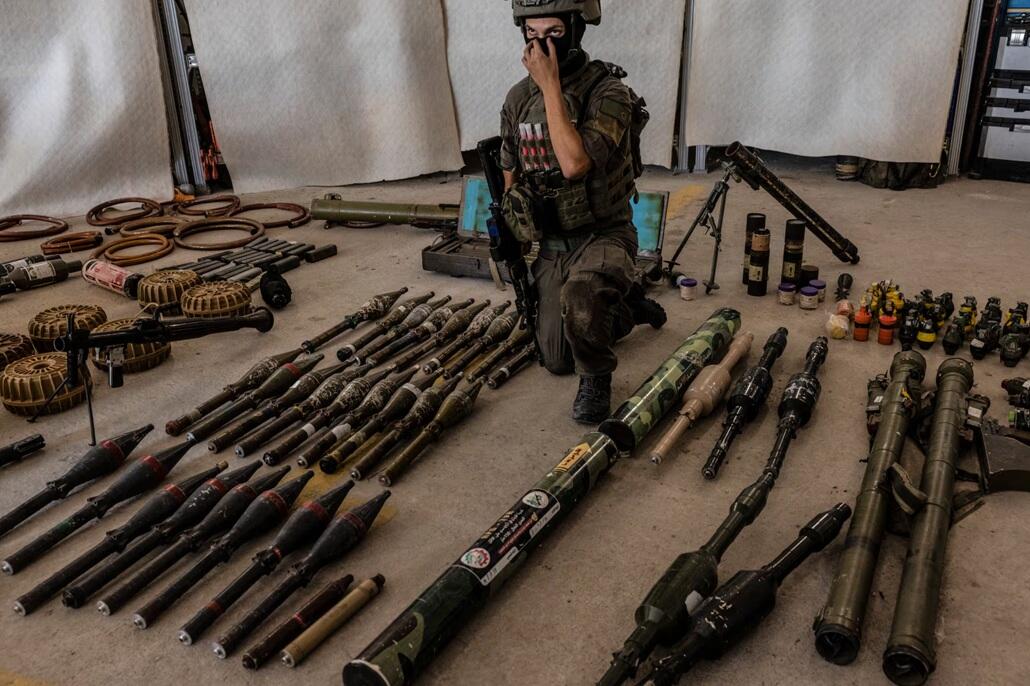
The move is being described as a fixed deadline rather than an opening for negotiations. Israeli and US teams are already reportedly working simultaneously to determine what they describe as “practical disarmament.” This after Hamas has effectively been defeated since it launched the brutal Oct.7, 2023 terror assault on southern Israel.
Source: Washington Post/Getty Images
Another key focus is the dismantling of Hamas’s underground tunnel network throughout Gaza, which Israeli officials consider a core element of the group’s military strength.
Hamas has throughout the Gaza war proven itself effective in guerilla and insurgency tactics, utilizing small teams to maneuver quickly in and out of the tunnels, even at times taking out IDF tanks with IEDs. Sometimes bombs are even attached to Israeli armor vehicles by hand in these ambushes, after which a Hamas militant darts back into an underground tunnel, as has been demonstrated in various videos.
Sources quoted by Israel Hayom said Israeli officials doubt Hamas that would be willing or able to relinquish most of its weapons or military capabilities within the two-month window.
From the perspective of Hamas leadership, the moment it fully gives up its weapons means the group is effectively dead and will have no more influence to govern in the future.
But this is also exactly what the US-Israeli plan and the ceasefire calls for: the effective end of Hamas rule in governance in the Gaza Strip forever.
PM Netanyahu while giving media interviews during his December US trip described that Hamas still possesses “around 60,000” Kalashnikov rifles and “hundreds of kilometers” of tunnels.
He has vowed that Hamas disarmament can be achieved “the easy way” or the hard way – that is through military force. But as of last summer, Hamas was insistent that it will never give up its weapons.
There’s also the possibility that Hamas leadership won’t be able to induce all of its fighters and ‘ground troops’ to give up their weapons – again, as they would fear being tracked down and killed by Israeli forces.
Tyler Durden
Thu, 01/01/2026 – 19:45
https://www.zerohedge.com/geopolitical/us-israel-set-firm-2-month-deadline-full-hamas-disarmament

CFP: No. 1 Indiana routs No. 9 Alabama 38-3 for its 1st Rose Bowl victory, roaring into semifinals
PASADENA, Calif. — Fernando Mendoza threw three touchdown passes, Indiana’s defense thoroughly throttled No. 9 Alabama and the top-ranked Hoosiers roared into the College Football Playoff semifinals with a 38-3 victory in the Rose Bowl on Thursday.
Mendoza passed for 192 yards in his first game since winning his school’s first Heisman Trophy, but the hard-nosed Hoosiers (14-0) won the Rose Bowl for the first time in school history by dominating the Crimson Tide (11-4) at the line of scrimmage.
Indiana scored the game’s first 24 points before pouring it on with fourth-quarter rushing TDs from Kaelon Black and Roman Hemby, wrapping up a jubilant win in the 112th edition of the Granddaddy of Them All.
Charlie Becker, Omar Cooper Jr. and Elijah Sarratt caught touchdown passes while Black rushed for 99 yards. Indiana outgained Alabama 407-193, steadily delighting a decidedly pro-Indiana crowd that celebrated its long-struggling team’s first Rose Bowl appearance since 1968 with chants of “Hoosier Daddy?” in the final minutes.
Indiana had not won any bowl game since the Copper Bowl in 1991, but history has been no match for Curt Cignetti and his dominant Hoosiers during the coach’s two transcendent seasons.
The Hoosiers are headed to the Peach Bowl on Jan. 9 for a CFP semifinal rematch with fifth-seeded Oregon, which routed Texas Tech 23-0 earlier Thursday in the Orange Bowl. Indiana beat the then-No. 3 Ducks 30-20 in October in Eugene in one of Cignetti’s most impressive Big Ten victories.
Indiana is two wins away from the first national championship in school history after becoming the first team to advance following a first-round bye in the current 12-team playoff format. The first six bye teams — including the first two this season — couldn’t come back strong from an extra-long layoff, but the Hoosiers took care of business while improving to 25-2 under Cignetti.
The Crimson Tide’s second season under Kalen DeBoer ended in the same venue as their final season under Nick Saban two years ago. Alabama was outclassed one week after an impressive road win over Oklahoma, managing just 151 yards before the meaningless final minutes of this blowout.
Ty Simpson passed for 67 yards before backup Austin Mack replaced him in the third quarter. Mack immediately got the Tide rolling on a 65-yard drive leading to a short field goal, but the Hoosiers responded with two unstoppable touchdown drives.
Indiana dominated the famous Rose Bowl turf, which stayed pristine despite nearly 24 hours of steady rain before kickoff. The storms dissipated while the Hoosiers took their first-half lead, and the sky cleared in the second half.
Alabama quarterback Ty Simpson, left, fumbles as he is hit by Indiana defensive back D’Angelo Ponds during the first half of the Rose Bowl in a College Football Playoff quarterfinal Thursday, Jan. 1, 2026, in Pasadena, Calif. The Hoosiers recovered the fumble and went on to win 38-3. (Mark J. Terrill/AP)
After the first scoreless first quarter in a Rose Bowl in 26 years, Indiana’s second drive stretched 84 yards on 16 plays over nearly nine minutes before Nicolas Radicic’s 31-yard field goal on the first snap of the second quarter.
Indiana’s defense then stopped Alabama on fourth-and-1 at the Tide 34, and Mendoza fired a long, high pass to the leaping Becker four plays later for a 21-yard touchdown.
Simpson fumbled in Indiana territory after a courageous first-down scramble late in the first half, and the Hoosiers methodically drove for Mendoza’s 1-yard touchdown pass with 17 seconds left to Cooper, the hero of Indiana’s dramatic victory over Penn State.
After halftime, Mendoza led a steady 79-yard drive ending in his 24-yard TD pass to the leaping Sarratt.
The victory is the latest step in the monumental two-season turnaround of what was the losingest program in college football when Cignetti took charge. After winning 11 games and reaching the CFP last season, the Hoosiers steamrolled through their schedule this fall before beating defending national champion Ohio State for the Big Ten title and ascending to the No. 1 spot in the AP Top 25 for the first time.
Takeaways
Indiana: The Hoosiers acted as if they had been here before, even though they hadn’t. Cignetti’s group has a businesslike demeanor that wasn’t remotely altered by Alabama’s reputation and history.
Alabama: It was remarkable to see the most successful program of the 21st century get dominated up front. The Tide’s inability to run the ball was a seasonlong problem, but it was particularly painful in Pasadena. Whether through personnel or scheme, DeBoer’s offense must take a step forward next year to reach the standard expected at Bama.
Up next
Indiana: A trip to Atlanta to face powerhouse Oregon, which lost last season’s Rose Bowl to Ohio State as the No. 1 seed.
Alabama: Hosts East Carolina on Sept. 5.
https://www.chicagotribune.com/2026/01/01/indiana-alabama-cfp-quarterfinals/
5 things we learned from the Chicago Bears, including seeking to avenge humiliating Week 2 loss to Detroit Lions
The Detroit Lions won’t have anything but pride to play when they traipse into Soldier Field on Sunday, but that doesn’t mean the Chicago Bears will overlook them.
“Yeah, I don’t think that’s a challenge,” defensive coordinator Dennis Allen said. “Each and every week in this league your next opponent it’s enough energy and enough time and enough mental process just to focus on that thing that’s right in front of you.”
Besides, the Bears are looking to lock down the No. 2 seed with a win over the Lions and not leave their playoff seeding to the outcomes of other games.
“We don’t worry about that,” linebacker Tremaine Edmunds said. “All we worry about is ourselves. We know we’ve got to go out and win the game.
“Everything else happening on the outside, we worry about that afterward. But all our focus is on going out there and winning versus Detroit.”
Here are five things we learned Thursday.
1. How badly do the Bears want to beat the Lions?
Most players and coaches in most sports typically will downplay the “revenge game” narrative, because trading wins and losses with an opponent is just the nature of the game.
But then you have a game that feels less like a loss and more like an obliteration, and the Bears’ 52-21 defeat to the Lions in Week 2 would fall into the latter category.
“It’s never a good taste when you get beat by that (much) so handily,” coach Ben Johnson said Wednesday. “The fourth quarter wasn’t even close. So yeah, I’ll leave it at that.”
Lions running back Jahmyr Gibbs jumps over Bears defensive end Dayo Odeyingbo in the second quarter at Ford Field on Sept. 14, 2025, in Detroit. (John J. Kim/Chicago Tribune)
On Thursday, defensive end Austin Booker didn’t mince words either: “We definitely want our lick back for sure, and that’s what we’re going to go do Sunday.”
Edmunds added: “We all feel that still. And obviously it left a nasty taste in our mouth.”
Still, the game was back in Week 2, and the Bears can’t do anything about it except focus on their weekly process, he said.
“We can’t jump to Sunday right now,” Edmunds said. The process involves “showing up every day, putting the work in, understanding what we’re doing, so we can go out there and execute. And then (if we) believe in that process, everything will take care of itself.”
Rookie receiver Luther Burden III said he hasn’t heard a lot of discussion this week after that 31-point loss on Sept. 14.
“I mean, we’re a totally different team than what we were then,” he said.
2. Bad day for the defense? Nothing to see here.
Allen didn’t want to delve into the particulars of the Niners game, in which his unit yielded six touchdowns, 496 yards and a season-high 32 first downs.
“We’re moving on to Detroit,” Allen said. “I’ll say this — I don’t think I coached well enough last week, I don’t think we played well enough last week.
“So, you learn your lessons, you make the corrections that you need to make.”
As bad as the defense showed at Levi’s Stadium, the Lions put up seven touchdowns and 511 yards in Week 2 — season highs for the Bears defense.
However, one glaring flaw stood out against the Niners: They averaged 3.24 seconds to throw, a season high for a Bears opponent (the Lions had the third-highest).
The Bears defense also had its fifth lowest pressure rate (23.7%) of the season.
“Winning the line of scrimmage is going to be a big part of trying to win this game,” Allen said. “When you look at the quarterback (Jared Goff) and being able to affect him in a lot of max protection stuff, play-actions, things designed to help protect him and keep that pocket clean for him.
“When they’re able to do that, they execute at a very high level.”
It’s no coincidence that Goff threw his most passing touchdowns in a game (five) and yards per attempt (11.9) while receiving his longest average time to throw (3.11 seconds) and facing his lowest pressure rate (20.7%).
To disrupt the Lions offense, “I think we just need to strike blocks,” Austin Booker said. “It’s all about us. … We’ve got to stay square at the line of scrimmage, and then we’ve got to get to get off blocks and make plays.”
And the Bears can help their pass rush by putting the Lions in longer down-and-distance. That’s a lesson the Bears took from the loss to the 49ers.
“The bottom line is stop the run,” Booker said. “I think everybody saw that (against the 49ers), so that’s what we’ve got to do next week — stop the run — and then on third down, get the quarterback.”
3. Is it Jahdae Walker or “PJ” Moore?
After practice Thursday, Walker got dressed in the locker room like players usually do. Only he looked like he was getting dressed for bed.
Walker donned some red-striped pajamas before putting on his street shoes.
“This is what I woke up in today, so I just wore it,” he told the Tribune. “I had to be here real early so I didn’t want to rush in. This is actually my first time wearing it. They haven’t seen me in this yet.”
Chicago Bears by the numbers: Breaking down their potential 1st-round playoff scenarios
A couple of stalls over in the locker room, receiver Rome Odunze looked up with a stunned expression and a crooked smile and interjected, “Liar!”
The rookie fessed up: “I wear new pajamas every day. People are starting to get used to it. I wore pajamas all the way up to Christmas and now I’m just doing it for fun.”
4. Injury updates
Bears wide receiver Rome Odunze, center, watches a video replay in the second quarter against the 49ers at Levi’s Stadium on Dec. 28, 2025, in Santa Clara. (John J. Kim/Chicago Tribune)
Odunze (foot) was still a nonparticipant in practice Thursday. He has missed the last four games and last played Nov. 28 in Philadelphia.
Guard Jonah Jackson also didn’t practice, popping up on the report with an illness. A bug ran through the locker room last week and still has been affecting players.
Defensive back Nick McCloud and wide receiver Olamide Zaccheaus are both listed as having an illness, with McCloud limited and Zaccheaus participating in the full practice.
Defensive end Joe Tryon-Shoyinka (concussion) was the only other Bear to miss practice. Left tackle Ozzy Trapilo remained limited with knee and quad injuries. He has started the last six games.
Wide receiver Luther Burden III (quad) and defensive back/special teamer Josh Blackwell (shoulder) were upgraded from limited to full participants.
“Body is getting better each and every day,” Burden said.
5. Odds and ends
Booker has been anxious for a final resolution regarding the two $5,000 fines he received after he was flagged twice for roughing the passer against the Green Bay Packers on Dec. 20, the second of which knocked quarterback Jordan Love out of the game with a concussion. “We’re still in the appeal process,” he told the Tribune. “I feel like the NFL is not the best with staying on top (of things). I mean, they just don’t work around our schedules very well to get the appeals (processed) and so (we) just had to push that back.”
Special teams coordinator Richard Hightower wouldn’t be surprised if the Lions have a trick play up their sleeves: “Yeah, always thinking about fakes, especially with that group. That group has done a number of fakes. Five over the last two years, 15 over the last four or five years, 15-plus. They did one this year against Philadelphia. We are always alert, antennas up for that.”
The Bears are tied with the Tampa Bay Buccaneers for the second-most plays (49) while trailing with less than two minutes to go in the game, so that gives them a lot of data. “Harry Freid runs our research and analytics,” offensive coordinator Declan Doyle said. “He does a really good job of preparing a meeting every week that we kind of sit and go through situations throughout the league, situations that may have come up in our games where we could’ve been better and we could’ve changed. A lot of times, it’s really communication between him and (coach) Ben (Johnson) because those are the two really managing us on game days.”
On third-and-10 and 1:09 left during the Bears’ final drive against the 49ers, Burden caught the ball about 5 yards or so short of the sticks and put the shimmy on cornerback Chase Lucas — twice — to pick up not only the first down but a 14-yard gain. “I was a running back, my first position ever playing football, so I know how to not get tackled,” Burden said. “When I get the ball, man, I’m trying to score.”
https://www.chicagotribune.com/2026/01/01/chicago-bears-detroit-lions-revenge/