Category: News

Advocate Sherman Hospital in Elgin announces first baby of 2026
A Crystal Lake couple are the parents of the first baby born in 2026 at Advocate Sherman Hospital in Elgin.
Kelly Davis and Kyle Partenheimer welcomed their new daughter, Kolbie Noelle Partenheimer, at 12:55 a.m. Thursday, Jan. 1, according to a news release. The baby girl weighed 7 pounds, 15.7 ounces and was 21 inches long. Kolbie has two older brothers, Kameron, 11, and Kannon, 5.
Kolbie is just five minutes younger than the first baby born in 2026 at any Advocate Health Care hospital in the Chicago area, the release said.
The first Advocate baby of the new year was born at 12:50 a.m. at Advocate Christ Medical Center in Oak Lawn, according to the release. Olivia Gorney and Ryan LaCount, of Chicago, welcomed baby girl Winona LaCount into their family. Winona is the couple’s first baby. She weighed 10 pounds, 6 ounces and was 22.5 inches.
https://www.chicagotribune.com/2026/01/02/advocate-sherman-elgin-baby-2026/
UBS Says Soaring Memory Chip Prices To “Turbo-Charge” Samsung Earnings
UBS Says Soaring Memory Chip Prices To “Turbo-Charge” Samsung Earnings
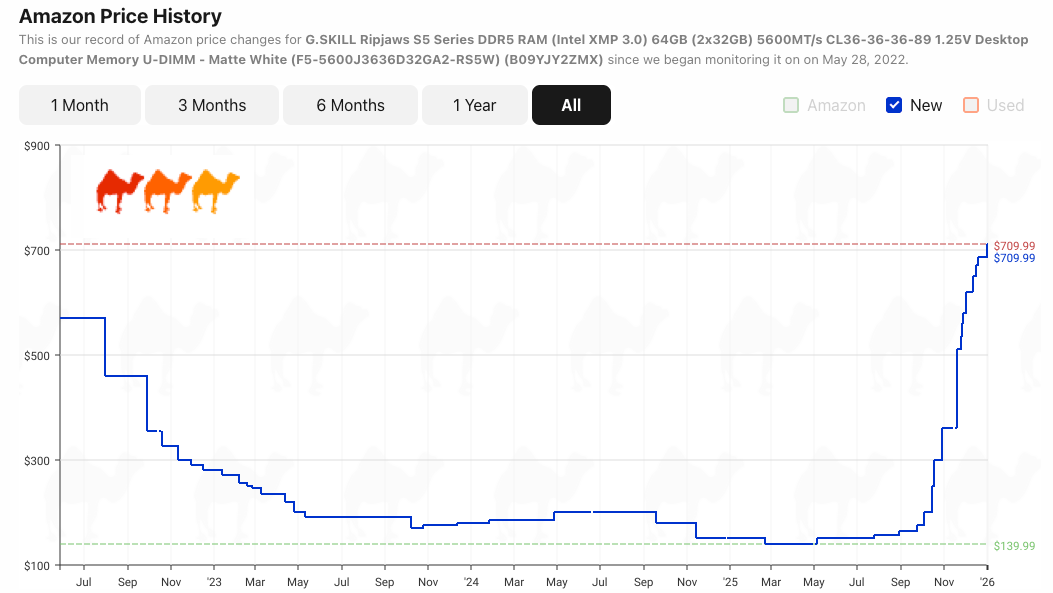
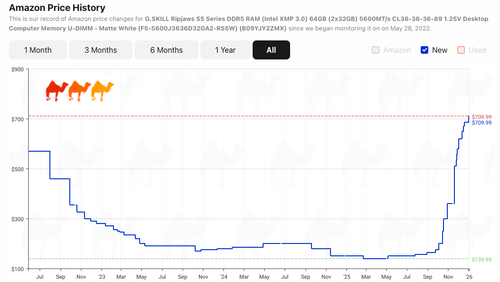
For several months, we have tracked a sharp increase in DDR5 DRAM pricing, as evidenced by DRAMeXchange data, driven primarily by surging AI-related cloud computing demand and hyperscalers accelerating data center buildouts.
On day one of the new year, Samsung co-CEO Jun Young Hyun told employees in an internal memo that customers have praised the differentiated competitiveness of its next-generation high-bandwidth memory (HBM) chips, or HBM4, saying, “It’s even earning an assessment from customers that ‘Samsung is back’.” He noted that Samsung will also benefit from favorable memory market conditions this year, as demand for artificial intelligence chips has materialized much quicker than initially anticipated.
The other week, Goldman analyst Maho Kamiya told clients that mounting concerns about soaring memory prices posed new risks for Nintendo, which manufactures consumer electronics such as the popular Switch 2.
“Some investors think that Nintendo will be selling Switch 2 at a loss and gross profit falling into the red. While rising memory prices are a risk factor that could depress hardware margins, we think concerns are somewhat excessive,” Kamiya told clients last week.
While end-use consumer electronics companies such as Nintendo may be pressured by higher memory costs, the same pricing surge is expected to “turbo-charge earnings” for Samsung’s memory business, according to UBS analyst Nicolas Gaudois.
Gaudois explains why:
DDR and NAND contract pricing coming out higher than expected
With 4Q25 memory contract pricing negotiations now completed, we lift our forecast for DDR contract pricing to +35% QoQ (was +21%), and for NAND +20% (was +15%). We believe customers are trying to secure 1Q26 contract pricing in earnest, with further potential for upside. We now forecast blended DDR contract pricing to increase 29% QoQ (was +15%) and NAND +20% (was +10%) in 1Q26. From there on, we continue to forecast DRAM to remain undersupplied until 1Q27, and NAND 3Q26. We see the ongoing upside in conventional memory pricing as the main stock driver for Samsung. At 1.43x NTM book, we believe the stock is not yet discounting the strength and length of the upcycle ahead.
HBM shipments to catch up in 2026E
While we maintain our 2026 DRAM bit growth forecast of 15% YoY, we could see up to 2 pct pts upside depending on production yields / efficiency / mix. We continue to forecast HBM shipments to reach 7.5bn Gb in 2026, up 77% YoY. We continue to expect Samsung to provide HBM4 samples to Nvidia by February, which could lead to qualification by 2Q26 (with production starting earlier in 1Q). We believe Samsung remains first source for HBM for AMD and Open AI. Regarding Google, we believe Samsung is second source for TPU 7p, while Micron may be second source for TPU 7e (first source in both cases being SK Hynix).
Increasing forecasts well ahead of consensus on DDR/NAND ASP estimates
We increase our 4Q25 OP forecast to Won18.1tn from Won15.0tn (VA consensus: Won15.3tn) on the back of increased DRAM and NAND ASPs. We raise 2026E/27E OP to Won135.3tn/Won143.6tn (from Won101.2tn/Won109.5tn respectively), well ahead of consensus Won86.9tn/Won109.6tn respectively, and lift our 2026/27 EPS forecasts by 31%/29%. These changes are due to raised DDR/NAND ASPs as well as DRAM bit growth forecasts, which more than offset us lowering smartphone margins due to rising memory prices.
Valuation: lift price target to Won154,000 from Won128,000 – Buy
We value Samsung ordinary shares at 1.97x NTM book (was 1.79x) considering our 2026-30 average ROE estimate of 16.3% (was 14.6%) and CoE of 8.3% (was 8.2%). We also raise our Samsung GDR PT to US$2,610, from US$2,230, with the latest FX.
We’ve shown readers DDR5 DRAM pricing via DRAMeXchange…
Update: two months later https://t.co/Q4TPIrpzxV pic.twitter.com/O3KTKxZOVE
— zerohedge (@zerohedge) December 22, 2025
But now, take a look at DDR5 DRAM pricing on Amazon!
As a reminder, AI workloads are built around memory.
ZeroHedge Pro Subs can view the full note in the usual place, which includes a thesis map of the memory cycle.
Tyler Durden
Fri, 01/02/2026 – 12:40
https://www.zerohedge.com/ai/ubs-says-soaring-memory-chip-prices-turbo-charge-samsung-earnings

10 Very Important Trends To Watch As We Enter 2026
10 Very Important Trends To Watch As We Enter 2026
Authored by Michael Snyder via TheMostImportantNews.com,
Are we on the brink of a worldwide nightmare? Many have described what we are currently experiencing as a “perfect storm”. We have been getting hit with one crisis after another as global events have greatly accelerated in recent months. But now it feels like the next chapter that we are entering is going to take things to an entirely different level.
On New Year’s Eve, something very unexpected happened at our most important landmark in the middle of the country. You will want to read all the way to the end of this article to see what I am talking about. This year is already off to a very unusual start, and I fully expect a lot more craziness in the months ahead.
The following are 10 very important trends to watch as we enter 2026…
#1 The Price Of Silver
The price of silver is telling us that there is big trouble under the surface of the global financial system. Even though there was a dramatic attempt to suppress the price of silver this week, it was still up about 140 percent in 2025.
And the difference between the price of paper silver and the prices that physical silver is going for around the world has become extremely alarming…
Silver at $130 in Japan, $106 in Kuwait, $97 in Korea, and “$71” on Western screens is not a market; it is a confession. The numbers read like a crime scene diagram: in the real world where bars change hands and coins disappear into safes, silver has quietly migrated into triple‑digit pricing, while the supposed “global benchmark” in New York and London is still stuck in a fantasyland of leveraged promises.
In Tokyo shops and Japanese bullion counters, you are not buying silver in the 70s; you are paying the equivalent of $120–130 an ounce because that is what it costs to replace inventory once you factor in tight wholesale supply, shipping, insurance, currency chaos, and the growing sense that the next shipment might not show up on time, or at all. Kuwait tells the same story in a different language: retail bars priced around $100+ an ounce are not a fat merchant’s greed; they are the market’s answer to a simple question—what will it really take to pry physical metal out of the pipeline in a world where everyone suddenly wants the same scarce asset at the same time.
#2 The Affordability Crisis
In 2025, I wrote about the affordability crisis in the United States a lot.
Sadly, at this stage approximately two-thirds of the entire U.S. population is struggling to even pay for the basics…
About 7 in 10 Americans polled by CBS News in December said they were struggling to pay for food, housing and health care, underscoring the affordability issues affecting millions of households.
#3 Israel And Iran
This is a big one.
Once Israel and Iran start fighting again, global events will go into overdrive.
Apparently a new round of airstrikes on Iran was discussed during Israeli Prime Minister Benjamin Netanyahu’s meeting with President Trump on Monday, and I am convinced that it won’t be too long before those airstrikes actually begin…
On Monday, Prime Minister Benjamin Netanyahu met with President Donald Trump at Mar-a-Lago, during which the two leaders discussed efforts by Iran to reconstitute its nuclear program following the Israeli and American airstrikes in June, and to expand its ballistic missile arsenal.
During the meeting, Netanyahu shared with Trump details regarding Israel’s planning for a possible follow-up air campaign against Iran, should Tehran continue to refuse to halt its efforts to enrich uranium.
According to a US official and two other American sources, Israel is considering airstrikes in 2026.
#4 The War In Ukraine
Russian forces are steadily moving forward on the eastern and southern fronts in Ukraine, and so the Russians will not be inclined to give the Ukrainians and our European allies what they are demanding…
Russian President Vladimir Putin inspected a command post of the Russian Armed Forces
Putin received reports from Chief of the General Staff Valery Gerasimov and the commanders of Russia’s Center and East groupings of forces.
Russian commanders told Putin that their army has captured the cities of Mirnohrad, Rodynske, and Artemivka in Ukraine’s Donetsk region, as well as Huliaipole and Steponohirsk in the Zaporizhzhia region.
#5 Europe Preparing For War
Russia has made it very clear that it does not intend to attack any other European countries.
But for some reason, the Europeans are feverishly preparing for war anyway.
In fact, Germany is now requiring all 18-year-old males to complete a compulsory survey about military service…
Germany is stepping up preparations for war – starting with its teenage boys.
From this week, every German male will be legally required to answer questions from the army the moment he turns 18, as part of a sweeping new military service scheme approved amid mounting fears of a major conflict in Europe.
Tens of thousands of teenagers will be sent a compulsory 14-question survey by the Bundeswehr, asking not only how interested they are in joining the military, but how fit they are to fight and how quickly they could be ready for service.
Ignoring the form is not an option. Young men who refuse to complete the questionnaire – or repeatedly ignore follow-up demands from the army – face fines of up to €1,000 (£800), even though ministers insist the scheme falls short of full conscription.
#6 Venezuela
The Trump administration has been bombing drug boats, seizing oil tankers and threatening the regime of Venezuelan President Nicolas Maduro.
This could put the U.S. on a collision course with China.
China does not intend to stop buying oil from Venezuela. If the U.S. starts seizing Chinese oil tankers that approach Venezuela, that could cause a major international incident. According to Newsweek, there are two Chinese oil tankers that are expected to arrive in Venezuela very soon…
Chinese oil tankers are pressing ahead with Venezuela-linked voyages despite a U.S. blockade and an escalating campaign of tanker seizures.
Two Chinese-flagged VLCCs are operating near Venezuelan waters, with the Thousand Sunny due to arrive in mid-January and the Xing Ye waiting off French Guiana, according to a new report by Lloyd’s List.
Newsweek has reached out to the U.S. State Department for comment.
#7 Taiwan
The Chinese just concluded military exercises that practiced what a full-blown blockade of Taiwan would look like.
At this stage, tensions between China and Taiwan are higher “than at any point in recent years”…
As 2025 ends, tensions between China and Taiwan are higher — and more overt — than at any point in recent years, fueled by expanded U.S. military support for Taipei, increasingly bold warnings from regional allies, and Chinese military drills that look less like symbolism and more like rehearsal.
Beijing has spent the year steadily increasing pressure on Taiwan through large-scale military exercises, air and naval incursions, and pointed political messaging, while Washington and its allies have responded with sharper deterrence signals that China now openly labels as interference.
#8 Pestilences
The bird flu continues to kill millions of birds all over the globe, various strains of mpox continue to circulate, and the pestilence that erupted in 2020 is still making people sick throughout the world. Meanwhile, some U.S. states are seeing a historic spike in flu cases…
The ‘super flu’ is exploding across the US, with some states seeing more cases than ever before.
The latest CDC data for the week ending December 20 shows positive flu tests are up 53 percent compared to the week prior. Positive tests are up nearly 75 percent from this time last year.
During the week ending December 20, the number of people hospitalized surged 51 percent, and the number already in hospital has nearly doubled compared to the same period last year.
It is just a matter of time before the next great global pandemic arrives, and scientists are warning us that it could come from a multitude of potential directions…
Scientists continue to discover viruses with worrisome characteristics (Chen et al. 2025). Some experts worry about the potential for a leak from pathogen research labs (Palacios, Garcia-Sastre, and Relman 2025), or AI’s ability, in the wrong hands, to help with the creation of a bioweapon (Tjandra 2025). Out in the open, H5N1 avian influenza continues to spread and infect a wide range of animal species—the virus perhaps just a mutation away from becoming a human threat (Lin et al. 2024). Another pathogen, most likely an influenza or another coronavirus is waiting to break out.
#9 Seismic Activity Along The Pacific Ring Of Fire
Seismic activity along the Pacific Ring of Fire increased dramatically in 2025.
And as we enter 2026, the state of California is being shaken by significant earthquakes on an almost daily basis.
In fact, we just witnessed a magnitude 4.9 quake that really shook a lot of people up…
A magnitude 4.9 earthquake was recorded near the town of Susanville in Lassen County on Tuesday, according to the U.S. Geological Survey. The quake was centered around nine miles northwest of Susanville at 9:49 p.m. It was downgraded from an initial magnitude of 5.3.
#10 The Greatest Global Food Crisis In Modern History
We are in the midst of the greatest global food crisis in modern history.
But don’t just take my word for it.
The following comes from the official website of the UN’s World Food program…
Yes. Right now, there is a global food crisis – the largest one in modern history. Since the United Nations World Food Program’s (WFP) creation in 1963, never has hunger reached such devastating highs. From the eruption of new conflicts and the escalating impacts of the climate crisis to soaring food and fuel costs, millions of people are being driven closer to starvation each day.
Nearly 350 million people around the world are experiencing the most extreme forms of hunger right now. Of those, nearly 49 million people are on the brink of famine. Behind these massive statistics are individual children, women and men suffering from the dire effects of such severe hunger. Malnourished mothers give birth to malnourished babies, passing hunger from one generation to the next. Children’s physical and cognitive growth is stunted. Farmers are unable to grow enough food to provide for their families and communities. Entire towns are forced to leave their homes in search of food.
We really are living in apocalyptic times.
Sadly, many in the western world don’t seem to understand this since we don’t have war or famine on our own soil.
But for those that are watching carefully, it is exceedingly clear that we have arrived at a truly unique chapter in human history.
So many incredibly strange things are occurring all around us.
On New Year’s Eve, a green meteor dramatically flew past the most important landmark in the center of the United States…
A shimmering meteor was spotted cutting across the sky over the famed Gateway Arch in Missouri hours before revelers rushed to a New Year’s Eve celebration at the monument’s base.
“HEY LOOK, it’s… A meteor saying hi to the Gateway Arch on New Year’s Eve!” The St. Louis Gateway Arch’s X account wrote in a post shared with the breathtaking video.
In the six-second clip, a small white speck appears over one end of the arch. It grows into a green blaze that pulses once before disappearing back into the dark obscurity provided by the predawn sky — right as it reaches the arch’s peak.
The viral video was captured on an Earth Cam situated at Malcolm Martin Memorial Park in east St. Louis. The camera is angled directly towards the city’s skyline all day, every day.
That is something that you don’t see every day.
Of course so many weird things have been happening in the heavens over the last couple of years, and most of the population simply doesn’t care.
Most of us have an unbreakable addiction to entertainment at this point, and getting people to focus on anything other than entertainment is becoming exceedingly difficult.
Most people are just going to continue to stare at their screens as the world falls apart all around them, and that is extremely unfortunate.
Michael’s new book entitled “10 Prophetic Events That Are Coming Next” is available in paperback and for the Kindle on Amazon.com, and you can subscribe to his Substack newsletter at michaeltsnyder.substack.com.
Tyler Durden
Fri, 01/02/2026 – 12:20
https://www.zerohedge.com/markets/10-very-important-trends-watch-we-enter-2026
3 Key Supreme Court Cases To Watch In Early 2026
3 Key Supreme Court Cases To Watch In Early 2026
Authored by Sam Dorman and Stacy Robinson via The Epoch Times,
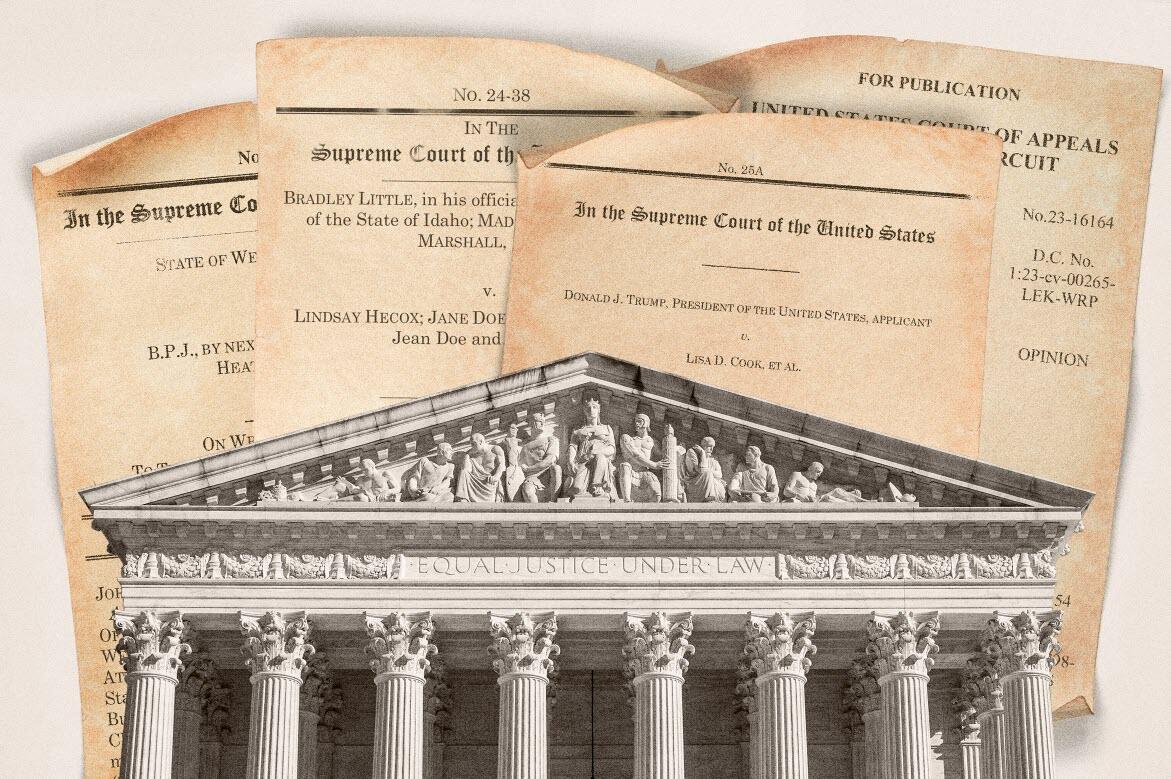
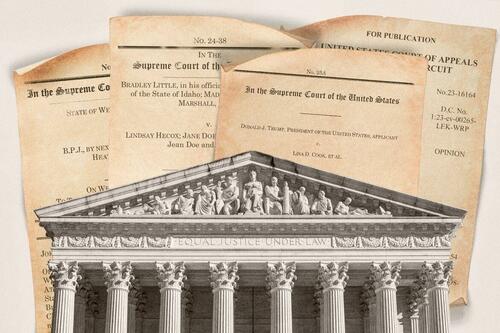
The Supreme Court will resume oral arguments the week of Jan. 12, taking on cases dealing with girls’ athletics, gun laws, and the president’s attempt to fire a member of the Federal Reserve.
Here are the top cases to watch.
1. Girls’ Sports
The Supreme Court on Jan. 13 will hear arguments in two cases—West Virginia v. B.P.J. and Little v. Hecox—that focus on West Virginia’s and Idaho’s laws barring males from competing in female sports. The eventual ruling is expected to tackle key questions about how federal law and the Constitution treat sex and gender.
Both states faced hurdles in federal appeals courts, which held that their laws classified individuals based on their sex and “transgender status.” They also indicated that those types of classifications violated the equal protection clause of the 14th Amendment, which generally directs states to apply the law equally to everyone regardless of particular characteristics.
While courts have sometimes allowed states to treat certain groups of people differently, legal classifications based on sex and other characteristics have also been rejected. That’s because when courts determine whether to uphold a state law, they weigh certain factors, such as whether the state has an important enough interest in using certain characteristics to classify individuals.
In both West Virginia’s and Idaho’s cases, the states have acknowledged that they classify people based on sex but that doing so is justified—specifically because they further important government interests in protecting equality in sports.
“On average, men are faster, stronger, bigger, more muscular, and have more explosive power than women,” Idaho told the Supreme Court. “For female athletes to compete safely and excel, they deserve sex-specific teams.”
West Virginia’s case has also led the Supreme Court to wrestle with a similar issue: whether athletics laws violate Title IX of the Civil Rights Act. That law, which prohibits sex-based discrimination in federally funded educational institutions, was cited by the U.S. Court of Appeals for the Fourth Circuit when it ruled against West Virginia in 2024.
That decision was wrong, West Virginia told the Supreme Court, because Title IX was focused on unequal treatment between the sexes rather than eliminating all sex-based distinctions.
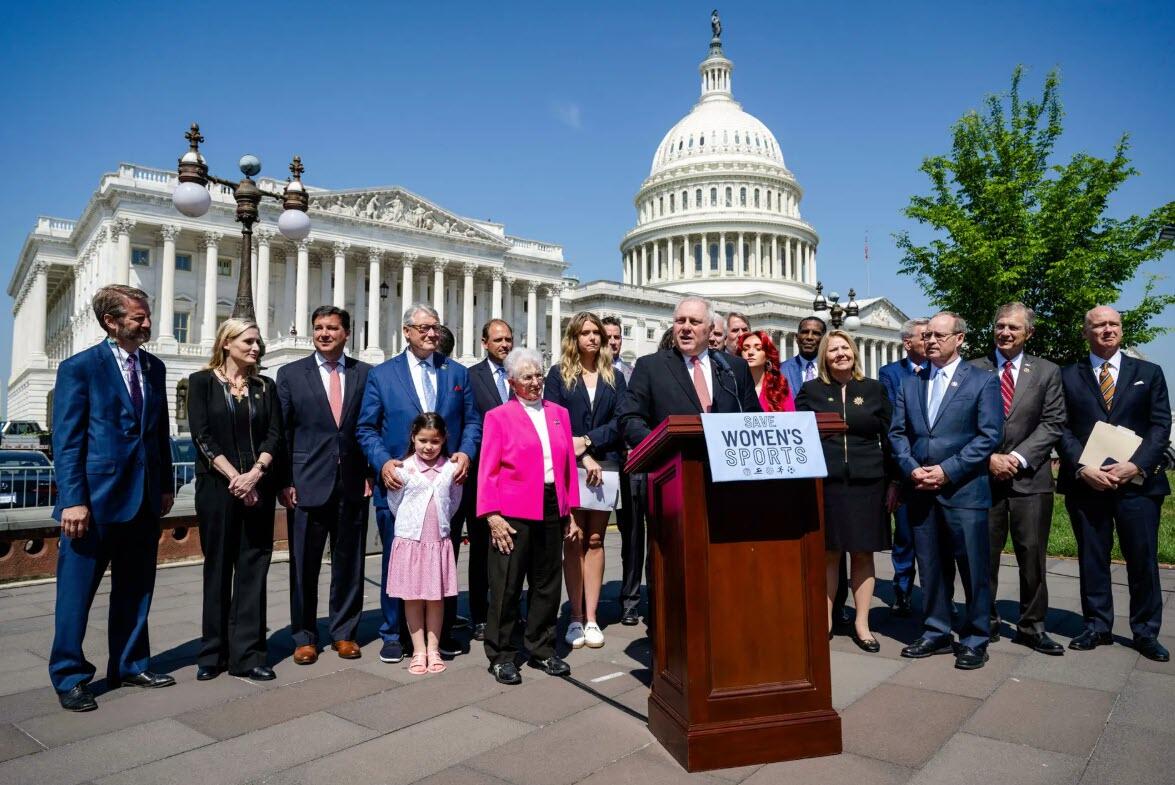
U.S. House Majority Leader Steve Scalise (R-La.) speaks following the passage of the “The Protection of Women and Girls in Sports Act,” outside the U.S. Capitol on April 20, 2023. The Supreme Court on Jan. 13 will hear arguments in two cases that focus on West Virginia’s and Idaho’s laws barring males from competing in female sports. Saul Loeb/AFP via Getty Images
Heather Jackson, whose male child was barred from participating in girls’ cross country and track teams, argued that West Virginia’s law was unreasonable. Part of Jackson’s argument is that puberty-delaying drugs have prevented her child from developing physiological, athletic advantages over girls.
Meanwhile, the student challenging Idaho’s law has attempted to withdraw from the dispute while pledging not to participate in women’s sports. The Supreme Court has deferred deciding on this attempt until after oral argument.
Beyond sex-based distinctions, the appeals courts raised a separate question about whether Idaho’s and West Virginia’s laws classify individuals based on “transgender status.” In other words, do the states target individuals based on that purported status rather than solely based on their sex?
So far, the Supreme Court hasn’t offered a definitive ruling on this issue, but multiple justices suggested in June that someone’s “transgender status” shouldn’t receive extra protection under the Constitution. Justices Samuel Alito and Amy Coney Barrett both said, among other things, that “transgender status” lacked the type of immutable characteristic held by other protected classes, such as race.
2. Hawaii’s Gun Law
The Supreme Court will hear arguments on Jan. 20 in Wolford v. Lopez, which challenges Hawaii’s restrictions on concealed carry but also invites the court to clarify the role of American history in upholding gun laws.
In a landmark ruling in 2022, Justice Clarence Thomas said that state laws should be consistent with the nation’s historical tradition of firearm regulation.
Since then, lower courts have tried applying the decision in that case, known as New York State Rifle and Pistol Association v. Bruen, to state laws such as Hawaii’s. The Hawaii law prohibited concealed-carry permit holders from carrying weapons in privately owned public spaces unless given “express authorization of the owner, lessee, operator, or manager of the private property.”
When the Ninth Circuit reviewed the law, it said those restrictions fell “well within the historical tradition.” The appeals court pointed to a New Jersey law from 1771 and a Louisiana law from 1865 that it said were “dead ringers” for Hawaii’s restrictions.
A man carries a gun before a hearing where four gun control bills passed the Senate Judiciary Committee at the Virginia state Capitol in Richmond, Va., on Jan. 13, 2020. The Supreme Court will hear arguments on Jan. 20 in a case challenging Hawaii’s concealed-carry restrictions that also asks the justices to clarify how history should factor into gun laws. Samira Bouaou/The Epoch Times
Those two were relevant because one was enacted just before the Second Amendment’s ratification, while the other came just before ratification of the 14th Amendment, which extends the Second Amendment to states.
Jason Wolford, a Hawaii resident who sued with other plaintiffs, is asking the Supreme Court to reverse the Ninth Circuit’s decision on the basis that it erred in analyzing the older laws. More specifically, his attorneys argued that historic laws couldn’t merely be similar to the one passed by Hawaii.
Instead, the Supreme Court’s decision in Bruen required that the laws needed to serve similar purposes, the petition says.
Louisiana’s law was too different from Hawaii’s, Wolford said, because it not only focused on land that was barred to the public but also came as part of the state’s “black codes” intended to deprive former slaves of civil rights. He also argued that the New Jersey law was intended to control poaching on enclosed lands and was therefore different from Hawaii’s law.
Hawaii, meanwhile, described its law as following numerous founding-era and Reconstruction-era laws in vindicating the rights of property owners to exclude certain people from their property.
3. Trump’s Fed Firing
On Jan. 21, the Supreme Court will examine the president’s authority to remove members of the Federal Reserve. The case, Trump v. Cook, follows another case heard in December over the president’s ability to fire a member of the Federal Trade Commission.
Both cases focus on laws Congress passed restricting the president’s ability to fire officials. Trump v. Cook is a bit different, however, in that it focuses more on the purported cause Trump cited in firing Federal Reserve Board of Governors member Lisa Cook.
Lisa Cook, member of the Board of Governors of the U.S. Federal Reserve, departs the Federal Reserve Board headquarters in Washington on Oct. 9, 2025. On Jan. 21, the Supreme Court will examine the president’s authority to remove members of the Federal Reserve. Andrew Caballero-Reynolds/AFP via Getty Images
The issue arose after Trump sent a letter in August accusing Cook of mortgage fraud.
Cook and Trump have differed over whether alleged fraud was the type of “cause” that Congress allowed the president to use as a basis for firing board members. While the Federal Reserve Act allows presidents to fire members “for cause,” it doesn’t offer much indication as to what that means. Trump, meanwhile, has argued that courts shouldn’t be able to second-guess his determination that a sufficient cause existed for firing someone such as Cook.
Many of the arguments surround how much protection Cook deserves under the Fifth Amendment, which says people can’t “be deprived of life, liberty, or property, without due process of law.”
A federal judge in Washington reinstated Cook on the basis that she had a property interest in her position but wasn’t given due process before losing her job. That due process, the judge said, should include some kind of meaningful notice and an opportunity to be heard.
Trump appealed to the Supreme Court, telling the justices that tenure-protected officers didn’t have a property right to their positions and that reinstatement was outside of judges’ authority.
Tyler Durden
Fri, 01/02/2026 – 11:40
https://www.zerohedge.com/political/3-key-supreme-court-cases-watch-early-2026

Fighting Breaks Out On Saudi Border In Oil-Rich Yemen Region
Fighting Breaks Out On Saudi Border In Oil-Rich Yemen Region
Yemen continues to be a major headache and security risk for the Saudis, and rare fighting has emerged just on the kingdom’s border. Looming over the crisis is the deepening rift between Gulf Cooperation Council (GCC) members Saudi Arabia and the United Arab Emirates.
Saudi warplanes carried out fresh airstrikes on sites near the Saudi-Yemeni border in Yemen’s Hadramout province on Friday, as clashes erupted between forces loyal to the Saudi-backed provincial governor and fighters affiliated with the separatist Southern Transitional Council (STC).
UAE-backed southern Yemeni separatist forces, via Reuters.
The STC has for years called the secession of a proposed federal “State of South Arabia” from the rest of the country, and is backed in this current conflict by the UAE.
At lease seven air raids along the border occurred Friday, according to local officials. The STC’s leader in Wadi Hadramout, Mohammed Abdulmalik, has said that the strikes killed seven people and injured more than 20 others.
Saudi-backed authorities have this week moved to reassert control over military installations in the province. Hadramout borders Saudi Arabia and thus whichever group controls the area gains great influence and strategic importance, also given it is an area rich with crude.
Earlier on Friday, Yemen’s Saudi-backed government formally announced the launch of a military operation targeting the STC in Hadramout. Speaking in a televised address from Riyadh, the province’s governor said the campaign was intended to reassert state authority and secure key institutions in the oil-producing region.
In response, STC forces said they were fully prepared to confront any military escalation following the governor’s announcement.
Al Jazeera’s Ali Hashem has explained of the geopolitical pressures which led to the new escalation:
The opportunity here for the Southern Transitional Council (STC) is to go towards separation, to have a southern state, which has been its dream for decades.
It’s a different moment and it’s instrumental in recalibrating the region. Israel’s war on Gaza war has changed everything – it changed the perception of national security within major states in the region. It changed also the way small players are regarding the possibilities and potential they can build on.
The UAE-backed STC has long rivaled Yemen’s internationally recognized government for influence in the south. However, both sides have at times coordinated against the Iran-aligned Houthi movement in an “enemy of my enemy is my friend” kind of way.
Map source: American Foreign Service Association
While media cameras have for years focused on the dominant Houthis in Yemen, friction between Saudi-supported and Emirati-aligned forces has increasingly flared into armed confrontations.
Tyler Durden
Fri, 01/02/2026 – 11:20
https://www.zerohedge.com/geopolitical/fighting-breaks-out-saudi-border-oil-rich-yemen-region
RFK Jr. Stops Requiring Doctors To Report Patient Vaccine Status
RFK Jr. Stops Requiring Doctors To Report Patient Vaccine Status
Authored by Zachary Stieber via The Epoch Times,
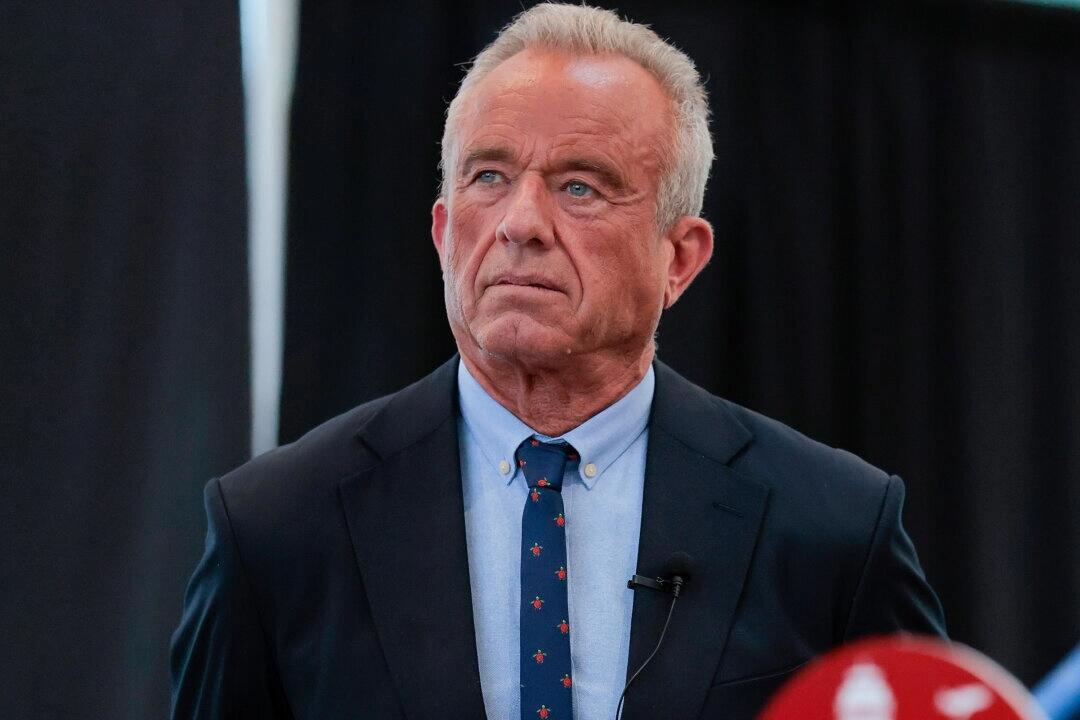
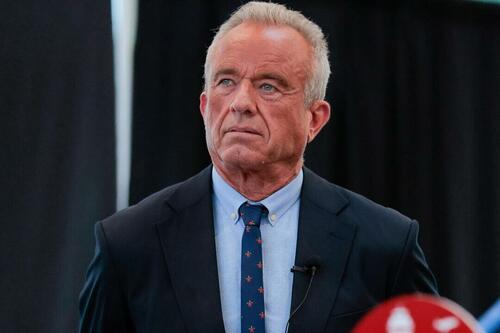
Health Secretary Robert F. Kennedy Jr. has stopped mandating health care providers report the immunization status of patients.
Kennedy decided to stop requiring doctors to list vaccinations children have received, the Centers for Medicare & Medicaid Services (CMS) said in a Dec. 30, 2025, letter to state health officials.
Doctors participating in Medicaid and the Children’s Health Insurance Program were previously required to report how many children received specific vaccines by their second birthday, and other shots by the time they turn 14 years old.
Kennedy also eliminated a requirement that doctors report the immunization status of pregnant women, according to the notice.
“Government bureaucracies should never coerce doctors or families into accepting vaccines or penalize physicians for respecting patient choice. That practice ends now,” Kennedy, head of the Department of Health and Human Services (HHS), of which CMS is a part, said in a post on X. “Under the Trump administration, HHS will protect informed consent, respect religious liberty, and uphold medical freedom.”
Federal law requires that doctors report certain measures while caring for the approximately 78 million people on Medicaid or the Children’s Health Insurance Program, and that states convey that data to CMS. The reporting was voluntary when first implemented. It began being mandated in fiscal year 2024.
CMS did not respond to a request for comment. In the letter, the agency noted that Kennedy has authority under the law to make changes to the required measures “to improve and strengthen” the reporting requirements, and that pursuant to that authority, CMS was removing the immunization reporting requirements.
The agency said that providers can choose to voluntarily provide the information moving forward “to allow CMS to maintain a longitudinal dataset while exploring alternative immunization measures.”
It also said that starting in 2026, officials would be exploring the development of new measures that would “capture information about whether parents and families were informed about vaccine choices, vaccine safety and side effects, and alternative vaccine schedules.”
Officials plan to talk with states, providers, and other stakeholders about those measures.
“CMS will also explore how religious exemptions for vaccinations can be accounted for in the data and the subsequent measures,” the letter states.
“CMS does not tie payment to performance on immunization quality measures in Medicaid and CHIP at the federal level. While states have flexibility and discretion to use quality measures in state developed value-based purchasing and payment incentive fee for service or managed care programs, CMS strongly discourages states from using immunization measures in payment arrangements.”
Tyler Durden
Fri, 01/02/2026 – 11:00
https://www.zerohedge.com/medical/rfk-jr-stops-requiring-doctors-report-patient-vaccine-status

Tesla loses title as world’s biggest electric vehicle maker as sales fall for second year in a row
NEW YORK — Tesla lost its crown as the world’s bestselling electric vehicle maker on Friday as a customer revolt over Elon Musk’s right-wing politics, expiring U.S. tax breaks for buyers and stiff overseas competition pushed sales down for a second year in a row.
Tesla said that it delivered 1.64 million vehicles in 2025, down 9% from a year earlier.
Chinese rival BYD, which sold 2.26 million vehicles last year, is now the biggest EV maker.
It’s a stunning reversal for Musk who once dismissed BYD as a threat as Tesla’s rise seemed unstoppable, crushing traditional automakers with far more resources and helping make him the world’s richest man.
For the fourth quarter, sales totaled 418,227, falling short of the 440,000 that analysts polled by FactSet expected. The sales total was impacted by the expiration of a $7,500 tax credit that was phased out by the Trump administration at the end of September.
Tesla stock was up 0.5% at $451.60 in early trading Friday.
Even with multiple issues buffeting the company, investors are betting that Tesla CEO Musk can deliver on his ambitions to make Tesla a leader in robotaxi service and get consumers to embrace humanoid robots that can perform basic tasks in homes and offices. Reflecting that optimism, the stock finished 2025 with a gain of approximately 11%.
The latest quarter was the first with sales of stripped-down versions of the Model Y and Model 3 that Musk unveiled in early October as part of an effort to revive sales. The new Model Y costs just under $40,000 while customers can buy the cheaper Model 3 for under $37,000. Those versions are expected to help Tesla compete with Chinese models in Europe and Asia.
For fourth-quarter earnings coming out in late January, analysts are expecting the company to post a 3% drop in sales and a nearly 40% drop in earnings per share, according to FactSet. Analysts expect the downward trend in sales and profits to eventually reverse itself as 2026 rolls along.
Investors have largely shrugged off the falling numbers, choosing to focus on Musk’s pivot to different parts of business.
He has been saying that plunging car sales don’t matter as much now because the future of the company lies more with his new driverless robotaxis service, the company’s energy storage business and building robots for the home and factory. To make his task worthwhile, Tesla’s directors awarded Musk a potentially enormous new pay package that shareholders backed at the annual meeting in November.
Musk scored another huge windfall two weeks ago when the Delaware Supreme Court reversed a decision that deprived him of a $55 billion pay package that Tesla doled out in 2018.
Musk could become the world’s first trillionaire later this year when he sells shares of his rocket company SpaceX to public for the first time in what analysts expect would be a blockbuster initial public offering.
NPR’s CEO Refused Internal Demands To Resign “For The Good Of Public Media” Before Loss Of Funding
NPR’s CEO Refused Internal Demands To Resign “For The Good Of Public Media” Before Loss Of Funding
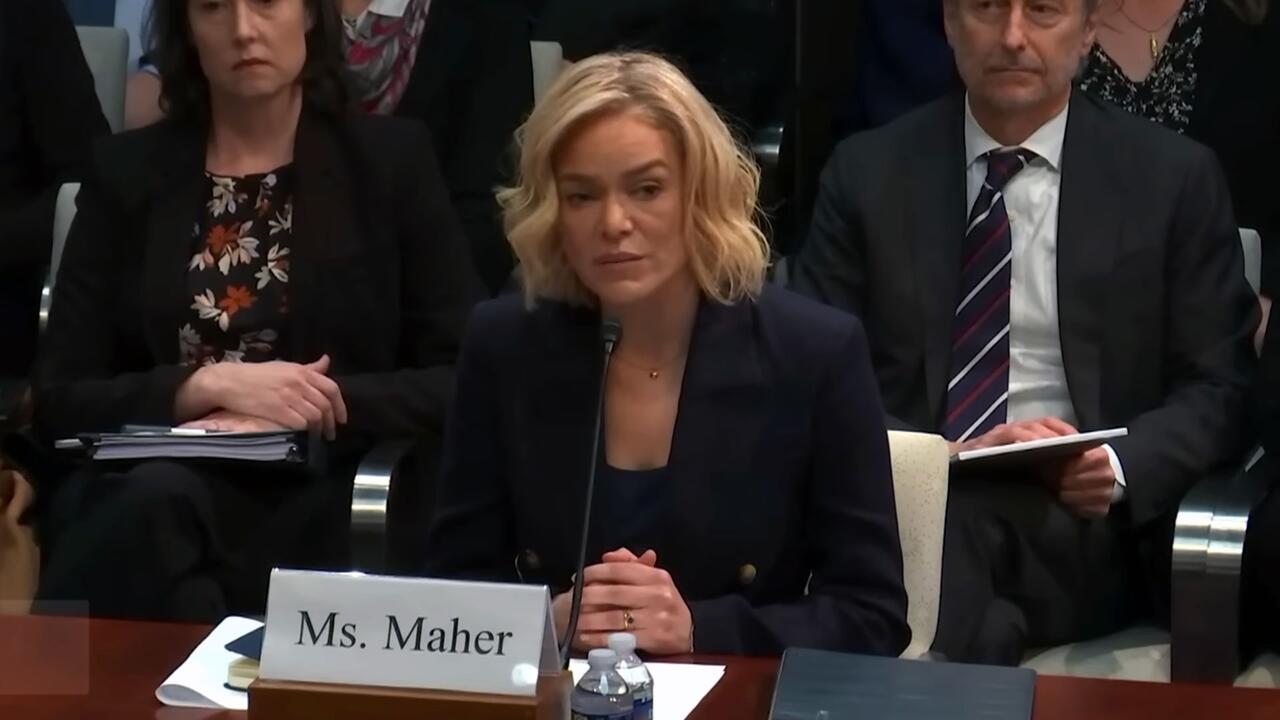
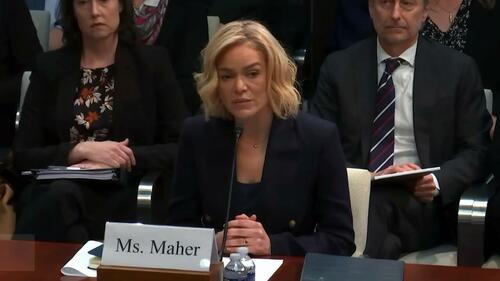
The New York Times reports that the Corporation for Public Broadcasting (CPB) called on National Public Radio (NPR) CEO Katherine Maher to resign before all federal funding for both the CPB and NPR was cut off. As in the past, Maher and the NPR board chose their own agendas over the interests of their institution and public radio.
I have long been a critic of Maher since her inexplicable selection by the NPR board to lead the media organization. Despite years of objections to NPR’s overt bias, many critics genuinely wanted NPR to reverse course and adopt more balanced coverage. That is why, when NPR was searching for a new CEO, I encouraged the board to hire a moderate figure without a history of political advocacy or controversy.
Instead, the board selected Katherine Maher, a former Wikipedia CEO widely criticized for her highly partisan and controversial public statements.
She was the personification of advocacy journalism, even declaring that the First Amendment is the “number one challenge” that makes it “tricky” to censor or “modify” content as she would like.
Maher has supported “deplatforming” anyone she deems to be “fascists” and even suggested that she might support “punching Nazis.”
She also declared that “our reverence for the truth might be a distraction [in] getting things done.”
As expected, the bias at NPR only got worse. The leadership even changed a longstanding rule barring journalists from joining political protests.
One editor had had enough. Uri Berliner had watched NPR become an echo chamber for the far left with a virtual purging of all conservatives and Republicans from the newsroom. Berliner noted that NPR’s Washington headquarters has 87 registered Democrats among its editors and zero Republicans.
Maher and NPR remained dismissive of such complaints. Maher attacked the award-winning Berliner for causing an “affront to the individual journalists who work incredibly hard.” She called his criticism “profoundly disrespectful, hurtful, and demeaning.”
Berliner resigned, after noting how Maher’s “divisive views confirm the very problems at NPR” that he had been pointing out.
In her disastrous appearance before Congress, Maher sat next to PBS CEO Paula A. Kerger and dismissed criticism. What was not disclosed is that PBS agreed with some of us that, if Maher truly wanted to save federal funding and protect NPR, she would resign.
According to the Times, our calls for her resignation were being repeated internally. Instead, the board that made the foolish choice of hiring Maher chose their ideological and personal agendas over the interests of their institution . . . again.
In the meantime, Maher and others were going public, bewailing the threat to journalism and calling on citizens to do everything that they could to protect NPR. The only thing that they were not willing to do was admit their own failure.
We have seen the same pattern in academia.
The fact is that this academic echo chamber may be killing educational institutions, but the intolerance still works to the advantage of faculty who can control publications, speaking opportunities, and advancement with like-minded ideologues.
We have watched the same perverse incentive in the media where outlets are seeing plummeting readers and revenue. Journalism schools and editors now maintain that reporters should reject objectivity and neutrality as touchstones of journalism.
It does not matter that this advocacy journalism is killing the profession. Reporters and editors continue to saw at the limb upon which they sit due to the same advantage for academics. For reporters, converting newsrooms into echo chambers gives them more security, advancement, and opportunities.
Recently, the new Washington Post publisher and CEO William Lewis was brought into the paper to right the ship. He told the staff “let’s not sugarcoat it…We are losing large amounts of money. Your audience has halved in recent years. People are not reading your stuff. Right. I can’t sugarcoat it anymore.”
The response from reporters was to call for owner Jeff Bezos to fire Lewis and others seeking to change the culture. The Post has been eliminating positions and just implemented another round of layoffs to address the budget shortfalls.
In the meantime, trust in the media is at record lows — paralleling the polling on higher education. The result is the rise of new media as people turn to blogs and other sources for their news.
At NPR, the board and Maher have led the organization into a complete and utter meltdown, resulting in the loss of millions in funding and a shrinking audience. However, it does not matter. CPB called on Maher to resign “for the good of public media.” It was not, however, good for her or her board.
Socially and personally, these individuals are praised and promoted as ideological champions on the left. They were even willing to see the death of CPB to remain faithful to the agenda.
So, CPB died, NPR lost all funding, but Maher kept her job… and her agenda.
Tyler Durden
Fri, 01/02/2026 – 10:20
“Then It Is War”: Elon Musk Responds After Somali TikToker Threatens His Life
“Then It Is War”: Elon Musk Responds After Somali TikToker Threatens His Life
A Somali TikToker (account now defunct), first highlighted by Libs of TikTok, mocked Americans about alleged Somali-linked fraud in Minnesota and pushed dangerous rhetoric suggesting Elon Musk was “about to die.” Such statements fit a broader alarming pattern surrounding the Democratic Party’s normalization of assassination culture against Musk and President Trump supporters.
“I wouldn’t worry too much about him. He [Musk] about to die,” TikToker “dowza.z” stated in a short 30-second clip. The account has since been taken down, and it remains unclear whether the TikToker deleted the account or whether the dangerous rhetoric directed at Musk violated the platform’s terms of service.
The somali tiktoker who mocked Americans had a meltdown over Elon Musk and appeared to threaten his life:
“I wouldn’t worry too much about him. He about to die.”
. @FBI should definitely look into this https://t.co/37Ok26xstv pic.twitter.com/Ow8NmwFhut
— Libs of TikTok (@libsoftiktok) January 1, 2026
Musk responded on X to DogeDesigner’s reposting of the video, saying, “Then it is war.”
Then it is war https://t.co/KdlKDW6f61
— Elon Musk (@elonmusk) January 2, 2026
Musk’s comment comes as the current political climate, characterized by increasingly hostile rhetoric from the Democratic Party, has significantly amplified threats and the spillover of inflammatory left-wing propaganda into real-world security risks. Historical precedent supports this assessment, including the role of dark-money-funded NGOs backing anti-American activist networks, what Peter Schweizer has described as the “protest industrial complex,” which coordinated protest activity and other pressure campaigns targeting Musk, Tesla, President Trump, and anything ‘America First’. These efforts coincided with radical left groups, including firebombing terror incidents at Tesla showrooms. Taken together, this pattern of threats from the left and their supporters has translated into real-world consequences. Just look at what happened to Charlie Kirk, which reinforces the urgency for Musk to ramp up his political activity this year.
“America is toast if the radical left wins. They will open the floodgates to illegal immigration and fraud. Won’t be America anymore,” Musk wrote on X.
Musk was quoting a report that he is reportedly going all-in on funding Republicans for the midterm election cycle.
America is toast if the radical left wins.
They will open the floodgates to illegal immigration and fraud.
Won’t be America anymore. https://t.co/9lppGuSyAV
— Elon Musk (@elonmusk) January 1, 2026
This is just day two of the new year.
Tyler Durden
Fri, 01/02/2026 – 10:00
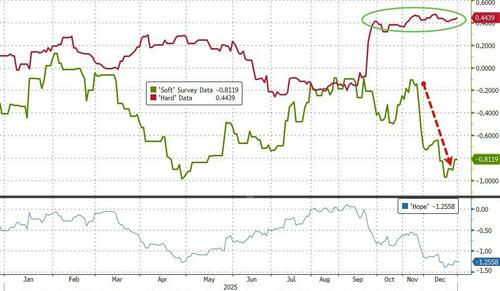
US Manfacturing Survey Signals “Wile E Coyote” Scenario
US Manfacturing Survey Signals “Wile E Coyote” Scenario
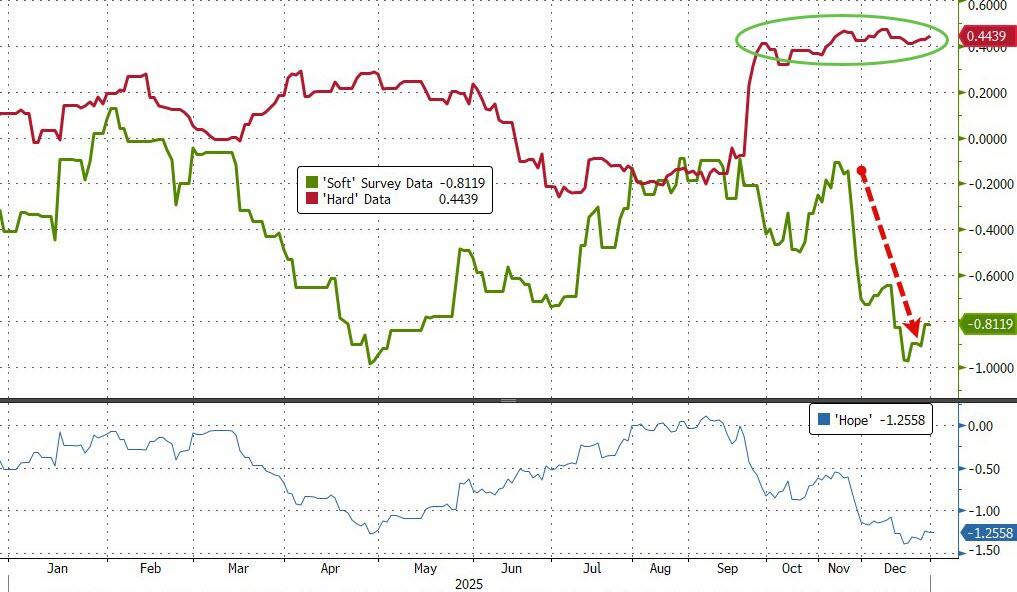
With ‘hard’ data showing resilience into year-end, ‘soft’ survey data has cratered (not helped by the government shutdown)…
Source: Bloomberg
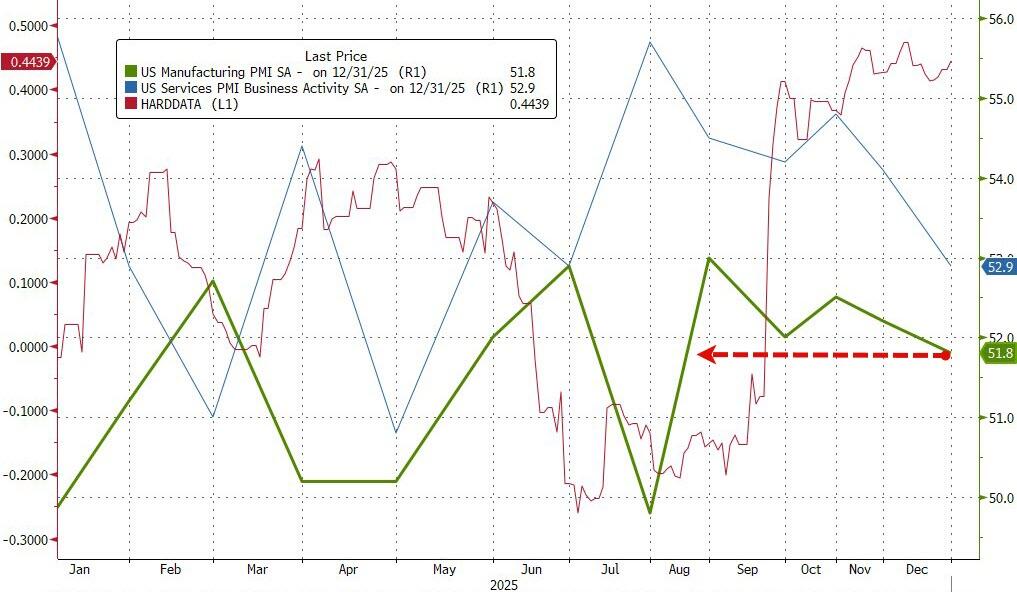
…and this morning brings more weakness as S&P Global’s US Manufacturing PMI (final print for December) dipped to 51.8 – its lowest since July (the only contractionary – sub-50- month of 2025)…
Source: Bloomberg
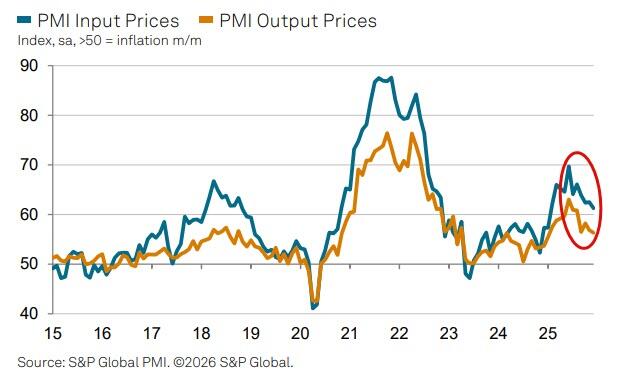
The latest survey showed a weaker gain in production, amid a renewed contraction in new order books – the first in exactly a year. International sales continued to fall, in part linked to tariffs, which also continued to push up operating expenses at an elevated pace. That said, although remaining historically elevated, both input and output prices rose at their slowest rates for 11 months.
“Although manufacturers continued to ramp up production in December, suggesting the goods producing sector will have contributed to further robust economic growth in the fourth quarter, prospects for the start of 2026 are looking less rosy,” according to Chris Williamson, Chief Business Economist at S&P Global Market Intelligence.
“Something of a Wiley E Coyote scenario has developed, whereby – just like the cartoon character continues to run despite chasing the roadrunner off a cliff– factories are continuing to produce goods despite suffering a drop in orders.“
The gap between growth of production and the drop in orders is in fact the widest seen since the height of the global financial crisis back in 2008-9:
“Unless demand improves, current factory production levels are clearly unsustainable.”
Payroll numbers will also be adversely impacted if production capacity has to be scaled back.
“A key factor causing concern over sales is the extent to which producers are having to pass higher costs on to customers in the form of raised prices, with higher costs continuing to be overwhelmingly blamed on tariffs,” says Williamson.
There is some good news:
“Some encouragement comes from input cost inflation moderating in December to the lowest recorded since last January.
But…
However, while this cost trend suggests the tariff impact on inflation peaked back in the summer, costs are still rising month-on-month at an elevated rate to suggest that US firms continue to face higher cost growth than competitors in most other major economies.”
So, choose your own adventure: Hard or Soft data?
Tyler Durden
Fri, 01/02/2026 – 09:54
https://www.zerohedge.com/economics/us-manfacturing-survey-signals-wile-e-coyote-scenario