Category: News

How A Techno-Optimist Became A Grave Skeptic
How A Techno-Optimist Became A Grave Skeptic
Authored by Roger Bate via the Brownstone Institute,
Before Covid, I would have described myself as a technological optimist. New technologies almost always arrive amid exaggerated fears. Railways were supposed to cause mental breakdowns, bicycles were thought to make women infertile or insane, and early electricity was blamed for everything from moral decay to physical collapse. Over time, these anxieties faded, societies adapted, and living standards rose. The pattern was familiar enough that artificial intelligence seemed likely to follow it: disruptive, sometimes misused, but ultimately manageable.
The Covid years unsettled that confidence—not because technology failed, but because institutions did.
Across much of the world, governments and expert bodies responded to uncertainty with unprecedented social and biomedical interventions, justified by worst-case models and enforced with remarkable certainty. Competing hypotheses were marginalized rather than debated. Emergency measures hardened into long-term policy. When evidence shifted, admissions of error were rare, and accountability rarer still. The experience exposed a deeper problem than any single policy mistake: modern institutions appear poorly equipped to manage uncertainty without overreach.
That lesson now weighs heavily on debates over artificial intelligence.
The AI Risk Divide
Broadly speaking, concern about advanced AI falls into two camps. One group—associated with thinkers like Eliezer Yudkowsky and Nate Soares—argues that sufficiently advanced AI is catastrophically dangerous by default. In their deliberately stark formulation, If Anyone Builds It, Everyone Dies, the problem is not bad intentions but incentives: competition ensures someone will cut corners, and once a system escapes meaningful control, intentions no longer matter.
A second camp, including figures such as Stuart Russell, Nick Bostrom, and Max Tegmark, also takes AI risk seriously but is more optimistic that alignment, careful governance, and gradual deployment can keep systems under human control.
Despite their differences, both camps converge on one conclusion: unconstrained AI development is dangerous, and some form of oversight, coordination, or restraint is necessary. Where they diverge is on feasibility and urgency. What is rarely examined, however, is whether the institutions expected to provide that restraint are themselves fit for the role.
Covid suggests reason for doubt.
Covid was not merely a public-health crisis; it was a live experiment in expert-driven governance under uncertainty. Faced with incomplete data, authorities repeatedly chose maximal interventions justified by speculative harms. Dissent was often treated as a moral failing rather than a scientific necessity. Policies were defended not through transparent cost-benefit analysis but through appeals to authority and fear of hypothetical futures.
This pattern matters because it reveals how modern institutions behave when stakes are framed as existential. Incentives shift toward decisiveness, narrative control, and moral certainty. Error correction becomes reputationally costly. Precaution stops being a tool and becomes a doctrine.
The lesson is not that experts are uniquely flawed. It is that institutions reward overconfidence far more reliably than humility, especially when politics, funding, and public fear align. Once extraordinary powers are claimed in the name of safety, they are rarely surrendered willingly.
These are precisely the dynamics now visible in discussions of AI oversight.
The “What if” Machine
A recurring justification for expansive state intervention is the hypothetical bad actor: What if a terrorist builds this? What if a rogue state does that? From that premise flows the argument that governments must act pre-emptively, at scale, and often in secrecy, to prevent catastrophe.
During Covid, similar logic justified sweeping biomedical research agendas, emergency authorizations, and social controls. The reasoning was circular: because something dangerous might happen, the state must take extraordinary action now—action that itself carried significant, poorly understood risks.
AI governance is increasingly framed in the same way. The danger is not only that AI systems might behave unpredictably, but that fear of that possibility will legitimize permanent emergency governance—centralized control over computation, research, and information flows—on the grounds that there is no alternative.
Private Risk, Public Risk
One underappreciated distinction in these debates is between risks generated by private actors and risks generated by state authority. Private firms are constrained—imperfectly, but meaningfully—by liability, competition, reputation, and market discipline. These constraints do not eliminate harm, but they create feedback loops.
Governments operate differently. When states act in the name of catastrophic prevention, feedback weakens. Failures can be reclassified as necessities. Costs can be externalized. Secrecy can be justified by security. Hypothetical future harms become policy levers in the present.
Several AI thinkers implicitly acknowledge this. Bostrom has warned about “lock-in” effects—not just from AI systems, but from governance structures created during moments of panic. Anthony Aguirre’s call for global restraint, while logically coherent, relies on international coordination bodies whose recent track record on humility and error correction is poor. Even more moderate proposals assume regulators capable of resisting politicization and mission creep.
Covid gives us little reason to be confident in that assumption.
The Oversight Paradox
This leads to a troubling paradox at the heart of the AI debate. If one genuinely believes advanced AI must be constrained, slowed, or halted, it is governments and transnational institutions that are most likely to hold the power to do so. Yet these are precisely the actors whose recent behavior gives the least confidence in restrained, reversible use of that power.
Emergency framing is sticky. Authority acquired to manage hypothetical risks tends to persist and expand. Institutions rarely downgrade their own importance. In the AI context, this raises the possibility that the response to AI risk entrenches brittle, politicized systems of control that are harder to unwind than any individual technology.
The danger, in other words, is not only that AI escapes human control, but that fear of AI accelerates the concentration of authority in institutions already shown to be slow to admit error and hostile to dissent.
Rethinking the Real Risk
This is not an argument for complacency about AI, nor a denial that powerful technologies can do real harm. It is an argument for broadening the frame. Institutional failure is itself an existential variable. A system that assumes benevolent, self-correcting governance is no safer than one that assumes benevolent, aligned superintelligence.
Before Covid, it was reasonable to attribute most technological pessimism to human negativity bias—the tendency to believe that our generation’s challenges are uniquely unmanageable. After Covid, skepticism looks less like bias and more like experience.
The central question in the AI debate is therefore not just whether machines can be aligned with human values, but whether modern institutions can be trusted to manage uncertainty without amplifying it. If that trust has eroded—and Covid suggests it has—then calls for expansive AI oversight deserve at least as much scrutiny as claims of technological inevitability.
The greatest risk may not be that AI becomes too powerful, but that fear of that possibility justifies forms of control we later discover are far harder to live with—or escape.
Roger Bate is a Brownstone Fellow, Senior Fellow at the International Center for Law and Economics (Jan 2023-present), Board member of Africa Fighting Malaria (September 2000-present), and Fellow at the Institute of Economic Affairs (January 2000-present).
Tyler Durden
Fri, 01/09/2026 – 23:00
https://www.zerohedge.com/ai/how-techno-optimist-became-grave-skeptic

Harden anota 31, Leonard 26 y los Clippers derrotan 121-105 a los Nets
NUEVA YORK (AP) — James Harden anotó 31 puntos, Kawhi Leonard sumó 26 y los Clippers de Los Ángeles vencieron 121-105 a los Nets de Brooklyn la noche del viernes.
El alero reserva Jordan Miller acertó sus primeros seis tiros y añadió 21 puntos. John Collins consiguió 16 unidades para los Clippers, quienes se recuperaron de su derrota ante los Knicks de Nueva York el miércoles para ganar por octava vez en diez juegos. Leonard, quien era duda más temprano en el día debido a un esguince en el tobillo derecho, comenzó lentamente pero anotó 19 tantos en la segunda mitad.
El base novato Egor Demin anotó 19 puntos para los Nets, quienes perdieron con un tiro sobre la bocina en tiempo extra contra Orlando el miércoles. Pero rápidamente quedó claro que este partido nunca estaría cerrado.
Michael Porter Jr. tuvo dificultades para anotar 18 puntos, fallando los nueve intentos de triples.
Los Clippers anotaron los primeros ocho puntos, y después de que Nic Claxton encestara dos tiros libres, Harden anotó los siguientes seis en una racha de 8-0 que puso el marcador 16-2. Demin encestó un triple para romper el inicio de 0 de ocho de Brooklyn, pero luego Leonard y Harden anotaron para que los Clippers tuvieran ocho de nueve y les dieran una ventaja de 21-5.
Los Clippers abrieron el segundo cuarto con una racha de 10-0 para poner el marcador 45-25 con una jugada de tres puntos del ex pívot de los Nets, Brook Lopez. Los Ángeles lideró por 22 antes de tomar una ventaja de 63-47 al medio tiempo.
___
Deportes en español AP: https://apnews.com/hub/deportes

Luigi Mangione’s federal death penalty trial could start before the end of the year
NEW YORK — Luigi Mangione’s federal death penalty trial in the killing of UnitedHealthcare CEO Brian Thompson could begin before the end of the year, a judge said Friday while weighing a defense bid to bar the government from making it a capital case.
U.S. District Judge Margaret Garnett said she expects Mangione’s trial to begin in December — or possibly January 2027, as federal prosecutors suggested — if the death penalty is still on the table. If not, she said, Mangione could stand trial in October.
Either way, Garnett said, she expects jury selection to begin around Sept. 8. No trial date has been scheduled in Mangione’s parallel state murder case. Prosecutors previously said they anticipated the state trial to be first.
Garnett said she would issue a written schedule after looking at her calendar and reviewing notes of conversations she’s had with the court’s jury coordinator.
The judge said she would rule at a later date on the defense’s requests to prevent prosecutors from seeking the death penalty, throw out some charges and exclude certain evidence. Another pretrial conference is scheduled for Jan. 30.
Mangione’s lawyers contend that authorities prejudiced his case by turning his December 2024 arrest into a “Marvel movie” spectacle and by publicly declaring their desire to see him executed even before he was formally indicted.
At the same time, they are asking Garnett to throw out two of the four charges against him, including the murder by firearm charge that has enabled the government to seek the death penalty. They argue that it is legally flawed.
Federal prosecutors say Mangione’s lawyers are wrong on both fronts, countering that the murder charge is legally sufficient and that “pretrial publicity, even when intense” is hardly a constitutional crisis. Any concerns about public perceptions can be alleviated by carefully questioning prospective jurors about their knowledge of the case, prosecutors wrote in a court filing.
Mangione has pleaded not guilty to federal and state murder charges, which carry the possibility of life in prison.
Friday’s hearing was Mangione’s first trip to Manhattan federal court since his April 25 arraignment.
A cause célèbre for people upset with the health insurance industry, Mangione again drew supporters to the courthouse. Some wore green clothing and carried signs such as “Free Luigi” and “No Death For Luigi Mangione.”
Mangione, wearing a beige jail uniform, was attentive but didn’t speak once during the nearly three-hour proceeding. After entering the courtroom, he greeted his lead attorneys, Karen Friedman Agnifilo and Marc Agnifilo, with handshakes. He nodded along while reading documents, sometimes sipping from a plastic water bottle.
In addition to the death penalty issue, Garnett is weighing a defense request — similar to one in his state case — to bar the government from using certain items found in a backpack during his arrest. The defense argues that the search was illegal because police had not yet obtained a warrant.
Those items include a gun that police said matched the one used to kill Thompson and a notebook in which Mangione purportedly described his intent to “wack” a health insurance executive.
Garnett said she is not inclined to hold a separate hearing on the evidence issue like one last month that took three weeks in Mangione’s state murder case. The judge in that case said he won’t rule until May.
Prosecutors contend police were justified in searching the backpack to make sure there were no dangerous items and that the gun, notebook and other evidence would have eventually been found anyway.
Thompson, 50, was killed Dec. 4, 2024, as he walked to a Manhattan hotel for UnitedHealth Group’s annual investor conference. Surveillance video showed a masked gunman shooting him from behind. Police say “delay,” “deny” and “depose” were written on the ammunition, mimicking a phrase used to describe how insurers avoid paying claims.
Mangione, 27, the Ivy League-educated scion of a wealthy Maryland family, was arrested five days later at a McDonald’s in Altoona, Pennsylvania, about 230 miles west of Manhattan.
He’s already had success paring down his state case. In September, a judge threw out state terrorism charges against him.
U.S. Attorney General Pam Bondi announced last year that she was directing federal prosecutors to seek the death penalty, declaring that capital punishment was warranted for a “premeditated, cold-blooded assassination that shocked America.”
Mangione’s lawyers argue that Bondi’s announcement, which she followed with Instagram posts and a TV appearance, showed the decision was “based on politics, not merit.” Her remarks tainted the grand jury process that resulted in his indictment a few weeks later, they said.
https://www.chicagotribune.com/2026/01/09/luigi-mangione-trial-date/
Aryna Sabalenka avanza a final de Brisbane tras vencer a Muchová
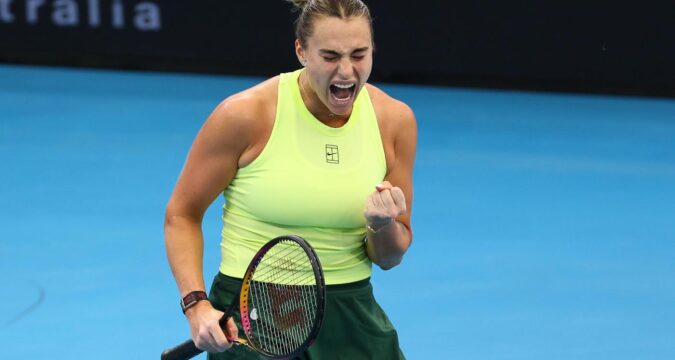
BRISBANE, Australia (AP) — La número uno del mundo Aryna Sabalenka derrotó el sábado 6-3, 6-4 a Karolina Muchová para avanzar a la final del torneo de Brisbane.
Sabalenka, la campeona defensora de Brisbane, resolvió la semifinal en la Arena Pat Rafter en su cuarto punto de partido para avanzar a la final del domingo contra la ganadora de una semifinal posterior entre la cuarta cabeza de serie Jessica Pegula y Marta Kostyuk.
El viernes, en una repetición de la final del Abierto de Australia del año pasado, Sabalenka rompió el servicio de Madison Keys en cinco juegos consecutivos en camino a una victoria por 6-3, 6-3. El año pasado en Melbourne Park, Keys venció a Sabalenka para ganar su primer título de Grand Slam en individuales.
El certamen en Brisbane es un evento preparatorio para el Abierto de Australia de este año, que comienza el 18 de enero.
En el torneo masculino en Brisbane, el primer cabeza de serie Daniil Medvedev jugará contra Alex Michelsen de Estados Unidos en una semifinal posterior. Dos estadounidenses participan en la otra semifinal.
Aleksandar Kovacevic se enfrentaba a Brandon Nakashima.
_____
Deportes AP: https://apnews.com/hub/deportes

Visualizing All Of The World’s Silver Reserves By Country
Visualizing All Of The World’s Silver Reserves By Country
Silver prices surged to new all-time highs in December, extending a powerful end-of-year rally supported by geopolitical uncertainty and a weaker U.S. dollar.
Silver futures briefly touched around $80, marking an unprecedented 160% rally in 2025 that outpaced even gold. Against this backdrop, Visual Capitalists Bruno Venditti notes that understanding where the world’s silver reserves are concentrated provides crucial context for future supply dynamics.
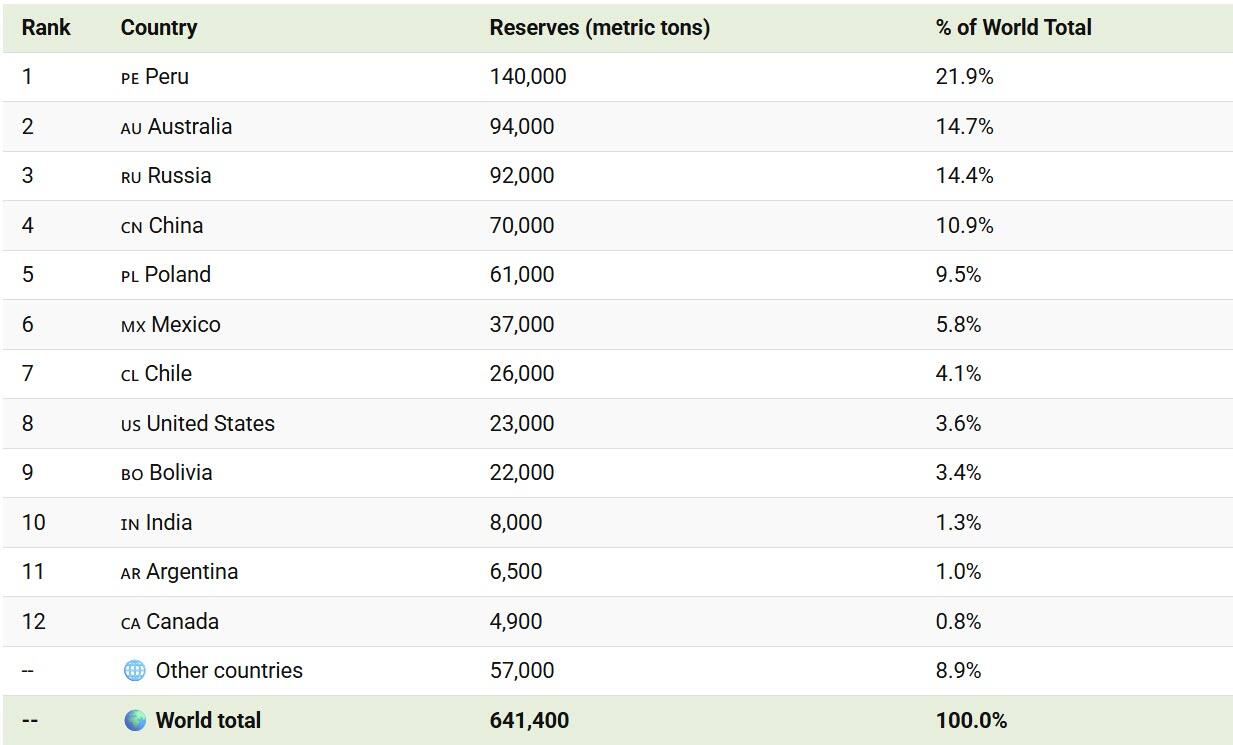
The data for this visualization comes from the U.S. Geological Survey’s Mineral Commodity Summaries (January 2025). It estimates total global silver reserves at about 641,400 metric tons.
Peru’s Dominant Reserve Position
Peru stands out as the single largest holder of silver reserves, with an estimated 140,000 metric tons. This represents roughly 22% of the global total, giving the country a uniquely strategic position in the silver market.
Behind Peru is a cluster of countries with substantial, but smaller, reserve bases. Australia, Russia, and China each hold between 70,000 and 94,000 metric tons, collectively accounting for about 40% of global reserves.
Production Powerhouses vs. Reserve Depth
Mexico offers a striking contrast between production and reserves. It leads the world in silver production, yet holds just 37,000 metric tons of reserves, or about 6% of the global total. Currently, Mexico’s mining sector relies on intensive extraction with fewer projects with established reserves in the pipeline.
Silver in Green Technology
Global silver demand is poised to soar in the next decade, driven by emerging technologies like electric vehicles and solar power.
Silver demand from solar alone has grown from less than 50 million ounces (Moz) a decade ago to an expected 160 Moz in 2023.
If you enjoyed today’s post, check out Mapped: Which Countries Hold the Most Gold Reserves? on Voronoi, the new app from Visual Capitalist.
Tyler Durden
Fri, 01/09/2026 – 22:30
https://www.zerohedge.com/precious-metals/visualizing-all-worlds-silver-reserves-country

Con 29 puntos de Maxey, 76ers doblegan a Magic en duelo de mala puntería en los triples
ORLANDO, Florida, EE.UU. (AP) — Tyrese Maxey anotó 29 puntos y logró tres robos, Joel Embiid añadió 22 unidades y nueve rebotes, y los 76ers de Filadelfia doblegaron el viernes 103-91 al Magic de Orlando en un partido en el que ambos equipos se combinaron para encestar apenas ocho de 57 triples.
Paul George anotó 12 de sus 18 puntos en la segunda mitad y añadió nueve rebotes por los 76ers, quienes ganaron por quinta vez en seis partidos. Filadelfia ha ganado cuatro compromisos seguidos como visitante.
Desmond Bane lideró a Orlando con 23 puntos. Anthony Black añadió 21 y Paolo Banchero terminó con 14 tantos, 11 rebotes y siete asistencias.
Filadelfia embocó cuatro de 28 triples (14,3%), mientras que Orlando acertó cuatro de 29 (13,8%).
Maxey, el tercer máximo anotador de la NBA con 30,7 puntos por partido en esta campaña, encestó solo tres de 12 tiros en una primera mitad en la que acumuló 12 puntos y falló sus cuatro triples. Terminó con diez de 22 en total y tres de ocho en disparos de tres puntos.
El árbitro Bill Kennedy abandonó la cancha en silla de ruedas tras sufrir una aparente lesión en una pierna durante el primer cuarto.
_____
Deportes AP: https://apnews.com/hub/deportes

Pelicans rompen racha de nueve derrotas al vencer 128-107 a Wizards
WASHINGTON (AP) — Los Pelicans de Nueva Orleans rompieron una racha de nueve derrotas con un triunfo por 128-107 sobre los Wizards de Washington, con 35 puntos de Trey Murphy III, 31 de Zion Williamson y un triple doble de Derik Queen el viernes por la noche.
Kyshawn George y Tristan Vukcevic consiguieron 15 unidades cada uno para los Wizards, que no contaron con el recién adquirido guardia Trae Young debido a problemas en el cuádriceps y la rodilla.
Queen, el destacado novato de Nueva Orleans, estuvo magnífico en su regreso al área de D.C. La exestrella de Maryland logró 14 tantos, 16 rebotes y 12 asistencias para el segundo triple-doble de su joven carrera. Los totales de rebotes y asistencias fueron los más altos de la temporada para él.
Young estuvo en la banca con el equipo y recibió una cálida ovación del público cuando fue presentado durante una pausa en el primer cuarto. El intercambio que lo envió de los Hawks a los Wizards se finalizó el viernes.
Los Pelicans también hicieron ese viaje, habiendo perdido en Atlanta el miércoles por la noche antes de vencer a los Wizards.
Nueva Orleans lideró 60-50 al medio tiempo y extendió su ventaja a 21 en el tercer cuarto. Washington se acercó a diez en el cuarto, pero una racha de 21-5 por parte de los Pelicans volvió a convertirlo en una paliza.
Jeremiah Fears anotó 21 puntos para Nueva Orleans, que tuvo un 53% de acierto en tiros de campo y superó a los Wizards 68-46 en la pintura.
Washington tuvo siete jugadores con cifras de doble dígito. Alex Sarr anotó 14 puntos, pero solo un rebote.
___
Deportes en español AP: https://apnews.com/hub/deportes

Pritchard anota 28 puntos y Celtics vencen 125-117 a Raptors disminuidos
BOSTON (AP) — Payton Pritchard anotó 28 puntos y repartió ocho asistencias por los Celtics de Boston, quienes resistieron el viernes ante unos mermados Raptors de Toronto para vencerlos por 125-117.
Jaylen Brown añadió 25 puntos, ocho rebotes y siete asistencias a la causa de los Celtics, que ganaron por quinta vez en seis partidos. Boston encestó 14 triples y tuvo un 54% de acierto en tiros de campo para despegarse en la segunda mitad.
El revés rompió una racha de tres victorias consecutivas de los Raptors. Toronto jugó sin los titulares Brandon Ingram (esguince en el pulgar derecho) y Scottie Barnes (esguince en la rodilla derecha).
Jakob Poeltl, pívot de Toronto, también se perdió su noveno partido consecutivo debido a un esguince en la espalda.
RJ Barrett y Ja’Kobe Walter anotaron 19 unidades cada uno por Toronto. Immanuel Quickley terminó con 17 puntos y 13 asistencias.
_____
Deportes AP: https://apnews.com/hub/deportes

Congressional Budget Office Projects Lower Than Expected US Population Growth
Congressional Budget Office Projects Lower Than Expected US Population Growth
Authored by Zachary Stieber via The Epoch Times,
The Congressional Budget Office (CBO) said on Jan. 7 that the U.S. population will likely grow by only 15 million people in the next 30 years, a decline from its last estimate.
The office projects 364 million people living in the United States in 2056, up from the current population of around 349 million.
The population growth will be 0.3 percent on average in the next 10 years, but will go down to an average rate of just 0.1 percent between 2037 and 2056, CBO projects.
The population projection is down 2.1 percent from the 372 million CBO estimated in a January 2025 report, and the 383 million it projected in a 2024 estimate.
The drop stems from declining fertility rates and lower numbers of immigrants coming to the country, according to the budget office.
For a generation to replace itself in the absence of immigration, the fertility rate needs to be 2.1 births per woman.
The fertility rate in the United States peaked in 2007 at 2.12 births per woman. It dropped to 1.6 births per woman in 2024, the most recent year for which data on fertility were available when the CBO compiled the new projections.
CBO projects the rate will decrease to 1.58 births per woman in 2026 and to 1.53 births per woman in 2036, and that the rate will not drop further in the following 20 years.
Women born in other countries are more likely to have more children. CBO projects the fertility rate for those women to fall from 1.79 births per woman in 2026 before flattening at 1.66 births per woman in 2036. Native-born women will have 1.5 births per woman in 2032, down from 1.53 births per woman currently, and stay around that rate through 2056, according to the office.
The office acknowledged its projections are “subject to considerable uncertainty” and that changes from the projections would impact the actual population.
President Donald Trump has attempted to increase the birth rate through various actions, including introducing taxpayer-funded savings accounts for newborns and making a deal to lower the cost of fertility drugs.
Immigration
CBO said that without net immigration, or more immigrants coming to the country than those leaving, the population would start shrinking in 2030.
The immigration projections are down from 2025, when CBO estimated net immigration would be 2 million in 2025, 1.5 million in 2026, and an average of 1.1 million per year from 2027 to 2055.
CBO said in 2025, just 410,000 immigrants were added. It also now projects an average of just 330,000 more immigrants entering the United States than leaving each year from 2026 to 2036, although it does forecast an increase to 1.2 million a year in the following two decades.
The reduction is partly because of a drop in illegal immigration under President Donald Trump, demographers said. CBO said the combined net immigration of three types of immigrants—people who illegally entered the country, people who illegally stayed after their legal status expired, and people who were paroled during the Biden administration—plummeted from 2.4 million in 2023 to 1.3 million in 2024 and negative 360,000 in 2025.
CBO said its immigration projections were uncertain, in part because future actions from Congress or a president could impact immigration.
Trump and administration officials have used a variety of methods to stem illegal immigration and strengthen vetting procedures, including a visa ban on applications for immigrants from some countries and deploying Immigration and Customs Enforcement agents in U.S. cities to track down immigrants who are in the country illegally.
Trump’s tax and spending legislative package, passed by Congress and signed in July, included roughly $150 billion to ramp up immigration enforcement and deportation agenda over the next four years.
Even if the limits on immigration and increased deportations end with the Trump administration in three years, “it’s still a demographic shock,” said William Frey, a demographer at the Brookings Institution, of the new forecast.
Tyler Durden
Fri, 01/09/2026 – 22:00

Police search Fox River, Clock Tower area for Elgin man missing since Nov. 25
Miguel Segura’s elderly parents live in a village in Veracruz, Mexico, far from the staging area set up Friday as police and firefighters searched the Fox River and surrounding area for the 52-year-old man missing for more than six weeks.
“His parents are suffering because they don’t know where he is,” said Laura Mora, Segura’s cousin. “They said, ‘We want to know what happened.’”
A missing person report was filed on Nov. 29, four days after Segura was last seen, police department spokesman Sgt. Matt Jacobucci said. Relatives contacted the police after a co-worker told them Segura failed to show up for work.
Miguel Segura, who has lived in Elgin for 12 years, was last seen on Nov. 25. He is described as standing 5-foot-5, weighing about 180 pounds, and having brown eyes and black hair. Last seen in the area of State and National streets. (Segura family photo)
Police have been looking into his disappearance and put out a missing person alert, Jacobucci said. This week, they searched near Clock Tower Plaza and along the river because Segura was last seen in the area and frequented the businesses in the shopping center.
“These are the steps we take with any missing person,” Jacobucci said. But each case is different, and investigators follow wherever the leads take them, he said.
Jacobucci couldn’t say whether Segura’s disappearance is “suspicious or not suspicious,” but said police do not consider him to be a danger to himself or others. Beyond that, Jacobucci said he was limited in what he could disclose because it’s an ongoing investigation.
Segura, who is single, stands 5-foot-5, weighs about 180 pounds, and has brown eyes and black hair. Last seen on Nov. 25 in the area of State and National streets, he was wearing a black/red/white Nike jacket, dark blue pants and a dark-colored baseball cap.
Investigators have spoken with friends and with people at the businesses he frequented, Jacobucci said. They’ve reviewed surveillance videos and have canvassed the area in which he was last seen.
“We know they are working on it. They’re trying to find him. We’re very grateful,” Mora said.
Mora and Segura grew up together in Mexico, she said. She now lives in Grand Rapids, Michigan, and came to Elgin last month to join other relatives in searching for him.
She described her cousin as a friendly, hard-working man who liked to joke around. He didn’t drive so he walked everywhere, she said.
“He didn’t give anyone problems,” Mora said, speaking in Spanish and sometimes catching herself when speaking of him in the past tense. “He didn’t hurt anyone. He was very humble.”
Segura immigrated to the U.S. in 1997, and moved to Elgin 12 years ago, Mora said. He rented a room with a local family, who came to view him as part of their family, she said.
Elgin police set up a staging area Friday near the Grand Victoria Casino as they searched the Fox River and surrounding area for Miguel Segura, an Elgin man who was last seen on Nov. 25. (Gloria Casas/The Courier-News)
While he worked hard, sometimes seven days a week, he also liked to have a few beers as he sat along the Fox River, she said. But, “even if he drank, he didn’t give anyone problems,” she said.
There are many scenarios family members have considered when thinking about what might have happened, Mora said.
“If someone saw that he had money, sometimes you think that someone did something to him and took his money,” she said.
They’ve also considered that Segura might have been taken into custody by U.S. Immigration and Customs Enforcement agents, Mora said. The family has been checking to see if his name has turned up at any of the detention facilities and they’ve contacted the Mexican government, which has been keeping track of people who’ve been deported, she said.
So far there’s been no indication he was detained, Mora said.
She’s also worried that memory loss might be involved, she said. Segura told relatives he was having memory problems and she’s concerned he might not remember where he lives, she said.
The relatives who came to Elgin to help in the search have walked the river banks, even when there was “lots of snow and lots of ice,” she said. Segura was well known at Spanky’s and a nearby laundromat, she said, but while everyone had nice things to say about him, no one has seen him lately, she said.
“We are very, very worried,” Mora said. “(His mother) says to bring him home to her.”
Anyone with information about Segura is asked to call the Elgin Police Department at 847-289-2700 or Segura’s family at 616-459-9794.
Gloria Casas is a freelance reporter for The Courier-News.
https://www.chicagotribune.com/2026/01/09/elgin-man-missing-river-segura-search/