Category: News

Denmark, Greenland leaders stand united against Trump’s Greenland takeover call ahead of key meeting
NUUK, Greenland — The leaders of Denmark and the country’s territory of Greenland on Tuesday offered a united front against President Donald Trump’s calls for the United States to take over the strategic Arctic island on the eve of critical meetings in Washington on the matter.
In perhaps their sharpest pushback to date, Denmark and Greenland’s prime ministers underscored that the territory is part of Denmark, and thus covered by the umbrella of the NATO military alliance. A U.S. attempt to take over or force the secession of the massive island would tear apart the transatlantic alliance, which has been a linchpin of post-World War II security.
The leaders, Danish Prime Minister Mette Frederiksen and Greenland Prime Minister Jens-Frederik Nielsen, sought to underscore their solidarity as their foreign ministers, Denmark’s Lars Løkke Rasmussen and Greenland’s Vivian Motzfeldt, prepared for talks at the White House on Wednesday with Vice President JD Vance and Secretary of State Marco Rubio.
“Dear Greenlanders, you should know that we stand together today, we will do so tomorrow, and we will continue to do so,” Frederiksen said during a joint press conference in Copenhagen.
“If we have to choose between the United States and Denmark here and now, we choose Denmark. We choose NATO. We choose the Kingdom of Denmark. We choose the EU,” Nielsen added.
Tensions have grown this month as Trump has ramped up calls for a U.S. takeover of the island. He has repeatedly said he’s considering a range of options, including military force, to acquire Greenland.
Trump earlier this week reiterated his argument that the U.S. needs to “take Greenland,” otherwise Russia or China would. He also says he’d rather “make a deal” for the territory, “but one way or the other, we’re going to have Greenland.”
Danish officials have made clear they are open to expanding cooperation with the U.S. military in Greenland, but have repeatedly stated the territory is not for sale.
In Greenland, ‘children are afraid,’ official says
Since 1945, the American military presence in Greenland has decreased from thousands of soldiers over 17 bases and installations on the island to just the remote Pituffik Space Base in the northwest with roughly 200 soldiers today. The base supports missile warning, missile defense and space surveillance operations for the U.S. and NATO.
Denmark’s parliament approved a bill last June to allow U.S. military bases on Danish soil. It widened a previous military agreement, made in 2023 with the Biden administration, where U.S. troops had broad access to Danish air bases in the Scandinavian country.
Naaja Nathanielsen, Greenland’s minister for business and mineral resources, said it’s “unfathomable” that the United States is discussing taking over a NATO ally and urged the Trump administration to listen to voices from the Arctic island’s people. Nathanielsen added that people in Greenland are “very, very worried” over the U.S. administration’s desire for control of Greenland.
“People are not sleeping, children are afraid, and it just fills everything these days. And we can’t really understand it,” Nathanielsen said at a meeting with lawmakers in Britain’s Parliament.
Meanwhile, Danish officials have also sought to underscore that Denmark has remained a faithful ally of the United States.
A Danish government official confirmed on Tuesday that Denmark provided U.S. forces in the east Atlantic with support last week as they intercepted an oil tanker for alleged violations of U.S. sanctions.
The official, who was not authorized to comment publicly on the sensitive matter and spoke on the condition of anonymity, declined to provide details about what the support entailed.
The U.S. interception in the Atlantic capped a weeks-long pursuit of the tanker that began in the Caribbean Sea as the U.S. imposed a blockade in the waters of Venezuela aimed at capturing sanctioned vessels coming in and out of the South American country.
The White House and Pentagon did not immediately respond to requests for comment. Danish support for the U.S. operation was first reported by Newsmax.
Separately, NATO Secretary-General Mark Rutte refused to be drawn into the dispute, insisting that it was not his role to get involved.
“I never, ever comment when there are discussions within the alliance,” Rutte said, at the European Parliament in Brussels. “My role has to be to make sure we solve issues.”
He said that the 32-nation military alliance must focus on providing security in the Arctic region, which includes Greenland. “When it comes to the protection of the High North, that is my role.”
Nathanielsen said Greenlanders understand the need for increased monitoring in the Arctic amid growing geopolitical insecurity. But she said “it is just unfathomable to understand” that Greenland could be facing the prospect of being sold or annexed.
A bipartisan U.S. congressional delegation is headed to Copenhagen for meetings on Friday and Saturday in an attempt to show unity between the United States and Denmark.
Nathanielsen said she thinks the people of Greenland should have a say in their own future.
“My deepest dream or hope is that the people of Greenland will get a say no matter what,” she said. “For others this might be a piece of land, but for us it’s home.”
Moulson reported from Berlin and Madhani from Washington. Jill Lawless in London, Darlene Superville and Matthew Lee in Washington and Lorne Cook in Brussels contributed to this report.
https://www.chicagotribune.com/2026/01/13/denmark-greenland-trump-takeover/

92% Of Employed Americans Have Cut Back On Spending As The Standard Of Living In The US Crumbles
92% Of Employed Americans Have Cut Back On Spending As The Standard Of Living In The US Crumbles
Authored by Michael Snyder via The Economic Collapse blog,
The headline of this article is not a misprint. The reason why “affordability” has become the number one issue for U.S. voters is because most of the population is being absolutely crushed by the rising cost of living.
Just look at how much you are paying for electricity compared to five years ago. And just look at how much you are paying for food compared to five years ago. Housing costs have risen to absurd heights, property taxes have become absolutely insane in many areas of the country, and health insurance premiums have more than doubled for millions of Americans. It isn’t just a coincidence that so many people are bitterly complaining about the cost of living these days. The truth is that most of the country is experiencing very real pain.
Of course it isn’t an accident that this has happened. Our politicians have borrowed and spent 28 trillion dollars that we did not have since Barack Obama first entered the White House in January 2009, and I warned that all of this money would create rampant inflation.
On top of that, the Federal Reserve has pumped trillions of dollars that were created out of thin air into the financial system since 2008. That has helped the stock market hit record highs, but it has been one of the factors that has made the cost of living unbearable for the rest of us.
The very foolish decisions that our leaders have been making have had dramatic consequences.
Our standard of living is crumbling right in front of our eyes, and now a brand new report is telling us that 92 percent of employed Americans have been forced to cut back on spending…
For millions of Americans, staying financially afloat now means difficult trade-offs. As the price of everyday necessities continues to rise faster than wages, new data shows workers are cutting back wherever they can – often at the expense of savings, overall financial security and even essential needs.
That is the picture emerging from Resume Now’s 2026 Cost-of-Living Crunch Report, a national survey of 1,011 employed Americans, which has found that only 17 percent of Americans feel financially secure enough to cover essentials and save money. Nearly two-thirds of respondents cited everyday essentials as their biggest financial burden. What’s more, a remarkable 92 percent said they have cut back on spending, including on items many would previously have considered non-negotiable.
Please notice that only “employed Americans” were asked about the cost of living.
More than 100 million U.S. adults are not working at all.
For those that do not regularly follow my work, yes that is an accurate number. The vast majority of U.S. adults that are not working are considered to be “not in the labor force” by the federal government.
Another survey that was conducted at the end of December found that 70 percent of Americans consider the cost of living where they live to be “not very affordable” or “not affordable at all”…
American consumers aren’t feeling great about the economy or their own financial situation, with the phrase “affordability crisis” dominating headlines and political campaigns over the last few months.
The majority — 70% — of Americans surveyed in a Marist poll of over 1,400 adults taken in December, say that the cost of living in their area is not very affordable, or not affordable at all, for the average family.
This is the result of decades of incredibly bad economic policy.
The purchasing power of our money has been steadily declining, and now 65 percent of employed Americans are struggling to even afford everyday essentials…
Sixty-five percent of the survey respondents said that affording everyday essentials was a top contributor to their financial strain.
Jared Kessler, founder of Forex Broker, said the concentration of stress around essentials is a key indicator that the problem runs deeper than any short-term financial shocks. “It is clear, based on this data, that we are experiencing a real cost-of-living crisis as opposed to an immediate inflationary response to the COVID-19 pandemic,” he told Newsweek.
Read that last sentence again, because it is so true.
We are in the midst of a nightmarish cost of living crisis that never seems to end.
At this stage, 60 percent of employed Americans “could only cover three months or less of expenses if they were to lose their job”…
Sixty percent of respondents said they could only cover three months or less of expenses if they were to lose their job, leaving little room for error in the event of layoffs, illness or other events that could impact their financial standing. For many, even routine expenses are being trimmed.
Most of the country is living right on the edge.
Nobody can deny this.
And consumer sentiment rapidly moved in the wrong direction in 2025…
Between January and November last year, consumer sentiment among the lowest and middle terciles of American household income fell 29.8% and 27.6%, respectively, while the country’s highest third of earners suffered a steeper 32.1% decline.
Our politicians in Washington shouldn’t have been borrowing and spending so much money all these years.
But they did.
And we should have never allowed ourselves to go 38.4 trillion dollars in debt.
But we did.
Many of us ranted about the bad decisions that were being made for years.
But most of the population didn’t listen.
Sadly, as I pointed out in a previous article, we have now reached a point where “affordability” has become the number one issue for U.S. voters…
A University of Michigan poll published in December shows that high prices remain a pain point for consumers. About 46% blame high prices for poor personal finances — among the highest shares since the series started in the late 1970s.
Consumers’ views of their current financial situation in December “collapsed” into negative territory for the first time since July 2022, the month after pandemic-era inflation had peaked, according to a poll published Tuesday by the Conference Board.
Overall, 65% of U.S. households say the cost of living has gotten worse or much worse in the past year, according to a recent Politico poll.
Previous generations handed us the keys to the greatest economic machine that the world had never seen.
And we went out and wrecked it.
50 years ago, the U.S. economy was so dominant that it would have taken stupidity on an epic scale to cause it to fail.
But somehow we managed to do it.
Even though our standard of living is in the process of collapsing all around us, most Americans are still working hard and are “effectively trying to muscle through this”…
“What we’re seeing is there is still inflation pressure across the system, particularly in the retail environment, and consumers, through our research tell us that they are effectively trying to muscle through this,” Will Auchincloss, Americas retail sector leader at EY-Parthenon, says. “They’re trying to buy what they’ve always bought or want to buy, but in the face of higher prices.”
Most of us want to continue to live the way we did before, but we simply do not have enough money to do it.
So U.S. households are piling up tremendous amounts of debt.
In fact, U.S. household debt recently hit an all-time record high of 18.59 trillion dollars…
Americans’ household debt levels – including mortgages, car loans, credit cards and student loans – are now at a new record high, according to data released Wednesday by the Federal Reserve Bank of New York.
Total household debt reached $18.59 trillion from July through September of this year, up by $197 billion from the previous quarter.
Of course the federal government is an even bigger offender.
The U.S. government is now 38.4 trillion dollars in debt, and it is being projected that number will be well above 40 trillion dollars before the end of this year.
For more than a decade I warned about what would happen if we kept going down this road, and now it has happened.
We are literally committing societal suicide.
The next time you feel like screaming while you are paying your bills, you might want to remember who got us into this mess in the first place.
* * *
Michael’s new book entitled “10 Prophetic Events That Are Coming Next” is available in paperback and for the Kindle on Amazon.com, and you can subscribe to his Substack newsletter at michaeltsnyder.substack.com.
Tyler Durden
Tue, 01/13/2026 – 17:15

Claudette Colvin, who refused to move seats on a bus at start of civil rights movement, dies at 86
WASHINGTON — Claudette Colvin, whose 1955 arrest for refusing to give up her seat on a segregated Montgomery bus helped spark the modern civil rights movement, has died. She was 86.
Her death was announced Tuesday by the Claudette Colvin Legacy Foundation. Ashley D. Roseboro of the organization confirmed she died in Texas.
Colvin was arrested months before Rosa Parks gained international fame before refusing to give up her seat on a segregated bus.
A bus driver called police on March 2, 1955, to complain that two Black girls were sitting near two white girls in violation of segregation laws. One of the Black girls moved toward the rear when asked, a police report said, but Colvin refused and was arrested. She was 15 at the time.
Colvin became a named plaintiff in the landmark lawsuit that outlawed racial segregation on Montgomery’s buses.
https://www.chicagotribune.com/2026/01/13/claudette-colvin-civil-rights-obit/
Residents on both sides of new Benet Academy sports stadium plan speak out
After nearly two hours of debate pro and con plans to build a new Benet Academy football/sports stadium, Lisle Mayor Mary Jo Mullen said a compromise is needed.
Benet representatives and residents need to meet with village officials “to find an alternative” before the issue returns to the Lisle Village Board in March.
“I really want us to continue working together (to) see if we can get closer together,” said Mullen, who lives in Oak Hill South, the subdivision that shares a property line with Benet and whose residents will be in closest proximity to the proposed venue.
Linda Donahue, a longtime neighbor of Benet Academy, told the Lisle Village Board Monday night that the lights and noise from the private school’s proposed sports stadium would have a negative effect on her quality of life. She said she fears her property value will plunge. (Steve Metsch/Naperville Sun)
Twenty-six people addressed the issue — 16 opposed it and 10 in support.
The private high school, which draws a large number of students from Naperville, is seeking village permission to build a 1,900-seat football stadium to replace the one near Maple Avenue and Cascade Drive, which is no longer used for varsity football and has been described by Benet officials as a “relic of the 1960s.”
Opponents don’t like the plan because it’s so close to residential property, with some homes just 86 feet away. The lights and noise resulting from games and practice sessions will affect their quality of life, they say.
Benet officials said lights will be needed 54 nights each year, and they’ve agreed to limitations on time, light usage and sound levels.
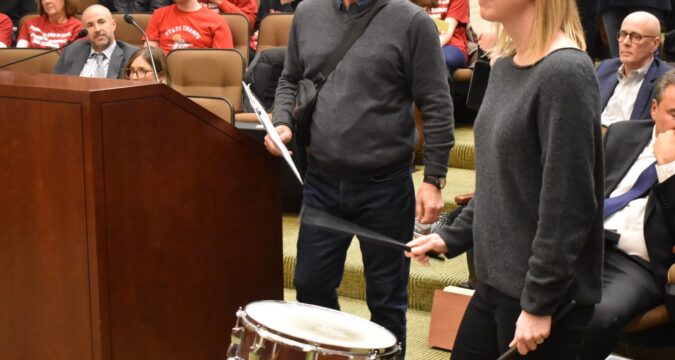
Two opponents said even the sound limits the school had agreed to were too high, and demonstrate loud it could be.
After Mike Krzywosz set a decibel meter in front of the mayor, Danielle Appello began banging on a snare drum.
“For your enjoyment,” he said as he played a tape of a random game.
The drum echoed loudly in the room with doors closed.
Mullen said the decibel meter was at 85 when the recording played and “jumped up between 90 and 102 with the snare.”
Several opponents wondered why the stadium can’t be built on the east side of the Benet property, closer to Yackley Avenue and farther from homes.
On Tuesday, Benet spokesman Patrick Skarr said that is not an option.
“The primary reason the school has not proposed locating the stadium along the eastern boundary is that the property is subject to a legal covenant that prohibits certain construction in that location,” Skarr said in an email. “Benet cannot propose a facility in a location where it does not have the legal right to build.”
Lisle resident Susan Srail said she thinks it would be “ridiculous” if the Lisle Village Board denies the special use permits that Benet Academy needs to build a lighted football/sports stadium. (Steve Metsch/Naperville Sun)
Benet attorney Caitlin Csuk said the school had made modifications that mirror the concessions Loyola Academy made with its neighbors when it wanted to build a new lighted field.
Opponents said Oak Hill South neighbors live much closer to the proposed Benet site than do residents living near Loyoyla’s stadium.
Amanda McIntyre, who lives in Oak Hill South, said she has no problem with Benet’s plans.
“We fully support the stadium project,” she said, citing “school spirit and the energy of young people.”
She called the project “a win for Lisle,” noting visitors will spend money in town. Denying the stadium “would be short sighted,” she said.
“Benet Academy is not just a school. It’s a cornerstone of this town,” McIntyre said.
Jim Mocarski, however, noted that the Lisle Village Board in 2002 rejected plans for a lighted football field for Lisle High School. The board cited “light intrusion, dangerous noise levels, negative housing value impacts,” he said.
“(They) were all obvious and significant then, just as they are today,” Mocarski said.
Plans call for installation of two synthetic turf fields, track, stadium lighting, press box, bleachers, long jump and pole-vaulting pit, scoreboard, time clock, modified parking lot, multifunction building and storage buildings. The varsity football team has played its home games at Benedictine University across the street since 2005.
While football will be the big draw, the stadium also will be used for soccer, lacrosse, girls flag football, track matches and physical education classes.
Four student-athletes spoke in favor of the project.
Benet sophomore Luke Crowder, who lives in Oak Hill South, is a wide receiver and cornerback for the football team. “I dreamed of playing for Benet,” he said.
Playing at Benedictine University “doesn’t feel like home,” he said.
Building a stadium would have a “generational impact” and he asked trustees for support of a project “that brings people together.”
But opponent Linda Donahue said her “life and well-being are directly impacted” by the plan.
“Imagine the constant glare of towering lights flooding my home and yard late into the night,” Donahue said. “This is a significant change and disruption.”
Benet officials said the lights will be dimmed right after games and turned off as soon as possible. Donahue countered that a proposed eight-foot fence won’t prevent the lights from illuminating her yard and house for hours, Donahue said.
Games would be played less than 100 feet from her property line, she said.
“Who would want to buy a home with stadium noise and bright lights?” she asked.
There are also concerns about fans parking on Cascade Lane during games.
Benet President Bill Myers and Athletic Director Scott Lawler have said the improvements are long overdue, noting the current stadium was built in 1961, preceding the houses that are now there.
Luke Crowder, a sophomore who plays wide receiver and cornerback for Benet Academy’s football team, says playing games at Benedictine University “doesn’t feel like home.” (Steve Metsch/Naperville Sun)
The last update to the existing stadium was the installation of a new track in 1991.
“It’s time to modernize and bring it up to par with other area schools — public or private — lights, turf,” Myers said last week “Our kids need them to compete in a healthy, safe environment.”
After Monday’s meeting, Myers said he looks forward to more meetings with residents and the village.
Following commission meetings that started in July, the school agreed not only to reduce the seating count but to Benet is to provide a plan on how it will deal with overflow parking and work with the police chief on closing Cascade Drive at Maple Avenue to nonresidents when home football games are scheduled, according to village documents.
The majority of games will not be played at night, and Friday night varsity football games may begin as early as 7 p.m., Lawler said last week.
Karen Maguire, who has lived with her husband in Oak Hill for 45 years, said “our son, daughter, daughter-in-law and oldest grandson graduated from Benet” and asked trustees if they’d want to live near the stadium.
But Lisle resident Susan Srail said she was appalled by opposition.
“I think these kids deserve four years. … Everybody wants to walk onto their home field. That’s what high school is about.
“I don’t know what (opponents) are complaining about. It’s not going to destroy their property. It’s 54 days. There are 311 days (in the year) with nothing going on at that field. It’s ridiculous if you turn this down,” Srail said.
Steve Metsch is a freelance reporter for the Naperville Sun.
https://www.chicagotribune.com/2026/01/13/benet-academy-sport-stadium-lisle/

Musk Offers Free Starlink As Iran Protests Endure Internet, Comms Blackout
Musk Offers Free Starlink As Iran Protests Endure Internet, Comms Blackout
Now amid a days-long internet blackout which stretches to last week, Iranians are being offered free Starlink satellite service by Elon Musk’s SpaceX.
“SpaceX has waived the Starlink subscription fee in Iran, so people with receivers in the country can access service without paying, according to Ahmad Ahmadian, executive director of the US group Holistic Resilience, which works with Iranians to secure Internet access,” Bloomberg reports Tuesday.”A person familiar with Starlink’s operations confirmed the free ser vice, while asking not to be identified because the information isn’t public,” the report says further.
Word of this comes after earlier the same day President Trump encouraged Iranians to mount a coup and attack government buildings and institutions. In a serious escalation of his Iran rhetoric, Trump posted to Truth Social earlier, “To all Iranian patriots: keep protesting. Take over your institutions if possible. And save the names of the killers and the abusers that are abusing you.”
What started as economically-driven protests in Tehran marketplaces last month threatens to become a full-blown insurgency targeting police and government buildings, amid some reports that over 100 security personnel have died.
Western press accounts have focused on the allegedly hundreds of protesters killed, with some highly dubious sources on Tuesday going so far as to claim 12,000 demonstrators have been killed.
But what hasn’t been a focus is that semi-official Tasnim News Agency is claiming that at least 109 security personnel have lost their lives.
“The servicemen were martyred after swarms of violent rioters attacked them by firing bullets and hitting the law enforcement forces with various weapons,” said the commander of the special forces General Masoud Mosaddeq, as quoted in the outlet.
Various external forces have tried to hijack the protests, amid Israel’s Mossad also boasting its agents have infiltrated and are influencing events on the ground. So obviously, there’s a raging info war of competing narratives – just like with the Syria and Libyan regime change wars before.
Starlink will supposedly help video from on the ground get out of the country, but such info could also be driven by foreign NGOs (or else foreign governments). The Wall Street Journal freshly reports:
With the government shutting down the internet and throttling phone services, Iranians are leaning heavily on Elon Musk’s Starlink service to share videos of growing protests and the regime’s escalating crackdown with the world.
But Iran has intensified efforts to jam the service, which is banned in the country, and users are being hunted.
Over the weekend, authorities began searching for and confiscating Starlink dishes in western Tehran, said Amir Rashidi, director of digital rights and security at Miaan Group, a U.S. nonprofit opposed to internet censorship.
“It’s electronic warfare,” Rashidi said. He said disruptions are worst in parts of Tehran where protests are taking place and in the evening, when the demonstrators gather.
The battle over information—while secondary to the confrontations taking place nightly in dozens of cities across Iran—has potentially serious consequences. President Trump has threatened to intervene in response to a crackdown by the regime.
But this can go the other way as well. Plenty of videos have surfaced which purport to show Iranian security officers being assassinated, beaten or stabbed by anti-government crowds.
Potomac, Maryland-based Clown Prince Reza Pahlavi has explicitly called for violent attacks on IRIB media facilities and its staff
He’s also called for targeting (read: killing) any government worker who does not quit their job and join the regime change riots https://t.co/5W9t4zP9WP
— Max Blumenthal (@MaxBlumenthal) January 13, 2026
According to Iranian state news outlet Press TV, President Masoud Pezeshkian accused US and Israeli intelligence agencies of training armed units, with that training happening both inside and outside the country. If outside governments are directly aiding the agitators, it wouldn’t be the first time that technique was used in an attempt to impose regime change on Iran. In 1953, US and British intelligence engineered a coup d’etat that ousted Iran’s democratically-elected prime minister, Mohammad Mosaddegh. “Operation Ajax” involved the use of CIA-funded Iranian agents and “rented” crowds of anti-government demonstrators.
Tehran is likely to seize on these reports of SpaceX offering free Starlink access and assistance, in order to further accuse the West of waging a covert campaign aimed at destabilizing the Iranian government. Well and this covert foreign-backed campaign is probably already in full swing.
Tyler Durden
Tue, 01/13/2026 – 16:50

Los Reales de Kansas City acercan los muros del estadio Kauffman para aumentar la ofensiva
Por DAVE SKRETTA
KANSAS CITY, Missouri, EE.UU. (AP) — Probablemente más pelotas volaran fuera del Kauffman Stadium esta temporada.
Los Reales de Kansas City anunciaron el martes que están acercando sus muros para la próxima temporada, algo que los fanáticos han demandado durante años, y que el club espera resulte en mayor acción y anotación desde que el estadio fue inaugurado en 1973.
“Hemos discutido esta posibilidad durante años, y después de mucho trabajo por parte de nuestro departamento de investigación y desarrollo, creemos que este será un cambio positivo para nuestro equipo”, indicó el gerente general de los Reales J.J. Picollo.
Las dimensiones del Kauffman han permanecido en gran medida sin cambios desde su apertura hace más de 50 años, con los postes de foul del jardín izquierdo y derecho a 330 pies del plato, los callejones a 387 pies y la pared del jardín central a 410 pies de la caja de bateo.
Eso creó uno de los jardines más amplios en las Grandes Ligas.
Los Royals a menudo lo han utilizado a su favor, también, construyendo equipos que valoran la defensa y el corrido de bases. Pero eso a menudo ha sido en detrimento de los fanáticos, que tienden a apreciar el jonrón y la anotación, y a veces ponía a los Reales en desventaja cuando un equipo con bateadores capaces de sacar la pelota del Kauffman llegaba a la ciudad.
Aunque la pared del jardín central permanecerá a 410 pies, los Reales dijeron que la pared cerca de cada poste de foul se acercará de ocho a diez pies, y los espacios resultantes serán de 379 pies. La altura de la pared también cambiará de 10 pies en la mayoría de los lugares a ocho pies y medio, permitiendo a los Reales agregar alrededor de 150 asientos en el jardín izquierdo y alrededor de 80 nuevos asientos con barandilla para bebidas en el jardín derecho.
La investigación del club estima que el valor de carrera de los elevados pasará del tercio inferior de los estadios de MLB al tercio medio.
El doctor Daniel Mack, asistente del gerente general y vicepresidente de investigación y desarrollo de los Reales, remarcó que “hacer de este un estadio más justo ayudará con la construcción del roster, pero más importante, permitirá a nuestros jugadores mantener el mismo enfoque sin importar dónde juguemos”.
“Nuestro enfoque fue cuidadosamente considerado para tener en cuenta tantos factores como sea posible. Creemos que esto reducirá en última instancia las limitaciones dentro del Kauffman”, señaló Mack.
Mientras los Reales modifican las dimensiones del Kauffman, también continúan trabajando en su reemplazo.
Los dueños han expresado que los Reales no jugarán en el pintoresco pero envejecido estadio después de que su contrato de arrendamiento expire en 2031, lo que los pone en marcha para construir un reemplazo. Los vecinos Chiefs anunciaron recientemente su intención de construir un nuevo estadio en Kansas a tiempo para la temporada 2031. Se espera que los Reales decidan pronto sobre su ubicación para un nuevo estadio.
La creencia de larga data es que los Reales prefieren construir en el centro de Kansas City, Missouri, aunque se están considerando otros sitios.
___
Deportes AP: https://apnews.com/hub/deportes

Column: With ‘fear and anxiety’ rising, Suicide Prevention Services to hold fundraiser for more therapists
Stephanie Weber has lots to thank Joe Popp for.
For starters, “he changed my life,” Weber says of her sixth-grade teacher at Bardwell Elementary School in Aurora, who is now 90 and living in Oregon, Illinois.
Popp, then a new teacher back in the late 1950s, did so by making a bright but overweight 12-year-old who wore pink glasses feel important again after experiencing a “fifth-grade teacher from hell” who “favored the kids who had money,” recalled Weber, the longtime executive director of Suicide Prevention Services/Stone Manor Counseling.
“He treated all of his students with such kindness,” 78-year-old Weber told me, adding that her former teacher became her colleague after she obtained a degree in education and returned to teach at Bardwell.
Even back then, however, Popp’s passion for art was evident, and one of her most empowering moments was when he convinced his insecure student to enter an art contest, despite having, as Weber put it, “minimal to no” talent.
“I was just so proud of that piece,” she said of her 3-D entry that featured a lily pond, and that she, surprisingly, kept well into her 70s.
Popp eventually left teaching to open an art studio in Aurora, which he ran until about 30 years ago when he and wife Dona moved to Oregon. But Weber and Popp remained friends. And it’s from her former teacher that Weber heard about an “Art Dash” fundraiser that this historic little town on the Rock River has been doing successfully for the past four years.
While attending the event with Popp last year she saw how it could be replicated, especially in an artistic community like the Fox Valley.
An art dash is described as a fast-paced fundraiser where local artists donate pieces of their work and supporters purchase tickets for the opportunity to rush to claim the artwork they want. Suicide Prevention Services officials are dubbing their event “Spring into Art.” It will be held from 5:30-9:30 p.m. March 19 at Society 57 in downtown Aurora, where the dashers – or in this case, “springers” – will compete three at a time to get that piece of art they have their eyes on.
The cost to be an observer only is $85 and will include hors d’oeuvres, desserts and cash bar. To get in on the action as a participant is $125, with each guaranteed a piece of art, some of which will range into the thousands of dollars, noted Weber.
Suicide Prevention Services has certainly grown in the nearly three decades since it was founded by Weber. The nonprofit not only runs the 988 National Suicide Prevention Lifeline, it features direct counseling at both its Stone Manor Counseling in Batavia and satellite office which opened on the second floor of Old Second Bank in downtown Aurora about 16 months ago.
The nonprofit also facilitates support groups and other community outreach programs and has contracts with some school districts that offer presentations, as well as clinicians who can provide assessments, support and referrals.
The money raised at this upcoming event, Weber said, will go toward hiring more therapists so there will be no waiting lists for those requiring counseling but can’t otherwise afford it.
“We have many more people coming to our front doors in crisis who did not even make an appointment. And that’s why we always have licensed clinicians ready to help,” she said, adding that the mental health of this country “has never been worse,” in large part because of the political and social unrest roiling our communities.
“The fear and anxiety is making people feel helpless,” especially those who feel targeted and marginalized, Weber said.
As an example she points to a close friend who, because she has trouble walking, was approached by a helpful Hispanic man while both were entering a Jewel recently. While she declined his offer for assistance, the pair began to talk – she told him about her husband in hospice, he opened up about the fear he feels every time he leaves his home.
By the end of that walk, “both were in tears,” Weber told me.
The world is certainly a different place from when she was was a young girl who found her mojo again thanks to a caring teacher. But one thing remains constant, Weber insisted.
“As a staff we talk about making a difference in the lives of those who come to us. But we want them to take what they get from us and pay it forward … to make a difference in the lives of others.”
This fundraiser, she is convinced, will help SPS do just that. Those interested in taking part – as an artist, sponsor, a “springer” or as an observer – can go to the Suicide Prevention Services website and click on the “Spring into Art” link at the top of the page.
Not only will the event put the spotlight on community artists as well as suicide prevention and awareness, Weber promises “it will be a lot of fun.”
dcrosby@tribpub.com

Fraud, Failure, & The Cost Of Not Demanding Assimilation
Fraud, Failure, & The Cost Of Not Demanding Assimilation
Authored by Kathy Barnett via The Epoch Times,
Minnesota did not wake up one morning and suddenly become a hub for fraud.
What Americans are witnessing—large-scale welfare and child care fraud, weak enforcement, political paralysis, and rising public anger—is not random. It is the predictable downstream result of decades of policies made by people who would never have to live with the consequences and who faced few personal costs for getting it wrong.
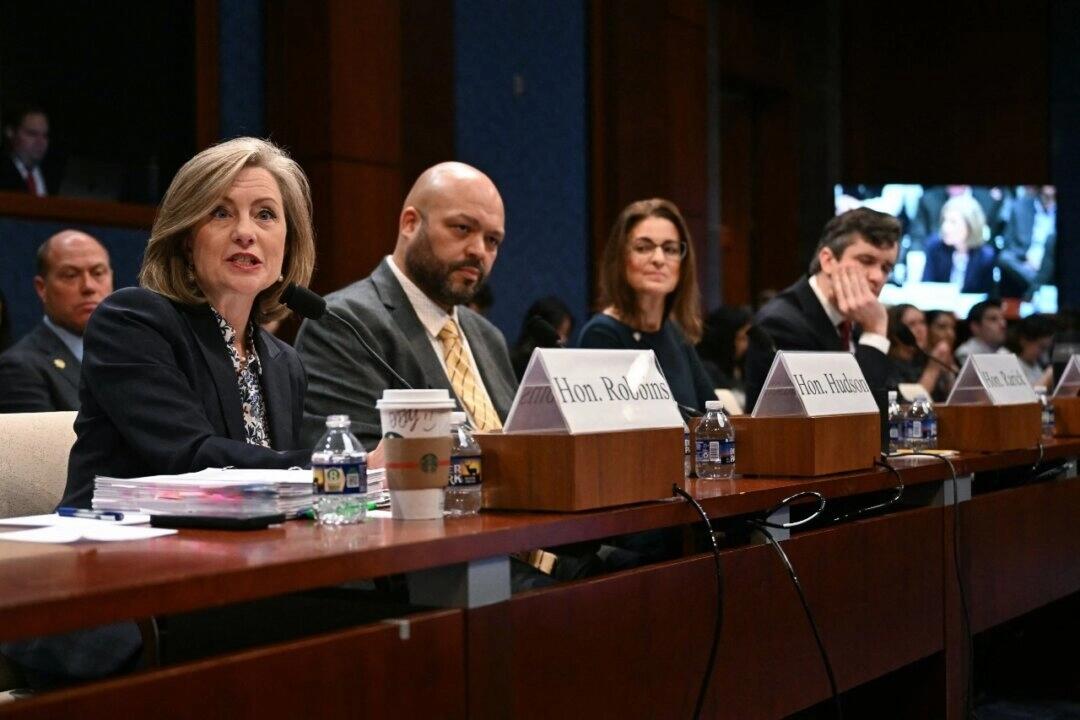
(L–R) Minnesota Rep. Kristin Robbins, Minnesota Rep. Walter Hudson, Minnesota Rep. Marion O’Neill Rarick, and former special counsel at the U.S. Department of Justice Brendan Ballou testify during a House Oversight Committee hearing on Capitol Hill in Washington on Jan. 7, 2026. Brendan Smialowski/AFP via Getty Images
To address this moment honestly, several truths must be held at the same time, without flinching and without allowing the conversation to be deliberately mischaracterized.
First, the fraud is real.
Millions of taxpayer dollars were stolen. Oversight failed. Warnings were ignored. Accountability has been slow, evasive, or nonexistent. Individuals who committed fraud should be prosecuted. And when offenders are not U.S. citizens, deportation is not cruelty; rather, it’s the lawful consequence of violating the terms under which residency was granted.
Second, the public anger is real and rational.
Anxiety Rooted in Reality
Americans are not imagining their fears.
They are anxious about artificial intelligence displacing jobs, the expansion of H-1B visas amid stagnant wages, declining educational outcomes, extensive wars, and a cost of living that continues to rise. They are frustrated by leaders who campaign on reform yet deliver very little, even when they control the White House, Congress, and key agencies.
When citizens who work hard, pay taxes, and follow the rules see millions of dollars siphoned off through fraud, and then watch political leaders stall, evade responsibility, or gaslight the public, anger is inevitable.
That anger is not racism. It is a response to betrayal.
This Is Not About Race—but It Is About Culture
This is where the conversation is often intentionally distorted.
Exposing fraud in Minnesota is not about race or the color of anyone’s skin. But it is about ethnicity, culture, and behavior, as well as the refusal to speak honestly about assimilation.
Ethnicity is not skin color. It is a shared set of cultural norms, values, beliefs, and behavioral patterns. And yes, the fraud in Minnesota appears to be highly concentrated within a specific ethnic community, one originating from a country defined by state collapse, clan rule, tribal allegiance, and chronic instability.
That observation is not a moral judgment. It is a sociological fact.
Culture Matters in a High-Trust Society
Somalia has been a failed state for decades. It is not governed by durable institutions, but by informal clan networks and survival incentives shaped by chaos.
When large numbers of people from such an environment are resettled into a high-trust society—one built on compliance, enforcement, and shared civic norms—without firm assimilation requirements, the outcome should not surprise anyone.
In addition to being exploited by malevolent political actors and nongovernmental organizations seeking power or funding, some Somali communities resettled from high-chaos environments can consolidate into self-contained enclaves, effectively recreating aspects of a failed state within a high-trust American society. In such settings, tribal loyalties may replace civic obligation, informal networks may supplant the rule of law, and a weak cultural or moral attachment to America can make fraud against public systems easier to rationalize.
Chaos does not disappear when it crosses a border. It adapts.
Why Assimilation Must Be a Mandate
America is a high-trust society. It functions because a broad majority of its citizens share common expectations about responsibility and fairness. Americans work hard, pay taxes, and accept obligations alongside rights. They expect the rules to apply evenly and believe that although the system is imperfect, it is meant to reward honesty, effort, and compliance with the law.
That social compact only holds when political elites, their allies, and newcomers are held to the same standard as everyone else. Specifically, newcomers are expected—clearly and unequivocally—to assimilate into those norms rather than recreate the conditions they left behind. A high-trust society cannot endure if parallel systems replace civic obligation or if cultural norms hostile to rule-based governance are permitted to take root without consequence.
Compassion without assimilation is not compassion. It is negligence.
Accountability Without Collective Guilt
None of this implies collective blame. Collective guilt is imprecise and counterproductive, and it conveniently absolves policymakers, bureaucracies, and nongovernmental organizations that designed, enabled, or ignored systemic failures.
What is required instead is a disciplined framework that distinguishes between identity and conduct, as well as between population and policy. Individuals who committed fraud must be prosecuted. Noncitizens who committed serious fraud must face deportation as a matter of law. And the policymakers and institutions that enabled, ignored, or shielded such behavior must also be held accountable.
Blaming an entire community resolves nothing. At the same time, refusing to acknowledge clear and repeated patterns of behavior resolves nothing either. Accountability loses meaning when it is either indiscriminate or absent.
The Choice Ahead
The path forward is not complicated, but it requires resolve.
If the national response is to deny the problem, credibility is lost. If the issue is collapsed into race, clarity is lost. If public anger is redirected away from those with authority and toward identity groups, failure becomes permanent.
Leadership requires refusing all three.
This is not about hatred. It is about standards. It is about the law. Either a society enforces the rule of law or it allows each person to live according to whatever seems right to him. It is not about exclusion; it is about assimilation. And it is not about scapegoating; it is about accountability, both upward and downward.
If America wants to stop absorbing chaos, it must confront the decisions that created it, enforce the laws already on the books, quickly hold wrongdoers accountable, and insist that anyone who wishes to live here fully join the moral and civic order that makes the country work.
Views expressed in this article are opinions of the author and do not necessarily reflect the views of The Epoch Times or ZeroHedge.
Tyler Durden
Tue, 01/13/2026 – 16:25
https://www.zerohedge.com/political/fraud-failure-cost-not-demanding-assimilation

US snowboarder Chloe Kim says she’s ‘good to go’ for the Olympics despite a torn labrum in her shoulder
Snowboarder Chloe Kim says she’s “good to go” for the Milan Cortina Olympics despite tearing the labrum in her shoulder during a training run last week in Switzerland.
The two-time gold medalist in the halfpipe posted an update to Instagram on Tuesday, saying she wasn’t surprised to learn she had torn her labrum — the lining of the socket that holds the shoulder together. She did not say which shoulder she injured when she fell while getting ready for this weekend’s Laax Open.
“There are two ways to do it, and the way I did it is less severe than the other, so I’m really happy about that,” she said. “Obviously, I’m really disappointed that I can’t snowboard until right before the Olympics, which is going to be hard. I haven’t gotten nearly the amount of reps that I would have liked, but that’s OK.”
The women’s Olympic halfpipe contest starts Feb. 11.
The 25-year-old Kim, who already has qualified for the U.S. team and is the heavy favorite to win in Italy if she’s healthy, said she won’t compete this weekend. She didn’t mention the Winter X Games later this month in Aspen, the last big contest before the Olympics.
Kim has been in only one competition this season — last month at Copper Mountain — and while warming up for the final there, she suffered a shoulder injury as well.
In her video, Kim said she’ll have to wear a “super-sexy shoulder brace” that is uncomfortable.
“I went through a bunch of different waves of emotions, but honestly, I’m really excited for this week,” she said.
The end of the video flashed to her picking up her boyfriend, Cleveland Browns defensive end Myles Garrett, at the train station.
“I’m so grateful to be able to do this even though the lows can get pretty damn low,” Kim wrote on the post that went along with her video. “Excited for a week of exploration!”
https://www.chicagotribune.com/2026/01/13/chloe-kim-olympics-torn-labrum/

Orland Fire Protection District union continues to raise concerns on calls for backup ambulances
The Orland Professional Firefighters Local 2754 union continues to raise concerns about the fire district’s ability to respond to an increasing number of calls since an ambulance went offline in June, despite the new fire chief’s assertions the additional ambulance is not needed.
Union President Dan Fagan, an Orland Park firefighter, said the district is daily finds it’s down to one or no ambulances, requiring them to seek backup from outside communities.
The union wrote in a social media post Friday that within one day, the Orland Fire Protection District requested out-of-town ambulances to assist them seven times. Calls included assisting a woman who was critically injured after being struck by a car on 159th Street Thursday night.
“That doesn’t mean that’s the only time that the town is at risk,” Fagan said. “When we’re down to one ambulance, that means we have one ambulance for the next major call that comes in, with 175,000 people in town.”
Fagan said that estimate includes people in the area during the day, such as for work. The Orland Fire Protection District provides service for all or parts of Orland Park, Orland Hills and unincorporated Orland Township.
Fagan said he has warned the board for about five years that projected area growth requires increased services. He said the nearly 230,000-square-foot Amazon retail center planned for the already busy 159th Street and LaGrange Road intersection would boost the number of calls the fire district receives.
“Every time a new home goes up, a new medical facility goes up, our call volume goes up,” Fagan said. “That means there’s less time in the day that an ambulance is available to the residents who are paying taxes.”
Kevin Doyle, who started as fire chief/administrator in October after serving as Homer Township Fire Protection District’s chief, said these concerns are exaggerated, based on his interpretation of call data. He said during the 24-hour period mentioned in the union’s Facebook post, the Orland Fire Protection District requested out-of-town ambulances to back them up six times, not seven, and only one of those ambulances was sent on a call.
He explained the high number of backup ambulances requested resulted from firefighters receiving physical examinations, which are all coordinated within a 10-day period.
“While there is an ambulance with two paramedics at the primary care getting their physical done, we no longer have five ambulances available — we have four,” Doyle said.
He also said the Orland Fire Protection District, as common practice, calls for outside assistance more quickly than many other fire districts.
The fire district board voted in July to return a district ambulance to operation for 12 hours daily, a month after removing it from the fire district’s circulation, but the Illinois Department of Public Health denied its waiver request. Fagan said the board could have brought back the ambulance for 24 hour daily service, but several board members refused.
Board member Tina Zekich asked to discuss the state agency’s denial during a September board meeting, expressing concern for the community. Board President Beth Damas Kaspar said she wanted to wait until after the new fire chief’s start date Oct. 20 to discuss the matter, saying the ambulance issue was not on the agenda.
Fagan said the union met with Doyle once after he was appointed and brought up the ambulance issue, Fagan said.
“He gave us his thoughts and reasons why we don’t need it, and he has not addressed it since,” Fagan said.
He said the 2026 budget approved by the board last month did not include funding for an extra ambulance.
ostevens@chicagotribune.com
https://www.chicagotribune.com/2026/01/13/orland-fire-protection-district-ambulance-concernss/