Category: News

US futures sink after Donald Trump warns of higher tariffs for 8 countries over Greenland issue
BANGKOK — European shares mostly fell and U.S. stock futures skidded Monday after U.S. President Donald Trump threatened to slap a 10% extra tariff on imports from eight European countries because they oppose having America take control of Greenland.
Germany’s DAX lost 1.3% to close at 24,960.33 and the CAC 40 in Paris fell 1.9% to 8,101.96. Britain’s FTSE 100 declined 0.4% to 10,190.26.
Among U.S stock futures, the S&P 500 was down 1% as of 11:48 a.m. Eastern Time, while the Dow Jones Industrial Average was down 0.8% and the Nasdaq composite was down 1.2%. U.S. stock markets are closed Monday in observance of Martin Luther King Jr. Day.
Trump said Saturday that he would charge a 10% import tax starting in February on goods from Denmark, Norway, Sweden, France, Germany, the United Kingdom, the Netherlands and Finland because of their opposition to American control of Greenland.
The European countries targeted by Trump blasted his threat to raise tariffs, saying they “undermine transatlantic relations and risk a dangerous downward spiral.” The unusually strong joint statement was the most forceful rebuke from the European allies since Trump returned to the White House almost a year ago.
Trump’s moves are testing the strategic alignment and institutional trust underlying support from Europe, the largest trading partner and provider of financing to the United States, Stephen Innes of SPI Asset Management said in a commentary.
“In a world where geopolitical cohesion within the Western alliance is no longer taken for granted, the willingness to recycle capital indefinitely into U.S. assets becomes less automatic. This is not a short-term liquidation story. It is a slow rebalancing story, and those are far more consequential,” Innes said.
In Asia, shares were mixed after China reported that its economy expanded at a 5% annual pace in 2025, though it slowed in the last quarter. Strong exports, despite Trump’s higher tariffs on imports from China, helped to offset relatively weak domestic demand.
Hong Kong’s Hang Seng index lost 1.1% to 26,563.90. The Shanghai Composite index gained 0.3% to 4,114.00.
In Tokyo, the Nikkei 225 declined 0.7% to 53,583.57. Japanese Prime Minister Sanae Takaichi was due to hold a news conference later Monday as she prepares to dissolve the parliament for a snap election next month.
Elsewhere in Asia, South Korea’s Kospi jumped 1.3% to 4,904.66, pushing further into record territory on strong gains for tech-related companies. Computer chip maker SK Hynix climbed 1.1%.
Taiwan’s Taiex added 0.7%, while the Sensex in India fell 0.6%.
On Friday, stocks edged lower on Wall Street as the first week of corporate earnings season ended with markets trading near record levels.
The S&P 500 fell 0.1% and the Dow industrials lost 0.2%. The Nasdaq composite shed 0.1%. They all notched weekly losses, while smaller company stocks fared better. The Russell 2000 eked out a 0.1% gain.
Technology stocks were the strongest forces behind the market’s moves throughout most of the day. Several big technology stocks made strong gains and helped offset losses elsewhere.
Earnings updates might give investors a better sense of how consumers are spending their money and how businesses are faring with persisting inflation and higher tariffs. Results from the technology sector are being scrutinized by investors trying to figure out whether the high stock prices fueled by the craze around artificial intelligence are justified.
This week will bring a broader mix of earnings from airlines, industrial companies, and technology companies. United Airlines, 3M, and Intel are all scheduled to release their quarterly earnings results.
The U.S. central bank will get another update on inflation this week with the government’s release of the personal consumption expenditures price index, or PCE. It is the Federal Reserve’s preferred measure for inflation.
The Fed’s next policy meeting is in two weeks, when it is expected to keep its current benchmark interest rate as it strives to balance a slowing jobs market with stubbornly high inflation, which remains above the Fed’s 2% goal.
In other dealings Monday, U.S. benchmark crude oil rose 12 cents to $59.58 per barrel. Price moves have settled down after a spate of volatility during widespread protests in Iran against that country’s leadership.
Brent crude, the international standard, added 5 cents to $64.17 a barrel.
The price of gold resumed its upward climb, gaining 1.8%, while the price of silver jumped 6.2%.
The U.S. dollar rose to 158.10 Japanese yen from 157.93 yen. The euro rose to $1.1643 from $1.1581.
AP Business Writer Alex Veiga contributed to this report.
https://www.chicagotribune.com/2026/01/19/us-futures-sink-trump-higher-tariffs/
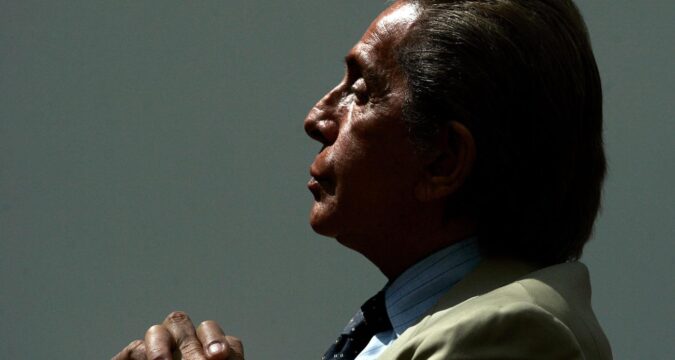
Fotos de la carrera del diseñador de moda Valentino, fallecido a los 93 años
Por The Associated Press
El emblemático diseñador italiano Valentino Garavani fue conocido por sus glamorosos vestidos y su característico “rojo Valentino”, que se convirtió en un elemento esencial de los desfiles de moda durante casi medio siglo. Su fundación anunció su deceso el lunes a los 93 años.
___
Esta es una galería curada por editores de foto de AP.

Gold And Silver Explosion: Something Big Is Happening
Gold And Silver Explosion: Something Big Is Happening
Gold and silver prices, according to Brandon Smith of Alt-Market.com, are signaling stress under the surface of the economy. From shrinking physical inventories to record central bank buying, precious metals warn that the underlying issues aren’t resolved…
In early 2020 at the beginning of the pandemic hysteria I noted that the covid panic seemed to perfectly coincide with the Federal Reserve’s acceleration of interest rates and asset dumping. This trend, I argued, was a precursor to a Catch-22 scenario I have been warning about for some time.
Since the crash of 2008, the central bank has used stimulus measures and near-zero interest rates to protect “too big to fail” corporations while keeping debt afloat globally. Doing this required the digital printing of tens of trillions of fiat dollars and, inevitably, a sharp devaluation in the greenback.
I predicted that this would lead to stagflationary conditions (which finally hit in 2022), and the conundrum of inflation vs. deflation.
The Federal Reserve could continue to keep rates low and ignore inflationary pressures to avoid a collapse of debt.
Or, they could significantly raise interest rates, let the debt system take its medicine and tumble in price and squelch the effects of inflation by suppressing consumer demand.
Either choice could cause an economic crisis.
Maybe it’s understandable that the Fed decided not to choose.
Instead, they raised rates but not enough to reverse stagflation. They took the middle road and refused to allow the economy to take its much-needed medicine, postponing a reckoning for badly-priced malinvestments.
Essentially, kicking the can down the road for the next administration to deal with.
Consequences of the Fed’s too-little-too-late strategy
This means we are still stuck with the massive price increases we incurred during the Biden Administration.
Granted, the rate of inflation has slowed. But the cost of living is significantly higher than just five years ago. (Remember, above-zero inflation doesn’t mean prices fall – it means they keep rising, but more slowly.)
In 2020 I wrote an article titled Physical Gold Will Soon Break Free from the Paper Market in Spectacular Fashion, predicting skyrocketing precious metals values once this Catch-22 situation became apparent to investors. I predicted that buyers would increasingly drop financial derivatives (futures etc.) in favor of physical delivery of gold and silver, causing physical prices to go parabolic.
This is now happening.
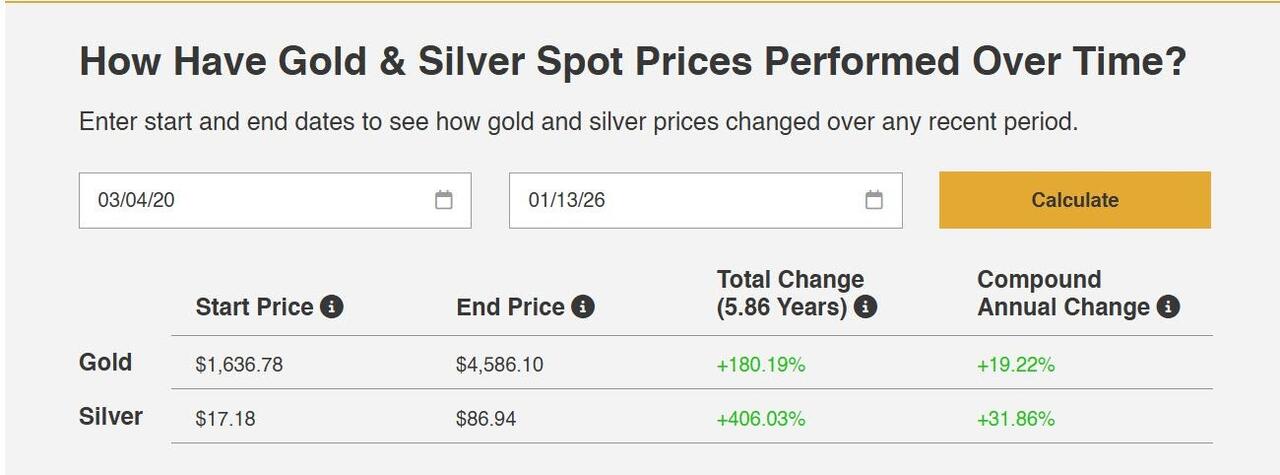
Since I wrote that article, the price of gold per ounce jumped over 200%. Silver prices have exploded by 400%.
Global inventories of physical metals have plunged
London vaults are reportedly down 30% since 2022
Refiners report 10-14 week delays for new bullion bars (vs. normal 2-4 weeks)
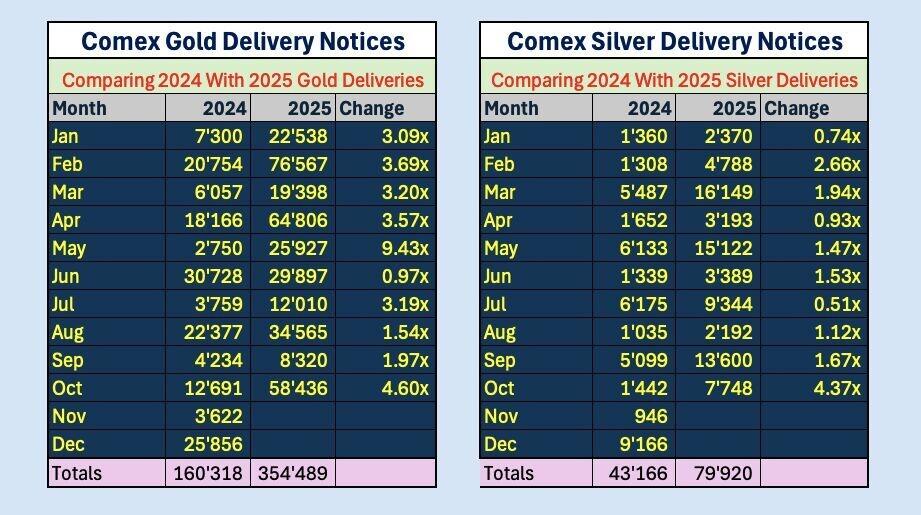
Physical redemptions of commodities contracts have accelerated to historically unprecedented levels
Via Clive Thompson on LinkedIn. Thompson adds: “This marks a dramatic behavioral shift: historically less than 1% of COMEX contracts resulted in physical delivery, but in 2025, some months delivery notices reached 100%.”
Silver is sitting at an all time high of $90 an ounce as I write this. Gold is closing in on $4700 per ounce.
(Maybe large banks like JP Morgan are deliberately backing away from market manipulation for some reason?) Global central bank gold buying has reached historic levels every year since 2022, surpassing even the levels we saw in the wake of the Great Financial Crisis.
All that is background – what does it mean?
The economic singularity
It seems to me that we are witnessing an economic singularity – a moment of great change.
Or, at the very least, the warning signs of an imminent change.
Precious metals prices are trying to tell us something.
The problem is, that message is mostly being ignored, even by more conservative platforms. Not enough people are talking about what’s happening with precious metals and what it means for the economy as a whole.
Here’s what I think…
First, the rush to physical assets suggests that banking institutions, governments and the wealthiest 1% of investors are scrambling to hedge in preparation for a true crisis. (I’m specifying institutions and the very wealthy because a single COMEX gold delivery contract represents 100 oz. of gold, nearly half a million dollars at today’s prices – well outside the typical American family’s means.)
As I noted in 2020, when the banks start rushing to buy physical gold and silver, then the rest of us should do the same. They are likely acting to counteract losses in other assets. Or they are forecasting some kind of geopolitical earthquake that will send prices exploding.
It’s not hard to see the potential for geopolitical conflict right now. European governments have become increasingly hostile to the U.S. over tariffs. They keep trying to start World War III with Russia and so on.
Second, there are the domestic problems caused by protests against immigration enforcement. The deportation issue is merely a convenient excuse for wider conflict between the left and the right. )If ICE agents went home tomorrow and stopped their arrests, the left would find something else to riot about.)
Just as we witnessed in 2020, domestic chaos is a tool for political extortion. In the meantime, civil instability helps fuel the rise in metals.
Third, there are the tensions with Russia and China, who are not happy with the capture of communist dictator Nicolás Maduro. Venezuela’s oil exports have been vital to China’s industrial capacity. Though Venezuela’s supplies only made up around 4.5% of China’s imports, a loss of 4% or more in a volatile global market is unwelcome to say the least.
Venezuela has served as a launching point for military assets in the western hemisphere (including surveillance systems to watch the U.S.). Chinese and Russian weapons failed miserably against U.S. operations, which might lead to escalation going forward.
The larger effects of Maduro’s removal can’t be quantified yet, but they will be consequential.
Most Venezuelans seem overjoyed by their liberation from Maduro. The question is, can we avoid a long-term quagmire? Our military excels at blowing up enemies with precision, but we have a miserable track record at long-term military occupation.
Fourth, let’s not forget the protests in Iran and the potential for regime change there. I have no personal stake in terms of what happens in the Middle East. I think the U.S. should stay out of the mess as much as possible, but I have no illusions that Trump is going to quietly sit back and just watch. He’s proven to be a man of action.
I have to admit, his decisions on foreign policy have been surprisingly effective and welcomed by the populations involved – in most cases at least. That said, when geopolitical conditions shift so quickly, this inevitably sends shockwaves through the global economy. Even when the action is morally correct and strategically necessary, the consequences are unpredictable.
Finally, the Fed appears intent on cutting interest rates without ever addressing the original stagflationary problem. Consumer spending never went down. Debt accumulation, at the federal and the household level, continues to grow. Prices are still high on most goods compared to 2020. The U.S. has to suffer through at least a short-term deflationary period in order to correct for stagflation, and the banks have done everything in their power to avoid this.
In other words, if the Fed continues to cut rates then inflation will a comeback in 2026.
Here’s what happens next
I believe all the right factors are in play for a continued gold and silver run.
I would not be surprised to see silver close to the $200 per ounce mark by 2027. The combination of demand for all the various industrial uses of silver combined with the multi-year supply deficit, on top of the U.S. decision to declare silver a critical mineral – adding in China’s attempts to ban silver exporting PLUS the insatiable demand for silver as an investment? This is a combination of forces all but guaranteed to send price higher. And they aren’t any more “transitory” than the Covid-era inflation spike. I predict these forces will drive the gold/silver ratio to levels last seen during the spike of 2011 (35:1), which would put the price closer to $131 per ounce today.
I’m not seeing any indication that global pressures are going to slow down anytime soon. In fact, I think precious metals are telling us that things are about to get much more chaotic.
Today, maybe more than ever, owning physical gold and silver is a declaration of financial liberty. Of independence from the fiscal chaos of the Federal Reserve and federal government debt.
Tyler Durden
Mon, 01/19/2026 – 14:40
https://www.zerohedge.com/precious-metals/gold-and-silver-explosion-something-big-happening

Inundaciones en Mozambique causan desplazamiento de más de 300.000 personas en una provincia
Por CHARLES MANGWIRO y GERALD IMRAY
MAPUTO, Mozambique (AP) — Más de 300.000 personas han sido desplazadas por inundaciones en una provincia de Mozambique, dijo su gobernadora el lunes. Las autoridades ya habían anunciado que alrededor del 40% de la provincia de Gaza ha sido sumergida por el agua de las inundaciones tras semanas de lluvias torrenciales en partes del sur de África.
El presidente de Mozambique, Daniel Chapo, ha cancelado su viaje al Foro Económico Mundial en Davos, Suiza, debido a las severas inundaciones que afectan las partes central y sur del país, según el diario estatal Noticias.
La gobernadora de Gaza, Margarida Mapandzene Chongo, dijo que alrededor de 327.000 personas estaban siendo alojadas en docenas de refugios temporales como escuelas e iglesias. Habían huido o sido evacuadas de áreas inundadas o amenazadas por inundaciones de la provincia del sur, que tiene una población de aproximadamente 1,4 millones de habitantes.
Las organizaciones humanitarias señalaron a principios de este mes que temían que alrededor de 200.000 personas se vieran afectadas por el clima extremo en Mozambique, pero parece que ese número ha sido superado. Inocencio Impissa, un ministro del gabinete y portavoz del gobierno, dijo que casi 600.000 personas habían sido afectadas en las dos provincias de Gaza y la vecina Maputo.
Chongo agregó que las autoridades ahora piden la evacuación de todos los habitantes de las partes bajas de la capital provincial de Gaza, Xai-Xai, ya que más inundaciones amenazan esa ciudad de alrededor de 115.000 habitantes que se encuentra junto al río Limpopo. Las calles de Xai-Xai parecían ríos cuando el agua de las inundaciones se precipitaba por partes de la ciudad, según videos en la página oficial de Facebook de la ciudad.
Imágenes de la cercana ciudad de Chokwe, que fue el sitio de evacuaciones anteriores, muestran el agua de las inundaciones cubriendo casi por completo casas y otros edificios, con apenas las puntas de algunos de sus techos visibles.
Semanas de intensas lluvias han dejado más de 100 muertos en Mozambique, Sudáfrica y Zimbabue, con esfuerzos de rescate aún en marcha en Mozambique y Sudáfrica. Las autoridades mozambiqueñas informaron que las severas inundaciones en el norte de Sudáfrica ahora estaban afectando a Gaza —que limita con Sudáfrica— ya que los ríos que fluyen hacia Mozambique habían desbordado sus cauces.
Chongo indicó que “la situación probablemente empeorará” en Gaza debido a las fuertes lluvias en el sur de Zimbabue que también fluirían finalmente hacia su provincia.
Mozambique, una nación de 34 millones de habitantes ubicada en la costa sureste de África, ha soportado el peso de ciclones devastadores y una sequía paralizante en los últimos años. Varias provincias han sido azotadas por estas inundaciones, con condiciones en tres de ellas descritas por las autoridades como “críticas”.
Se ha emitido una alerta roja a nivel nacional, el nivel más alto, sobre el clima.
El Instituto Nacional para la Reducción del Riesgo de Desastres, que está coordinando las operaciones de rescate, informó que alrededor de 110 personas fueron rescatadas en helicóptero el domingo cuando quedaron atrapadas en árboles u otros puntos altos. Incluían niños, ancianos y una mujer embarazada a punto de dar a luz.
El ministro de Transporte y Logística, João Matlombe, dijo que alrededor del 40% de Gaza estaba sumergido por el agua, 152 kilómetros (94 millas) de carreteras en todo el país habían sido completamente destruidos y más de 3.000 kilómetros (1.864 millas) de carreteras estaban dañados.
El costo de recuperación para Mozambique podría ascender a cientos de millones de dólares. El primer ministro de una de las provincias en Sudáfrica afectadas por semanas de intensas lluvias dijo que el daño allí podría ser de alrededor de 250 millones de dólares.
___
Imray reportó desde Ciudad del Cabo, Sudáfrica.
___
Esta historia fue traducida del inglés por un editor de AP con la ayuda de una herramienta de inteligencia artificial generativa.
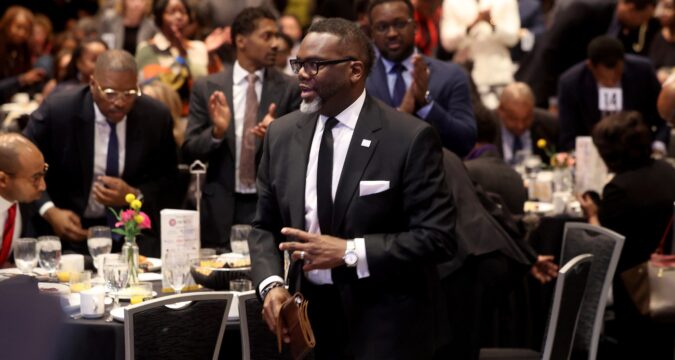
Mayor Brandon Johnson and Don Lemon speak out against Trump at annual MLK breakfast
Mayor Brandon Johnson revived his crusade to tax the rich during the annual Martin Luther King Jr. breakfast hosted by the civil rights group Rainbow PUSH.
Speaking downtown Monday morning, Johnson reflected on the “evil that is manifesting” under President Donald Trump, whose second term in office began a year ago. The freshman mayor sought to tap into the discontent by telling the room of politicians as well as faith and community leaders to “understand what our collective assignment is” as he paid tribute to King.
“If we’re going to ensure that every single person in this city is protected, we have to demand more, not just from one another, but those with means,” Johnson said. “In order to ensure that descendants of slaves’ hopes and aspirations can become realized, we have to challenge that the ultrarich and these big corporations have to pay their fair share in taxes. They don’t need our protection. They got a protector.”
Fresh off the heels of a stinging defeat in the City Council, which in December rejected his push to reinstate Chicago’s corporate head tax, Johnson is racing against time to make inroads on his progressive revenue agenda before he would have to seek reelection. His mission has been complicated by a difficult relationship with Springfield, the final authority over enacting some of these new taxes, as well as earlier defeats such as Johnson’s Bring Chicago Home tax referendum.
Still, with local resentment against Trump in solidly blue Chicago no duller in the new year, Johnson is banking on his progressive brand to cast himself as a liberal defender of the nation’s third-largest city. During his Monday remarks, the mayor again condemned the slaying of Renee Good by a U.S. Immigrations and Customs Enforcement officer in Minneapolis, as well as the capture of former Venezuelan President Nicolas Maduro.
“Millionaires, billionaires and now trillionaires have to realize the hope and dreams of the words of the greatest human being to walk this planet,” Johnson said. “If militarism and poverty and racism can be eradicated, it’s going to require everyone in this room to put the words into action.”
Members of the Leo High School choir sing at the annual Rainbow PUSH Coalition Dr. Martin Luther King Breakfast at the Fairmont Hotel in Chicago on Jan. 19, 2026. (Antonio Perez/Chicago Tribune)
Rainbow PUSH’s event this year was headlined by Don Lemon, the former longtime CNN host who was fired from the network three years ago. Trump’s Justice Department announced Sunday evening that Lemon was put “on notice” after a video of him confronting a Minneapolis pastor during a chaotic service disrupted by anti-ICE protesters went viral.
Lemon alluded to the controversy “coming from MAGA bigots” when he addressed the Chicago audience on Monday.
“I’m just covering a protest, so I’m being targeted and it’s uncomfortable, but it’s appropriate that I’m here today with Rainbow PUSH,” Lemon said. “I might need you to stand up for me. I might need you to do a couple posts. I might need you to say a few words about me, but I ain’t going nowhere.”
https://www.chicagotribune.com/2026/01/19/brandon-johnson-don-lemon-trump-mlk-breakfast/

Aurora event celebrates life of Martin Luther King Jr.
The Fox Valley Christian Ministerial Alliance helped local residents celebrate Martin Luther King Day on Monday with its annual prayer breakfast at Westminster Presbyterian Church in Aurora.
This year’s theme was “Strength to Love,” a concept that organizers said reflects some of the issues and challenges many are facing in today’s society.
Peggy Hicks, former president of the Fox Valley Christian Ministerial Alliance, said the annual event has been held for a number of years.
“We always have more than 150 people regardless of the weather,” she said. “We pay for this breakfast and it’s free to the public. We feel it’s important to start off the day like this as we’re very concerned about community and the well-being of each other.
“This event, it just brings a spirit of love,” Hicks said. “Regardless of our differences and all of that, we come together as a group to pray for our community but to also celebrate the work that Martin Luther King did.”
Hicks said that “people need a commitment to do something and people that come say, ‘I feel wonderful, I feel so refreshed and feel like I need to go do something in the community,’” she said about the breakfast event. “This energizes people to go and get involved in their community or church and King was very much about a call to action and service to others and volunteerism.”
Fox Valley Christian Ministerial Alliance Board President the Rev. John Burch of North Avenue Missionary Baptist Church in Sycamore, who lives in Aurora, said Monday’s program included sermonettes focusing on King’s life as well as prayers.
“I’ve been to many of these breakfasts before, since its inception,” he said just before the event on Monday. “To me, it’s been a time of reflection of the current situation spiritually as well as socially and over the years it’s been moving forward as we’re bringing people together from different ethnic backgrounds.”
King’s call to volunteerism was evident Monday as youngsters like Ta’mia Gray, 10, worked with others to serve the breakfast at the event.
Ta’mia Gray, 10, of Aurora, was one of a number of young people who volunteered to work Monday, Jan. 19, 2026, during a Martin Luther King Day breakfast at Westminster Presbyterian Church in Aurora. The event, sponsored by the Fox Valley Christian Ministerial Alliance, honored the legacy of Martin Luther King Jr. (David Sharos/For The Beacon-News)
“I’m glad to be here and I’m glad to serve on Martin Luther King Day and I’m just ready to help people,” she said as she brought out trays of food. “We’re going to just pass out food and serve people. To me, this day is to praise (King) and remember ideas and be respectful of people.”
Lauri Phillips of Aurora said being at the event “was to honor Martin Luther King’s legacy, especially in light of what is going on in the country right now.”
“I feel we have to honor his legacy and actions he has laid down for us and shown us the path to help the population as a whole,” Phillips said. “There are still things to do. We do have to keep on moving ahead not only for the African-American population but others we need to stand up for.”
David Sharos is a freelance reporter for The Beacon-News.
https://www.chicagotribune.com/2026/01/19/aurora-event-celebrates-life-of-martin-luther-king-jr/

Real Madrid y Chelsea retoman la Champions con técnicos novatos en temporada de despidos
Por GRAHAM DUNBAR
Real Madrid y Chelsea reanudan su participación en la Liga de Campeones esta semana después del parón invernal con nuevos técnicos que dirigirán en la competición por primera vez.
Los ceses en los banquillos es un tema fuerte en una temporada donde la paciencia se ha agotado en la sala de juntas y 11 de los 36 clubes de la Liga de Campeones han cambiado de entrenador.
Nueve de los 11 fueron despedidos. El último fue Xabi Alonso hace una semana cuando el Madrid lo removió después de apenas siete meses y bien posicionado — en el séptimo lugar — en la clasificación de la Liga de Campeones.
Álvaro Arbeloa, el nuevo timonel, dirigirá apenas el tercer partido de su carrera al recibir a Mónaco el miércoles. La última vez que el Madrid presentó a un estratega novato a mitad de temporada resultó en atino: el nombramiento de Zinedine Zidane en enero de 2016 llevó a tres títulos consecutivos de la Liga de Campeones.
Chelsea reemplazó a Enzo Maresca, el técnico que les sacó campeones del Mundial de Clubes, con Liam Rosenior, quien había llevado al club hermano Estrasburgo a liderar la clasificación de la Conference League de tercera categoría, y recibirá a Pafos el miércoles.
Mónaco y Pafos también han cambiado de entrenadores. Mónaco despidió a Adi Hütter en octubre y acudió a otro equipo de la Liga de Campeones, Union Saint-Gilloise, para atraer a su técnico campeón de la liga belga, Sébastien Pocognoli.
Juan Carlos Carcedo, el español que inició la campaña al mando Pafos, arregló su salida este mes para regresar al Spartak de Moscú. Pafos contrató a Albert Celades, otro español, que fue parte del Real Madrid que ganó la Liga de Campeones en 2002 y más tarde jugó en los New York Red Bulls.
Ajax, Atalanta (quinto en la clasificación) Benfica, Club Brujas, Juventus y Bayer Leverkusen también despidieron a sus técnicos. El Leverkusen echó a Erik Ten Hag antes de que comenzara la Liga de Campeones.
Benfica despidió a Bruno Lage un día después de una derrota en casa en el partido inaugural contra Qarabag y contrató a José Mourinho. El dos veces campeón de Europa fue despedido en Fenerbahce por perder en los playoffs de clasificación ante Benfica.
Pocos se sorprenderían si Tottenham se une a la lista antes de la ronda final de partidos de la fase de apertura de la Liga de Campeones la próxima semana.
Inter-Arsenal
La estabilidad impera en Arsenal y el Inter de Milán, los líderes de la Liga Premier y la Serie A que se enfrentan en el partido de mayor perfil de la semana, uno que enfrenta al primero de la tabla contra el sexto.
El Arsenal de Mikel Arteta es el único equipo con el pleno de seis victorias y ahora regresa al escenario de su única derrota en la fase de liga de la temporada pasada. Entonces, un penal de Hakan Çalhanoğlu fue decisivo en San Siro.
El Inter estuvo a la par de Arsenal durante cuatro rondas en su primera temporada dirigido por Cristian Chivu, pero luego perdió partidos consecutivos contra el Atlético de Madrid y Liverpool.
El Inter probablemente necesita evitar una tercera derrota para mantenerse en camino hacia los octavos de final. La temporada pasada se necesitaron 16 puntos para asegurar un lugar entre los ocho primeros y evitar la ronda de playoffs en febrero.
Man City en el Círculo Ártico
Cuando la UEFA confeccionó el calendario de partidos en el caluroso y húmedo Mónaco en agosto, una pregunta clave era quién tendría que visitar el Círculo Ártico en enero.
La respuesta fue el Manchester City, que jugará en Bodø/Glimt el martes.
Aun así, las temperaturas pronosticadas a la hora del partido están apenas por debajo del punto de congelación en la tarde temprana en la natal Noruega del delantero Erling Haaland.
El Man City, campeón europeo de 2023, ya tiene 13 puntos en el cuarto lugar, a diferencia del drama del último día en enero pasado, cuando necesitaron ganar para entrar en los playoffs de eliminación directa en el puesto 22 de la clasificación.
Lejano oriente
Dos equipos en el lejano oriente de Europa —Qarabag y Kairat Almaty— tienen ambos partidos en casa esta semana porque sus zonas horarias distantes significan que no serán anfitriones en la decisiva última ronda.
Los 18 partidos del 29 de enero deben comenzar simultáneamente para garantizar el juego limpio, a las 9 de la noche en Europa Central, cuando serían la 1 de la mañana en Almaty, Kazajistán.
Aun así, será temprano, a las 4:30 de la tarde en Europa Central cuando Kairat inicie contra Club Brujas a las 8:30 de la tarde hora local el martes. Qarabag recibe al Eintracht Frankfurt en un partido temprano el miércoles.
___
Deportes AP: https://apnews.com/hub/deportes

Denmark Skips Davos Forum In Protest Over Deepening Greenland Crisis
Denmark Skips Davos Forum In Protest Over Deepening Greenland Crisis
The World Economic Forum (WEF) Annual Meeting in Davos for 2026 is scheduled for this week (Jan. 19-23), focusing on the theme “A Spirit of Dialogue”. Day one, which has kicked off Monday, isn’t much of a display of “dialogue” as some key officials are absent, amid Europe’s ongoing spat with President Trump over the future fate of Greenland.
Among a record number of 400 top political leaders, including over 60 heads of state and government – as well as hundreds of CEO’s – conspicuously absent are officials from Denmark, who have decided not to attend this year in protest over the Greenland crisis.
“We can confirm that the Danish government will not be represented in Davos this week… Danish government representatives were invited this year, and any decisions on attendance are a matter for the government concerned,” the official statement said.
Trump has repeatedly declared that Greenland should become part of the United States, calling it a matter of national security as China and Russia make inroads in the Arctic region, and also questioning Denmark’s right to oversee the autonomous resource-rich territory.
Over the weekend Trump took things well past just rhetoric, threatening on Saturday to slap a 10% additional tariff on EU countries, starting on Feb 1, unless there’s a deal for America to purchase Greenland.
Eight nations have responded by issuing a firm joint statement saying they stand behind Denmark and the people of Greenland, writing, “Tariff threats undermine transatlantic relations and risk a dangerous downward spiral.”
These eight include Denmark, Norway, Sweden, France, Germany, the United Kingdom, the Netherlands and Finland – all which also happen to be NATO members.
Europeans have warned that the Greenland issue threatens to unravel the north Atlantic military alliance, especially if Washington were to unilaterally move on Greenland. And more:
DENMARK FOREIGN MINISTER: YOU CAN’T THREATEN YOUR WAY TO OWNERSHIP OF GREENLAND
DENMARK FOREIGN MINISTER: IT’S EUROPE THAT WILL RESPOND TO THE TARIFF THREAT, NOT DENMARK
Denmark and a handful of European countries have sent a troop contingency there, while at the same time the White House hasn’t appeared to actually send in military forces. NBC newly reports that Trump hasn’t said whether he would use force or not to seize Greenland:
As tensions escalate over President Donald Trump’s efforts to acquire Greenland, he was guarded Monday in how far he’ll go to take control of the semi-autonomous Danish territory.
Asked if he would use force to seize Greenland, the president said, “No comment,” in a brief telephone interview with NBC News.
Previously US officials have said that given Greenland doesn’t have a standing army, or much other defense to speak of, the US wouldn’t have to move on it militarily.
EXCLUSIVE: Trump wants a signing ceremony for his Board of Peace in Davos on Thursday. It is unclear which countries will sign. Many invitees want the US to rewrite the terms, sources tell @AlbertoNardelli and me.
The Board of Peace has had a rough landing: it’s been criticised…
— Alex Wickham (@alexwickham) January 19, 2026
There’s still an idea floating around D.C. that the US could just purchase it, and that every Greenlander could receive millions of dollars, and reject Denmark’s historic claims on it.
As for Davos, while Denmark will be absent in protest, Kremlin officials will be there. There are plans for Russian officials to meet with US envoys, at a moment Ukraine peace talks have largely stalled.
Tyler Durden
Mon, 01/19/2026 – 14:15
Europa busca reducir la dependencia en EEUU en seguridad
Por LORNE COOK
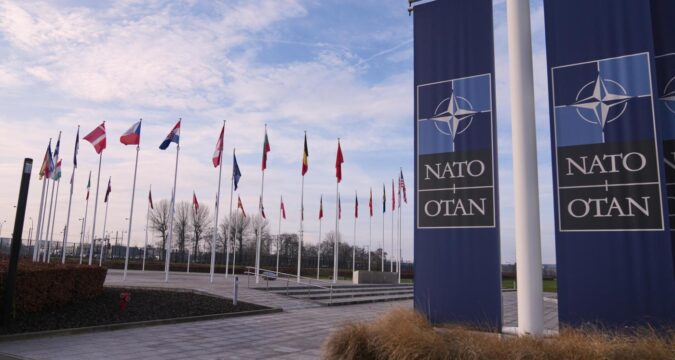
BRUSELAS, Bélgica (AP) — “Intimidación”, “amenazas” y “chantaje” son solo algunos de los términos que utilizan los líderes de la Unión Europea para describir la advertencia del presidente de Estados Unidos, Donald Trump, de que impondrá nuevos aranceles a las naciones que se opongan al control estadounidense de Groenlandia.
El lenguaje europeo se ha endurecido desde que Trump regresó a la Casa Blanca hace 12 meses. Ahora es en reacción a la idea previamente impensable de que el miembro más poderoso de la OTAN amenazaría con apoderarse del territorio de otro aliado. Es probable que haya represalias comerciales si Trump cumple con su anuncio de aranceles.
Al cumplirse un año del segundo mandato de Trump, la fe de Europa en la fortaleza del vínculo transatlántico se está desvaneciendo rápidamente. Para algunos, ya ha desaparecido. La adulación de los meses pasados no ha funcionado y las tácticas están evolucionando mientras los europeos intentan gestionar las amenazas de un viejo aliado justo cuando enfrentan la amenaza de una Rusia cada vez más hostil.
El primer mandato de Trump llevó a la OTAN al borde del colapso. Jens Stoltenberg, exsecretario general, escribió en sus recientes memorias: “Temía que la OTAN estuviera a punto de dejar de funcionar”, después de que el presidente de Estados Unidos amenazó con abandonar una cumbre en 2018.
Ahora, la primera ministra danesa, Mette Frederiksen, advierte que si Trump intenta anexar Groenlandia, una parte semiautónoma de Dinamarca, “entonces todo se detiene… incluida nuestra OTAN”.
“Estamos en la etapa muy temprana de una crisis político-militar bastante profunda”, dijo Maria Martisiute, analista del Centro de Política Europea. “Hay una mayor comprensión, aunque a los líderes políticos no les guste admitirlo, de que Estados Unidos ha abandonado la OTAN”.
Leyendo la cartilla
En enero de 2025, los aliados de Estados Unidos en la OTAN esperaban escuchar los planes de Trump para Ucrania.
La mayor guerra de Europa en décadas estaba a punto de entrar cumplir tres años. Los europeos creían que el presidente Vladímir Putin representaría una amenaza existencial para su territorio si Rusia ganaba.
Pocos pensaban que las políticas de la administración Biden continuarían. Pero en pocas semanas, cualquier esperanza persistente en el compromiso de Estados Unidos con Ucrania se desvaneció. Los suministros de armas y fondos estadounidenses comenzaron a agotarse. Europa tendría que llenar el vacío y pagar por la ayuda de Estados Unidos.
En un discurso en la sede de la OTAN en febrero, el secretario de Defensa de Estados Unidos, Pete Hegseth, leyó la cartilla a los aliados europeos y Canadá. Estados Unidos tenía prioridades en otros lugares y Europa debía manejar la seguridad en su propio patio trasero.
Ucrania no se uniría a la alianza. El territorio que le arrebató Rusia no sería devuelto. Los europeos podrían reunir una fuerza para ayudar a Kiev si lo deseaban, pero no recibirían ayuda de Estados Unidos si entraban en el país y eran atacados.
Desde entonces, Trump ha culpado al presidente ucraniano Volodymyr Zelenskyy por la invasión, a pesar de las visitas con la realeza en el Reino Unido y Holanda destinadas a apaciguarlo.
Días después, en febrero, en Múnich, el vicepresidente estadounidense JD Vance se reunió con el líder de un partido de extrema derecha durante la campaña electoral en Alemania. Afirmó que la principal amenaza de Europa era interna, no rusa. La libertad de expresión está “en retroceso” en todo el continente, advirtió Vance.
Pero después de ganar las elecciones, el canciller Friedrich Merz dijo que “en vista de la creciente situación de amenaza”, Alemania y Europa “deben ahora muy rápidamente hacer grandes esfuerzos, muy rápidamente”, para fortalecer sus capacidades de defensa.
Independencia de seguridad de Europa
En el último año, los líderes europeos y Zelenskyy volaron a Washington para tratar de mantener a Trump de su lado. Un plan de 28 puntos para poner fin a la guerra que él propuso cedería a muchas de las demandas rusas.
El plan fue reelaborado. Las conversaciones continúan, pero sin Putin. Pocos esperan que él acepte. Trump culpa principalmente a Zelenskyy por el estancamiento.
Mientras tanto, Europa avanzaba con nuevas medidas de defensa, incluso cuando Trump libraba una guerra arancelaria mundial, incluso contra aliados de Estados Unidos, sacudiendo sus economías.
La UE creó un fondo de miles de millones de euros para comprar armas y municiones, con énfasis en obtenerlas de empresas europeas y desvincular a las naciones de los proveedores estadounidenses.
Se relajaron las reglas de deuda para el gasto en seguridad. Se canalizó dinero hacia la industria de defensa de Ucrania. En diciembre, los líderes europeos acordaron pagar la mayoría de sus necesidades militares y económicas para los próximos dos años mientras Kiev se tambalea al borde de la bancarrota.
Una nueva estrategia de seguridad nacional de Estados Unidos empeoró aún más las relaciones transatlánticas. Pinta a los aliados europeos como débiles, ofrece apoyo tácito a partidos políticos de extrema derecha y critica la política europea de libertad de expresión y migración.
El presidente del Consejo Europeo, Antonio Costa, advirtió a Washington contra la interferencia en los asuntos de Europa. Merz dijo que la estrategia de Estados Unidos subraya la necesidad de que Europa se vuelva “mucho más independiente” de Estados Unidos.
Desde entonces, se ha comenzado a trabajar en la propia estrategia de seguridad de Europa. Su objetivo es responder a “los cambios geopolíticos en nuestro mundo y dar una respuesta adecuada a eso”, dijo la presidenta de la Comisión Europea, Ursula von der Leyen.
Parte de ello es hacer que Europa sea aún más autónoma.
Mientras Francia, Alemania, el Reino Unido, Noruega, Suecia y Holanda enviaron tropas a Groenlandia la semana pasada, pequeñas en número pero altamente simbólicas en el mensaje enviado a la Casa Blanca, el presidente francés Emmanuel Macron dijo que es importante “estar al lado de un Estado soberano para proteger su territorio”.
“Europa está siendo sacudida de algunas de sus certezas”, dijo a los jefes militares franceses. “A veces tiene aliados que pensábamos que eran predecibles, intrépidos, siempre a nuestro lado, que ahora nos están haciendo dudar mucho, o incluso se están volviendo contra aquellos que menos lo esperaban”.
Por ahora, los ocho países europeos amenazados por los aranceles de Trump dicen que “apoyan firmemente” los principios de soberanía e integridad territorial. “Las amenazas arancelarias socavan las relaciones transatlánticas y arriesgan una peligrosa espiral descendente”.
________
Esta historia fue traducida del inglés por un editor de AP con la ayuda de una herramienta de inteligencia artificial generativa.
https://www.chicagotribune.com/2026/01/19/europa-busca-reducir-la-dependencia-en-eeuu-en-seguridad/

El Festival de Cine de Sundance se despide de Park City y Robert Redford
Por LINDSEY BAHR
El Festival de Cine de Sundance puede ser un poco agridulce este año. Será familiar en algunos aspectos al comenzar el jueves en Park City, Utah. Habrá estrellas, desde Natalie Portman hasta Charli XCX, y descubrimientos reveladores, películas conmovedoras, comedias, thrillers, rarezas que desafían la categorización y tal vez incluso algunos futuros nominados al Oscar. Las tiendas emergentes y los patrocinadores estarán presentes con fuerza en Main Street. Las filas para entrar a las 90 películas que se estrenan a lo largo de diez días serán largas y los voluntarios serán infinitamente serviciales y alegres en temperaturas bajo cero.
Pero la principal vitrina del país para el cine independiente también está en un momento de profunda transición después de décadas de relativa estabilidad. El festival se despide de su hogar de toda la vida y avanza sin su fundador, Robert Redford, quien falleció en septiembre. El próximo año, deberá encontrar su lugar en otra ciudad de montaña, Boulder, Colorado.
El legado de Robert Redford y su creación
No es sorprendente que el legado sea un hilo conductor en la edición final de este año en Park City. Habrá proyecciones de joyas restauradas de Sundance como “Little Miss Sunshine” (“Pequeña Miss Sunshine”), “Mysterious Skin” (“Piel misteriosa”), “House Party” (“Fiesta en casa”) y “Humpday” (“Día de miércoles”), así como la primera película verdaderamente independiente de Redford, el drama deportivo de 1969 “Downhill Racer” (“Cuesta abajo”). Muchos también rendirán homenaje a Redford en el evento de recaudación de fondos del instituto, donde los homenajeados incluyen a Chloé Zhao, Ed Harris y Nia DaCosta.
“Sundance siempre ha sido sobre mostrar y fomentar películas independientes en Estados Unidos. Sin eso, muchos cineastas no habrían tenido las carreras que tienen”, dijo Gregg Araki, cineasta de “Mysterious Skin”. Asistió por primera vez al festival en 1992 y ha regresado muchas veces, incluso en los laboratorios donde Zhao fue una de sus estudiantes.
Bastantes veteranos del festival están planeando hacer el viaje, incluido el cineasta de “Navalny”, Daniel Roher. Su primer Sundance en 2022 pudo haber sido poco convencional (completamente remoto en el último minuto debido a la pandemia) pero terminó en una nota alta con un Oscar. Este año regresa con dos películas, su debut narrativo “Tuner”, y el estreno mundial de “The AI Doc: Or How I Became an Apocaloptimist”, que codirigió con Charlie Tyrell.
“Estamos pasando por un momento extraño en el mundo… Hay algo que me llama la atención sobre una institución que ha sido perenne, que parece tan arraigada pasando por su propia transición y renacimiento”, dijo Roher a The Associated Press. “Estoy eligiendo enmarcar este año como una celebración de Sundance y el instituto y un futuro que asegurará que el festival continúe para siempre y siempre y siempre y siga siendo el conducto vital para tantos cineastas que ha sido”.
Durante las últimas cuatro décadas, innumerables carreras han sido moldeadas y potenciadas por el festival y el Instituto. Tres de los posibles nominados al Oscar de este año, Paul Thomas Anderson, Ryan Coogler y Zhao, están entre aquellos a quienes el Instituto apoyó al inicio de sus carreras.
Jay Duplass, quien vino por primera vez a Sundance en 2003 con su hermano, Mark, con lo que él llama una “película de 3 dólares”, dijo que fue el lugar donde se hizo su carrera.
“Probablemente, sería psicólogo ahora mismo si no fuera por Sundance”, expresó Duplass.
Aunque ha estado en “probablemente 15 Sundances” desde entonces, no ha perdido su brillo. De hecho, cuando un programador lo llamó para decirle que su nueva película “See You When I See You” fue seleccionada, lloró. La película está basada en un libro de memorias en la que un joven escritor de comedia (Cooper Raiff) intenta procesar la muerte de su hermana (Kaitlyn Dever). Es una de muchas películas que encuentran humor en medio de temas sombríos.
Apuestas audaces, comedias y estrellas de Hollywood
Como siempre, la programación también está llena de películas estelares, incluida la sátira del mundo del arte de Cathy Yan, “The Gallerist”, protagonizada por Portman, Jenna Ortega, Sterling K. Brown, Zach Galifianakis y Da’Vine Joy Randolph. El drama romántico “Carousel”, de Rachel Lambert, presenta a Chris Pine y Jenny Slate como exnovios de secundaria que reavivan su romance más tarde en la vida. Araki también trae una nueva película, “I Want Your Sex”, en la que Olivia Wilde interpreta a una artista provocativa (Araki la describió como una mezcla entre Madonna y Robert Mapplethorpe) que toma a Cooper Hoffman como su joven musa.
“Es una especie de carta de amor positiva sobre el sexo para la Generación Z”, dijo Araki. “Es una comedia. Tiene elementos de misterio, thriller, asesinato —un poco de ‘Sunset Boulevard’… es divertida, es colorida, es sexy. Es un viaje”.
Wilde también se pone detrás de la cámara para “The Invite”, en la que protagoniza junto a Seth Rogen como una pareja cuyo matrimonio se desintegra en el transcurso de una noche. Olivia Colman es una pescadora que busca hacer el esposo perfecto en “Wicker”, coprotagonizada por Alexander Skarsgård. Zoey Deutch interpreta a una novia del Medio Oeste que busca su “pase libre” de celebridad (Jon Hamm) en la comedia alocada “Gail Daughtry and the Celebrity Sex Pass”. Y Ethan Hawke y Russell Crowe lideran el drama criminal de la era de la Depresión “The Weight”.
La estrella del pop y conocida cinéfila Charli XCX también estará presente, protagoniza el falso documental autorreferencial “The Moment”, y también aparece en “The Gallerist” y “I Want Your Sex”.
Documentales sobre celebridades y temas urgentes
El festival de 2026 también presenta una sólida programación de documentales, que tienen un buen historial de obtener nominaciones y premios Oscar. Hay un puñado de películas sobre rostros famosos, incluidos la estrella de baloncesto Brittney Griner, Courtney Love, Salman Rushdie, Billie Jean King, Nelson Mandela y la comediante Maria Bamford.
Otros profundizan en temas de actualidad pasados y presentes, como “When A Witness Recants”, en la que el autor Ta-Nehisi Coates revisita el caso del asesinato de un niño en 1983 en su escuela secundaria de Baltimore y descubre la verdad. “American Doctor” sigue a tres profesionales que intentan ayudar en Gaza. “Who Killed Alex Odeh” examina el asesinato en 1985 de un activista palestino estadounidense en el sur de California. “Everybody To Kenmure Street” trata sobre la resistencia civil a las deportaciones en Glasgow en 2021. Y “Silenced” sigue a la abogada internacional de derechos humanos Jennifer Robinson en su lucha contra la utilización de las leyes de difamación como arma contra las víctimas de violencia de género.
Y algunos no encajan en ninguna categoría fácil, como “The History of Concrete”, en la que el cineasta John Wilson toma lo que aprendió en un seminario de “cómo vender una película de Hallmark” e intenta aplicarlo a un documental sobre concreto.
Adiós a Main Street
También puede haber un poco de nostalgia en el aire, mientras todos hacen balance del último Sundance en Park City e intentan imaginar lo que podría deparar Boulder.
“Se siente muy especial ser parte del último en Park City”, dijo Duplass. “Es un lugar súper especial donde, sabes que habrá películas allí con estrellas gigantes y también habrá algunos chicos que hicieron películas por unos pocos miles de dólares. Y todos se mezclarán”.
Araki, al igual que Redford, supo hace mucho tiempo que el festival había superado a Park City. Será extraño no tener más funciones en el Egyptian Theatre, Eccles y The Ray, pero también es solo un lugar.
Araki expresó: “El legado y la tradición de Sundance continuarán sin importar dónde esté”.
___
Para más cobertura del Festival de Cine de Sundance 2026, visita: https://apnews.com/hub/sundance-film-festival
___
Esta historia fue traducida del inglés por un editor de AP con la ayuda de una herramienta de inteligencia artificial generativa.