Category: News

Massive fire destroys True Light Temple of Praise church in Ford Heights
A fire Wednesday afternoon consumed True Light Temple of Praise church in Ford Heights.
The Ford Heights Fire Department said in a statement firefighters saw heavy smoke coming from the roof when arriving at 1602 Drexel Ave.
In photos and videos posted to social media, the structure can be seen to have been reduced to smoldering ruins by the fire.
The Cook County sheriff’s office, which polices Ford Heights, said police observed the building engulfed in flames and smoke.
Firefighters fight the blaze Wednesday at True Light Temple of Praise church. (Ford Heights Fire Department)
The Fire Department said it fought the blaze from outside the building. A defensive stance is usually taken when fighting the fire from inside the building is considered unacceptably dangerous, such as if there’s a risk of collapse.
Two maintenance workers were treated for smoke inhalation and released, the sheriff’s office said. No one else was in the building at the time of the fire.
The cause of the fire is under investigation by the office of the Illinois State Fire Marshal, the department said. The sheriff’s office said that as of Thursday morning the cause of the fire did not appear suspicious.
elewis@chicagotribune.com
WTI Dips After Geopolitical Risk Eases, Across-The-Board Inventory Builds
WTI Dips After Geopolitical Risk Eases, Across-The-Board Inventory Builds
Oil prices are lower this morning after Ukrainian President Zelenskiy said that the US, Russia and Ukraine will meet in coming days for trilateral team meetings.
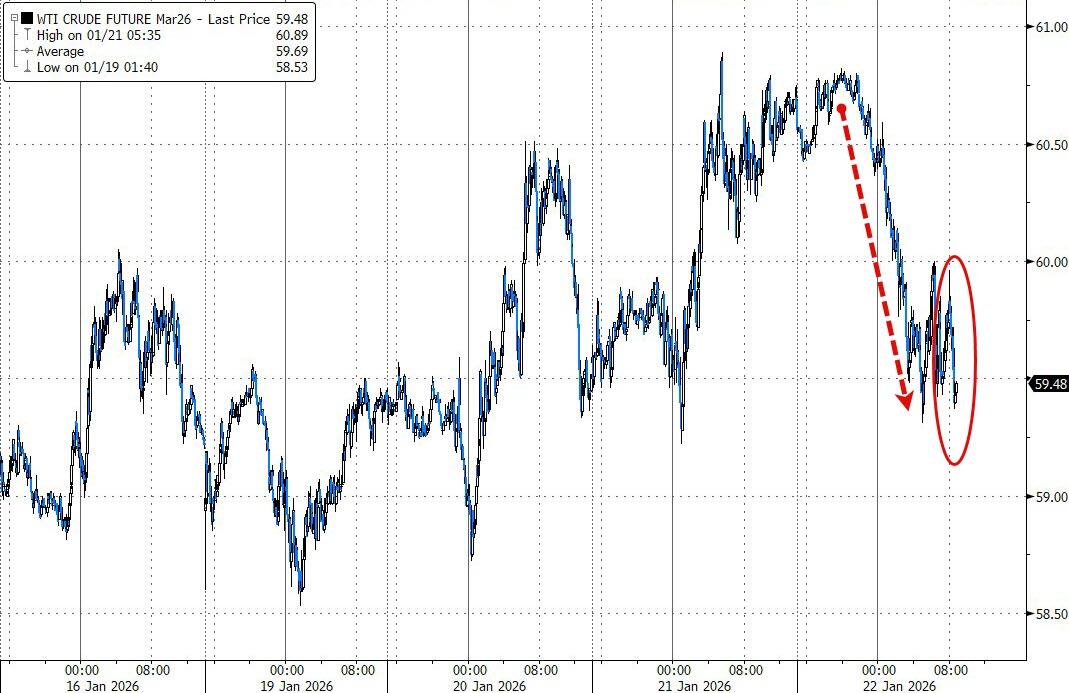
WTI dropped below $60 as Zelenskiy urged Russia to be “ready for compromises.”
Any breakthrough to end Moscow’s war in Ukraine could iron out supply disruptions and end sanctions on Russian crude in an already oversupplied global market, sapping a longstanding geopolitical risk premium.
Adding to pressure on prices, Kazakhstan is getting closer to ending a weeks-long export constraint as repairs at a key Black Sea oil-loading facility near completion. A backlog of cargoes at the Caspian Pipeline Consortium terminal is easing.
And supplies are also returning to the global market from Venezuela.
Easing tensions returned the focus to market fundamentals, as traders look to rising global inventories as supply runs well ahead of demand (seemingly confirmed by a large build in crude and product stocks reported overnight by API).
API
Crude +3.04mm
Cushing +1.2mm
Gasoline +6.2mm
Distillates -33k
DOE
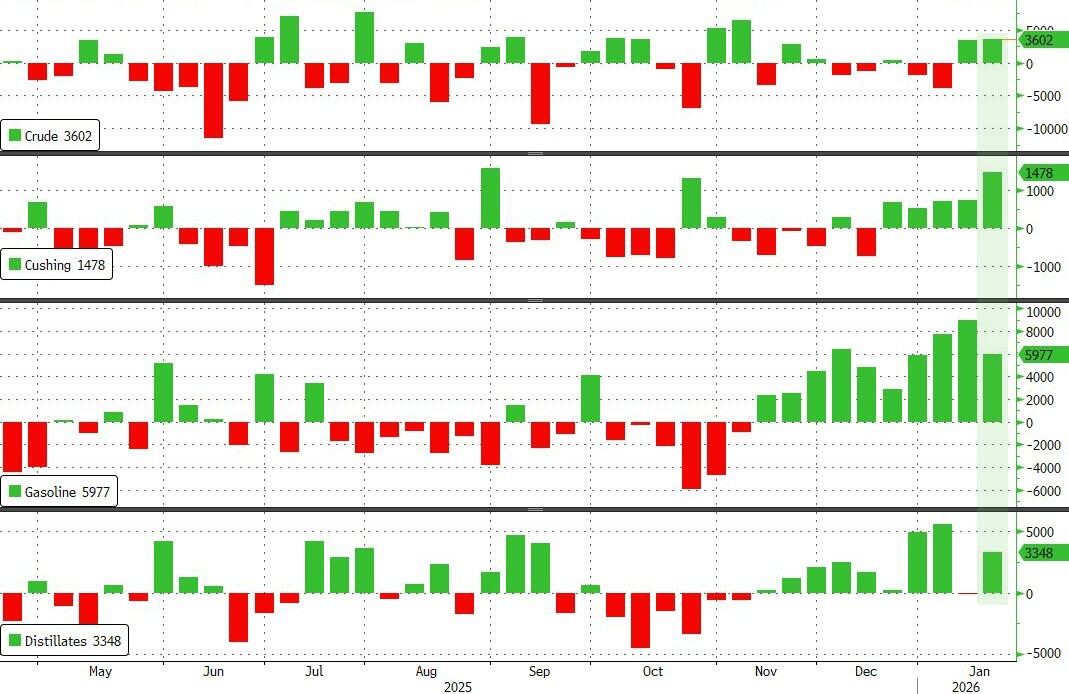
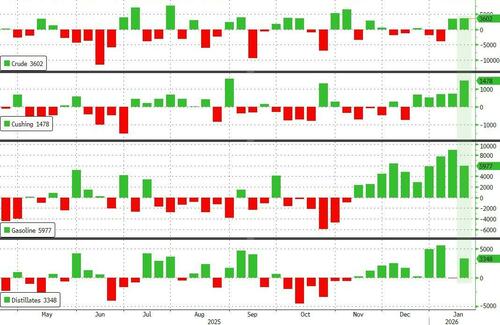
Crude +3.6mm
Cushing +1.478mm – biggest build since Aug 2025
Gasoline +5.977mm
Distillates +3.348mm
The official data showed inventory builds across the board with Cushing stocks jumping by the most since August and gasoline inventories up for the 10th week in a row
Source: Bloomberg
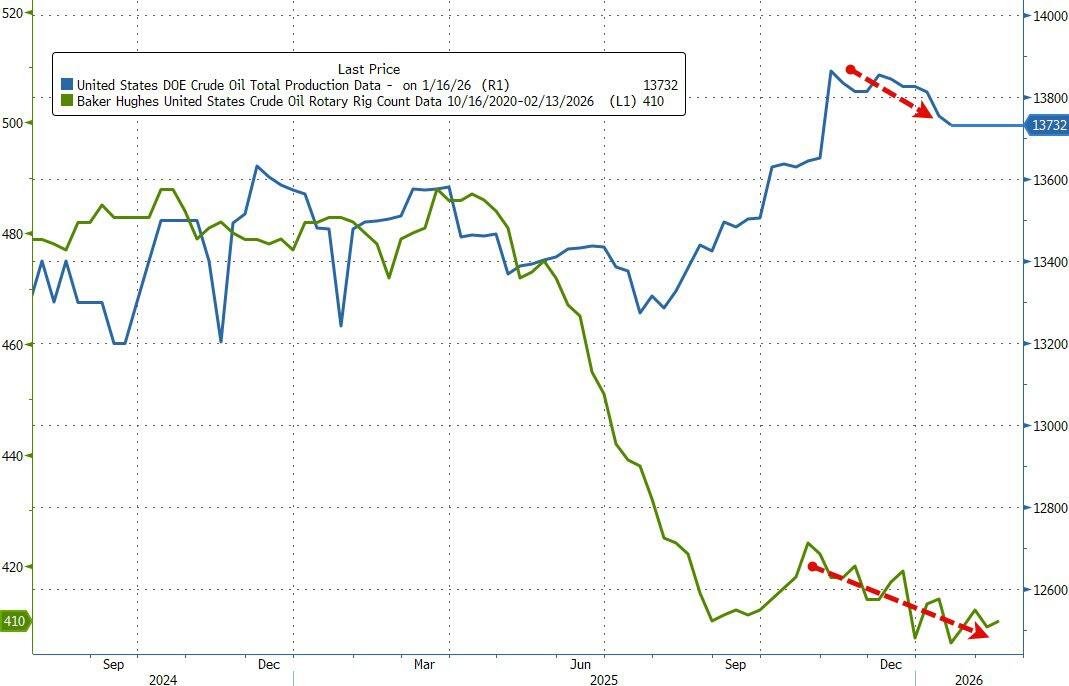
US Crude production dipped a little from record highs as rig counts continue to trend lower…
Source: Bloomberg
WTI extended losses after the across the board builds…
Source: Bloomberg
“The geopolitical temperature has eased a few degrees,” said Ole Sloth Hansen, a strategist at Saxo Bank A/S in Copenhagen.
But with a range of supply threats unresolved, and colder weather set to bolster US demand, prices will likely “hold firm.”
Tyler Durden
Thu, 01/22/2026 – 12:05
Court Blocks Feds From Searching Materials Obtained In Raid On WaPo Journalist
Court Blocks Feds From Searching Materials Obtained In Raid On WaPo Journalist
Authored by Joseph Lord via The Epoch Times,
A federal judge has blocked the government from searching data obtained in a raid last week on the home of Washington Post journalist Hannah Natanson.
The order from U.S. Magistrate Judge William B. Porter comes after the federal government on Jan. 14 executed a search warrant at Natanson’s home. According to The Washington Post, federal authorities seized a phone, two laptops, a recorder, a portable hard drive, and a Garmin watch during the raid.
The Standstill Order granted by Porter specifically says that the government must “preserve but … not review” the materials obtained in the raid while litigation on the matter moves forward.
An additional motion filed by Natanson and The Washington Post called on the court to order the government to return Natanson’s seized materials. Oral arguments on this motion will be held Feb. 6, with the court holding off on any intervention until then.
The brief order contains no discussions of the case’s merits or arguments, which will be delayed until after the Feb. 6 hearing.
Federal authorities say the search warrant was part of an investigation into a national security leak.
Aurelio Perez-Lugones, a government contractor with top secret security clearance, is at the center of the investigation. According to the FBI, Perez-Lugones is believed to have brought classified information from his job to his home.
In a criminal complaint, the FBI said it found documents marked “secret” and described as “related to national defense” in his basement, lunchbox, and car.
The raid on Natanson was related to this leak, though additional details on the nature of the information have not been provided.
“This past week, at the request of the Department of War, the Department of Justice and FBI executed a search warrant at the home of a Washington Post journalist who was obtaining and reporting classified and illegally leaked information from a Pentagon contractor. The leaker is currently behind bars,” Attorney General Pam Bondi wrote in a post on X.
“The Trump Administration will not tolerate illegal leaks of classified information that, when reported, pose a grave risk to our Nation’s national security and the brave men and women who are serving our country.”
First Amendment Concerns
Meanwhile, critics of the move—including The Washington Post—say that the unprecedented raid represents a major threat to First Amendment protections related to freedom of speech and freedom of the press.
According to the Reporters Committee for Freedom of the Press—which tracks issues affecting First Amendment freedoms as they relate to members of the media—the raid on Natanson’s home marks the first time in U.S. history that the Department of Justice (DOJ) has raided a journalist’s home in connection with a national security leak.
The president of the organization, Bruce Brown, described the raid as “a tremendous escalation in the administration’s intrusions into the independence of the press.”
Following the raid, The Washington Post immediately filed to have the materials returned, citing First Amendment protections and federal statutes that provide extra legal protections to journalists.
“The federal government’s wholesale seizure of a reporter’s confidential news-gathering materials violates the Constitution’s protections for free speech and a free press and should not be allowed to stand,” The Washington Post wrote. “It … flouts the First Amendment and ignores federal statutory safeguards for journalists. The seizure chills speech, cripples reporting, and inflicts irreparable harm every day the government keeps its hands on protected materials.”
The petition called for the court to “order the immediate return of all seized materials. Anything less would license future newsroom raids and normalize censorship by search warrant.”
Privacy Protection Act
Under the Privacy Protection Act of 1980, specific procedures are mandated for obtaining notes, communications, and other work-related data from journalists, requiring that these materials be obtained via a subpoena related to an ongoing criminal investigation.
Subpoenas can also be challenged in court before being executed, in contrast to a search warrant, which is generally only able to be challenged after the fact.
The Privacy Protection Act prohibits the use of standard search warrants as grounds for such a raid.
The bill was passed specifically to overturn a 1978 Supreme Court ruling in Zurcher v. Stanford Daily. In that instance, police had raided a newsroom with a standard search warrant, which the Supreme Court ruled lawful.
Congress, disapproving of the ruling, passed the Privacy Protection Act to make it more difficult for the government to obtain journalistic materials.
The Washington Post cited the statute in its filing, writing that returning the materials is justified as “much of it is protected by the Privacy Protection Act.”
The DOJ has been given until Jan. 28 to file a response to the suit.
Tyler Durden
Thu, 01/22/2026 – 11:45

US stocks climb again after Trump calls off his tariffs for Greenland
NEW YORK — The U.S. stock market is ticking higher Thursday and regaining more of its losses for the week following the latest walkback by President Donald Trump from tariffs he had earlier threatened.
The S&P 500 rose 0.4% and added to its big gain from Wednesday, when Trump said he had reached “the framework of a future deal with respect to Greenland” and called off 10% tariffs on European countries that he said opposed his having the Arctic island. The index has recovered most of its losses taken after Trump shook financial markets with his initial tariff threat.
The Dow Jones Industrial Average was up 260 points, or 0.5%, as of 10:15 a.m. Eastern time, and the Nasdaq composite was 0.6% higher.
It’s the latest example of Trump making a big, initial threat, only to pull back after seeing how much pain it caused in financial markets. The pattern has led to the “TACO” acronym, suggesting that “Trump Always Chickens Out” if markets react strongly enough. Tuesday’s drop for the U.S. stock market was the worst since October and large enough that Trump, who often takes credit when Wall Street is doing well, acknowledged “the dip.”
But the pattern has also led to deals for Trump that outsiders may have initially considered unlikely if not for his extreme initial threat.
Details are still sparse about the framework of a deal on Greenland that Trump said he reached with the head of NATO. And it is not a signed deal yet.
Financial markets nevertheless showed some signs of steadiness, though nerves were still apparent. Gold’s price seemed to pause its ascent into records as investors may have felt less urgency to own something seen as safe. The value of the U.S. dollar rose against some foreign currencies, though it fell against the euro, after sliding sharply earlier in the week when global investors bailed out of several U.S. markets.
Treasury yields held relatively steady in the bond market following some encouraging reports on the U.S. economy’s strength. One said that fewer U.S. workers applied for unemployment benefits last week than economists expected in a potential signal that the pace of layoffs remains low. A second suggested the U.S. economy grew at a faster rate during the summer than the government initially estimated.
A third said that inflation in November was close to economists’ expectations, while spending by U.S. consumers was a touch better than expected.
They helped the yield on the 10-year Treasury remain at 4.26%, where it was late Wednesday.
On Wall Street, Northern Trust climbed 5.8% after reporting a stronger profit for the end of 2025 than analysts expected. CEO Michael O’Grady also said that the financial services company is entering 2026 with “strong momentum across all our businesses.”
Procter & Gamble added 2.1% after delivering a better profit than analysts expected. Revenue for the company behind the Downy, Pantene and Tide brands, though, fell just shy of expectations amid what CEO Shailesh Jejurikar called a “challenging consumer and geopolitical environment.”
Another winner was Generac, which makes power generators. It rose 4.1% as forecasters warn a potentially catastrophic ice storm may hit a large swath of the United States.
They helped offset a 6.3% drop for spice seller McCormick & Co., whose profit fell short of expectations. CEO Brendan Foley said it continues to face rising costs because of “a shifting global trade environment.”
Shares of BitGo, a company that helps everyone from crypto businesses to traditional financial firms hold and manage digital assets, are set to begin trading later in the day on the New York Stock Exchange for the first time. The company priced its stock at $18 per share in its initial public offering, above its earlier estimated range of $15 to $17.
In stock markets abroad, indexes climbed across Europe and Asia amid relief on Trump’s walkback of tariffs.
Japan’s Nikkei 225 jumped 1.7%, and France’s CAC 40 climbed 1.1% for two of the world’s bigger gains.
Global markets also got support from a continuing easing of long-term yields in Japan’s bond market. They had spiked early in the week on worries that Japan’s popular prime minister could make moves that would add heavily to the government’s already big debt.
But the 40-year Japanese government bond yield has eased since hitting a record and dropped back below 4% on Thursday after hitting 4.22% on Tuesday.
https://www.chicagotribune.com/2026/01/22/us-stocks-trump-tariffs-greenland/

Foreign Policy: Grading Trump’s Second Term So Far
Foreign Policy: Grading Trump’s Second Term So Far
Following Dinesh D’Souza and Dave Smith’s clash on what really is America First last week, fault lines were largely drawn on geopolitical lines. Core differences between the Carlson-Gaetz-Bannon and Shapiro-Levin-Loomer camps of the conservative movement lie on issues like the U.S. relationship to Israel, the capture of Maduro, with some GOP hawks still supporting intervention in Eastern Europe.
Given the divide is on these grounds, the question is: How has Trump done on foreign policy in his second term?
Answering this question, tonight we’ll host Trump’s former National Security Council Chief of Staff Fred Fleitz against Libertarian Institute founder and antiwar.com editor Scott Horton covering South America to Middle East to Europe to Asia.
What the President does with Iran in the face of Israeli and neocon pressure may be a key question in the coming days.
The only reason America doesn’t have good relations with Iran is because Israel forbids it. https://t.co/MgxCeUngXC
— Scott Horton (@scotthortonshow) January 20, 2026
Horton is firmly is the “stay the hell out” corner while Fleitz recently made his call for intervention known, citing agreement with former Speaker of the House Newt Gingrich:
“The demonstrations may have stopped or ebbed because security forces are shooting at even small groups of people who gather on the street. Iran’s FM yesterday told Fox that executions were off for Wednesday and Thursday but could not say about Friday. Other Iranian officials seem determined to begin executions. The regime is blaming the US, Israel, and drug traffickers for the protests. Iranian officials are sending large funds out of the country. The US reportedly is moving military assets into the region, including the USS Lincoln aircraft carrier. I agree with Newt Gingrich that the Iranian regime is not about to fall but is struggling to survive. I also agree with Newt that the Iranian people cannot overthrow the regime without outside help. Iran will never be the same after this brutal crackdown. The fall of the regime is within sight.”
My take on the current situation in Iran.
The demonstrations may have stopped or ebbed because security forces are shooting at even small groups of people who gather on the street.
Iran’s FM yesterday told Fox that executions were off for Wednesday and Thursday but could not…
— Fred Fleitz (@FredFleitz) January 15, 2026
Another open question of Trump’s foreign policy is the fate of Greenland. Hosting will be David Rand from the Human Reaction podcast.
We’ll see you tonight at 7pm ET, live on the homepage, X, and YouTube.
Tyler Durden
Thu, 01/22/2026 – 11:25
https://www.zerohedge.com/geopolitical/foreign-policy-grading-trumps-second-term-so-far

Cleveland-Cliffs gets settlement for lower tax assessments on its operations
Cleveland-Cliffs Inc. has reached a settlement to reduce the size of a proposed increase in the tax assessments of its multi-million-dollar steel mill facilities in Porter and Lake counties.
The Indiana Department of Local Government Finance revealed the agreement on Jan. 14 with the steelmaker, before the appeal from Cleveland-Cliffs could be heard by the Indiana Board of Tax Review.
Property tax collections are based on the tax assessment. As a result, Porter and Lake County government entities will receive a lower increase because of the lower tax assessment.
Cleveland-Cliffs disputed the proposed 13.5% increase in the tax assessment to $134 million from $118 million for its Porter County operation, centered in Burns Harbor. The settlement figure is $121 million, which is a 2.5% increase.
The steelmaker also contested the 6.1% increase to $121 million from $114 million on its holdings in Lake County, around the city of East Chicago. The compromise will increase the valuation to $116 million, a 1.7% increase.
Taxes are paid the next year based on the valuation from the prior year.
Porter County Assessor Sue Neff and Lake County Assessor Latonya Spearman learned of the decision last week.
“I think both of us were extremely disappointed to learn these settlement discussions had been held without our involvement,” Spearman said.
Neff said she believes the Indiana Board of Tax Review must ratify the agreement, but that’s usually a formality.
The steelmaker’s operations in East Chicago yielded $3,498,579 in tax collections for Lake County in 2025. With the smaller assessment, Lake County will only receive $60,000 more rather than $210,000, according to the Lake County Auditor’s office.
This November 2021 file photo shows the Cleveland-Cliffs mill in Burns Harbor. (Kyle Telechan for the Post-Tribune)
Porter County had calculated that it would receive $348,000 more under the original assessment, but that amount has shrunk to around $70,000. Porter County collected $2.6 million in taxes in 2025 from Cleveland-Cliffs, Porter County Auditor’s statistics show.
The Indiana Department of Local Government Finance set the value for the Cleveland-Cliffs properties. The state agency is responsible for ensuring property tax assessment and local government budgeting are carried out in accordance with Indiana law.
While the state agency was in charge of defending its assessment, Neff and Spearman wanted to make sure that the interests of their counties were represented.
Neff had attended a Burns Harbor Town Council meeting in June, asking that the town support her efforts to hire an expert appraiser who could help present evidence in support of the assessment for the Cleveland-Cliffs property. She said that it’s believed that traditionally, the assessment for steel mills undervalues the property.
But Porter County and Lake County never got the opportunity to present their case.
Spearman said the Indiana Department of Local Government Finance “acted within its rights and within its authority.”
In the future, however, Spearman said she would like the state legislature to give county tax assessors more power in situations like this one.
Cleveland-Cliffs didn’t return a message seeking comment.
Jim Woods is a freelance reporter for the Post-Tribune.

Trump’s “Green Deal” Has Fully Shattered The Liberal World Order
Trump’s “Green Deal” Has Fully Shattered The Liberal World Order
By Michael Every of Rabobank
Green Stocks Land
The Greenland crisis was logically always likely to end quickly, to market approval, due to European geostrategic weakness, but still herald a new world order that markets don’t understand and won’t like once they do. That’s exactly how it’s now played out.
At Davos, President Trump ruled out the use of force but gave Europe and NATO an ultimatum on Greenland: within hours, a ‘framework deal’ was struck and threatened US tariffs on eight EU countries have been removed. This reportedly echoes the post-imperial arrangement the UK has with Cyprus. The US gains time-unlimited (Trump: “Forever”) access to areas of Greenland around military bases, as well as concessions for critical minerals, and the island will host the US Golden Dome missile defense shield. There will also be a far greater, permanent European NATO focus on its defense and the Northern Passage.
Those who say TACO all the time will cluck here. Those who see Republicans serve up ‘American Greenland’ cake at a Kennedy Centre event, Trump forcing vastly higher defense spending on all US allies, being paid tariff revenues that aren’t part of any agreed FTA, receiving trillions in pledged inwards FDI which the US will direct, and putting Iran’s nuclear programme under rubble and Venezuela’s Maduro in a New York courtroom, will argue it’s Europe that yielded, and will be forced to spend even more on Arctic defence, and to move even further under a US shield and a critical minerals processing compact, not its own independent ones.
For markets, that’s the good news. The bad news is that the liberal world order is shattered.
Trump didn’t invade – and he was never going to except in some fevered imaginations. Yet he demonstrated to Europe he could, as could others in the future, and there’s presently nothing they can do about it. That’s how the world always worked until the past few decades, and it’s how it will work again going forwards.
For example, as Europe looks north-west, this week saw the US suddenly withdraw support for the Kurdish region of Syria that has thrived in recent years as it opts to back the former-jihadi Syrian president instead: there are already reports of appalling violence being inflicted on Kurds there. If Europe noticed that development to its south-east, it’s completely powerless to do anything about it if it disagrees – which isn’t clear at all either.
Moreover, on top of trade, energy, tech, finance, and NATO/Ukraine as points of relative European geostrategic weakness, once one accepts realpolitik, consider that if Europe ever ‘pivots to China’, as some have whispered, the US can ‘pivot to Russia’ and arm it against Ukraine and Europe. If Europe thinks it has that China card in its pocket, it needs to be aware that the US still has more of them.
That’s hardly the foundation for a solid Western alliance. Indeed, even with tariff threats removed, the European establishment loves America but in private evidently wishes Trump were gone – ECB President Lagarde walked out of a Davos dinner after anti-EU barbs from US Commerce Secretary Lutnick. Equally, the US President states in public that he loves Europe and his admin that they wish its establishment was gone (see the NSS). So where to from here?
Logically, leaderships could change. November 2026 looms, as does the French presidential election in April 2027. Yet some genies aren’t so easily put back into bottles.
As such, it’s down to the realpolitik of who has the best cards. Canada’s PM Carney, who didn’t meet Trump at Davos, earlier made a much-publicized speech which stated: “Many countries are drawing the same conclusions – that they must develop greater strategic autonomy: in energy, food, critical minerals, in finance and supply chains. And this impulse is understandable. A country that can’t feed itself, fuel itself or defend itself has few options. When the rules no longer protect you, you must protect yourself.” That sounds exactly like Trump.
Yet as George Magnus points out, Carney citing Czech anti-communist dissident Vaclav Havel’s ‘The Power of the Powerless’ to call out Trump and the polite hypocrisies of the liberal world order doesn’t sit easily with him heading to China to strike trade deals. That’s Trump’s game, played with far weaker cards. Today, the powerless are… powerless.
Indeed, Trump noted from the Davos stage: “Canada lives because of the United States. Remember that, Mark, the next time you make your statements.” As the Canadian press puts it, ‘At Davos, a new great game dawns for the world. Which way, Canada?’ And all of us.
In the short term, green land – because TACO, or because Europe in 2026 is Egypt of 1956. In the long term, it’s unclear – and starkly binary.
Europe and others can try to go their own way. For example, Spain just urged the EU to create a joint army. Yet that’s the same Spain that adamantly refuses to spend 5% of GDP on defence within NATO. Talk is cheap. Preparation for war, or for strategic autonomy, is mind-blowingly expensive, and the US can block these moves every step of the way. Or European disunity can block itself: the European parliament just voted for the new EU-Mercosur deal to be given judicial review, which will delay it for a year. Trump deals seem to get agreed on a handshake or a tweet.
Or Europe and others will see policy after policy directed by the US. Consider the EU just watered down its green rules to ensure it can keep flows of Qatari LNG; and symbolically, the World Economic Forum is considering moving from Davos to new places. Like Florida?
Long-term planning is going to be very hard if you don’t know who is doing it for you – the US, or Europe – or China?
Domestic politics will also twist and turn in tandem. In Australia, the opposition coalition between the Liberals and the Nationals has just shattered again for the second time in a year. This time, it may not come back together as One Nation surge in the polls.
In markets, at Davos, ‘Wall Street Chiefs Try to Lay Low to Avoid Trump’s Trolling’ says Bloomberg, which summarises the mood.
Eyes are on the Supreme Court, which in hearing oral arguments expressed scepticism over Trump’s bid to sack Lisa Cook from the Fed, with specific mention of the importance of its independence. That Trump front matters as much, if not more, than Greenland, and potentially opens up a new world order to the same extent. If he wins there it would again mean green land at first, because “rate cuts!”, but then serious questions over what/where next.
There is also relative calm in Japan, which is also in the green following efforts to stabilize things after the wild volatility in JGB markets this week. That trend, which some try to paint as “a quarrel in a faraway land between people of which we know nothing”, with no implications for sensible developed markets like Europe, is also a warning. Japan just ran its fifth consecutive annual trade deficit in 2025, and it’s that development –alongside “it’s baaack” inflation– which is undermining its ability to stabilize its markets without relying on the kindness others.
That structural threat looms ahead for many economies and is another reason why they need to not only be ‘resilient’ but to run trade surpluses —which obviously not everybody can– or find a bloc they can sit within that will support them. And sometimes that choice is made for them.
Tyler Durden
Thu, 01/22/2026 – 11:05
https://www.zerohedge.com/markets/trumps-green-deal-has-fully-shattered-liberal-world-order

Cifras de las películas nominadas al Oscar en taquilla y qué estudios dominaron
Associated Press
Warner Bros. tuvo una gran mañana cuando se anunciaron las nominaciones para la 98ª edición anual de los Premios de la Academia el jueves.
El estudio detrás de películas como “Sinners” (“Pecadores”) y “One Battle After Another” (“Una batalla tras otra”) recibió 30 nominaciones para los Oscar de este año, que se presentarán el 15 de marzo en Los Ángeles.
En conjunto, las nominadas a mejor película de este año han recaudado casi 1.400 millones de dólares en la taquilla mundial, según cifras proporcionadas por Comscore.
A continuación, un desglose de las nominadas a mejor película, sus resultados en taquilla y qué estudios obtuvieron más nominaciones para los Premios de la Academia de este año:
“Bugonia”, Focus, 4 nominaciones
Doméstico: 17,7 millones de dólares
Mundial: 38,8 millones de-t dólares
“F1”, Apple, 4 nominaciones
Doméstico: 189,6 millones de dólares Mundial: 631,7 millones de dólares
“Frankenstein”, Netflix, 9 nominaciones
No se reportaron totales de taquilla por parte de Netflix.
“Hamnet”, 8 nominaciones
Doméstico: 15,3 millones de dólares Mundial: 28,2 millones de dólares
“Marty Supreme” (“Marty Supremo”), A24, 9 nominaciones
Doméstico: 80,6 millones de dólares Mundial: 100,5 millones de dólares
“One Battle After Another,” Warner Bros., 13 nominaciones
Doméstico: 71,6 millones de dólares Mundial: 206,1 millones de dólares
“O Agente Secreto” (“El agente secreto”), Neon, 4 nominaciones
Doméstico: 2,6 millones de dólares Mundial: No disponible
“Sentimental Value” (“Valor sentimental”), Neon, 9 nominaciones
Doméstico: 4,3 millones de dólares Mundial: No disponible
“Sinners”, Warner Bros. 16 nominaciones
Doméstico: 280 millones de dólares Mundial: 368,3 millones de dólares
“Train Dreams” (“Sueños de trenes”), Netflix, 4 nominaciones
No se reportaron totales de taquilla por parte de Netflix. ___
Fuente: Comscore
Estudios con más nominaciones al Oscar 2026 en general
Warner Bros. – 30 Neon – 18 Netflix – 16 Focus Features – 13 A24 – 11 Apple – 6 Walt Disney – 4 GKIDS – 2 Sony Pictures Classics – 2 ___
Fuente: Academia de las Artes y Ciencias Cinematográficas
___
Para más cobertura de los Oscar de este año, visite https://apnews.com/hub/academy-awards

FBI Arrests Far-Left Activists Who Stormed Minnesota Church
FBI Arrests Far-Left Activists Who Stormed Minnesota Church
Attorney General Pam Bondi on Thursday announced that two far-left activists – one of whom played a ‘key role’ in the storming of a Minnesota church – have been arrested.
“So far, we have arrested Nekima Levy Armstrong, who allegedly played a key role in organizing the coordinated attack on Cities Church in St. Paul, Minnesota,” Bondi posted on X, adding “WE DO NOT TOLERATE ATTACKS ON PLACES OF WORSHIP.”
Roughly 30 minutes later, Bondi announced a second arrest had been made, with Chauntyll Louisa Allen having been taken into custody. Allen is a board member for Saint Paul Public Schools.
UPDATE: A second arrest has been made at my direction. Chauntyll Louisa Allen has been taken into custody.
More to come.
WE WILL PROTECT OUR HOUSES OF WORSHIP 🙏🏻
— Attorney General Pamela Bondi (@AGPamBondi) January 22, 2026
Armstrong, former president of the NAACP in Minneapolis, helped lead a group that poured into the Cities Church in St. Paul before chanting “ICE out” and “Justice for Renee Good,” because one of the church’s pastors, David Easterwood, heads up the local ICE field office.
Nekima Levy Armstrong, Facebook
Armstrong posted a video of the protest, which she referred to as “our demonstration,” which showed dozens of agitators storming the church. In the post, she wrote “It’s time for judgment to begin and it will begin in the House of God!”
Shocking footage from Cities Church in Minneapolis this morning (an SBC church) where an anti-ICE mob stormed the service and disrupted their worship, alleging one of the church’s lead pastors is an ICE agent. pic.twitter.com/hS2FhzrFc4
— Center for Baptist Leadership (@BaptistLeaders) January 18, 2026
Following the incident, washed up propagandist Don Lemon tried to lecture a pastor, suggesting that the storming was constitutional.
NEW: Don Lemon tries lecturing a pastor on the First Amendment after a mob of far leftists stormed a church in Minneapolis.
Pastor: “This is unacceptable. It’s shameful to interrupt a public gathering of Christians in worship…”
Lemon: “Listen, there’s a constitution, the First… pic.twitter.com/joHdCvaXe6
— Collin Rugg (@CollinRugg) January 18, 2026
Armstrong, a former law professor who’s now a full time activist, has been a key organizer in boycotts against Target for scaling back DEI programs.
Meet Nekima Levy Armstrong…
She led the group of Marxists that stormed the Church with Don Lemon.
She is a community agitator tied to Leftist orgs.
She made $170,000 at a 501(c)(3) called The Wayfinder Foundation.
Of course…
The Resistance is funded by us. Lock her up! pic.twitter.com/G7oaiKWdWl
— C3 (@C_3C_3) January 19, 2026
Tyler Durden
Thu, 01/22/2026 – 10:50
https://www.zerohedge.com/political/fbi-arrests-far-left-activists-who-stormed-minnesota-church

NIRPC urged to streamline process for updating project costs
The Northwestern Indiana Regional Planning Commission is considering a change in how it handles price adjustments for transportation projects.
The Transportation Resources Oversight Committee agreed to follow the same process for local projects as the Indiana Department of Transportation does for state projects.
NIRPC Transportation Projects Manager Charles Bradsky said federal officials said it makes sense to use INDOT’s rules for state projects for consistency. Committee members decided further consistency means adopting the same policy for local projects, too.
The recommended changes define what’s considered a minor change and what’s a major change in cost.
For projects under $2 million, any cost change up to 75% would be an administrative modification, assuming the money is available in the project’s budget. For projects of $2 million to just under $15 million, the threshold is 50% of the cost. For $15 million to $75 million, the percentage change would be 40%. The state sets the threshold at 30% for projects costing more than $75 million, but no local projects are likely to cost that much for the foreseeable future.
Currently, the formal amendment process is required for any construction or transit project cost change over $100,000.
With this change, a speedier administrative modification would be used for smaller changes, a process that takes about a month, Bradsky said. Amending the Transportation Improvement Plan can take six weeks or more, bouncing around various state and federal agencies and requiring public comment.
Director of Transportation Tom Vander Woude said huge cost changes likely would also include changing the scope of the project, which automatically triggers the amendment process and the resultant bureaucratic reviews.
The aim of the proposed changes is to minimize delays for transportation projects.
The proposal now goes before the Transportation Committee and the full commission before it can become incorporated into the Transportation Improvement Plan and related documents.
Doug Ross is a freelance reporter for the Post-Tribune.